Buckle up your seat belts, because you’re in for a ride all around San Diego!
We explored the city over a period of three weeks. We went many places, walked many miles, and I took hundreds of pictures. Any one of these destinations could be placed into one blog by themselves. But I’m going to do my best to condense, because time has passed since we were in San Diego. I have many more fantastic places to tell you about.
In my last post, I mentioned a harbor tour that we had taken while here. On that tour, we passed the USS Midway Museum, an aircraft carrier that missed World War II by one week. It is the longest-serving aircraft carrier, only having been decommissioned in 1992. I highly recommend touring this ship if you ever visit San Diego; we did it on our one previous visit a few years ago. Here, you can also see the back of the statue depicting the famous picture of a sailor kissing a nurse in New York Times Square on V-J day.

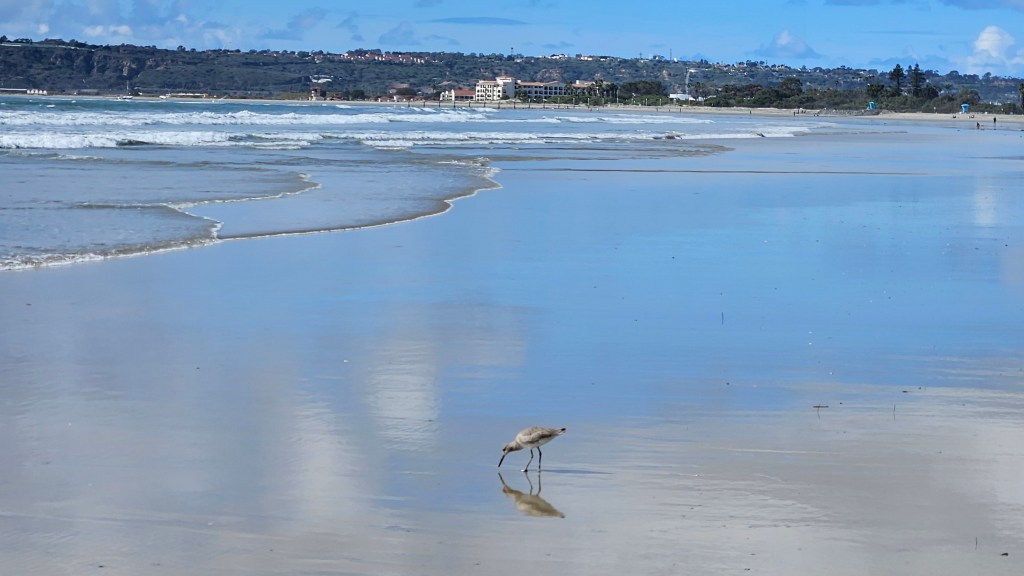
Point Loma is a place we frequently found ourselves in, near, or viewing from a distance. You can see the eastern side of it in the picture at the top of this post. Like Coronado, it is a long peninsula. Unlike Coronado, it hangs down from San Diego from the north instead of pointing up from the south. No one calls it an island: there is no part of it that is low enough to be at sea level for miles. It is high and rocky.
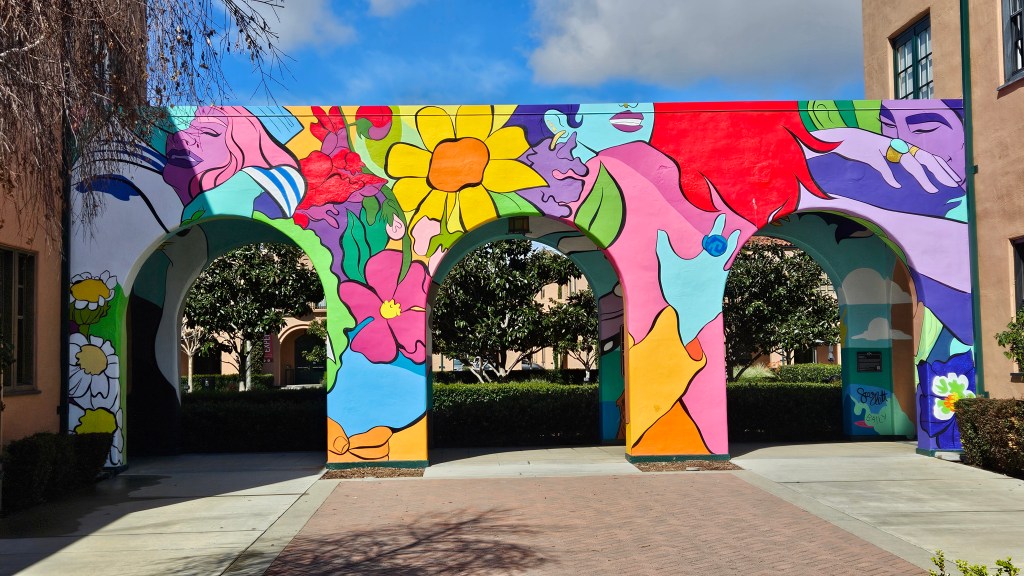
At the very top of Point Loma, where it merges with the city, is Liberty Station. This place was formerly a Navy trainee center. It has closed and the buildings have all been recycled and repurposed. This has been done in a way that respects its history but provides a multitude of various uses. The former barracks have artist studios and venues. There are both exclusive and casual restaurants as well as a food hall, and mixed with these is a high school, church, a Trader Joe’s and other commercial stores, an improv theatre, open air space for festivals, and I’m sure a whole lot more that I’m not mentioning. It’s all in a beautiful setting. The painting decorating this breezeway stood out among the more austere buildings.
We met my nephew’s wife, Emily, here for lunch while he was on deployment with the Navy. We could each have our own idea of a good lunch in the food hall, and all of it was delicious. The food hall looks a bit like it could formerly have been a mess hall. She and I lost ourselves at Sea Hive Station, a large vintage and maker’s store. We decided that the building had maybe been a gym in its earlier life.
I’m sending my readers a postcard from Liberty Station:

Farther down the coast, we had a view of Point Loma from the water on our harbor tour, and enjoyed seeing many sea lions alongside the coast.

In our truck, we drove down to the tip of Point Loma to visit Cabrillo National Monument.
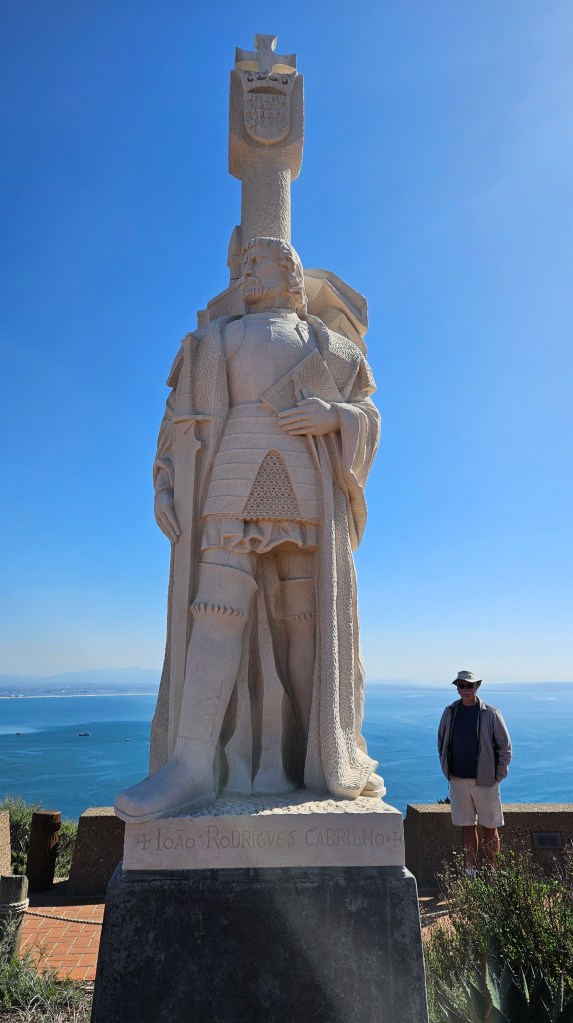
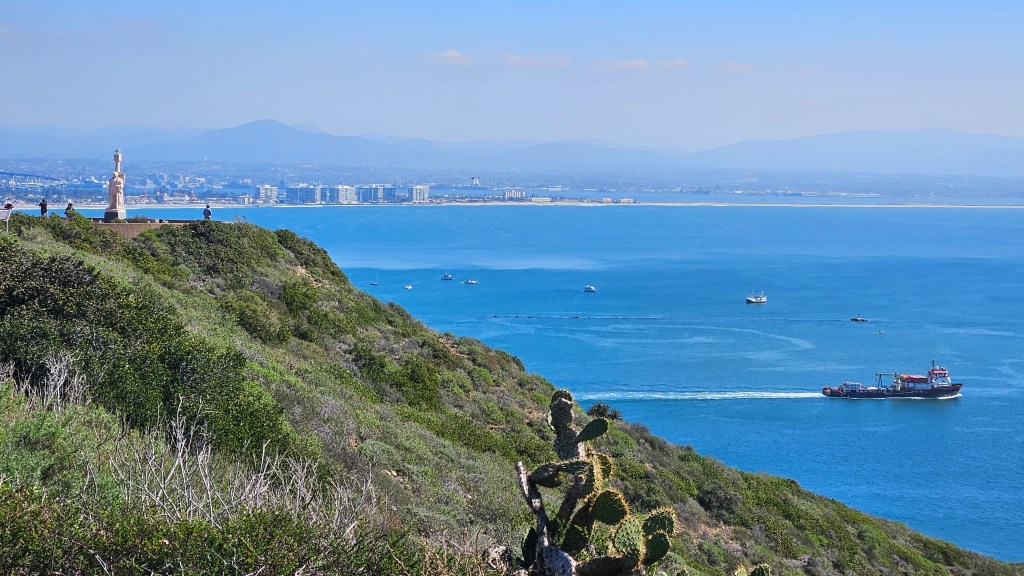
This statue commemorates Juan Rodriguez Cabrillo, who was the first European to set foot in present-day California. He explored the coast in 1542 from what is now Mexico, on behalf of the Spanish Empire.
Besides the visitor’s center, there is also the Old Point Loma Lighthouse to visit.
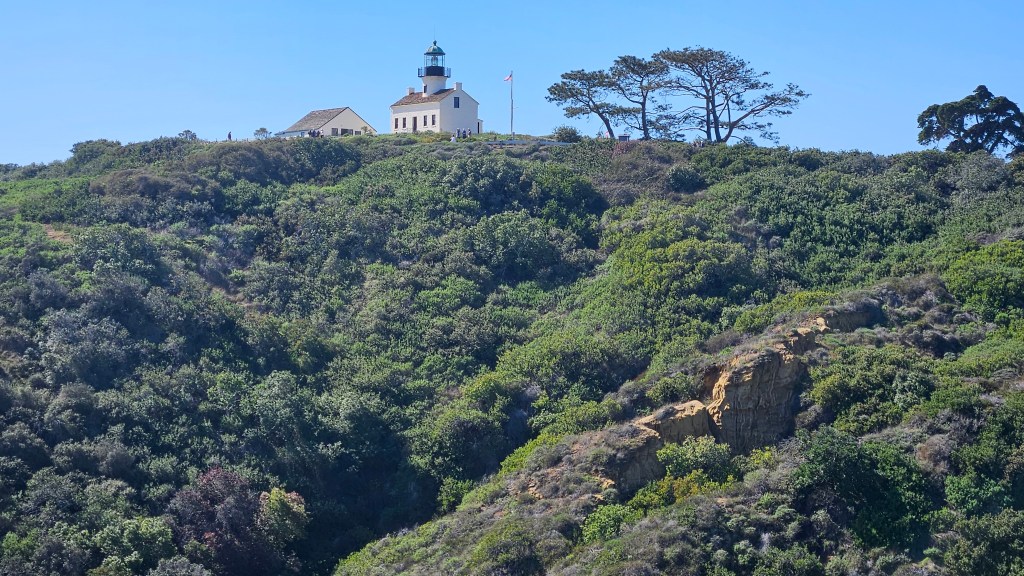

This lighthouse served from from 1855 to 1891, when a new lighthouse was built. We were not able to climb the tower.
From both the lighthouse and the statue, sweeping views were to be seen. We could look back at Coronado Island and San Diego harbor.
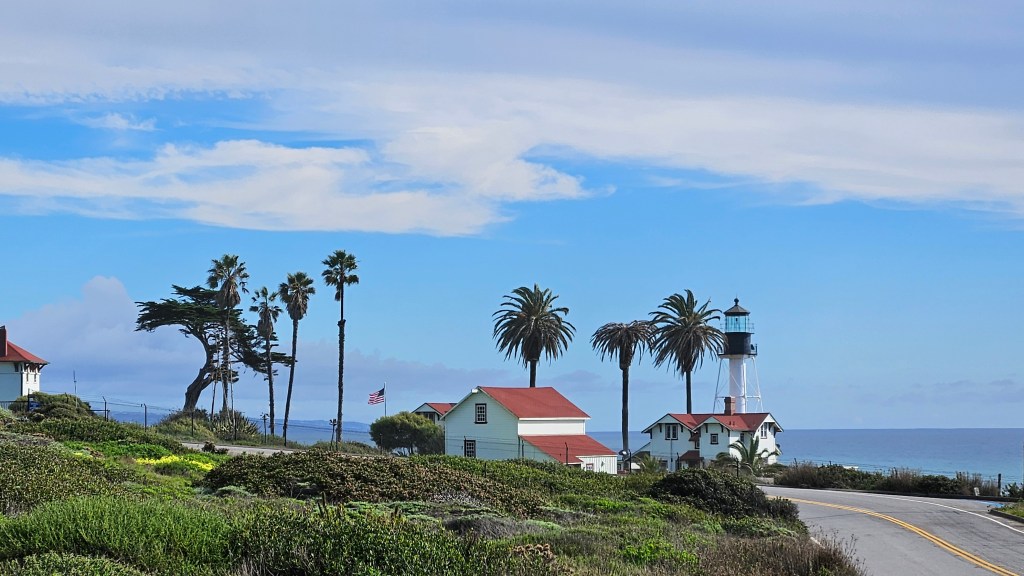
From this area, we drove down closer to the water, and could look at the new lighthouse. It’s still in operation, so it belongs to the Coast Guard and can’t be visited.
There are tide pools here which I wanted to see. To investigate them, one needs to visit the ocean at low tide. The first time we were here, we hit it squarely at high tide. We went down again after our visit to Liberty Station, right at low tide, and the area was closed for a sewage leak! Oh no!! Instead, we took the coastal path and enjoyed a walk along the mighty cliffs.

The National Park Service calls the dramatic cliff rocks here a “seven-layer sediment cake”. There are of course more than seven layers, which were formed millions of years ago when they were 3,500 feet under the sea.
Moving on from Point Loma, we go now up to the city of San Diego. On two different days, we visited Old Town San Diego and Balboa Park. We followed advice given to us and used public transportation. For Old Town, we took an Uber to the ferry at Coronado, and rode it over to the harbor area. We had the ferry mostly to ourselves on an early weekday morning.

When we got off the ferry, a short walk took us to light rail which, in San Diego, is called “The Trolley”. It took us right to Old Town San Diego State Historic Park.
Old Town dates back to San Diego’s earliest days. It is the first European settlement in what is now California. Some of the buildings here are museums, and this part of it is the state park. Some of the buildings have been turned into shops or Mexican open-air craft markets. There are countless restaurants, and all of them that I saw are Mexican. Whatever your idea of a fun day is, you can have it here. Many of the old buildings line a pleasant park in the middle. And admission is free, including the museums.

One of our first stops was to the La Casa de Machado y Stewart Museum, where the table was set for dinner. There were lots of beans, which looked pretty good to me.

We also visited the first newspaper and printing office.

The other building to the left of the printing office is a rock and gem shop, which, I might mention, is also a great place to wander though.
Here is the inside of the printing office:
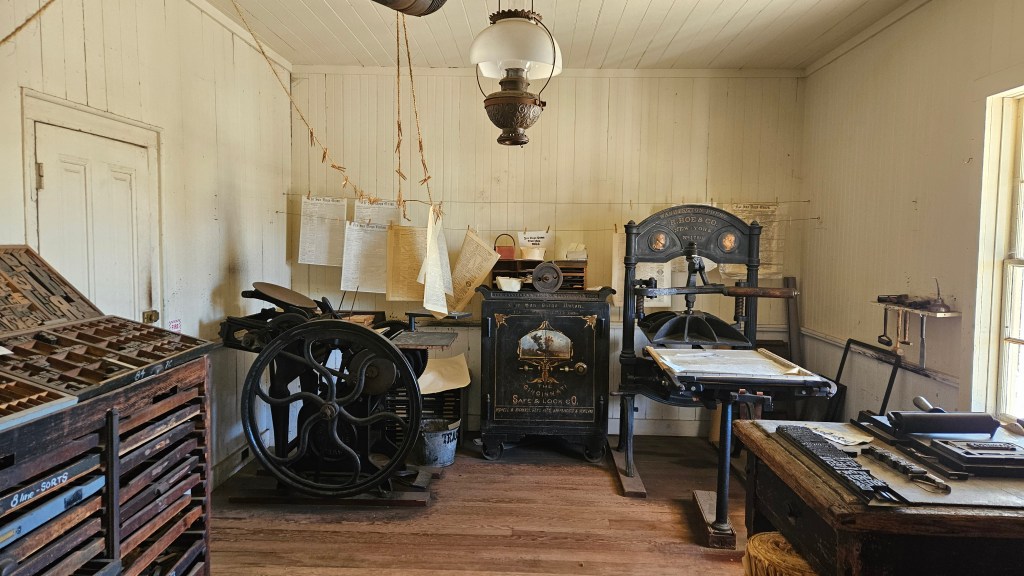
The building housing the printing office was actually constructed in Maine, and shipped around the Horn in 1851. The first edition of the San Diego Union newspaper came out in 1868.
We also saw the earliest courthouses, an 1860’s restaurant, and other historic structures. We made the mistake of visiting on a Monday, and many of the museum buildings are closed on that day. There was still plenty to see, though, and the shops were mostly open.
After our excellent Mexican lunch (which did include beans), and having visited the buildings that we could, we wandered over to the Whaley House. It is considered to be the most haunted house in America because of family deaths in the house. Not only that, before its construction it had been the site of public town executions…right under the arch in the parlor.
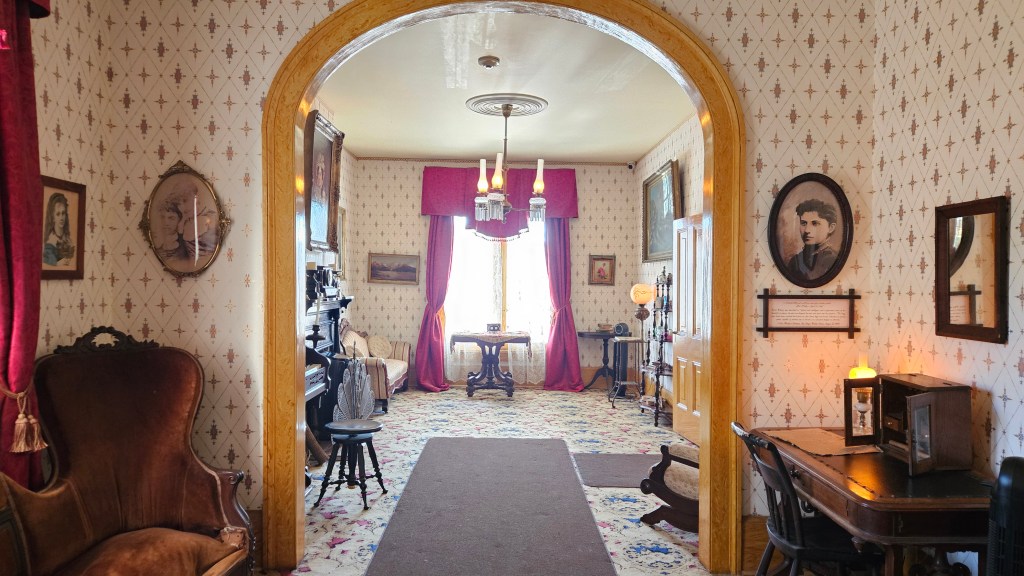
Hauntings aside, it was a fascinating look at early San Diego and the Whaley family. Thomas Whaley was an extremely enterprising man and built the house big enough so that he could rent out parts of it at various times for a courtroom, a general store, and a theatre.
We visited Balboa Park just a few days later. We were getting better with public transportation at this point and caught a bus not far from our park. It took us over the Coronado Bridge and into downtown San Diego. We only had to transfer to another bus and ride two stops to get there.
Balboa became a park way back in the 1800’s, but then it hosted two world’s fairs – in 1915 and in 1935. Its layout and many of its buildings are the direct result of those fairs. There are eighteen museums to suit anyone’s interest – from Comic-Con to art, cars, railroads, air and space, and the Museum of Us, to name just a few. There are many various gardens, attractions, plus the usual things that you’d expect in a park: a golf course, a pool, baseball and soccer fields and the like. The world-renowned San Diego Zoo is here. The whole thing covers 1,200 acres, bigger than New York’s Central Park and Chicago’s Millennium Park combined.
We thought for this visit we would mainly wander and explore. Right away, I liked the feel of being in Europe as we entered the park.

Plaza de Panama was built for the 1915 Panama California fair, which celebrated the completion of the Panama Canal.

At lunch-time, I tried my first-ever Vietnamese banh mi sandwich at one of the park’s cafes near this plaza, and it was delicious.
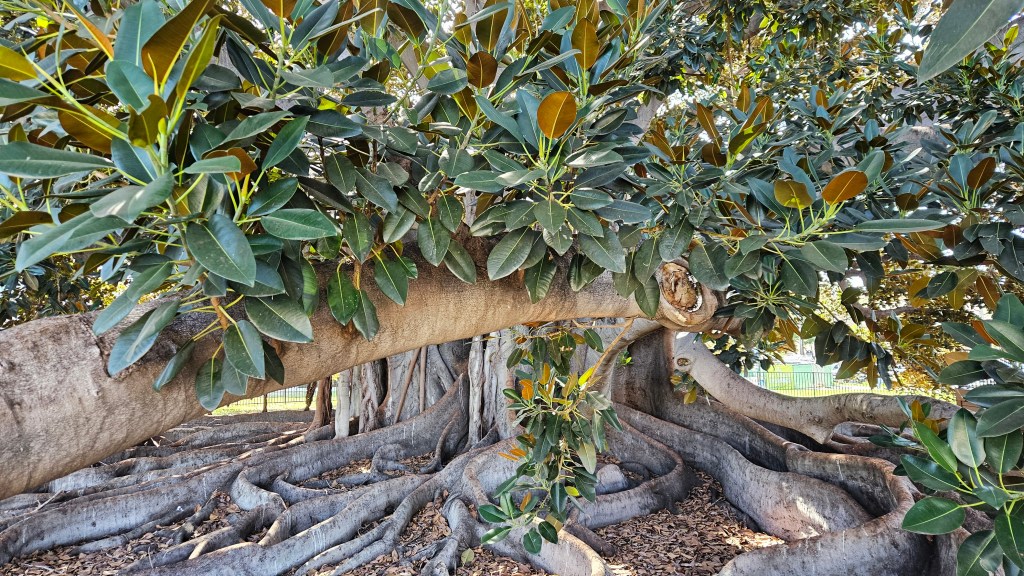
Continuing on, this fig tree was planted for the same World’s Fair, and we wandered around under its canopy.

It’s a Moreton Bay strangler fig with a trunk that is 16 feet around. Although it still stands, its surroundings have completely changed in the over one hundred years since its planting.
We walked through a desert garden, and the Japanese garden which we had to pay to get into. Most gardens are free, but that one was not.

The Japanese garden had an impressive display of bonsai trees. This one is a 45-year-old “juniper forest”.

Like the gardens, some museums are free and some not. We went into two of the free museums, one being the San Diego History Center. They had a collage of the murals in that are in Chicano Park, exciting to see since we had ridden through it on the bus.

We spent the better part of a day in Balboa Park and only scratched the surface. I wanted to come back to concentrate on a museum or two or perhaps visit some sections that we missed. That was not to be, but just maybe we will be back another time.
San Diego provided us with a wealth of things to do, and after being here I still feel like I’ve only just begun to explore.

Next time – family fun during our San Diego stay

 Twosna Travels
This is a wonderful post and makes me really want to visit San Diego. I have never been there! My brother was in the navy and did his “boot camp” in San Diego. This was in 1972, I believe. He may have been at Liberty Station! (He passed away in 2003.) I know my mom saved all his letters, but I don’t know whatever happened to them. Perhaps another brother (I have 3 more) will know if he was at Liberty Station. This city looks like there is a ton of things to do and places to explore. I have to admire you and Cal for the way you use public transportation to get around. I think Dan and I have to up our game. 🙂 I recognized the strangler fig tree as we have these here in Big Cypress. We really hadn’t had any of California on our “places to visit.” We have so many places we want to see, and the price of gas is high there. However, your post has me reconsidering. I look forward to your next post!
LikeLiked by 1 person
If your brother did his boot camp in San Diego, chances are it was at Liberty Station. Cal and I got pretty good at using the public transportation button on Google Maps when we were in Europe. Sometimes it works well, sometimes not, and sometimes we have to put both of our brains together to figure things out! It certainly is preferable to driving our big truck around all the time. I will tell you-RV spaces in the San Diego area are expensive. We paid $70 nightly at the military family camp, which is over double what they normally are. That’s the most we’ve ever paid for any type of stay. And restaurants and groceries are expensive. But it was one of our best stays anywhere, and I would rearrange my budget and come back if it happens to work out! Thanks for reading the blog and my lengthy reply!
LikeLike
I really enjoyed reading this post and seeing your pictures. We have been to those places, as well, and definitely a favorite of ours. Thanks for sharing and the great reminders of a fabulous place to visit.
LikeLiked by 1 person