As I searched for adjectives to describe Munich, I thought of the impressive neo-Gothic architecture of the Marienplatz and the playfulness of its Glockenspiel, but other edifices such as the majestic Residenz are imposing and inspiring. I thought of delicious beer and bratwurst in the Hofbrauhaus and other breweries, and the plentiful treats in the Viktualian Market, but there are plenty of other good things to eat. Museums of all varieties abound. I’ve had so much fun when I’ve visited the Oktoberfest in other years. The city is both traditional and cosmopolitan. I had to settle for marvelous. I’ve been here many times, and it’s one of my favorite European cities, so can there be any other word?
Having a Europe rail pass meant that we could zip on into the city whenever we wanted on the commuter S Bahn. It was generally a thirty to forty-minute ride. Over the course of our stay in Feldafing, we came in three times, once just for dinner. We would get off at Marienplatz and then we were in the center of everything. This blog will be a composite of all three visits. Let me show you just a little of the city that I love!
We were all business on our first rainy trip in, but there was one important thing to do first: head over to the Viktualienmarkt (Victuals Market) for a currywurst. It’s a favorite of Cal’s, and I like it too. Basically, it’s bratwurst cooked in a mixture of ketchup and curry powder. It may sound dreadful, but it grows on you, trust me.

Mine had a smidge too much mustard, but I wasn’t complaining. (Well, I did, just a little.) Otherwise, it was perfect: a roll crispy crusty on the outside, soft inside, with the wurst hanging out the sides. In Germany, an orange Fanta tastes great. I wouldn’t drink it anywhere else.
The Viktualienmarkt is a feast for the senses. I always want to buy everything, but I don’t want to carry food around with me all day. The market began long ago in the Marienplatz. After growing too large it was moved in 1807 to this place.

Most interesting to me are the unusual items that are sold. Below is a booth dedicated to selling mushrooms. I don’t know if I’ve ever seen so many kinds.

Every town in Bavaria has a Maypole. It is a focal piece which usually shows its main business and culture. Munich’s Maypole towers over the Viktualienmarkt, and I have here just the bottom portion of it to show you.
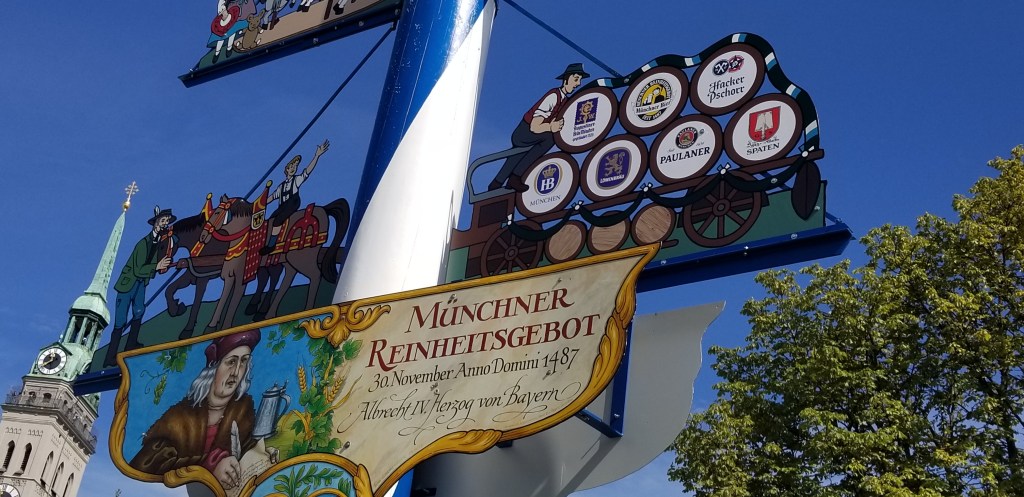
What is Munich about? Beer! The right side of the maypole shows the seven major breweries. The “Reinheitsgebot” below it is the Bavarian purity law for beer originated by Duke Albrecht in 1487. Brewers could only use water, malt, and hops for their beer, and that law governs the breweries still today.
Our “business” I mentioned earlier that brought us into Munich the first time involved a birthday gift that we needed to find and purchase for our grandson, and the mailing of a box back to the US. That didn’t mean we couldn’t stop and look around in the Marienplatz, as we always do.

This is the heart of old town Munich, and several main streets lead from here. The old and the new town hall is here, and so is the the Christmas market in December. Sadly, the Marienplatz was heavily bombed during World War II. Behind the spot where I took this picture, all the buildings are modern.
Most of the northern side of the Marienplatz is taken up by the new town hall, which isn’t really new: it was built between 1867 and 1909 in neo-gothic style. This picture only shows part of it.

Walking through the arches you see above, past the Ratskeller sign, we found several curious figures on the sides of the walls in the courtyard, such as this one. We decided they serve as water gutters since all their mouths are open.

But it is the Glockenspiel on the town hall’s tower in the plaza that catches everyone’s eye. The day we were shopping for our grandson, we hiked a pretty fair distance to a toy store I had seen on-line. We had no luck in that store, so were walking back through Marienplatz to my favorite department store, the multi-level Kaufhof. That’s where we should have gone in the first place. Luck was with us – it was exactly 11:00, time for the Glockenspiel to play! Everyone stops to watch and the Marienplatz fills with people. We’re not always fortunate enough to catch it at the exact time we are here, since it only plays at certain times of the day.
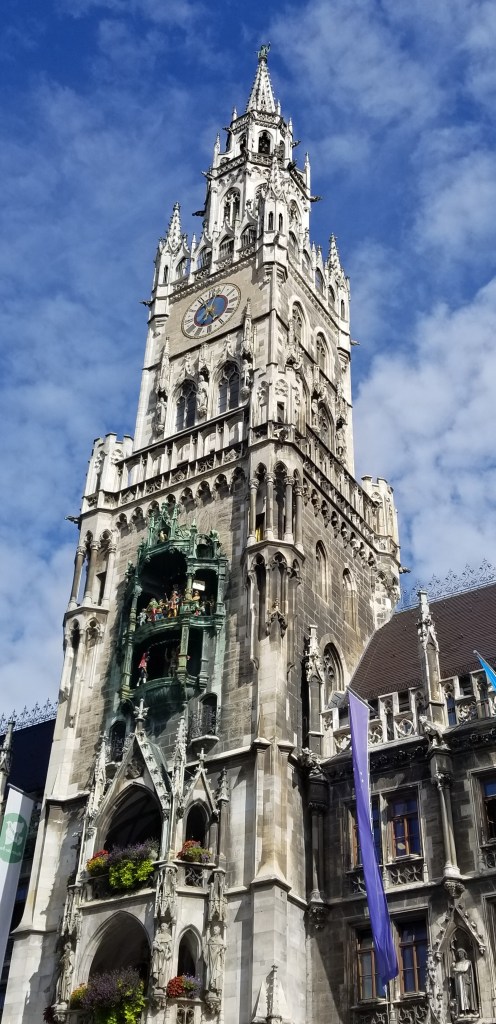

At left, you can see the whole tower with the Glockenspiel below the clock. There are 43 bells and 32 life-sized figures and it renacts two stories from the 16th century. On the top level in the left picture, there are dancers celebrating the marriage of Duke Wilhem V to Renata of Lorraine. Duke Wilhem founded the Hofbrauhaus – more on that later. On the right picture, knights are jousting in honor of the couple and of course the Bavarian knight always wins. Hooray! In the bottom level, then, is the cooper’s dance, which celebrates the end of the plague in 1517. At the end, a golden rooster at the top of the Glockenspiel chirps three times. The show lasts around 15 minutes, depending on the tunes that are played.
The Hofbrauhaus is a place we always return to when we are in Munich. It is the drinking and eating beer hall that Duke Wilhem founded for the Hofbrau brewery, but at that time it was only open for the royalty. King Ludwig I opened it to the public in 1828, and the party has been going on ever since. It’s full of “gemutlichkeit”; which means a comfortable friendliness. There is always an oompah band playing and the place is busy, even late afternoon. The crowd ebbs and flows; the empty spots you see here were filled again shortly after this picture was taken, including our own table.

These are not the standard size, full liter mugs of beer that are usually standard for the Hofbrauhaus. For the first time in our lives, we ordered the smaller size. I hardly like the taste of beer any more, but Hofbrau beer is different, and it only tastes this good in Germany. Sitting and enjoying the “gemutlichkeit” felt good after doing all that shopping and searching for a place to wrap and mail a package.
We returned to Munich just for dinner one evening, and enjoyed a stroll afterwards. We turned down a street we hadn’t explored yet, and discovered: the Residenz. I’m not sure why we never visited this place. Maybe I confused it with the Nymphenburg Palace, on the west side of the city, which we have been to before. It was too late in the evening for a tour so we just walked about.
The Residenz is the largest city palace in Germany, the home of Bavarian royalty until the monarchy was dissolved, and I don’t know how we ever missed it. See, Munich is just that way…there is so much to explore and maybe I never will see all of it.
In the sunset hours, we walked through portions of the garden–
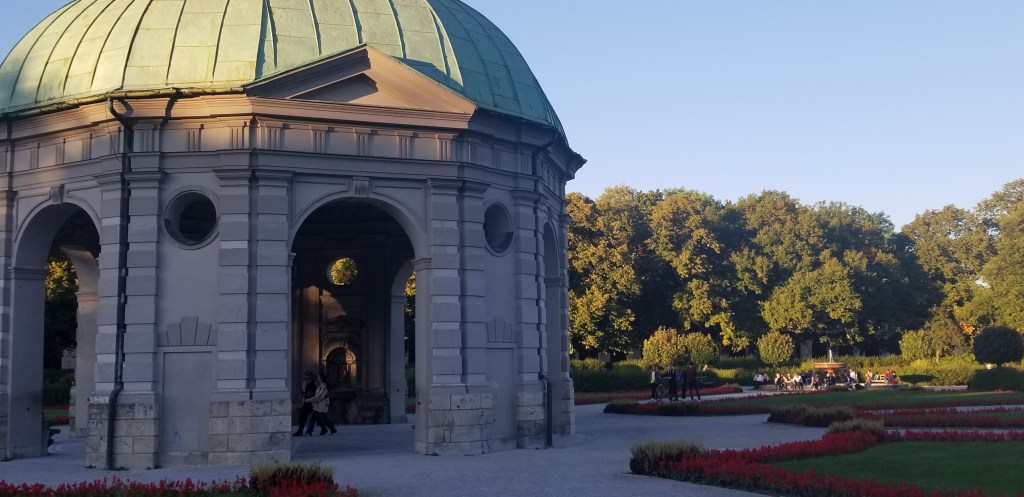
and out through the garden walls, which contained pictures of royal historical events.

Out on the plaza, a huge monument:
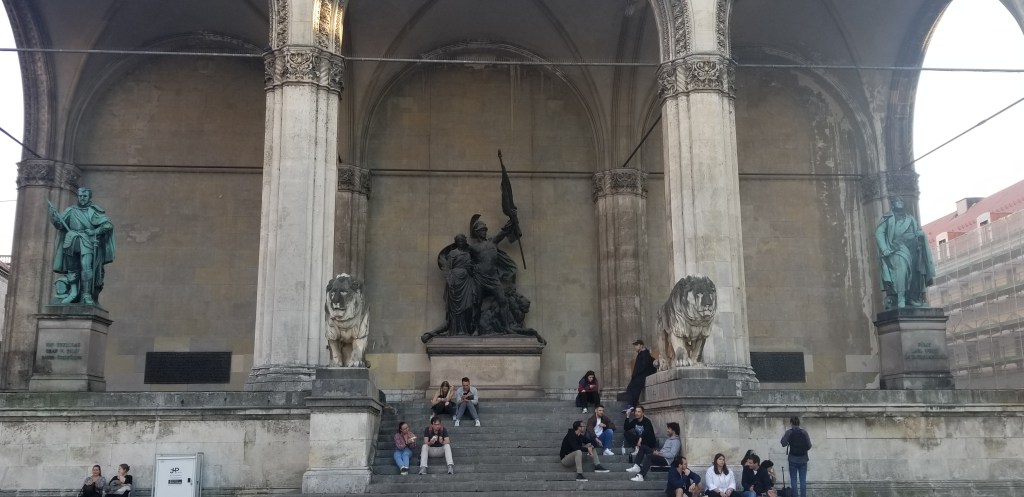
This is the immense Feldernhalle, commissioned by King Ludwig I in 1941 to honor the Bavarian Army.
At a right angle to the Feldernhalle stands the Theatine Church of St. Cajetan. I had to look up the definition of “Theatine”. This branch of the Catholic church was founded in 1524 “to combat Protestantism and promote higher morality among Roman Catholics”, according to Collins.

The church was built in the late 1600’s to honor the new heir to the Bavarian throne, Prince Max Emanuel.
Inside, a riot of cherubs and curling vines and curlicues awaited us. It was stunning, and a massive contrast to the stark Frauenkirche that we had visited earlier.

The entire interior of the church was designed in this fashion.
As we headed back to the Marienplatz that evening, still awed by that amazing church, I thought about this: that one should never assume that one has seen everything in a certain place. If you are traveling, always look for the surprises that await around any corner. They are there, and that is especially true in Munich.

Next time – discovering Feldafing

 Twosna Travels
What an amazing city! From the market to the Maypole to the Glockenspiel to the Residenz. The old and ornate architecture. The gutter guards. The beautiful golden facade. I didn’t know anything about Munich! Now, even though I don’t like beer, given the chance, I would definitely visit Munich. Thanks for taking me there!
LikeLiked by 1 person
You’re welcome! It certainly has a flavor all it’s own.
LikeLiked by 1 person