For the next few weeks I will take you back in time and over the ocean to our trip to Europe last summer. I last left off with our outstanding visit to Bath. It was while we were in Bath that we took a excellent day trip to Stonehenge and the Cotswold region of England.
Rick Steve’s guidebook had led us to beautiful Bath. Another reason for coming here was that in the book he mentioned Mad Max’s day tour to Stonehenge. Since we were totally traveling by rail on this trip, I had not thought that we would be able to see it. This tour was icing on the cake for visiting Bath. Once again, we were in a little minibus, tooling around the Cotswold area for the day. Stonehenge is on the Salisbury Plain in Wiltshire.
And now I’ll let you in on a little secret. If you take this tour, you will be among the first to arrive at Stonehenge for the day. Tours from London – in those huge, hulking tour buses – arrived after us, because it takes longer to get there from London.
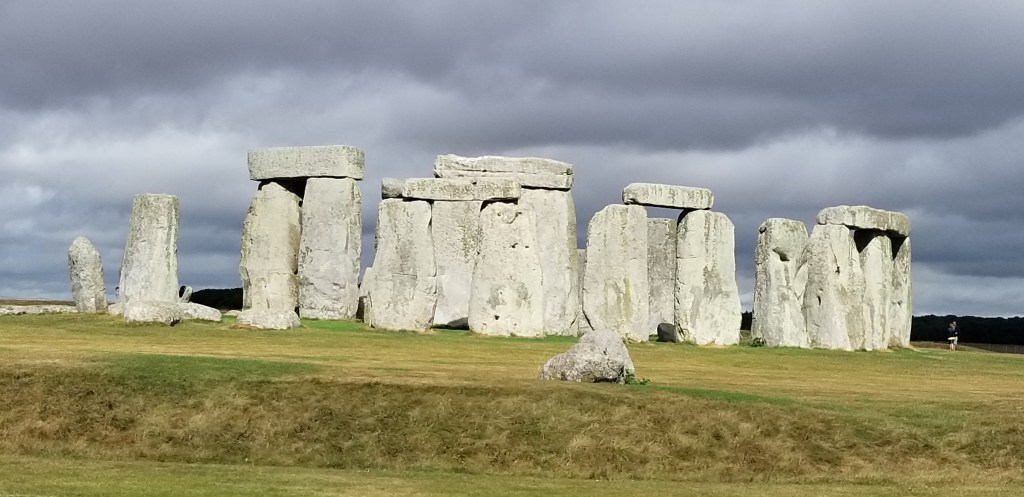
What a feeling to walk around it in person. The sun played peekaboo through the clouds and at times illuminated the rocks. The place was largely silent through most of our visit.
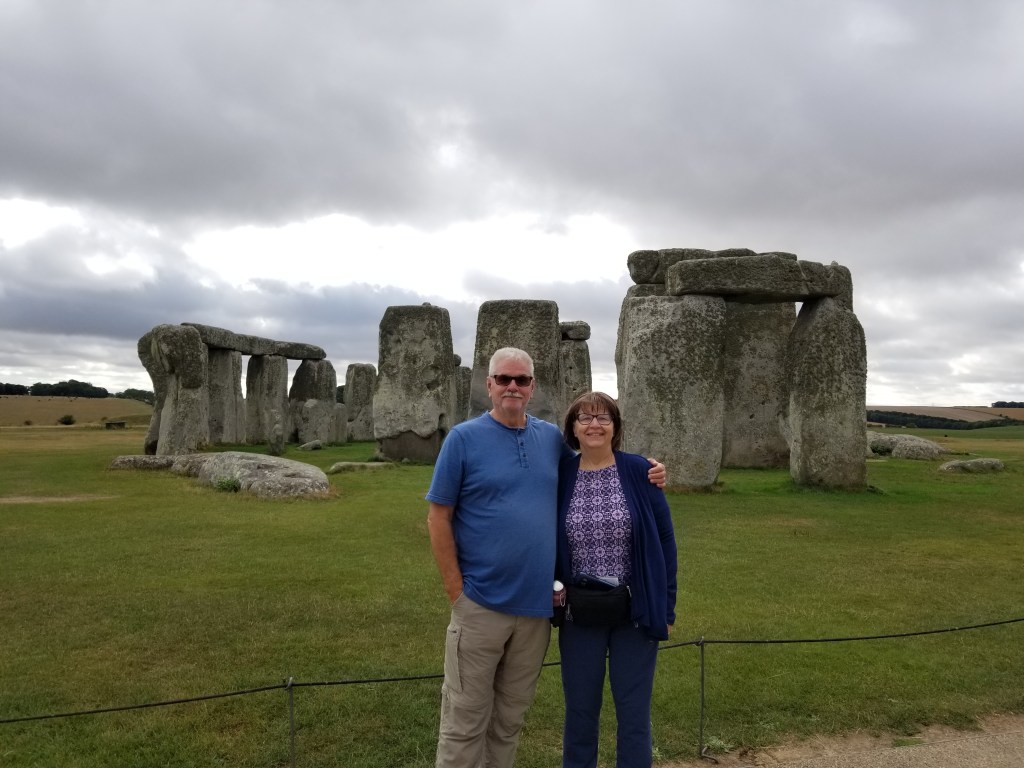
At its core, Stonehenge is a prehistoric temple in which the stones are aligned with the movements of the sun. The flat stones laying down at the top went all the way around in a circle. We still don’t know if it was a burial site or a place of healing, a celestial calendar, or all of the above. It took a thousand years to build. The beginning of its construction predates the Great Pyramids and the Roman Empire.
The outer circle of standing stones, called sarsens, enclosed five huge horse-shoe shaped stone arches. There are two inside circles, made of bluestones, and four station stones outside the central monument. The whole thing is surrounded by a circular ditch. The builders brought some of these rocks from great distances. The blue stones come from Wales, 140 miles away. In those days, there was no loading them up on a truck using a crane.
This diorama in the museum did a good job of showing what it looked like.
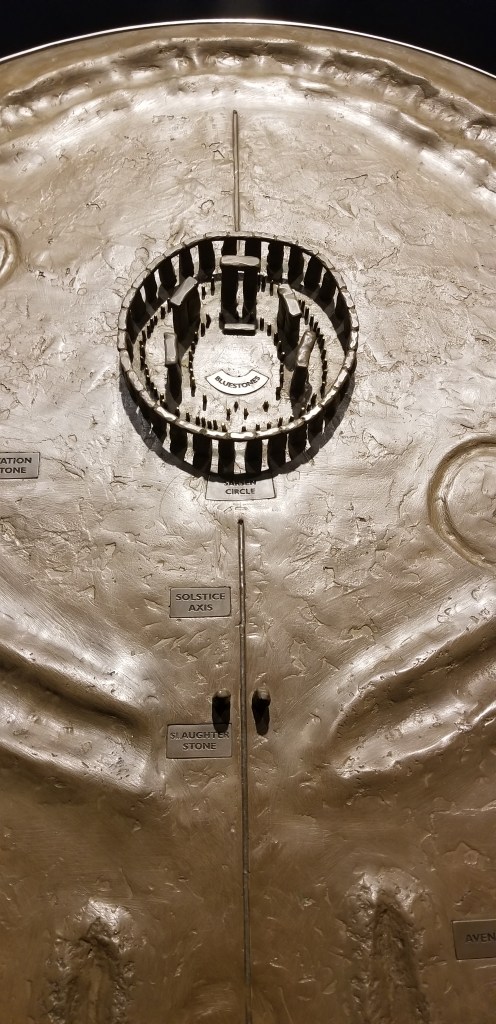
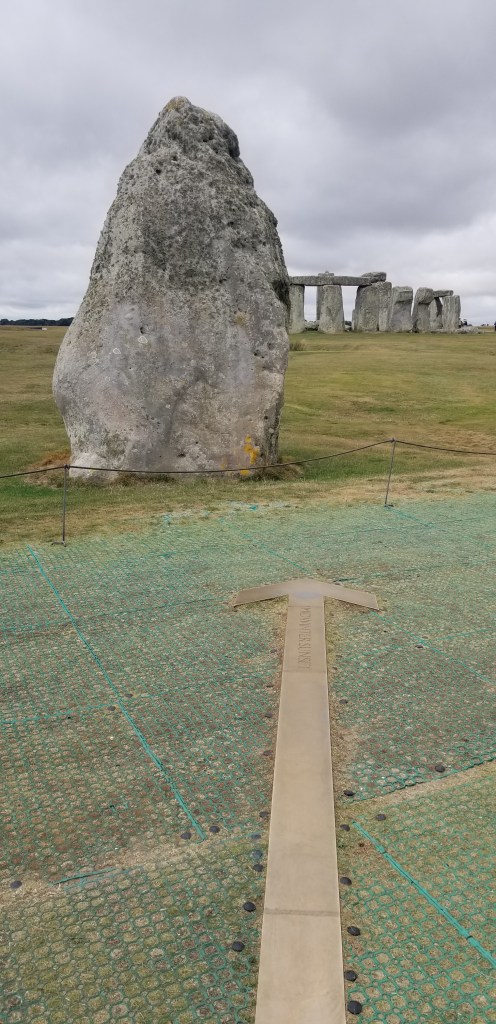
Back at the stones, we stood at the entranceway which is the thin line at the bottom of the diorama. It was a processional avenue built around 2300 BC. The stone in front is called a Heel Stone, and blocked by this view is one of the slaughter stones. Archeologists have found intense prehistoric activity here, because originally they lined the avenue with wooden stakes. The stakes were later replaced by stones, most of which are gone now.
I follow BBC news, and by coincidence Stonehenge has been in their news this week. Scientists now believe the stones may have also been a huge echo chamber. Voices inside the stones were amplified, while those outside the stones would not have been able to hear what was said. This just lends more fascination to the mystery.
We had plenty of time on our own to wander, visit the museum, and see their display of a Neolithic village.
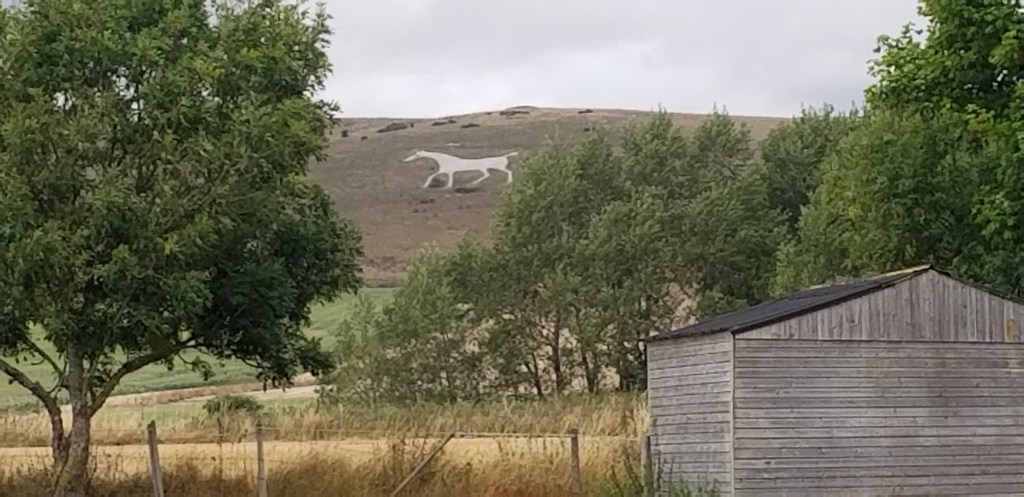
Back down the road, we made a brief stop to get a view of a chalk horse in Wiltshire that dates back to 1812. The chalk lies just under a layer of sod. Later on we drove by another that was cleared even earlier, in 1780.
We stopped at this little pasture, and friendly Gypsy Cobb horses came loping right up to see us. This was because our tour guide had a bag of carrots! With permission from the owner, he makes this stop every day and the horses know for sure that the tourists are going to feed them.
The Cotswolds are a rural and quaint area of England with towns and homes built from a limestone which is golden colored. Many picturesque thatched roof buildings can be found here. Our first stop in the Cotswolds was Avebury, where the thatched roofs take second place to the standing stones over an area that dates farther back than Stonehenge.
A “henge” is a large ditch or trench with a bank. At Avebury, the circular ditch is almost a mile around, and it was cleared with deer antlers and cow bones 6,000 years ago. The ancients would have cleared this down to the bedrock.

Inside the circle formed by the henge, stones were set in a straight line for quite a distance, perhaps as a processional route, leading up to stone circles. These were spread out and, unlike Stonehenge, uncut. Of course, through millenia many stones are gone. The town of Avebury grew inside the henge circle, along with farms.
Here you can see some of the stones with the bank of the henge behind them. This is a sheep pasture and we had to watch where we were stepping!

The huge stone below is called “The Devil’s Stone”. If you run around it 100 times, so the story goes, you will meet the devil. Well, we did not do that, but this handy rock also has a fertility seat. I sat in it and I can happily report that since then no babies have arrived.

Many people were out enjoying the stones and the day in Avebury. You can see the Devil’s Stone again at left below.

I was also happy to be out of the minibus to view the thatched roofs. Here an old cottage built of Cotswold stone, now a barn, sits among the stones.

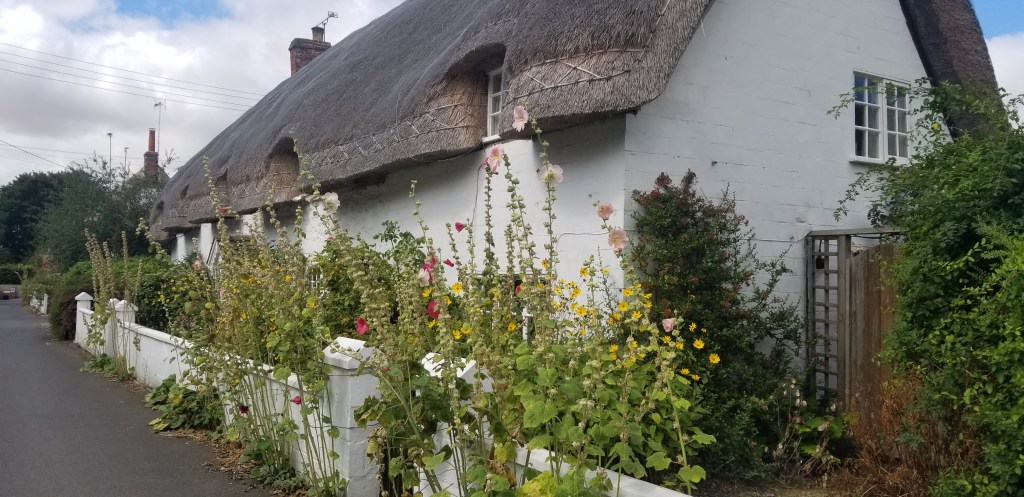
In town, I took this picture of a thatched home with a pretty garden.
After Avebury, our guide showed us many other thatched buildings. Here is the only church in England with a thatched roof:

It takes a lot of training and expertise to be able to repair a thatched roof. The buildings need to be re-thatched after several years, and a specialized craftsperson is hired for the job. It is custom for the thatcher to leave their trademark at the top of the roof when done. Here, on this house, you can see a little squirrel left as this crafter’s trademark.

We spent time in two villages, the first of which was Lacock. It was already mid afternoon so we made a lunch stop. Cal and I have figured out the score on these lunch stops. We were given plenty of time on our own, but we’ve learned from other tours that we didn’t want to use up this time waiting for food in a restaurant. We had put a picnic lunch together before we left Bath. As it happened, there was a little picnic area near our drop-off spot with a grove of trees and a low stone wall. Soon enough we were on our way to explore Lacock after our break.
For the past few centuries, the entire town of Lacock was owned by one family, the Talbots. Lacock Abbey, a former nunnery, was converted to be their manor home. There wasn’t time for a guided tour but our guide showed us a path we could take to explore the grounds. As we walked around we could see a security guard on the back terrace keeping an eye on us.

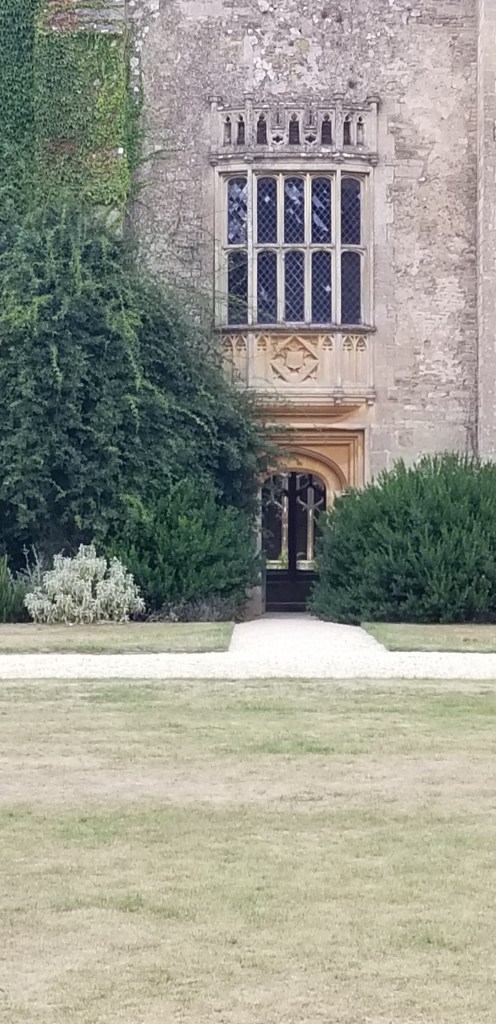
Lacock Abbey has a claim to fame: in 1835, William Henry Fox Talbot created the first photographic negative. The first picture ever taken was the small window that you see above the door.
In 1944 the last descendant of the Talbots sold the manor house and the town to the National Trust. The people who reside there are essentially living in a museum. They have all the trappings of modern day life inside their homes but none of it is shown on the outside save for the cars parked on some of the streets.

Laycock had an old workhouse reminiscent of Oliver Twist. That building is on the left of the picture below, next to a tannery where the folks in the workhouse were obliged to work.

The village dates to the early 14th century and there are seven centuries of buildings that can be seen in just a 10 minute walk around. There is nothing built after the 1920’s.

There were many beautiful gardens as well.
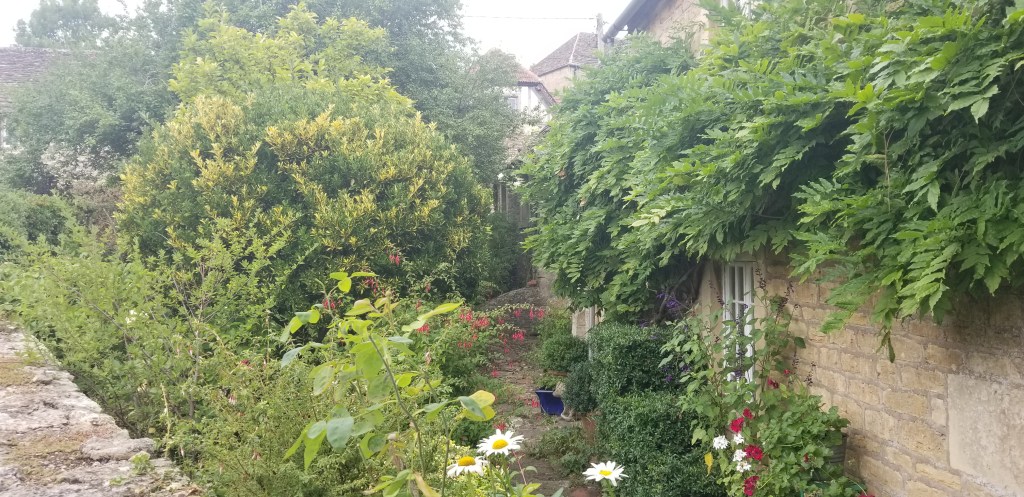
It was already getting on to late afternoon but we still had one more village to visit. Picturesque Castle Combe has had no new buildings in their historic area since 1600. The castle for which the town was named has long since been demolished. This was a large cloth making town in its day, but by the 1700’s the level of the river fell and could no longer support the mills. Spinners and weavers lived in the homes along the river.
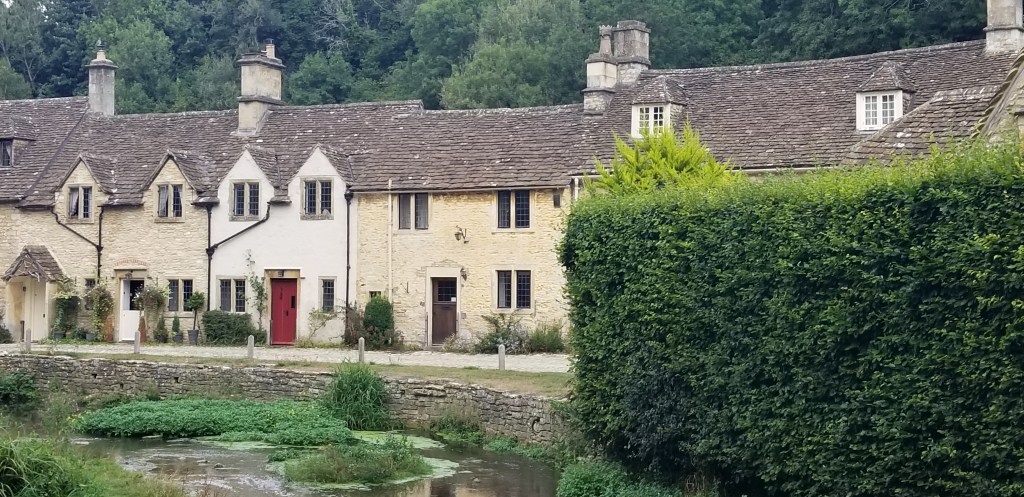
Again, we were turned loose to explore. We had but a short time to look at the market center of town–

and to take a peek into the village church. There is a knight buried here.
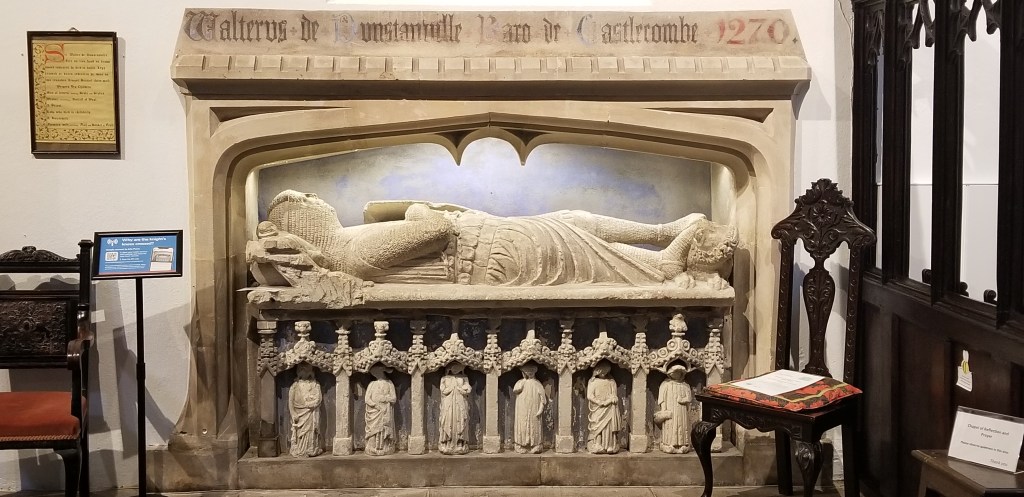
This is Sir Walter de Dunstanville. His hand on his drawn sword indicates that he died in battle. His legs are crossed, signifying that he went on two crusades.
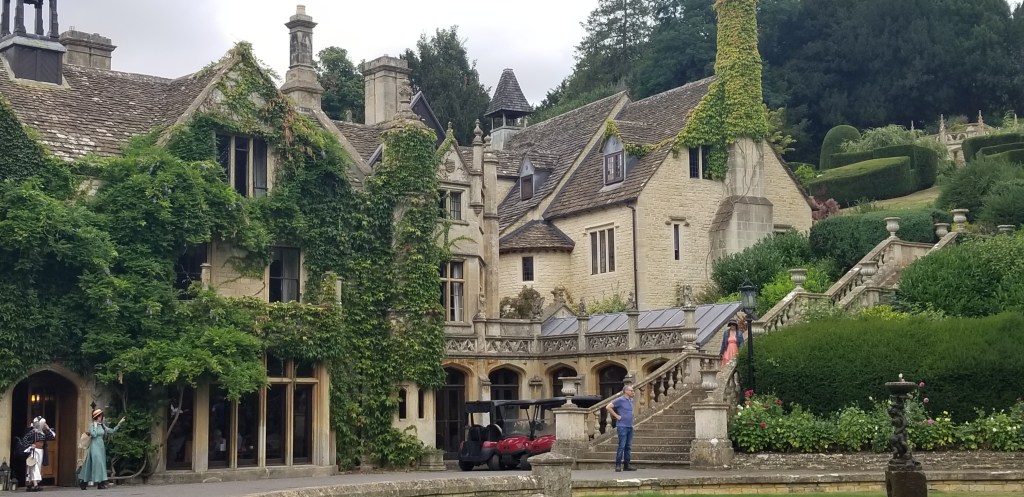
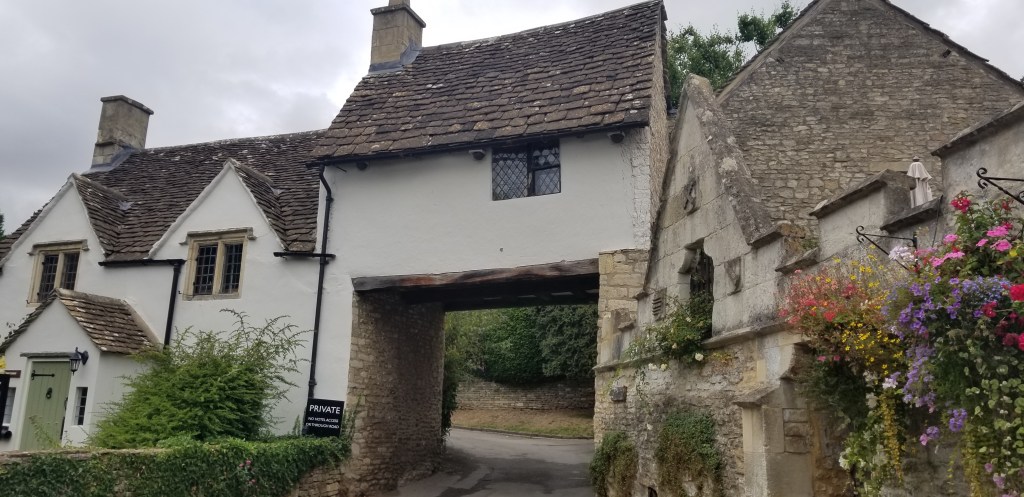
Castle Combe, like Laycock, had its manor house and for five centuries one family owed it and the town. Unlike Laycock, though, the town does not belong to the National Trust. The manor house has changed hands many times and is now a very upscale hotel. After I took this photo, I was amused to see various clashing eras in view. There is the house/hotel itself, some women in period costumes, a gentleman in jeans, and some golf carts. I would have loved to explore the grounds and the gardens more.
So many sights had been packed into one day! We capped off our return to Bath with 3 different and tasty mezes at a Greek restaurant on their patio. It was on a little pedestrian alley where we could people watch as we dined. I felt that this had been a very well-planned tour, and it went into memory as one of the highlights of our European trip.
Next time – London

 Twosna Travels
What a wonderful day and fascinating tour! Very well thought out! It is amazing that you saw all that – buildings from so long ago – all in one day. The thatched roofs look like they were laid on the house. I like the little squirrel “signature.” Thanks for the tour!
LikeLiked by 1 person
You’re welcome, and I’m glad you enjoyed it! It’s fun to relive these memories as I am writing about them.
LikeLiked by 1 person