Europe · Italy

The Venetian Islands of Murano and Burano – Europe Travels September 2022

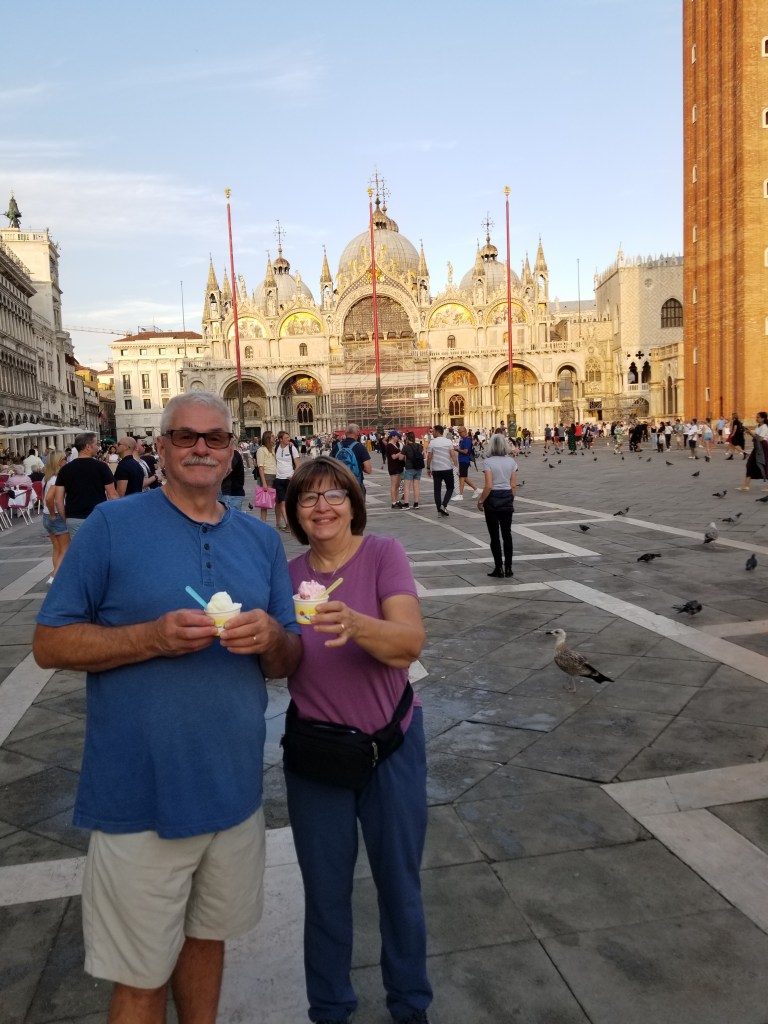
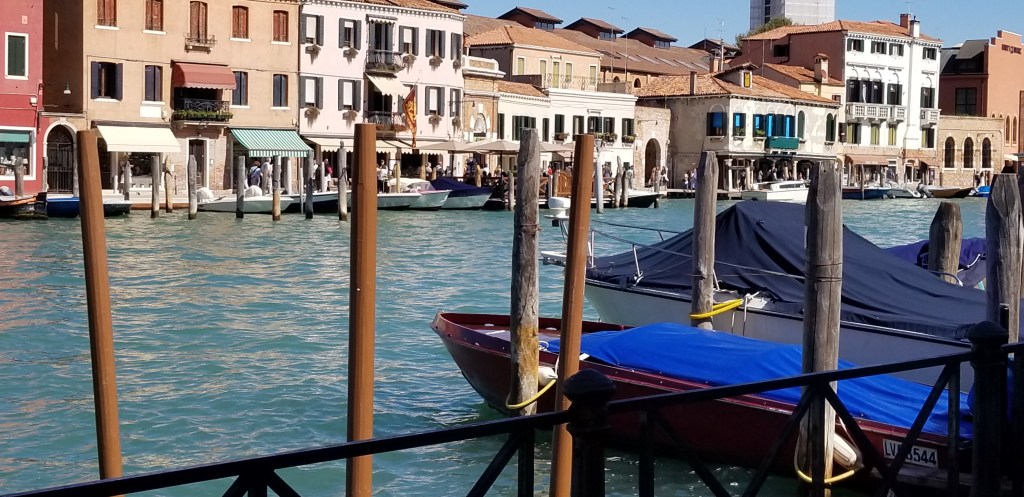
This picture may look like it was taken in Venice, but it is actually on the little island of Murano.

Many shops in Venice sell Murano glass, and it is interesting to look in the windows at them. All of the glassblowers that make this famous glass are located on this island, and early on the Sunday of our visit we went to visit them.

We walked to the Fondamenta Nova vaporetto station to catch the Number 12 Vaporetto (city water bus) line to Murano. It was only a short ten minute ride. We were a little early for the glass blowers to be open, so we had a small refreshment in a sidewalk cafe.

Visiting the glassblowers of Murano is more a window shopping trip than it is a look at the craftspeople in their workshops. I did peek into a few, but on a Sunday they are not working. For sure, the shops are open, and there is plenty of beautiful glass to see and little shops to peek into.
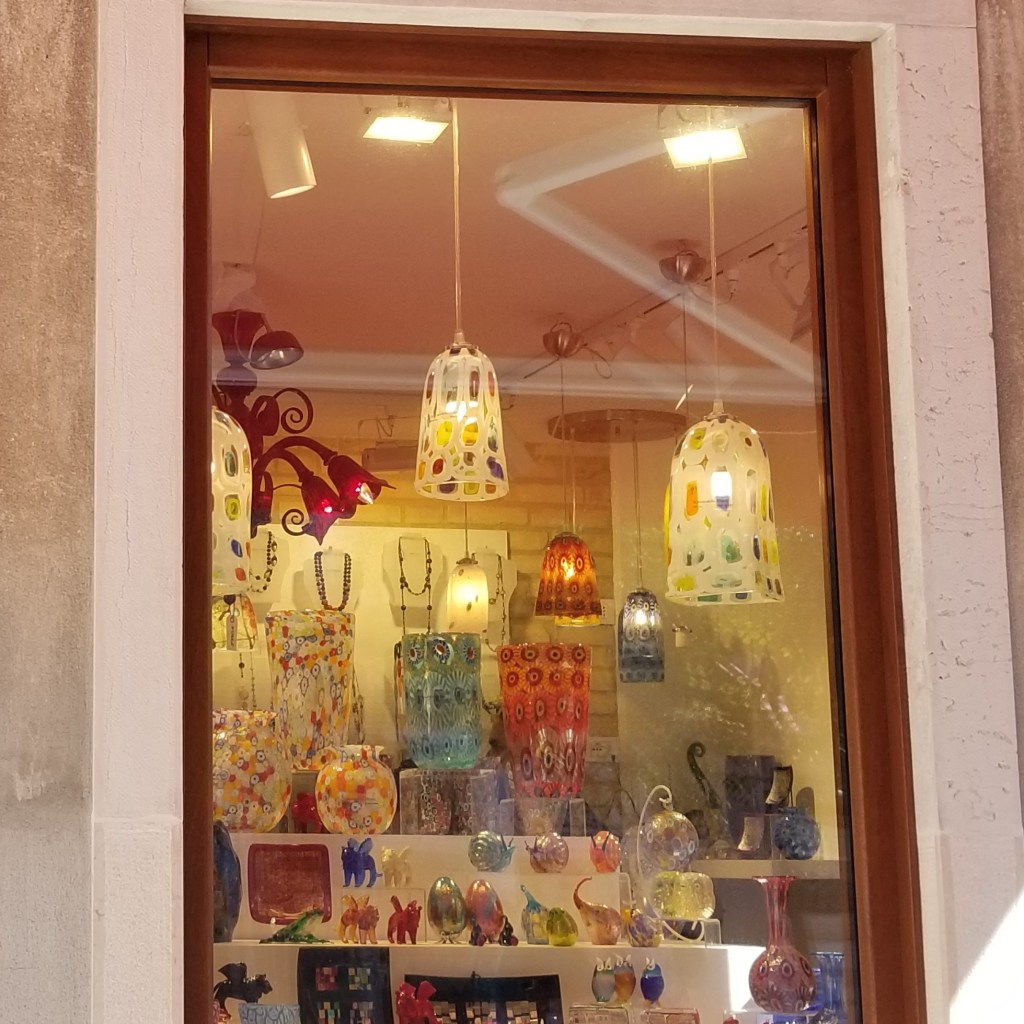
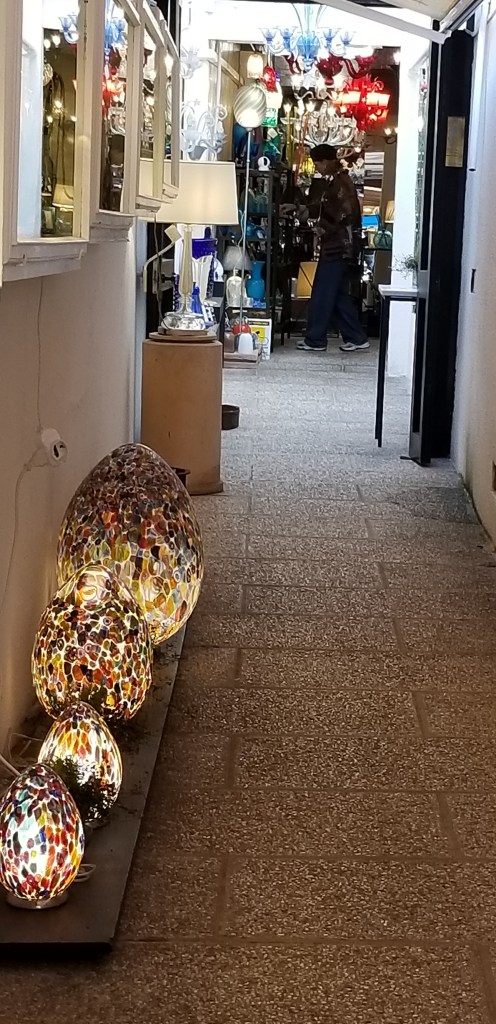
Some shops specialize only in jewelry. This one has a beautiful facade.
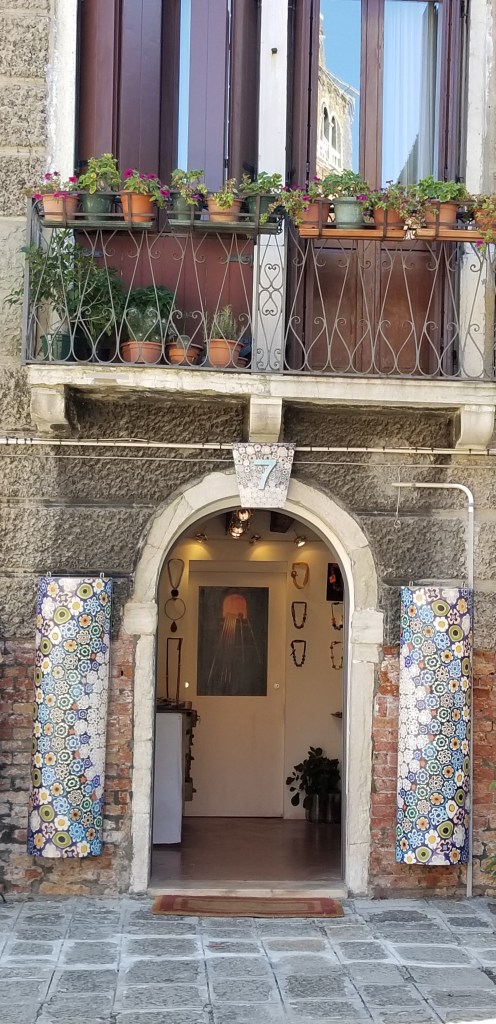
Of course, I couldn’t buy hardly any of this. It would be in shards traveling around Europe in my suitcase. I did purchase a couple of necklaces with glass pendants for gifts, though.

The reason that all the glass makers in Venice are here on this island goes back to the 13th century. The story goes that they were moved to the island to avoid the risk of fire to wooden structures in the already over-populated city. In reality, the motive was to isolate the craftsmen so that they wouldn’t disclose trade secrets. Venetian glass was already of the finest quality.

We had gotten off the boat in a quieter part of the island where many of the glassmakers are. By the time we worked our way to the main area, things were already hopping. Murano has canals just like Venice does because it is actually seven small islands connected with bridges and a Grand Canal.

We made our way back to the vaporetto stop for a ride to Burano, only to discover we were at the end of a very long line waiting in the hot sun for the next one. Would we even be able to get on it when it arrived? As we were pondering this question, we noticed a gentleman working the line. He and his partner offered a ride for 10 Euros per person to ride in his speedboat to the island.

Circumstances sometimes call for quick thinking and a large helping of trust in our fellow man. The price was right. We took the deal and we were not the only ones; the two enterprising gentlemen soon filled up every seat in their little boat with other takers.
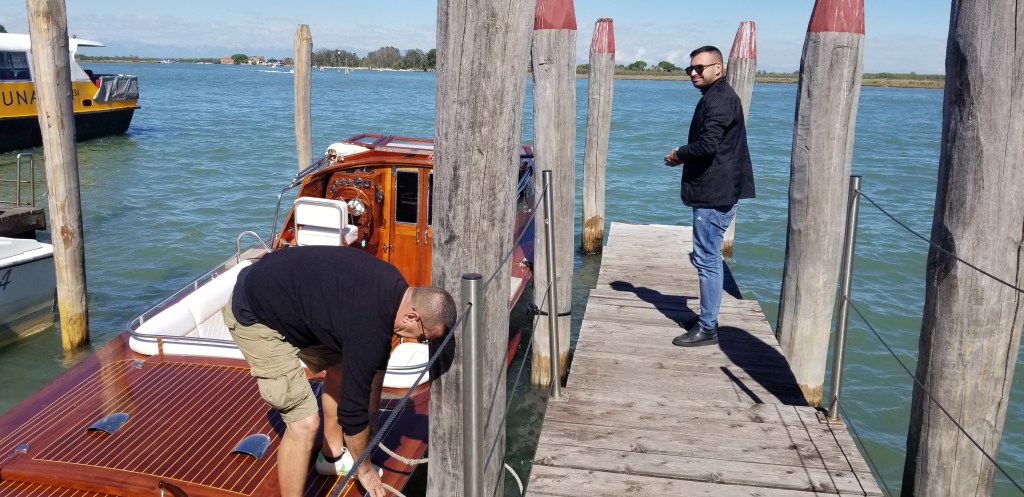
We zipped across the lagoon and found ourselves docking in Burano in half the time it would have taken us to ride the vaporetto. Besides that, it was fun!

Burano is a smaller island than Murano. It is traditionally known for its hand-made lace and its colorful houses. Leonardo da Vinci visited here, purchased an altar cloth, and the lace began to be exported all over Europe. Today, tourism has supplanted the lace-making industry. Lace is expensive and time consuming to make. I only remember seeing one or two shops and didn’t take pictures. I read later that most of what is sold now is machine-made.

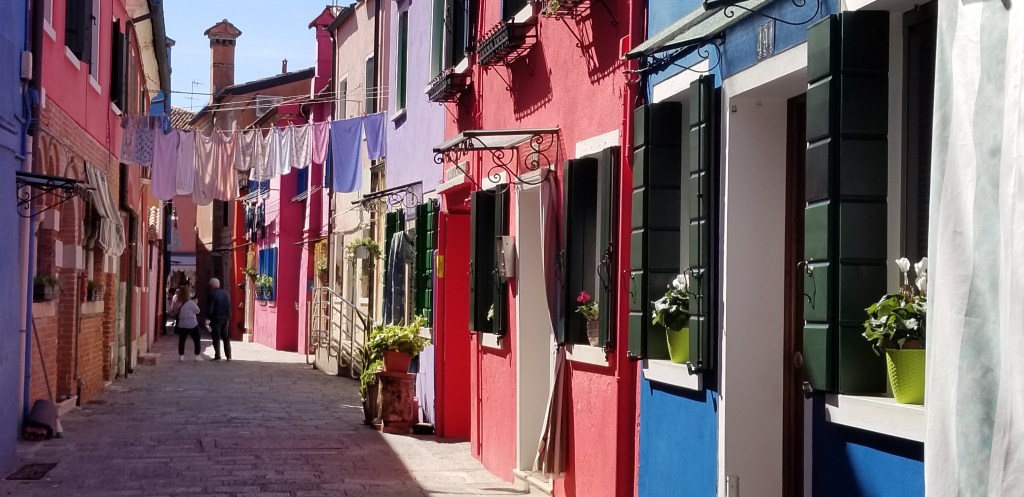
No matter, I was mesmerized by these colorful and picturesque little streets and homes.
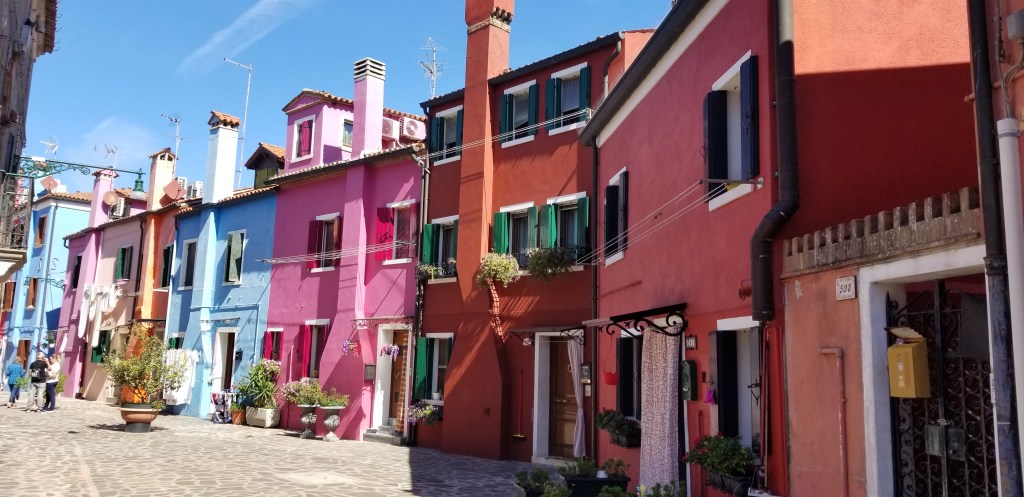
What is it about hanging laundry that makes everyone want to take a picture? Me included.
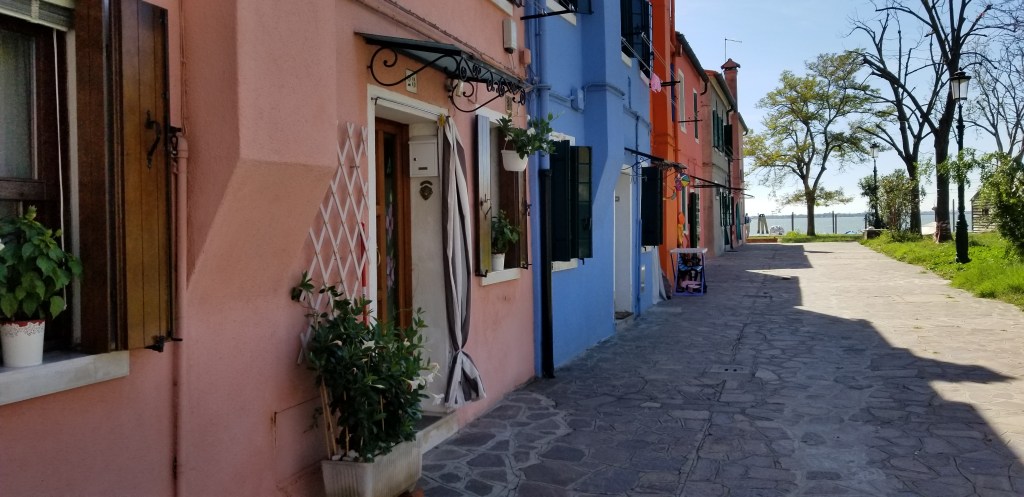
Traditionally, the houses were painted different colors so that fishermen returning home could easily see their own house while still out at sea. Today, the color of a house is regulated by the government; only certain colors are allowed for each particular lot.

I thought it was interesting to take a look at all the fishing gear in this small boat.

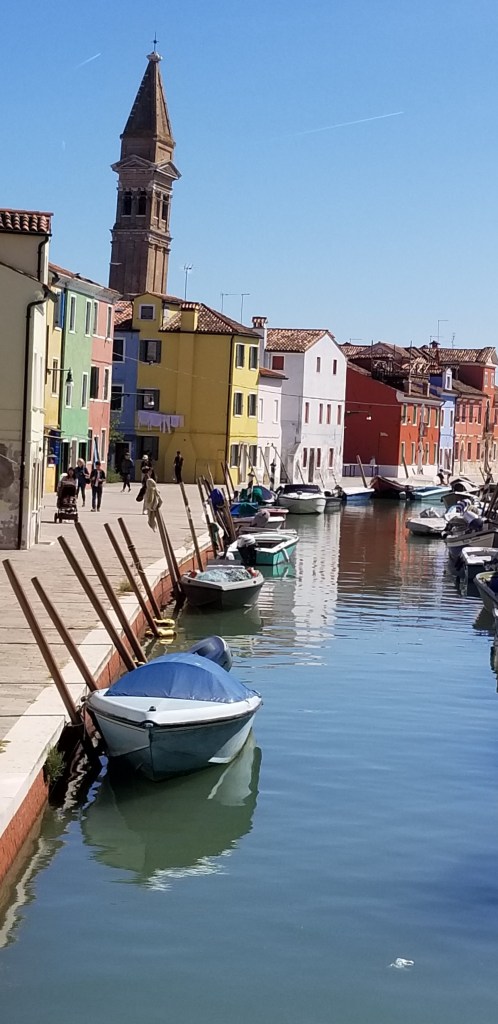
Murano may be tiny, but it still has its share of canals, plus a church with a leaning campanile.
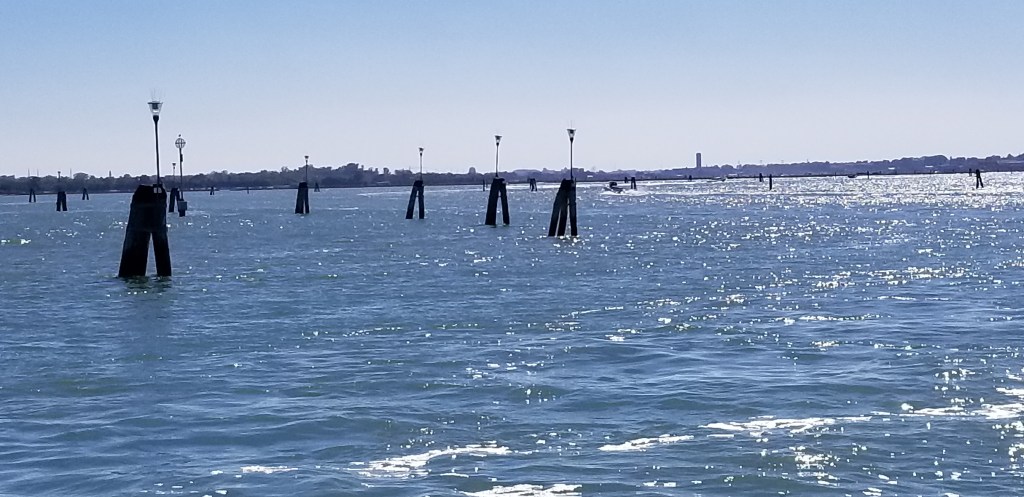
This time, upon leaving Murano, we took the vaporetto. It was not crowded. Since we were now further out from Venice, the ride was longer, and I had time to observe the “highway” in the lagoon. Posts help to keep everyone in their lane and prevent head-on collisions.
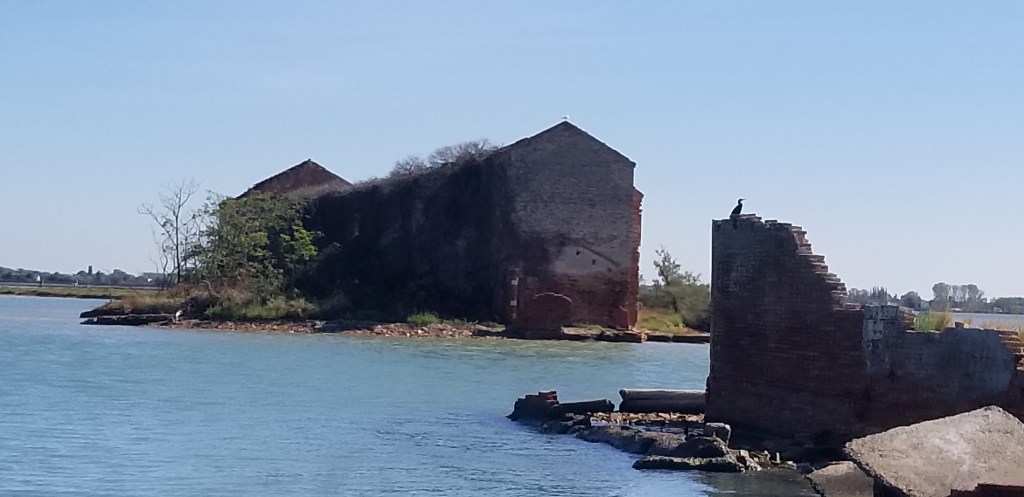
There are many things to be seen along the way, such as ancient buildings long abandoned:
and a lighthouse at one of the vaporetto stops.
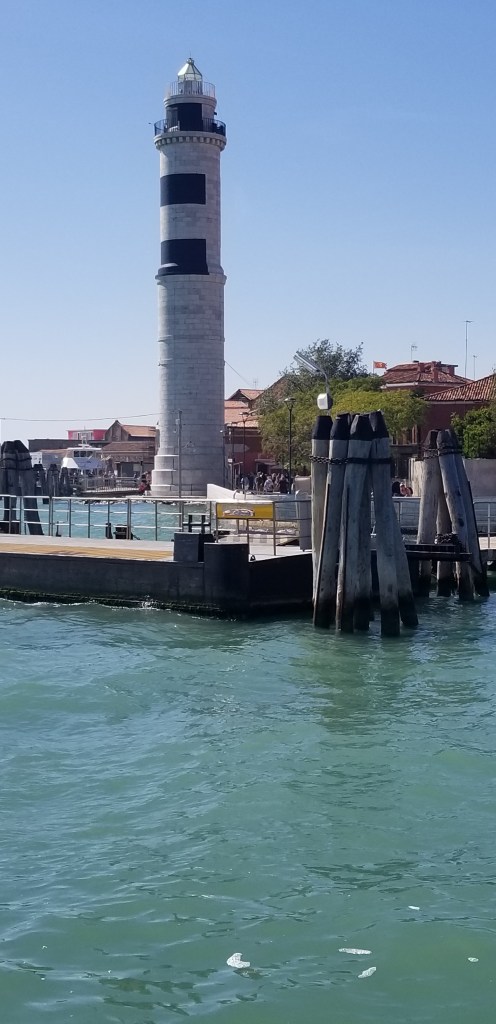
It had been a lovely, relaxing time on the islands of Burano and Murano, and just getting there and back was half the fun.

Next time: Boating to Padua
Europe · Italy

Six Days in Venice, Italy – Europe Travels, September 2022

Six days. That’s how long I wanted to stay in Venice. Despite its reputation for having entirely too many tourists.

We’d been here, once, long ago. It was a ten-day romp through Italy from Germany on a great big bus. I don’t remember if we received an orientation to the city, only that we had just one day in Venice. We roamed about on our own, probably had some spaghetti or pizza, and the day was over much too soon. It’s always been my wish to come back and have plenty of time to explore. Six days this time was perfect.

This is the sight that greeted us when we stepped out of the train station upon our arrival from Bolzano. The body of water is the Grand Canal, which is the main boulevard in a city that has no streets for motorized vehicles. No cars, buses, trucks, emergency vehicles, motorcycles or even bicycles are allowed here. So it follows that there are no traffic lights or horns blaring. Except for one day that we left the city, we were blessedly relieved from normal everyday traffic noise. Everything in Venice goes by boat or on foot.

From the train station, we navigated the labyrinthian streets of Venice carefully and with an eye on our Google map. To get to our AirBnb we needed to cross the great bridge over the Grand Canal, walk along the pathway on the other side, execute a series of turns down various pathways, and cross smaller bridges. We followed a nun shepherding some other folks from the train station, until we went our separate ways.

I juggled my suitcase and interrupted the GPS on my phone to take pictures as we walked.

I did not want to lodge in the San Marco area, which is crowded and is where most of the tourists are. Venice has several neighborhoods and our AirBnb was the farthest away from it in Santa Croce, an easy walk from the train station. We could look out to the piazza from a small bedroom window. It was always interesting to see what was going on out there. Sometimes the restaurant was bustling, sometimes not. We had a couple of good meals there, and if we were back by late evening, we would watch the servers unfurl the umbrellas, whisk the linens away, and push all the furniture back to the side of the building.

In Venice I heard the term “tourist river” for the first time. Of course Venice has lots of tourists, although by now we were in late September and it was not too terrible. Tourist rivers are areas where a lot of people walk in a crowded stream to see sights or to shop. At times there was a light tourist river on the back of our piazza, where the person in red is walking, because we were on a pathway to the train station.

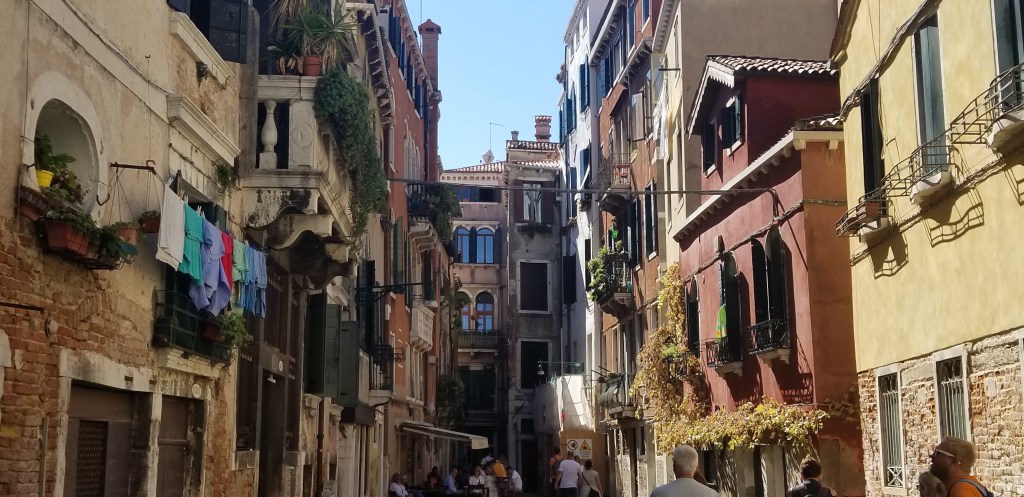
The joy of having time to explore Venice was being off of tourist rivers and into the quiet neighborhoods. This is the very definition of slow travel.

Yes, we found plenty of busy passageways. Even here there was so much to look at. There are not only tourists in Venice. There are students going to school, employees hurrying to work, and folks doing their marketing or crowding the tiny grocery stores for some lunch.

But then, there were plenty of quiet ones, too.

We would wander about, vaguely trying to get somewhere without any assistance, just enjoying the neighborhoods and the canals. A passageway would lead nowhere, or take us back to a piazza we had just walked through. We would finally have to give up, look at either our paper map or GPS and discover that we had been walking in circles. That was OK too!

In the middle of the picture below, you can see a passageway that just ends at a canal with no walkway or bridge. That happened to us quite a bit while wandering. We would have to turn around and retrace our steps.

Bridges are always picturesque, providing a view over canals large and small.

The famous Rialto bridge is the oldest of four bridges across the Grand Canal. Construction on this bridge began in 1588. We crossed this one on our way down to the San Marco neighborhood, and I got good photos of it on two separate occasions.

Venice is a faded lady. The city is over 1,200 years old and some of the buildings are 800 years old. Most, though, date back to the 1500’s. That was Venice’s Golden Age, which lasted a couple of hundred years. For good or for ill, it was one of the most richest and powerful Italian cities, with a stable government to keep everything in check.

The water in the canals are actually very shallow, only about ten to fifteen feet deep. The city was founded in the fifth century AD, and it was built in a lagoon, with small, marshy islands. Natural canals in between the islands were gradually enlarged and reinforced with bricks and other materials. There are 150 canals running through the city, connecting 118 small islands with a mixture of salt and fresh water. The local government works to keep the canals looking clean.

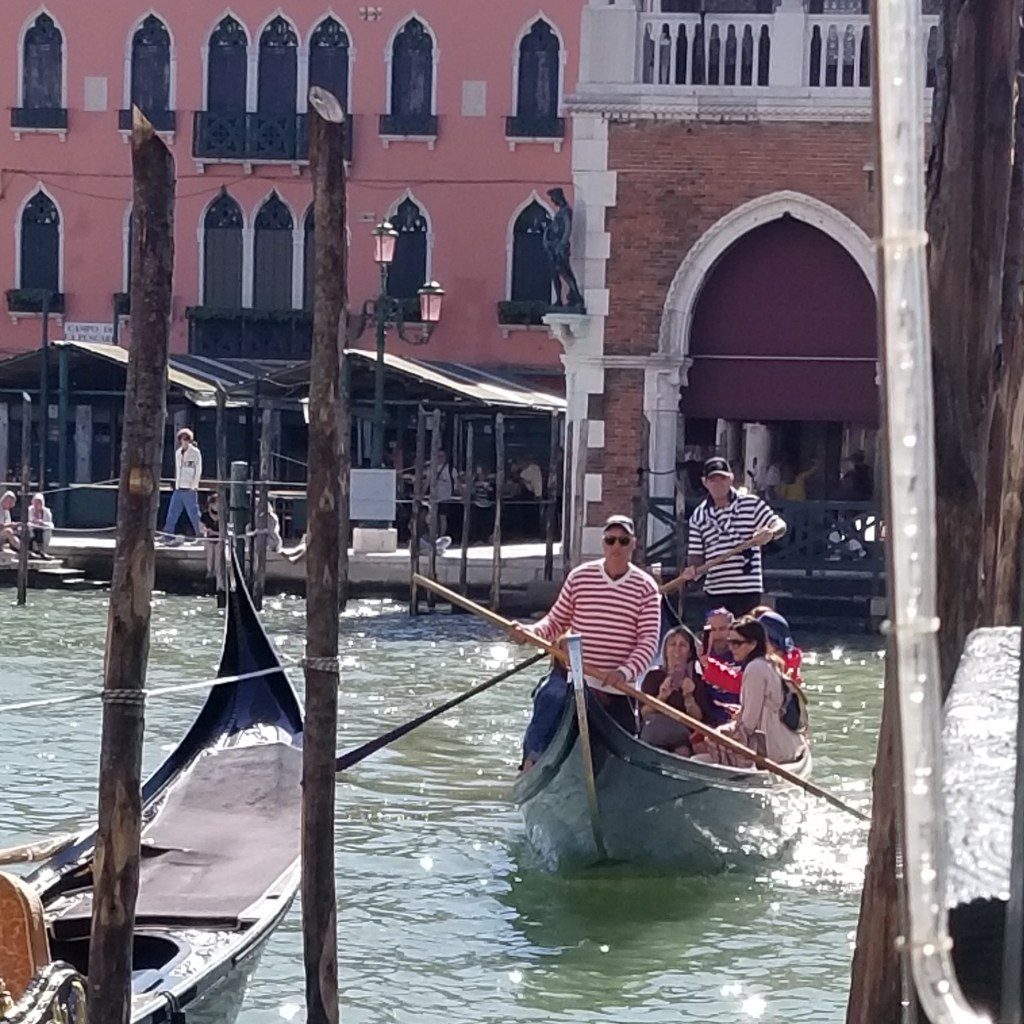
We didn’t always have to go on foot around the city. The canals have a system of vaporetti, or water buses, that run frequently and punctually on the Grand Canal. A vaporetto is docked at right in the picture below.

I took this picture while riding on a traghetto.

Along the entire length of the Grand Canal, there are only four bridges, and sometimes you just need to cross the Grand Canal where there isn’t one. For that there are traghettos. On one of our wandering excursions, the walkway ended at a traghetto stop. For two euros we could ride across. That looked interesting, so we hopped aboard. According to the sign, this is the Traghetto S. Sophia coming across for us.

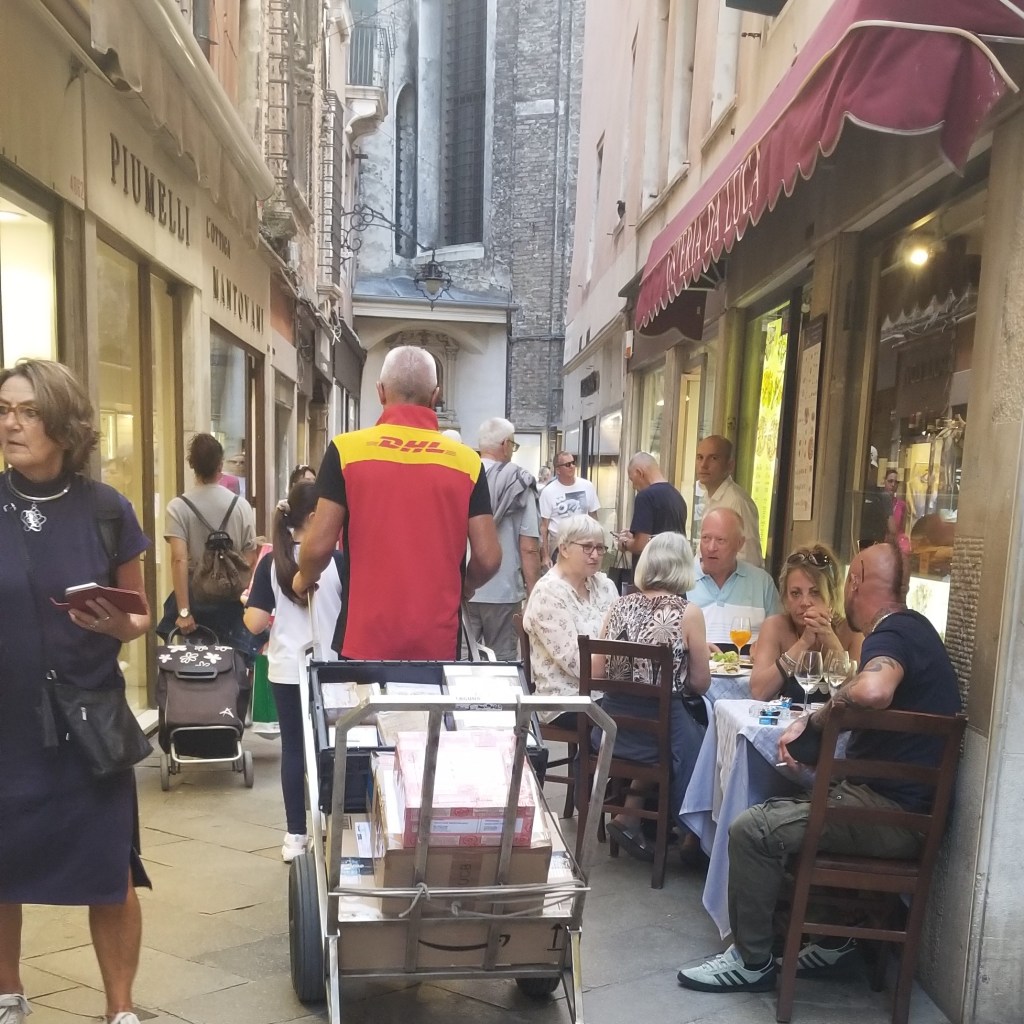
What about commercial transport in a city like Venice? Everything comes in or goes out by boat. Then it is transferred on carts down the pathways. The carts are built so that they can negotiate the steps, too, and people who pull them are good at getting up and down.

Package delivery on a crowded passageway near San Marco Plaza

The Grand Canal is used to transport everything, including perhaps the boxes that this DHL person is delivering.

One evening a strong wind blew in, followed by gusts of rain. From our window, I watched diners hurriedly finish eating and paying at the restaurant on our piazza. The servers scurried around swooping everything off tables and trying to fold up stubborn patio umbrellas that wanted to blow the wrong way. It was still raining in the morning. With the gloomy weather, I decided it was a good time to visit the Jewish quarter, in the Cannaregio neighborhood.

We crossed the Grand Canal on the bridge near the train station, where there were lots of people already out and about.

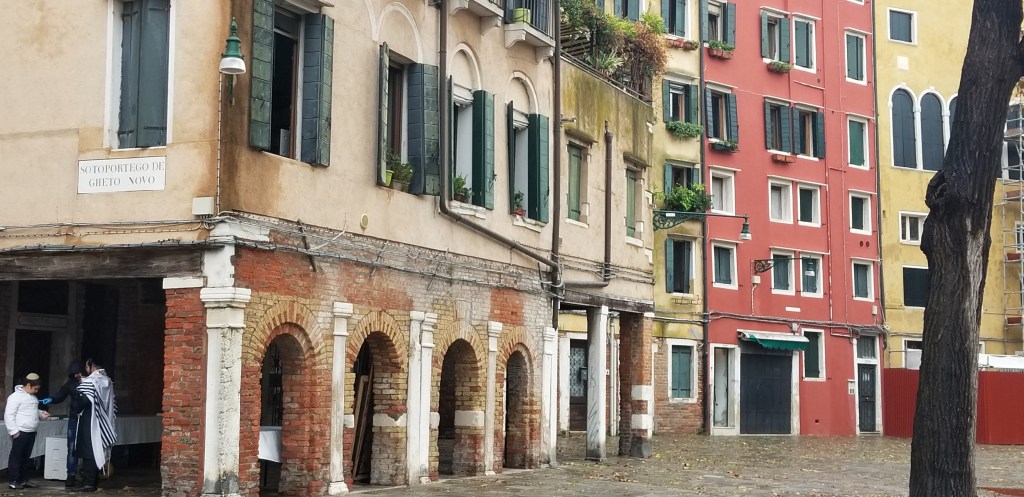
A few twists and turns, and we were in the quarter. It was a Saturday and the Sabbath, so a service was getting ready to start in a nearby synagogue. Despite that, some stores and cafes were open.

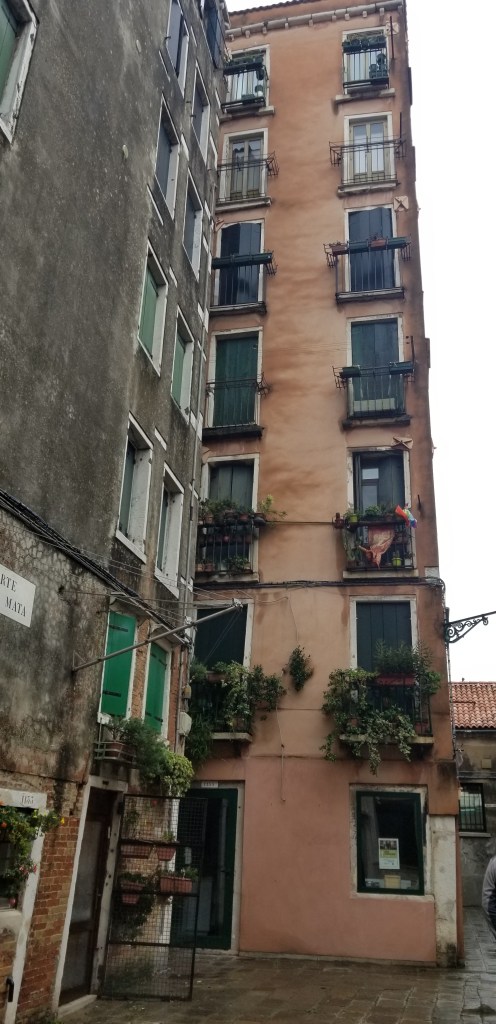
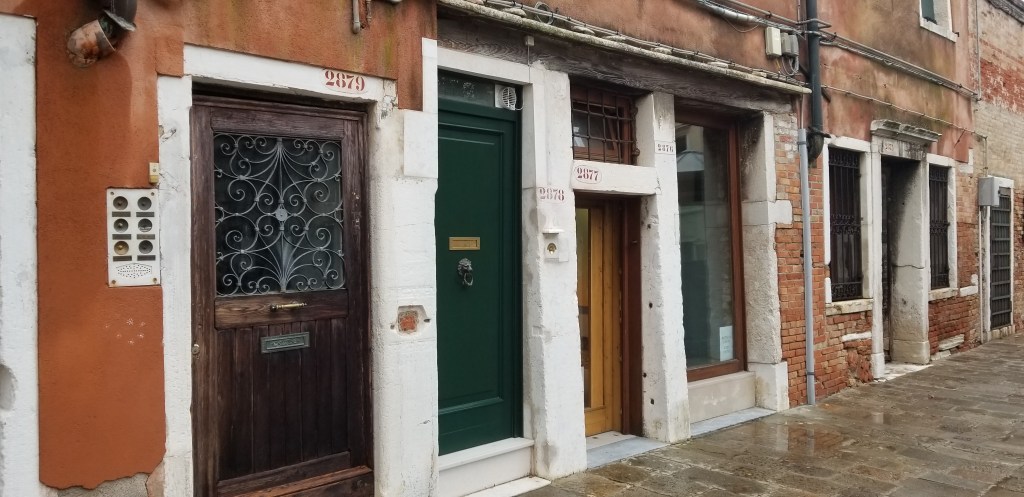
The “Golden Age” of Venice did not apply to Jews. In 1516, they were all made to move to an area where foundries, called “geto”, had been in ancient times. The area that included the ghetto is an island, since there is no way to get to it other than bridges. It got so crowded in the ghetto that buildings were made taller with substandard apartments. On ground level, smaller apartments were squeezed right next to each other.

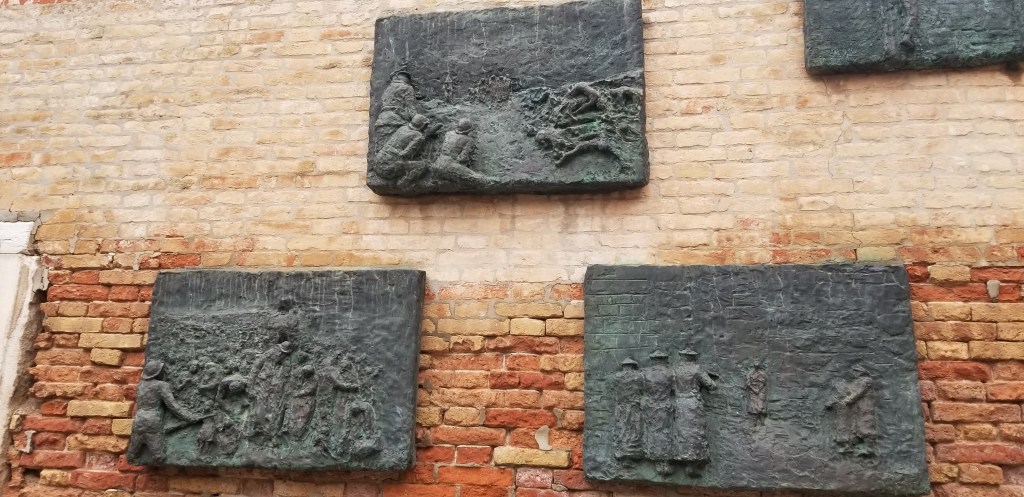
Looking about, I noticed pictures on the piazza wall. They are tributes to those arrested and murdered by the Nazis between 1943 and 1944 in this piazza.

It was sobering to ponder what happened here, but I think it is good to pause and reflect on these things.

All is not gloom and doom. The Jewish community is still here, with five synagogues and a library. Venetian Jews today number about 500, but only a handful live in the former ghetto.

I found a small art gallery where a gentleman had some cats lounging about. He takes pictures of scenes around the quarter and sends them to Israel, where an artist paints them onto canvas. I fell in love with one picture that included his cats, but I did not want to purchase anything.

We stepped into a small cafe to warm up and have a cup of tea (for me) and coffee (for Cal) with a cannoli. Cal was pretty happy with this stop. After thinking about it over my tea, I went back to the gallery and purchased my picture. It is now hanging up in my RV bedroom.

This was our only rainy morning in Venice, and the sun soon appeared to warm the day.

We did not just wander around Venice the whole time. There are golden treasures here: the Scuola Grande di San Rocco, the Chiesa del Gesu and other churches, the Doge’s Palace, Bridge of Sighs, and Piazza San Marco. That’s for next time!