USTravel

Castle Dome Ghost Town, Arizona

In our continuing futile search for warmer weather, we moved our home just as far as we could go and still stay in the United States – to Yuma, Arizona. If we had gone any further south we would have been in Mexico. Our RV park was only fourteen miles away from the border.

While in Yuma, we had an incredibly interesting and fun day at Castle Dome Ghost Town.

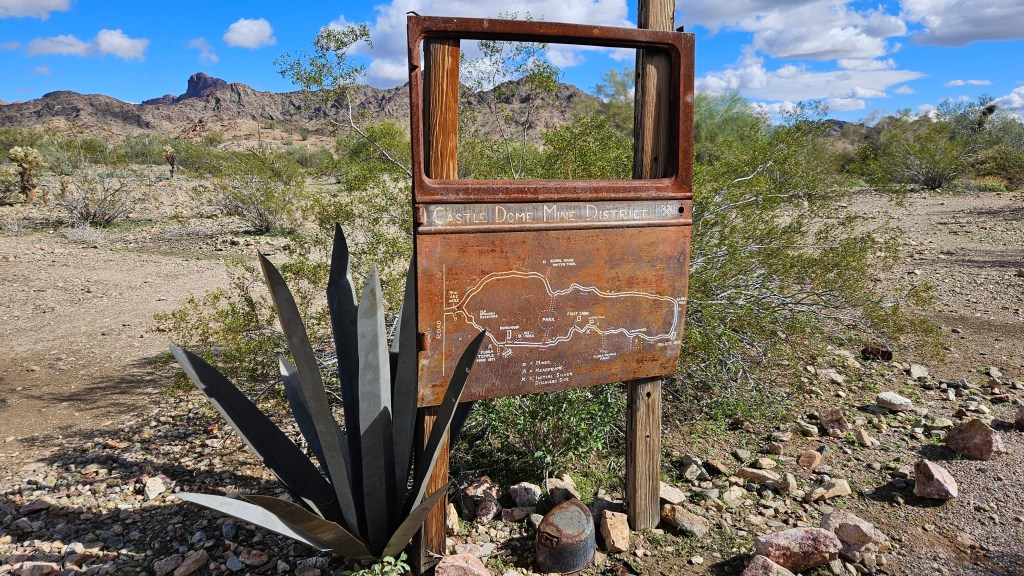
The town takes its name from the mountain range behind it. Castle Dome is the peak that looks a bit like a knob on top of the peak on the left. We could always see it clear back to Yuma. And I say “clear back” because it is a bit of a drive to get here. After the forty mile or so trip, there is a three mile stretch of pavement on the turnoff, and then about seven miles on a rough dirt road through Kofa Wildlife Preserve. A good ghost town is never easy to get to – at least not the ones we have seen.

The actual name of this place, Castle Dome Mine Museum, is owned by a couple by the name of Stephanie and Allan Armstrong. They salvaged original town artifacts from the desert and the surrounding abandoned mines. Around 60 buildings have been resurrected and furnished. What I liked is that everything is open – no peering through dusty windowpanes here – and for the most part there are no display cases or ropes to stand behind.
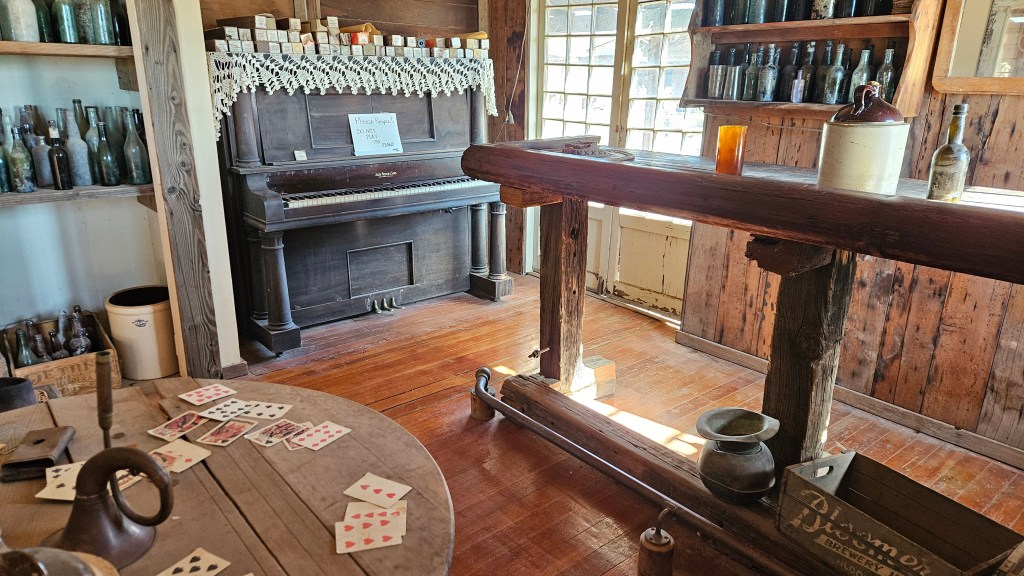
Inside one of the many saloons, where a good card game has seemingly just been abandoned. I could almost hear the piano playing some old-time tunes.

Cal found a bigger saloon to hang out in. This one belonged to the hotel and stagecoach stop. Is that a ghostly apparition in the mirror behind him?

Meanwhile, I tried to work the cash register in the general store.

There were once over three hundred mines here, and this is the longest worked mining district in Arizona. Both silver and lead were mined as late as 1979. Galena was the primary ore and the minerals were extracted from the rock, but when silver prices plummeted the mines finally closed. There are other minerals too, including gold, but the gold mostly played out before the 1900’s. The late 19th century was the heydey of mining in Castle Dome.
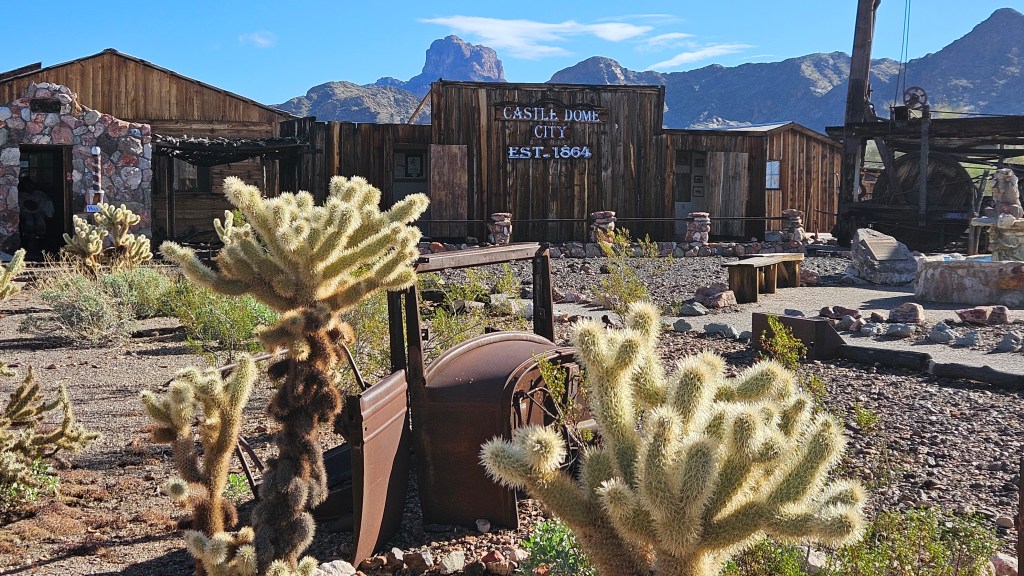
The town of Castle Dome was once larger than Yuma, and its main drag stretched for miles.
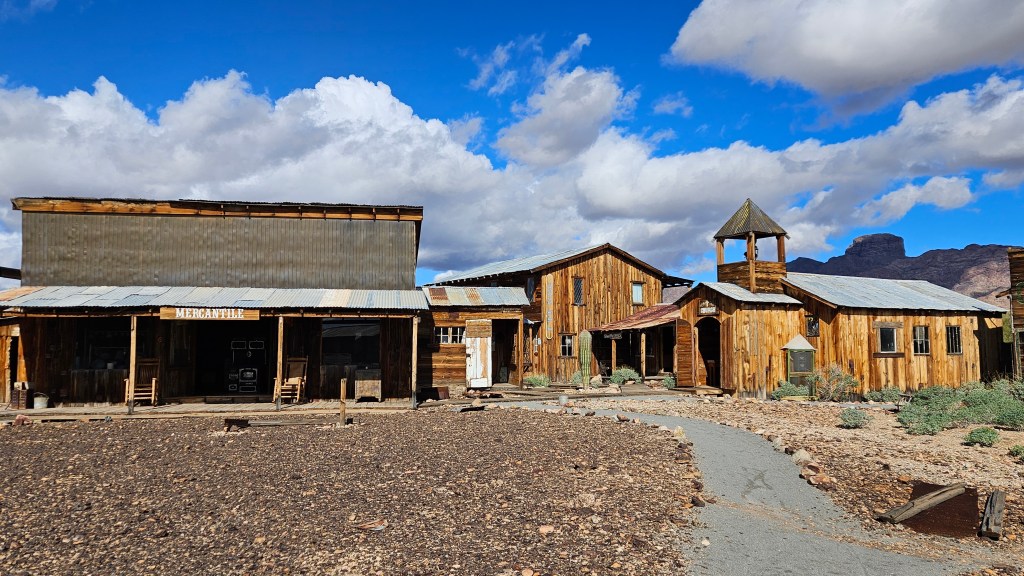
During and after the civil war, people came here in search of a better life. Other people were disillusioned by the California Gold Rush and came back east a bit to stake a claim. They would set up some cactus or tree branches from the desert, throw a blanket over the top, and call it home until their fortunes turned.

Tools of the trade

There were some areas that are restored back to the eras of the 50’s to the 70’s, since people were living here then, too. But I liked wandering a little further out from the restored town and looking at remains that are still sitting the way they were left.

In case the sign is hard to read, this is the encampment of Rita, who came here in 1883 looking for “the right man”. She built the stone steps to her cabin and the rock pillar with which to do her cooking. She always had a pot of beans and cup of coffee at the ready, and all were welcome.

There are actually four mines in this picture. Can you find them all?

It’s possible to tour one of the mines in Castle Dome. I will admit that, to us, it is outrageously expensive at $70 per head, but we are on the road to see and do all we can. We decided ahead of time that we’d plunk down the money and not look back!

We were in a large golf cart with only three other people plus the guide for the mine tour, and he was a fount of information. And this is where it got a little weird. Turns out Alan, the owner, has come into the treasure of someone who is liquidating their metal sculpture business. It’s not something that is advertised, but they are being set up everywhere out back. In between listening to the bits of information our guide was giving us, there was this to look at:
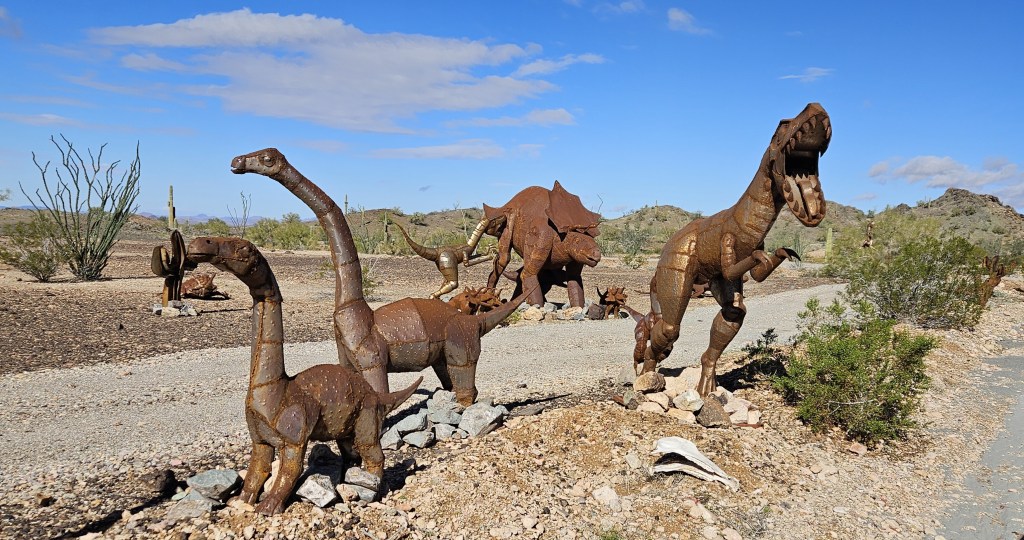
The pre-teen in our group was very impressed. I decided that this would really make the tour fun for kids (or adults) who might need a bit of a diversion from rocks and mining. And to be fair, there is more to the metalwork than just dinosaurs: there are animals and birds of the desert, a miners camp, and other scenes. Another adult in our group took picture after picture of the sculptures, so I guess she enjoyed them too.

We finally arrived at the mine and discussed mining equipment. While our guide was talking, I took a picture of the view. Just ignore the little coyote on the far right. It was impossible to take pictures without these things popping up.

Our golf cart went right into the mine, 100 feet down. We stayed on this level, but there are actually seven levels to the Castle Dome mines, and all mines feed into the main passageways. Out of the seven levels, five are under water. When the mines were in operation, the water was being continually pumped out.

Once down in the mine, we were out of the golf cart.

The mines are no longer in use because prices have dropped and the cost of extraction and production would erase any profit. We looked at this chunk of galena. It contains about 60% lead and 40% silver, and there is fluorite wrapped around it. Its value is estimated at about $5,400, but there would really be no value in processing it.

Our guide highlighted a vein of silver, which shows up more easily with his blue light.
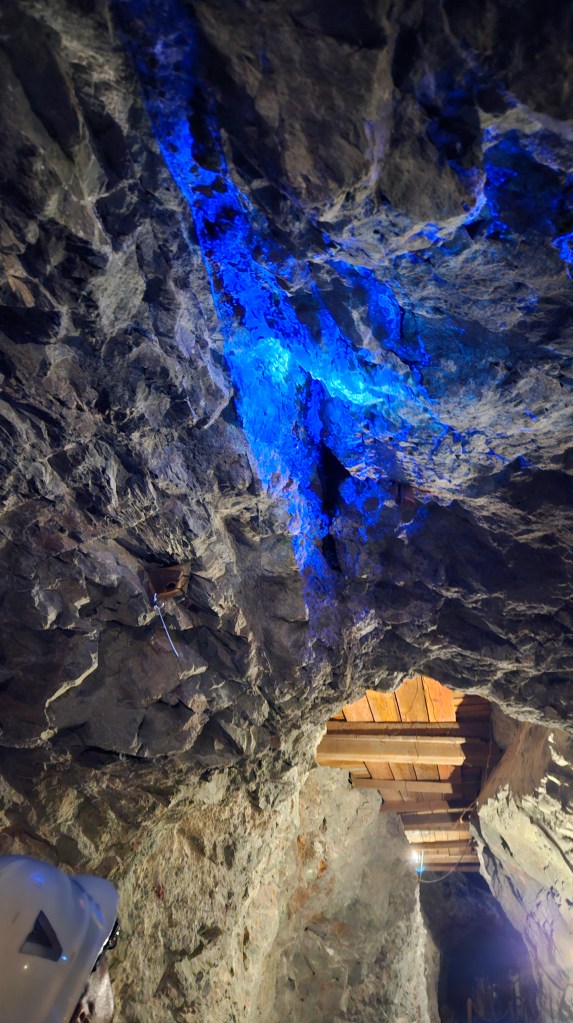
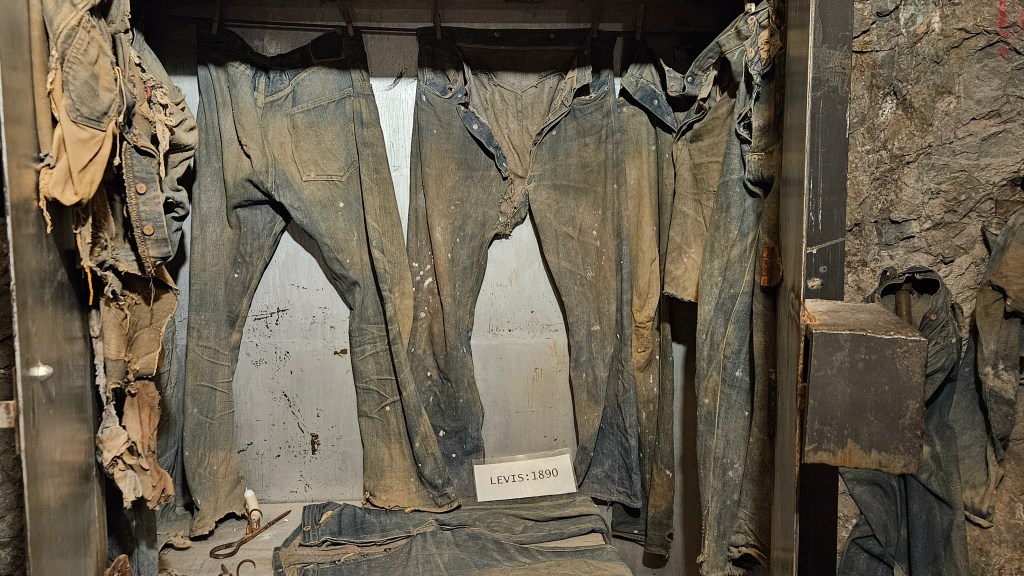
Besides the minerals, there is a treasure trove of items left behind by generations of miners. The climate of the mine preserves them perfectly. Outlaws hid their plunder down here, and there was once a blacksmith shop. Miners wore out their jeans quickly and needed replacements on the job, and many pairs have been found. We looked at some Levi’s that were over a hundred years old:
To us, the thing that made this mine absolutely worth what we paid for the tour was the view we received with the lights off and the high-powered black lights on. The mine is full of fluorescent minerals and these lights cause them to glow.
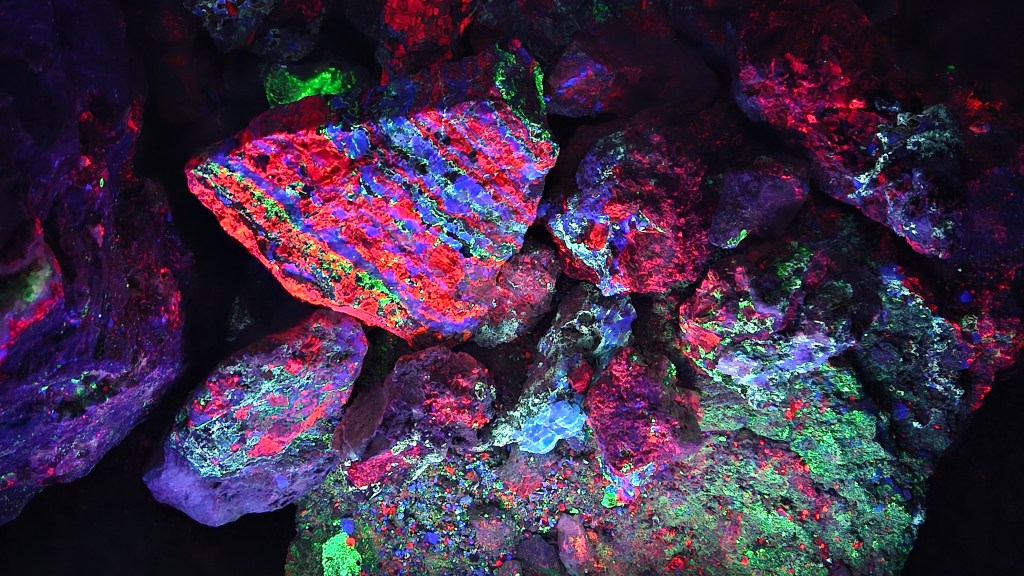
The reds are calcite or halite. Chalcedony, hyalite, or opalite causes the greens. The blues are mostly fluorite, but could also be hydrozinite. It is literally a feast for the eyes, each picture that I took a work of art. With the lights, the mine becomes a wonderland.

When our guide turned the lights off and we entered a totality of darkness, the rocks still glowed. They would continue to do so, he said, for about an hour.

This naturally-occurring “Karaoke Cat” was still glowing after the lights went out.

Our tour was done soon after that, because of course, the phosphorescence was the highlight. The tour lasted an hour and a half.

Inside the mine, our guide had discussed the shifting rocks that are pushing upward under the surface. Mountains were caused eons ago by this shifting rock. We could see the shape of the rocks that come together underground, and once above ground on the way back, could see the effect of those same rocks on the small hill in the picture below. Yes, the one the dinosaur is standing on.
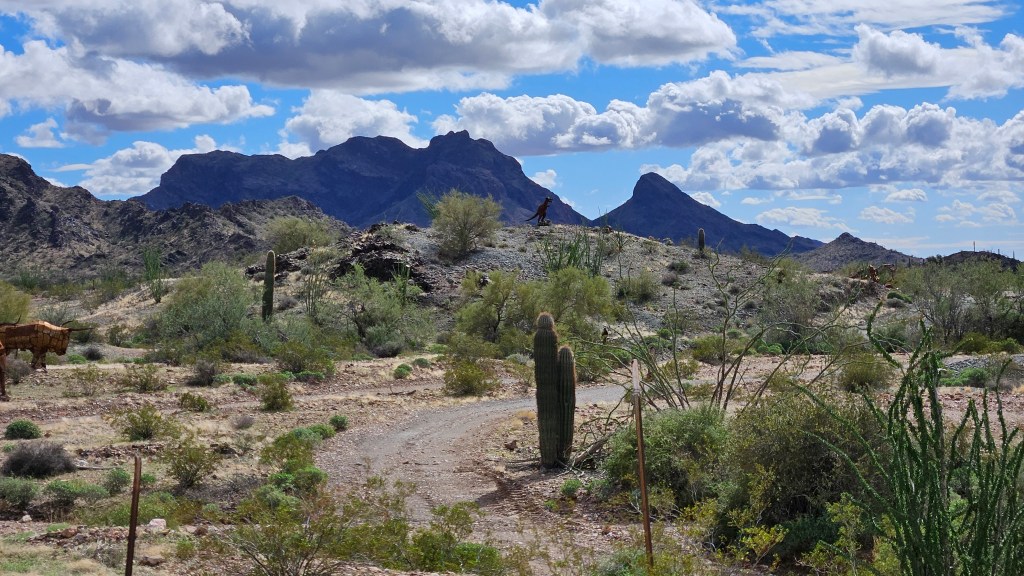
Our guide stopped so we could have a little fun, too. He compared this to one of those tourist places where a picture can be taken with a fake background. Let me assure you, the background here is absolutely the real thing.
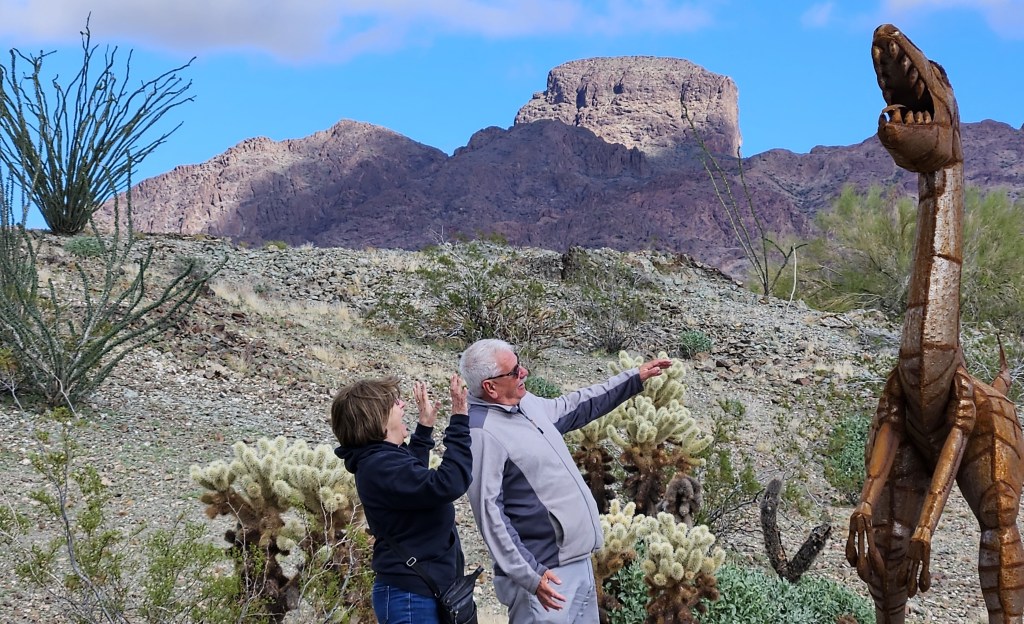
What a time we had here! If I’d loaded up all the pictures I took or enlightened you with all the other things I learned, we’d be here all day. So I’ll stop for now, and maybe do one more post about our stay in Yuma later.

Next time – what’s in your salad bowl?

USTravel

A Quartzsite Day

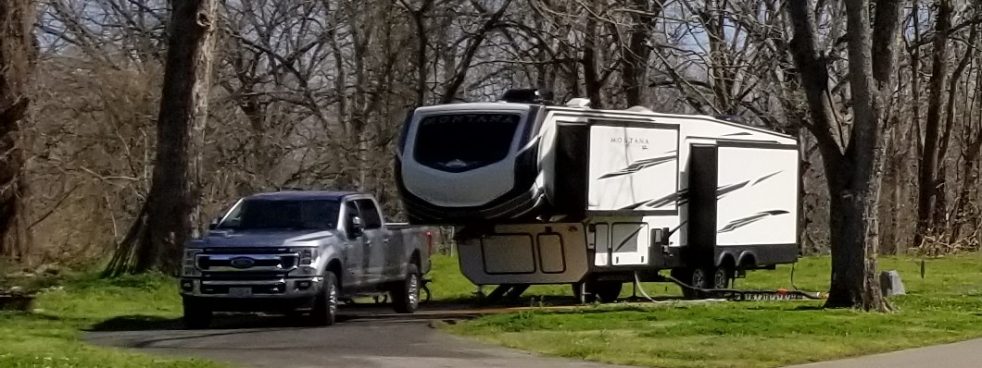
An RV sits on BLM land near Quartzsite, Arizona

Boondocking in the desert with nothing but the stars all around! Isn’t that the great RVer’s dream? 

Except that three and a half years into RV ownership, we know now that we are not boondockers. So no, that is not our RV in the picture at the top of the page. We may boondock (stay self-contained in an RV or van with no connection to electric, water or sewer) for an occasional night at a winery or other such idyllic enterprise, and even that throws Cal into a frenzy of planning: checking out the generator, filling up with fresh water, and whatever else might have to be prepared. Having hookups for our RV home makes life easier and everyone happier. I booked us into an RV park thirteen miles down the road in Brenda, Arizona.

In the months of January and February, Quartzsite, Arizona is a boondocker’s mecca. It is a little town with a population of 2,413 which swells during these months. The place attracts all types of RVers, drawn by the warm weather and sunny skies. The area is surrounded by miles of government Bureau of Land Management desert, which is free and open for people to set up camp if they are willing to tent or boondock . It is also called “dispersed camping”.  

It’s not just the boondocking experience here that draws everyone. At various times throughout these months, the town hosts a large RV show, several rock and gem shows and the Rubber Tramp Rendezvous, which is an annual gathering for van dwellers.

Our first stop for our day in Quartzsite was to pay homage to Hi Jolly. One hundred and twenty two years after his death, he is still a larger-than-life personality.

Hi Jolly originally had two names: Philip Tedro and Hadji Ali. He was brought here from the Middle East with a group of camels as part of a failed US Army experiment to use camels for cargo transport across the southwest desert. The camels terrified the accompanying burros and horses, the Civil War broke out, and funding for the project dried up. Hi Jolly had several other enterprises throughout his life and made his home in Quartzsite.

If you didn’t know this story, you would wonder why so many businesses in Quartzsite are named “Hi Jolly” and why there are camels decorating everything in town, including the welcome sign.

The reason why we were in Quartzsite this particular week was for the RV show. While many RV shows are understandably only about the RV’s, Quartzsite’s is more about the “stuff”. We wanted to see what it was all about.

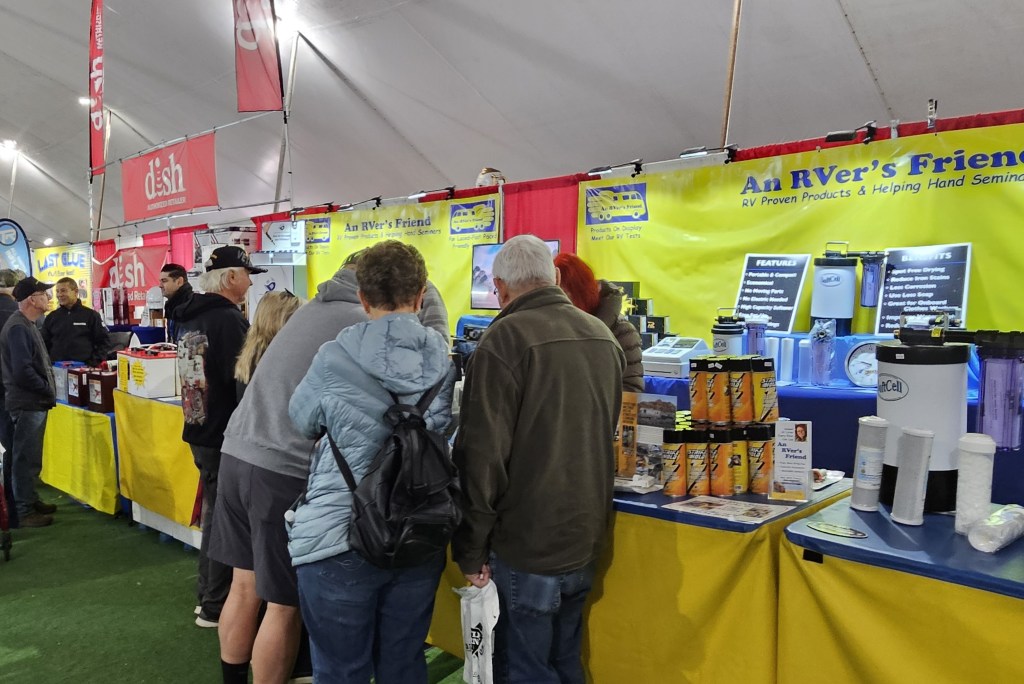
The show is free, and right away when coming in, there is a huge vendor tent. 

There area vendors for RV accessories, RV parks and resorts, and all kinds of other stuff both RV and not RV related. It reminded me just a bit of the vendor tents I’ve seen at state fairs. Cal was a little disappointed to not see vendors with more useful stuff for the RV or people to answer particular questions that he had. 

We were taken in by this vendor. You can make toasty grilled cheese sandwiches in only three minutes in the microwave!

We purchased it, and have since tried it, and–it’s great! I think it will be handy when we have the grandkids over for lunch this summer.

Outside of the tent, there are around 200 RV’s to be seen. Of course, we are most interested in the Montanas, because that is what we own.

There is a new 2024 Montana with an ebike compartment that we’ve heard about, and would have liked to see it. But that RV is too new for this show. We did enjoy looking at the various Montana models, including a newer version of our own.

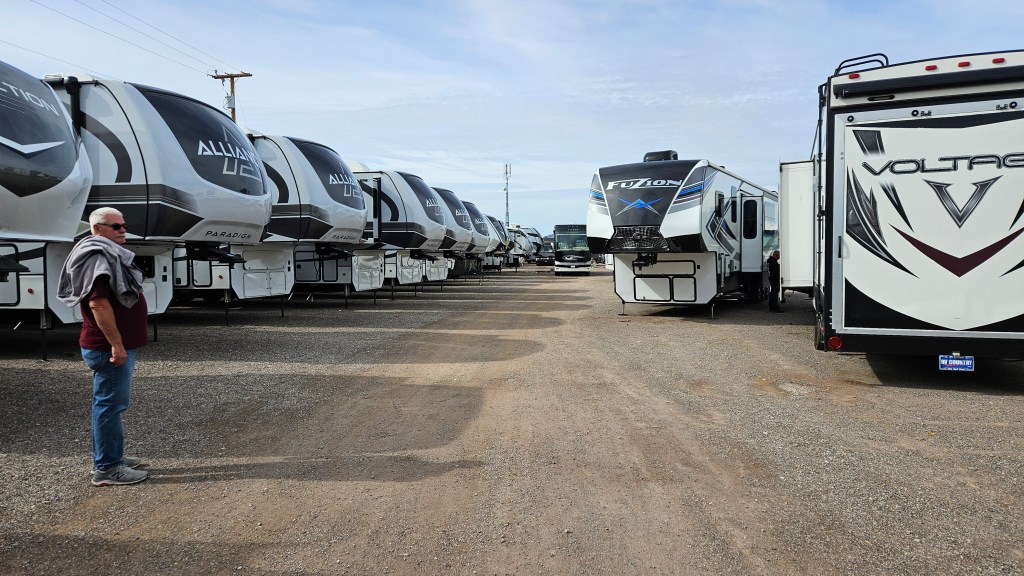
It was also interesting going into some of the RVs that we’ve seen in RV parks. The Voltage at right in the picture below is called a “toy hauler”. The back flips down, and there is space to store a motorcycle or an ATV. Many people convert these to an extra bedroom or office. The RVs where Cal is standing are all 5th wheels.

We stepped into many, many RVs. In the end, we concluded that we still like ours best.

After we finished with the RV area, we walked across the street and discovered acres more of vendors, mostly selling crafts but also related RV supplies. We’d been at the show for four and a half hours, including a break back in the truck for lunch. Enough! Our feet were tired.

We were here on this particular day not only for the RV show but also to go to a party. We are members of an RV club called Escapees. There are many good aspects to having a membership with them, the most important for us being a mail center which holds and sends us our mail. On this day, they were having a gathering far out in the desert. 

There was music, free hotdogs, and some information tables. After awhile, though, I got up to take a walk down the BLM road to further check out the boondocking scene.

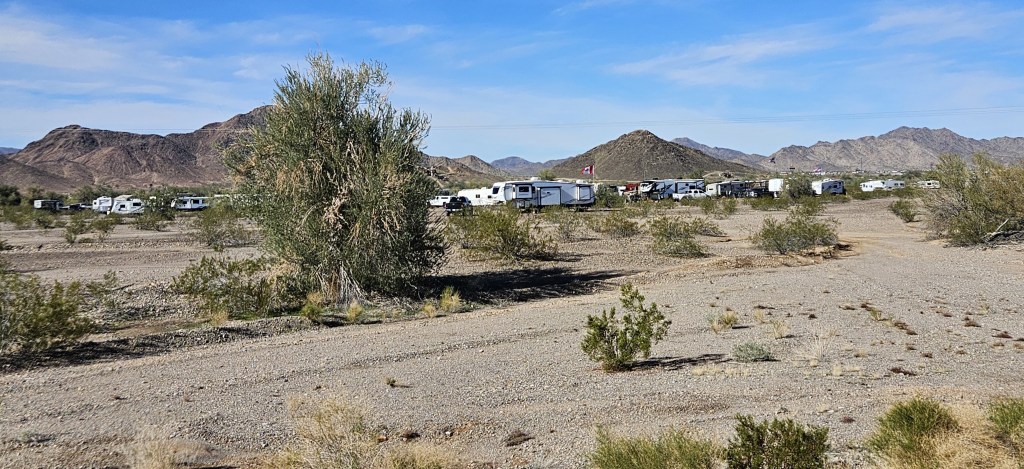
Many boondockers huddle in groups like this. Some are organizations that are having a gathering, and some are just people who know each other. And maybe some people feel that there’s safety in numbers. It looks too much like being in an RV park to me. Boondockers also tend to converge close to a main road.

I took this picture because the RV is a Montana. But you can see another boondocker close by. Do they know each other? If I was boondocking, I would not want someone even this close to me unless I knew them. To me, that is the magic of boondocking – to be out there all on your own.

As much as I’m attracted to the idea of boondocking, I think that the reality might not be quite so fun. So we headed back to our RV park in Brenda where the desert and mountain views were every bit as spectacular. We just had to walk behind the park to get to them.

Next time – we visit a ghost town

USTravel

Life in the Phoenix area

We spent a total of about two and a half months in the Phoenix area this winter, save the ten days that we returned to Denver for Christmas. Although I’m acclimated to desert living by now, I think once in awhile about how different life is here compared to life in the Midwest.

Everyday, mundane things, such as how it’s not unusual to find the parking lot at the grocery store with a covering over it. 

It’s not any covering, either. Those are solar panels. So the cars stay nice and shaded while they’re parked in the hot summers, and the panels help provide energy. The birds love it, as evidenced by all the tweeting coming from above. By the way, the grocery store is a Fry’s, a brand of Kroger’s, which is the main option here.

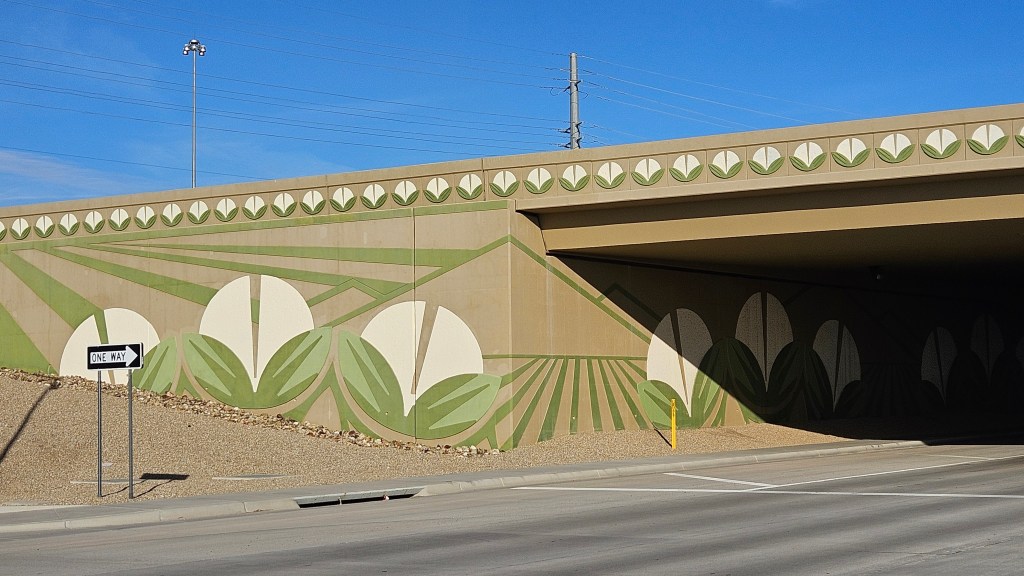
The highway berms are completely finished off with beautiful desert landscaping. The barrier walls and exit tunnels are decorated with desert or native designs. Two enormous lizards playfully climb up a column on an overpass near Goodyear, and a large cute bug graces a tunnel entrance nearby. Near where we were staying in Gold Canyon, a quail family marches along an exit berm in colored gravel, and a roadrunner is on the opposite side.

Of course, when we are on the highway, I can’t very well yell at my husband to stop so I can take a picture. But on an ambitious walk from our park in Goodyear one day I was able to photograph one of these.

The design on this particular exit bridge and tunnel is of cotton. That is because it is right next to Cotton Road, or because cotton has been traditionally grown around here. Or perhaps for both reasons.

Development is booming here. Subdivisions are going up everywhere. They bring in the road crew to add more lanes to an existing old desert road, then add sidewalks, desert landscaping, and a five-foot high decorative cement brick wall around the subdivision. I don’t know why every one has to have a wall. A new subdivision is going in kitty-corner from our park, and the empty stretch of land across from it will also be developed at some point soon, I’m sure. Signs from home builders about new developments are on every corner.

It’s not only homes, but also shopping centers. Of course, everyone needs a grocery store, but all the chain stores and restaurants are being built too.

We rode bikes one Sunday afternoon and tried without a lot of success to push past all the development. Our ride went like this: we were on the narrow edge of road pavement, then a new sidewalk, then a dirt path, then a stretch of prettily landscaped walkway between the walls of two communities, then a new subdivision road, then a path again, then a busy rural road. 

I’m afraid that, at some point not long in the future, family farms like this one will go the way of the dinosaur. 

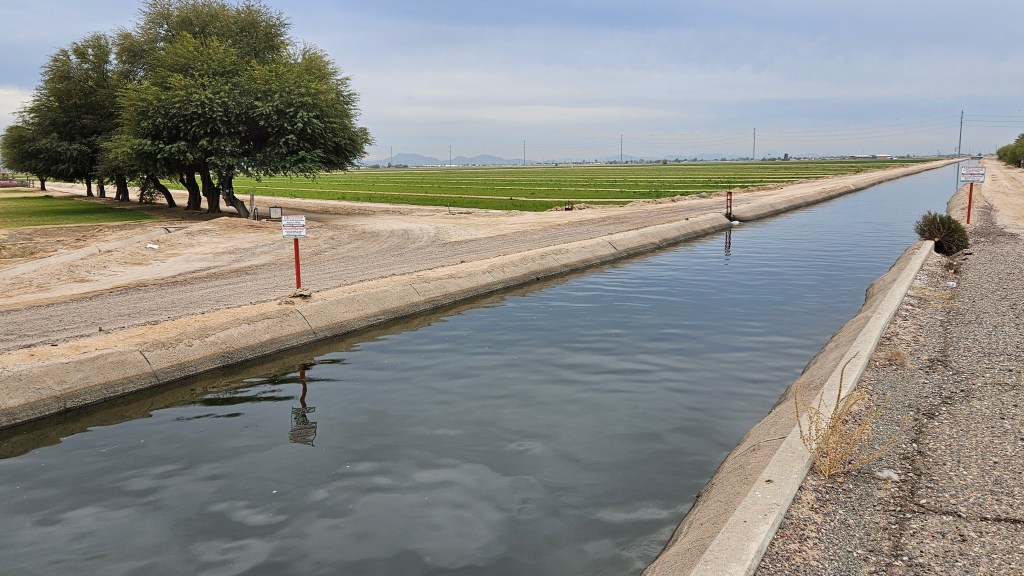
How can this lush green field exist in the desert?

The answer lies in irrigation from the canal system that crisscrosses this city. In antiquity, the Hohokam peoples cultivated the Salt River valley with a system of hand-dug canals for farming. Centuries later, the European settlers noticed the old canals, and began digging them up themselves. I’ve learned that there are 180 miles of canals in the Phoenix area. 

It’s not only for irrigation, of course. These canals provide drinking water, and the city could not survive without them. Water rights, preservation and distribution are an ongoing struggle here.

Roosevelt Canal lies next to our park. In one subdivision farther down the canal, they’ve built a sidewalk next to it that goes on for about a quarter mile.

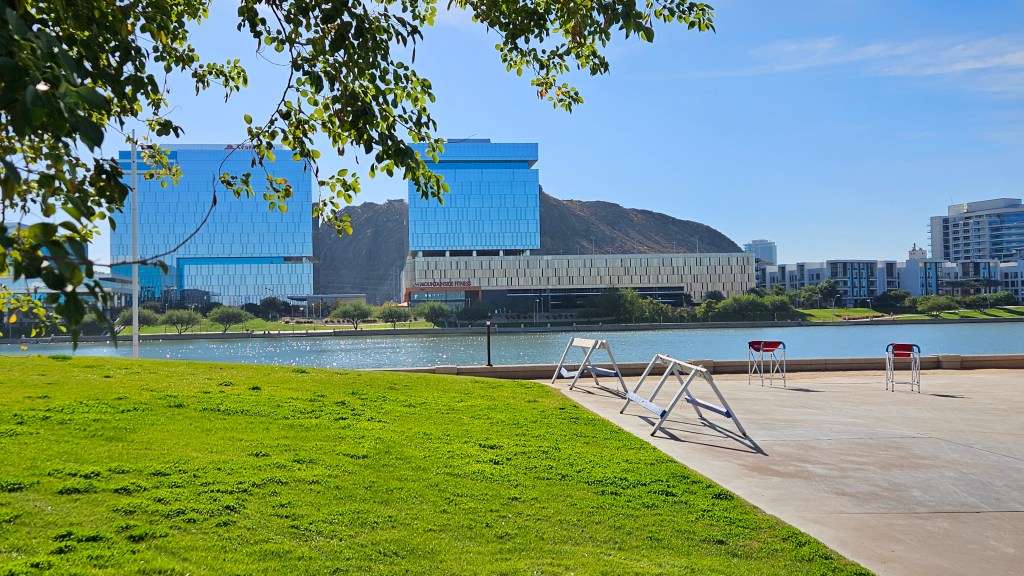
The city of Tempe, Phoenix’s first suburb, calls a wide spot in the canal “Tempe Lake”. They have built a park, complete with a bike trail, next to their stretch of canal. This part of it dams up the Salt River.

Although the valley that Phoenix is in is very flat, it is also surrounded by a mountain range, and every now and then an individual mountain pops up. The city has simply built around them, as evidenced by this mountain popping up behind the sparkly buildings on Tempe Lake.

We rode the bike trails around Tempe Lake, but only one of them really went anywhere. It took us to the Phoenix suburb of Scottsdale. The trail followed the canal for awhile, but then closer to Scottsdale it went through a series of parks and golf courses. We greatly enjoyed this ride.

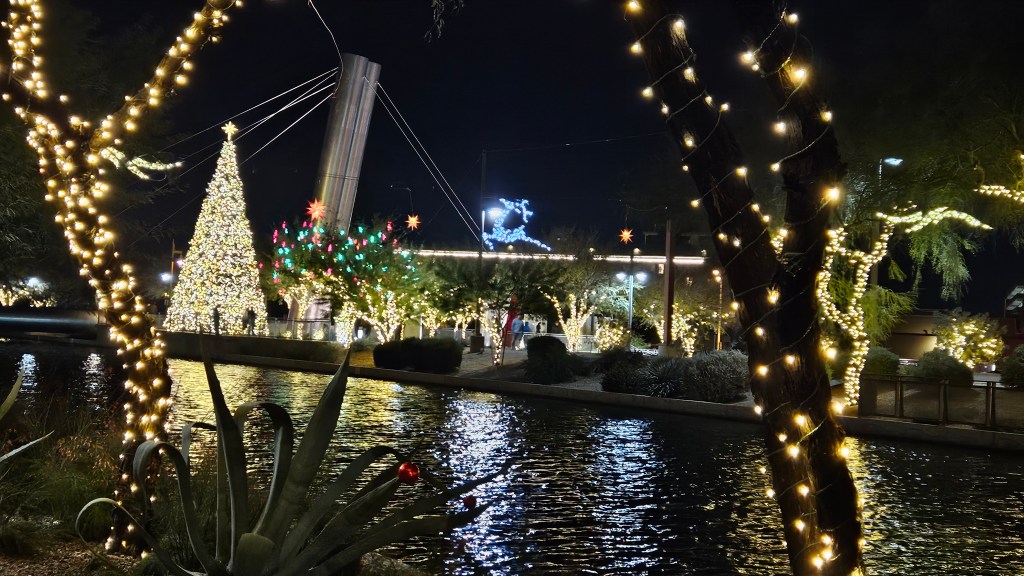
Speaking of Scottsdale, the Arizona Canal goes through the Old Town area. At Christmas time, the lights are very pretty on the canal.

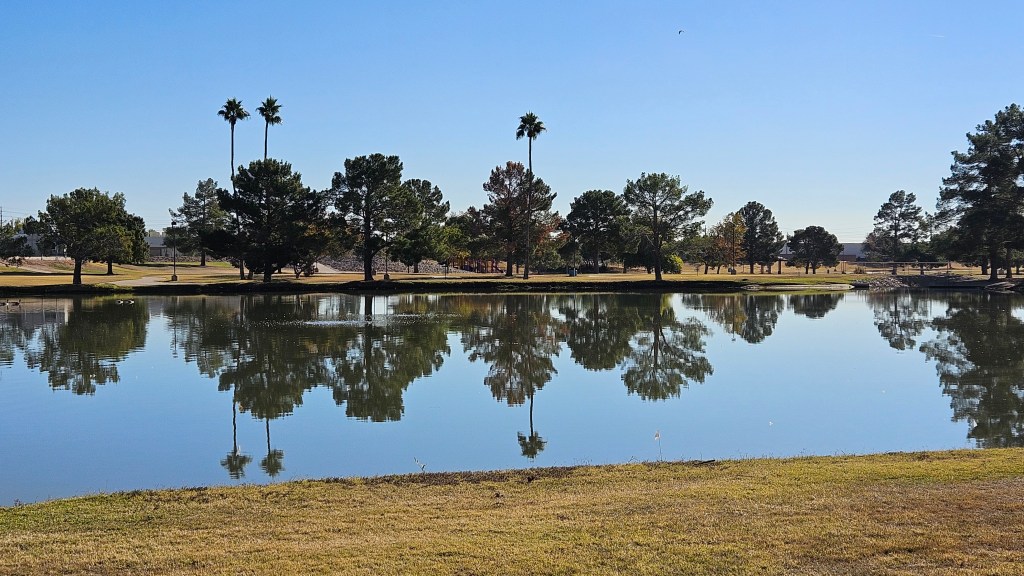
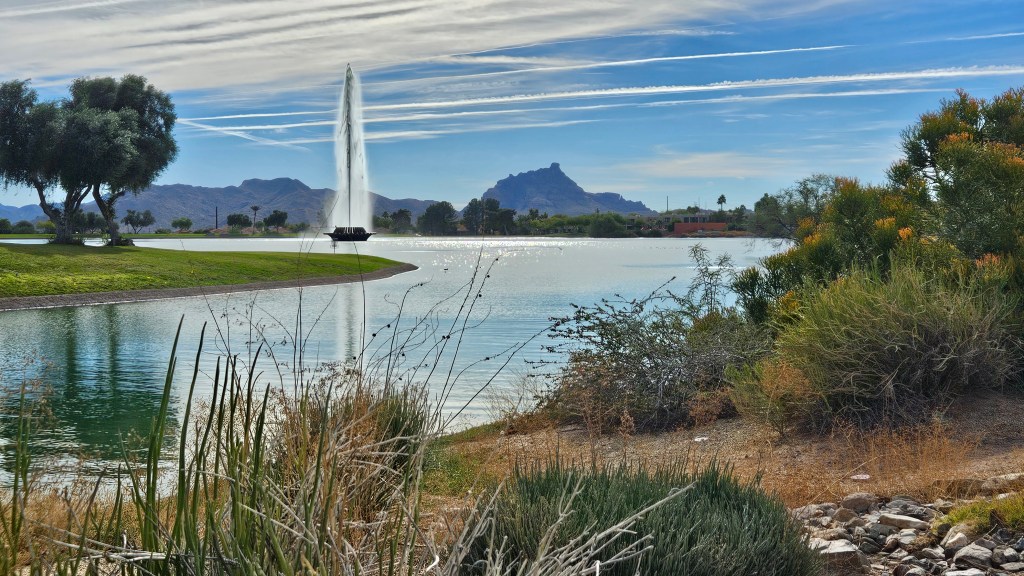
Another suburb with water is Fountain Hills. Their water is not a canal, but Fountain Lake. A beautiful paved walking path goes around the whole of it. The lake is effluent, meaning that it receives its water from a groundwater flow system. That’s about all I understand about that.

The centerpiece of this lake is a fountain. And not just any fountain, but the world’s fourth-tallest at 560 feet, and the second-tallest in the United States. It only goes off for 15 minutes on the hour.

Flying back in to Phoenix from our Christmas in Denver, we were able to see the fountain from the air. It rose up from the lake like a great white feather.

There are many fascinating sculptures along the path.

We went up to another suburb, Sun City West. There was no water to be seen here, but something much better: an afternoon spent with my brother and sister-in-law Marcus and Heidi, while they were visiting their son-in-law’s mother Joy. Their mutual family lives in Hawaii, and Marcus and Heidi had just returned from there. Joy graciously invited us to her home for lunch and we all had a lovely afternoon visit. 

From left to right: Heidi, Joy and Marcus
Marcus, Cal, Julia (that’s me), and Heidi

While we visited, we watched hummingbirds repeatedly visit at Joy’s feeder, and a family of Gambel’s quail playing around on the golf course behind her patio. Just before that visit, I was delighted to see a covey of them walking around our RV. It’s very hard for me to get pictures of them; they skitter around so fast. This time, they didn’t know I was watching them from inside.

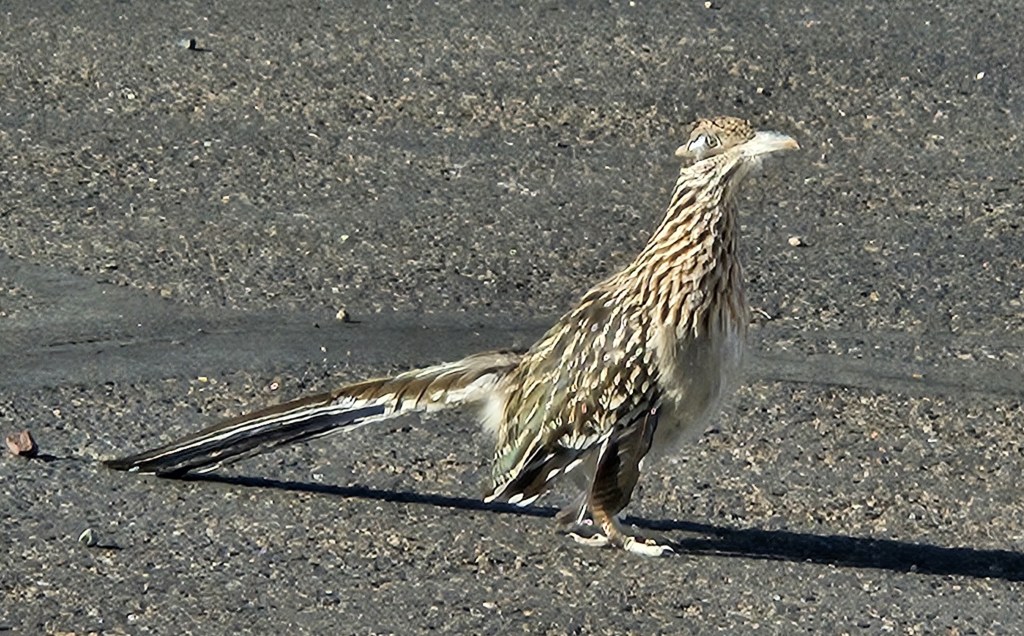
At our RV, Cal would often see a roadrunner making its way to somewhere further into the park. Later in the day, it would make its way back through our site again.

The thing I really liked about our stay in Goodyear was that there were citrus trees in our park, and the fruit was ours for the picking as residents. At any time, I would help myself to oranges, tangerines, lemons and grapefruit. This was my favorite grapefruit tree:

There are two regional Maricopa County Parks near Goodyear: Estrella Mountain, and White Tanks. We got in a couple of hikes when the weather warmed.

Estrella Mountain Regional Park
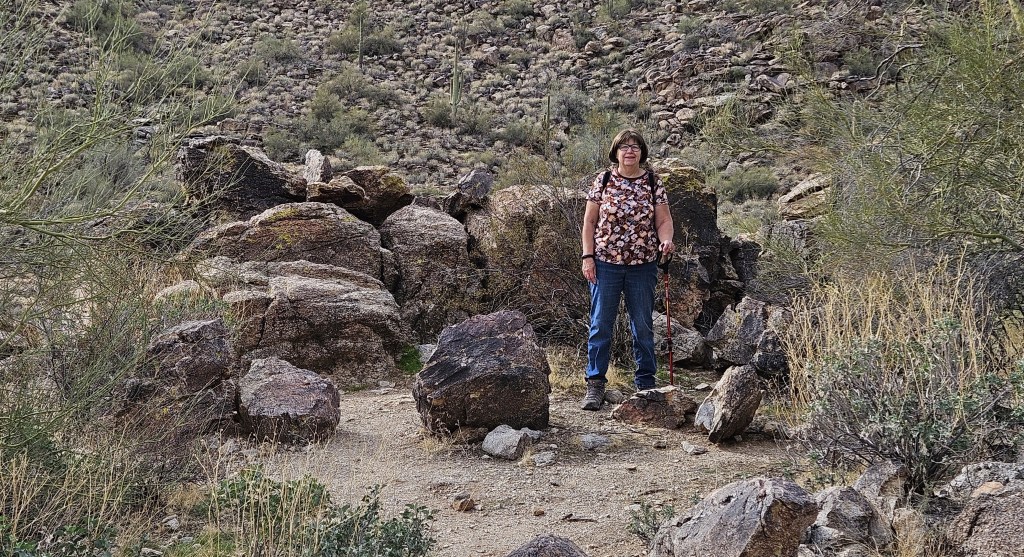
Yours truly in the rocks at White Tanks
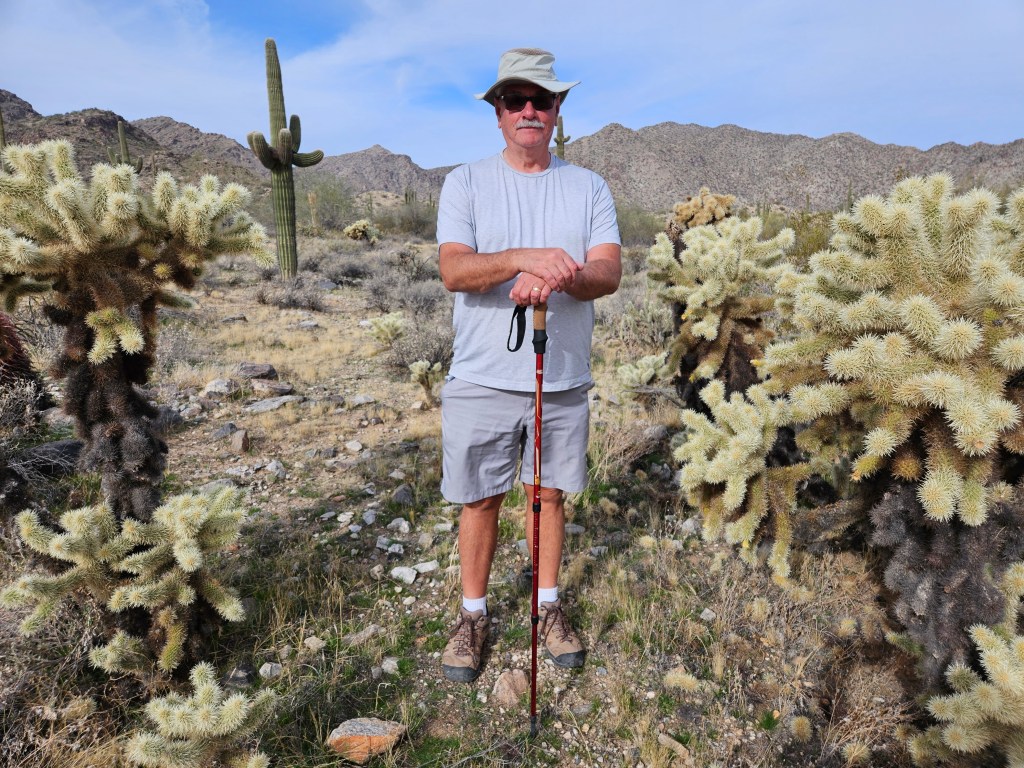
Cal at White Tanks between the cholla cactus

A winter in Arizona is certainly different from the Midwest, especially when I think about the landscape there in January. We’ve done our share of complaining about the chilly temperatures, but we know we have nothing to complain about when everyone up north is shivering with snow and ice.

Next time – Quartzsite!

USTravel

A Visit to the Capitol of Arizona

Just over a week before Christmas, we moved to Goodyear, on the west side of Phoenix. Two days later, we were on a plane to spend the holidays with our family in Denver. We were back in our RV for the New Year, ready to go and find out just what’s on this side of the city.

Except…we came back to Goodyear with long lingering colds, and Arizona was having its winter. It was chilly, and we spent a lot of time in the RV. One day, I was ready to get out, but we needed to go somewhere indoors. We hadn’t yet visited Arizona’s capitol building, so we headed back east to downtown Phoenix.

This may seem like an odd choice, but we have visited many capitol buildings, and they are usually pretty interesting. There is something different about each one. 


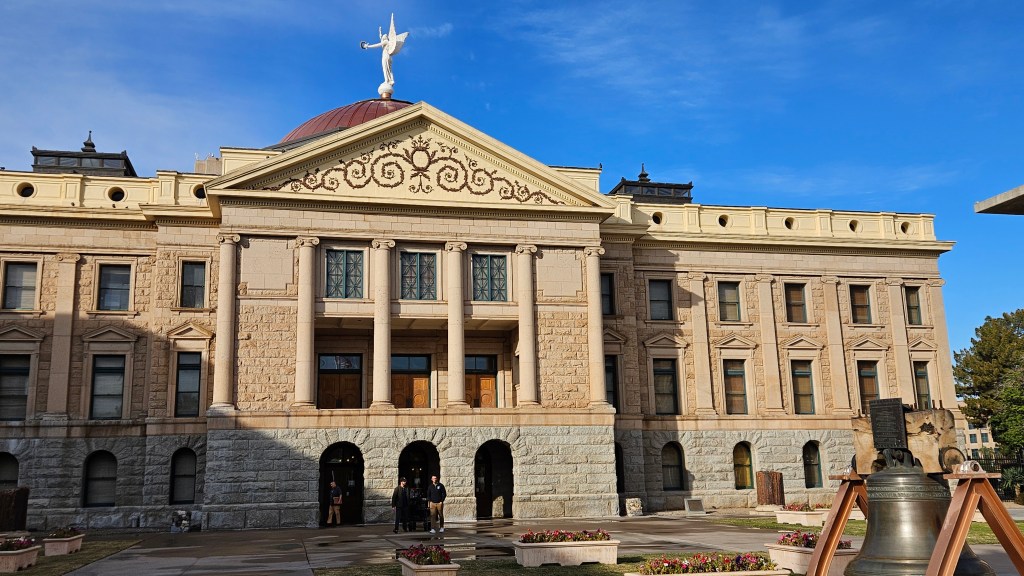
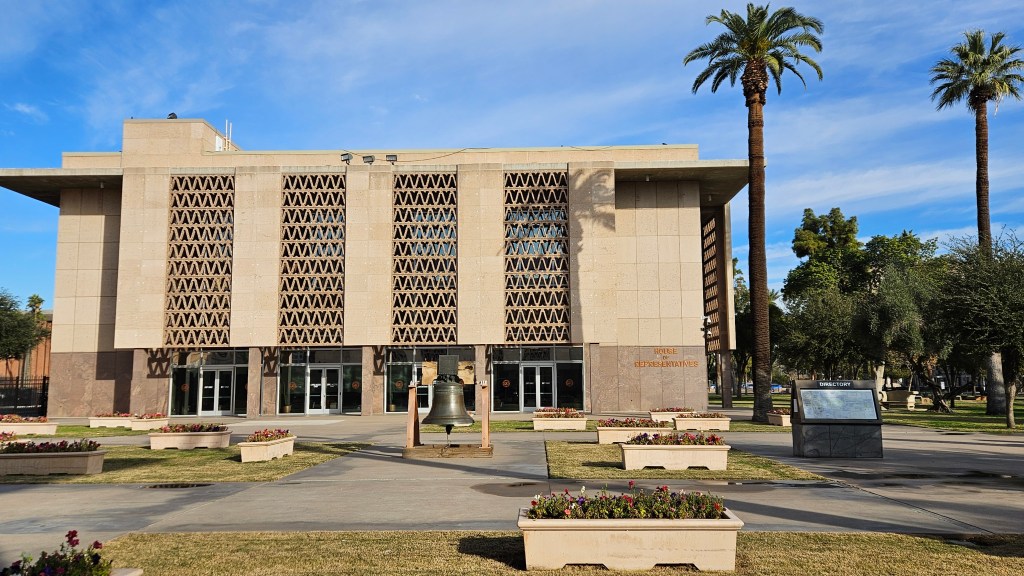
Right away, I spotted the difference in Arizona’s capitol building. It’s a museum. The state grew out of its building pretty quickly, and in 1960 constructed both a house and a senate building. 

This image has an empty alt attribute; its file name is 20240105_095334.jpg

From where I was standing to take the Capitol building picture, the House of Representatives and the Senate buildings were on my right and left.

A Capitol docent was on hand as we stepped into the building. He made sure we knew that there is no fancy architecture here or impressive sculptures as in other state capitols. During the time of its construction in 1900, money was tight and the entire cost of the construction was a mere $135,000.00. Arizona was only a territory until statehood came in 1912. Even the copper dome on top was just painted on for its first 75 years, until the Arizona Mining Association donated the material for the real deal. This was a low budget build.

We walked through the original senate room, where the statue of a man presided over an empty room. Empty, that is, except for Cal over there on the right. Together, they look like they’re studying something up on the balcony.

This image has an empty alt attribute; its file name is 20240105_103925.jpg

I thought this was a little strange, but a small plaque on his desk told me who he was: none other than George W.P. Hunt, first governor of Arizona. He also served in both houses of the Arizona Territorial Legislature. Interesting piece of trivia – his burial spot is in a gleaming pyramid on a hill in Papago Park overlooking the Phoenix Airport. Jets are flying right over him in perpetuity.

Other than the legislature, the rooms on all four floors are for exhibits now. The first one we came to was a room dedicated to the USS Arizona, a battleship that was sunk during the attack at Pearl Harbor. Although it is now at the bottom of the sea and part of the memorial there, a piece of it is right here in the capitol building.

Across the hall is an exhibit dedicated to Buffalo Soldiers. They were the first African American soldiers to serve at Fort Huachuca back in the late 1800’s. Having spent time at that military post both when Cal was in the Army and at the RV park there two years ago, it was like greeting old friends. 

We looked at the exhibit, and then went into a room where they detailed the lives of some of the soldiers. I was interested in one in particular: Private Cathay Williams. It turns out that Cathay was a woman, although her picture is a fictionalized version of what she was thought to look like.

Born into slavery, Cathay experienced great discrimination and oppression in her life. Only being able to cook and clean after emancipation, she joined the military to be able to make her own way. Being 5’9″ tall, she was able to conceal her identity for a full two years, until a smallpox outbreak put her in the hospital. She was then discharged. The military denied her a pension even though she suffered ill health for the rest of her life as a result of her service. If she didn’t receive the honor she deserved in life, I’m glad her story is here in the Capitol for all to learn about.

A model railroad is set up in another room. The train runs the length of the state of Arizona in the exhibit. One of the engineers was on hand to point out the points of interest in various “towns” and natural features – including the Grand Canyon – that the train passes.

The life of Sandra Day O’Connor is also highlighted in the capitol building. She was the first female Supreme Court justice, and she grew up on a family cattle ranch near Duncan, Arizona.

When we visited, there was also an art exhibit of paintings solely by Arizona women artists. I liked this painting, called “Laughter in Creases”, by Christina Carmel.

The results of the 1912 election are written on the wall on the first floor. It was the first election after statehood, and in this election, women were given the right to vote. Nationally, this did not happen until 1920.

When we reached the top floor, we could look all the way down to the first floor and the mosaic of the state seal.

There were many other items of interest here which I haven’t covered. We found this to be a great way to pass a dreary and cool winter morning.

Next time – wrapping up our Phoenix-area stay

USTravel

Saguaro Lake and the Wild Horses of the Salt River, Arizona

The distance from our abode at Lost Dutchman State Park to our next stay at Gold Canyon RV Park was a grand total of eight miles away. For all that, our forty-day stay there might have been a world away in comparison. We enjoyed happy-hour music on the bistro patio while watching the Superstition mountains turn red, a golf-cart Christmas parade and a choir concert, and watching folks playing (or trying to play) glow-in-the-dark golf one evening as we took in our evening walk. It is a fun and welcoming place, which is why we returned. We’d stayed here two years ago.

We are already gone from there, though. Joe Friday from Dragnet comes to mind with the quote: “Just the facts, ma’am, just the facts.” In this case, “just the highlights”. When I think of the highlights from our Gold Canyon stay, it is the the wild horses of the Salt River that I think of first.

During our last stay at Gold Canyon, I’d heard about the horses and wanted to see them, but didn’t know where to find them. This time, I received information on two possibilities. 

We headed east a little bit before driving north of Mesa into the Tonto National Forest, leaving the Superstitions behind us and going into the Four Peaks mountain area. This was new territory to us and we enjoyed the drive. 

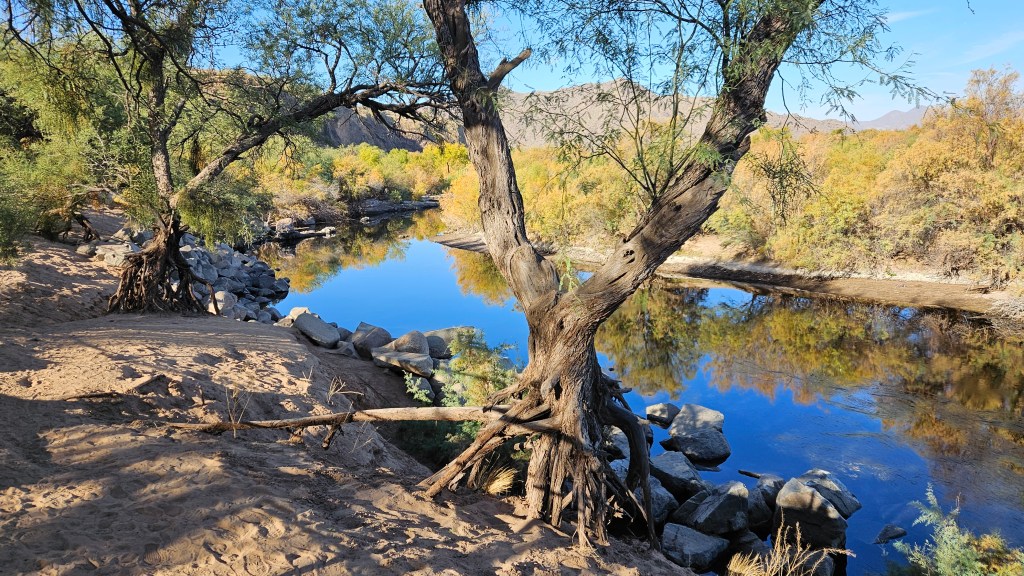
Our first stop this day was Coon Bluff Rec Area. It is a pretty spot with mesquite trees lining the high banks of the Salt River. Many bird watchers were out on this sunny day. I don’t know if they were successful in their bird sightings, but we didn’t have luck seeing the horses here. Still, it was pretty enough for a picture, horses or no.

Our second lead for possible horse sightings was Blue Point Rec area. We continued down the road, and just as we were on the bridge before the turnoff I saw them: several beautiful horses in the river! We turned into the Pebble Beach area across the road from Blue Point.

Except for one thirsty horse, they came up from the river soon after our arrival. We discovered there was a group of about eight, although they didn’t stay together.

They seemed aware of us but not afraid, moving not too far away as they munched their way up into the desert.

The horses are descendants of those brought here by the Spanish missionaries in the 1600’s when they were establishing their new churches. They are wild, but of course not indigenous. As such, they have had a long and fraught history. Their numbers multiplied more than local ranchers and the government would have liked, so they have been hunted and their numbers culled. Because of the dense vegetation along the river where horses could hide, however, many survived.

Several of them came up from the riverbank and I sat down on a rock to watch the show. They were unafraid of us but I did not want to come too close.

Today, the horses of the Salt River are protected and managed. It is thought that there are around three hundred of them, maybe more. There is an effort, through birth control, to reduce the herd down to one hundred. The horses do have predators: I was briefly a member of their Facebook group, and one of the new colts had just fallen prey to a mountain lion.

As we walked back to the car, the horses seemed to follow us.

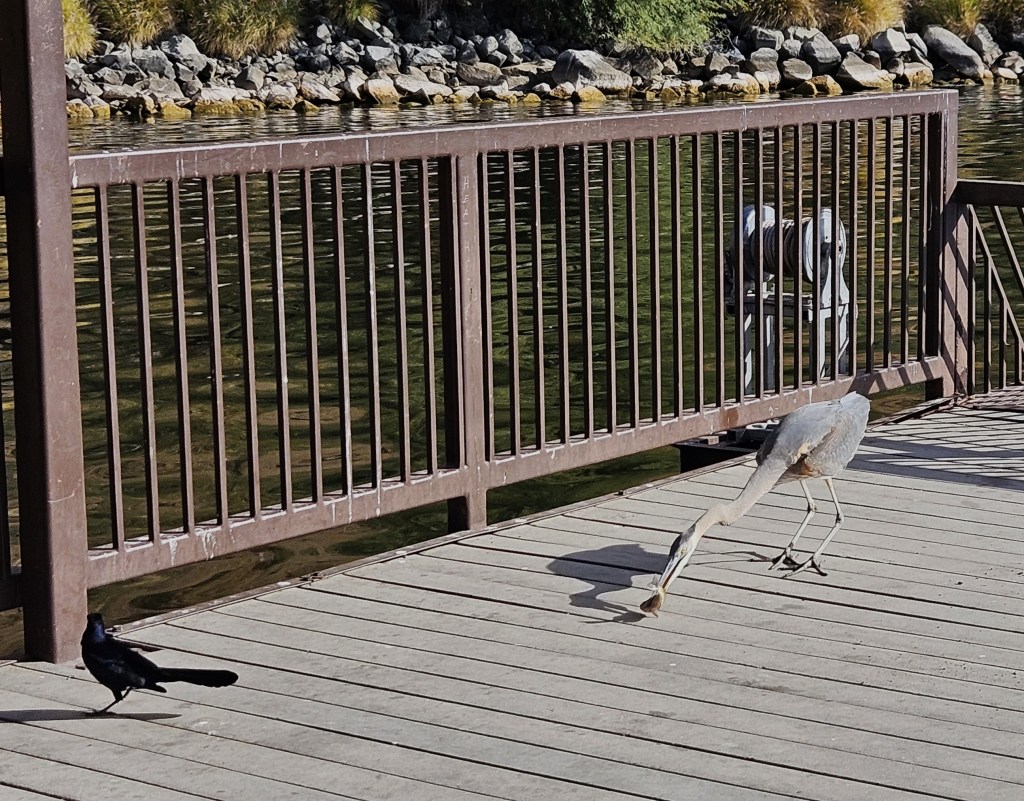
We weren’t ready to head home yet after all that excitement, so we moved up the road a short way to Saguaro Lake. We turned into the marina and drove around to a fishing dock where a blue heron was perched.

I usually can never, ever get a shot of a heron from this distance. They are aware of me long before I can focus my phone. I soon discovered the reason why this one was sticking around. A fisherman was throwing his small unwanted catch over to the heron.

We watched as he did this. A hopeful crow fluttered down next to the fish, but waited for the heron first. Snap! That fish was gone quick as a flash!

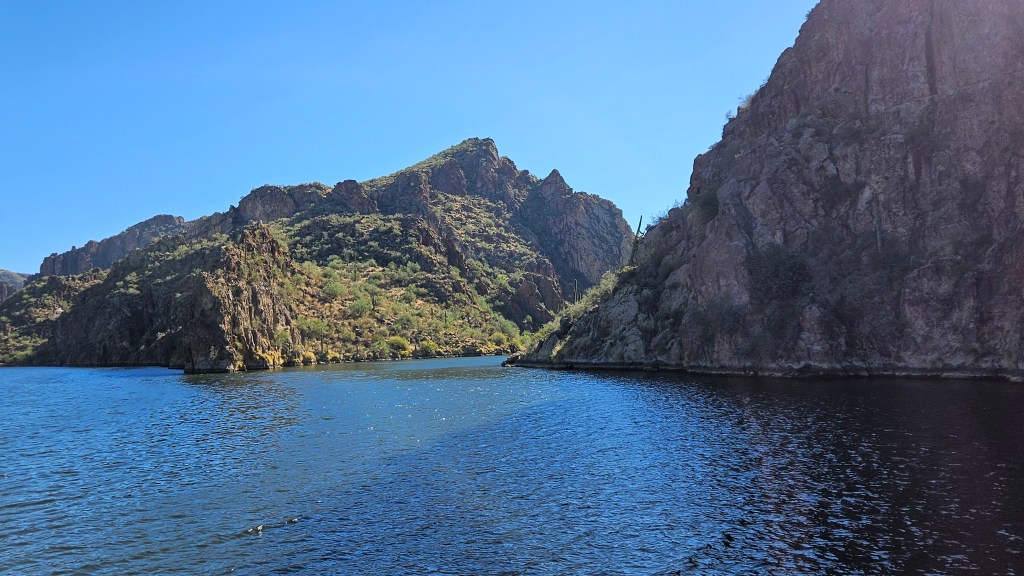
We returned to Saguaro Lake a few weeks later to ride its tour boat, the Desert Belle. For an hour and a half, we were treated to pretty mountain and desert views as we circled the lake.

A forest of saguaros grows on a hillside on one corner of the lake, where the sun and moisture are most favorable.

As the boat rounded the back of the lake, we found one of those most elusive of saguaros: the crested saguaro. For every 200,000 saguaros that there are, there is only one that is crested. We saw two or three during our last winter in Arizona, so now we can add this one to our list.

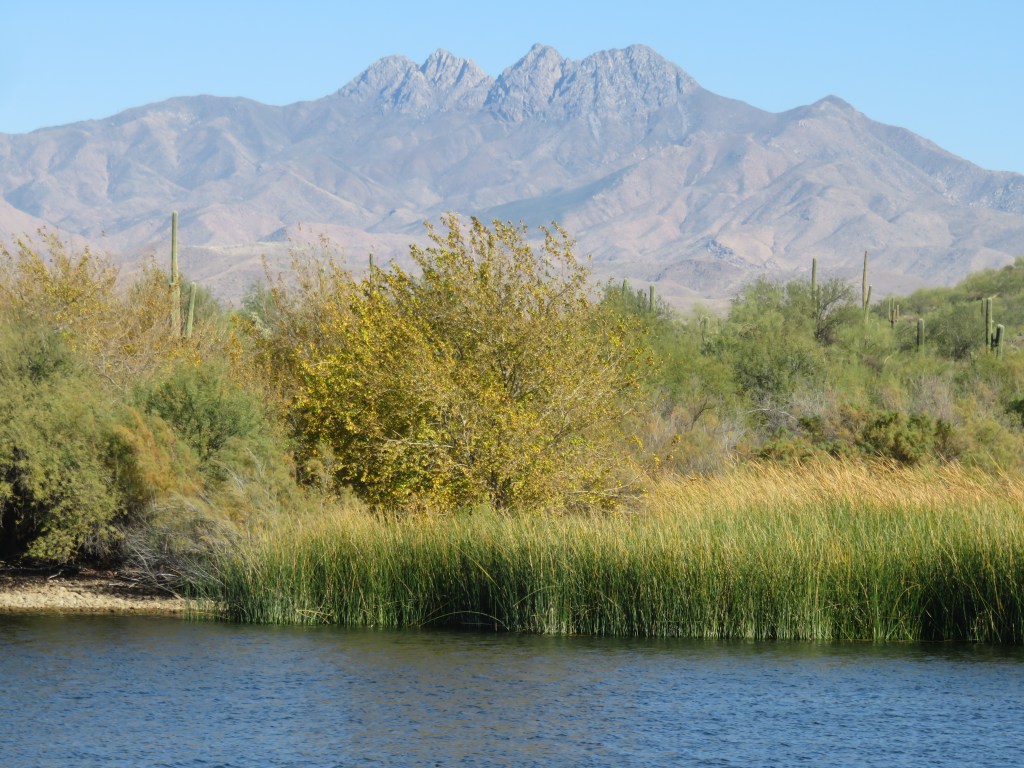
At the beginning of this blog, I noted that we were in the Four Peaks region of the Tonto National Forest. From the lake, we could see those peaks off in the distance.

The captain told us that there is an amethyst mine nestled below the peaks.

Bighorn sheep live here, but there were none to be seen today. We did, however, see eagles, and I switched my phone out for my camera to get this shot of one high on the rocks.

He also told us that there are actually four lakes created by damming the Salt River. From where we were, at Saguaro Lake, they go off to the east. If you think of the dams as a “scar” on the land, you can remember the names of the lakes that way: Saguaro, Canyon (in the Superstition Mountains), Apache, and Roosevelt.

One last shot of the lake for you – if you can see it, there is a rock formation that looks like an elephant. Appropriately, it is called Elephant Rock.

There were other adventures during our Gold Canyon stay, but I’ll save them for another time, perhaps. We’re on the move!

Next time – visiting Arizona’s Capitol Museum

Life in General · USTravel

“Home” Again in St. Peters, Missouri

We left this place two years and two months ago to begin our full-time RV life, and haven’t returned. It was exactly a year after the Covid pandemic began. Cal was happy to finally be leaving the Midwest. I was happy to be off on our new adventure. Life has taken us elsewhere, but a special wedding brought us back.

The RV park in which we stayed in for the week, 370 Lakeside Park, is one that we visited many times when we first purchased our RV. It was close to our apartment. As soon as we received a wedding date, I was on the phone and booking my coveted spot.

This is in the back row of the park closest to the lake and the bike path. Score for me! I had never been so lucky as to be able to book this when we had previously stayed.

As always, the geese are here in plentiful numbers.

The wedding was for our godson, Chip, and his bride Jessica. It was held at our former church in Florissant, and the reception was in downtown St. Louis. We had a great time and wish them well in their new life.

Chip and his siblings, Shannon and Megan, grew up with our daughters.

Chip’s parent’s, Kris and Rusty, are our good friends and we were happy to see them again.

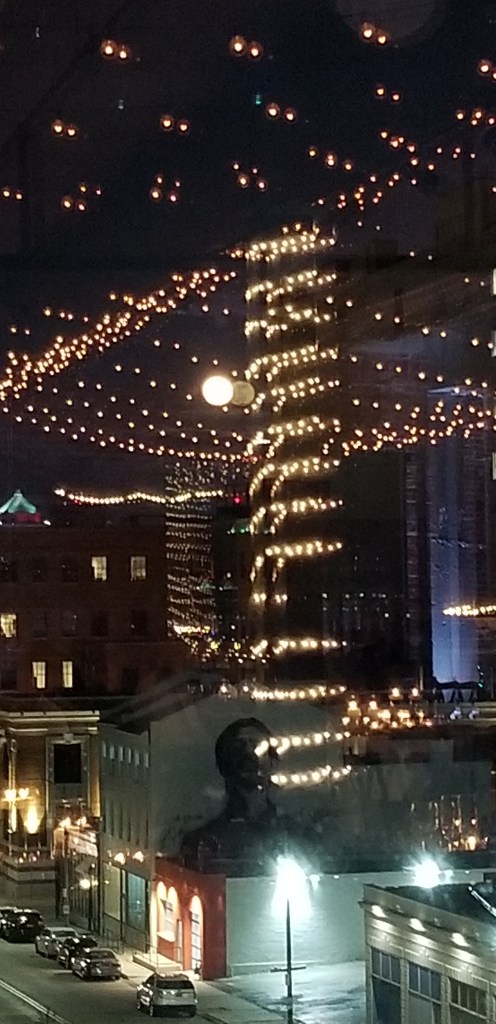
As it got dark, the lights in the reception room reflected outside the window, together with the full moon, for a surreal picture.

After the wedding events were over, we spent time with my sister Diana, my brother-in-law John, and their daughter Melissa and her family. We met Diana, John and their granddaughter at Blanchette Park, where there are some pretty gardens.

From Austin to St. Peters, we experienced spring over and over!

Clarissa, Diana and John in the gardens. It was a hot afternoon and we didn’t stay long.

And then…my blogging world met my real world. We had a lunch date with Betty and Dan Chambers. Betty has been one of my best followers on this blog, usually leaving thoughtful comments on what she has read. She also writes her own engaging blog, Chambers on the Road. I enjoy reading that, and in the past few months she has gone a step further and written an an e-book: RVing with Bikes.

We met at a little lunch restaurant, Lady Di’s, and were still visiting when the place closed for the afternoon! There was so much to talk about. We were on the patio, so we were able to stay long past their closing time. Although we had just met in person, it felt as if we had been friends for a good long while. They have kept their home in the area, but they like traveling with their RV and enjoy their e-bikes.

The week was a whirlwind of many family and friends to visit. One day I ate all three meals in restaurants or had carryout with three different groups of people. We saw many old friends from our church, and I also had a lunch with my former colleagues.

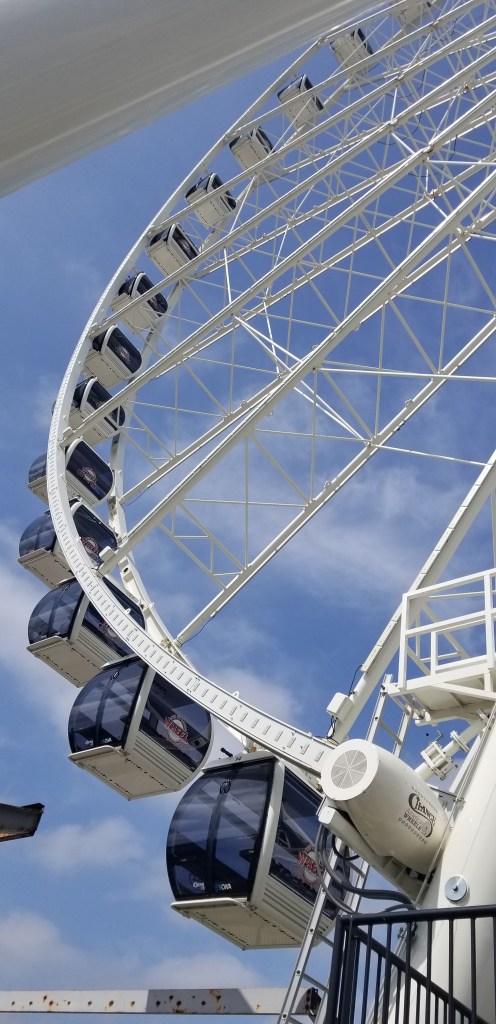
We decided to take one day out on our own to visit the aquarium and wheel at Union Station in downtown St. Louis. Both opened back when Covid was just beginning, so we were not able to go there before we left.

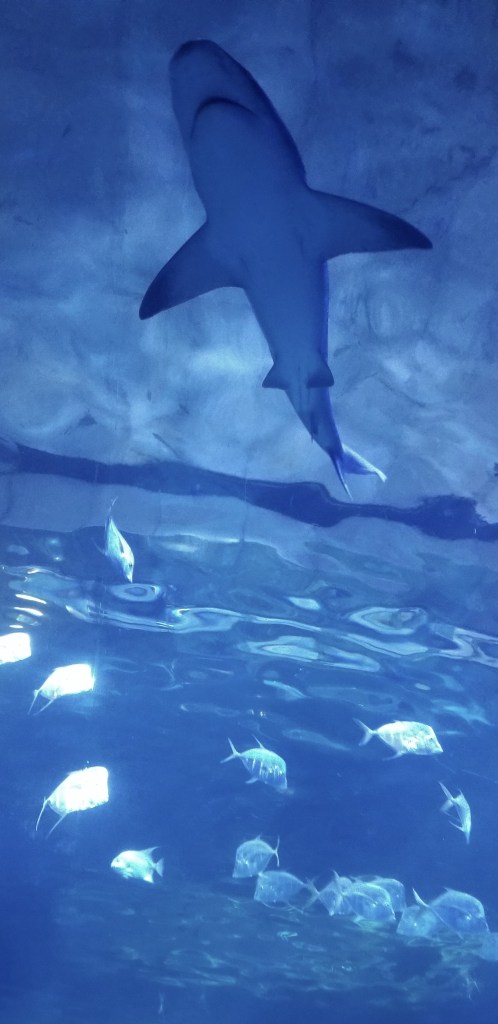
An immense tank around and above us in “Shark Canyon” included sandbar sharks, sting rays, and many varieties of fish

When our kids were young, we would often visit Union Station downtown. In the early 1900’s and in war time, it was a busy rail station. Fast forward to the late 1900’s when we were often visiting, it was a shopping mall with interesting one-of-a-kind stores, train memorabilia and a fun fudge shop where the workers had a whole “makin’ the fudge” show. The historic adjoining hotel had some pretty cool architectural features that even the kids found fun. They could stand in one part of an archway, whisper into the wall, and someone on the other side of the archway could hear them.

It’s exciting that St. Louis has an aquarium finally, and it’s not large, but I think they did a good job. The old mall went defunct and this is an excellent alternative. I just think it’s a little overpriced, and there is no price bundling with all the other attractions outside.

We did pony up to ride the wheel, though. It was a beautiful morning and we enjoyed seeing a different kind of view over St. Louis.

This is St. Louis’s brand new soccer stadium, which wasn’t finished yet when we left.

On our last evening, Diana, John, Cal and I brought Chinese dinner over to Darlene, who is a mutual friend of all of us. She lives just two doors down from our old house. We looked around our old neighborhood and it felt strange that we no longer call it home. Our house now has play toys in the front yard, and I’m happy to hear that there is a child growing up there.

Darlene was excited. She had the Corvette refurbished that she and her husband had dated in long ago. He passed away before he could begin his retirement dream to work on it. After a year in repair, she had just received it back and was proud to show it off. It’s a beaut!

It all happened so fast, and then we were gone. I have much to blog about regarding the rest of our journey to Denver. We’ve had busy lives since we arrived, and family obligations are now calling me.

I’m going to finish my Europe blogs, mostly without interruptions, till they are finished. Already it has been over a year since we arrived in Ireland so, while I’m writing, I figure that I can relive those memories at the same time of year as they happened. What is the next country we visited? Hmmm….

Next time – back to Europe

USTravel

An (almost) Perfect Roadtrip North

An idyllic stay at Coulter Farmstead

We had four days and three nights to move our RV from Austin, Texas to St. Peters, Missouri. When looking for our evening stops, I usually search the state and COE parks first, and then see if there are any Harvest Host establishments on our route. This, in addition to making sure that the drive time for Cal is in manageable time chunks. I’m not always lucky on this score, but I hit the ball out of the park on this trip.

Tyler State Park marked our last night in Texas. We had been in the state for almost six months.

Our drive from Waco to this pretty spot near Tyler, Texas was on a curving state route with green woods, rolling hills and fields that were carpeted with blooming flowers in shades of yellow, pink and blue. The park itself is also hilly, in a piney woods next to a small lake. It was relaxing place to stop and unwind from the day, and take in a hike or two.

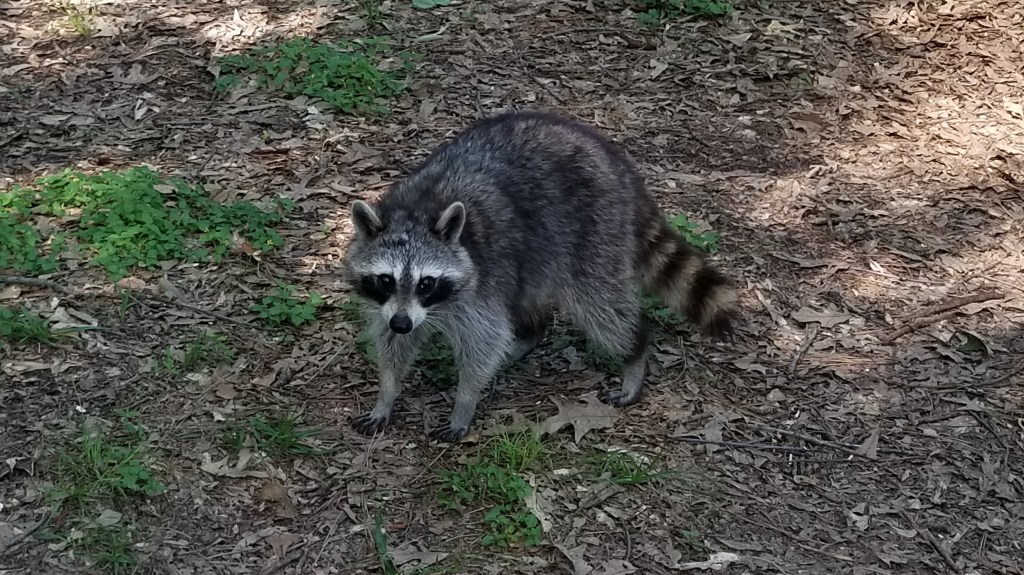
A resident raccoon ambled through now and again, scavenging for a bite to eat. Sadly for this raccoon, signs around the campground admonished us sternly not to feed the wildlife.

All is not as perfect as it would seem, however. Google directed us to the wrong side of the park, necessitating a drive the long way around on the country roads. That beautiful road in from Waco was bumpy, so many things in the trailer got jostled around. When I opened up the cupboard housing my spices, the turmeric fell out, the lid smashed, and…. well, we had a bit of a yellow floor for a little while. The shelf in my closet which has a clothing rod under it also fell sometime during the day. Hmmm…could it be I had too many books sitting on it?

As I was strolling around the campground, I noticed a stand of firewood for sale. Next to it, a Little Free Library! I had never seen one in a state park campground before. I took this as a direct message from God, the universe, whatever, and hoofed it back to our site. I filled up that Little Free Library with an overflow of unread books that I’d picked up from other free libraries and swap shelves. I was a little sorry to see some of them go, but I will always pick up more.

The rest of our trip was thankfully uneventful and Cal has since repaired my little shelf securely with several screws.

We spent the next evening at Coulter Farms and Historic Wolff Mercantile, a Harvest Host stop near Washington, Arkansas which is pictured at the top of this blog. Justice and Katie, the owners of this paradise, have moved several historic buildings, including old cabins, to their bed and breakfast establishment. The Mercantile is a little gift shop and they also sell frozen meals.

They own the cutest little Highland cow, and several goats. Justice gave us a little bag of feed to give to them.

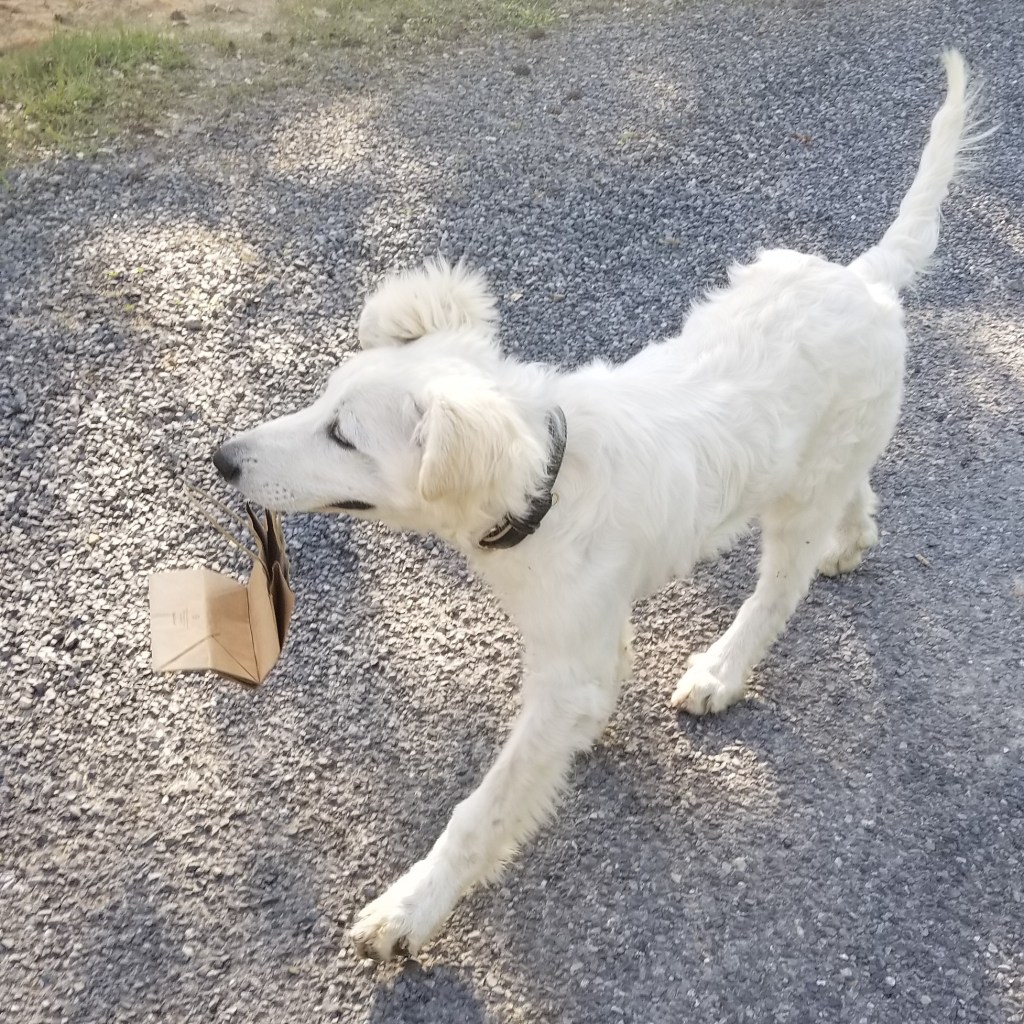
Their dog, Abel, helpfully carried the feed bag for us, even when it was empty.

There were also curly-haired pigs to see, as well as their cat. Altogether, it is a very beautiful and peaceful setting.

The town of Washington, Arkansas is itself a state park. In the 1800’s, it was a stop on the Southwest Trail and for a couple of years served as the Confederate capital of Arkansas. Goodlett Cotton Gin, dating back to 1883, is in the front of the property we were staying on.

The post office in Washington has the honor of being the oldest facility in Arkansas, dating back to 1820. The Bowie knife also originated here.

Walking into town after dinner provided some evening’s entertainment, but all the buildings that have been restored or converted into museums were closed. In the morning, of course, we were on our way before they opened.

On our way, that is, after we had a delicious breakfast of hot and tasty egg souffle, muffins, yogurt parfait and orange juice delivered to our RV. That was a treat!

We were in northern Arkansas for the next evening’s stop at Davidsonville Historic State Park. This is another small park, easy to get to, with the full hookups that Cal likes. It is right on the edge of the Ozark hills.

This time our site came with a cat. He was very friendly and affectionate, and seemed well fed. I’m hoping that the park rangers in the visitors center across the street are feeding him and keeping an eye on him.

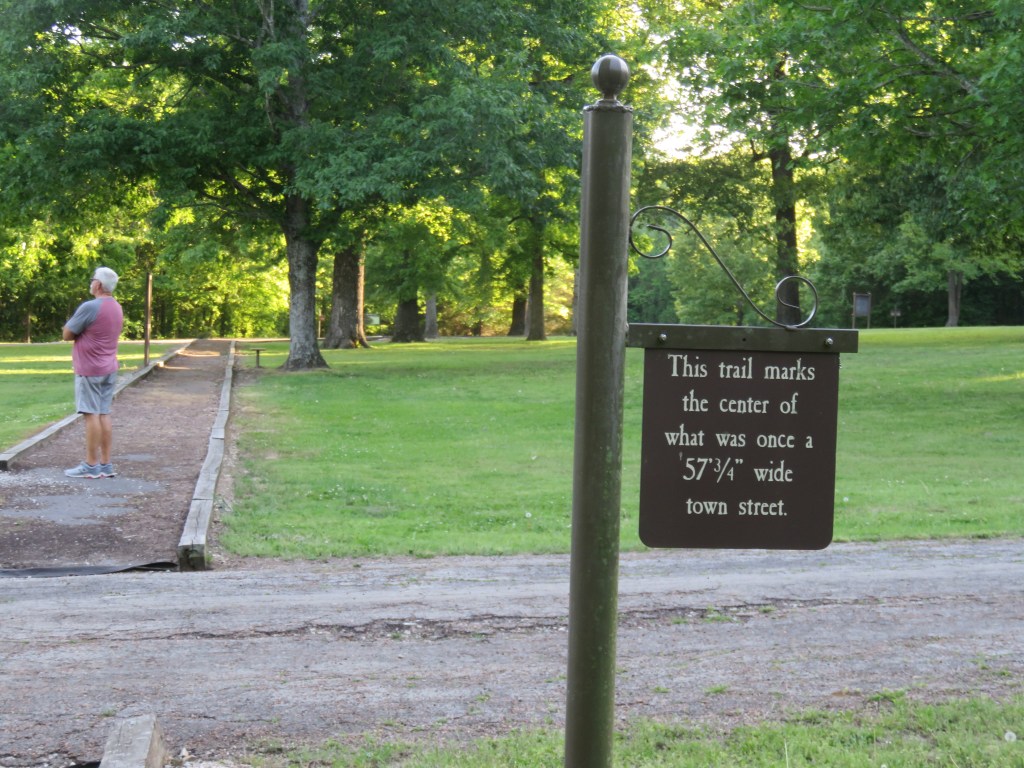
This park takes the visitor even further back in time than Washington, Arkansas. The old streets are here but the buildings are gone. Archaeological digs have been done here to determine where they were and to search for artifacts. Davidsonville was one of Arkansas Territory’s first settlements in 1815. There is evidence that French colonists were here even earlier, and Native Americans used the site as early as 4,000 B.C.

Ghost structures show the outline of a few buildings. Washington may have had the first postal facility, but Davidsonville had the first postal stop. It was in Adam Richey’s house in 1817. His former house is one of the ghost structures.

Unlike the way we send mail today, a letter in those days was sent without postage. When a person went to pick their mail up at Adam’s house, they paid for it at that time. Mail only ran once a month.

Davidsonville also has a pretty little lake.

A good place to stay for the night certainly makes the trip shorter and a whole lot more fun.

Next time – we arrive at “home base”

USTravel

Visiting our 36th President in Johnsonville, West of Austin

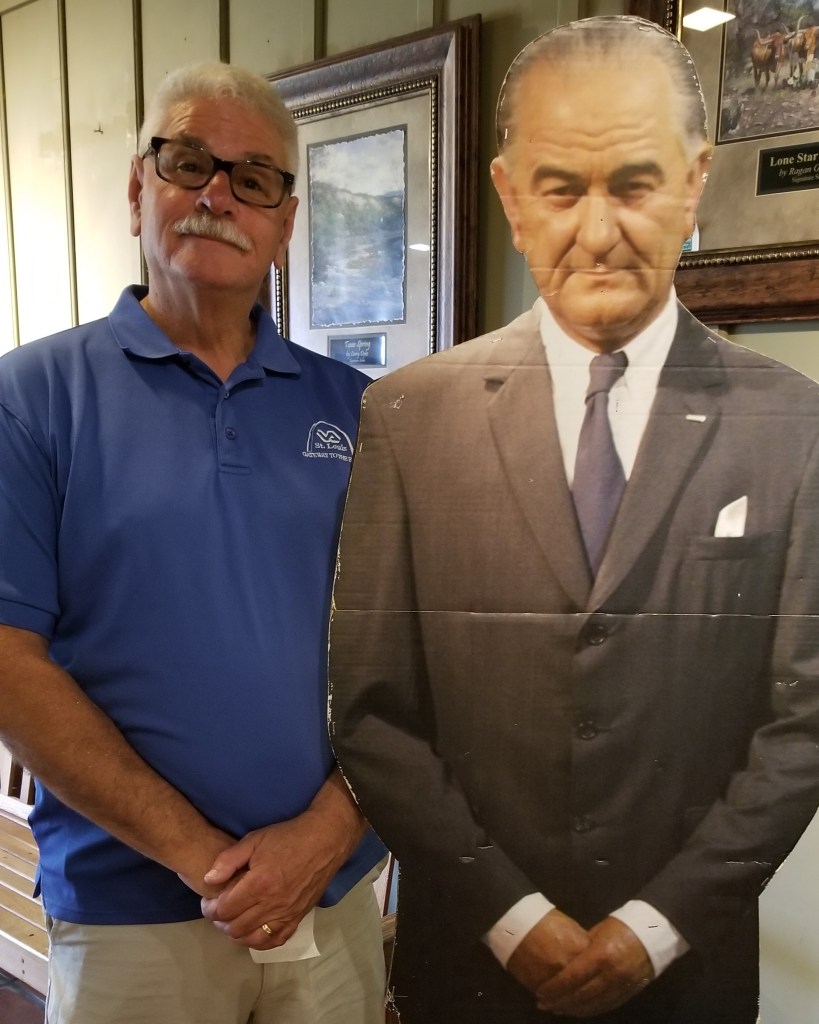
Do you recognize this person? The guy on the right is who I mean. By now, you probably recognize my husband Cal, on the left. Lyndon Baines Johnson (often called LBJ) was our 36th president from 1963 to 1969. We spent a day in and around the Hill Country town of Johnson City, Texas. When you look at the whole of it, to go back into LBJ’s life in Texas is to go back in time to the earliest days of Texas settlement. That includes both ranching and cotton farming, and a whole way of life that is gone now.

Despite doing a little research, I wasn’t sure where we should start. We ended up visiting the National Historical Park in town first. Johnson City was settled in 1879 by a person named James Polk Johnson, for whom the town is named. Another early settler was Sam E. Johnson, Sr., who was Lyndon’s grandfather and James’s uncle. From what we heard, practically everyone in town is related to some branch of the Johnson family somehow. The National Historical Park has a little museum, and when we stepped in, a docent was ready to take us right back out and down the street for a tour of LBJ’s boyhood home.

Young Lyndon lived here from the age of five until he left home for college. He had three sisters and a brother, all of whom were younger than he. The inside of the house is shown as it would have been during his teen years. His sisters all had the front bedroom with windows that you can see behind the bush. He and his brother had a bedroom right behind their parents’ room, so there was no sneaking out after bedtime!

It was from this front porch that LBJ announced his first foray into politics: his candidacy for the House of Representatives, which he won in 1937.

After visiting the museum, it was a pleasant little walk to the Johnson Settlement. There are historic buildings here to give the story of Texas frontier ranching life. I was a little disappointed to see that all of the buildings in this area were either closed or under reconstruction. LBJ’s grandparents’ cabin is shown below on the right. They moved in in 1867 and lived out their lives here.

LBJ’s grandfather and uncle had a cattle droving business. As a nod to Texas ranching history, a couple of iconic Texas longhorn steers were out in the little pasture. This one stopped to pose nicely for me:

From Johnson City, it is fourteen miles out to the LBJ Ranch District area of the National Historical Park. It was time for lunch, so we had a little picnic in the cab of the truck. It was a cool day, and rain threatened. The picturesque Pedernales River was in view.

Most of my reason for wanting to visit the LBJ Ranch was that I had visited here already many years ago and remembered how fun it was. I think I was here twice: once on a tour from Ft. Hood, where I was stationed, and once when my parents came down to visit. It’s all very fuzzy, but I remember riding all around the ranch in something like a golf cart. A ranger at the office told me that it was a 10-person tram. The tour did not start until every seat was full! I wouldn’t want to be the person who arrived just after the tram had left.

It is all different today, and to me it’s a little confusing until you are there. When you follow the sign in to the ranch, you are in the LBJ State Park and Historic Site. You buy your tickets for the national park in the visitors center of the state park unless you already have a pass. In the state park is also the Sauer-Beckmann Living History Museum. You can see it or skip it. Then you drive down the road, cross the Pedernales River which separates the two parks, and you are on the ranch. It is a neatly mapped out park road now; no more trams.

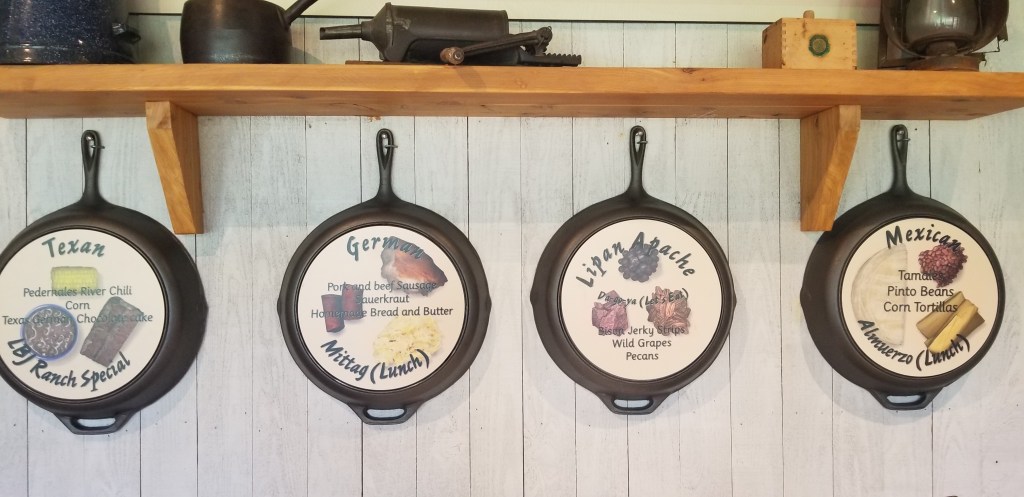
The state park offers a little detour from the Johnson history. There was this little display in the visitor center which showed what various cultures on the land would have had to eat, going back in time. I thought all of them sounded good.

The living history farm in the state park takes the visitor back in time to 1918.

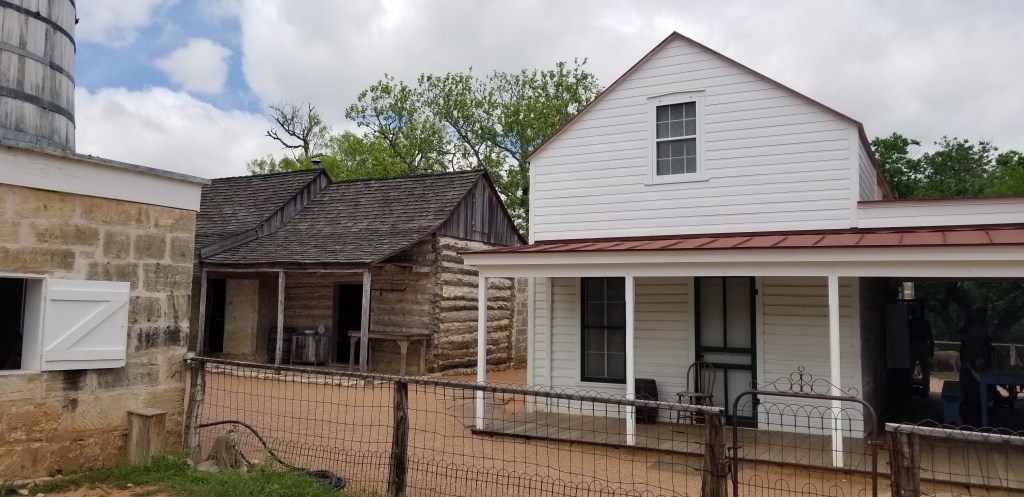
The Sauers moved here from Germany in 1869, built their log cabin, and later a frame house next to it. They farmed and raised cattle and sheep. They lived their lives here, adding to the land, and then sold the farm to the Beckmann family in 1900. The Beckmanns raised cotton.

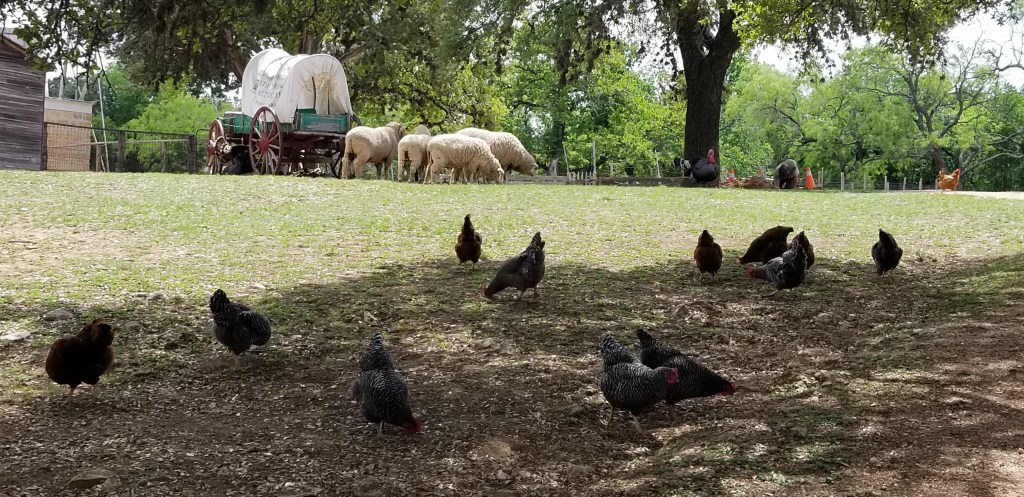
This is a “living history” farm in that the rangers are dressed as they would have been in 1918. They care for the animals. They gather eggs, cook, clean, work in the garden, make lye soap and do seasonal chores such as canning and slaughtering. Here’s the thing: what they eat for lunch has to be whatever they have produced on the farm. The rangers admitted that sometimes it gets a little challenging to put it together.

The last Beckmann descendent died in the 1960’s. When the state park took it over, they put the farm into a time machine. They took out the shag carpeting, the appliances, and all the hookups to electric, water and sewer. The farm transformed into what it had been.

In 1918, Lyndon Johnson was a boy. The family had land here and sometimes retreated to the old farm when times were hard. The Beckmanns were his neighbors.

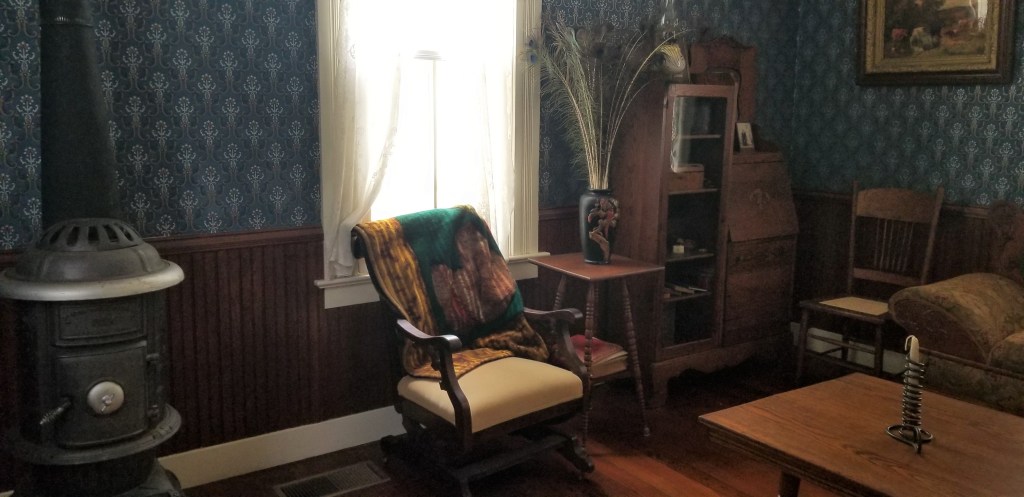
What was fascinating to me was that in 1918 my own mother was almost five years old and living on a farm in Michigan. As I walked through the house I took myself back in time, imagining that maybe her house looked a little like this, too.

Would her family have used these medicines?

The day was already getting on and we needed to get ourselves over to the ranch.

We passed the school where 4-year-old Lyndon started his education. We stopped to look at his birthplace, but the house that is there now is reconstructed; LBJ as President turned it into a guesthouse. Instead of that house, I decided to show you a view of the ranch from out back. The beautiful yellow flowers were in bloom in fields all over Texas.

LBJ’s grandparents moved out here from the cabin near town. They lived the rest of their lives in a house near this spot.

Across the road from both houses is the Johnson family cemetery. This is where both LBJ and his wife are buried. It’s a peaceful place overlooking the river.

The ranch maintains a herd of longhorn cattle which roam freely. We had to be sure to watch out for them, and not run over any young calves, as we drove the ranch roads. The Sauer-Beckmann farm has cattle, too, and I don’t think they needed any more beef.

The cattle are cared for in a “show barn” area but we did not stop there.

Our last stop was the highlight: the “Texas White House”. This was the original rock farmhouse on the property and LBJ’s refuge. It was enlarged over the years and added on to so many times that now there are structural issues. There is massive reconstruction going on so for that reason the house is currently closed. I was able to walk around part of it. Imagine all the barbeques on this lawn, with the famous politicians of the day in attendance!

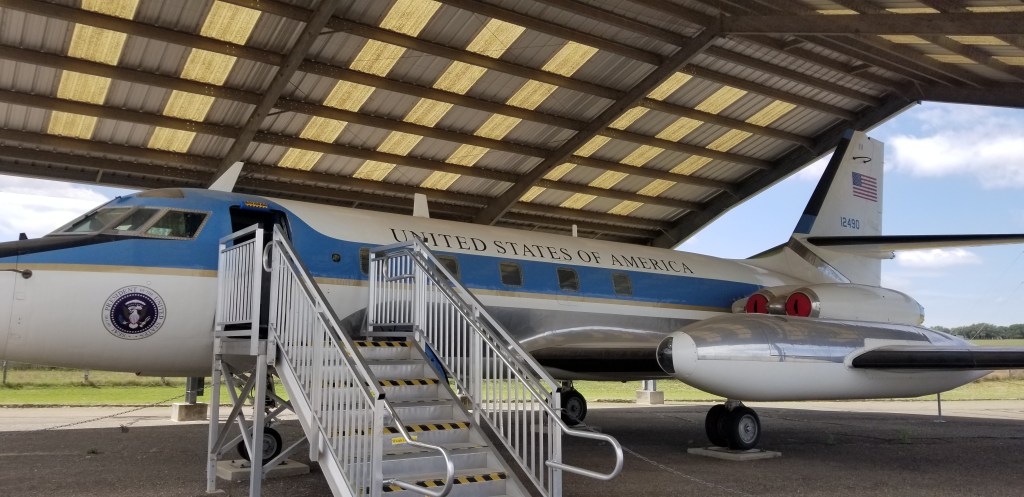
A small airfield was constructed on the ranch for LBJ’s arrival. His plane was called “Airforce One-Half” because Airforce One was too large to land here. He would fly into Randolph Airforce Base near San Antonio, and then embark on this plane for the ride home.

LBJ was vice-president under John F. Kennedy, and was sworn into office upon his death. At the end of his term he successfully ran for president again. He could have run for a second term but the Vietnam War was becoming a major problem and he declined, choosing instead to retire to his central Texas ranch. He only had four years of retirement when he passed suddenly of a heart attack.

We have come to the end of our Austin time, and indeed, as I’m writing this, it is almost two months later and we are far away from there. There is much to tell you about our travels as we have continued down the road. However, I’m going to pick up my blogs again from our trip to Europe last year first for a few weeks.

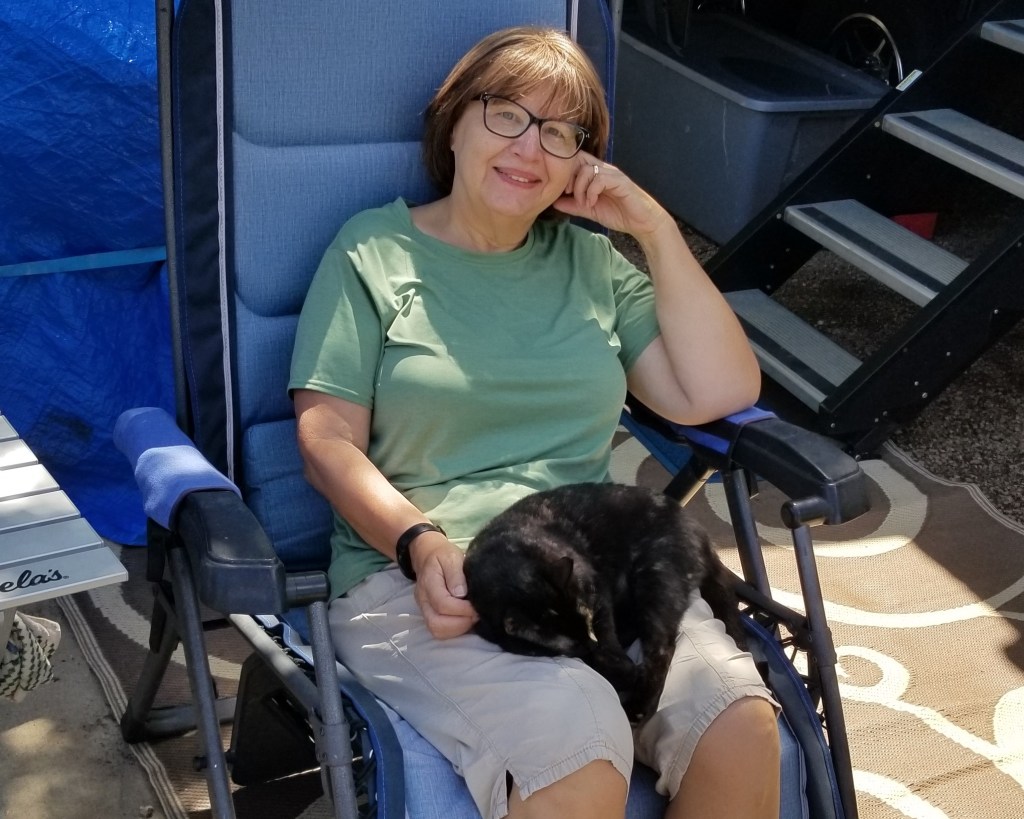
At our RV park, we were in exactly the same site as we had been in two years ago and had made friends with the cat that the permanent RV dwellers next door owned. When we arrived for this stay, Pumpkin appeared shyly from under the trees. As soon as I called her name, she ran to me. We bonded again for the month we were here and she could often be found snoozing on one of our lawn chairs. It was bittersweet because we will never have this site again. The park is making it a site for permanent dwellers only. I’ll leave you for now with a picture of me and my special friend.

Next time – back to England with a tour of Stonehenge and the Cotswolds

USTravel

Longhorn Cavern West of Austin

Not far from the bluebonnet fields of Muleshoe Bend lies a Texas state park called Longhorn Cavern. The entire purpose of this small park is for its cave tours. We drove right past this park a couple of years ago on the way to another state park, Inks Lake, which is only six miles down the road from Longhorn Cavern and is itself another great park to visit. It’s a beautiful drive through rolling hills with spring wildflowers and longhorn cattle in view.

Natives used this cave as a Comanche Indian Council room. An outlaw by the name of Sam Bass used it as a hideout. Just before the cave was purchased by the state in the mid-1930’s, it was used as a speakeasy nightclub complete with dance floor and a kitchen. Once the state purchased it, the cave was completely readied for tours by the CCC boys. This was prime CCC time. Our tour group gathered in this pavilion below, which they built solely for that purpose from local limestone. The craftsmanship is admirable.

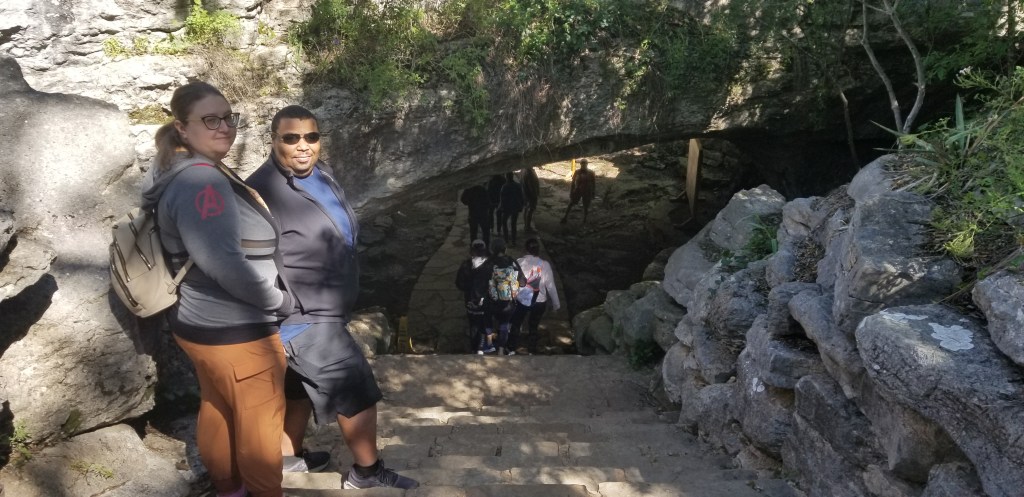
From this building, it was a short walk over and down to the cave. I captured these views as we were going in.

Every cave I’ve visited is different from every other one. I like to see what new thing each cave is going to show me. For starters, I’ve never been in a cave that was totally developed by the CCC. They removed 2.5 tons of silt, debris and bat guano, and they built stairs and walkways. Their entire long days were spent working down underground with candlelight. For that, they were paid a dollar a day.

Longhorn was formed long ago by underground flowing rivers, which makes it unique. Most caves are formed by water sinking down through the earth. The flowing water sculpted beautiful works of rock art.

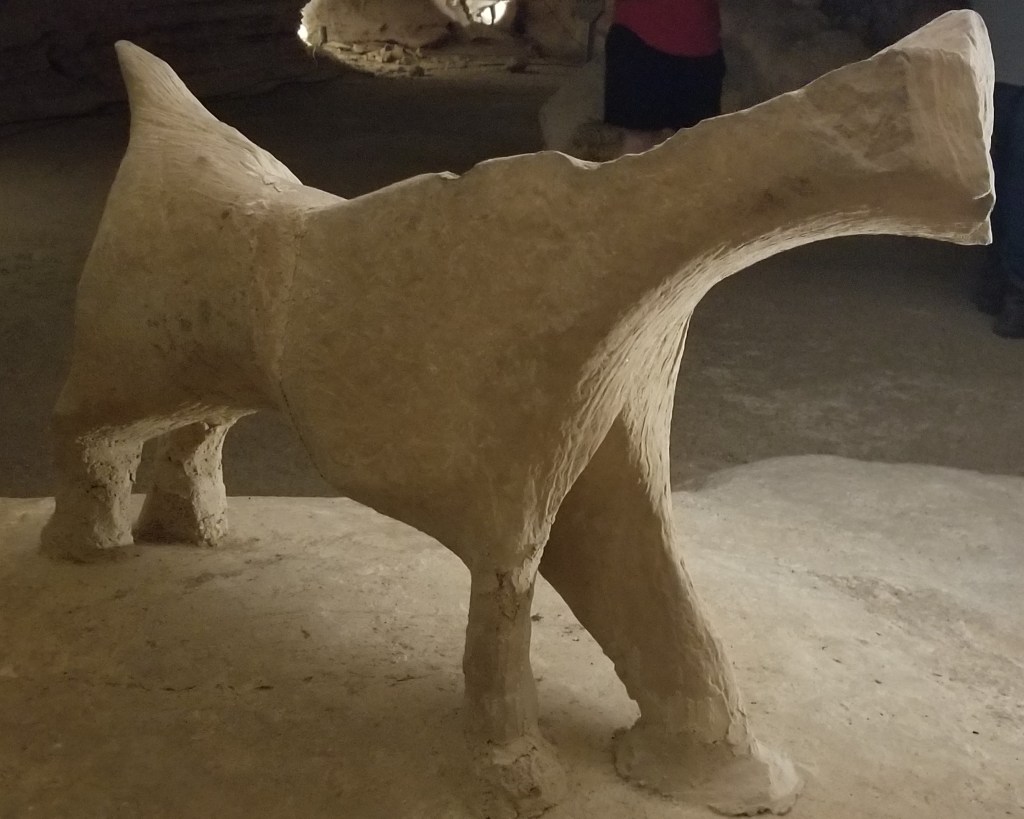
The CCC workers found this “dog” further back in the canyon and moved it up to where it could be seen better. They were working back in the day when it wasn’t common knowledge that caves should be left in their natural state. Mother Nature carved this sculpture out of magnesium-rich dolomite rock.

Because of flowing rather than dripping water, this cave is not resplendent with stalactites and stalagmites. It did fold some of them in with its sculpted rock art, though.

There is a colony of 80 to 100 tricolored bats here. Of course, they were snoozing away, so we were admonished not to disturb them and not to use flash on our cameras if we wanted to take a picture. Our daughter, Katie, was particularly good at spotting them.

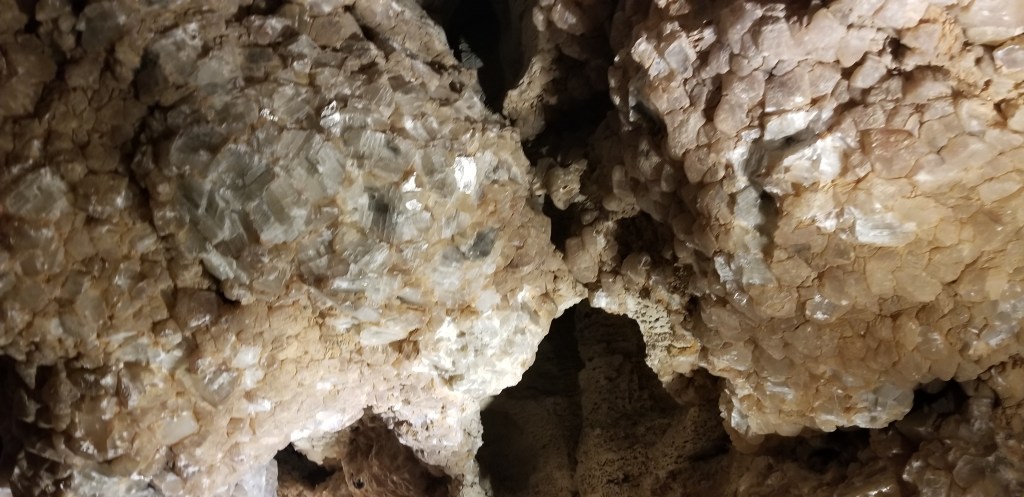
The thing that made this cave a standout for me, though, was an area lined with calcite crystals. There were so many in one place in the cave that our tour could divide as we wished through two tunnels left or right, circle around back to the main tunnel, and go see the other side. They glittered in the dim light. Wow!

I learned a new word in the cave – “pareidolia”. It is the human ability to see shapes or pictures out of something random. For example, “cave bacon” is simply flowstone which looks very much like real bacon. Our guide showed us many formations that looked like something familiar and, for fun, urged us to find our own pereidolia. She showed us this face made from light and rock:

Can you see a man’s face?

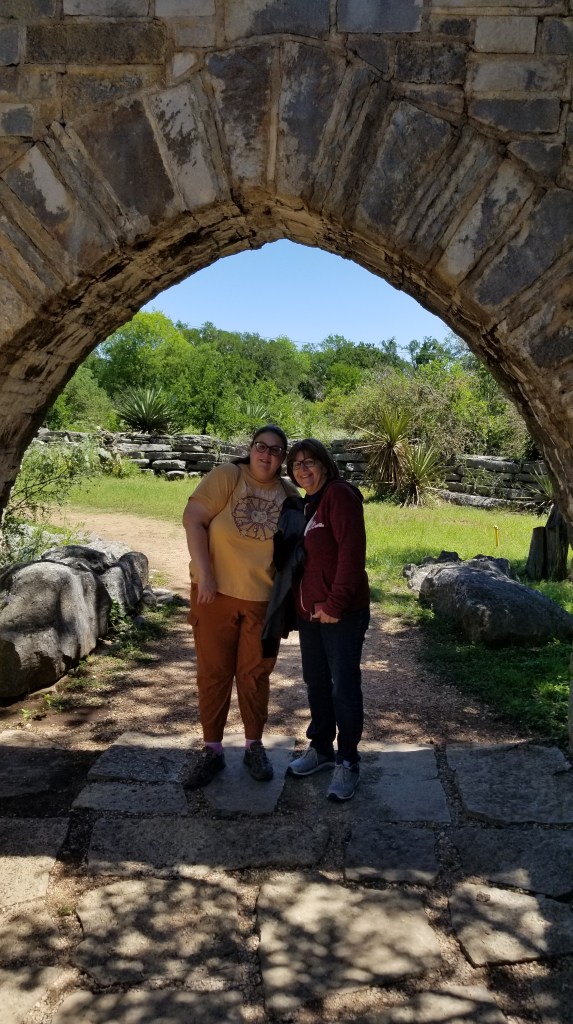
The tour was a full hour and a half and it was well worth the ticket price. Coming back up, my daughter and I stopped for a picture under the CCC’s beautiful stone archway:

Above ground, there are a few trails in this small day-use park, and the CCC built a tower here also. Climbing it gives a view of the Hill Country all around. But I can’t tell you more than that, because it was lunchtime. We were all hungry, so we skipped it.

The best stop here that we’ve found for lunch is in nearby Marble Falls, at Blue Bonnet Cafe. Cal and I had stopped here for their renowned pie once, and this time we discovered they do a great lunch too. It was a Saturday, and there was a line, but it moved quickly.

There was one more destination I wanted to see in the Hills area, and I will save that for my next and last posting of “West of Austin”.

Next time – we visit a past President of the United States

USTravel

Bluebonnet Bonanza West of Austin

West of Austin–a bounty of beautiful hills, rivers, parks, historic towns, wineries, and destinations for a day or more. Instead of jamming everything together in my usual fashion, I decided to write a series of three shorter blogs about three destinations in this area. Muleshoe Bend Recreation Area will be the first.

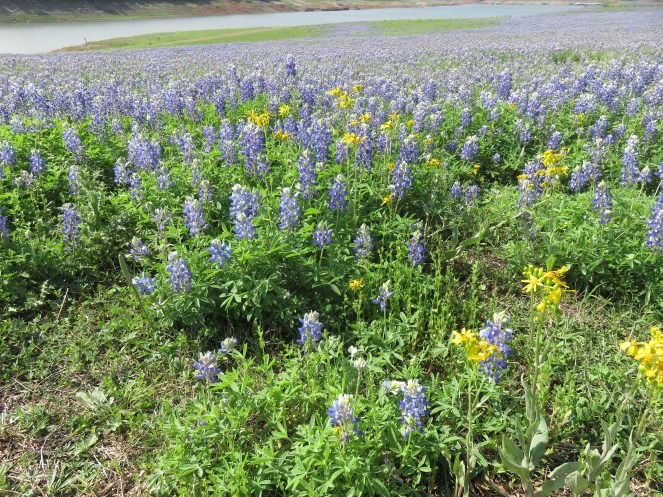
We started to see them when we were in Corpus Christi. And then, driving into central Texas, they carpeted the roads and the fields. Beautiful swaths of color: blue, orange, pink, white. Sometimes just one color, sometimes two or more mixed in. Texas’s highways and byways in the spring are not to be missed. What am I talking about? The wildflowers, of course! If you have not been to Texas in late March or early April, it should really be on your calendar for next year. And now, I can tell you where the Shangri La of Texas wildflowers is: Muleshoe Bend Recreation Area.

Muleshoe Bend is an LCRA park, the same as South Shore Lake Bastrop where we had stayed earlier. LCRA stands for Lower Colorado River Authority, a non-profit public utility that provides water stewardship and electric energy. While at South Shore, I picked up a little magazine that listed all of the LCRA parks. Next to the write-up for Muleshoe Bend was a glossy picture of fields of bluebonnets. Wildflower heaven! This was to be our first weekday trip for our Austin stay; the flowers along the roadways seemed to be at their height of blooming and I did not want to miss them.

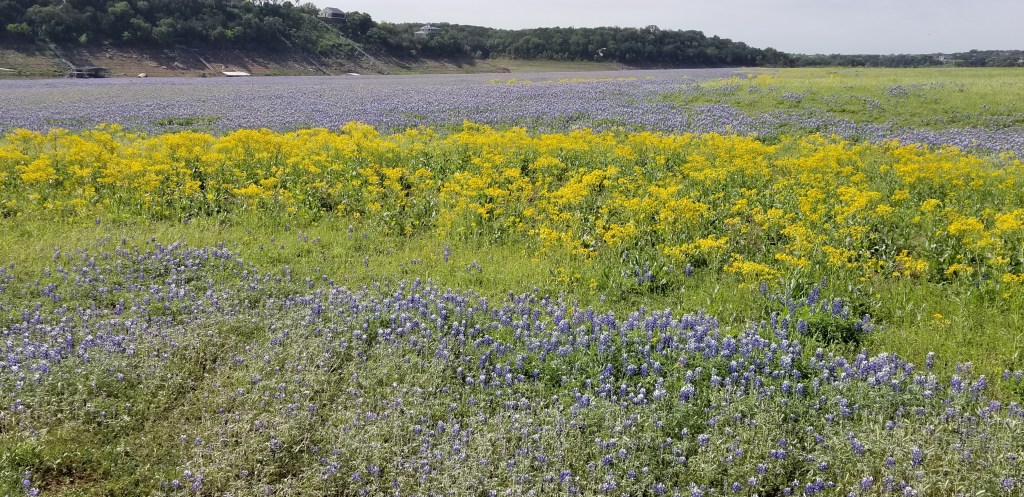
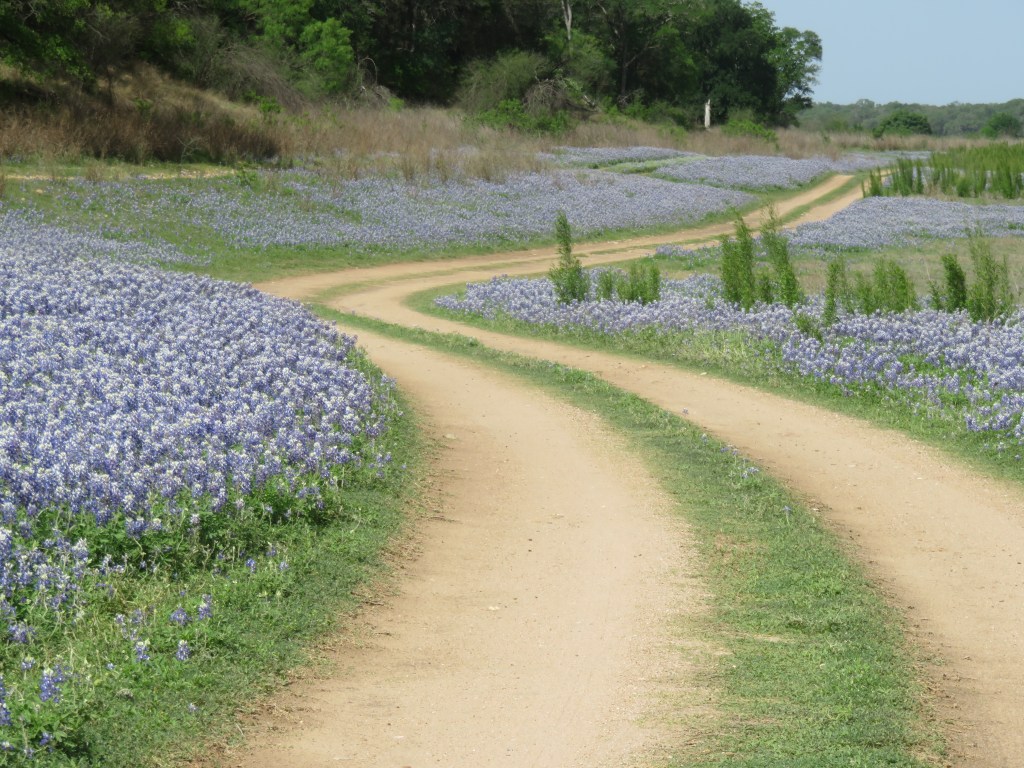
I didn’t know if the magazine had overhyped the flowers. Arriving in the park, we stopped to look at a map and found a trail to hike. While looking at the map, I noticed a small handmade sign close to the ground that said just: “Flowers”, with an arrow. We decided to follow that first. The road was dirt, dry and dusty. There were more signs so we kept going. And then, this:

The picture above was my first look, and it was only in one direction. There was more! Here I am, as happy as can be, in those beautiful bluebonnets:

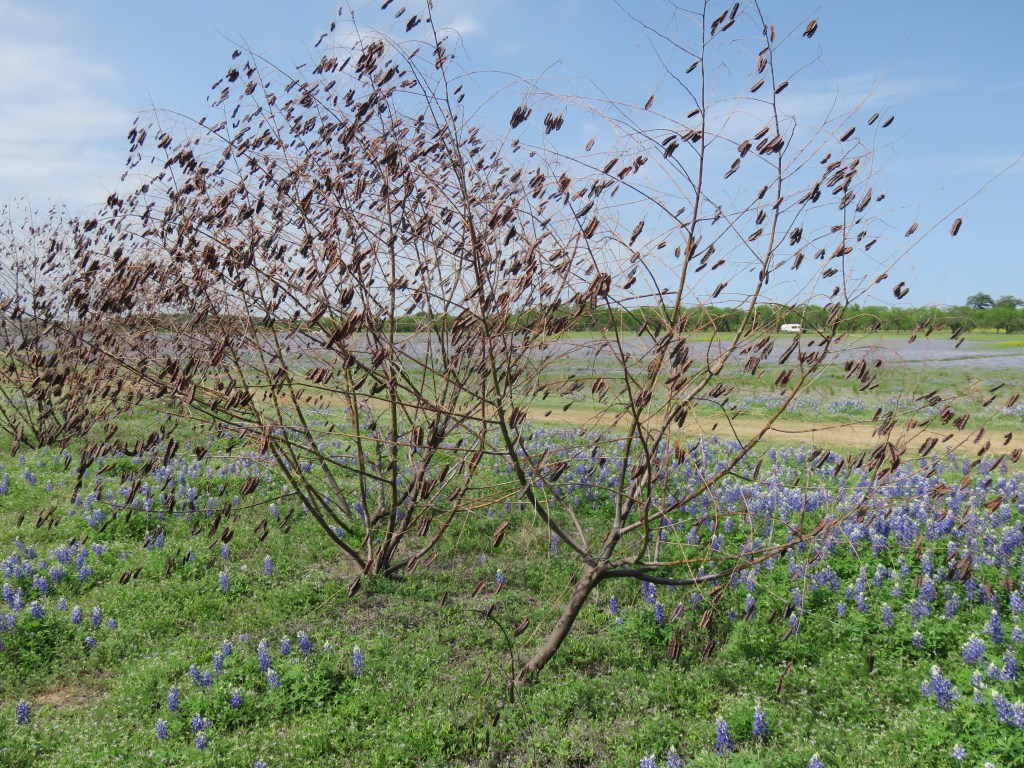
All was quiet here, except for the seed pods on these bushes clacking in the wind:

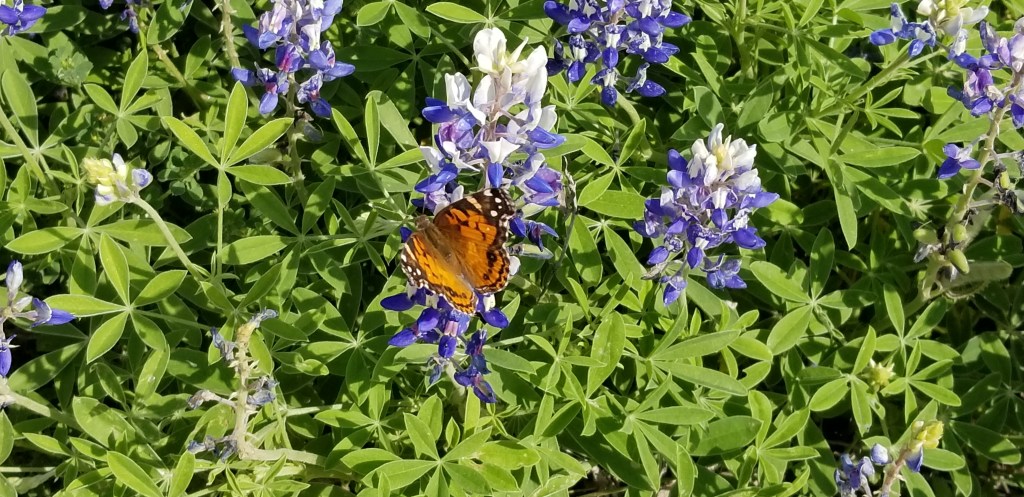
We hiked, we took in the flowers and the views, listened to the wind and the pods and the birds, watched tiny butterflies flit about, and I took the time just to be still with the camera put away. A place like this is good for the soul.

The whole huge area is bounded on one side by the Colorado River. The river here was very low when we visited. There are a few houses on the bluff high above. It looked like the steps behind their houses were supposed to go down to boat docks in the river below, but the docks are sitting on weeds. It’s been a long time since the river has been at capacity. You can see one or two houses in the background of this photo:

The river is still there, although you can’t see it in the above picture. Here is a better view below. In light of all the beautiful flowers, I wasn’t focused on taking pictures of it.

We abandoned the trail we were going to hike. There is another, going through the flowers and around the hillside, that we ended up on while flower gazing. Or maybe it’s a park road, I don’t know.

There was an eye-catching area filled with white prickly poppies, too.

I thought that seeing the massive splendor of all of the flowers here was almost as good as visiting the monarch butterflies in their migrating place in Mexico this past early March. And that is saying a lot.

I wouldn’t come here on a Saturday or Sunday, though! I’m sure that on the weekend, with flowers in bloom, that this place is packed.

Next time – we go underground