Europe · Greece

Back in Time to Giannitsa, Greece – Europe Travels September 2022

On this sunny Saturday of Cal’s reunion with his Army buddies, we went back to where it all happened – the small detachment outside Giannitsa where they were stationed. For background, if you haven’t read my previous post, you may want to do so before reading this one.

Lefteris procured a van for us for the day. I was surprised that no other family members besides myself were coming, but there wouldn’t have been much more room in the van anyway. I wasn’t going to miss seeing this place that I’d heard so much about.

Our first stop down memory lane was this bridge:

Back in the day, this one-lane bridge was a mile long and had a stop light on either end, necessitating at times a long wait. And sometimes, the drivers coming the other way just didn’t want to wait for their light. The guys had many funny memories here, and there were a lot of stories flying back and forth. There is a “new” road now that bypasses this bridge.

By titling this blog “back in time” I didn’t only mean the time while Cal and his friends were stationed here. There also things to see that went back to the time of Alexander the Great.

Tom was the perfect guide for the day, making sure we stopped at everything of interest, and I really appreciated his efforts in this. Our first stop: a statue of Alexander, in the town where he was born, Pella.

We then moved on to ancient Pella. We pulled in to the site, discovered that it cost money, and Tom and Lefteris went over to the ticket booth.
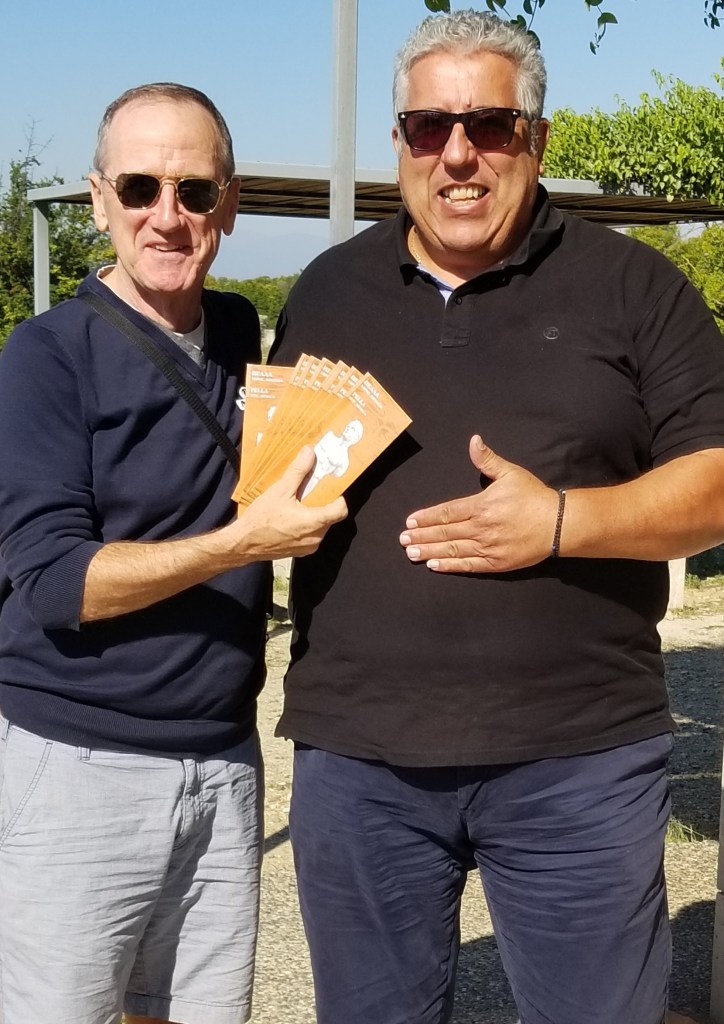
Score! They told the people that we were all veterans and that the guys had been stationed nearby. Free tickets for all!

This is the ancient town of Pella, the place where Alexander the Great was born and raised. The amazing thing about this is that it used to be covered by the road going to Giannitsa. Cal still remembers seeing this pillar, which was the only thing that could be seen when he and his friends were here.

They couldn’t believe all of this had been underground as they had driven by. In the picture below, you can see the lone column amongst the ruins.

I should mention that we were respectful of these ruins, despite my sitting on an old Macedonian wall. The ruins were open for anyone to walk in and around, but we stayed outside the walls when doing that. The most precious pieces, the ones no one should step or sit on, are in a museum. Here at Pella are some, though, that have low barrier fences under shelters around them, and these were mostly the mosaics that had been found:

This was a mosaic floor depicting the abduction of Helen.

Once-flourishing Pella was the capital of the Macedonian kingdom. The city is believed to be inhabited as far back as the 4th century BC, and it was huge. There was a palace here, a rectangular street layout, and a water supply system with drainage, among other things. Most homes had a mosaic, which told the archaeologists that there were many mosaic craftspeople in town.

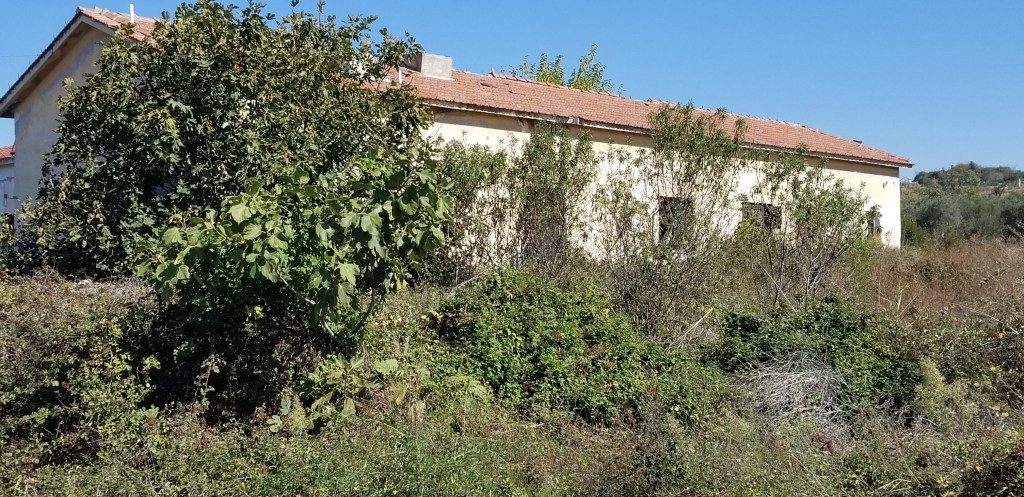
We finally arrived at the old detachment, which is now in a ruined state.
What were the guys doing when they were stationed here? Officially, they were advisors to the Greek Army since the communist country formerly known as Yugoslavia was just over the border. Today, that country is North Macedonia, named so as not to cause confusion with this area of Greece which was formerly Macedonia.

Nature is reclaiming the site. Mulberries and olive trees are growing wild and fighting for space along with the weeds and prickers. We picked through some of it to get a closer look, but I think the prickers won the battle.
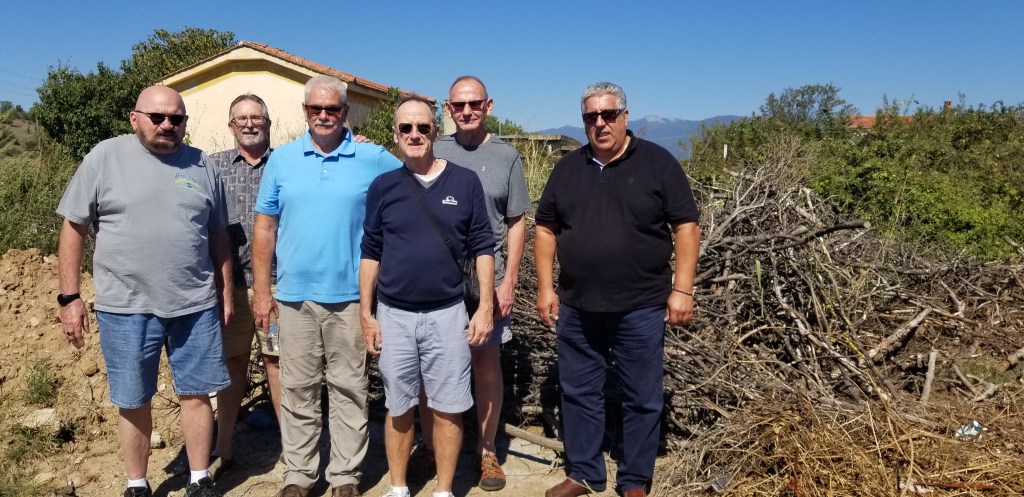
Billy, Mark, Cal, Tom, Milan and Lefteris: not the young kids they used to be!

The Greek Army was across the road and that site is still there and operating. That is where Lefteris was stationed.

Here is an old throwback picture of the American detachment from back in the day:

From the site, this picture is a view of Mount Paiko, which lies on the border:

This area is a fertile plain, producing cotton, tobacco, peaches, rice, olives, and other crops. Cal remembers that fields completely encircled the site, but now there are some homes and farms.

The guys were excited to see the site. They tried to figure out what was where back in the day, and many stories were told. Cal felt bad that it had deteriorated so much. Inside, everything which wasn’t nailed down, to include the fixtures, had been plundered and hauled away. We looked and walked down the road a bit.

Many of their memories are also linked to the little town of Giannitsa which is nearby. We traveled there next for a walkabout and a late lunch.
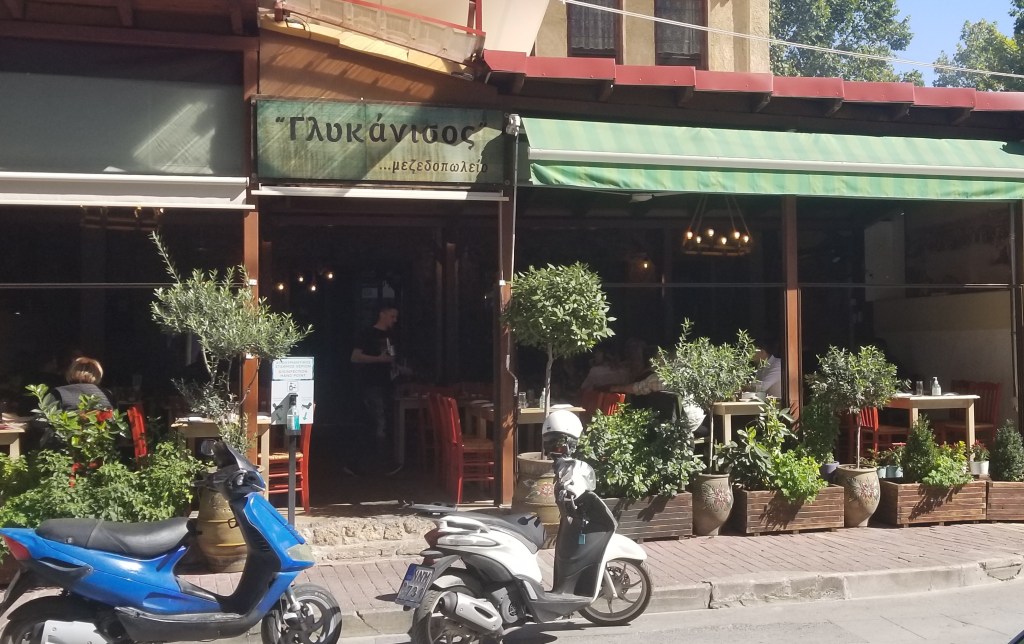
There is a tradition in Greece called the volta. Every town has one, and it is an area for an after dinner stroll and socializing. The way it was explained to me, in Giannitsa, a street was blocked off on weekend nights for this purpose. Lovely young ladies would be part of the stroll, and Mamas would hope that their daughters would make a good catch. Once she found a young man, of course, Mama could also supervise the dating scene right there on the Volta. Cal just remembers walking up and down the street, saying hello to people and that the locals were friendly. He thinks that the Greeks enjoyed them being part of the tradition.

Giannitsa is now a small city, and the volta is blocked off permanently to traffic. Cafes line the sidewalk.

The efforts of the Mamas must have paid off. In just the couple of years surrounding the time that Cal was here, several of the guys married Greek women. This is the local church:

We had one more stop to make on the way back while still in Giannitsa. Tom said he had driven by this statue many times but had never stopped to look at it before.
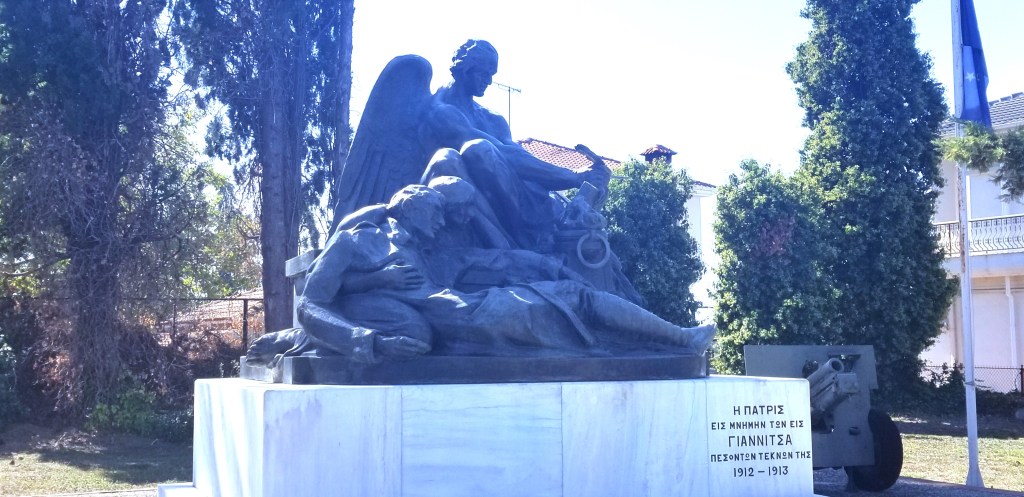
It is a memorial to the soldiers lost in the Battle of Giannitsa, the final combat between the Greeks and the Ottomans in the war for independence in 1912. The signboard nearby stated that “the Ottoman Army retreated disorderly, followed by Muslim residents.”

Our day had come to a close, and it was time for the drive back to Thessaloniki. Kudos to Tom and Lefteris for all of their efforts in planning such a wonderful day. The whole weekend had been spectacular. Seeing the detachment again was fun, but seeing his friends again for made it special for Cal. I really enjoyed meeting the guys. Of course, there were so many others…ones that had not been able to make the trip, ones who have never been found on Facebook, and many that have already passed on. They were all remembered this weekend.

Of course, we couldn’t just spend one long weekend in Thessaloniki and leave the country. It was time to head south, and the next destination was just a train ride away.

But first: how about another throwback picture to when Cal was here? Most of the guys had an extra job in addition to their regular duties. Cal’s job was to run their little PX. He had to make trips down to Athens to resupply it, and usually had a list of special requests from the guys. The Quonset hut which housed the PX, rec center and a bar is gone now.

Next time: south to Athens

Europe

A Reunion in Thessaloniki, Greece – Europe Travels September 2022

Cal and I had only been dating a few months when the Army sent him to a little isolated detachment in northern Greece for a year. This was at the height of the Cold War era. In a pre-internet time where even phone calling was impossible, he wrote me letters. Lots of them, to his credit. I heard about all the antics that he and the guys got into, the day-to-day drudgery, but also all the things he saw and did. He sent back beautiful pictures of Greece, and I thought he was so lucky to be seeing the sights while I was back in the middle of Texas.

He and his buddies lost touch, but Facebook brought them back together. In 2019, they had a reunion in Las Vegas, with many of them attending. This was the year to have a reunion back where it all happened. Amazingly, it dovetailed perfectly with our big Europe trip, which was very exciting!

How to get to Thessaloniki from Venice? It’s too long a distance by train, involving many transfers, so we couldn’t use our Eurail pass. The best deal was, strangely, with Austrian Air. We flew north to Vienna and then south to Thessaloniki.

The city lies on the Aegean Sea north of Athens by about two hundred miles, as the crow flies. Driving that distance would add on another hundred miles. For the reunion, we stayed at the City Hotel in the heart of downtown and a couple of blocks away from the water.

We met two of the guys at the hotel, Milan and Billy. Another, Mark, came later in the day with his wife and additional family members. The reunion was organized by Tom, who has a Greek wife and lives here. That was it for our group. Attendance was small for a long and expensive trip to Greece.

On our first morning we set off with Milan and Billy to explore the White Tower which you can see on the left of the picture above.

It is a long climb up but there are displays on the history of the city on each level, where prison cells had been.

At the top we were rewarded with a great view, and Tom found us here.

The White Tower replaced an old Byzantine fortification in the fifteenth century by the Ottomans. It has a sad past, since it had been a notorious prison and the scene of many executions. When Greece reclaimed it in 1912, it was cleaned up and now it is a symbol of the city.

Over the weekend, there were many recollections of the city back in the day: buildings that were here and are not now, especially the American Embassy, and memories of fun times. Thessaloniki lies about 35 miles from where the detachment was.

Tom was a great guide and walked us around the city a bit. He showed us the old Greek Embassy. When Thessaloniki was under Ottoman Rule, Greece had an embassy here, which sounds really strange. 1912 was the big year; when Greece gained control the embassy was closed. We looked at the Greek Orthodox church next door from its patio.

Later, I needed a nap and when I awoke, the guys had disappeared. I left them to their visiting and went exploring. There was an old Jewish bath house that I wanted to check out, hoping I could peek inside. It was locked tight.

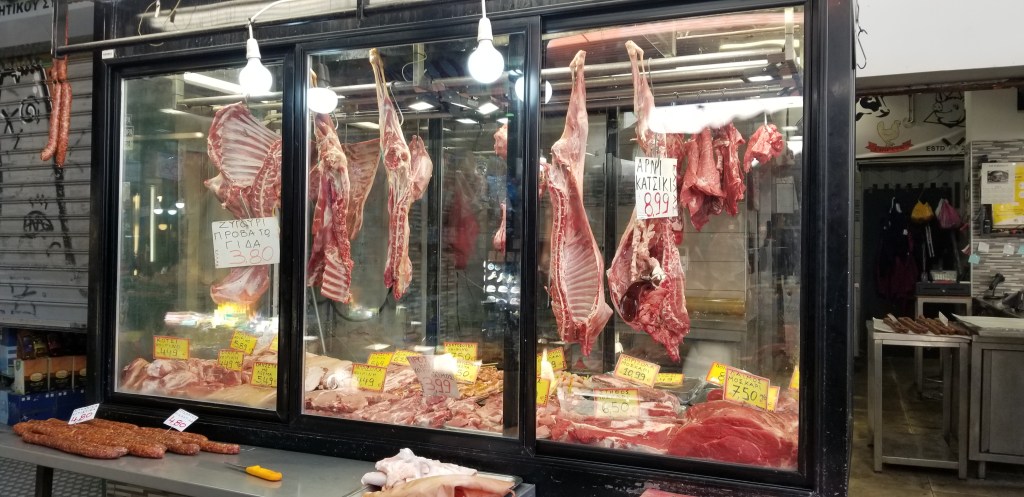
Next to the Jewish baths, there’s a market:

I was pretty glad that I did not need to purchase any meat or fish.

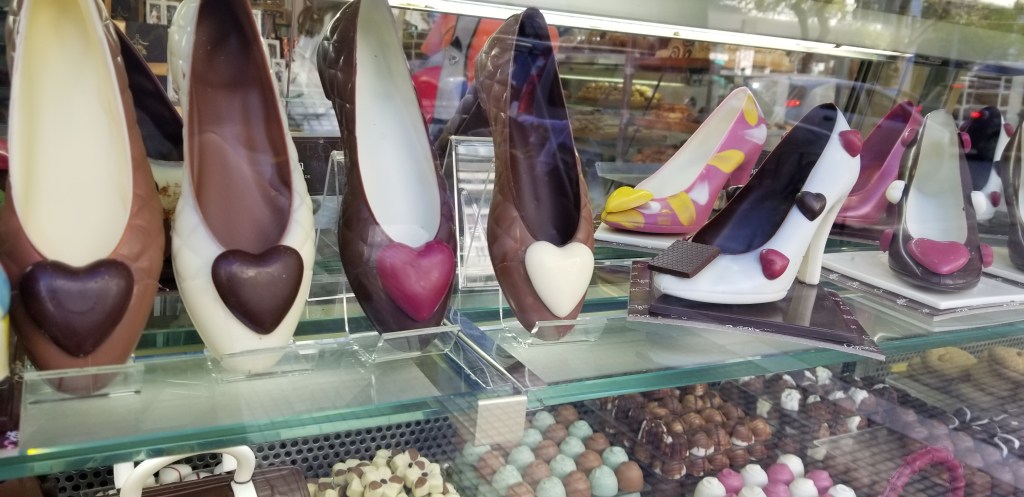
Chocolate high heels, anyone?

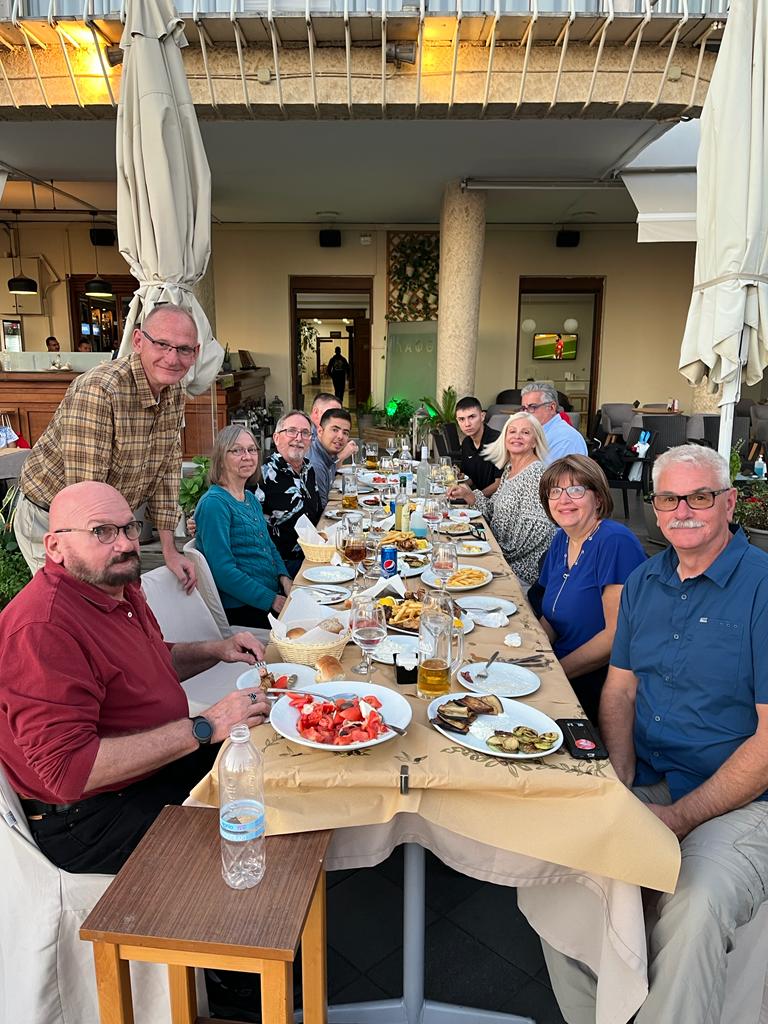
There was one other person to meet besides the Americans: Lefteris Dimopoulos, who had been in the Greek Air Force and had been part of the support for their detachment. He and Tom had put our reunion dinner together, which was at the Greek Officer’s Club. It was a feast of Greek salad, grilled aubergine, squash, and other vegetables, platters of Greek hamburger, souvlaki pork, chicken, pork strips, and french fries, with tzatziki sauce. The food kept coming, the conversations flowed, and we had a great view of the White Tower and sunset on the Aegean. It was spectacular.

Credit for these two pictures goes to Tom.

Left to right: Mark, Billy, Tom, Cal, and Milan

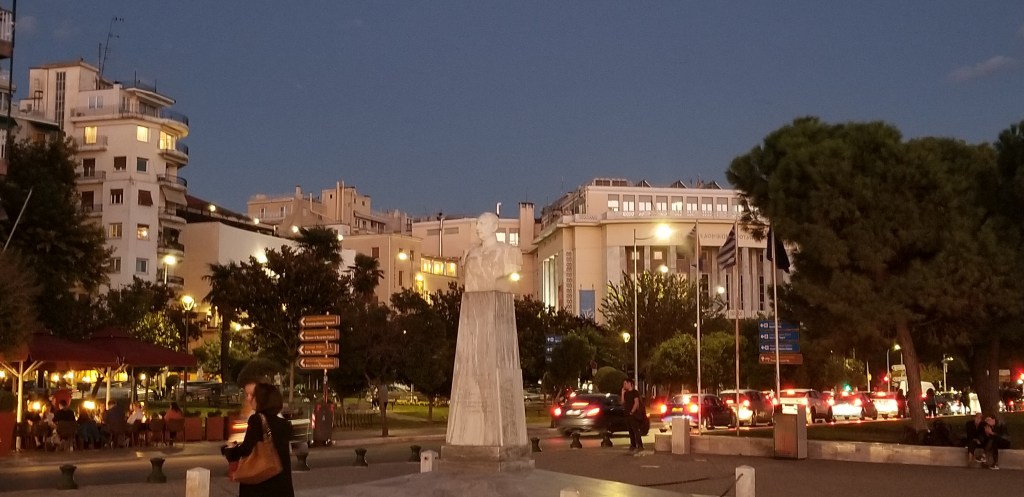
At night, Thessaloniki comes alive. The Greek Officer’s Club is behind the flags and is where we had our dinner.

The next evening our entire group visited a local seafood restaurant. It was Saturday night and the town was humming. We were there for several hours and for that entire time, every seat was packed in the restaurant inside and on the huge patio outside. The streets were crowded with pedestrians and traffic was down to a crawl. Party time in the city!

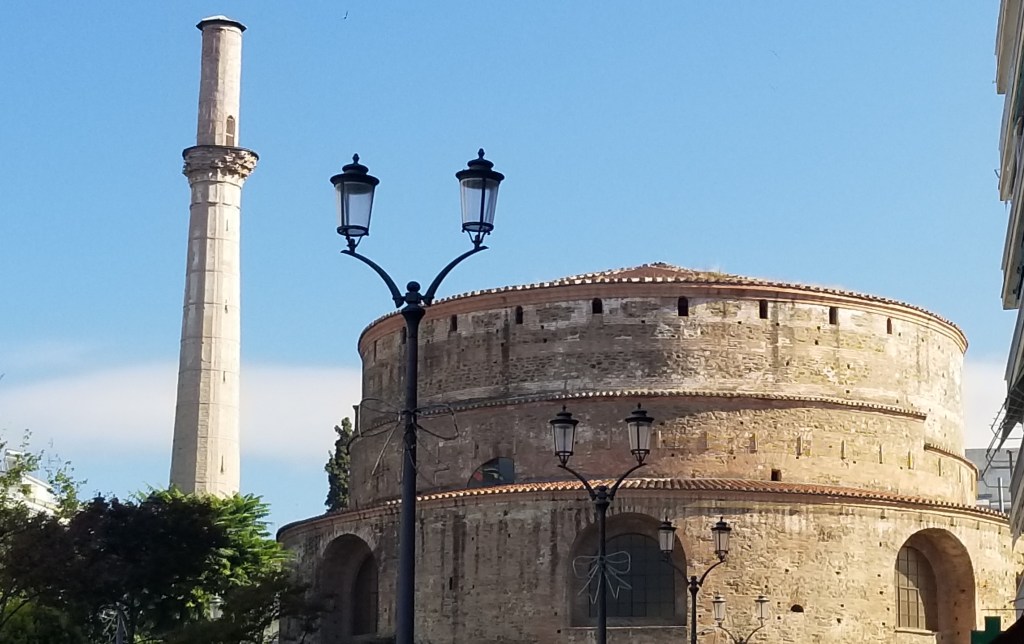
We did get to do some other sightseeing in Thessaloniki. This is the Rotunda:

For the Romans who built this Rotunda, the building’s purpose was a place for worshipping their deities. It can be compared to the Pantheon in Rome. Later, it became a Greek Orthodox church, and then a mosque when the Ottomans came to power in the 1500’s. That is why the minaret still stands to the left of the Rotunda. When Greece regained power it reverted back to Greek Orthodox.

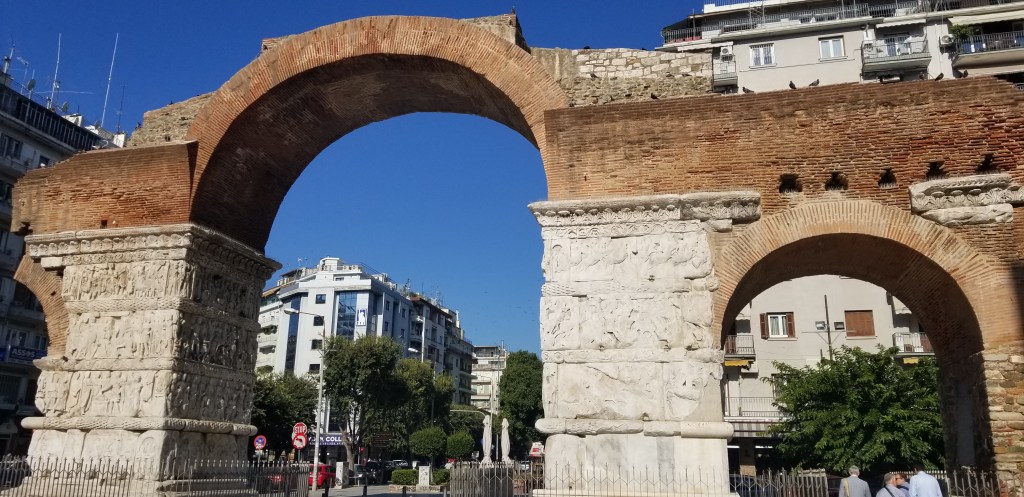
There is the ruins of a Roman gate:

What I came to love about Thessaloniki, and all of Greece, is that you can walk anywhere and see ancient ruins. If any kind of building is to be built, a team of archaeologists have to investigate the site and see what’s in the ground first.

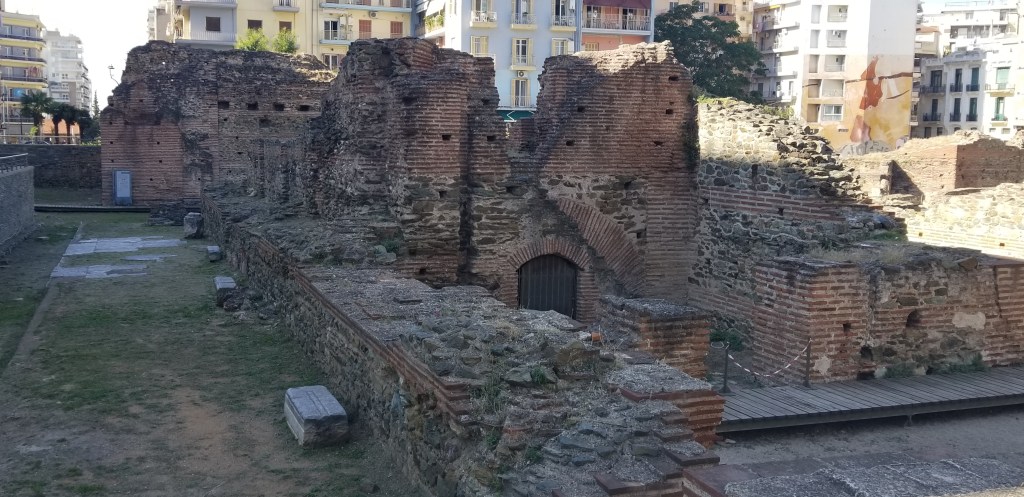
So, we were just walking down the street, and we came to a whole complex just below street level. It was once the magnificent home of Caesar Galerius and his court whenever he was in town. There are ruins of a basilica (an audience room), which still partly lies under the street. Additionally, we saw ruins of the Roman baths, and other buildings that made up part of the palace.

I also visited two museums: the Archaeological Museum of Thessaloniki, and the Museum of Byzantine Culture.

In the archaeological museum, antiquities abounded. This is the deed to a house, dated to 350 BC.

The Byzantine museum moved forward in time. This mosaic dates to about the 5th century AD.

I was glad I went to these museums, because they clarified for me what was happening historically in Greece through the centuries. There was the early Macedonian kingdom which was replaced by the Romans. The Roman era went into the Byzantine era, and then Greece was conquered by the Ottomans in the 15th century. Their rule lasted until 1912. This is simplified, but it greatly helped to explain everything I was about to see in the coming weeks.

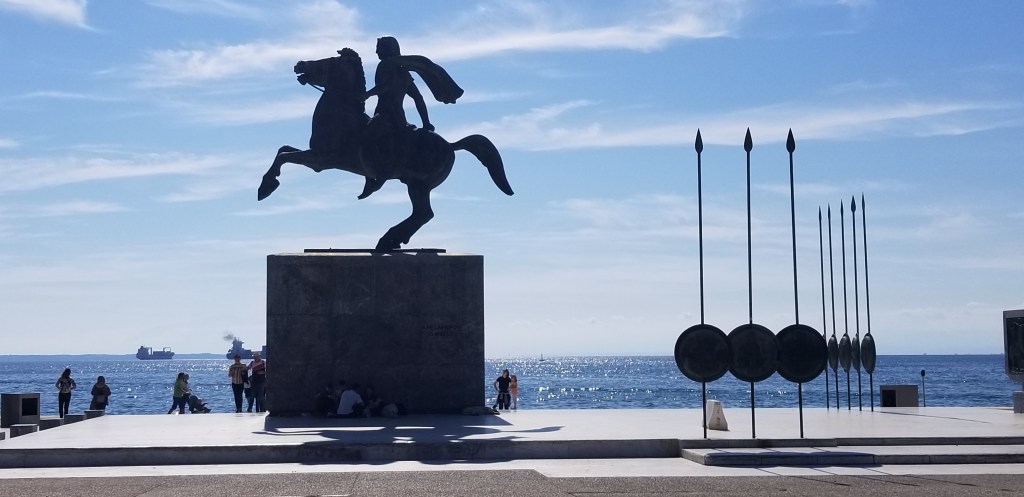
A statue of Alexander the Great looks out to sea on the shores of the Aegean:

Beginning with Italy, our trip began to look like Eat, Pray, Love with an emphasis on “eat”. In Thessaloniki it went full throttle. Every time we were out with the group, there were plates upon plates of food because everyone wanted to try some remembered dish. Out on the street, there are souvlaki stands, and Milan found a good one for us for the times in between when we might be just a little hungry. The smells coming out of the souvlaki stands are incredible.

This is the first meal we had when we came to Thessaloniki, on the patio of a restaurant by the sea:

Over the years, Cal has told me many times about having feta cheese that had been thrown in a wood-fired oven until it was soft, warm, and delectably tasty. Mark shared this memory with him, and they ordered the warm feta appetizer in a couple of restaurants until – Bingo! – one restaurant got the taste exactly right.

I’ve left off a big part of this reunion. On the day after our grand dinner at the Officer’s Club, we traveled to the detachment where the guys had been stationed. It turned out to be more than just a quick view. That’s for next time!

Next time: A Trip to Giannitsa, and Everything Along The Road