
As the calendar flipped over to October, our travels were winding down. We figured that the best way to celebrate the last two weeks of an epic journey was by visiting a couple of Greek islands.
I could not ignore Santorini. It’s another one of those places that has a reputation for being overcrowded with tourists. But how I could go to the islands and not go there?
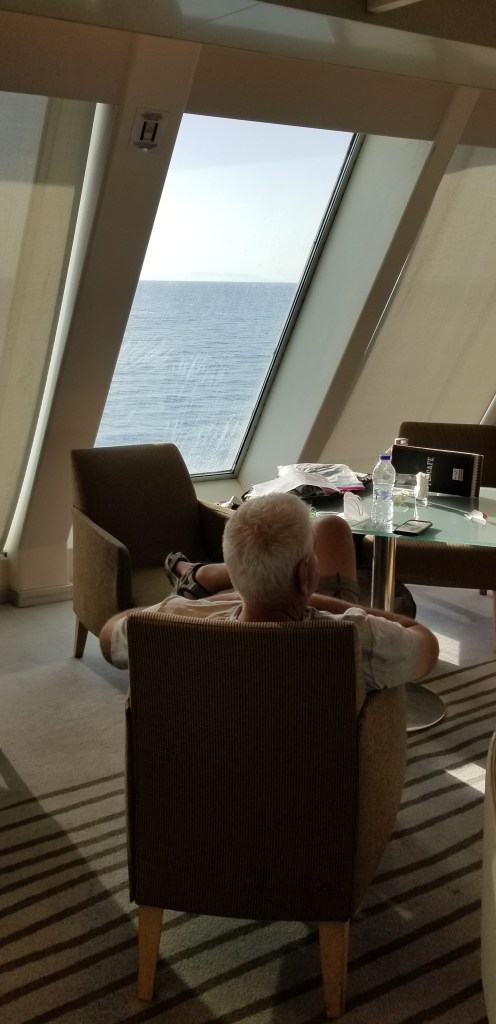
The sun hadn’t yet come up when we left our hotel in Athens, got on the subway, and found the Blue Star Delos at the Piraeus docks with a depart time of 7:25 AM. The ferry isn’t terribly expensive when all things are considered, so we upped our fare to Business Class. For that, we had a table, comfortable chairs, and an attentive server who would come by now and again to see if we needed drinks or food. We could look out the front of the ship, and of course we would go round and explore it at times. Views of other beautiful island towns were thrown in when stops were made at various ports. We were very pleased with our do-it-yourself cruise, which took about seven hours.

Santorini is one of a chain of islands called the Cyclades in the Aegean sea. The main feature of these islands is that they were all formed by a volcano.
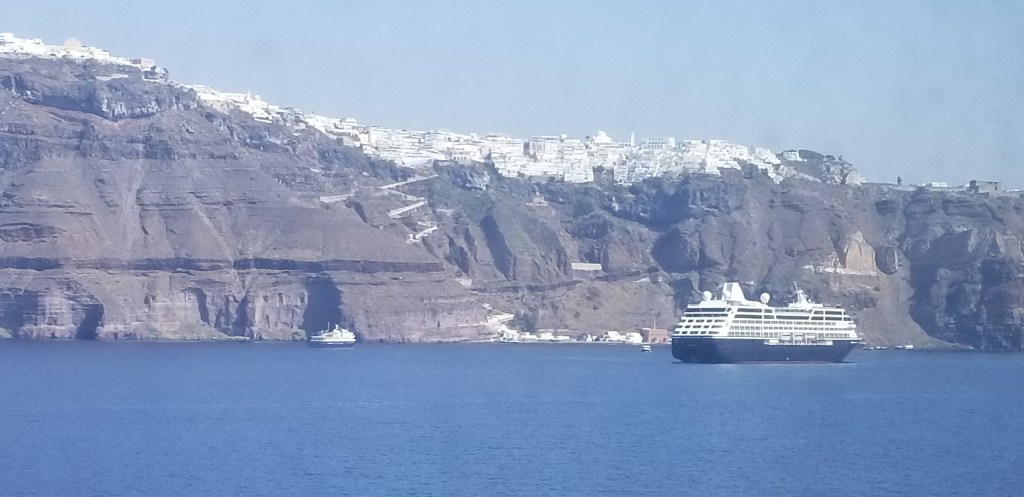
We received our first look at the island from our ship.
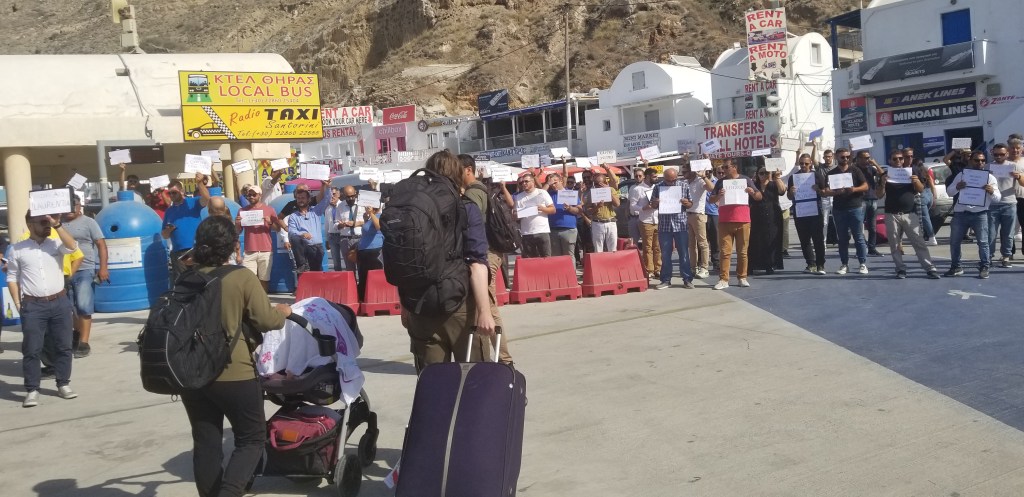
Somehow, we ended up at the front of the line upon disembarking. We still have not forgotten the sight of all of these drivers waiting for their passengers. It was crazy! Amazingly, we readily found the guy holding our name on his board, and we were off.
It’s tempting to call the biggest town “Santorini”, but that’s the name of the whole island; its name is really “Fira”.
On our first afternoon, we did some wandering around in Fira. It was lovely – at first. We had lunch, and wandered down some of the labyrinthine streets and paths.
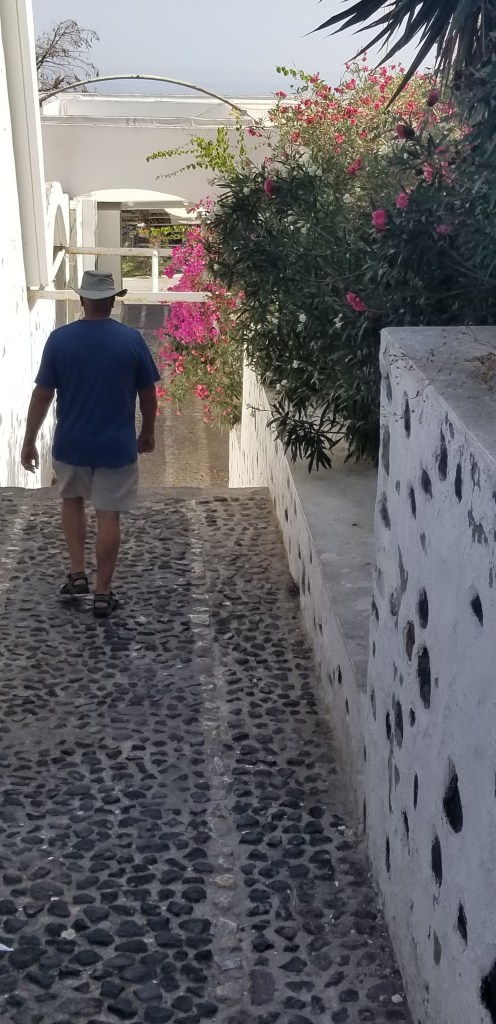
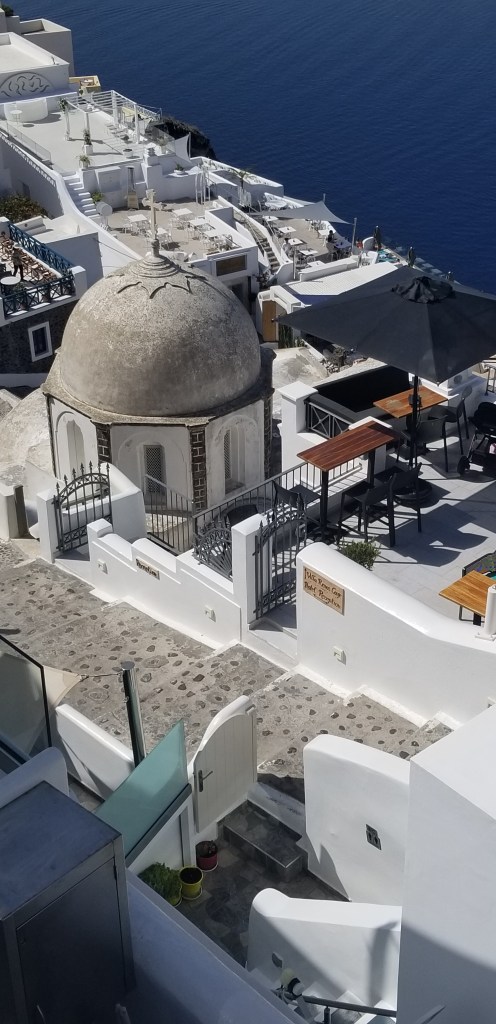
Soon enough, we got caught in a tourist river – a steady stream of people filling up the path from side to side, moving in one direction. People dodged in and out of the tiny shops. It was hard to get out of and really not enjoyable. Afternoon, as we discovered, is not a great time to explore Fira. Do you see the two cruise ships out in the harbor in my top picture? They hold lots of people. A driver that later took us back to the ferry told us that in July there could be as many as seven cruise ships in the harbor at one time. I cannot imagine all those people filling the little passageways of Fira.
Have you ever seen the iconic blue dome pictures of Santorini? That is what I was looking for. I don’t know why I was so fixated on finding that particular view. Later, I looked on a postcard I’d picked up, and I saw some lettering to the side – “Firostefani”. Now that I’d been here a couple of days, I knew that Firostefani is a village that bumps up right next to Fira. On the morning of our last full day, we headed down to Fira to run an errand or two. And then we split up. He wanted nothing more to do with my blue dome fixation – smart man!
Here it was that I found the magic of Santorini. Crowds were light, the whitewashed buildings shone in the bright sunshine, and the water sparkled in the harbor. It was a fine walk to Firostefani. I worked my way up to a dizzying walkway along the cliffs.

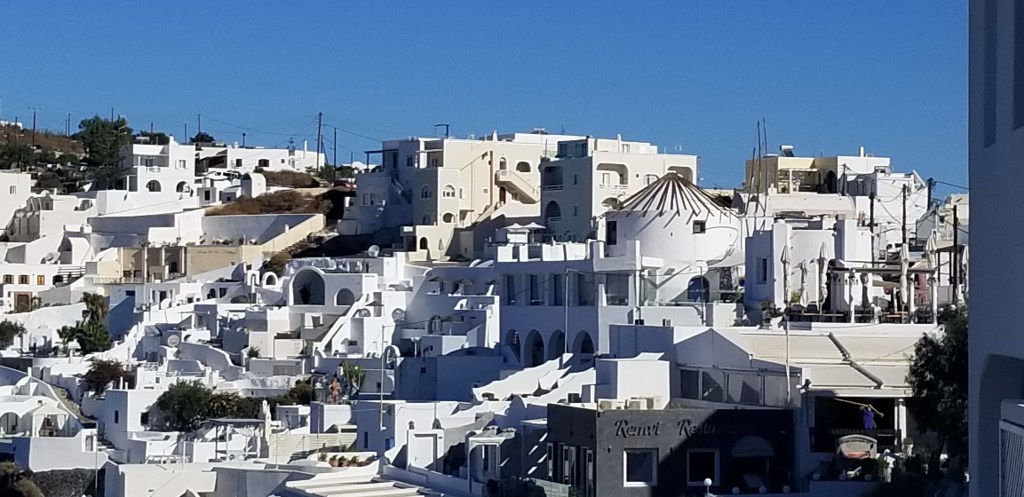
I walked along, enjoying the fine views so much that I was ready to give up my blue dome search. I stopped to look at an ornate gate in front of a church. It was as I was studying the gate that I saw it on the right of it – a picture of the blue dome, and directions on how to find it! It belongs to this church, the Catholic Church of Koimisi Tis Theotoku. A little walk back up the path and behind, and I was there. Eureka!

Ah….so beautiful. I took photos of other tourists when they asked, and of course they offered to take pictures of me.
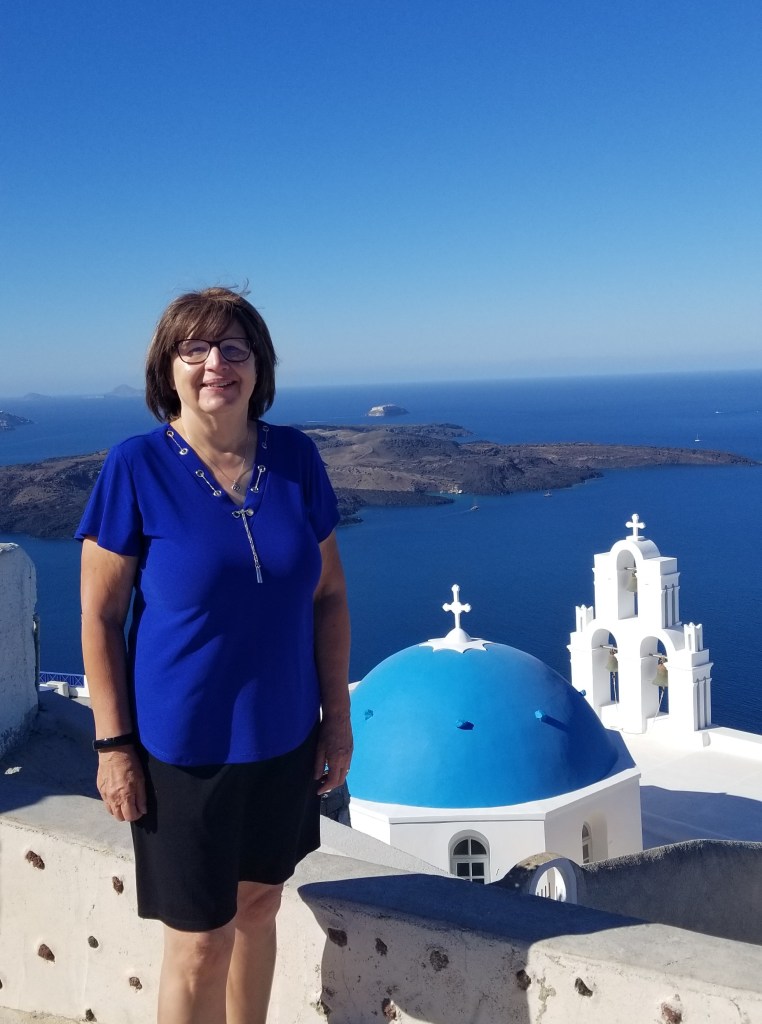
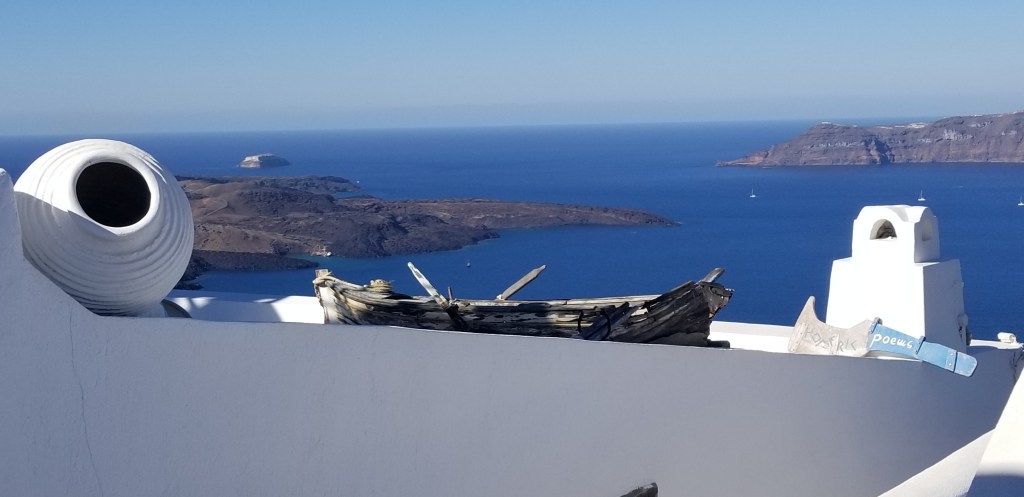
From here, I could see to the opposite side of the island. In places, Santorini is so narrow that you can do that.

When I found Cal again, he was entertained by watching tourists taking selfies and group shots in front of a colorful plastic-looking donkey in the main square. He had spent most of his time in a coffee shop overlooking the harbor, enjoying the view, and had thoroughly enjoyed himself. His mode of travel is a lot less intense than mine.
I’d found our lodgings through AirBnb, but the place was more like one of a handful of villas in a family-owned bed and breakfast. They brought us breakfast every morning on a tray. By Santorini standards, it was inexpensive, probably because it was neither here nor there – it lay just outside of tiny Imerovigli on the road between Fira and Santorini’s other main village, Oia. When booking, I thought maybe we could hike to Oia on a little footpath, and with one more day, we may have. The view from our place wasn’t totally amazing, but not bad either. The villas are on the sunrise side.

Taking a walk from our place, we found another church with a blue dome. The reason for white buildings and blue domes is simple – they are the colors of the Greek flag.

Down and across the road from us a bit, we found tiny little Taverna Tasos that we loved so much that we ate there two out of the four nights that we were in Santorini. The Oia-Fira path was behind it, and also the “sunset” side of the island, so we would walk there after dinner for a sunset view.

The path follows the low brick wall in the bottom right of the above picture, and you can just barely see it as it winds around on top of the cliffs. It ends at the town of Oia, which is not seen in this picture and would be on the far left.

Santorini was already occupied back in the 16th century BC when a volcano erupted that totally reshaped the island and formed a caldera. The island is crescent shaped and the landscape is rugged. Today, the villages are built a thousand feet above sea level, right on top of the steep walls of the caldera, half of which is submerged under the Aegean Sea. The island is only five miles from the active underwater volcano Kolumbo.
No better place to get a look at it than from a sunset dinner cruise.

In early times, there was little building material to be found in Santorini. Residences were dug right out of the cliffs, because the top layer of the caldera is a chalky substance called pumice. These cave dwellings were cool in the summer and warm in winter. All of the white you see on top is not only whitewash, which also reflects heat, but pumice.
The cruise gave us an entirely different view of the island. We could view all of the little towns way up high, and could see close-up the walls of the caldera.


In the below picture, the volcanic rock and dirt can clearly be seen on a nearby uninhabited island.

And then the sun went down – plop! – just like that.

As with other tourist-heavy places that we visited, there is gold (or white chalk) under the surface of Santorini. It is so much more than just those beautiful white buildings and blue domes spilling down the caldera. All one has to do is to take the path, or time of day, less traveled. Avoiding the shops, especially in the afternoon, helps. It seems sometimes that everyone’s main function is to shop and go.
We were sitting near the footpath one evening, waiting for sunset, when we struck up a conversation with a British couple. “I’m seeing so many American tourists here,” the gentleman commented. “Why is that?”
I had to give this a lot of thought before I answered him, because I think there are several reasons and maybe not just one. I said something about Santorini being heavily promoted as a romantic destination in the United States. But just maybe it is simply this – that Santorini has a magic all its own, which draws people here.
Or maybe it’s the view of that blue-domed church over the Aegean sea.
Next time – ATV’ing in Santorini
 Twosna Travels