USTravel

A First Day In Yosemite National Park

We did not have far to go to switch from one RV spot to another while heading to Yosemite. By now we were into the week before Memorial Day, a time of year that I really didn’t want to be in to visit the park. That’s the way calendar planning goes sometimes, so we had to make it work. The very next day after our new setup, Tuesday, we went into the park.

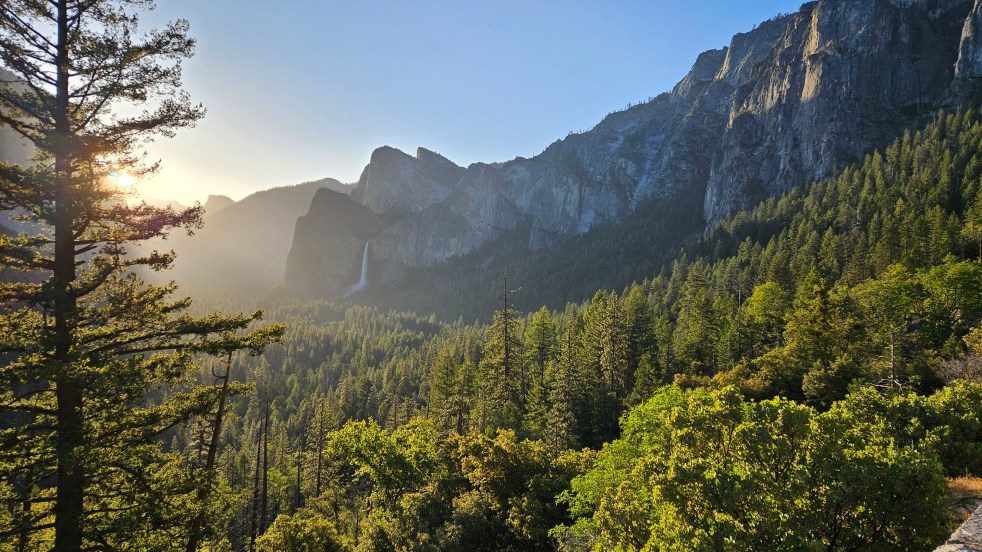
I was afraid of a miles-long wait to get into Yosemite. Massive crowds. Happily, we did not experience that, even for a weekday before a holiday. We did get up at 5 AM to drive the hour and a half trip to get there. The guard shack at the entrance was not even open yet, and we drove right in. Coming through Tunnel View, this is the sight that greeted us:

The morning sunlight streamed in between the peaks, filling the valley with exquisite light and playing a peek-a-boo shadow game with the surrounding cliffs.

From Tunnel View, we proceeded to the Yosemite Valley Floor, and got a spot in the empty parking lot at Yosemite Valley Lodge. It was a short walk across the road, where the climbers in their tiny dome tents at Camp 4 were already packing and ready to take on El Capitan. Down an easy paved trail, and up to Upper and Lower Yosemite Falls, there were only a handful of other folks out.

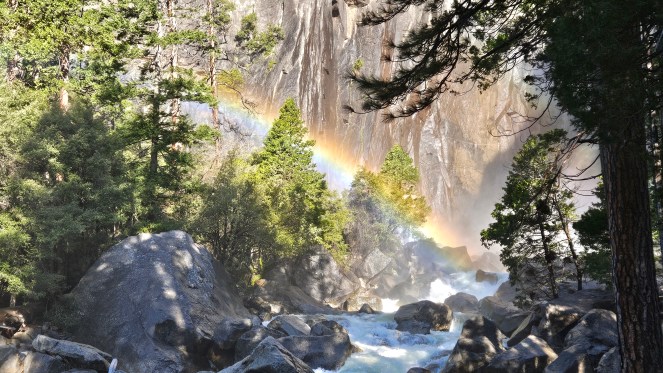
At Lower Yosemite Falls, I was delighted to see that the sparkling water and morning sun produced a beautiful rainbow.
We had signed up for a Valley Floor Tour, and had some time to kill, so back at the lodge we sampled some pastries. A young man from one of the cities on the California coast shared our table and we had an interesting chat. He was hoping to do some climbing that morning, but wanted to meet someone to buddy up with to do his climb. We were for sure not the right folks for that!

The Valley Floor Tour may have been too sedate an activity for him, but it was a perfect introduction to the park for us as we rode on an open air tram. This is the Three Brothers Peaks:
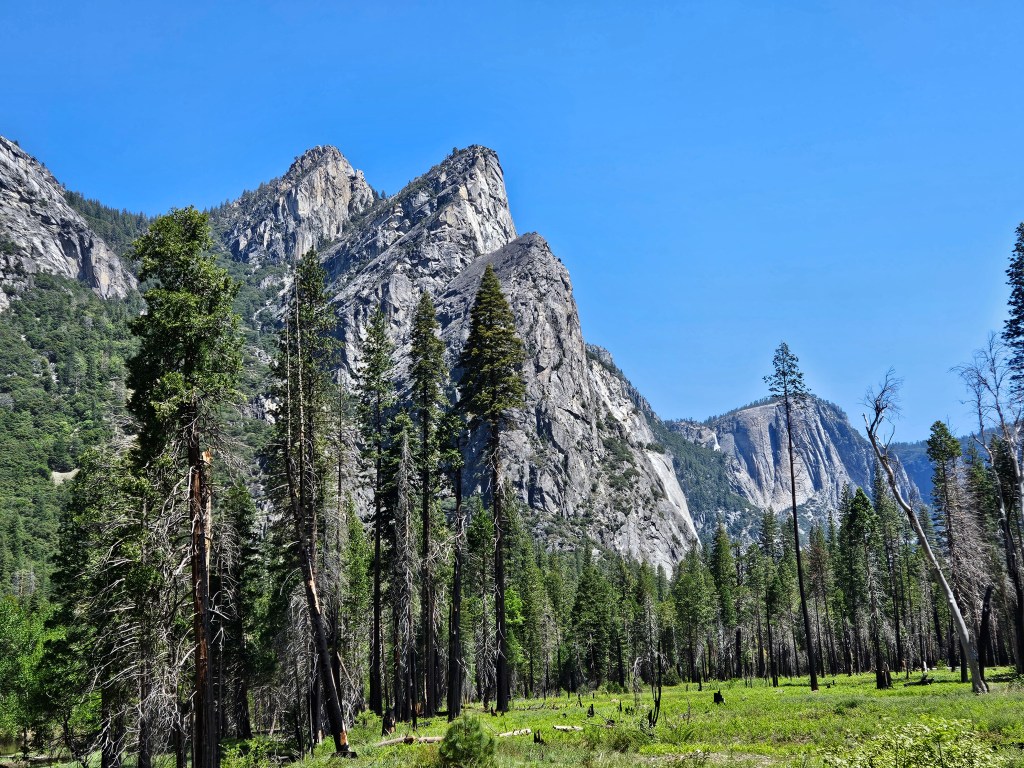
Our ranger guide told us some interesting stories. The middle peak of the Three Brothers had a rockfall in the 90’s that covered the busy Valley Floor park road. A park ranger heard the rumbling and stopped traffic, despite orders from his supervisor. His actions saved many lives as the large rocks tumbled onto the road.

She also pointed out the climbers on the face of El Capitan, so tiny you could hardly make them out. You certainly can’t see them in my picture, but they are there.

Both our guide and our climber friend from breakfast talked about Alex Honnold, the first person to free solo El Capitan. Free solo means NO ropes or safety gear! There has been a documentary made about him – “Free Solo” which I’d like to watch see sometime.

We got out of the tram to look at the gushing Merced River, with beautiful Bridal Veil Falls as a backdrop. All of the creeks, rivers, and waterfalls were swollen with water due to the late spring snow melt from the higher elevations.
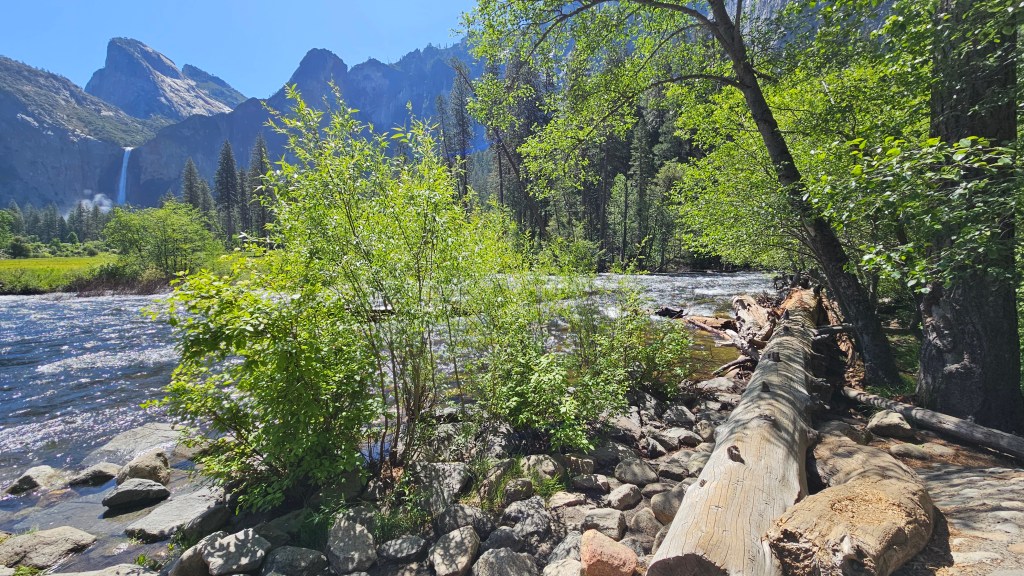
Later in the tour we were able to see Bridal Veil Falls from a bit closer as it tumbled down the cliffside:

Bridal Veil Falls is grand, but the prize for the shortest waterfall – 18 inches high – goes to pretty Fern Spring Waterfall. Our guide told us this little fact, but it may have been tongue-in-cheek.

The tour went up to Tunnel View, where we had stopped on our way in earlier in the day and was where I took the first picture in this post. The rising sun had cast the mighty cliffs in shadows and made it difficult to take pictures. Now we could see everything more clearly, all the way back to Half Dome and Cloud’s Rest.
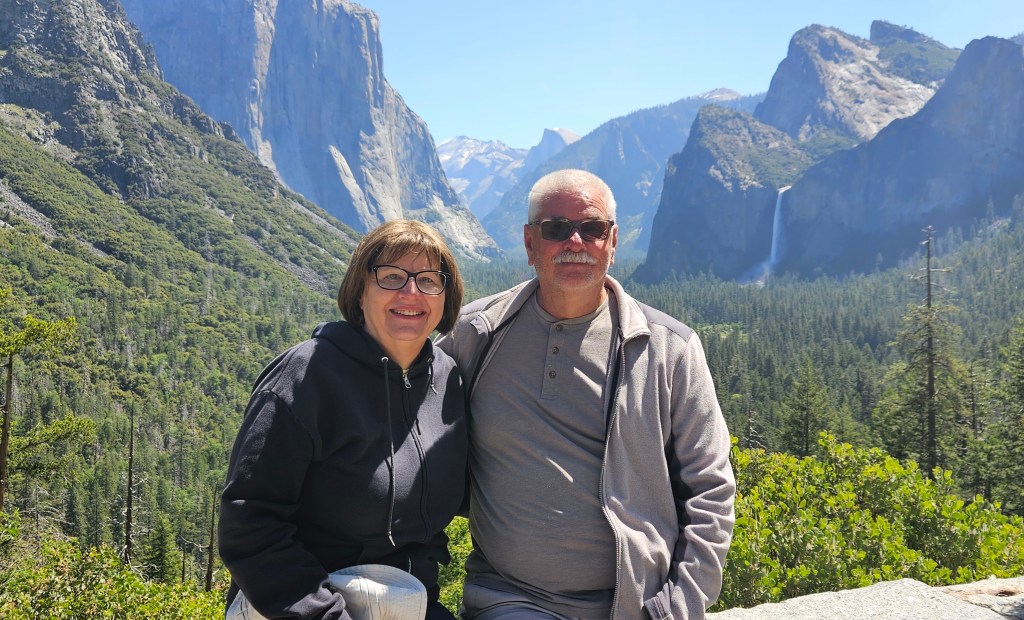
On the way back to Yosemite Valley Lodge, we learned many more facts about Yosemite as we rode, and received a closer view of Bridal Veil Falls. We felt that this tour was a good “Yosemite 101” introduction to the park and all of its wonders, excellent for a first morning. Not knowing anything about Yosemite to begin with, I had felt a little overwhelmed about what to do when I was planning our visit here. It’s important to book the tour far in advance, though.

One of the best pieces of advice I’d heard is to park once and visit everything on foot, bike, or by shuttle. The parking lot was already packed by the time we returned from the tour. So, we grabbed our e-bikes, put our lunch in my basket, and returned to a picnic area we had seen at Yosemite Falls. We were very glad we had visited the falls early, because now the path was crowded with other tourists.

After lunch, we hadn’t ridden our bikes far when we came to Yosemite Village, where there are some museums. At the Yosemite Museum, I admired the expert weaving of Lucy Telles and her younger sister Alice Wilson. They were both natives who lived in Yosemite most of their lives.
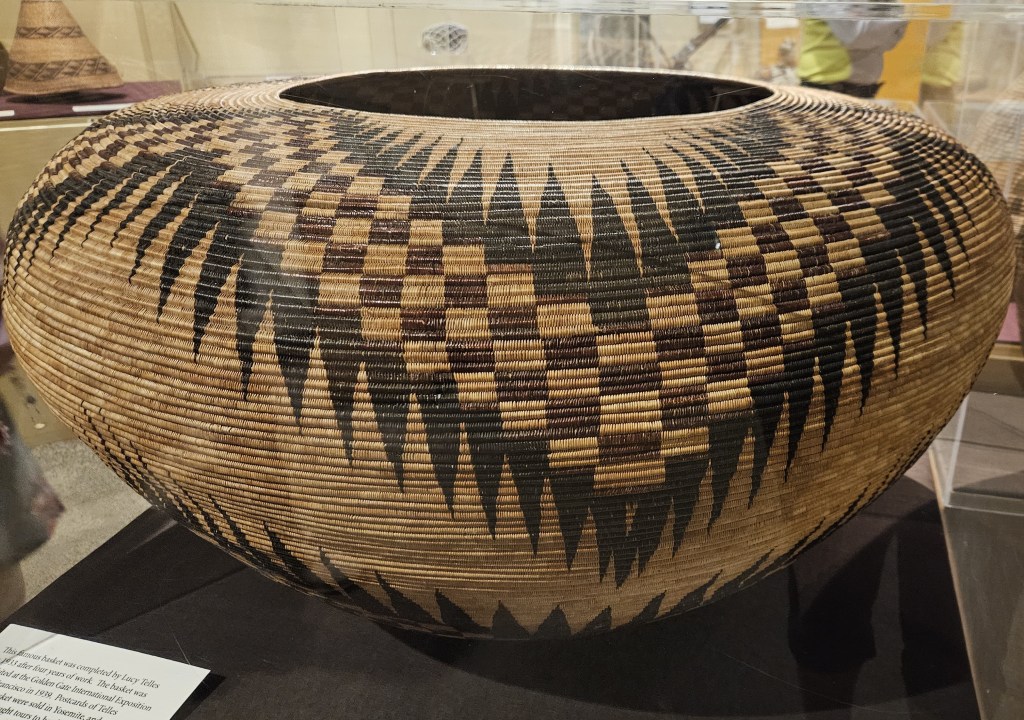
This basket is made of sedge root, bracken fern root, redbud and willow, and took four years to complete.

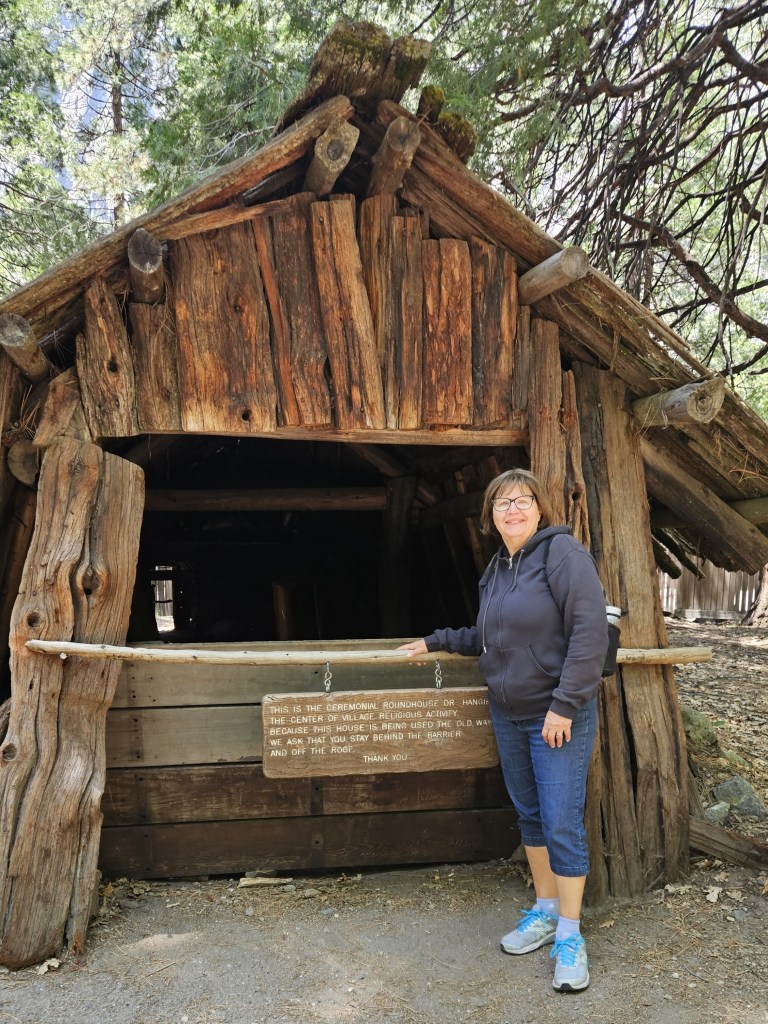
Behind Yosemite Village is a native village. The Miwok Indians lived in this valley beginning in the 14th century. In the early 1900’s they were considered an asset to the tourist trade, and both Lucy and Alice demonstrated their skills. The Indians are no longer here but their little village is on display.

Here I am in front of, as the sign says, “a ceremonial round house…the center of religious activity.” It is still in use.
The inside of it looks like this:

Back in the museum, I looked at the equipment climbers use, including a cot that can hang off the side of the mountain for the night! No thank you! And here, I learned more about Alex Honnold.

Nearby stands this statue and display board of John Muir:

There is an exhaustive list of things John Muir did in his lifetime, but among them he was a naturalist, environmentalist, and champion for the preservation of wilderness: namely, Yosemite Valley, Sequoia National Park, and the Sierra Nevada Mountains in which they exist.

Another luminary of Yosemite is Ansel Adams, a photographer and, like Muir, an environmentalist. He’s perhaps the best known for his black and white landscape photos of the West and Yosemite. I popped into the Ansel Adams Gallery at Yosemite and admired some of the photos but it seemed to be more of a shop to purchase them and other items.

We were ready for some real bike riding by this time, and the crowds around Yosemite Village were thick. There is a nice trail but there is also a bike rental place which adds to the number of people on it. Finally, it cleared out because most people didn’t ride far. The valley opened up and we had a beautiful ride.
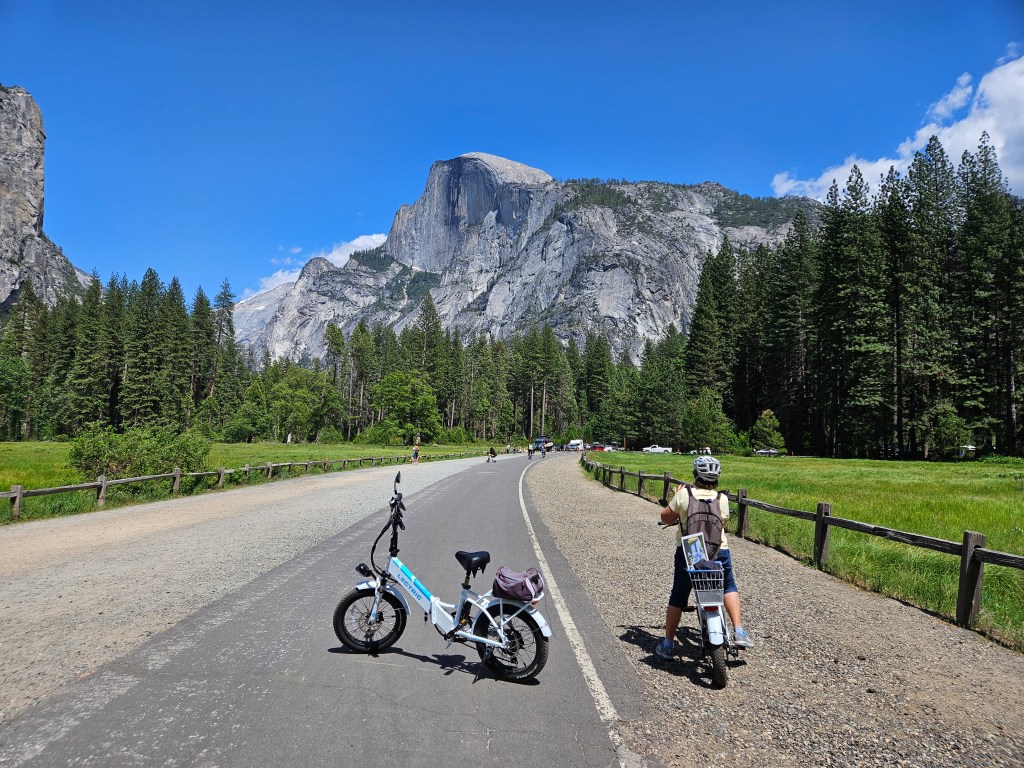
Looking at Half Dome on the Yosemite Valley bike trail

We packed even more into this very special day, but that’s for next time.

Next time – Yosemite – the best view, and a challenging hike upward

USTravel

Big Cats at Cat Haven, and RV Life

View of the Sierras from the pond in our RV park

When the National Parks have been seen, and we still have days to stay in our spot, then what?

Driving back and forth to Kings Canyon and Sequoia National Parks, I noticed a sign for something called Project Survival Cat Haven. Looking online, I saw their mission statement: “…an innovative park dedicated to the preservation of wild cats.” They are not a sanctuary, although some cats have been orphaned in the wild or have needed to be re-homed. Their focus is to “educate people about the plight of endangered cat species, and to raise funds for the conservation project in the wild.” The reviews of the place were good.

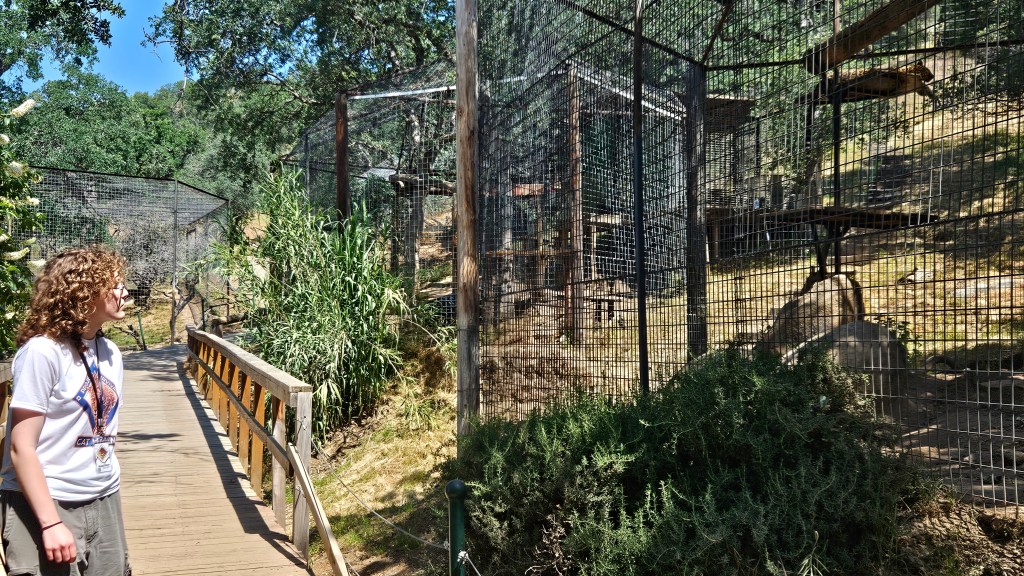
The only way to visit Cat Haven is to book a tour, so we did. Below is a picture of our guide and what some of the pathways looked like with the cats’ cages. There are two cats in the cage on the right.

It was morning, and the cats had already had their breakfast and playtime. Most were stretched out for naps in the front of their cages. Although I don’t like seeing them behind bars, the cages for the largest cats stretched back into the hillside.

There are about 25 big cats here. We learned each one’s story as we passed their cages.

The park is the culmination of a dream for Dale Anderson, who became focused on the cats at a young age. Before he could ever start his park, he received hands on experience by working with cats while purchasing the land for his park. The first cats, a pair of Amur Leopards, arrived in 1997. If you are interested in his conservation and education projects, you can look the park up on the Internet.

We saw a lion, a tiger, a lynx, a jaguar, and a Bengal tiger, among others. There was also a mountain lion, a Canada lynx, and this black leopard:

There were also very small cats, such as caracals and a pallas cat.

I learned many things. Leopards have been called black panthers, and they don’t exist. The word “panther” means big cat, and this is an error that goes all the way back to “Jungle Book”. Also, a jaguar has teeth that are very strong. The jaguar in this park chewed through his metal bucket as a play toy!

And , this: small cats purr but big cats don’t. So that jaguar with the strong teeth won’t purr, but a mountain lion does, making it a small cat.

The caracals were sleeping in their little nest, so we couldn’t see them. I purchased this photo postcard in the store, which is a nicer picture than I could have ever gotten of them:

Photo credit: Project Survival Cat Haven

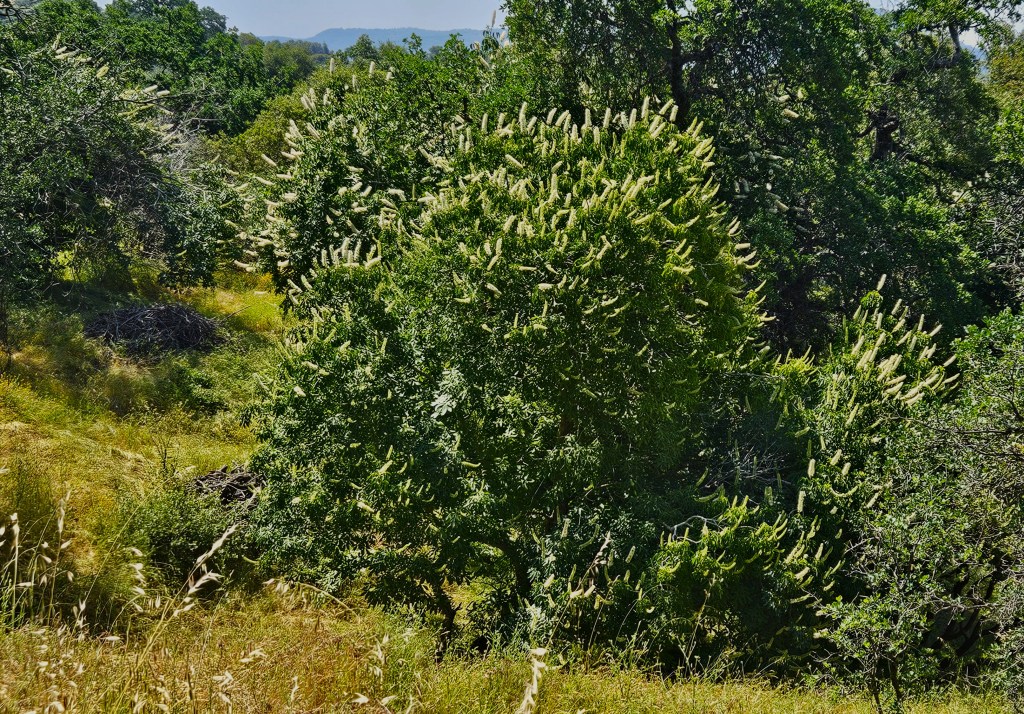
The park covers 93 scenic acres on a hillside covered with live oak and buckeye trees. At this time of year, the blooming manzanitas were spectacular here and also outside of the park.

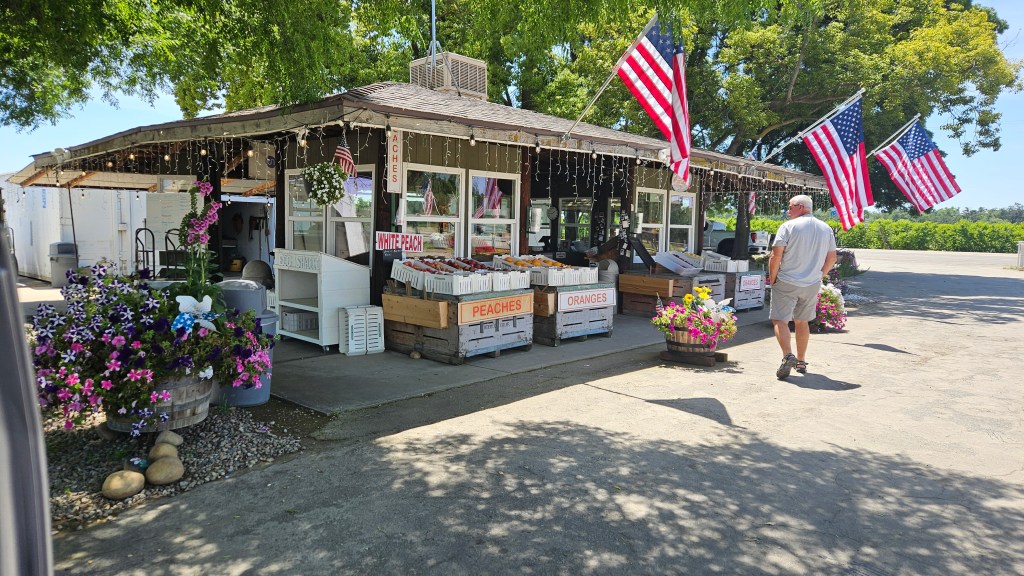
On another day, we drove back down out of the foothills and towards Fresno to stop at some orchard fruit stands. At the first tiny stand, there were only oranges. I wasn’t really interested, as we’d had plenty of fresh oranges in Arizona. But the old gentleman inside began cutting a large warty looking tangerine just as we were going to leave. He spoke no English, just handed over the freshly cut fruit. Delectable! It was so juicy and sweet and easy to peel, we bought a bag. Just not as big a bag as he would have liked us to purchase.
At another stand, we purchased freshly picked peaches, cherries, and vegetables.

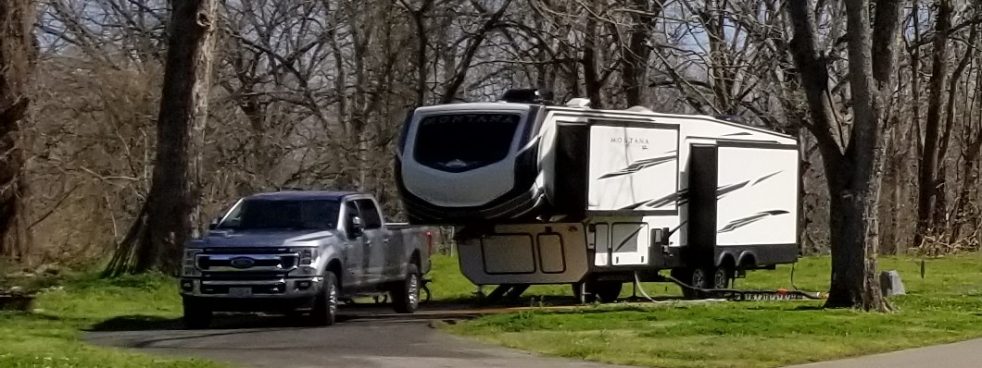
The interesting thing about Sequoia RV park is that sites are not assigned, even though an RV’er or camper has a reservation. There’s no office. Upon arriving, one simply drives through the park and chooses a site. This is an old park, so many sites aren’t level and in some, the utilities are problematic. We arrived early on our first day, tried a couple spots, and finally found one we liked.

The camp host and his wife were wonderful folks, who actually live in the trailer park that fits like a cap over the RV park. He took on the hosting job to clean up the neighborhood in both parks. We enjoyed this view with no RV’s in sight (they were all to one side or behind us) for a few days because he was having issues with the guy who was mowing the grounds. When the sites were finally mowed, they filled in.

Around 5 PM, the show started. Folks would start arriving from either the National Parks or from were they had driven that day, looking for the best site. When the park started filling up, we would see the same RVs circling more than once just to find a place to settle. Many of these were small RV’s rented from Cruise America or El Monte, and most of the people renting them that we talked to were European. I decided this grab-your-own-site deal wasn’t such a fine idea.

At our site, I would sometimes look down on our driveway or on a corner of our mat, and it seemed like the ground was moving. There were tiny little frogs hopping en masse! It wasn’t a constant thing, so it was startling and fascinating when I saw them. What I found on Google is that these frogs lay eggs on land, rather than water, and look like fully grown frogs when they hatch. They prefer to live under leaf and other ground litter, and move quickly when they think they are being detected.

A mini frog, no bigger than a quarter

One evening, what should come down our lane but a big fat pig on a harness?

This is Cleopatra and despite her huge size, she is picky about what she eats. Our neighbor had come out with a bag of lettuce and she totally rejected it. Not good enough for her. I’m supposing Cleopatra lives in the mobile home part of the park because I can’t imagine traveling with a pig in an RV.

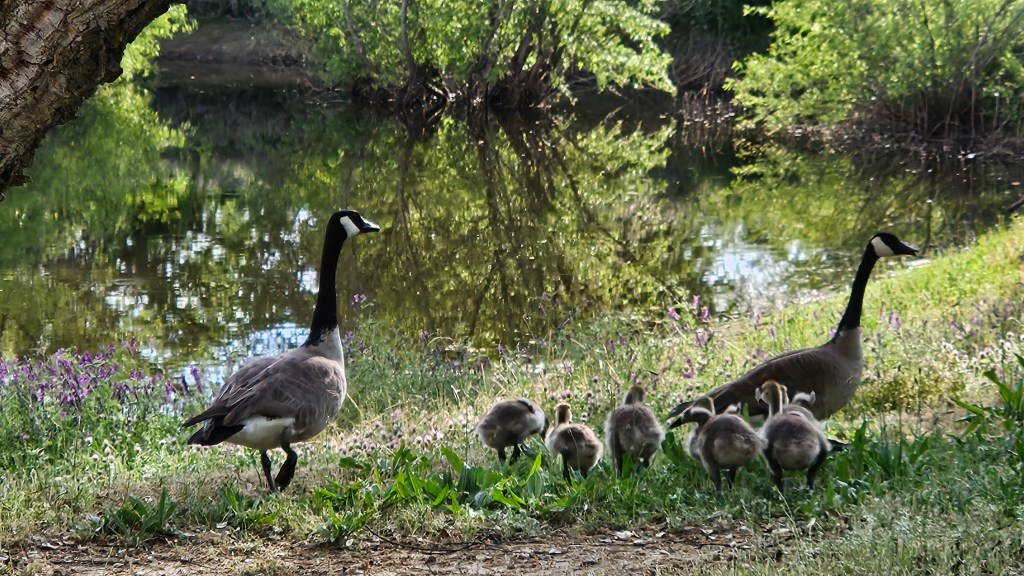
We also had a goose family that waddled near our site now and again. Their favorite spot was the pond, of course. I took my lawnchair and my cross-stitching under a tree near the pond on a Sunday afternoon and they provided fine entertainment. They swam around the pond, rested on their little island, and got into some squabbles with a pair of ducks.

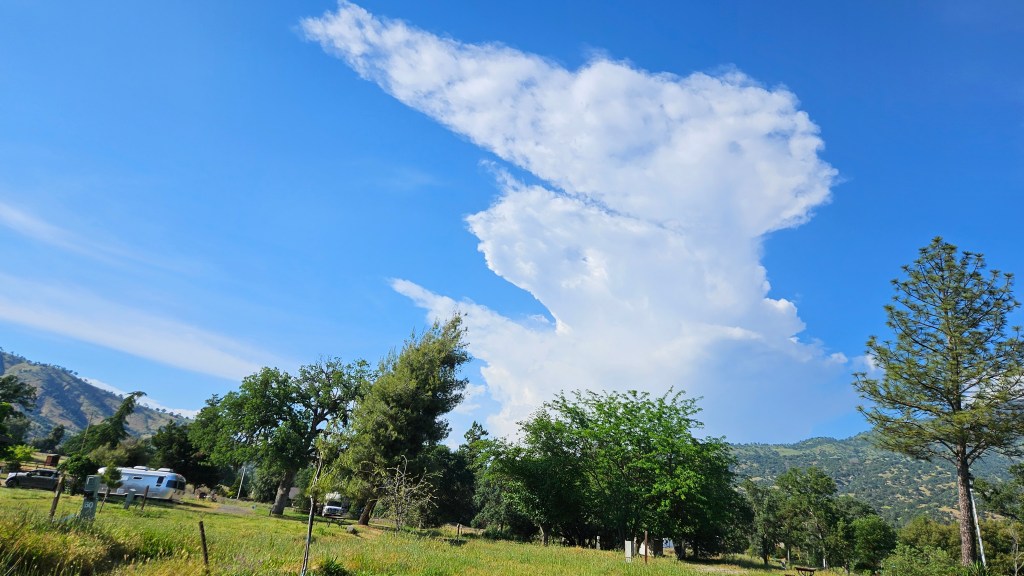
One of the best things here, though, was a dramatic sky that was ever-changing.

Although we are blessed to travel and see many things, it is the every day experiences in our home that provides the fabric of our current life. Whatever will happen at the next place is a constant gift that is just waiting to be opened.

Next time – Yosemite National Park

USTravel

Sequoia National Park – It’s All About the Trees

No other tree in the world, as far as I know, has looked down on so many centuries as the sequoia or opens so many impressive and suggestive views into history. — John Muir

Although where we stayed was billed as the closest RV park to the National parks, the road was twisting and full of precipitous drops on the passenger side. It was still a fair distance to the gate. Past the entrance, we turned right, to go into Sequoia, instead of left, to go into Kings Canyon as we had done previously.

From Grant Grove Village, where we came into the parks, it is a 30 mile, 60 minute drive on the Generals Highway down to parking for the Sherman Tree trail. This is a beautiful and heavily forested drive. As we rode through the conifer forest, the music of Josefine and Trine Opsahl – Sterna Paradisae – provided a perfect accompaniment.

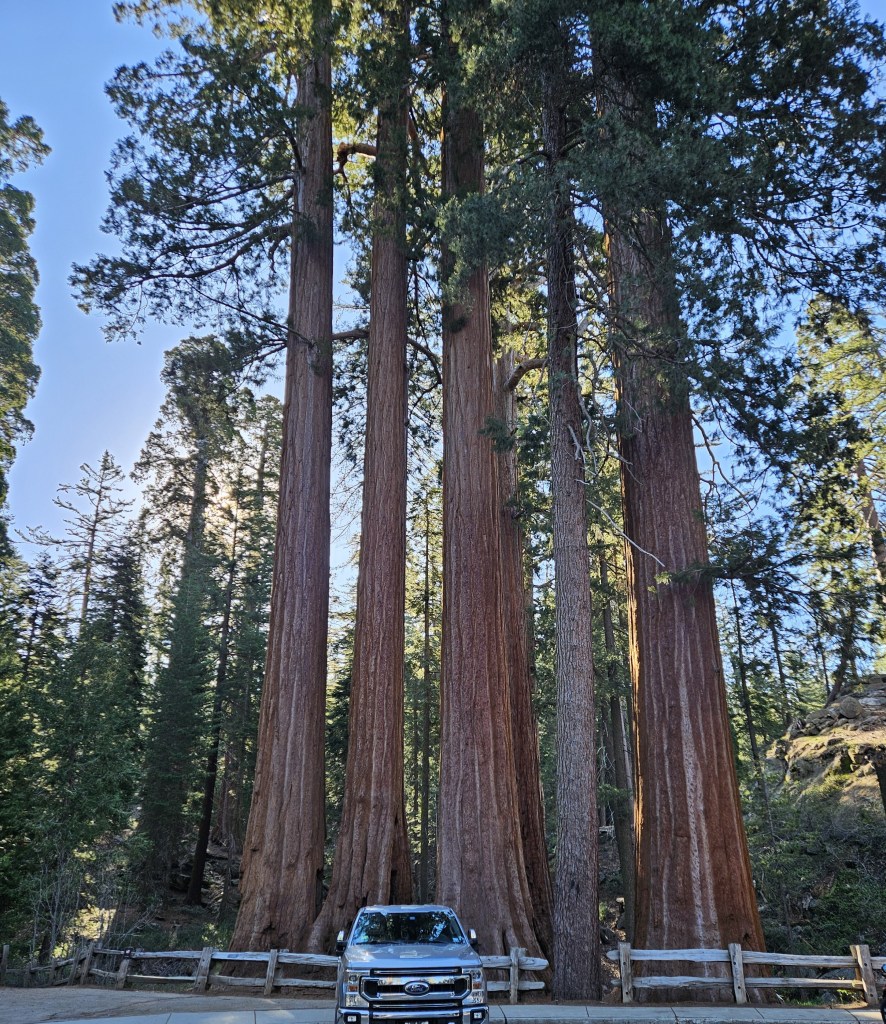
This is one of the world’s largest remaining groves of the world’s largest trees. Here, in an area measuring roughly five miles, are over 2,100 trees that measure over 10 miles in diameter. Many have been burned in forest fires but yet, fire is the way that giant sequoias regenerate.

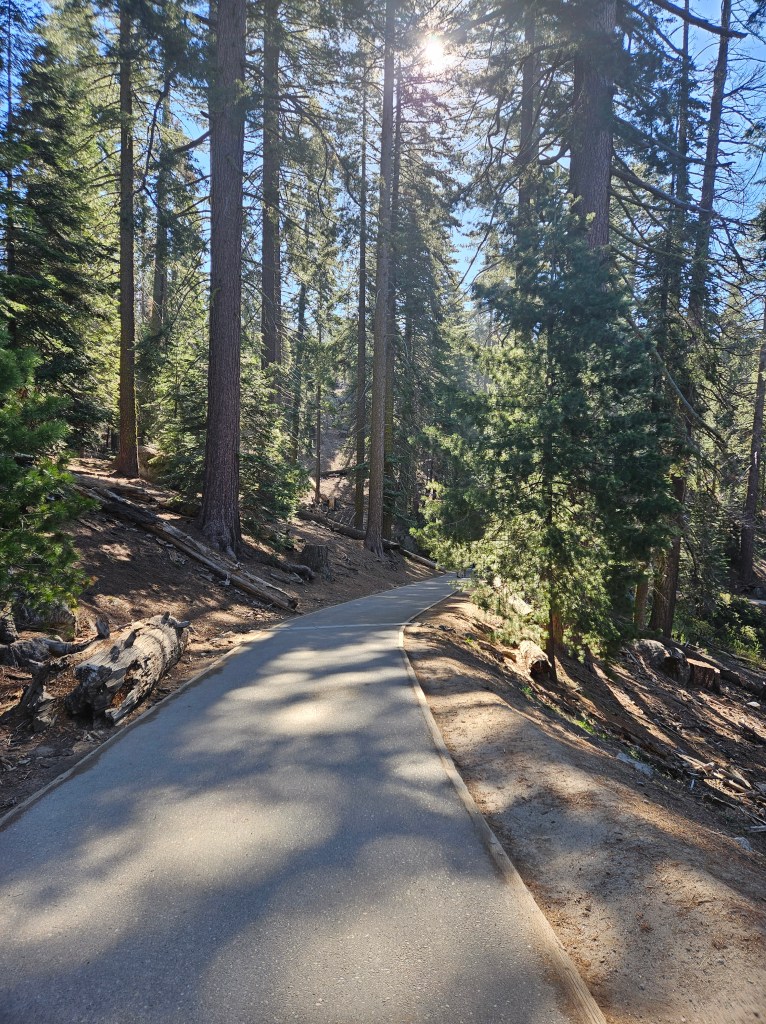
Once parked, it is a half mile hike to the General Sherman Tree. Even taking the sequoias out of the equation, the pines are tall and stately. The forest is hushed, the animals long gone into their hiding places for the day, and the sun plays peek-a-boo with the trees.

Until, that is, we get down to the General Sherman tree, where the other tourists are. Early on a weekday, though, the crowd level is not too bad.

Here it is – the largest tree in the world.

Not the tallest, the oldest, or even the largest around. It is the volume of its trunk. It just keeps growing, to the point where it has more wood than any other tree – 52,500 cubic feet, to be exact. It is 109 feet around its base. Maybe its easier to understand that it would take up three lanes of traffic if you set it down on a highway.

The General Sherman tree was named back in 1879 by a cattleman who had served in the Civil War under General Sherman and greatly admired him. The tree naming continues on the 2.7 mile Congress Trail, where we took a longer hike through the stately sequoia grove.

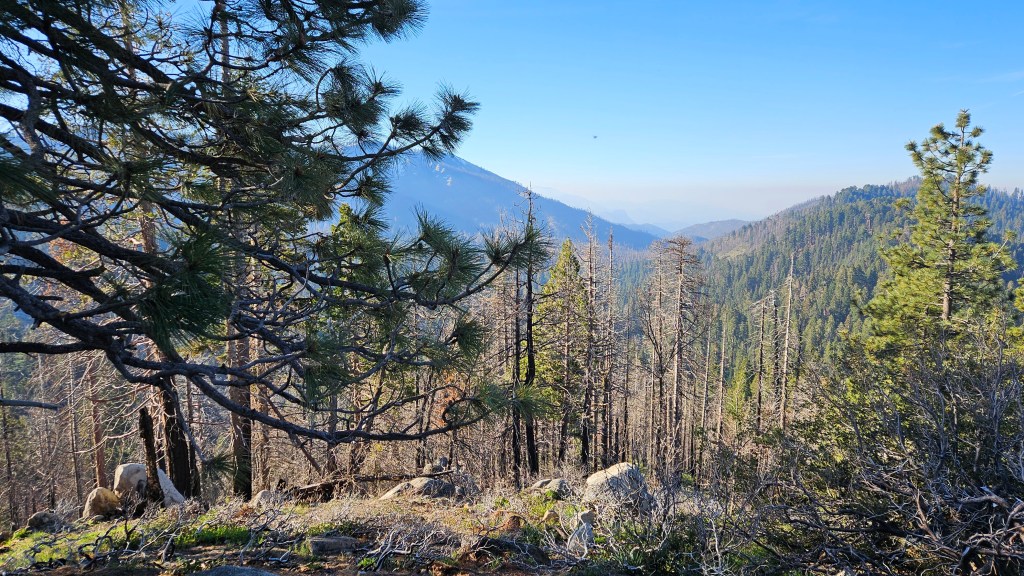
Many trees here have been burned in the 2021 fire. General Sherman itself had been under threat, but received protective wrap around the base to help it survive.

The stumps of burned trees hold their own special beauty.

Despite the fire, the sequoias still stand tall – one may be damaged, but the next is not.

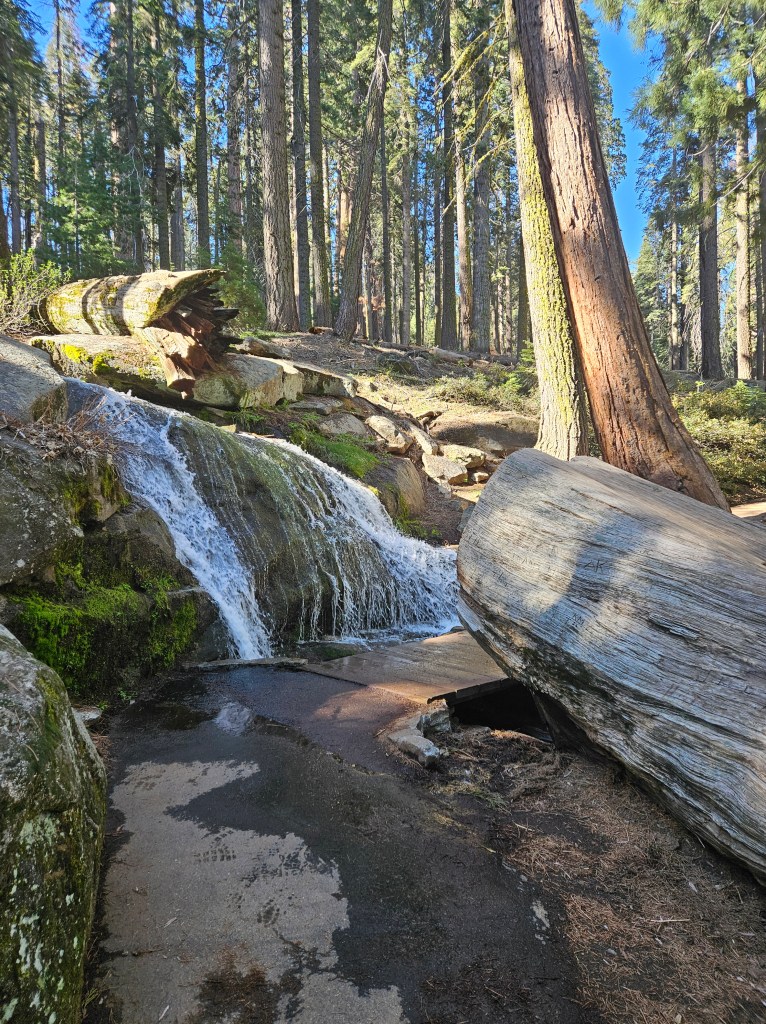
The whole trail is beautiful, and some parts of it even more so when a pretty waterfall is thrown in across the path.

Tree roots form impossible loops and holes.

What do you do when a sequoia falls on the trail? You simply tunnel under it.

Congress Trail is named for trees that have themselves been given names of the various branches of the US Government. There is the Senate grouping, and there is the President McKinley tree. The rear of the House trees look battle-scarred. Down, maybe, but for sure not out. I thought this was an amusing metaphor for our current House.

Fire generates new growth in the forest, and this is good to see. What will our planet be like when these trees grow tall?

All too soon, it was time to leave the forest. We could have gone further to the Giant Forest Museum, but our truck was over on the other side of General Sherman and up a hill. We hiked back to it and continued down the Generals Highway to the museum. There, I learned a lot more about the trees and how the park has changed its approach to having visitors in it. The focus now is on forest conservation and remediation from years of damage.

We also learned that our next stop to the Moro Rock area of the park would not be possible since the road had not yet been cleared for the summer.

Nothing else to do but have a lovely late lawn chair lunch.

Next time – Cat Haven and RV life

USTravel

Kings Canyon National Park

Everybody needs beauty as well as bread, places to play in and pray in, where Nature may heal and cheer and give strength to body and soul alike. –John Muir

Heading out from San Luis Obispo, our destination was to the Sierra Nevada mountain range. We retraced some of our drive through the California Central Valley. This time, though, we turned northeastward, driving through miles and miles of orchards and fields growing strawberries, blueberries and other produce around Fresno. We learned later that we were driving on part of the “Fresno County Fruit Trail”.

We soon ascended into the Sierra foothills and arrived at an aged RV park, the closest one to the entrance of the twin Kings Canyon and Sequoia National Parks. On our first day, we decided to explore just Kings Canyon.

Maybe if you think about Sequoia trees, you think about Sequoia National Park. I know I did, and did not know what to expect with Kings Canyon. This park has its share also, though. Upon arrival at the park we soon turned off onto a parking lot for a half-mile loop that would bring us face-to-face with these majestic sentinels of the forest.

In the morning, when the day was fresh and new and we were one of the first on the trail, the feeling of walking among the tall trees was indescribable. It isn’t just the giant sequoia: there is the ponderosa pine, the sugar pine, and the white fir, among others.

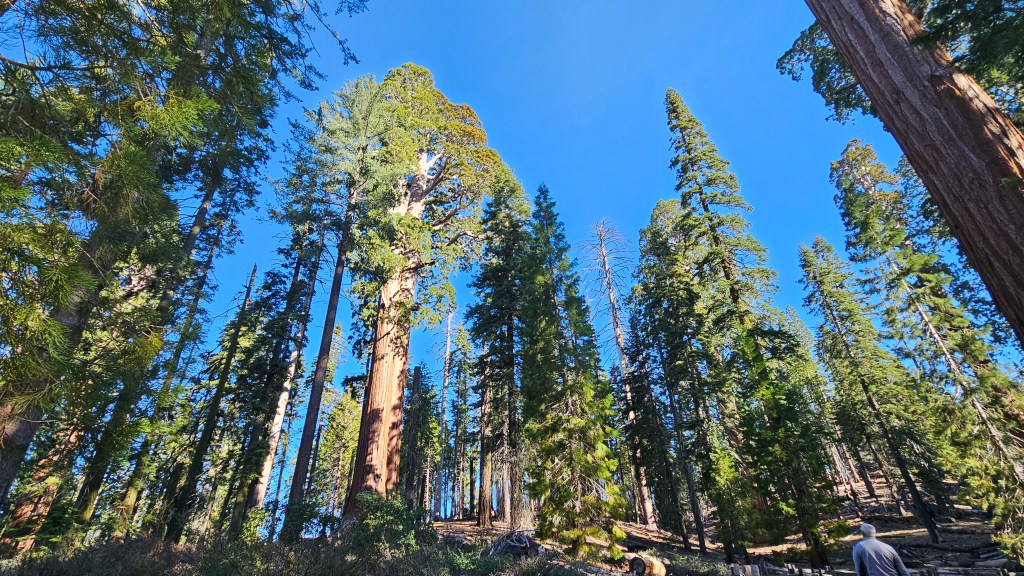
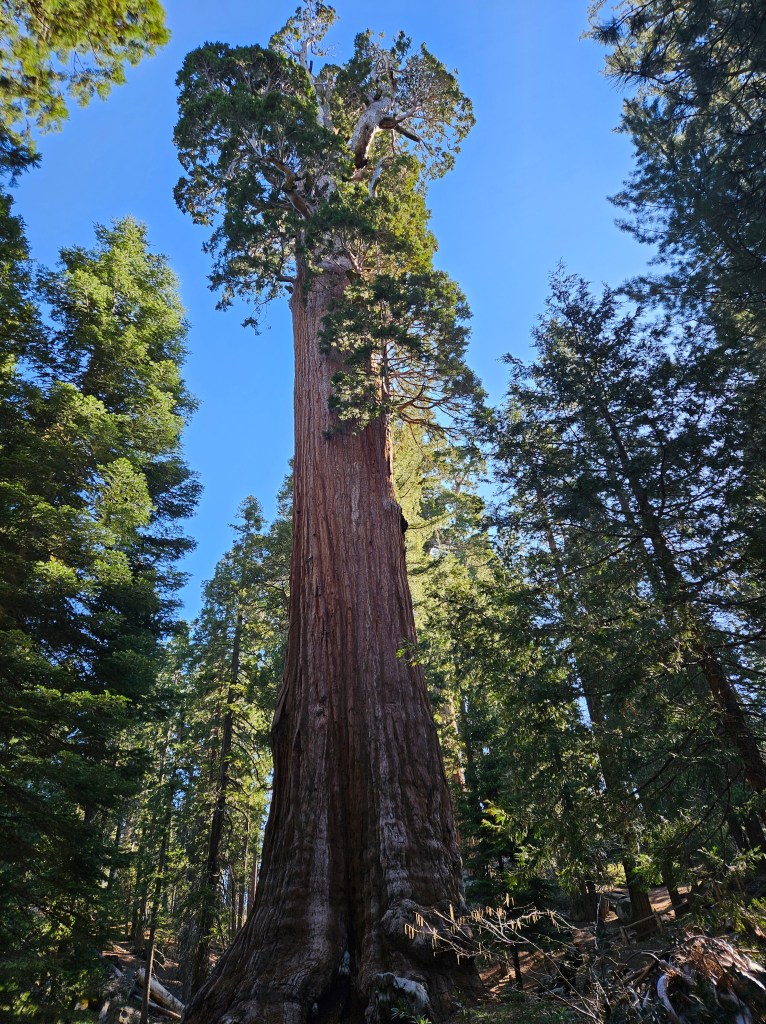
The headliner in this area is the Grant Tree. Its stats are impressive. It is the third largest in the world by volume, 268 feet tall and 1700 years old. I tried to wrap my head around what was going on in the world when this tree was but a seedling.

It’s not age that makes a sequoia grow so tall, though. Just the right amount of nutrients, water and sun is the secret sauce that makes one tree thrive so extraordinarily.

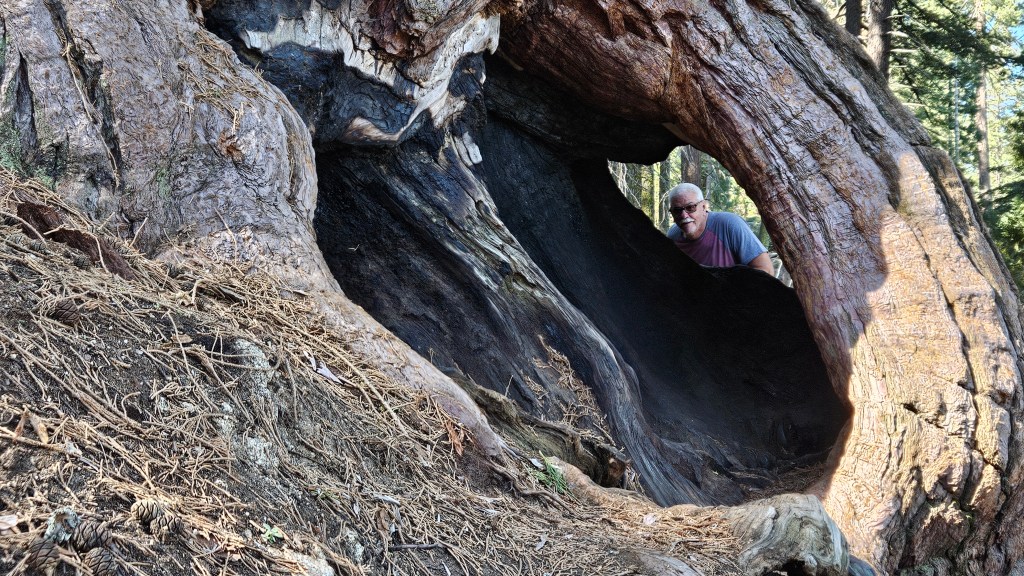
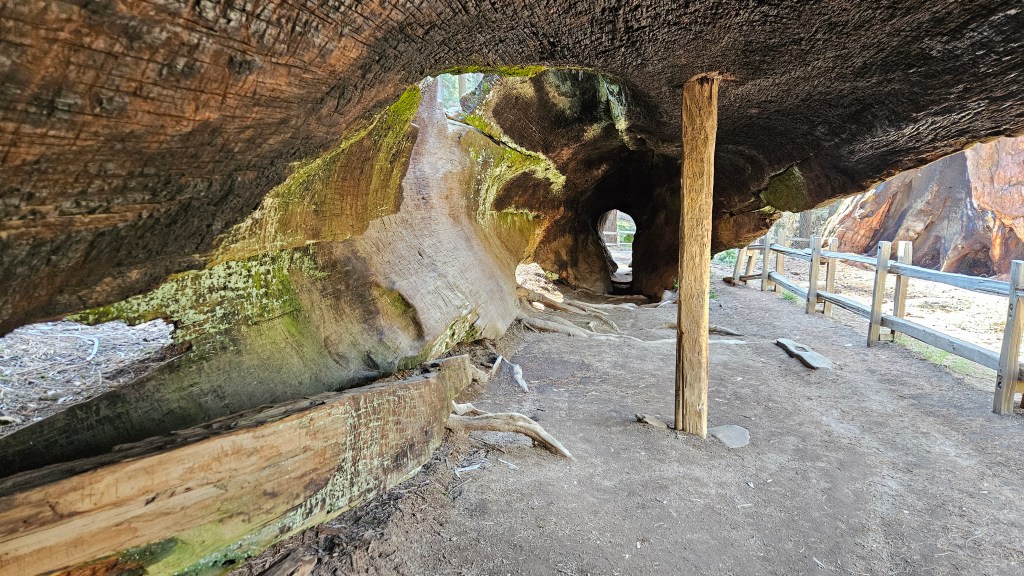
Also on this trail is the trunk of a long-felled sequoia which we could walk through. There is a photograph on a signboard which shows that this trunk sheltered a construction crew around the turn of the century, and likely other travelers needing a spot to camp for the night down through the ages.

Sequoias decay very slowly when they fall, continuing to exist for hundreds of years.

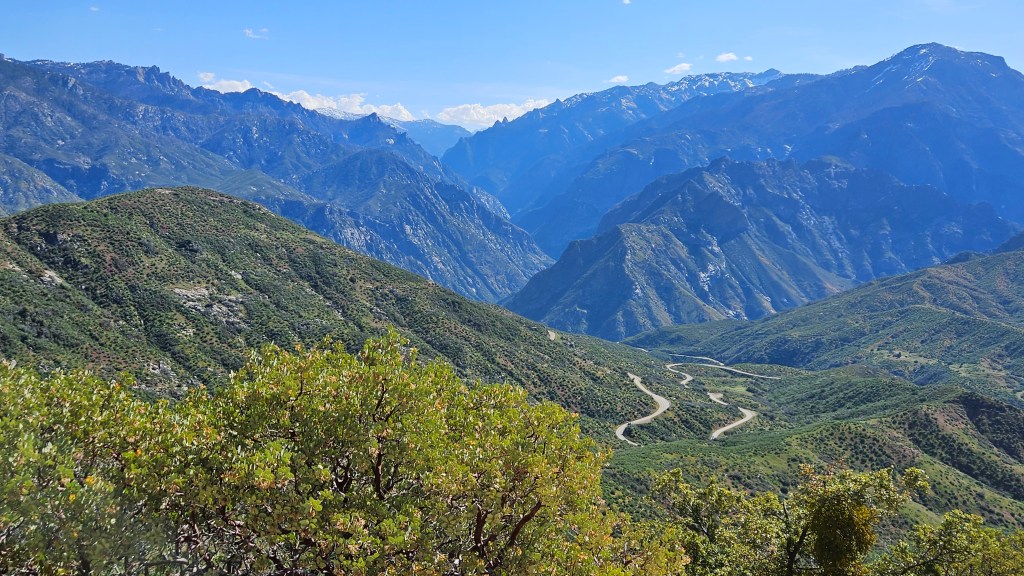
As wonderful as all of this was, it was only part of what was to come during our day in the park. Upon entering the gate, we were delighted to discover that the Kings Canyon Scenic Byway had just been opened for the summer. Every time I’d looked it up online, the byway had still not been cleared from the winter snows.

I’m so glad we did not miss seeing it!

Here we were, with a ringside seat to the Sierra Nevada mountain range. Mount Whitney is the highest peak in this range, and it’s possible we were looking right at it, but I can’t be sure which peak it was.

As we descended into Kings Canyon, the South Fork of the Kings River came into view.

Gushing waterfalls streamed from the high walls of the canyons to join the roiling river waters.

Boyden Cave sounded interesting so we stopped, but the trail to whatever cave that may have been there was closed. It was a nice break, though, and we enjoyed the scenery all around.

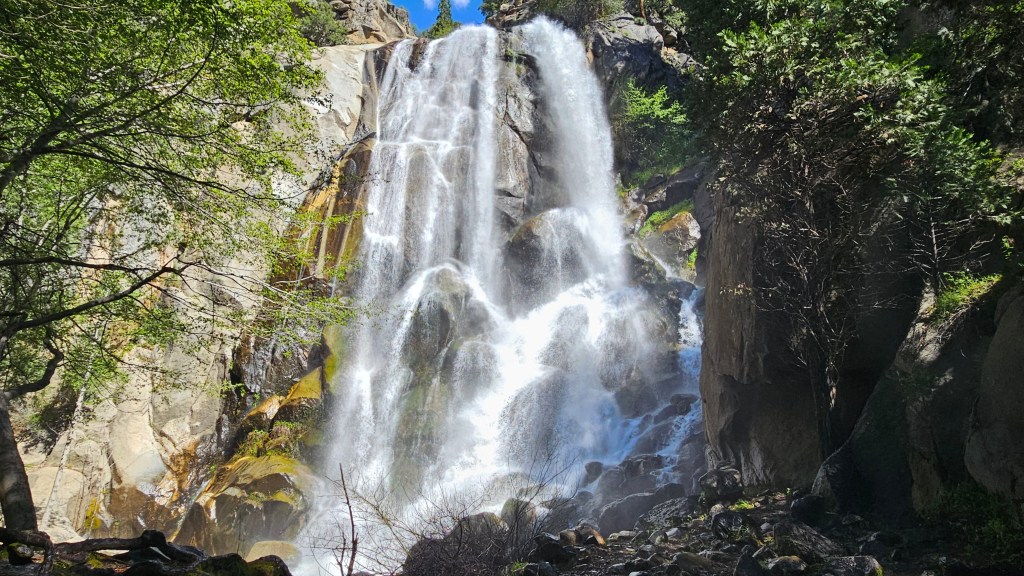
The grand finale to this drive was Grizzly Falls.

We stayed a little while to take in this extraordinary sight before regretfully turning the truck around. The road continued to Cedar Grove Visitor Center and Zumwalt Meadow, but it had not yet been cleared and opened for the summer.

Retracing our drive, we turned off at Hume Lake.

A man by the name of John Eastwood had this dam built in 1908 for his lumbering operation. The lake served as a holding tank for cut sequoia and pines, and water supply for a 54-mile flume that carried the water through Kings Canyon to a town on the other end for finishing. At one time, an entire community lived here.

Thankfully, the era of sequoia harvesting ended in 1929. The sawmill had burned down. By 1936 the federal government came under ownership of the lake as part of the Sequoia National Forest. And, decades later, we could enjoy a picnic lawn chair lunch on its shores.

Next time – Sequoia National Park