USTravel

Sequoia National Park – It’s All About the Trees

No other tree in the world, as far as I know, has looked down on so many centuries as the sequoia or opens so many impressive and suggestive views into history. — John Muir

Although where we stayed was billed as the closest RV park to the National parks, the road was twisting and full of precipitous drops on the passenger side. It was still a fair distance to the gate. Past the entrance, we turned right, to go into Sequoia, instead of left, to go into Kings Canyon as we had done previously.

From Grant Grove Village, where we came into the parks, it is a 30 mile, 60 minute drive on the Generals Highway down to parking for the Sherman Tree trail. This is a beautiful and heavily forested drive. As we rode through the conifer forest, the music of Josefine and Trine Opsahl – Sterna Paradisae – provided a perfect accompaniment.
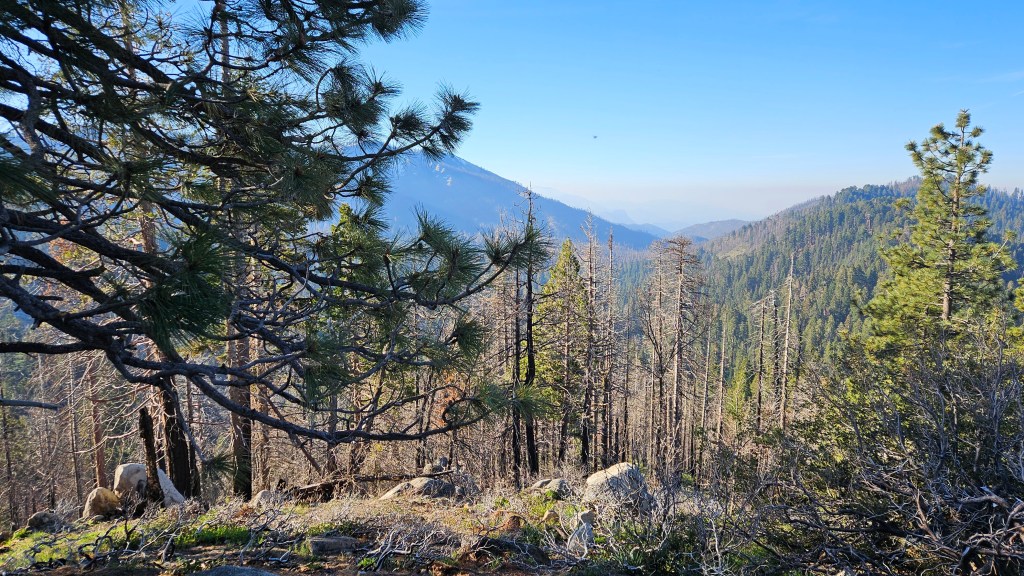
This is one of the world’s largest remaining groves of the world’s largest trees. Here, in an area measuring roughly five miles, are over 2,100 trees that measure over 10 miles in diameter. Many have been burned in forest fires but yet, fire is the way that giant sequoias regenerate.

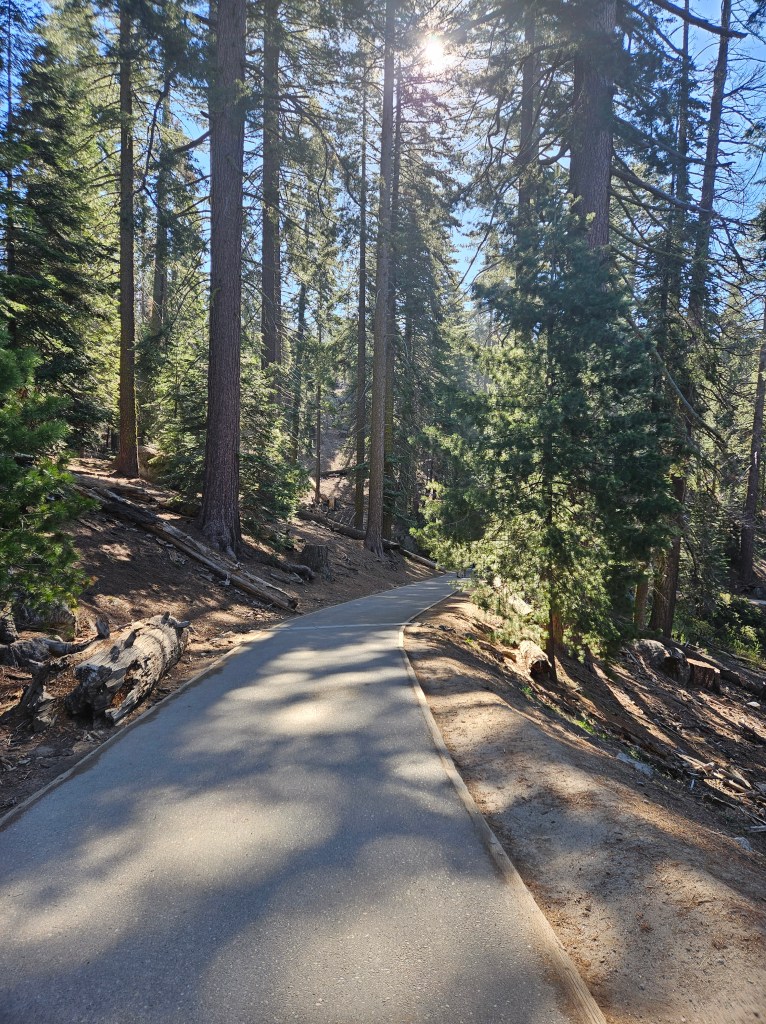
Once parked, it is a half mile hike to the General Sherman Tree. Even taking the sequoias out of the equation, the pines are tall and stately. The forest is hushed, the animals long gone into their hiding places for the day, and the sun plays peek-a-boo with the trees.

Until, that is, we get down to the General Sherman tree, where the other tourists are. Early on a weekday, though, the crowd level is not too bad.
Here it is – the largest tree in the world.

Not the tallest, the oldest, or even the largest around. It is the volume of its trunk. It just keeps growing, to the point where it has more wood than any other tree – 52,500 cubic feet, to be exact. It is 109 feet around its base. Maybe its easier to understand that it would take up three lanes of traffic if you set it down on a highway.

The General Sherman tree was named back in 1879 by a cattleman who had served in the Civil War under General Sherman and greatly admired him. The tree naming continues on the 2.7 mile Congress Trail, where we took a longer hike through the stately sequoia grove.

Many trees here have been burned in the 2021 fire. General Sherman itself had been under threat, but received protective wrap around the base to help it survive.

The stumps of burned trees hold their own special beauty.

Despite the fire, the sequoias still stand tall – one may be damaged, but the next is not.

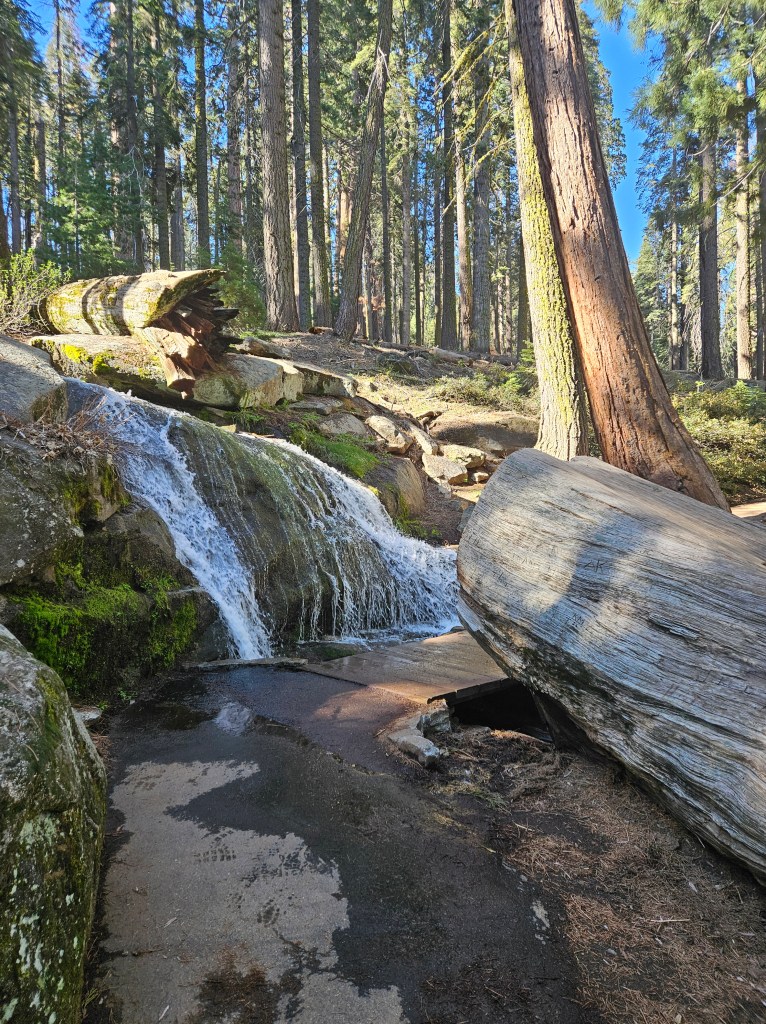
The whole trail is beautiful, and some parts of it even more so when a pretty waterfall is thrown in across the path.
Tree roots form impossible loops and holes.
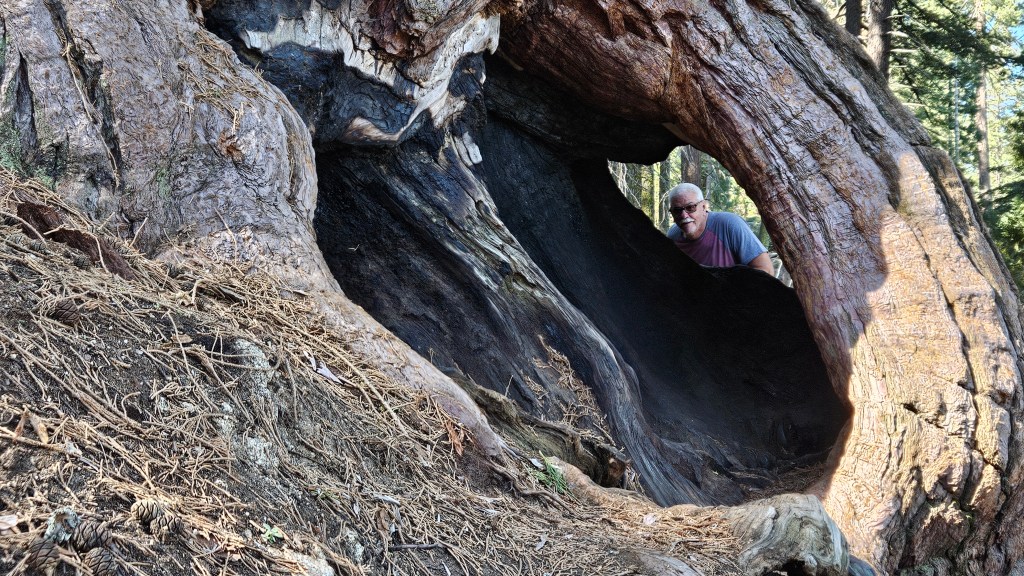
What do you do when a sequoia falls on the trail? You simply tunnel under it.

Congress Trail is named for trees that have themselves been given names of the various branches of the US Government. There is the Senate grouping, and there is the President McKinley tree. The rear of the House trees look battle-scarred. Down, maybe, but for sure not out. I thought this was an amusing metaphor for our current House.

Fire generates new growth in the forest, and this is good to see. What will our planet be like when these trees grow tall?

All too soon, it was time to leave the forest. We could have gone further to the Giant Forest Museum, but our truck was over on the other side of General Sherman and up a hill. We hiked back to it and continued down the Generals Highway to the museum. There, I learned a lot more about the trees and how the park has changed its approach to having visitors in it. The focus now is on forest conservation and remediation from years of damage.

We also learned that our next stop to the Moro Rock area of the park would not be possible since the road had not yet been cleared for the summer.

Nothing else to do but have a lovely late lawn chair lunch.

Next time – Cat Haven and RV life

USTravel

Kings Canyon National Park

Everybody needs beauty as well as bread, places to play in and pray in, where Nature may heal and cheer and give strength to body and soul alike. –John Muir

Heading out from San Luis Obispo, our destination was to the Sierra Nevada mountain range. We retraced some of our drive through the California Central Valley. This time, though, we turned northeastward, driving through miles and miles of orchards and fields growing strawberries, blueberries and other produce around Fresno. We learned later that we were driving on part of the “Fresno County Fruit Trail”.

We soon ascended into the Sierra foothills and arrived at an aged RV park, the closest one to the entrance of the twin Kings Canyon and Sequoia National Parks. On our first day, we decided to explore just Kings Canyon.

Maybe if you think about Sequoia trees, you think about Sequoia National Park. I know I did, and did not know what to expect with Kings Canyon. This park has its share also, though. Upon arrival at the park we soon turned off onto a parking lot for a half-mile loop that would bring us face-to-face with these majestic sentinels of the forest.

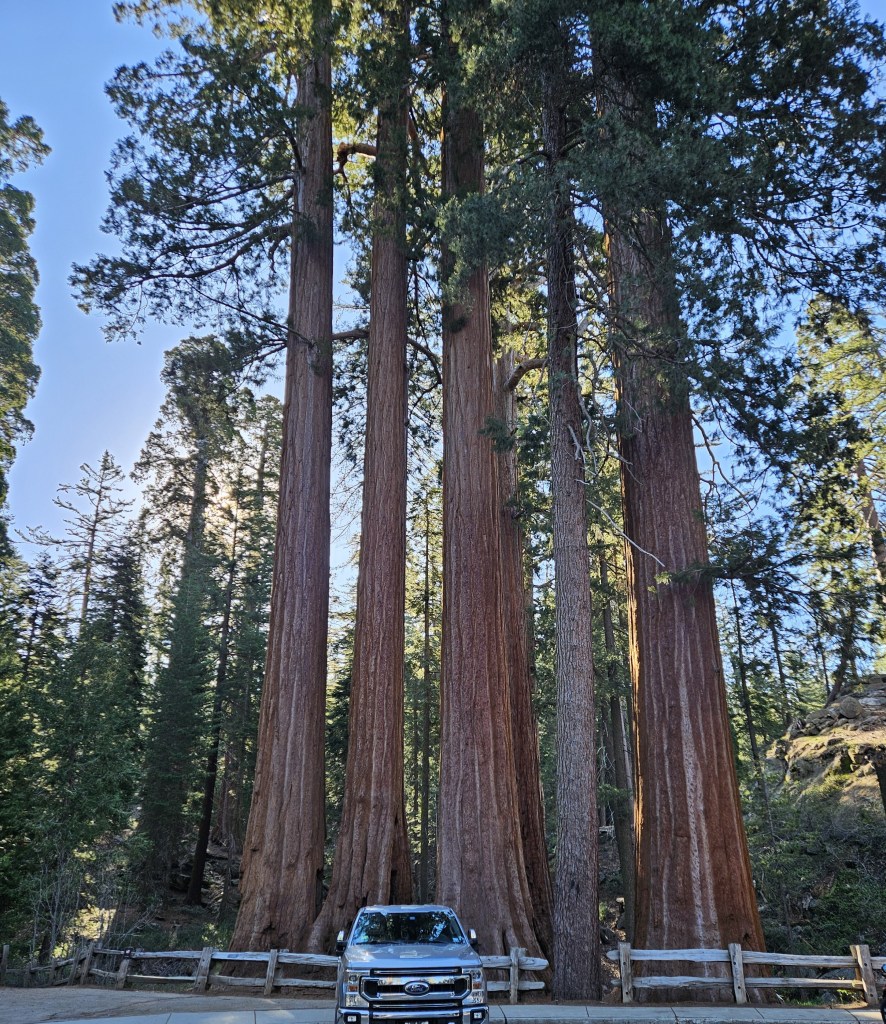
In the morning, when the day was fresh and new and we were one of the first on the trail, the feeling of walking among the tall trees was indescribable. It isn’t just the giant sequoia: there is the ponderosa pine, the sugar pine, and the white fir, among others.

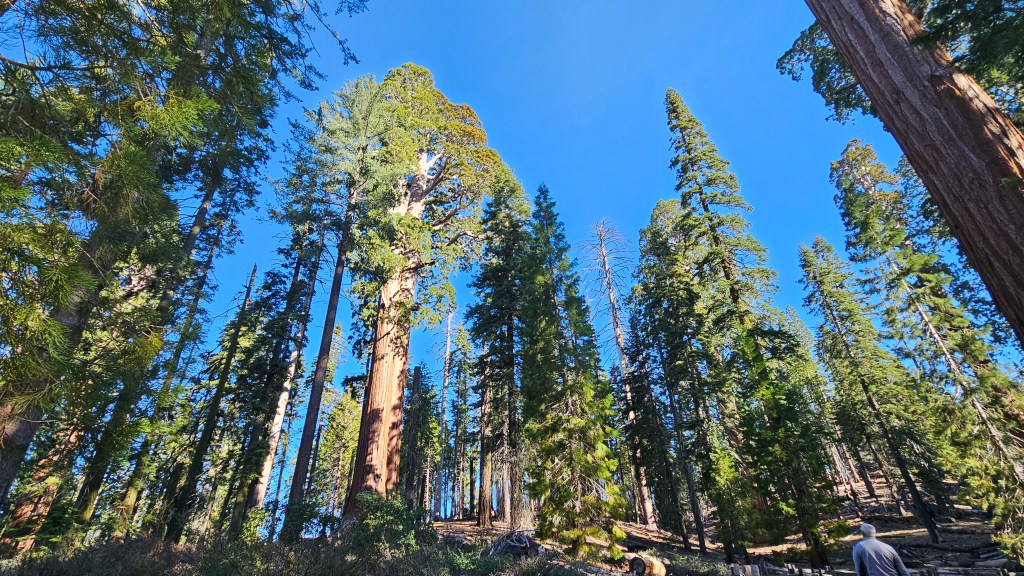
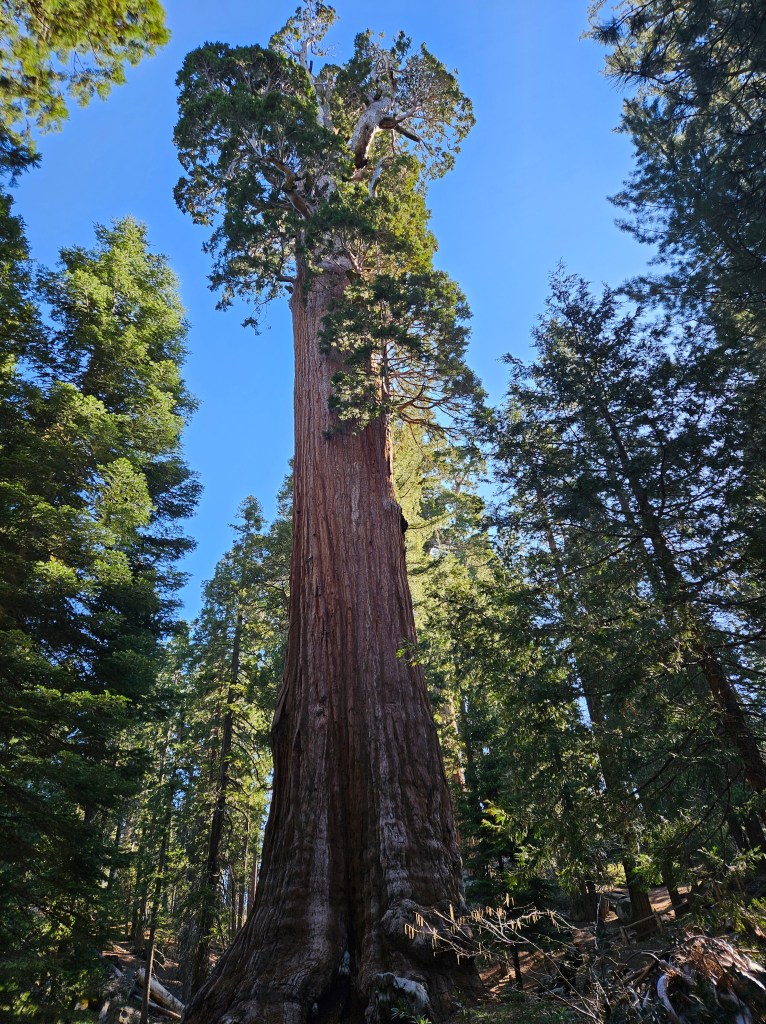
The headliner in this area is the Grant Tree. Its stats are impressive. It is the third largest in the world by volume, 268 feet tall and 1700 years old. I tried to wrap my head around what was going on in the world when this tree was but a seedling.

It’s not age that makes a sequoia grow so tall, though. Just the right amount of nutrients, water and sun is the secret sauce that makes one tree thrive so extraordinarily.

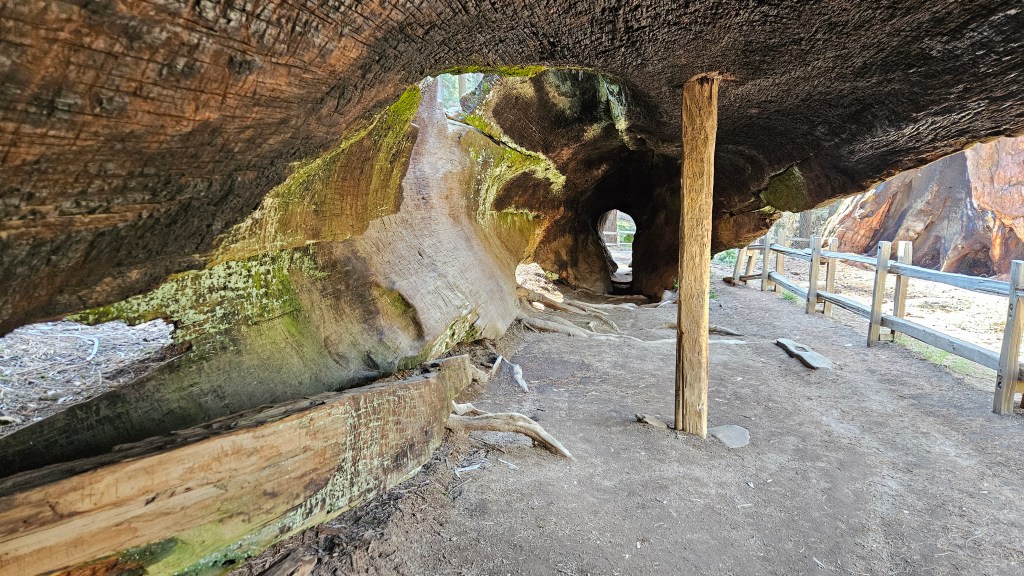
Also on this trail is the trunk of a long-felled sequoia which we could walk through. There is a photograph on a signboard which shows that this trunk sheltered a construction crew around the turn of the century, and likely other travelers needing a spot to camp for the night down through the ages.

Sequoias decay very slowly when they fall, continuing to exist for hundreds of years.

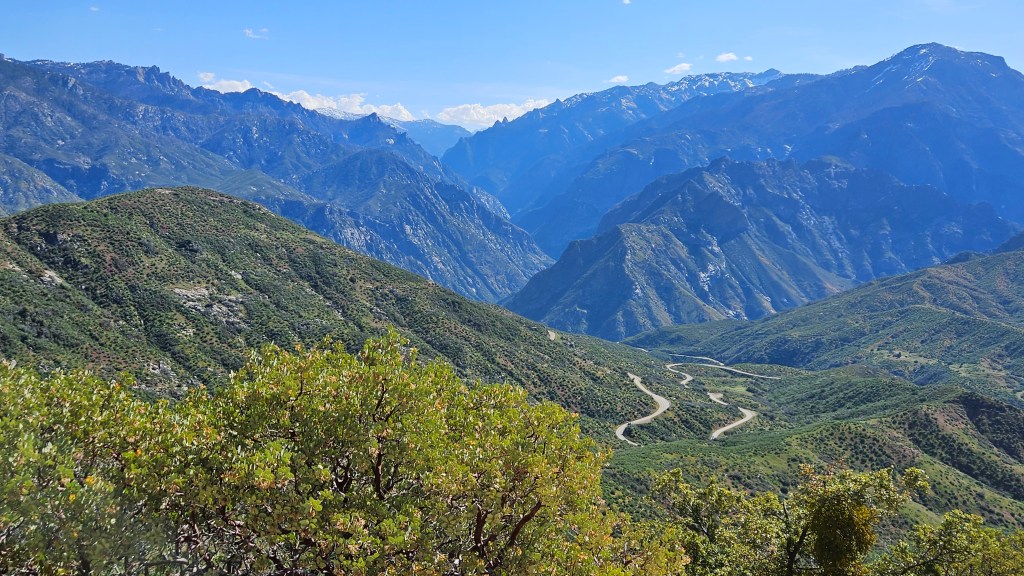
As wonderful as all of this was, it was only part of what was to come during our day in the park. Upon entering the gate, we were delighted to discover that the Kings Canyon Scenic Byway had just been opened for the summer. Every time I’d looked it up online, the byway had still not been cleared from the winter snows.

I’m so glad we did not miss seeing it!

Here we were, with a ringside seat to the Sierra Nevada mountain range. Mount Whitney is the highest peak in this range, and it’s possible we were looking right at it, but I can’t be sure which peak it was.

As we descended into Kings Canyon, the South Fork of the Kings River came into view.

Gushing waterfalls streamed from the high walls of the canyons to join the roiling river waters.

Boyden Cave sounded interesting so we stopped, but the trail to whatever cave that may have been there was closed. It was a nice break, though, and we enjoyed the scenery all around.

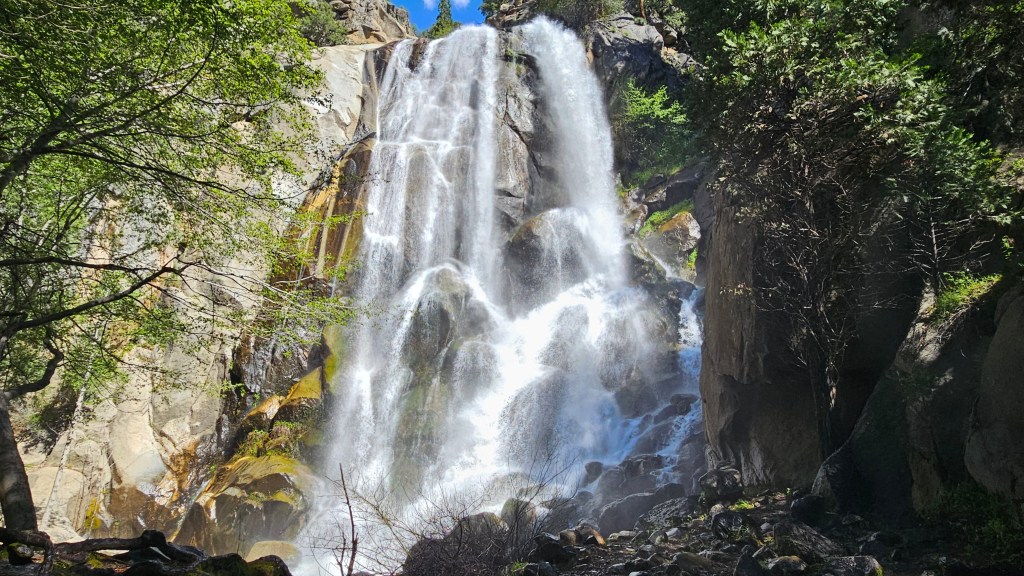
The grand finale to this drive was Grizzly Falls.

We stayed a little while to take in this extraordinary sight before regretfully turning the truck around. The road continued to Cedar Grove Visitor Center and Zumwalt Meadow, but it had not yet been cleared and opened for the summer.

Retracing our drive, we turned off at Hume Lake.

A man by the name of John Eastwood had this dam built in 1908 for his lumbering operation. The lake served as a holding tank for cut sequoia and pines, and water supply for a 54-mile flume that carried the water through Kings Canyon to a town on the other end for finishing. At one time, an entire community lived here.

Thankfully, the era of sequoia harvesting ended in 1929. The sawmill had burned down. By 1936 the federal government came under ownership of the lake as part of the Sequoia National Forest. And, decades later, we could enjoy a picnic lawn chair lunch on its shores.

Next time – Sequoia National Park