Besides the enjoyable walks all over Venice, I wanted to get inside some of her buildings. I had picked up a pocket guidebook of Venice for this purpose somewhere on our travels, and knew where I wanted to start: the Scuola Grande San Rocco.
The monumental building is described as a “confraternity”, established in 1478, for a group of wealthy Venetians. It is next to the church of San Rocco which holds the remains of this saint, who was believed to be a protector against the plague. Basically, it’s their meeting place. There are two levels.

I was bowled over when walking into this room.
The other piece to this story is that the group commissioned a Venetian painter named Tintoretto, one of the leading painters in the era. He produced his finest work here over 23 years in the late 1500’s. There are paintings dedicated to the life of Mary, and, on the ceiling, scenes from the old Testament. Basically: huge, massive paintings everywhere. On the first floor, there are also paintings by an acclaimed artist named Titian.
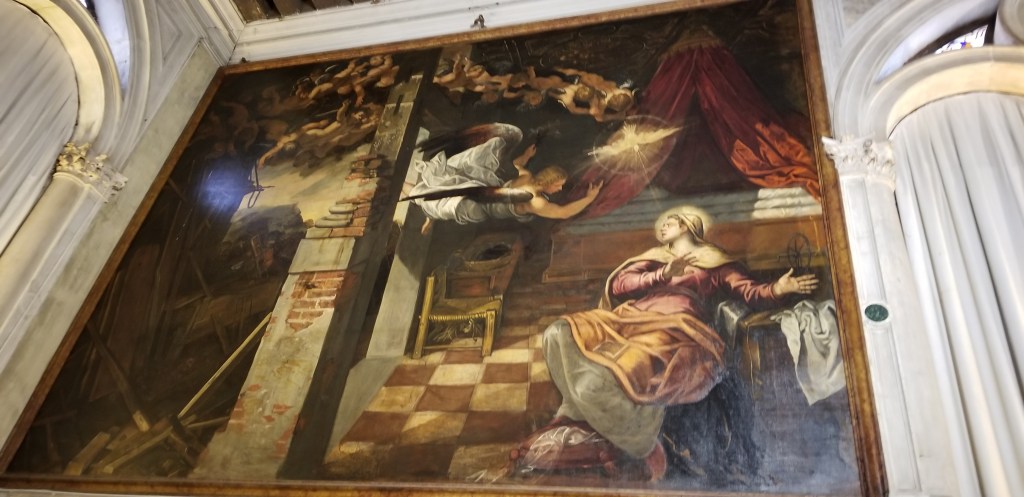

As we climbed the stairs to the second level, the Old Testament scenes with swooping angels were over our heads. As Tintoretto painted, the plague was sweeping through Venice, and the paintings were meant to give solace and comfort. Tintoretto’s paintings on this floor were of crucifixion, resurrection and hope.
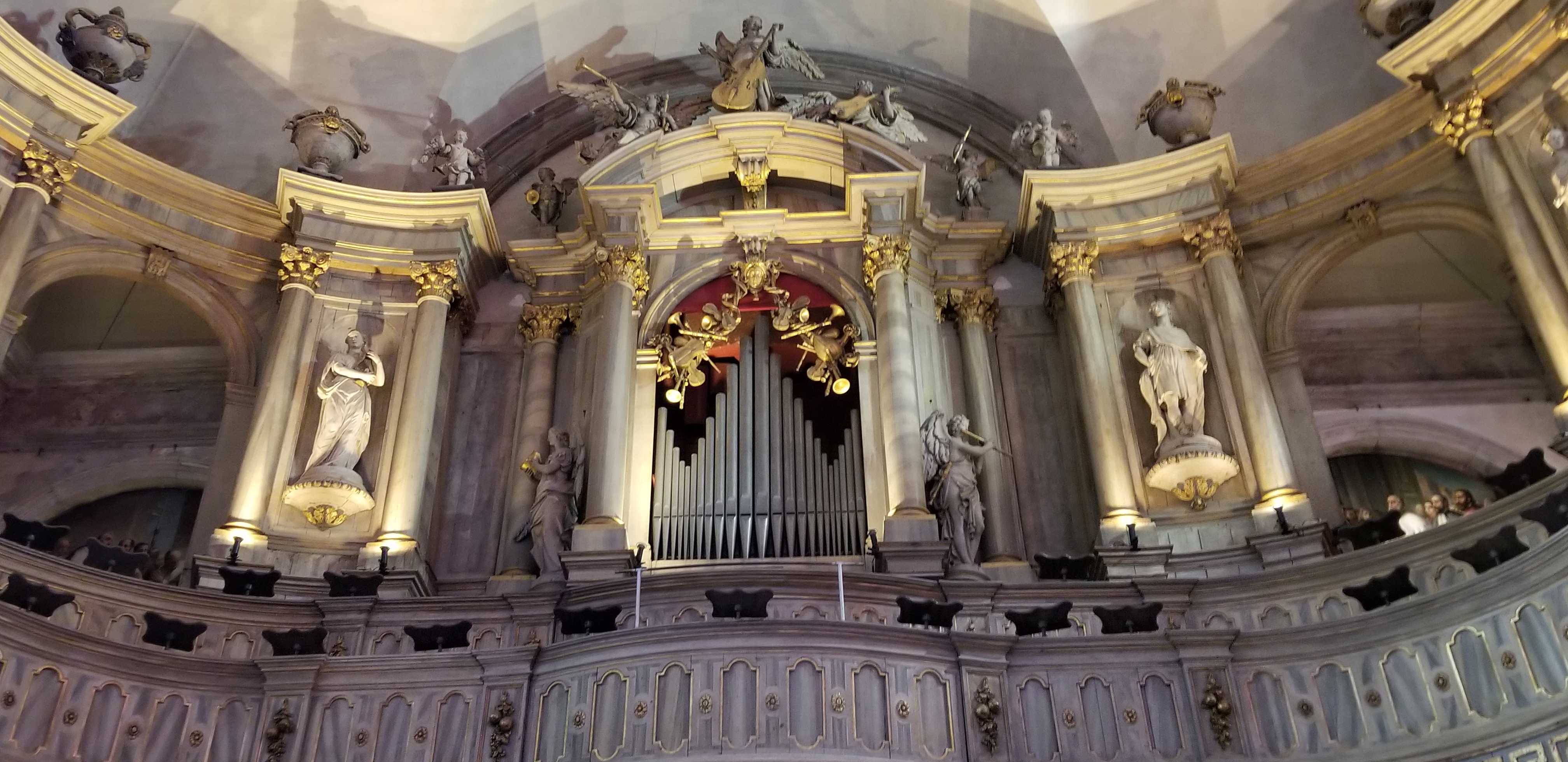
But it was the wood statues on the second level that really fascinated me. These were made by a sculptor named Francesco Pianta in the mid-1600’s. Each one is different and an allegory to such things as Melancholy, Honor, Spy, Science, Ignorance, and so on, as well as five shelves of a library carved all in wood. I didn’t know any of this when I was looking at them. I just thought they were interesting.


I went a little crazy taking pictures of these and couldn’t decide which ones to include!
This organization still exists today and they are focused on charitable causes.
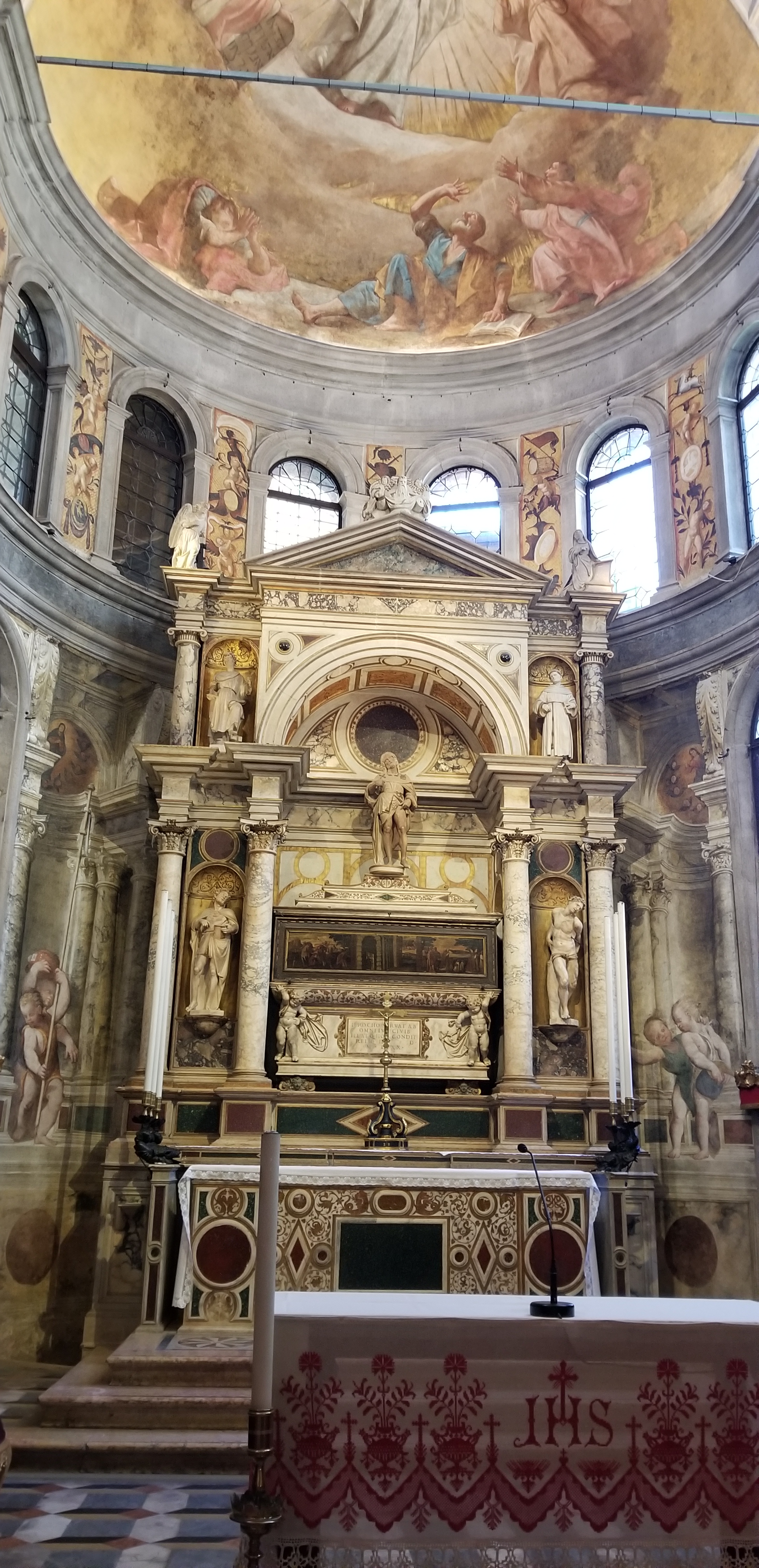
We went to cathedrals: the Church of San Rocco is next door to the Scuola and is its associated church, with more works by Tintoretto and other Renaissance artists. Tintoretto painted many scenes of the San Rocco’s life (St. Roch, in English). The saint helped heal people during the plague. We saw the Basilica of Santa Maria Gloriosa dei Frari. It is the largest church and the artist Titian is buried here. I walked into a couple more on other days. Cal was tired of cathedrals at this point and was content to sit outside in the shade and watch the people go by.


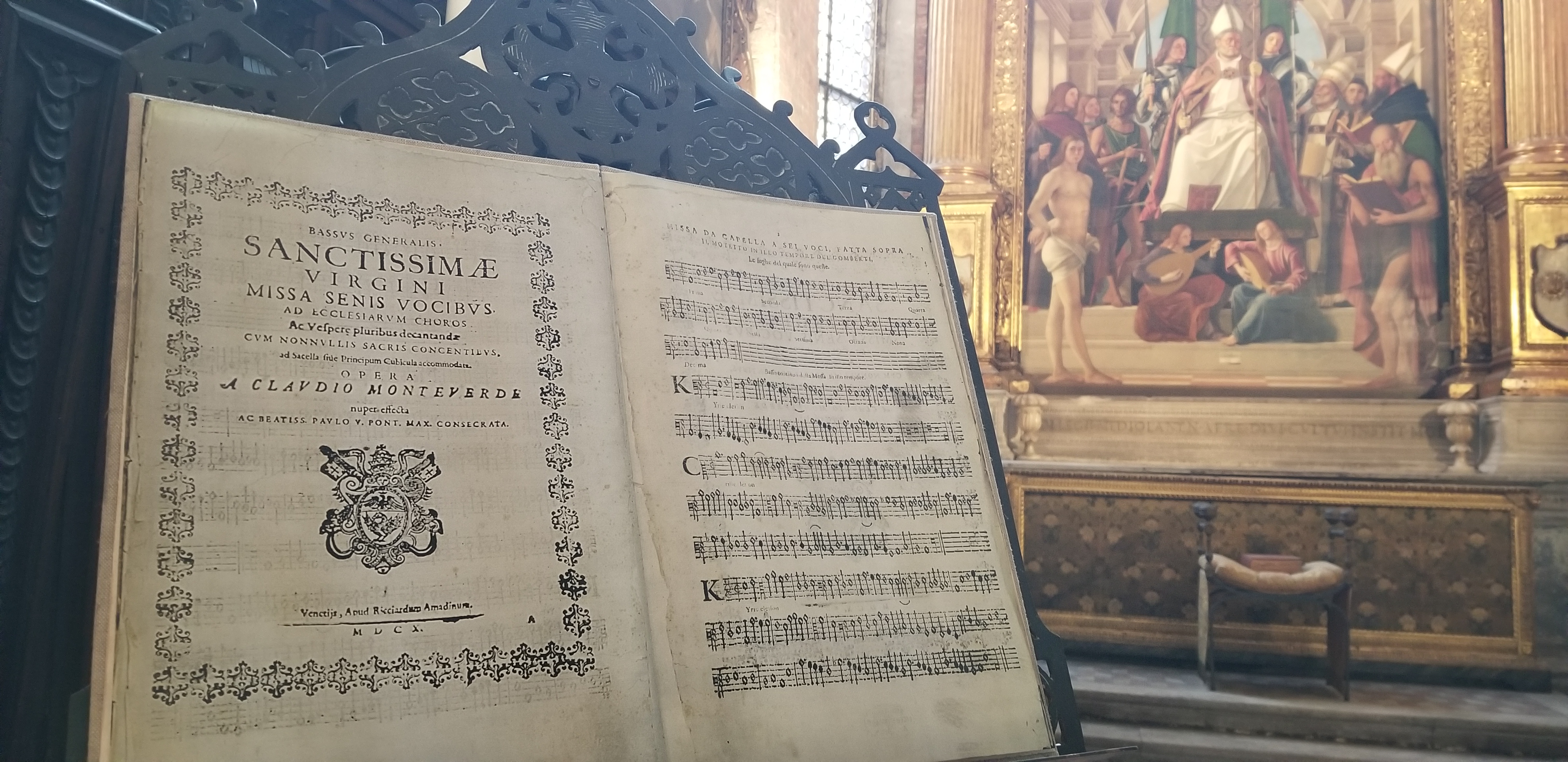
One of the most memorable gems of Venice, however, was our tour of the Doges Palace. I booked ahead for the “Secret Itineraries” tour because with this we were able to see some places not normally seen on just a walk-through of the palace. It’s not possible to purchase a timed ticket for the main rooms, so this enabled us to “skip the line” for that. Our tour began early in the morning, so on our way to the palace we saw everyone starting their day:
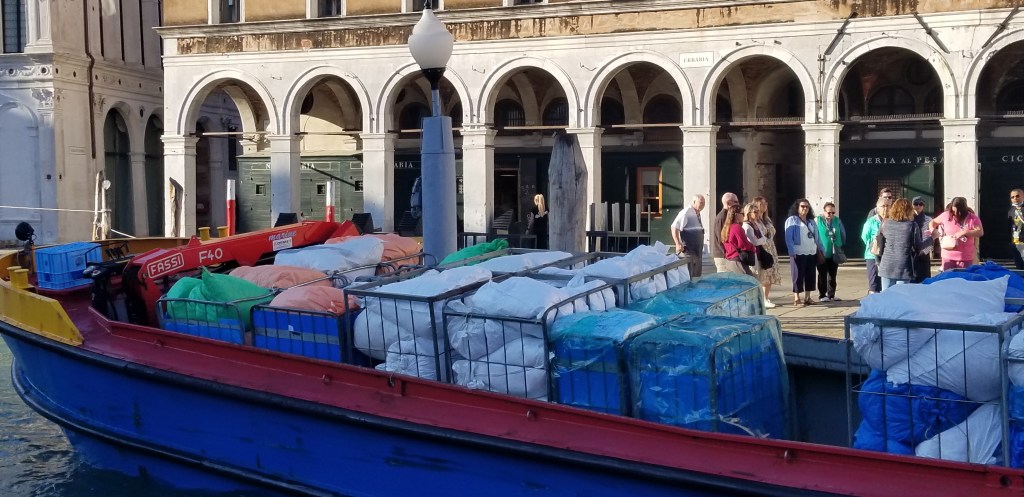
It was always fun to look in the shop windows along the way.

In this picture, the Doges Palace can be seen at the front right. On its left are St. Mark’s Cathedral and St. Mark’s Square.
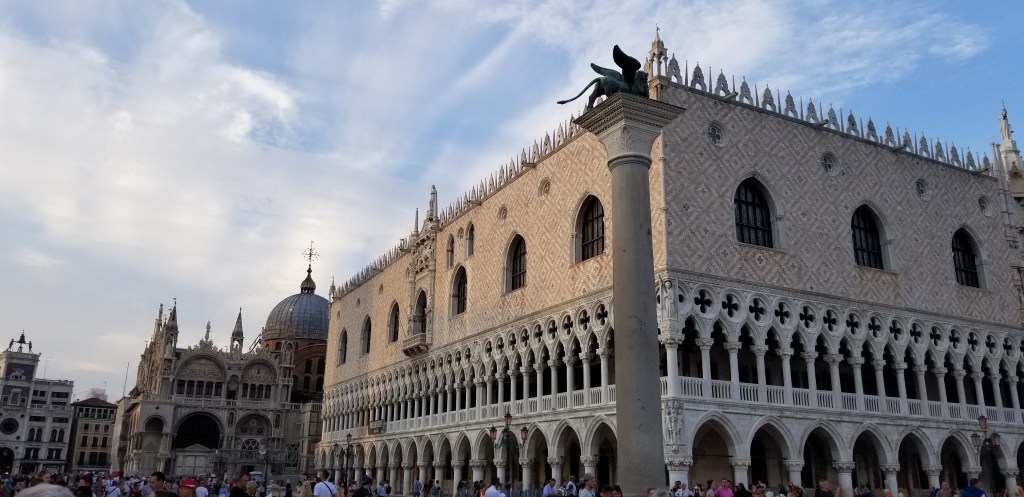
The palace is the residence of the Doges of Venice, originally built in 1340. Of course, it has been enlarged and modified over the years. I looked this up out of curiosity: tradition holds that the first doge was Paolo Lucio Anafesto, who was elected in 697. I guess he and many subsequent doges had to do without a palace for several centuries. A doge was chosen from the ruling families of Venice and held his office for life. The last doge was Ludovico Manin, who lost his seat when Napoleon conquered northern Italy in 1797.
The Doge’s Palace held not only the apartments of the doge, but it was also the seat of government and had courtrooms and a jail. A doge’s position was largely in attending ceremonial events and receiving foreign dignitaries. He also presided over all meetings, but had no executive authority. Venice dominated trade in the Mediterranean between the 1200’s to the 1600’s, so the doge also commanded Venice’s vast military and naval fleet. A doge was not allowed to leave the palace.
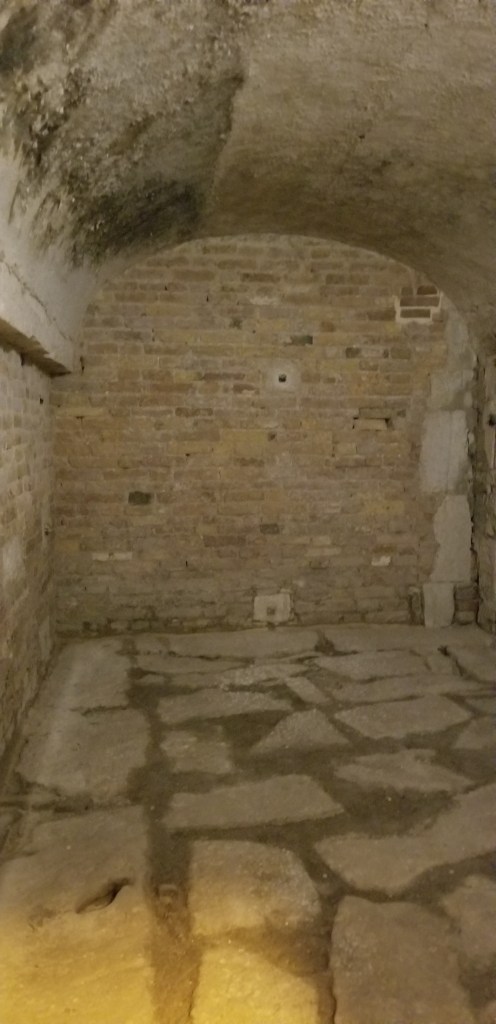
The first place we visited on the Secret Itineraries tour was the prison cells. Three to four prisoners would have been in one cell. A cell had no windows and was subject to canal flooding, which brought in vermin. Even in its day, it was considered to be the worst of the worst.
Up near the attic, there were another set of cells which were for the royal class. These prisoners got their own room and all the comforts of home except, of course, they were locked up. Casanova, the famous lover, was imprisoned here in the 1798 and is the only prisoner to have ever escaped. He went on to lead a long and interesting life, mixing with famous notables of his day, and even wrote a memoir. His room was here:

Looking out a window, we could see the steps in the courtyard in which Casanova made his hasty escape.

Venetian society was very secretive. Scribes would copy out city information and perform other administrative tasks. They could only work for one month so they wouldn’t learn too much.

There were other things to be seen on this tour, including the Council of Ten Secret Headquarters (one of the governing bodies of Venice), the Chancellery, where drawers of top-secret files by the spy network were kept, a torture chamber, and displays of medieval armament.
The Secret Itineraries tour was over; we entered the main palace, which looked vastly different from the chambers we had been in.
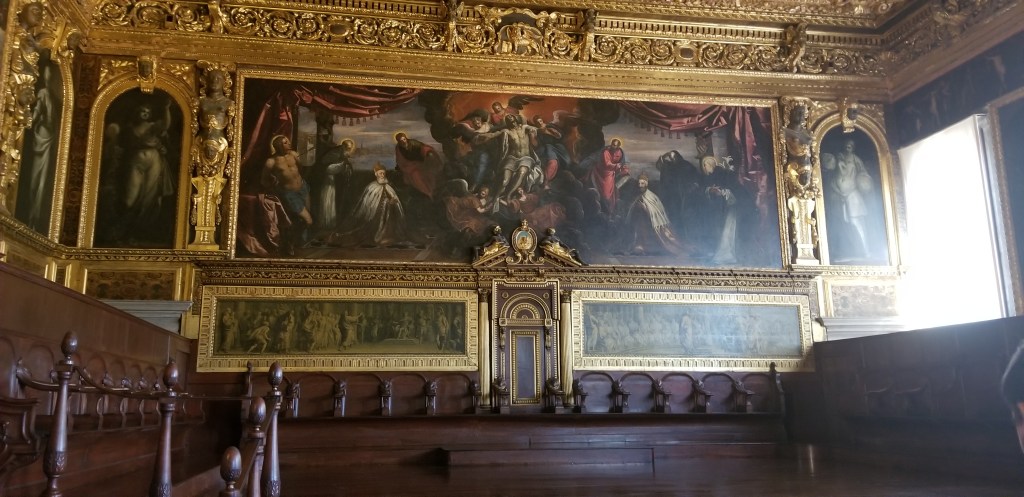
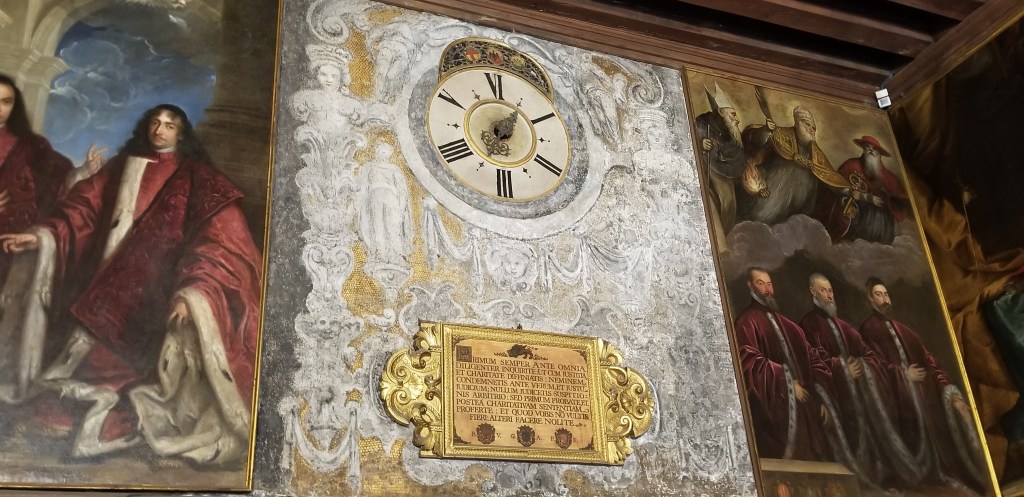
The main palace dealt with higher-level administrative tasks. This included keeping the names and records of who was considered to be part of the ruling class in the Coffer Room.
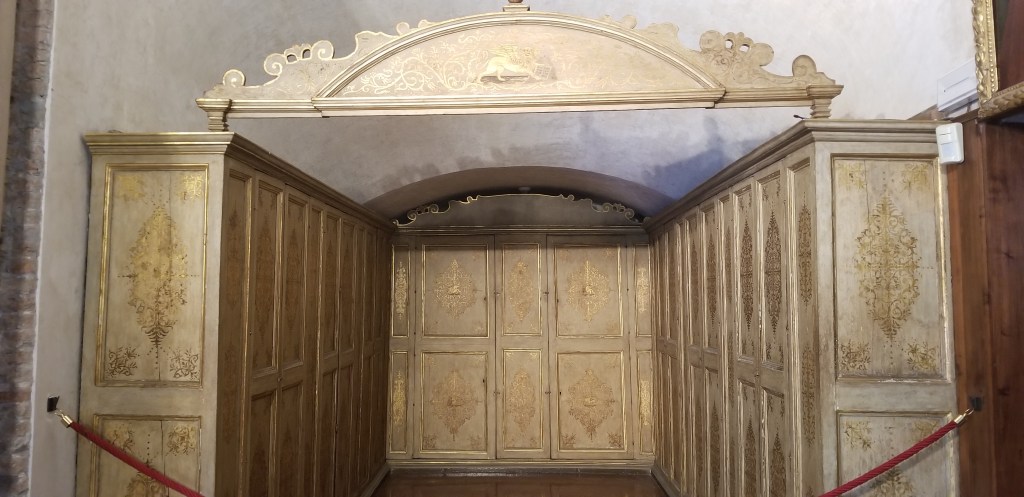
If your name wasn’t in here somewhere, you were definitely not part of the aristocracy.
Part of the main tour is entrance to the “new” prison, which was built in the 1600’s. It was only a slight improvement over the old one. Going through to the new prison, we passed through the Bridge of Sighs. It is so named because prisoners heading to their cell would look out the window at their beloved city and know it was their last look for many years, if ever again.
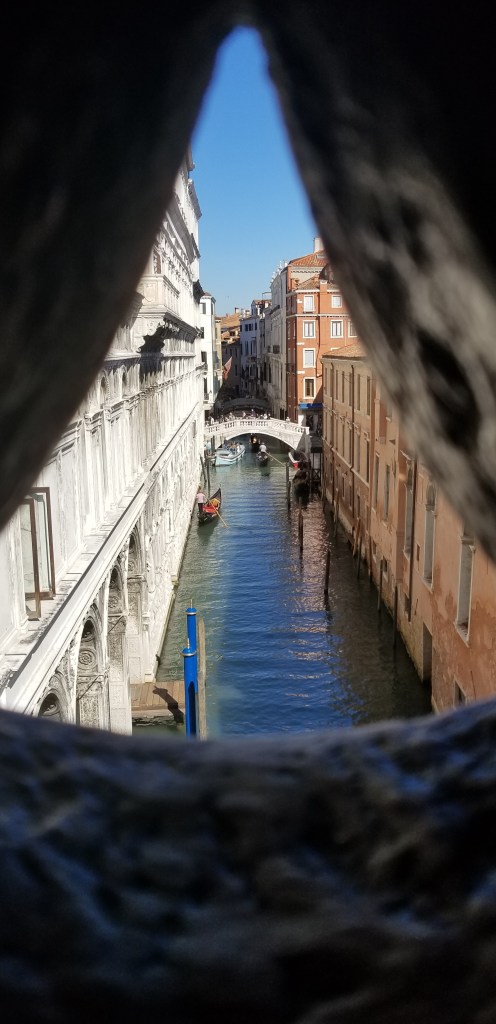
This is the view of the Bridge of Sighs (and us) from the outside. We happened to be chatting with a family of other tourists here, and we all took each other’s pictures.

The new prison is on the left and the Doges palace, which includes the old prison, is on the right.
When we were in Venice for that one day years ago, we had one of those gondola rides that Venice is famous for. It was a cool evening and the gondolier had blankets for us. Behind our little flotilla of gondolas, a singer was in his own gondola singing traditional Venetian songs. People popped out of windows and waved. In short, it was a perfect, still-remembered experience, and I saw no need to even try to duplicate it. Many gondoliers today no longer wear the traditional costume and I never heard any music.

We are always happy at the end of the day to sit and relax. We discovered “Aperol Spritz” in Venice because that was what everyone was drinking. It is a light, refreshing drink which is alcoholic but I don’t ever feel the alcohol in it. On some days, that became our perfect drink for sitting in a little outdoor cafe to pass time before dinner.
One evening, we found a perfect spot for a Spritz while waiting for a pizza. It was on a small canal with gondolas occasionally going by. Hearing one of the gondoliers speaking English to his passengers, I asked him if he ever sings while he paddles. His reply? “No ma’m, you would not wish to hear me sing.”
Well, I guess that’s that.
Next time: visiting the little islands of Murano and Burano
 Twosna Travels