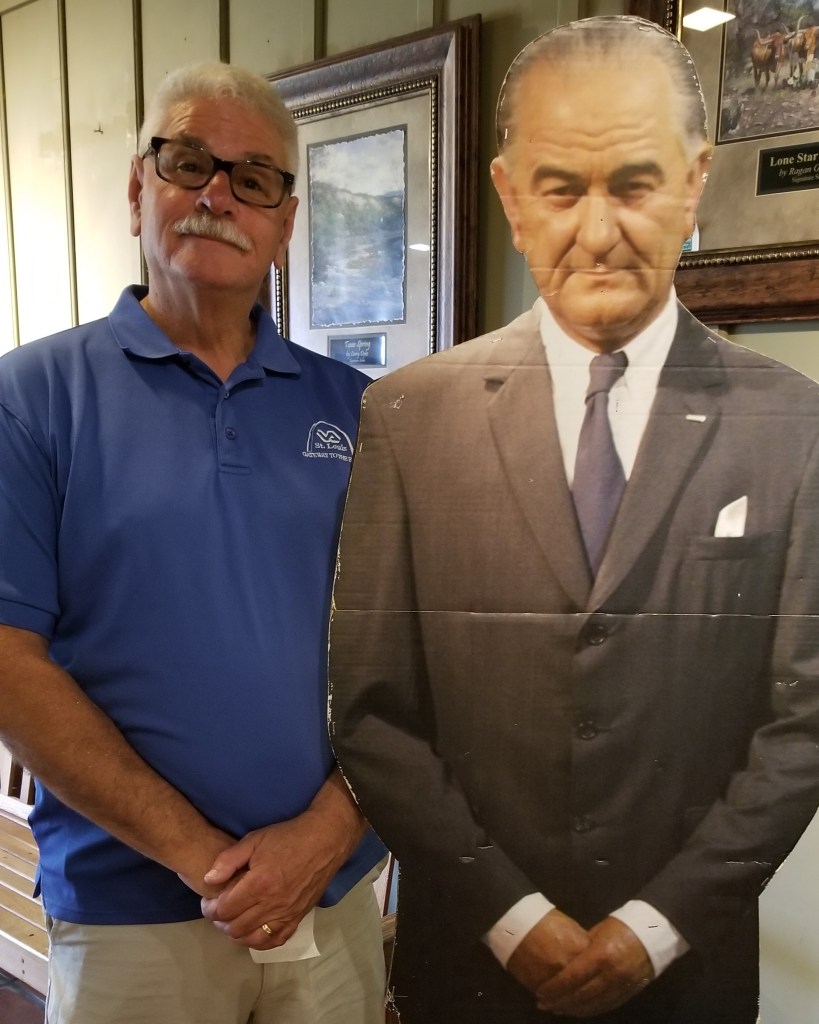
Do you recognize this person? The guy on the right is who I mean. By now, you probably recognize my husband Cal, on the left. Lyndon Baines Johnson (often called LBJ) was our 36th president from 1963 to 1969. We spent a day in and around the Hill Country town of Johnson City, Texas. When you look at the whole of it, to go back into LBJ’s life in Texas is to go back in time to the earliest days of Texas settlement. That includes both ranching and cotton farming, and a whole way of life that is gone now.
Despite doing a little research, I wasn’t sure where we should start. We ended up visiting the National Historical Park in town first. Johnson City was settled in 1879 by a person named James Polk Johnson, for whom the town is named. Another early settler was Sam E. Johnson, Sr., who was Lyndon’s grandfather and James’s uncle. From what we heard, practically everyone in town is related to some branch of the Johnson family somehow. The National Historical Park has a little museum, and when we stepped in, a docent was ready to take us right back out and down the street for a tour of LBJ’s boyhood home.

Young Lyndon lived here from the age of five until he left home for college. He had three sisters and a brother, all of whom were younger than he. The inside of the house is shown as it would have been during his teen years. His sisters all had the front bedroom with windows that you can see behind the bush. He and his brother had a bedroom right behind their parents’ room, so there was no sneaking out after bedtime!
It was from this front porch that LBJ announced his first foray into politics: his candidacy for the House of Representatives, which he won in 1937.
After visiting the museum, it was a pleasant little walk to the Johnson Settlement. There are historic buildings here to give the story of Texas frontier ranching life. I was a little disappointed to see that all of the buildings in this area were either closed or under reconstruction. LBJ’s grandparents’ cabin is shown below on the right. They moved in in 1867 and lived out their lives here.

LBJ’s grandfather and uncle had a cattle droving business. As a nod to Texas ranching history, a couple of iconic Texas longhorn steers were out in the little pasture. This one stopped to pose nicely for me:

From Johnson City, it is fourteen miles out to the LBJ Ranch District area of the National Historical Park. It was time for lunch, so we had a little picnic in the cab of the truck. It was a cool day, and rain threatened. The picturesque Pedernales River was in view.

Most of my reason for wanting to visit the LBJ Ranch was that I had visited here already many years ago and remembered how fun it was. I think I was here twice: once on a tour from Ft. Hood, where I was stationed, and once when my parents came down to visit. It’s all very fuzzy, but I remember riding all around the ranch in something like a golf cart. A ranger at the office told me that it was a 10-person tram. The tour did not start until every seat was full! I wouldn’t want to be the person who arrived just after the tram had left.
It is all different today, and to me it’s a little confusing until you are there. When you follow the sign in to the ranch, you are in the LBJ State Park and Historic Site. You buy your tickets for the national park in the visitors center of the state park unless you already have a pass. In the state park is also the Sauer-Beckmann Living History Museum. You can see it or skip it. Then you drive down the road, cross the Pedernales River which separates the two parks, and you are on the ranch. It is a neatly mapped out park road now; no more trams.
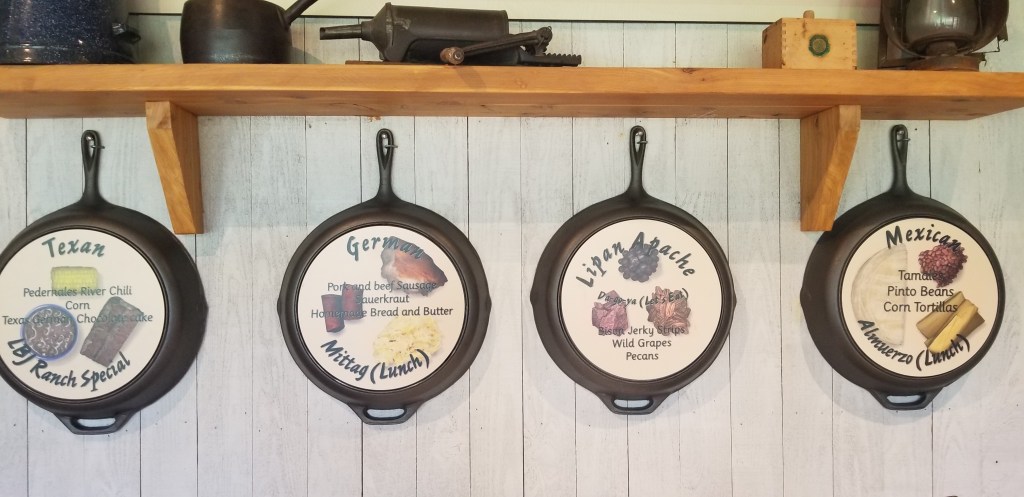
The state park offers a little detour from the Johnson history. There was this little display in the visitor center which showed what various cultures on the land would have had to eat, going back in time. I thought all of them sounded good.
The living history farm in the state park takes the visitor back in time to 1918.
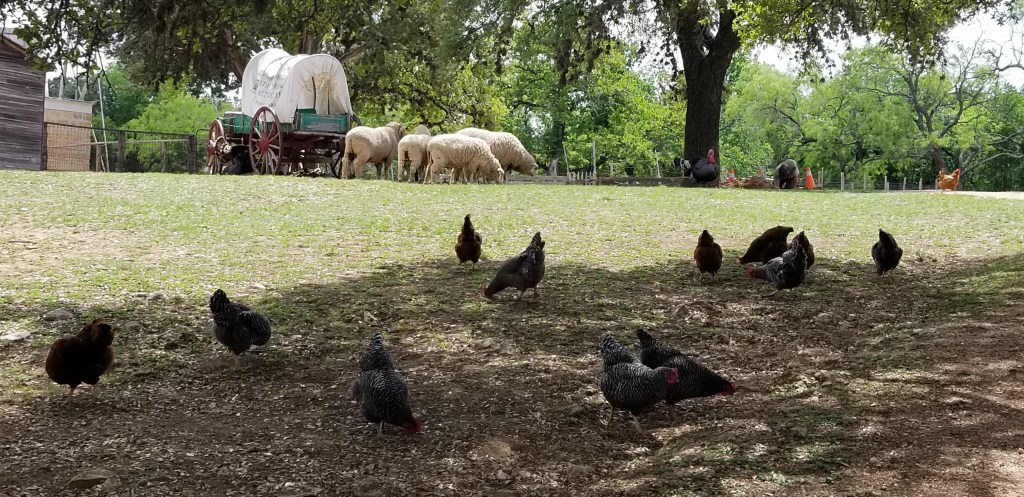
The Sauers moved here from Germany in 1869, built their log cabin, and later a frame house next to it. They farmed and raised cattle and sheep. They lived their lives here, adding to the land, and then sold the farm to the Beckmann family in 1900. The Beckmanns raised cotton.
This is a “living history” farm in that the rangers are dressed as they would have been in 1918. They care for the animals. They gather eggs, cook, clean, work in the garden, make lye soap and do seasonal chores such as canning and slaughtering. Here’s the thing: what they eat for lunch has to be whatever they have produced on the farm. The rangers admitted that sometimes it gets a little challenging to put it together.
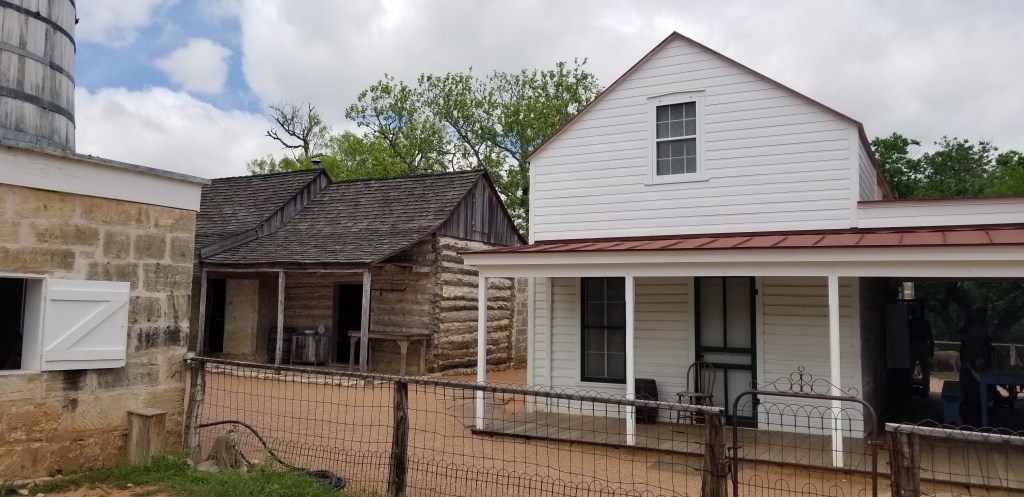
The last Beckmann descendent died in the 1960’s. When the state park took it over, they put the farm into a time machine. They took out the shag carpeting, the appliances, and all the hookups to electric, water and sewer. The farm transformed into what it had been.
In 1918, Lyndon Johnson was a boy. The family had land here and sometimes retreated to the old farm when times were hard. The Beckmanns were his neighbors.
What was fascinating to me was that in 1918 my own mother was almost five years old and living on a farm in Michigan. As I walked through the house I took myself back in time, imagining that maybe her house looked a little like this, too.
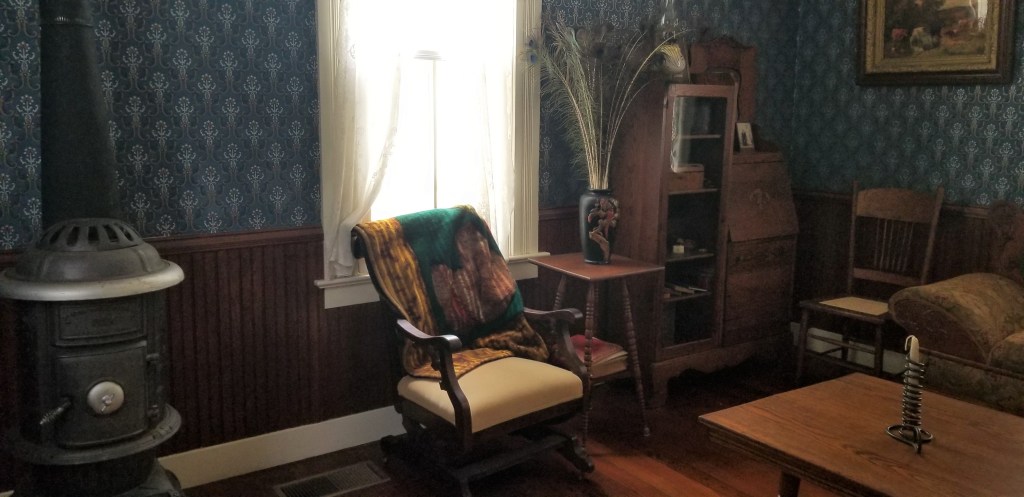
Would her family have used these medicines?

The day was already getting on and we needed to get ourselves over to the ranch.
We passed the school where 4-year-old Lyndon started his education. We stopped to look at his birthplace, but the house that is there now is reconstructed; LBJ as President turned it into a guesthouse. Instead of that house, I decided to show you a view of the ranch from out back. The beautiful yellow flowers were in bloom in fields all over Texas.

LBJ’s grandparents moved out here from the cabin near town. They lived the rest of their lives in a house near this spot.
Across the road from both houses is the Johnson family cemetery. This is where both LBJ and his wife are buried. It’s a peaceful place overlooking the river.

The ranch maintains a herd of longhorn cattle which roam freely. We had to be sure to watch out for them, and not run over any young calves, as we drove the ranch roads. The Sauer-Beckmann farm has cattle, too, and I don’t think they needed any more beef.
The cattle are cared for in a “show barn” area but we did not stop there.

Our last stop was the highlight: the “Texas White House”. This was the original rock farmhouse on the property and LBJ’s refuge. It was enlarged over the years and added on to so many times that now there are structural issues. There is massive reconstruction going on so for that reason the house is currently closed. I was able to walk around part of it. Imagine all the barbeques on this lawn, with the famous politicians of the day in attendance!

A small airfield was constructed on the ranch for LBJ’s arrival. His plane was called “Airforce One-Half” because Airforce One was too large to land here. He would fly into Randolph Airforce Base near San Antonio, and then embark on this plane for the ride home.
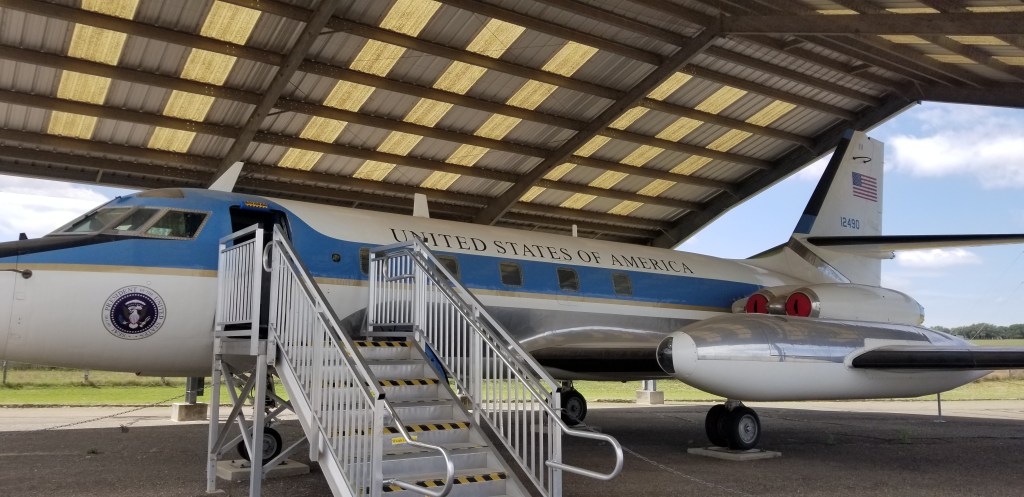
LBJ was vice-president under John F. Kennedy, and was sworn into office upon his death. At the end of his term he successfully ran for president again. He could have run for a second term but the Vietnam War was becoming a major problem and he declined, choosing instead to retire to his central Texas ranch. He only had four years of retirement when he passed suddenly of a heart attack.
We have come to the end of our Austin time, and indeed, as I’m writing this, it is almost two months later and we are far away from there. There is much to tell you about our travels as we have continued down the road. However, I’m going to pick up my blogs again from our trip to Europe last year first for a few weeks.
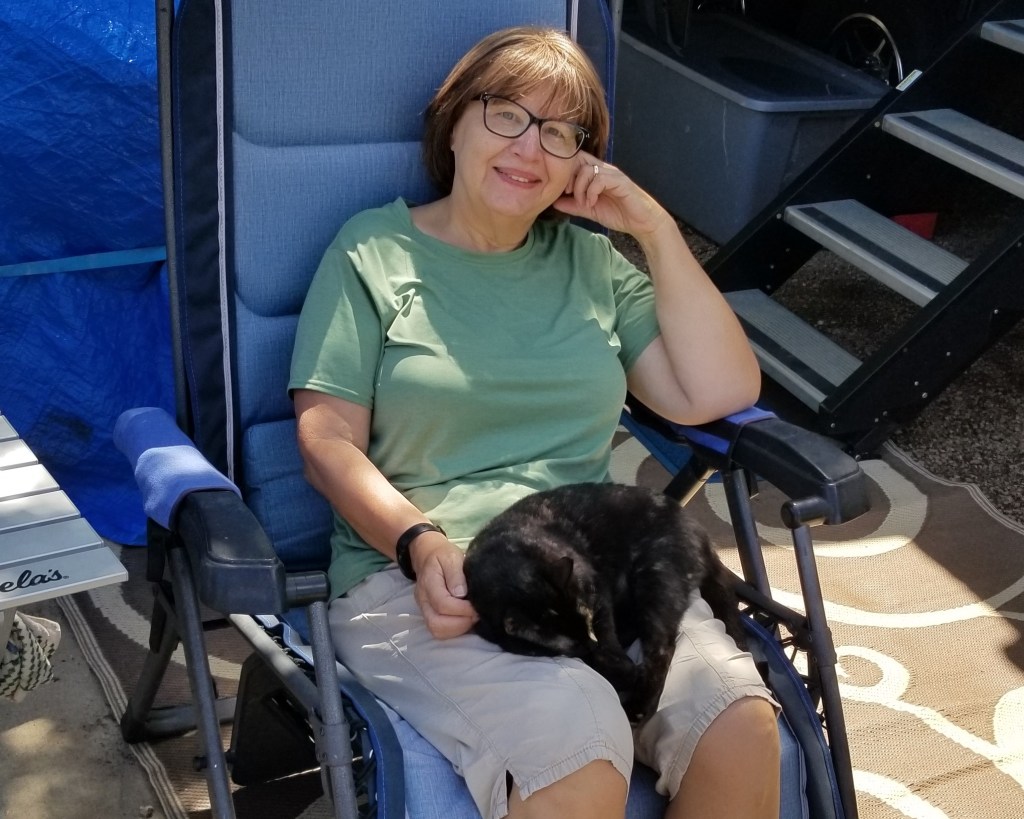
At our RV park, we were in exactly the same site as we had been in two years ago and had made friends with the cat that the permanent RV dwellers next door owned. When we arrived for this stay, Pumpkin appeared shyly from under the trees. As soon as I called her name, she ran to me. We bonded again for the month we were here and she could often be found snoozing on one of our lawn chairs. It was bittersweet because we will never have this site again. The park is making it a site for permanent dwellers only. I’ll leave you for now with a picture of me and my special friend.
Next time – back to England with a tour of Stonehenge and the Cotswolds
 Twosna Travels