In my previous blog, I wrote that our apartment in Santorini was “neither here nor there”. I knew that going in, but thought we could use the bus system. Upon our arrival we were told that buses were unreliable. Seeing tourists waiting patiently at each bus stop reinforced that opinion for us. In hindsight, I think we should have given it a try at least once.
So on our first evening in Santorini and not knowing where else to go, we walked up the hill to Imerovigli for dinner. It was a little distance along a winding road and the shoulder was rocky and narrow. Traffic zoomed by, and that included many folks on ATVs. Our dinner conversation centered around a new idea: if we rented an ATV while in Santorini? Of course, Cal would be the driver. He has driven many types of motorized vehicles, although he had only operated an ATV once before. He was game for the plan, and Margarita in our apartment office arranged everything for us. We took delivery the very next morning.
Of course, there was a lengthy introduction to our ATV when it arrived, including a test drive. Here is Cal heading out on to the road for the very first time.

At first, he just tooled around on the roads around us, and to Oia. The ATV was very handy for getting to and from Fira. I couldn’t take pictures of what I was seeing, though, because I needed to hang on! I was afraid that we’d hit a bump and then the phone would go flying.
One morning, though, we cajoled Margarita (procurer of all things in our apartment office) into bringing our breakfast earlier than usual, and set off for the south side of the island. We knew it would be a bit of a ride, but after a while I felt that we were climbing. It was getting darker, foggier, and starting to sprinkle. Cal had inadvertently headed up toward the east, and we were in the mountains. It was hard to talk to him over the noise of the ATV, but after awhile I gave him a poke, and he stopped. “Hmmm, are we going in the right direction, do you think?” It remains one of the funniest stories of our trip.
GPS didn’t work well in Santorini, and I had a sketchy little map ripped out of a brochure. We finally found the sunshine again and figured out our location, and most of the day proceeded without incident.
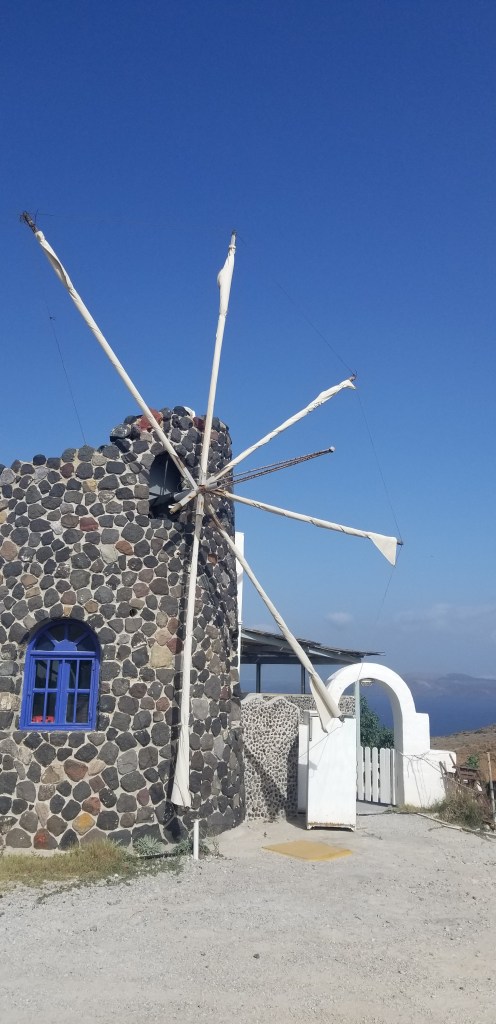
These windmills were once a familiar sight around Santorini. They were used to grind grain for flour. Today, many of them have been renovated into villas. This one was next to a restaurant.
Now, which way should we go?

In the sweeping landscape of this portion of the island, we could see the pumice layer left by the volcano 3,600 years ago.

Santorini has its very own version of Italy’s Pompeii in the form of an archaeological site named Akrotiri, and we stopped at this place for awhile. The island at that time was called not Santorini, but Thera. There was a thriving town here back in 1620 B.C. It had earlier been hit by two earthquakes which made the resident Minoans more determined to build back better before the volcano finally wiped it out completely. Their buildings contained the treasures of their advanced civilization. I could compare this to the city ruins found in Thessaloniki and under the Parthenon Museum in Athens, but these were mind-blowingly 1300 years older!

These urns were found in the “Pithoi Storeroom” – so named because of the large number of “pithoi”, or storage jars, found here.

An then, most impressive to me, an actual town square.
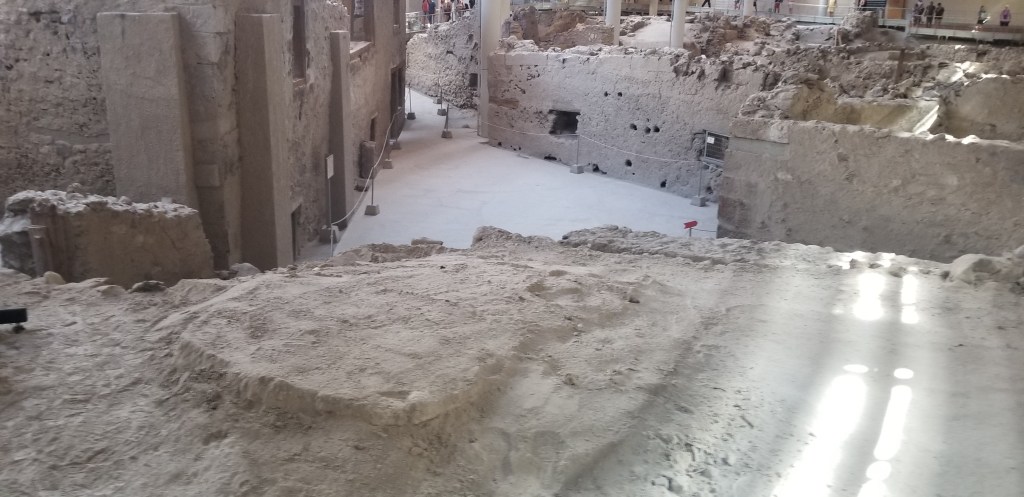
The building in the front of this picture is still unexcavated, as is about 70% of the city. The picture below shows how the building on the top left would have looked like before the volcano hit.

During the volcano event, a huge mudflow filled up Akroteri. This preserved not only the treasures inside the homes but also many of their wall paintings. The paintings were the symbol of a resident’s wealth and status.
The next day, I visited the Archaeological Museum of Prehistoric Thera, which contains not only many artifacts from Akroteri but also the wall paintings which have been meticulously removed and preserved. I love the “Blue Monkeys” particularly.

There have never been indigenous monkeys in Santorini. The monkeys in this painting are indigenous to Ethiopia. Crete is in sight of Santorini, sixty miles away. It is thought that monkeys were traded there and brought to ancient Thera, or else sailors picked them up on their voyages around the Mediterranean. I love to imagine how these blue monkeys looked when the paint was fresh.
OK, back to our explorations. Besides Akroteri, I’d heard there was a red sand beach, and in a short time we were there. We’d visited a red sand beach in Hawaii so I wanted to check this out. It was a short drive away, and luckily easy to find, but quite a walk just from the parking lot. As usual, there were plenty of diversions along the way.
A couple getting married were having their picture taken in front of a pretty little church:

and a violinist was playing lively Greek folk music which we could hear from a distance away.

The hike to the beach began to get serious, and involved a little rock scrambling.

The beach is made up of fine red pebbles, which I do not think I would like to lay or sit on for long. When I shucked my shoes, it was felt sharp under my feet. Volcanic matter has iron in it, and that is what turns the pebbles red.
This is one of best that Santorini has in the way of beaches and from what I’ve read, other islands have better ones. Especially with its high volcanic cliffs, beaches are not the reason to come here. Red Beach scores points for beauty, though.

What remains in my memory is the sound of the receding waves moving all of the rocks around under the water. It was like nothing I’ve ever heard before, like soft thunder.
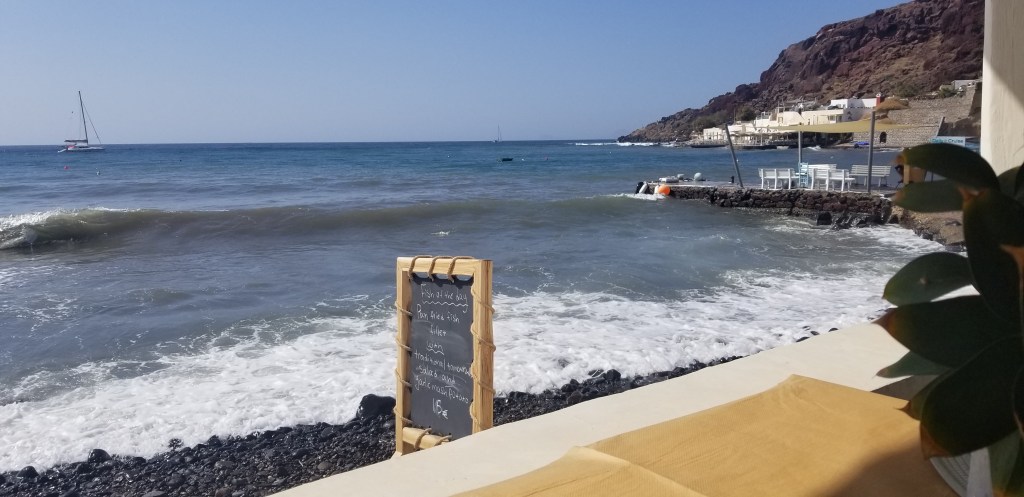
It wasn’t quite lunch time yet but there was a cute restaurant at the end of the beach. To be able have a front row seat on their porch and take a break, I ordered a plate of mussels saganaki, delicously sprinkled with feta cheese.

From our table, we could not possibly be too much closer to the water. I could have sat there all day, but unfortunately, the proprietor might have frowned on that.
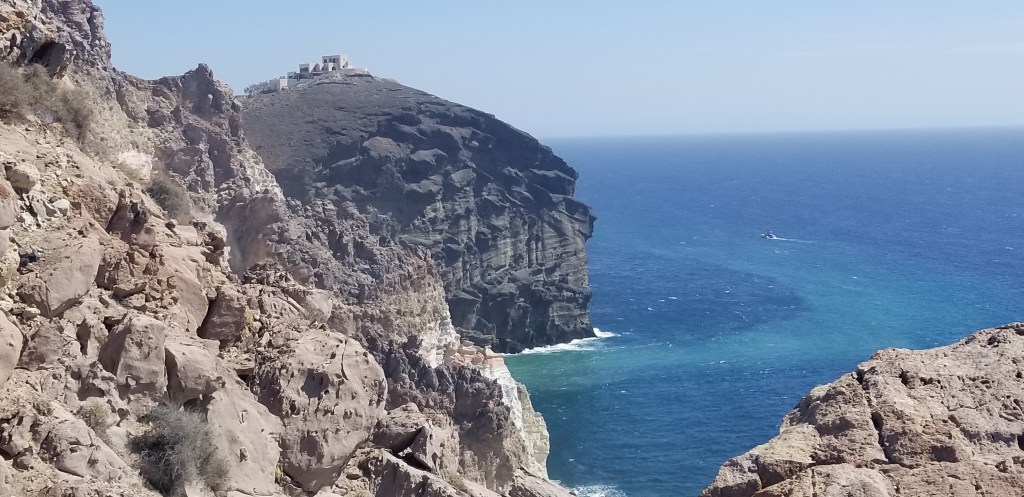
We had one more stop at the very tip of the island, Faros Lighthouse, also called the Lighthouse of Akrotiri. Built in 1892, it is one of the oldest lighthouses in Greece.

Looking at it from the parking lot, you’d wonder how it could possibly do its job, since the building is short. Hiking on the rocks below it, though, one sees its vantage point at the top of a cliff. This is what the lighthouse sees, although from considerably higher than I was at this point:
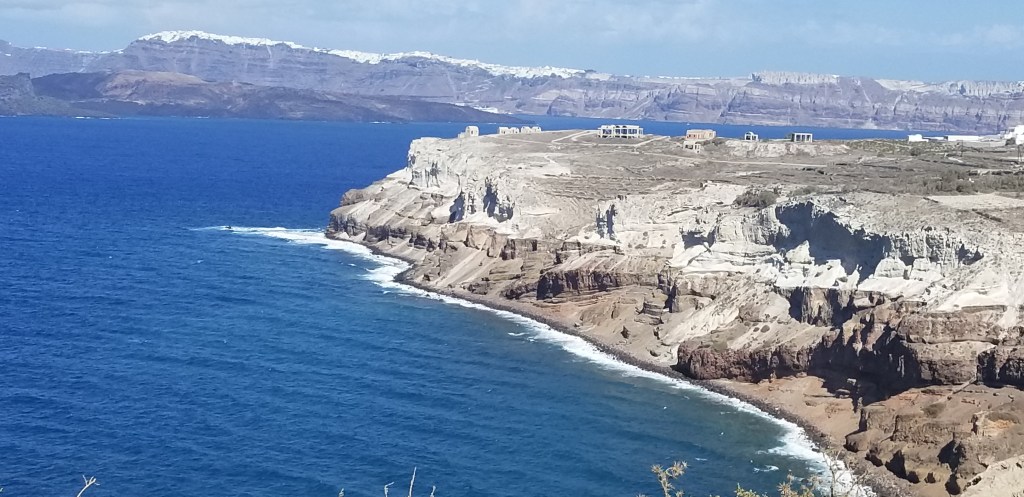
In the distance, Fira could be seen:
The ATV rental was a complete success.
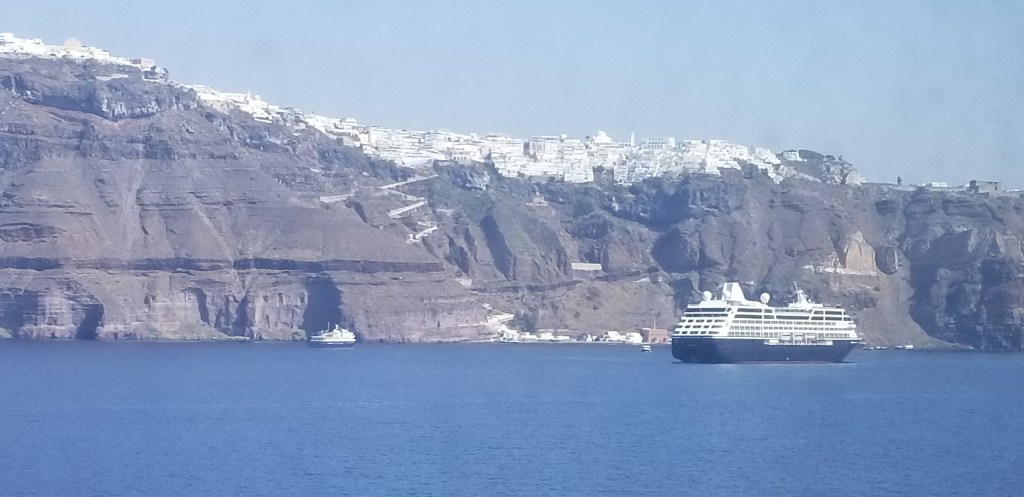
Santorini left us with a lot of great island memories. Saying goodbye to Margarita, she told us that she was very happy; a vacation was coming soon. She had been in the office every single day we’d been there. Santorini officially shuts down November 15. The workers, who mostly come to the island from Athens, then leave and get a four month break. She said they work every day with no time off for eight months before that vacation. After telling us that, I really had to appreciate all of her hard work.
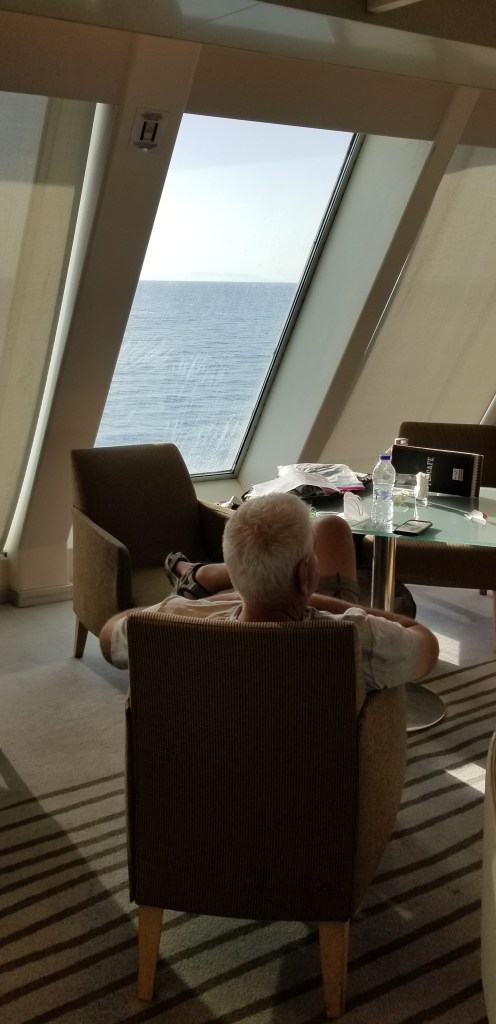
Our talkative driver on the way back through the island and down the precipitous cliffs also had the same sort of story to tell. Thanks to Margarita’s advice, we arrived much too early for the ferry. An entertaining server at the ferry restaurant plied us with warm croissants from the oven. From start to finish, Santorini shone, and I was sorry to leave.
Next time – Naxos, another Greek island






 Twosna Travels