USTravel

Rallying in Gering, Nebraska

One of the benefits of membership in Escapees, which is an RV club that we are members of, is being able to be part of smaller, regional chapters and to attend rallies. Basically these are just gatherings, large and small, of RV’ers, with various events planned during the rally. We are never in the right place for them, usually.

While we were wintering in Denver last year, though, we discovered that the Rocky Mountain Chapter 2 of Escapees meets once a month at the Golden Corral just down the road from the AirBnb where we were staying. I thought that besides meeting some new folks, we might be able to find some new-to-us Colorado RV’ing spots that we might like to check out whenever we want a break from Denver. We went to a couple of meetings and discovered that their first rally we could go to was in…Gering, Nebraska.

Surprisingly, Gering is only 200 miles from Denver. And it sits in the shadow of beautiful Scotts Bluff, which in the 1800’s was a main stopping point for travelers heading West. Our RV park was in view of the bluffs. We could catch the changing mood of the rocks, whether at sunset or sunrise or sitting under storm clouds.

Scotts Bluff National Monument was the first excursion our group took together. We listened to a ranger talk, watched a movie, and then were turned loose to go explore. The covered wagons lined up in the picture below are all sitting on the former Oregon Trail.
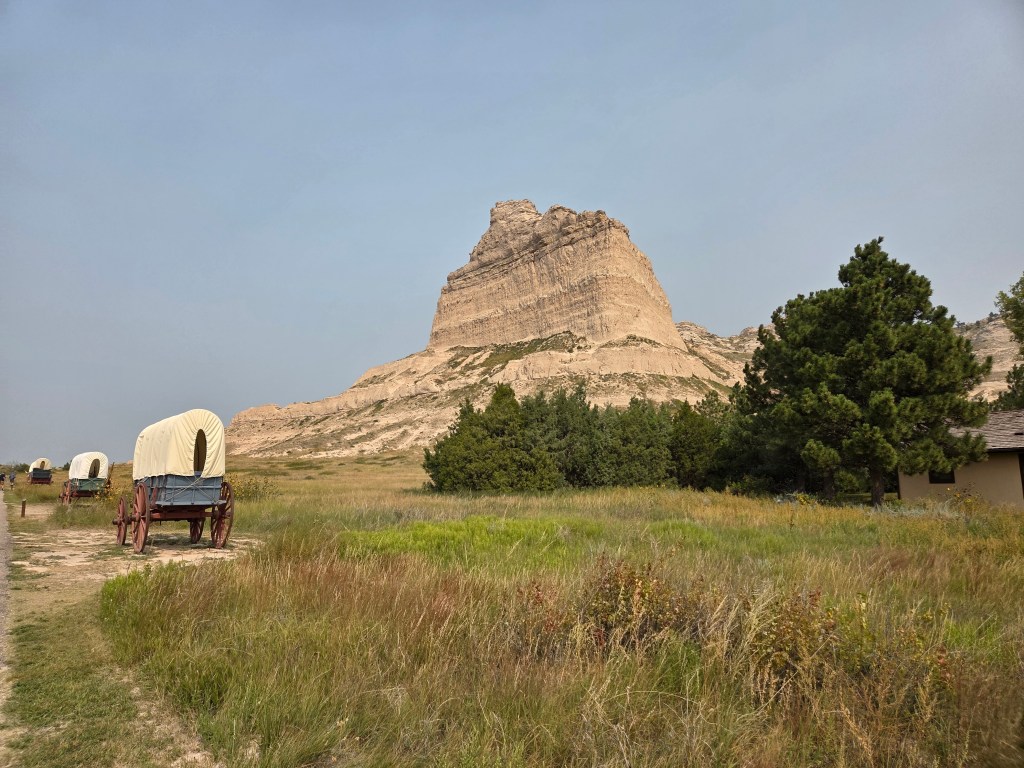
The bluff is a series of striking rock formations. The pioneers in their day would not have seen the view from the top. We were able to do it simply by driving up to the top on the road that now exists for us.

Scotts Bluff was important for them because it was a measure of progress after weeks of seeing nothing but prairie grass. On the Oregon Trail, a third of the journey now lay behind them. They had been hard-won miles of disease, unpredictable weather, flood, and bison stampedes. It was called “a Nebraska Gibraltar”.

The Legacy of the Plains Museum is close to Scottsbluff and later we took a quick visit before closing time.

Looking at a fully loaded wagon is a sobering reminder of just how small they are.

Of course, John Deere tractors were not seen on the plains until many years later. In an alternate life, Cal envisions himself driving one.

A very different experience was next on the rally agenda. We visited Cozad’s Antique Ford Garage. All of this is the work of one man, Tom Cozad, who has a special passion for both Fords and Coca Cola. So much so, that he bought up the whole block.
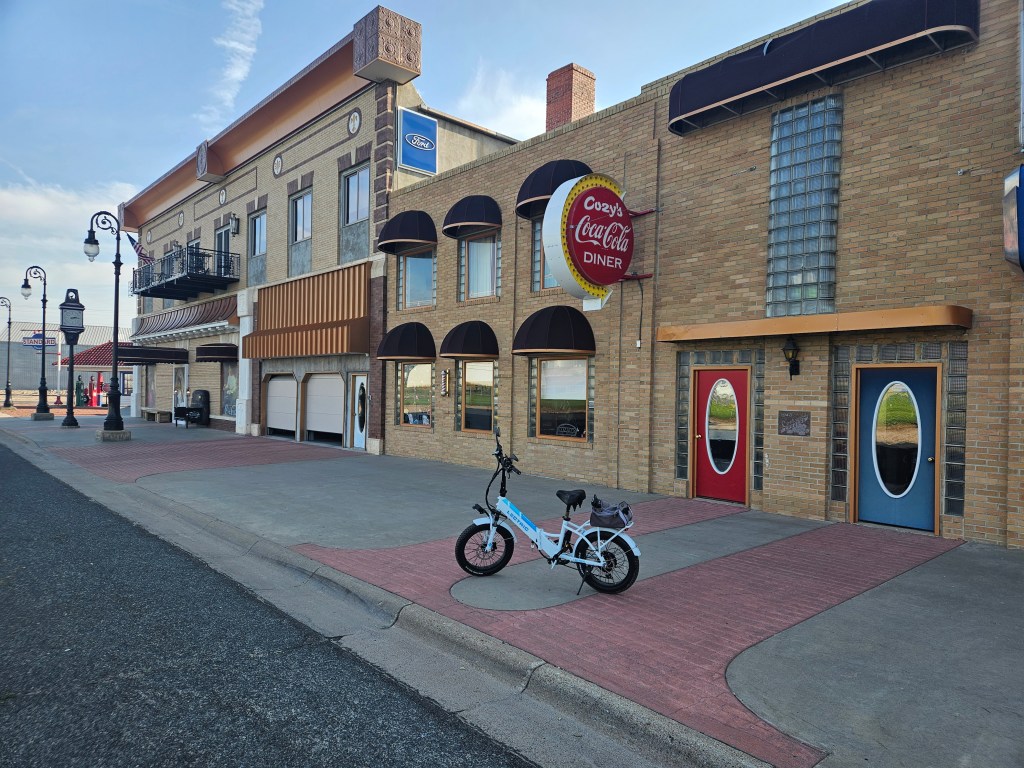
Oh, and there’s a gas station too.
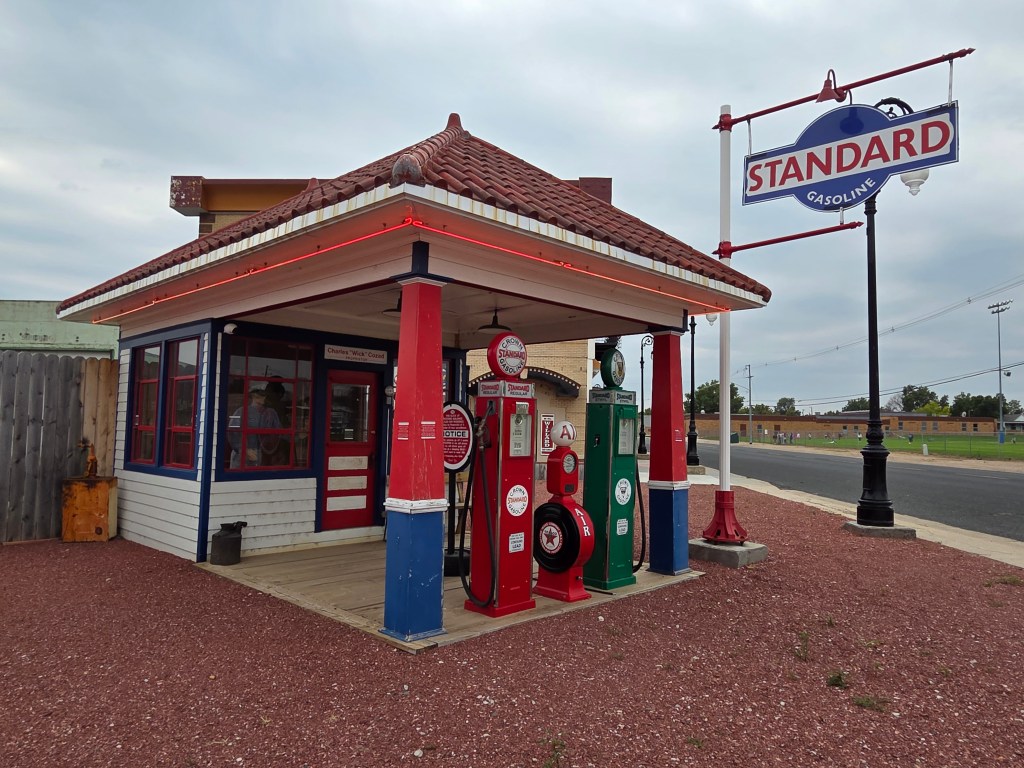
Around the corner is Tom’s sign shop, the business that he owns. The rest is all a hobby.
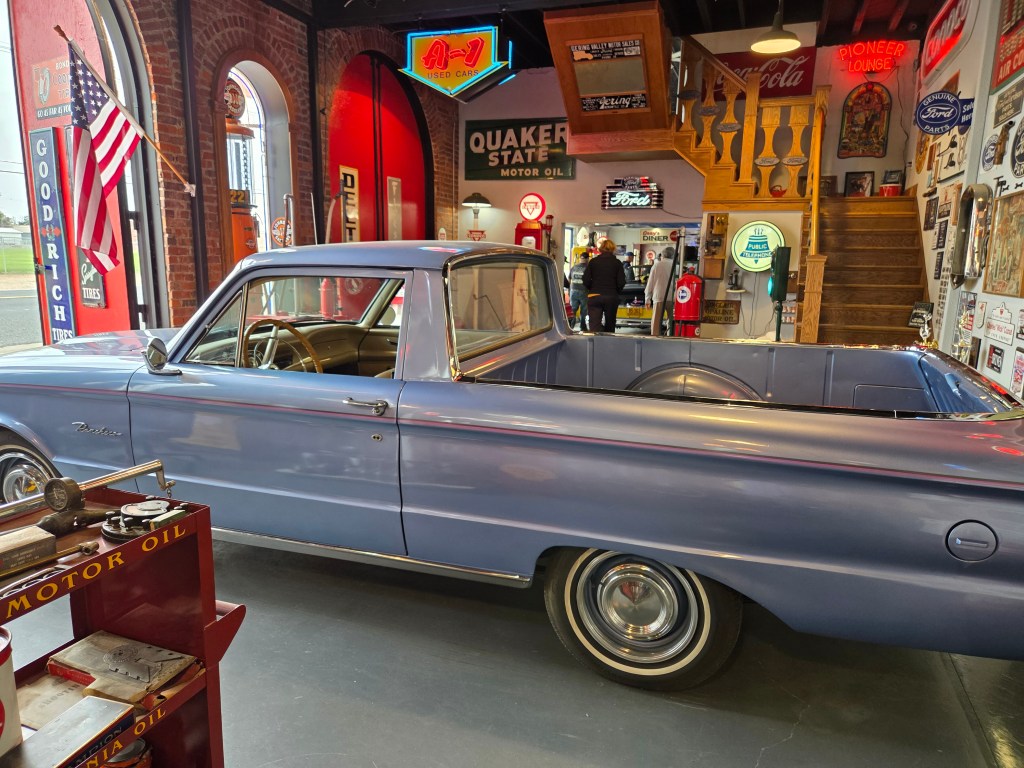
Only one of several restored antique Fords

Besides the cars and Ford displays, there are several rooms of Coca Cola memorabilia, a small theatre with old theatre seats and a big screen TV, a tiny antique barbershop, fully equipped, and all on two levels.

When I first saw this on the rally agenda, I was not sure that I would find it interesting. But it was, very much so, since there was so much to look at. I just couldn’t believe he collected all this stuff singlehandedly!

Unfortunately, Mr. Cozad does not keep regular hours, is not open to the general public, and only does this by word of mouth. He accepts no entrance fees, only cash contributions which he then donates to charity.

What I liked about the rally is that we could join in on as much or as little as we liked, with plenty of time to do things on our own. On another morning we rose early to visit Chimney Rock.
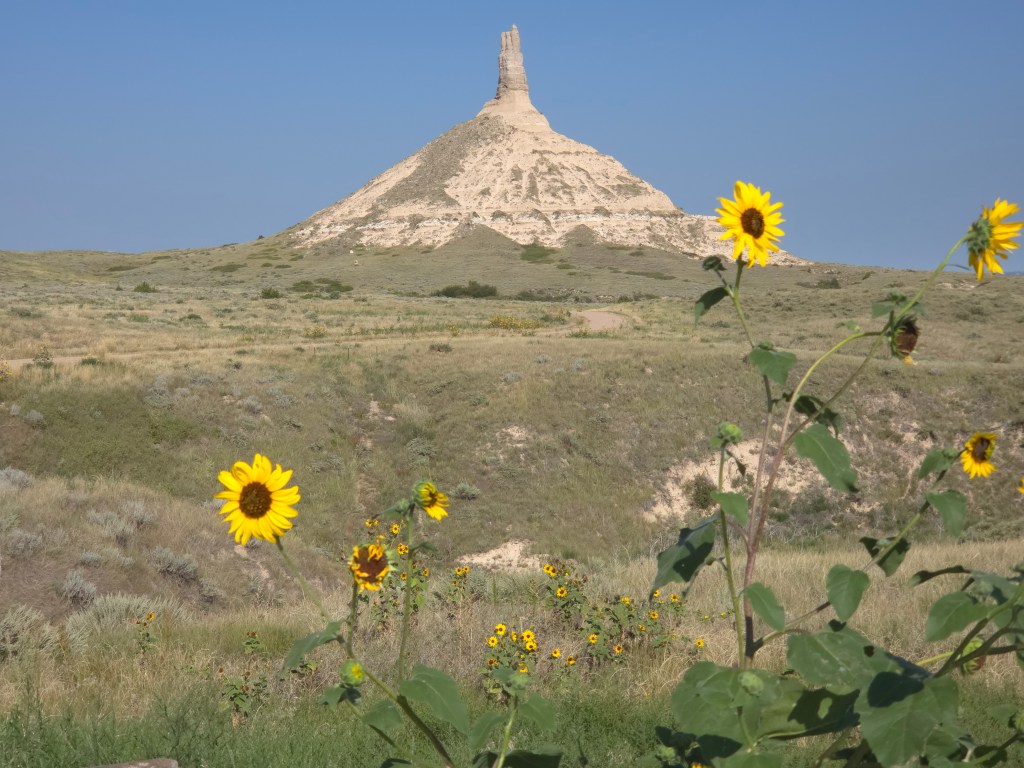
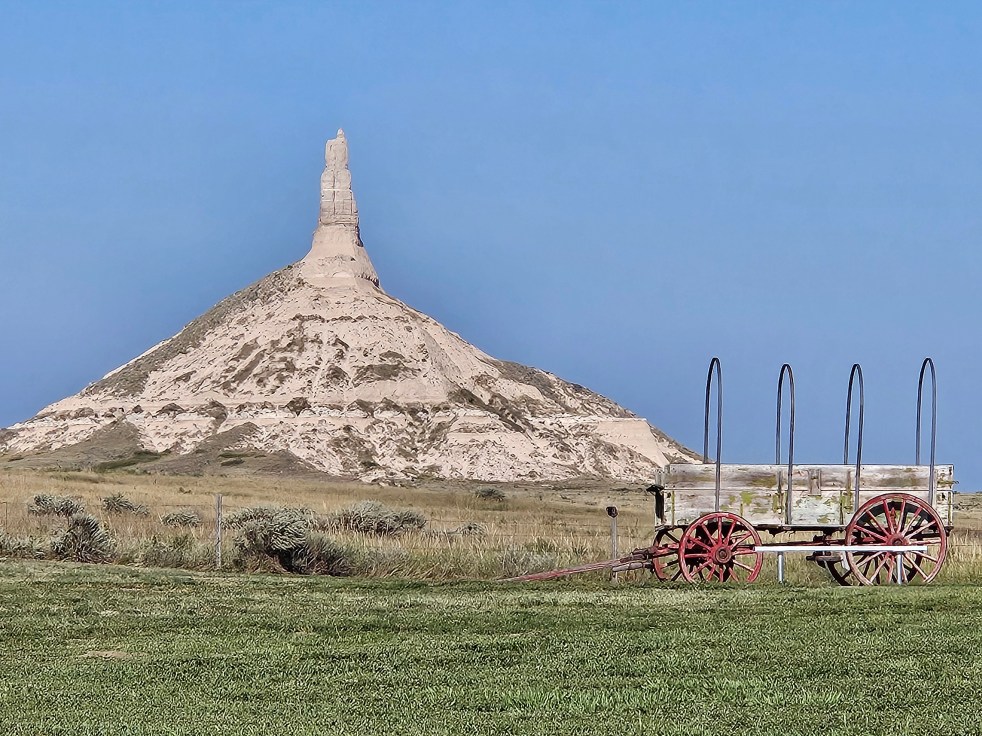
This rock, along with Courthouse and Jailhouse Rocks, were actually what the pioneers saw first when coming from the east. It let them know they were not far from Scotts Bluff. Chimney Rock is a state park and in the visitors center there are more exhibits about the pioneer story.

I was really more interested in reading about the rock, but I did get this information about the trails west: the graves of 20,000 people line those trails. This is no surprise. But then there is this: a half million people traveled on them. So, more than 90% of travelers made it to their destination.

We hiked the mile-long trail behind the visitor center toward Chimney Rock. There was a small graveyard in the bluff close to the rock. The graves were mostly post-1900, but there was this memorial stone:
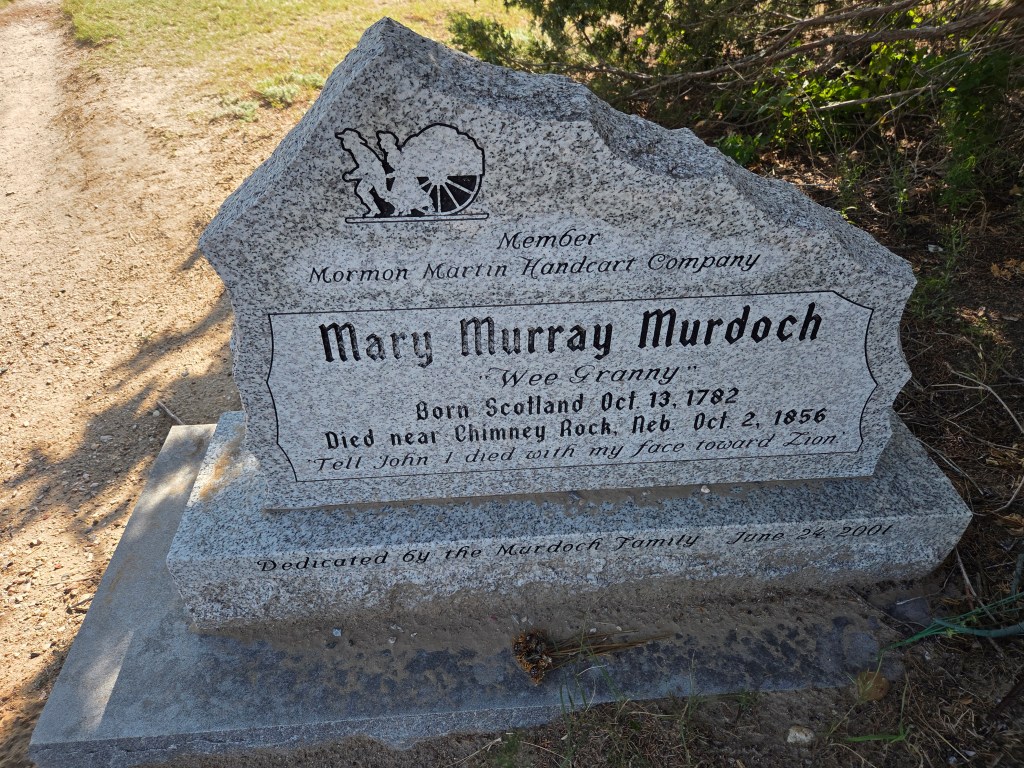
Mary’s son John converted to the Mormon faith in the United States, returned to Scotland, and converted the rest of his family. Mary, whose husband had already died in a mining accident, made the trip from Scotland at age 67 to join her son and his family in Utah. She died in her sleep, though, and is buried somewhere out on the trail. She was part of a group of Mormon immigrants who were pushing carts on the trail for lack of wagons.

Chimney Rock itself is not as the pioneers saw it. The rock has a sandstone cap, which protects it, but it is still eroding. Early travelers were sure it would have fallen over by now. Who knows how much longer it will stand?

Robidoux RV Park, where our rally gathered, has nice wide sites and belongs to the city of Gering. We could ride our bikes into the small town or out into the countryside along a pretty little canal. After breakfast at a local restaurant, we were able to walk across the historic downtown area over to Tom Cozad’s museum. We enjoyed the small-town environment here.

In between the sightseeing, we joined other rally members for dinner every night. All 26 of us overloaded the kitchen at the golf course one evening. Other meals were potluck or covered by the rally planners. A couple of mornings I joined some other women in the clubhouse to work on our crafts and chat for an hour or so. Those interested could do a scavenger hunt, watch the Sunday afternoon Broncos game together, or play golf.

The rally was fun and if time allows we’ll be back for another in a different location next year. And who knows, maybe we’ll visit Gering again? We liked the RV park and here are still things to see that we didn’t do.

Back here in Denver, we are getting excited for a month-long international trip, leaving in just a few days. It will be at least that amount of time before I post again.
USTravel

Of Bikes and Books in Windsor and Mansfield, MO

We have quite the adventures with our Garmin, and humanize it by calling it a “she”.  After Lake Shawnee, she had all kinds of ideas on how to get us to Windsor, Missouri.  We had already decided on a route to get there, but we do value her opinion. When she keeps trying to turn us around for missing her turns, I get nervous. What does she know that we don’t? I look at the low bridges listed in the Rand McNally Trucker’s Atlas that we have. I double and triple check the route.  On more than one occasion, she’s had good reason to make numerous attempts to get us to mind her.

She finally settled down for the last forty miles or so, but I sat with that map on my lap the whole way.  We did pick a pretty good route, for humans.

For us, there are two reasons to visit Windsor, and they both have to do with bike riding.  They are the Rock Island Trail and the Katy Trail, both rails-to-trails Missouri state parks.  Years ago, we rode the entire 275 mile Katy trail round trip over a period of years.  Windsor was one of our overnight stops, in one of Kim’s Cabins.

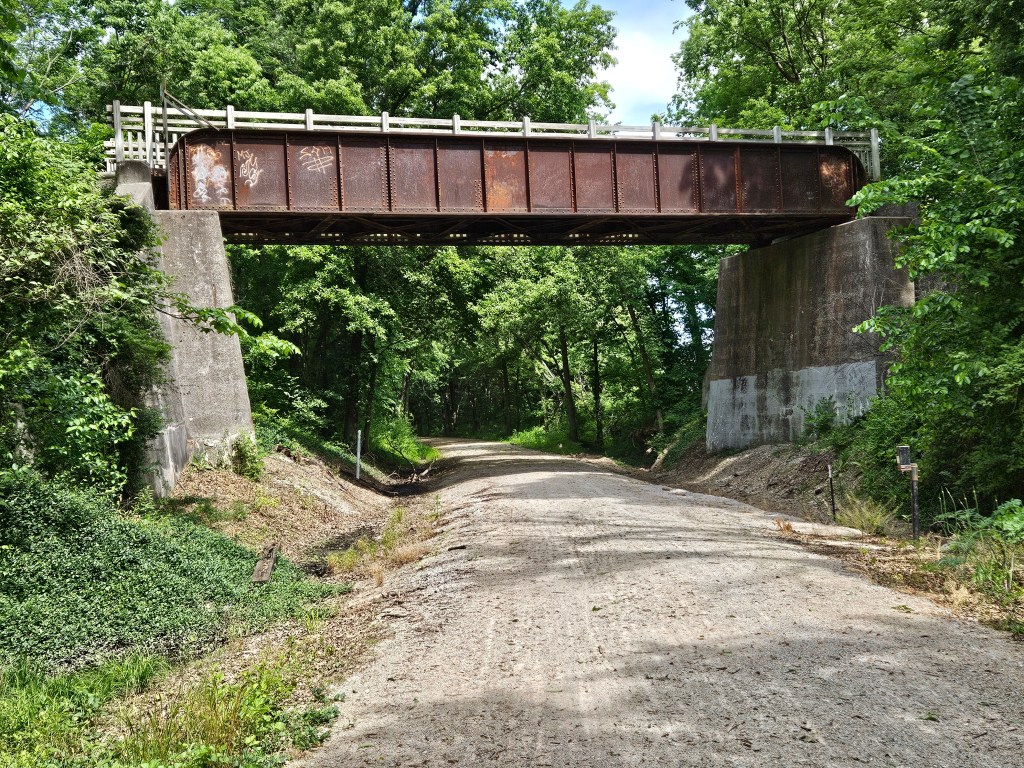
“Two roads diverged in a wood”… we took both, the Katy on the left and the Rock on the right, on two different days
Another view: the Katy above on an old rail bridge and the Rock Island below

This time, we stayed in Farrington City Park.  There is a layout of 8 RV spaces plus room for tent campers looking for a night’s stop off the bike trails.  It is woodsy and secluded and was mostly empty when we were there. Although there is a narrow spur road that goes in front of it, there were no more cars on the road than would be in a campground.  The road T’s  off further down, and one can go uphill to the left to get to the trail or right to go into the park.  Occasionally, there would be a clip- clop of hooves on that road, which meant that some Amish were coming by their horse and buggy.

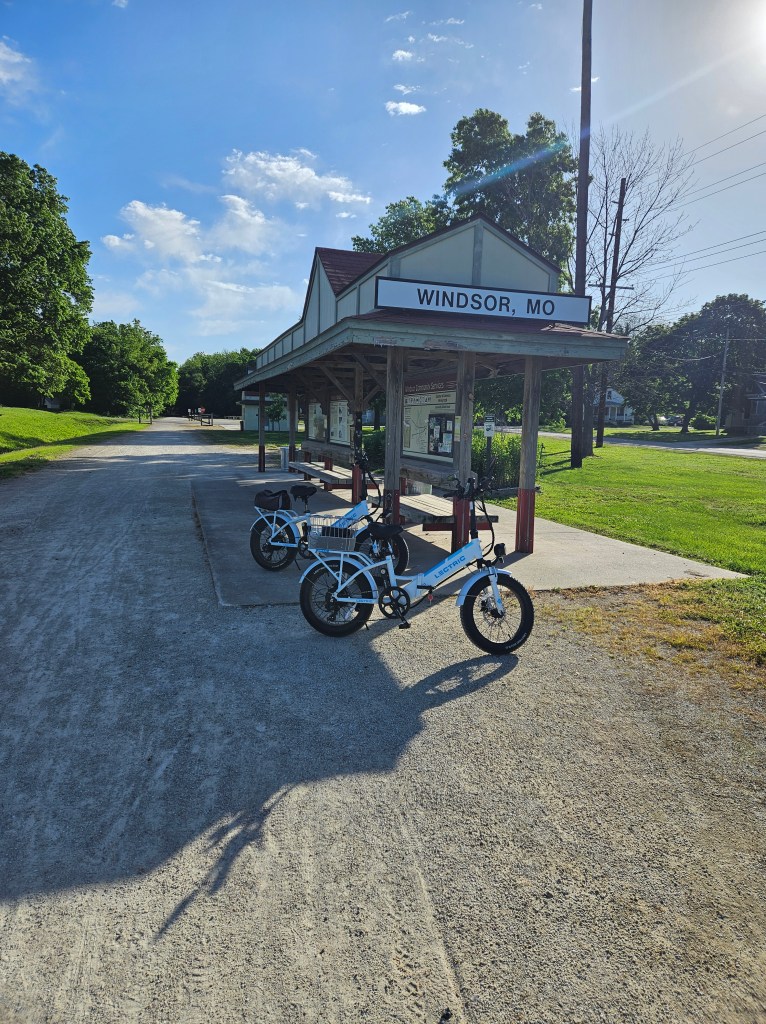
The Windsor trailhead is prettily landscaped, with its own caboose.

We broke ourselves in gently on the Katy since we hadn’t ridden for a period of some seven months or so. Our ride stretched from Windsor to Calhoun, the next trailhead and a distance of fourteen miles round trip.

Ready, set, go!

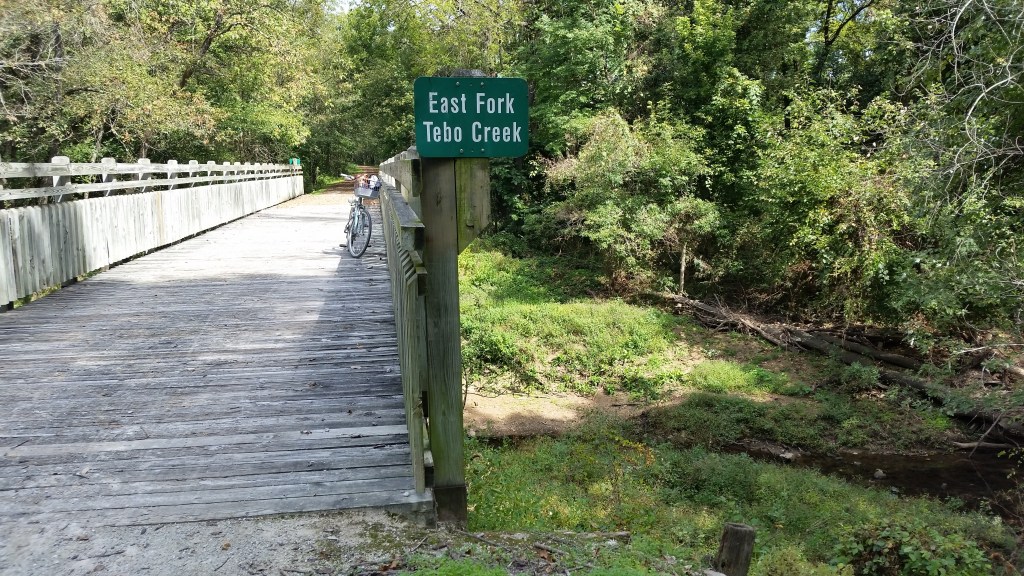
This part of the trail is totally wooded with few road intersections. There are interesting bridges along the way:

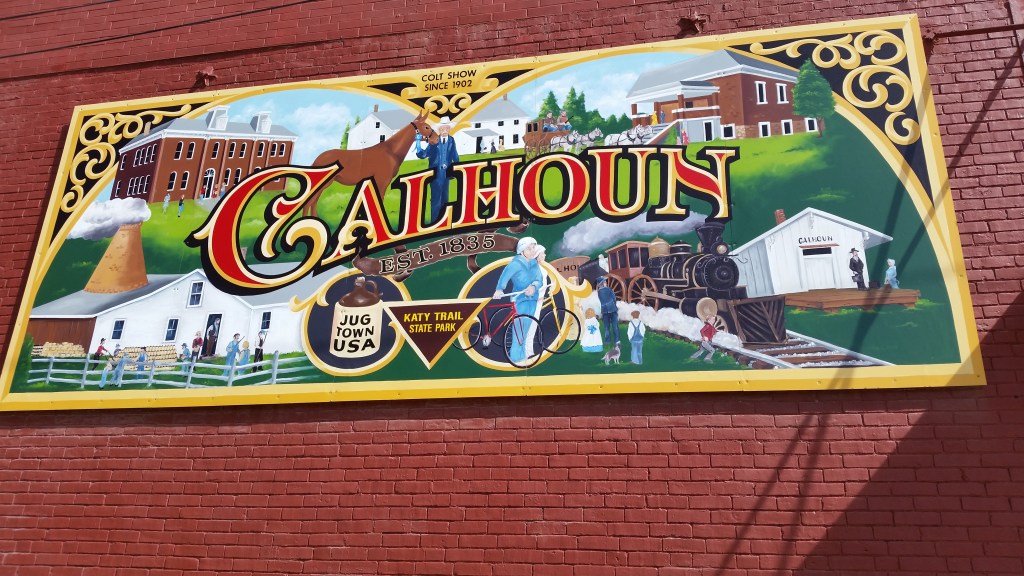
This mural was on the side of an old building in Calhoun:

We rode around Windsor a bit after that, catching up on Windsor news with Kim at her cabins, and visiting with the locals at the Wagon Wheel restaurant.  I think they were a bit bemused to see us riding up on our bikes for lunch.

On a snowy day in December, 2016, we were on hand for the grand opening of the Rock Island Trail in Pleasant Hill, Missouri by then-governor Jay Nixon. 47.5 miles opened from there to Windsor, where it intersects with the Katy. 144 miles eastward are still in development.  Despite my high hopes, no other portions of the trail have opened since then, save for a couple of one-or-two mile sections further east.

On the Rock Island I had expected open prairie, but the trail defied expectations.  Like the Katy, woods and trail ran for the ten miles to Leeton like a ribbon of green amid farms and pasture land.  It was so pretty.  It ran just a little rougher than the Katy, and there were more intersections, but these were mostly gravel farm roads.  We give it a thumbs up.  I guess I won’t be trying to do the whole Rock Island trail, but that’s OK.

So, our total mileage count for the two days was 32.

We could walk in any direction for the evenings we were there, but Farrington Park itself was a favorite.

The lake and a pretty decoration at Farrington Park

Our Rving neighbors gave us a tip about an Amish wholesale store just outside of town. Before leaving, we purchased a loaf of freshly made bread, eggs for half the current price at the grocery, a small apple pie and some fresh vegetables, among other things. We looked at all the things the Amish might purchase:  bulk spices and sauce mixes, all kinds of stainless steel kitchenware, an aisle full of canning supplies and jars, racks of puzzles and shelves of religious greeting cards, and these: fifty-pound sacks of grain and sugar.

Moving down the road…

When connecting the dots between our Missouri destinations, I was elated to see that Mansfield and “Laura I. Wilder RV Park” was on our route for an overnight stay.  The truck would stay hooked up to the trailer, but no matter: I could simply walk across the road to the museum and house. That’s what I did as soon as we were set up for the night.

Laura I. Wilder wrote a whole series of “Little House” books for young children.  You may be familiar with the “Little House on the Prairie” TV show from years back.  For me it was all about the books, and I reread the series many times.  As an adult I’ve read all the non-fiction stories about her and her family.

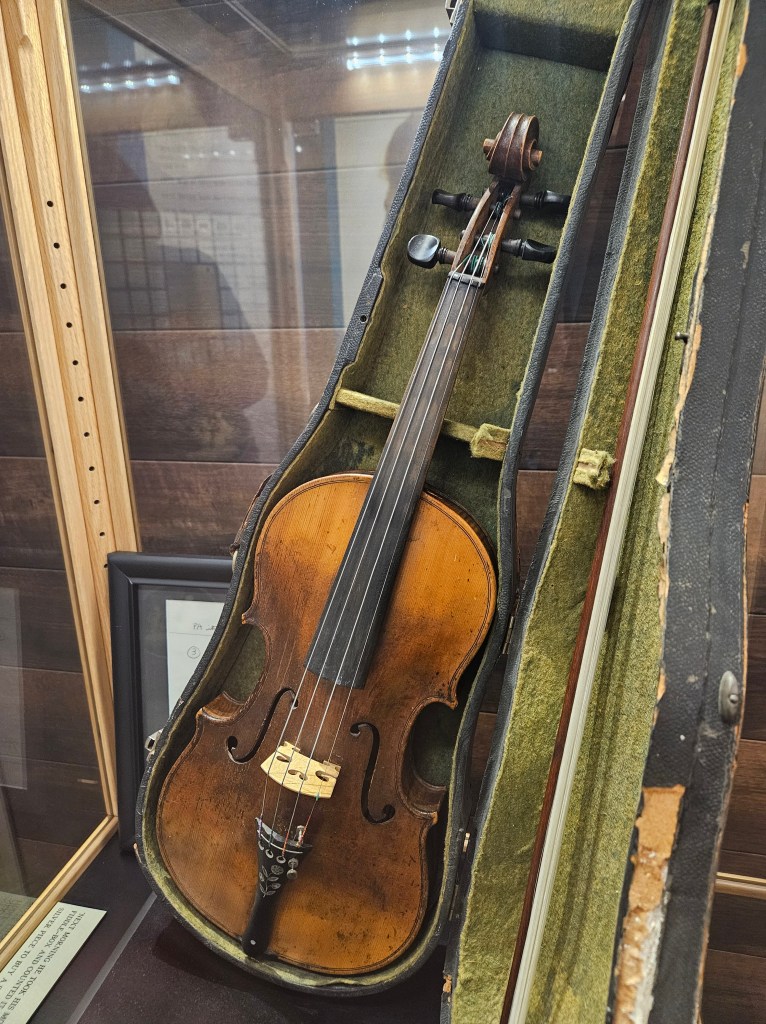
The home where she lived for most of her adult life with her husband, Almanzo, was turned into a museum only months following her death. I’ve already visited twice in earlier years, but the museum building is new since the last time.  There’s a short eight-minute video and then when you walk into the museum you see Pa’s fiddle.

Pa’s fiddle, an object that was a large figure in all of Laura’s books.

It’s great to see all the family memorabilia, but I enjoyed walking through her house the most.  I think about all the years that she and Almanzo shared here.  There are the things Almanzo carved – lamps and tables, and home updates to accommodate things like the purchase of a new refrigerator. He even made a latch hook rug. 

In a foreshadowing of things to come for us, Laura liked the architect Frank Lloyd Wright and wanted the living room to have aspects of his design. It took 17 years to complete all the rooms in the house, and this room was last.

I could see the desk where Laura wrote the books and the table where she would open all the pieces of mail that arrived daily when the books were published.

Laura’s desk, where she wrote all of her books

These days, Laura’s books and the times she lived in are controversial. There have been books written that suggest her daughter Rose had a heavy hand in editing or even co-writing, and books that call into question the reality of the books, all of Pa’s pioneering and moving the family around, and even some racial overtones. Laura did not mean for the books to be non-fiction. And they speak to another time and era, as well as what was known and accepted in that era.

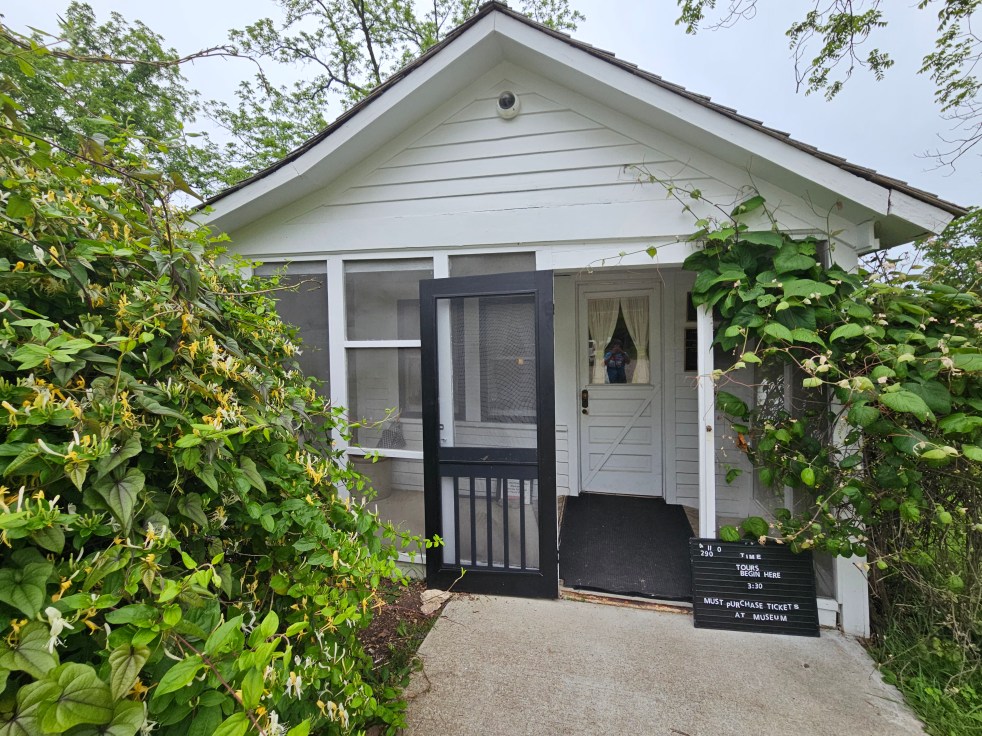
Being the only person showing up, for the 3:30 tour, I had the curator to myself for Laura’s home. We talked of many things, but not these issues. I had gotten sidetracked on another topic: counted cross stitch.

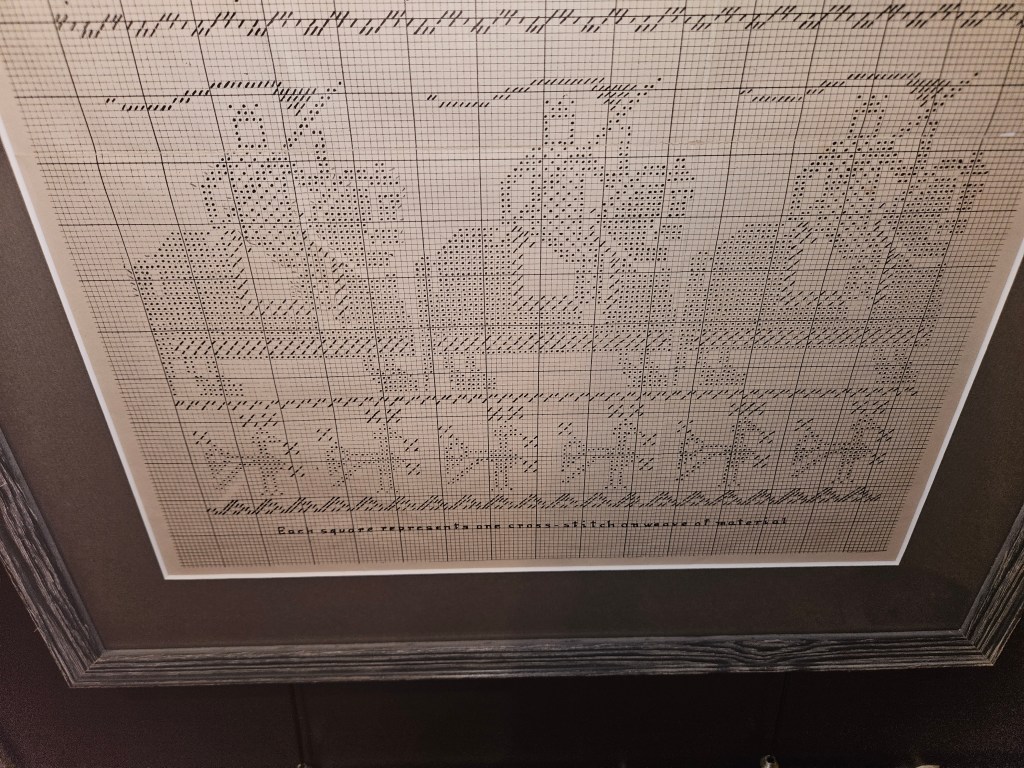
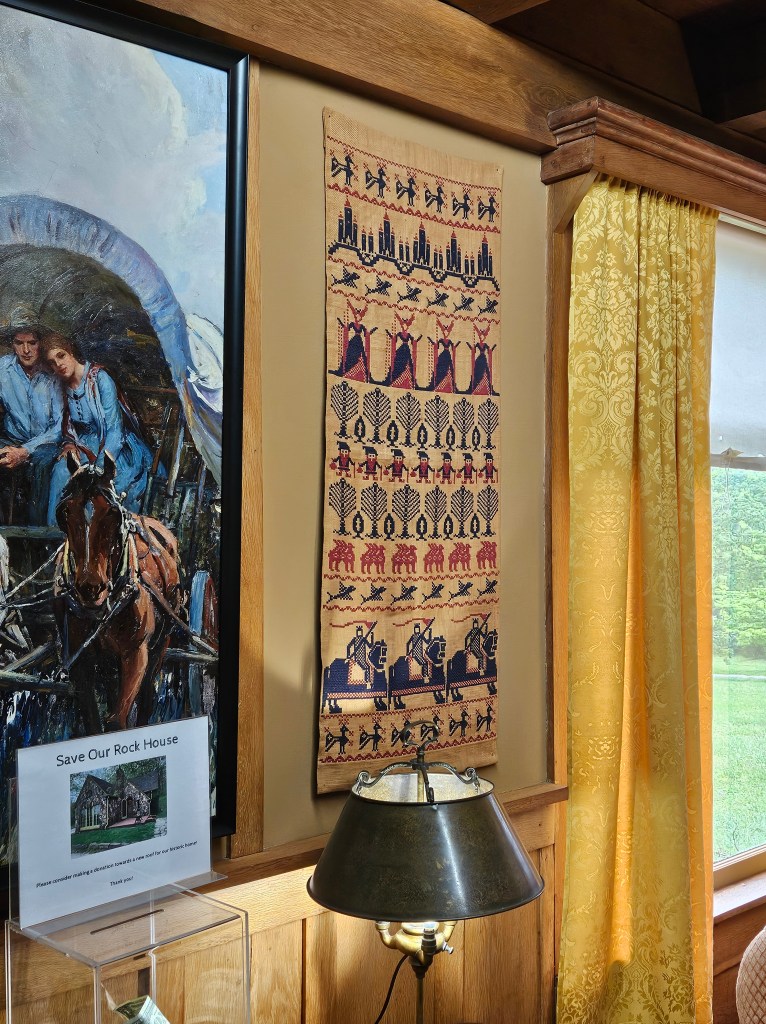
This is part of a pattern for a picture Laura made, which I saw in the museum. In the house, I found the picture, called Knights and Castles:

I fell in love with the picture and asked the curator about it. She herself had found the pattern in the attic just two years ago. It was in a box of old newspapers, tucked in a folder. Until then, the origin of the picture had been a mystery. Laura had sent away for the kit offered in the 1936 Woman’s Home Companion magazine for $1.00. The curator was elated about her find. I went back to the museum and took multiple photos of the pattern. It’s repetitive and in only two colors so I believe I can re-create it. Will I ever? That remains to be seen.

“It’s not the things you have that make you happy. It’s love and kindness and just helping each other and just being plain good.”–Laura Ingalls Wilder

Next time – moving on to Greenville, Missouri

Uncategorized

Rolling through Kansas

It was a little sad leaving the AirBnb in Denver that we had called home for seven months. We had sort of grown to like the place, cramped as it was. We don’t feel cramped in the RV. I don’t know why that is, but we’re very happy to be back in it and on the road again for a journey across the Midwest. First, though, we have to get through Kansas. At our speed that entails three nights.

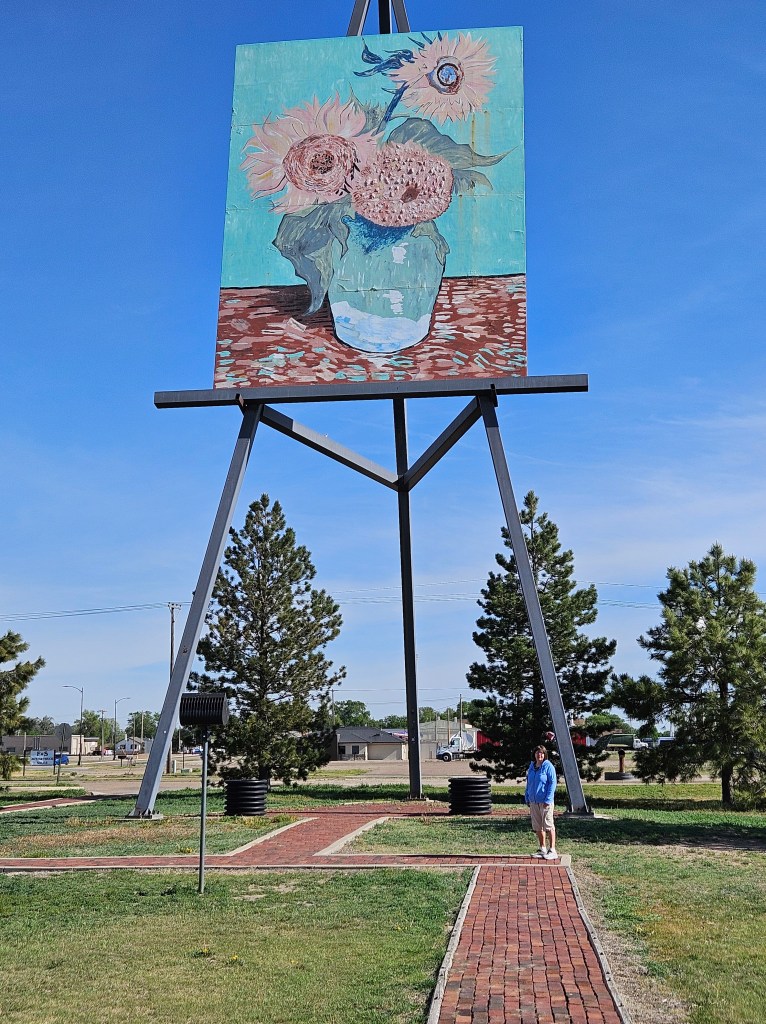
First stop – a repeat in Goodland at the KOA. Goodland’s claim to fame is the huge Vincent Van Gogh replica painting that stands on a 80-foot high easel. I had Cal take a picture of little me for perspective.

Goodland is a tidy little town, with old houses on quiet streets that you can walk down the middle of and no one would care. On a previous visit we discovered that they have a cute historic downtown area. There’s also a tiny museum which, on the outside of its building, proclaims their other claim to fame: America’s first helicopter was patented here.

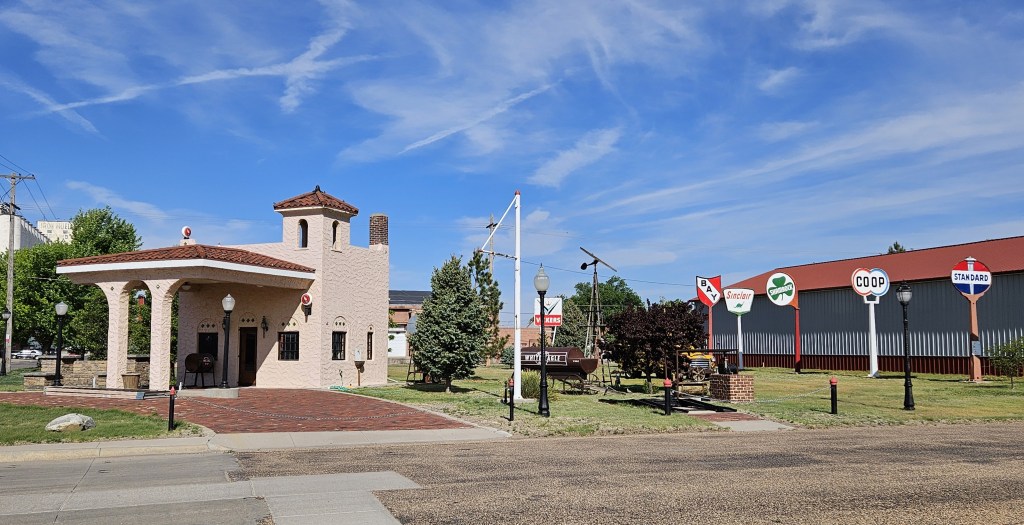
This time, we only walked as far as the restored White Eagle Gas Station.

Rod Cooper, who owns the Crazy R’s restaurant in town, moved the gas station as well as historic gas signs here from another location. Every town needs a visionary. His latest project is a huge historic home which he placed right next to the KOA. It’s still a work in progress.

Further down I-70 lies Wilson, Kansas. We discovered Wilson a few years ago when visiting the Garden of Eden in Lucas. Afterward, we had lunch at the “Made from Scratch” diner across from the grain silos in Wilson. It’s only open at lunch time and on certain days. A tradition was born. We try to stop whenever we venture across the Kansas prairie. It’s a good homestyle lunch with great pies and we always enjoy soaking up the local atmosphere: seeing all the farmers coming in to chew the fat with their buddies.

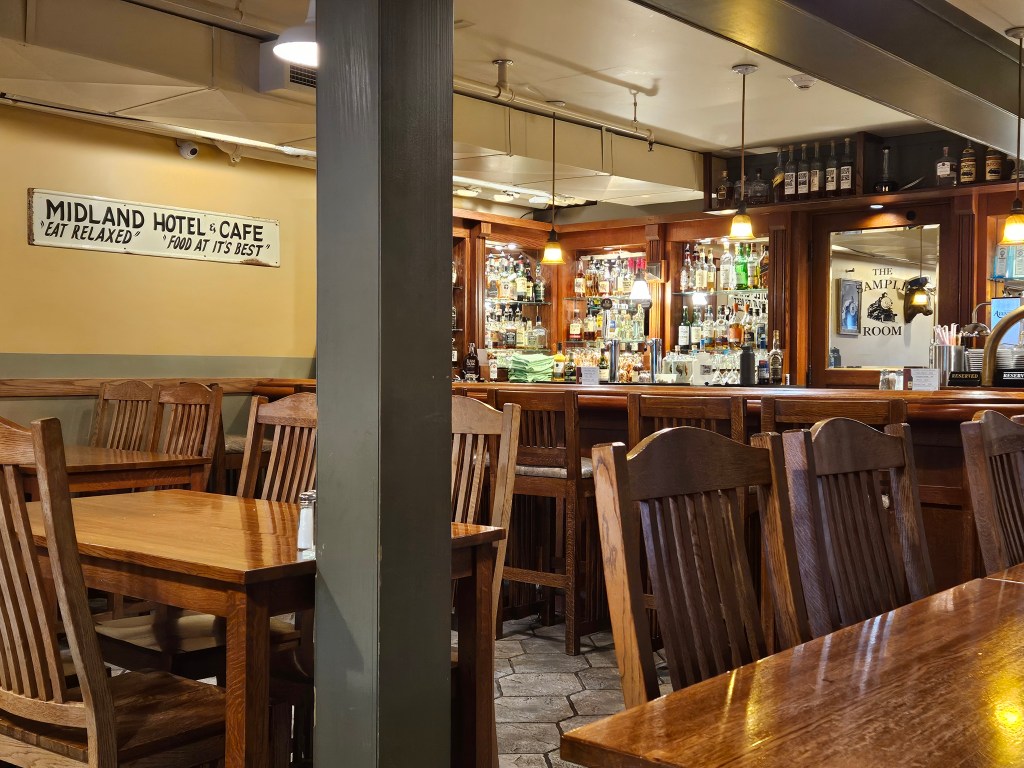
Tiny little Wilson RV Park, where we booked our stay this time, is a bit of a work in progress. Unfortunately we were here on a day when the diner was closed. They have problems finding help. Just when I resigned myself to having our leftovers for dinner, we discovered another Wilson restaurant which sits inside the 1899 limestone Midland Railroad Hotel.

This is called “The Sample Room”, in the basement of the hotel. You could guess that it’s named for attempts to try the samples of alcohol behind the bar. Actually, though, this hotel was once a popular railway stop between Kansas City and Denver. Salesmen would bring samples of their wares down here to try to score a sale. Cal and I watch “Antiques Road Show” and I’ve seen these samples. They are often intricate working miniatures of the real thing: windmills, tractors and other farm implements, as well as household items, which would fit in a small case.

Verdict: I think lunch at the Made from Scratch is more fun, and we love those pies, but our humble little plates of meat loaf and chicken fried chicken at the Sample Room were also delicious. Besides, one place is only open for lunch and the other place is only open for dinner.

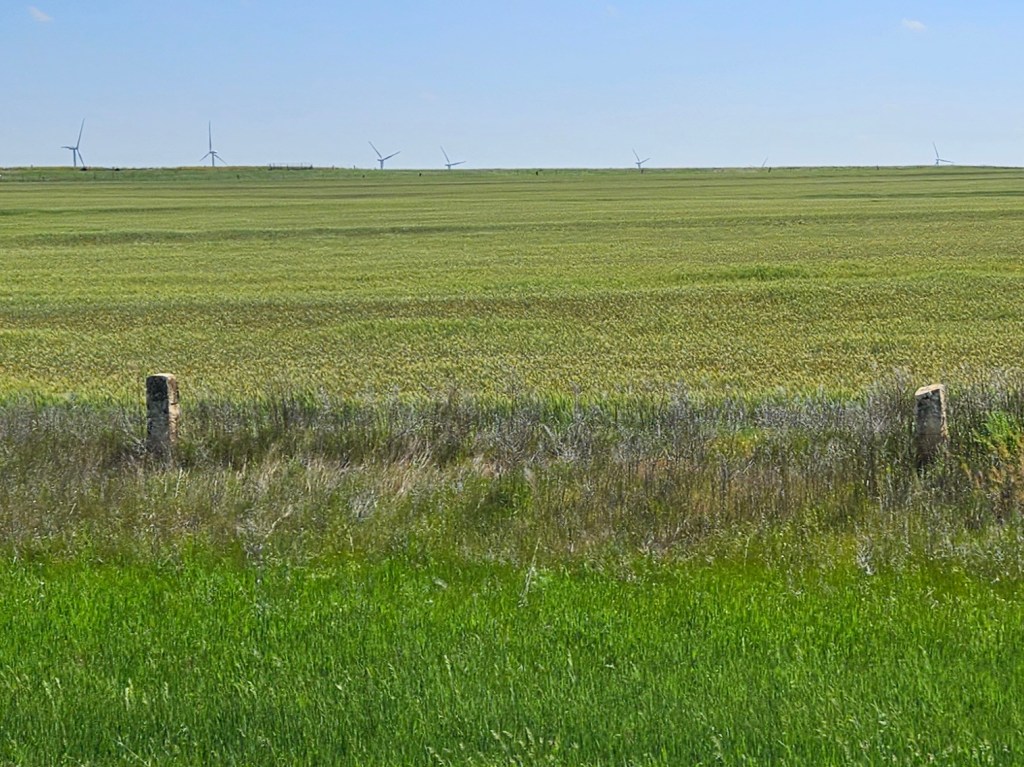
Wilson is on the “Post Rock Byway”. Besides the pretty view of the hills and prairie on the road, you can also still see fences made from limestone on this road and also all over western Kansas. You can see two of these antique posts in this prairie view, as well as the modern barely visible windmills on the horizon. The past meets the future.

Early pioneers discovered that wood was not plentiful here, but limestone was. Besides being used for fencing still, these posts are included in landscaping everywhere. There was a pretty little garden outside the hotel using them as the legs for a limestone table. It is on the right in this picture.

Wilson was built by Czech immigrants and has dubbed itself “The Czech Capital of Kansas”. These decorated eggs can be found all over the little downtown area, but this golden one was especially beautiful.

The most fantastical, though, is this: at 20 feet tall, the world’s largest Czech egg:

In a state where all the sights are small-scale, Kansas likes superlatives. North of here, we once went to see the biggest ball of twine in Cawker City. We haven’t seen the world’s largest belt buckle in Abilene yet, though.

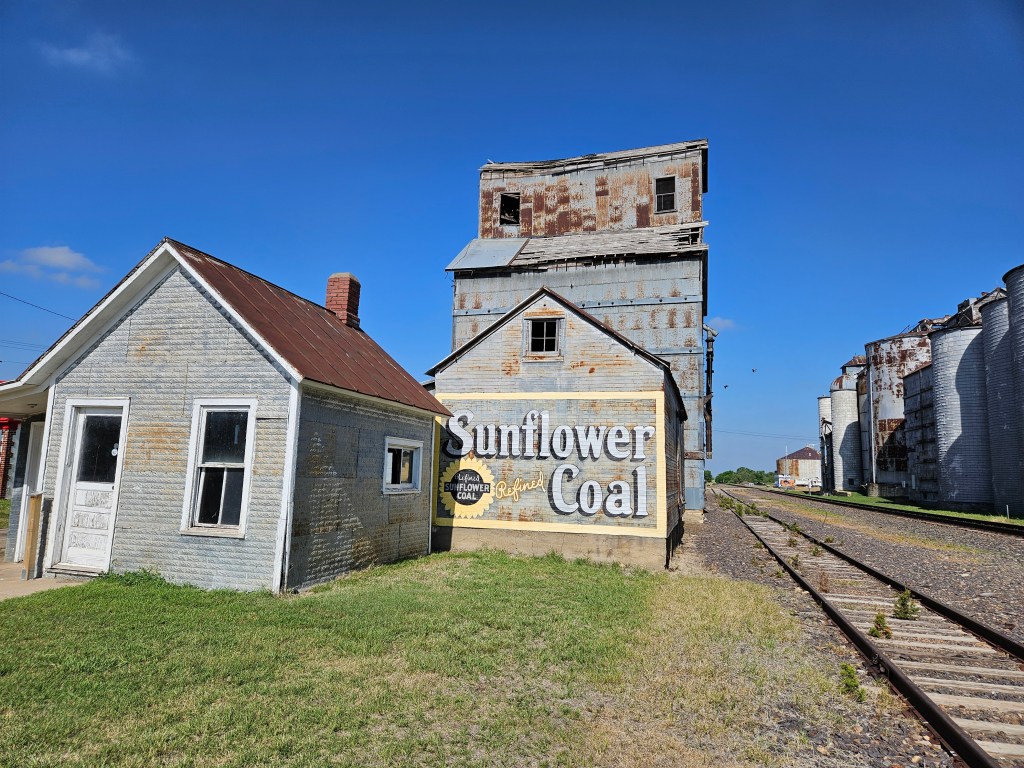
This complex consisting of a grain elevator, a office, and a coal storage building dates from 1900. Trains still do blow by here fairly regularly.

Our RV park owner also has a little coffee shop in front. As we stood in line for treats, we spoke to her, and to the owner of “Missile Silo”, which is a decommissioned missile base. There are more things to see around Wilson and a good restaurant in a neighboring town was recommended. I guess we’ll have to come back! Next time, though, I’ll make sure “Made from Scratch” is open.

We waved out the window as we passed Manhattan and Ft. Riley. We lived there many moons ago. A plan to include a visit to our friend Gayle had to unfortunately be scrapped when the itinerary expanded to too many days out.

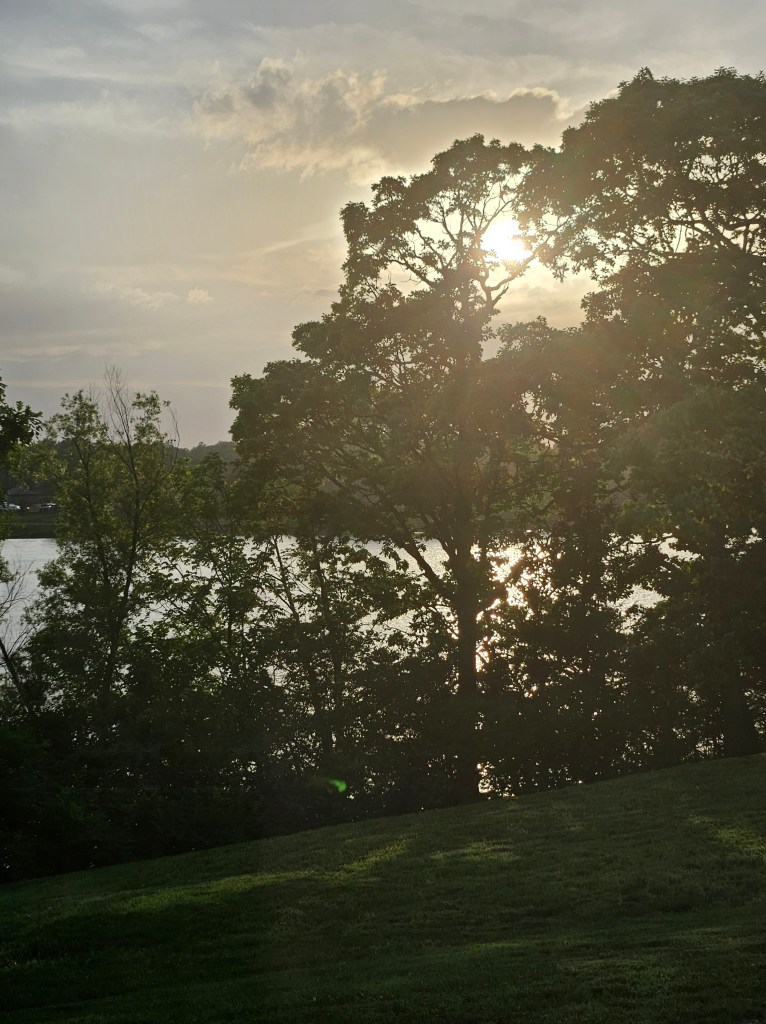
The last Kansas stop, a new one for us, was Lake Shawnee County park on the west side of Topeka. Everything was paved so it was pretty nice. The campground is above the lake on a little peninsula that juts out into it, so there was water to be seen on both sides. A sunset view over the lake was right out our back window.

It was a good start to the trip, so we are looking forward to continuing eastward.

Next time: biking and Laura I. Wilder in Missouri

USTravel

A National Monument, a State Park, and Dinosaurs in Western Colorado

As we crossed over the border into Colorado from Utah, we were ready for a little break. James M. Robb State Park seemed like the place to put down the RV jacks for a few days. It sits just off of I-70 in the small town of Fruita.

Actually, it was a little too close to I-70 for a state park – I could see vehicles on the freeway in the distance in one direction, although I couldn’t hear them. And if I peered hard through the trees I could see – what?? It was the distinctive red of a Dairy Queen sign. That was too tempting. On our first evening, we walked through the campground and right out the front gate to have a little ice cream after supper.

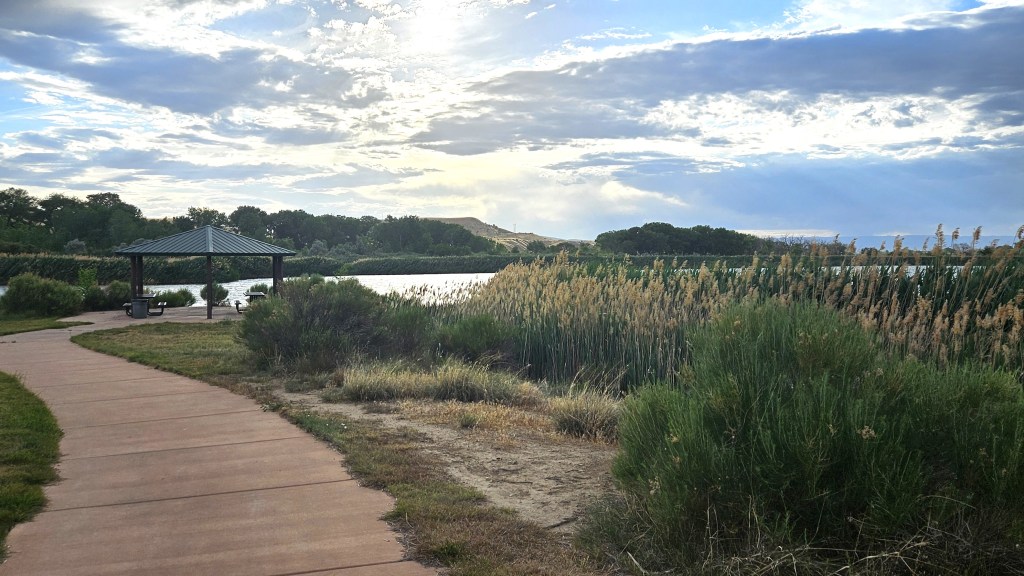
Still, our site was pretty and there were pleasant walking paths in the park. It was a welcome improvement over some of the RV parks we’d overnighted in on our journey east. The park borders the Colorado River, which was full of gushing snow melt.

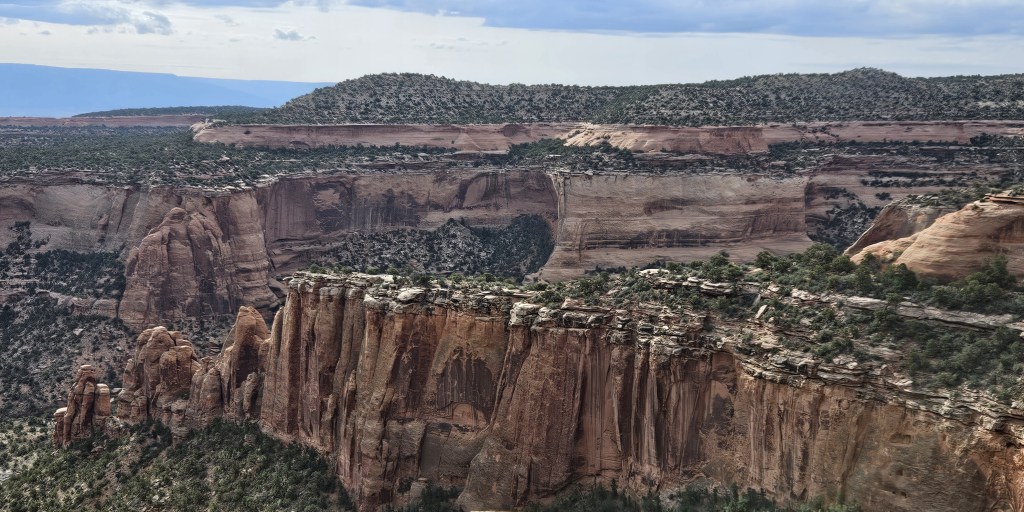
Behind us, we could see the towering cliffs of Colorado National Monument. We drove to the park for a visit. It’s only a couple of miles from the state park, but a world away. The road to the entrance wound up and up, with some rock formations, a couple of tunnels, and then…wow! We arrived on top of a huge canyon with rocks in formations and colors, pinon and juniper trees, and many viewpoints from which to see them. Rim Rock Road, which goes through the park and was built by the CCC, travels on top of mesas with plenty of switchbacks.

The scene was so different from what we were now seeing that it felt like a hidden surprise.

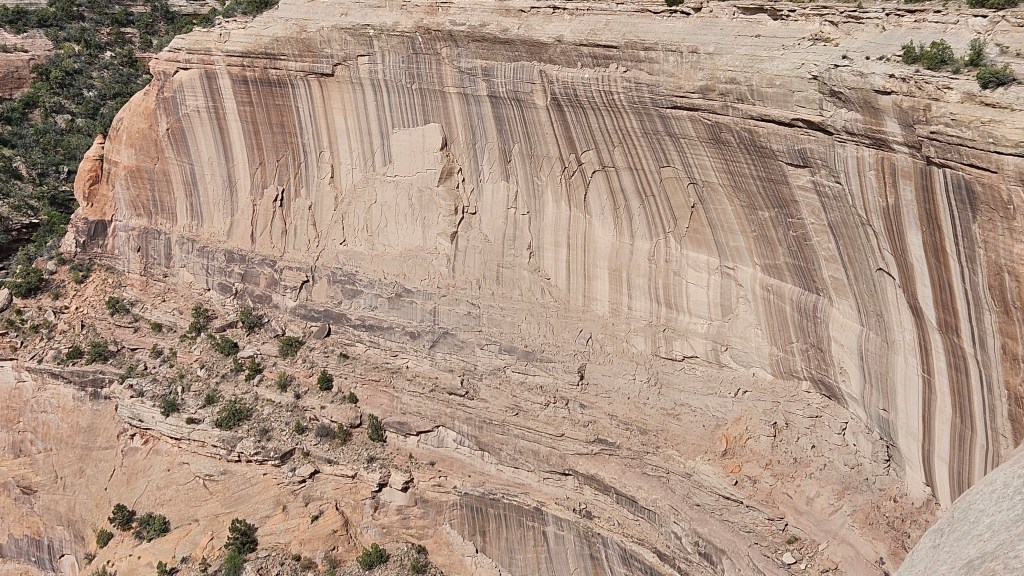
Desert varnish painted some of the cliffs in multi-colored stripes.

There was a different view around every turn–

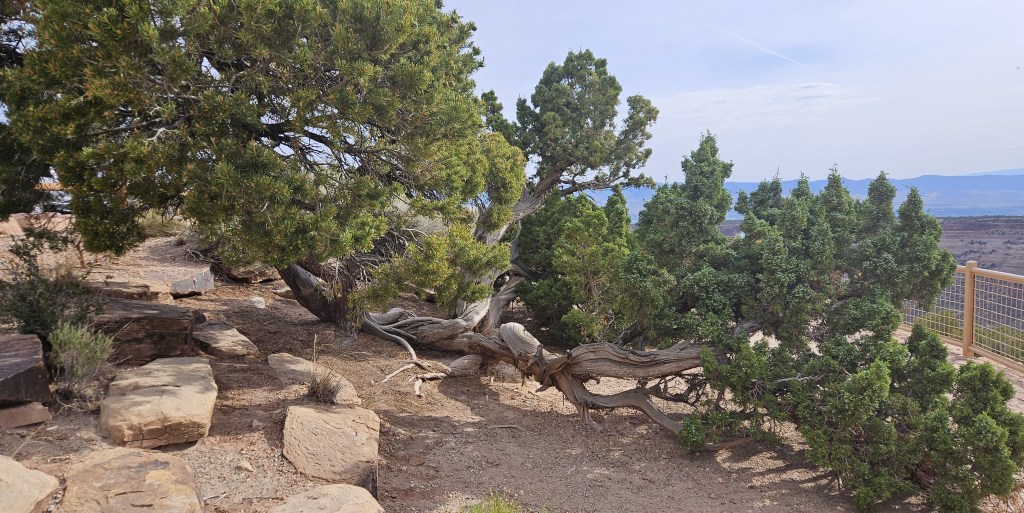
–and ancient junipers stretched out their long and gnarled limbs.

We had come into the park just before the visitors center opened, so that was our last stop. They had a great movie about the formation of the canyon and its rocks eons ago.

Dairy Queen wasn’t the only establishment in walking distance from the state park. As we’d driven back and forth, I’d seen a building called Dinosaur Journey Museum. It is part of the Museum of Western Colorado, just down the road in Grand Junction. I walked down to it from our campsite to check it out.

It turns out that this area has been rich in fossil finds. It’s called “the Jurassic Badlands” with hard sandstone ledges called “the Morrison Formation”.

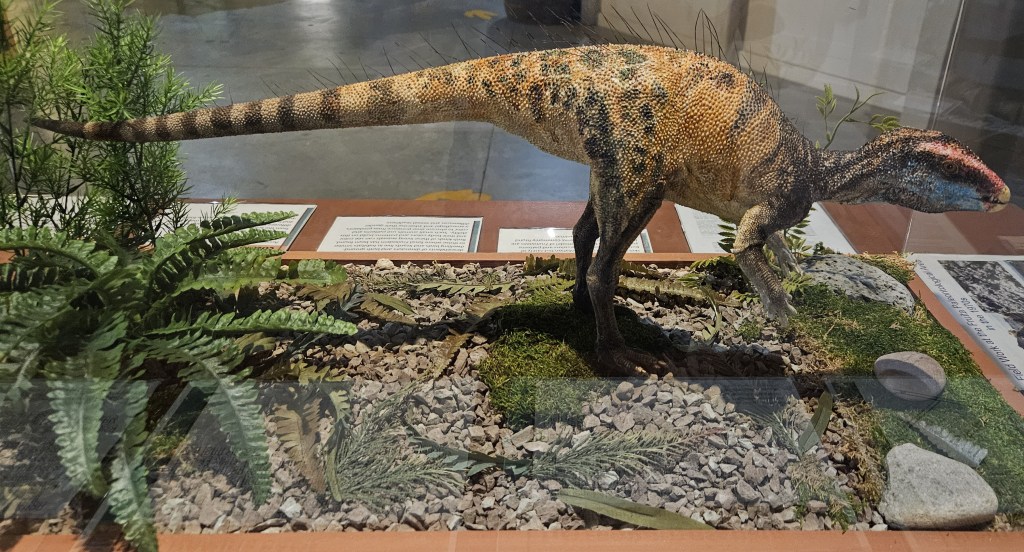
There’s even a dinosaur named after the area. This is a life-size model of Fruitadens, one of the smallest dinosaurs in the world.

There are larger dinosaurs here, too. This is Dryosaurus Altus, which lived during the late Jurassic period. It’s still considered to be a small dinosaur!

I learned many things here, among them the fact that the state of Colorado has the largest track site of late Jurassic dinosaurs anywhere in North America. It is 350 miles away on the eastern side of the state, in La Junta. I appreciated the fact that this was not a kid attraction and that everything was presented factually. There was even an interesting movie to watch.

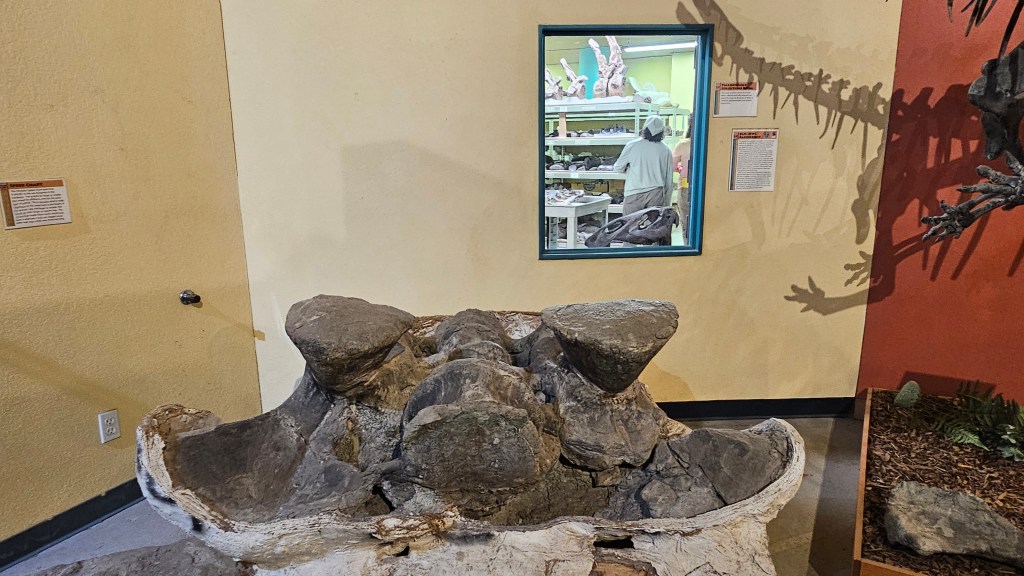
There are working labs here which could be seen through windows, with a multitude of shelves containing fossils. One of those windows can be seen here, behind this picture of an upside-down Apatosaurus pelvis.

There was one more thing to do while we were at James M. Robb, and that was to ride our bikes. This town is working hard on having a network of bike trails. Actually, the full name of this park is James M. Robb Colorado River State Park, and it boasts that there are five ecological areas in separated parks: Fruita on the west end, where we were; Connected Lakes, Colorado River Wildlife Area, Corn Lake, and Island Acres on the east end. We did not have time to explore the other areas and opted instead to head back west on our ride.

The trail started out prettily enough, along the river, but then it swung alongside the highway with little shade. I think it’s great to build bike trails, but I wish planners would consider proximity to busy roads. I suppose it comes down to land availability. My lone picture from this very hot ride was from something called “Wakezone Park.” People could waterski on a lake without a boat through a system of cables and pulleys. It looked like fun.

I caught this person on top of an incline. It looks like she is stopped on the incline, but she was actually going full speed.

The day was sunny and very hot. I thought Cal was in a hurry to get back to our site, but as we came back into town he suddenly veered onto a left turnoff instead of going directly back. I was perplexed until I discovered the reason for the detour: he’d seen a sign for Ace Hardware, one of his favorite stores, and needed to make a purchase. I was impressed that he was able to spot it, but I suppose it would have been the same for me if it had been a craft store or antique mall sign!

Back on the road, we had one more stop before arriving in Denver: another state park, Rifle Gap. Unlike James M. Robb, this park is set a few miles away from the highway.

We explored Rifle Gap and the surrounding area couple of years ago. Now it provides a restful mountain overnight on our eastward journeys back to Denver.

Next time: our Denver life

Note: although I am writing this during the winter of 2025, the trip actually occurred in June 2024.

USTravel

A First Day In Yosemite National Park

We did not have far to go to switch from one RV spot to another while heading to Yosemite. By now we were into the week before Memorial Day, a time of year that I really didn’t want to be in to visit the park. That’s the way calendar planning goes sometimes, so we had to make it work. The very next day after our new setup, Tuesday, we went into the park.

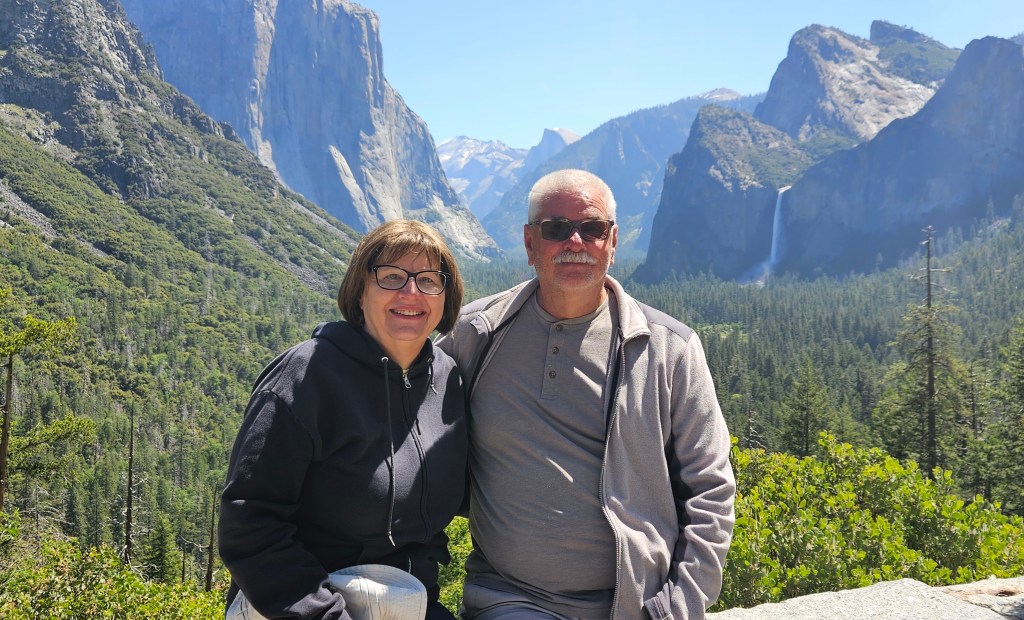
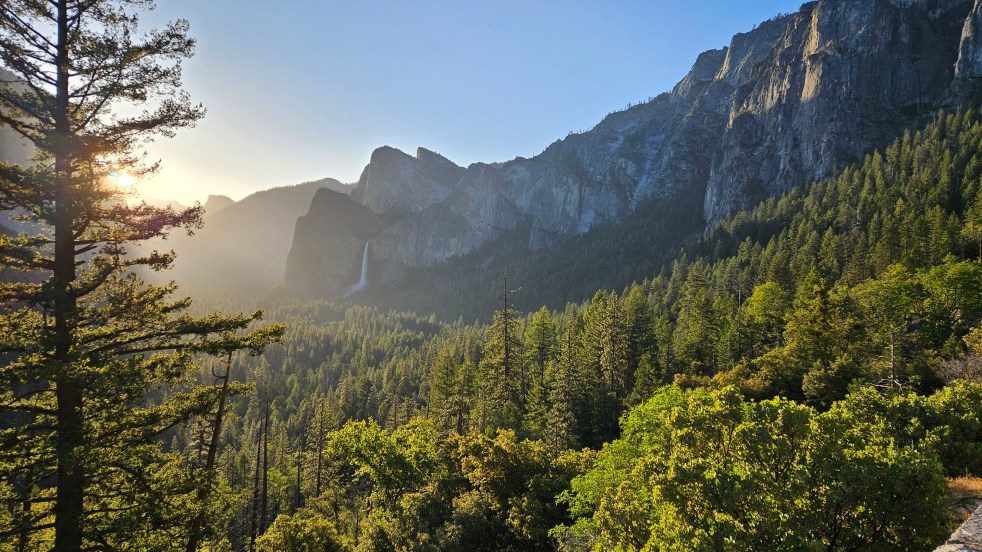
I was afraid of a miles-long wait to get into Yosemite. Massive crowds. Happily, we did not experience that, even for a weekday before a holiday. We did get up at 5 AM to drive the hour and a half trip to get there. The guard shack at the entrance was not even open yet, and we drove right in. Coming through Tunnel View, this is the sight that greeted us:

The morning sunlight streamed in between the peaks, filling the valley with exquisite light and playing a peek-a-boo shadow game with the surrounding cliffs.

From Tunnel View, we proceeded to the Yosemite Valley Floor, and got a spot in the empty parking lot at Yosemite Valley Lodge. It was a short walk across the road, where the climbers in their tiny dome tents at Camp 4 were already packing and ready to take on El Capitan. Down an easy paved trail, and up to Upper and Lower Yosemite Falls, there were only a handful of other folks out.

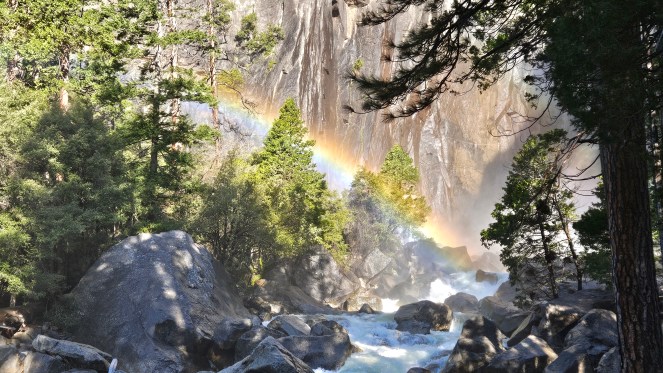
At Lower Yosemite Falls, I was delighted to see that the sparkling water and morning sun produced a beautiful rainbow.

We had signed up for a Valley Floor Tour, and had some time to kill, so back at the lodge we sampled some pastries. A young man from one of the cities on the California coast shared our table and we had an interesting chat. He was hoping to do some climbing that morning, but wanted to meet someone to buddy up with to do his climb. We were for sure not the right folks for that!

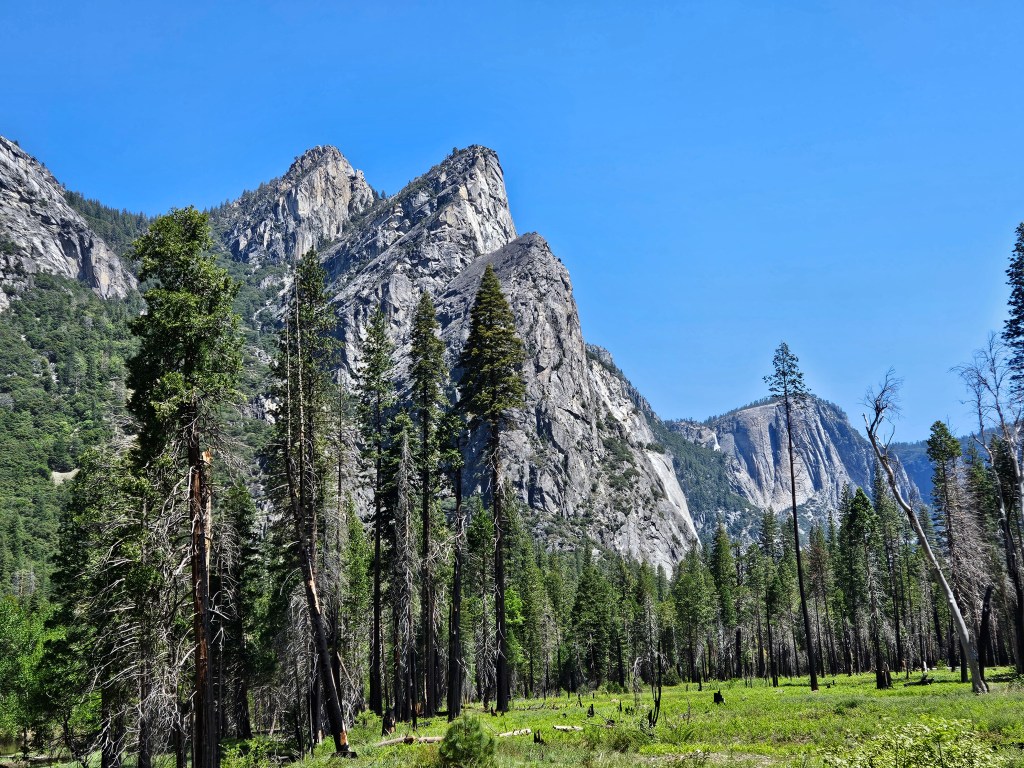
The Valley Floor Tour may have been too sedate an activity for him, but it was a perfect introduction to the park for us as we rode on an open air tram. This is the Three Brothers Peaks:

Our ranger guide told us some interesting stories. The middle peak of the Three Brothers had a rockfall in the 90’s that covered the busy Valley Floor park road. A park ranger heard the rumbling and stopped traffic, despite orders from his supervisor. His actions saved many lives as the large rocks tumbled onto the road.

She also pointed out the climbers on the face of El Capitan, so tiny you could hardly make them out. You certainly can’t see them in my picture, but they are there.

Both our guide and our climber friend from breakfast talked about Alex Honnold, the first person to free solo El Capitan. Free solo means NO ropes or safety gear! There has been a documentary made about him – “Free Solo” which I’d like to watch see sometime.

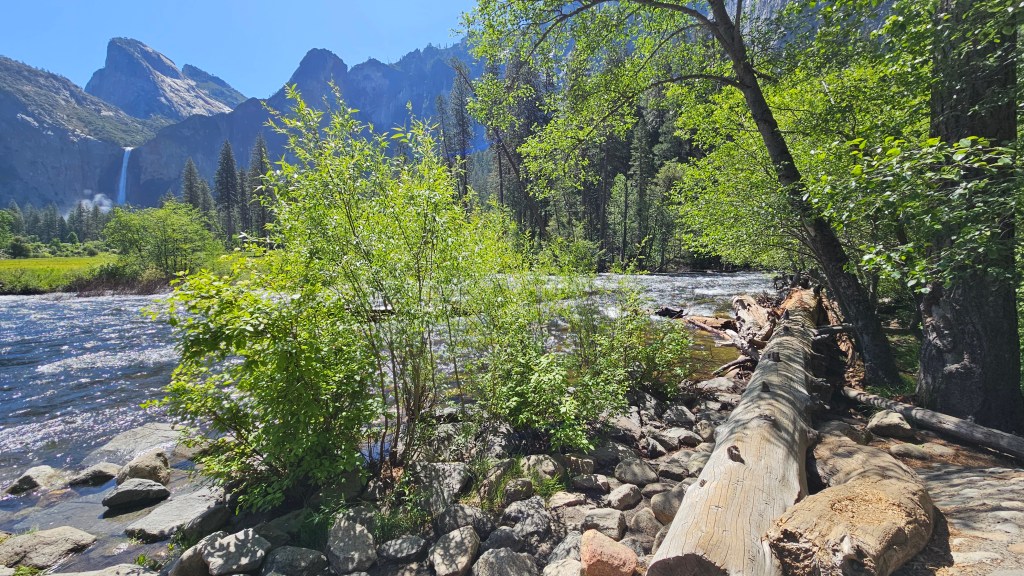
We got out of the tram to look at the gushing Merced River, with beautiful Bridal Veil Falls as a backdrop. All of the creeks, rivers, and waterfalls were swollen with water due to the late spring snow melt from the higher elevations.

Later in the tour we were able to see Bridal Veil Falls from a bit closer as it tumbled down the cliffside:

Bridal Veil Falls is grand, but the prize for the shortest waterfall – 18 inches high – goes to pretty Fern Spring Waterfall. Our guide told us this little fact, but it may have been tongue-in-cheek.

The tour went up to Tunnel View, where we had stopped on our way in earlier in the day and was where I took the first picture in this post. The rising sun had cast the mighty cliffs in shadows and made it difficult to take pictures. Now we could see everything more clearly, all the way back to Half Dome and Cloud’s Rest.

On the way back to Yosemite Valley Lodge, we learned many more facts about Yosemite as we rode, and received a closer view of Bridal Veil Falls. We felt that this tour was a good “Yosemite 101” introduction to the park and all of its wonders, excellent for a first morning. Not knowing anything about Yosemite to begin with, I had felt a little overwhelmed about what to do when I was planning our visit here. It’s important to book the tour far in advance, though.

One of the best pieces of advice I’d heard is to park once and visit everything on foot, bike, or by shuttle. The parking lot was already packed by the time we returned from the tour. So, we grabbed our e-bikes, put our lunch in my basket, and returned to a picnic area we had seen at Yosemite Falls. We were very glad we had visited the falls early, because now the path was crowded with other tourists.

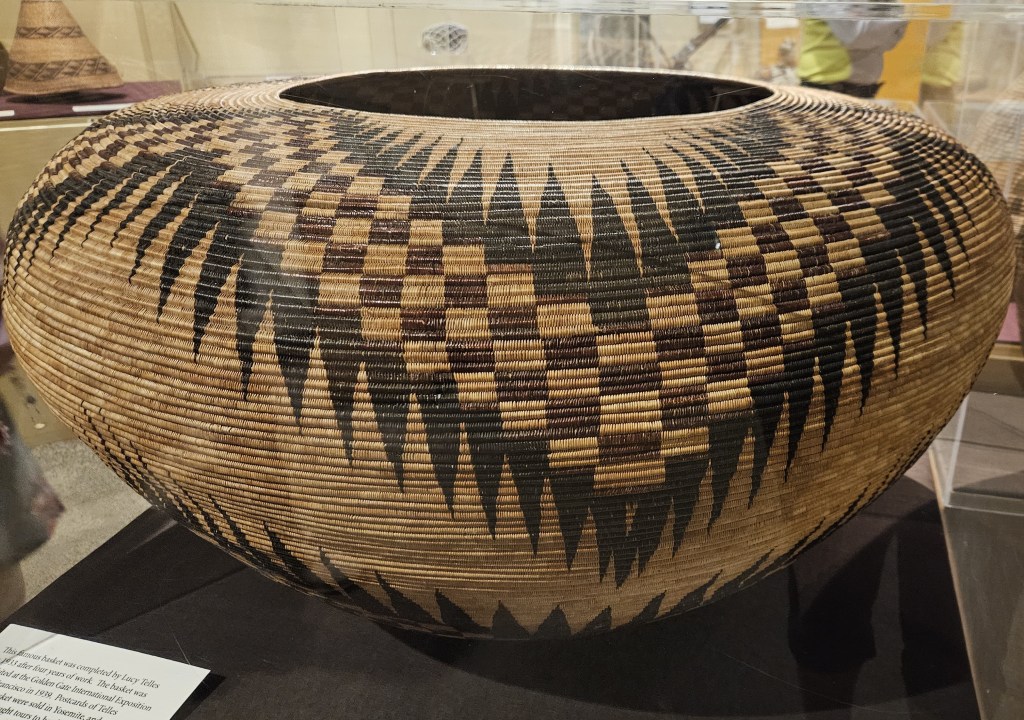
After lunch, we hadn’t ridden our bikes far when we came to Yosemite Village, where there are some museums. At the Yosemite Museum, I admired the expert weaving of Lucy Telles and her younger sister Alice Wilson. They were both natives who lived in Yosemite most of their lives.

This basket is made of sedge root, bracken fern root, redbud and willow, and took four years to complete.

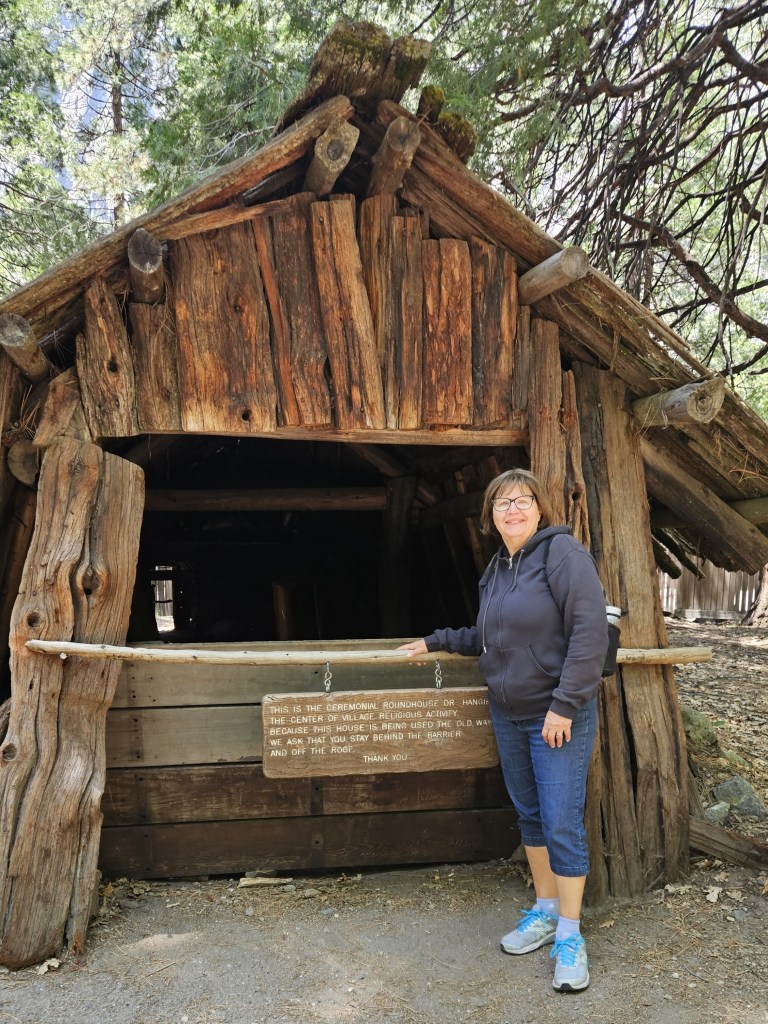
Behind Yosemite Village is a native village. The Miwok Indians lived in this valley beginning in the 14th century. In the early 1900’s they were considered an asset to the tourist trade, and both Lucy and Alice demonstrated their skills. The Indians are no longer here but their little village is on display.

Here I am in front of, as the sign says, “a ceremonial round house…the center of religious activity.” It is still in use.

The inside of it looks like this:

Back in the museum, I looked at the equipment climbers use, including a cot that can hang off the side of the mountain for the night! No thank you! And here, I learned more about Alex Honnold.

Nearby stands this statue and display board of John Muir:

There is an exhaustive list of things John Muir did in his lifetime, but among them he was a naturalist, environmentalist, and champion for the preservation of wilderness: namely, Yosemite Valley, Sequoia National Park, and the Sierra Nevada Mountains in which they exist.

Another luminary of Yosemite is Ansel Adams, a photographer and, like Muir, an environmentalist. He’s perhaps the best known for his black and white landscape photos of the West and Yosemite. I popped into the Ansel Adams Gallery at Yosemite and admired some of the photos but it seemed to be more of a shop to purchase them and other items.

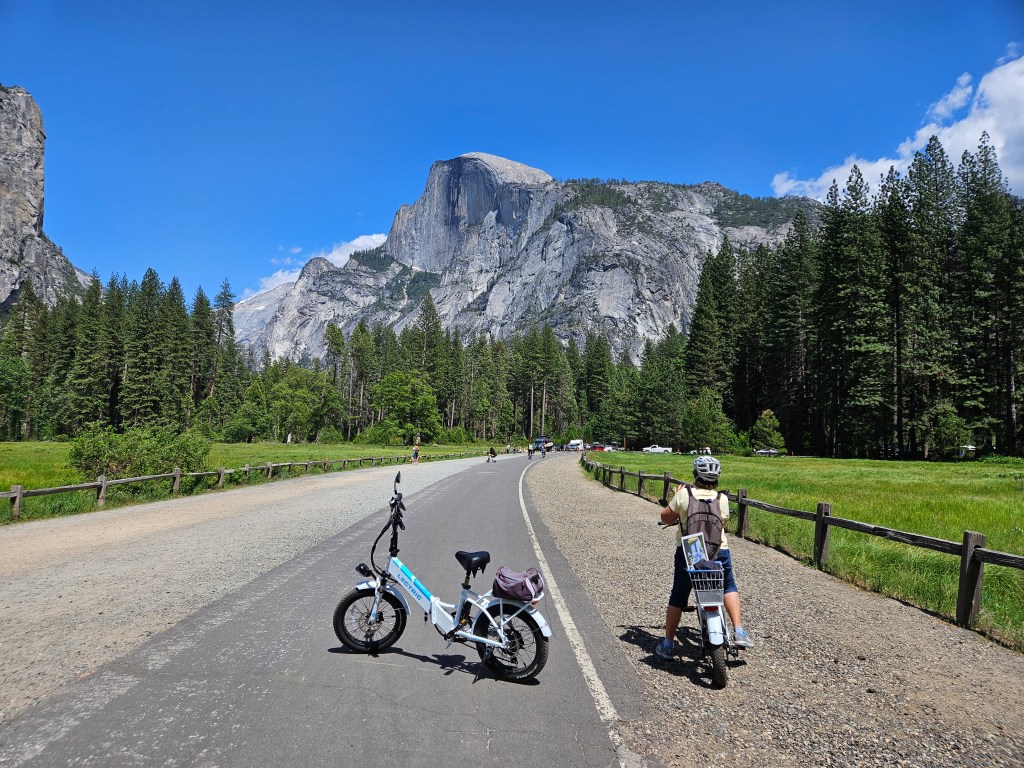
We were ready for some real bike riding by this time, and the crowds around Yosemite Village were thick. There is a nice trail but there is also a bike rental place which adds to the number of people on it. Finally, it cleared out because most people didn’t ride far. The valley opened up and we had a beautiful ride.

Looking at Half Dome on the Yosemite Valley bike trail

We packed even more into this very special day, but that’s for next time.

Next time – Yosemite – the best view, and a challenging hike upward

USTravel

Kings Canyon National Park

Everybody needs beauty as well as bread, places to play in and pray in, where Nature may heal and cheer and give strength to body and soul alike. –John Muir

Heading out from San Luis Obispo, our destination was to the Sierra Nevada mountain range. We retraced some of our drive through the California Central Valley. This time, though, we turned northeastward, driving through miles and miles of orchards and fields growing strawberries, blueberries and other produce around Fresno. We learned later that we were driving on part of the “Fresno County Fruit Trail”.

We soon ascended into the Sierra foothills and arrived at an aged RV park, the closest one to the entrance of the twin Kings Canyon and Sequoia National Parks. On our first day, we decided to explore just Kings Canyon.

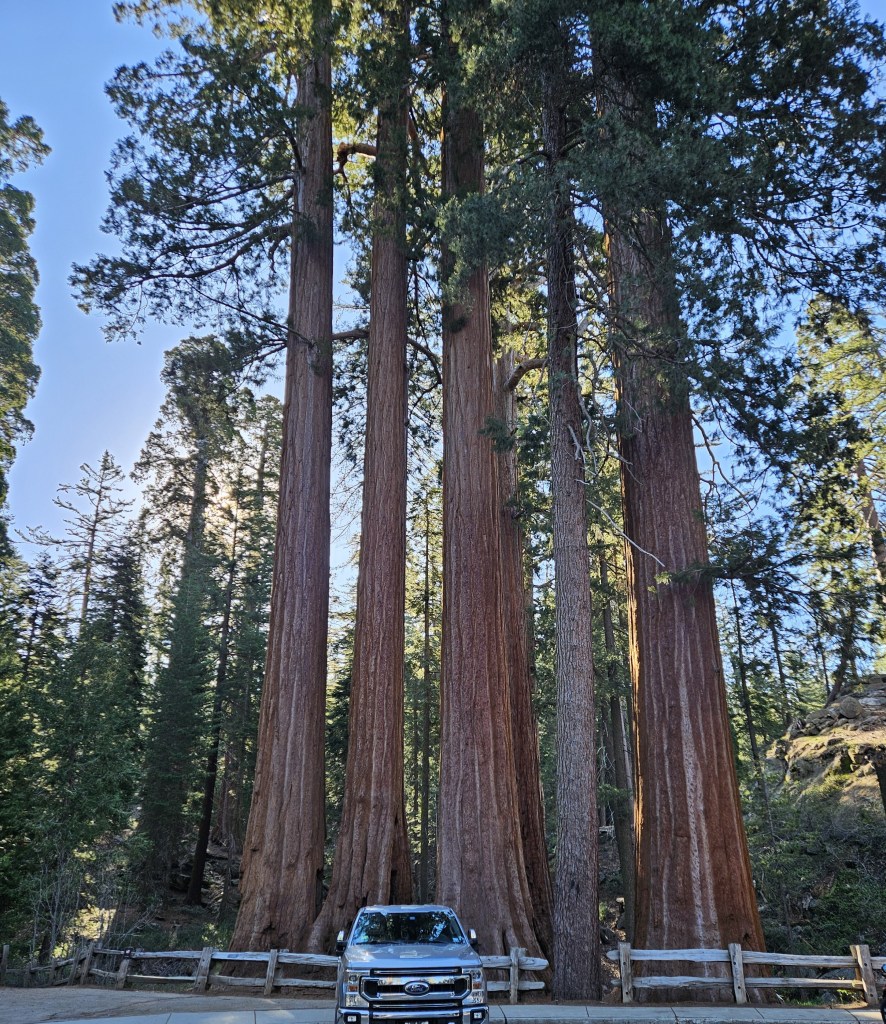
Maybe if you think about Sequoia trees, you think about Sequoia National Park. I know I did, and did not know what to expect with Kings Canyon. This park has its share also, though. Upon arrival at the park we soon turned off onto a parking lot for a half-mile loop that would bring us face-to-face with these majestic sentinels of the forest.

In the morning, when the day was fresh and new and we were one of the first on the trail, the feeling of walking among the tall trees was indescribable. It isn’t just the giant sequoia: there is the ponderosa pine, the sugar pine, and the white fir, among others.

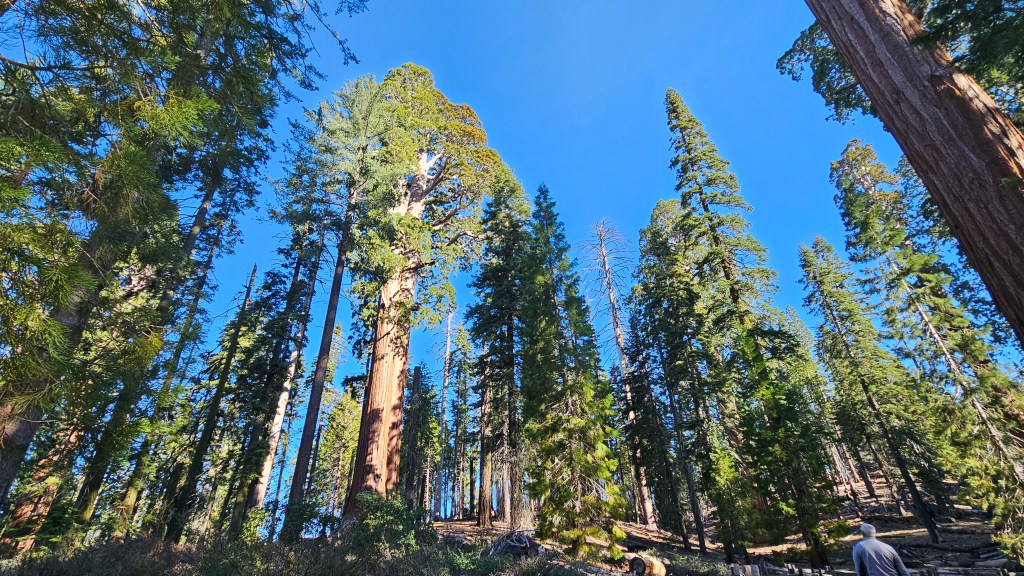
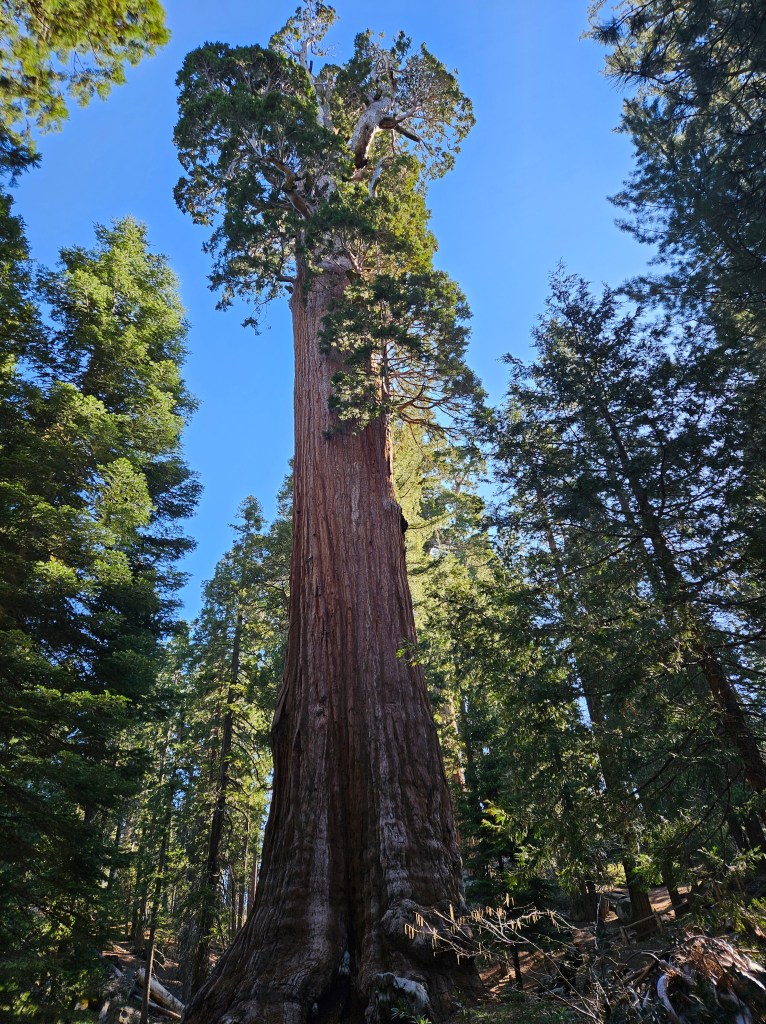
The headliner in this area is the Grant Tree. Its stats are impressive. It is the third largest in the world by volume, 268 feet tall and 1700 years old. I tried to wrap my head around what was going on in the world when this tree was but a seedling.

It’s not age that makes a sequoia grow so tall, though. Just the right amount of nutrients, water and sun is the secret sauce that makes one tree thrive so extraordinarily.

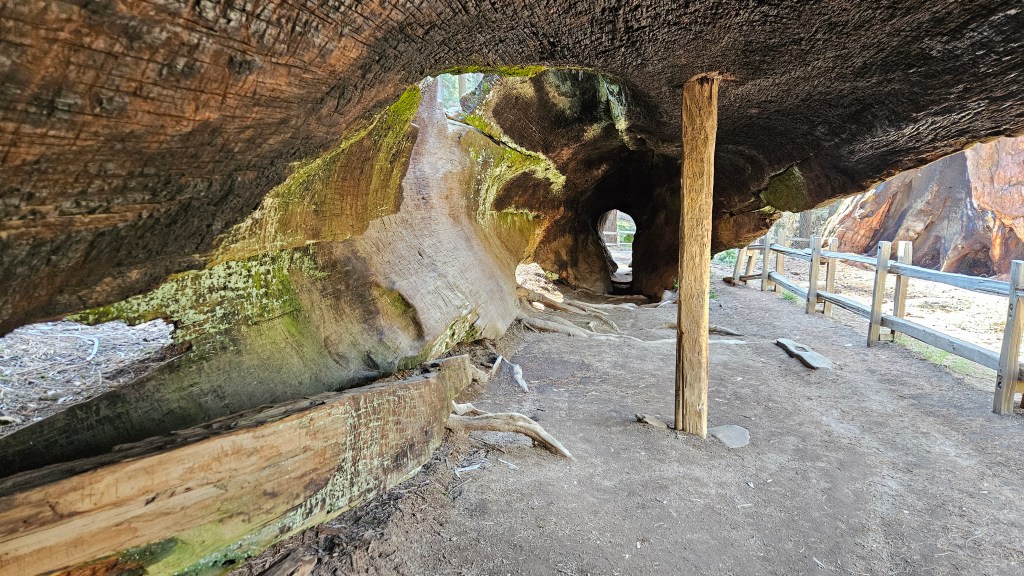
Also on this trail is the trunk of a long-felled sequoia which we could walk through. There is a photograph on a signboard which shows that this trunk sheltered a construction crew around the turn of the century, and likely other travelers needing a spot to camp for the night down through the ages.

Sequoias decay very slowly when they fall, continuing to exist for hundreds of years.

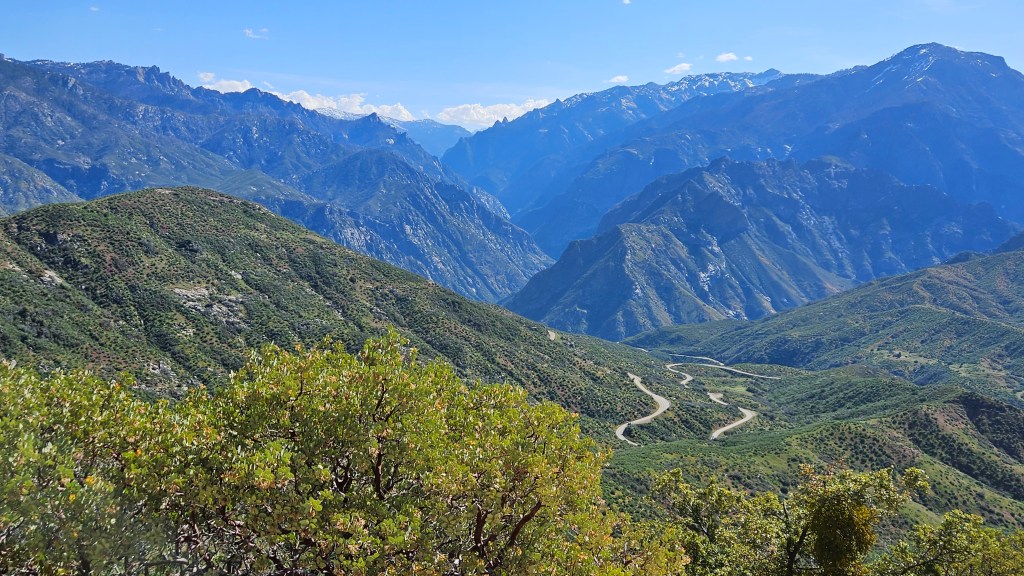
As wonderful as all of this was, it was only part of what was to come during our day in the park. Upon entering the gate, we were delighted to discover that the Kings Canyon Scenic Byway had just been opened for the summer. Every time I’d looked it up online, the byway had still not been cleared from the winter snows.

I’m so glad we did not miss seeing it!

Here we were, with a ringside seat to the Sierra Nevada mountain range. Mount Whitney is the highest peak in this range, and it’s possible we were looking right at it, but I can’t be sure which peak it was.

As we descended into Kings Canyon, the South Fork of the Kings River came into view.

Gushing waterfalls streamed from the high walls of the canyons to join the roiling river waters.

Boyden Cave sounded interesting so we stopped, but the trail to whatever cave that may have been there was closed. It was a nice break, though, and we enjoyed the scenery all around.

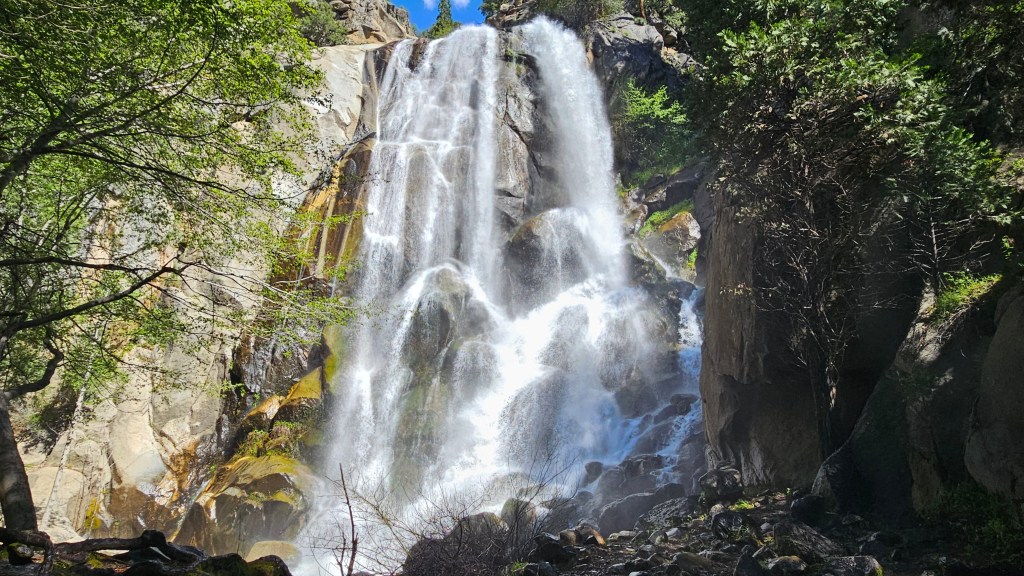
The grand finale to this drive was Grizzly Falls.

We stayed a little while to take in this extraordinary sight before regretfully turning the truck around. The road continued to Cedar Grove Visitor Center and Zumwalt Meadow, but it had not yet been cleared and opened for the summer.

Retracing our drive, we turned off at Hume Lake.

A man by the name of John Eastwood had this dam built in 1908 for his lumbering operation. The lake served as a holding tank for cut sequoia and pines, and water supply for a 54-mile flume that carried the water through Kings Canyon to a town on the other end for finishing. At one time, an entire community lived here.

Thankfully, the era of sequoia harvesting ended in 1929. The sawmill had burned down. By 1936 the federal government came under ownership of the lake as part of the Sequoia National Forest. And, decades later, we could enjoy a picnic lawn chair lunch on its shores.

Next time – Sequoia National Park

USTravel

A Visit to Hearst Castle

The reason why we were in this part of California at all is because I wanted to see Hearst Castle. Looking around for a place to stay, Camp San Luis Obispo was the best recommended for the best price. And by staying there, we discovered the whole area of San Luis Obispo. Travel is like that. You find one thing while looking for another, and soon a new world has been opened up to you, one you’d like to revisit again and again.
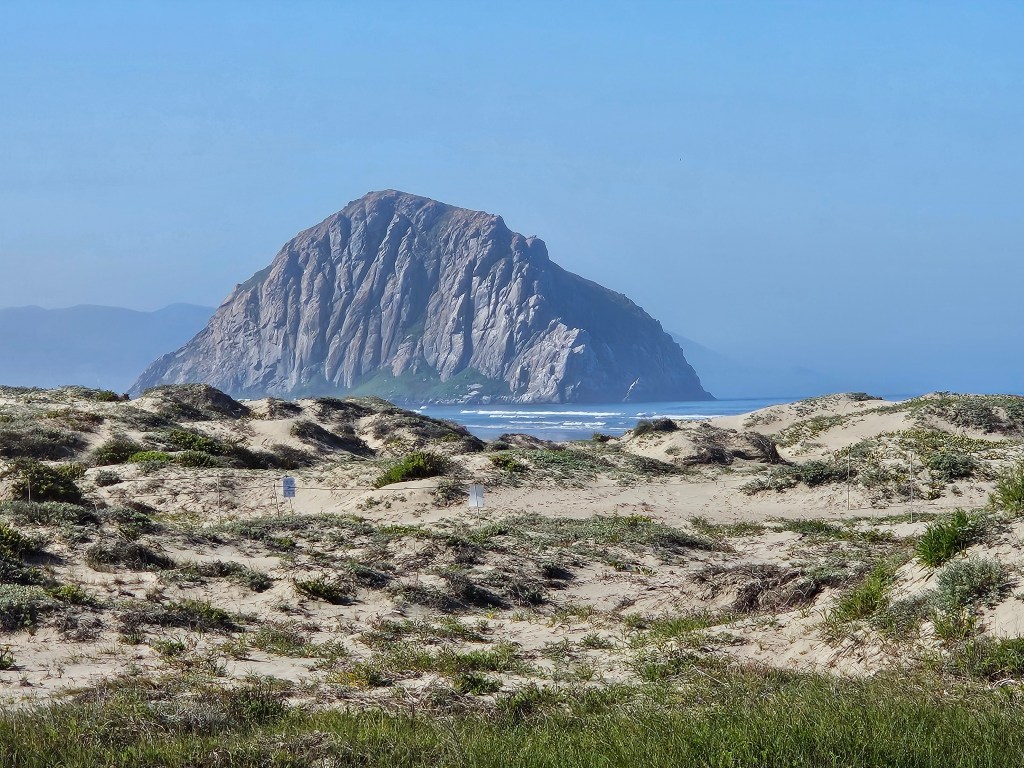
The bonus to staying near San Luis Obispo is that we had to drive up the Pacific coastal highway 1 to get to Hearst Castle. I had purchased timed tickets for our visit and we allowed plenty of time for stops along the way. This is when I snapped the beautifully clear photo of Morro Rock that I posted earlier. The turnoff to the castle is just south of San Simeon.

Magnificent coastal views awaited us at every turn

Hearst Castle was built by William Randolph Hearst, on land he inherited from his father. George Hearst purchased 40,000 acres of ranch land in 1865. George made a fortune, lost it, made two new fortunes. It was a major stake in the gold that came out of the South Dakota Black Hills, though, that clinched his wealth. William inherited the land upon the death of his mother in 1919 and eventually expanded the spread to 250,000 acres.

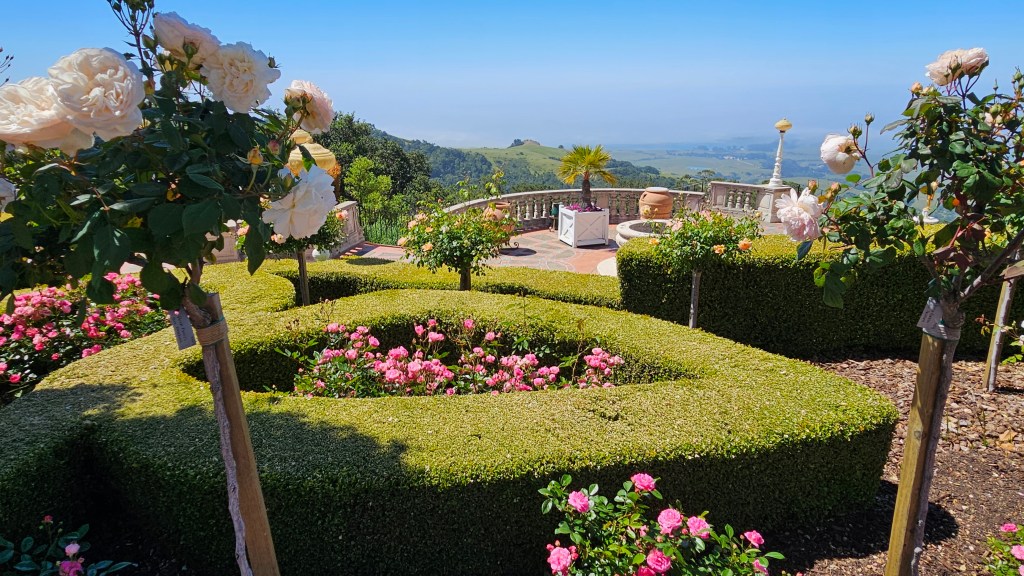
When we were standing here, at this spot in the gardens, we could see for about thirty-seven miles. That used to be about the extent of his property. Now, much of it has been sold off and only 83,000 acres are still owned.

William R. Hearst expanded on his father’s wealth in newspaper publishing beginning in the late 1800’s. By the turn of the century, one in four newspapers printed was a Hearst newspaper.

His family loved to come up to the ranch. In 1919 he found an architect, Julia Morgan, and famously asked her if she could build something a little more comfortable to stay in than tents up on the hill. For over thirty years she worked closely with him. The castle is still unfinished, although I didn’t see any evidence of that.

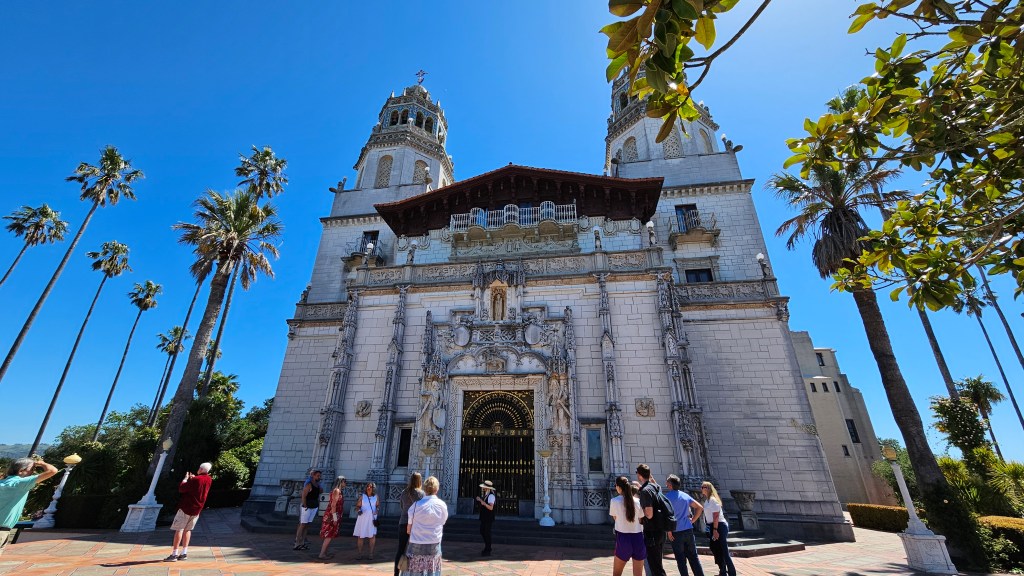
This is only partially the result, the grand entrance of the house:

The entrance gate once belonged to a convent and the gold is real.

We actually started our tour by getting on a bus at the visitor center, and rode up through verdant countryside and around the hill before arriving at the mansion. As we rode, we were given taped introduction to the castle narrated by none other than the lately departed Alex Trebek from Jeopardy. When we first arrived, we walked through gorgeous gardens, our tour guide giving us a lot of information as we went.

In the right corner of the above picture is one of the guest houses. There are three at Hearst castle, and another is shown below. There is a tour just to visit the guest houses at Hearst, which would all be worth seeing in their own right.

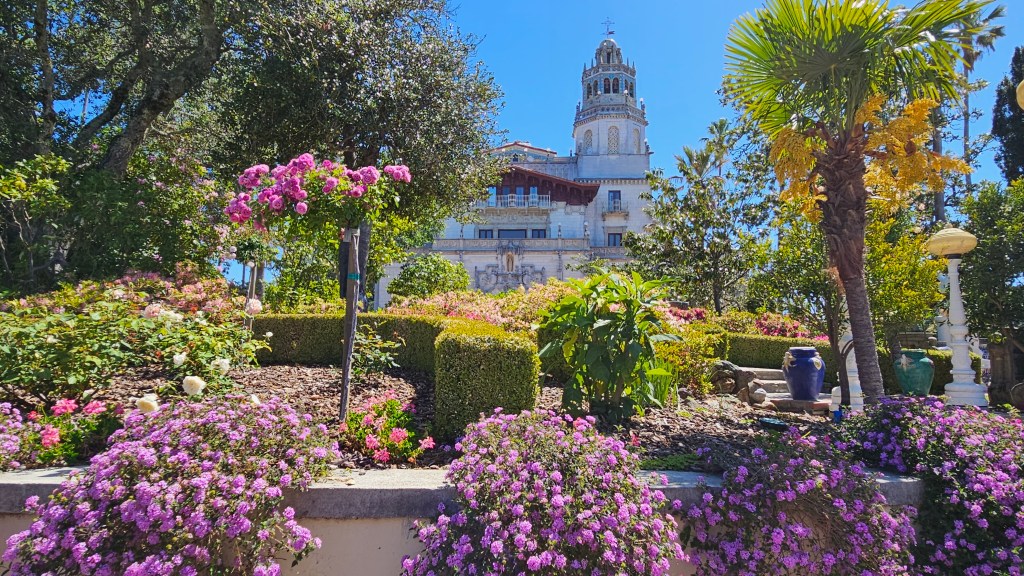
Soon, views of the main house began to peek out at us. At the time, I didn’t really know if it was the house or something like a private chapel!

We saw a video about Hearst’s life in the visitors center after our tour. In 1873, his mother wanted to educate him on the finer things of life and took him on the grand tour of Europe when he was only 10. I loved seeing this as they showed many of the places that I have also seen. This trip affected him as much as it did me over one hundred years later. I don’t have a fortune to purchase all of the pieces of castles, monasteries, and other antiquities that he did, though.

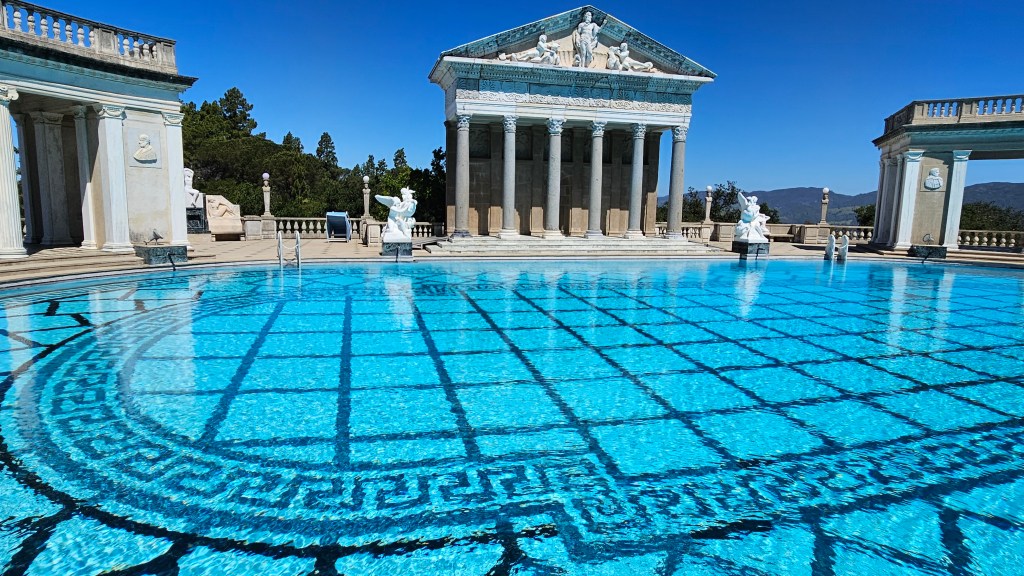
Those pieces are what Julia Morgan incorporated into the design of Hearst Castle. The top of the structure by the pool is from ancient Rome, and was Julia’s inspiration for creating the Neptune Pool. An artist by the name of Charles Cassou created the statuary.

The first room we entered upon going through the golden gates is the assembly room, which would be a living room to you and me. Guests would gather here for conversation and cocktails before dinner. One of the things you see here, just to give an idea of the treasures Hearst amassed, is an 18th century monastery chant book on the table that is so large that it has wheels:

Tapestries hanging in this room are the remaining four of a set of ten that are 500 years old and depict the defeat of Hannibal.

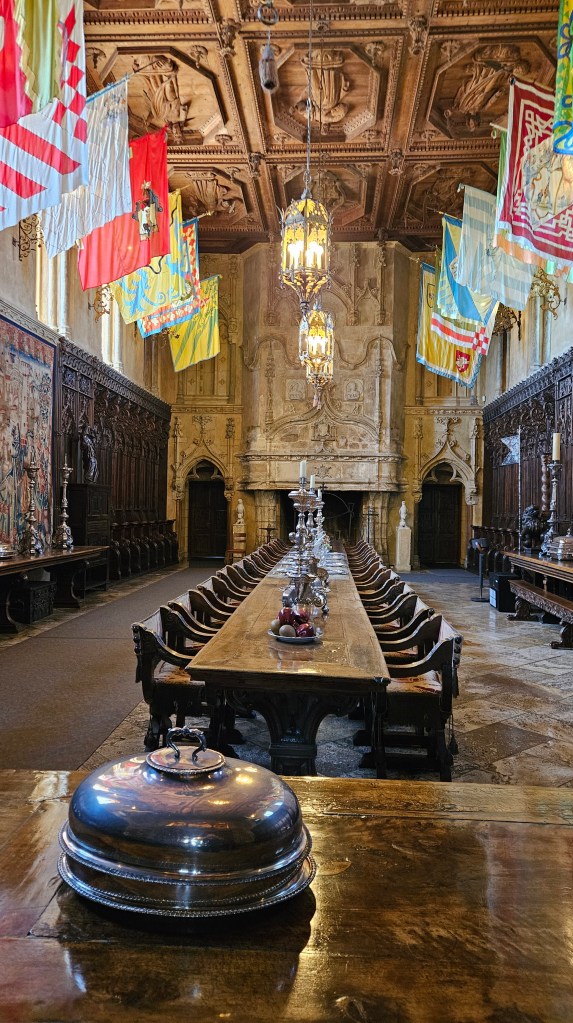
The dining room is done in Gothic style. It reminded me of the dining room at Hogwarts Castle, if you are a Harry Potter fan.

It was here that our guide mentioned that Hearst wanted to give the visitor a taste of the art and architecture of Europe without traveling there. He and Julia nailed it. Every piece was exquisite, had history to tell, and was wonderfully incorporated with the work of artists and designers of the day. At the same time, though, I wondered if some of this stuff shouldn’t have stayed back in a museum in Europe, where it originally came from. Times were different back in the early 20th century.

A passageway like any you’d find in a European castle
Tapestry and tiles in the billiard room

If it was too cold or rainy to swim in the pool outside, you could always swim in the indoor Roman pool. It’s styled like an ancient Roman bath, with heated water. There are eight statues of Roman gods and goddesses, created by an Italian sculptor in the 1930’s.

We sat in the theatre, where Hearst would show movies to his guests. One of those was Clark Gable, who watched the movie Gone With the Wind which he himself starred in. Hearst would also film his guests having fun at the castle, and we watched some clips of those.

Among Hearst’s guests were politicians such as Winston Churchill and Calvin Coolidge, and folks from the entertainment industry: Charlie Chaplin, Gary Cooper, Greta Garbo, Carole Lombard, and Harpo Max, to name a few. Other guests were Howard Hughes and George Bernard Shaw. Some I recognized in the black and white film clips but most I did not.

There were also tennis courts and horses for riding. There was once even the world’s largest private zoo. We could see the bear pits as we rode up to the castle. All of this opulence comes at a cost, however. Hearst spent prodigiously not only on this property but also on other ones that he owned, eventually bankrupting himself. The animals were sold off to pay debts, but zebras can still be seen mingling with cattle herds on the hills around the castle. I had hoped to see them, but we did not on this day.

Both our tour guide and a couple of folks in the visitor center told us not to miss seeing the elephant seals at Elephant Seal Beach, just a short drive further up the Pacific Coast Highway. So after leaving the castle we had a late tailgate lunch overlooking the beach, and then walked over to see the seal rookery.

This is the Piedras Blancas colony of elephant seals, which number about 25,000. They are never all here at the same time, and they only come up on shore for only four or five weeks. The ones that we saw were adult females as well as juveniles that had been out at sea all winter. They were shedding old skin and hair while growing a new one.

This was truly an unforgettable sight, and a superb finish to this day.

Next time – back east to the national parks

USTravel

The Pacific Coast near San Luis Obispo, CA

Before I came to the San Luis Obispo area, I knew nothing about what there is to see or do. Somewhere in the back of my mind, though, I’d heard of Morro Rock, which sits in the ocean about ten miles away from where we were staying at Camp San Luis Obispo. That was where we headed for another look at the Pacific Coast.

At Morro Bay State Park we received our first view of the bay. At the visitors center there is also the small Museum of Natural History. We admired the views, and this statue, while we waited for it to open up.

“Seasons Come and Seasons Go”

Interestingly, the state park was once a country club, opened just a few months before the stock market crash of 1929. The state of California purchased it not too long afterward, and the Civilian Conservation Corps of the 1930’s transformed it into the park that it is today.

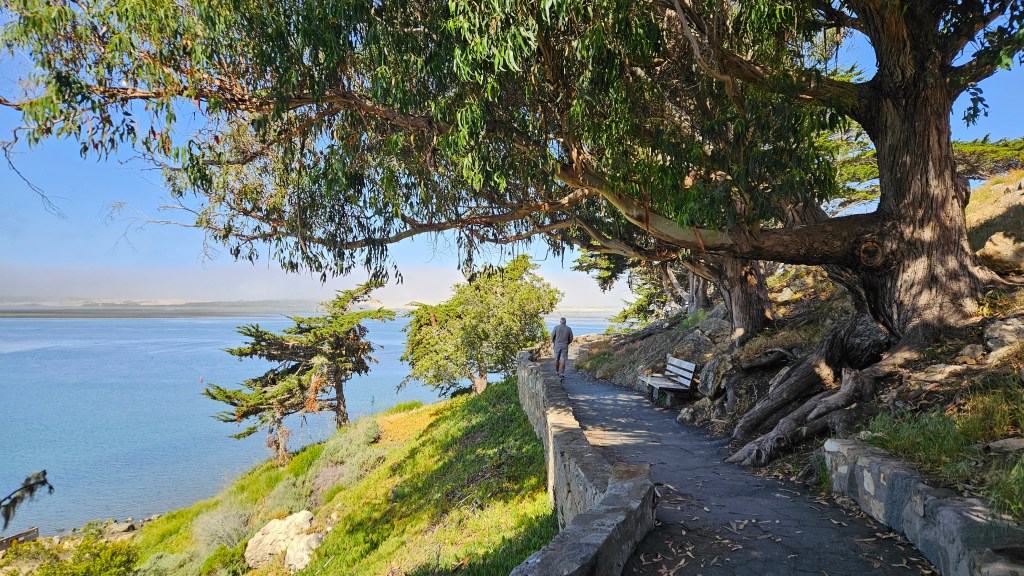
Enjoying a short hike on one of the CCC’s rock-lined trails

Down below this point, there is a marina and the Moro Estuary National Preserve. We took another little hike on its boardwalk, but there weren’t too many bird sightings for us on this day.

Looking over the bay from the estuary, you can just see the CCC trail.

Back in the truck again, we drove through the town of Morro Bay–

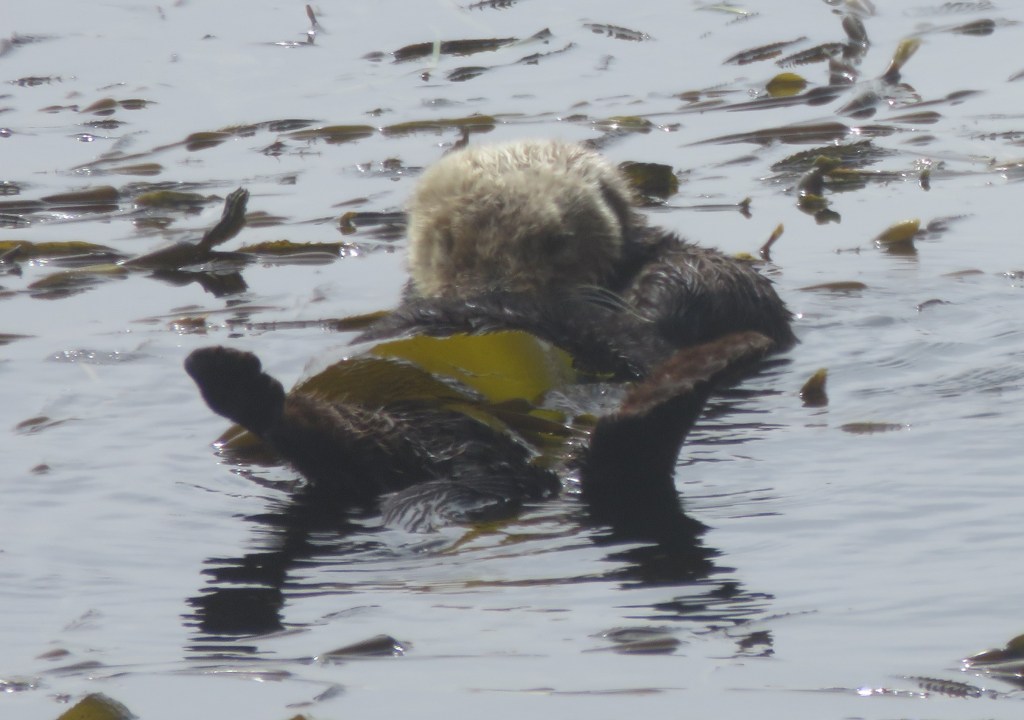
–and out to Morro Rock Beach. Here was a surprise – sea otters! I had never seen so many in their natural habitat.

Meanwhile, the ground squirrels were everywhere, trying to wrest food from the tourists and entertaining us with their Chip-and-Dale-style antics.

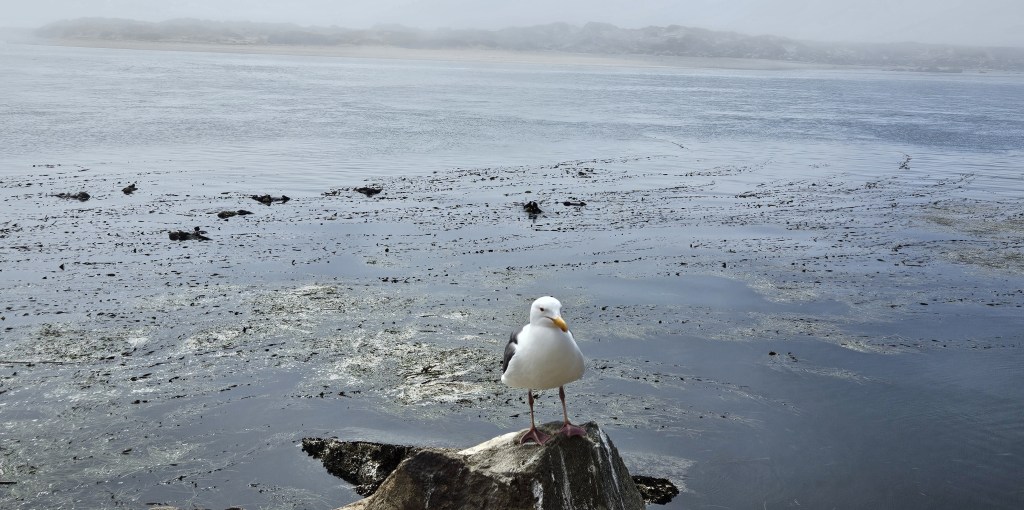
The dunes beyond the water were lost in a marine layer that had settled over everything.

And still we wondered…”where’s the rock?”

We hiked out to the end of the beach, where it turns into impassable huge boulders. We studied a park map. And then we realized…it was right next to us! It had been shrouded in the dense fog all morning.

Cal walking on the beach trail right next to Morro Rock

Morro Rock is a volcanic plug, which means that it was created from magma inside a vent on an active volcano 23 million years ago. The rock was quarried from the late 1800’s until as late as 1969, when it was declared a California Historical Landmark. Today, even just climbing on it is not allowed.

We received a better look at the whole rock the next day as we were driving up the coast. On this day there was no marine layer.

Morro Rock – we had been on the other side of it the day before.

We had lunch at a restaurant on the dock from where I’d taken the picture of the town of Morro Bay. Our server said that on days when the marine layer is heavy, the main question that he gets is “Where’s the rock?”

Morro Bay lies to the west of San Luis Obispo. Just south of the town is Montana de Oro State Park, and there the coastline takes a turn eastward. The other two beaches we visited here lay to the south of us.

Our stay happened to coincide with Mother’s Day. When we are not far from the ocean, this Mother wants to eat seafood. Even though I’d had excellent clam chowder and grilled fish at Morro Bay, another chance for seafood was not an opportunity to pass up.

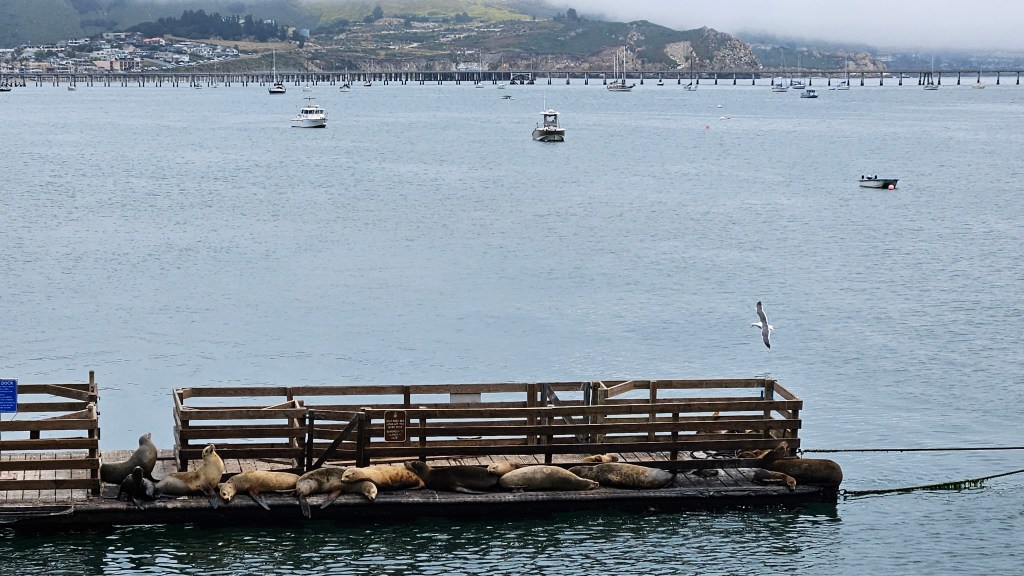
Mersea Restaurant sits at the end of a long pier on Avila Beach. As we walked down the pier, I was delighted to see seals in the water.

The seals at Avila Beach

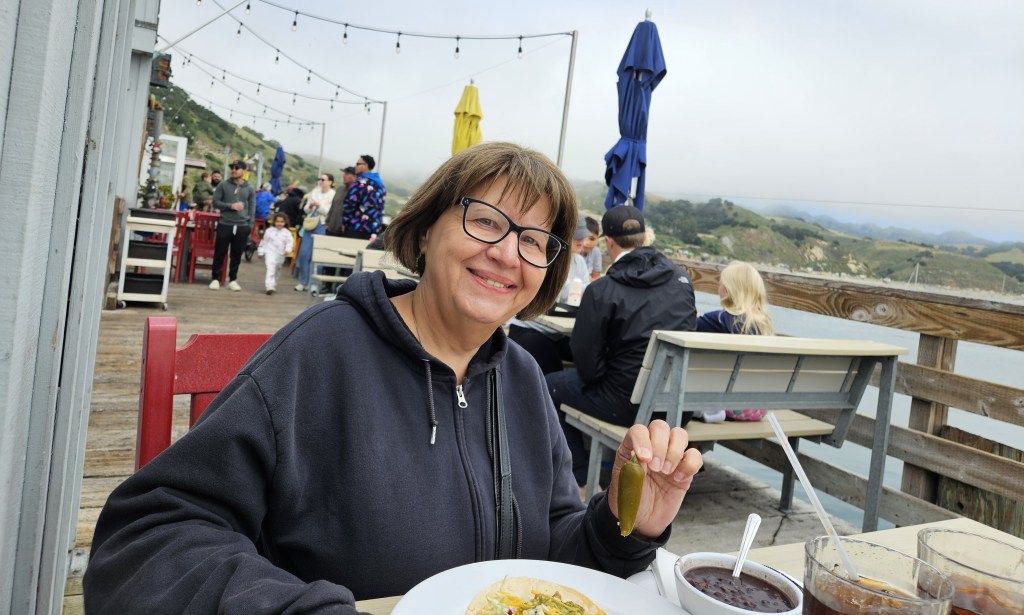
The seals were swimming below us as I had my excellent lunch of fish tacos. This picture didn’t quite capture my whole lunch, but you can see I that I would have shared my jalapeno with anyone who wanted it. This made a perfect, although a little chilly, setting for a Mother’s Day meal.

I looked nice for Mother’s Day, really. We had been to church earlier. My pretty clothes were all under that toasty warm sweat jacket!

From the pier, we could see Avila Beach has a small sandy beach. We also admired an RV park going up the hill, and another one alongside the water. But otherwise, it seemed more like a place for the locals. Certainly fine by us.

Tools of the trade on the Avila Beach pier
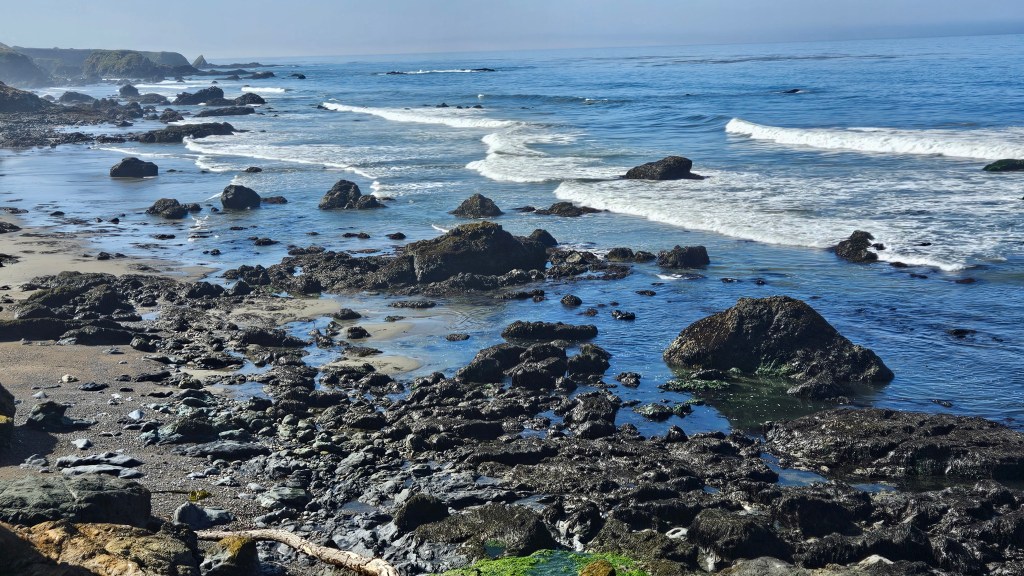
The beautiful green Pacific coastline

Pismo Beach is just down the road from Avila Beach and seems to be the greater attraction for families and tourists. On this Mother’s Day, parents huddled on lawn chairs and under blankets and canopies while the children chased the waves. It was a happening place.

As we walked on the sandy beach, there were many small blue jellyfish that had washed up, as well as several purple sand dollars. I have learned that the purple ones are still alive, so when I can I throw them back into the water.

There’s a boardwalk at Pismo Beach, as well as hotels, restaurants and shops.

You wouldn’t know it, but away from the beach it was a clear sunny day. You can see the blue sky behind the hills in the picture above. On this day, the marine layer later crept in almost all the way in to where we were staying.

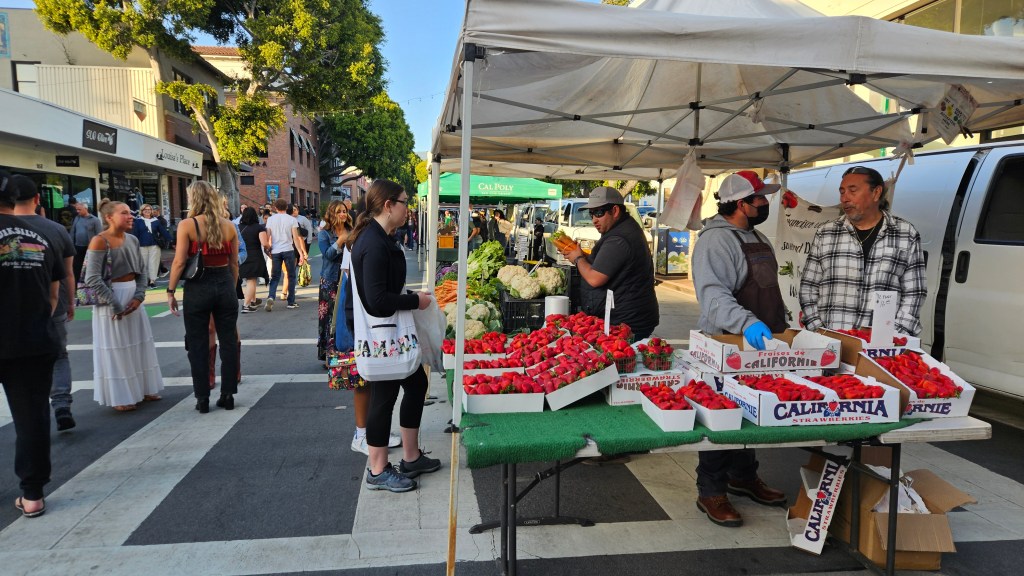
San Luis Obispo is a college town. Cal Poly (officially: California Polytechnic State University) is here, and so is Cuesta College. As we drove to the pretty tree-lined downtown area, students were everywhere walking or riding bikes with backpacks and iced coffees in hand. The streets close every Thursday night for the Downtown SLO Farmers Market. The students queued up for all the places that were serving food, met and chatted in groups, and shopped at the crafter’s tents.

At the market, we realized that in the nearby Central Valley, strawberries were in season. There were tables heaped with them. We bought some at the market and they were a sweet, delectable opposite of the strawberries that you buy in the grocery store.

Our time here was short, and I would have loved to explore more of the town and what there may have been to see away from the beaches. Certainly, with more time, I would have gone to Paso Robles and done some wine tasting. But we had one more place to see, which in actuality was the whole reason why we were here at all.

Next time–we visit a castle

USTravel

Amargosa Valley and Longstreet RV

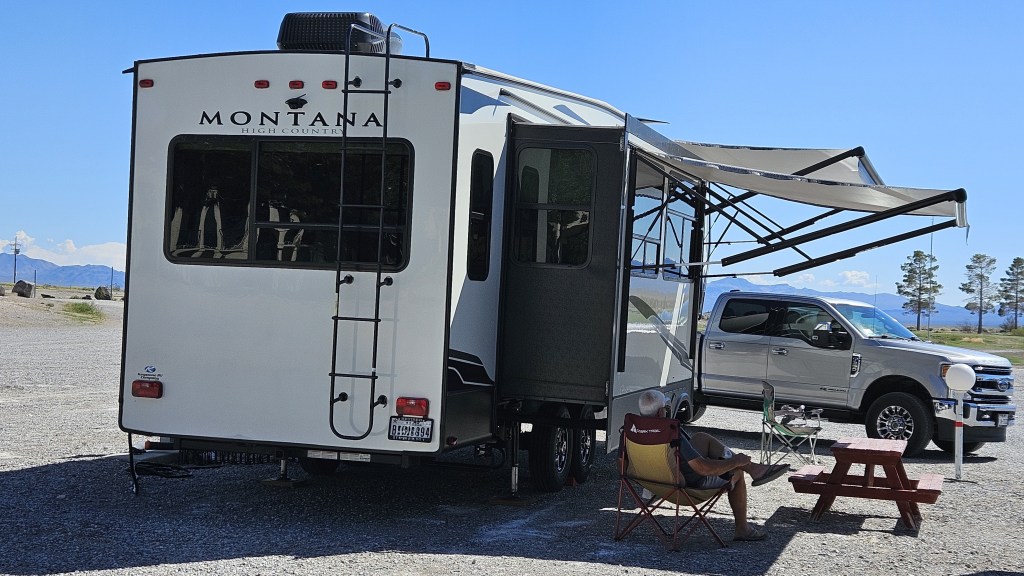
Anywhere that we put our slides, awning and lawn chairs out is home – for a few days, anyway

By the words and pictures of my blog, it may look like Cal and I are always running around from here to there and seeing everything there is to see. That’s not exactly true. There are stretches of time where we are just living life, same as everyone.

It’s not often that I write about one single RV stay, but that will be what this post is about. And the question is, what makes a perfect place to park our RV?

When we started out RV’ing, the answer was simple. A state park or Corps of Engineers park, out in nature, with full hookups, or at least with water and electricity is a must. Then, a nice level spot with lots of shade, and preferably not in close sight of our neighbors. Places to walk are also important. These sorts of places weren’t hard to find where we lived in Missouri. But we’ve only been in Missouri once in the past three years of full time RVing.

The RV park for Death Valley was full before I could even blink. Of course there weren’t any state parks nearby, and not even many commercial parks to choose from within spitting distance of the park. That led me to “Longstreet Hotel Casino and RV Resort”. This was a novel idea. The pictures looked good, reviews okay. I’ve long ago learned to take the “Resort” part of an RV park with a grain of salt. We would be in Death Valley for a good part of the time, anyway.

The building only has two stories, and the RV “resort” was around back. The gentleman at the desk assigned us a site and said we could move if we didn’t like it. That is a rare offer.

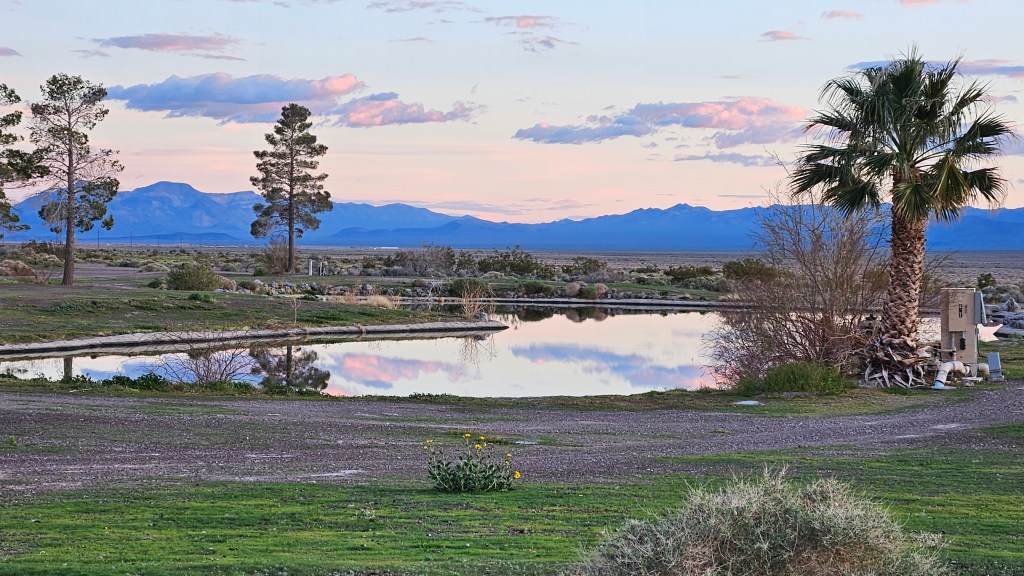
The casino is out in the middle of nowhere, and this was the view out our window. For our first two days, there were RV’s in these sites with ATV’s parked next to each. If I had my druthers, we would have moved, preferring instead to have been in the first row facing the mountains. Cal was happy with the site, though, so we stayed. It was interesting watching the ATV’ers head out for jaunts into the desert; after two days, they were gone. No one ever moved into these sites again, leaving us with a perfect view.

We thought maybe the green space might have been a golf course at one time, and the pond a part of it.

On our first evening we took a long walk down a narrow gravel road leading straight into the desert and alongside the mountain. There is no cacti here, just sagebrush and scrub.

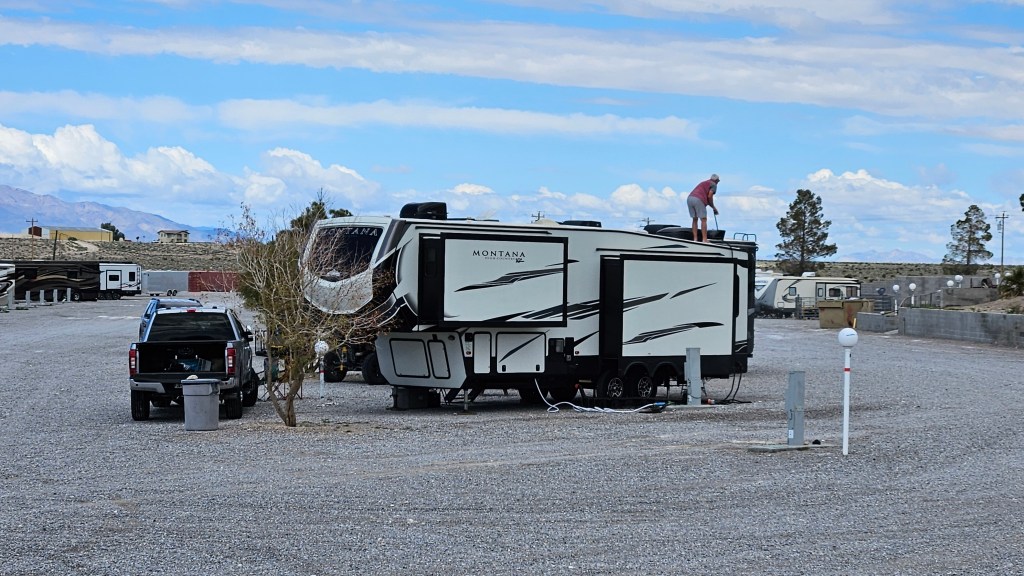
We put a rest day in between each of our visits to the park. Those days had long miles in them, both for the truck and on our feet. At home, we caught up on chores, all the stuff one normally does in life. Here, Cal is attending to something on the roof. All we had here was a gravel spot in a parking lot. It was nice that the park was always less than half full.

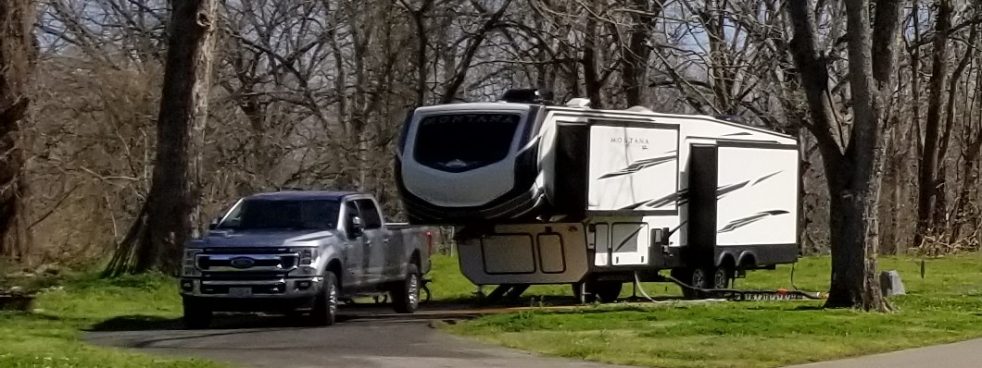
Someone was in that site next to us only one or two nights. On the other side, there was another 5th wheel with a gentleman who left for work early every morning and went inside his RV when he came home.

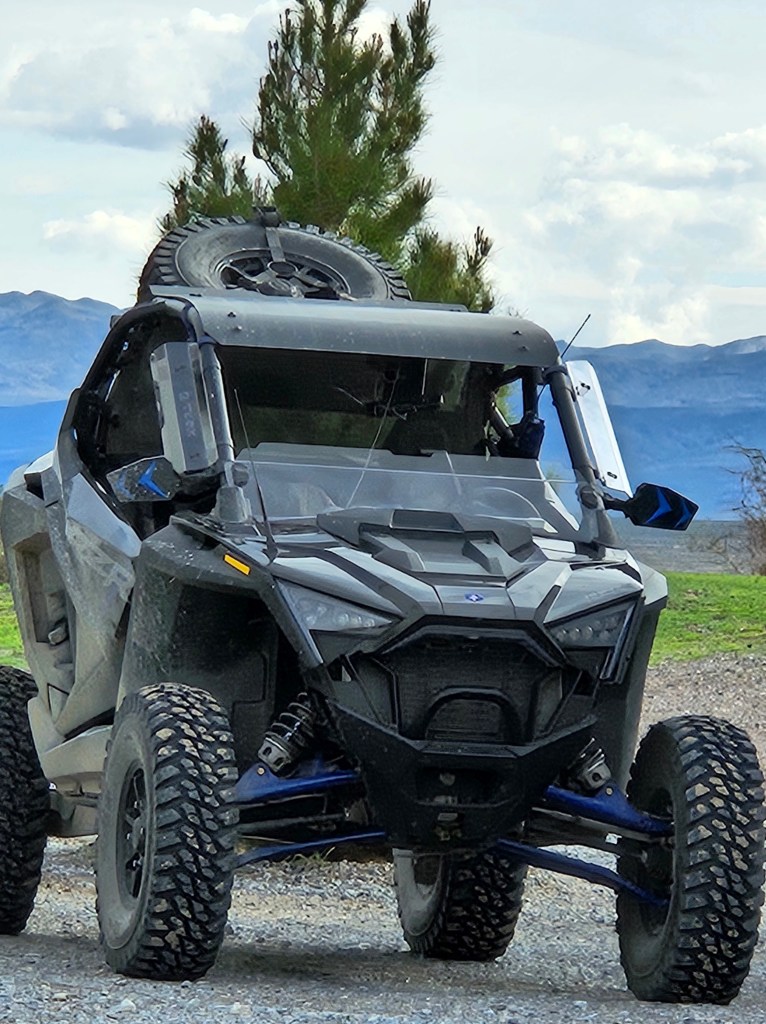
Cal was really impressed with his ATV.

On our “off days”, when I needed to stretch my legs, I could walk out to California. And then, back again to Nevada.

The wildflowers were just starting to come out. How can they grow in the harsh desert terrain?

The inside of the casino is typical of many casinos. Longstreet has a gaming floor, an area with couches, a restaurant, a convenience store, and a bar. With the exception of the store, everything is in one big room. A country band played on the weekends. I thought I’d be tempted to eat in the restaurant more than we did but we only had one lunch there. It was a rare treat to just walk over from the RV.

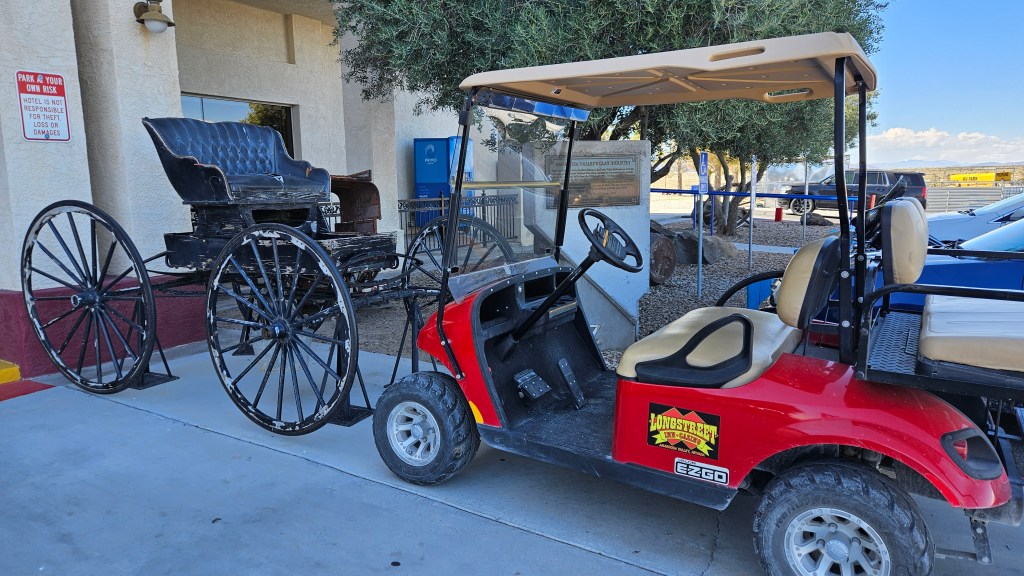
Walking around the building, there were many things to see. I could admire the old conveyances out front.

The old with the new

There is a petting zoo, with animals that mostly didn’t want to be petted. The zoo also includes a bull, a goat and a sheep.

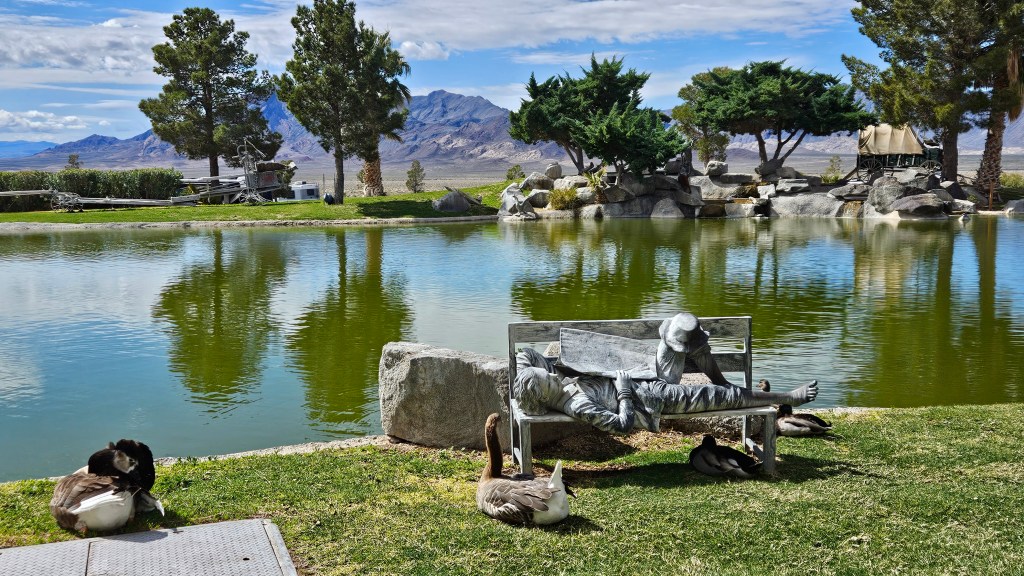
The back rooms to the hotel had patios and balconies which looked out onto another pond. This one is nicely landscaped and there are sculptures and many interesting artifacts set out to look at. This pair of geese would fly from one pond to the other daily, honking along the way for good measure.

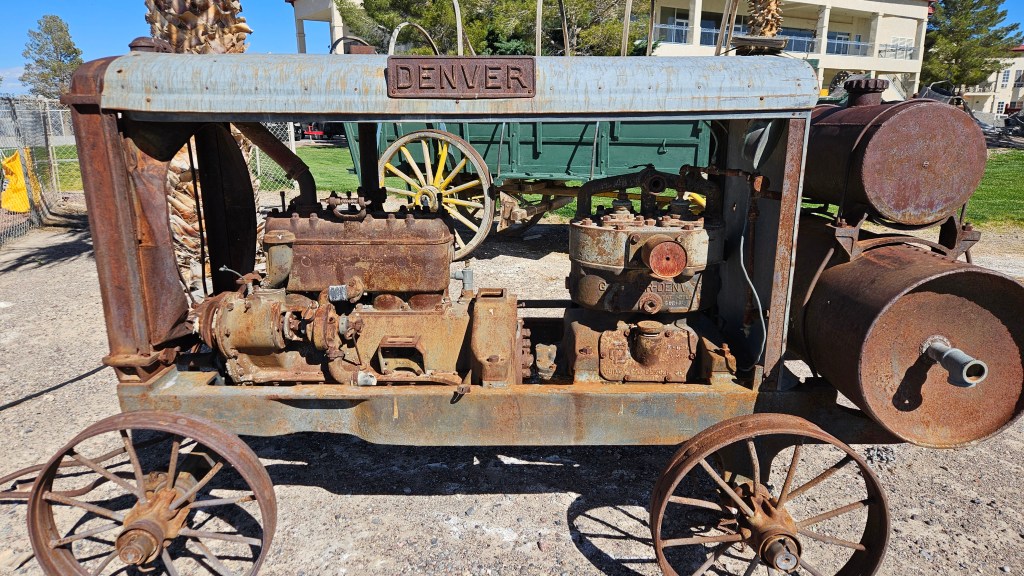
I’m not sure what this is, but I liked that it said “Denver”.

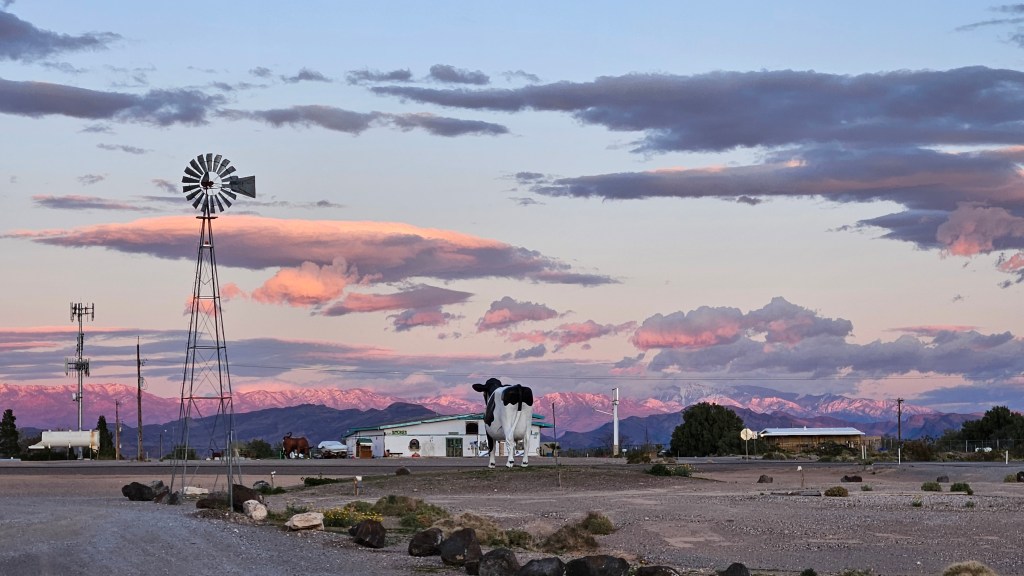
When the sun started to set, we would put our lawn chairs out on the (not) golf course, and watch the mountains turn red. We would puzzle over why the owner thought he needed the enormous cow out front, and where it may have come from. And, of course, we could ponder the meaning of life and let ourselves be swallowed up into the silence.

So, back to what makes a perfect RV spot?

The road has shown us that there is no one simple answer. The spot that we are initially disappointed in may reveal its secrets to us later. It could be the friendly folks at the park or some fun events that they held, a great trail to walk on, an interesting neighbor to hang out with, or a resident cat. We don’t tend to use a lot of the amenities that parks like to advertise.

A concrete pad here might have been nice, but gravel is the way of the desert. No, Longstreet wasn’t perfect. Only a select few sites have ever won that title for us. Longstreet did, however, score points with both of us for 1) the view into the desert, 2) lots of delightful places for me to walk and get my steps in, 3) a slight quirkiness with all the various little things to see, and 4) being quiet and peaceful.

In the end, we can’t ask for too much more.

When we passed our first night in San Diego, I was very excited to put a California sticker on my map. And then, in Boulder City, I could add the one for Nevada. It had been almost two years since we’d been able to add new stickers. You can see that we have covered the Southwest. Which state will be next? Even we, the Twosna Travelers, don’t have the answer to that question at present.

Next time – It’s Vegas, baby!

USTravel

Yuma, Arizona – What’s in Your Salad Bowl?

When we arrived in Yuma, trucks were suddenly everywhere. Several were lined up at an intersection, we were following one or two more, and we thought perhaps our next RV stay was going to be in an industrial park. Happily, not so. But what was up with these trucks?

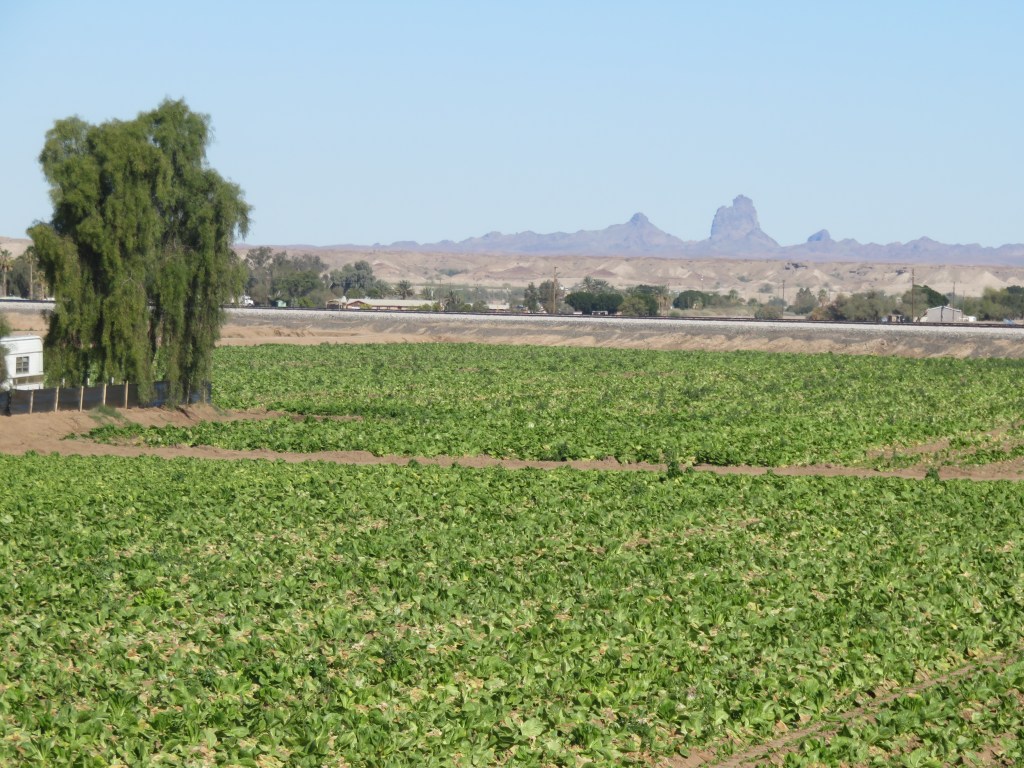
It wasn’t long before we figured it out: lettuce! Most of the lettuce you’ve been eating this winter comes from Yuma. We’d follow trucks filled with boxes of romaine and iceberg lettuce. We saw fields of broccoli and cauliflower too. The fields are fertile, the weather warm, and there is an ample supply of pickers just over the border in Mexico. Dole and Sunkist are major employers.

During our first days in the town, we visited the Yuma Territorial Prison State Historic Park. It is the main tourist attraction in this town and a very interesting place. It dates back to the days before Arizona was a state.

The guard house at Yuma Territorial Prison

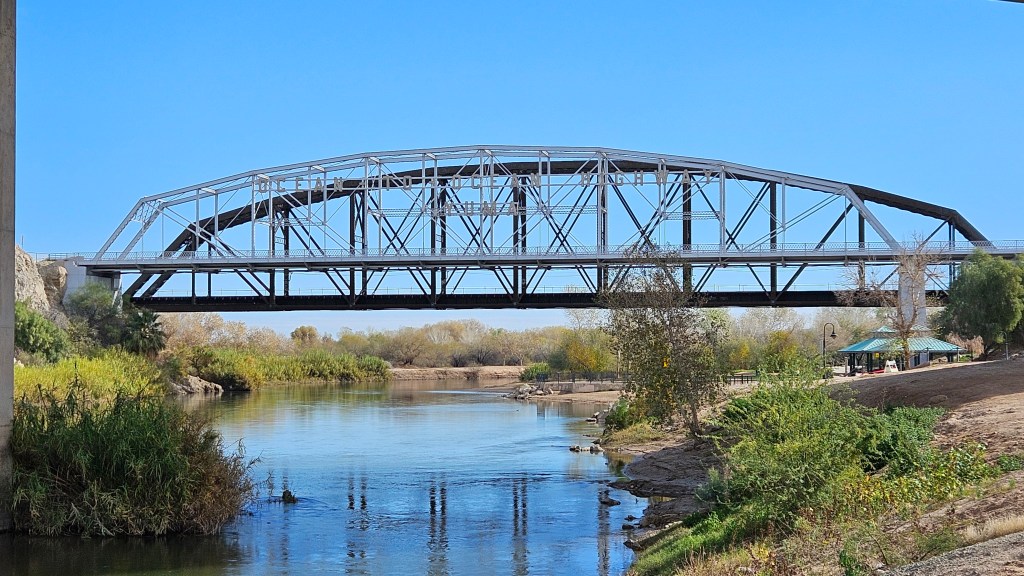
A few days later, we saw the prison again from the bike trail, which runs for three and a half miles along the Colorado River. On the bike trail, we were able to see the Ocean to Ocean Highway Bridge. It was built in 1915 and was the last link in the “new” interstate highway system. Previously, a ferry shuttled travelers across the river. Now it is only used for local traffic and a massive highway bridge serves for drivers on I-8.

The Colorado River had been dammed up in the early days of the city’s growth. The fertile valley and wetlands that the natives had enjoyed into prehistory was destroyed. I’m glad to see the wetlands brought back with native trees and grasses.

The bike trail wasn’t long, and eventually it went on to a country road. We rode it for some miles and eventually ended up in an iceberg lettuce field.

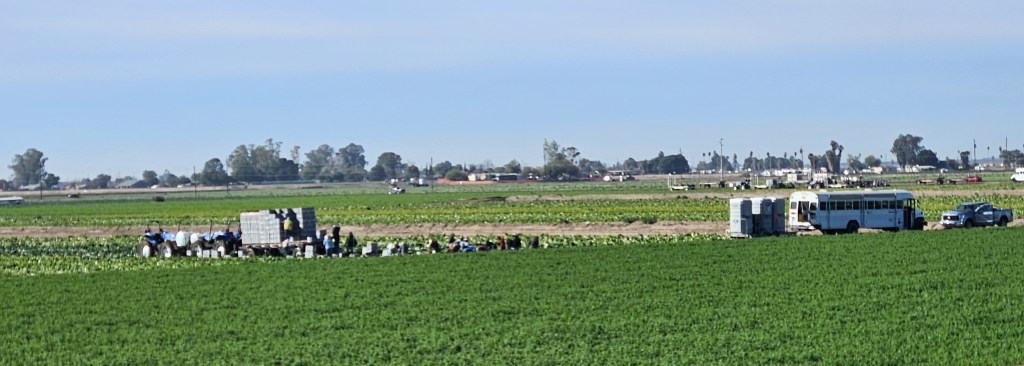
Across the road, another field was being harvested.

The bus with the porta-potties behind, which carries the pickers, is also a common sight around town.
It’s not just lettuce, though. Our RV park was miles down a country road. Getting to town, we would pass many orange and lemon groves. It seemed like they had mostly been picked earlier in the month. I took a longer-than-usual walk one afternoon and wandered through rows of lemon trees. There was a soft whisper of lemon scent in the air.
Inexplicably, there was one loaded orange tree in this orchard. Is anyone going to come and pick them?

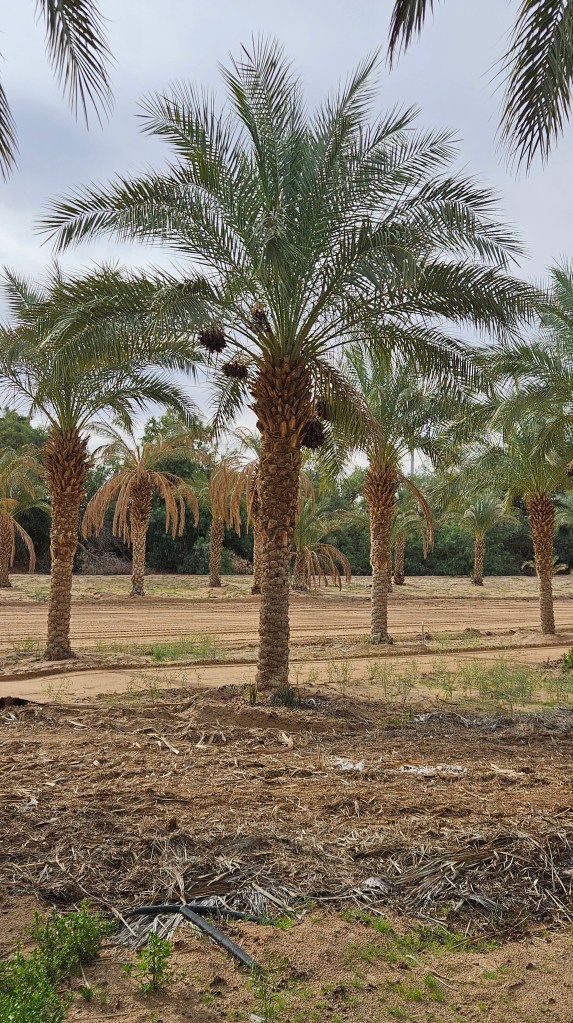
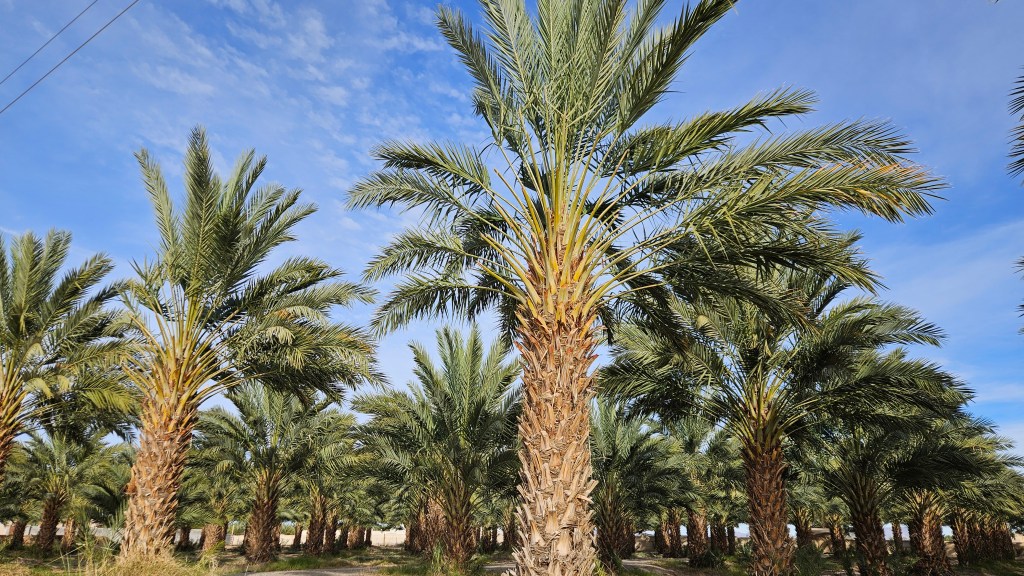
Dates are also grown in Yuma. It’s not the season for harvesting dates so I’m not sure how it is that this palm tree has some hanging down. But I wouldn’t know; we tried unsuccessfully twice to tour Martha’s Gardens Date Farm. If you ever show up there, know that they do not do tours on Monday, even though they are open.

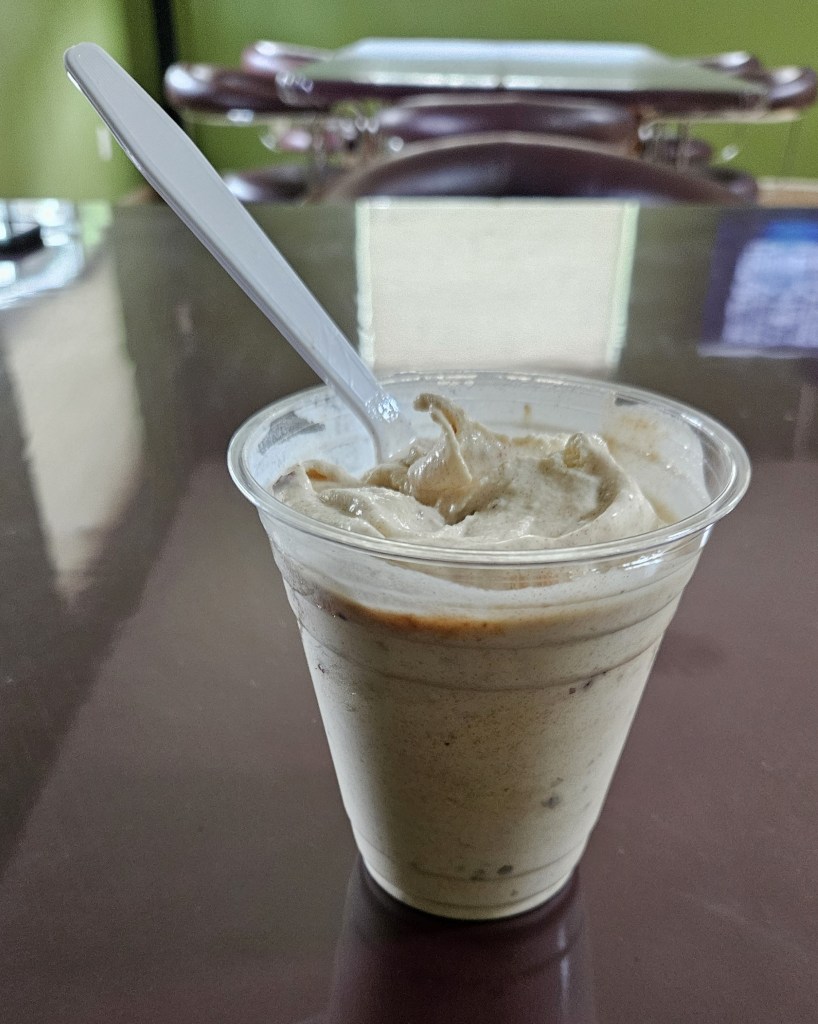
We settled for a date shake in their little cafe while watching a video about the farm. It was delicious!

If we had toured the farm, I was hoping to find out why there are groves of palm trees planted in many areas around Yuma. It’s still a mystery to me.

A crop of something we couldn’t identify was being newly grown in the fields behind our RV, with green shoots just peeking out of the ground. The irrigator made for some great sunset pictures.

Yuma has a huge winter snowbird population. I wanted to see what it was all about, and the produce production was pretty interesting aspect of our stay. I’m not sure that I would want to stay much longer than the two weeks that we were here, though. Many RVers have their special winter spot, but we are still looking for ours!

Next time – moving further west to the big city!