I had two goals in visiting Bavaria: to be in the Alps, and to see things we hadn’t seen before. The first goal failed, since Feldafing isn’t in the Alps, but the second goal? Scored!

Feldafing, being situated on the shores of the Starnberger See, rises up along steep bluffs. We were buried deep in a subdivision and every trip into town meant walking up or down a hill. Postwar, it had the first all-Jewish displaced persons camp, and hosted a large community of survivors. It also has pretty little Roseninsel (Rose Island), the only island on the Starnberger See.
We rode a quaint little boat out to the island. From here, the Alps can be seen in the distance.

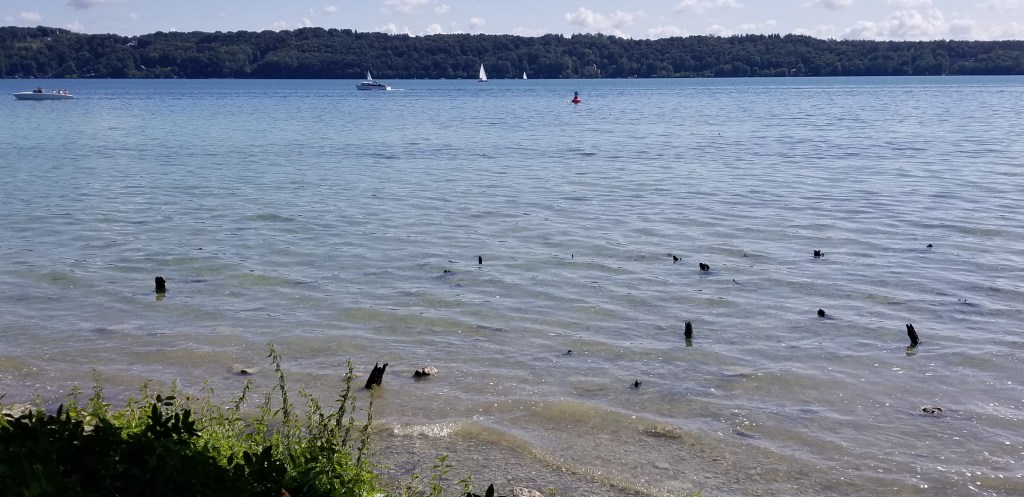
In the water just off the shoreline are Iron-Age timbers, dating from the 6th to the 4th century BC. It is evidence of the only known pre-historic lakeshore settlement of pile dwellings in Bavaria and has been designated a UNESCO World Heritage site. They are sticking up from the water in the picture below, with the framing unseen underwater. It’s unbelievable that this has been there all this time!
The thing to see on Roseninsel, though, is the beautiful casino. No, you can’t gamble here. The early definition of a casino is a small villa in the Italian style. It was commissioned by King Ludwig II’s father, but he was attached to it and made many renovations. A frequent guest was a relative, the Empress of Austria Elisabeth, nicknamed “Sissi”. King Ludwig also met here with Richard Wagner, a composer. It must have been a restful place for them.

It includes a beautiful garden, although the blooms were already finished for the year.

We took a tour of the house, but it is empty of furnishings.
It was time for a late lunch by the time we were back from Roseninsel, but since it was Sunday, our grocery store (and everything else in town) was closed. We walked along the shoreline to a bustling lakefront restaurant that had a special deal. How about some “steckerlfisch”?

Although this is supposed to be a treat in these parts, we passed on it in favor of other traditional German food.
Our AirBnb was billed as a small cottage, and although it felt like that, it was attached to a main home by a narrow hallway. Everything about it was very private, even our small patio in the back with its relaxing little pond. When he was home, our accomodating host turned on the fountain and I loved the sound of the flowing water. His name is Martin and he was the very first Airbnb host we’d met to date.
We had asked Martin for some hiking tips, and he had an excellent idea for us. Rain threatened but we set off anyway, out the other end of our subdivision and into the woods. We came to an open meadow, and there was the most gorgeous house:

Martin had told us that if we found it, we were going the right way. He’s not native to Feldafing and he could not tell us anything about it, and a search on line yielded no results. I could imagine it was built for some lower branch of the royal family.
My active imagination was working as we followed the path around behind the house and directly to the next town, Tutzing. We passed a half-buried moss-covered stone marker, so I conjectured that we were on an old road. I imagined royal guests coming to visit the yellow manor house, the women in long flowing velvet capes, galloping down the path on horses after riding the train from Tutzing.
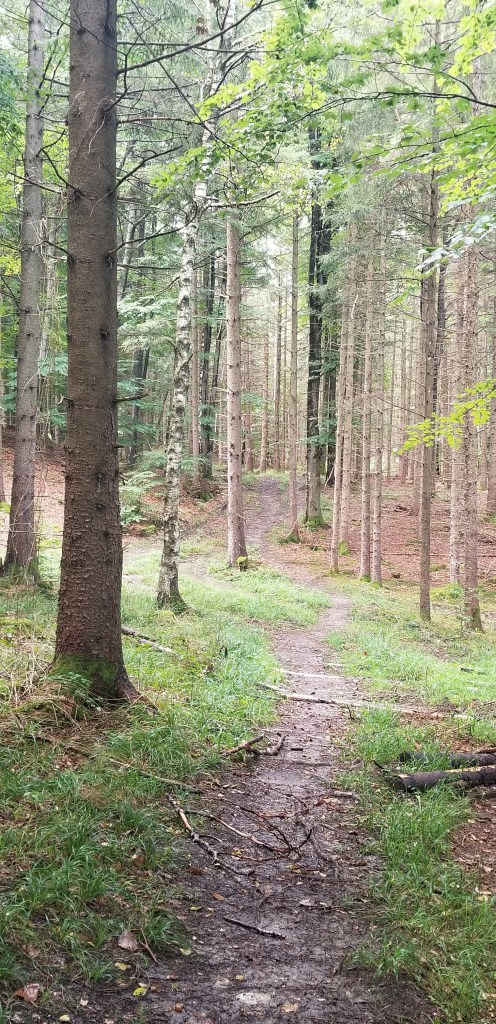
The trail did take us to the train station, but we decided to ride a bus home. We were overjoyed to discover it was coming soon and would let us off almost directly across from our house, with no final hike up a hill for our tired feet!
I had heard of Andechs Monastery, where the monks make beer, but it took me a few days to work out how to get there. This involved a train ride back to Tutzing and then a different bus through the countryside.

Andechs, a Benedictine monastery is on a “holy hill” and was built in 1455. Pilgrims have been coming here since the 11th century, though, to see relics from the Third Crusade; most notably, a piece of Jesus’ crown of thorns. We admired the ornate architecture inside the church and this sundial on the bell tower.

Today, thirteen monks live here, and two hundred people call this their place of employment. Maybe the monks made their beer themselves in former days, but now it takes a lot of folks to produce it and run a large beer garden and restaurant.
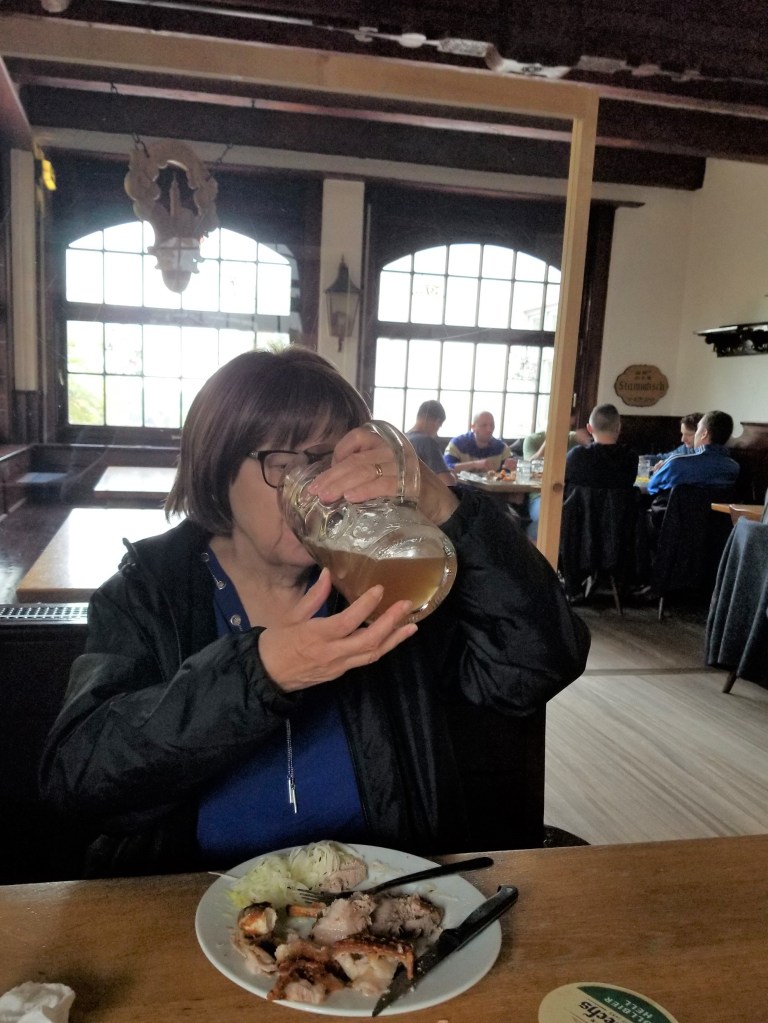
After we explored the monastery grounds, it was time for the second part of this excursion: lunch in the Braustuberl. The thing to order here is the “Schweine Haxen”, pork knuckles. It is so large that it’s best to share, which we did. The plate came with potato salad and a pretzel, and I also ordered the sauerkraut. The pork had a nice crispy rind, the meat was delicious, and the sauerkraut wasn’t overcooked like it is in the US.

We shared an Oktoberfest-size liter of the famous Andechs beer. Cal thought it was humorous that now I need two hands to lift one of these mugs. It’s heavy!
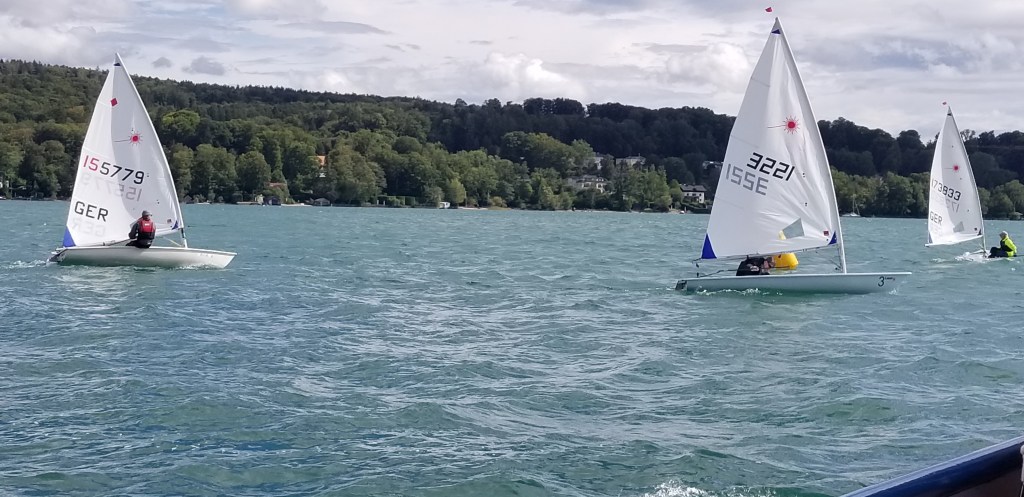
We saw excursion boats on the Starnberger See and waited for a sunny day to explore the lake. A sunny day never happened, so toward the end of our stay we finally gave up on that and just went.
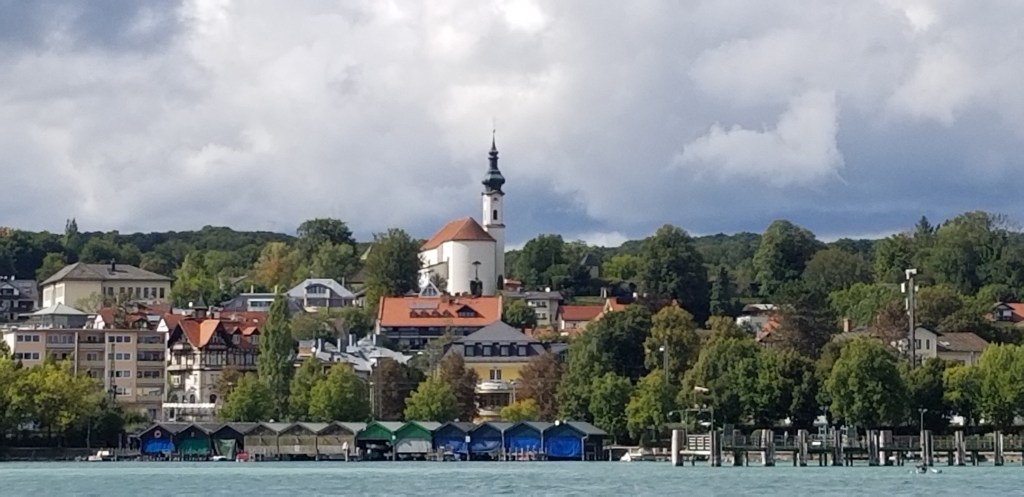
We could finally view the pretty town of Starnberg from the water.
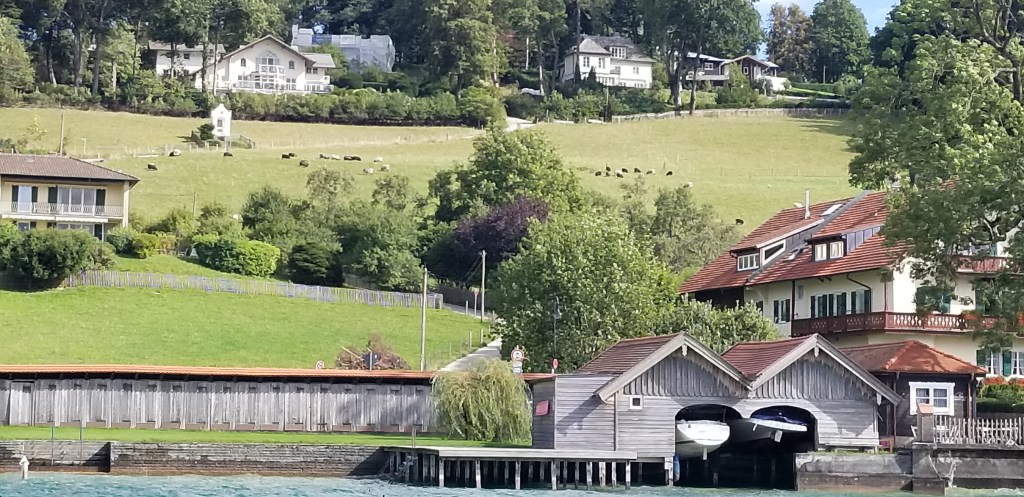
We had often passed Possenhofen Castle on our train rides to Munich, so from the water we got a better look at it. It’s privately owned.

Homes, boat shelters, and sheep grazing in the meadows all came into focus when we stopped in little towns to pick up or drop off other passengers.
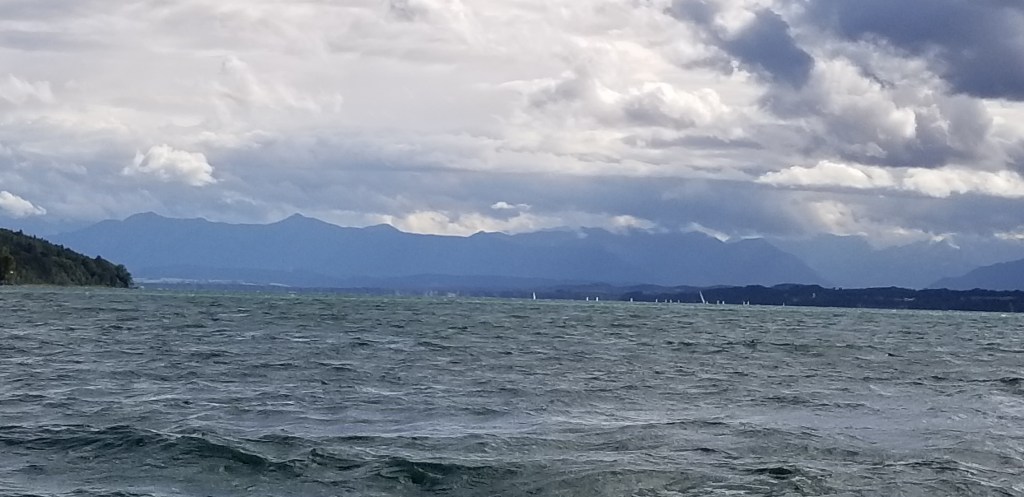
I’m always on the lookout for the Alps, even in lousy weather:
King Ludwig II, who lived from 1864 to 1886, was responsible for the existence of most of the famous Bavarian castles, including Neuschwanstein. We’ve been to all of them, some more than once, so we didn’t include them in this trip. As the years went on, King Ludwig became reclusive and his royal accountants were afraid he was draining the royal treasury in the building of the castles. This gave rise to his nickname: “Mad” King Ludwig. It was here on the shores of Lake Starnberg that he was taken into custody, and the following day both he and his doctor were found dead in the lake. It was ruled a suicide, but there has been some controversy.
I knew the story but wasn’t sure which lake. As we rode on our little cruise, we passed the spot, marked by a small cross.
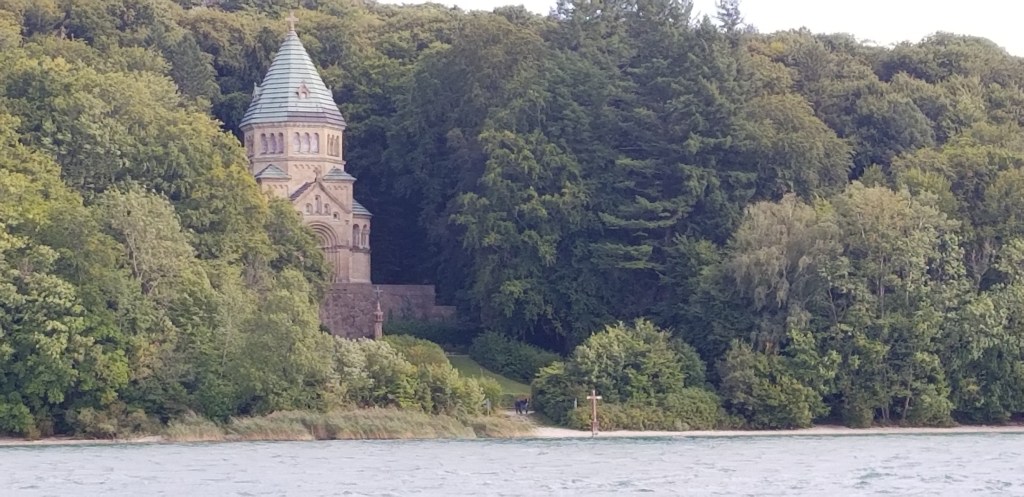
If the royal treasurers only knew how much tourist revenue the king’s castles would bring in future times, they might not have been so hard on him!
After our boat ride, ice cream was in order, but the only open cafe was full service and indoors. We sat, and there in front of me was a life-size portrait of the good King. He has a way of turning up when I least expect it.

The rest of our days in Feldafing dissolved into rainy storms. There was a day, maybe more, where we just didn’t fight the weather, choosing instead to stay indoors. Chores, further trip planning, and just mentally “catching up” have to be done on the road, too. The Queen of England had just died and on TV we watched her coffin procession move from Balmoral, Scotland to Edinburgh through all the little towns where people waited for her on the streets.
There were sunnier days ahead as we headed further south, with more surprises in store.
Next time: another new country to see
 Twosna Travels