
If you think about a battlefield in Pennsylvania, I’m sure Gettysburg comes to mind. But no, we were still near Ohiopyle, a hundred and fifty miles away to the west.
Cal wanted to get the oil changed in the truck, so on his way in to Farmington he dropped me off at Ft. Necessity National Battlefield. I wanted to get my National Park book stamped, but I also wanted to see what it was about.

I spent some time in the Visitors Center, boning up on my American history. There is a short video to watch, too. Here’s the information I gleaned: this site was the catalyst of the French-Indian-British wars that would last for about 7 years. Before the American Revolution ever started, there were trade disputes with the French to the north, British to the south, and Indians stuck in between.
In May of 1754 a group of British soldiers, led by none other than a young inexperienced George Washington, surprised some French soldiers in nearby Jumon Glen. No one knows who fired the first shot (the excellent video told both sides of the story).To add insult to injury, an Indian on the British side killed their leader. Of course, that led to more fighting on both sides that spread to a conflict that would rattle the European world for years to come, and ultimately lead to victory for the British.
After their victory at Jumon Glen, Washington saw trouble coming, and built Ft. Necessity. It has been reconstructed according to archeological finds. Coming down the trail and first seeing it, I was surprised by how tiny it was!

I was able to get a little more perspective on it by going inside. This cabin, probably Washington’s headquarters and lodging, takes up the almost whole fort.

It didn’t take long to visit. But something else had intrigued me in the Visitors Center: the story of the National Road.
George Washington’s men had had to hack through trees and brush in order to get to this natural meadow. Once the Revolution passed, people were starting to push west. There were not only settlers but also tradespeople. With the first section completed in 1811, the National Road had been established. It was the first federally financed highway.
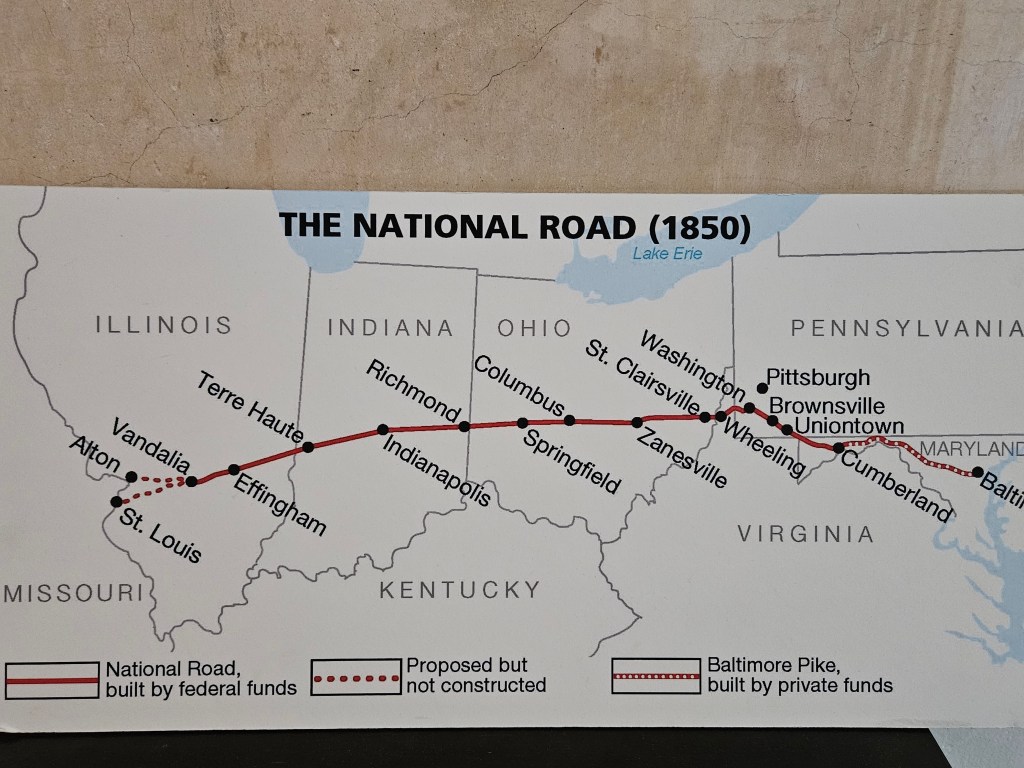
In modern times, this road has been replaced by US State Route 40. Nothing was said about Interstate 70, but it follows the same route.
Mount Washington Tavern is also part of the Ft. Necessity park. It was built in the 1830’s when traffic on the National Road was hopping. People needed sustenance, a place to stay, and a change of horses. It became a stop on the Good Intent stagecoach line.

My only picture of the outside is above, on the side, as I hiked up to it. It’s a 3-story brick structure. I sure could have used a nice cold lemonade about then, owing to the heat and the small hill I’d had to climb, but I was about 200 years too late.
The tavern was the surprise of the day. I knew nothing about it, and tried the door: open. Creeeak! Absolutely no one around. It is self-guided.
A traveler would have come into the main hall. There is a lovely parlor on the left.

Looking to the right, I could see why the parlor had been so nice: it was for women and families. The men would have congregated in the bar.

When a bell was rung, everyone came to dinner in the dining room, family-style, around one big table.
Upstairs, men and women slept in separate bedrooms. It would not have been unusual to share a bed with a stranger. If the sheets had been washed in the past few days, you were lucky.

And, I was feeling lucky that I had been born in the latter half of the 20th century. I really enjoyed this peek into the past.
Our time in Ohiopyle was sadly over. It had been a full and enjoyable couple of days, and I was sorry to move on.
More fun was ahead, though, as we moved northward on the National Road and other roads to Lake Pymatuning State Park. This lake straddles the two states of Pennsylvania and Ohio not far south of Lake Erie. We stayed on the Pennsylvania side.
Lake Pymatuning is a lake that is probably much like countless others that dot the Midwest. For me, though, it has some faded memories. When my family lived in a Cleveland suburb, we came here for camping trips in our family tent. I remember swimming with a (real) inner tube and eating tons of my mother’s pancakes, although I may not have the right park in my mind.

We arrived in a downpour. We could not remember the last time we had to set up in the rain. That showed us that our site had excellent drainage. By the next morning, all was clear.
My Dad would pile my brothers into a rented row boat for some fishing. Always a rowboat. I don’t know if motor boats were as much of a thing back then, or if he just didn’t want to pay what I’m sure would have been a higher cost. If I was really lucky, I was invited along. They would give me a little bamboo pole but I don’t remember catching anything.
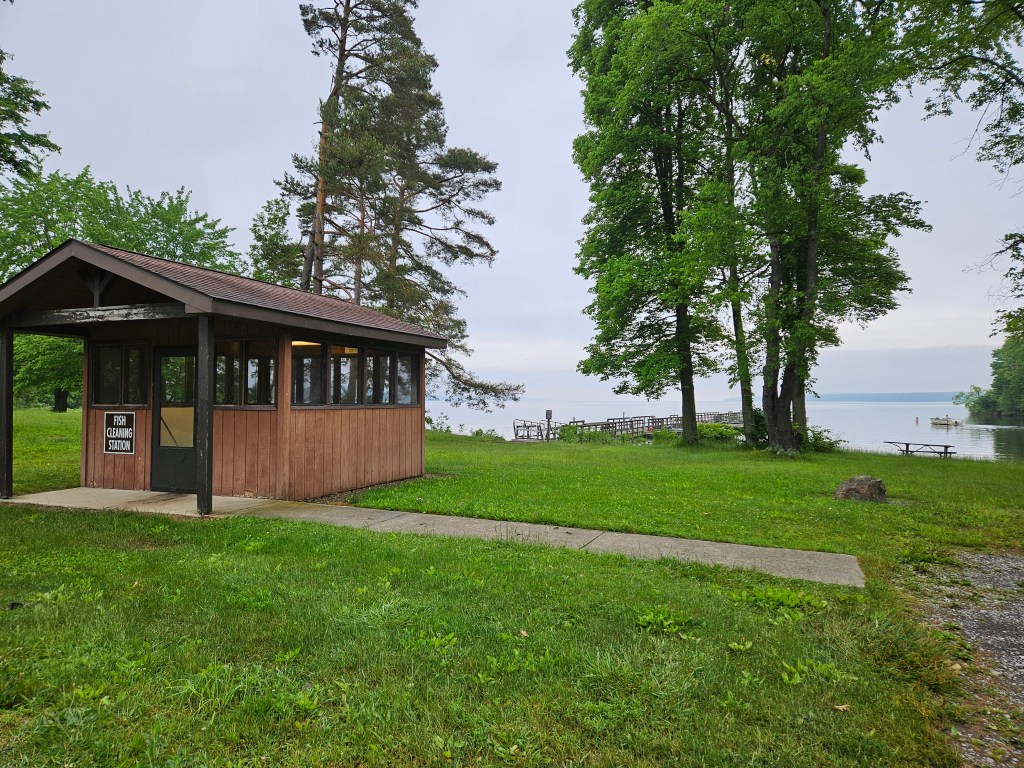
My family was strictly in the camp of eating whatever we caught. No “catch and release” for us, unless it was “just” a little sunfish. My Dad and brothers would clean the fish and my mother would fry them up for supper. What would she do if there were not enough? I don’t know, she always made plenty to eat.
There was an Amish encampment here with a lot of kids. Perhaps there was more than one family. As I walked by, they had a huge pile of bikes behind their tent. Instead of seats, though, they had skateboard platforms. I’d never seen these before. A young man unwittingly demonstrated how they work as he flew all over the campground.
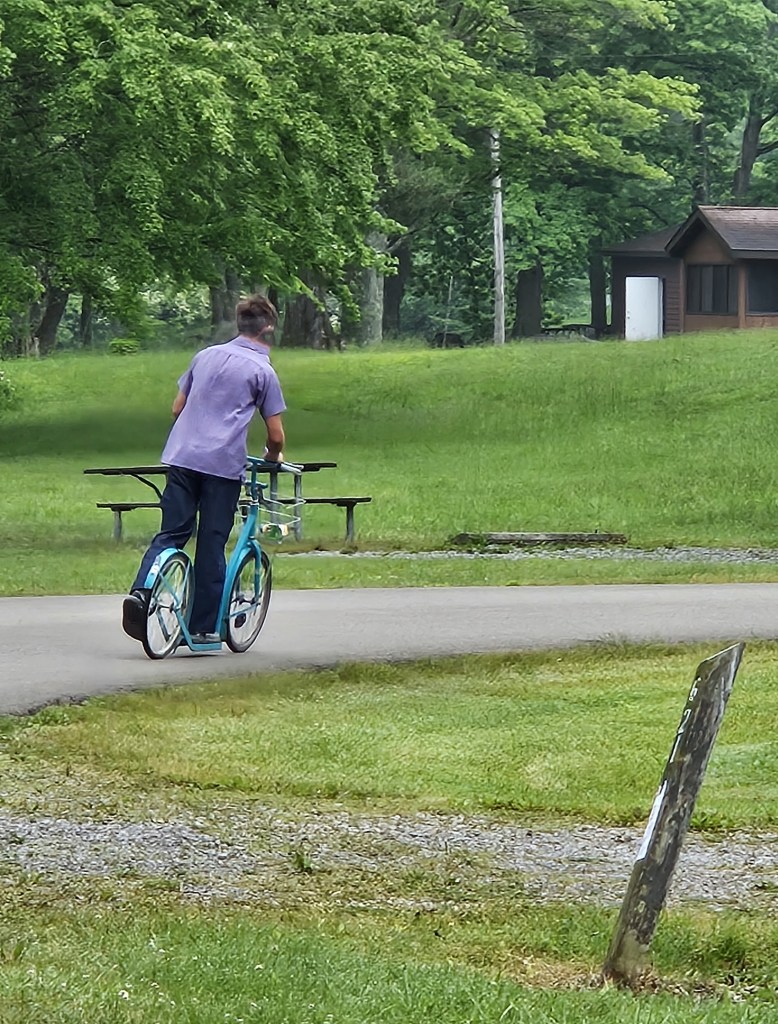
My first thought was, “They’re not even allowed to sit on a bike?” Cal pointed out that it is just better exercise to stand rather than sit, since he had seen these before.
Our stay here was relaxing and idyllic. We were in a smaller, quieter loop than the main one with its beach, playground, dock and fish cleaning station. It looked like folks were mainly local, and a lot of people just had tents.
We did get out a bit. The thing to do is to drive up to the spillway and feed the fish. I did not know what the big deal is about that, but apparently it has gone on for years. The catchphrase is “Where the ducks walk on the fish!”
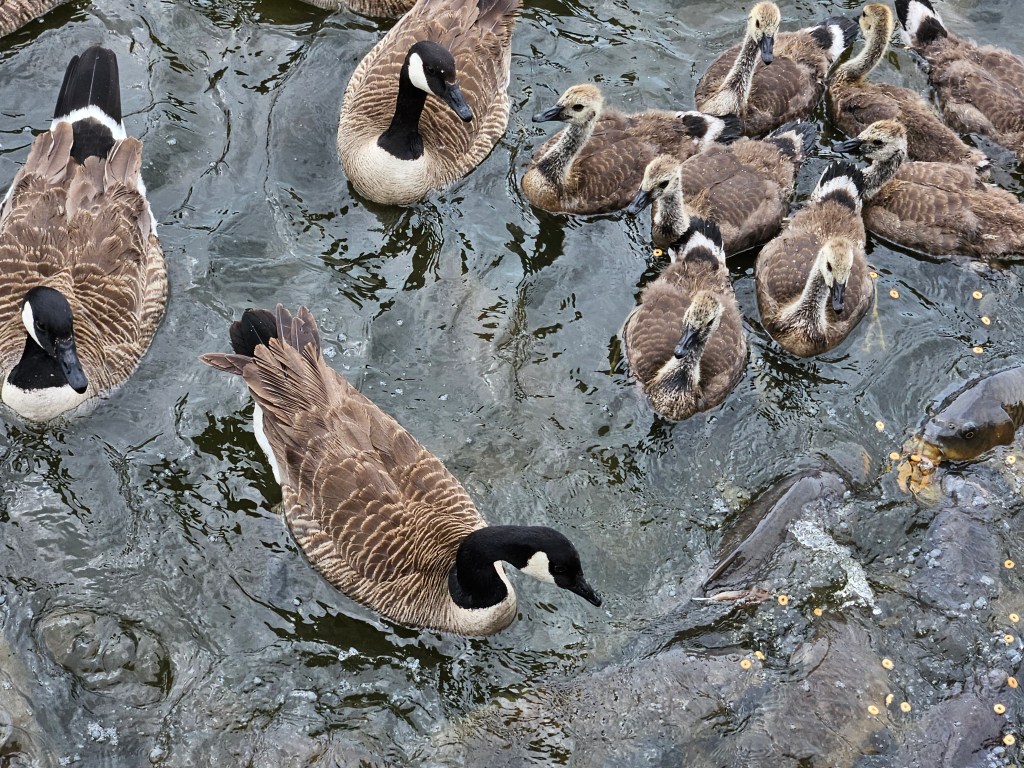
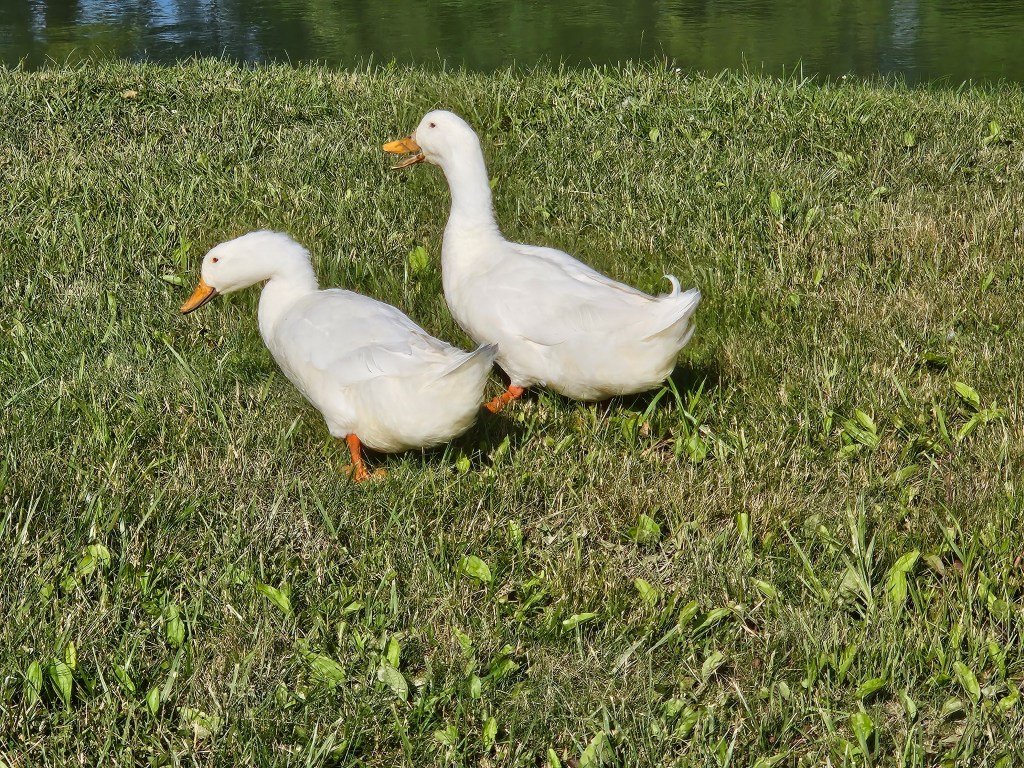
The fish are carp and there were a lot more geese than ducks, but that is something that changes with the seasons. There were SO many geese, and SO many big fat carp all vying for a bit of bread…or Cheerios.
I do not remember my parents bringing us here. My sister Gloria says that our Mom would have used every scrap of her homemade bread in her cooking, and my ever-practical Dad would never have bought us bread just to feed fish and ducks. I would tend to agree. But this was evidently a thing as far back as the 30’s, according to the signboard. You can buy an entire loaf of bread for $1 to feed them. It is a feeding frenzy.

The board also noted that, while it is now known that bread is not the best thing to feed waterfowl and fish, the culture and tradition are being honored. It’s prohibited to do this anywhere else.
We left the fish, and their gaping mouths, and drove along the causeway into Ohio to the little town of Andover for lunch. The main part of the town is on a square. It seems like there should be a courthouse on that square, but there is a nice park instead. The city street goes around the square in one direction. On the edge of the square is a gas station, and behind it and off to the side is the town grocery store. This has the effect of keeping the old town busy, and is brilliant city planning.

We ate lunch at West Side Deli, which is in yellow lettering at the far left of the above picture. We ordered the shrimp basket special, and while we were waiting for lunch a steady stream of customers flowed in. They were giving free hot dogs to the kids. I had gotten into conversation with another customer, and she said for sure it is a once-a-week event, if not more often. It’s really wonderful to see a business supporting the community in this way.
There is also a campground on the Ohio side of Lake Pymatuning, and we drove through it. It is smaller than the Pennsylvania park we were in, but it looks a little more familiar. I’m not sure if this isn’t where my family camped, because it was all too long ago.
At Ohiopyle and Pymatuning, we were at the farthest south and east that we would be on this trip. From here eastward, the only place to go is back to Ohio. And that is a story for next time.
Next time: we visit the Cleveland area, and old friends too








 Twosna Travels