Hawaii

Diamond Head, Pearl Harbor, and back to Waikiki – Oahu

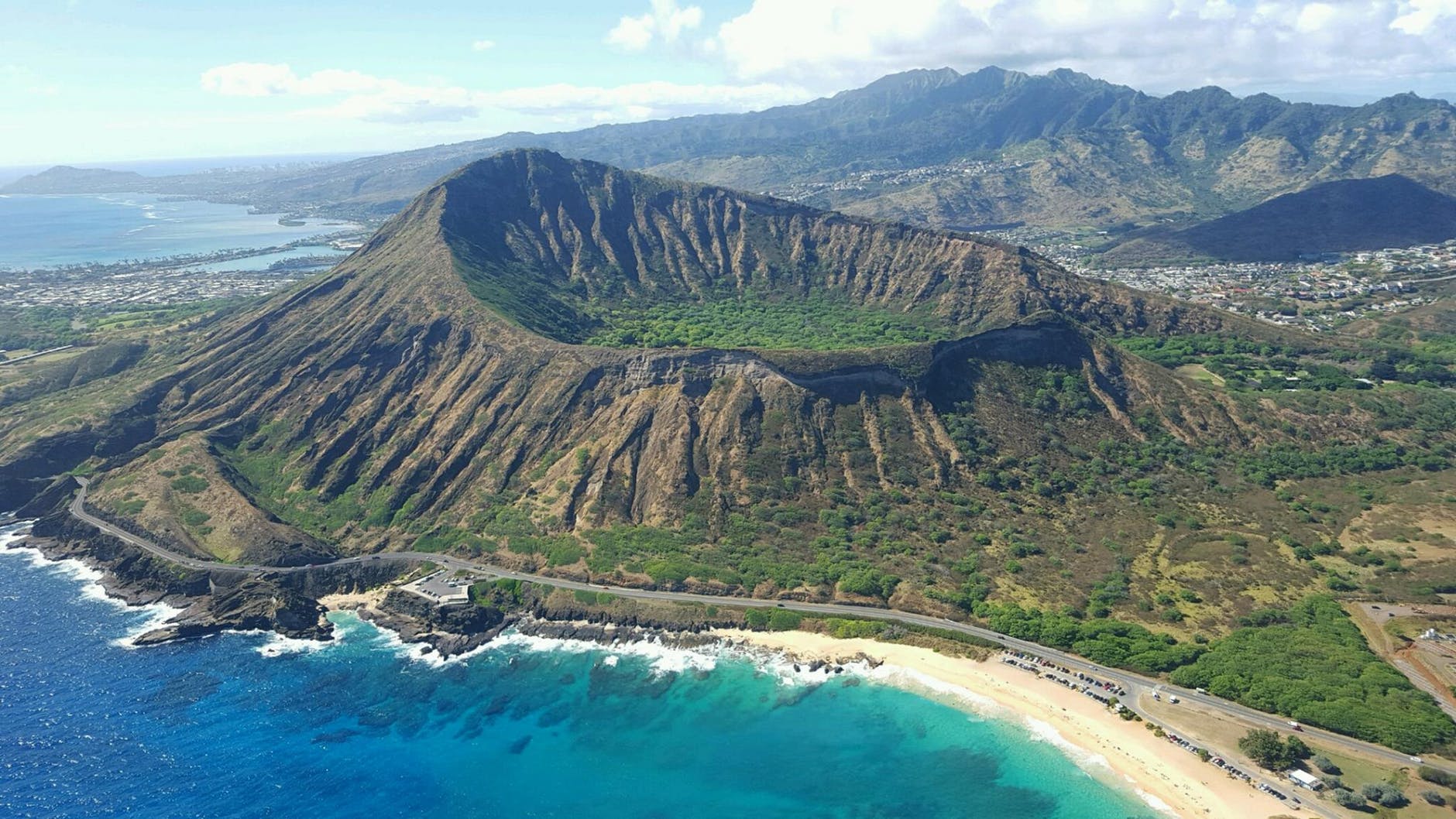
Diamond Head Crater: Photo by Nick Michael on Pexels.com

Hiking Diamond Head crater was at the top of my list for Oahu; a bucket list item, if I had a bucket list. I pulled this picture off the WordPress site to give you a better picture of what the crater looks like. I’ve never taken Uber to a trailhead to hike, but that’s what we did. And the Uber driver knew just where to drop us off. We walked through a tunnel to the inside of the crater:

After we paid our entrance fee, we were on the trail. Right away we started going up from the crater floor. The trail is only .8 mile long, but it is steep. Once we climbed high enough, we could see over the crater to Honolulu.

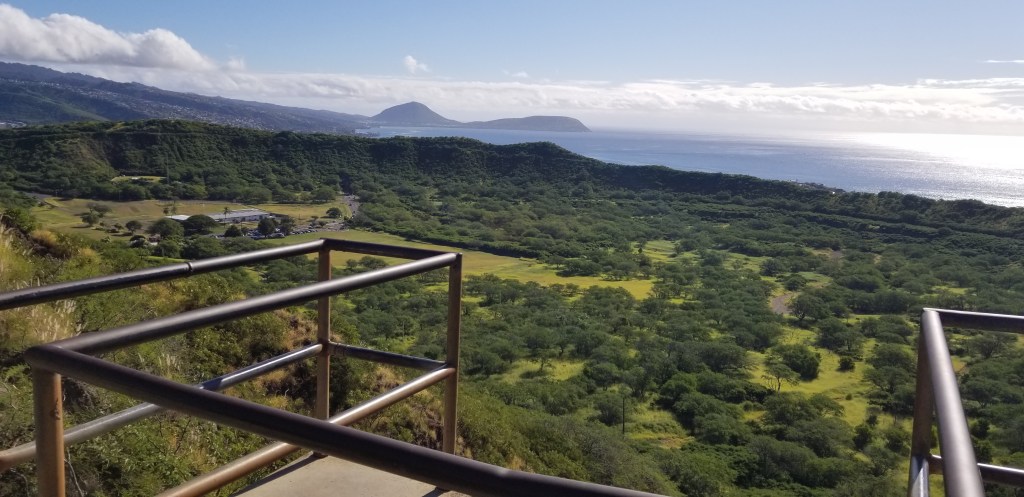
Ocean in view and a precarious lookout

Diamond Head was used for military coastal defense from the early 1900’s right up through the 1960’s, and on the crater floor are two buildings still in use. This tunnel was used for fire control.

This hike was beginning to feel like a fun obstacle course.

A view of Waikiki from Diamond Head
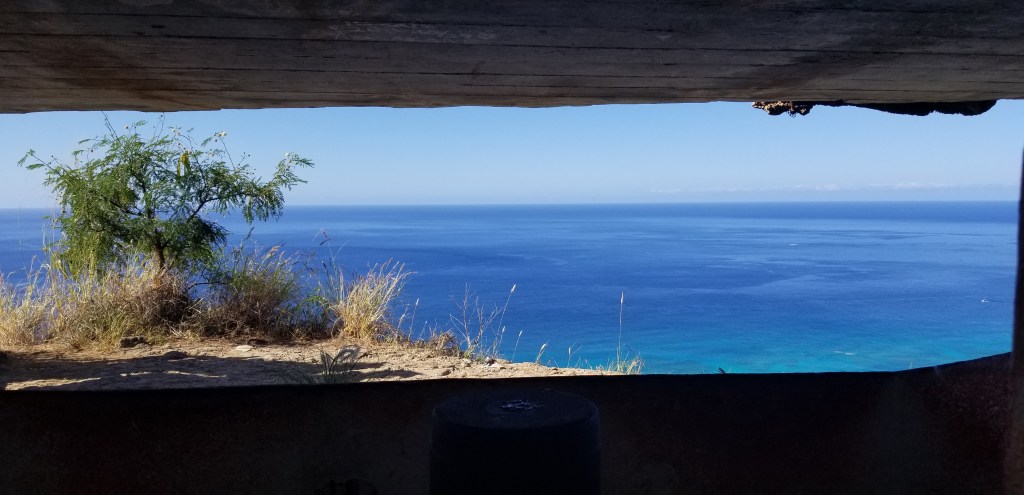
Looking out to sea from a military pillbox
Diamond Head Lighthouse

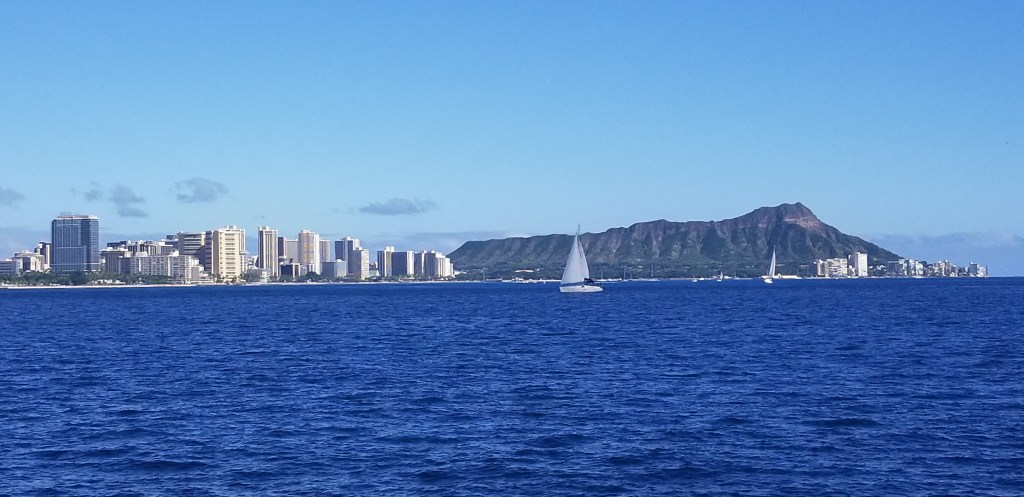
Later on in the day we went on the whale watch that I’ve already blogged about and saw Diamond Head from the sea. It was pretty amazing to think we had just been on top that morning.
We couldn’t leave Oahu without paying our respects to the sailors and marines who lost their lives on the Arizona and at Pearl Harbor when it was bombed by the Japanese on December 7, 1941. Pearl Harbor is a national monument called “World War II Valor in the Pacific”.

Pearl Harbor Memorial, Ford Island

The memorial is sitting directly over the remains of the ship. We rode a boat over to the memorial, and then we could walk inside and look down on it.
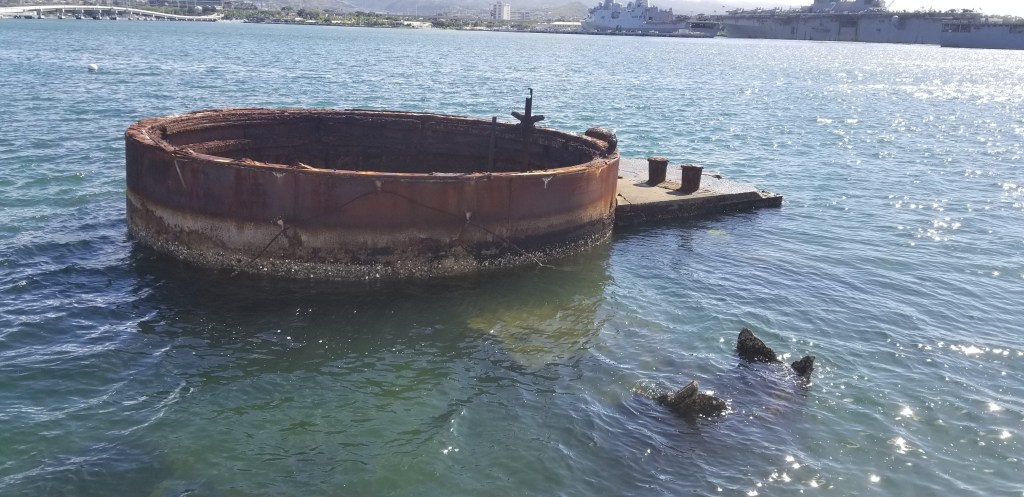
The base of gun turret # 3

There was a lot to ponder while on the Arizona and at Pearl Harbor. We watched active duty military ships leave the Harbor. At the time we were here, war clouds were just starting to gather in Ukraine. I worried about what Putin was going to do, while at the same time feeling the weight of the events that happened here.

The USS Bowfin

We also went through a submarine, the USS Bowfin, which saw action during WWII. She was nicknamed “The Pearl Harbor Avenger”.
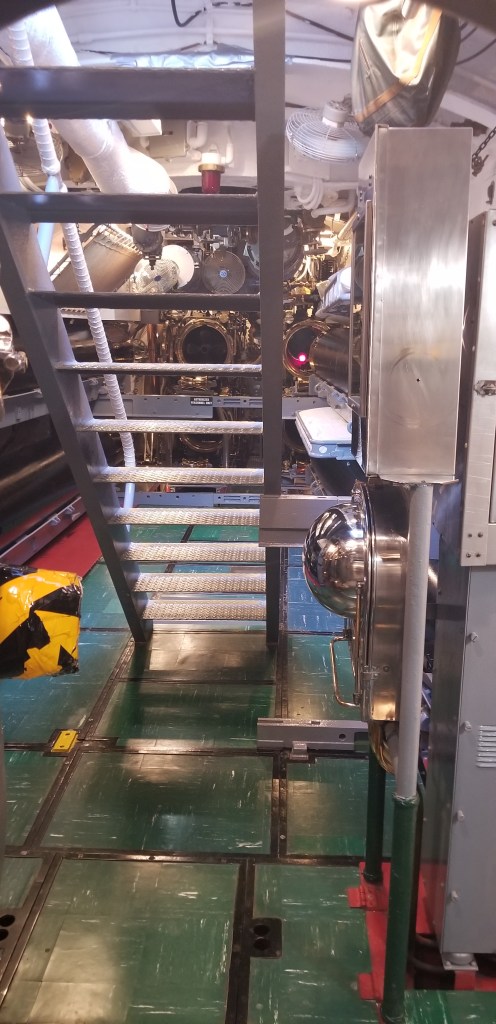
The spaces inside were pretty cramped!
How could anyone work in this tiny kitchen?
On the Bowfin

We did it all at Pearl Harbor, including the USS Missouri. It was possible to walk around most of the ship, above and below decks.

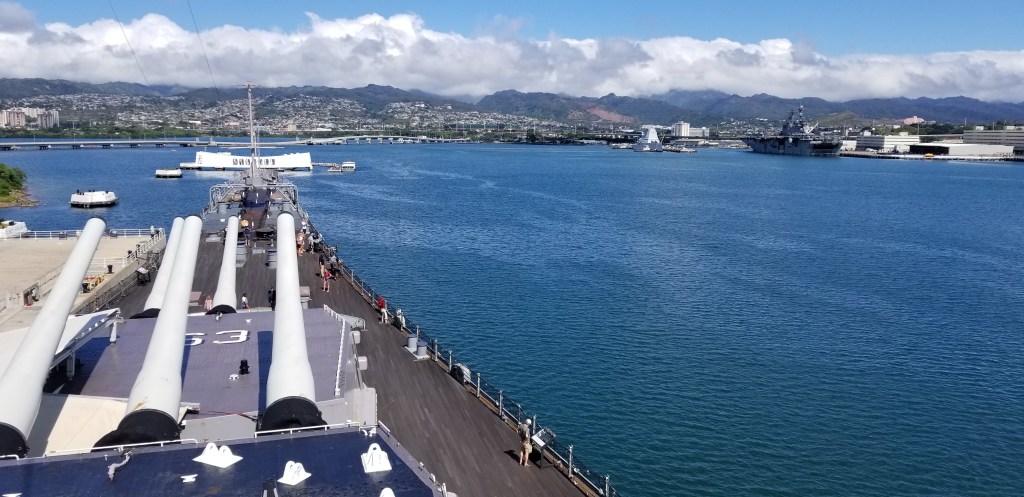
The Arizona memorial as seen from atop the Missouri. An active-duty naval ship can be seen at top right.

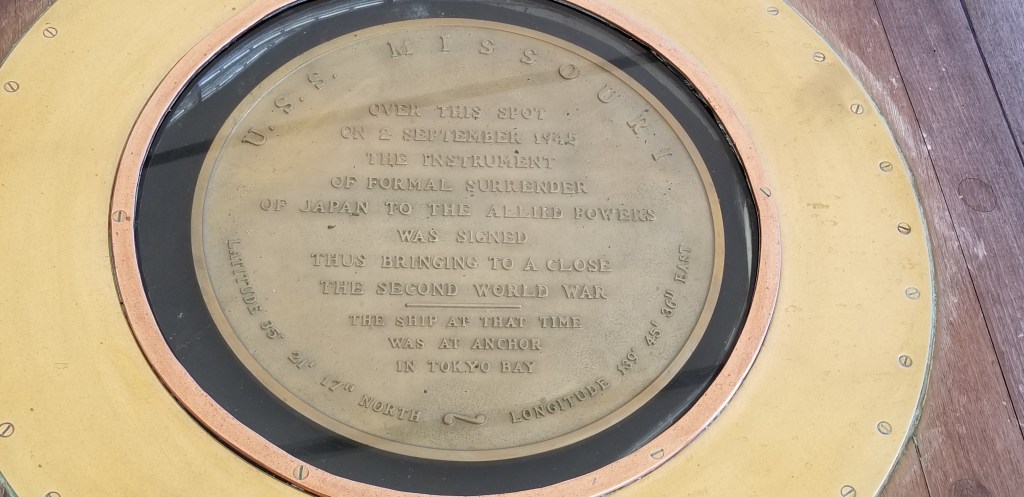
The Missouri was commissioned in 1944 and was the last battleship built. Her guns were fired in WWII, the Korean War, and the Gulf War. Her biggest claim to fame, however, is that the documents ending the war with Japan were signed on her deck in Tokyo Bay.
Exploring below the decks was the most interesting part for me. There would be thousands of men living on this ship for months at a time, and bunks were stuffed into every nook and cranny.

A room dedicated to supplying everyone with enough bread

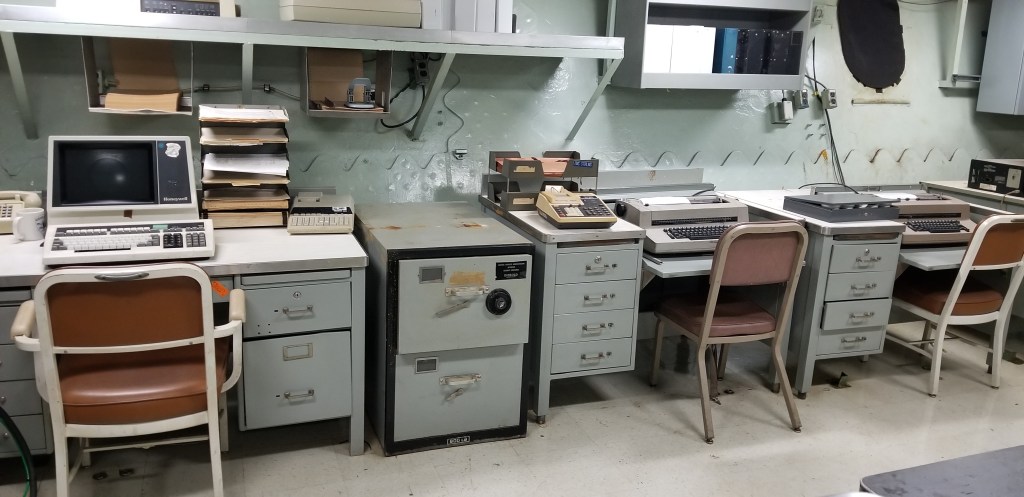
The Missouri was decommissioned in 1992, and so it was a bit of a time machine from that era. We came to the Finance Office, where sailors could get all their money-related items taken care of. I was in Finance when I was in the Army, so this room looked very familiar! I could picture myself at one of those IBM Selectrics on an identical desk typing checks. My time was a little earlier, though, so I had no computer, and used earlier model calculators.
We slowed our pace way down for our last day or two in Oahu with a picnic dinner at Ft. Derussy Park, some time on the beach, and a last meal of shrimp in Waikiki.
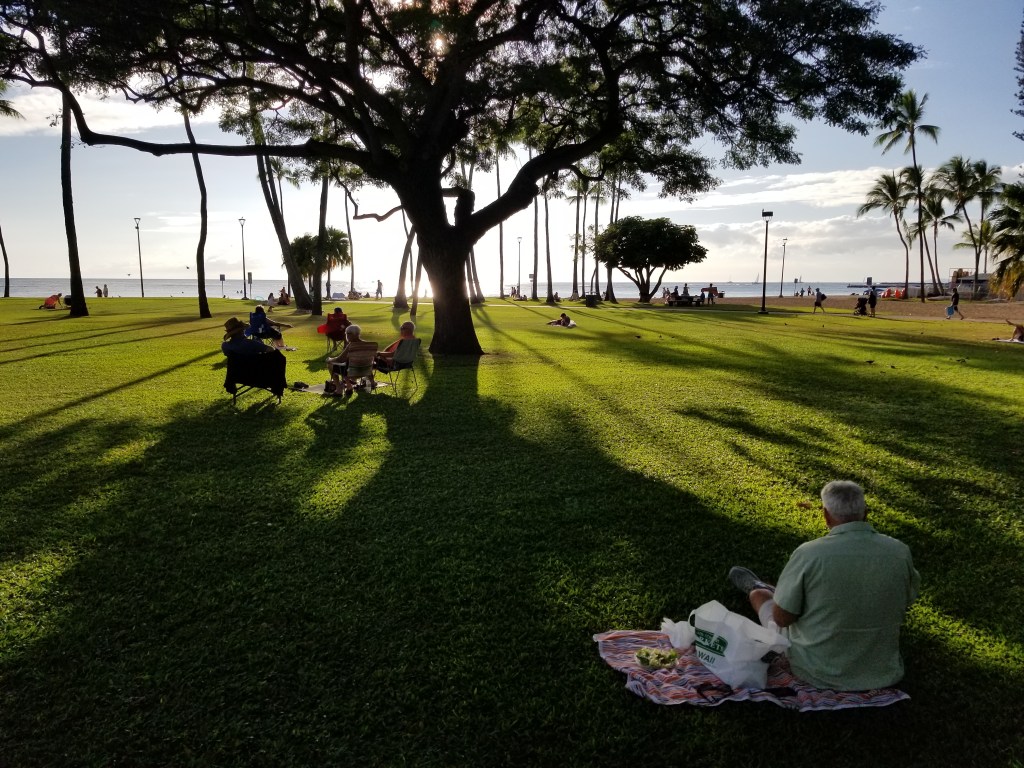
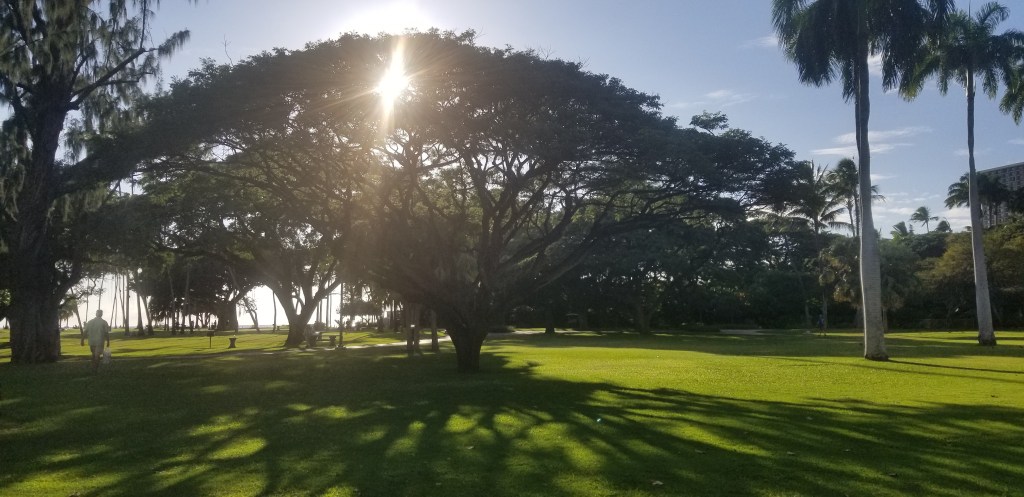
An acacia koa tree. I enjoyed seeing many of these while on Oahu; some were massive.
Shrimp dinner, complete with pigeon
The “cultural area” at the Honolulu airport

Next time – On to Maui

Hawaii

Polynesian Cultural Center – Oahu

A postcard from the Polynesian Cultural Center

Is the Polynesian Cultural Center a tourist trap?

Let me explain first what it is, in the words of the PCC themselves: “The purpose of the Polynesian Cultural Center is three-fold: 1) to protect and promote the beautiful cultures of Polynesia; 2) to support our student workers as they gain a degree that will assist them and their home nations to progress and thrive; and 3) to share the spirit of aloha with the world.” It has been run by the Church of Jesus Christ of Latter Day Saints since 1963. Brigham Young University – Hawaii is next to the PCC.

Simply put, there are six Polynesian “islands” to move through in the afternoon, a buffet dinner or a luau, and an evening show. The villages are Tonga, Samoa, Tahiti, Aotearoa (New Zealand), Fiji, and Hawai’i. There are also tourist shops, food trucks, and restaurants in the front.

The first village we visited was Samoa. We watched a funny guy splitting coconuts (he had a lot of good jokes), another shimmying up a palm tree lickety-split for said coconuts, and another making a dish out of green bananas and coconut milk. It would be like mashed potatoes, he said. It had to cook over a fire. We didn’t get back to Samoa for a sample.

Here’s our tree climber

Each island has a presentation, either on the hour or half hour. You can wander around in between, but you really get a feel for everything by attending as many island presentations as possible. When I started paying attention to the schedule, it was easier to figure out what to do.

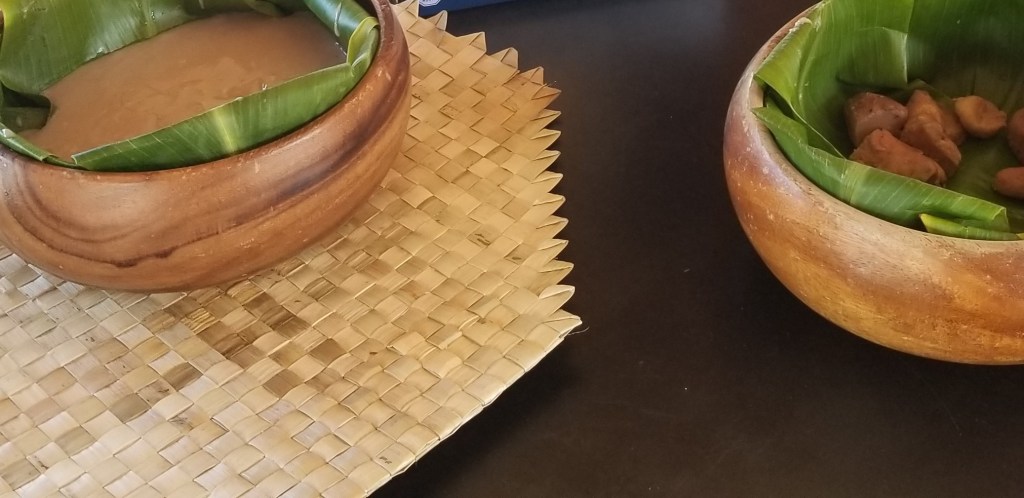
In another island we watched a “villager” make poi out of taro. Taro is still a staple on the islands and it is a root vegetable comparable to potatoes. Poi is baked taro pounded to a paste. I had a sample and it’s pretty bland.

Servin’ up the poi
Dishes of poi and taro

On the island of Hawai’i, there were young male hula dancers to watch. As explained, their dance was pre-European contact, which meant no ukeleles. They were accompanied by vigorous drumming.

Also on Hawaii, we looked at the Iosepa (Joseph). It is a 57 foot double hulled sailing canoe, made for the open sean, which was built by two master carvers with assistance by Brigham Young students. The voyage to Hawai’i by ancient Polynesians was 2,400 miles long and was accomplished by canoes such as this, called a wa’a kaulua. The canoe is navigated only by the stars and has been out to sea. It was huge, and I couldn’t stand anywhere to get a picture of the whole thing.

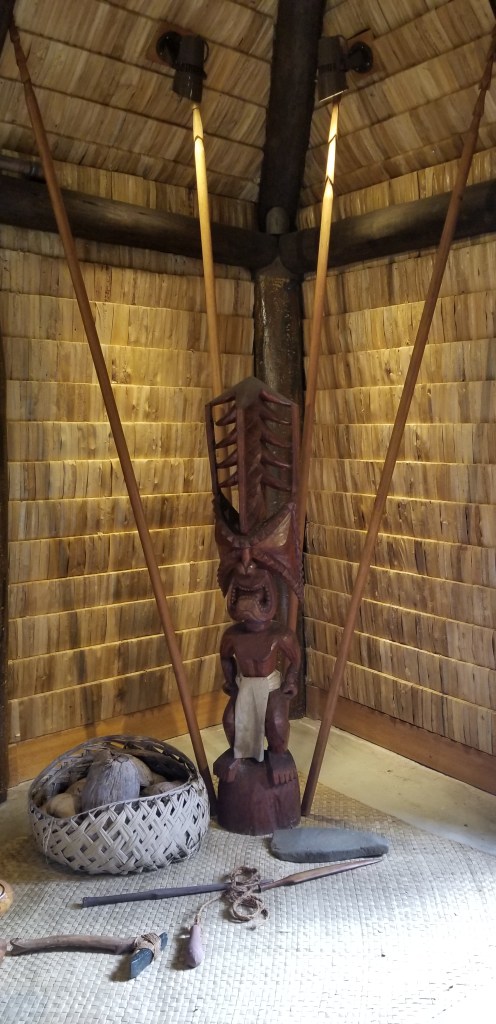
We walked by a chief’s hut and stopped in:

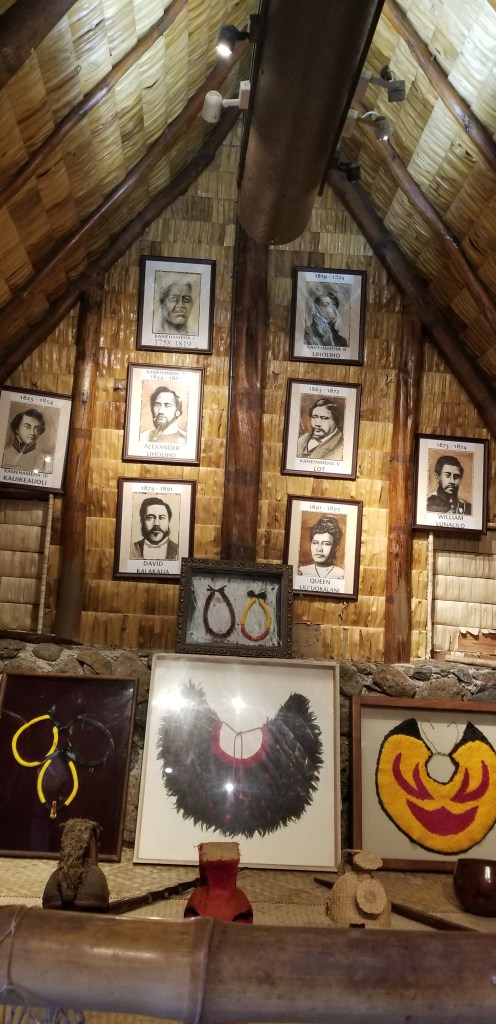
On the wall were pictures of past Hawai’ian kings and the queen:

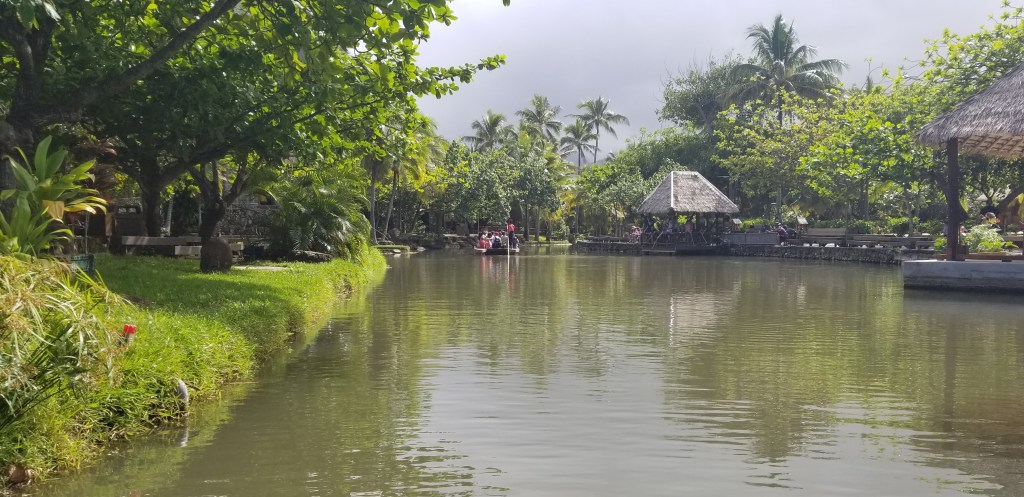
We hopped on a “canoe” for a ride through the islands.

The yellow flowers are the Hawaiian hibiscus, the state flower
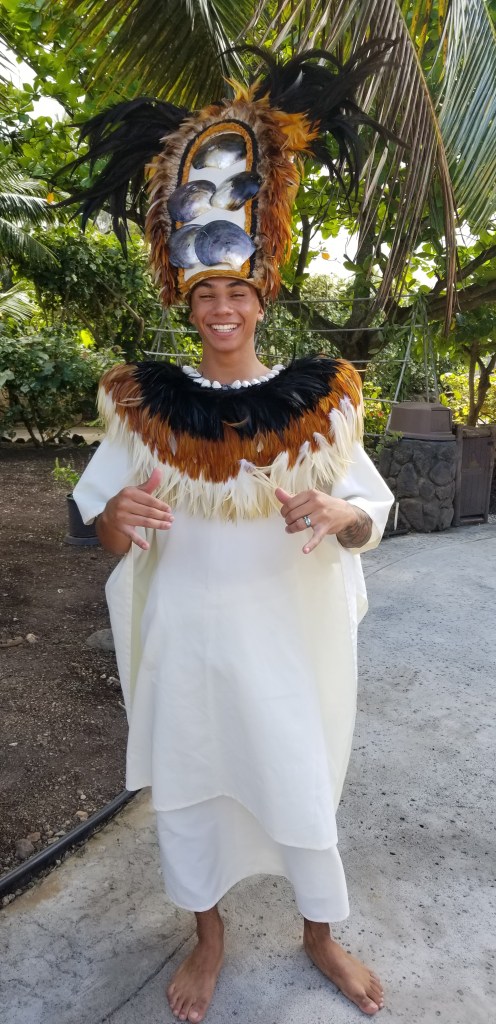
I thought this gentleman walking by looked quite stately and elegant

In Tahiti, we attended a wedding ceremony and renewed our vows. Our own tradition in weddings is to say “Yes, I will take you to be my spouse”. In Tahiti the question is “Will you ever leave this woman you love?” and the answer is “No!” We were in the back of the crowd, so there are no pictures, but I did get one of the band, and the priest after the ceremony.

Tonga is the only island out of the six that was never colonized by any other country. We listened to drumming there, although I was a little disappointed that they used mostly audience participation for their presentation.

We looked at some native Tonga crafts:

We had purchased a package which included entrance to the islands, a buffet dinner, and the evening show. Another option was to attend a luau. We passed on the luau not only because it was so expensive, but also because we were planning to go to a luau elsewhere. I later heard, though, that the PCC’s luau is the one in all the islands that is most culturally authentic. Maybe another time.

I have no idea what was on my buffet plate. I tried everything that I was unfamiliar with along with some macaroni and cheese in case the native foods didn’t pan out. As it happened, I was too full to eat the mac and cheese. I tried some different types of poke. By Merriam Webster’s definition, poke is a Hawaiian salad made typically from cubed pieces of raw seafood (such as tuna) marinated with soy sauce and sesame oil and mixed with onions or other ingredients. I had a fish poke, and a shrimp poke. Along with that, there was some ahi sashimi (raw tuna), a guava roll, and a whole lot of other stuff that I don’t remember the names of. It was all delicious.

The evening show as called “Ha (line over the a) – Breath of Life”. There were no pictures allowed so I have uploaded a picture of the program. The story line of the show follows a young boy from birth through his life. Each stage of life is on one of the six islands. It was a great show. The dancing, songs, and special effects were beautiful. There were fire dancers, fire eaters, and an act where they were jumping and sitting on fire, putting the fires out. How did they do that? The boy was in Tahiti when he married, so there was the Tahitian wedding ceremony. There was hula dancing, of course. 400 different costumes are worn nightly.

Back to my original question: is the PCC a tourist trap? When I was looking for more detail on it, I read just a few negative reviews on Trip Advisor that called it that. Most reviews were overwhelmingly positive. It’s not an inexpensive day, but the buffet and show are, in my opinion, top quality and great entertainment. If you just skim the surface of the various islands, or visit the shops at the front of the complex, you might think it is. I learned a lot, though, and appreciated both the professionalism and the effort to keep these cultures alive in an authentic way. Plus, it was just a lot of fun!

Next time: Diamond Head

Hawaii

Circling Oahu’s North Shore

Near Halona Blowhole, Oahu

We did not rent a car in Oahu, figuring that we could easily work out some sort of transportation for wherever we wanted to go. To visit the North Shore of Oahu, we signed up for a tour. Cal likes the ease of not having to drive, and I like having someone point out what we are seeing. We chose a small group tour, less than 20 people, so we were riding around in a van as opposed to a huge bus.

Our very first stop was not far from Waikiki, at the Diamond Head lookout, for a great view over Kuilei Cliffs. Diamond Head was up and behind us here, and it is where throngs of people stood to watch Amelia Earhart be the first person to fly solo from Hawaii on the US mainland in 1935. A marker here commemorates the occasion.

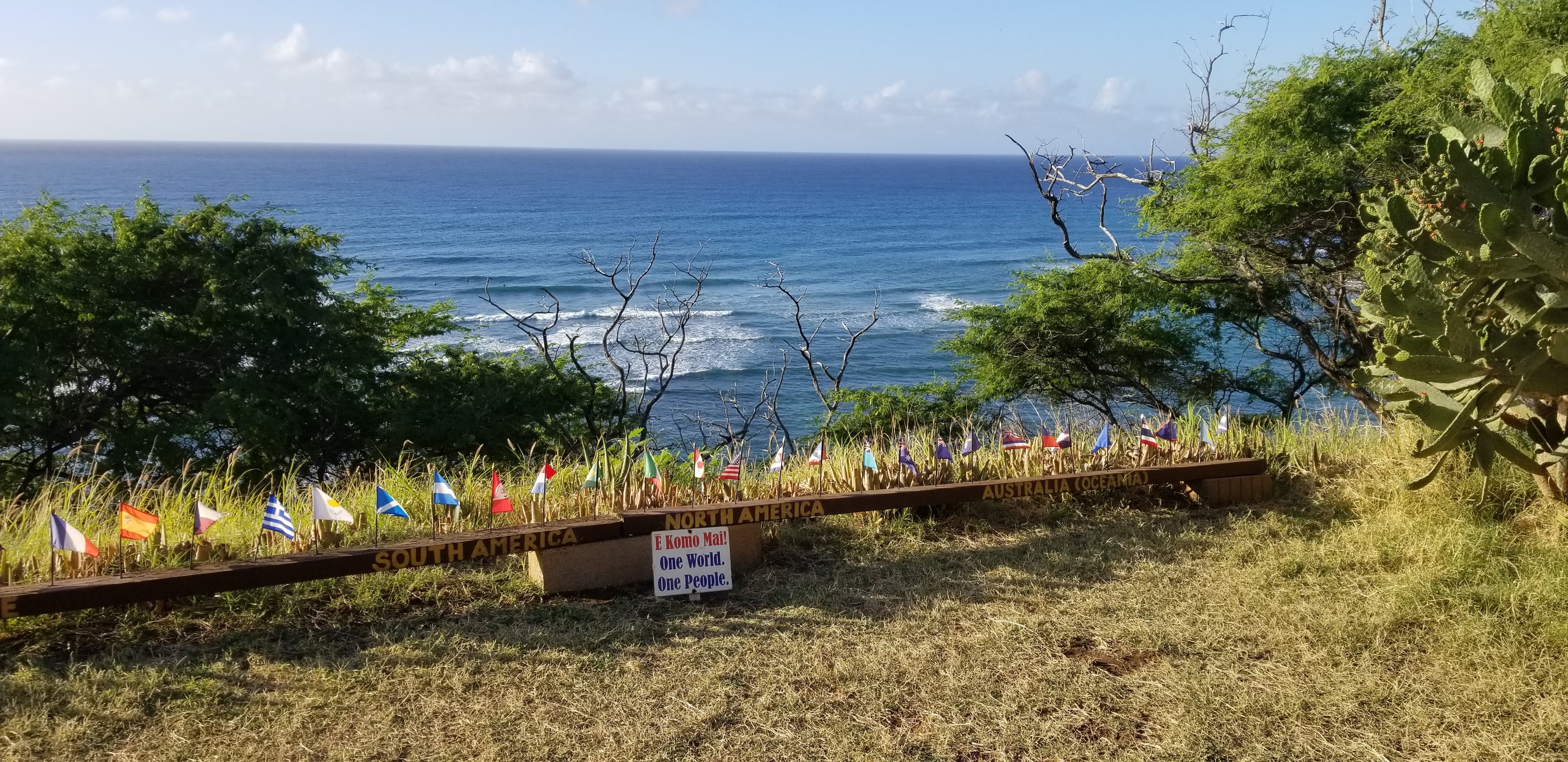
The waters off Kuilei Cliffs are popular for surfing, and people from all over the world come to surf. The spot is also known as “Seven Continents” for that reason.

There were surfers in the water, but they look like tiny dots from this vantage point.

Next stop: Halona Blowhole. If I’ve ever seen a blowhole before, I don’t remember it, and it is pretty fascinating to watch.

A blowhole is a sea cave in which water is forced landwards and upwards by the action of the waves. The water comes up through the hole, and creates a dramatic geyser effect. Above, the hole only has a small puff of water to the right of the bottom-most person that is standing there, like steam through a teakettle, but then the big wave that you see creates the geyser in the picture below.

Whoosh! It was fun to watch how high the water would go!

We had a stop at the “Tropical Farms of Hawaii”. It’s billed as a stop at a macademia nut farm, but their trees aren’t here. This is really just an outlet. I’ve been on tours before where they make these commercial stops and I always see them as a bid to get our tourist dollars. They know us tourists are going to spend money, and usually we oblige. They had many flavors of packaged macadamia nuts with samples for us. I would rather have been able to see the trees, but the nuts were delicious. The honey roasted and the cinnamon sugar were our favorites. They also had some coffee samples.

While waiting for our group, I walked around outside and admired this bird of paradise:

This thicket of greenery was so tall:

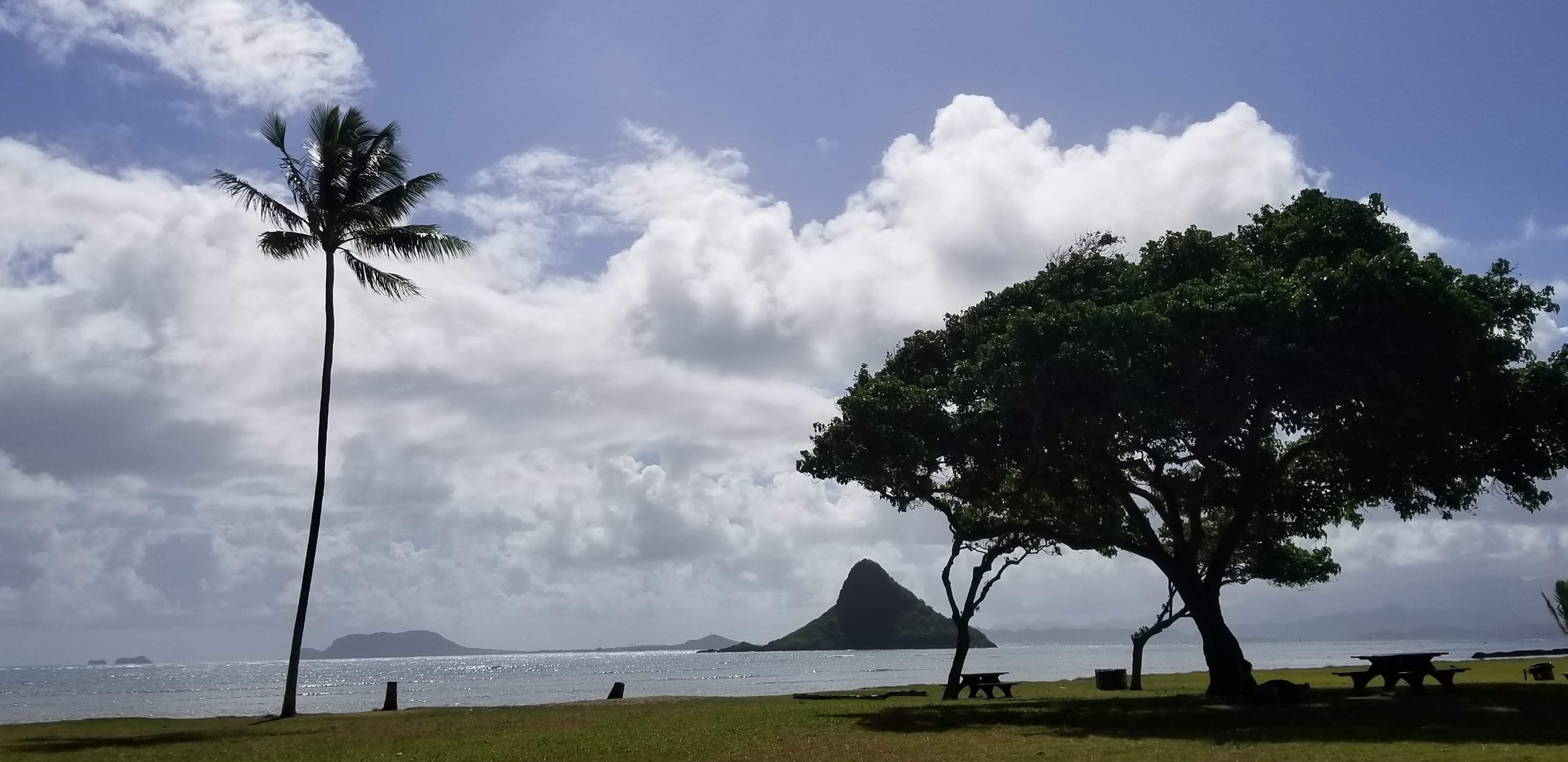
Chinaman’s Hat is a basalt island named for its resemblance to the peasants hats worn in rural China. The Hawaiian name is Mokoli’i, which means “little lizard”. I just call it beautiful.

We were at Kualoa Regional Beach Park to see Mokolii

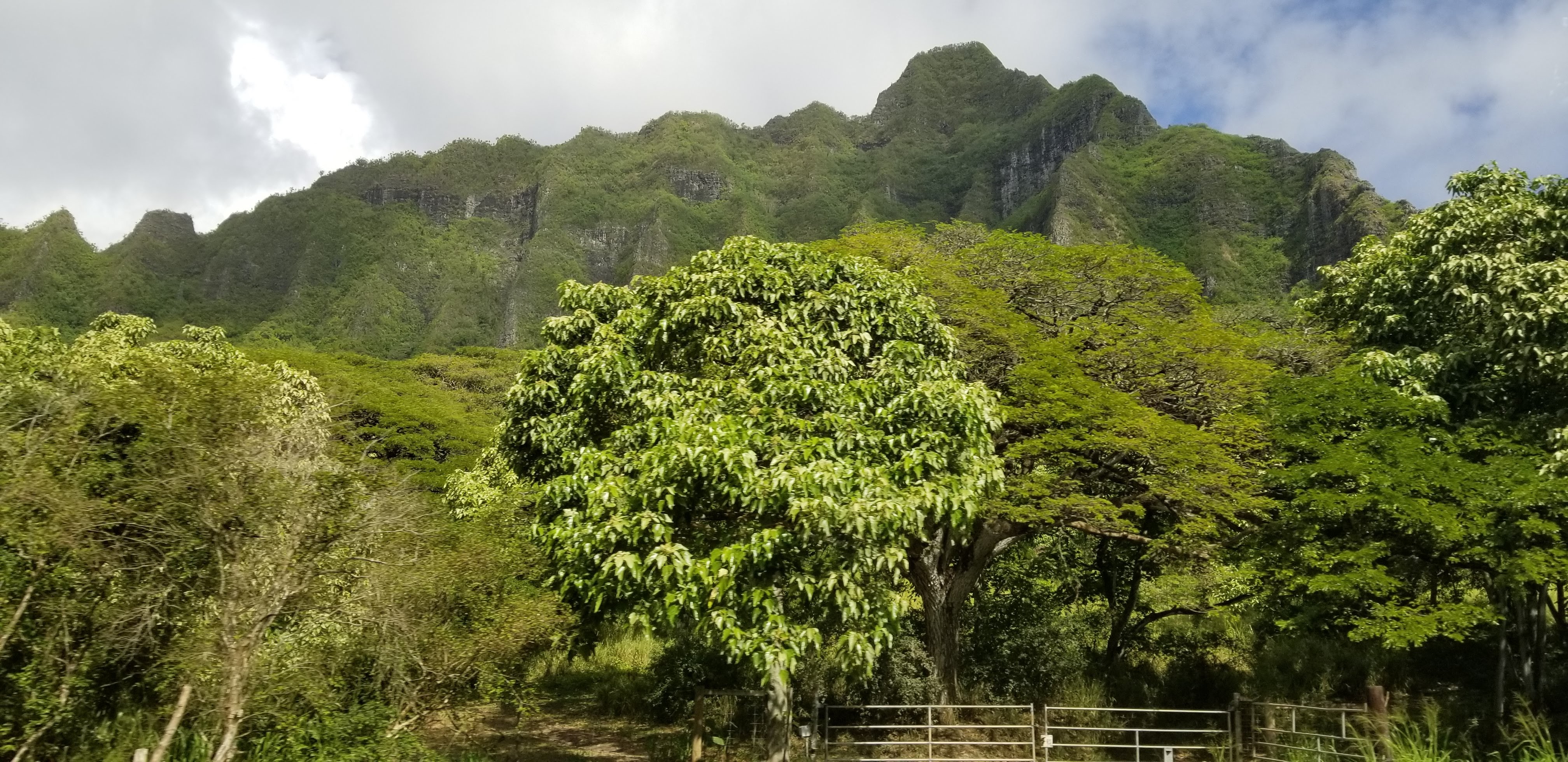
As we rode up the coast we passed beach homes, parks, and gorgeous ocean scenes. We had to remember to look out the other side of the bus, the mountain side, which was just as beautiful:

Lunch on this tour was a stop at a shrimp farm. We received an incredibly huge pile of shrimp, which we had to peel, plus rice, corn, and a wedge of pineapple. This was one of my favorite meals on our trip.

We had a long stop at Hale’iwa beach. We were supposed to snorkel to see turtles, but the waves were deemed to be too high. When we arrived at the beach, it was decided that it was okay, but by that time we had left our suits back in the van. We missed the boat on this one, but we enjoyed the beach anyway. And we did see turtles.

Hale’iwa Beach

Watching the waves, we caught sight of a flipper here, a foot there, and occasionally a head bobbing up. Then – full view!

While driving, we had gone past excellent surfing beaches: Hale’iwa Alii Beach Park, Sunset Beach, and Banzai Pipeline, which was having a competition while we drove by. We also passed Waimea Bay, which put the Beach Boys song “Surfin’ USA” in my head for a while. There were many surfers and paddle boarders on Hale’iwa as well.

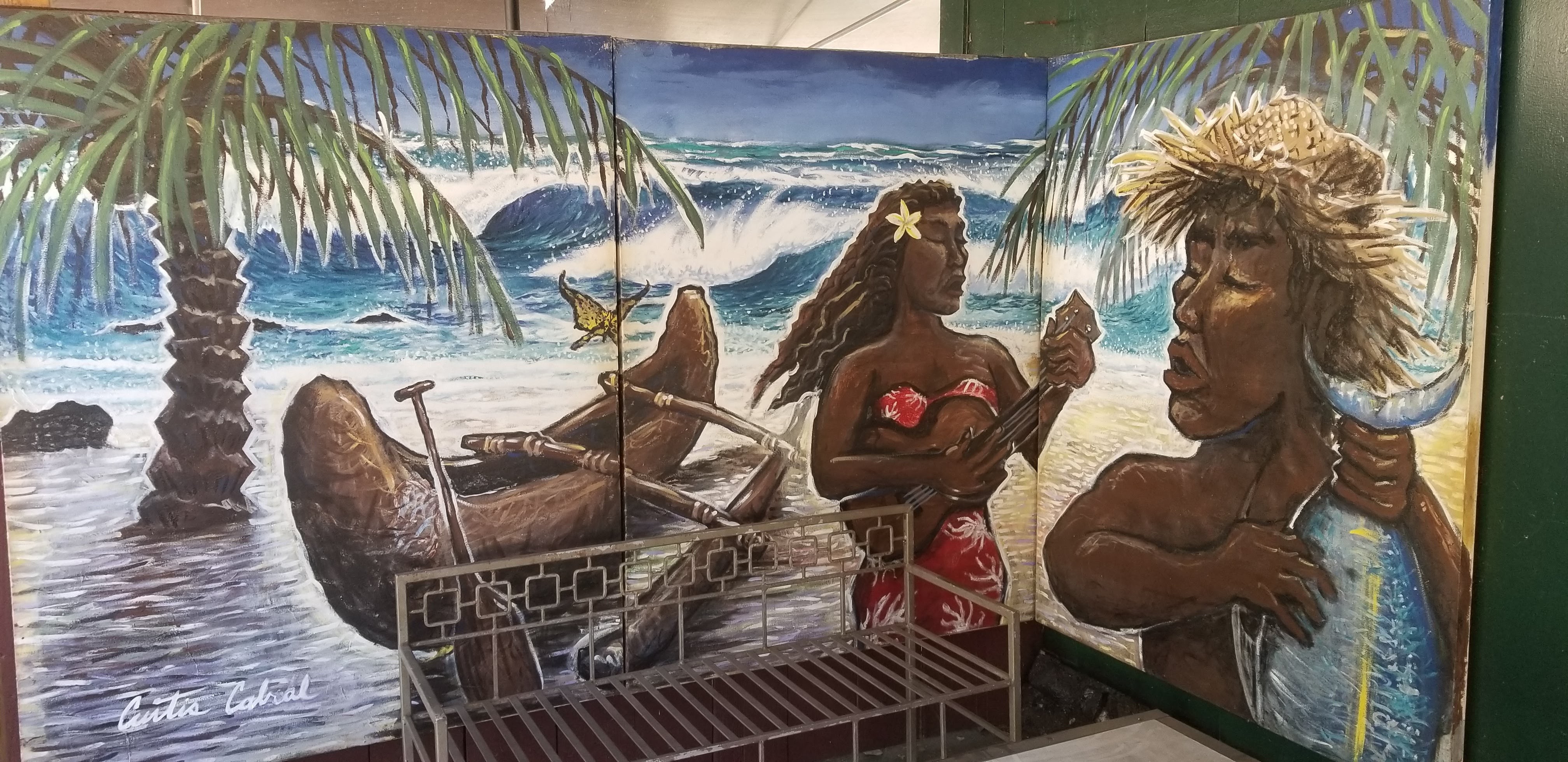
We still had plenty of time because this was a long stop. Cal wanted ice cream, so we walked over to a nearby beach town. I enjoyed looking at some of the murals painted on the buildings while we were there.

Last stop: the Dole Plantation. Pineapples used to be a huge cash crop in Hawaii. In 1901, James Dole opened the first pineapple plantation, named the Hawaiian Pineapple Company. The Hawaiian Islands were exclusive producers of pineapple until the 1960’s, when pineapples began to be available in other nations around the globe. It is still grown here in Oahu, but mainly for Hawaiian and US consumption.

I could have learned all this on their train tour, but as I realized when we arrived, there was no time for the train tour. I had wanted to see pineapples growing in a field but our stop here was only 15 minutes. I guess I should have done my homework better on this one, but it was only a minor disappointment. We stood in line to share a Dole Whip, which is the thing to do. They are absolutely, delectably delicious and a cool refreshing treat on a hot day. I found them available everywhere both in Oahu and Maui.

There were some gardens next to the gift shop and treat truck, and we raced through. I was able to see some pineapple plants with a pineapple growing on one of them. Only one, but better than none.

We ate a lot of pineapple in Hawaii, of course, and every bite that I tasted was so sweet and juicy.

In the garden, it was interesting to see what cacao trees look like:

I caught this chicken strutting its stuff in the Dole Garden. I mentioned that we heard roosters crowing from our condo in the previous Oahu post. We saw feral chickens running all over Hawaii. The first chickens were a red jungle fowl brought several hundred years ago by Polynesians colonizing Hawaii. Chickens were also brought to Hawaii from the European colonists, cross bred with the Polynesian chickens, and escaped from coops during hurricanes. They’re fun for the tourists, not so fun for people that own property.

It was a long drive back to Honolulu. We arrived just in time for rush hour traffic, happy that someone else was doing the driving!

Next time: Polynesian Cultural Center

Hawaii

First Days – Oahu

Waikiki and Diamond Head

Admittedly, blogging while being in a beautiful destination such as Hawaii was impossible for me. As I’m writing this, we are still here, but the trip is winding down. It’s getting easier to find some time for it.

To reel it all back to the beginning – we started in Oahu and landed smack dab in Tourist Zone Central, in the Waikiki I had always heard about and never been. It was beautiful and I soaked up the scenes that I had only ever seen pictures of.

We heard many times that it was not as crowded as pre-Covid. The Japanese are not visiting right now, and they used to be a big part of the tourist crowds. We moved as we wanted to, but masks were a must for transportation and inside restaurants and stores.

Our condo was a couple of blocks away from most of the hotels and shopping district, and sat to the side of the Ala Wai canal:

The view from the balcony, 19th floor

We liked being high in the air in order to survey our kingdom. Despite the height, we could hear roosters crowing in the dark every morning.

Just down from our condo, we could walk into Fort Derussy Beach Park, with beautiful trees and flowers.

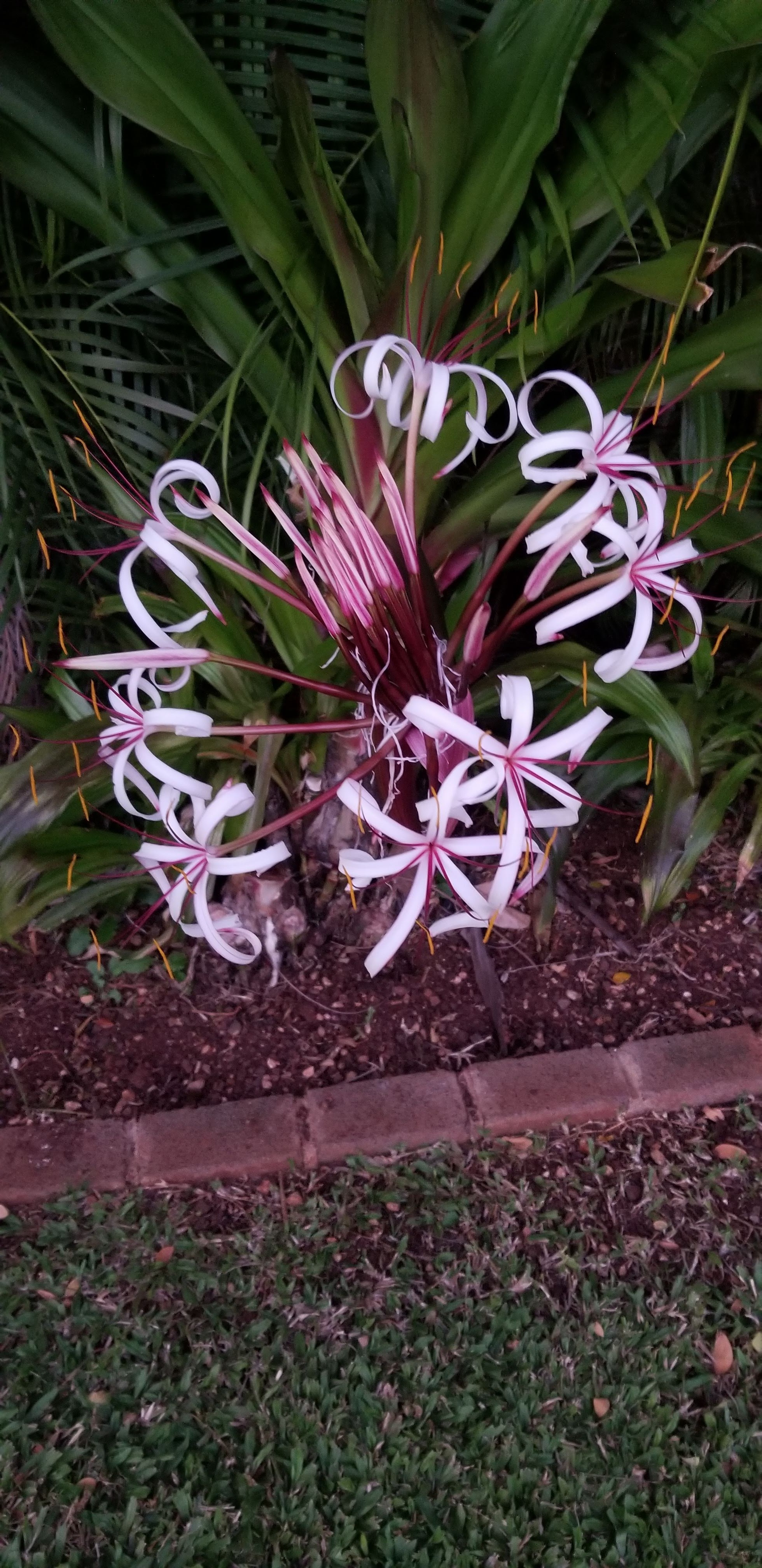
A spider lily

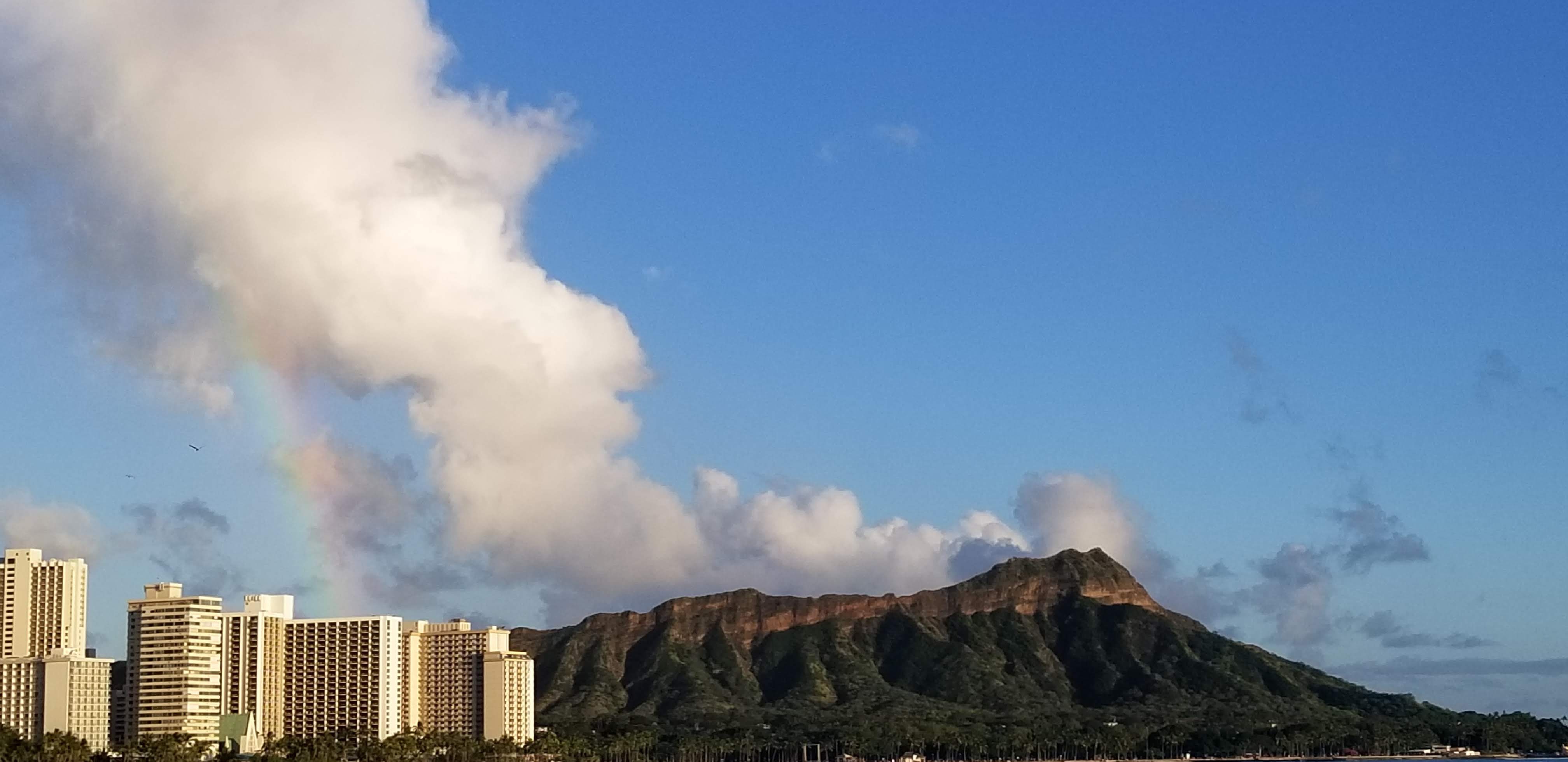
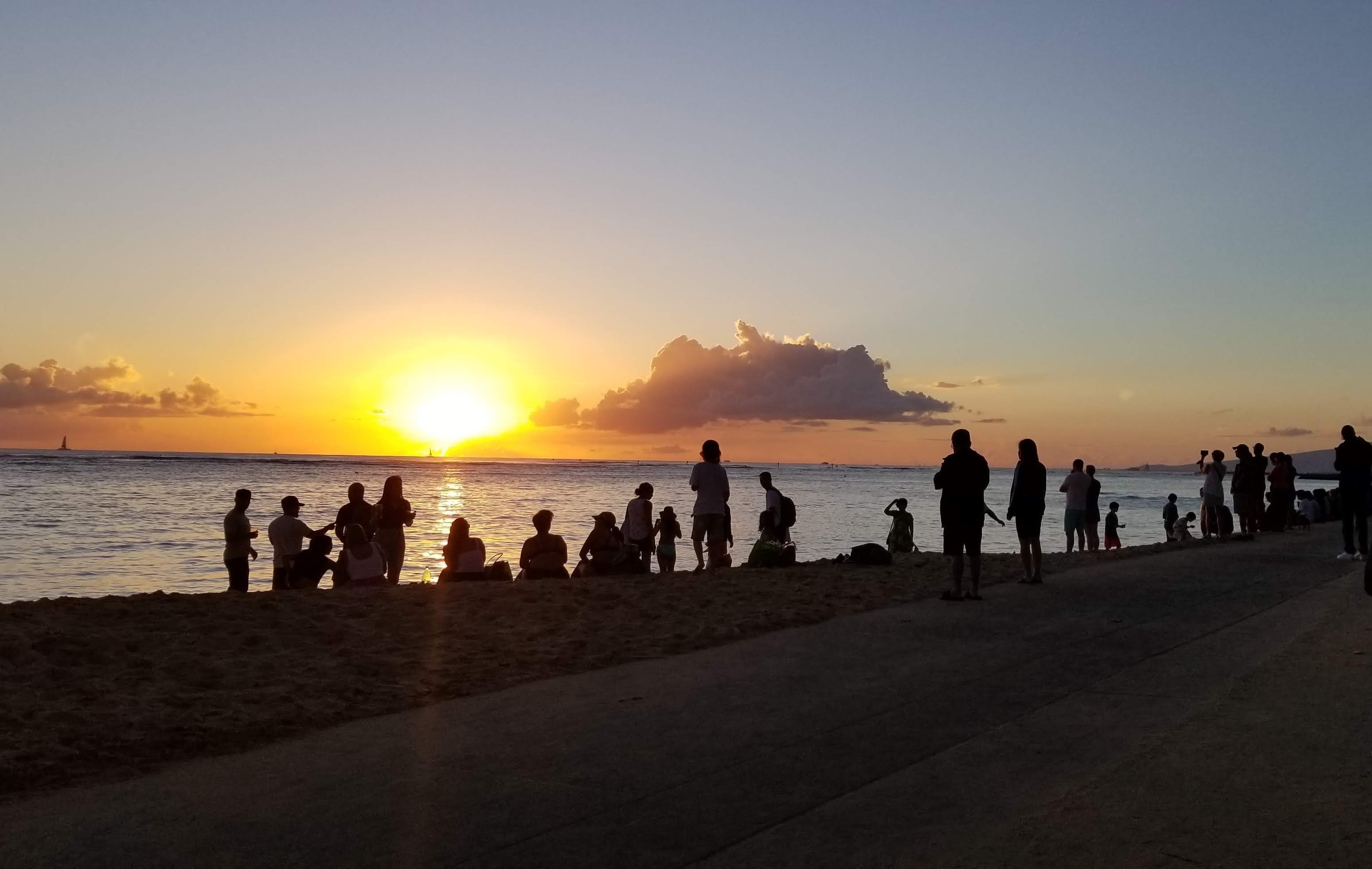
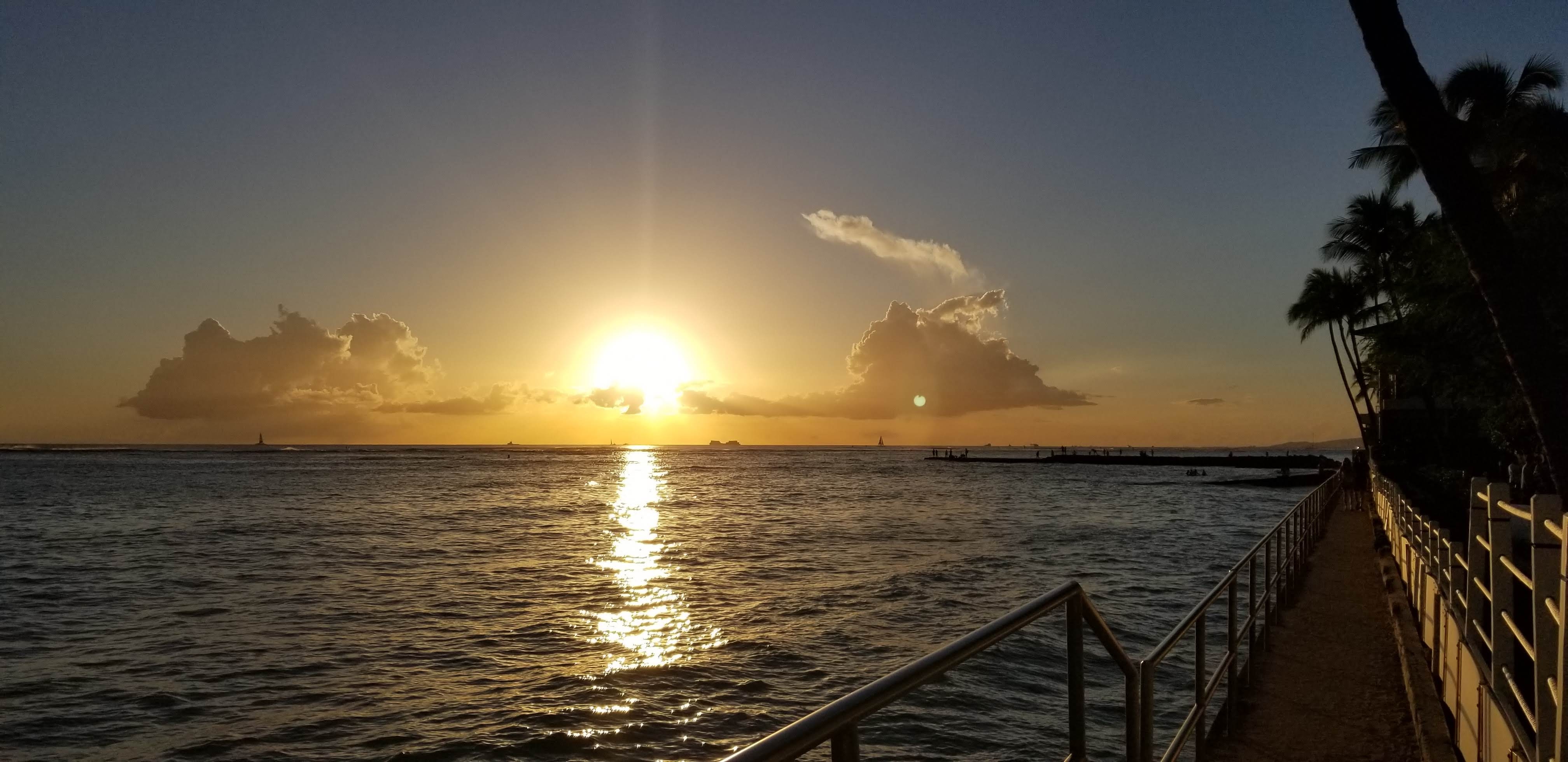
The park opens on to Waikiki beach, and we joined that day’s crowd of people to enjoy the sunset, plus the gift of a rainbow over Diamond Head:

On our first full day, we met with our friends Kathy and John to catch up on plenty of years past, and to go to the Honolulu zoo together.

Photo credit : Kathy Jarvis

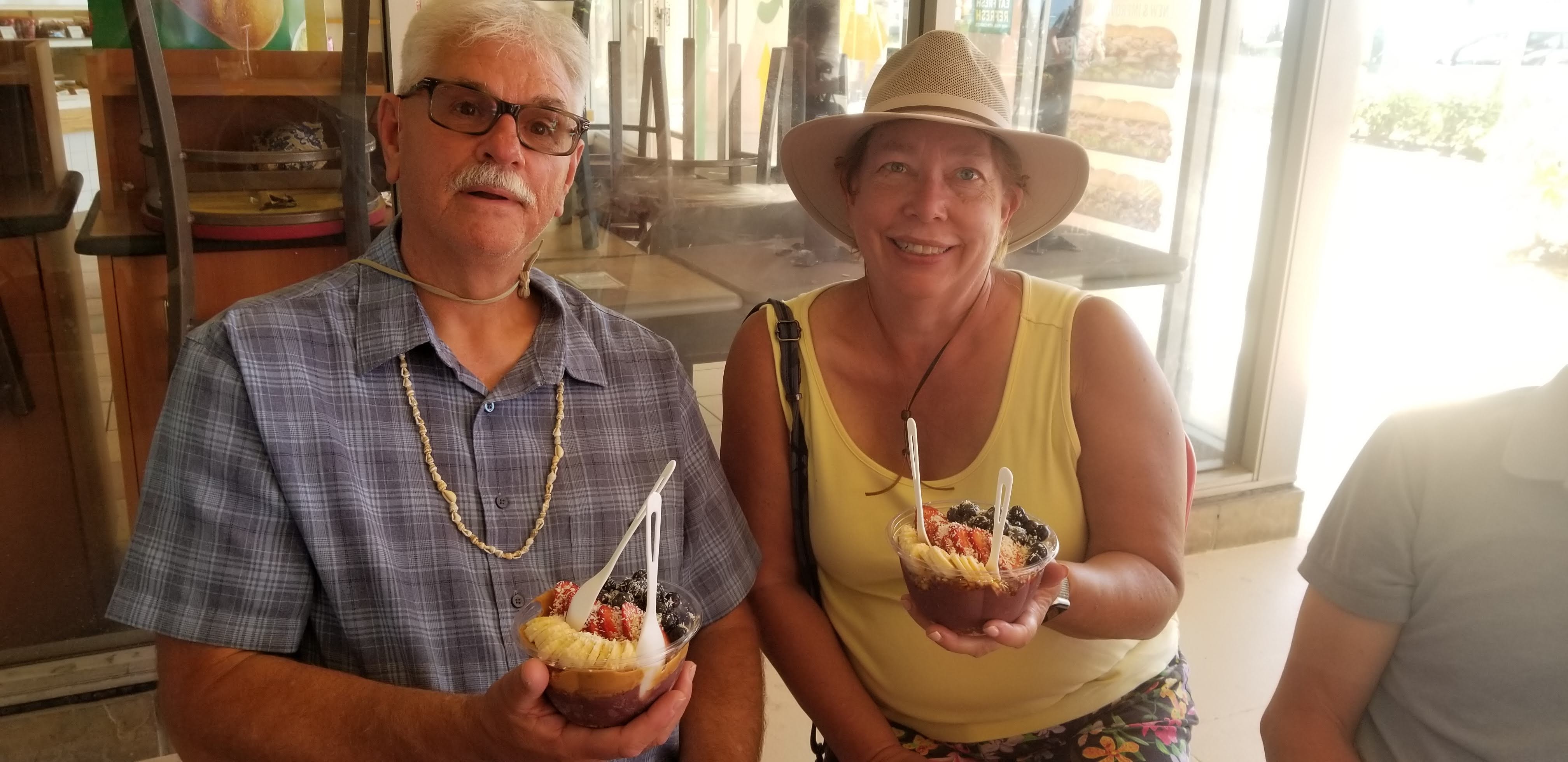
We were all hot and tired, so ice cream was in order. At a little ice cream stand, Kathy talked us into an acai bowl. We had seen these the night before on the beach. Cal wanted some ice cream and we saw a sign that said “healthy treats”. Cal and “healthy treats” just don’t go together, so we passed. With Kathy’s recommendation, though, we gave it a try. The bowl that Cal and I shared had organic acai, blueberries, strawberries, bananas, granola, honey, coconut, and peanut butter, and it was delicious.

Cal and Kathy with their acai bowls

A few days later, we met up with their whole family for a whale watch. Whale watching, if you’ve never been, involves a whole lot of waiting for whales to show themselves. And when they do, it is breathlessly exciting. There are many whales in the waters off Hawaii right now. It’s their winter break, and they come to mate, calve, and nurse their young after making the 3,000 mile trip from Alaska. They’ve been gorging themselves in Alaska, and don’t need to eat when in the warmer waters of Hawaii. On a whale watch, the boat is required to maintain a 100-yard radius from the whales when they are seen.

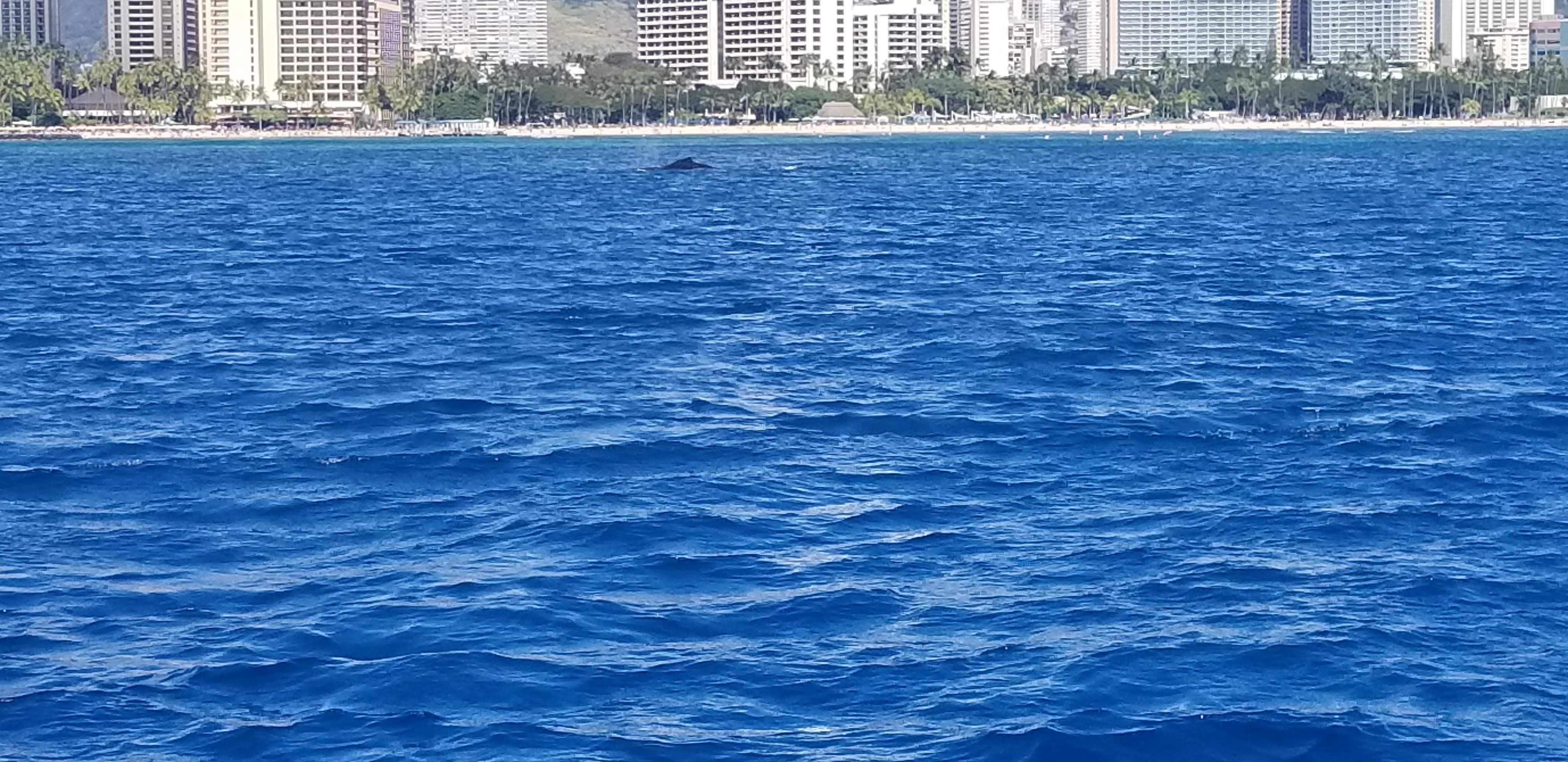
The first indication that a whale is nearby is the puff of water that is coming out of its blowhole. They are above water only briefly unless you are lucky to see them totally jumping full body in the air. I’m a very amateur photographer, and all I have on hand at present is my phone. I try to be prepared for that special moment but what I get is a whole lot of pictures of nothing but water!

See the whale in the water?
I got the whale’s tail this time!

The whales were hanging around not far off of Waikiki Beach and the one we were watching came very close to some kayakers. If a whale is spotted, boats have to stay outside a 100-yard radius to watch it. Nothing can stop the whale from coming closer to the boat, however. We weren’t that lucky this time.

While waiting for whales and enjoying the boat ride, though, it was fun to get pictures of the family, and Kathy and John’s very cute granddaughters, Hanna and Kate.

Hanna and her Dad, Nick. Photo Credit: Kathy Jarvis
Kate, the ship’s captain! Photo credit: Kathy Jarvis
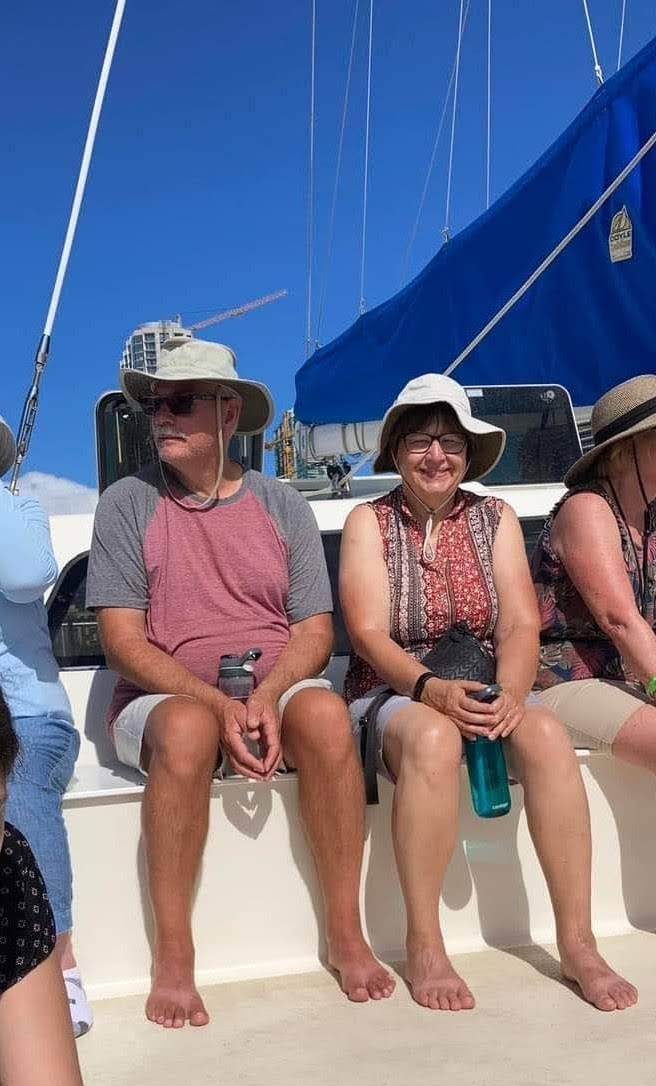
Enjoying our whale watch! Photo credit: Kathy Jarvis
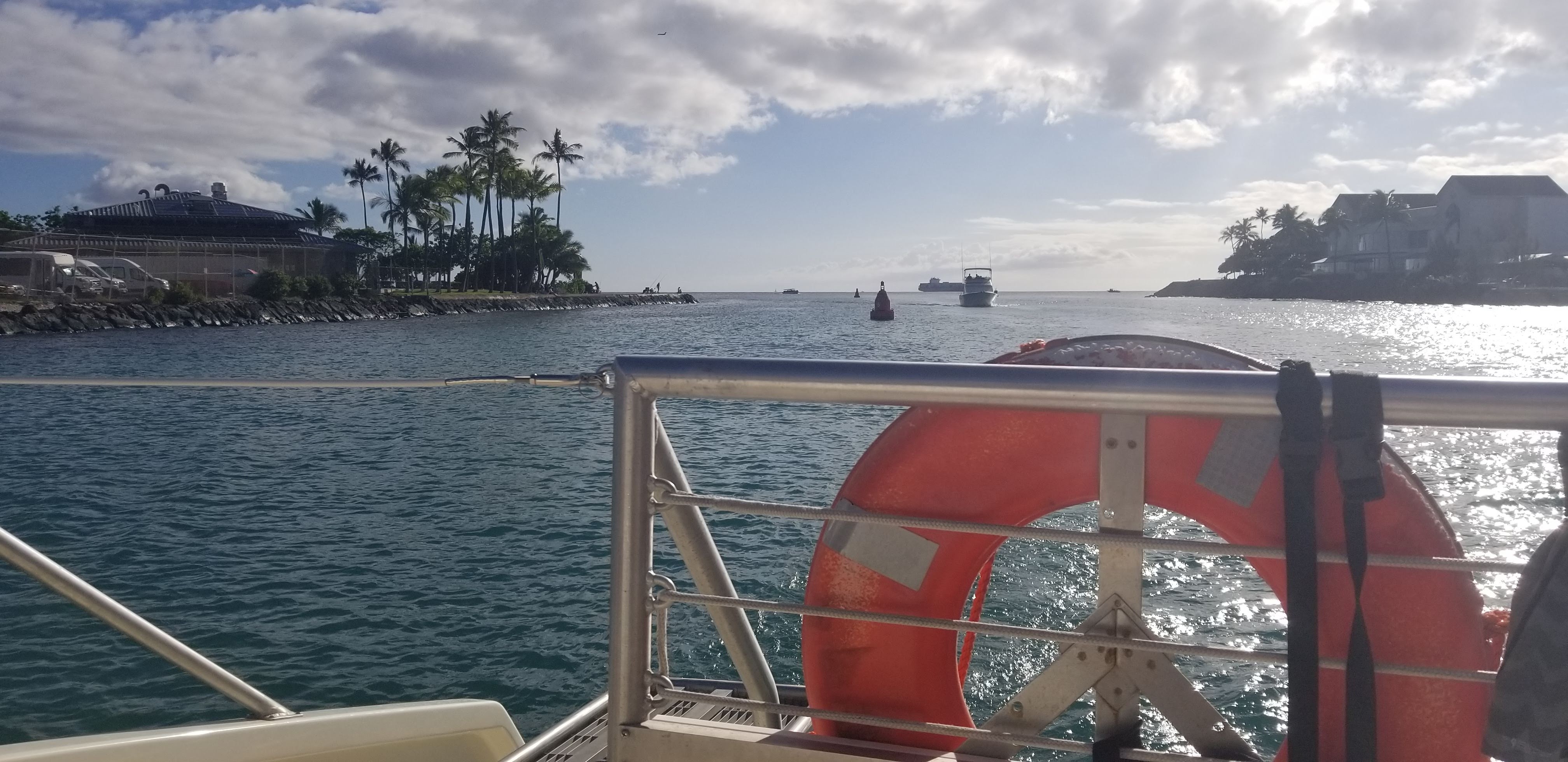
Coming back into port

The Hawaiian word for humpback whale is kohola, with a line over the a. Their culture sees the whale as an ancient being, revered as a physical manifestation of Kanaloa, god of the sea.

Next time – traveling to Oahu’s north shore