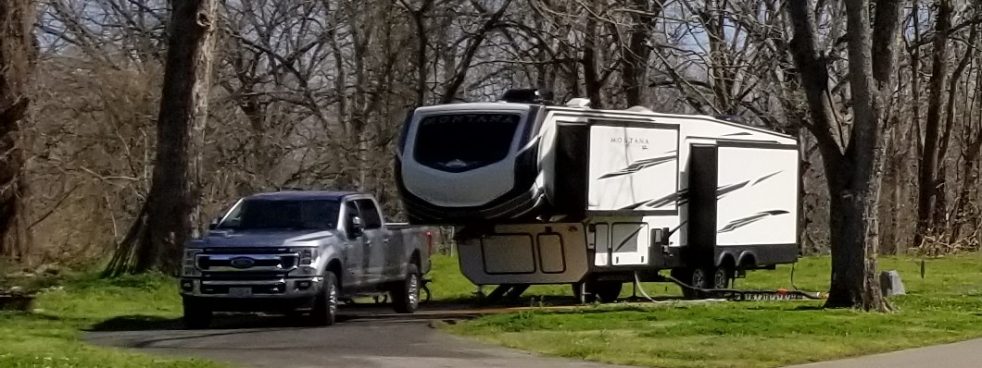
Sitting on the border of Nevada and Utah, Great Basin is one of the least-visited national parks because of its remoteness. It sits right off of State Route 50 (the Loneliest Road) near Baker, Nevada. We parked for two nights so that we could visit it.
Looking through the museum in the visitor center, I learned something that was fascinating. An area that covers almost the entire state of Nevada and west to the Wasatch Mountains in Utah is a huge basin. Water comes in the form of rainwater and snowmelt and flows through the streams and rivers, but never leaves the basin. Sort of like the milk at the bottom of your cereal bowl. The National Park is but a tiny microcosm of it.
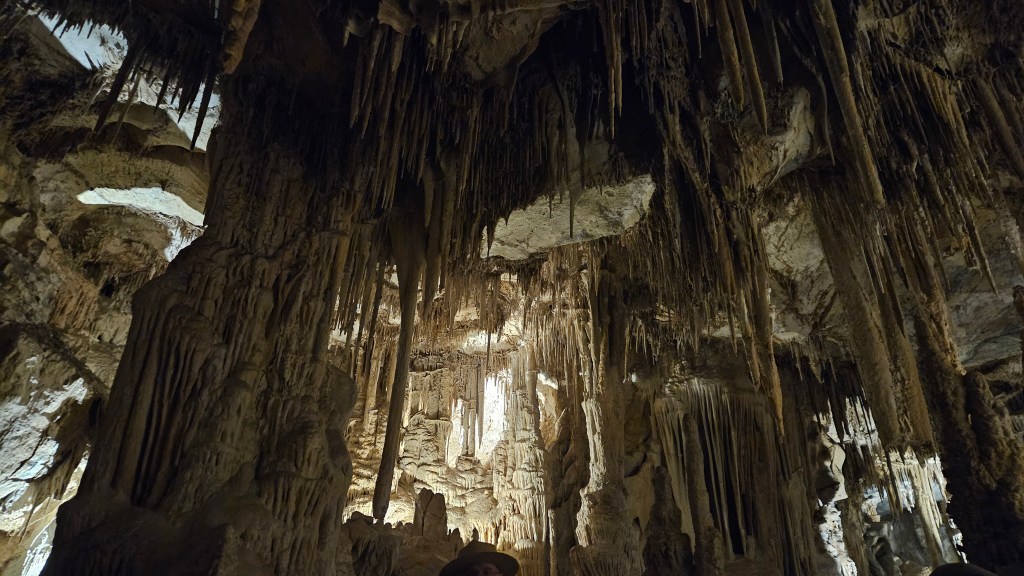
Some of the Basin’s moisture has dripped into Lehman Cave, a feature of the park that we were able to get a tour for.
Every cave that we’ve visited has one or two things that differentiate it from any other. Lehman has 1,107 “cave turnips”. Only a dozen caves have them world wide, and they date back to the Ice Age. A cave turnip is a stalactite with a bulge in it. There are two of them in the picture below; can you spot them?
Out of the cave, we drove up the scenic drive, stopping at a couple of view points. Here was a flip side of the view that we had been seeing for the last couple of days.
At Mather Overlook, we could see another basin, this one carved out by a glacier.
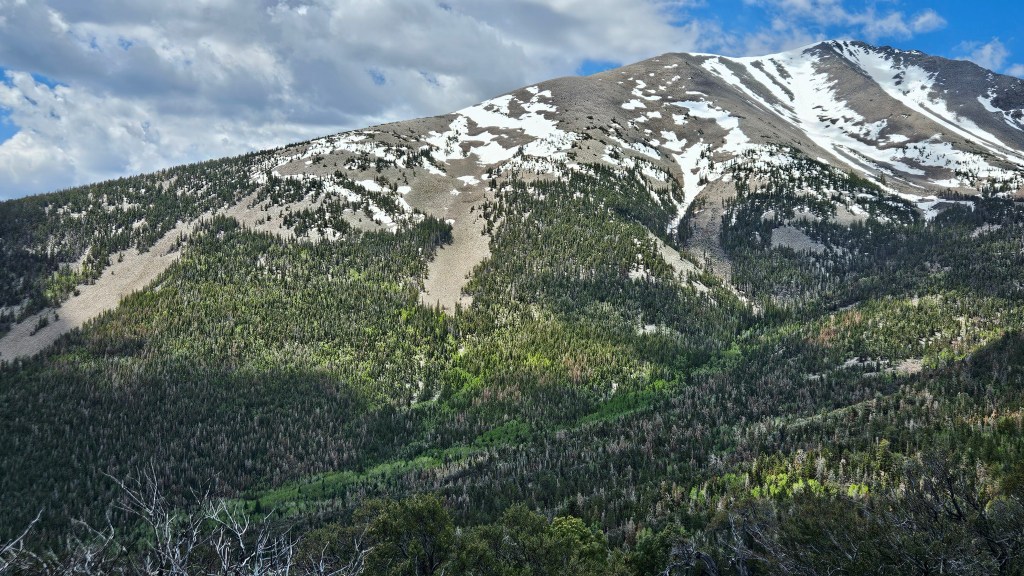
We topped out at 9,886 elevation on Wheeler Peak, although it was not the tippy-top of the mountain. The road ended here, and we stopped for a little hike.
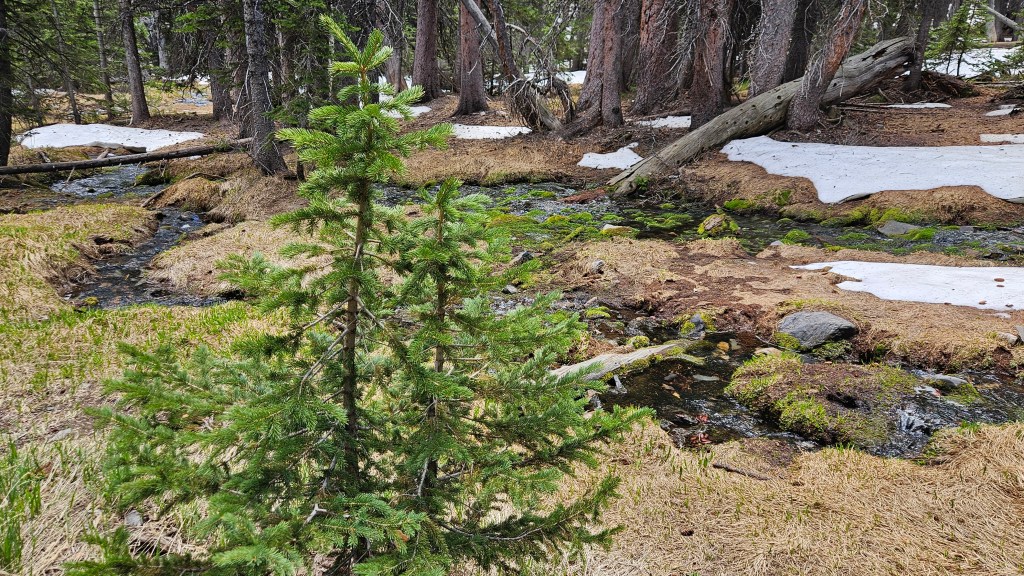
Melting snow created a wonderland of waterfalls and rushing streams. The sound of flowing water and the chirping of the birds made a nice backdrop for a lawn chair lunch.
Although this is a smaller national park, it is nice not to have all the crowds of the more dramatic parks we have been to.
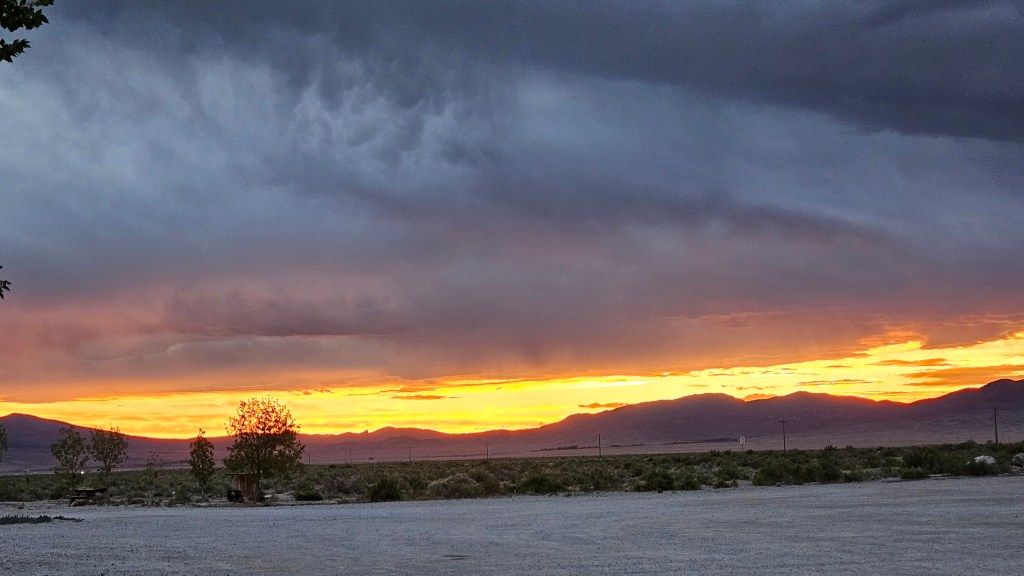
Back at our RV, we admired the clashing fronts happening in the sky – dark clouds rolling in but still blue to the west, from which we had come. There was intermittent wind and splashes of rain. It was a relief from the heat.
Also looking west–the official Lonely Road sign.
I wandered around in the desert a bit.
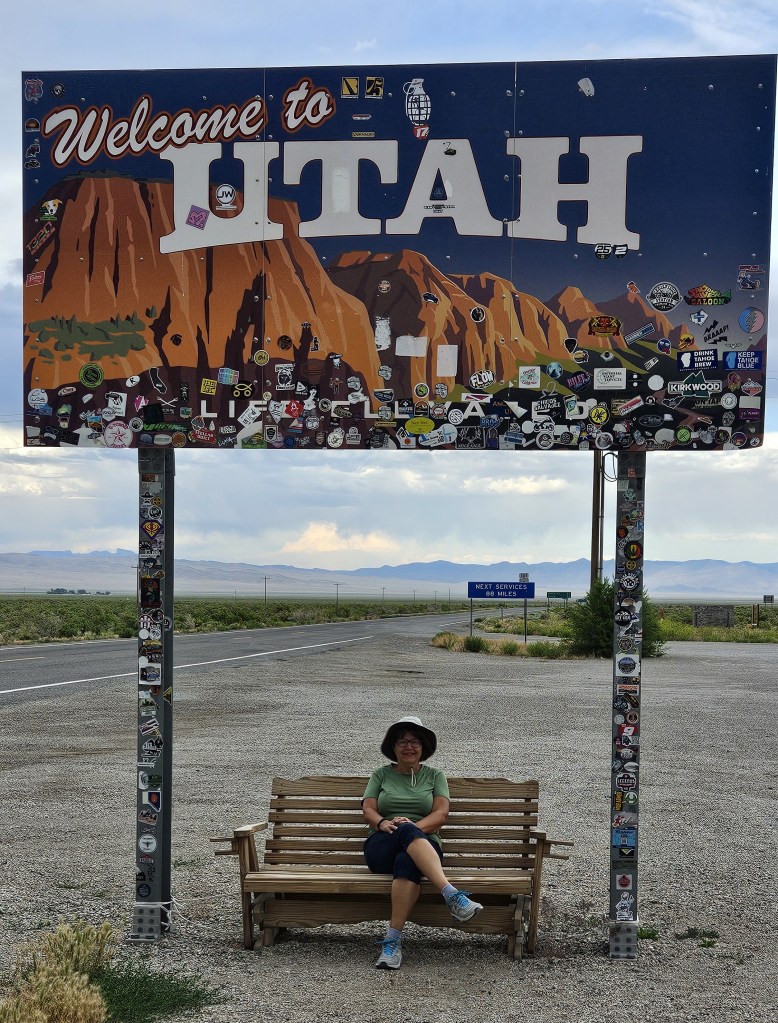
In the morning, we drove about a second before we were in Utah and Mountain Time.
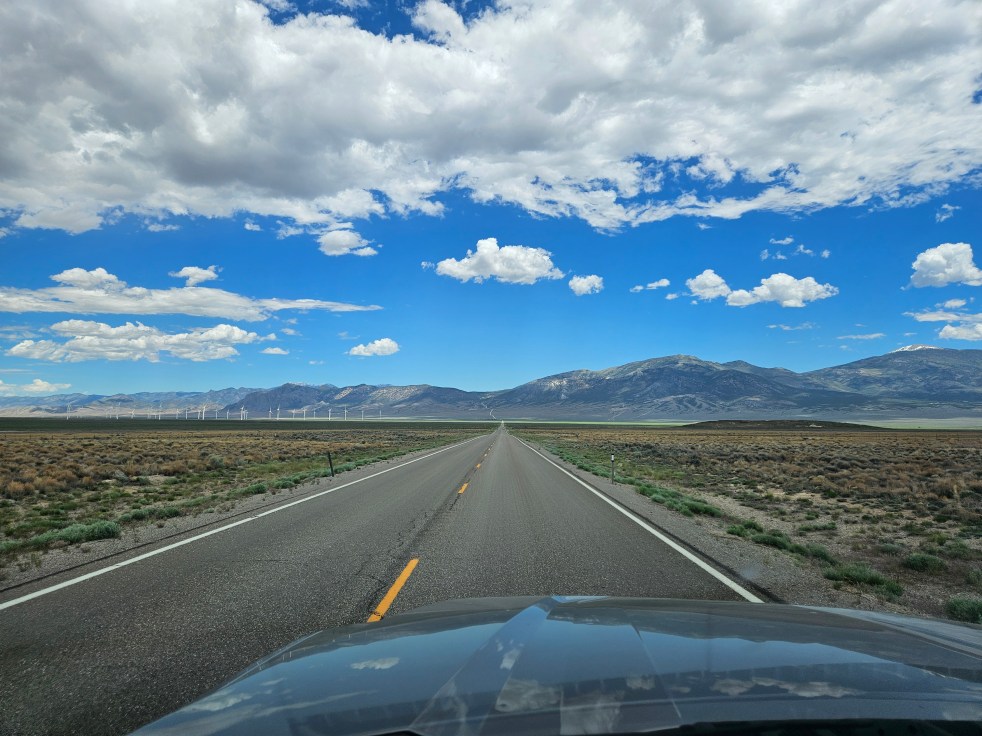
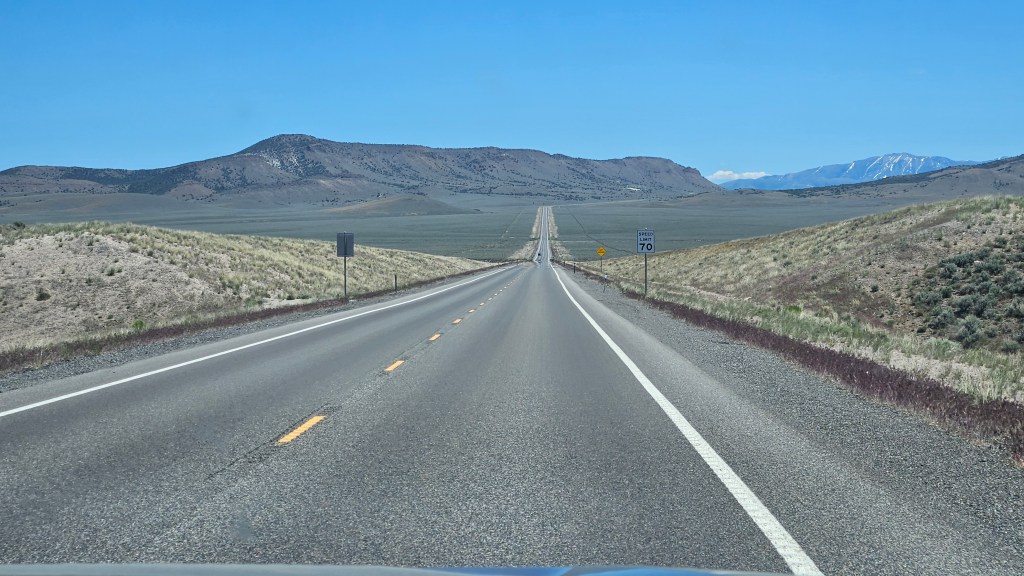
And still, the road went on.
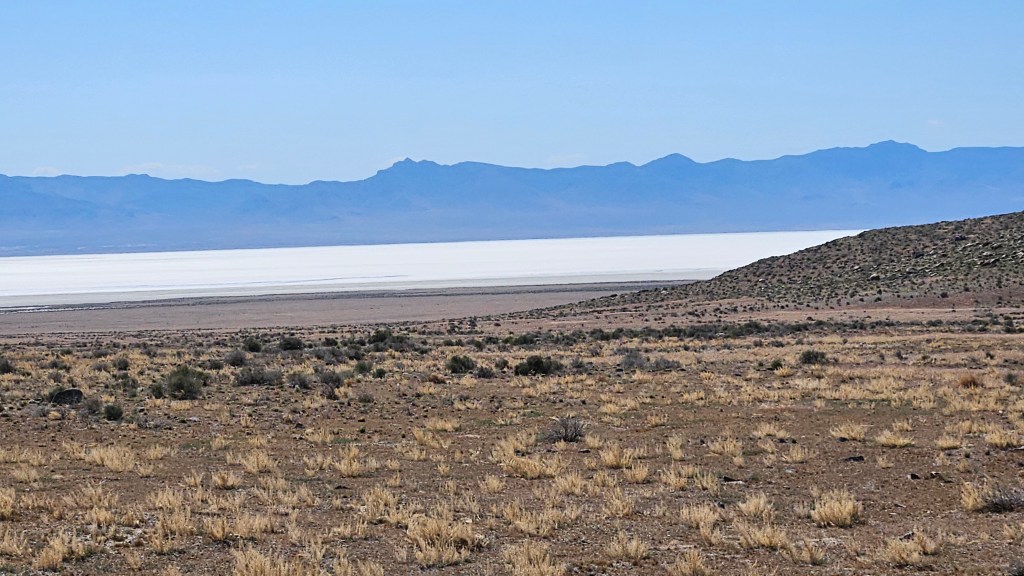
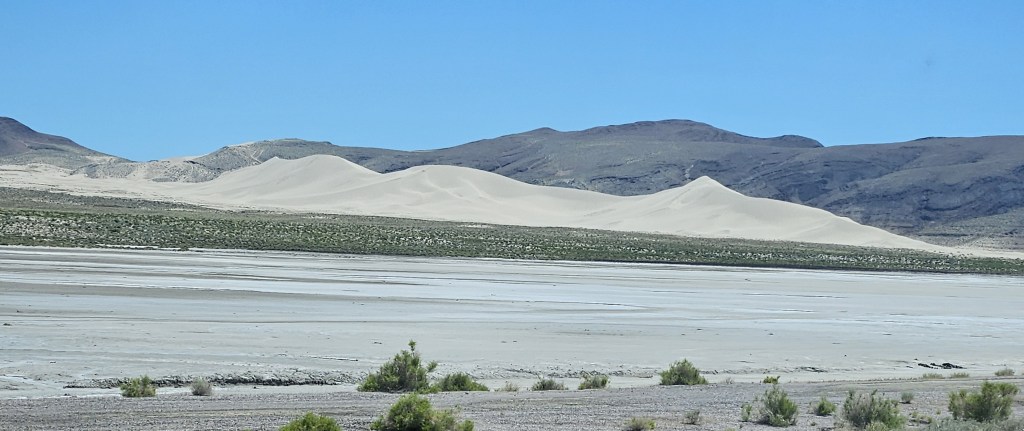
The western side of Utah was prettier than I thought it would be. We climbed up a pass and went down into a rocky gorge. Then, there was something that looked to be a huge dry lake covered with sand, or maybe it was a salt bed, and it went on for miles.
I looked at my paper Utah map, and it was noted there as Sevier Lake (Dry).
We climbed out of the Wasatch mountains, and we were out of the Great Basin. Our stay for the night was an RV park in Salina, Utah. The only thing memorable about this park was that the owner kept a huge flock of chickens, and she gave us a complimentary dozen eggs in several colors. Today, I’m not sure if she wouldn’t have charged us for them, because they are pure gold!
Highway 50 ended here, and we were now on Interstate 70. Route 66 may be called “The Mother Road”, but to me, I-70 is the Mother Road. I’ve either lived a large portion of my life not far from this highway, or I’ve driven on it through many states countless times to vacation or visit family. I think, though, that this was only the second time we’d been on it at its western origination.
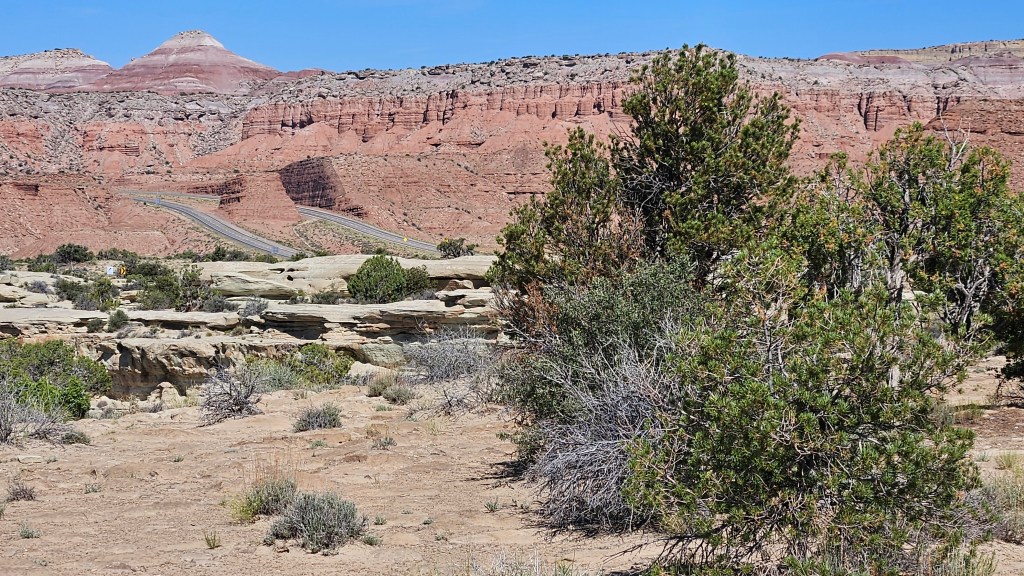
Interstate 70, looking like ribbons through cut rock, is on the upper left of this picture
We were now entering a spectacular area with towering rock monuments, rock pillars and canyon vistas. It was almost as good as going through the Utah national parks. Actually, Arches National Park is somewhere to the south of this view. There was even a turnoff, Salt Wash Scenic area, to take in the view and enjoy a picnic lunch.
The parking lot was packed and I felt really happy that this stop off was here. It gives people a small taste of the state’s wonders, even if all they can do is zip through it.
Next time – a few days in Western Colorado
Note: although I am writing this during the winter of 2025, the trip actually occurred in June 2024.
In 1986 a Life magazine article dubbed Highway 50 in Nevada “The Loneliest Road in America”. It’s a pretty desolate stretch of two-lane highway, with miles between services. The pictures I’ve seen of the scenery along the roadway looked intriguing and I always thought it would be fun to ride it to see what it’s all about. “Desolate” is a word that in my language means “enticing”.
Cal is the driver of our journey and after looking at the map, he thought the drive would be OK. It’s a truck route, after all. So we headed east on 50 from Nevada’s western side at Washoe Lake State Park. There was nothing lonely about it for the first 60 miles or so. Construction and lane closures caused line-ups and slowed traffic, especially in some small towns we passed. Finally, we left everyone behind. The view was of salt and sand, pretty mountain scenery as we went up and down passes, a large flooded lake. We saw horses and a pronghorn antelope.
Along this stretch of road people had used rocks to leave their markon the salt flats
Color contrasts on the desert floor and hills of sand
I had read ahead of time to look for a sign that said “BAR” in big red letters. Like a desert mirage, it soon appeared.
This was to be our lunch stop since this place has a reputation for delicious juicy hamburgers.
Middlegate was so named back in the 1860’s for Overland stagecoach trail that was cut through the mountains. Huge rocks on either side of the blasted trail formed the “gates”. This was a stagecoach and freight station until the early 1900’s, and for a brief time it was also a Pony Express stop. The hamburgers here lived up to their reputation.
After lunch, the road went on.
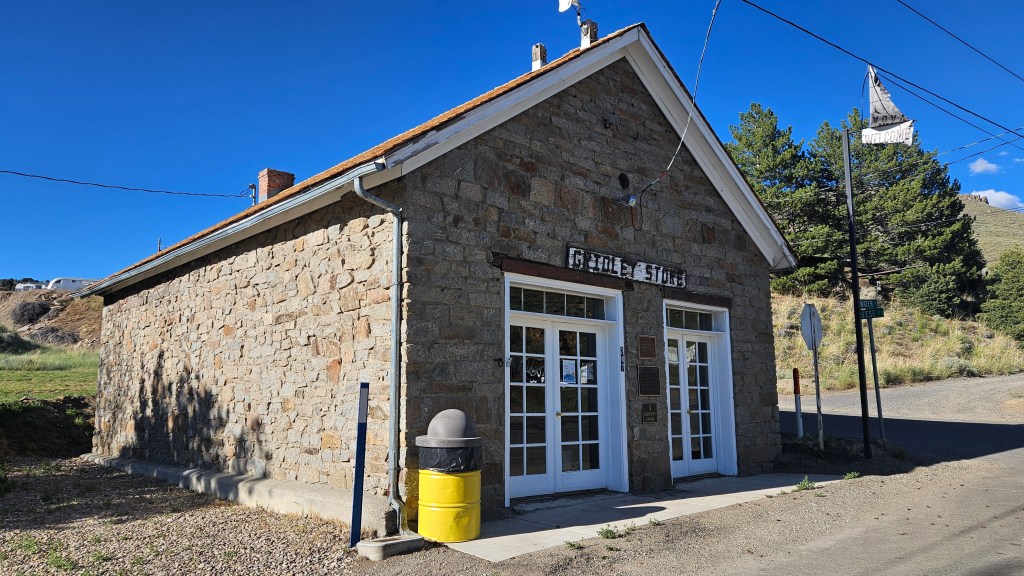
Our stop for the night was in Austin, Nevada. Summer weather had finally caught up to us, and it was hot. I had thought that after parking we might explore this tiny town, but we were perched on a cliffside and nothing looked inviting enough to cause us to want to sweat. The RV park was advertised as being next to a city park, which it would have been if not for the hill. We did walk down the road a bit to peer in the windows of this old general merchandise store, opened in 1863, which happily has been turned into a library.
Here was our first sighting of the invasion of the Mormon crickets. There weren’t a lot of them as they marched off to the side of our RV. At first I was fascinated, but in the morning I was happy to put Austin behind us. As we drove, we saw hordes of them crossing the roadway in places, staining the entire roadway red where they had been smashed.
**Fun fact – Mormon crickets are actually shield-backed katydids. They received their nickname after they destroyed the early crops of the Mormon settlers.
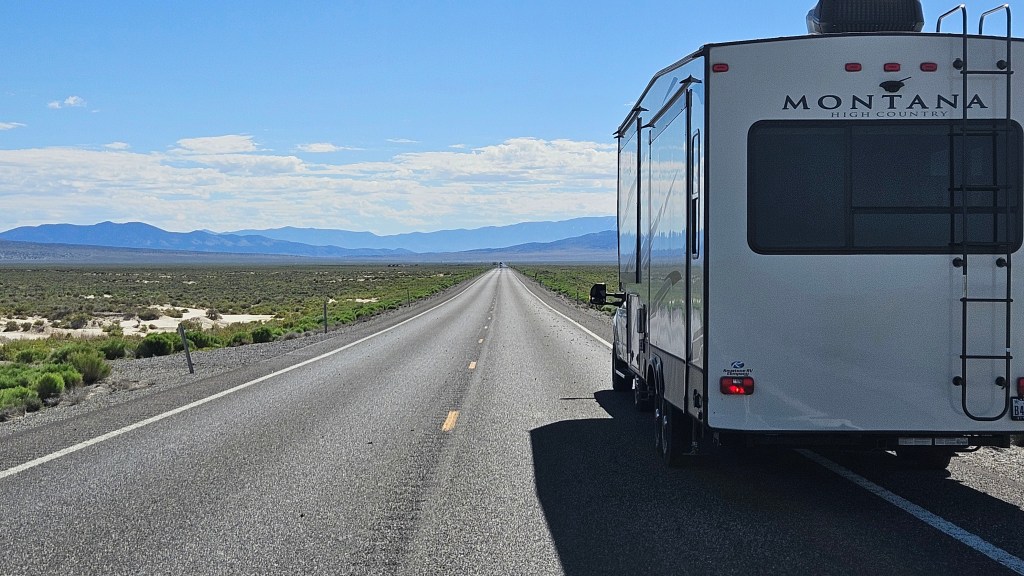
Not too long after leaving Austin, Cal discovered that the rubber seal around our RV door was flapping. He stopped and made a five-minute fix. That was enough time for me to hop out and take some pictures, and I noticed that the desert floor was alive with the movement of the crickets in a steady stream, north to south. Where were they going? They aren’t visible in this picture but trust me, they were there. I’m happy to report that this was the last sighting.
In Ely, Nevada, we stopped for a picnic lunch in the city park, and the sight and smell of the green grass was intoxicating. In the other direction from this view, some folks were engaged in a dog obedience class that provided us some entertainment. The far end of the park had a small duck pond.
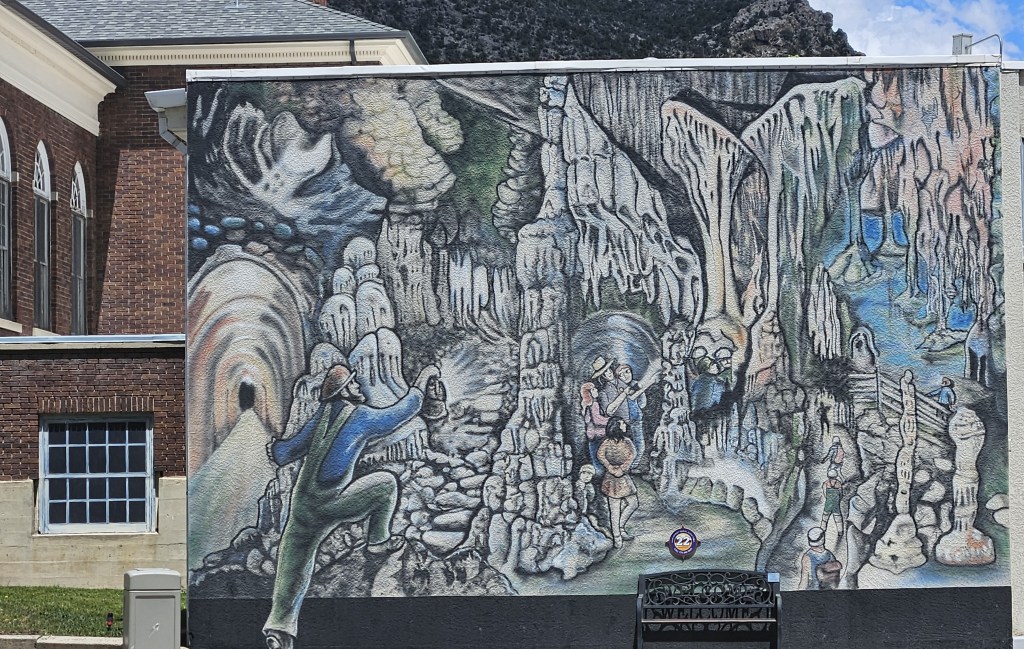
A glimpse of a mural can just be seen in the back of the photo above. There was another mural across the street, depicting explorers and visitors to Lehmann Cave in Great Basin National Park. Altogether, there are more than twenty murals in this town.
I would have loved a closer look at Ely’s downtown and to hunt for more murals, but it was hot and we were still on the move.
Our drive today involved ascending more mountain passes, descending through junipers and pinion pines, and back down to fragrant sage deserts. More jaw-dropping scenery.
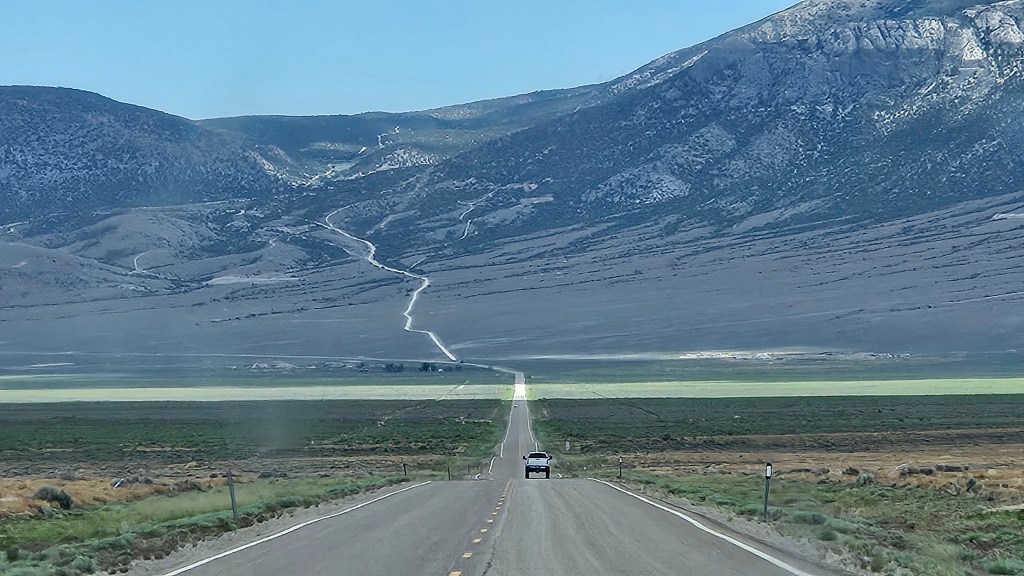
From a great distance, we saw a road snaking impossibly up a mountain side. Were we really going to have to go up there? Relief: as we got closer, our road revealed itself: no, we were happily going to veer off to the side. This turned out to be the backside of Great Basin National Park.
At the end of the day, we stopped for the night just inside the Nevada-Utah border. We had been generally trouble-free for a long time. But after arriving we discovered that a road-striping truck had splashed yellow paint on the lower front of the RV. To add to that mess, it was covered with red sticky Mormon cricket goo. Inside the RV our fire extinguisher had come off the wall, rolled under a strip of molding, and in the process of opening the slide, had pulled the strip off the wall.
Trouble comes in threes. Some tubing under the bathroom faucet had leaked and flooded the basement. Cal kept his good humor and everything was cleaned and repaired. It’s a good thing this doesn’t happen often!
Storm clouds at sunset in Baker, Nevada
In 2024 (or 2025), would State Route 50 in Nevada still be considered the loneliest road in America? It’s probably debatable, but I do know that it provided us with a lot of grand vistas and new sights on our journey through it.
Next time – we visit Great Basin National Park
Note: although I am writing this during the winter of 2025, the trip actually occurred in June 2024.
Silver! The Comstock Lode was discovered in Virginia City in 1859, and the boom was on. It was the first major silver deposit found in the United States. Mines opened and the town grew to a population of around 25,000 ten years later. The growth in this town is what led the state of Nevada to statehood.
It had been a while since we’d ridden a train, so upon our arrival here we decided to take a ride on the diesel-powered Virginia and Truckee Railroad to start our day.
The train was originally built to haul the ore out of the Comstock Lode Mines, as well as other building materials and supplies, and went all the way to Carson City. Now it hauls tourists on a round-trip venture down to Gold Hill, a tiny town where the first of the silver lode was mined.
Our conductor and guide shared names of the mines and some of their stories as we rode.
You can see the train tracks just above this long-gone silver mine
The town of Gold Hill was so named because gold is what was found here first.
After riding the train, we wandered along the boardwalk through town.
If for some crazy reason you didn’t find anything of interest to see in Virginia City, you could at least wander into the candy shops and have a treat. Your favorite must be in here somewhere!
Mark Twain had a job as a newspaper reporter in the 1860’s. He wrote about his Nevada years in the book “Roughin’ It”. There is a museum dedicated to his time here, but it is being reconstructed.
Of course, in a town such as Virginia City, there are several mine tours that one could take in while visiting. We wandered into the Ponderosa Saloon, and a tour of Best and Belcher mine is available (for a fee, of course) once you walk straight back past the bar. Who could resist?
A hapless miner displays various drilling tools in the Best and Belcher Mine.
This mine was dug for gold, but it was not profitable. Not, that is, until the present-day owners of the Ponderosa realized that this shaft entrance was steps from their saloon. We enjoyed this informative 25 minute tour.
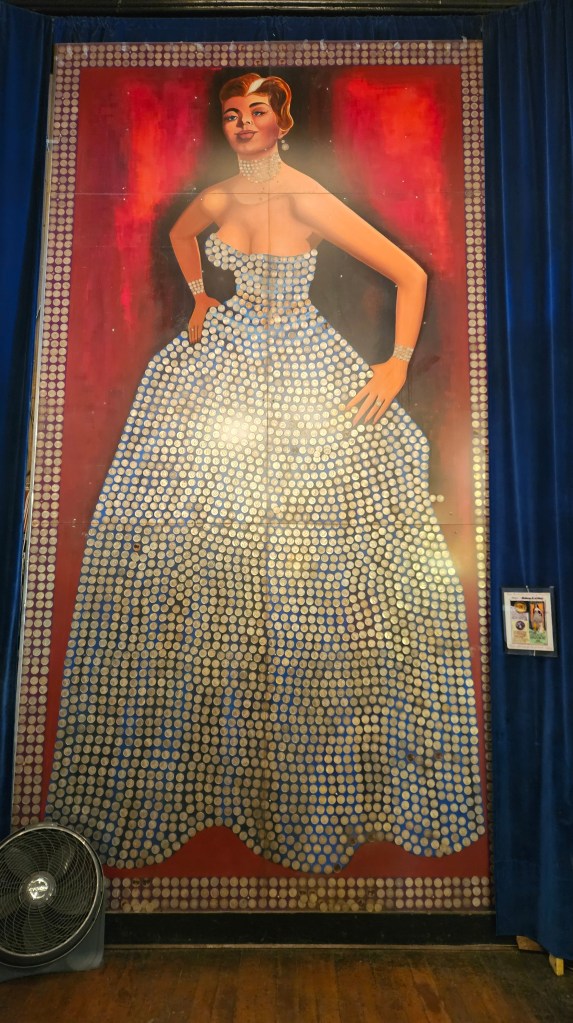
Not that we are saloon hoppers by any means, but down the street at the Silver Queen saloon, we could see a 16 foot Queen made out of 3,261 silver dollars. This lady weighs 210 pounds and the coins are all Virginia City silver. There is a wedding chapel in the Silver Queen too, in case you want to get married after you see her.
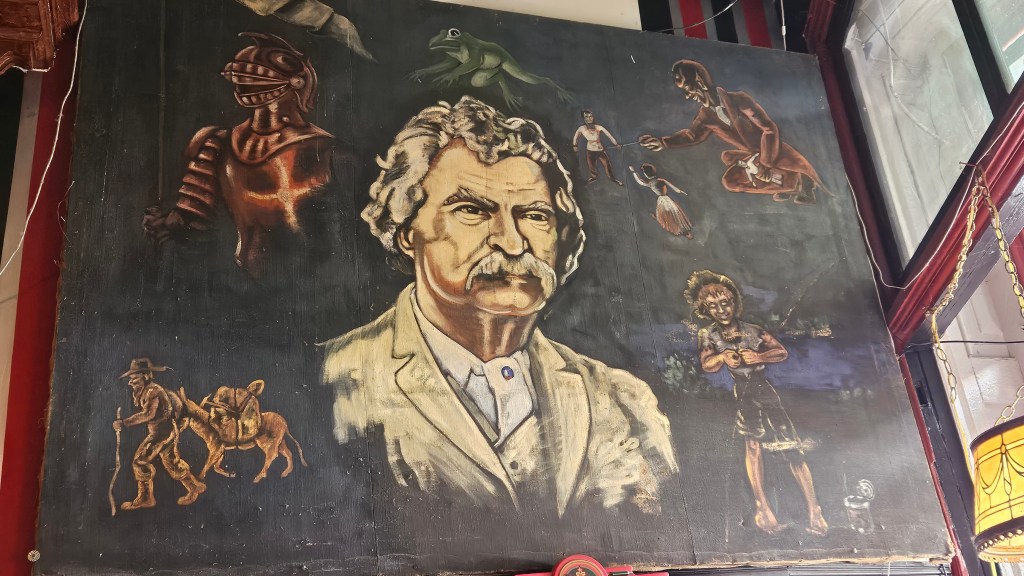
I also liked this tribute to Mark Twain inside the saloon. Samuel Clemens used the pen name of Mark Twain for the first time when he lived and worked here.
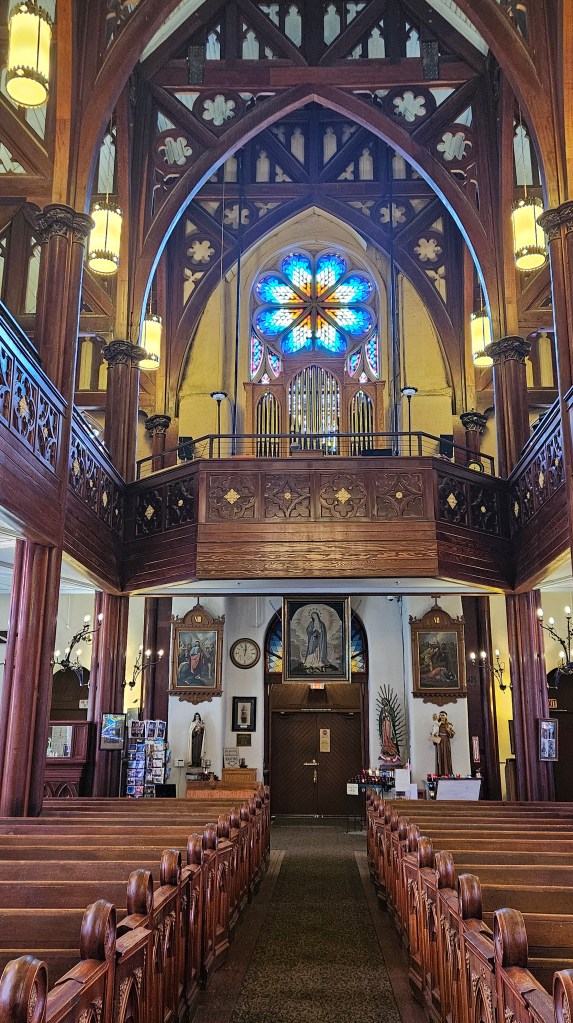
We visited two other places in Virginia City. The first was St. Mary in the Mountains, Nevada’s oldest Catholic church. The number of Irish immigrants working the mines necessitated its original construction. It outgrew that one and a new building burned down during a huge fire that decimated the town. The church was rebuilt with bricks in 1864.
Looking from the nave to the entrance of St. Mary’s in the Mountains
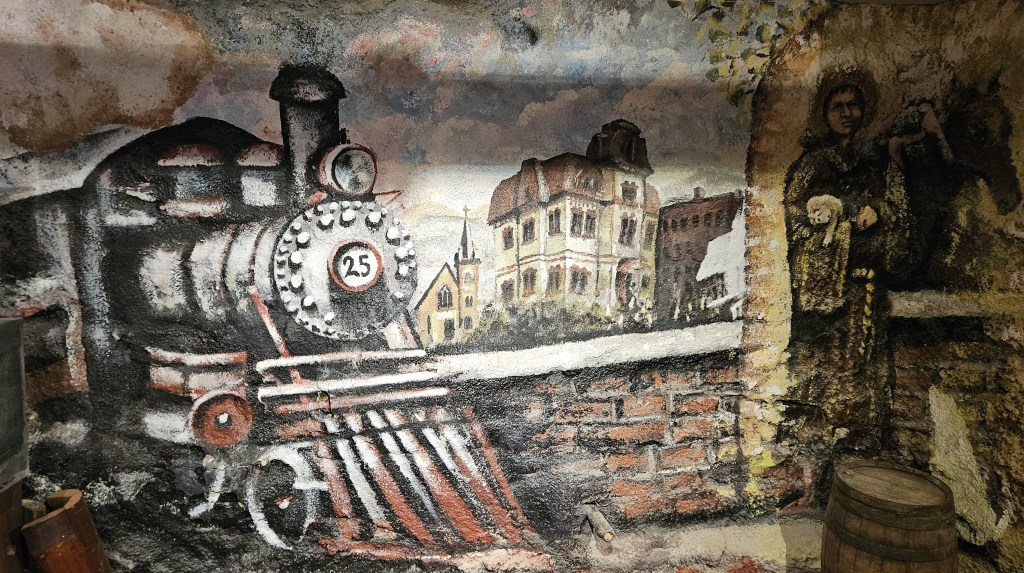
Our train conductor had touted the museum in its basement, and also the fact that they sell wine down there. We couldn’t figure out what happened to the wine, but the paintings in the wine cellar were splendid. The museum held many ecclesiastical treasures.
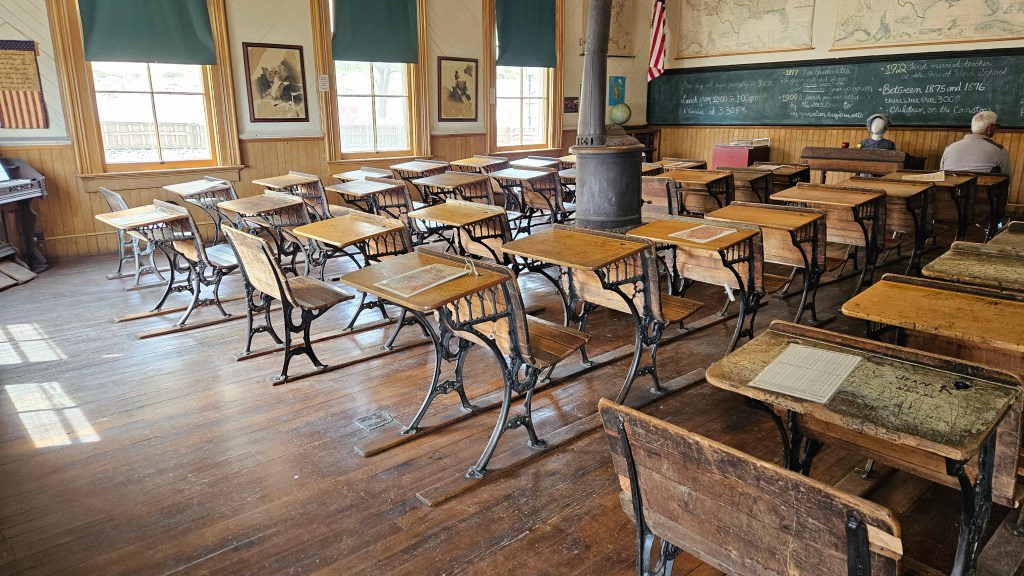
Our last stop of the day was at the old schoolhouse, renovated and turned into the Historic Fourth Ward School Museum. It’s painted into the center of the picture above, and shown below as well.
The children of immigrant miners, wealthy mineowners, town professionals, the shopkeepers, and other residents of the town crowded into this school. There were 3,000 children living here in 1875! Here’s all the facts:
This four-story, Victorian-era school building is the last of its type still in existence. Children from young elementary all the way up through high school attended here. One room was set up exactly the way it was back in the day. Yes, that’s Cal in the front row.
Here is the first grade class in the 1890’s. Note that there is only one teacher for all of these kids!
Other school rooms contain displays of Virginia City history. Here is a piece of Comstock ore:
Unexpectedly for us, we spent an entire day visiting this mining town. It is hard to compare mining towns from one to another because they all have their own history, but Virginia City had a lot of stories to tell.
Next time – we head out on a road dubbed “America’s Loneliest”
I didn’t have a clue what Reno would be like, but I imagined something like we’d seen in Las Vegas. Remembering our time there, we knew we didn’t want to drive our truck into the city. We took an Uber instead, and our driver was very chatty. He said that beginning twenty years ago, less people began to come to Reno. Older hotels and casinos closed, and some have been torn down, leaving empty lots. We saw some empty storefronts and boarded up casinos. He pointed out the two or three that were still good places to go. New casino resorts are here, they just aren’t being built much on the old Strip.
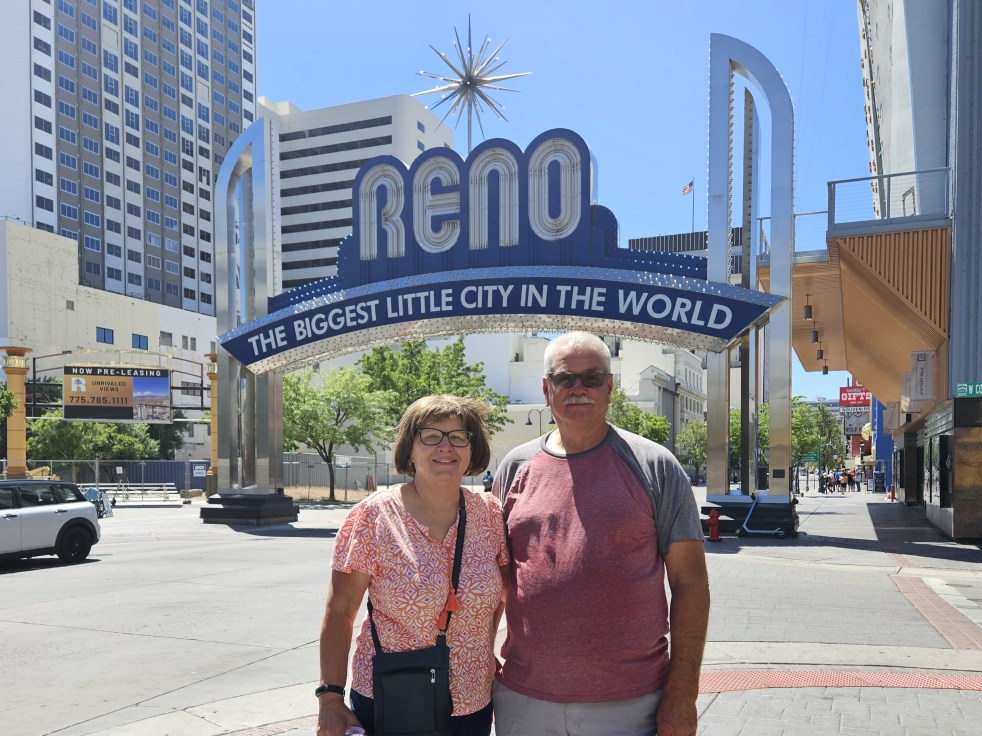
Downloading a walking tour of Las Vegas had been a good idea, so I did the same for Reno. I had our driver drop us off at the Reno sign. Following the walking tour, this meant that we did not walk past any casinos at all, which was fine. The Strip didn’t look enticing enough to check out. And so, this whole day was totally different than I had envisioned.
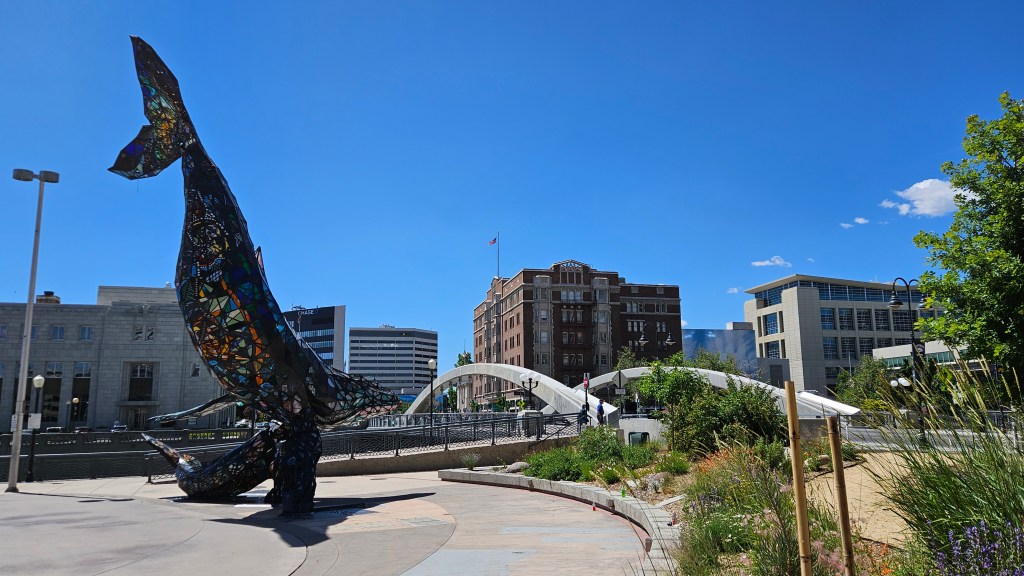
We walked through City Plaza, with the Truckee River flowing by below it.
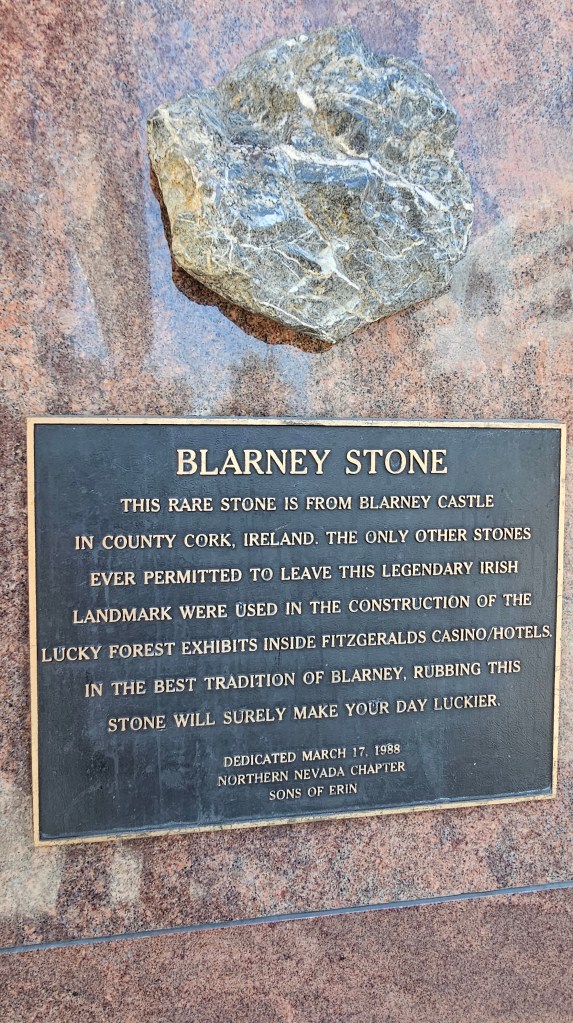
We actually found a piece of the Irish Blarney Stone. You don’t have to go to Ireland to see it!
Tourists in Ireland go through great lengths to kiss the Blarney Stone. I guess here in Reno they thought that just rubbing it might be a better idea.
We looked at the copper-colored geodesic dome of the Performing Arts Center and took a peek inside the old Post Office. Next up was the Riverwalk area which was quiet on a Saturday morning.
We went off-tour through the beautiful city park, where people were floating down the river.
We were off the tour route and passing by the park on our way to Washoe Public House for a delicious lunch.
Back to the tour, we visited the West Street Market. I had looked forward to this, but disappointingly, it was no longer a market. Was this tour written pre-covid? I hadn’t checked the date.
Our last stop was at the beautiful Thomas Aquinas Cathedral. It has a beautiful wrap around mural in the front from the 1950’s, thought to be one of the finest works of art in America.
We had come to the end of the walking tour. Cal was tired of walking on city streets and hot concrete. He was ready to call it done, but I didn’t feel done with Reno. He took an Uber back to the RV park, and I walked back past where we’d had lunch to the Nevada Museum of Art.
At first, I was a little disappointed. It was smaller than I thought it would be, with no permanent exhibits due to construction. But an eager docent took me through an exhibit by Cannupa Hanska Luger, an artist who is of mixed Native and European ancestry, entitled “Speechless”. She made the art come alive with her interpretations of his various pieces.
It was the second exhibit that stole my heart. It displayed the art of Maynard Dixon, who lived from 1875-1946. He painted the West, including Nevada. I love the paintings that I saw, some capturing the red rocks at sunset, and immersed myself in his life and work. He really got the feel of the Nevada landscape. Dixon also illustrated in magazines and books of the day and wrote poetry.
“Mountains in Sunset Light” – Maynard Dixon
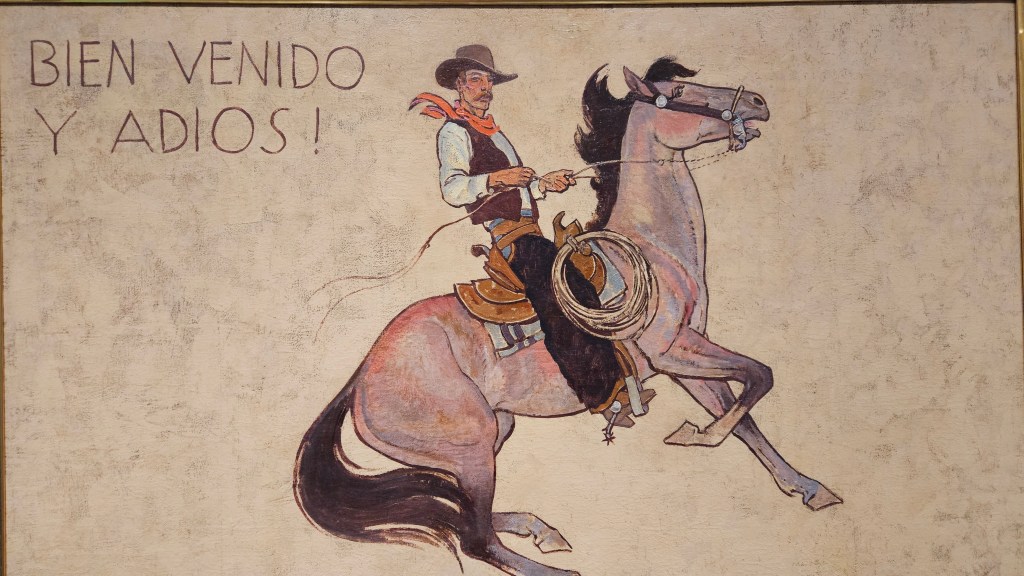
A self-portrait mural, “Welcome and Goodbye!”
The other thing that I learned about him was that he was married for a time to Dorothea Lange, a well-regarded photographer in her own right whose works I have admired. She was the mother to their two sons.
I’m sure the Reno strip would have appeared differently at night. The Riverwalk is regarded as a great place to visit and perhaps have dinner after taking in the casinos. But we did not return.
It had been a short stay at the park in Sparks, outside of Reno, and one of our nights had been out of the RV in South Lake Tahoe at a lodge. But I was happy to move on, especially since the next three nights were a grand total of 32 miles down to Washoe Lake State Park.
We had a beautiful spot here–
–with beautiful views of the Sierra Nevadas. The lake that gives the park its name was between our RV and the mountains. Scrubby hills lined with cedar trees were behind us.
All of this would be very fine, in and of itself. But the thing that makes this park extra special is the wild horse herd that lives here.
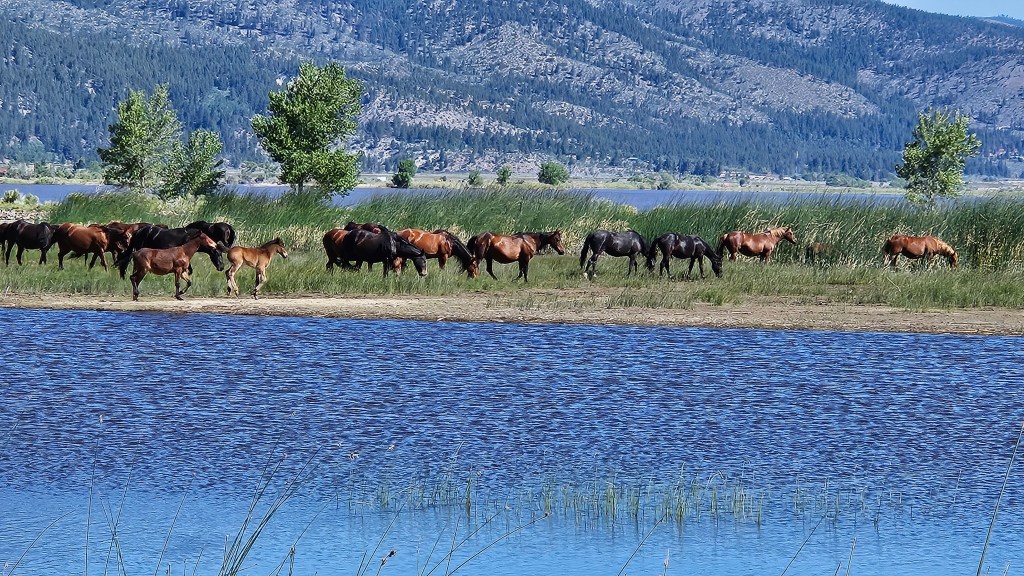
We’d seen them as we’d driven in and out of the park. One morning we drove the truck out to a trailhead to hike in order to see them closer. From the path, we watched a group of horses.
In the distance, we saw a larger group having breakfast lakeside. The two colts on the front left were frolicking and running together so they were fun to watch.
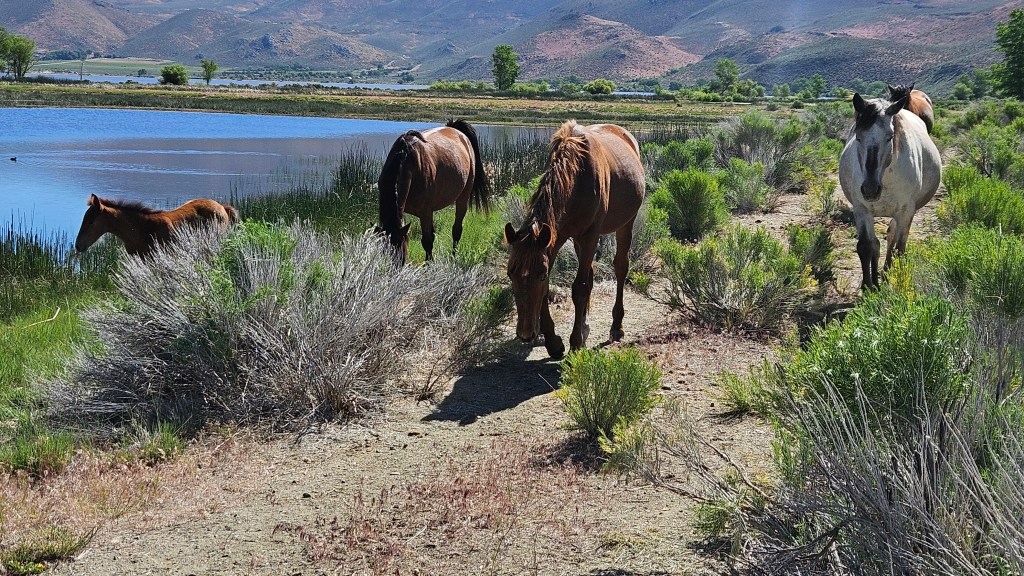
I was busy photographing them when Cal came up and said in a low voice, “You might want to turn around.” The first group was coming up right behind us on the path! They did not seem to have any fear of us, but were definitely minding their own business as they clip-clopped by.
Seeing so many horses in this gorgeous natural environment was a real treat. Afterwards, Cal drove the truck back to our spot but I opted to take a long hike back. Horses were still in view. There was a group hanging around the restrooms at the picnic area. It must be true what they say…the grass is always greener over the septic tank?
For a time, I was walking along the Washoe Lake shore, where a lone horse was doing the same.
In all, we had sighted over 60 horses on this morning.
We never know what lies around the bend on our travels. Some sights are not quite what we think they will be, but others go over and beyond our expectations. That is the surprise and the gift of the journey.
Lake Tahoe is a place I’ve long wanted to visit, although my husband says that everywhere is somewhere I’ve always wanted to visit. That may be true, but it was still a very exciting moment when I stood on the shoreline and gazed at the clear blue water.
It had been a long drive back into California from where we left our RV on the east side of Reno. I hadn’t been able to find available RV parks any closer, although I had looked months earlier. In a rare occurrence, I was at the wheel, and enjoyed driving on the winding roads along mountain sides and pine forests until we arrived at the lake.
The picture above was taken at one of the first small turnoffs we came to.
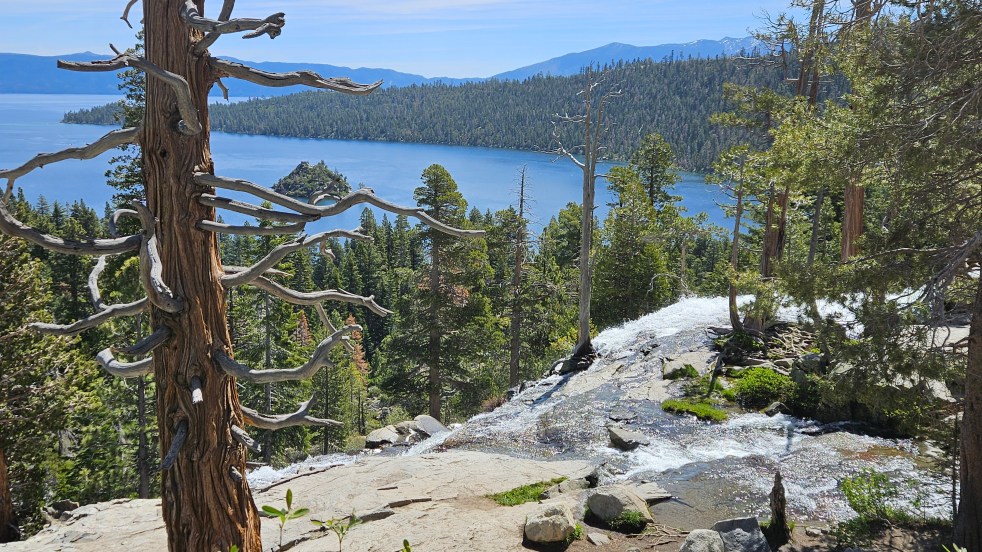
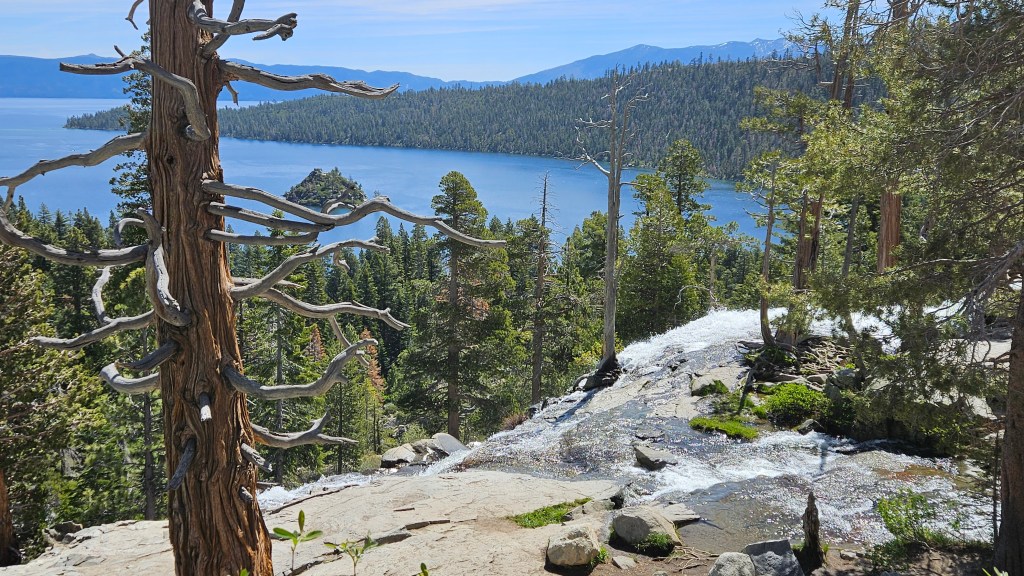
Our first actual stop was at Eagle Falls on Emerald Bay. We were on top of it in the picture below, and the falls are on the right of this picture. The little island in the water (above the tree limb) is Fannette Island.
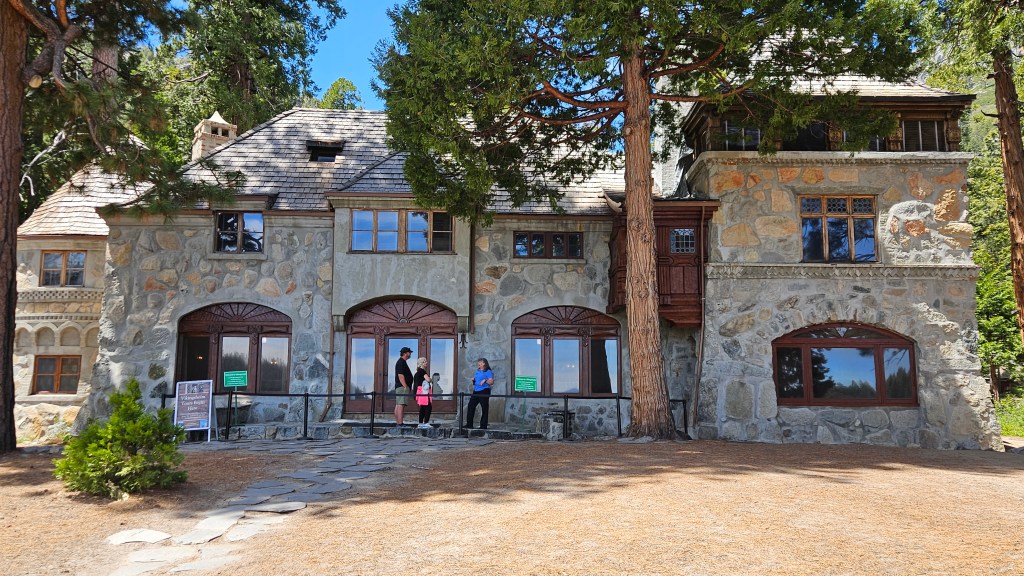
Lake Tahoe didn’t receive the early protection from development that Yosemite did. In the early 1900’s, wealthy folks purchased swaths of land and built homes along the lake. One of these was Vikingsholm, considered to be “Tahoe’s Hidden Castle”. If you enjoy Scandanavian architecture, it is considered to be one of the finest examples in the United States. We decided to take a tour of the home.
First though, we had to walk one mile downhill in the gorgeous pine forest on the old road, now a path, to the house. Views of the lake abounded. We were acutely aware that we were going to have to walk this same mile up when we were done!
The home was built for Lora Josephine Knight, a widow in her 60’s. A house had already been here since the late 1860’s, and a later owner built cabins. The land was cleared to build the home but Lora did not want one single tree cut down in the construction. She had traveled to the Scandinavia many times and Emerald Bay reminded her of the fjords there. Her niece’s husband was a Swedish architect who designed the home for her in that style. It was completed in 1929, and became her summer home.
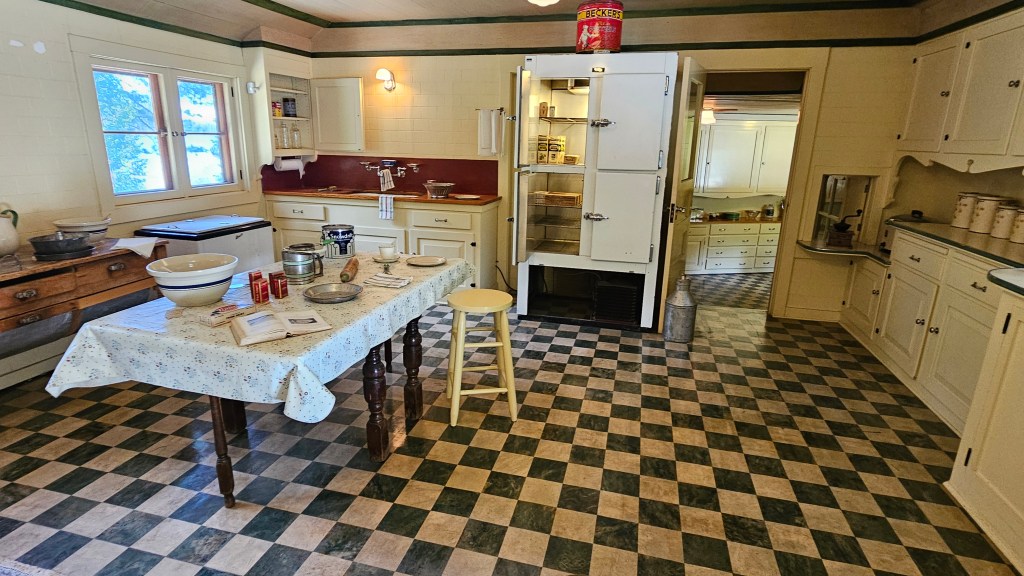
Of course, the Scandinavian design continued inside the home, as our guide pointed out many features. Lora loved to entertain and have guests, so the dining room is large enough to stretch out the table when needed. And of course, having many guests requires having a large kitchen!
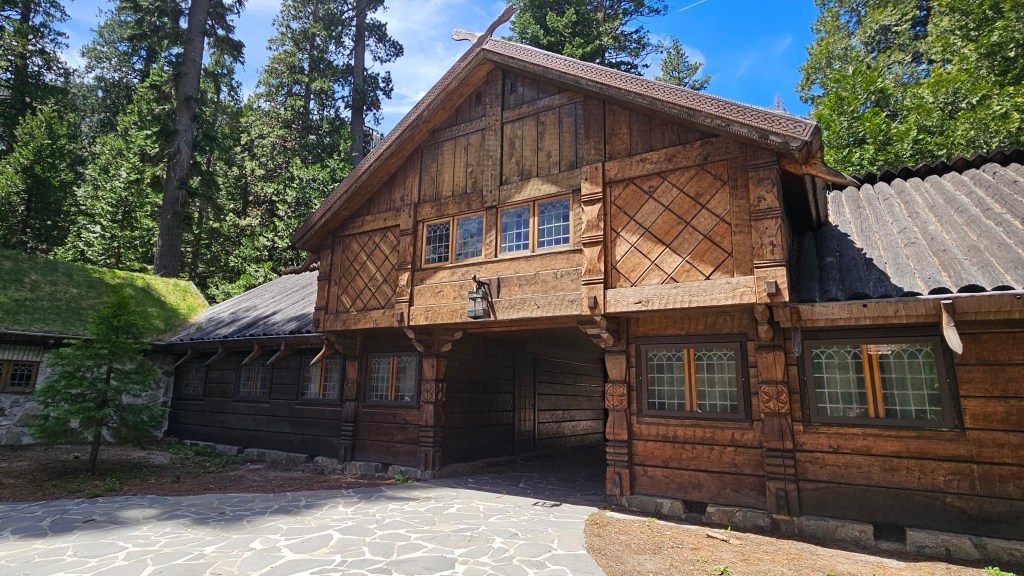
Arriving guests would drive under the structure in the picture below to the courtyard in the back. This structure housed the caretaker, who lived here year round, and also guests. This roof was made of logs; the low buildings on either side of it had roofs made of sod in true Scandinavian fashion.
From the front of the house we could walk right out to the lake shore, and happened to catch a passing excursion boat. On the right is Fannette Island again, which also belonged to Lora, and she built a tea house there.
Lora enjoyed 15 summers here and she had no descendants. The home eventually was acquired by the state of California, and is part of Emerald Bay State Park. Besides the home, she is also known for generous contributions to youth organizations, and for providing educational opportunities for those who could not afford them. In addition, she was a prime financial backer of Charles Lindbergh’s flight across the Atlantic.
Our next stop was the marina restaurant at Camp Richardson. It is an old resort community, and its setting under the tall pines gives it a national park feel. There are cabins, and – across the road – a great-looking RV park. I didn’t remember if I had seen this in my RV park search, but most likely it was already full. At the restaurant, we had delicious bread bowls of clam chowder with bacon sprinkled on the top. We were in full view of the lake.
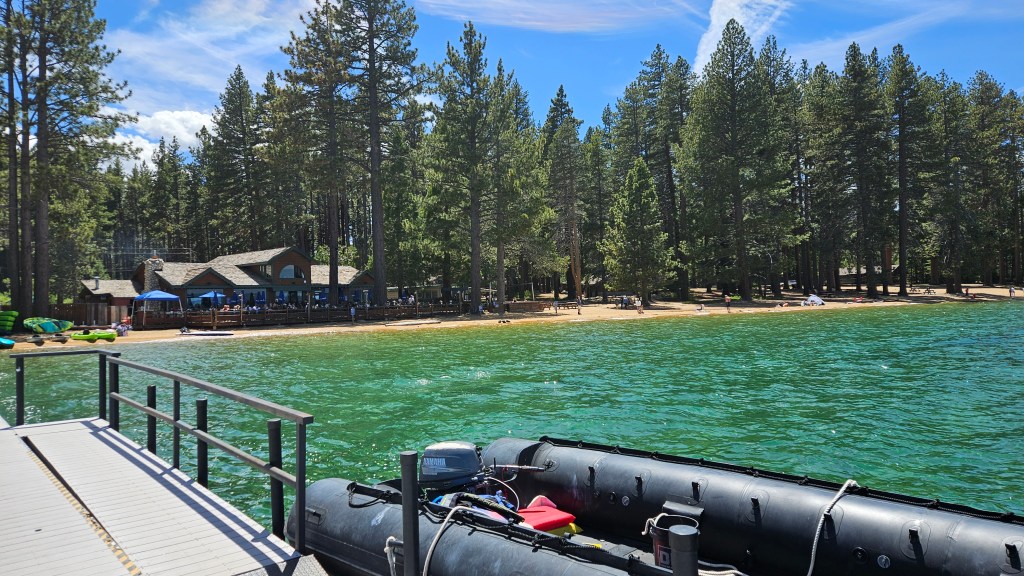
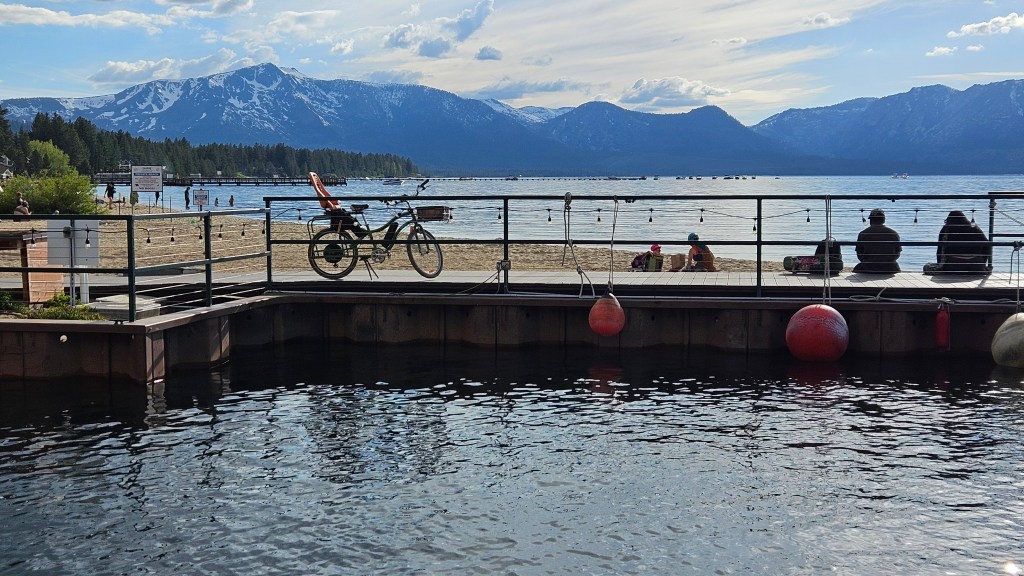
We walked out onto a very long dock after lunch and I took pictures of the restaurant, the beach, and the lake with that beautiful clear water.
The rest of the afternoon was spent in scenic driving down to South Lake Tahoe. I had booked a room in a ski lodge at a post-ski-season rate. Calling it a ski lodge makes it sound fancy, but it was really just a remodeled old motel. Our room was cozy, had a gas fireplace, and was decorated with a fishing theme. Turning left onto the road from the lodge would have taken us directly up to the ski slopes.
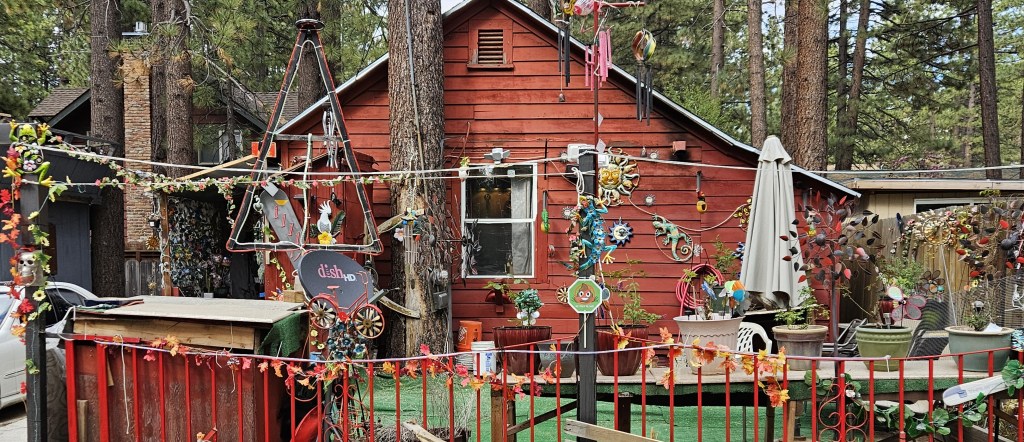
Walking a few blocks to dinner, we enjoyed the neighborhood under its canopy of tall pines. Some of the homes were very interesting.
And later, we found another couple of docks.
So, just the same as our last night in Arizona at Grand Canyon West, our last night in California was spent outside of RV.
I highly recommend breakfast at Heidi’s Restaurant in South Lake Tahoe. I had a waffle with warm strawberry sauce and whipped cream. This turned out to be a very tasty trip!
South Lake Tahoe is right on the border with Nevada, so as soon as we crossed it we were passing by several casinos. Rounding a bend in the lake, we were now proceeding north. We received magnificent views of the snow-capped Sierra Nevadas from here.
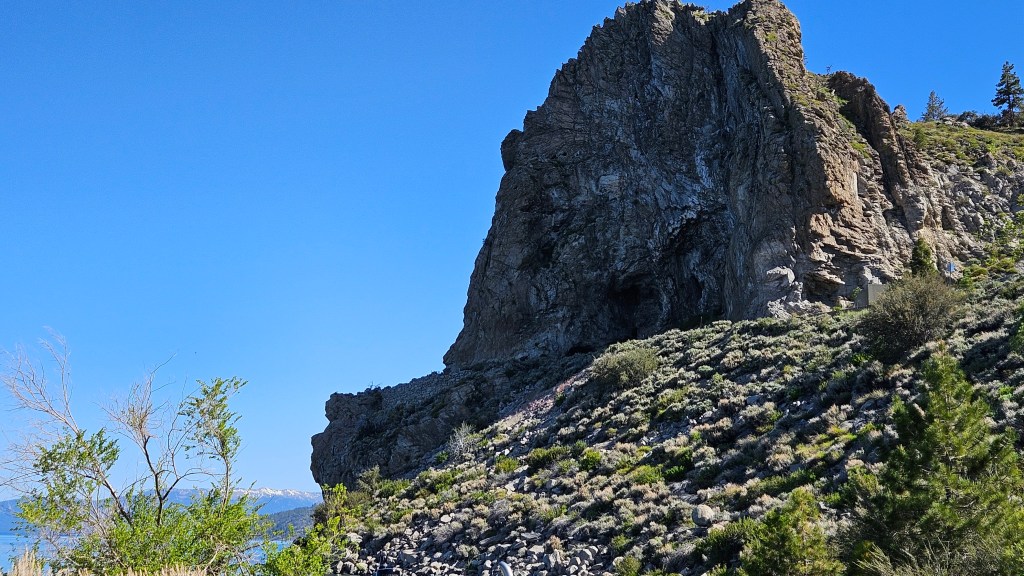
We were going to take a hike at Cave Rock, but it didn’t pan out. First we found ourselves in a marina parking lot, where I did get a view of the rock. This is a sacred place for the Washoe native peoples.
It seemed like we were supposed to drive through a residential area to the trailhead, but the signs were confusing. We dropped that idea and drove on to see Carson City, which is the capitol of Nevada. With a little bit of extra time before heading home, we decided to stop at the capitol building. It serves the governor of the state and has some offices besides the museum. The other workings of the state happens in buildings around this one.
I learned a some interesting things here. The first is that the Nevada became a state on October 31, 1864, just eight days before President Lincoln’s reelection. He needed the votes, and Nevada was not a slave state. Politicians in Nevada wrote up a constitution and telegraphed it to Washington – the longest telegraph ever sent to that date. As soon as he received it, he admitted Nevada to the Union by an act of Congress. And the rest is history.
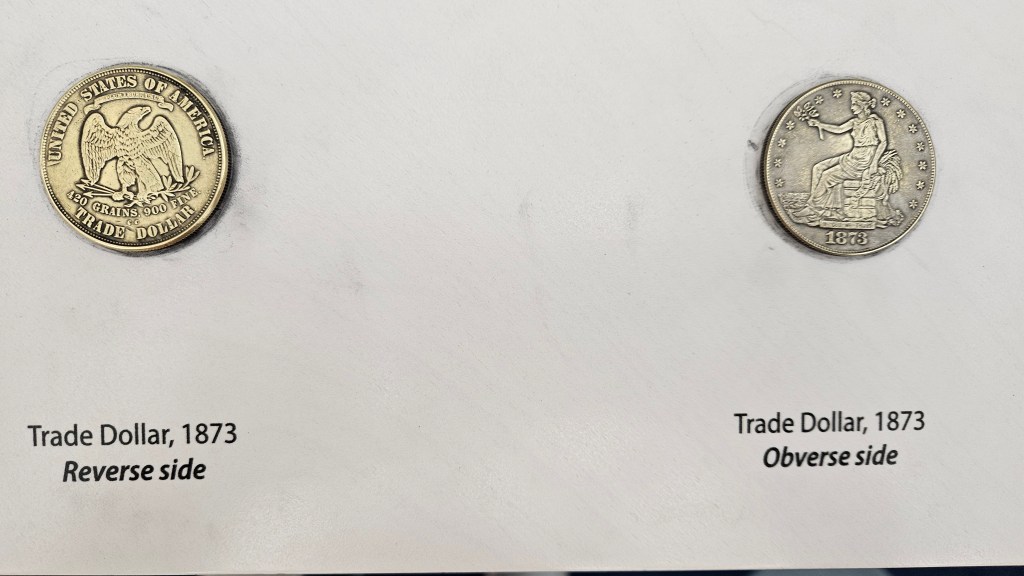
The other thing I learned is that Carson City is one of only eight cities to be an official US mint. It was short-lived, however. The first minting was in 1870 after discovery of the Comstock Lode. It closed permanently in 1893 after silver mining declined. If you ever find a coin with the “CC” designation on it, it might be worth a little something.
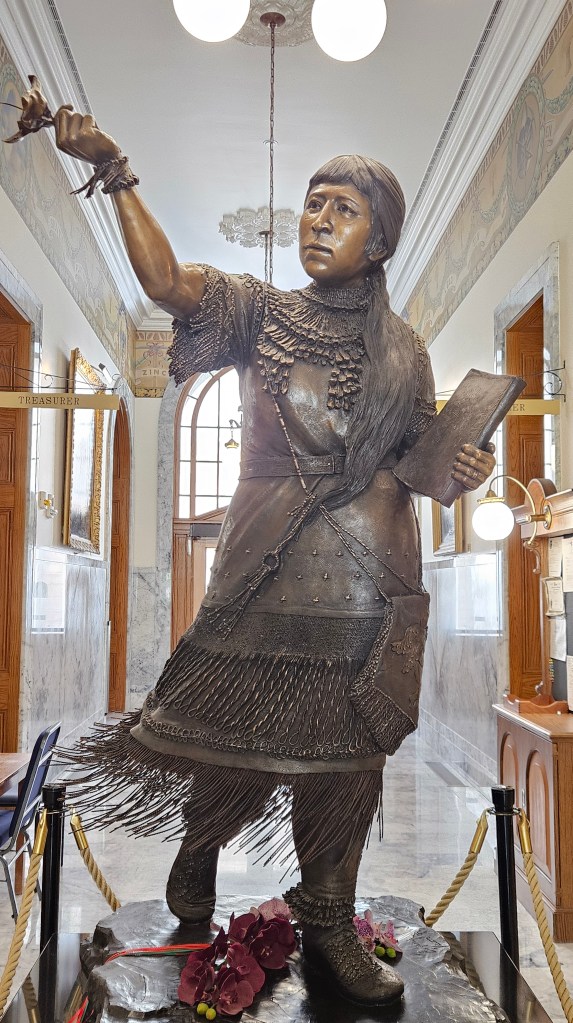
I also learned about Sarah Winnemucca, who lived from 1844 to 1891. I’ll let this signboard tell you what you might like to know about her, and there is a statue of her in the capital:
Every state capitol we’ve been to has something interesting and different to see and learn.
This had been a great little trip, and our adventures still continue!
Next time – we check out Reno and move to Washoe Lake State Park
Have you ever been to the Grand Canyon? If you have, chances are that you’ve been to the South Rim of the National Park. Grand Canyon National Park also includes the North Rim, which not as many people visit. It doesn’t usually open until mid-May and it’s harder to get to.
There is also Grand Canyon West, which is a commercial enterprise run by the Havasupai Indian Tribe on their reservation land. About fifteen years ago, they constructed a skywalk out over the Grand Canyon. We’ve been to the South Rim several times, so I thought this might be a different way to go. The distance from our RV at Nellis AFB to Grand Canyon West was 125 miles. Thinking that we might appreciate a little overnight road trip after spending so many weeks in Las Vegas, I booked us into one of their cabins for a night. It was to be our last night in Arizona for the 2024 winter and spring.
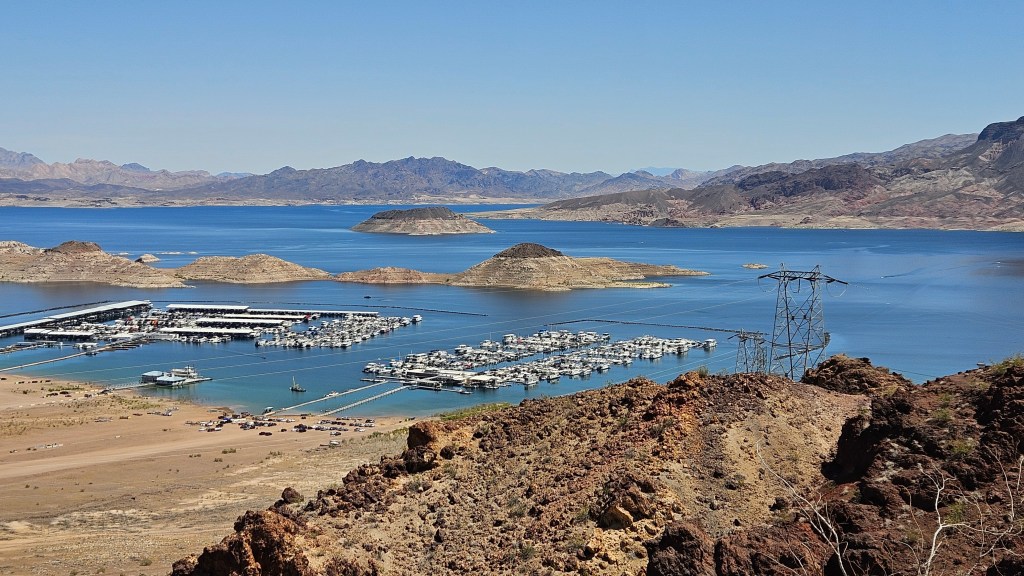
Driving out to Grand Canyon West, we drove though Lake Mead National Recreation Area. The lake shimmered in the sun. The lake level is still a little low, although not as bad as it had been.
A surprise treat was in store for us as we drove through Arizona. Joshua trees! Miles upon miles of them. We thought their height and sheer beauty rivaled what we had seen weeks earlier at Joshua Tree National Park. Some were in the desert or tucked into sloping mountain canyons. Some looked to be at least thirty to forty feet tall with trunks as large as regular trees.
As we drew closer to Grand Canyon West, the Joshua trees began to intersperse with juniper trees and pinon pines until, finally, they were gone. The juniper and pines, too, eventually gave way to a prairie-style desert with cacti and beautiful orange-blooming flowers.
When we arrived, we first stopped into the visitors center to pick up our tickets. A shuttle takes visitors to the first stop, Eagle Point. All of these places are very important to Hualapai culture.
Do you see the eagle in the rock with its wings in flight? It was spectacular to receive not only the first glimpse of the Grand Canyon here, but also to see the eagle.
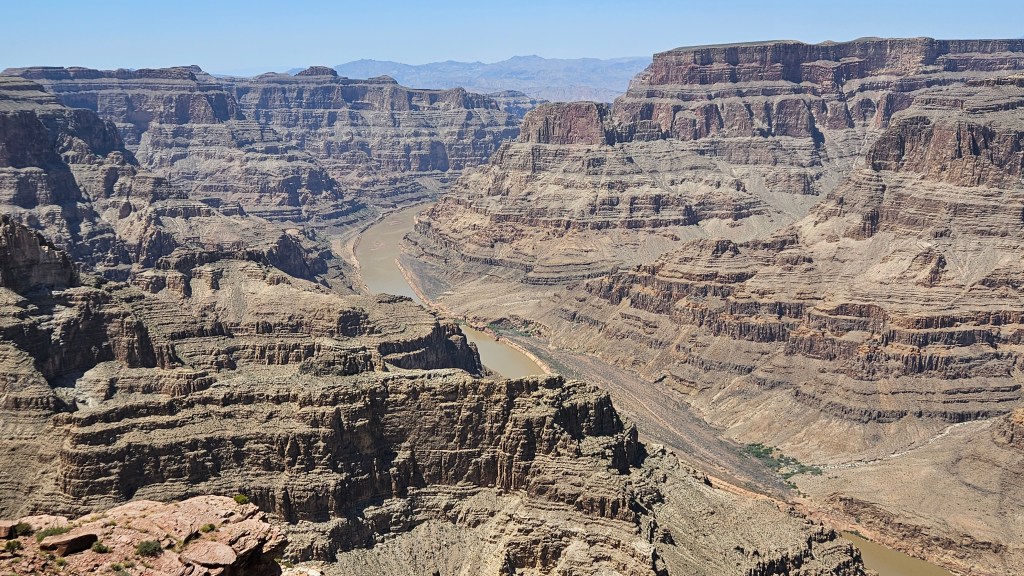
The views of the canyon are no less grand for being on the west side.
Looking to our left from here, we could see the Skywalk.
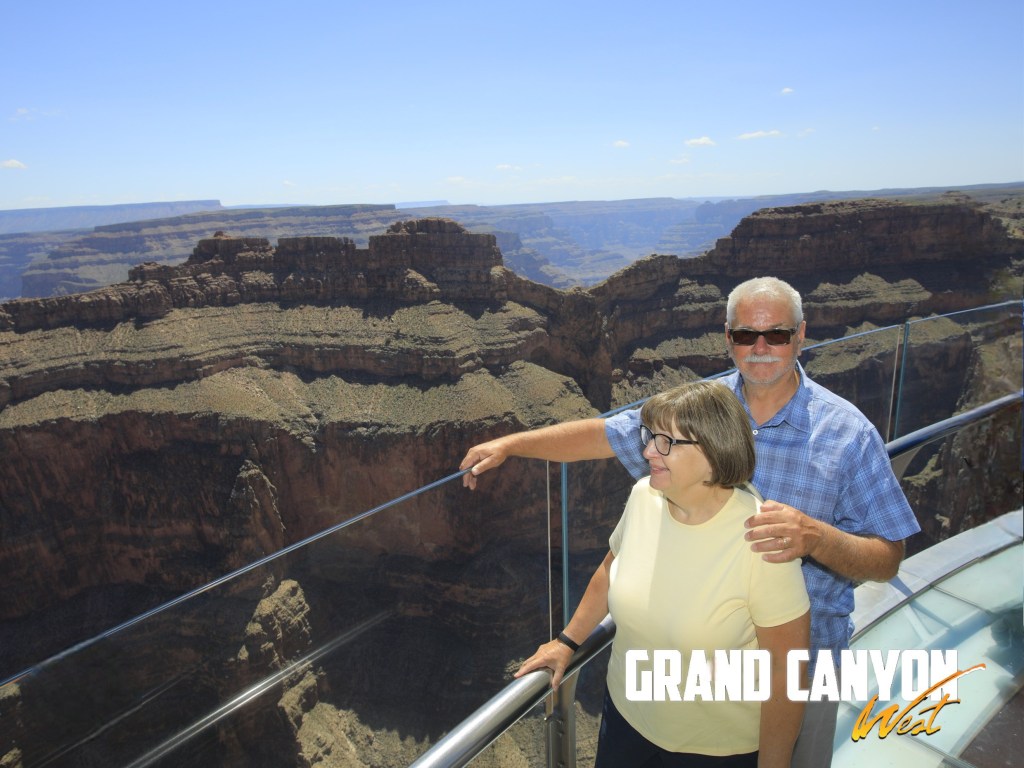
When the Skywalk was completed in 2007, it was the world’s biggest glass cantilever bridge. It extends 70 feet over the Grand Canyon, has a glass bottom, and can hold 800 people at once. By now the length has been superseded by a bridge in China.
Here’s the thing: you have to pay, of course, to step out on the bridge. (The whole day is not a cheap proposition. We supported the Hualapai quite well.) But you cannot take any possessions out onto the bridge. That includes phones and cameras. The reason given is to protect the canyon from things dropped or intentionally thrown from above. There are folks right there on the bridge to take your picture, of course. It costs $50 to purchase the photo package.
Our photographer arranged us in several cheesy poses. Afterwards, I noticed people could ask their photographer to take pictures in poses of their choosing, and I wish we had done that. I would have liked a photo of our feet down through the glass floor.
After our photoshoot, there was plenty of time to look at the canyon below our feet and all around.
I purchased the photo package because it came with the scenic photos that I was not able to get from the bridge. When I first went out to the website for the photos, I glanced at them and figured I’d download them later. I did download the photos of us. But then as the days after our visit went on, we were busy and traveling, and I never quite got around to downloading the scenic photos. When I did, they were gone: they are only out there for 30 days. Live and learn. If you visit, and spring for the package, don’t be Julia: download your pictures immediately! Better yet, just enjoy the view and have a passing tourist take your picture in front of Eagle Point for free.
Outside of the bridge, we walked to the Native American Village. Here, we could see various types of Native housing and sweat lodges.
This “wikiup” is made of the juniper trees that are plentiful here and can come in many different sizes. There must be a native person (or many) skilled in making these here because I saw at least three of them like this in various places. They can be bare of the greenery or have animal skins on the ground, and can be large enough to house an entire family.
After a good lunch at Sky View Restaurant, we walked over to the shuttle stop for the ride to to Guano Point. As we waited, we listened to this gentleman chant. I was intrigued with his combination of native and current day dress. He has next to him on the bench burnt sage in a shell. For the people, the rising smoke has spiritual meaning, and the shell that the sage sits on does as well.
The Hualapai have always lived here and a small piece of their land includes the Grand Canyon. They are not subsidized by the US Government. Years ago, they started trying to generate revenue with a casino, but realized that what people really wanted was to see their land. They make a fine living off the tourism offered here.
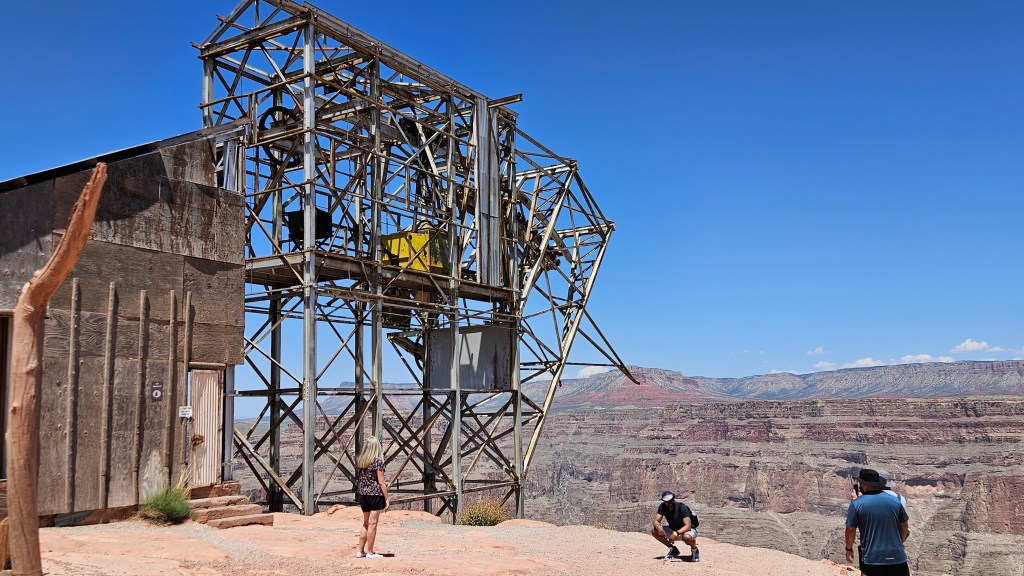
Guano Point is so named for an enterprise that operated in the mid-century to extract what was supposed to be 100,000 tons of bat guano from a cave. The guano was used in that time for fertilizer, dynamite and (yikes!) makeup. A tramway was built over the canyon to ferry the workers over and bring the guano back. But there was actually only 1,000 tons to be mined and it played out quickly. A US Air Force jet crashed into the cable, damaging it, and it was never repaired.
Remains of the bat doo-doo cable system and extraction enterprise
More interestingly to me, this is also a sacred site for the Hualapai. There was a time when the US Government tried to round them up and place them in a central camp in La Paz. The Hualapai call this the “Long Walk”. Many Hualapai jumped off the canyon to escape, and the people call them “the lost souls”.
Just below the bat guano operation, the Grand Canyon offers an extraordinary view of the Colorado River far below. All around Grand Canyon West, there are no fences to keep anyone from going over the edge.
The day was getting on, so we rode back to the truck and drove to another GCW area where the Hualapai operate cabins, and checked in. It’s set up like a Western town, which is really weird considering this is reservation land. There’s not much here that’s open, save for a tourist shop and a place to purchase tickets for the zip-line. There is a restaurant, but we opted to save that for breakfast. Instead, we drove back down the road off-reservation, enjoying the view at “golden hour” with the canyons and hills bathed in a warm glow from the setting sun.
Grand Canyon Western Ranch has a variety of acommodations and also a restaurant. It’s small with less than a handful of tables, but the tables are large and different groups are expected to share it. Many evenings they have a guitar player singing songs. The restaurant closes at 8 PM and the resort does a campfire with s’mores, to which we were invited. We were fairly early and didn’t stay as we had other plans, but we ordered their barbeque ribs and the food was good. It would have been a great alternative to staying with the Hualapai on the reservation.
Returning to the reservation and cabin area, there are two trails that lead out onto the prairie. I wanted to do a sunset walk on the shorter, 1/2 mile trail. Arriving at the edge of the canyon, we had the view all to ourselves for a very long time, and it was magnificent. Like Red Rocks outside of Las Vegas that I wrote about in my previous blog, it was totally quiet. All was still except for some birds soaring over the canyon.
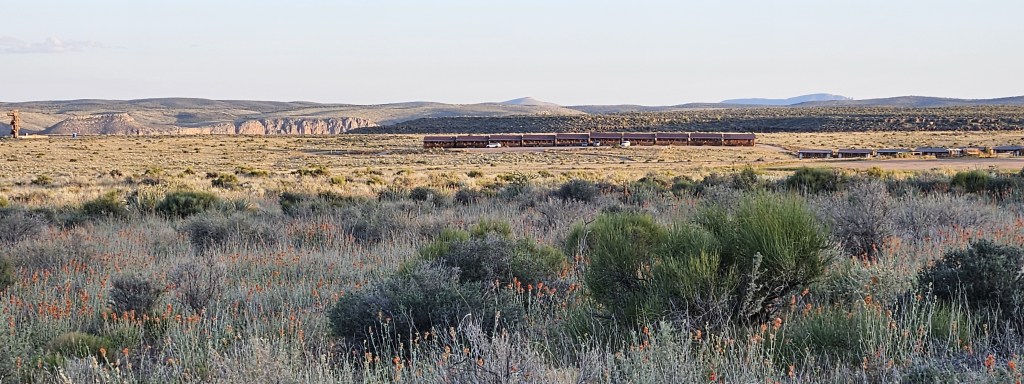
Off in the distance you can see the cabins at Grand Canyon West, strung out like a wagon train
We rose early the next morning to hike on the longer, 1.75 mile trail. Needing to get on with our day, we only walked about a mile through the prairie before turning around. At our turnaround point we finally reached the start of the canyon, but this part of it was green with hills folded into hills.
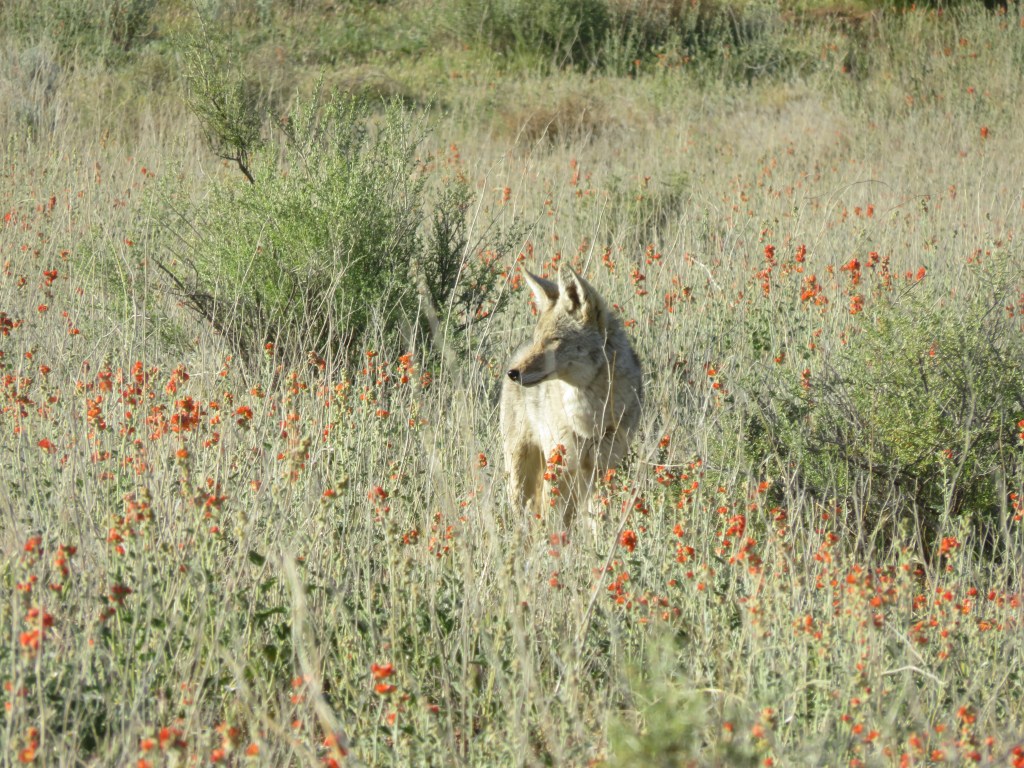
The prior evening we noted that there was a whole warren of rabbits running around. This morning, we watched a coyote unsuccessfully on the hunt for one of them. Those are wily rabbits.
Returning toward Las Vegas, we stopped just below the Lake Mead Visitors Center in Boulder, Nevada to ride our bikes on the Historic Rails to Trails. As the title implies, this is an old rail line which leads 3.7 miles to Hoover Dam. Many people were hiking it but they seemed mostly to be going the other way. It was a good thing they started early because the day was getting hot. It wasn’t too bad on e-bikes.
There are five old train tunnels on this trail. Each one is very exciting to ride through.
Looking ahead to one train tunnel while inside another
When the trail ended, we jumped on the state route for just a bit and stopped at a turnoff to view Hoover Dam.
This was a novel view for us. We have been on this road many times in years past; it used to be the only way to get from Arizona to Nevada. Cal remembers us touring Hoover Dam for $1.00. Having visited the dam in earlier times, we did not feel the need to go any closer.
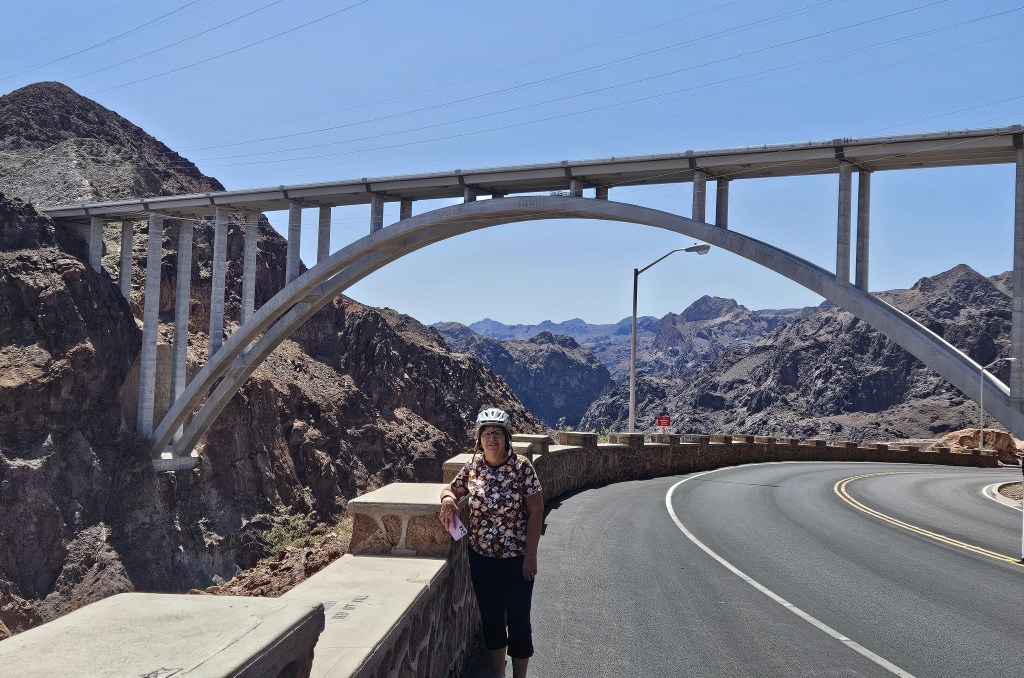
From here, we could turn around and see the new bridge that bypasses this whole area. It was built between 2005 and 2010. When we drove on the bridge, we would have never have known that Hoover Dam was below. It’s not possible to see anything with the concrete barriers. I really think it’s too bad they’ve “lost the view” in the construction of the bridge, as wonderful as it may be for safety and bypassing a congested area.
With our added little side trip to Hoover Dam, we logged in 11 miles on this ride, plus had a great chat with a young German couple at a rest stop.
This trip completed our time in Las Vegas; we left just a few days later with a whole lot of great memories.
Valley of Fire State Park lies about 45 miles from where our RV was parked in north Las Vegas. It’s considered to be a geologic park. The additional thing that drew me to it was the promise of seeing petroglyphs. These messages left from ancient peoples are fascinating and I like to think about the people who drew them. So, we packed a picnic and headed out.
A hint of sights to come is the bright red rocks that greet you as you enter the park.
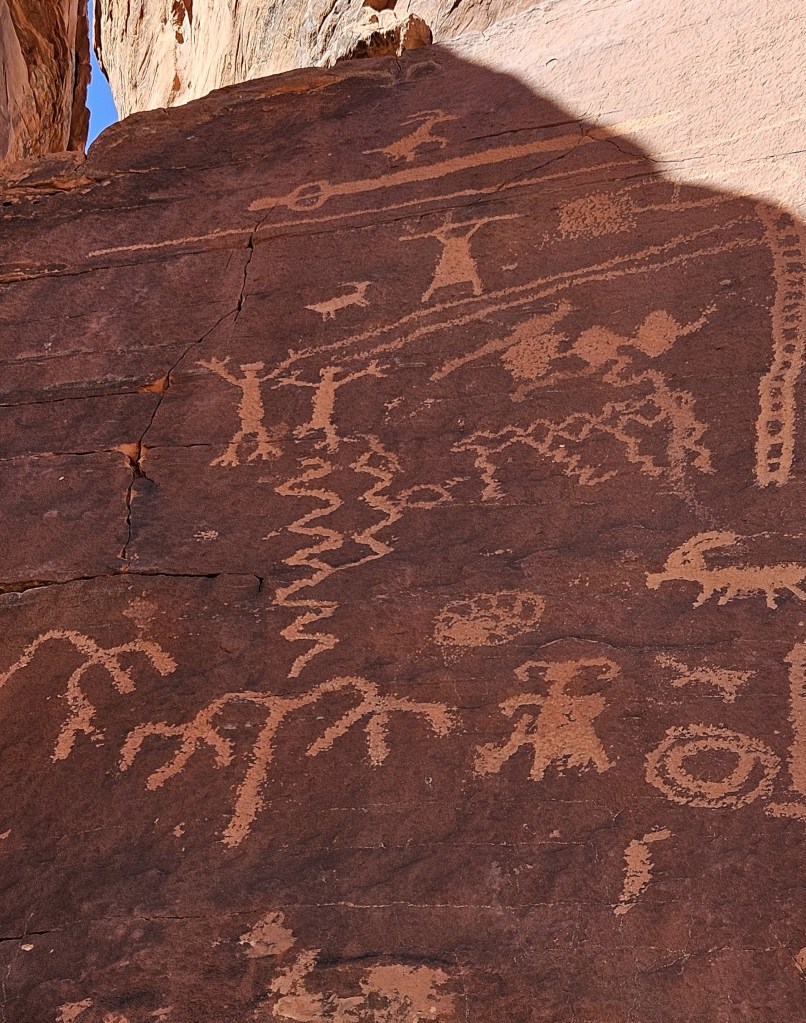
The first stop just after entering Valley of Fire is Atlatl Rock. Here, the petroglyphs are high up on the boulders. The stairs up to them presented the first challenge, but the reward is great for those who make the climb.
Petroglyphs offer a window into the lives of the people who lived here long ago. An atlatl is a primitive spear. Here, near the top, the artist drew a picture of one as well as a person with an atlatl in his hand. There are also some big- horn sheep scattered around. It’s interesting to speculate what else the artist, or artists, may have been thinking of when creating these.
The artwork covered much of the tall rock slab. We marveled at how they might have gotten up there to accomplish it.
At the Visitors Center, there are descriptions of the rocks. Valley of Fire’s rocks come in many colors. They are mostly sedimentary, meaning they come from liquid rock that is deep within the earth, compressed and formed into new rock. They then metamorphose into new forms such as dolomite (from limestone) or quartzite (from sandstone).
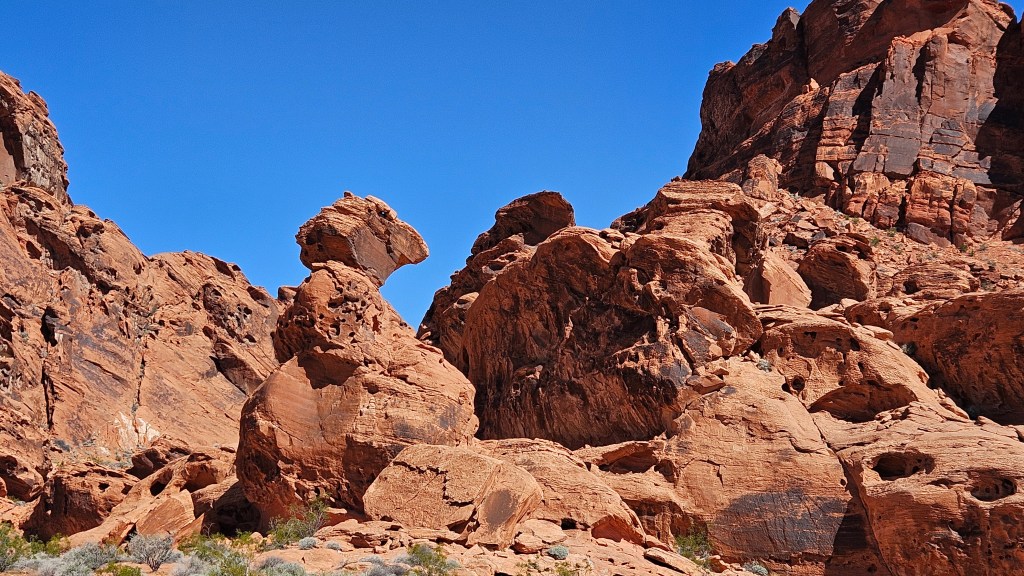
This formation of rocks can be seen just after leaving the Visitor’s Center.
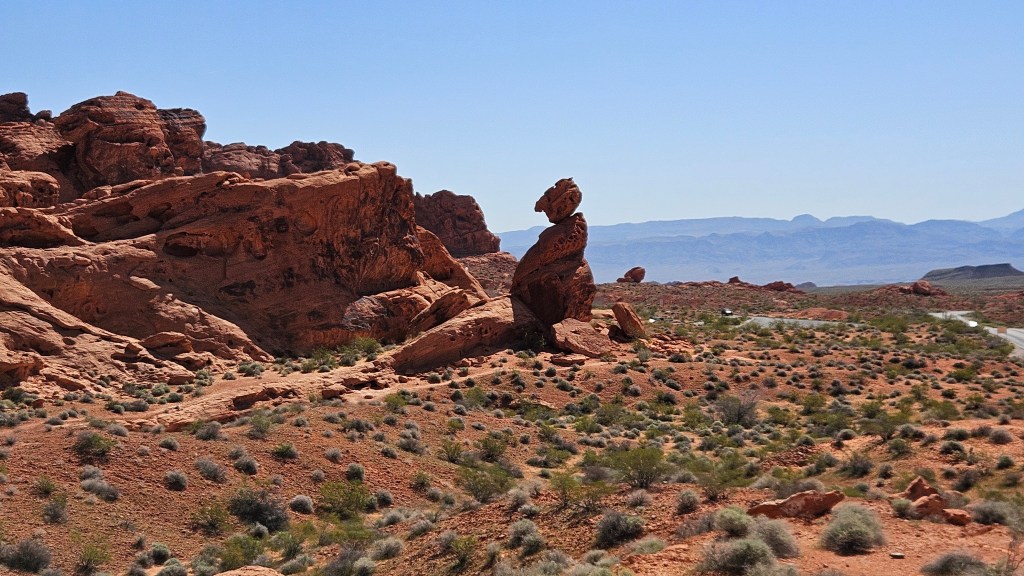
What is intriguing about the rocks is that just by moving your perspective, you receive a whole different view. After driving around a corner of the road, the above formation is also pictured below. The small rock perched on another looks like it might fall right off in a good windstorm!
We hiked Mouse’s Tank Trail, which starts out with sand for the feet and orange boulders rising up on the side. There are petroglyphs here, too, and it was like an Easter egg hunt to find them as we walked.
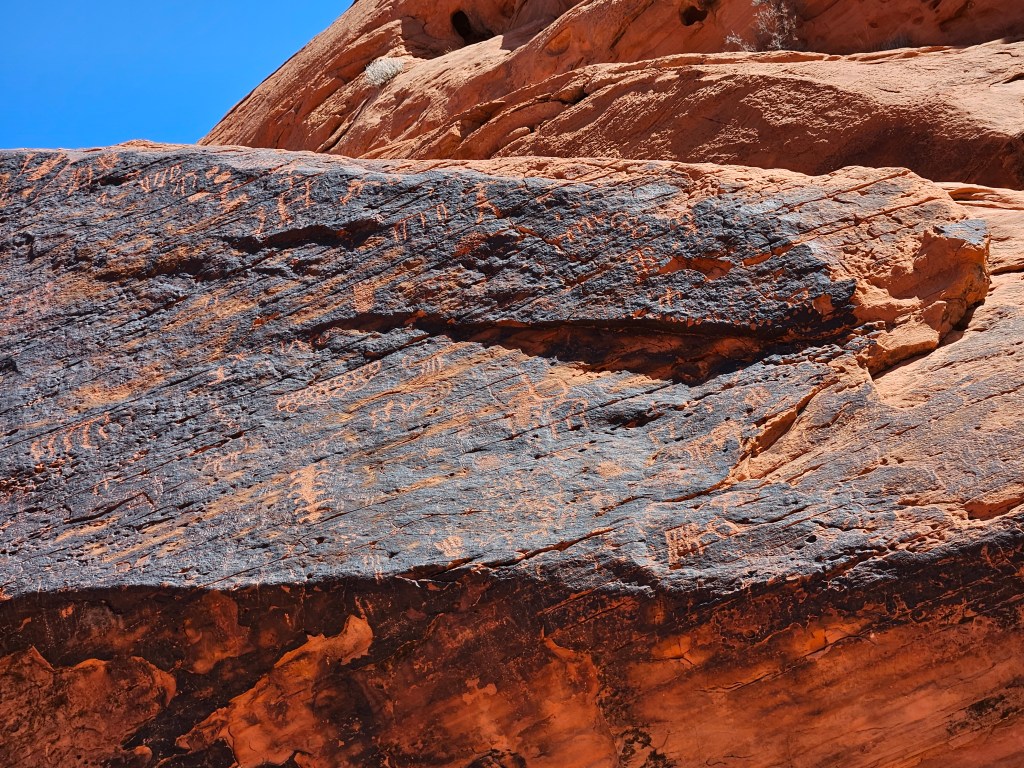
Another thing I learned in the Visitor’s Center is that a dark staining of some of the exposed sandstone walls is called “desert varnish”. Valley of Fire has a lot of desert varnish, and this is what the natives preferred for their petroglyphs.
Still another definition for you – a “tank” is a pool of water formed when rocks form a sort of bowl which holds rainwater. The early peoples and later travelers greatly benefited from these water pockets. We learned about these when we unsuccessfully tried to find a tank on a trail at Capitol Reef National Park a while ago. I was happy to see this one.
Supposedly, Mouse is the name of the Indian fellow who found it. I’d venture to say he wasn’t the first.
Our other trail for this day was White Dome Trail, with two huge white domes of rock as the entrance portals. On this trail there is a piece of a movie set.
What looks like an old ruin was actually built in 1965 for the movie “The Professionals”.
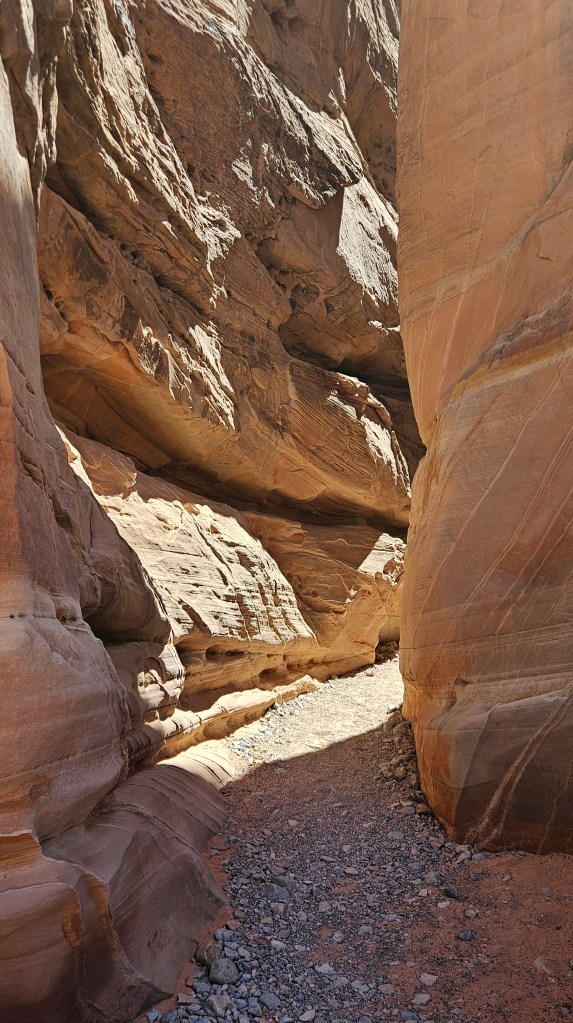
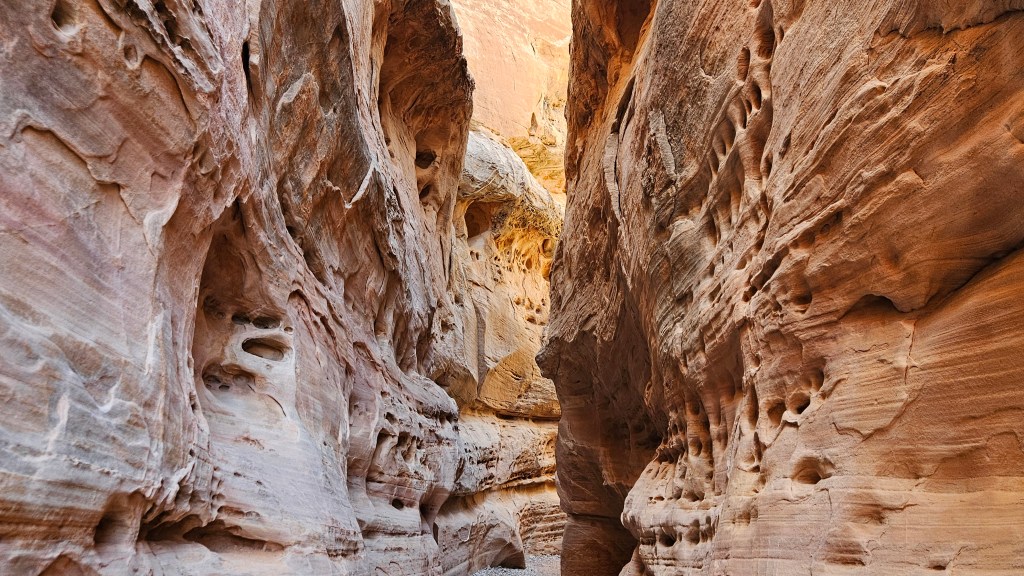
Still on this same trail, and shortly after the movie set, we entered a slot canyon.
After walking in to it, the air was suddenly cool and we were shaded from the sun.
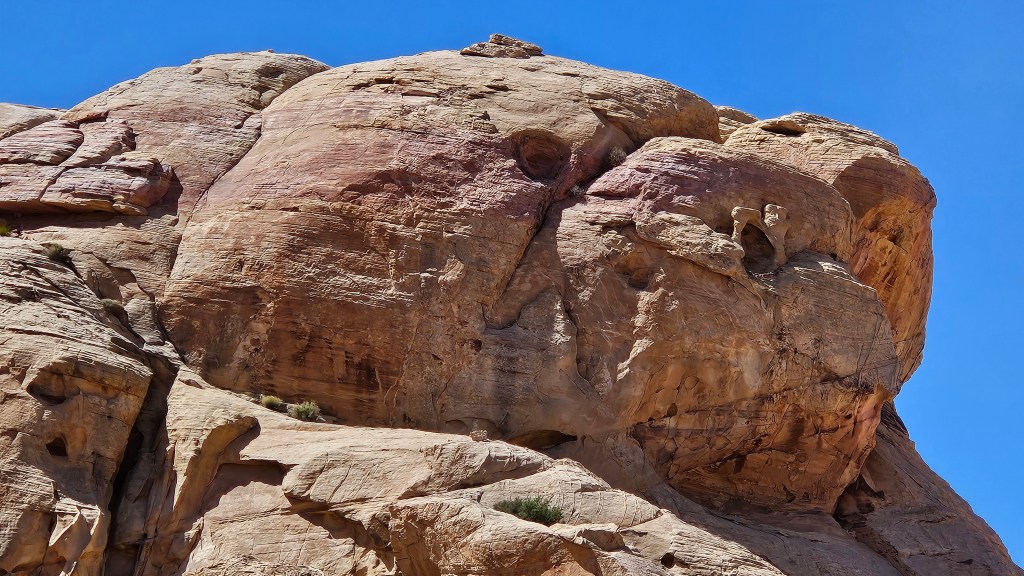
Coming out of the slot canyon, the walk was level and the rocks were so pretty. I saw what looked to me like a giant tortoise head in this formation:
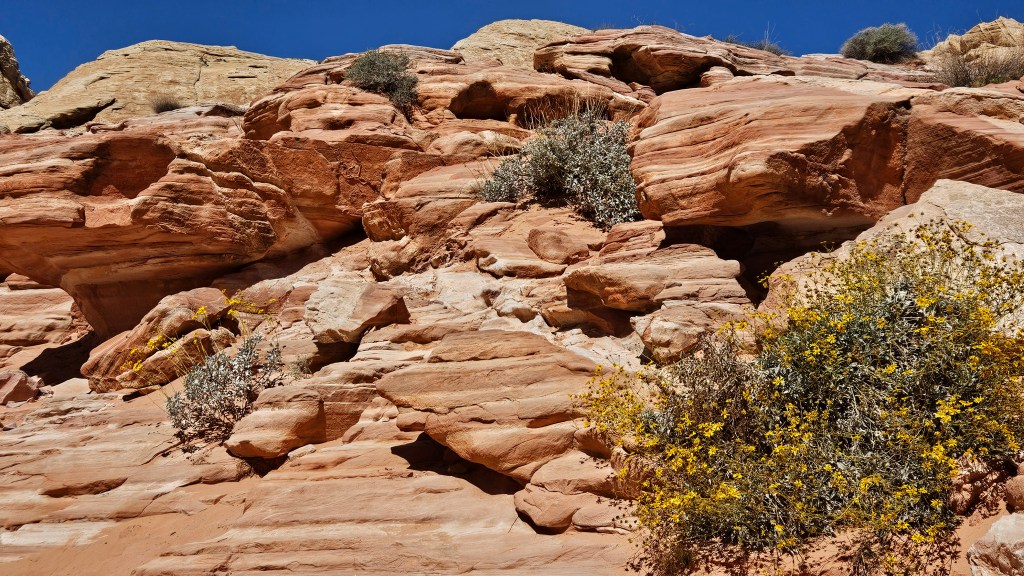
And, the colorful striated rocks for which the park is known, in pinks and reds and whites, along with some spring flowers blooming:
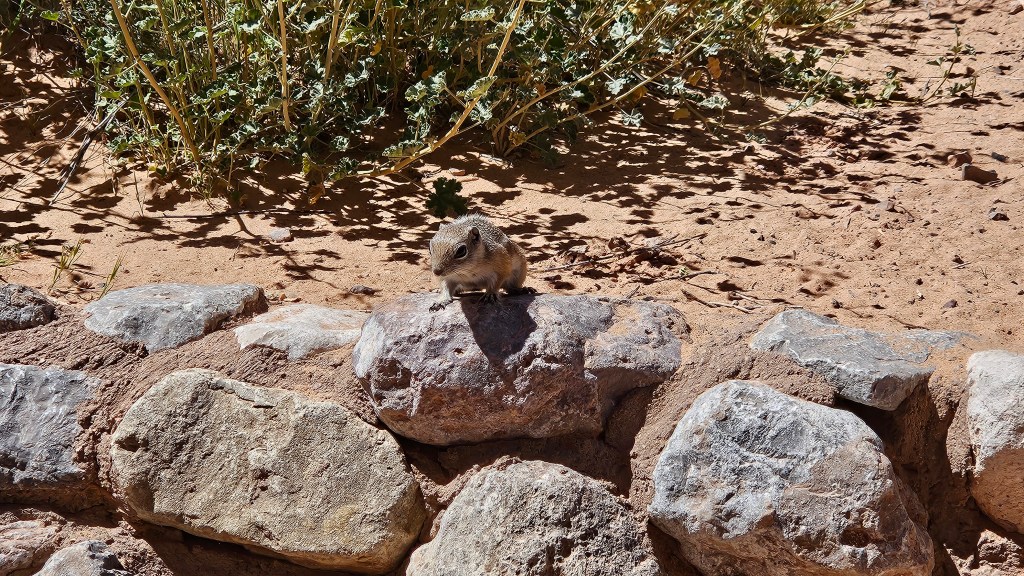
We found a picnic area for our lunch. It turned out to be a stage for a nest of chipmunks who were all vying for a piece of our lunch. I don’t feed the critters anymore, and no one should, but people do. They were very entertaining as they scampered about.
Here’s more photo of Valley of Fire, showing a deep contrast between the colors of weathered rock and desert varnish:
Coincidentally, the morning news on the same day as our visit here did a feature on the Clark County Fair. I looked up the location and found it was only a little distance from Valley of Fire.
We had come into the state park on the west side. To get to the fair, we needed to go through the park – which we were doing anyway – go out the east side, and turn north for a little while. We enjoyed the different view along the way. The east side emerges just north of the northernmost reach of Lake Mead. The landscape was other-worldly. There were dry mesas with lofty tables miles long, yet the valley was green with trees.
Inside the fair gates, I was ready for a treat and our mission was to find funnel cakes and lemonade to share. I couldn’t remember when I’d last had one, although we’d had plenty of opportunity. There was a grove of trees with a large patch of grass and we soon joined everyone else taking a break from the sun. It beat hard on this day and felt hot, even though the temperature was barely eighty degrees.
Only small animals were being judged at this fair. There were no cows or horses here, although there were one or two on display. There was a mama sow with her piglets and other animals such as this group of llamas:
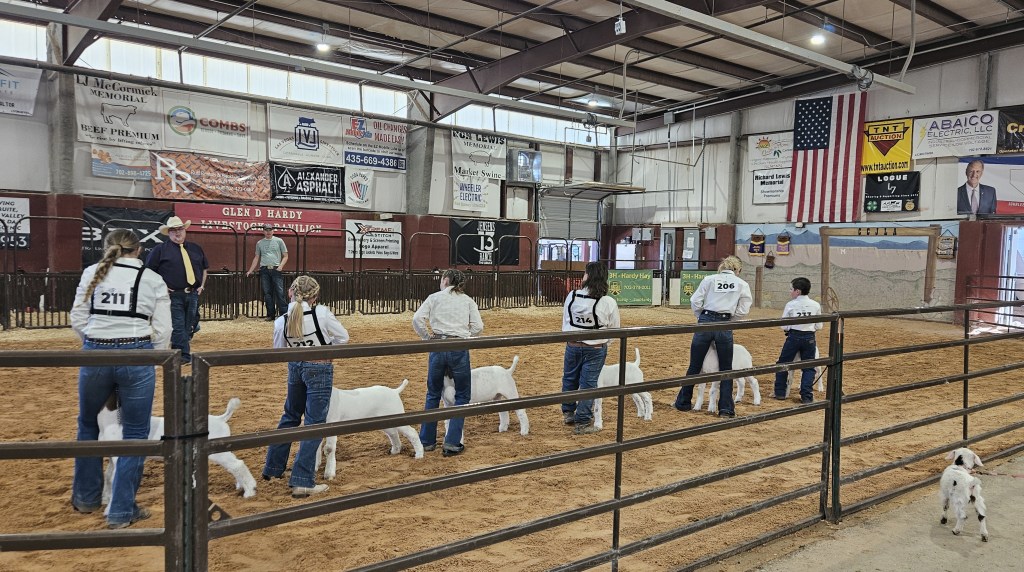
We watched the goat judging. These kids work so hard taking care of their goat all year long, and then making sure they and their goat are looking their best for the big day. The judge had a lot to say as he checked them all out. The goats and their owners are evaluated in groups of six. All of the goats are then in their pens for the duration of the fair, and ribbons proudly displayed.
When the judging was done, the kids could enjoy the carnival at the fair to provide some stress relief. There was also a handful of buildings to walk through. I always enjoy the fine arts building at fairs in order to view the needlework, paintings, and other creativity on display. This is an embroidered piece with a multitude of French knots that form the background and the tablecloth for the vase of flowers. I’m sure it was a lot of work!
From here, it was an easy drive a little further north to hop on the interstate for the drive back to Vegas. I counted this day as one of the highlights of our time here.
“Just listen to the music of the traffic in the city, linger on the sidewalk where the neon signs are pretty, how can you lose? –Petula Clark
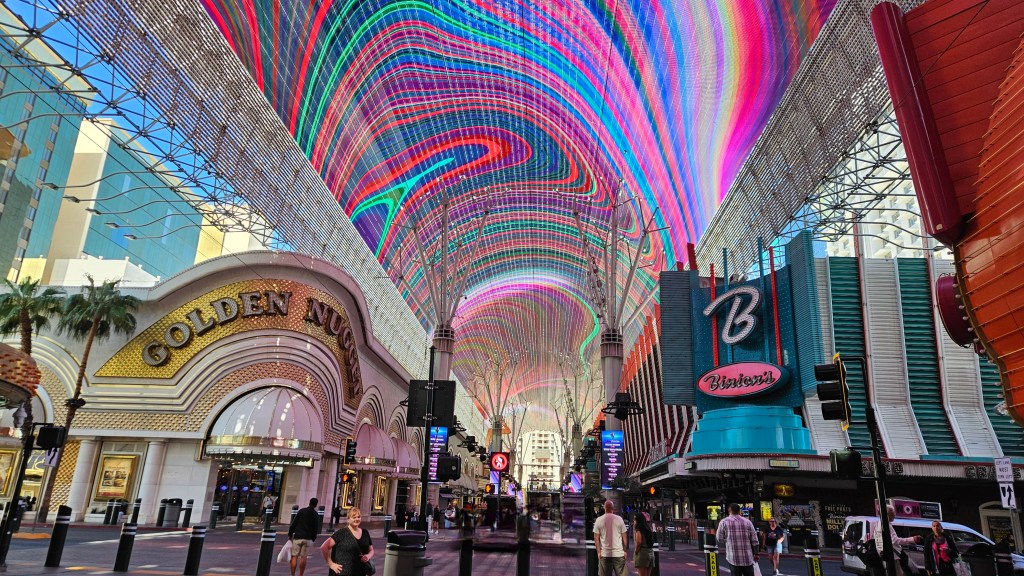
The place that used to be hopping with the main casino activity in Vegas is downtown on Fremont Street. After our fine hotel stay on the Strip that I wrote about in my last post, we came here after checkout. Since it was morning, things were pretty quiet. Change was immediately evident since the last time I was here. The street has been permanently blocked off and made into a pedestrian zone. Something called a Viva Vision canopy now covers the whole thing. It is the largest LED canopy screen in the world. Free light shows happen on the hour. There is even a zip line that goes from one end to another. It has been dubbed “the Fremont Street Experience.”
As I first stepped on what was formerly known as the Strip, a wave of nostalgia washed over me. I was here, days before my 19th birthday, with my best friend who has since passed. She had purchased a car from her uncle who lived here, and I flew to Vegas to meet her and help her drive it back to Texas. Of course, we dressed up to the nines to go out on the town. We played the slots, but I’m sure we didn’t spend more than some of our quarters. A decade later, Cal and I also visited here a couple of times when we had family living in town.
On a side street, I could almost feel the old Vegas.
Cal and I remember when people would stand outside the casinos handing out coupons for free sodas, a room, a low-cost meal. Breakfast was especially cheap. Anything to get you inside. If you played, they gave you free drinks. What I didn’t know then, I know now: in those days, the Mafia ran Vegas with a tight fist. They are credited with developing the city into what it is today, both good and bad. People with money ran hand in hand with those who had no money but had expertise.
Two things happened to change things: law enforcement cracked down on traditional organized crime, and new Nevada laws were passed to ease the way for corporations to own and operate casinos. Add to that, all of the newer casinos out on the Strip are not in the city of Las Vegas. They are in an unincorporated township named Paradise.
Here in downtown Las Vegas, on Fremont Street, no one passes out coupons anymore. It seems smaller to me, but someone I talked to said it really is not. Some of the smaller casinos have been swallowed up by bigger ones, though, so there are less of them.
If you are interested, you can get more of the history by visiting the Mob Museum in downtown Vegas. We didn’t visit it this time.
There is a show on TV called Pawn Stars. Occasionally, when Cal is flipping channels, he stops on this show to watch something that catches his interest. On the show, people bring in things they want to sell. Many times they are antiques or oddities and the owners then consult experts to check the value. It is interesting to see what the experts tell about the history of the item and to find out how much they think it is worth, and then see how much the pawn shop owners give the seller for it. Sometimes a deal is struck, sometimes not. Usually the seller receives much less than they said they originally wanted.
The shop that the Pawn Stars own is Gold and Silver Pawn. We walked down to it from Fremont Street.
It was strange to be in a place we’d only seen on TV. The counter is familiar as the place where people set their treasures for evaluation and sale. There was nothing we would have been interested in buying, though, and some of the collectibles were very expensive. I’d call this “Upscale Pawn”. Do they have good luck selling this stuff? Well, there are buyers for everything, and the store is also on-line so you don’t need to come to Vegas to shop.
After digging around, I discovered the shows we’d watched are reruns. The show has been off the air for two years. The shop is owned and run by three generations of men and one of their friends, but scandal and legal issues surrounded them. The store is still a popular place to visit, judging from all the people coming and going.
Walking from Fremont Street to the shop, we passed a pretty wedding chapel:
We made one more visit downtown. I wanted to see the Neon Museum. We took an Uber back downtown for an excellent dinner at Nacho Daddy’s. From there it is a 3/4 mile walk to museum. It wasn’t the nicest walk. I suppose walking isn’t the main way people get there, and I think it’s too bad that the city can’t do something to clean this up just a little bit.
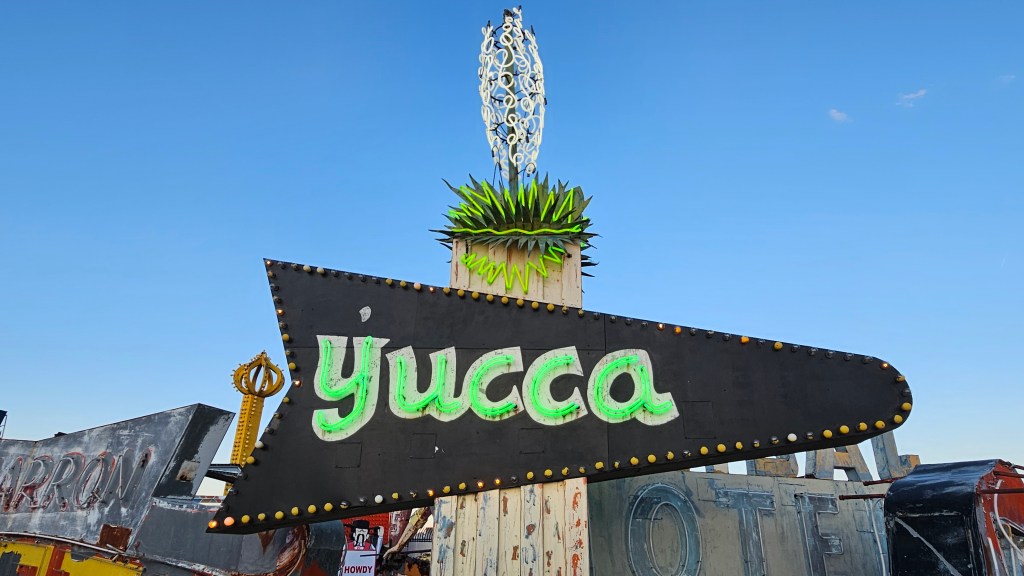
The Neon Museum is a graveyard for many of Las Vegas’s old signs. There is a lot of history to be seen just by looking at them.
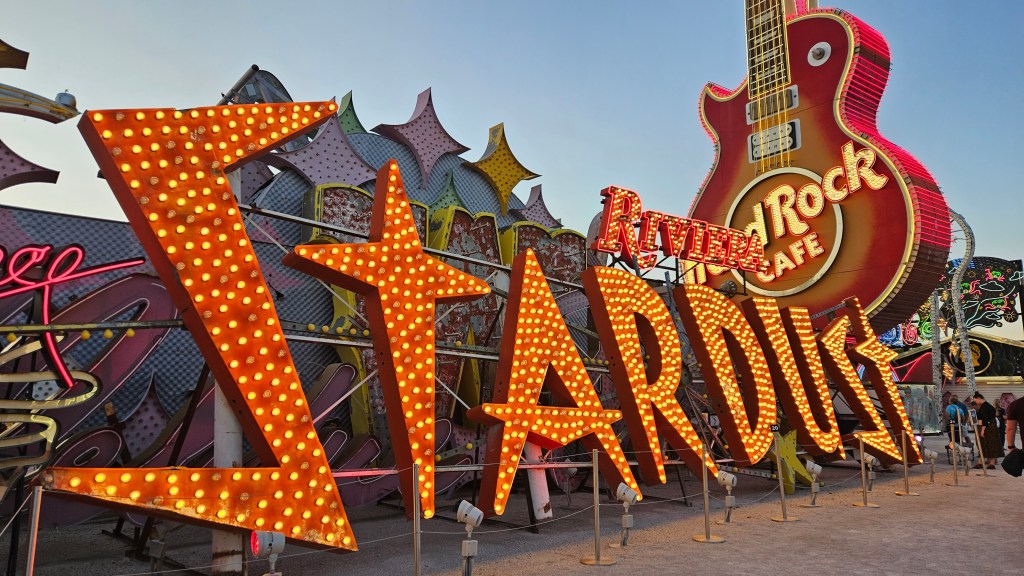
The Stardust Casino opened in 1958 and the hotel was the world’s largest at the time. As a child, I remember it being one of the iconic scenes of Las Vegas that you would see on TV or movies. The design of the sign is a nod to the beginning of the space age that was happening at the time. The resort closed in 2006.
I was surprised to see the Hard Rock Cafe sign behind it. How can a Hard Rock be out of business? It was here for only five years before being purchased by Richard Branson and rebranded as Virgin Hotels. Word is that a new Hard Rock will be opening in 2027.
Argon makes the light in this sign, which dates back to the early 1950’s. The light that argon produces is blue, but the colored glass used for the words changes it to green. This was a motel sign.
Neon, however, is what put Vegas on the map. The museum’s oldest operating sign is the Chief Motel Court which dates to 1940.
The Golden Nugget, built in 1946, is one of the oldest casinos. Today there are six Golden Nugget resorts in five states. I suppose this sign doesn’t work any more.
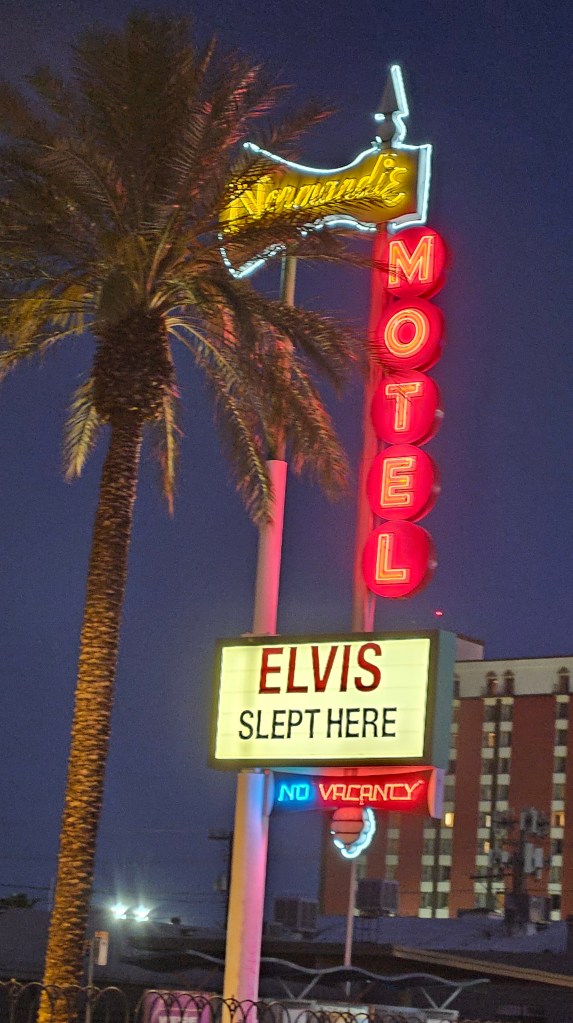
The Neon Museum has placed some of the old motel signs in the median on some streets downtown. Of course, the Normandie Motel is long gone.
I’d want to sleep here if I could. Maybe I’d get the same room Elvis had?
Walking back to Fremont Street, we noticed that we could have happy hour at the Gold Spike at 4 AM. That’s handy.
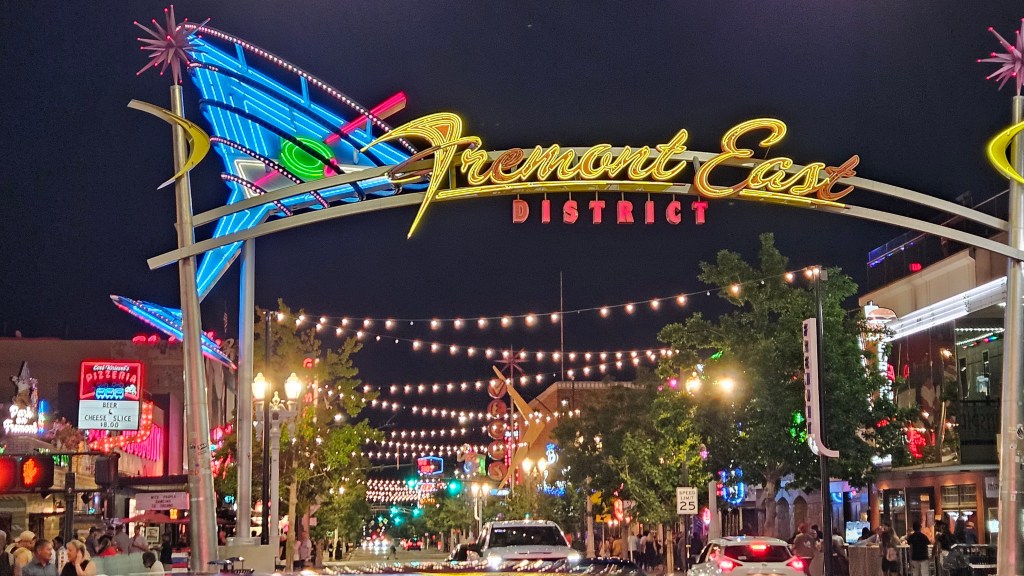
The Strip in Las Vegas today uses LED lighting, but the neon lights (and light bulbs) are all still aglow on Fremont Street. When we arrived back after visiting the Neon Museum, the place was hopping. It was a drastically different scene than we’d encountered on our morning visit.
The East side of Fremont street doesn’t have the covering over it and traffic is allowed on the street.
Visiting the city of Las Vegas was a whole lot of fun but it didn’t take many visits for us to decide we were done. We talked to many locals while here, and every one of them said that they only go down into the city when they have company. What else could there possibly be to see and do? I’ll be exploring that in the next couple of posts.
Why would an outdoor loving, RV’ing couple that doesn’t gamble and isn’t particularly into night life opt for a six week stay in Las Vegas?
There were two reasons: mainly, we wanted to wait a few weeks for the Sierra Mountains in east California to warm up before we headed in that direction. The second was that Nellis Air Force Base has an RV park there that a lot of folks in the military RV’ing world talk about as being one of the best. And, a bonus reason: it was an easy flight to Denver for some time with our family there. So really, only our RV was there six weeks. We were in Denver for ten days out of that time.
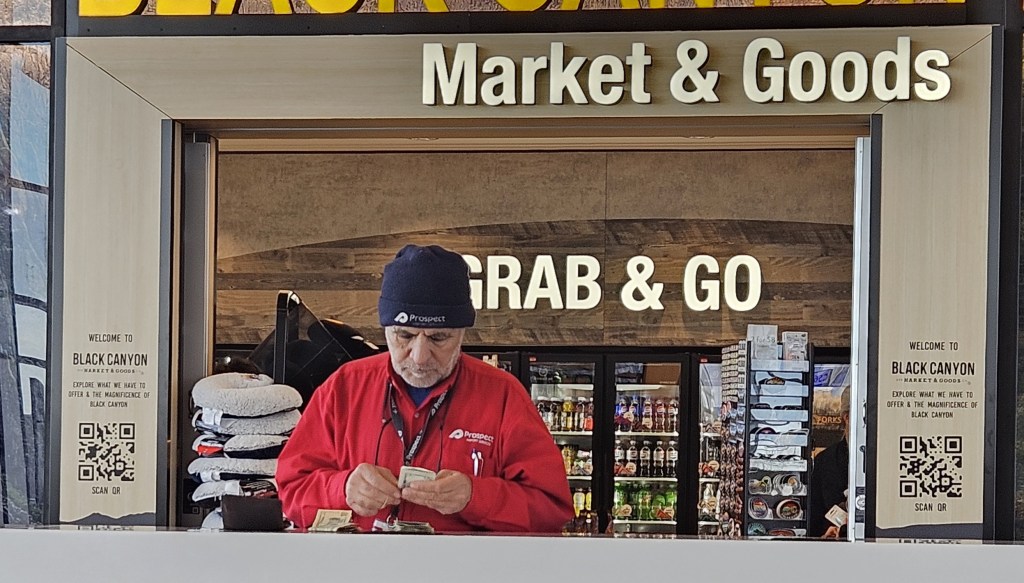
At our gate at the Denver airport and waiting for our flight back to Las Vegas, we watched this gentleman counting his cash before boarding. It was quite an involved process.
Ready to hit the casinos?
We’ve both been to Vegas, together or with others. Our memories are centered around the old Strip, or what is now called “Downtown”. I’d heard a lot over the years about all the changes in the city, and was curious to see them.
Someone flying into Vegas for a few days of fun might have a hotel in one of the casinos on the Strip or near it. There’s no need to rent a car, since one can simply walk out the door from one casino right next door to another one. And so on down the street. For anywhere further, there’s always Uber. We weren’t dropped right onto the Strip, so where to start?
Nellis Air Force Base, and our RV, were a fair distance north from the Strip. We did not know where to park our massive truck, and there was also the question of security. We opted to Uber whenever we went there. I loaded an on-line walking guide onto my phone, and we had our Uber driver drop us off at the New York-New York Hotel and Casino for a daytime stroll on the Strip.
New York-New York tries to hit all the highlights of the Big Apple: inside, there is a street that looks like Broadway and Times Square. There is a New York-style deli that looked great but we were too early for lunch. Outside were the Brooklyn Bridge and even the Statue of Liberty:
New York? No, this lady’s on the Strip in Las Vegas
Outside, the colorful turrets and towers of Excalibur beckoned.
We walked through a casino floor, although I’m not sure now which one this was.
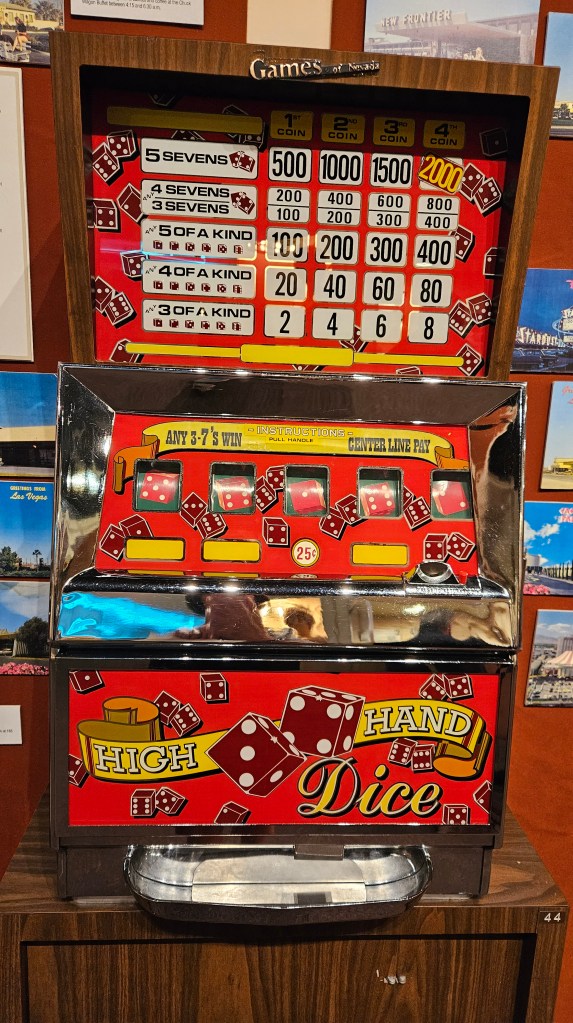
The slot machines don’t look like ones we remembered. This is what we remember:
This beauty is at the Clark County Museum, Las Vegas
Oh well, I guess I’m showing my age!
We thought we might do some shopping, but these stores weren’t really my style.
There is a feast for the senses out on the street, even though Vegas hadn’t quite woken up yet when I took this photo.
All of a sudden, we were transported to Paris in the spring:
I’ve been to the real thing for most of the sights in Vegas. I was prepared to not be impressed, but I was. They’ve copied the world’s treasures, jammed them into the Strip, and it seems crazy but it works. It’s all a facade, but it brings in the crowds and the revenue and I’m sure that’s the general idea.
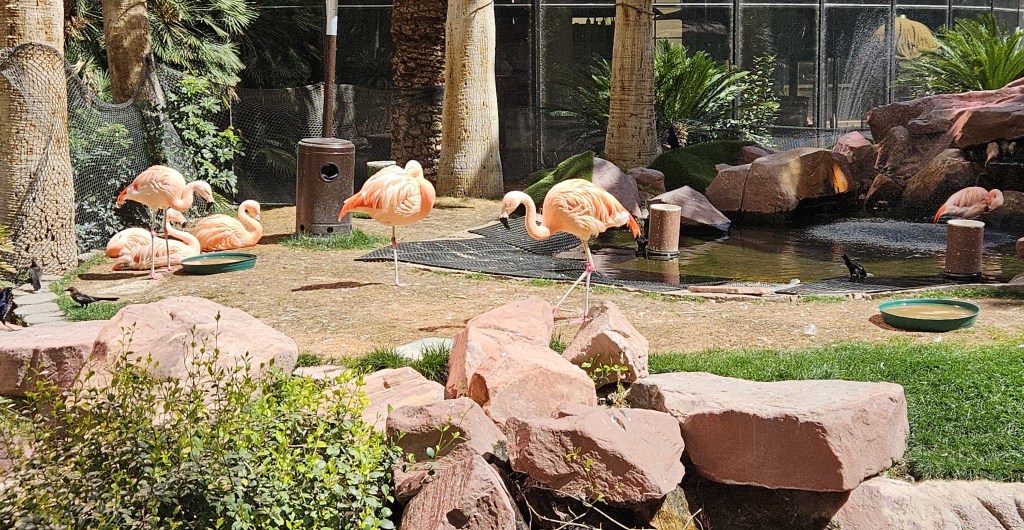
We lunched at the Flamingo. Outside, there were real flamingos.
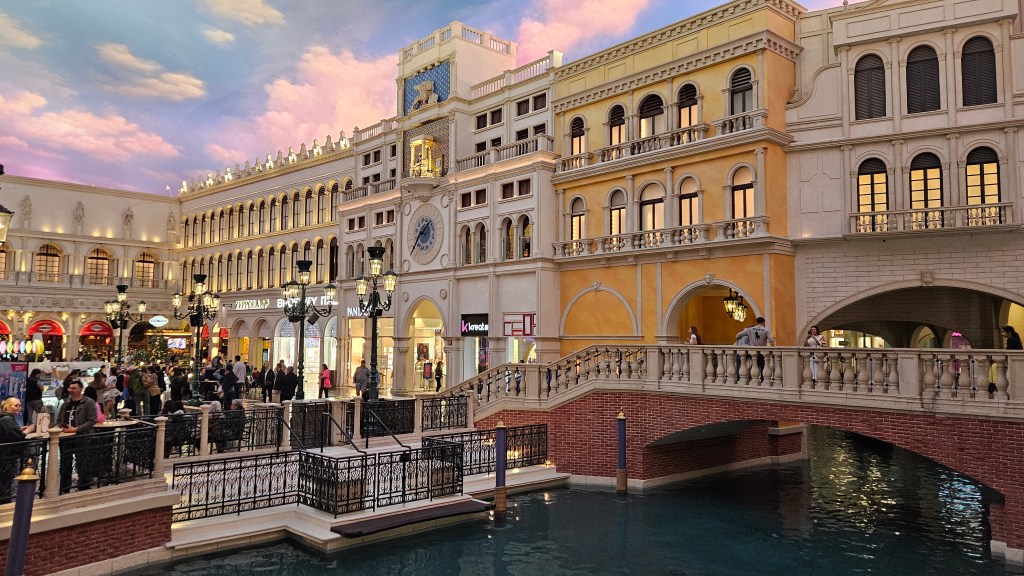
I wanted to see the canals of “Venice”, since we were actually in Venice less than two years ago. This is a reimagined Bridge of Sighs from that city in the Venetian, with everything not quite where it would be in reality:
When you are inside, it feels like you are still outside. I didn’t get a picture of the gondolas going down the canal, but the gondoliers are in their traditional costumes, and they are singing. They don’t even do that in Venice any more! The canals and Venice-style buildings cloak what is really just a shopping mall.
We walked by the new Sphere, but I wished it was night time so we could see it lit up. The design changes frequently.
I wanted to see a show, but couldn’t decide what I wanted to see. There were many big-name performers in town, but none that either of us wanted to spend a lot of money on. Going down the highway one day, I saw a billboard for Penn and Teller. That’s it! Their nightly show starts at 9 PM. Whew, I didn’t know what time we’d get back to North Las Vegas afterwards. We found a $99 special at the Rio Hotel and Casino, where they perform, and a couple of days later we checked in.
We wandered around the casino floor and hotel. If you wanted to, you could get married here, as there is a chapel. Since we are already married, we stopped for a pre-dinner glass of wine. As we sat, the animated lady in this slot machine beckoned us over to play. It wasn’t all that hard to resist her charms.
Rio Hotel is not right on the Strip. Although it’s not far, it’s not walkable either. Since our show didn’t start till later, we Uber’d down to the Bellagio. I wanted to see Bellagio and the city lights.
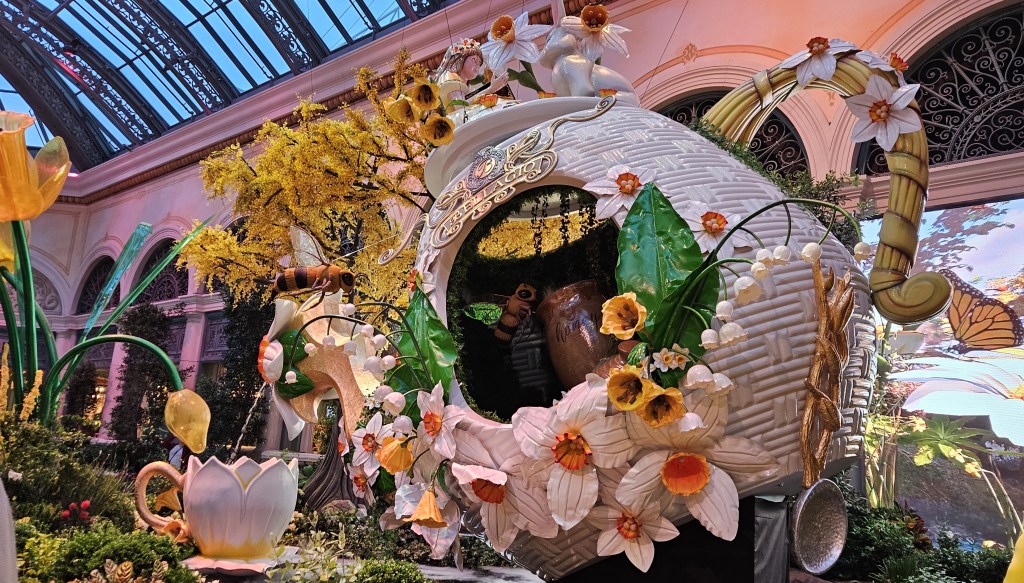
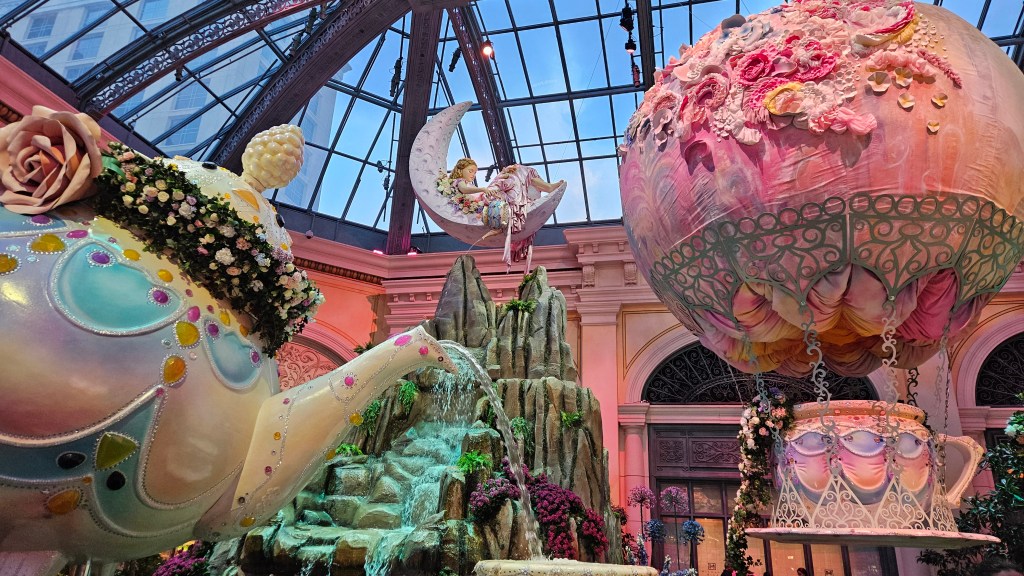
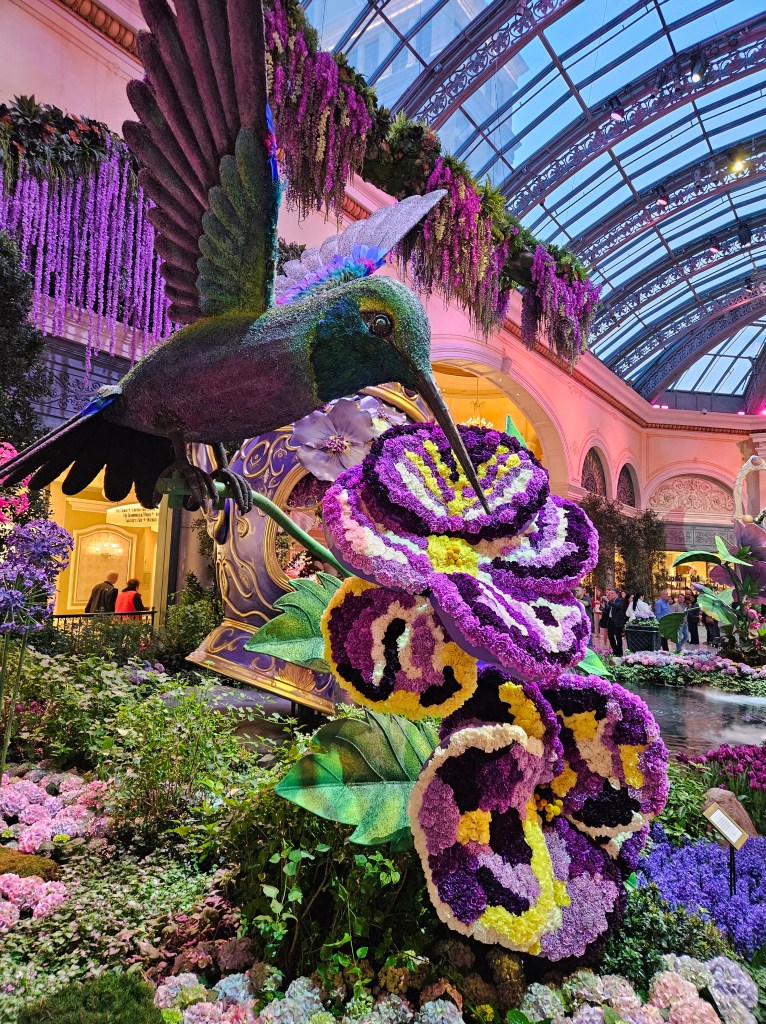
Entering the Bellagio, there is Chihuly glass on the lobby ceiling. That is another thing I wanted to see here, and Mr. Chihuly didn’t disappoint. He never does. It is spectacular.
The Bellagio has a free-to-all conservatory and botanical gardens with installations that change five times a year – one for each season and Lunar New Year. The exhibit for spring was “Tea and Tulips”.
I wish I could put the smell of all the spring flowers on display in this blog for you. It was intoxicating.
While I’m wishing for things, I also wish I could be transported right here every time the exhibit changes.
We walked for a bit on the gaming floor. There were blackjack, craps, roulette, and other games I’m not familiar with going on, with some large stacks of chips being exchanged. Even for a Sunday night, everything was rolling.
Outside of the Bellagio, I had one wish fulfilled: to see the lights on the Strip. Just a little. The Sphere peeked out from around the corner of the Flamingo.
It is said that the fountains at the Bellagio are not to be missed. We didn’t realize that they are on a timed show, and had to wait a while for it to start. It was windy and cold, but we waited. Behind me, I watched limos pull up to the Bellagio in a steady stream. Finally music began to play – Celine Dion’s “My Heart Will Go On” – and the water danced to the music.
This doesn’t capture the whole thing, but the “Eiffel Tower” in the background sure was beautiful. The water soars 460 feet in the air and the fountain spans a distance of 1,000 feet. Funny thing, though, Cal and I both later agreed that we were a little disappointed in the fountain show. I don’t know what either of us expected.
By now, we needed to hurry back to the Rio for our show. Penn and Teller were excellent. They do a comedy and magic routine. Teller never speaks, but his actions do all the talking for him – he is very funny and they both made us laugh. They are the longest-running show at the same hotel in Las Vegas history. We really enjoyed seeing it. And what a treat, afterwards, to just ride the elevator up to our room for bedtime!
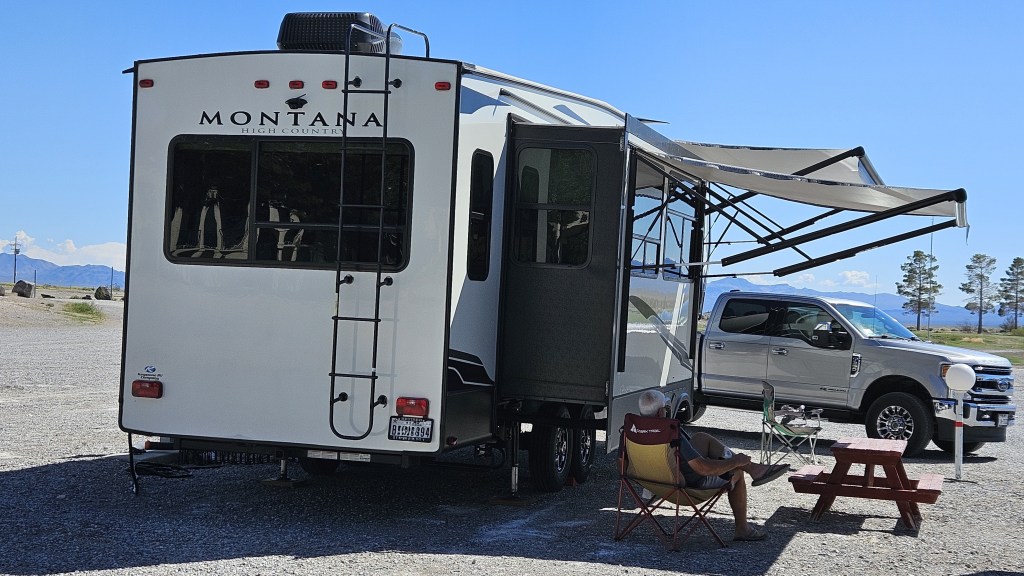
Anywhere that we put our slides, awning and lawn chairs out is home – for a few days, anyway
By the words and pictures of my blog, it may look like Cal and I are always running around from here to there and seeing everything there is to see. That’s not exactly true. There are stretches of time where we are just living life, same as everyone.
It’s not often that I write about one single RV stay, but that will be what this post is about. And the question is, what makes a perfect place to park our RV?
When we started out RV’ing, the answer was simple. A state park or Corps of Engineers park, out in nature, with full hookups, or at least with water and electricity is a must. Then, a nice level spot with lots of shade, and preferably not in close sight of our neighbors. Places to walk are also important. These sorts of places weren’t hard to find where we lived in Missouri. But we’ve only been in Missouri once in the past three years of full time RVing.
The RV park for Death Valley was full before I could even blink. Of course there weren’t any state parks nearby, and not even many commercial parks to choose from within spitting distance of the park. That led me to “Longstreet Hotel Casino and RV Resort”. This was a novel idea. The pictures looked good, reviews okay. I’ve long ago learned to take the “Resort” part of an RV park with a grain of salt. We would be in Death Valley for a good part of the time, anyway.
The building only has two stories, and the RV “resort” was around back. The gentleman at the desk assigned us a site and said we could move if we didn’t like it. That is a rare offer.
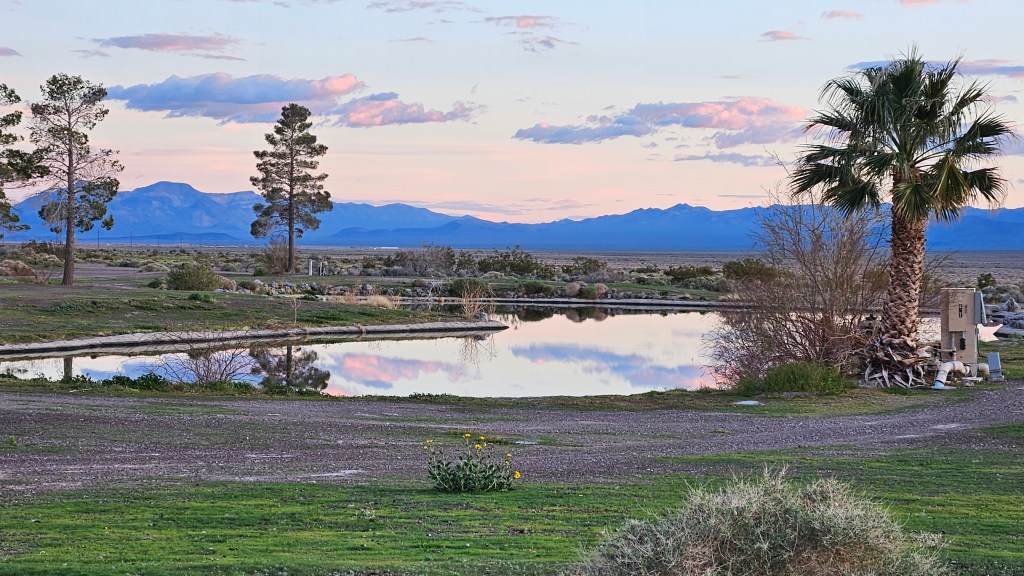
The casino is out in the middle of nowhere, and this was the view out our window. For our first two days, there were RV’s in these sites with ATV’s parked next to each. If I had my druthers, we would have moved, preferring instead to have been in the first row facing the mountains. Cal was happy with the site, though, so we stayed. It was interesting watching the ATV’ers head out for jaunts into the desert; after two days, they were gone. No one ever moved into these sites again, leaving us with a perfect view.
We thought maybe the green space might have been a golf course at one time, and the pond a part of it.
On our first evening we took a long walk down a narrow gravel road leading straight into the desert and alongside the mountain. There is no cacti here, just sagebrush and scrub.
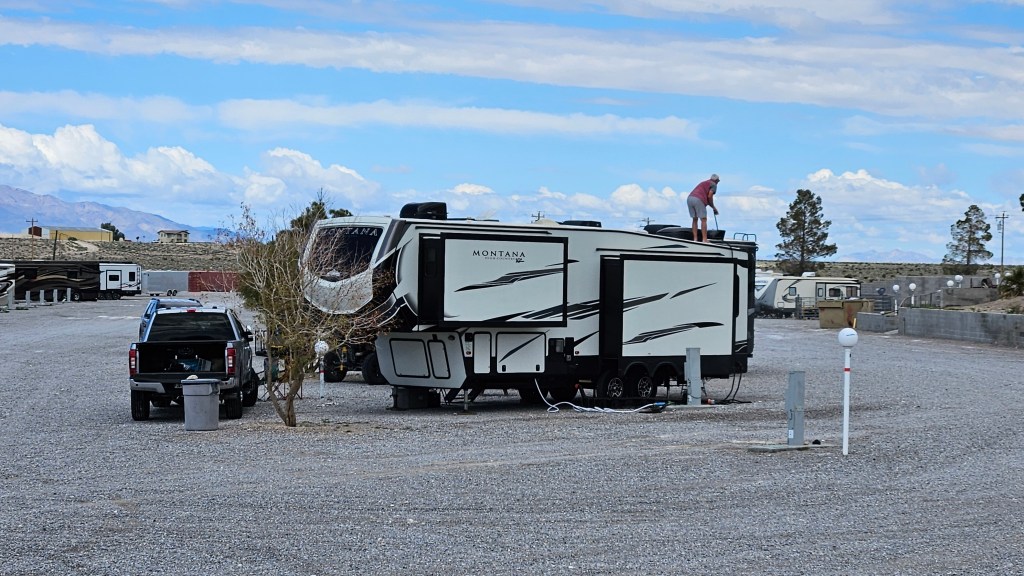
We put a rest day in between each of our visits to the park. Those days had long miles in them, both for the truck and on our feet. At home, we caught up on chores, all the stuff one normally does in life. Here, Cal is attending to something on the roof. All we had here was a gravel spot in a parking lot. It was nice that the park was always less than half full.
Someone was in that site next to us only one or two nights. On the other side, there was another 5th wheel with a gentleman who left for work early every morning and went inside his RV when he came home.
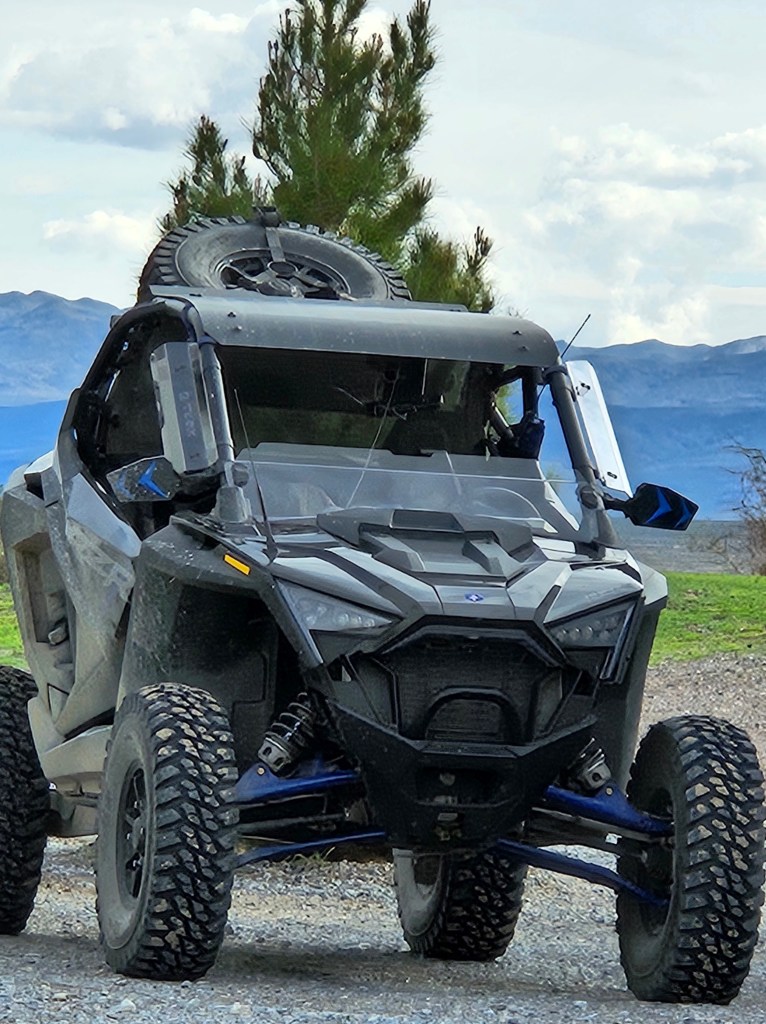
Cal was really impressed with his ATV.
On our “off days”, when I needed to stretch my legs, I could walk out to California. And then, back again to Nevada.
The wildflowers were just starting to come out. How can they grow in the harsh desert terrain?
The inside of the casino is typical of many casinos. Longstreet has a gaming floor, an area with couches, a restaurant, a convenience store, and a bar. With the exception of the store, everything is in one big room. A country band played on the weekends. I thought I’d be tempted to eat in the restaurant more than we did but we only had one lunch there. It was a rare treat to just walk over from the RV.
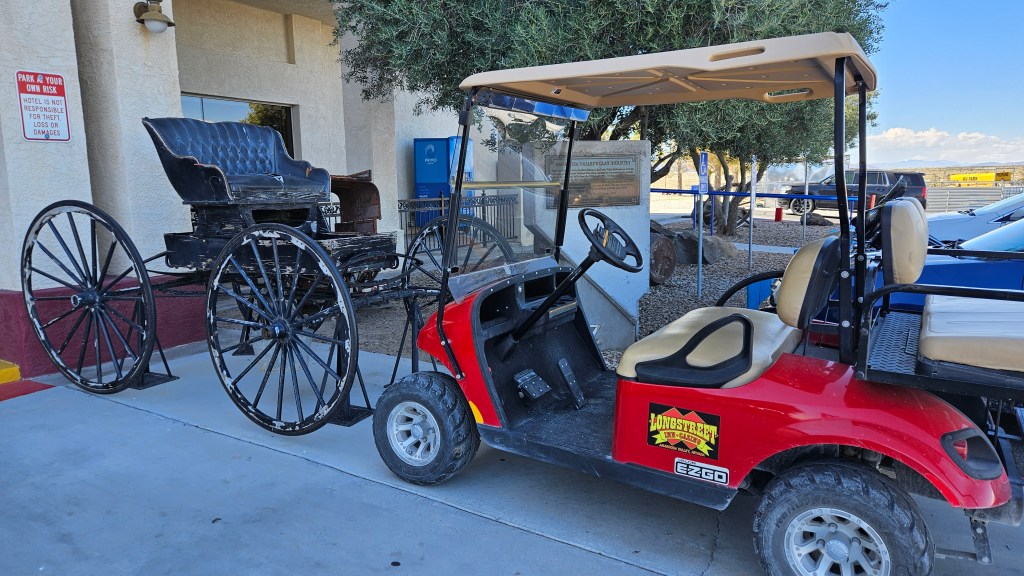
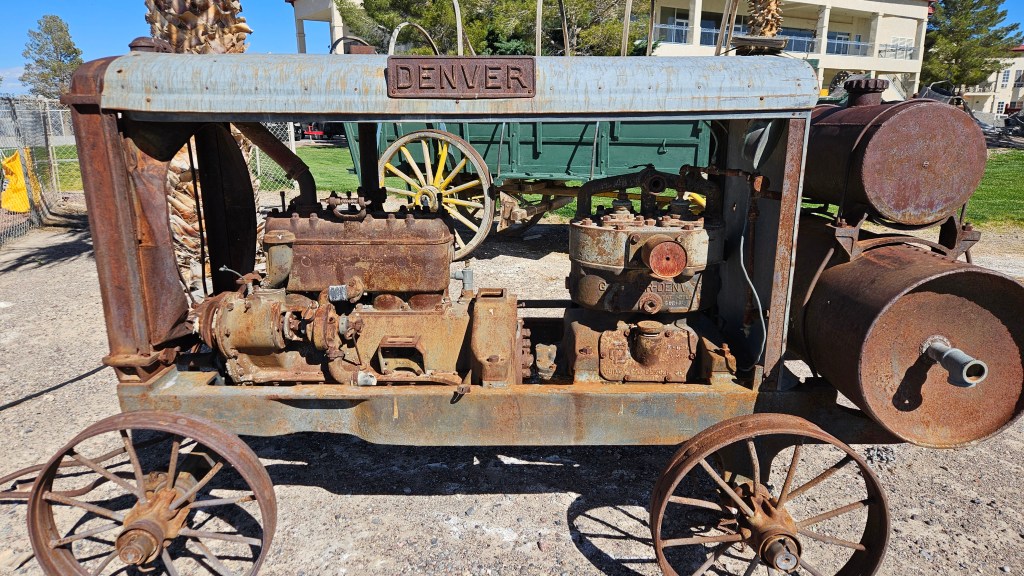
Walking around the building, there were many things to see. I could admire the old conveyances out front.
The old with the new
There is a petting zoo, with animals that mostly didn’t want to be petted. The zoo also includes a bull, a goat and a sheep.
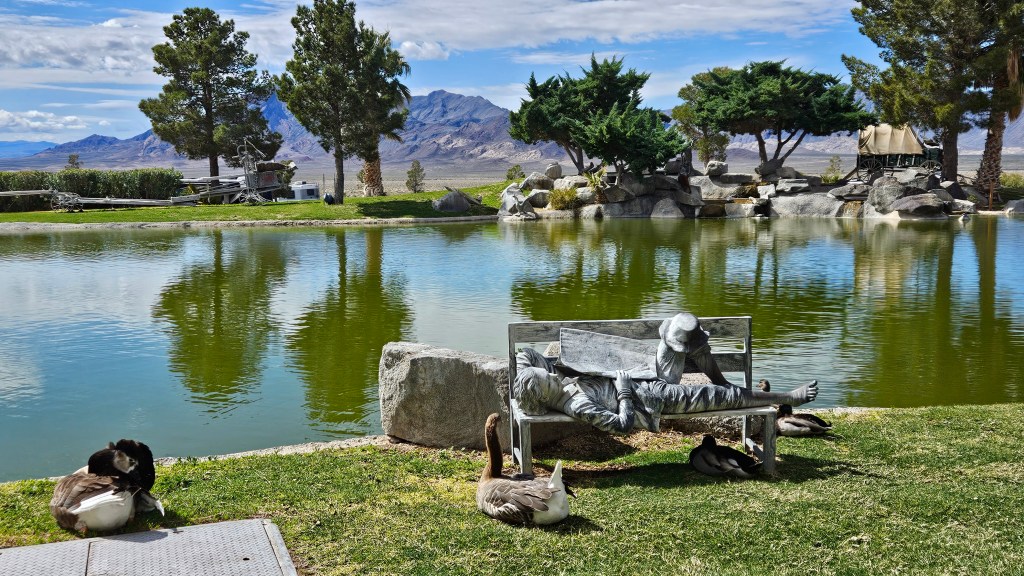
The back rooms to the hotel had patios and balconies which looked out onto another pond. This one is nicely landscaped and there are sculptures and many interesting artifacts set out to look at. This pair of geese would fly from one pond to the other daily, honking along the way for good measure.
I’m not sure what this is, but I liked that it said “Denver”.
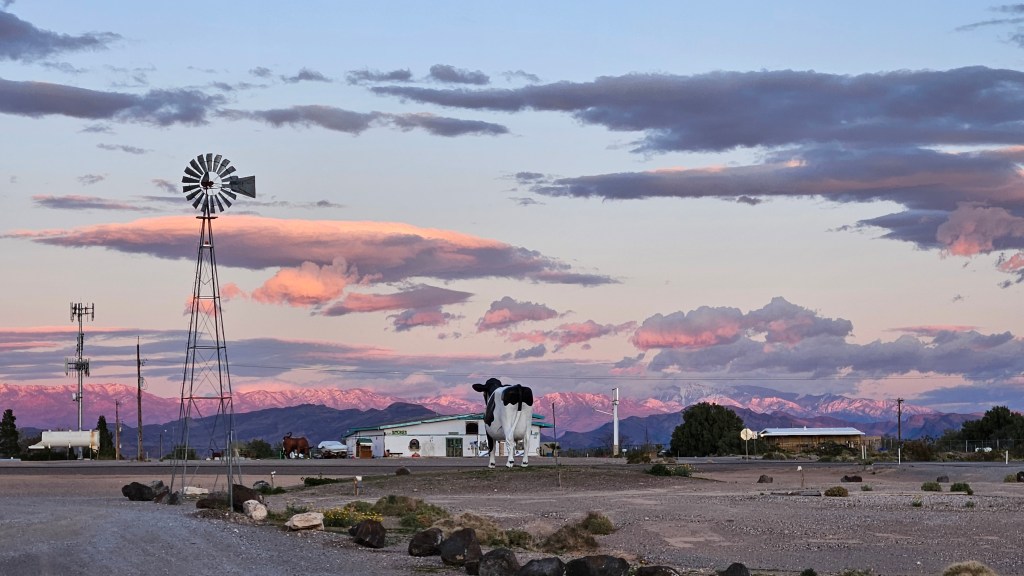
When the sun started to set, we would put our lawn chairs out on the (not) golf course, and watch the mountains turn red. We would puzzle over why the owner thought he needed the enormous cow out front, and where it may have come from. And, of course, we could ponder the meaning of life and let ourselves be swallowed up into the silence.
So, back to what makes a perfect RV spot?
The road has shown us that there is no one simple answer. The spot that we are initially disappointed in may reveal its secrets to us later. It could be the friendly folks at the park or some fun events that they held, a great trail to walk on, an interesting neighbor to hang out with, or a resident cat. We don’t tend to use a lot of the amenities that parks like to advertise.
A concrete pad here might have been nice, but gravel is the way of the desert. No, Longstreet wasn’t perfect. Only a select few sites have ever won that title for us. Longstreet did, however, score points with both of us for 1) the view into the desert, 2) lots of delightful places for me to walk and get my steps in, 3) a slight quirkiness with all the various little things to see, and 4) being quiet and peaceful.
In the end, we can’t ask for too much more.
When we passed our first night in San Diego, I was very excited to put a California sticker on my map. And then, in Boulder City, I could add the one for Nevada. It had been almost two years since we’d been able to add new stickers. You can see that we have covered the Southwest. Which state will be next? Even we, the Twosna Travelers, don’t have the answer to that question at present.





































































 Twosna Travels