

What else is there to do in London that may be a little off the radar? Well, I did have a small list, as I always do, but I wouldn’t call it a bucket list. I’m not one for just checking things off and moving on. Who knows? There may be something else more interesting to experience.
I had heard about the Charles Dickens Museum at the start of the Covid pandemic. It was a little news blurb about small museums, shuttered for the pandemic. They rely on their income from visitors to survive and they were concerned that they might not be able to reopen. I hoped it would make it so I could see it!
No worries: they did survive, and so we headed over to 48 Doughty Street to do our part in keeping the venerable museum afloat.
Dickens resided here almost three years from 1837 to 1839 with his wife and first child. He wrote “The Pickwick Papers” and “Oliver Twist” while here. It is an early Victorian home, and is one of only two of his London homes still remaining.

The grandfather clock that you see in the dining room was owned by Moses Pickwick, who owned a stagecoach and inn enterprise. He was thought to be the inspiration for the Pickwick Papers.
Dickens’s writing desk is here:
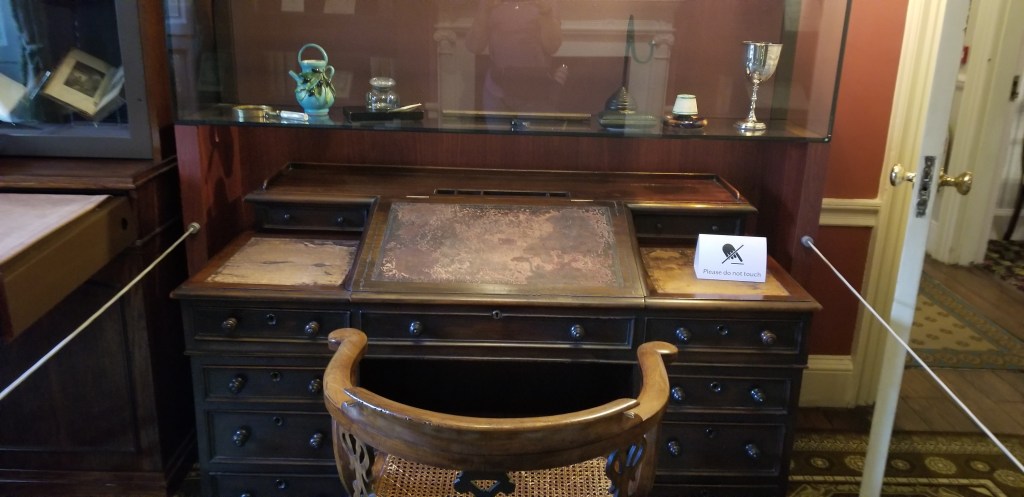
The desk was a later acquisition by Dickens. His final home was at Gad’s Hill and he purchased it while he lived there, in 1859. “Great Expectations” and other works were written on this desk.
Going down the steep narrow steps and into the basement, I found something interesting. Called the “wash-house copper”, a fire was set in the bottom to heat water inside the pot to wash laundry. The laundry was stirred with a stick. The pot was cleaned out at Christmas-time for boiling the Christmas pudding.
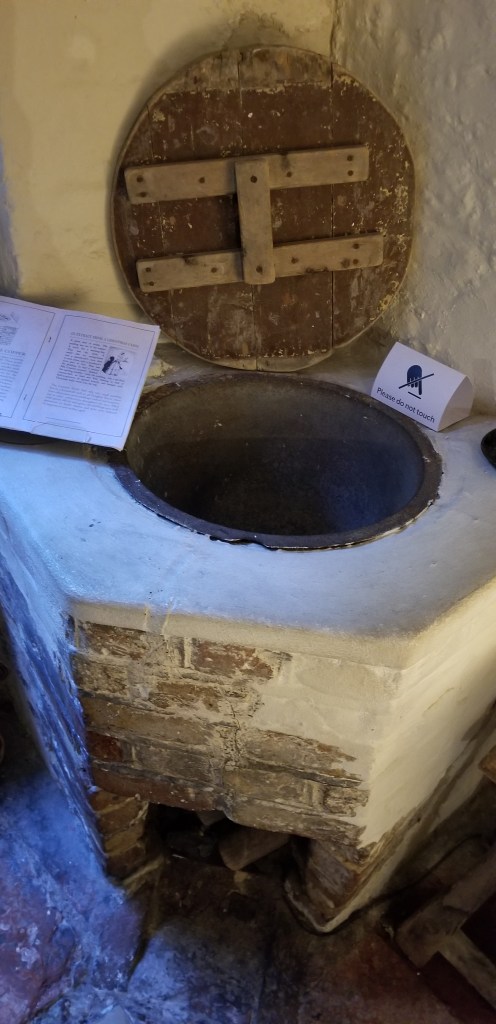
The Dickens home is a narrow city townhouse, but there are five floors. Water was boiled here in the basement for cooking, cleaning and bathing. I cannot imagine having to haul the boiled water up five floors for a bath in one of the bedrooms.
Both the Dickens and the British museums were walking distance from our AirBnb, so we headed out early on the leafy streets for each of our two remaining mornings to arrive at the museums when they opened. We spent over two hours in the British museum and that was a fairly quick overview. I, but probably not Cal, could’ve spent days. There was just so much “stuff” to see.
The British Museum may not be off the radar, but it is free. It bills itself as having “two million years of human history and culture”. There are objects from around the world. First and foremost is the Rosetta stone, the key to deciphering Egyptian hieroglyphics. Too many people were gathered ’round to get a good picture.
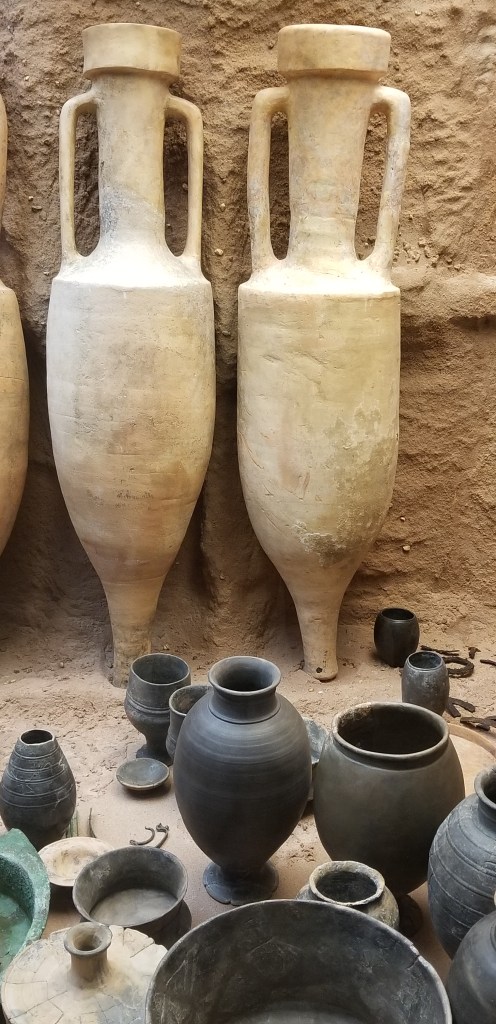
There were treasures from an Iron Age burial pit-
and the Lindow Man, who was found preserved in a bog. Time of death has been placed at between 2 BC and 119 AD.

The Lindow man was British, but so many of the artifacts are not. I have mixed feelings about antiquities that belong to other parts of the world. Still, Hoa Kananan’a from Nui/Easter Island was impressive. I will probably never get there to see the others. Looking at the visitor on the bottom left helps to give perspective on its size.

I could post so many more pictures, but I’ll leave off for now with a picture of part of the library. The British Museum library was founded in 1753 and has one of the world’s largest collection of written literature.

Out on the streets, there was a picturesque pub near the museum–

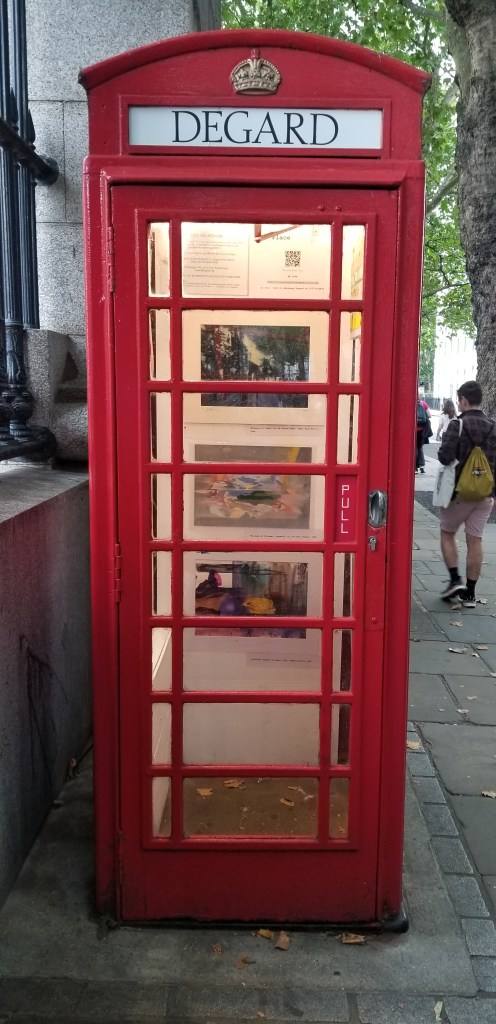
and an old telephone booth turned into a miniature art museum.
We hadn’t yet had a proper tea, and we were only a day away from leaving the continent. There are a mind-boggling lot of them to choose from in London, and they can be very expensive. Tea at Fortnum and Mason’s, THE tea spot for discerning afternoon tea patrons, starts at 78 pounds – which in today’s dollars is about a hundred dollars. We settled for a less expensive, but by no means less delicious, tea at The Coral Room. It was a sumptuous spread which served as our late lunch and we needed no more to eat the rest of the day.

For each of us there were four types of finger sandwiches, seen at bottom right, for starters. There were two scones in two different flavors with strawberry jam and clotted cream plus four different cubes of dessert. The full pot of tea was made with tea leaves (not a bag, heaven forbid!) and brewed with a timer. Perfection!
While I’m on the subject of food, I’d also like to tell you about our Sunday Roast. It is a custom in the UK, and we saw signs for Sunday Roast everywhere beginning in Scotland. On the Sunday we were in London the stars aligned. A pub we walked by often on the way to and from our AirBnb served this delectable dinner. We had a pint and watched a cricket game between India and Pakistan while we waited for our food. It consisted of roast beef and potatoes with gravy, cheesy cauliflower, and Yorkshire pudding. That last item may seem glamorous, but it is simply popovers which are baked and not fried. It was delicious sopped with the gravy.
We had ridden a black taxi from the train station when we first arrived in London, and we had been catching buses all over London. The one thing we hadn’t ridden on was the Tube, so on our last evening we rode the Tube down to Tower Bridge. Our tube stop must have been one of the older ones. It was 138 narrow steps spiraling down to the platform.
It was a beautiful evening and a lot of people were out, probably owing also to the holiday. We walked past the Tower of London, which was larger than I had remembered.
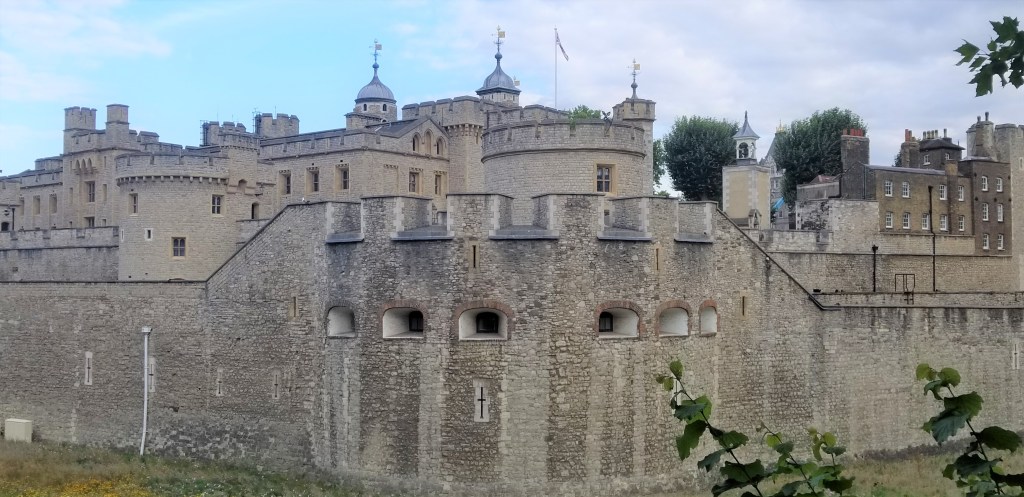
We also passed the Traitor’s Gate, over a little canal.

It is the most notorious entrance to the Tower by famous Tudor prisoners such as Lady Jane Grey, who died here at the tender age of 17 after claiming the throne for nine days back in the 1550’s. Prisoners would have been taken upriver to the Westminster courts for trial.
There is only a short walk to the Tower Bridge from here.

Could there possibly be a better finish to a visit to London?
Next time – grab your popcorn, we’re going to the movies!









 Twosna Travels