Before leaving home and also in the earlier parts of our trip, I wondered if we would be tired of spending so many days in Venice. It might be nice to have a little side trip over to the mainland, maybe. Padua looked interesting. It is about thirty miles inland, has frequent trains from Venice, and the train ride is only about a half hour long.
As it happened, on our train ride from Munich to Bolzano, I conversed with a woman from Berlin across the aisle from me. She was traveling solo to Padua on her “holiday” (that’s what Europeans call a vacation). She’d been to Padua a couple of times earlier as part of other trips, but this time she wanted to spend her whole vacation there. Hearing my interest in Padua, she told me about many wonderful things that one could see, most of which I’ve forgotten now. “I’m not going to do it this time,” she mused, “but I always thought that I would like to take the boat from Venice to Padua.”
What? It’s possible to ride a boat to Padua?
It is, and after some investigation, I booked us on the tour that goes across the lagoon and down the Brenta River from Venice to Padua. Traveling involves a certain amount of serendipity, plus keeping one’s ear to the ground.
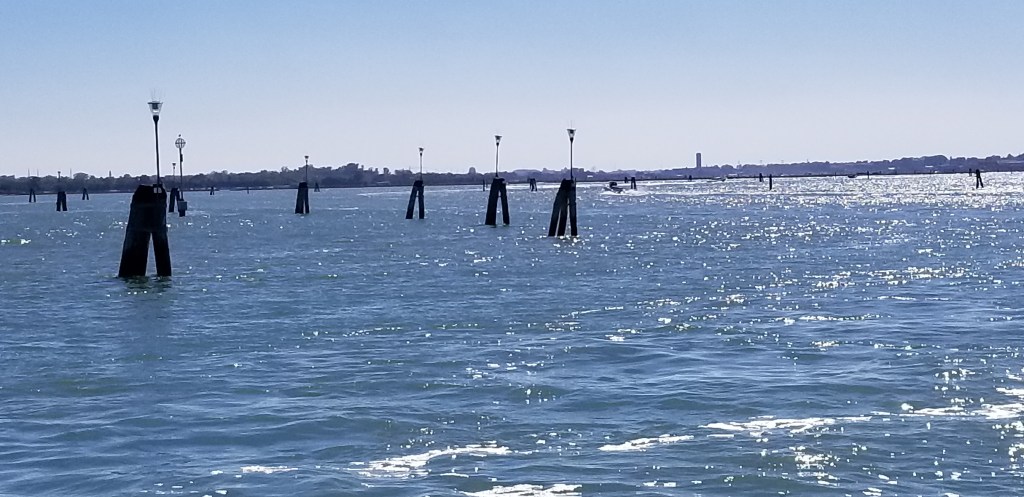
So it was that early on a sunny morning, we boarded “Il Burchiello” at the harbor near St. Mark’s Square and found great seats at the top. Some passengers brought suitcases. Our group spoke English, Italian, and French, and our guide gave us information in all three languages all day long. She began by giving us a rundown of what we were seeing as we left Venice. It was interesting to see the city from a different vantage point.

We rode out into the open lagoon and soon entered the mouth of the Brenta River.

In the 1500’s, the Venetians turned part of the river into a canal. We passed through the first of six locks. This one was still purely Venetian made, constructed in that era.

From the 1500’s to the late 1700’s, this canal was extensively used by the wealthy of Venice – the ones that had their names written in the Coffer room back at the Doges Palace. It was hot in the summertime in the city and the idea of air conditioning had not yet entered anyone’s mind. They would spend their summers in their villas along the Brenta Canal. It was considered a “fashion canal” because they would promenade along the pathways visiting each other and trying to outdo each other with their style of dress, the construction and decor of their villas, and the sumptuous parties that they hosted.
The nobility arrived at their summer homes with all of their wardrobes, all of their servants, and even some of their furniture.
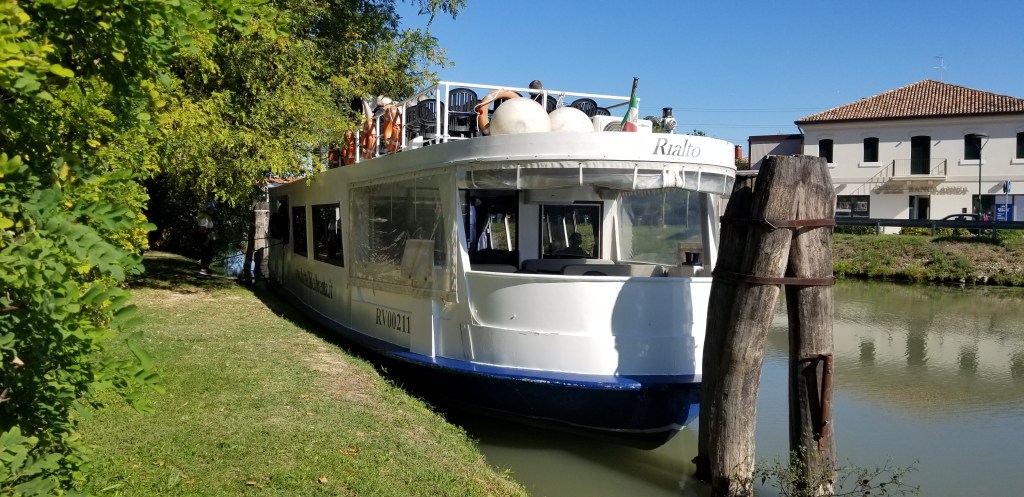
This was our boat for the day. Back in the Renaissance era, the boats were called “burchielli”. They were powered by oars through the lagoon. Along the Brenta Riviera, they were drawn by horses. So, a trip out to the villa was slow. The ladies and noblemen were entertained by adventurers, actors and artists.
Going through the locks, it always took quite a bit of time for our lock to drain or fill in order to pass to the next level. In this picture, we are ready to go, and the doors are opening.

There were also nine bridges that swung sideways for us. We had first seen one in Scotland, but this time we were the ones on the river.

Our first stop was at Villa Foscari, in the town of Malcontenta, built between 1558 and 1560 by the renowned Renaissance architect by the name of Andrea Palladio. More recently it fell into ruin, and then was restored.
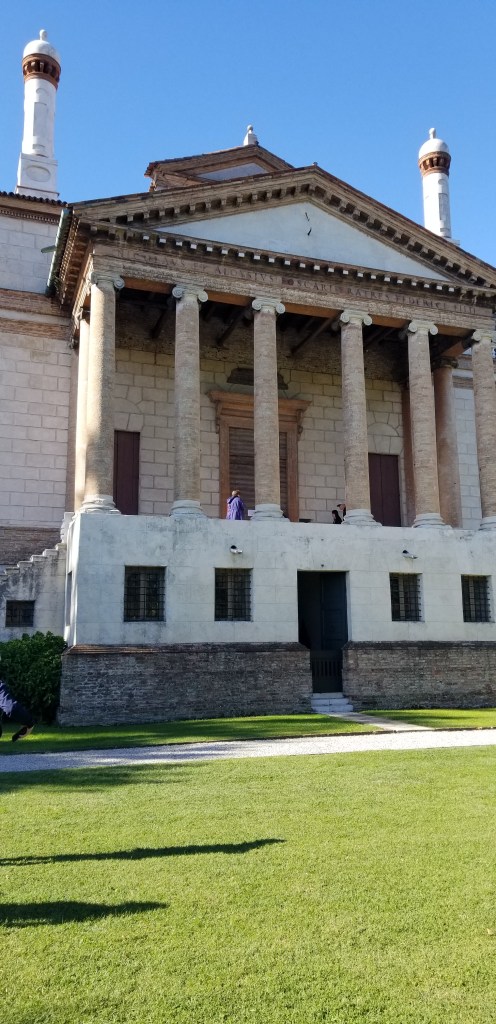
The villa was originally owned by the Foscari family, and changed hands over the years. Today, it is owned by a descendant of that original family. An architect would tell you it that it is built with a Roman temple facade, and stands on a pedestal. Inside, gorgeous frescos cover the walls and ceiling with scenes from mythology. The second floor has a balcony all around, so that one can look directly down to the first floor.
“Villa Malcontenta” is the nickname of this villa, which means “the discontented one”. A Foscari family member was confined in the home and its surrounding park for several years of her life for licentious behaviour. The confusing thing is that the town bears the same name but for a different reason: the area was marshy and the river was prone to flooding as far back as the Middle Ages, which brought disease and pestilence. The villagers may have been a little malcontented. Pretty dreary names for such a beautiful place!
Since the villa is still in the family, no pictures are allowed inside. I purchased these postcards, which shows “La Malcontenta” and the inside of the villa.


We had time to walk around the grounds before getting back on the boat. We didn’t have too much further to go before we docked at the restaurant that was our lunch stop.
The lunch on this trip had received mixed reviews. For the 22 Euro cost, some folks thought it was a better idea to walk into town and find a pizza place or just sightsee. We decided to go with the flow. The meal is called “The Casanova Fish Menu”. We received, in several courses: salad, smoked fish with a piece of toast (more fish than I could eat), fried shrimp, calamari, and baby octopus with a rectangle of polenta, rolls, and a bowl of fruit with ice cream. It was all delicious. The lunch was a bit salty and there was a lot of food, so we downed our water and almost finished the wine.
Of course, all that food and wine had a somnolent effect on Cal: he was snoozing down the river for quite awhile. It was hot and sunny on top of the boat so he moved down to a shadier spot, and he was not the only one. I had been glued to my seat because I didn’t want to miss anything, but now I went exploring the boat for a bit. We’d heard the guide talking about our disembarkation in Padua, making it seem like we wouldn’t be getting back on. What was that about? Were we not riding the boat back to Venice? Was there a bus to take us back? I found a brochure in the bar area to read later.
Meanwhile, I enjoyed the passing landscape along the way: villages, homes and churches, and people waiting for us to pass though bridges. I wondered who this pensive fellow might be:

You can’t see the word “Transit” before the above quote, but it means “Shadow passes, light remains” in Latin. That might have been something for “La Malcontenta” to think about.
We stopped at another villa, called Villa Weidmann. It was built later than Villa Foscari, in 1719, and was remodeled in the latter part of that century. Like Villa Foscari, everything is built around a square central hall with a balcony on the upper floor, Murano glass chandeliers, and those breathtaking frescoes. Unlike Villa Foscari, we could take pictures here.
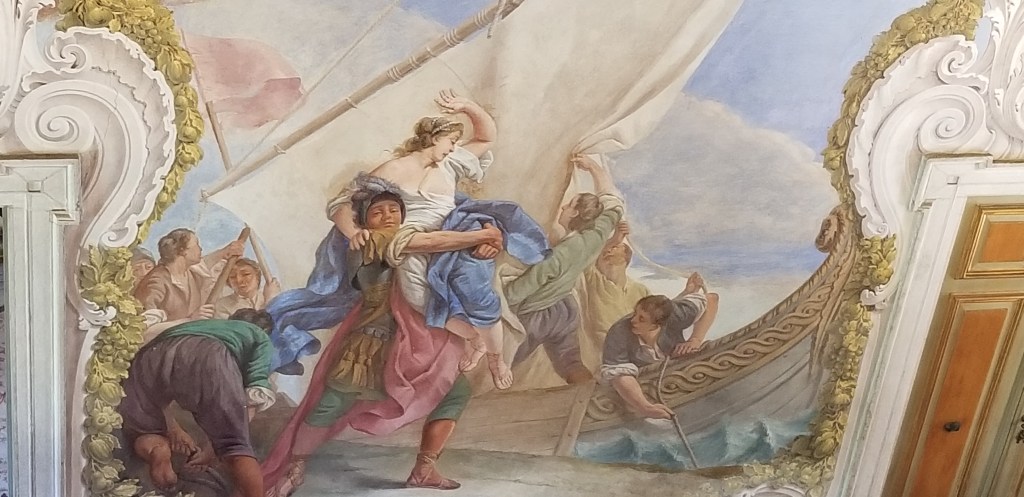


Outside, we could see a view of the villa from the back:
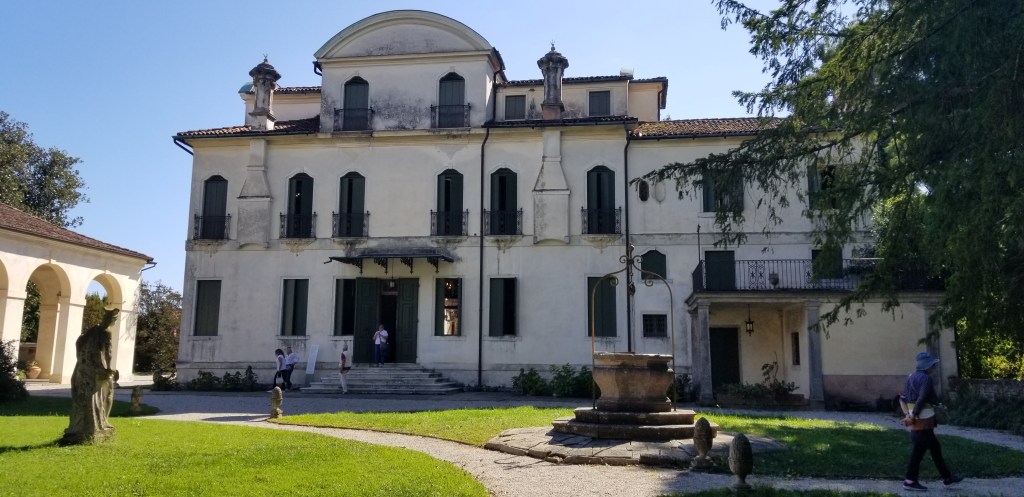
The fountain is just like those that still exist in Venice and would have been their water supply.
There are many statues in the beautiful garden.

There were once over forty villas lining the Brenta. The lifestyle came crashing down when Napoleon invaded in 1797. Peasants revolted, many villas were burned, and land taken over for farming. Other villas were used for animal, implement, and feed storage. I can imagine that this felt pretty good to the local farmers after seeing the upper class flaunt their wealth for two centuries.
Many villas still can be seen along the river, in different states of splendor or disrepair.

Some peeked out from behind woods or vineyards.

Some were on their last legs.

After Villa Widmann, I read the brochure I had picked up earlier, and went over to talk to our guide. She confirmed that yes, indeed, this was a one-way trip to Padua. Ah, that’s why so many people had suitcases. As it was taking us all day to get to Padua, the boat wouldn’t have gotten us back to Venice until the middle of the night. I don’t know how I had missed this little fact when I booked. But, in my defense, every single tour we’d taken thus far returned us to where we started! No worries though: we could take a train back to Venice.
The last villa was jaw-dropping. Nothing I read could have prepared me for it. It may be called Villa Pisani, but it looked like a palace. It is considered to be the queen of all the Italian villas.
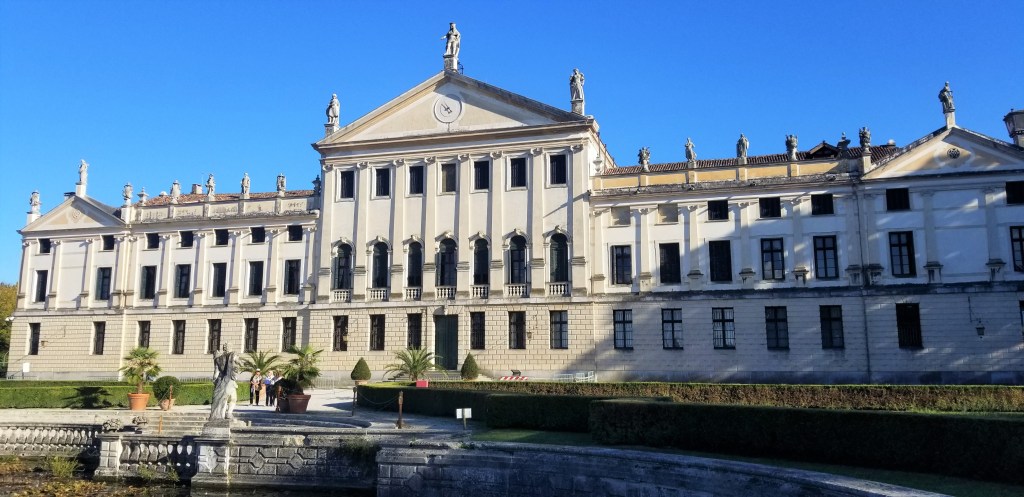
Looking out from the “villa”, the stables almost matched its size.
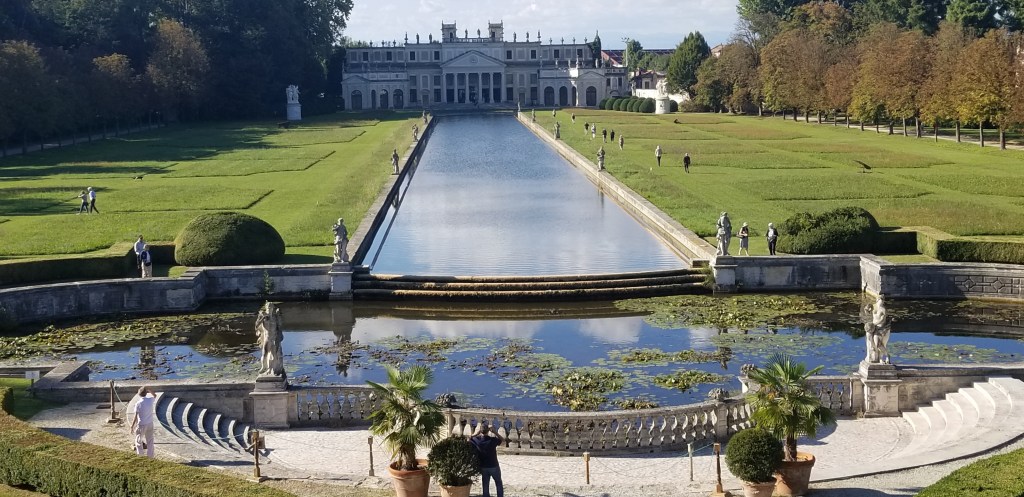
As you may imagine, this villa belonged to a doge: the 114th doge of Venice, actually, by the name of Alvise Pisani. It was purchased by Napoleon in 1807, and in 1814 fell into the ownership of European aristocracy. Finally, in 1882, it became part of the Italian state. There are over a hundred rooms. Doges, kings and emperors were welcomed here, and it is now a national museum. Most rooms have no furniture, but the dining room was set for dinner:
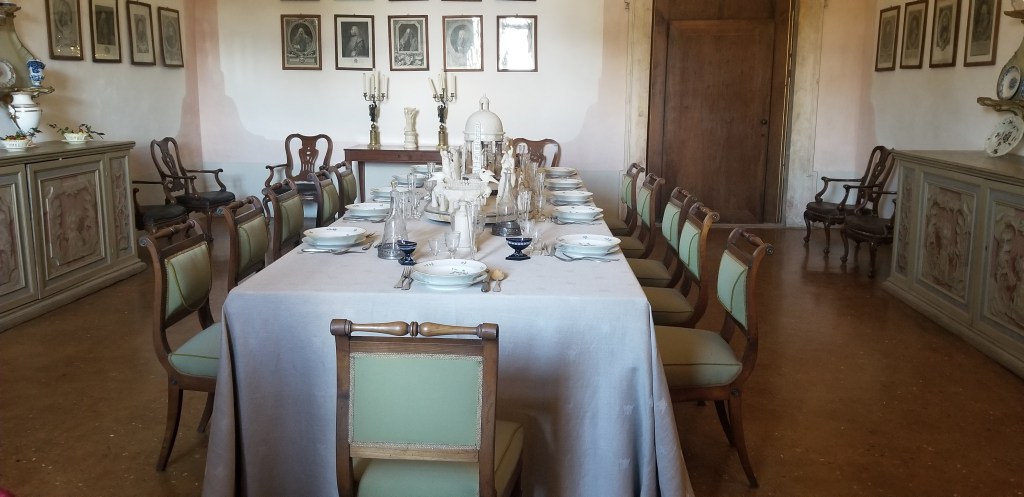
The frescoes here are masterpieces by a renowned artist by the name of Tiepolo.

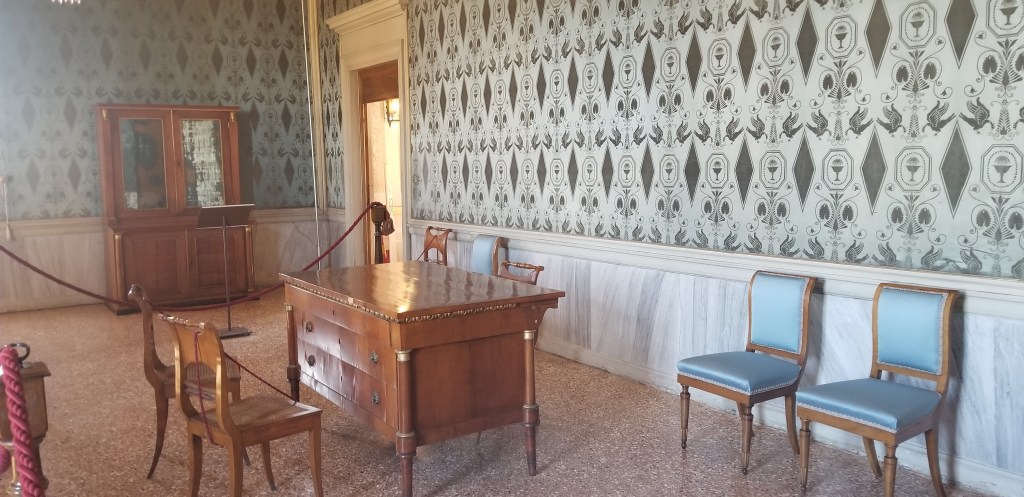
I enjoyed the many paintings and frescoes providing glimpses of what life looked like in those days.

In this room, Mussolini and Hitler met for the first time.
Back onboard, we enjoyed the last idyllic miles of river.

The sun was setting when we came to the outskirts of Padua.
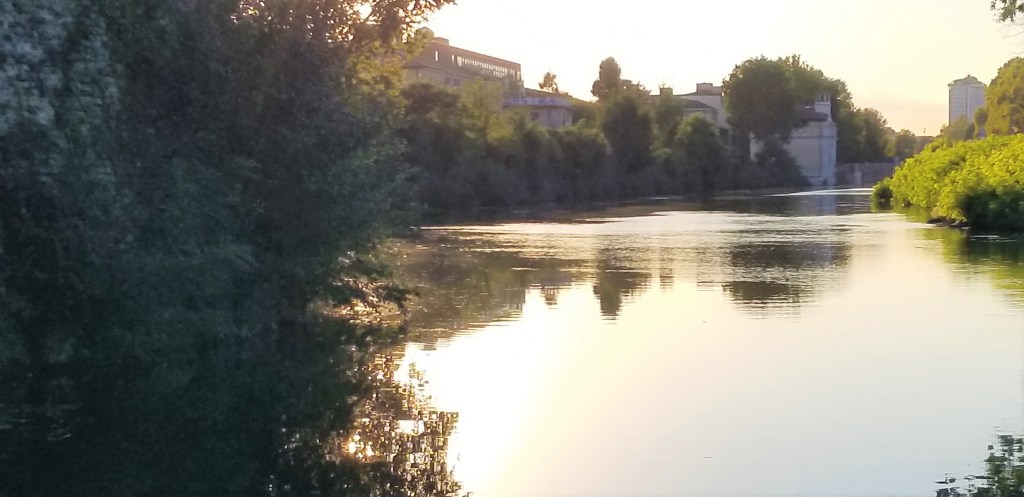
In the end, all I saw of Padua was the river, a part of an old wall, and a pretty bridge where we got off the boat.
It was a mile to the train station in the gathering darkness and we could have opted for a taxi, but it felt good to stretch our legs for the walk after being on the boat all day. A train was waiting for us, the cost was covered by our Eurailpass, and we were back in Venice in no time.
This concludes our Italian travels. We had one more country to visit, and we were both eagerly anticipating this last leg of the trip. Where did we go? Well, all I’ll say about that for now is that we attended a reunion, visited a beautiful city on the sea, and we had to fly there.
Next time: flying north to go south
































 Twosna Travels