USTravel

A Quick Stop In Northwest Indiana

Our travel journey took us to Elkhart, Indiana. I’ve traveled in, around, and through this state, and even lived in it for a short time or two. There are a couple of places I’ve missed seeing, but I don’t have the fondness for Indiana that I do for Ohio. With that in mind, our stop in Elkhart was only two nights. I had a plan for our one day here, which involved a small museum and a place to have lunch.

I’m generally our trip planner, but Cal surprised me in the morning of our stay by asking me if I wanted to go to Indiana Dunes National Park, some 65 miles away. I wasn’t going to turn that offer down.

The Visitor’s Center was open when we arrived. I stamped my National Park book, watched a video about the park, and purchased a couple postcards. As I was checking out, the cashier – who was also helpful park staff – asked if I needed assistance in planning our time in the park. I told him we were looking for a trail to hike after our long drive, maybe a combination of woods and dunes? What he suggested was absolutely perfect.

I had learned in the video that the park is working hard to restore the woodlands after decades of abuse. It lies in an industrial area, and indeed, we passed the road to a steel mill on our way to the trail. The woodlands are the final result of sand dunes that have been blown out by the wind, forming ponds and marshes first, and then a savanna after the marsh dries.

So, the view in the picture above was an ancient pond which is now a marsh. Lake Michigan would have lapped at my feet eons ago. This process doesn’t happen quickly.

We found West Beach and the Dune Succession Trail easily enough. First, there were boardwalk steps to climb —
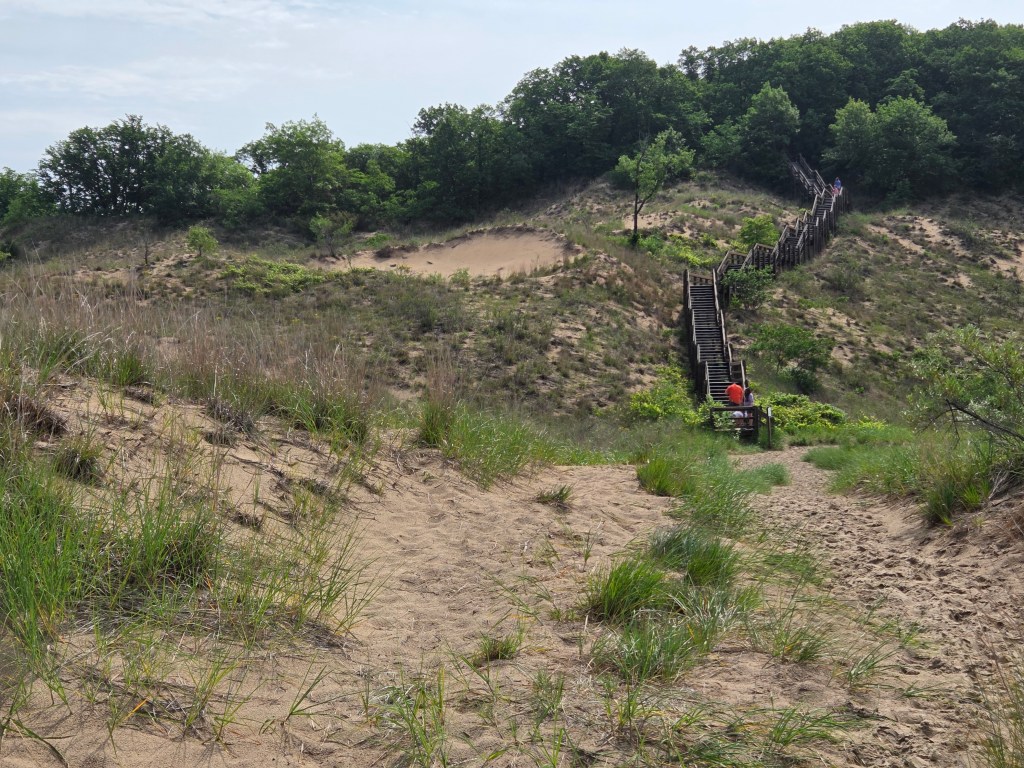
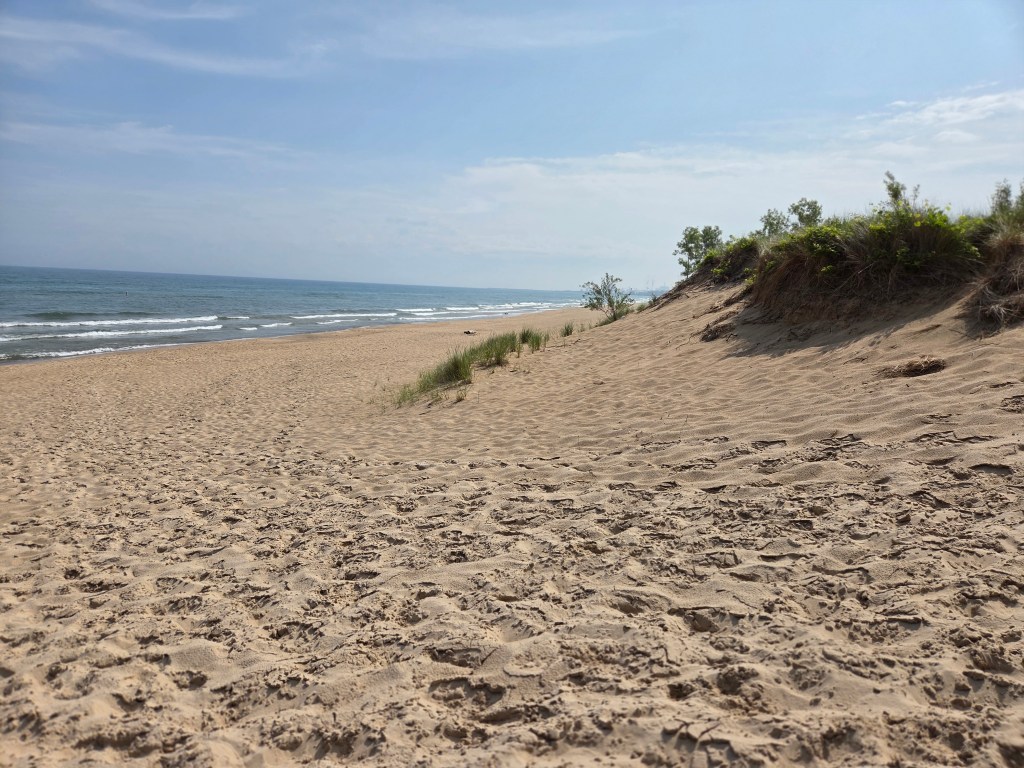
–after which we were rewarded by our first view of Lake Michigan and the dunes.

Down into the woods we went–
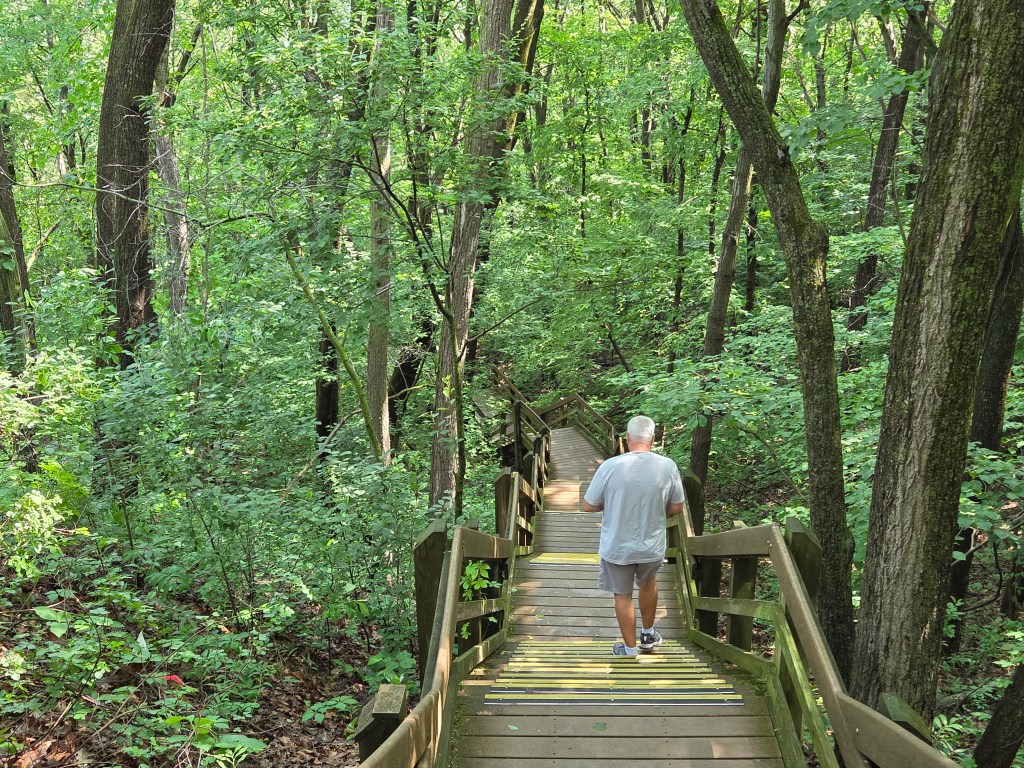
— and finally, out to the dunes and the lake.
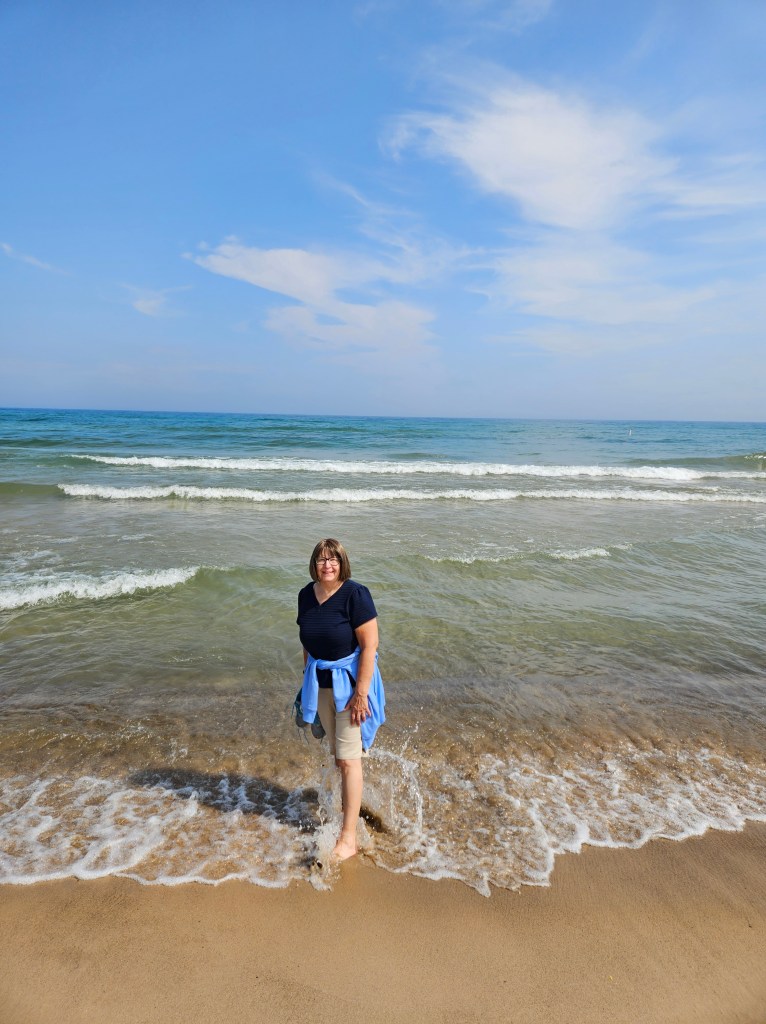
Dipping my feet into the lake was mighty fine.
This had been about a three-mile hike.

Our morning over, we headed back past Elkhart to Middlebury and Das Essenhaus, a restaurant that had been recommended to me by my sister-in-law Heidi. Indeed, I’m not even sure I hadn’t been there before. It’s in Amish country and not too far from Shipshewana, a shopping mecca that I enjoyed with her on a couple of occasions long ago.

This was a late lunch and our appetites were up. When our delectable broasted chicken arrived, we had already inhaled the dinner rolls. We even had pie for dessert because it was too tempting to resist.

Das Essenhaus is huge. A sign up in their hallway stated that they can serve 1,100 guests at once. They have their own bakery store, plus other shops outside of the restaurant. Afterward we purchased more dinner rolls (they are great for lunchtime sandwiches) and other baked goods for the freezer.

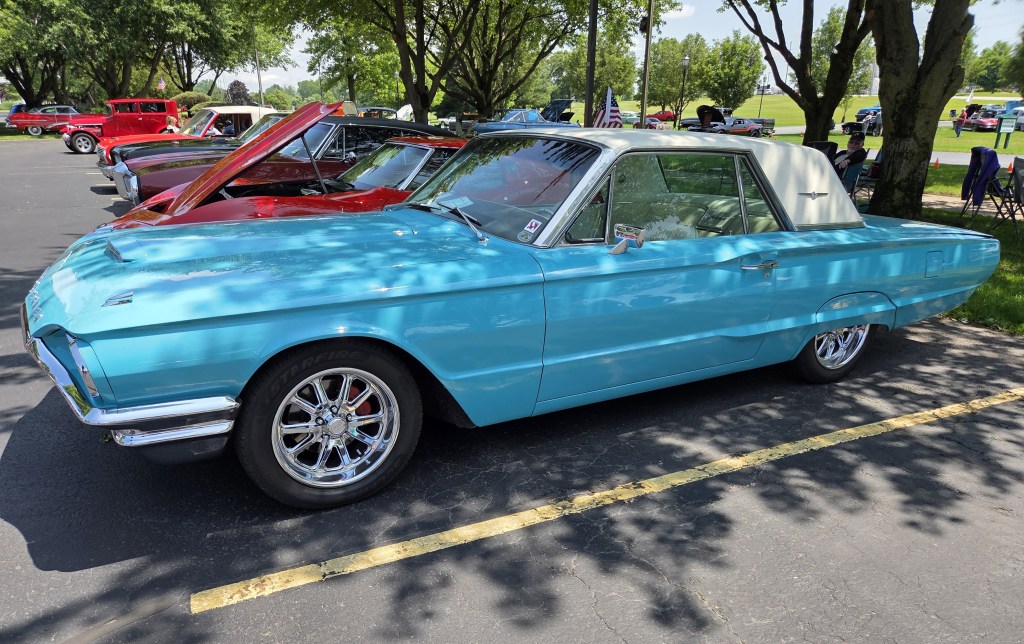
They have their own car show every Thursday. It doesn’t start till 4:30, but that didn’t stop folks from setting up several hours early. We had seen plenty of old cars in the drive by in Ohio, but stopped for a quick look.
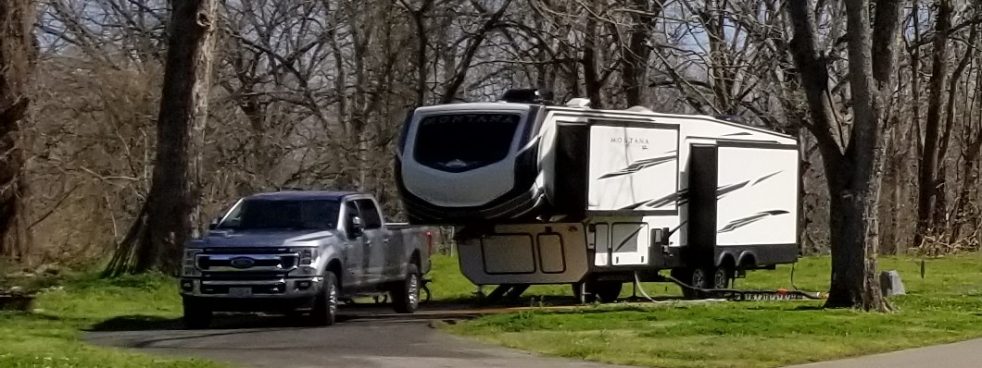
The Elkhart area is the RV capital of the United States, since most of the big brands are built here. As we drove around, we saw some names we recognized and names of makers of the parts that go inside of them. Early in our planning process, I had hoped to tour the factory that made our Keystone Montana, but we weren’t here on their Tour Day.

Instead, we visited the RV Hall of Fame and Museum. I don’t know who or what is in the Hall of Fame, I just wanted to see the old RV’s. It was a fun stop to end our day.

This is the oldest one, a 1913 Earl, which could go behind a Ford Model T.

A trailer from 1916 made me want to go camping. Out in the woods or mountains somewhere.
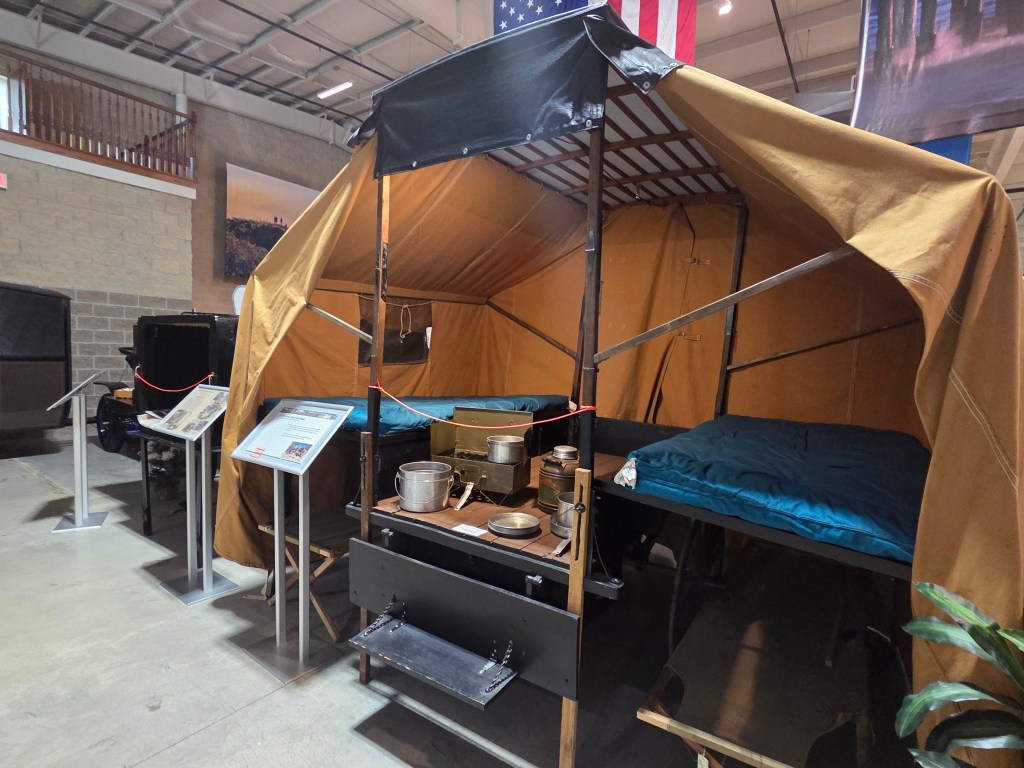
It is one of the first manufactured trailers. Most to this point had been homemade.

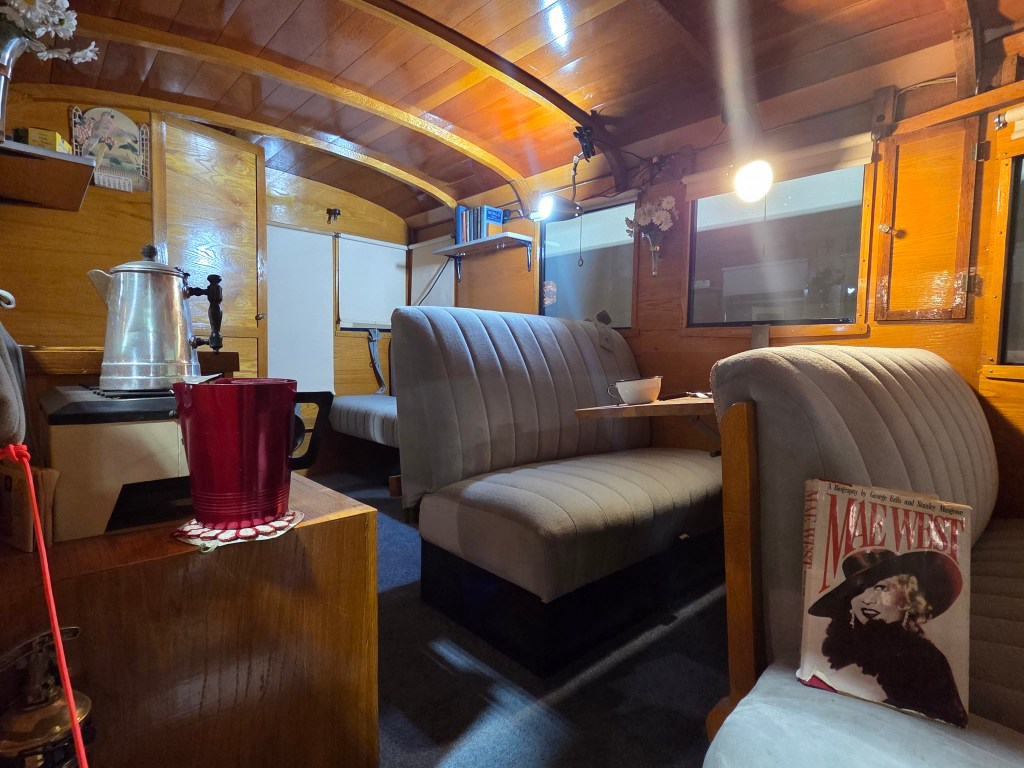
An RV built for a famous movie star is here, too. It was built in 1931 for Mae West. Paramount built it for her to entice her to make movies for them. It has a small hot plate and an icebox, plus a porch out back to sit and enjoy a fine day. What more could any movie star want?
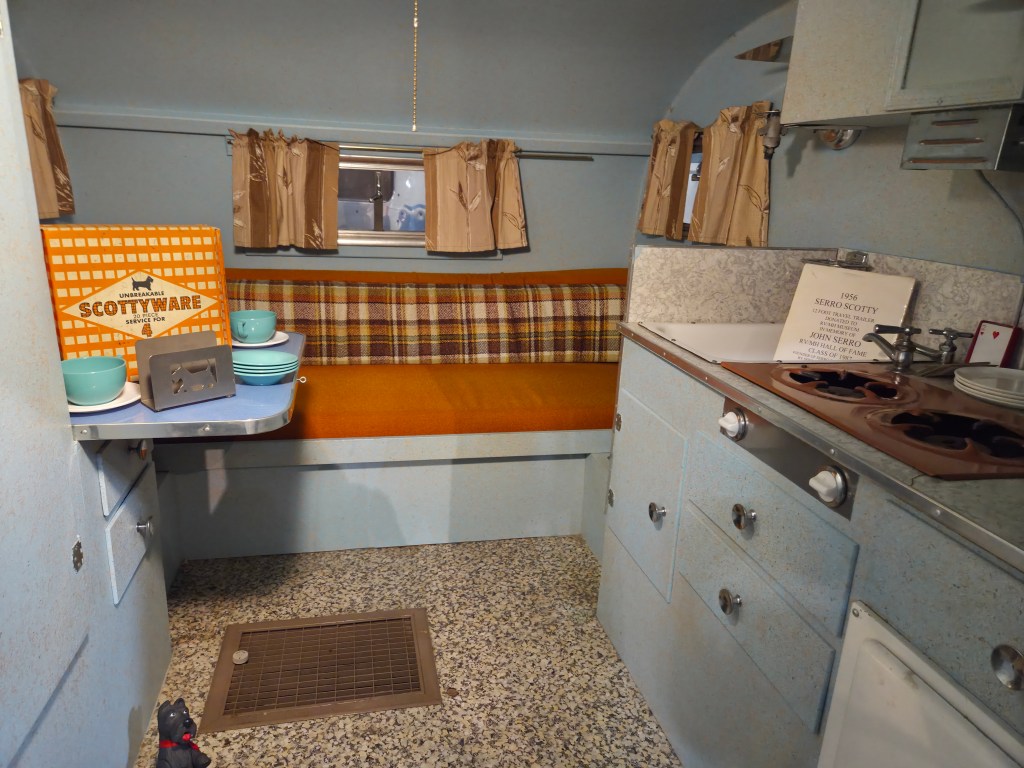
Moving forward in time, this “Scotty” trailer was manufactured in the late 1950’s. It just looks so cozy.
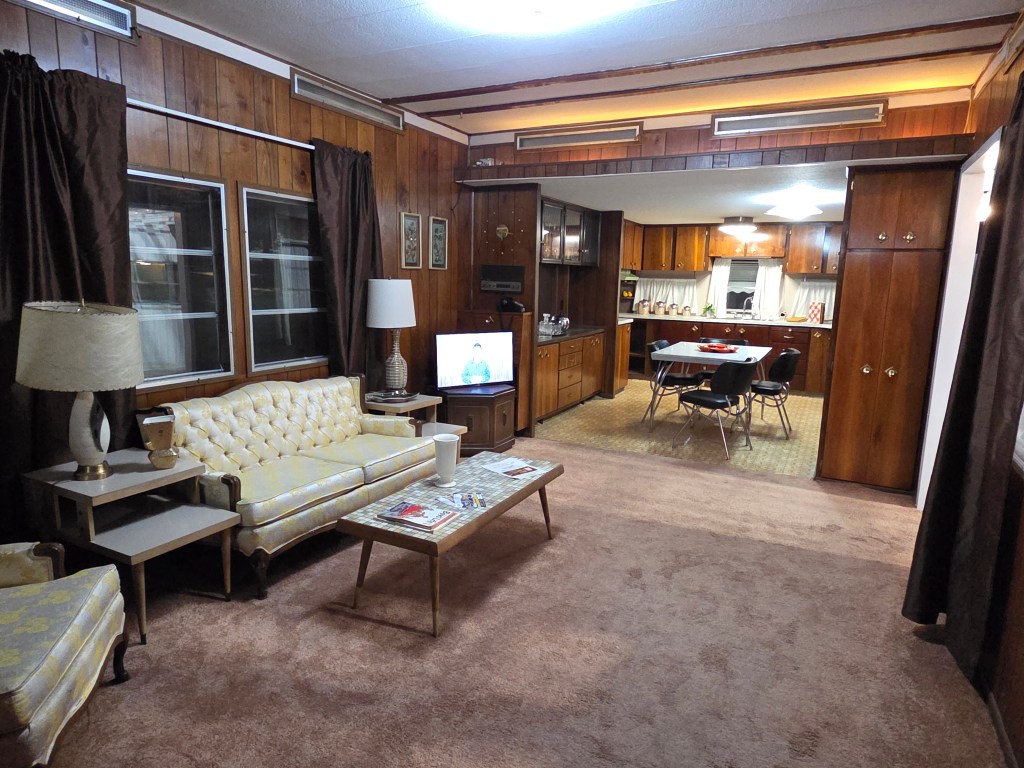
Mobile homes are here, too. Cal lived in one for many years as a child, so I asked him if this looked familiar. He was very young then, so didn’t remember.
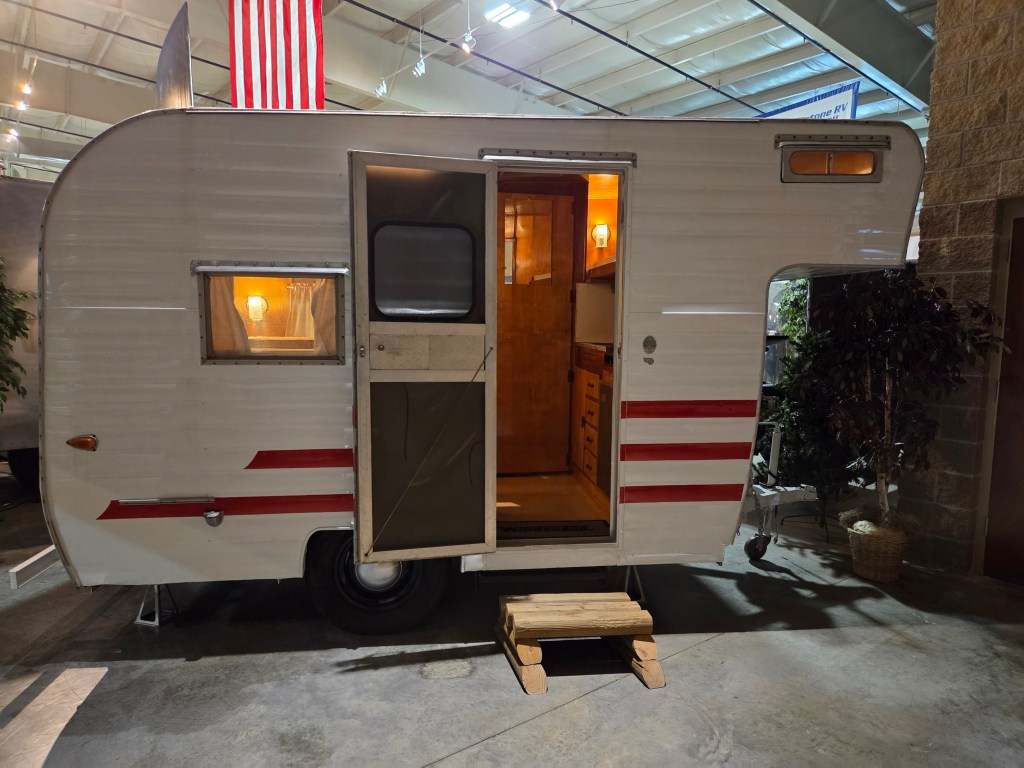
There wermotorhomes and many varieties of trailers and campers, as well as park models – the ones that go into RV parks and don’t move. It wasn’t until we left that I realized – why were there no 5th wheels, like our RV? I didn’t think to ask until after we left. This RV may look a little bit like one, but it is really a trailer.
The RV I like best, however, is our own, and that’s the one we go home to after all our adventures on the road.

Next time – north to Michigan
USTravel

A Lake Tahoe Visit

Lake Tahoe is a place I’ve long wanted to visit, although my husband says that everywhere is somewhere I’ve always wanted to visit. That may be true, but it was still a very exciting moment when I stood on the shoreline and gazed at the clear blue water.

It had been a long drive back into California from where we left our RV on the east side of Reno. I hadn’t been able to find available RV parks any closer, although I had looked months earlier. In a rare occurrence, I was at the wheel, and enjoyed driving on the winding roads along mountain sides and pine forests until we arrived at the lake.

The picture above was taken at one of the first small turnoffs we came to.

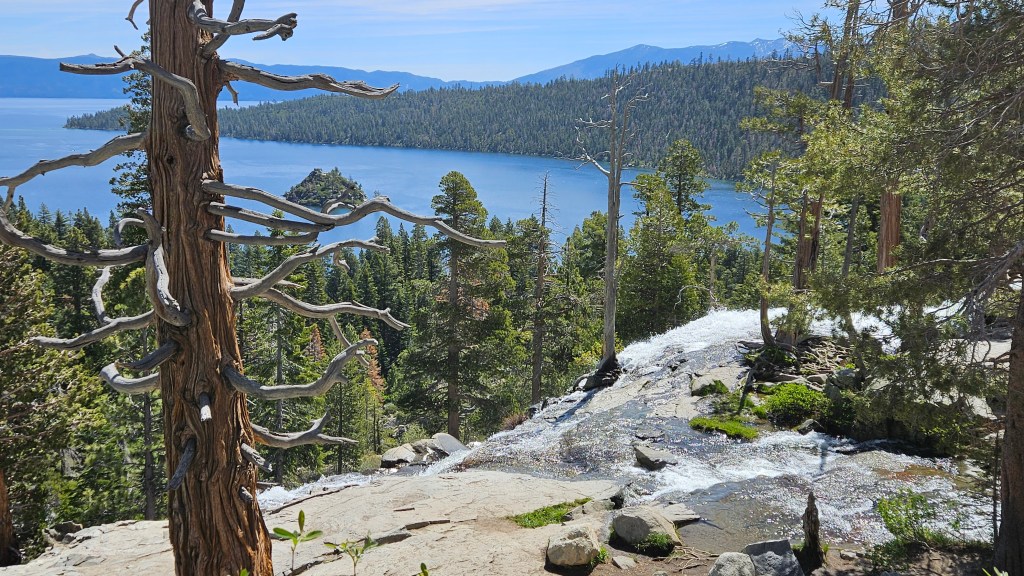
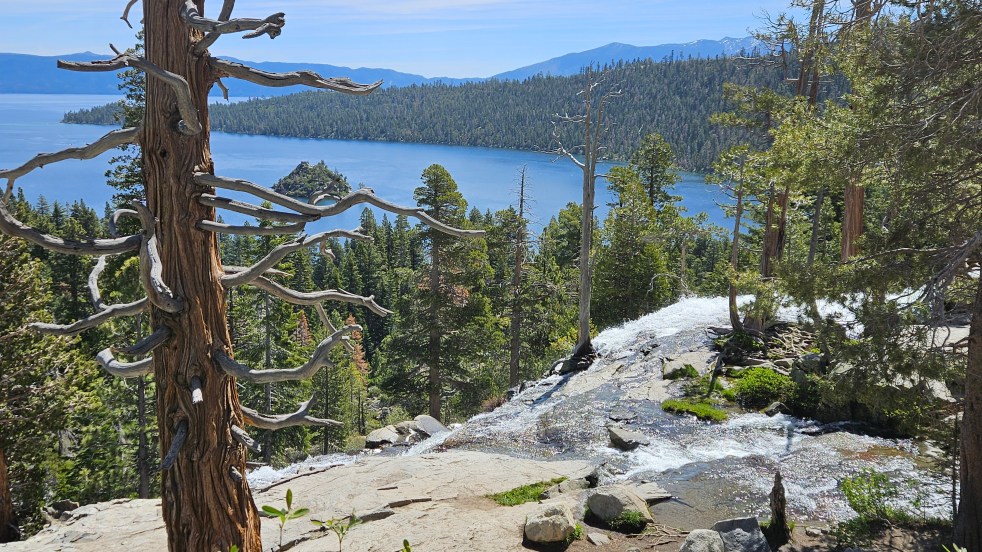
Our first actual stop was at Eagle Falls on Emerald Bay. We were on top of it in the picture below, and the falls are on the right of this picture. The little island in the water (above the tree limb) is Fannette Island.

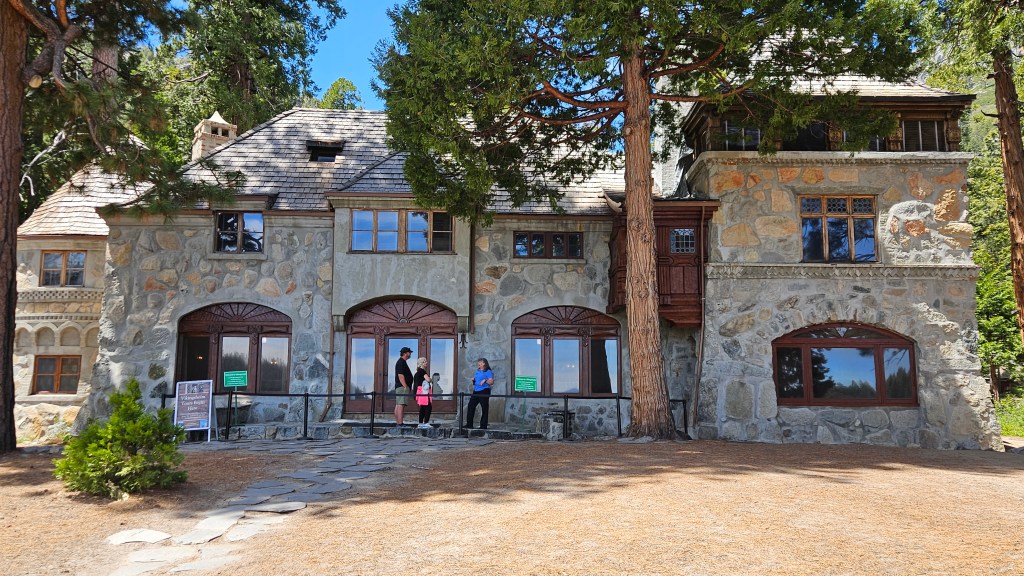
Lake Tahoe didn’t receive the early protection from development that Yosemite did. In the early 1900’s, wealthy folks purchased swaths of land and built homes along the lake. One of these was Vikingsholm, considered to be “Tahoe’s Hidden Castle”. If you enjoy Scandanavian architecture, it is considered to be one of the finest examples in the United States. We decided to take a tour of the home.
First though, we had to walk one mile downhill in the gorgeous pine forest on the old road, now a path, to the house. Views of the lake abounded. We were acutely aware that we were going to have to walk this same mile up when we were done!

The home was built for Lora Josephine Knight, a widow in her 60’s. A house had already been here since the late 1860’s, and a later owner built cabins. The land was cleared to build the home but Lora did not want one single tree cut down in the construction. She had traveled to the Scandinavia many times and Emerald Bay reminded her of the fjords there. Her niece’s husband was a Swedish architect who designed the home for her in that style. It was completed in 1929, and became her summer home.

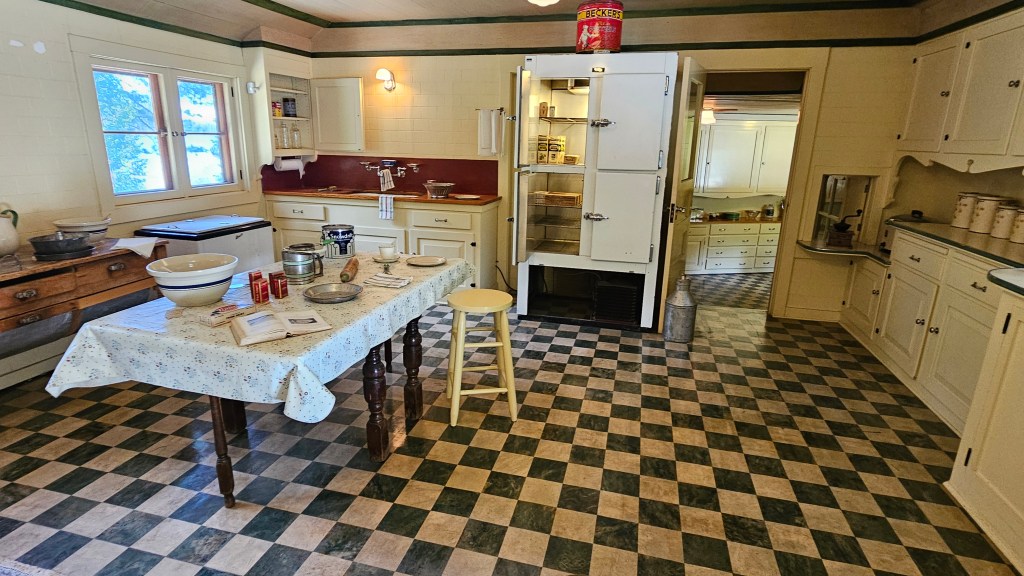
Of course, the Scandinavian design continued inside the home, as our guide pointed out many features. Lora loved to entertain and have guests, so the dining room is large enough to stretch out the table when needed. And of course, having many guests requires having a large kitchen!

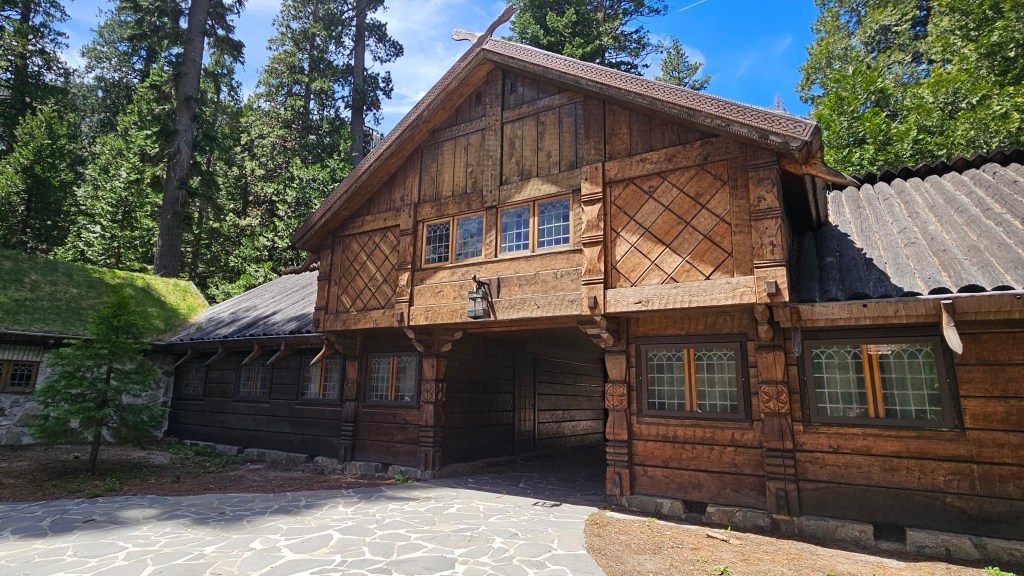
Arriving guests would drive under the structure in the picture below to the courtyard in the back. This structure housed the caretaker, who lived here year round, and also guests. This roof was made of logs; the low buildings on either side of it had roofs made of sod in true Scandinavian fashion.

From the front of the house we could walk right out to the lake shore, and happened to catch a passing excursion boat. On the right is Fannette Island again, which also belonged to Lora, and she built a tea house there.

Lora enjoyed 15 summers here and she had no descendants. The home eventually was acquired by the state of California, and is part of Emerald Bay State Park. Besides the home, she is also known for generous contributions to youth organizations, and for providing educational opportunities for those who could not afford them. In addition, she was a prime financial backer of Charles Lindbergh’s flight across the Atlantic.

Our next stop was the marina restaurant at Camp Richardson. It is an old resort community, and its setting under the tall pines gives it a national park feel. There are cabins, and – across the road – a great-looking RV park. I didn’t remember if I had seen this in my RV park search, but most likely it was already full. At the restaurant, we had delicious bread bowls of clam chowder with bacon sprinkled on the top. We were in full view of the lake.

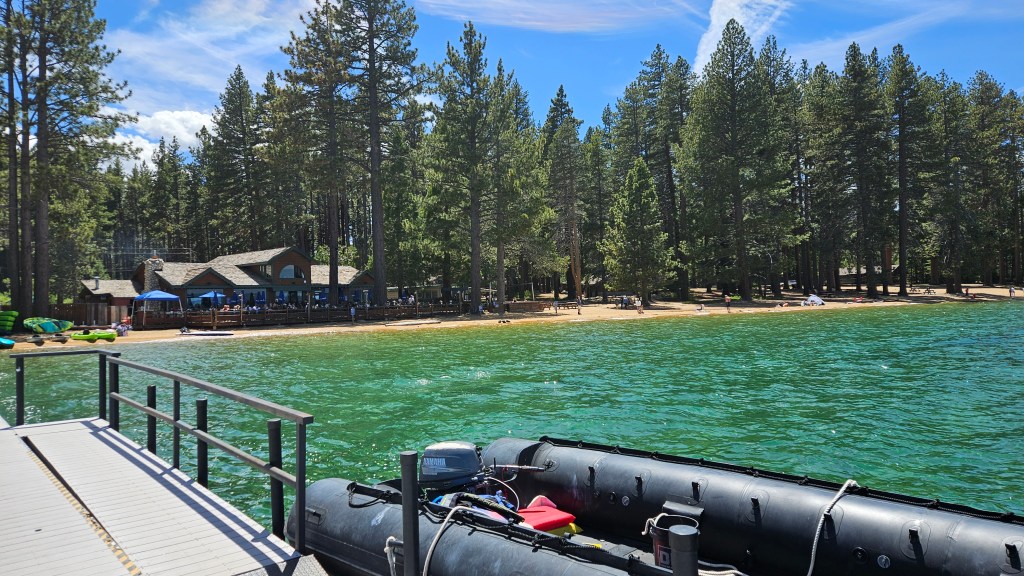
We walked out onto a very long dock after lunch and I took pictures of the restaurant, the beach, and the lake with that beautiful clear water.

The rest of the afternoon was spent in scenic driving down to South Lake Tahoe. I had booked a room in a ski lodge at a post-ski-season rate. Calling it a ski lodge makes it sound fancy, but it was really just a remodeled old motel. Our room was cozy, had a gas fireplace, and was decorated with a fishing theme. Turning left onto the road from the lodge would have taken us directly up to the ski slopes.

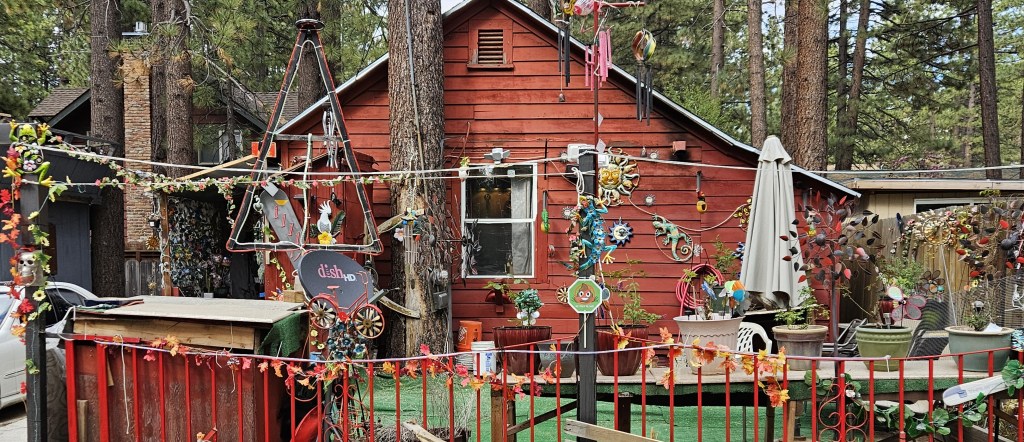
Walking a few blocks to dinner, we enjoyed the neighborhood under its canopy of tall pines. Some of the homes were very interesting.

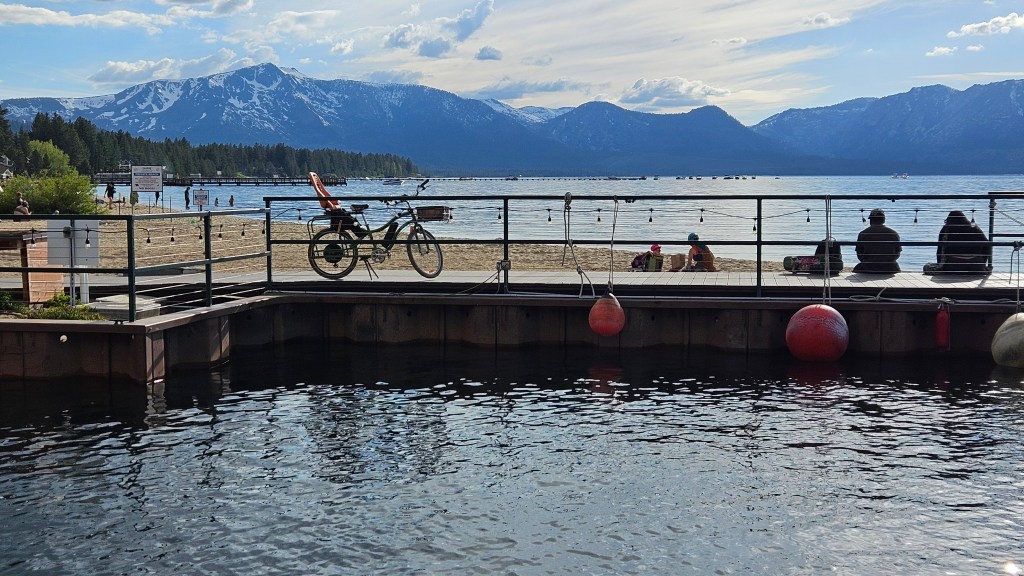
And later, we found another couple of docks.

So, just the same as our last night in Arizona at Grand Canyon West, our last night in California was spent outside of RV.

I highly recommend breakfast at Heidi’s Restaurant in South Lake Tahoe. I had a waffle with warm strawberry sauce and whipped cream. This turned out to be a very tasty trip!

South Lake Tahoe is right on the border with Nevada, so as soon as we crossed it we were passing by several casinos. Rounding a bend in the lake, we were now proceeding north. We received magnificent views of the snow-capped Sierra Nevadas from here.

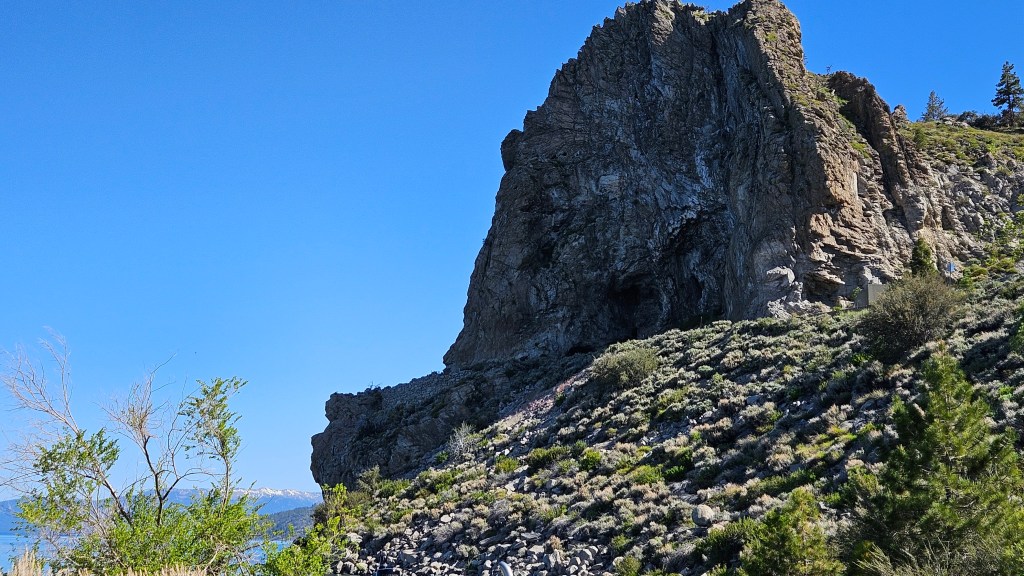
We were going to take a hike at Cave Rock, but it didn’t pan out. First we found ourselves in a marina parking lot, where I did get a view of the rock. This is a sacred place for the Washoe native peoples.

It seemed like we were supposed to drive through a residential area to the trailhead, but the signs were confusing. We dropped that idea and drove on to see Carson City, which is the capitol of Nevada. With a little bit of extra time before heading home, we decided to stop at the capitol building. It serves the governor of the state and has some offices besides the museum. The other workings of the state happens in buildings around this one.

I learned a some interesting things here. The first is that the Nevada became a state on October 31, 1864, just eight days before President Lincoln’s reelection. He needed the votes, and Nevada was not a slave state. Politicians in Nevada wrote up a constitution and telegraphed it to Washington – the longest telegraph ever sent to that date. As soon as he received it, he admitted Nevada to the Union by an act of Congress. And the rest is history.

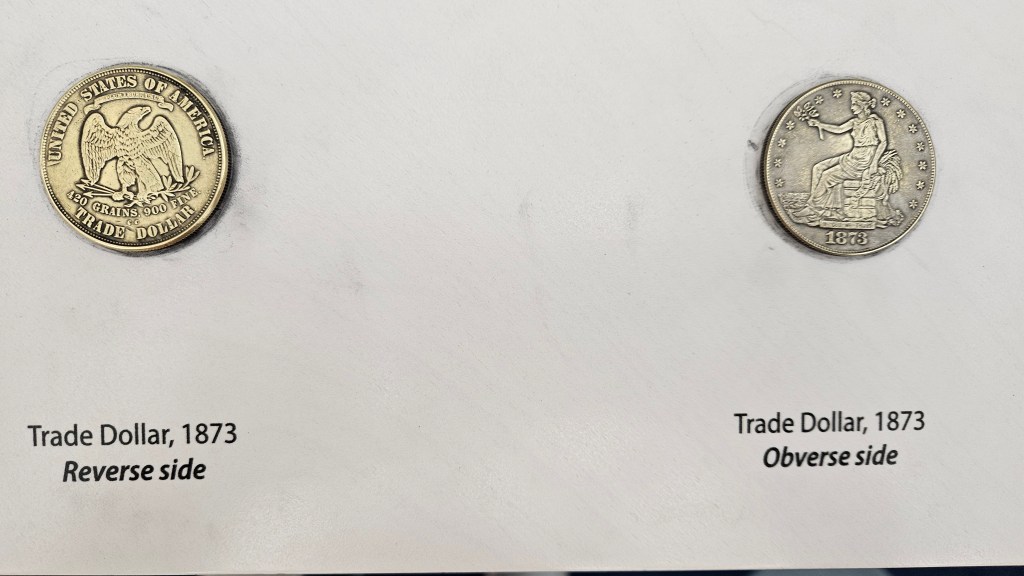
The other thing I learned is that Carson City is one of only eight cities to be an official US mint. It was short-lived, however. The first minting was in 1870 after discovery of the Comstock Lode. It closed permanently in 1893 after silver mining declined. If you ever find a coin with the “CC” designation on it, it might be worth a little something.

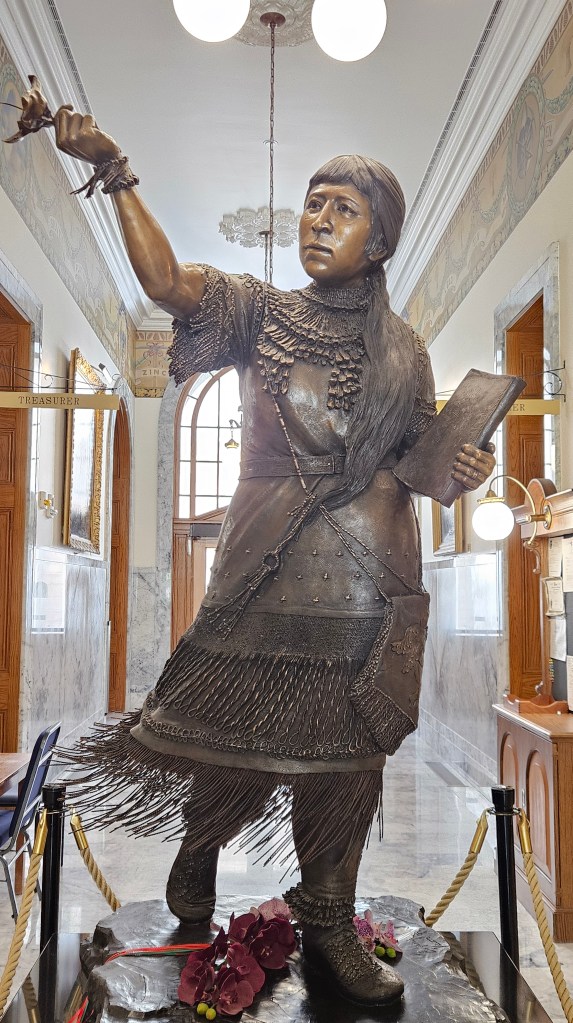
I also learned about Sarah Winnemucca, who lived from 1844 to 1891. I’ll let this signboard tell you what you might like to know about her, and there is a statue of her in the capital:

Every state capitol we’ve been to has something interesting and different to see and learn.

This had been a great little trip, and our adventures still continue!

Next time – we check out Reno and move to Washoe Lake State Park

USTravel

Sabino Canyon

Sabino Canyon, Esperero Trail

After spending a month at Gold Canyon, we moved a little further south to Tucson. This is a city we were very familiar with years ago, but time changes things and we didn’t see much that was familiar. Several people we talked to told us to go to Sabino Canyon, which was not a place we had heard of.

The proper name for this place is “Sabino Canyon Recreation Area, Coronado National Forest”. It is not far from Tucson so it is a popular place to hike. There is a whole network of trails in here. In an effort to ease congestion, a shuttle service was installed years ago. There’s a one-hour narrated 7.4-mile roundtrip tour into the upper end of the canyon, with nine stops to get off sooner to hike various trails. There is also another shuttle route with service to Bear Canyon which is shorter and not narrated.

It is an error these days to think you can just show up and ride a shuttle. When we arrived at Sabino Canyon, all the shuttles for the day were full. We should have booked ahead on-line. They’ve recently converted the pollution-belching gas shuttles to electric – but several don’t work. However, a volunteer ranger was ready for us. He mapped out a route for us from the visitor’s center with several interconnecting trails – just over two miles, he said. I think it was further than that. I had 12,000 steps on my Fitbit at the end of the day, which is about six miles.

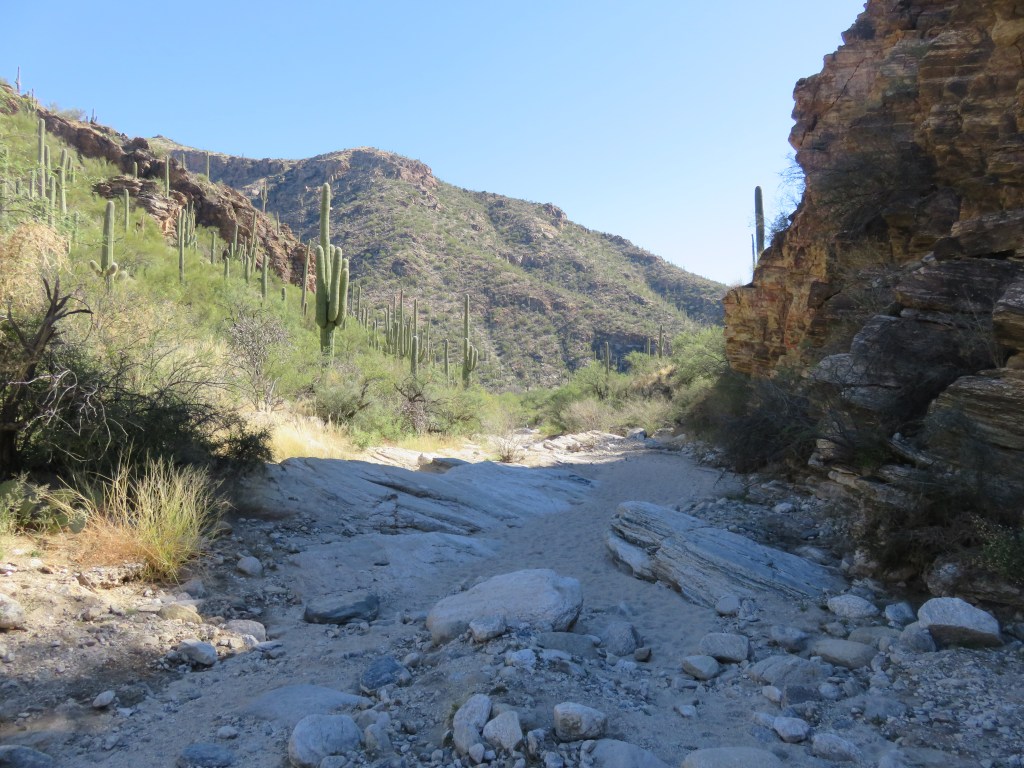
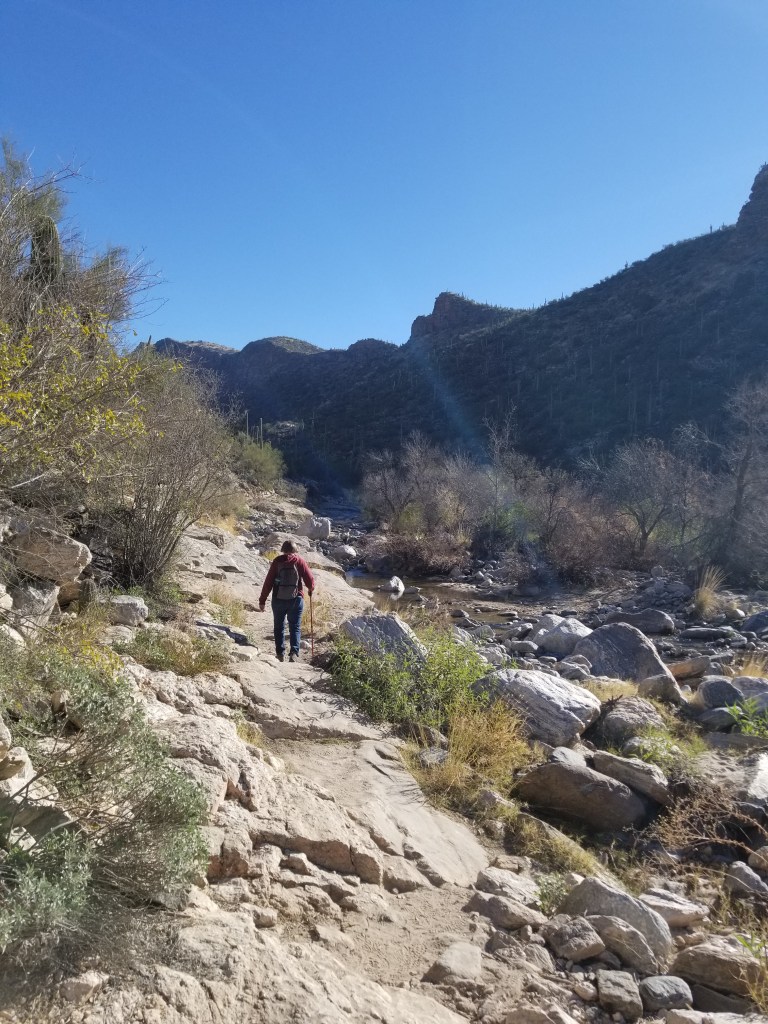
No matter, once we hit the trail we left everyone behind, and mostly had it to ourselves.

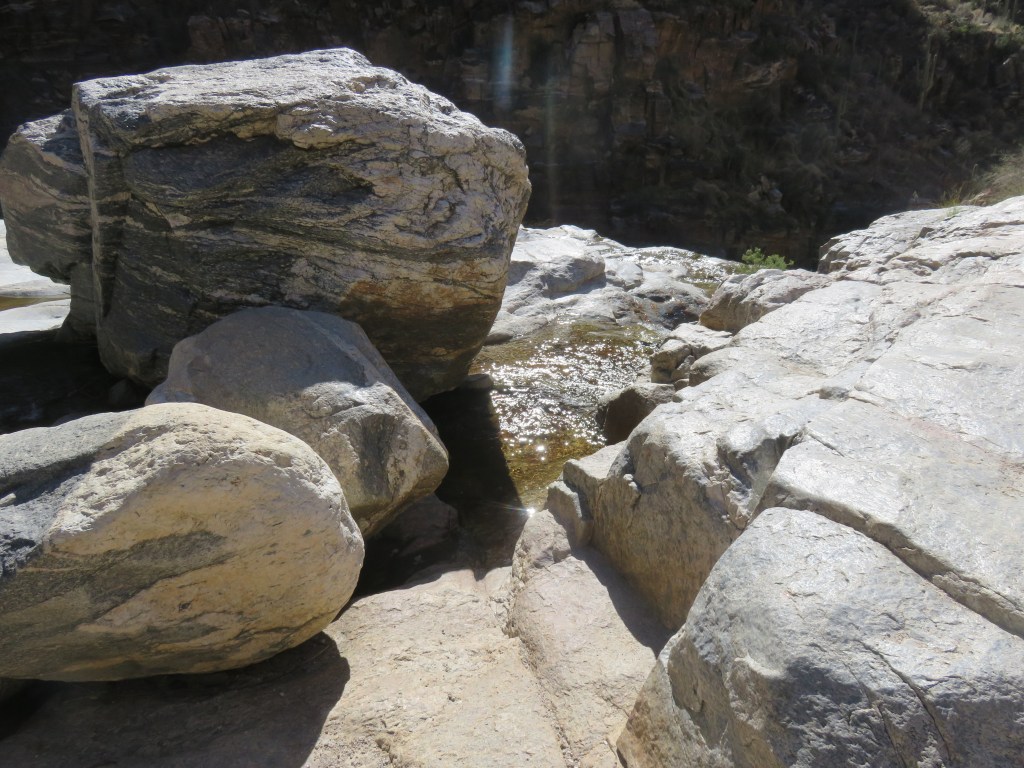
This little ledge overlooking a creek was a great spot to have a picnic lunch
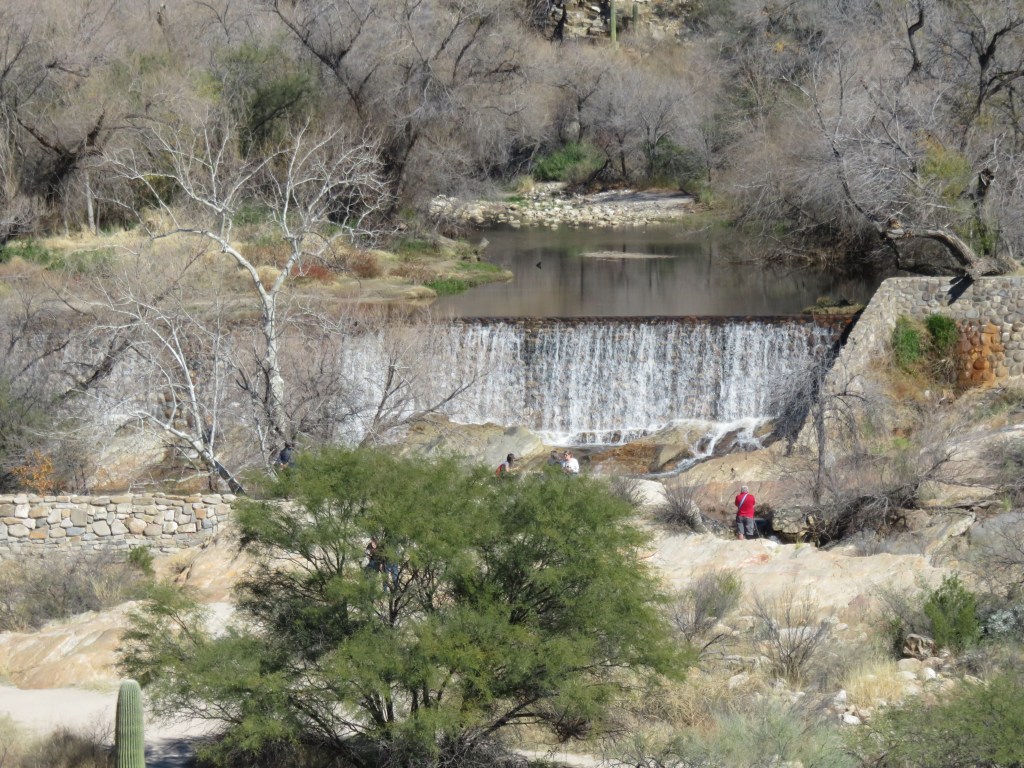
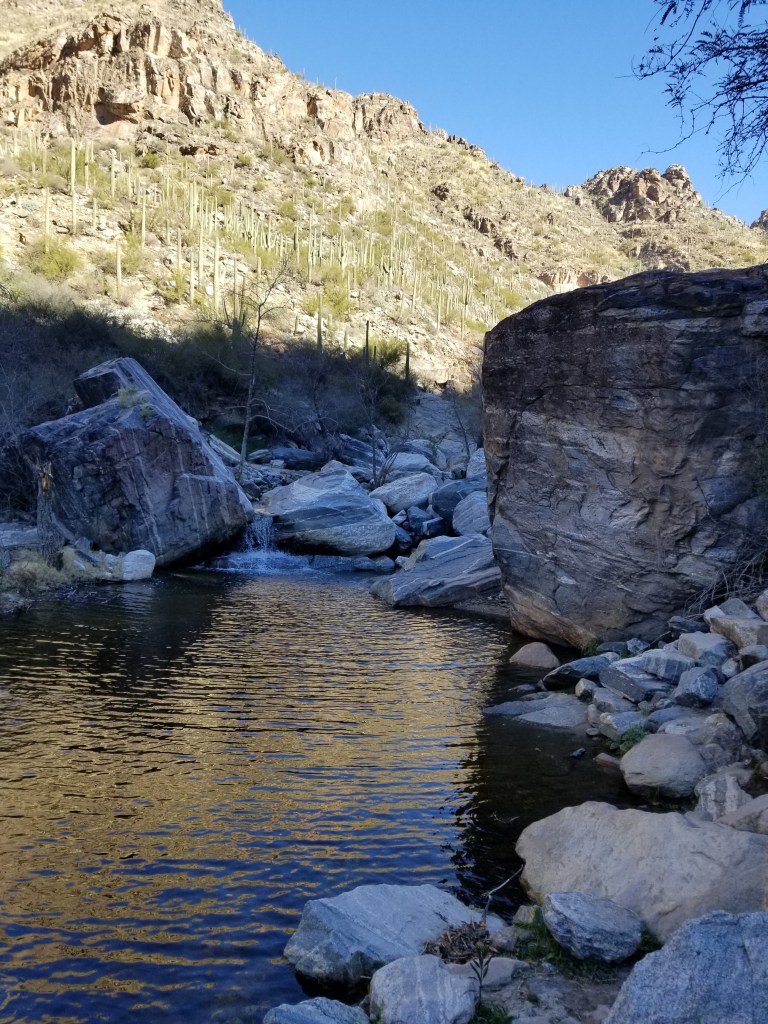
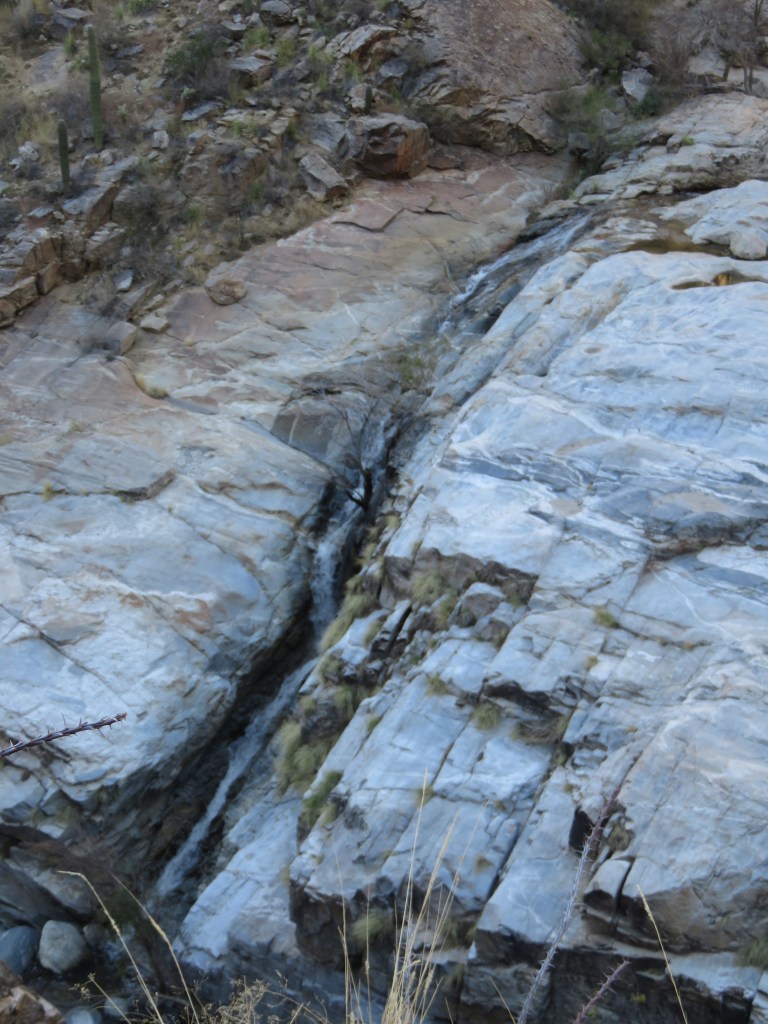
An old dam is gone, but has left a pretty waterfall
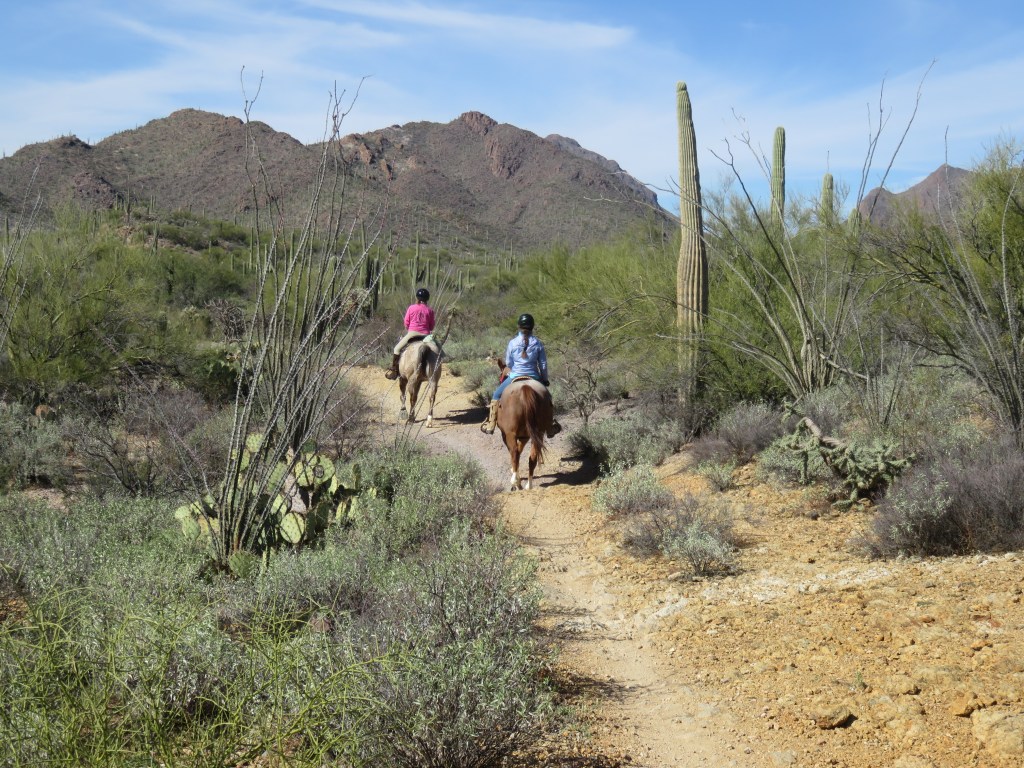
Another great way to visit the trail!

Bear Canyon Trail to Seven Falls

We thought our first hike at Sabino Canyon was fun, but we actually missed the one that everyone talks about: the Seven Falls hike. It was a longer trail than we had wanted on our first visit: 8.6 miles. The distance can be reduced down to about 5 miles by taking the Bear Canyon Shuttle. We returned the next week to give it a go. The Bear Canyon Shuttle isn’t as busy as the Sabino Canyon Shuttle, but I still made sure to get tickets this time.

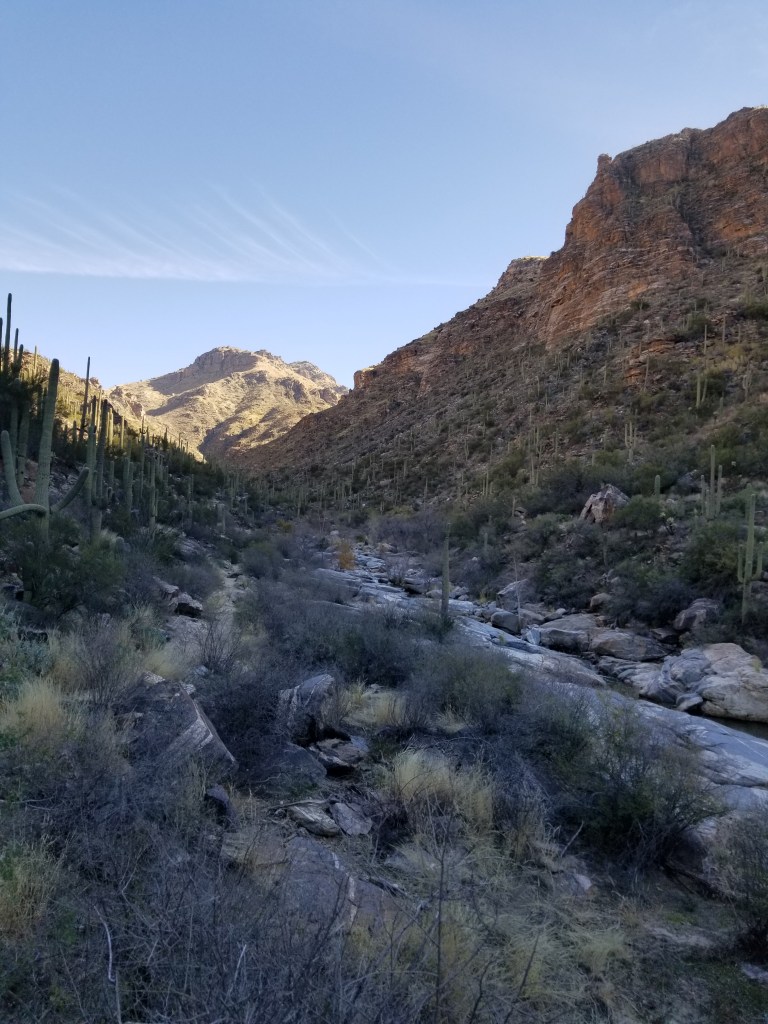
The sun was still coming up over the higher mountain peaks as we walked.

Soon we were following a creek–

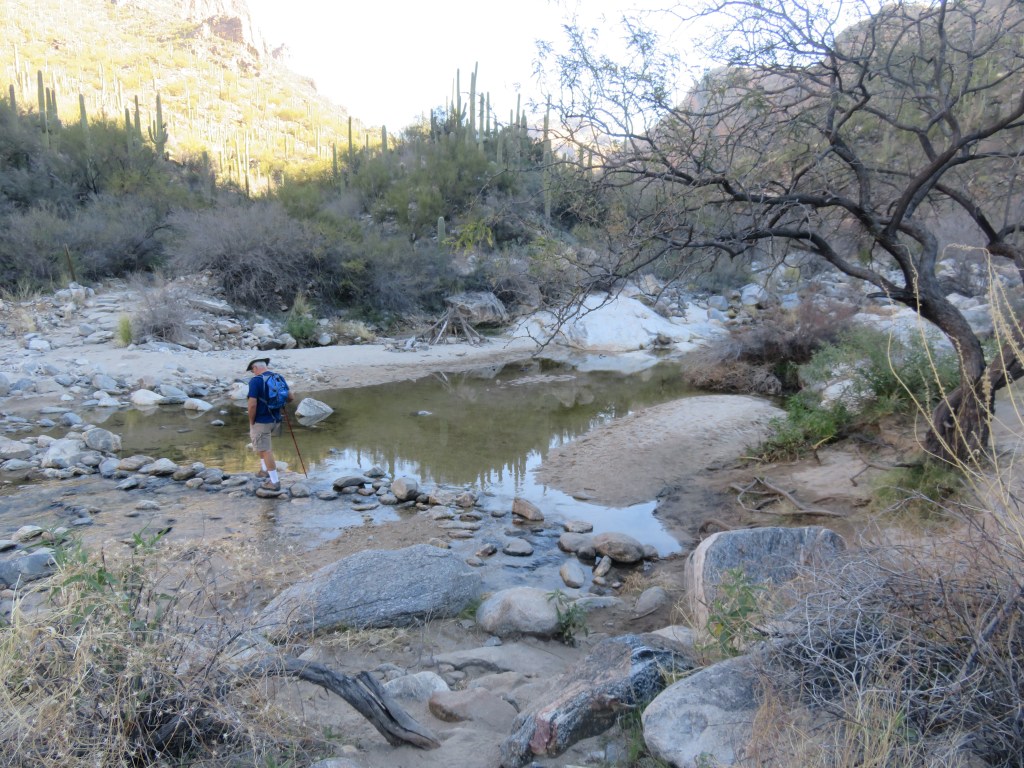
And then, we crossed the creek. And then crossed back. And back again. The river got deeper, the rocks farther apart. Finally I consulted our trail map: there are seven creek crossings before reaching Seven Falls! Which means, of course, seven crossings back, since this is an out-and-back trail.

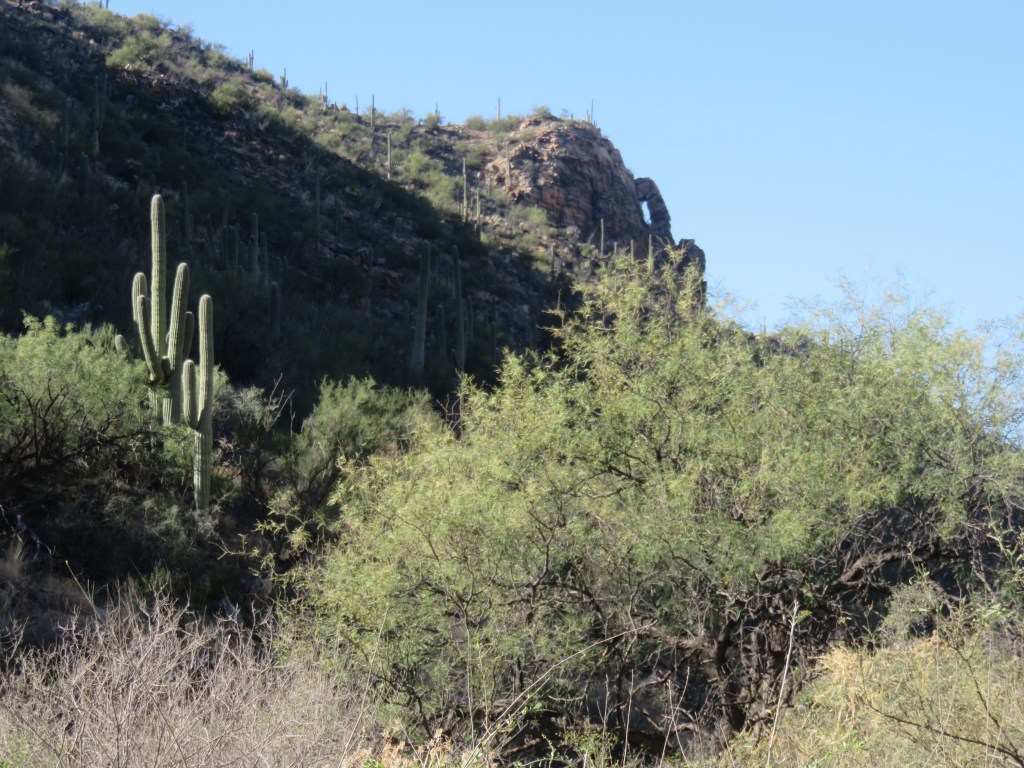
We looked back behind us, and saw an arch in the rocks:

On trails in the Southwest, I’ve learned that a sign like this means switchbacks are coming, which means going up. Shortcutting is going off-trail and climbing straight up, as opposed to the gentler zig-zagging on the trail. We did indeed hike upwards, and then around the edge of the cliffs, and the trail narrowed. It was a little treacherous, so there are no pictures on that part!

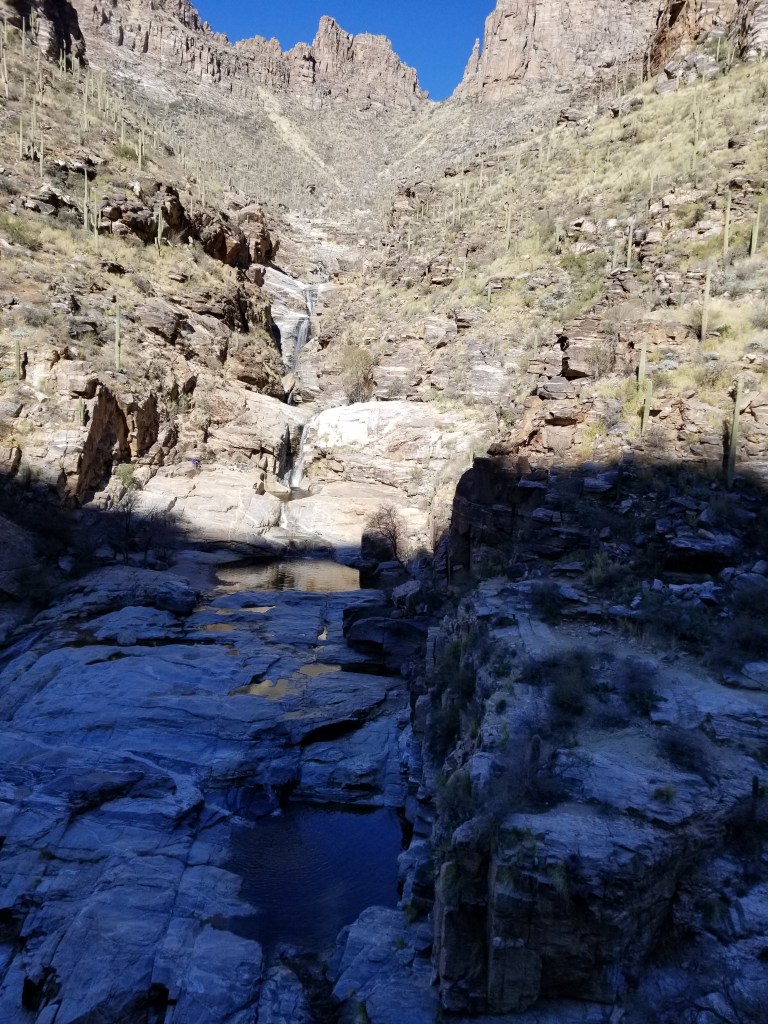
Our first glimpse of Seven Falls:

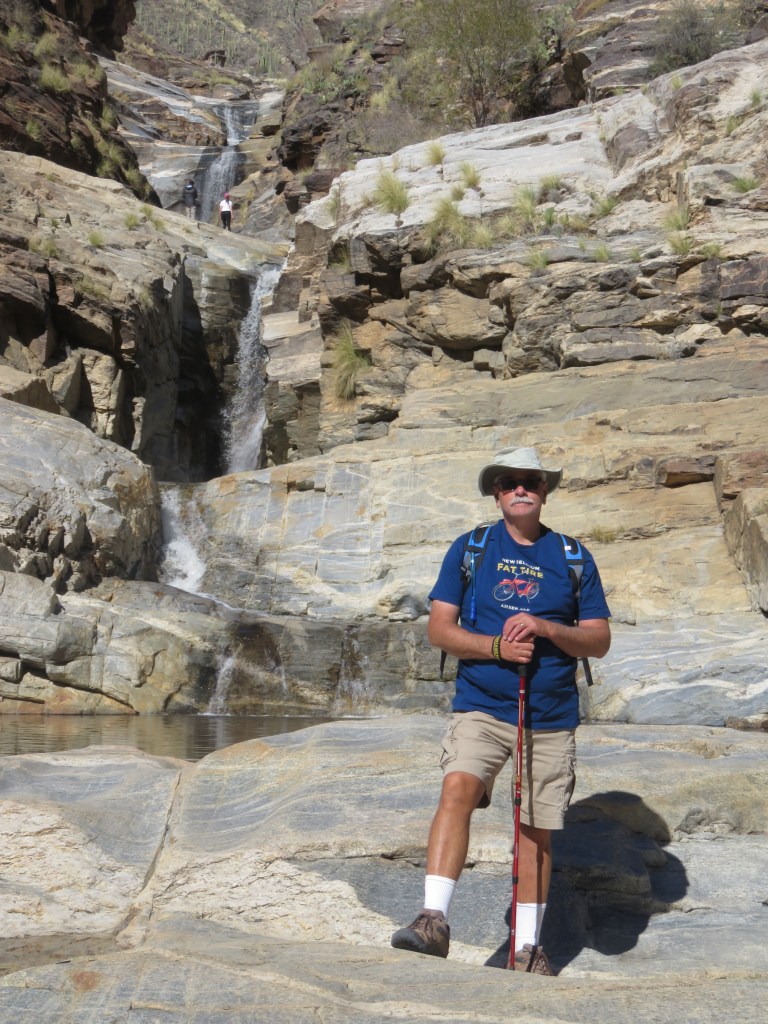
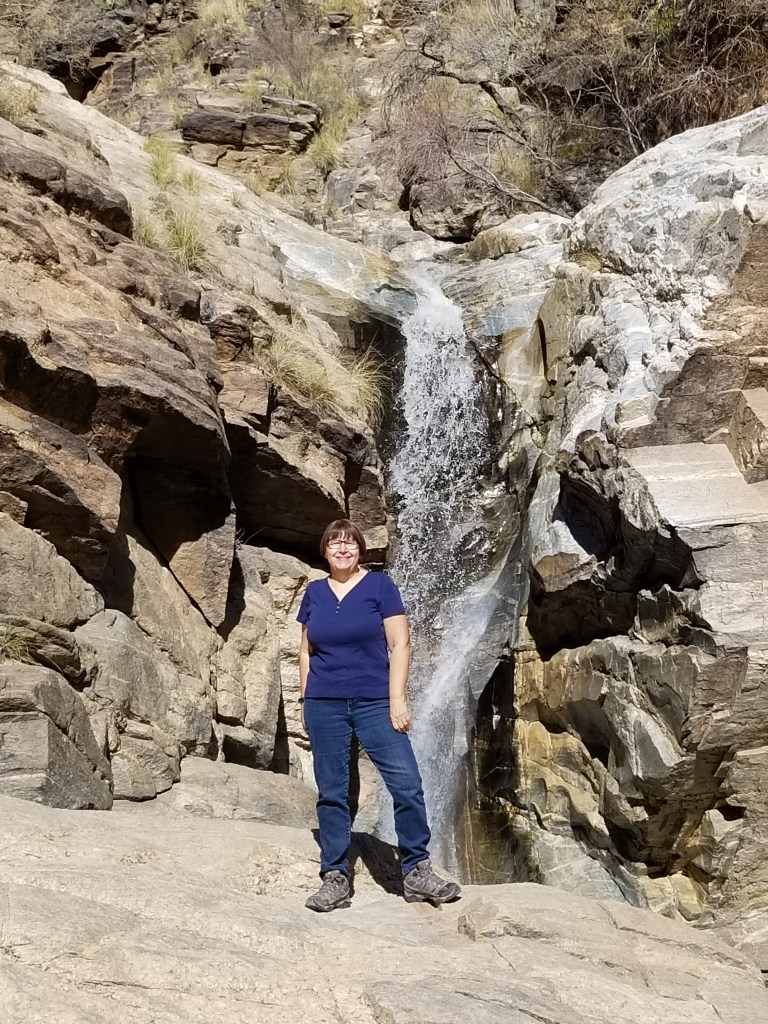
The view is breathtaking. I counted them and indeed there are seven waterfalls. The distance from top to bottom is of considerable length and couldn’t be captured on Cal’s phone or my camera well, especially with the sun in the wrong spot. Trust me…it was worth the hike and all the creek crossings. Looking at the above picture: from here, we climbed down to the right, crossed the creek, and then back up to the first rock in the sun on the left to enjoy the waterfalls and the view. In the picture below, you can see people in the bottom left, and that’s where we sat for awhile.

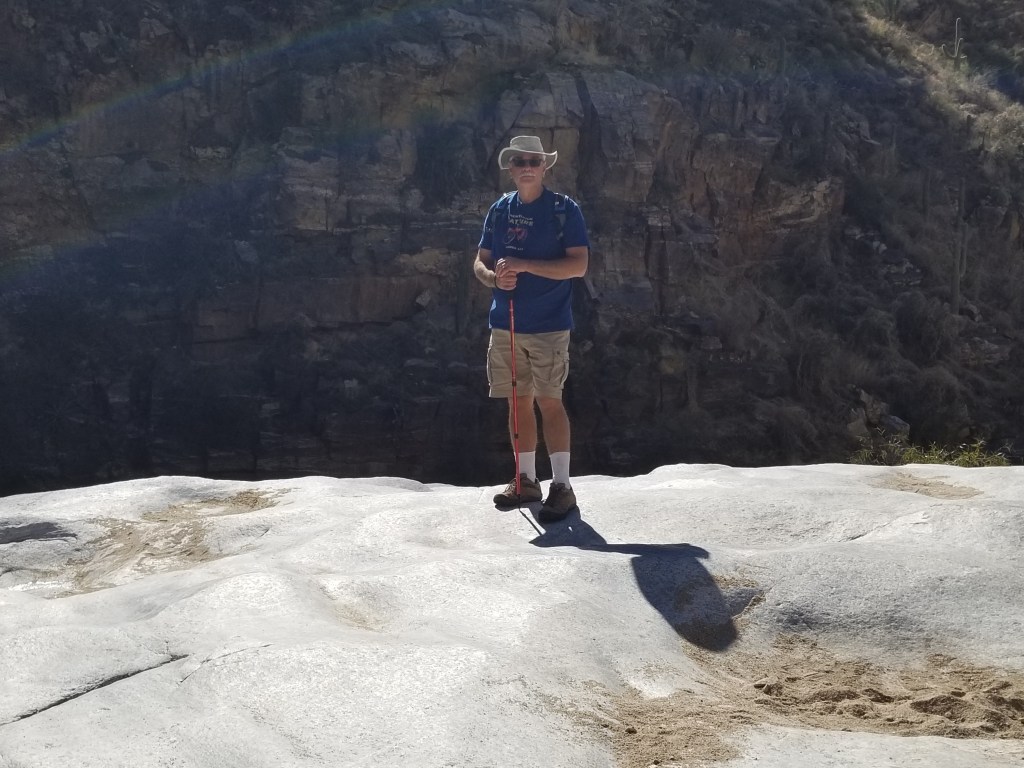
Coming out of the falls, we passed a group of young college students (judging by their t-shirts and ballcaps). By the time we reached the cliff above the falls, they had stripped down to bathing suits and had jumped into this pool (above) under the waterfall. This was accompanied by much whooping and hollering, as we could hear even from our vantage point! The water must have been cold!

Next time – Saguaros, and an announcement