I traced a finger down the rail line on a map of Europe. We would be catching a train in Munich into Austria, through the Brenner pass, and into northern Italy. This area is in the Dolomite mountains, and, with its strong Austrian influence, might be a good transitional spot for going into Italy. I speak passable German, but not a word of Italian.
Bolzano looked promising: walkable, with a scenic old town, and with mountains all around. Most everything is printed in two languages: Italian and German. Great choice! It turned out to be excellent for a four-night stay.
I had some sort of a mental block about Bolzano, and could never remember its name off the top of my head. If anyone asked about our Italian stops, I had to go look it up. There was no more trouble about that after spending time here!
After less than a quarter mile walk from the train station, we came to what we later learned is the most important square of Bolzano: the Piazza Walther. It was built during the short period in the early 19th century when Bolzano was under Bavarian rule. The Bolzano Cathedral, with its striking green, yellow and white diamond roof, looks down on all the bustle like a fond friend.

Bicycles zipped past us as we turned onto the pedestrian street to our AirBnb. I was happy to see this town has a bike culture.

Our home for a few days was a couple of floors up inside the arcade on the left. While waiting for me (he always has to wait for me to do whatever) Cal liked to watch the street activity on the bench opposite the entrance.
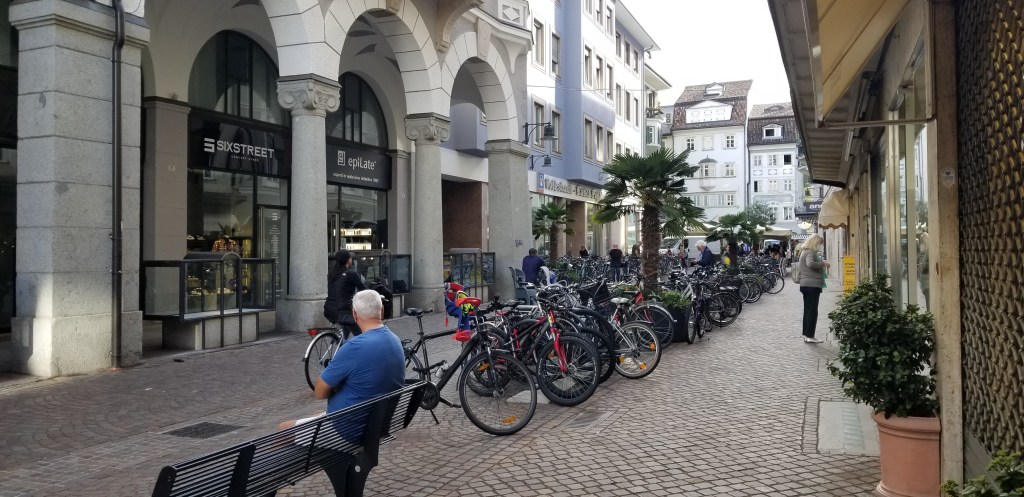
Soon enough, we figured out the reason for all the bikes. We were near a university – the Free University of Bozen-Bolzano. Bozen is Bolzano’s German name. Classes at the university are given in Italian, German and English. Down the street was a middle school, judging from the ages of the kids who poured out from it every day. In the evening, most of the bikes were gone.
The elevator in our building had a window in it from which we could survey the neighborhood on our rides up and down.

Around the corner in the other direction was a fruit, vegetable and flower market.
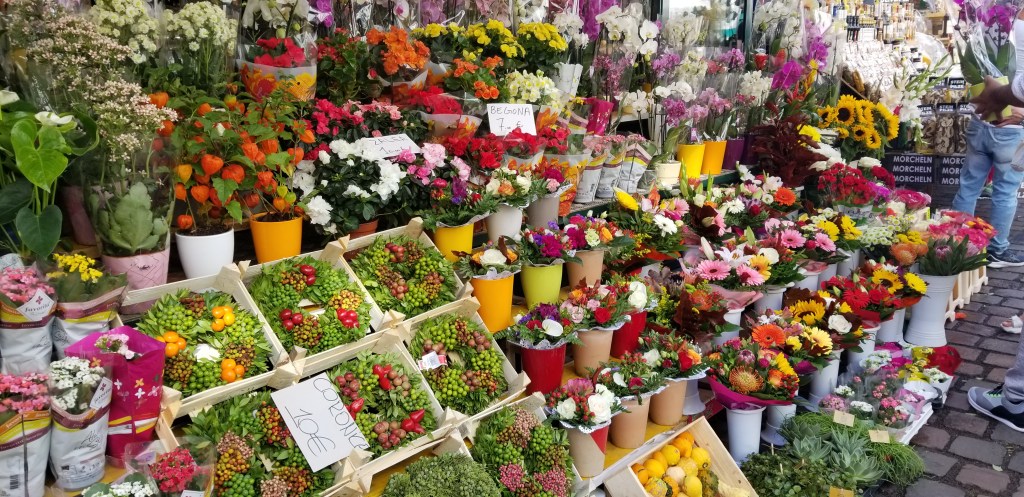
In the early morning, there would be a lot of bustle around the market as everyone got ready for their day. That includes purchasing some flowers for a special occasion.

We found our grocery store near the market, and near it, a pizzeria:

Metal chicken sculptures were in every window of this building. Bolzano, like its Austrian and German counterparts, also has traditional paintings on some of its buildings.
During our stay here, we wandered down labyrinthine streets and admired the architecture.


One evening we returned to Piazza Walther for dinner.

The next morning, there was a formal event in the piazza, and a platoon from the Italian Army was there. I loved their Tyrolean hats with the jaunty little feathers.

All we had to do was to step out our door to explore in any direction. We never knew what we’d find.

Besides being a pretty town, Bolzano is famous for something: Otzi’s mummified remains are here.
Otzi was discovered by hikers in 1991 in a melting glacier not too far from Bolzano. He lived between 3350 and 3105 BC and is Europe’s oldest known natural human mummy. We could visit him, as well as the clothing and equipment found with him, in the South Tyrol Archeological Museum near our apartment.
It wasn’t possible to take a picture of him, but I could take a picture of what the scientists think he looked like:

Lately Otzi has been in the news. Recent DNA analysis has shown that his skin may have been darker than what they first thought, he may have been bald, and came from an isolated group of farming people. Is his model going to receive a make-over?
It was interesting getting a small picture of this man’s life so far back in time. Otzi’s museum did not take much time to go through, so after finishing it I went over to the small Bolzano City Museum. It fast-forwarded me in time a few thousand years.
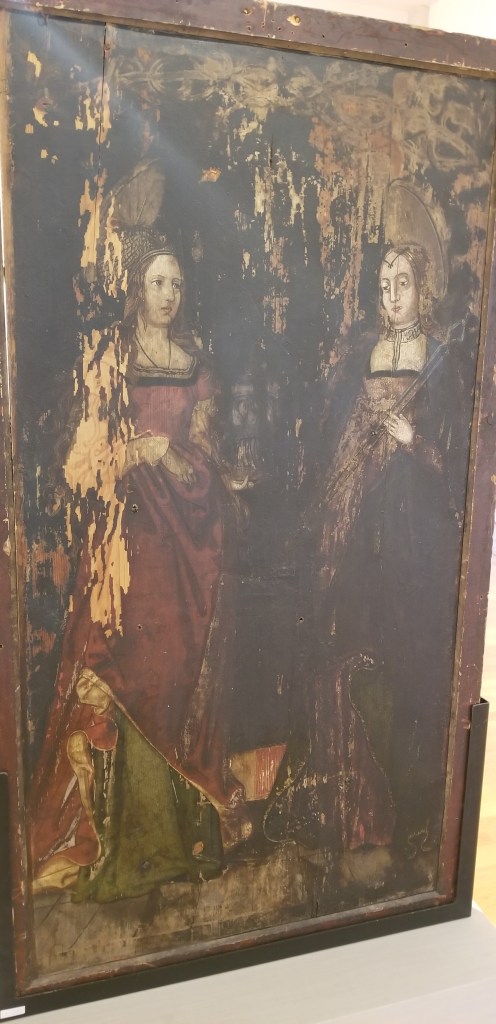
There was a carved and painted wood picture from 1510 of Saints Barbara and Catharina that, interestingly, had their picture on the reverse side also. Maybe the one was a model for the other.

Moving forward in time, there was an entire room of elaborately painted and tiled wood stoves – “baking ovens”. This one dates back to 1780.
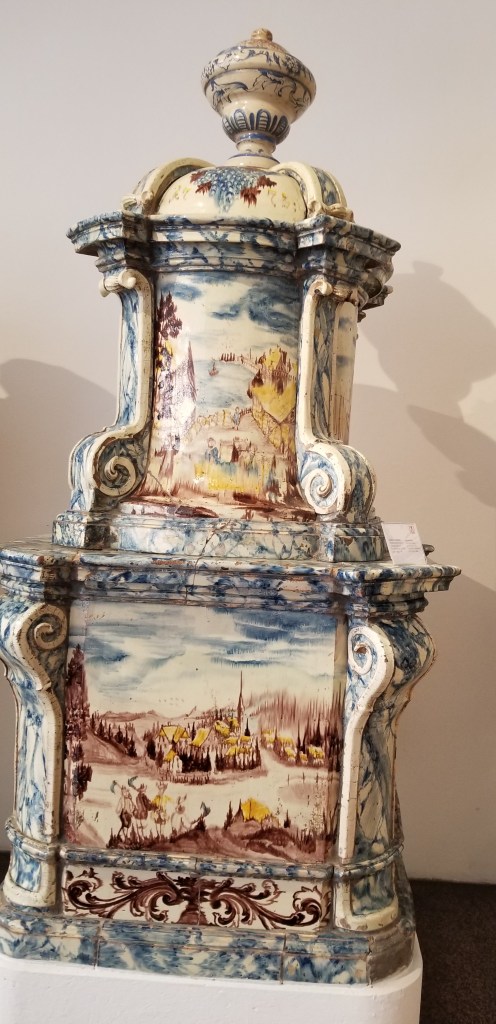
There were also ancient frescoes lifted from old churches as well as paintings by local artists in more modern eras.
Besides all this, there was beauty to be seen not far from the city center.

Old churches and an old watchtower, as well as picturesque homes, dotted the hillsides.
In Bolzano, I was able to photograph a phenomenon that I’d seen all over Europe, beginning in Belfast. In the evenings, shop keepers roll aluminum shades down over their stores. These are all covered in graffiti. The loveliest postprandial stroll down a picturesque pedestrian street can make one feel at times that they may not be in the best part of town. I got this picture while eating dinner in a restaurant on one of those streets after we watched this store being zipped down for the day.

Not nice, right? Imagine a street filled with these.
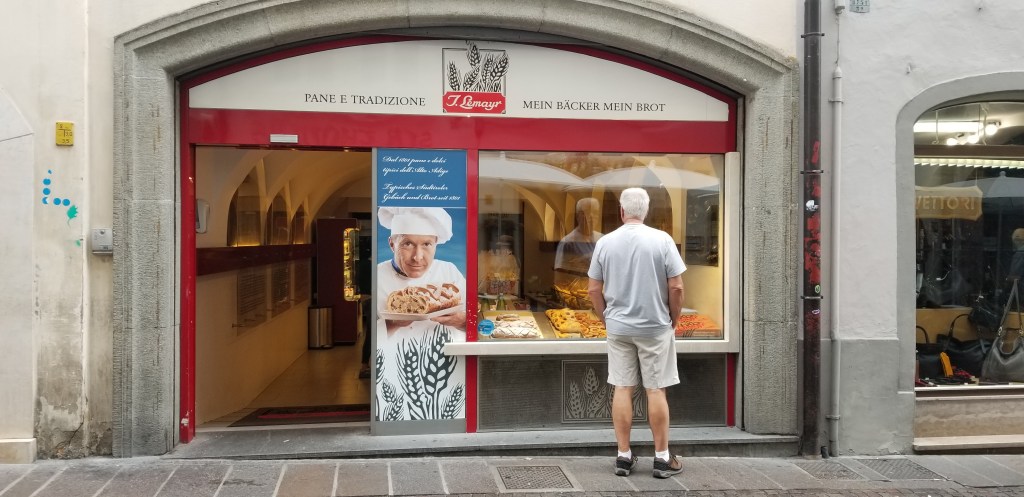
But in the morning, voila: a bakery with tempting treats! As with most everything in this area of Italy, the lettering over Cal’s head is both in German and Italian. That’s due not only to its proximity with Austria, but the fact that this region was ruled by the Austro-Hungarian empire for centuries.
But wait – there’s more!
Coming soon are two more blogs about our time here, each one better than the last. Taken together, it all adds up to one amazing stay in this South Tyrolian town. Here is a sneak peek:

Next time – Bolzano’s castles
 Twosna Travels