Europe · Italy

A Mountain Discovery Day – Italy, Europe Travels September 2022

The Dolomites are a mountain range in northern Italy, and their beauty was all around us while we stayed in Bolzano. As soon as we could, we headed higher up in altitude for some exploration.

The cable car building was an easy walk from our lodging, and soon we were on our way.

It didn’t take long to rise above Bolzano and the vineyards encircling the city. The city lies on the floor of a valley and soon we lost sight of it as the mountains surrounded us.

Off the cable car, though, we were not on top of the mountain. On most every other cable car we have been on in the Alps, one or maybe two cable car runs usually puts us on top of the world where we can begin a hike. Surprise – not in this case!

The cable car had taken us to a little mountain village called Oberbozen. And straight ahead of me was a handy Tourist Information Office. There, I discovered that there was more to this journey than we anticipated. The nice lady inside the office, who spoke English, helped me map out our day.

To get up higher, we needed to board a small cog wheel train, which took us across the mountain instead of up. Off the train, everyone hoofed it en masse over to a waiting bus in Klobenstein. We all packed that bus.

On both the bus and the train, we passed alpine farms and large dwellings that I would guess hold lots of skiiers in the winter season. There were brilliant green meadows with horses, cows, and sheep grazing. Huge barns and houses held planters of flowers spilling out over multiple balconies.
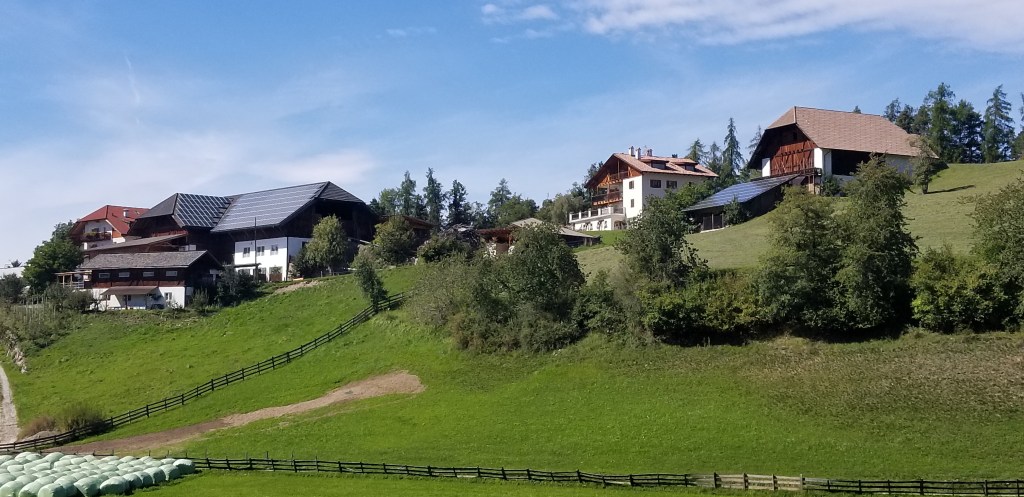
We stopped at tiny train stations.

Walking trails everywhere provided good options for a day in the Alps. In the winter these same trails are probably great for cross-country skiing.

We were not done yet. After the bus, the next step was another cable car. In September of 2022, masks were still the law Italy for any public conveyance.
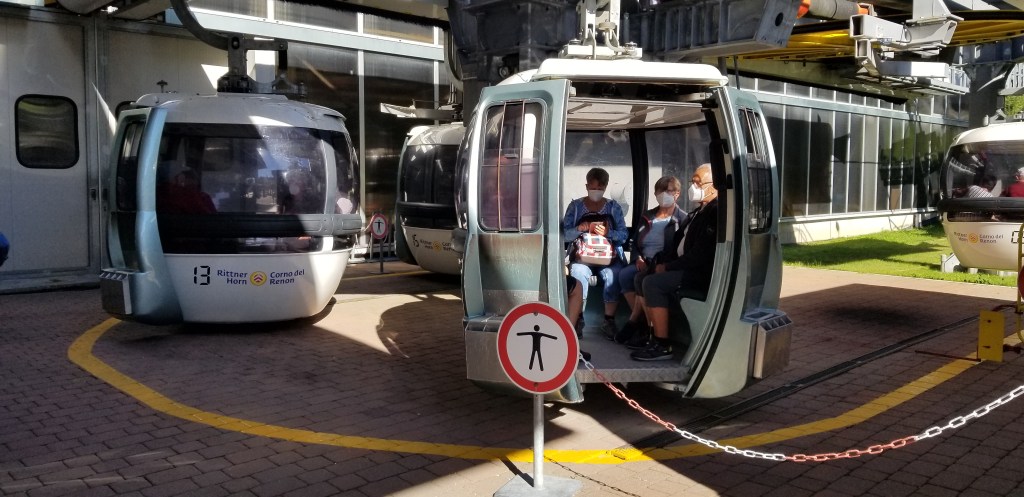
Off the cable car, and finally – the mountain top! Here, even the little mountain villages are no longer to be seen. But which way to hike?

We set off on the “Panoramaweg”, hoping for pretty views. Of course, there was a pretty view everywhere we turned.

The start of this walk is in a forest of short trees, almost bushes, that are called the mountain pine. The tallest of them are only nine feet tall, and some are three hundred years old.

Mountain pine oil is used internally and externally for colds, rheumatism, sore muscles and other purposes. The oil “makes tired legs kick”. Well, my legs weren’t too tired yet. It felt good to get out and stretch after riding on all the various conveyances to get here.

On our walk, we dipped down in elevation a bit, and here the trees are taller.

Rounding a curve, the actual top of the mountain, Rittner Horn, rises up over the treeline. A lift would take you there in the wintertime for skiing. The beautiful plateau of the Ritten has been designated a Unesco World Heritage site.

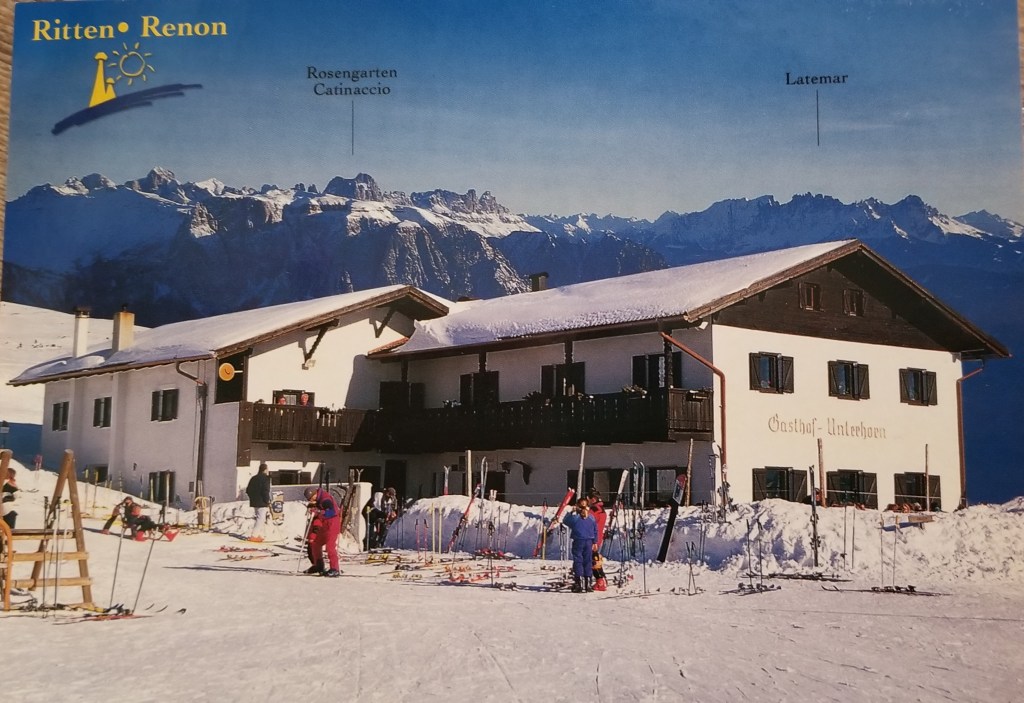
We did not hike up to it, since the sun was warm and it was already lunchtime. We made a stop at Gasthof Unterhorn, the white building in this picture.

We ate out on the patio, but I popped inside the restaurant and found this postcard. This is probably a great place to ski, and I can see why folks might want to lodge here. A skier would be right on the slope at the start of their day.
I did hike up just a little further after lunch to photograph this cow, which was also taking in the view. Or napping, I’m not sure which.

Hiking back to the cable car on the remainder of the “Panoramaweg”, there is more mountain splendor in store.

Starting from the highest peaks furthest away, waves of various colors ripple down the landscape.

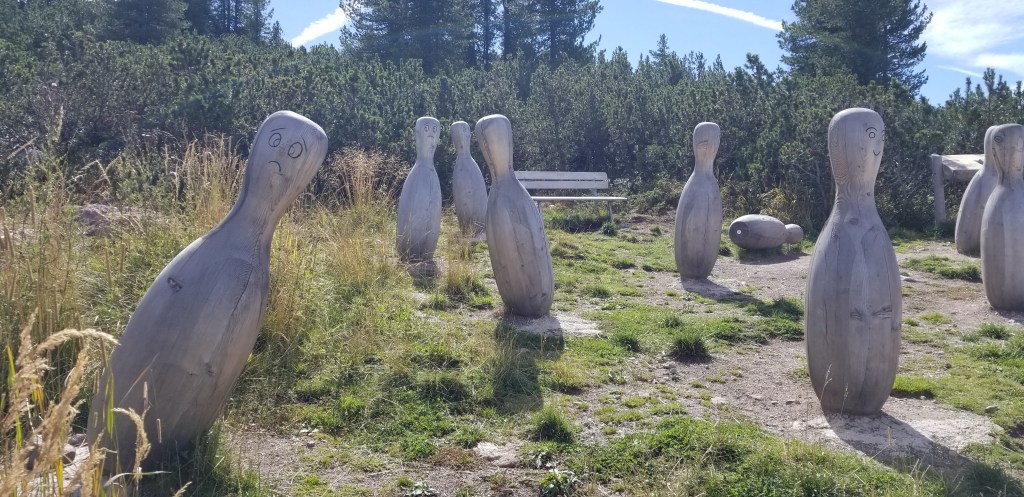
This part of the path has some small sculptures to keep the kids entertained.
The woman at the tourist office back in Klobenstein had pointed out something else we might want to see, and we did. After the upper cable car and the bus ride we walked around the small bus depot to board a bus with a different route. This brought us to the stop for the “earth pyramids”. This is a natural phenomena due to hillside erosion. Each pyramid has a big rock on top. When the rock finally falls, the pyramid begins to die.
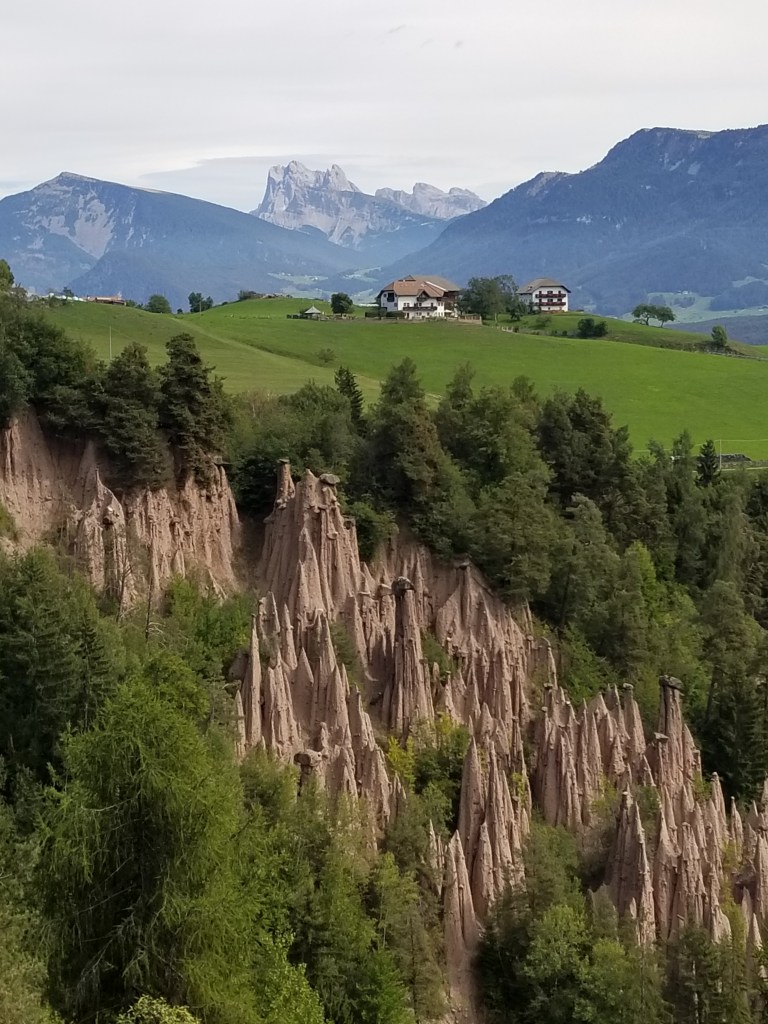
There was a sign that told us that pyramids such as these exist on every continent, but these are the tallest and best-developed. Several factors have to exist for the pyramids to happen: the type of soil, a steep incline, and protection from wind.

The earth pyramids were an extraordinary sight, and I was happy we’d taken this little detour. The short hike from the bus stop to see them gave us more beautiful scenery to enjoy, too.

There was a cute little bridge over a babbling mountain stream,

mountain ash trees full of berries clustered in profusion,

and we could hike in deeper woods than we had been in on the Ritter Horn, with the earth pyramids playing peek-a-boo.

What a day, full of nature and beautiful sights. Taken together with the other places we’d seen in Bolzano, we were feeling like our already-amazing trip was getting even better. A bonus: the weather was warming up, and on this day the sun shone all day. Along with all of that, one of my most-anticipated cities was the next stop on the itinerary.

Next time: our second (and last) Italian destination
Europe · Italy

Two Castles in Bolzano, Italy – Europe Travels September 2022

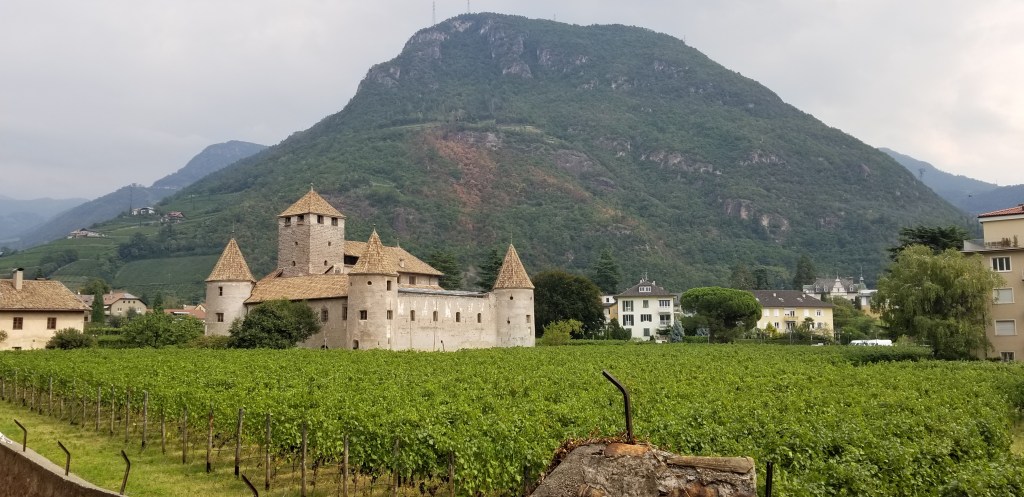
Maretsch Castle sits on the outskirts of Bolzano and was a pleasant walk for us from our stay inside town. The higher peaks of the Dolomites loomed in the distance, ancient villas dotted the walk, and a field of grapes were sitting ripe for the picking.

The oldest part of the castle was built in the 13th century, but received a makeover during the Renaissance in the 1560’s. It was built to be a residence and not a fortress. It’s used currently as an event center.

Frescoes were added as part of the makeover.

I could only imagine what this must have looked like when the paint and plaster was fresh.

Looking out from Maretsch’s windows

We wandered through rooms upon rooms bereft of furniture, up narrow and well-used staircases, and came upon a postcard exhibition. Not only that, but the exhibition told of how the area near the castle was once a resort town named Gries. The sun, the climate and the lush green hills made it a prime health and holiday resort in the 1800’s and early 1900’s.

The practice of sending postcards began in 1865, and of course everyone coming to the resort had to have postcards to send home. The collection of about 2,000 cards belonged to one person. The picture below is an enlargement of one of the postcards, and showed how Gries looked back in the day.

Unfortunately, the resort area of Gries was bombed badly in 1944. Reconstruction folded it into the town of Bolzano.

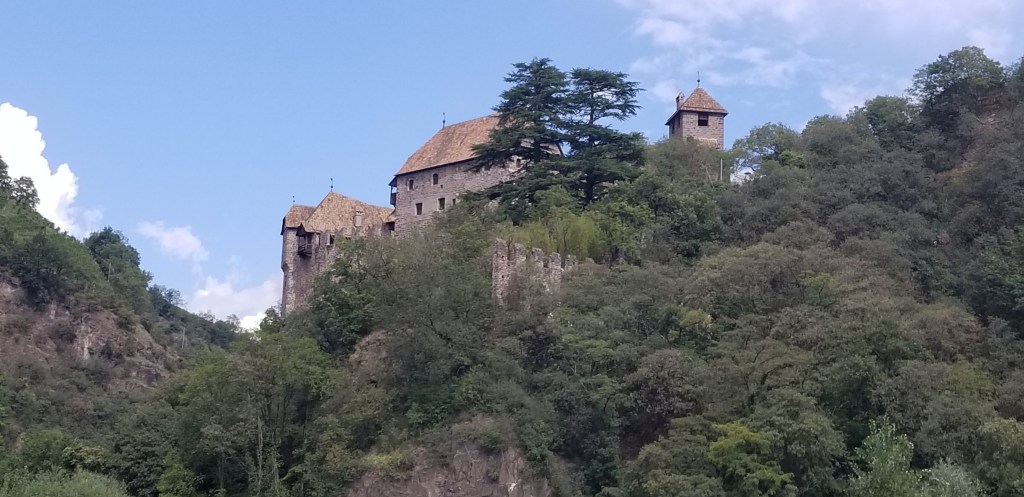
Back in our AirBnb, we looked out our window and saw Runkelstein Castle, although at first we didn’t know it was Runkelstein. Could we visit that castle, and how could we get there?

Of course, it was a much more distant view from our apartment!

The answer was yes: we could visit, and all we needed to do was to get on a bus from Piazza Walther. We stopped at a bakery for some lunch provisions before we set out.

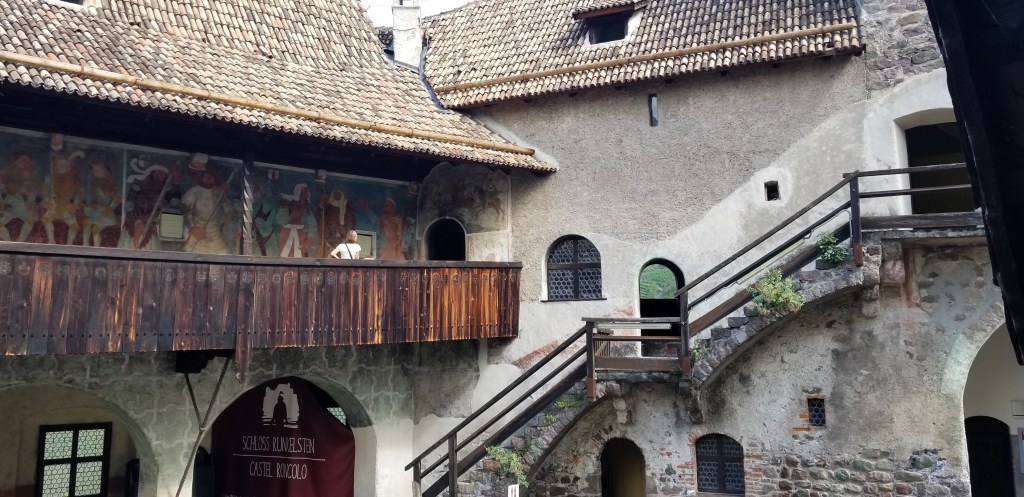
This castle is a medieval fortification originally built in 1237. It entered its golden years when two brothers, Nicklaus and Franz Vintler, purchased it in 1385. Sons of wine merchants, they wanted to validate their rise to aristocracy by giving it a fabulous makeover. In those days, as at Maretsch, the way to do that was by adding frescoes. This castle has one of the largest secular collections from medieval times. Also important: the addition of a privy and a cistern to store water.

There are frescoes everywhere, and new corners to explore at every turn.

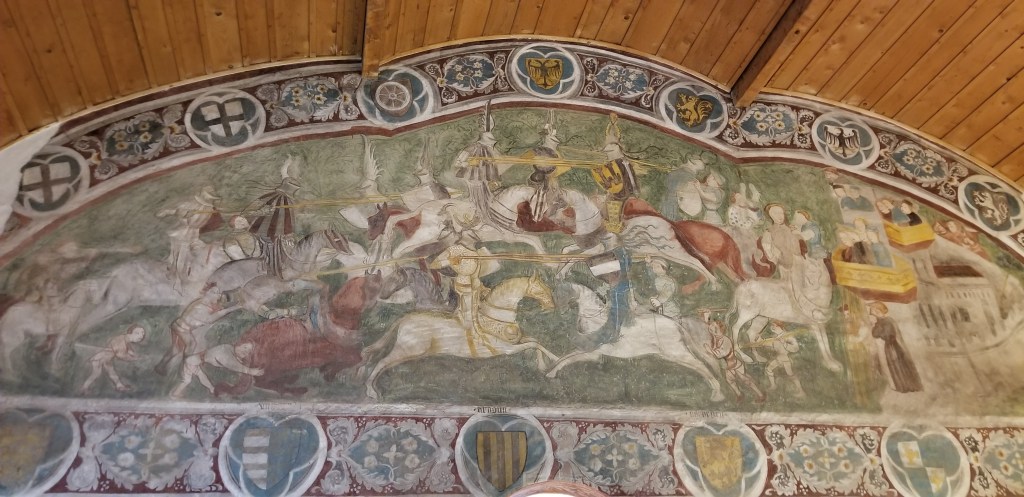
This fresco depicts a jousting tournament. What’s interesting here is not only the tournament but also what is happening on the right side.

There are women looking on from above, and a priest stands below. Perhaps the priest was needed in case of a mortal blow? In the far right corner, not allowed inside the the walls but watching from wherever they could, are Jews discernable by their pointed hats.

Another fresco shows the height of medieval fashion. A lady may own only one dress, but have several interchangeable sleeves for the dress. For the men, the longer the point on the shoe, the more important was the wearer.

Making a fresco takes a lot of time and experience. A picture must be drafted. Then the wall is prepared by making it smooth and even, and a top layer of plaster is applied. Finally the painting can begin. Frescoes have an advantage over other types of painting because they are very durable. It took five years to freshen up Castle Runkelstein’s frescoes in the late 1990’s.

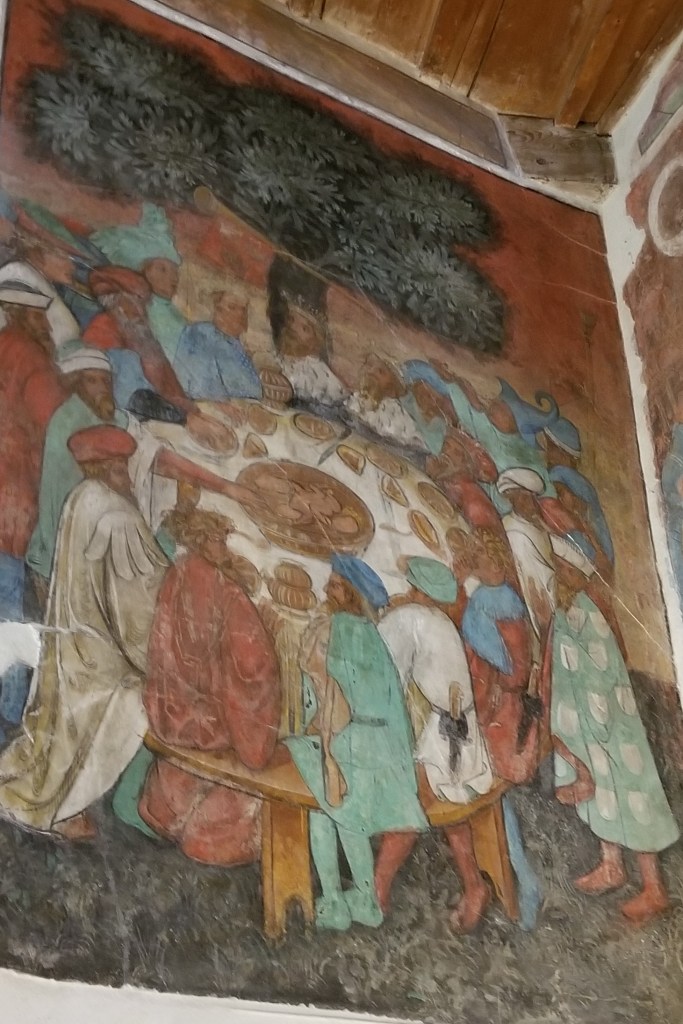
There is also one of the earliest known depictions of King Arthur and his knights seated at the Round Table.

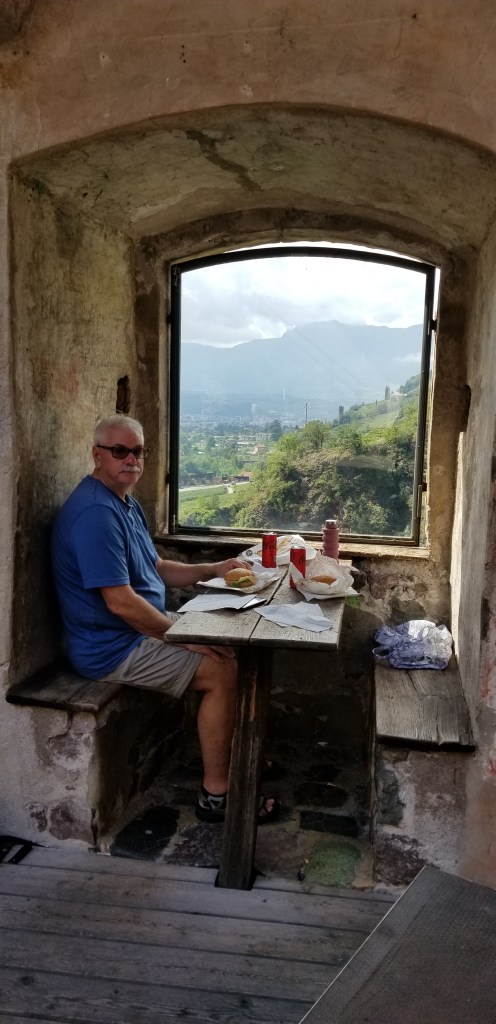
Cal was not immersed in every detail of the frescoes as I was, and when I emerged from inside the castle, I found he had snagged the greatest spot for us to have lunch.

Lunch with a view

I had watched our route to Castle Runkelstein when we had been on the bus. There were walking paths, and the distance of about two miles back to town looked very doable. Cal opted for the bus, and I set out for what was to be one of my favorite walks of the trip.

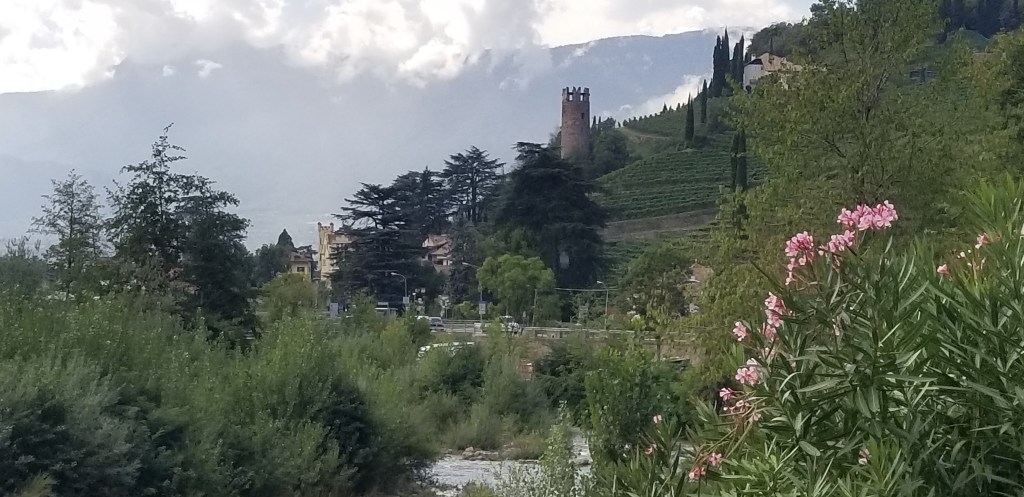
I could see the old watchtower close up. Cypress trees dotted the grape vines growing precariously on the hillsides.

Does this villa date back to the Gries resort days?

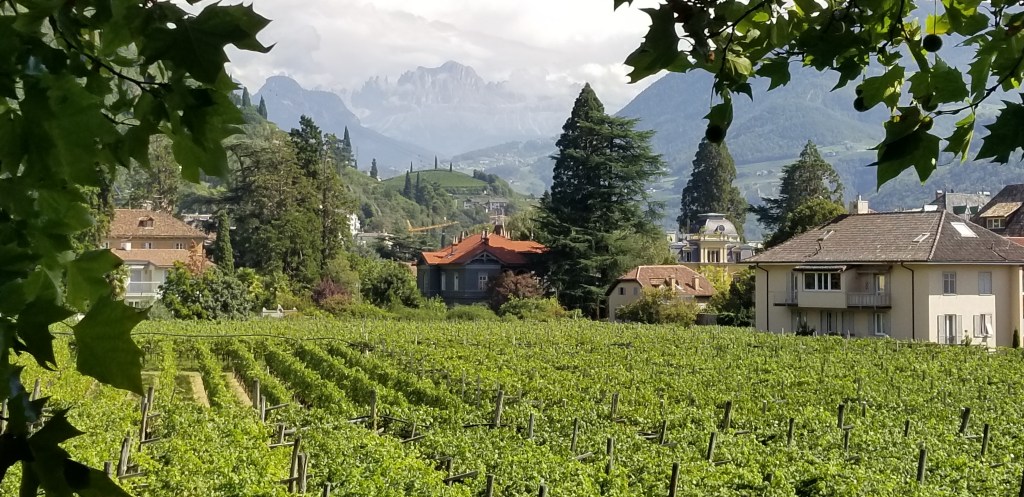
And then, one of the best views. It looked to me like an old landscape oil painting with the Dolomites hazily in the background. I took pictures, walked, took more pictures.

Still to be written is our most memorable Bolzano day. Like all great days, it was full of surprises.

Next time – a mountaintop experience high above Bolzano

Europe · Italy

Bol-what? Italy, Europe Travels September 2022

I traced a finger down the rail line on a map of Europe. We would be catching a train in Munich into Austria, through the Brenner pass, and into northern Italy. This area is in the Dolomite mountains, and, with its strong Austrian influence, might be a good transitional spot for going into Italy. I speak passable German, but not a word of Italian.

Bolzano looked promising: walkable, with a scenic old town, and with mountains all around. Most everything is printed in two languages: Italian and German. Great choice! It turned out to be excellent for a four-night stay.

I had some sort of a mental block about Bolzano, and could never remember its name off the top of my head. If anyone asked about our Italian stops, I had to go look it up. There was no more trouble about that after spending time here!

After less than a quarter mile walk from the train station, we came to what we later learned is the most important square of Bolzano: the Piazza Walther. It was built during the short period in the early 19th century when Bolzano was under Bavarian rule. The Bolzano Cathedral, with its striking green, yellow and white diamond roof, looks down on all the bustle like a fond friend.

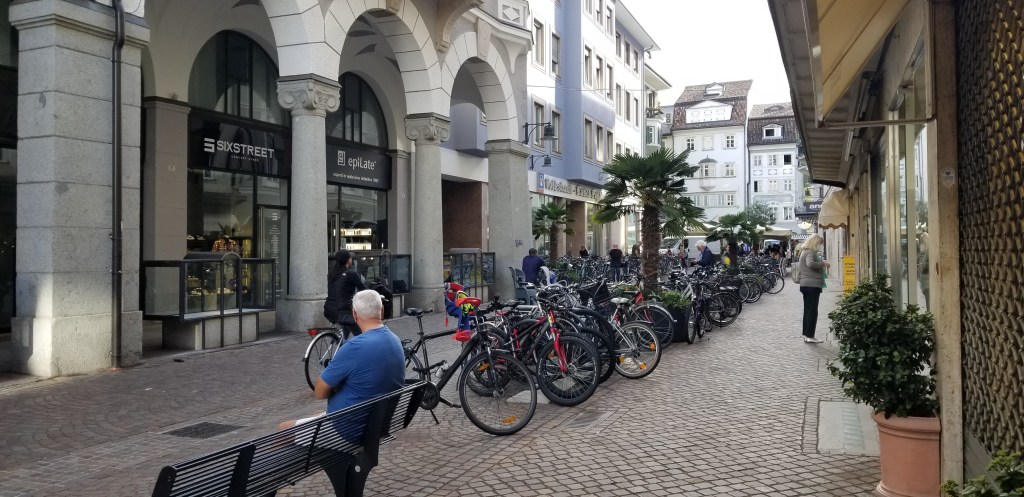
Bicycles zipped past us as we turned onto the pedestrian street to our AirBnb. I was happy to see this town has a bike culture.

Our home for a few days was a couple of floors up inside the arcade on the left. While waiting for me (he always has to wait for me to do whatever) Cal liked to watch the street activity on the bench opposite the entrance.

Soon enough, we figured out the reason for all the bikes. We were near a university – the Free University of Bozen-Bolzano. Bozen is Bolzano’s German name. Classes at the university are given in Italian, German and English. Down the street was a middle school, judging from the ages of the kids who poured out from it every day. In the evening, most of the bikes were gone.

The elevator in our building had a window in it from which we could survey the neighborhood on our rides up and down.

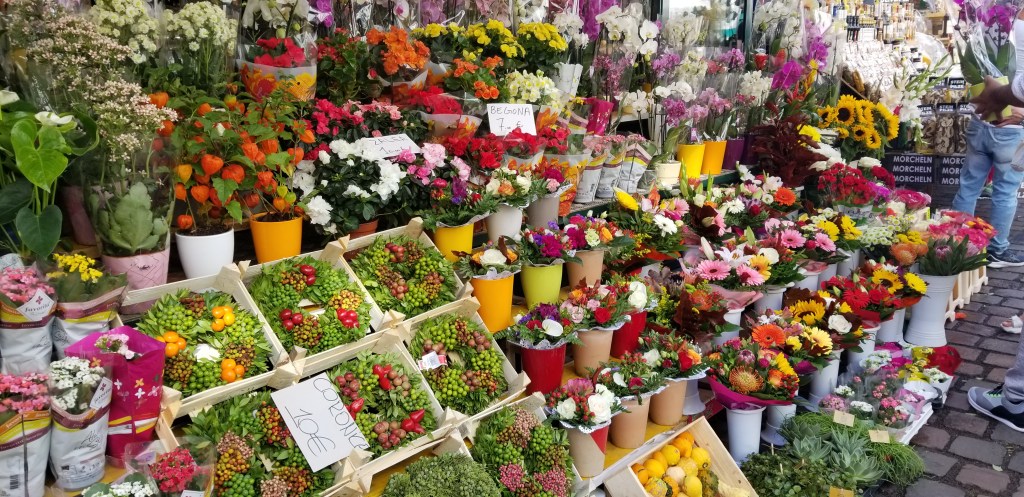
Around the corner in the other direction was a fruit, vegetable and flower market.
In the early morning, there would be a lot of bustle around the market as everyone got ready for their day. That includes purchasing some flowers for a special occasion.

We found our grocery store near the market, and near it, a pizzeria:

Metal chicken sculptures were in every window of this building. Bolzano, like its Austrian and German counterparts, also has traditional paintings on some of its buildings.

During our stay here, we wandered down labyrinthine streets and admired the architecture.

One evening we returned to Piazza Walther for dinner.

The next morning, there was a formal event in the piazza, and a platoon from the Italian Army was there. I loved their Tyrolean hats with the jaunty little feathers.

All we had to do was to step out our door to explore in any direction. We never knew what we’d find.

Besides being a pretty town, Bolzano is famous for something: Otzi’s mummified remains are here.

Otzi was discovered by hikers in 1991 in a melting glacier not too far from Bolzano. He lived between 3350 and 3105 BC and is Europe’s oldest known natural human mummy. We could visit him, as well as the clothing and equipment found with him, in the South Tyrol Archeological Museum near our apartment.

It wasn’t possible to take a picture of him, but I could take a picture of what the scientists think he looked like:

Lately Otzi has been in the news. Recent DNA analysis has shown that his skin may have been darker than what they first thought, he may have been bald, and came from an isolated group of farming people. Is his model going to receive a make-over?

It was interesting getting a small picture of this man’s life so far back in time. Otzi’s museum did not take much time to go through, so after finishing it I went over to the small Bolzano City Museum. It fast-forwarded me in time a few thousand years.

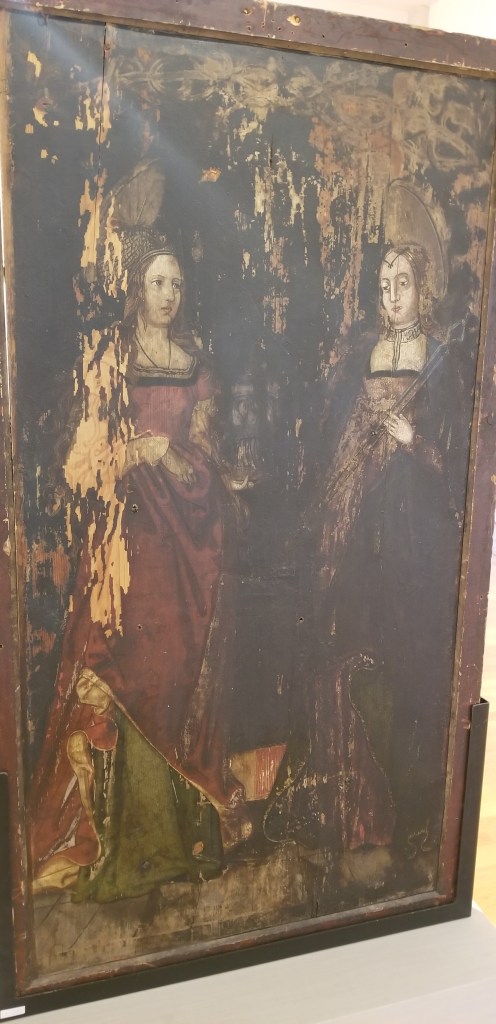
There was a carved and painted wood picture from 1510 of Saints Barbara and Catharina that, interestingly, had their picture on the reverse side also. Maybe the one was a model for the other.

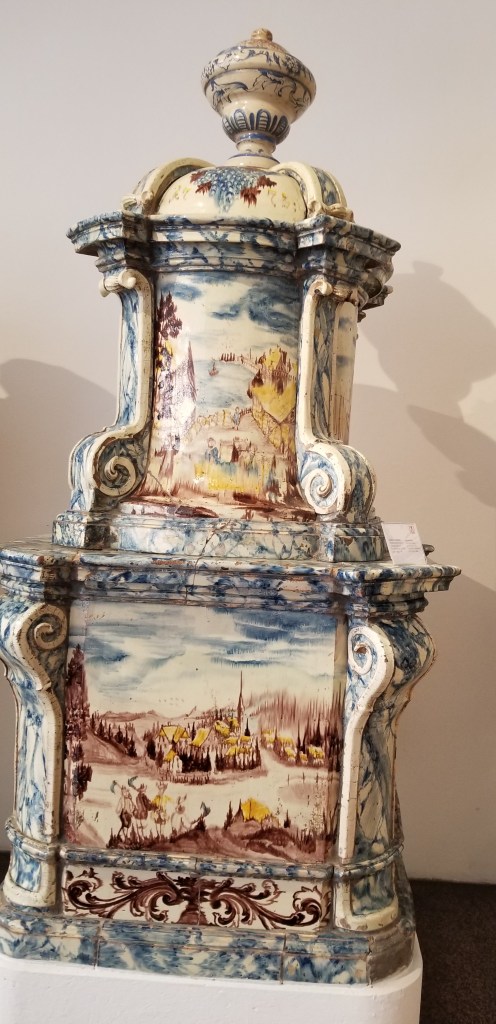
Moving forward in time, there was an entire room of elaborately painted and tiled wood stoves – “baking ovens”. This one dates back to 1780.

There were also ancient frescoes lifted from old churches as well as paintings by local artists in more modern eras.

Besides all this, there was beauty to be seen not far from the city center.

Old churches and an old watchtower, as well as picturesque homes, dotted the hillsides.

In Bolzano, I was able to photograph a phenomenon that I’d seen all over Europe, beginning in Belfast. In the evenings, shop keepers roll aluminum shades down over their stores. These are all covered in graffiti. The loveliest postprandial stroll down a picturesque pedestrian street can make one feel at times that they may not be in the best part of town. I got this picture while eating dinner in a restaurant on one of those streets after we watched this store being zipped down for the day.

Not nice, right? Imagine a street filled with these.

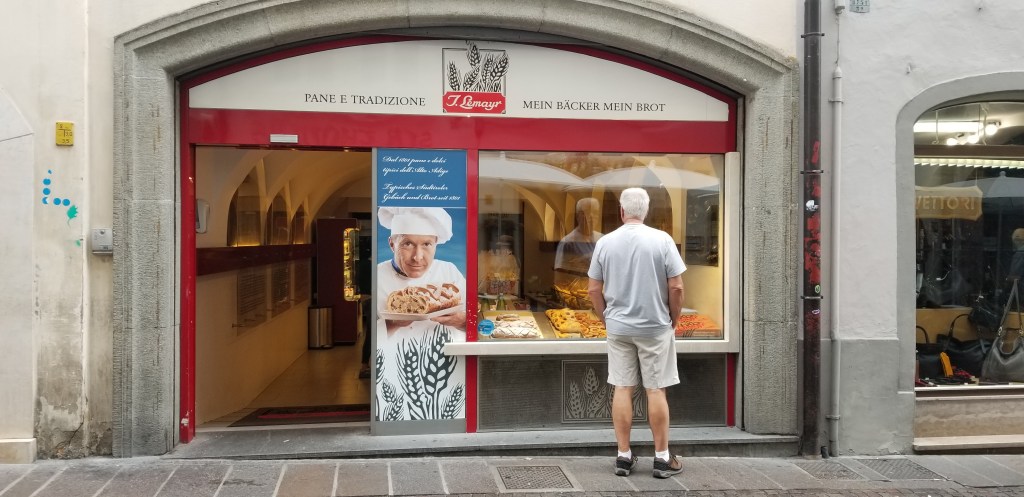
But in the morning, voila: a bakery with tempting treats! As with most everything in this area of Italy, the lettering over Cal’s head is both in German and Italian. That’s due not only to its proximity with Austria, but the fact that this region was ruled by the Austro-Hungarian empire for centuries.

But wait – there’s more!

Coming soon are two more blogs about our time here, each one better than the last. Taken together, it all adds up to one amazing stay in this South Tyrolian town. Here is a sneak peek:

Next time – Bolzano’s castles