
Choosing a Greek island to visit is a lot like going to a buffet and knowing you can only have two dishes. Which one….? It’s hard to pick when you have never been there. There are so many, and they are large and small. Some may be known for great night life, the best beaches, or excellent cuisine.
After visiting Santorini, I knew I wanted to look for an island where the cruise ships did not stop. Naxos has those pretty whitewashed buildings, narrow streets and passageways to explore, and beaches. There are places of interest to visit. There is farming, and much of its food is grown on the island. It’s less touristy than Santorini, although Naxos Town has its share of shops. Sounds good to me!
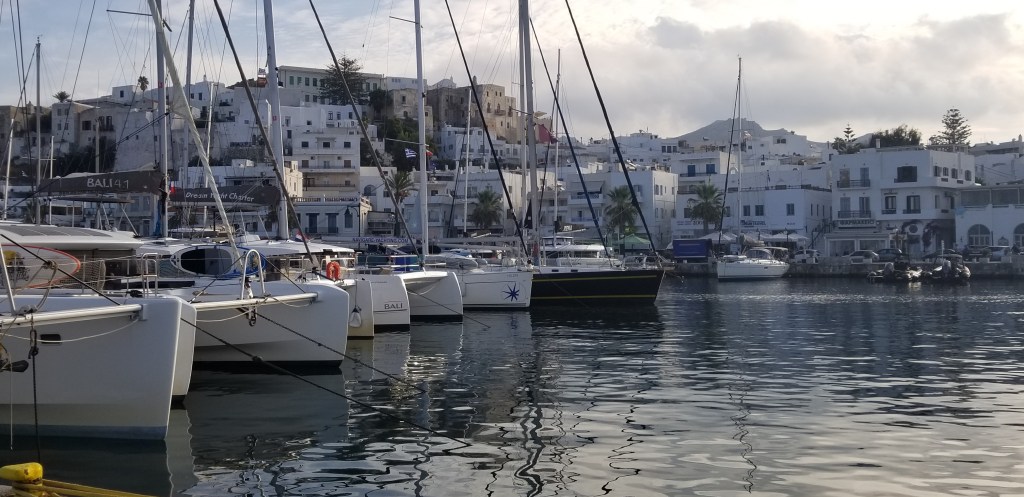
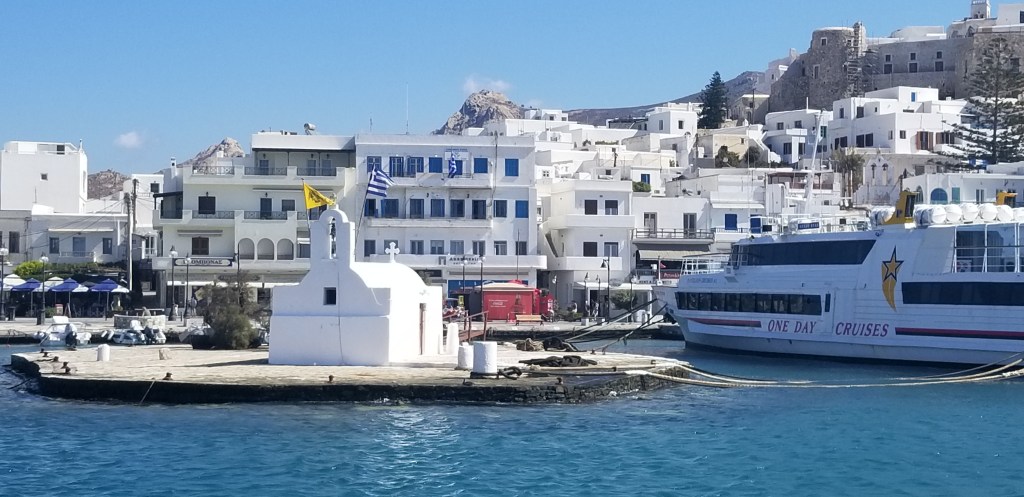
Like Santorini, Naxos is in the Cyclades group of islands, so our ferry ride from there was only an hour and a half long. We rode a Sea Jets ship, was supposed to be faster. For some inexplicable reason, though, it was running late.

Our apartment in Naxos was situated in a residential neighborhood. There were several ways to walk everywhere, and on our first afternoon we took too many turns and got totally lost coming back. GPS did not work. Two heads are better than one: we worked it out, and in the process learned better which way we should go in the future.

One of Naxos’s most striking sights welcomes everyone arriving to the island. It is the ruins of the Temple of Apollo, called the Portara. I took this picture from the ferry.

The walk over to the ruins has a trick sidewalk. It takes careful timing so as not to get hit by the waves.

We waited for a big wave to pass, dove across…and still got wet. No matter, the October winds were already blowing and dried us off quickly.
The temple of Apollo was never finished, even in its own day. It dates back to 506 BC, and construction had commenced at the direction of a tyrant leader who was overthrown before completion.

If you have been reading my blogs as far back as our time in Venice, I wrote about Venice’s “Golden Age”. It stretched back as far as the 8th century for a millenium, until Napoleon finally ended things. They had great maritime might and power. The remains of Venetian castles and fortresses dot the Mediteranean, and Naxos is no exception.
There really is no “castle” to see here, except the outside walls. There are four levels and it has a round shape, but the city of Chora (also called Naxos Town) is built right up and around it. Inside the “Kastro” is a Catholic cathedral and an archaeological museum, formerly a girls school. Mansions once housed Venetian ruling families, and some are now shops and cafes.
Part of the fun of walking up to it is trying to find it from the picturesque old market place to an old Venetian maze of passageways. We figured that as long as we were going upward, we were good.


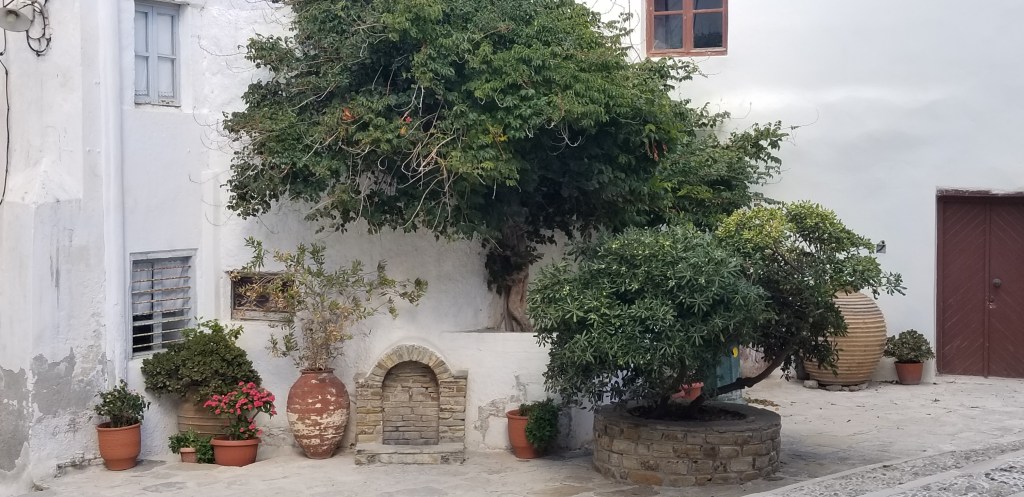
We did get a view of the castle walls as we walked. From what I read, the tower will be a Byzantine museum when reconstruction is finished.

I visited the small archaeological museum inside the castle area.
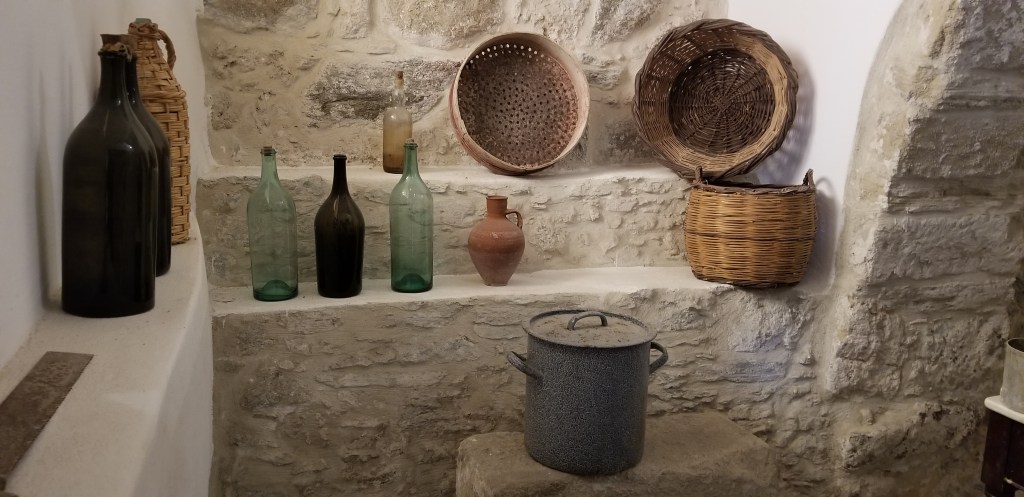
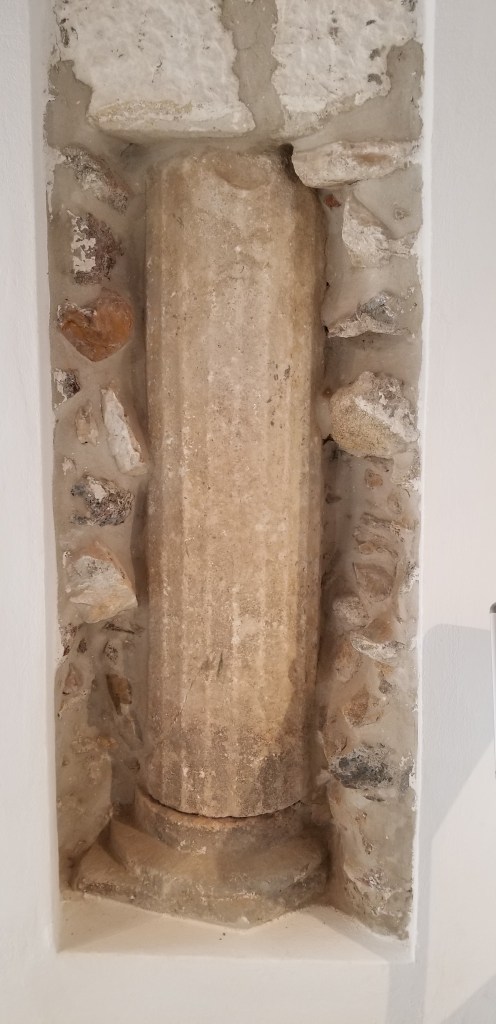
In the year 1207, Venetians built their castle on the foundations of an old Greek acropolis, and used the building materials from it and also from the Portara for construction. Here, a wall was built right around the acropolis column.
A little dwelling place I found while walking in this area:

The ceiling is a hodgepodge of sticks and timbers.
On another of our walks was a cemetery. Walking through, we noted that a number of the caskets were open and empty. What’s up with this? Later we found out that the city wants to move the cemetery elsewhere. The lucky deceased who still have living relatives have had their coffins removed elsewhere. It seems a little macabre!

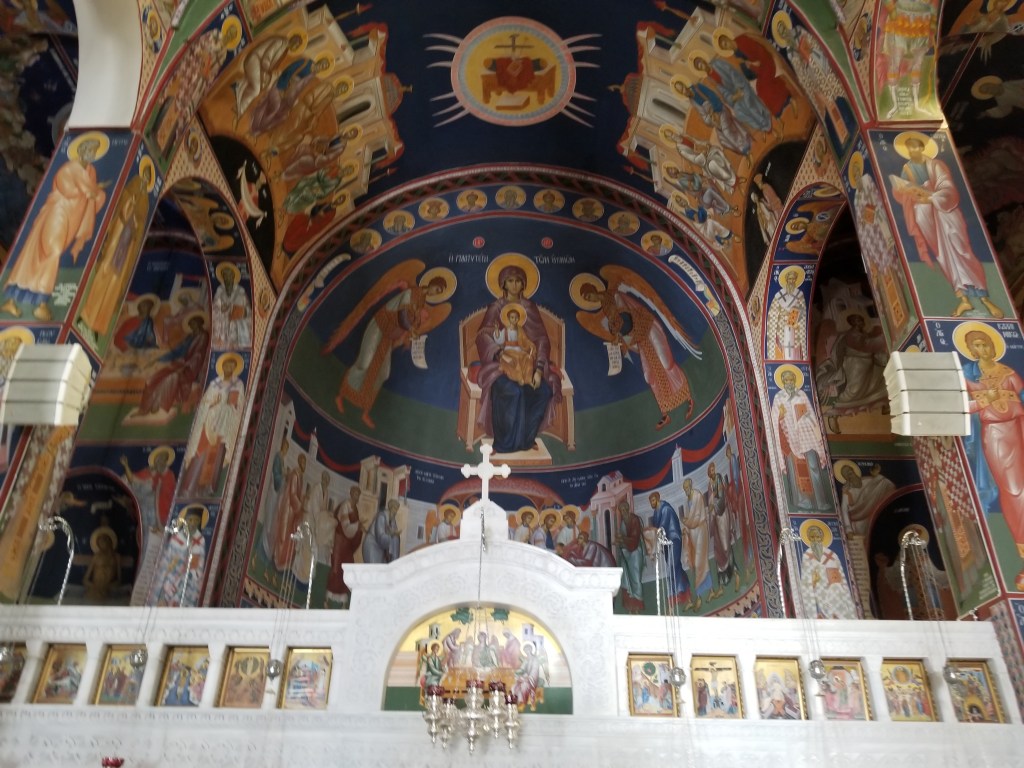
One of our most memorable church visits was to a Greek Orthodox church near our apartment. Cal is still talking about this one. There weren’t a lot of spaces in it that are left unpainted.
In my blogs from our visit to the UK, I usually closed with a photo of a breakfast we’d had. I haven’t done this since for a simple reason: as we traveled further south, breakfast became less of a big deal in the countries we visited. In both Italy and Greece, people tend to rise later and snatch a quick cup of expresso or cappucino, perhaps with a croissant. I think maybe it is because they like to dine later in the evening and so aren’t really hungry first thing in the morning, but that’s pure speculation on my part. Of course, exceptions can be found in all the tourist hotels.
I’m generalizing here, but Greeks do seem to like omelets. Or maybe it’s because they know we travelers like omelets. When we walked in a certain direction, we’d see a little cafe advertising a Greek breakfast, so one morning we stopped by. It was exciting to not be eating a bowl of cereal in our apartment for once.
My Greek breakfast:

The omelet contains potatoes, onions, and cheese. It was not overly stuffed with any of these three ingredients, and the cheese seemed like a cross between cream cheese and goat cheese. It came with toasted bread, a salad, and a strawberry smoothie. Delicious!
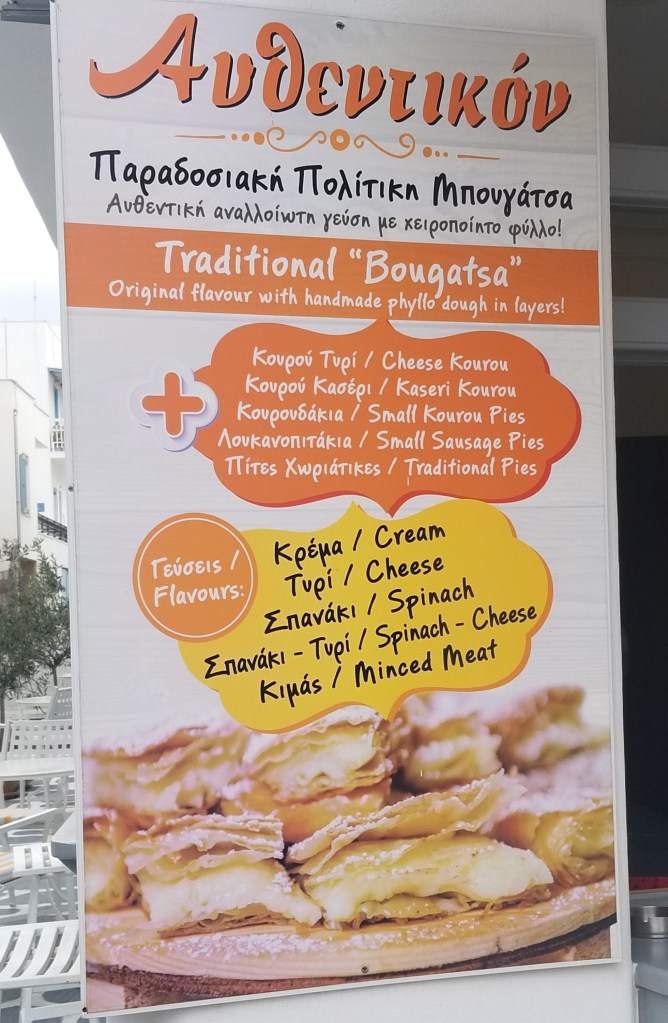
More typically, though, if the Greeks have anything with their coffee other than a croissant, it might be a bougatsa. I had one of these for lunch a time or two and it was delicious.
Another favorite all over Greece for any meal is a Gyro-in-hand. This is a gyro with french fries sticking out of it. It’s an entire compact meal which I often saw people munching on while they were walking down the street.
Earlier I mentioned the October winds. Naxos shuts down earlier than Santorini does, on October 15, for this reason. As our visit here progressed, we noticed stores starting to close for the season. The wind was not bad during the day, but it would become gusty later on and would become downright chilly. The darkness in the evenings plus the chill meant that I was digging out my jacket for the first time since Germany when we’d go out for dinner. The day before we left Naxos, the wind miraculously slowed and the clouds disappeared. Beach time!
Agios Georgios beach was not far from our apartment. Cal and I walked down the beach together–
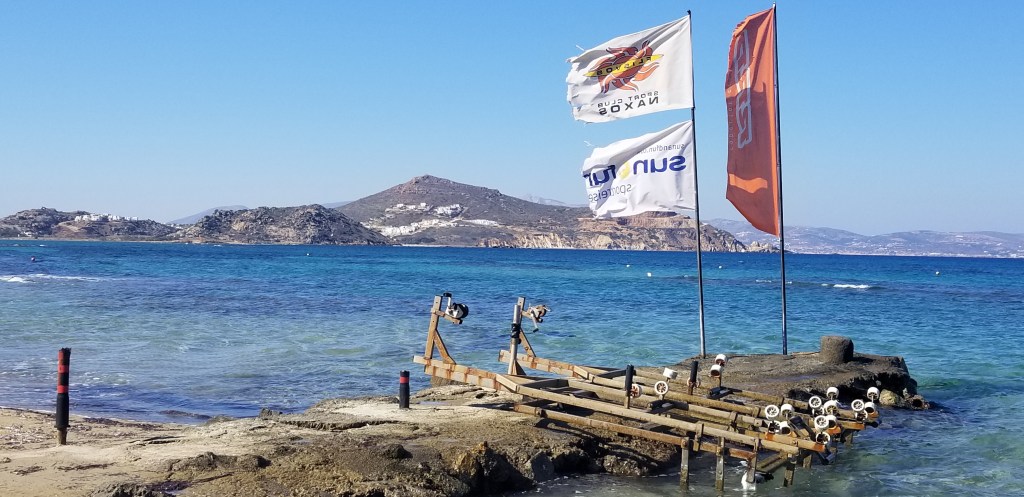

and then Cal settled in to a chaise lounger under an umbrella. He likes the beach, but he does not enjoy the sun. Meanwhile, I walked further down the beach and found a sheltered cove with many windsurfers. The wind on Naxos makes for some great windsurfing.
We were feeling the end of the trip. Our pattern for life in Naxos was often to go out and explore for awhile, maybe have lunch or pick something up from a bakery, and come back to the apartment. There were several days here. It was a relaxing time and Naxos lends itself to that. I was trying hard to finish a cross-stitch Christmas stocking for my granddaughter that I’d been carrying all over Europe. We watched a bit of TV, but Wheel of Fortune is just a little different in Greek.

We had one last day trip on Naxos, though. One last tour. That will be in my next post!
Next time – exploring the mountain villages of Naxos
 Twosna Travels