Greece is a country that has so much to see and do, depending on how much time you have and what you are interested in. Much of what looked interesting took more time than we had available to step outside of Athens, which was just one day. Delphi sounded doable, so off we went.
By now, I was looking only for “small group tours” and found it with Get Your Guide. We were very surprised, getting in the van, that it was just going to be us and one other couple for the day. They were a young couple from Dallas and by the end of the day we were friends. Our guide, Soteri, was smart and funny and ran a patter of information and conversation all day.
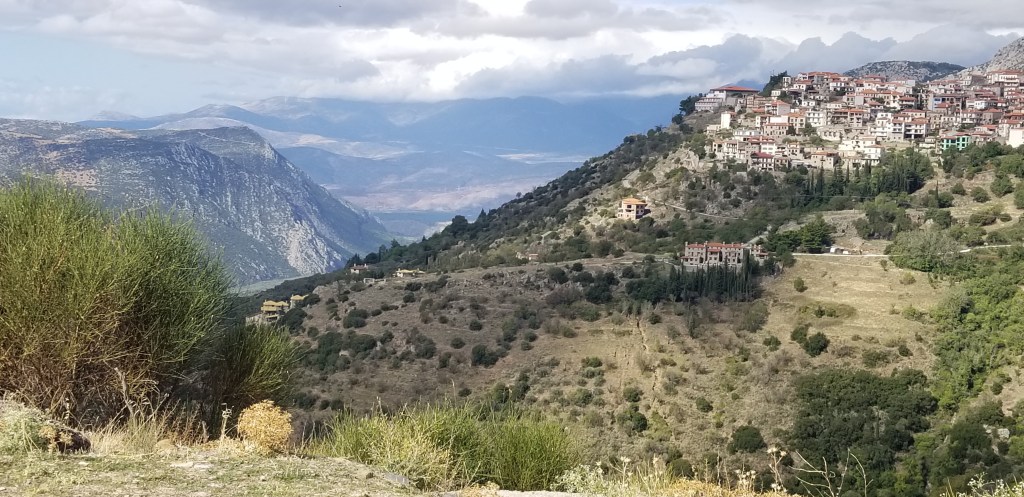
We stopped off for pictures with a view of Arachova, which is another great destination, but not today for us.
Soteri offered to take pictures of us at the scenic view, and ended up taking a selfie with my phone.
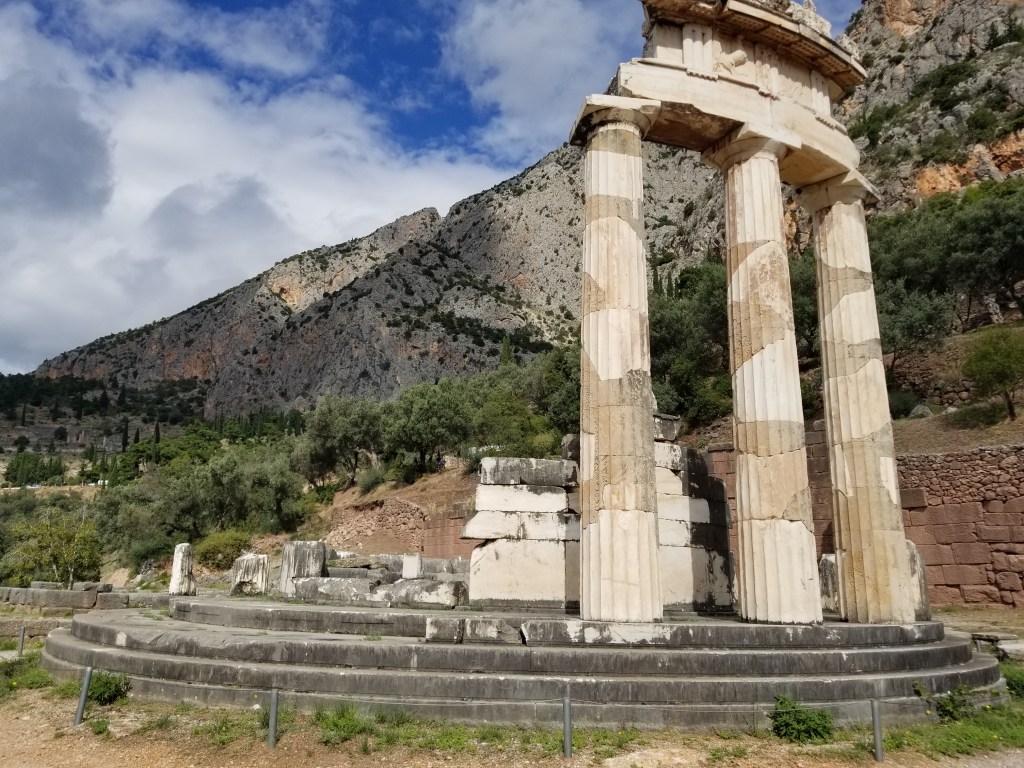
The visit to ancient Delphi began with a visit to the Temple of Athena, which was a major rest stop to the the city in those days. It was a “familiar, welcoming, and peaceful place” (according to the board) after making the arduous journey from all over Greece.
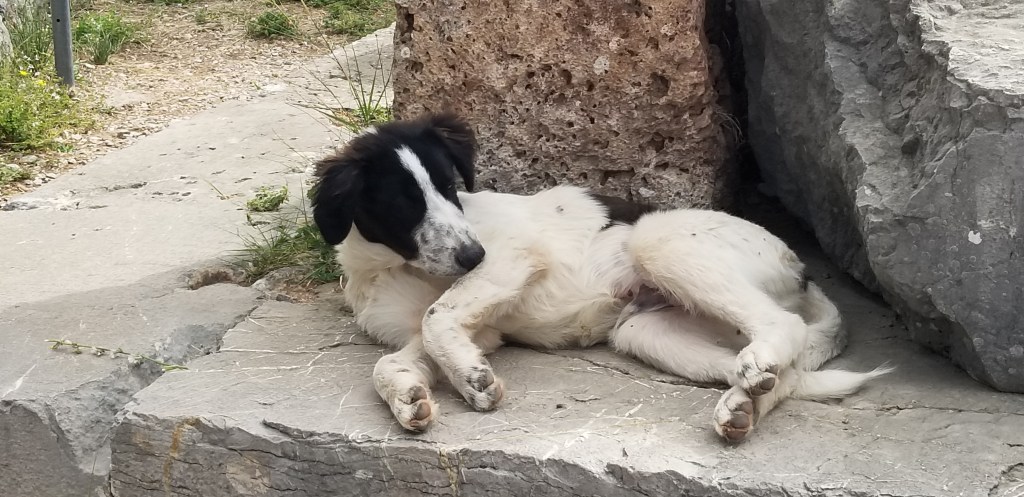
I’d been taking so many pictures of the cats I’d seen everywhere, so I had to take one of this dog that I saw at the temple.
So what’s the big deal about Delphi? Well, it was considered the center, the navel, of the world as far back the eighth century BC. Here, in this sacred place, the god Apollo gave oracles to the people through a priestess named Pythia. People traveled from all over the ancient world to give offerings and receive their oracle, generally an ambiguous sort of prophecy about their future. Of course, Pythia was human, so she wielded great power. She was highly regarded, educated, mysterious, and had to reliquish all family duties when chosen.
We started out at the museum. Soteri turned us over to another guide, Georgia, and she walked us through it, telling us so many things that I would not have known if I was just walking through. Then we were outside again, and just like the ancient peoples, we were walking on the way up to the Temple of Apollo to see Pythia.
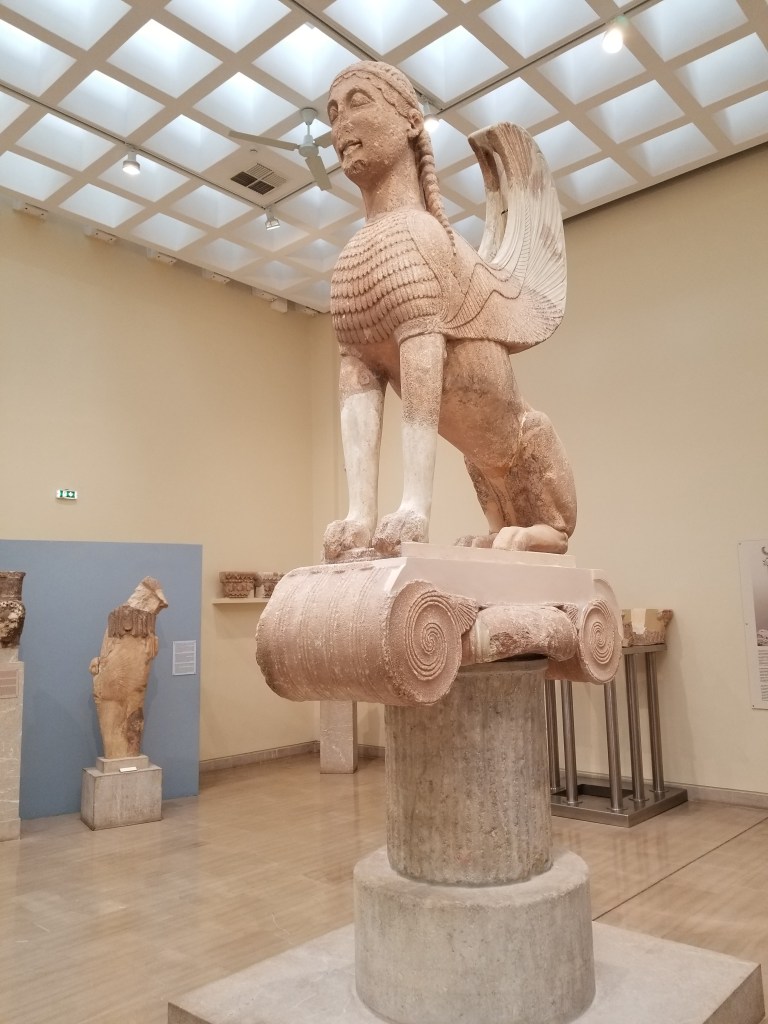
Originally, the way was lined with statues, such as this one that we’d seen in the museum.
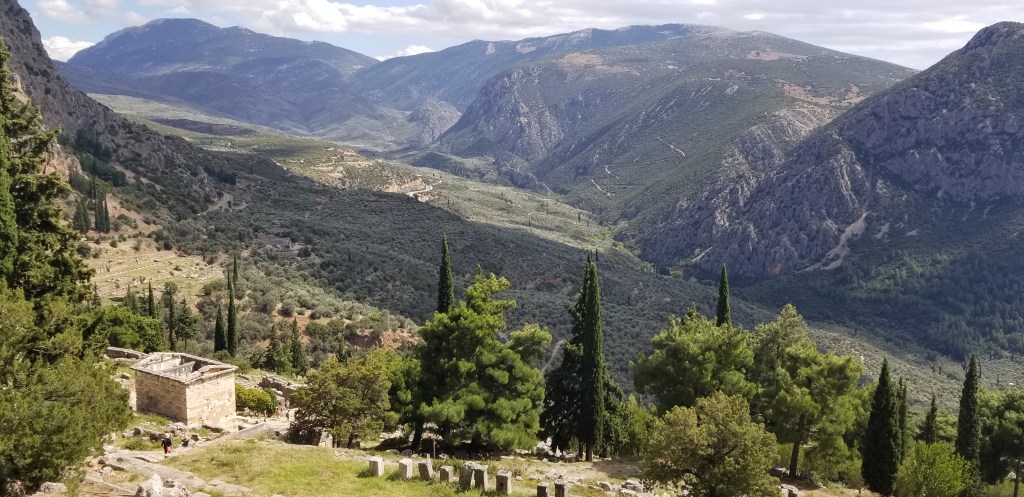
It was not enough just to go to the temple and seek Apollo’s counsel through the priestess Pythia. The people needed to bring offerings, too. It was difficult to travel with elaborate offerings, so each city-state had a treasury. This one belonged to Athens:
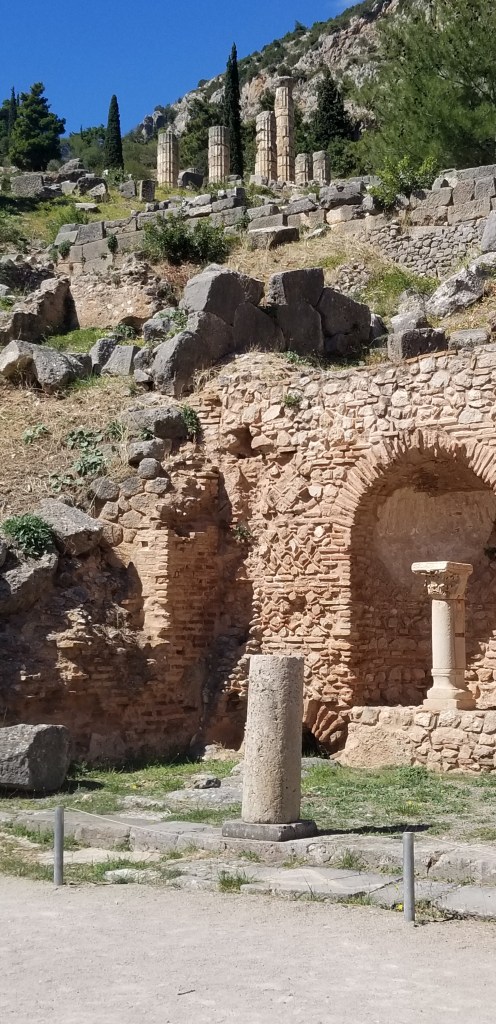
Finally, we were at the ruins of the Temple of Apollo and the place where Pythia was consulted.
It’s a beautiful spot, and I’m standing there at the entrance of the temple at the top of this blog. The picture below shows the building, and one of these rooms would have been Pythia’s.
Georgia was so knowledgeable about ancient Greece. She told us that in high school, which is five years, they are required to study Ancient Greek. This includes reading classic literature and studying the culture. She said that at first she wasn’t thrilled, but then it became interesting to see how different aspects of what she was learning fit together. Georgia left us here, but we were on our own to walk higher to visit Delphi’s amphitheater-
and admire the pretty view. Cypress trees dotted the landscape as far as the eye could see. Stopping here was also a good excuse to catch my breath.
Finally, at the top, a stadium, which is the best preserved ancient stadium in Greece. There were track and field events held here, as well as musical contests. There is room for 6,500 spectators.
I wanted a time machine so that I could sit here among the ancient Greeks and watch a contest.
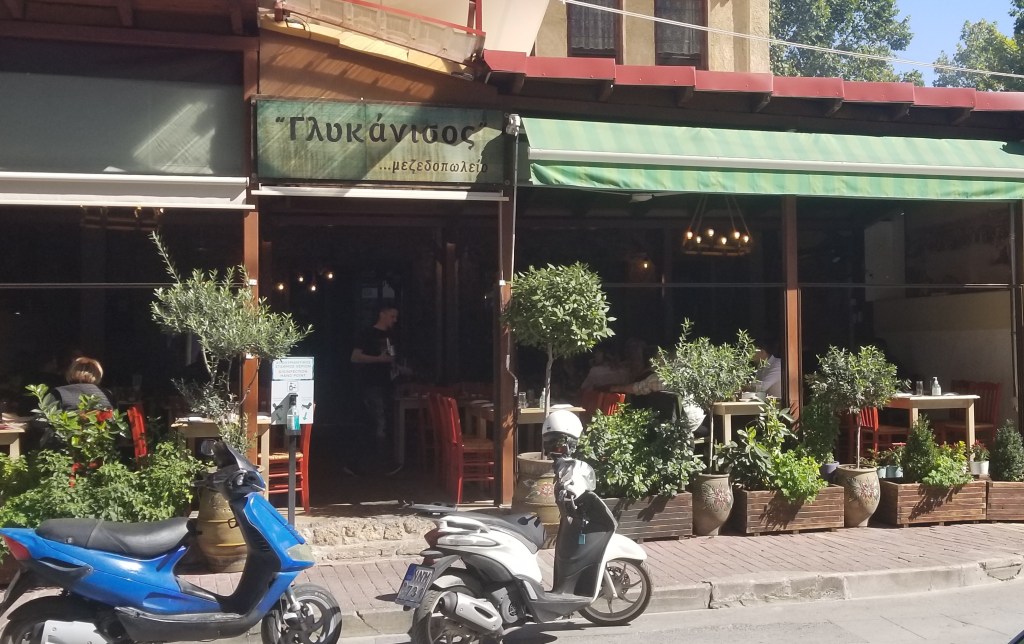
It was already almost three o’clock and we hadn’t had a chance to stop for lunch, so Soteri took us in to modern Delphi to an excellent restaurant with traditional Greek cuisine. We dined with our new friends from Dallas but Soteri declined to join us. I guess he needed his break time.
We greatly enjoyed this journey back in time and the beautiful scenery along the entire way was a bonus. I’ll sign off on this blog with a couple of pictures from near our restaurant.
Some of what I read, pre-trip, said to give Athens two or three days and then head out of town. After all, there isn’t much more that’s worth seeing in Athens besides the Acropolis. The city is covered in grafitti, and traffic is heavy and crazy. Athens is working hard to clean up its act, though, and the city has a character all its own. I can always find much to see when looking under the surface. There certainly is plenty here for a multi-day stay.
We found other places to visit after our day around Acropolis.
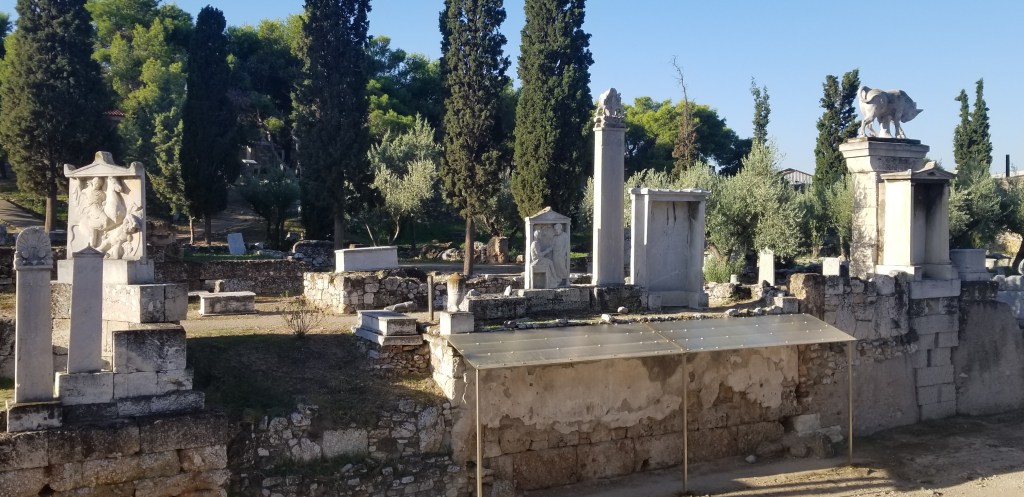
The Cemetery of Kerameikos popped up often in my “Athens Must-Sees”. In antiquity, this is a neighborhood where the potters lived. It flooded often, so it was not a great place to live. It began to be used as a cemetery as far back as the Bronze Age – around 2000 BC – from the Greek era to the Romans and early Christianity. Besides, that, there are a lot of cats and turtles here.
As you can see in the photo above, we did see several cats, playing and peeping out at us from the crevices in the stones.
The site lay just outside the Athens city wall, and some remnants of that wall can still be seen:
The Sacred Way was once lined with elaborate tombs for rich Athenians, going back to the late 4th century BC. It lay on the road to Eleusis. Going into Athens, this cemetery would be passed before entering the city walls. The party ended for the fancy tombs in 317 BC, when they were banned by law and replaced by simple columns for new burials. Maybe they were running out of space.
Also here is the Pompeion, which was the starting point for a grand parade for a festival that happened every four years. According to the explanatory sign, there was a large colonnaded court and rooms for feasts. A processional ship was made ready and moved through the streets to the Acropolis. The Romans destroyed some of this site when they invaded, but the festival continued for centuries.
Yes, we did see several turtles:
We also visited the Greek Agora. “Agora” is a word that means “market” in Greek but it had more meaning to them as a “gathering place”. It was the center of life for the city. Here, the fledgling democracy conducted state affairs, but also there were performances, philosophers giving lectures, business transacted, and folks just hanging out. I included a picture of the Roman Agora in my previous post; the ruins of the Greek Agora are far more extensive.
I was not prepared for this:
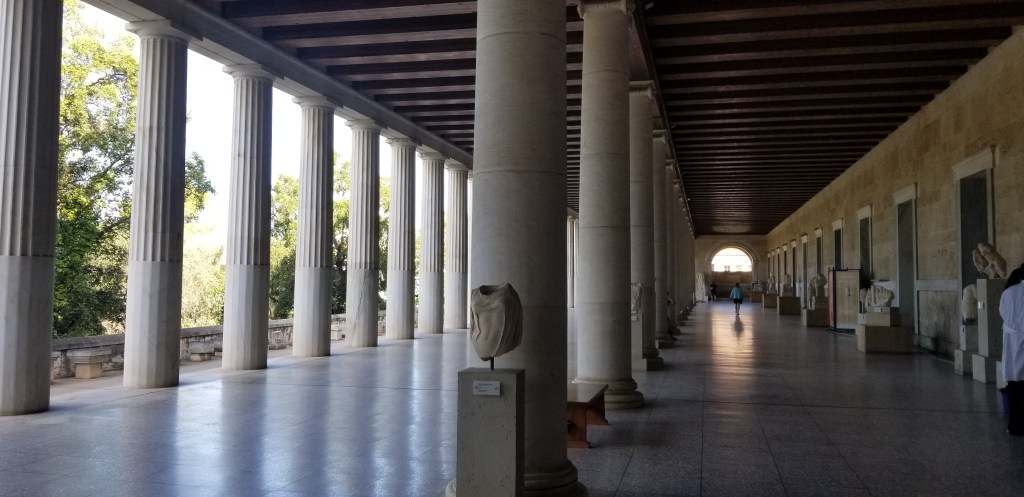
It is the Stoa of Attalos, which was reconstructed in the 1950’s. It was the largest reconstruction of an ancient building to that time, and I was bowled over by its size. In ancient times it was simply a covered porch with rooms in the back for important business. People could hang out here and there were people conducting business. Now it is a museum, and I spent a lot of time checking everything out.
Upstairs, I was fascinated by an exhibition dedicated to the work of Irishman Edward Dodwell, who traveled to Greece in the early 1800’s. On one occasion he came with an Italian painter, William Gell, and together they spent fifteen months drawing and documenting landscapes and monuments as they looked in that era, sights which are now lost. They also used a camera obscura. This quote from the sign board gave me things to ponder on:
“The sight of the ancient monuments now lying in ruins as well as the awareness of the achievements of the once pioneering spirit of the Greeks, now doomed to decline under the decaying Ottoman Empire, provoked the philosophical reflection on the transience of the human condition.”
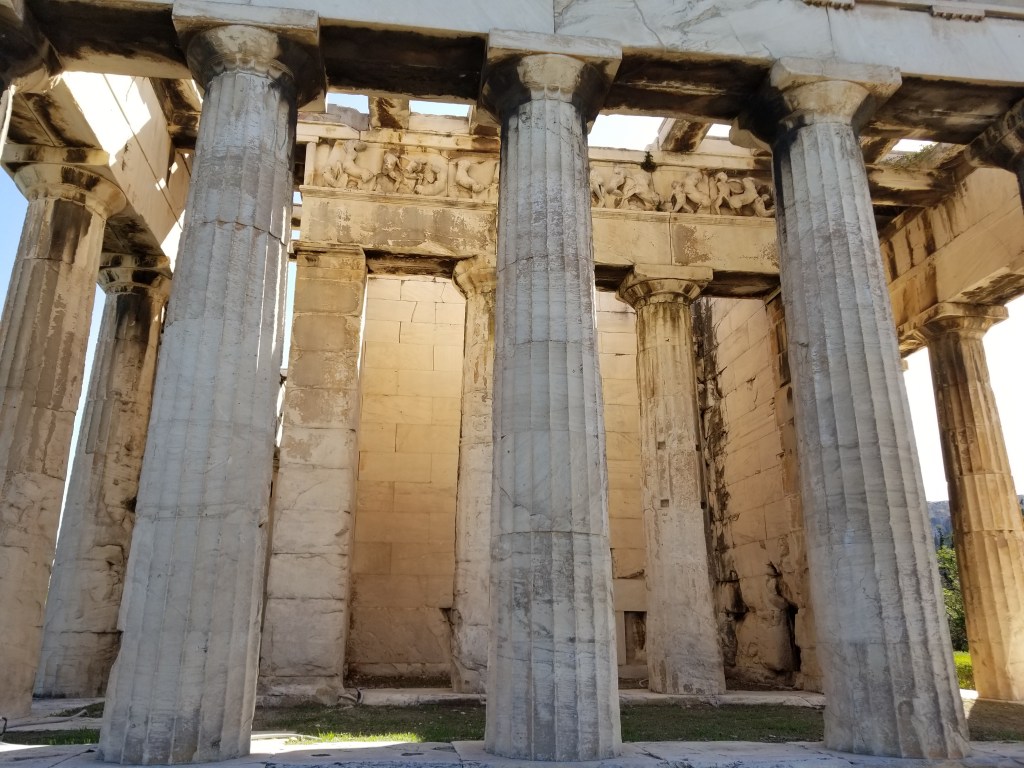
The ancient Temple of Hephaistos is also in the Greek Agora:
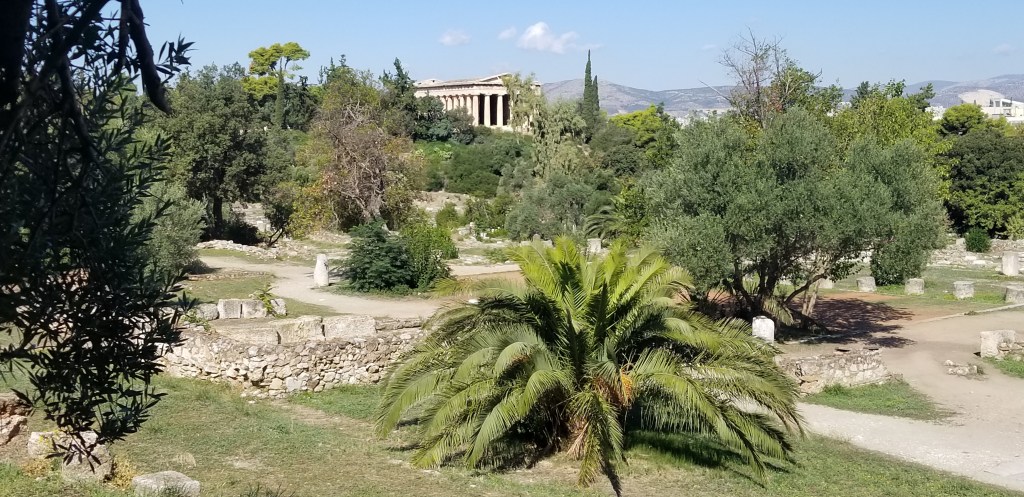
The place is a beautiful to walk around and view the various ruins.
We did see the famous changing of the guard, but it was at the Presidential Palace and not at Syntagma Square where everyone else goes. There were only two guards, and it was drizzling so they didn’t make a fuss, but we did see them up close. So up close, in fact, that one of the guards softly tapped his weapon on the ground as I peeked through the gates of the Palace. Uh-oh!
Part of what made our stay so memorable was our location at the Hotel Attalos. It is not sleek and modern, just an old and fairly inexpensive tourist hotel, and probably one step down from the City Hotel where we had stayed in Thessaloniki. A lot of tourists opt for the picturesque and mostly pedestrian Plaka district which is on the opposite side of the Acropolis hill. Despite all the city hubbub going on outside the doors, our hotel was clean, comfortable, and put on a great spread for breakfast every morning. A subterranean subway stop just five walking minutes away took us to the ferries, and to the airport in the other direction.
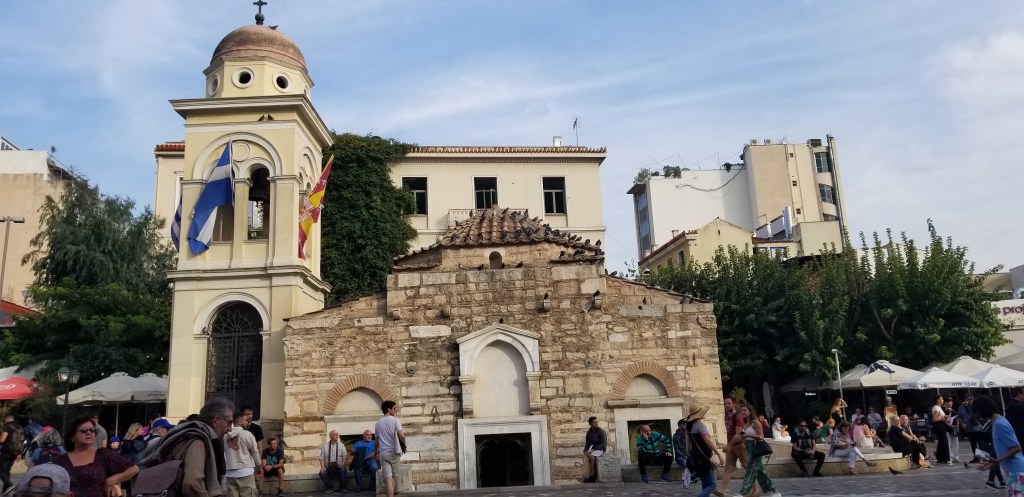
We were just down the street from Monasteriki, a square which has a flea market, shops, and a great view of the Acropolis. The Holy Church of the Virgin Mary Pantanassa is here, and it is all that remains of a 10th century monastery. The dark interior paired with the lush gilt furnishings was something to see.
Monasteriki Square is a very busy place. The picture below is looking up from the square:
Behind our hotel was a rabbit-warren of tiny streets, many of them pedestrian, filled with all sorts of restaurants. I had a delicious moussaka there one night:
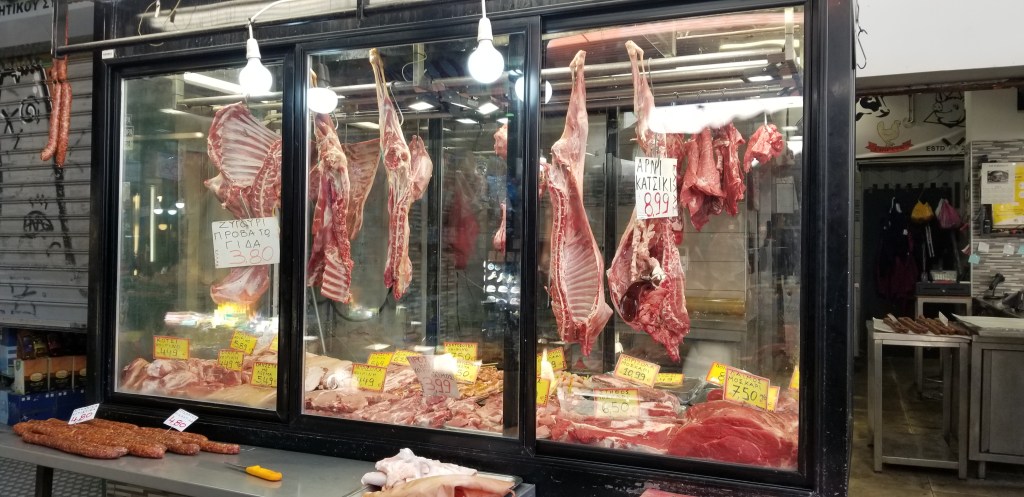
Walking out the door in the other direction, we’d see some great murals, and a market selling goods old and new, as well as produce, meat and fish. There was a lot of hanging meat here, too, but since I included a picture of that in my Thessaloniki blog I thought I’d spare my readers the sight of that.
Just a few blocks down was our favorite souvlaki stand. Upon our second meal there, a woman who worked there recognized us and started chatting with us. We returned to the Hotel Attalos for our last night in Greece and looked forward to one last souvlaki meal, and perhaps finding out more about her. Was she one of the owners? She was not there that night, so we’ll never know, unless we return to Hotel Attalos some day. That is a distinct possibility. Cal really wants to return to this souvlaki stand.
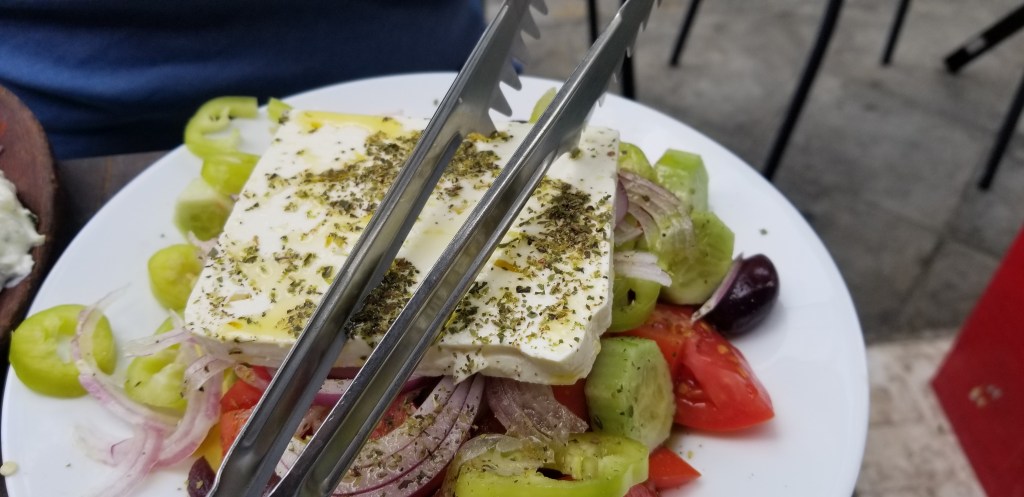
This is a Greek salad. No matter where we went in Greece, a Greek salad was the same all over: tomatoes, cucumbers, green pepper, and (for Cal) onions and olives. All of it under a slab of feta, with no lettuce. The tomatoes, in particular, always tasted freshly picked from someone’s garden.
The best thing about the Hotel Attalos, however, and the reason for booking this hotel, was their rooftop bar. I don’t normally look for bars in hotels, but this one was special: it had a view of the Acropolis, lit up, at night. The great view of the city all around and out in the distance was a bonus. How relaxing, after a busy day of sightseeing, to sit up here with a Spritz and watch the sun go down and the lights go on!
One more train ride on our Eurail Pass, from Thessaloniki to Athens. Unexpectedly, it was one of the best. On the day we arrived in Thesssaloniki, before we met the group, we figured out the closest bus number and stop from our hotel to the train station, and made a trial ride. We showed a sleepy ticket agent the Eurail passes on my phone and without comment he punched out a couple of paper tickets with seat reservations. We were excited about paper tickets! It meant we could actually go through the turnstiles without causing a commotion.
On travel day, we allowed extra time for the capriciousness of bus schedules and arrived at the station early. There was time to thoughtfully purchase lunch to eat on the train, find our track and our particular car. All of the seats faced forward, the train was not crowded, and the windows were clean to see out. We had a view of Mt. Olympus (which Cal climbed, a long time ago), a lot of cotton being harvested, and a beautiful mountain range that we went right through. The travel time to Athens was about four hours. Two stops on the subway, an eight minute walk, and we were in front of our hotel.
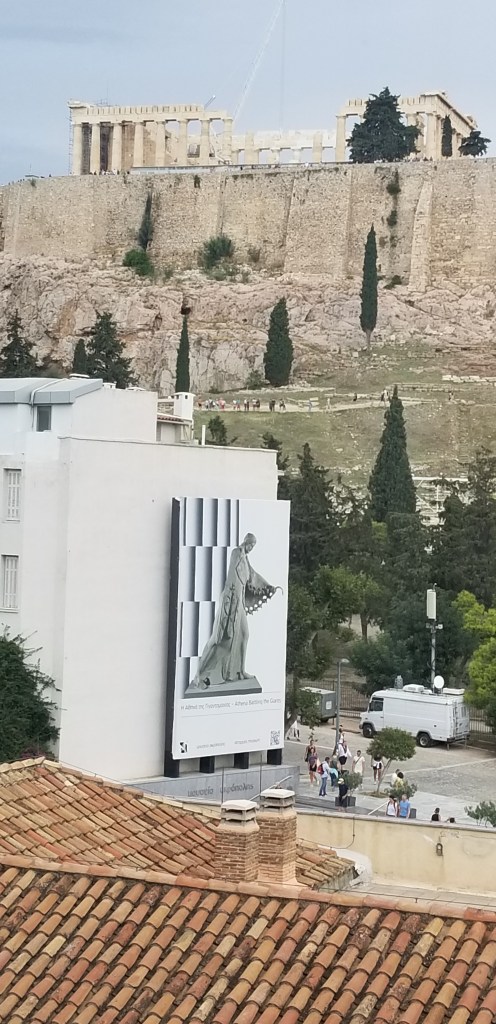
The star attraction in Athens, of course, is the Acropolis. We headed out early the next morning for our walk through picturesque neighborhoods, with many ruins along the way. The Acropolis, at the top of the hill, was often in view.
An ancient stadium is still in use.
We walked past the remains of the Roman agora:
and plenty of pretty cobblestone streets and lanes.
We were at the Acropolis almost as it opened, which was perfect. The crowds only get heavier as the day goes on.
The Acropolis is the term for the whole complex on the hill. There have been fortification walls around this hill for 3,300 years; the first wall was built in the 13th century BC. In the latter part of the 5th century BC, the Greeks had a decided victory against the Persians and established democracy. An exceptional age of thought and art followed, and the monument to these ideas were established. It was dedicated to the goddess of wisdom, Athena. Today it is a UNESCO world heritage site.
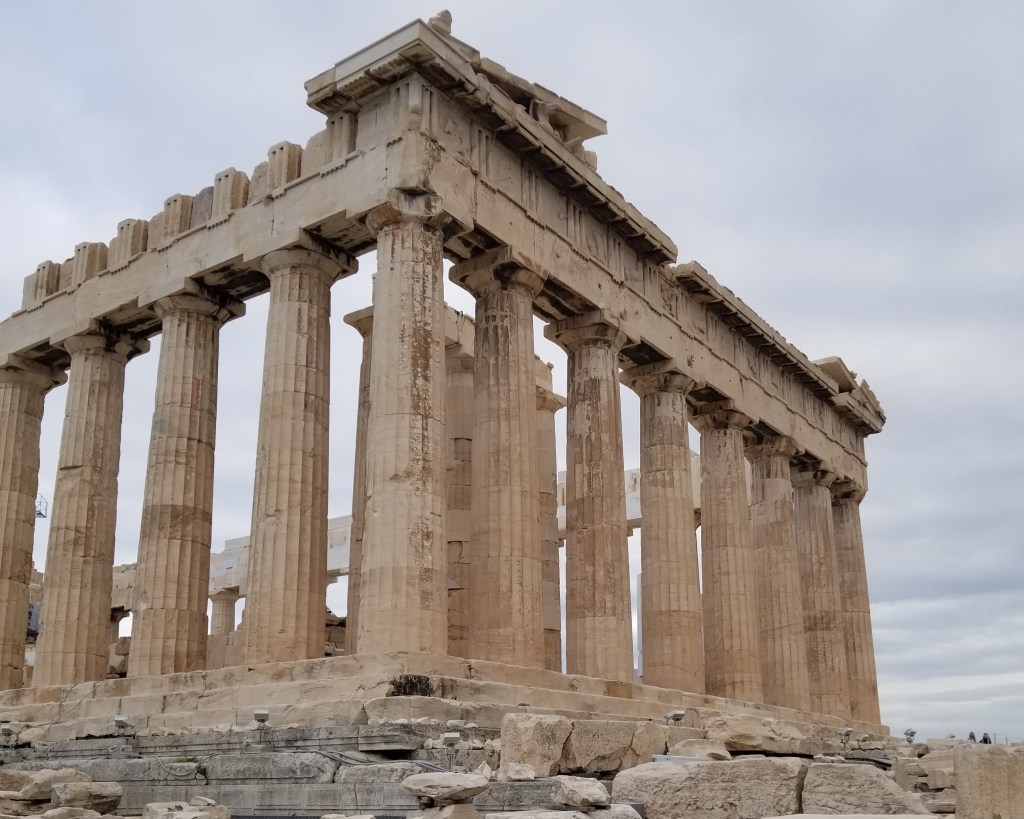
The Parthenon is a temple and but one of the ancient structures on the Acropolis, although it is arguably one of the most famous. It was an unbelievable and indescribable moment to be standing here.
Also at the Acropolis is the temple of Erechtheion, dedicated to several different deities, including Athena.
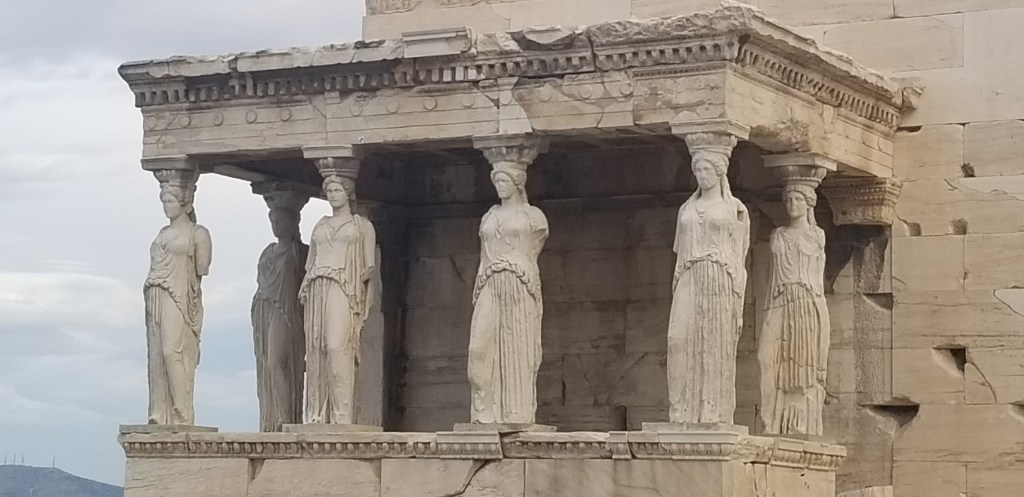
I liked the caryatids that are to one side of the Erechtheion. Caryatids are sculpted female figures used as a support instead of a column. These are all replicas; the originals are in the Acropolis Museum.
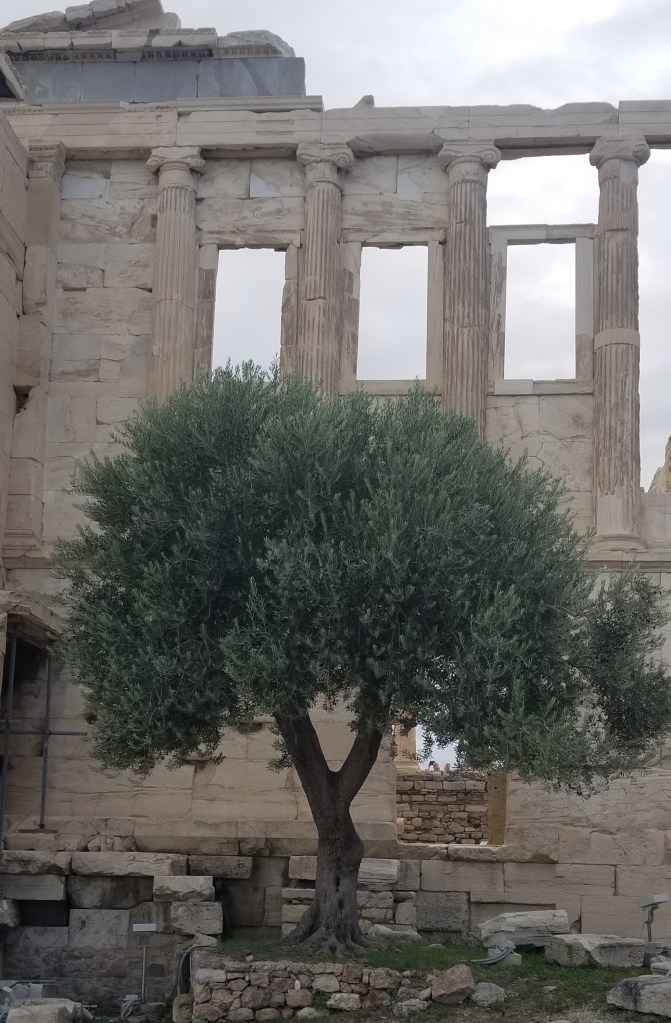
There was once a statue of Athena here; it was later carted off and destroyed in one of Greece’s battles. The story goes that Athena planted an olive tree here. The olive tree symbolizes peace, wisdom and harmony. Of course, the sacred olive tree from antiquity is long gone. This one was planted in the early 20th century.
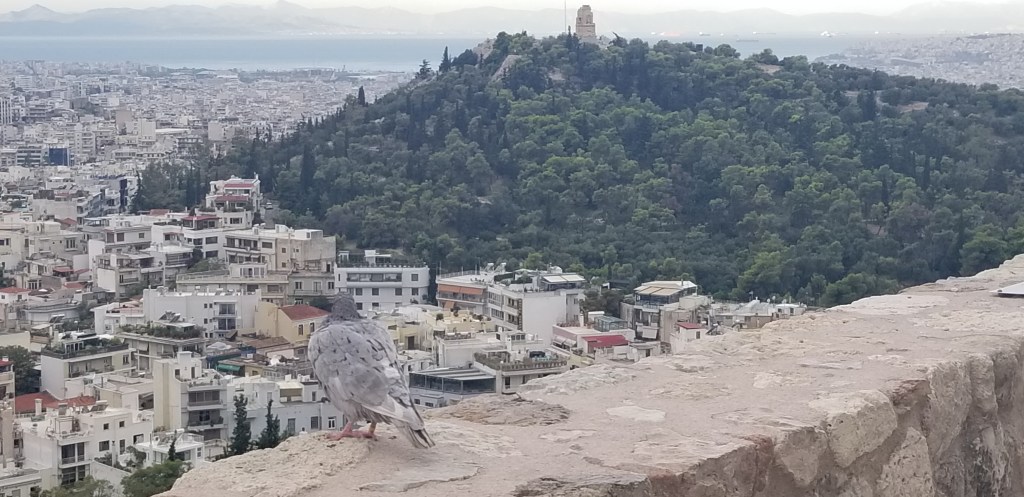
A pigeon and I admired the view from the Acropolis.
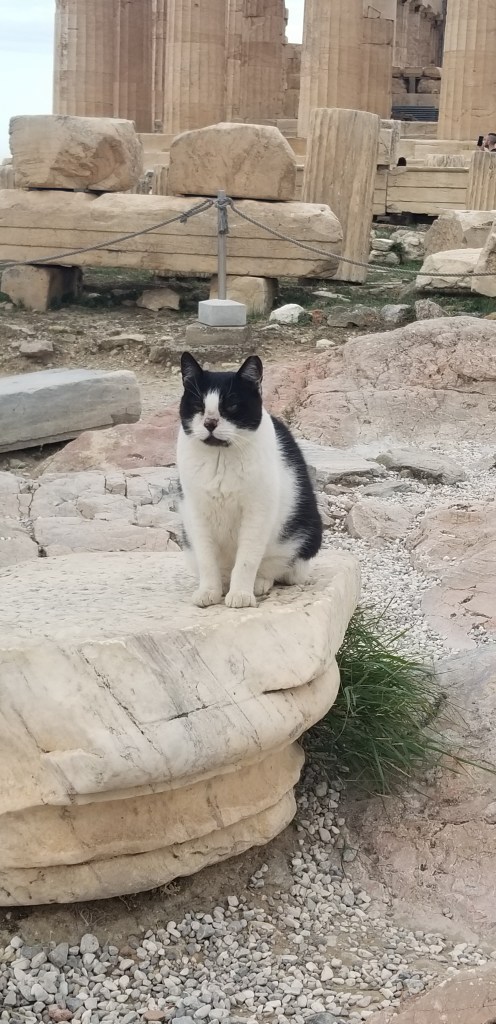
Beginning in Thessaloniki, we had begun seeing feral cats everywhere, and I delighted in seeing them. There are several to be seen at the Acropolis. I presumed this one was male, owing to his size, and dubbed him “King of the Parthenon”. I chatted with a lady who was feeding kitty treats to all the cats; she walks up and does this every morning. I’m sure that’s better than the junk food that many tourists probably feed them. Mr. King looks pretty well fed.
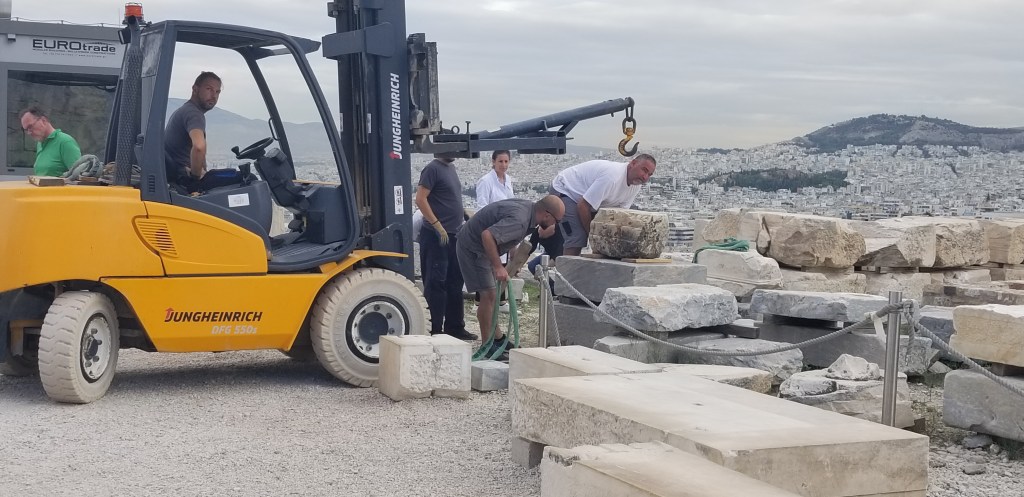
We also had fun watching a team of people reconstructing some ancient ruins. There was great discussion regarding the placement of the stones. The forklift driver waited patiently for someone to make a decision. The lady in the white coat, whom I would presume to be the archaeologist, seemed to always have the final word.
It’s wonderful that they pay so much attention to getting the tiniest details just right.
After visiting the Acropolis, the natural thing to do is to visit the Acropolis Museum, which is on the south side of the hill.
The surprise here is what is under the museum. When building it, the remains of a whole neighborhood dating back to the 4th and 5th century BC was discovered.
I was surprised that this neighborhood had a system of pipelines for clean water and and an underground sewer that ran under the sidewalks. I did not think that any dwellings of that age would be so advanced.
It is quite extensive. One more view:
What to do with such a treasure? Well, if a museum is being built above this, that’s easy: just make it a subterranean level of the museum.
Upstairs, I found one of the original caryatids from the Erechthion up on the hill.
This is what the pediment of the west side of the Parthenon looked like. A pediment is the triangular upper part of the front of a building; the Greeks loved to put statues up there. In the center is Athena, and next to her is the sea god Poseidon. Poseidon is revered for striking a rock with his trident and causing a saltwater spring to appear on the Acropolis.
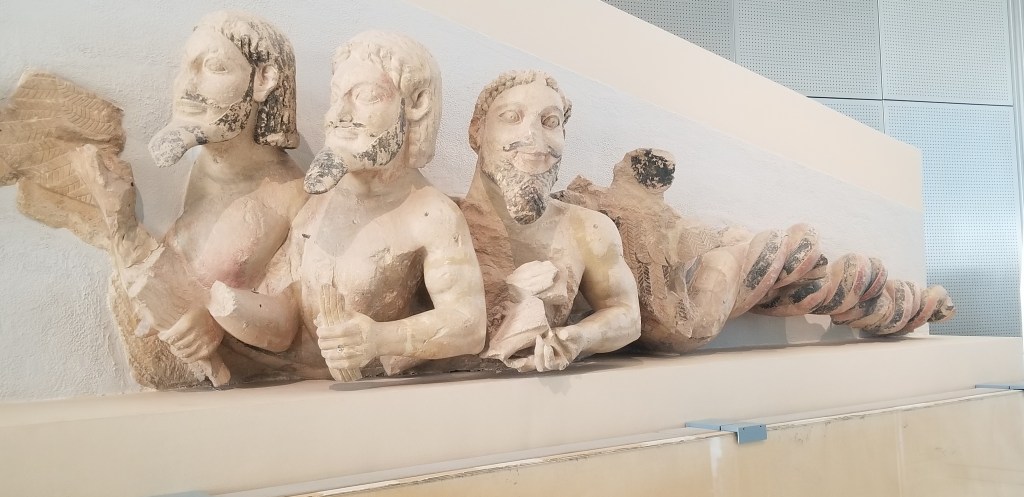
These smiling gentlemen are original architectural details that would have gone above a pediment.
Here is a view looking out from the museum to the Acropolis above, where the antiquities came from.
My original plan was to smoosh everything we saw in Athens, including a day tour that we took, into one blog. Clearly, it did not work. Our short time here was packed from the time we left our hotel early in the morning to our search for a place to eat dinner – and it didn’t even stop there. There will be another Athens blog!
On this sunny Saturday of Cal’s reunion with his Army buddies, we went back to where it all happened – the small detachment outside Giannitsa where they were stationed. For background, if you haven’t read my previous post, you may want to do so before reading this one.
Lefteris procured a van for us for the day. I was surprised that no other family members besides myself were coming, but there wouldn’t have been much more room in the van anyway. I wasn’t going to miss seeing this place that I’d heard so much about.
Our first stop down memory lane was this bridge:
Back in the day, this one-lane bridge was a mile long and had a stop light on either end, necessitating at times a long wait. And sometimes, the drivers coming the other way just didn’t want to wait for their light. The guys had many funny memories here, and there were a lot of stories flying back and forth. There is a “new” road now that bypasses this bridge.
By titling this blog “back in time” I didn’t only mean the time while Cal and his friends were stationed here. There also things to see that went back to the time of Alexander the Great.
Tom was the perfect guide for the day, making sure we stopped at everything of interest, and I really appreciated his efforts in this. Our first stop: a statue of Alexander, in the town where he was born, Pella.
We then moved on to ancient Pella. We pulled in to the site, discovered that it cost money, and Tom and Lefteris went over to the ticket booth.
Score! They told the people that we were all veterans and that the guys had been stationed nearby. Free tickets for all!
This is the ancient town of Pella, the place where Alexander the Great was born and raised. The amazing thing about this is that it used to be covered by the road going to Giannitsa. Cal still remembers seeing this pillar, which was the only thing that could be seen when he and his friends were here.
They couldn’t believe all of this had been underground as they had driven by. In the picture below, you can see the lone column amongst the ruins.
I should mention that we were respectful of these ruins, despite my sitting on an old Macedonian wall. The ruins were open for anyone to walk in and around, but we stayed outside the walls when doing that. The most precious pieces, the ones no one should step or sit on, are in a museum. Here at Pella are some, though, that have low barrier fences under shelters around them, and these were mostly the mosaics that had been found:
This was a mosaic floor depicting the abduction of Helen.
Once-flourishing Pella was the capital of the Macedonian kingdom. The city is believed to be inhabited as far back as the 4th century BC, and it was huge. There was a palace here, a rectangular street layout, and a water supply system with drainage, among other things. Most homes had a mosaic, which told the archaeologists that there were many mosaic craftspeople in town.
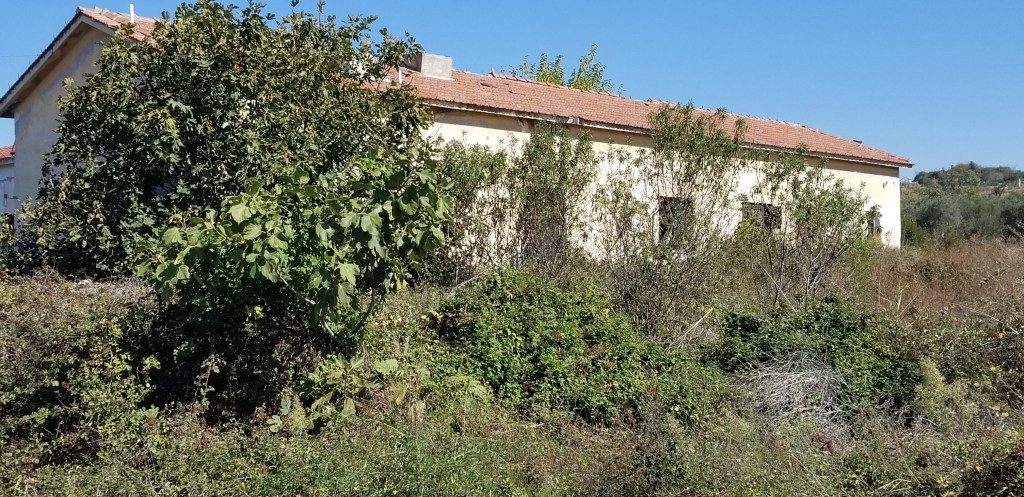
We finally arrived at the old detachment, which is now in a ruined state.
What were the guys doing when they were stationed here? Officially, they were advisors to the Greek Army since the communist country formerly known as Yugoslavia was just over the border. Today, that country is North Macedonia, named so as not to cause confusion with this area of Greece which was formerly Macedonia.
Nature is reclaiming the site. Mulberries and olive trees are growing wild and fighting for space along with the weeds and prickers. We picked through some of it to get a closer look, but I think the prickers won the battle.
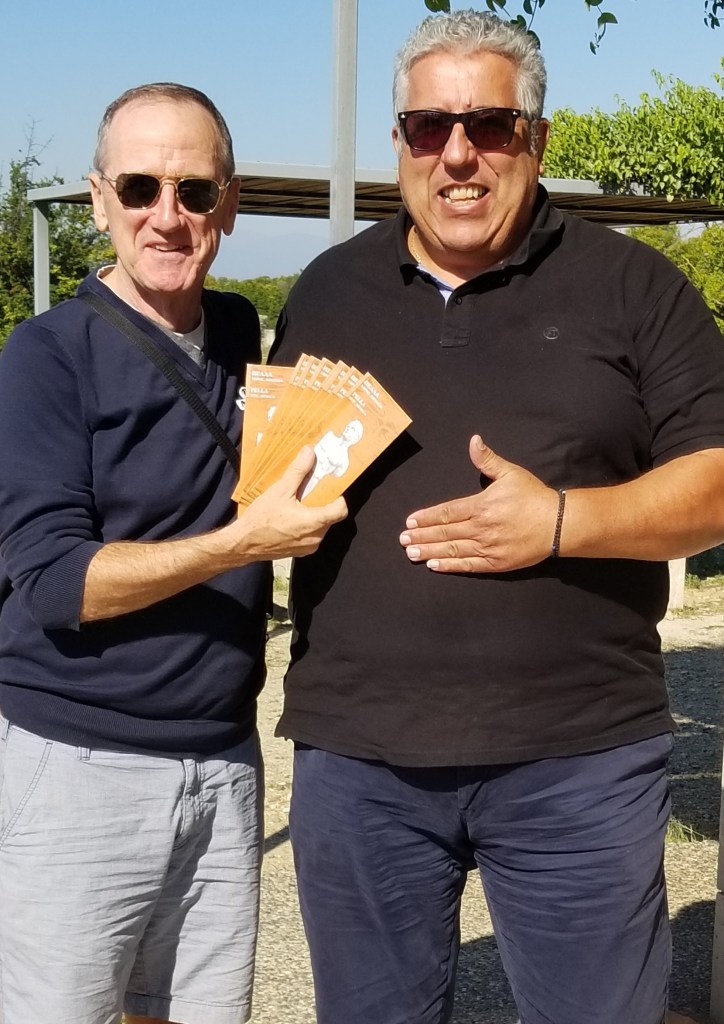
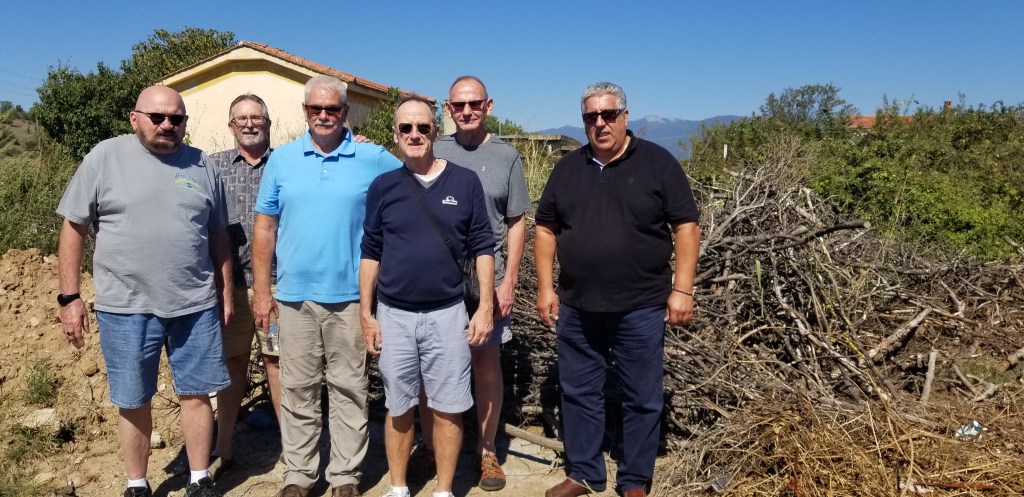
Billy, Mark, Cal, Tom, Milan and Lefteris: not the young kids they used to be!
The Greek Army was across the road and that site is still there and operating. That is where Lefteris was stationed.
Here is an old throwback picture of the American detachment from back in the day:
From the site, this picture is a view of Mount Paiko, which lies on the border:
This area is a fertile plain, producing cotton, tobacco, peaches, rice, olives, and other crops. Cal remembers that fields completely encircled the site, but now there are some homes and farms.
The guys were excited to see the site. They tried to figure out what was where back in the day, and many stories were told. Cal felt bad that it had deteriorated so much. Inside, everything which wasn’t nailed down, to include the fixtures, had been plundered and hauled away. We looked and walked down the road a bit.
Many of their memories are also linked to the little town of Giannitsa which is nearby. We traveled there next for a walkabout and a late lunch.
There is a tradition in Greece called the volta. Every town has one, and it is an area for an after dinner stroll and socializing. The way it was explained to me, in Giannitsa, a street was blocked off on weekend nights for this purpose. Lovely young ladies would be part of the stroll, and Mamas would hope that their daughters would make a good catch. Once she found a young man, of course, Mama could also supervise the dating scene right there on the Volta. Cal just remembers walking up and down the street, saying hello to people and that the locals were friendly. He thinks that the Greeks enjoyed them being part of the tradition.
Giannitsa is now a small city, and the volta is blocked off permanently to traffic. Cafes line the sidewalk.
The efforts of the Mamas must have paid off. In just the couple of years surrounding the time that Cal was here, several of the guys married Greek women. This is the local church:
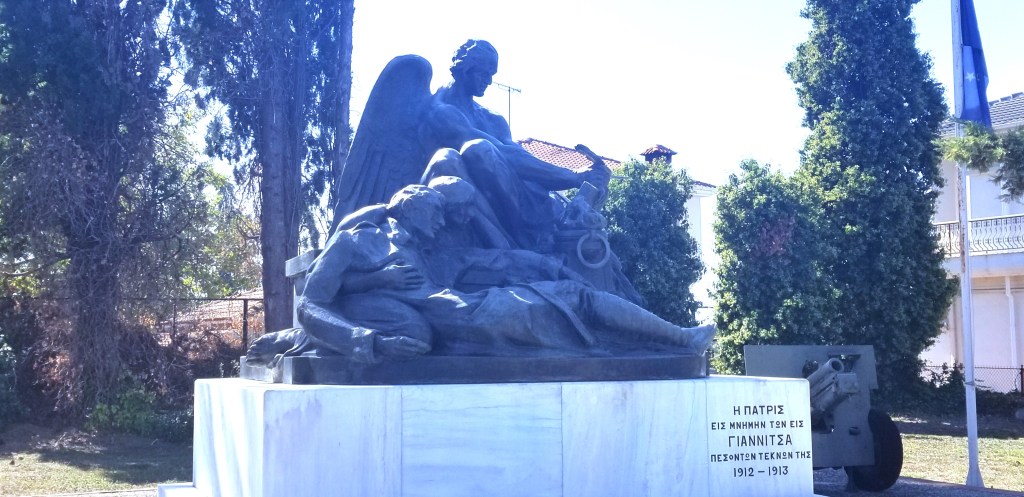
We had one more stop to make on the way back while still in Giannitsa. Tom said he had driven by this statue many times but had never stopped to look at it before.
It is a memorial to the soldiers lost in the Battle of Giannitsa, the final combat between the Greeks and the Ottomans in the war for independence in 1912. The signboard nearby stated that “the Ottoman Army retreated disorderly, followed by Muslim residents.”
Our day had come to a close, and it was time for the drive back to Thessaloniki. Kudos to Tom and Lefteris for all of their efforts in planning such a wonderful day. The whole weekend had been spectacular. Seeing the detachment again was fun, but seeing his friends again for made it special for Cal. I really enjoyed meeting the guys. Of course, there were so many others…ones that had not been able to make the trip, ones who have never been found on Facebook, and many that have already passed on. They were all remembered this weekend.
Of course, we couldn’t just spend one long weekend in Thessaloniki and leave the country. It was time to head south, and the next destination was just a train ride away.
But first: how about another throwback picture to when Cal was here? Most of the guys had an extra job in addition to their regular duties. Cal’s job was to run their little PX. He had to make trips down to Athens to resupply it, and usually had a list of special requests from the guys. The Quonset hut which housed the PX, rec center and a bar is gone now.
Cal and I had only been dating a few months when the Army sent him to a little isolated detachment in northern Greece for a year. This was at the height of the Cold War era. In a pre-internet time where even phone calling was impossible, he wrote me letters. Lots of them, to his credit. I heard about all the antics that he and the guys got into, the day-to-day drudgery, but also all the things he saw and did. He sent back beautiful pictures of Greece, and I thought he was so lucky to be seeing the sights while I was back in the middle of Texas.
He and his buddies lost touch, but Facebook brought them back together. In 2019, they had a reunion in Las Vegas, with many of them attending. This was the year to have a reunion back where it all happened. Amazingly, it dovetailed perfectly with our big Europe trip, which was very exciting!
How to get to Thessaloniki from Venice? It’s too long a distance by train, involving many transfers, so we couldn’t use our Eurail pass. The best deal was, strangely, with Austrian Air. We flew north to Vienna and then south to Thessaloniki.
The city lies on the Aegean Sea north of Athens by about two hundred miles, as the crow flies. Driving that distance would add on another hundred miles. For the reunion, we stayed at the City Hotel in the heart of downtown and a couple of blocks away from the water.
We met two of the guys at the hotel, Milan and Billy. Another, Mark, came later in the day with his wife and additional family members. The reunion was organized by Tom, who has a Greek wife and lives here. That was it for our group. Attendance was small for a long and expensive trip to Greece.
On our first morning we set off with Milan and Billy to explore the White Tower which you can see on the left of the picture above.
It is a long climb up but there are displays on the history of the city on each level, where prison cells had been.
At the top we were rewarded with a great view, and Tom found us here.
The White Tower replaced an old Byzantine fortification in the fifteenth century by the Ottomans. It has a sad past, since it had been a notorious prison and the scene of many executions. When Greece reclaimed it in 1912, it was cleaned up and now it is a symbol of the city.
Over the weekend, there were many recollections of the city back in the day: buildings that were here and are not now, especially the American Embassy, and memories of fun times. Thessaloniki lies about 35 miles from where the detachment was.
Tom was a great guide and walked us around the city a bit. He showed us the old Greek Embassy. When Thessaloniki was under Ottoman Rule, Greece had an embassy here, which sounds really strange. 1912 was the big year; when Greece gained control the embassy was closed. We looked at the Greek Orthodox church next door from its patio.
Later, I needed a nap and when I awoke, the guys had disappeared. I left them to their visiting and went exploring. There was an old Jewish bath house that I wanted to check out, hoping I could peek inside. It was locked tight.
Next to the Jewish baths, there’s a market:
I was pretty glad that I did not need to purchase any meat or fish.
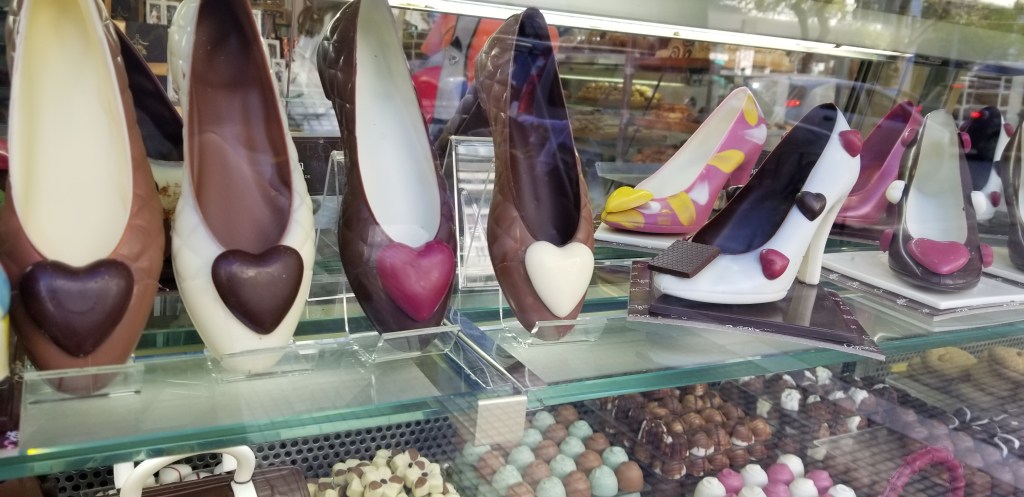
Chocolate high heels, anyone?
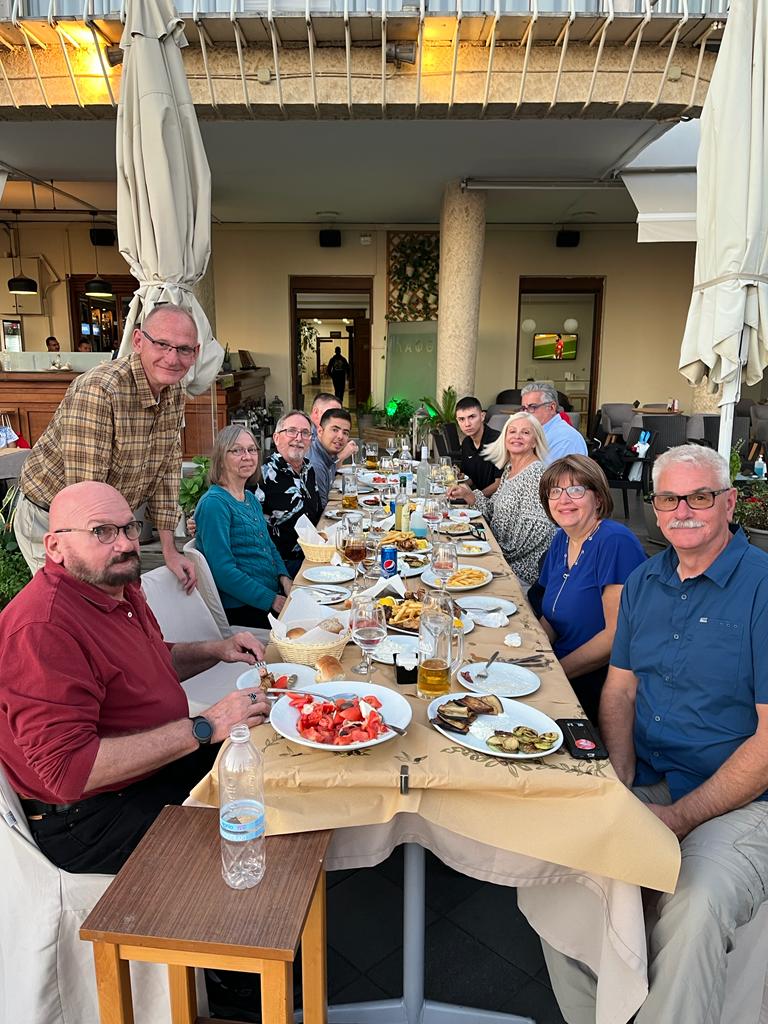
There was one other person to meet besides the Americans: Lefteris Dimopoulos, who had been in the Greek Air Force and had been part of the support for their detachment. He and Tom had put our reunion dinner together, which was at the Greek Officer’s Club. It was a feast of Greek salad, grilled aubergine, squash, and other vegetables, platters of Greek hamburger, souvlaki pork, chicken, pork strips, and french fries, with tzatziki sauce. The food kept coming, the conversations flowed, and we had a great view of the White Tower and sunset on the Aegean. It was spectacular.
Credit for these two pictures goes to Tom.
Left to right: Mark, Billy, Tom, Cal, and Milan
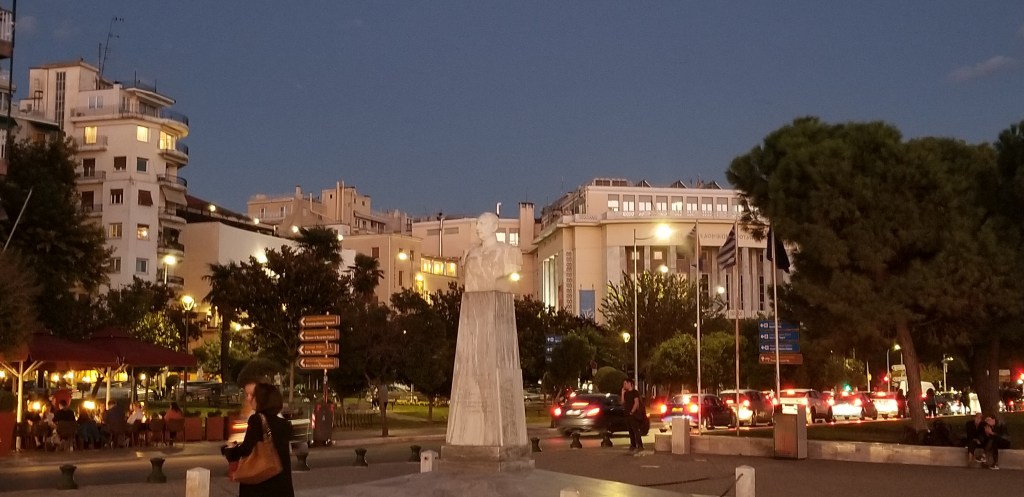
At night, Thessaloniki comes alive. The Greek Officer’s Club is behind the flags and is where we had our dinner.
The next evening our entire group visited a local seafood restaurant. It was Saturday night and the town was humming. We were there for several hours and for that entire time, every seat was packed in the restaurant inside and on the huge patio outside. The streets were crowded with pedestrians and traffic was down to a crawl. Party time in the city!
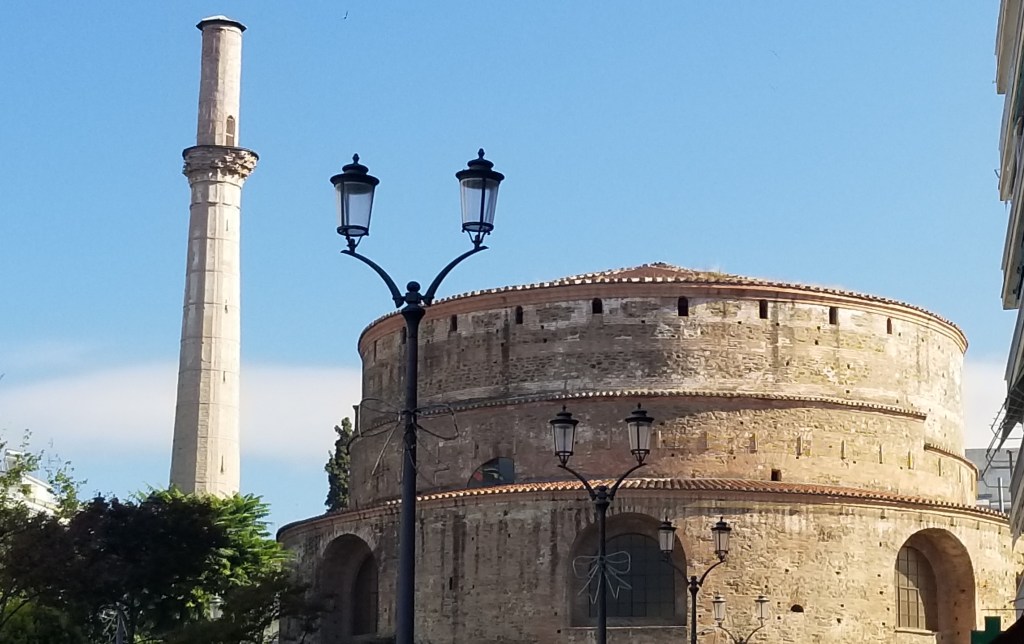
We did get to do some other sightseeing in Thessaloniki. This is the Rotunda:
For the Romans who built this Rotunda, the building’s purpose was a place for worshipping their deities. It can be compared to the Pantheon in Rome. Later, it became a Greek Orthodox church, and then a mosque when the Ottomans came to power in the 1500’s. That is why the minaret still stands to the left of the Rotunda. When Greece regained power it reverted back to Greek Orthodox.
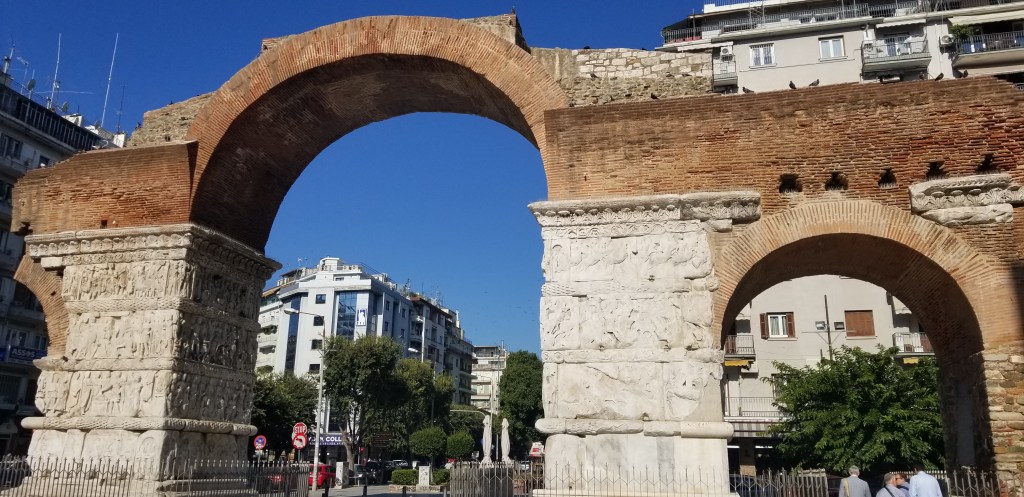
There is the ruins of a Roman gate:
What I came to love about Thessaloniki, and all of Greece, is that you can walk anywhere and see ancient ruins. If any kind of building is to be built, a team of archaeologists have to investigate the site and see what’s in the ground first.
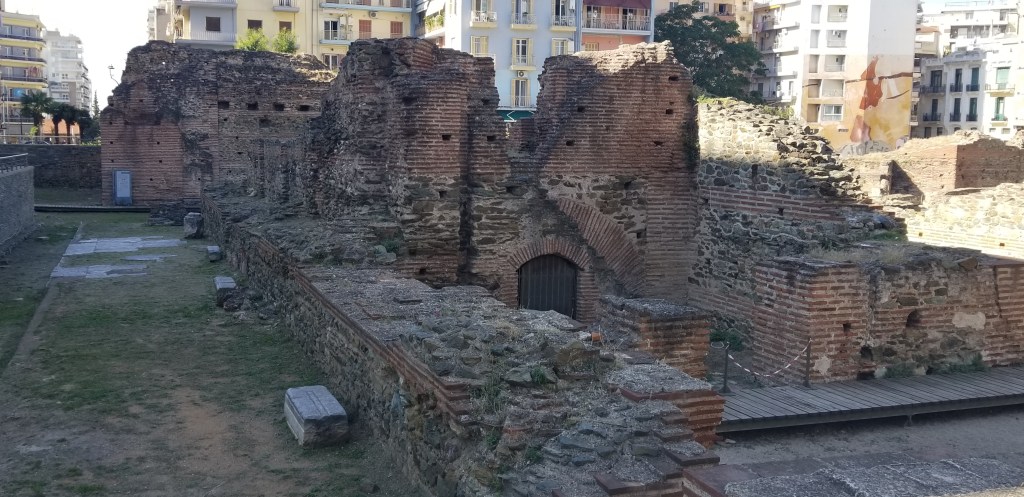
So, we were just walking down the street, and we came to a whole complex just below street level. It was once the magnificent home of Caesar Galerius and his court whenever he was in town. There are ruins of a basilica (an audience room), which still partly lies under the street. Additionally, we saw ruins of the Roman baths, and other buildings that made up part of the palace.
I also visited two museums: the Archaeological Museum of Thessaloniki, and the Museum of Byzantine Culture.
In the archaeological museum, antiquities abounded. This is the deed to a house, dated to 350 BC.
The Byzantine museum moved forward in time. This mosaic dates to about the 5th century AD.
I was glad I went to these museums, because they clarified for me what was happening historically in Greece through the centuries. There was the early Macedonian kingdom which was replaced by the Romans. The Roman era went into the Byzantine era, and then Greece was conquered by the Ottomans in the 15th century. Their rule lasted until 1912. This is simplified, but it greatly helped to explain everything I was about to see in the coming weeks.
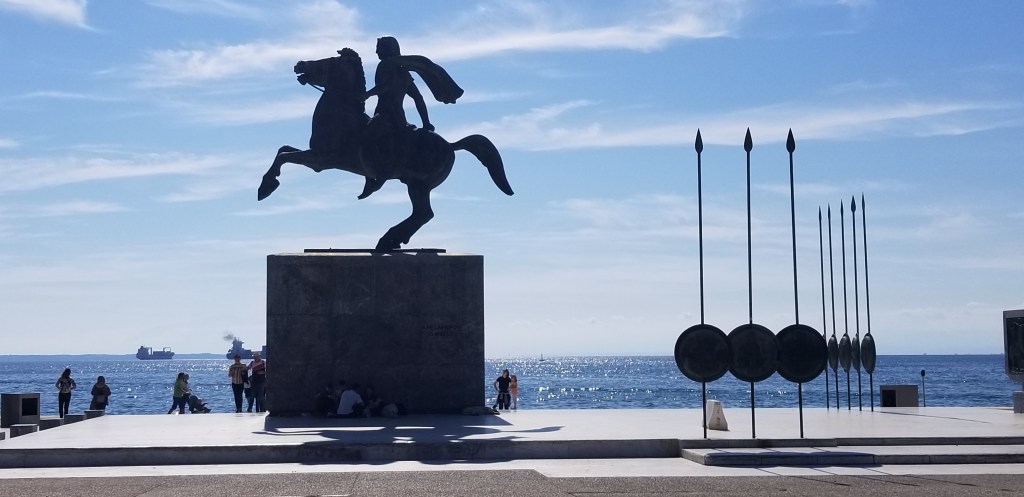
A statue of Alexander the Great looks out to sea on the shores of the Aegean:
Beginning with Italy, our trip began to look like Eat, Pray, Love with an emphasis on “eat”. In Thessaloniki it went full throttle. Every time we were out with the group, there were plates upon plates of food because everyone wanted to try some remembered dish. Out on the street, there are souvlaki stands, and Milan found a good one for us for the times in between when we might be just a little hungry. The smells coming out of the souvlaki stands are incredible.
This is the first meal we had when we came to Thessaloniki, on the patio of a restaurant by the sea:
Over the years, Cal has told me many times about having feta cheese that had been thrown in a wood-fired oven until it was soft, warm, and delectably tasty. Mark shared this memory with him, and they ordered the warm feta appetizer in a couple of restaurants until – Bingo! – one restaurant got the taste exactly right.
I’ve left off a big part of this reunion. On the day after our grand dinner at the Officer’s Club, we traveled to the detachment where the guys had been stationed. It turned out to be more than just a quick view. That’s for next time!
Next time: A Trip to Giannitsa, and Everything Along The Road
Before leaving home and also in the earlier parts of our trip, I wondered if we would be tired of spending so many days in Venice. It might be nice to have a little side trip over to the mainland, maybe. Padua looked interesting. It is about thirty miles inland, has frequent trains from Venice, and the train ride is only about a half hour long.
As it happened, on our train ride from Munich to Bolzano, I conversed with a woman from Berlin across the aisle from me. She was traveling solo to Padua on her “holiday” (that’s what Europeans call a vacation). She’d been to Padua a couple of times earlier as part of other trips, but this time she wanted to spend her whole vacation there. Hearing my interest in Padua, she told me about many wonderful things that one could see, most of which I’ve forgotten now. “I’m not going to do it this time,” she mused, “but I always thought that I would like to take the boat from Venice to Padua.”
What? It’s possible to ride a boat to Padua?
It is, and after some investigation, I booked us on the tour that goes across the lagoon and down the Brenta River from Venice to Padua. Traveling involves a certain amount of serendipity, plus keeping one’s ear to the ground.
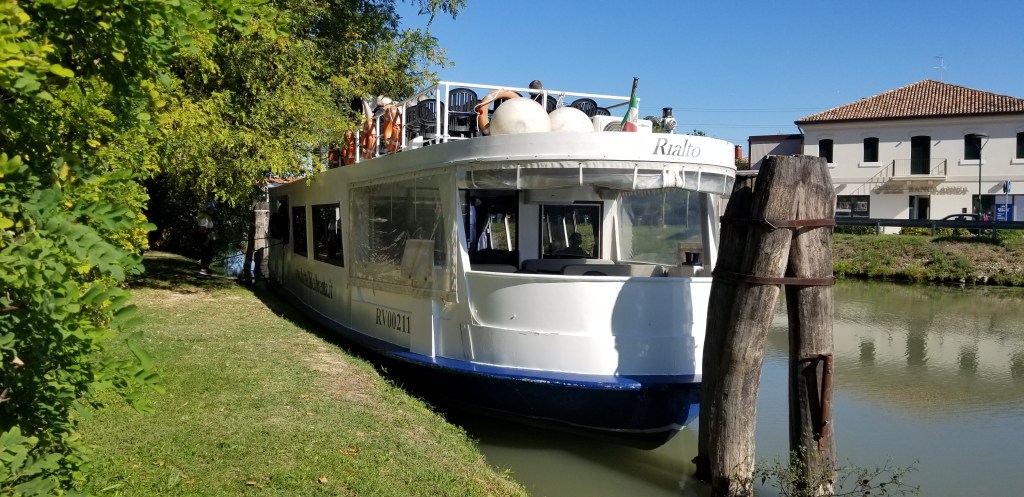
So it was that early on a sunny morning, we boarded “Il Burchiello” at the harbor near St. Mark’s Square and found great seats at the top. Some passengers brought suitcases. Our group spoke English, Italian, and French, and our guide gave us information in all three languages all day long. She began by giving us a rundown of what we were seeing as we left Venice. It was interesting to see the city from a different vantage point.
We rode out into the open lagoon and soon entered the mouth of the Brenta River.
In the 1500’s, the Venetians turned part of the river into a canal. We passed through the first of six locks. This one was still purely Venetian made, constructed in that era.
From the 1500’s to the late 1700’s, this canal was extensively used by the wealthy of Venice – the ones that had their names written in the Coffer room back at the Doges Palace. It was hot in the summertime in the city and the idea of air conditioning had not yet entered anyone’s mind. They would spend their summers in their villas along the Brenta Canal. It was considered a “fashion canal” because they would promenade along the pathways visiting each other and trying to outdo each other with their style of dress, the construction and decor of their villas, and the sumptuous parties that they hosted.
The nobility arrived at their summer homes with all of their wardrobes, all of their servants, and even some of their furniture.
This was our boat for the day. Back in the Renaissance era, the boats were called “burchielli”. They were powered by oars through the lagoon. Along the Brenta Riviera, they were drawn by horses. So, a trip out to the villa was slow. The ladies and noblemen were entertained by adventurers, actors and artists.
Going through the locks, it always took quite a bit of time for our lock to drain or fill in order to pass to the next level. In this picture, we are ready to go, and the doors are opening.
There were also nine bridges that swung sideways for us. We had first seen one in Scotland, but this time we were the ones on the river.
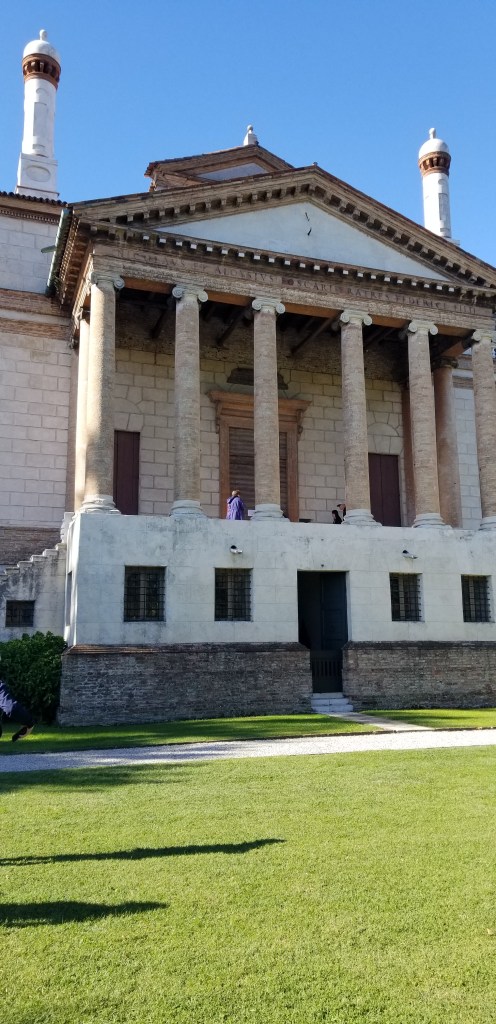
Our first stop was at Villa Foscari, in the town of Malcontenta, built between 1558 and 1560 by the renowned Renaissance architect by the name of Andrea Palladio. More recently it fell into ruin, and then was restored.
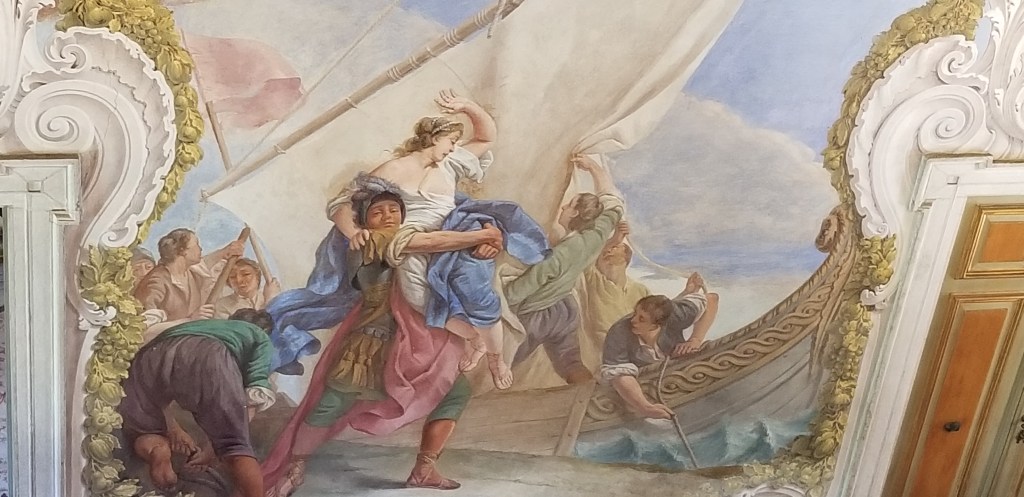
The villa was originally owned by the Foscari family, and changed hands over the years. Today, it is owned by a descendant of that original family. An architect would tell you it that it is built with a Roman temple facade, and stands on a pedestal. Inside, gorgeous frescos cover the walls and ceiling with scenes from mythology. The second floor has a balcony all around, so that one can look directly down to the first floor.
“Villa Malcontenta” is the nickname of this villa, which means “the discontented one”. A Foscari family member was confined in the home and its surrounding park for several years of her life for licentious behaviour. The confusing thing is that the town bears the same name but for a different reason: the area was marshy and the river was prone to flooding as far back as the Middle Ages, which brought disease and pestilence. The villagers may have been a little malcontented. Pretty dreary names for such a beautiful place!
Since the villa is still in the family, no pictures are allowed inside. I purchased these postcards, which shows “La Malcontenta” and the inside of the villa.
We had time to walk around the grounds before getting back on the boat. We didn’t have too much further to go before we docked at the restaurant that was our lunch stop.
The lunch on this trip had received mixed reviews. For the 22 Euro cost, some folks thought it was a better idea to walk into town and find a pizza place or just sightsee. We decided to go with the flow. The meal is called “The Casanova Fish Menu”. We received, in several courses: salad, smoked fish with a piece of toast (more fish than I could eat), fried shrimp, calamari, and baby octopus with a rectangle of polenta, rolls, and a bowl of fruit with ice cream. It was all delicious. The lunch was a bit salty and there was a lot of food, so we downed our water and almost finished the wine.
Of course, all that food and wine had a somnolent effect on Cal: he was snoozing down the river for quite awhile. It was hot and sunny on top of the boat so he moved down to a shadier spot, and he was not the only one. I had been glued to my seat because I didn’t want to miss anything, but now I went exploring the boat for a bit. We’d heard the guide talking about our disembarkation in Padua, making it seem like we wouldn’t be getting back on. What was that about? Were we not riding the boat back to Venice? Was there a bus to take us back? I found a brochure in the bar area to read later.
Meanwhile, I enjoyed the passing landscape along the way: villages, homes and churches, and people waiting for us to pass though bridges. I wondered who this pensive fellow might be:
You can’t see the word “Transit” before the above quote, but it means “Shadow passes, light remains” in Latin. That might have been something for “La Malcontenta” to think about.
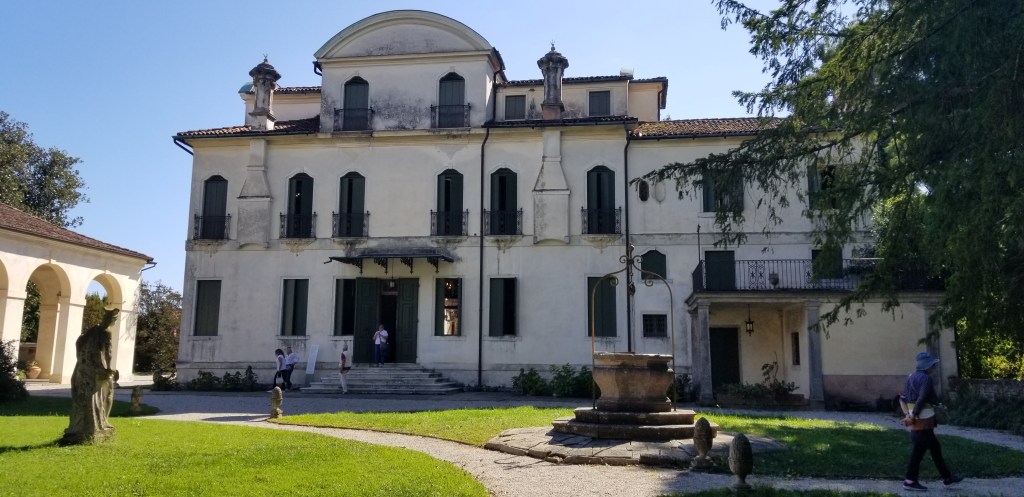
We stopped at another villa, called Villa Weidmann. It was built later than Villa Foscari, in 1719, and was remodeled in the latter part of that century. Like Villa Foscari, everything is built around a square central hall with a balcony on the upper floor, Murano glass chandeliers, and those breathtaking frescoes. Unlike Villa Foscari, we could take pictures here.
Outside, we could see a view of the villa from the back:
The fountain is just like those that still exist in Venice and would have been their water supply.
There are many statues in the beautiful garden.
There were once over forty villas lining the Brenta. The lifestyle came crashing down when Napoleon invaded in 1797. Peasants revolted, many villas were burned, and land taken over for farming. Other villas were used for animal, implement, and feed storage. I can imagine that this felt pretty good to the local farmers after seeing the upper class flaunt their wealth for two centuries.
Many villas still can be seen along the river, in different states of splendor or disrepair.
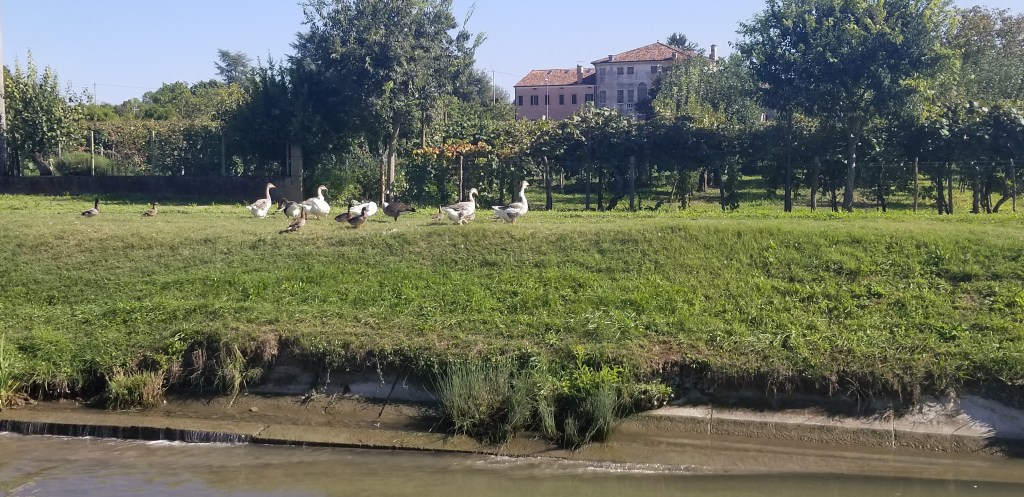
Some peeked out from behind woods or vineyards.
Some were on their last legs.
After Villa Widmann, I read the brochure I had picked up earlier, and went over to talk to our guide. She confirmed that yes, indeed, this was a one-way trip to Padua. Ah, that’s why so many people had suitcases. As it was taking us all day to get to Padua, the boat wouldn’t have gotten us back to Venice until the middle of the night. I don’t know how I had missed this little fact when I booked. But, in my defense, every single tour we’d taken thus far returned us to where we started! No worries though: we could take a train back to Venice.
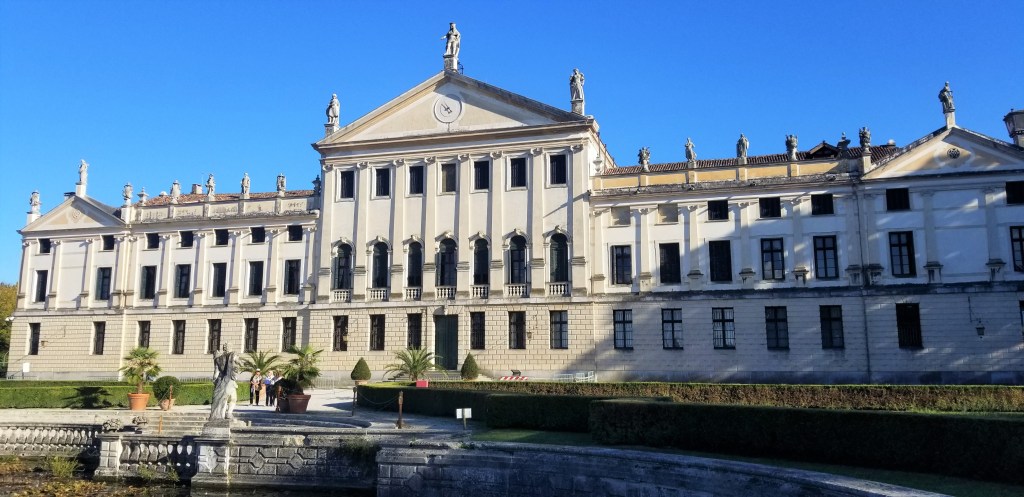
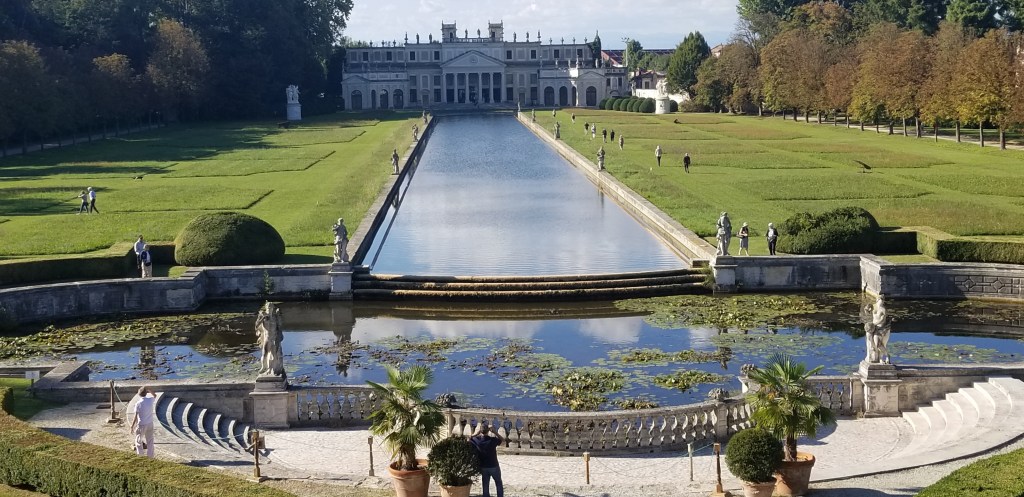
The last villa was jaw-dropping. Nothing I read could have prepared me for it. It may be called Villa Pisani, but it looked like a palace. It is considered to be the queen of all the Italian villas.
Looking out from the “villa”, the stables almost matched its size.
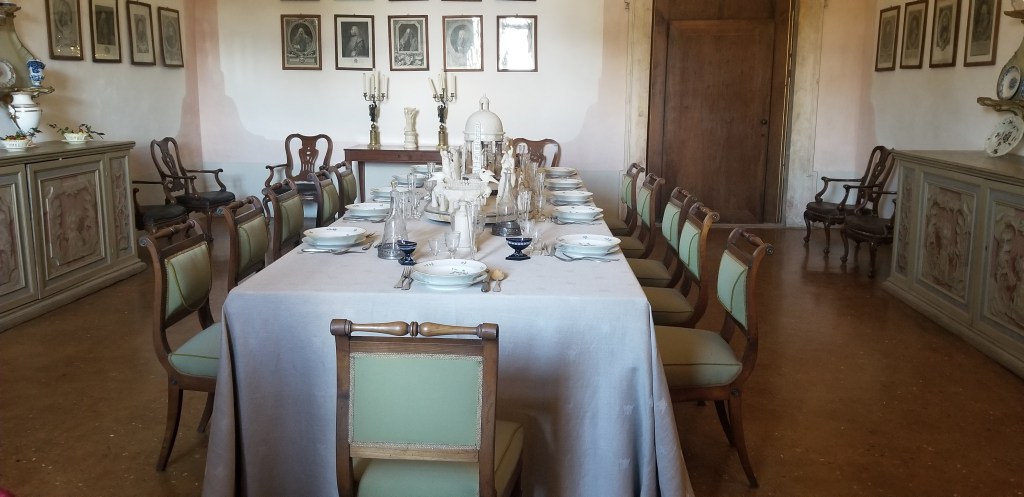
As you may imagine, this villa belonged to a doge: the 114th doge of Venice, actually, by the name of Alvise Pisani. It was purchased by Napoleon in 1807, and in 1814 fell into the ownership of European aristocracy. Finally, in 1882, it became part of the Italian state. There are over a hundred rooms. Doges, kings and emperors were welcomed here, and it is now a national museum. Most rooms have no furniture, but the dining room was set for dinner:
Pictures of past doges lined the walls
The frescoes here are masterpieces by a renowned artist by the name of Tiepolo.
I enjoyed the many paintings and frescoes providing glimpses of what life looked like in those days.
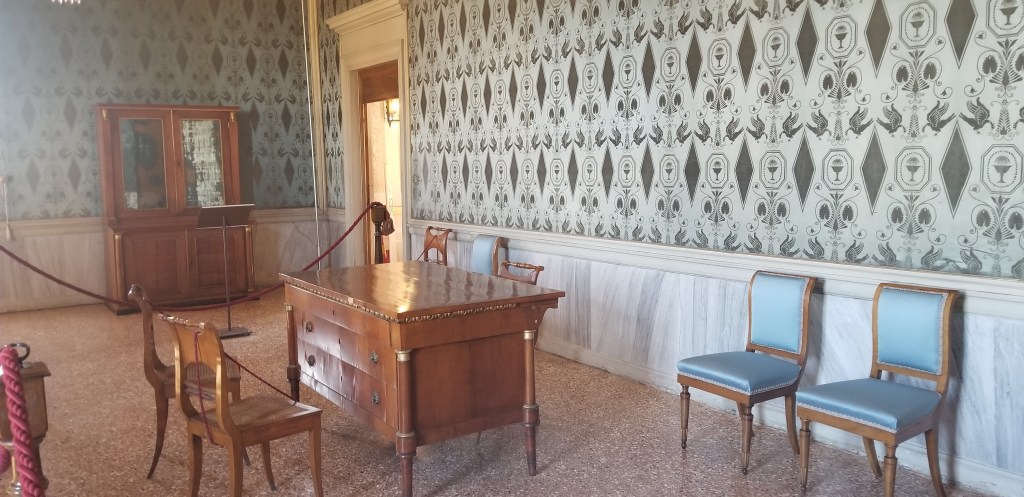
In this room, Mussolini and Hitler met for the first time.
Back onboard, we enjoyed the last idyllic miles of river.
The sun was setting when we came to the outskirts of Padua.
In the end, all I saw of Padua was the river, a part of an old wall, and a pretty bridge where we got off the boat.
It was a mile to the train station in the gathering darkness and we could have opted for a taxi, but it felt good to stretch our legs for the walk after being on the boat all day. A train was waiting for us, the cost was covered by our Eurailpass, and we were back in Venice in no time.
This concludes our Italian travels. We had one more country to visit, and we were both eagerly anticipating this last leg of the trip. Where did we go? Well, all I’ll say about that for now is that we attended a reunion, visited a beautiful city on the sea, and we had to fly there.
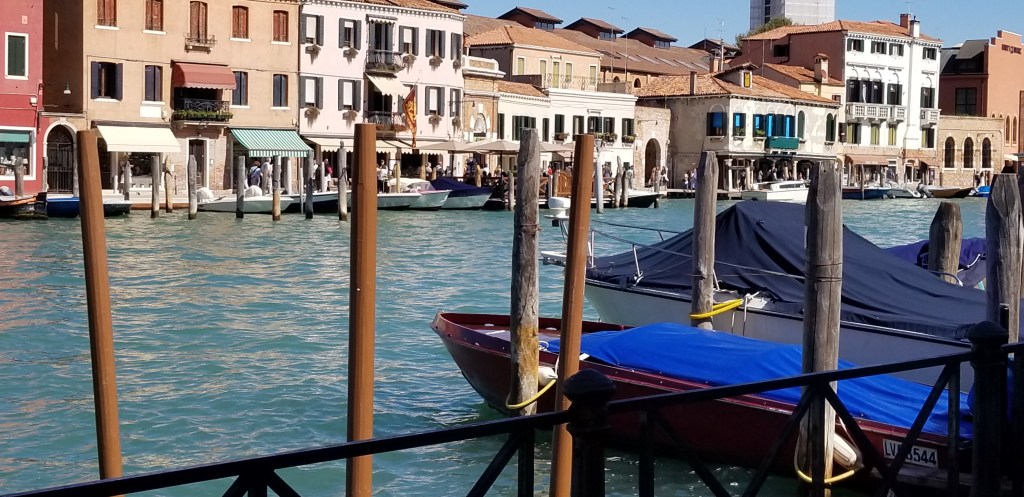
This picture may look like it was taken in Venice, but it is actually on the little island of Murano.
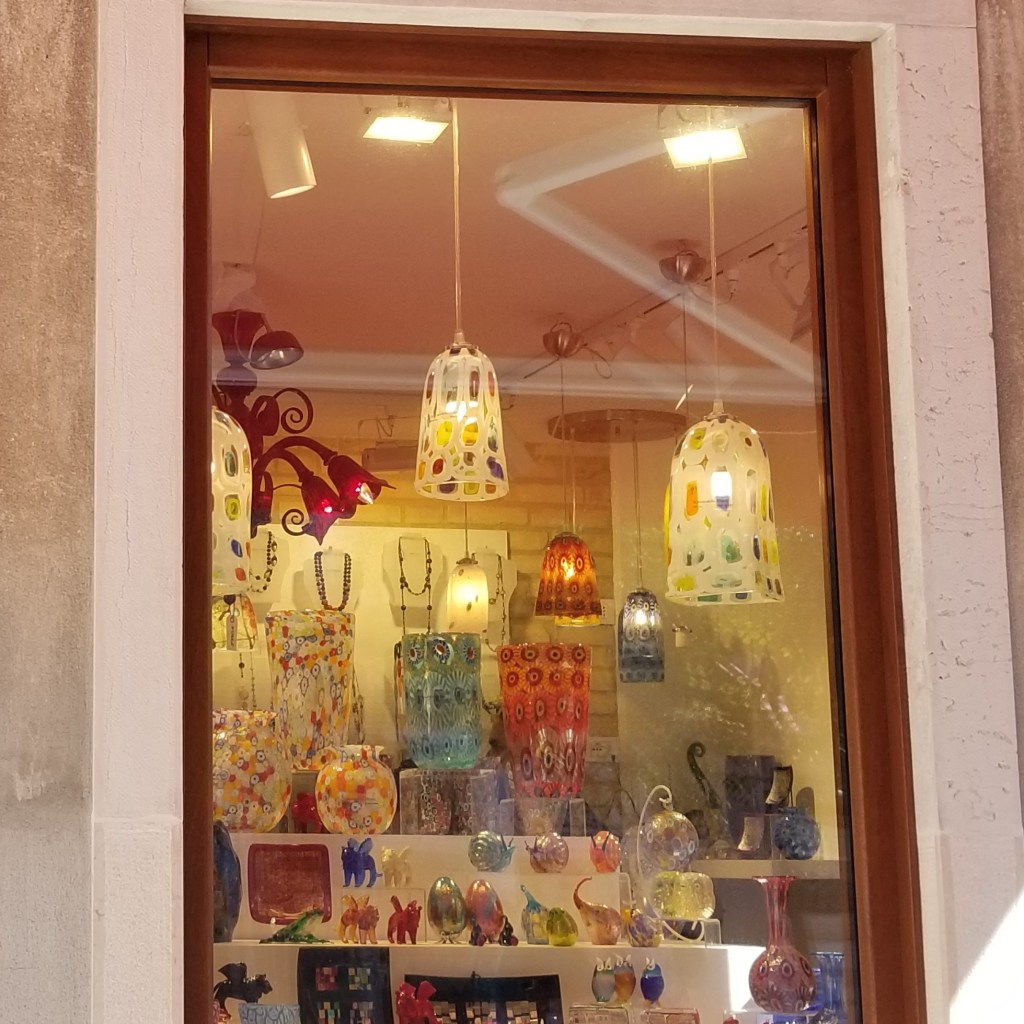
Many shops in Venice sell Murano glass, and it is interesting to look in the windows at them. All of the glassblowers that make this famous glass are located on this island, and early on the Sunday of our visit we went to visit them.
We walked to the Fondamenta Nova vaporetto station to catch the Number 12 Vaporetto (city water bus) line to Murano. It was only a short ten minute ride. We were a little early for the glass blowers to be open, so we had a small refreshment in a sidewalk cafe.
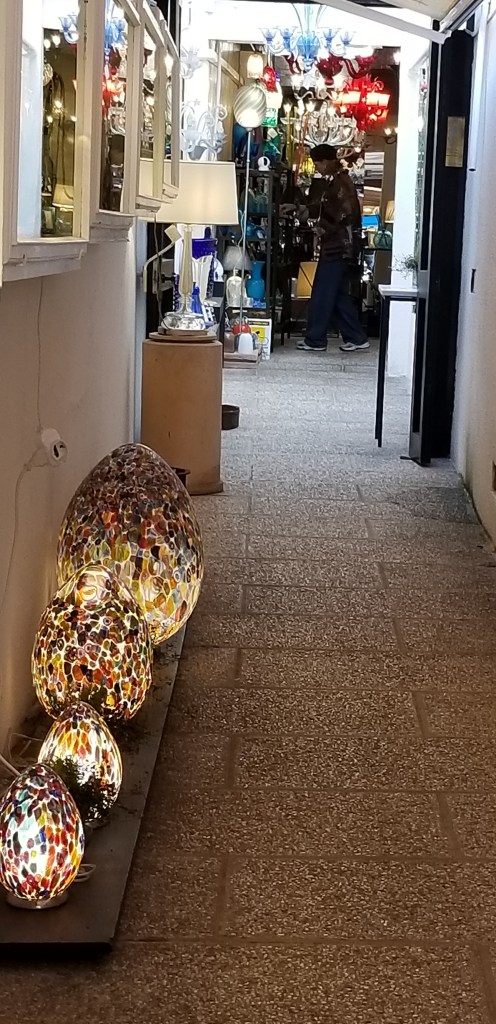
Visiting the glassblowers of Murano is more a window shopping trip than it is a look at the craftspeople in their workshops. I did peek into a few, but on a Sunday they are not working. For sure, the shops are open, and there is plenty of beautiful glass to see and little shops to peek into.
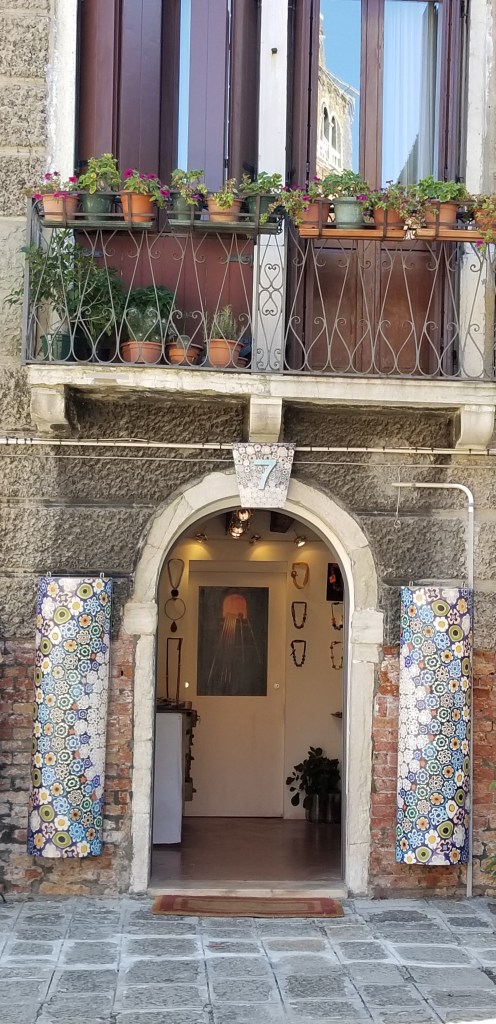
Some shops specialize only in jewelry. This one has a beautiful facade.
Of course, I couldn’t buy hardly any of this. It would be in shards traveling around Europe in my suitcase. I did purchase a couple of necklaces with glass pendants for gifts, though.
The reason that all the glass makers in Venice are here on this island goes back to the 13th century. The story goes that they were moved to the island to avoid the risk of fire to wooden structures in the already over-populated city. In reality, the motive was to isolate the craftsmen so that they wouldn’t disclose trade secrets. Venetian glass was already of the finest quality.
We had gotten off the boat in a quieter part of the island where many of the glassmakers are. By the time we worked our way to the main area, things were already hopping. Murano has canals just like Venice does because it is actually seven small islands connected with bridges and a Grand Canal.
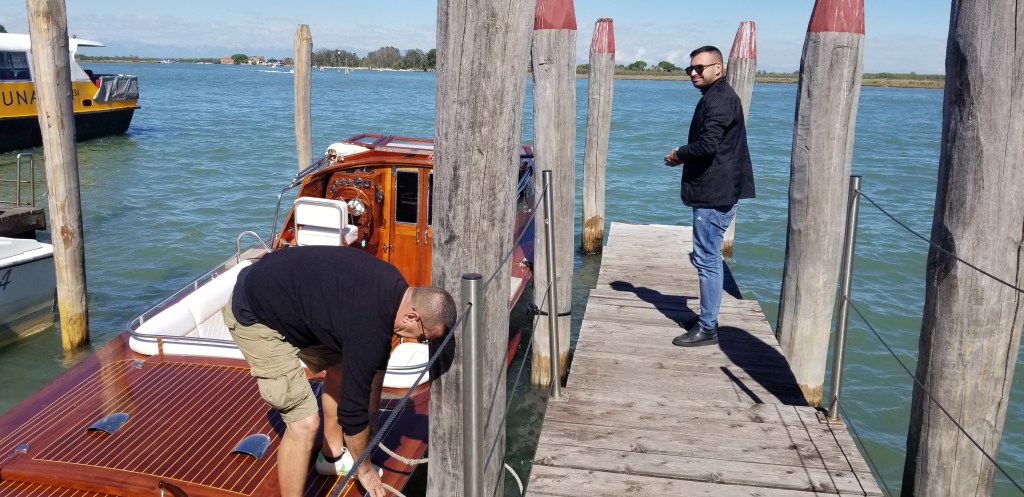
We made our way back to the vaporetto stop for a ride to Burano, only to discover we were at the end of a very long line waiting in the hot sun for the next one. Would we even be able to get on it when it arrived? As we were pondering this question, we noticed a gentleman working the line. He and his partner offered a ride for 10 Euros per person to ride in his speedboat to the island.
Circumstances sometimes call for quick thinking and a large helping of trust in our fellow man. The price was right. We took the deal and we were not the only ones; the two enterprising gentlemen soon filled up every seat in their little boat with other takers.
We zipped across the lagoon and found ourselves docking in Burano in half the time it would have taken us to ride the vaporetto. Besides that, it was fun!
Burano is a smaller island than Murano. It is traditionally known for its hand-made lace and its colorful houses. Leonardo da Vinci visited here, purchased an altar cloth, and the lace began to be exported all over Europe. Today, tourism has supplanted the lace-making industry. Lace is expensive and time consuming to make. I only remember seeing one or two shops and didn’t take pictures. I read later that most of what is sold now is machine-made.
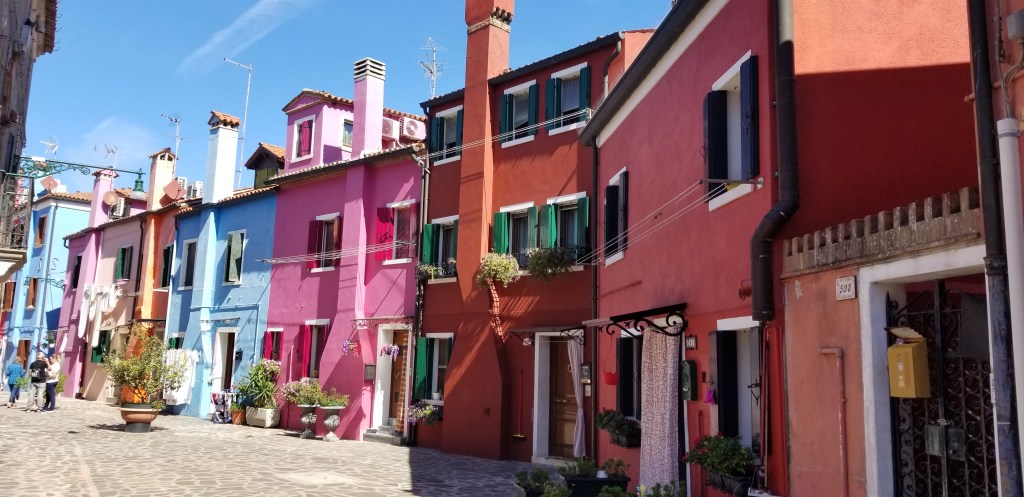
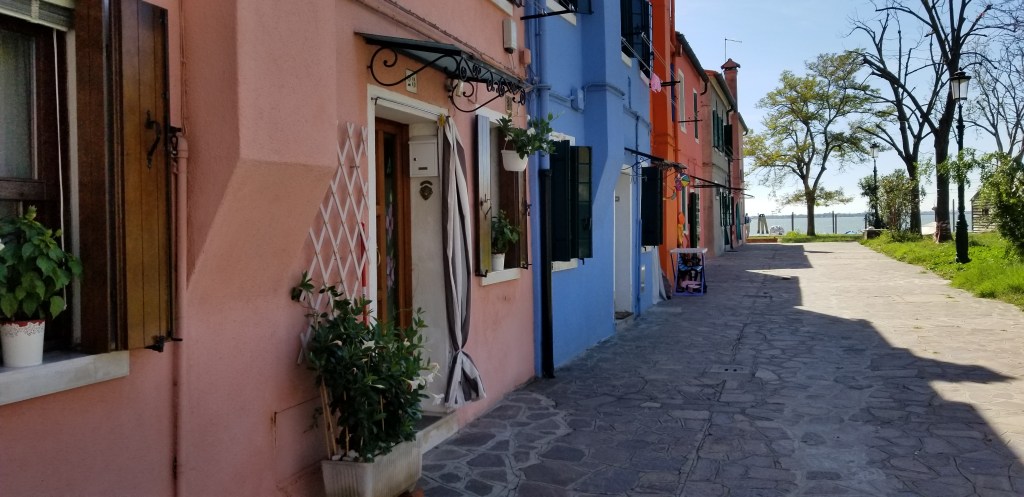
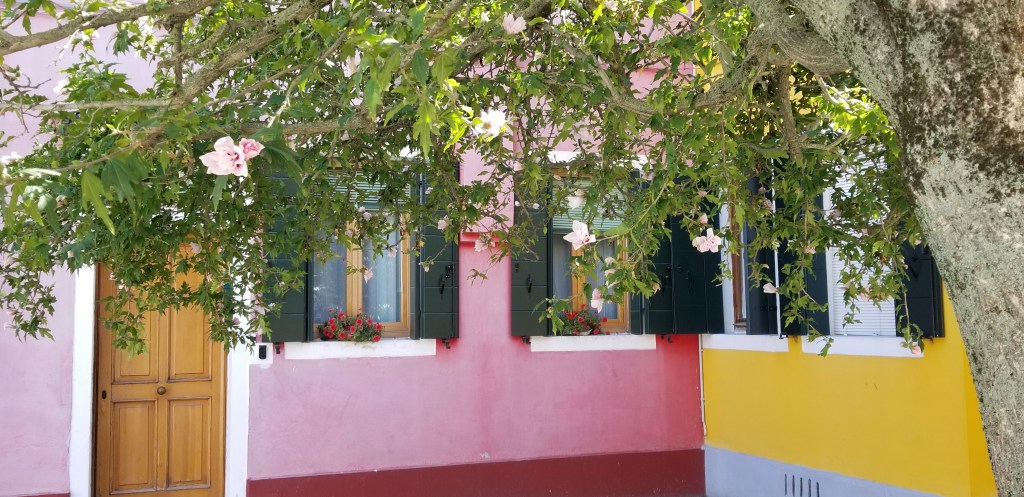
No matter, I was mesmerized by these colorful and picturesque little streets and homes.
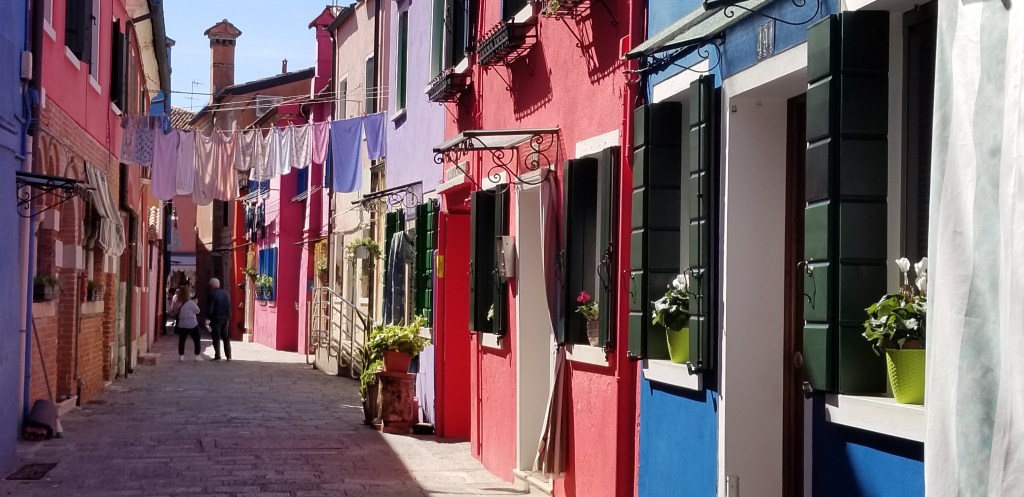
What is it about hanging laundry that makes everyone want to take a picture? Me included.
Traditionally, the houses were painted different colors so that fishermen returning home could easily see their own house while still out at sea. Today, the color of a house is regulated by the government; only certain colors are allowed for each particular lot.
I thought it was interesting to take a look at all the fishing gear in this small boat.
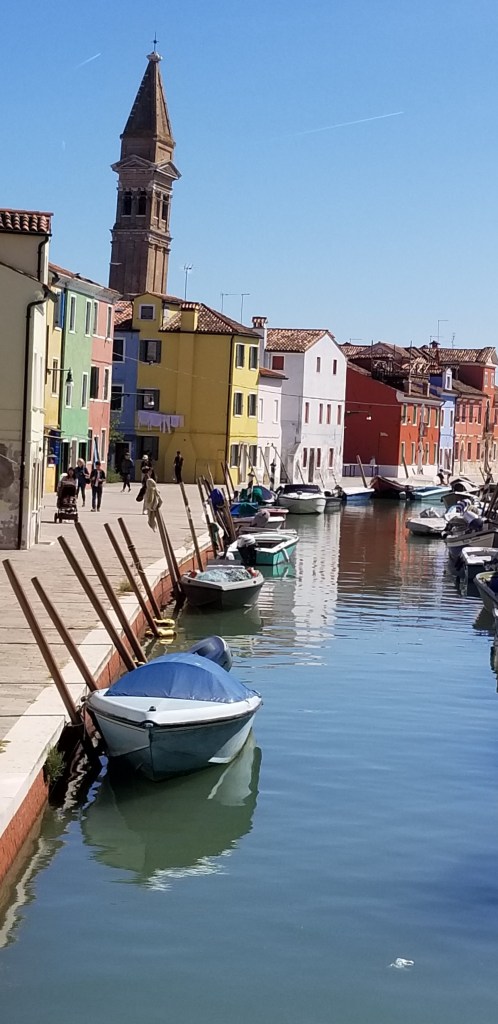
Murano may be tiny, but it still has its share of canals, plus a church with a leaning campanile.
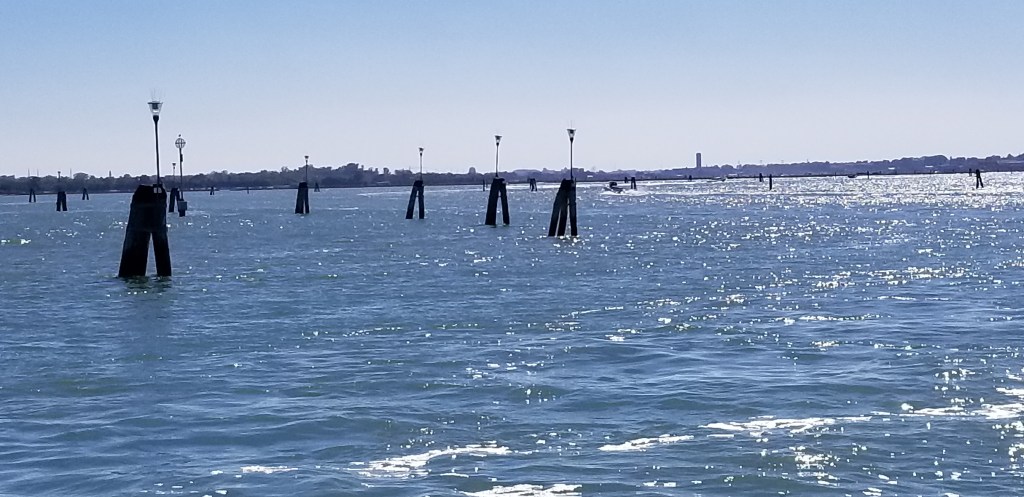
This time, upon leaving Murano, we took the vaporetto. It was not crowded. Since we were now further out from Venice, the ride was longer, and I had time to observe the “highway” in the lagoon. Posts help to keep everyone in their lane and prevent head-on collisions.
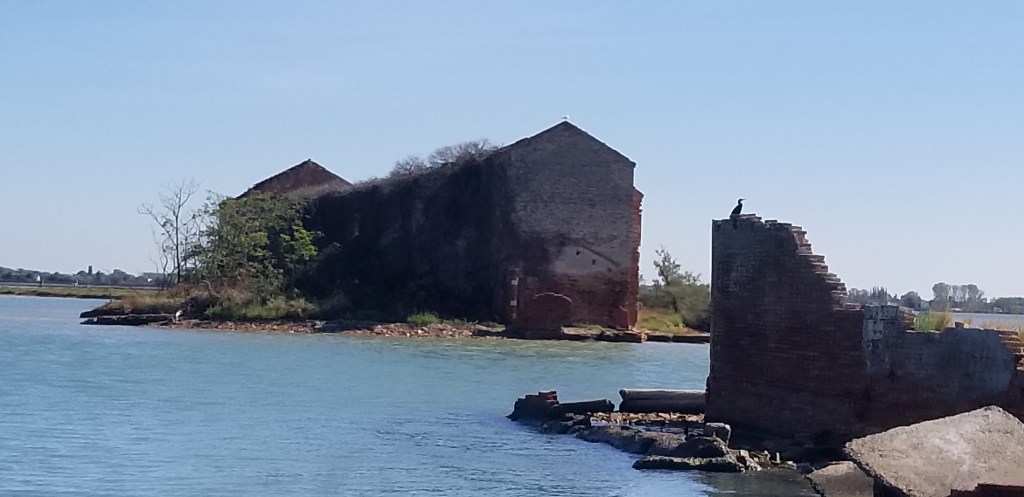
There are many things to be seen along the way, such as ancient buildings long abandoned:
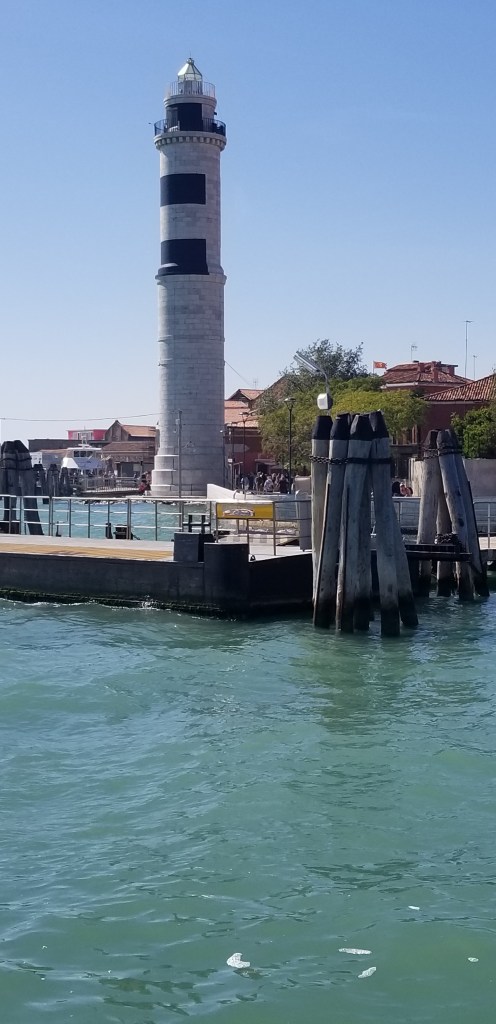
and a lighthouse at one of the vaporetto stops.
It had been a lovely, relaxing time on the islands of Burano and Murano, and just getting there and back was half the fun.
Besides the enjoyable walks all over Venice, I wanted to get inside some of her buildings. I had picked up a pocket guidebook of Venice for this purpose somewhere on our travels, and knew where I wanted to start: the Scuola Grande San Rocco.
The monumental building is described as a “confraternity”, established in 1478, for a group of wealthy Venetians. It is next to the church of San Rocco which holds the remains of this saint, who was believed to be a protector against the plague. Basically, it’s their meeting place. There are two levels.
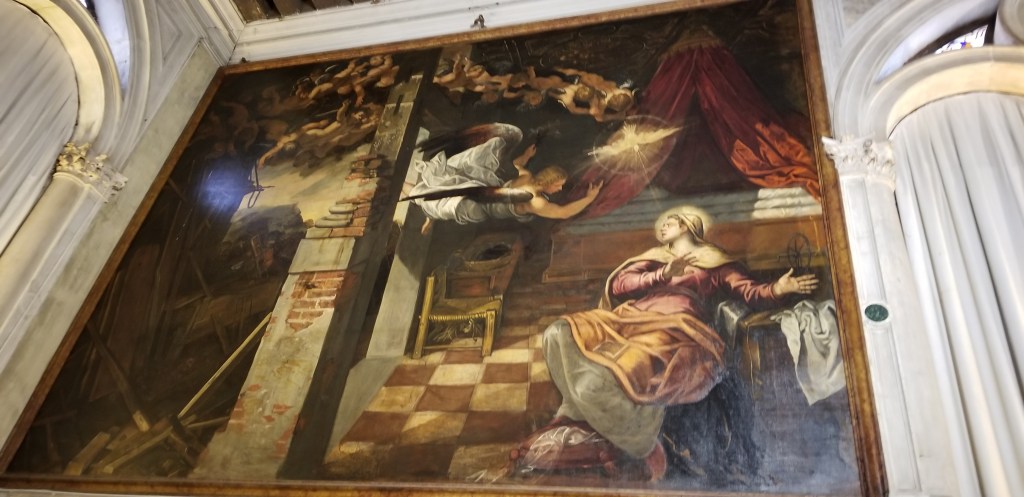
The other piece to this story is that the group commissioned a Venetian painter named Tintoretto, one of the leading painters in the era. He produced his finest work here over 23 years in the late 1500’s. There are paintings dedicated to the life of Mary, and, on the ceiling, scenes from the old Testament. Basically: huge, massive paintings everywhere. On the first floor, there are also paintings by an acclaimed artist named Titian.
Tintoretto’s painting of the angel’s appearance to Mary as she is doing her sewing
Mary’s ascension, also Tintoretto: I love how the little cupid is pulling on her foot, or giving her a push upwards.
As we climbed the stairs to the second level, the Old Testament scenes with swooping angels were over our heads. As Tintoretto painted, the plague was sweeping through Venice, and the paintings were meant to give solace and comfort. Tintoretto’s paintings on this floor were of crucifixion, resurrection and hope.
But it was the wood statues on the second level that really fascinated me. These were made by a sculptor named Francesco Pianta in the mid-1600’s. Each one is different and an allegory to such things as Melancholy, Honor, Spy, Science, Ignorance, and so on, as well as five shelves of a library carved all in wood. I didn’t know any of this when I was looking at them. I just thought they were interesting.
I went a little crazy taking pictures of these and couldn’t decide which ones to include!
This organization still exists today and they are focused on charitable causes.
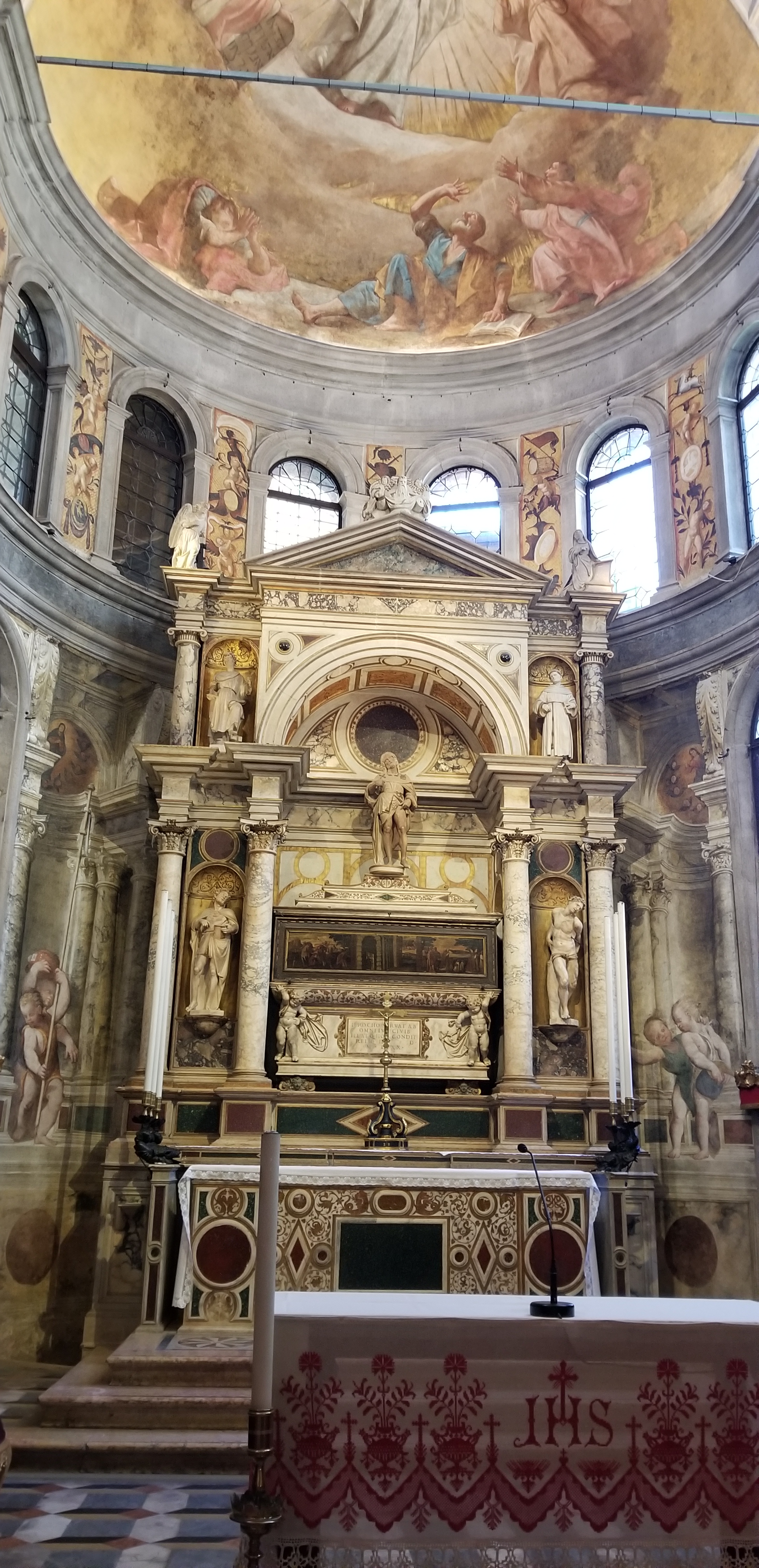
We went to cathedrals: the Church of San Rocco is next door to the Scuola and is its associated church, with more works by Tintoretto and other Renaissance artists. Tintoretto painted many scenes of the San Rocco’s life (St. Roch, in English). The saint helped heal people during the plague. We saw the Basilica of Santa Maria Gloriosa dei Frari. It is the largest church and the artist Titian is buried here. I walked into a couple more on other days. Cal was tired of cathedrals at this point and was content to sit outside in the shade and watch the people go by.
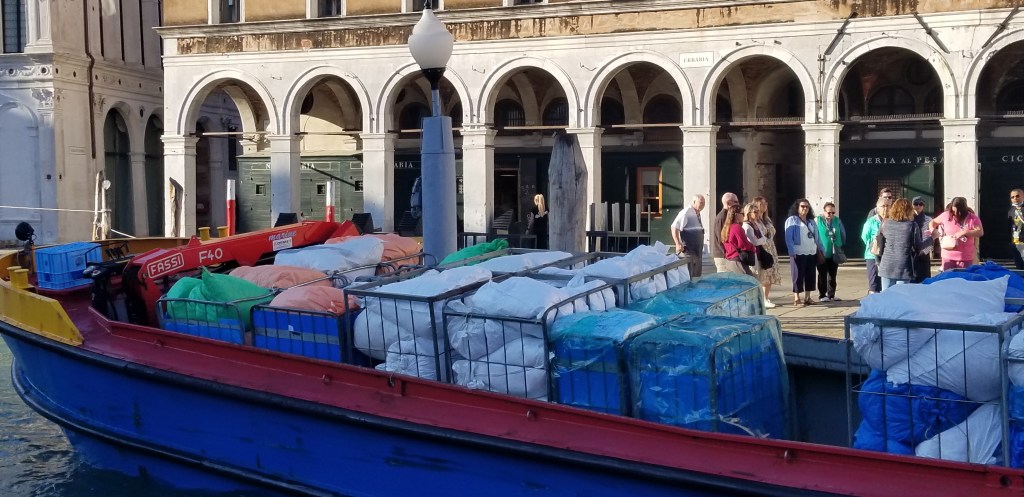
One of the most memorable gems of Venice, however, was our tour of the Doges Palace. I booked ahead for the “Secret Itineraries” tour because with this we were able to see some places not normally seen on just a walk-through of the palace. It’s not possible to purchase a timed ticket for the main rooms, so this enabled us to “skip the line” for that. Our tour began early in the morning, so on our way to the palace we saw everyone starting their day:
Hotel linens loaded on to a boat, and a walking tourgetting started
It was always fun to look in the shop windows along the way.
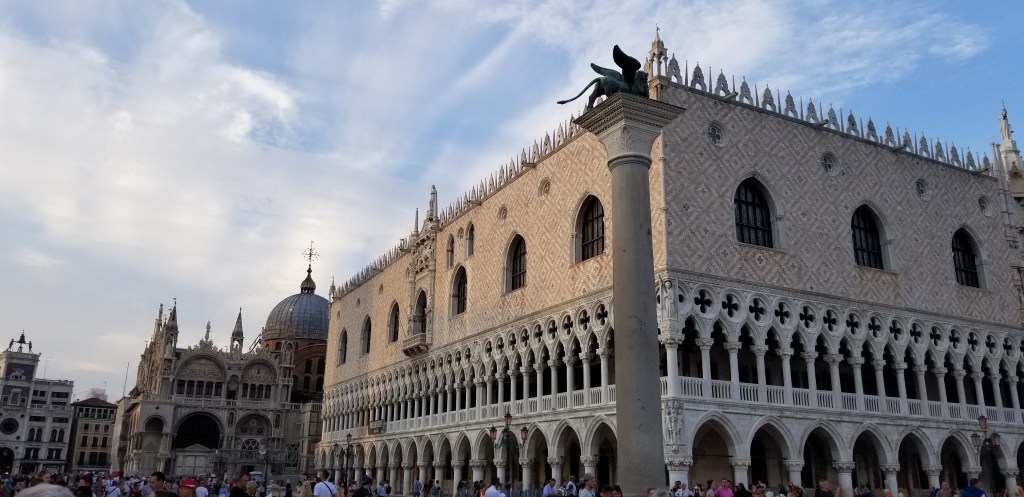
In this picture, the Doges Palace can be seen at the front right. On its left are St. Mark’s Cathedral and St. Mark’s Square.
The palace is the residence of the Doges of Venice, originally built in 1340. Of course, it has been enlarged and modified over the years. I looked this up out of curiosity: tradition holds that the first doge was Paolo Lucio Anafesto, who was elected in 697. I guess he and many subsequent doges had to do without a palace for several centuries. A doge was chosen from the ruling families of Venice and held his office for life. The last doge was Ludovico Manin, who lost his seat when Napoleon conquered northern Italy in 1797.
The Doge’s Palace held not only the apartments of the doge, but it was also the seat of government and had courtrooms and a jail. A doge’s position was largely in attending ceremonial events and receiving foreign dignitaries. He also presided over all meetings, but had no executive authority. Venice dominated trade in the Mediterranean between the 1200’s to the 1600’s, so the doge also commanded Venice’s vast military and naval fleet. A doge was not allowed to leave the palace.
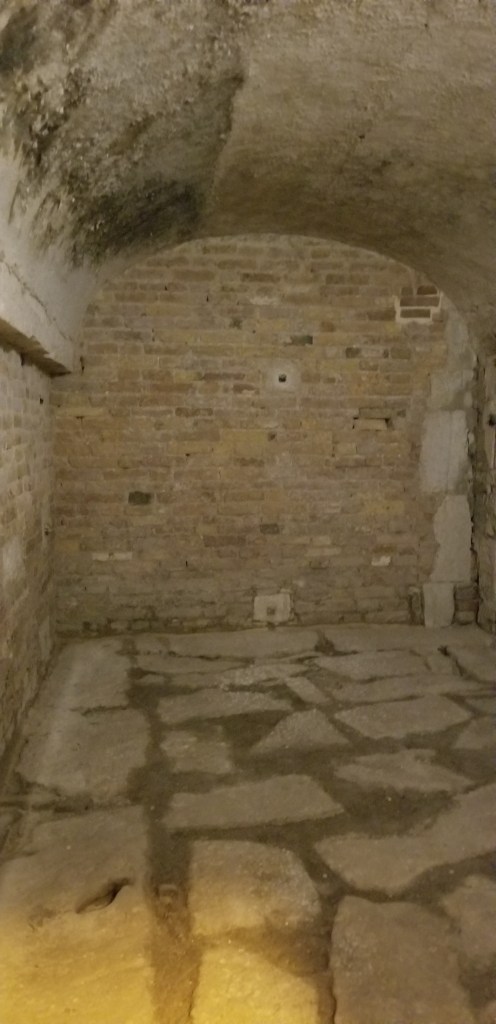
The first place we visited on the Secret Itineraries tour was the prison cells. Three to four prisoners would have been in one cell. A cell had no windows and was subject to canal flooding, which brought in vermin. Even in its day, it was considered to be the worst of the worst.
Up near the attic, there were another set of cells which were for the royal class. These prisoners got their own room and all the comforts of home except, of course, they were locked up. Casanova, the famous lover, was imprisoned here in the 1798 and is the only prisoner to have ever escaped. He went on to lead a long and interesting life, mixing with famous notables of his day, and even wrote a memoir. His room was here:
Looking out a window, we could see the steps in the courtyard in which Casanova made his hasty escape.
Venetian society was very secretive. Scribes would copy out city information and perform other administrative tasks. They could only work for one month so they wouldn’t learn too much.
There were other things to be seen on this tour, including the Council of Ten Secret Headquarters (one of the governing bodies of Venice), the Chancellery, where drawers of top-secret files by the spy network were kept, a torture chamber, and displays of medieval armament.
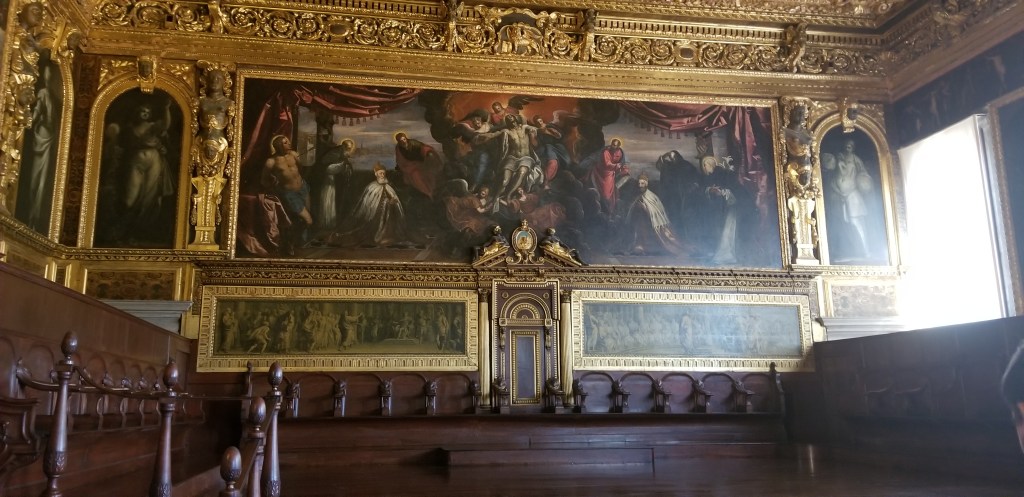
The Secret Itineraries tour was over; we entered the main palace, which looked vastly different from the chambers we had been in.
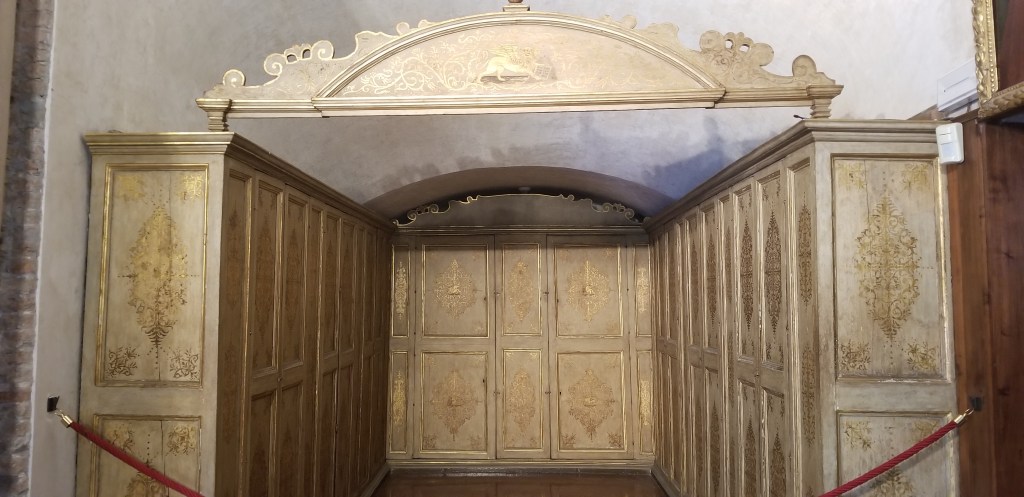
The main palace dealt with higher-level administrative tasks. This included keeping the names and records of who was considered to be part of the ruling class in the Coffer Room.
If your name wasn’t in here somewhere, you were definitely not part of the aristocracy.
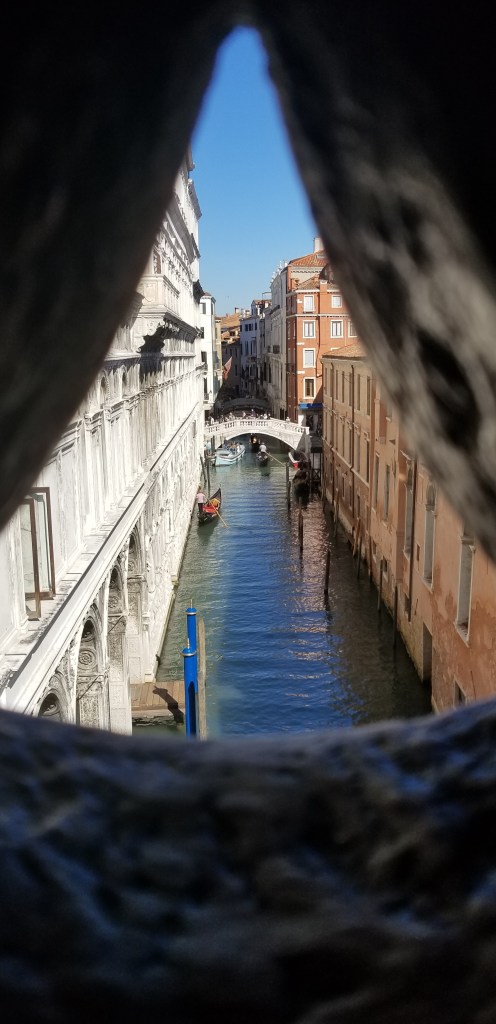
Part of the main tour is entrance to the “new” prison, which was built in the 1600’s. It was only a slight improvement over the old one. Going through to the new prison, we passed through the Bridge of Sighs. It is so named because prisoners heading to their cell would look out the window at their beloved city and know it was their last look for many years, if ever again.
This is the view of the Bridge of Sighs (and us) from the outside. We happened to be chatting with a family of other tourists here, and we all took each other’s pictures.
The new prison is on the left and the Doges palace, which includes the old prison, is on the right.
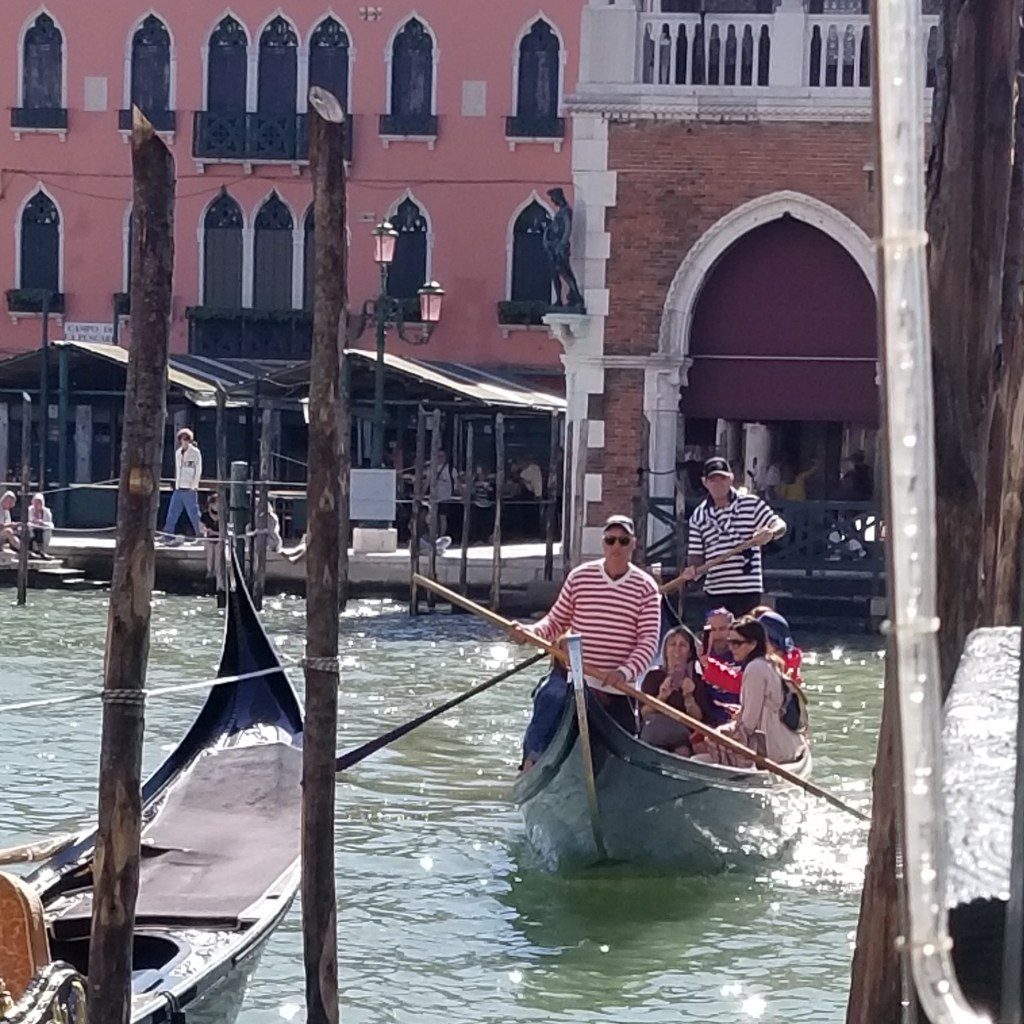
When we were in Venice for that one day years ago, we had one of those gondola rides that Venice is famous for. It was a cool evening and the gondolier had blankets for us. Behind our little flotilla of gondolas, a singer was in his own gondola singing traditional Venetian songs. People popped out of windows and waved. In short, it was a perfect, still-remembered experience, and I saw no need to even try to duplicate it. Many gondoliers today no longer wear the traditional costume and I never heard any music.
We are always happy at the end of the day to sit and relax. We discovered “Aperol Spritz” in Venice because that was what everyone was drinking. It is a light, refreshing drink which is alcoholic but I don’t ever feel the alcohol in it. On some days, that became our perfect drink for sitting in a little outdoor cafe to pass time before dinner.
One evening, we found a perfect spot for a Spritz while waiting for a pizza. It was on a small canal with gondolas occasionally going by. Hearing one of the gondoliers speaking English to his passengers, I asked him if he ever sings while he paddles. His reply? “No ma’m, you would not wish to hear me sing.”
Well, I guess that’s that.
Next time: visiting the little islands of Murano and Burano
Six days. That’s how long I wanted to stay in Venice. Despite its reputation for having entirely too many tourists.
We’d been here, once, long ago. It was a ten-day romp through Italy from Germany on a great big bus. I don’t remember if we received an orientation to the city, only that we had just one day in Venice. We roamed about on our own, probably had some spaghetti or pizza, and the day was over much too soon. It’s always been my wish to come back and have plenty of time to explore. Six days this time was perfect.
This is the sight that greeted us when we stepped out of the train station upon our arrival from Bolzano. The body of water is the Grand Canal, which is the main boulevard in a city that has no streets for motorized vehicles. No cars, buses, trucks, emergency vehicles, motorcycles or even bicycles are allowed here. So it follows that there are no traffic lights or horns blaring. Except for one day that we left the city, we were blessedly relieved from normal everyday traffic noise. Everything in Venice goes by boat or on foot.
From the train station, we navigated the labyrinthian streets of Venice carefully and with an eye on our Google map. To get to our AirBnb we needed to cross the great bridge over the Grand Canal, walk along the pathway on the other side, execute a series of turns down various pathways, and cross smaller bridges. We followed a nun shepherding some other folks from the train station, until we went our separate ways.
I juggled my suitcase and interrupted the GPS on my phone to take pictures as we walked.
I did not want to lodge in the San Marco area, which is crowded and is where most of the tourists are. Venice has several neighborhoods and our AirBnb was the farthest away from it in Santa Croce, an easy walk from the train station. We could look out to the piazza from a small bedroom window. It was always interesting to see what was going on out there. Sometimes the restaurant was bustling, sometimes not. We had a couple of good meals there, and if we were back by late evening, we would watch the servers unfurl the umbrellas, whisk the linens away, and push all the furniture back to the side of the building.
In Venice I heard the term “tourist river” for the first time. Of course Venice has lots of tourists, although by now we were in late September and it was not too terrible. Tourist rivers are areas where a lot of people walk in a crowded stream to see sights or to shop. At times there was a light tourist river on the back of our piazza, where the person in red is walking, because we were on a pathway to the train station.
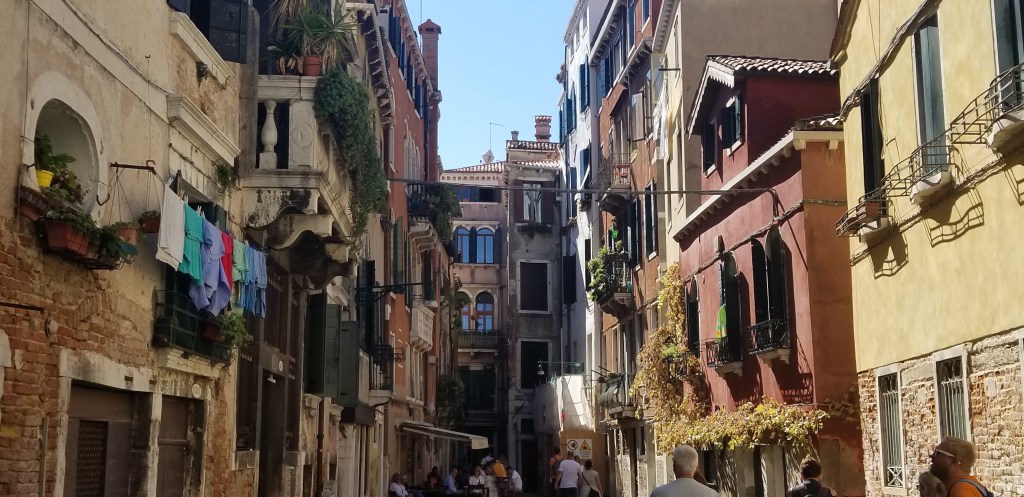
The joy of having time to explore Venice was being off of tourist rivers and into the quiet neighborhoods. This is the very definition of slow travel.
Yes, we found plenty of busy passageways. Even here there was so much to look at. There are not only tourists in Venice. There are students going to school, employees hurrying to work, and folks doing their marketing or crowding the tiny grocery stores for some lunch.
But then, there were plenty of quiet ones, too.
We would wander about, vaguely trying to get somewhere without any assistance, just enjoying the neighborhoods and the canals. A passageway would lead nowhere, or take us back to a piazza we had just walked through. We would finally have to give up, look at either our paper map or GPS and discover that we had been walking in circles. That was OK too!
In the middle of the picture below, you can see a passageway that just ends at a canal with no walkway or bridge. That happened to us quite a bit while wandering. We would have to turn around and retrace our steps.
Bridges are always picturesque, providing a view over canals large and small.
The famous Rialto bridge is the oldest of four bridges across the Grand Canal. Construction on this bridge began in 1588. We crossed this one on our way down to the San Marco neighborhood, and I got good photos of it on two separate occasions.
Venice is a faded lady. The city is over 1,200 years old and some of the buildings are 800 years old. Most, though, date back to the 1500’s. That was Venice’s Golden Age, which lasted a couple of hundred years. For good or for ill, it was one of the most richest and powerful Italian cities, with a stable government to keep everything in check.
The water in the canals are actually very shallow, only about ten to fifteen feet deep. The city was founded in the fifth century AD, and it was built in a lagoon, with small, marshy islands. Natural canals in between the islands were gradually enlarged and reinforced with bricks and other materials. There are 150 canals running through the city, connecting 118 small islands with a mixture of salt and fresh water. The local government works to keep the canals looking clean.
We didn’t always have to go on foot around the city. The canals have a system of vaporetti, or water buses, that run frequently and punctually on the Grand Canal. A vaporetto is docked at right in the picture below.
I took this picture while riding on a traghetto.
Along the entire length of the Grand Canal, there are only four bridges, and sometimes you just need to cross the Grand Canal where there isn’t one. For that there are traghettos. On one of our wandering excursions, the walkway ended at a traghetto stop. For two euros we could ride across. That looked interesting, so we hopped aboard. According to the sign, this is the Traghetto S. Sophia coming across for us.
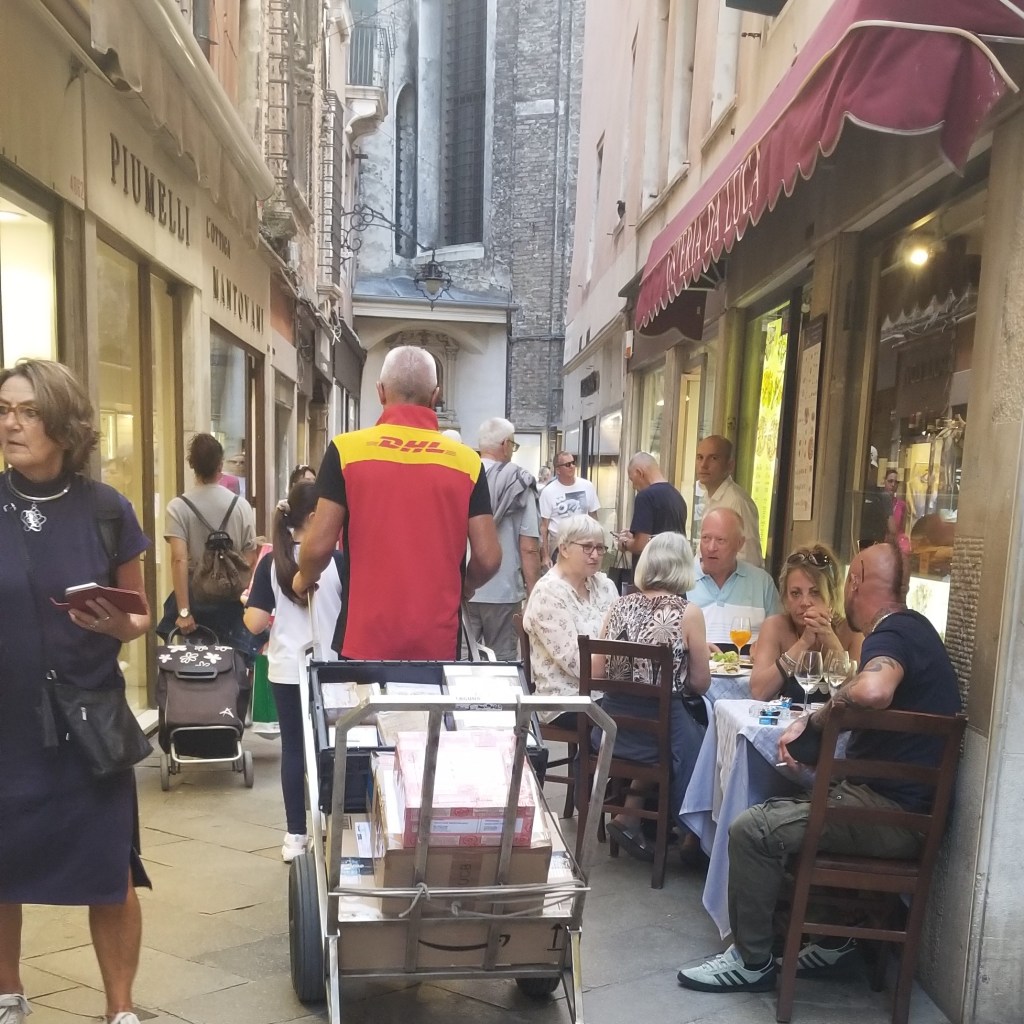
What about commercial transport in a city like Venice? Everything comes in or goes out by boat. Then it is transferred on carts down the pathways. The carts are built so that they can negotiate the steps, too, and people who pull them are good at getting up and down.
Package delivery on a crowded passageway near San Marco Plaza
The Grand Canal is used to transport everything, including perhaps the boxes that this DHL person is delivering.
One evening a strong wind blew in, followed by gusts of rain. From our window, I watched diners hurriedly finish eating and paying at the restaurant on our piazza. The servers scurried around swooping everything off tables and trying to fold up stubborn patio umbrellas that wanted to blow the wrong way. It was still raining in the morning. With the gloomy weather, I decided it was a good time to visit the Jewish quarter, in the Cannaregio neighborhood.
We crossed the Grand Canal on the bridge near the train station, where there were lots of people already out and about.
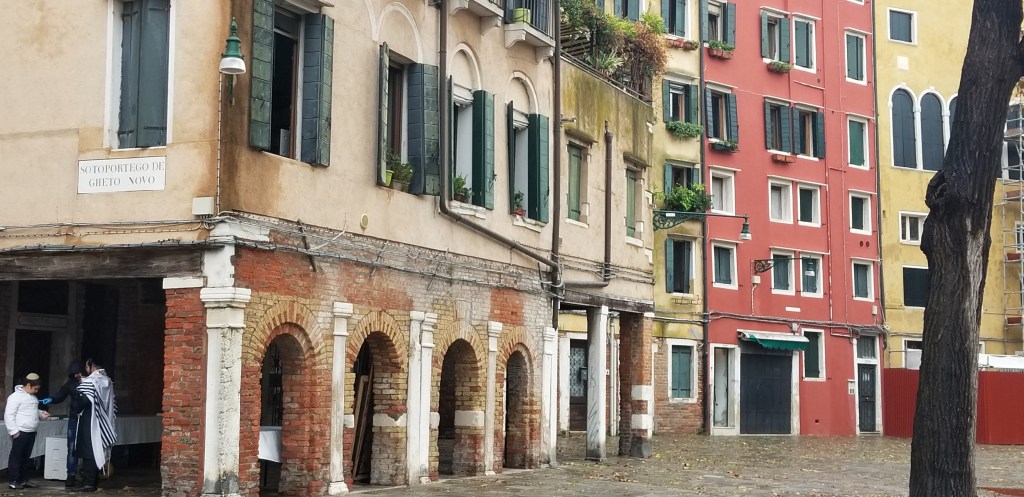
A few twists and turns, and we were in the quarter. It was a Saturday and the Sabbath, so a service was getting ready to start in a nearby synagogue. Despite that, some stores and cafes were open.
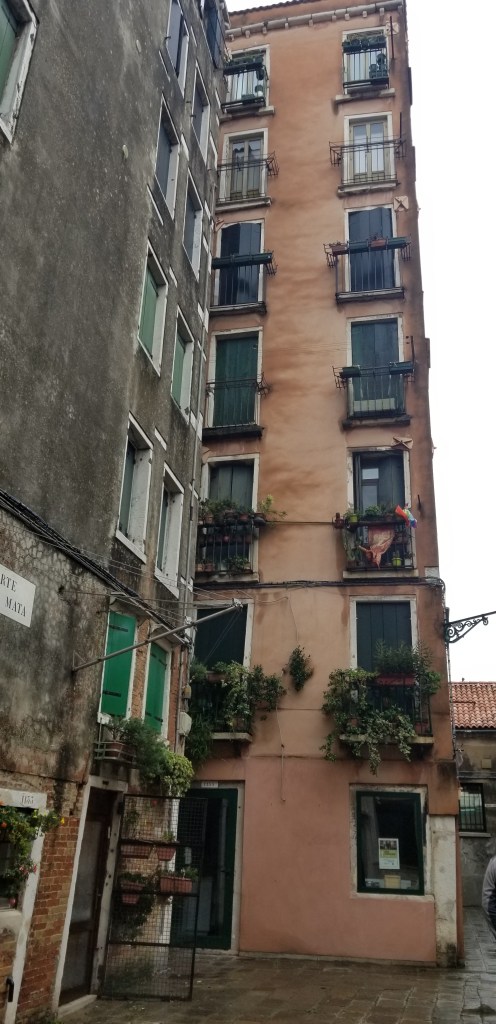
The “Golden Age” of Venice did not apply to Jews. In 1516, they were all made to move to an area where foundries, called “geto”, had been in ancient times. The area that included the ghetto is an island, since there is no way to get to it other than bridges. It got so crowded in the ghetto that buildings were made taller with substandard apartments. On ground level, smaller apartments were squeezed right next to each other.
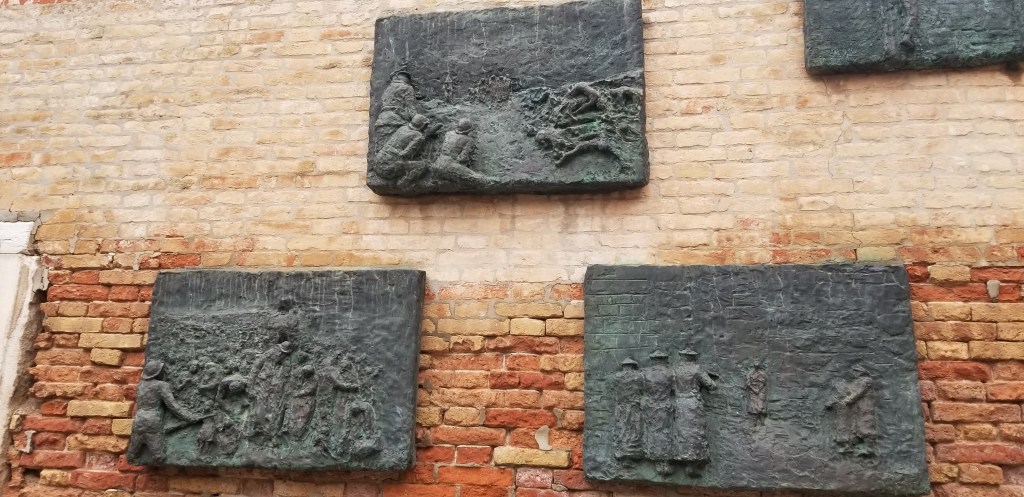
Looking about, I noticed pictures on the piazza wall. They are tributes to those arrested and murdered by the Nazis between 1943 and 1944 in this piazza.
It was sobering to ponder what happened here, but I think it is good to pause and reflect on these things.
All is not gloom and doom. The Jewish community is still here, with five synagogues and a library. Venetian Jews today number about 500, but only a handful live in the former ghetto.
I found a small art gallery where a gentleman had some cats lounging about. He takes pictures of scenes around the quarter and sends them to Israel, where an artist paints them onto canvas. I fell in love with one picture that included his cats, but I did not want to purchase anything.
We stepped into a small cafe to warm up and have a cup of tea (for me) and coffee (for Cal) with a cannoli. Cal was pretty happy with this stop. After thinking about it over my tea, I went back to the gallery and purchased my picture. It is now hanging up in my RV bedroom.
This was our only rainy morning in Venice, and the sun soon appeared to warm the day.
We did not just wander around Venice the whole time. There are golden treasures here: the Scuola Grande di San Rocco, the Chiesa del Gesu and other churches, the Doge’s Palace, Bridge of Sighs, and Piazza San Marco. That’s for next time!
It seems like there is a special day for everything now, doesn’t it? Today, October 1, is World Postcard Day. Simply put, it is a day to reach out and send a postal hug to anyone – a loved one, friend or stranger – by dropping a postcard in the mail to them and saying hello.
In light of this auspicious occasion, I thought I’d share with you one of my favorite hobbies – sending, receiving, and collecting postcards.
Yours truly mailing a postcard in Inverness, Scotland
I was twelve years old when I got the idea that I would never again throw away a postcard, and I haven’t. I have several older siblings and a large extended family, and in those days, postcards arrived often either to my parents or to me. Many of my siblings were already beginning careers or on college trips. My two older sisters took trips together. Of course, they couldn’t forget their little sister, and I looked forward eagerly to the cards I received.
Multi-view postcards, such as this one from one of my brothers, were especially treasured. He has passed, so that makes it even more so. I don’t see these sold anymore.
It wasn’t necessary to use a zip code in those days!
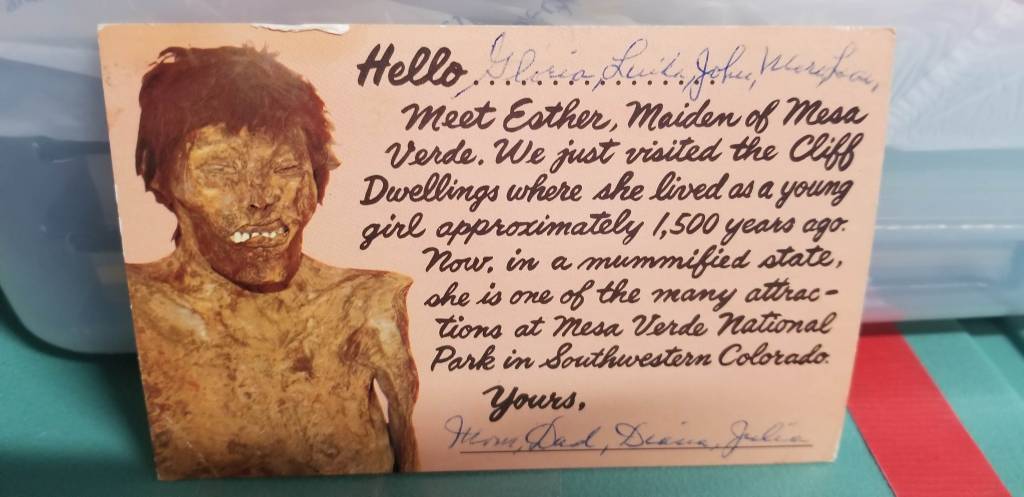
Around the same time, my parents took me on a huge vacation from our home in Ohio all the way to Arizona, stopping in Colorado along the way. My oldest sister, Diana came along. She was already in her mid-twenties and living on her own in St. Louis. My Dad sent a card to the five remaining siblings who were all at home working summer jobs. I love having something in his handwriting.
I don’t remember seeing Esther and if, I did, it wouldn’t be possible today. Remains like Esther’s are treated more respectfully now and have been reburied by their tribes.
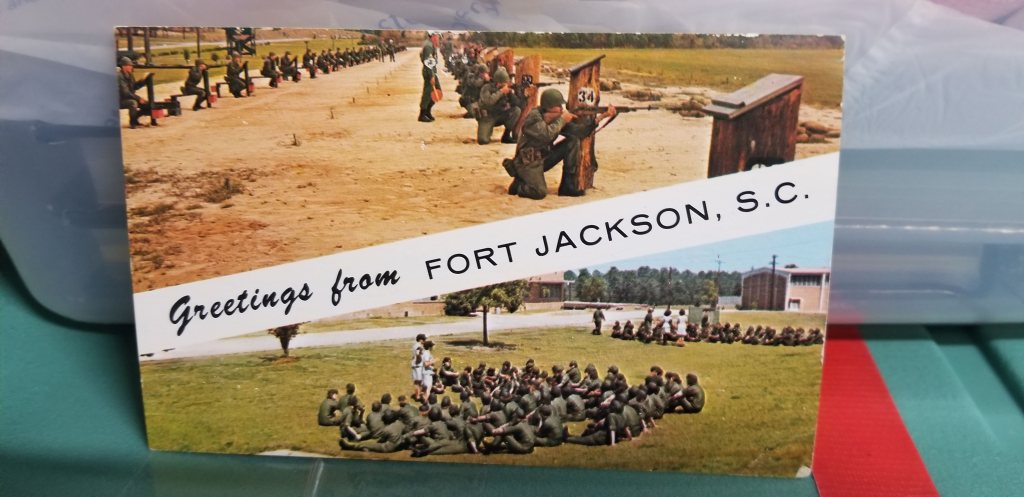
When it was my turn to leave home, I sent post cards home too, like this one from basic training. With the soldiers firing their weapons on the top, I’m sure I was going for shock effect. I’m happy my parents saved it for me.
As I traveled, I would purchase fistfuls of postcards to send to friends and family. Invariably, some wouldn’t get sent, and I added these to my collection.
This would have been all I could tell you about postcarding until 2014, when something happened that took my collection out of its disorganized little tin and into the stratosphere. In a magazine, I read about a postcard exchange group called Postcrossing. It is an online group where people can exchange postcards globally through the mail. Postcrossing’s tag line is to “send a postcard and receive a postcard back from a random person somewhere in the world”. They have been around since 2005.
Currently, there are 804,385 members in 209 countries. At the minute I am writing this post, 366,761 postcards are currently making their way to members around the world, including the 6 that I have traveling to Canada, Australia, France, China and Germany.
When I first joined, I went over to our local Schnucks grocery store and purchased five postcards of the Gateway Arch in St. Louis. I set up a login and a profile telling a little bit about myself. I could have skipped that step if I’d wanted to. I clicked on the box that says “Send a Postcard” and drew my first name and address, with a “US” country code and number. At the beginning, it is only possible to send five postcards to five different receivers, and I wrote the different codes on each card with a short message. When my postcards were received, the recipients logged them into their sites, and I received an e-mail from each individual.
Logging in the postcards triggered Postcrossing to give members somewhere in the world my name and address. In due time, I received my first postcard in the mail, from Finland.
It was perhaps not quite what I was expecting, but exciting nonetheless. The translation: “Wealth ends and beauty fades, but love always remains.” In Postcrossing, if a person especially likes a postcard, they can “favorite” it with a heart. Looking at a recipient’s “favorite” wall is a good way to see what kind of postcards they like. I made this a favorite, because it was my first, and for a long time after that I received many postcards with quotes on them.
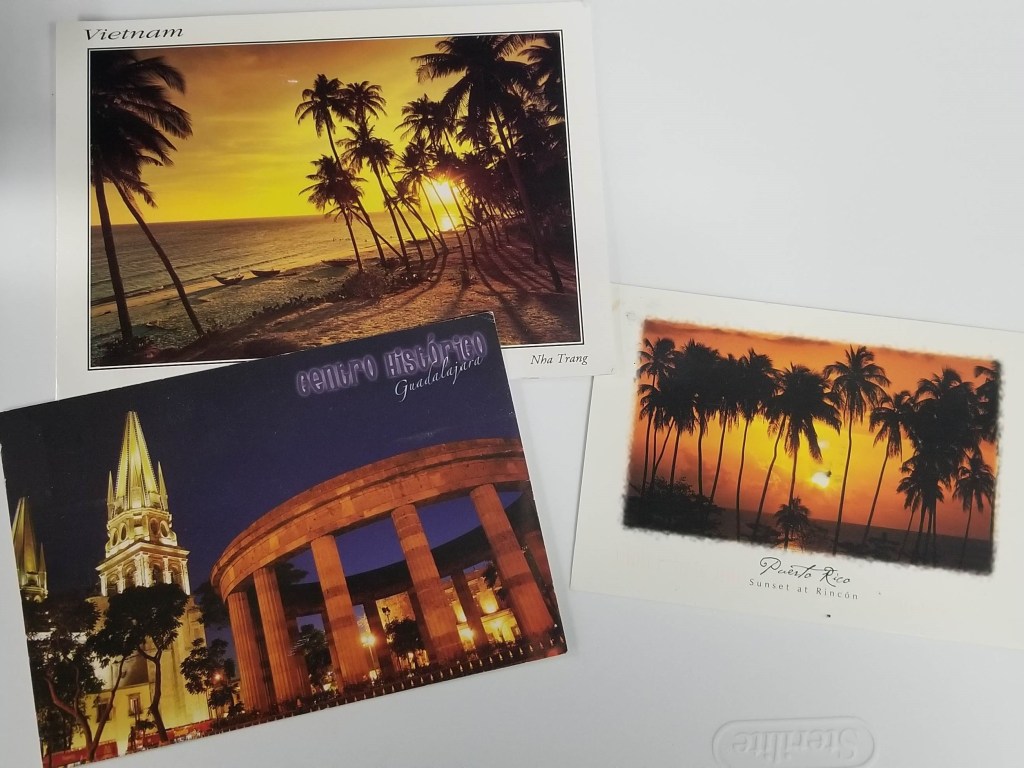
I also received these postcards from Vietnam, Mexico, and Puerto Rico near the beginning, not knowing that I was lucky. I never received postcards from these countries (territory, in Puerto Rico’s case) again. Some countries don’t have many Postcrossers.
The purpose of Postcrossing is not to collect postcards, although that’s a happy byproduct. Its purpose is to reach out and touch by the act of sending the card and hopefully putting a messsage on it. Sometimes someone across the world is reading a book that I’ve already read. They will tell me about a trip they just took, their family, their garden, some special interest, or just what they’ve been doing that day.
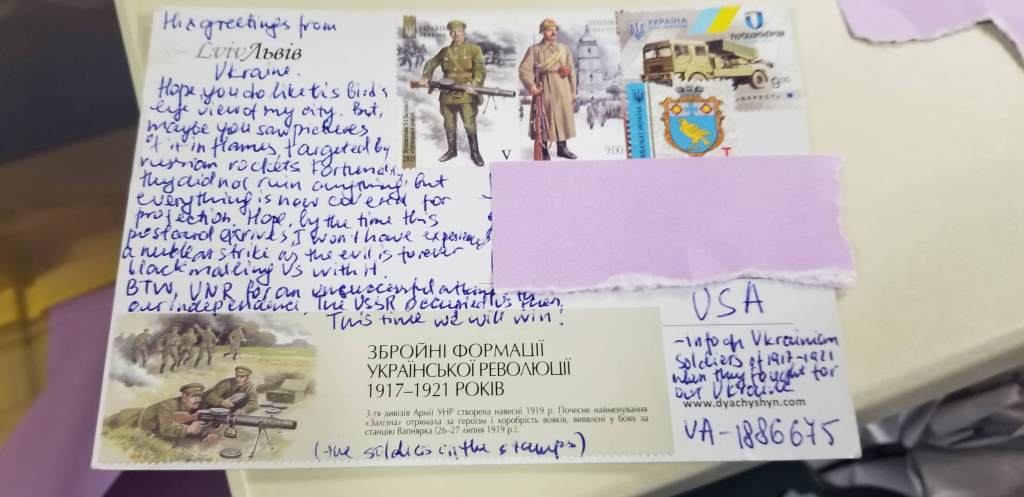
This poignant card from Ukraine made me sad and I hope by now that the city portrayed on the front of it hasn’t been bombed to smithereens. The sender wanted me to know that this is not the first time in history the Russians have invaded and that, eventually, Ukraine will be victorious.
The stamps on the card portray the Russian soldiers from the first invasion. On the invaders’ side, I do receive a lot of cards from Russia. People are just people the world over.
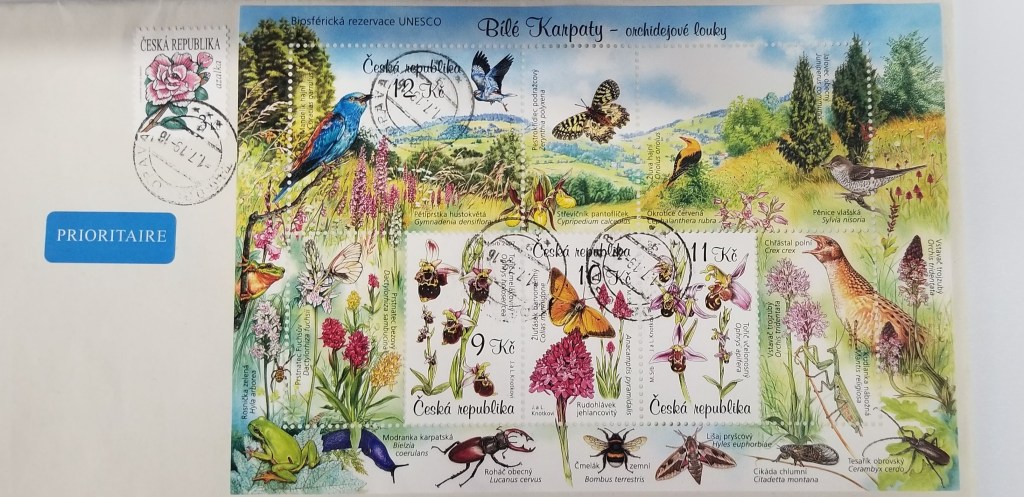
Speaking of stamps, sometimes the sender overloads me with a lot of beautiful ones on the card. Many people in Postcrossing collect stamps, too. The sender of this postcard from Czech Republic put the card in an envelope and covered it with a whole page of stamps. Wow!
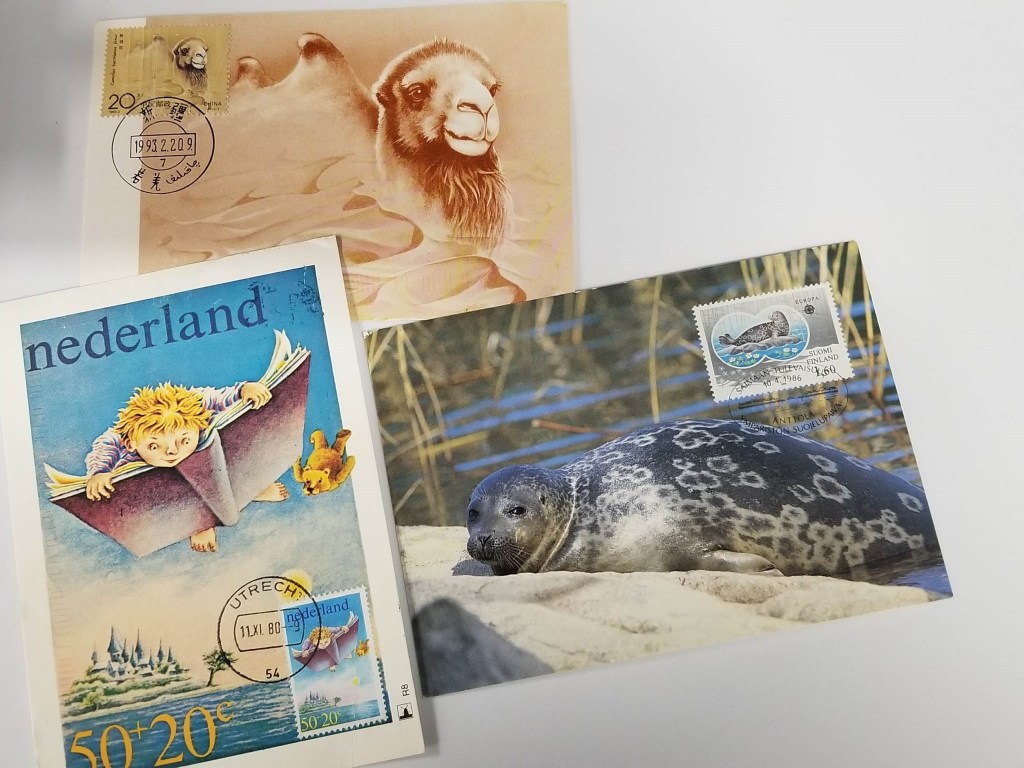
I’ve learned a little bit about postcards along the way, too. Maximums (maxi cards) are postcards that have a stamp on the front that matches the view on them, usually to commemorate the first day of issue. I’ve received many of these from Australia, and other countries too. I know that the post office in Australia sells them, but I don’t know if that’s the same in the others. The United States Post Office does not sell maximums. These cards from China, Netherlands, and Finland are some of my favorite maxis. Maxis are on my profile as a type of card I like to receive.
Receiving a card with an image that I like, or a card from a country new to my collection, or cards with an especially meaningful message, pretty stamps, or even a treat in an envelope with the card like a tea bag, makes for a very fun experience. A card with more than one of these attributes makes it even better. This sender painted a card of herself and her dog riding a bike through her home city of Prague:
Part of the experience that I enjoy is drawing a name and picking out a card. I could send any card, but I now have a large box of unsent cards and try to match something on the recipient’s profile. Most people like basic scenic tourist cards so they can see what the other side of the world looks like. Animals, birds, flowers, map cards, “Greetings from” cards, art cards, movie stars and royalty are also popular, although I don’t have any of the latter two categories. I can tell when a recipient is excited about my card, as I am when I receive a particularly perfect one.
To date, I have sent and received just over 700 cards on Postcrossing over the past nine years. I’ve seen Postcrossers with thousands of received cards. I don’t know what I will do when my numbers creep up over a thousand, but that is a few years away.
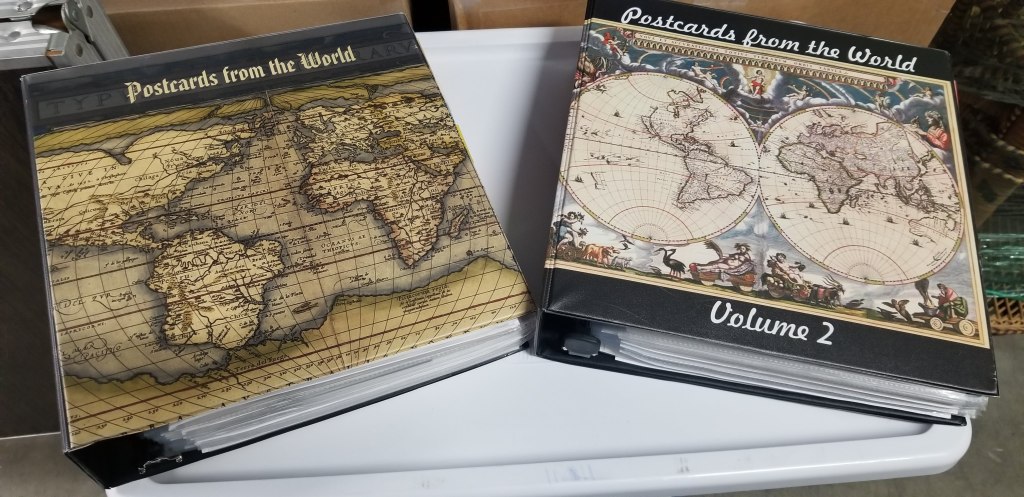
From the beginning, I knew I needed a good storage solution, so here’s what I came up with:
The notebooks hold one or more cards from each country. There are also sections for specialty cards such as vintage, Christmas, and others. The overflow goes in the box. I have another box that is just for cards from the United States, which I don’t receive from Postcrossing, although I could. Those are mostly the old cards plus ones I still receive from friends and family. I always say that if I need a third notebook or box, I will stop. That would be a sad day, though, so I’ll have to think about that!
Everything goes in a big tub which currently sits in storage. Once or twice a year when I visit our storage unit, I file away my received cards. I do miss not having this out to enjoy as I did when I lived in a house, but I’m sure that day will come again some time.
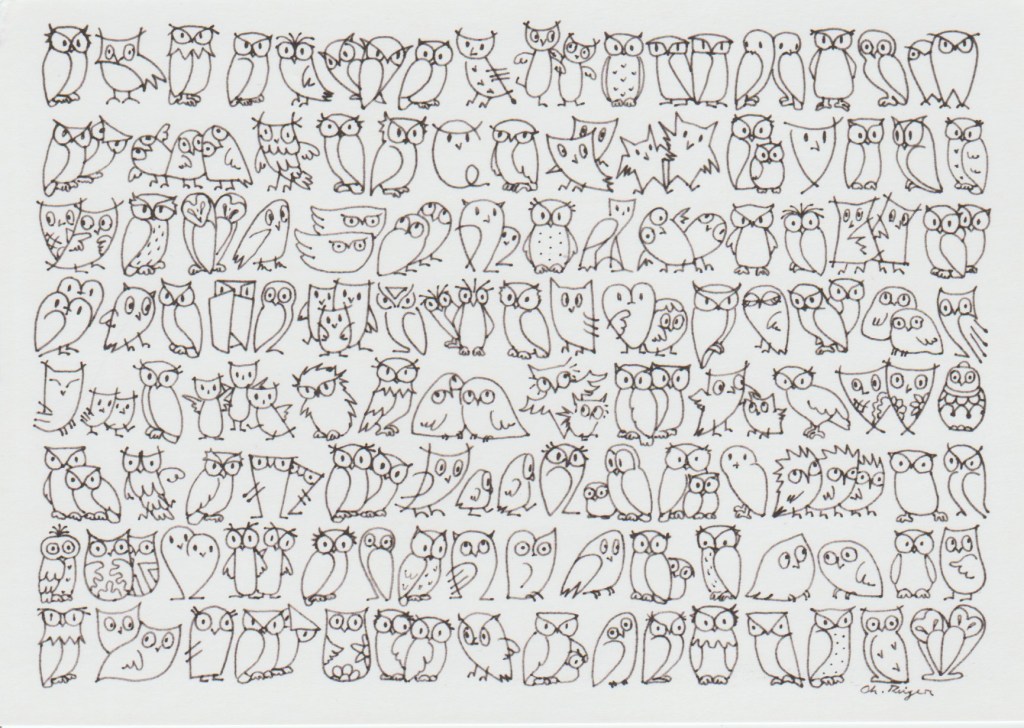
This would have been all I had to say about my hobby for now except that yesterday I received a mail drop containing about three weeks accumulated mail. I received postcards from seven people around the world. A German Postcrosser named Peter totally made my day. Pettson and Findus, originating in Sweden, is a popular book series in Europe. This postcard is of Pettson and his cat Findus:
It is so cute! But not only that, he also put the postcard below along with it in an envelope, and wrote interesting messages on both:
His mother drew all these little owls! The envelope also held a business card-size beautiful photo of the Water Castle in Hamburg at night – a tea and treat shop was advertised on the back – and there were stamps of historic half-timbered houses on the envelope.
The other six postcards were all interesting, too. It’s gifts like these in my mail drop that are a bright light in my life.
You don’t have to belong to Postcrossing to send a postcard and brighten someone’s day, though. In this age of social media, it is rare and special to receive something in your mailbox that has been written and chosen just for you. Doing this for someone else is a gift for their day.
I’m currently traveling internationally, as I was last year, so I will purchase and send out my cards from the country I’m in. Besides my Postcrossing names, I will be sure to also send a few to friends and family.














































































 Twosna Travels