In my last post, I stated that I would be telling you about our travels as we’ve moved on. I’ve decided to write about our new ebikes instead. They are a lot of fun for us and I thought I would share.
My husband, Cal, and I have loved bike riding since we were each growing up. Bikes were part of our first purchases long ago as newlyweds. Our last few years in Missouri were spent riding the mostly flat Katy Trail, a rails-to-trails that stretches all the way across Missouri. We rode the entire 225 miles round trip but took years to do it, exploring local sights and bed-and-breakfasts along the trail. The Katy Trail is really the kind of trail we are used to now.
A flashback from eleven years ago, here we are on the Katy trail
We hauled our bikes out to Rend Lake in Illinois after purchasing our RV. There was a bike trail there, but the (small) hills on the trail were more difficult than we thought they should be. I guess we’re not getting any younger! We don’t ride enough now to attain any level of fitness on them. We’ve had the bikes out for rides since then, depending where we are, but not really all that often. I can tell you, most trails in the Southwest are not like the Katy Trail. So, mostly our bikes have sat, bundled up, on the back of our RV.
Cal wanted to buy ebikes from the beginning of our RV venture. I’m not mechanically inclined and although I liked the idea, I was honestly a little afraid of riding one. I was also somewhat tired of spending bundles of money after the RV purchase, so I put him off a bit by telling him we needed to save for them. Meanwhile, he researched the future purchase and talked to people who had them in some of the parks we have been in. In January I could put it off no longer – we had plenty of money saved in the little fund that I had set aside for this purpose.
We were in agreement on the two reasons we wanted the bikes – to be able to tackle hills with ease, and to be able to go longer distances on our rides.
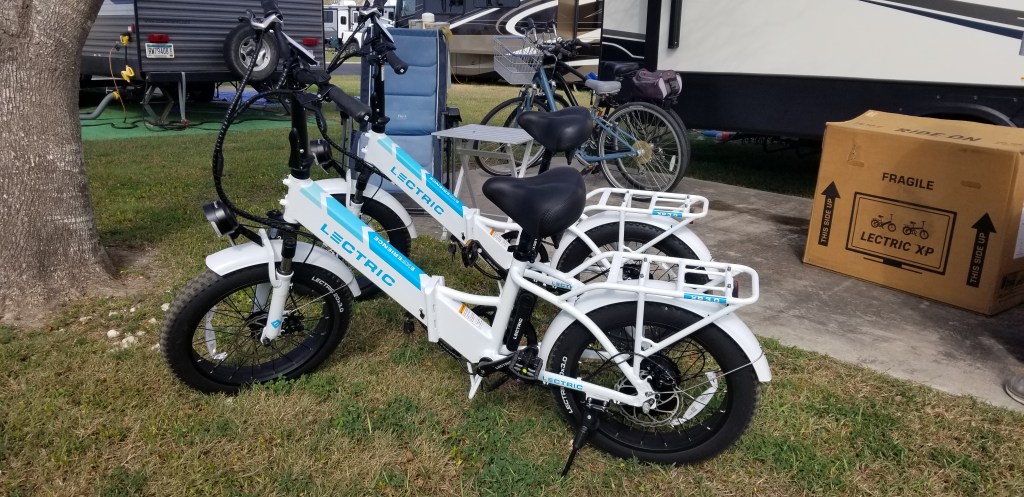
When the time came, he knew exactly what we needed. He ordered the bikes from Lectric and they came in two big boxes – not much assembly required! They are Lectric eBikes XP 3.0 and they fold in half. He purchased them with a package that included better headlights, seats, locks and bigger batteries. He also ordered mirrors from Amazon.
The new eBikes, with one of the boxes they came in to the side, and the old bikes in back.
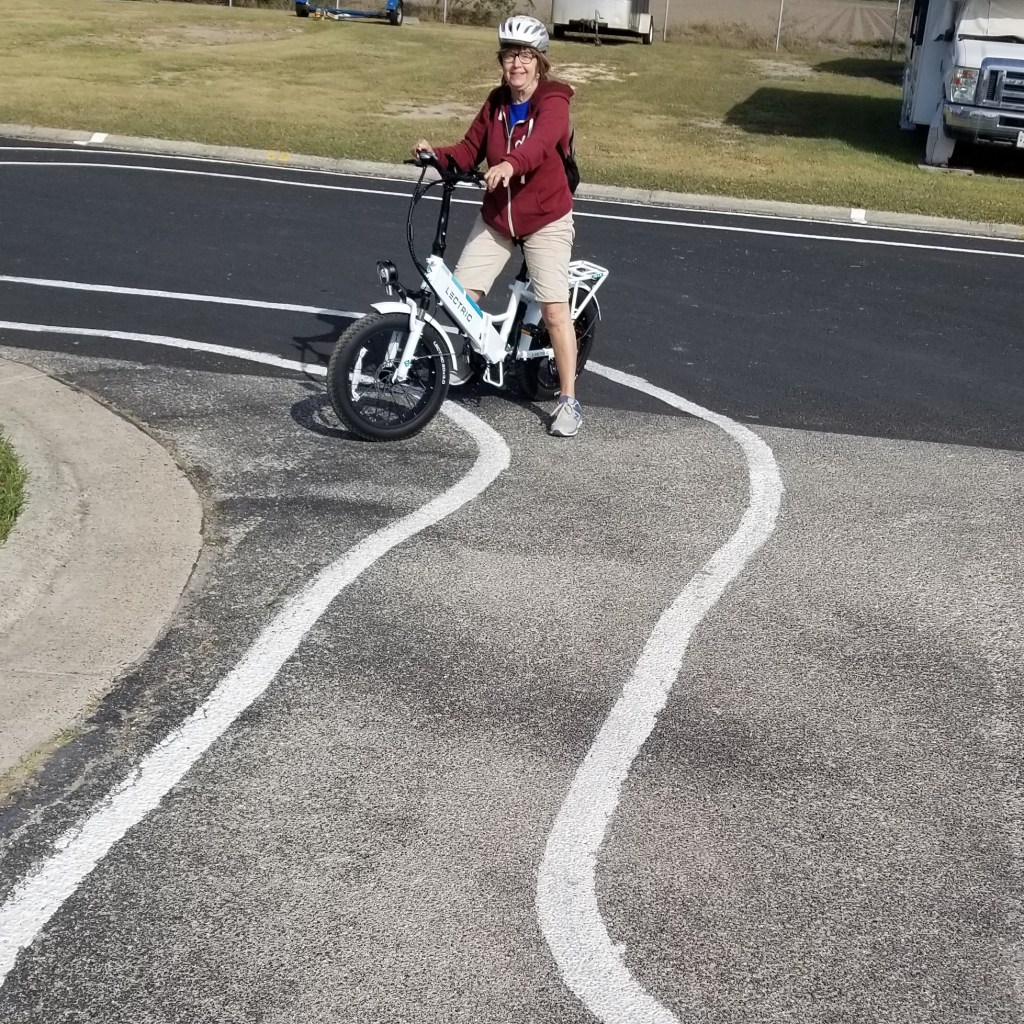
I was more than a little nervous getting on my bike for the first time. Cal was very patient with me and walked me through the use of the pedal assist, the gears and the throttle. There were some weird painted lines at the end of our street which seemed tailor made for an ebike rookie like me.
Soon we were riding around the RV park, and then out the gates on our first adventure. Just five minutes away was a Marine military academy. Everyone there must have been on a winter break because the streets were deserted. We found a huge empty parking lot where I could experiment with using the throttle, and tentatively took the bike up to 18 mph. Wheeee!
It was on the way back to our park from this ride that I realized that it was one of those windy Harlingen days. In our excitement over the bikes, we had not noticed. So it was that we found our third use for ebikes: riding in the wind. With our old bikes we would definitely been fighting the strong headwinds.
We rode the country roads around Harlingen:
and, later, around the naval air station in Corpus Christi.
Both places were perfect for learning how to ride. Contrary to what I used to think, I get as much of a workout as I want by adjusting the gears. There are seven, and I have my bike set usually at five or six. The pedal assist adjusts the speed, and it helps when I’m getting started or going up a hill. There are five levels, and level two or three is fine for riding. I’ve gotten it up to to four only once. That was for a granddaddy of a hill which I pedaled up with ease.
The throttle is what helps me zip across a busy street, or catch up to Cal when I’m lagging behind. On a straightaway, it is fun to just use the throttle, sit on the bike like I’m on a scooter, and take up the speed. But I don’t do that often. It is both exhilarating and a little scary. It uses up battery life faster, too.
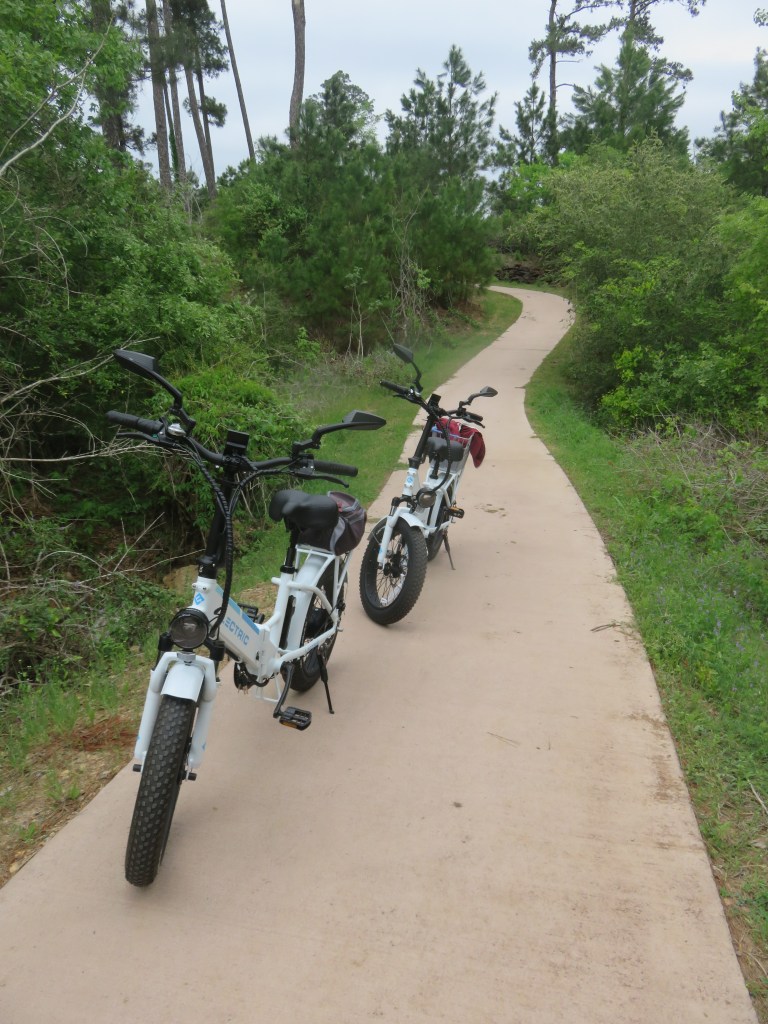
Harlingen and Corpus Christi are on a coastal plain, so the roads around both places are flat as a pancake. When we traveled further on, to Central Texas and Austin, we were able to see what the bikes could do on hills. Bastrop State Park had some paved trails, and I could go up the hills with no problem. In the picture below, we had just come off a pretty good down hill where the bike had gone up to 21 miles per hour.
The bikes weigh 70 pounds including the battery. They are fairly heavy to schlep in and out of our truck but so far Cal says he doesn’t think it’s too bad. I’ve helped him and I think they’re heavy. We’ll see how it goes down the road.
We found a couple of great paved bike trails in Austin: the North and the South Walnut Creek Bike Trails. The paths were wide, paved, and woodsy. You wouldn’t know you were right in the middle of the city.
I was taking some scenic photos of the Texas bluebonnets, and Cal thought it would be cute to put his bike right in the middle of them:
Another day, we went into Austin for a trail that didn’t pan out. This was exactly the way I was feeling on that trail. Only in Austin!
We did circle back on that ride to get on the trail that lines the Colorado River downtown and crosses over with bike-dedicated bridges. Although it was busier, the trail was wide and very beautiful.
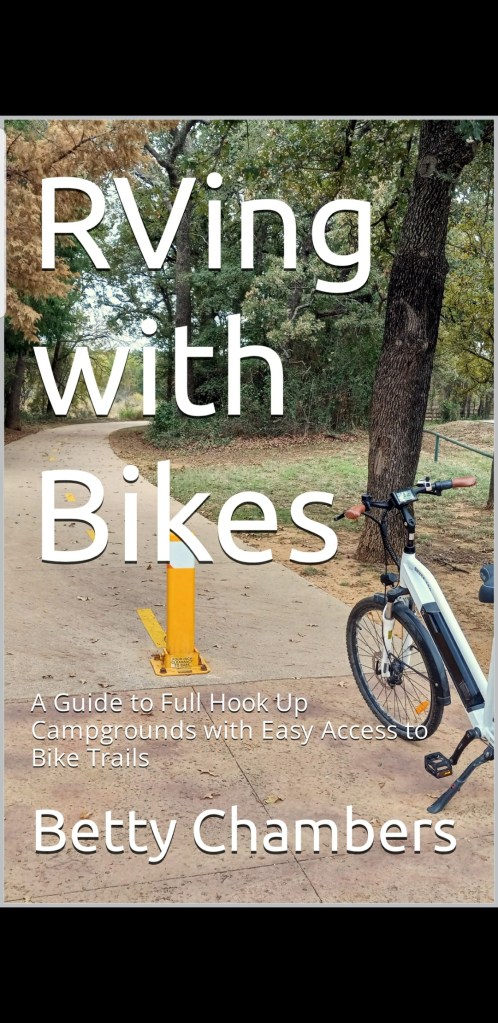
It would be great to have paved trails where we are RVing so that we can ride bikes out of the park. We did not have that luxury in the places in Texas where we stayed. This is where my fellow blogger and friend, Betty Chambers, comes in. She has written an ebook “RVing With Bikes”. It shares the locations of full hookup RV parks that have easy access to bike trails right out of the park. The book is small but Betty is adding new parks to it as she finds out about them. I see a lot of value in this book as time goes on. You can find it on Amazon for the paltry sum of $2.99.
I’m going to close for now, it’s time for a bike ride. See you on the trail!
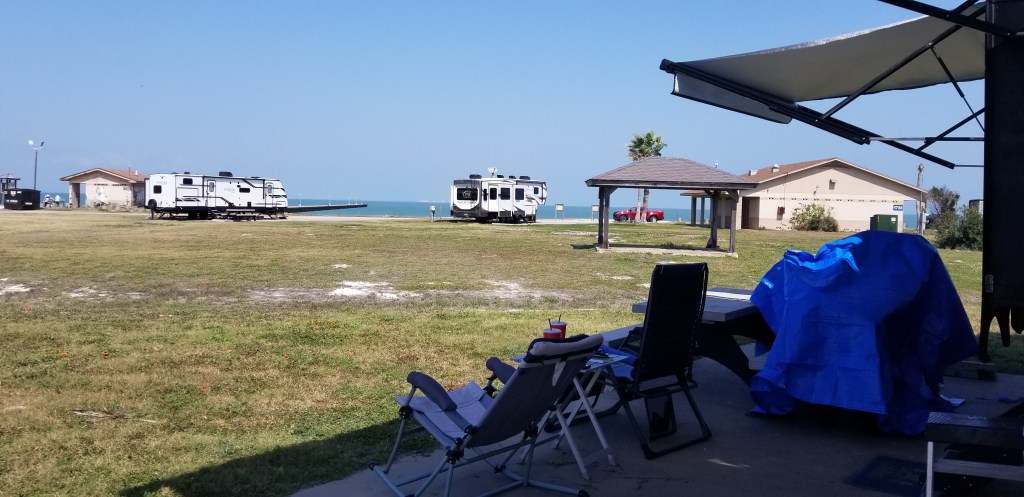
To wrap up the winter of 2023, we moved “up north” 145 miles. This time we sat about as close as you can get to the water, on Corpus Christi Bay at an exclusive private club: the US Military. We were at Naval Air Station Corpus Christi for ten days, for our first stay with the navy.
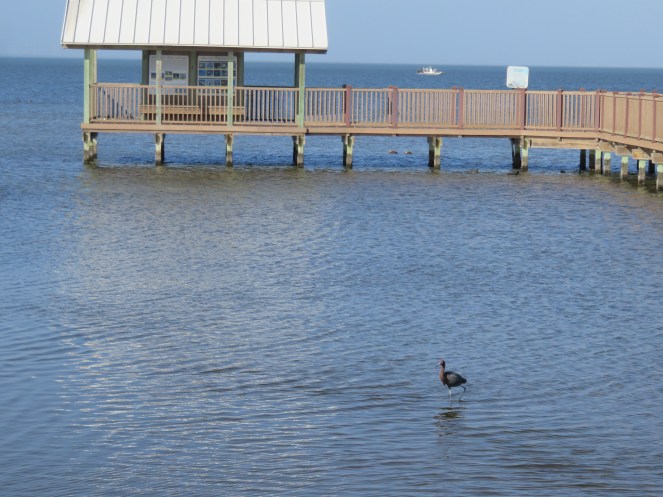
It isn’t quite as fancy as it may sound. Hurricane Harvey did its work here back in 2017. The road to the family camp is riddled with potholes. A lot of “non-essential” (i.e., recreation) facilities such as the marina have been deemed too structurally unstable for repair but have yet to be torn down. We enjoyed watching all the bird life on the fishing pier, but supposedly it was off limits for this same reason. I say “supposedly” because we saw plenty of people walking or fishing from it now and again.
This naval base is very quiet. There are only 140 permanent Navy service people stationed here. It is a training ground for new navy pilots who pass through until they attain their wings. My own nephew, Mike, trained here and didn’t have much good to say about the place. I don’t think it would be particularly exciting for a young service person. There are only a couple of places to eat outside of the military dining facility, and the commissary and base exchange are small. The club, and other spots for socializing, are only open once or twice a week. The base is in need of sprucing up but there doesn’t seem to be the funds for that.
We’re in a different stage of life than my nephew, though, and found it to be perfect for us. We like off-the-wall, quiet places. I enjoyed many walks on the beach in front of our RV and on the long, wide concrete strip on the other side of the fishing pier. That strip stretched for over a mile and we surmised that it was the shipping dock back when ships stopped here. It was also great for bike riding. We rode bikes all over every corner of this small base. On a Saturday morning the empty streets transformed into great bike paths for us.
Many RVer’s don’t like NAS Corpus Christi because of the constant wind, but we were already used to that after our winter in Harlingen. When the wind was more intense, it would stir up the waves and they would crash against the sea wall. Other RV’ers told us they’d seen it kick up higher than this. I think I’m glad we weren’t here for that kind of weather!
The below RV is not ours. We were glad we did not have this front-row spot. The other drawback to being here is that the salt air is detrimental to RV’s and other equipment one may have. This RV was a little too close to the salty sea spray. As it was, Cal was hosing the RV down every three days or so.
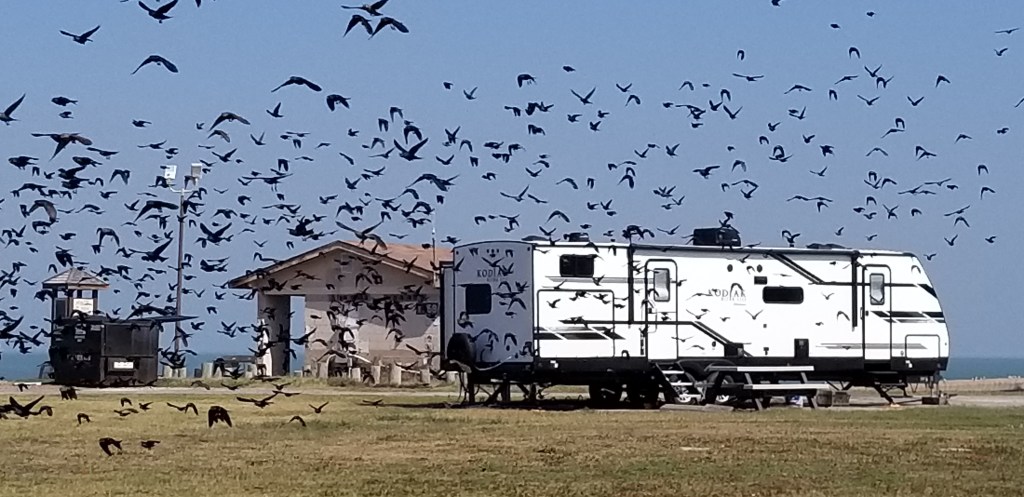
In the mornings, grackels would congregate, swooping and landing in a tiny area of the field, then suddenly taking off again.
There was a little cove across the road behind our park. I liked to walk there to see the roseate spoonbills that made the cove their home, and to see what other birds might be hanging out that day. I often saw sandhill cranes in the field behind us as well.
The base was built during World War II and I can imagine it was hopping during that era. Senior officer’s quarters were built fronting the dock and the water. Most are gone; Harvey finished off what was left in 2017. But, amazingly, a handful are still lived in.
A rear admiral lives here. What does it look like inside, I wonder?
There is nothing between this house and the bay except for a small field and the concrete strip.
I was surprised to learn that when these homes were built many officers still had servants. The servant’s quarters were to the side of the garage. I peeked into one that was standing empty. It is truly a remnant of a by-gone era. Not much later, the quarters were turned into a multitude of uses by the officers living in the house.
We were both outside a good portion of every day here and it was relaxing to just forget about the time. Many days we joined a group of friends who gather late afternoon most days for a beer or whatever was in their water bottles. We compared notes with them on other military family camps. Some of these folks fish or golf. We like to see what’s in the area, and they were a good resource for that.
Not far to the east of Corpus Christi, the John F. Memorial Causeway bridge crosses the Laguna Madre to the barrier islands on the Gulf of Mexico. A left turn past the bridge leads north to Mustang Island State Park and then up to Port Aransas. The state park is small but I couldn’t miss exploring its beach.
There were many people fishing here on the two rock piers or on the beach. This woman was repeatedly plunging a white PVC pipe into the sand; what was she doing? We had to find out, so we asked and she was happy to tell us.
The device is called a shrimp gun or pump, and she was using it to catch ghost shrimp for fishing bait. They are a tasty treat for pompano and other fish.
In Port Aransas we visited a bird refuge. It was behind a sewage treatment plant – phew! – but there was a nice view of Laguna Madre to see the birds. We even found an alligator hanging out right underneath the viewing platform.
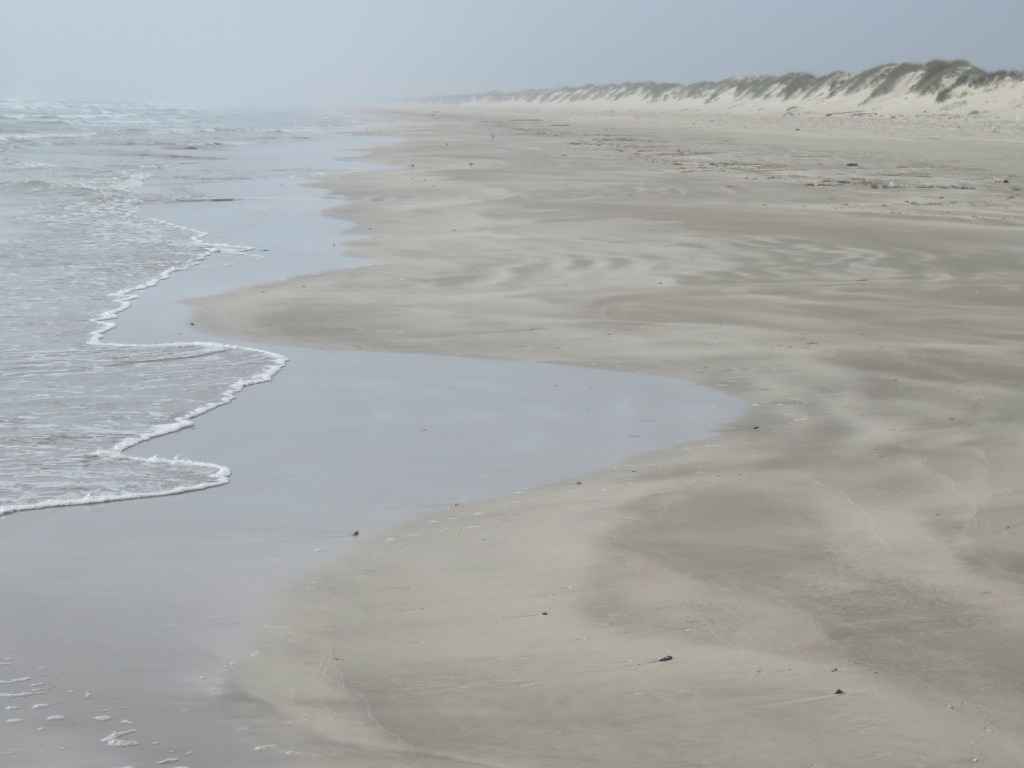
Over the JFK causeway, if you turn right, you end up at Padre Island National Seashore. This is a place that is near and dear to my heart, because it contains happy memories of weekend trips camping on the beach with my best friend years ago. I was happy to see it was still mostly the same unspoiled place it used to be.
Padre Island (not to be confused with South Padre Island to the south; they are not connected) is the longest undeveloped barrier island in the world. It’s possible to drive 65 miles down the beach, and we probably only drove less than half of it. It’s a relatively young island – about 4500 years old – in a constant state of change. It’s a fragile environment with its exposure to wind, hurricanes, and ocean currents.
When we first drove on to the beach, there was a line up of RV’s camping on the beach. Then, a smattering of tents, which were fewer and fewer as we went on. Finally, a deserted section: perfect!
Pods of pelicans glided silently by.
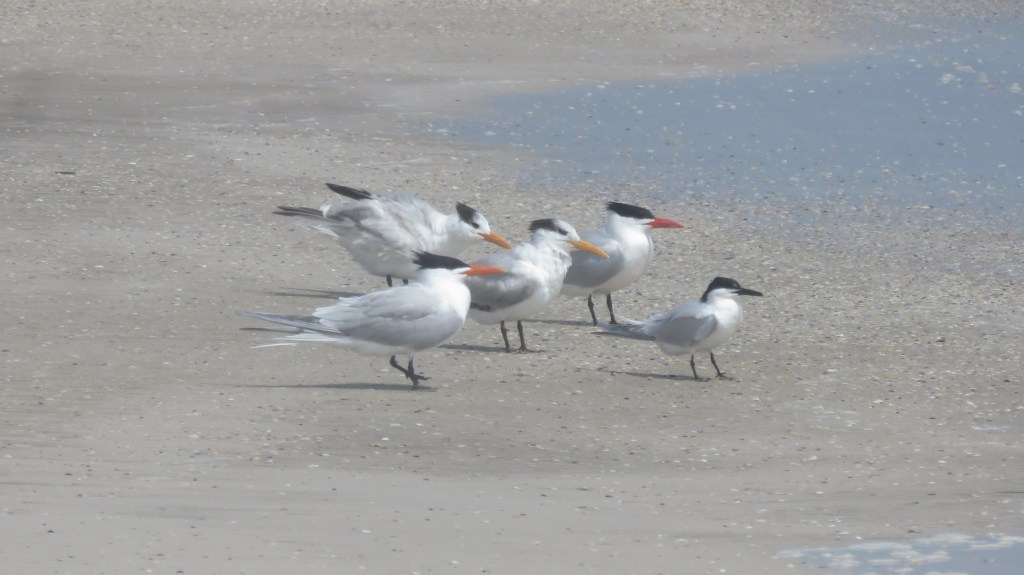
These birds on the beach are a little different than the sea gulls they were hanging out with. Their black hats and long tail feathers blew in the wind.
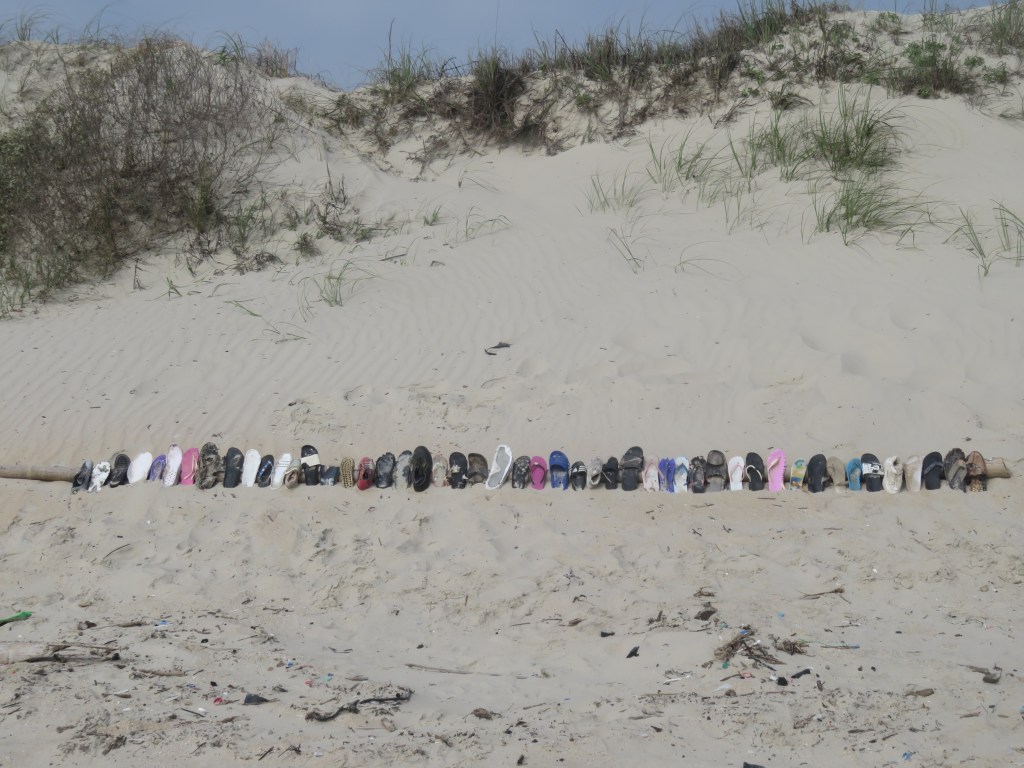
I took a wonderfully long walk down the beach, and saw more trash than I would have liked. I passed several lonely flip-flops without their mates when I came upon this. I wish I’d known this was here; I’d have added to the line!
When we were finished visiting the beach, we stopped at the national park museum on the way back. There’s an explanation for the trash: several currents flow in around the Gulf of Mexico. Those currents swirl around and collect debris from ships and fisherpeople, and all the islands and countries that touch its shores. The north and south currents converge and dump not only sand and shells but also trash right on to Shell Beach, further south than where we stopped driving. Several exhibits discussed the effect of this trash on marine life.
They do a big clean-up day at least once a year. There are trash bags outside of the museum so folks can do a pickup if they’d like, and we did see a gentleman walking the beach with one of the yellow bags. Note to self for another time: stop at the museum first. I had been in a hurry to get to the beach, of course.
I hadn’t been to an aquarium in many years, so we made a stop at the Texas State Aquarium in Corpus Christi. We watched a dolphin show and admired all the tanks of sharks, alligators, corals and fish from the Gulf of Mexico, the Caribbean, and Mexico’s Yucatan Peninsula.
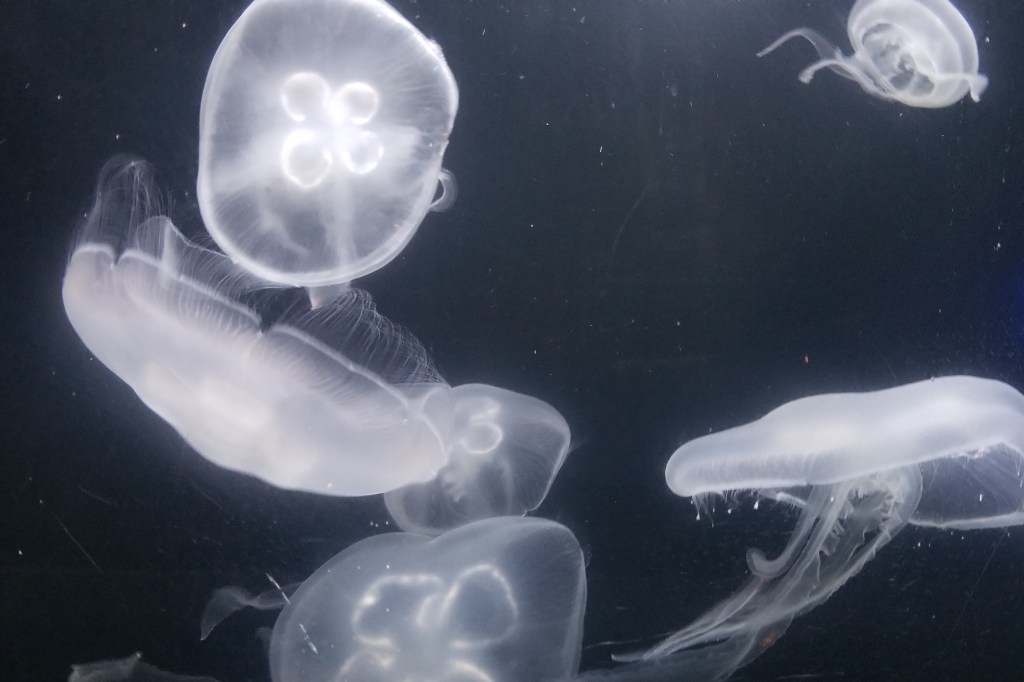
There were moon jellies in the aquatic nursery:
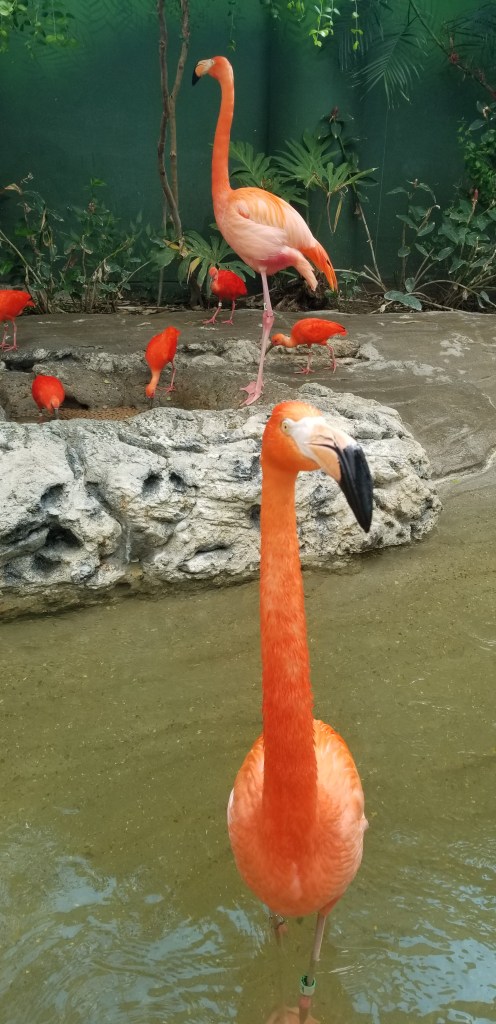
and I enjoyed watching the flamingos in the jungle area. The one in front inspected us up and down. “Just what are you looking at?” it seemed to say.
This one just wanted to dance. They were fun to watch, or maybe I just enjoyed them because I can’t get this close to shore birds out in the wild.
Near the marina downtown, which is where the picture at the top was taken, was a statue of Selena Quintanilla-Perez, a young rising singer who was murdered at a young age in 1995. She was much loved in Texas and many people were here for a look or a picture in front of her memorial.
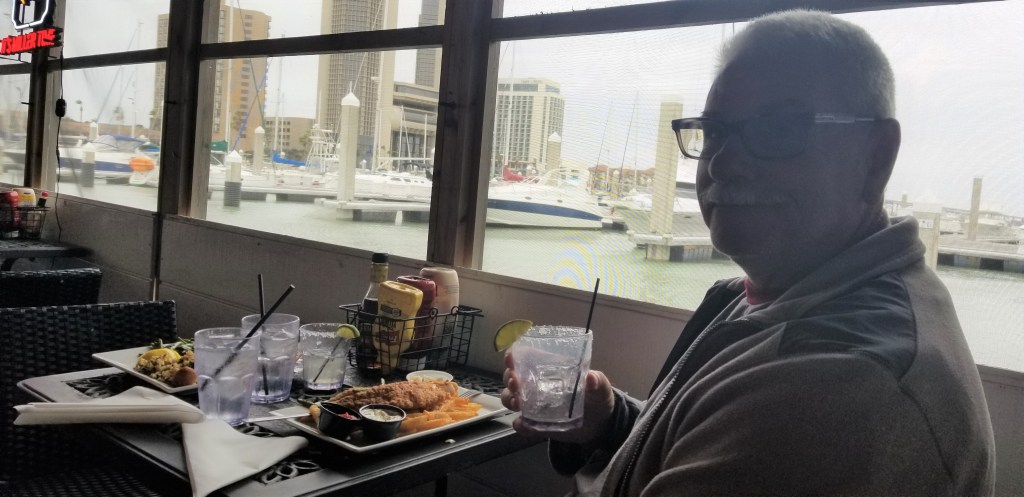
We were getting ready to say farewell to the Gulf region for now, but one last seafood dinner at Harrison’s landing was in order.
Where do our travels take us from here? That’s for the next post!
My never-ending quest for a warm winter is what led me to book a stay in Harlingen this past January and February. Harlingen is almost as south as you can go without bumping into Mexico.
The town is part of an area known as the Rio Grande Valley. The “valley”, or the RGV as it’s sometimes called, is bounded by South Padre Island on the east to Mission on the west. This whole area sits just north of the Mexican border. It’s not really a valley, but mostly part of a flat scrubby coastal plain.
The RGV is a popular place for “snow birds” from northern states like Michigan, Wisconsin and Minnesota, and the whole area has a plethora of RV parks. The snow birds are welcome here; they have a huge positive effect on the local economy. I have posted about all of our trips down to the Gulf; what else is there to do?
Plenty, as we found out. I will try in this blog to give you a little flavor of what our life here was like.
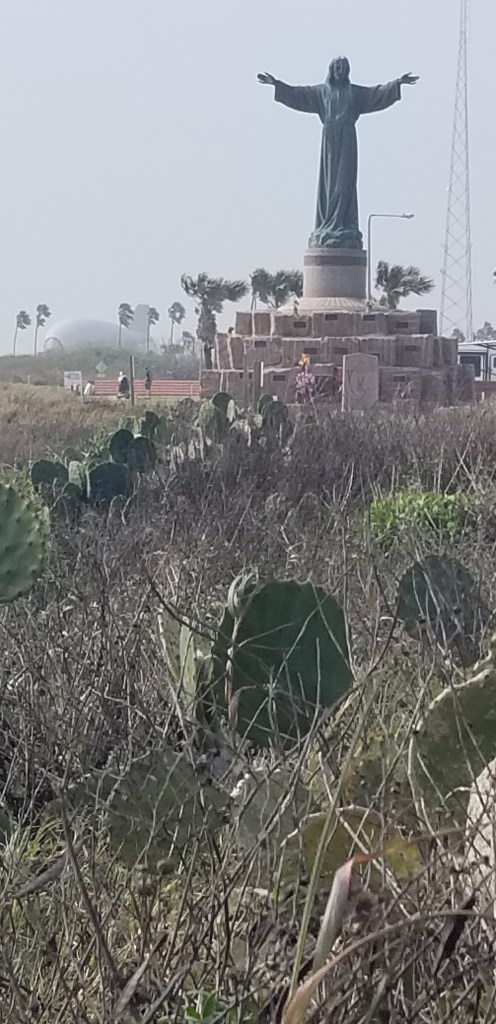
Closest to us and just a short ride on our new e-bikes (more on that later) was a large Iwo Jima monument. I took a picture of Cal in front of it just to show how he was dwarfed by it.
The original statue is in Arlington Cemetery. The sculptor, Dr. Felix W. de Weldon, gifted this full-size model of his statue to the Marine Military Academy across the street. It is 32 feet high. It is made of molding plaster prior for casting in bronze; the constant temperature and humidity here were thought to be perfect for its preservation. All of the conflicts that our country has been in are etched around the base of the statue.
Still on our bikes, after seeing the memorial we also drove right past the Valley Airport doors. That’s how small it is! I flew out of this airport when I went to New Orleans. It only has seven gates.
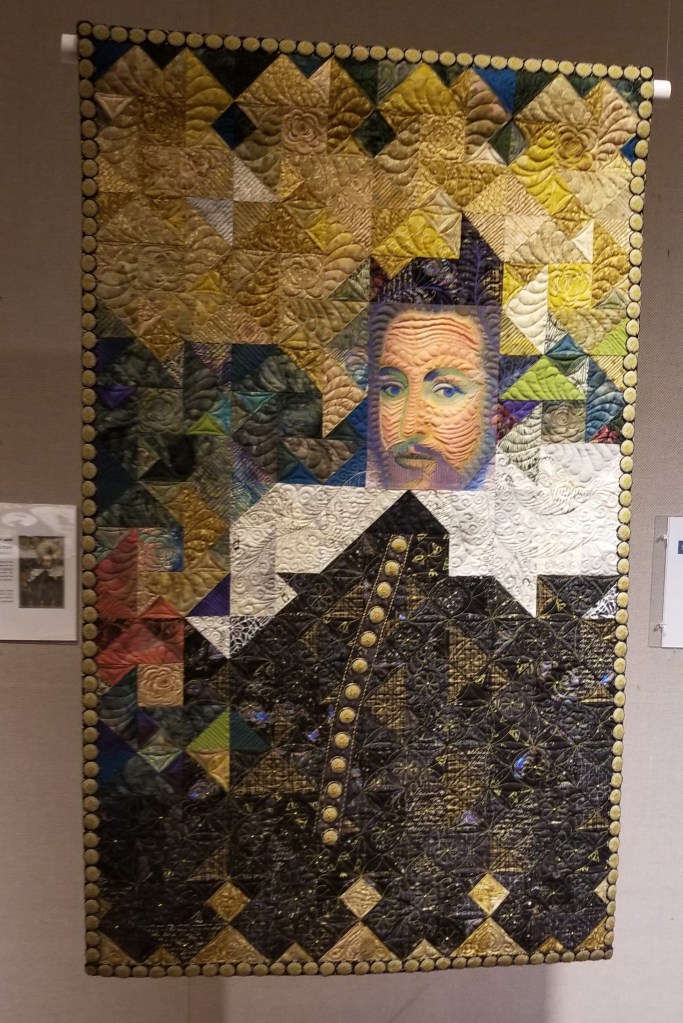
Harlingen Arts and Heritage Museum was also near our park. They had a quilt show in their exhibition area. The quilt show had a Shakespearean theme and this quilt was inspired by the bard himself.
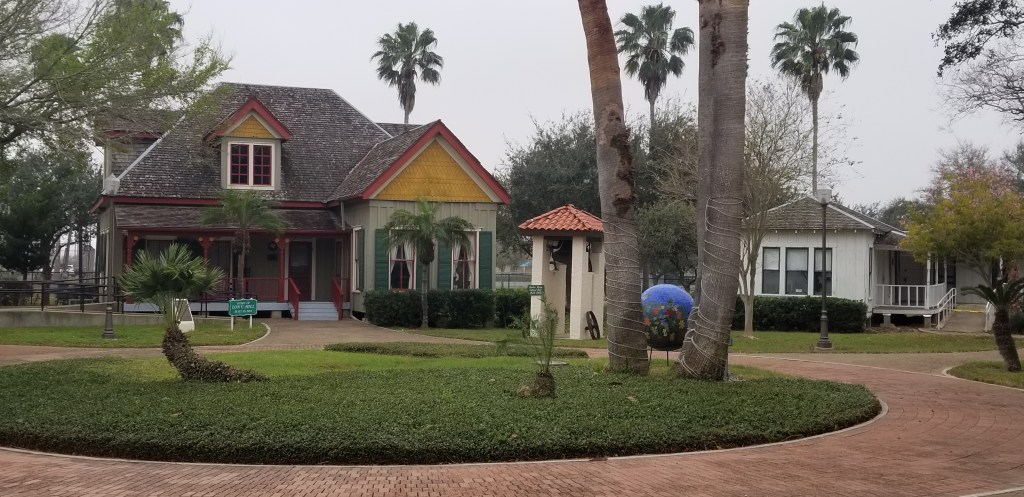
Stepping outside the exhibit and entrance, we could see the 1904 home of Lon C. Hill, along with other historic buildings. According to the museum brochure, Lon was a “lawyer, store keeper, hotel owner, farmer, sugar mill owner, developer, builder, brick kiln owner, canal builder, Statesman, pioneer and visionary.” What a busy guy! His wife died when he built the home, leaving him with eight children.
Len’s house is on the left
One of the things we love about Texas is being able to grocery shop at HEB. To me, it is the best grocery store chain of anywhere we have been. How can you complain about a store with a tortilla bakery? But what does the abbreviation mean?
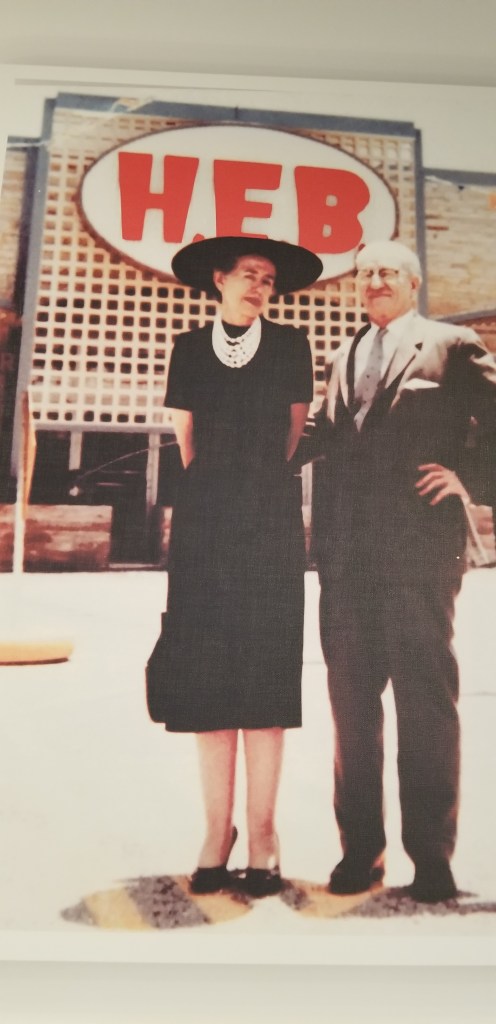
It is explained at the historical museum here. The H.E. Butt family donated the building housing the museum to the city back in 1967. Howard Edward Butt took over management of the family grocery store from his mother, Florence T. Butt, in 1919. She founded it and ran it for fourteen years, so why isn’t the store named for her? Well, that’s a mystery. Howard and his wife are in this somewhat grainy picture.
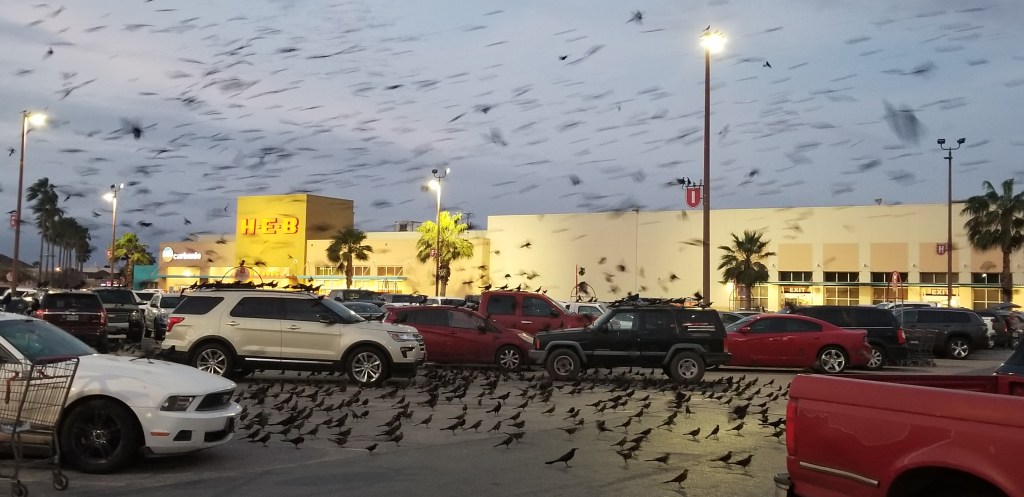
Shopping at our local HEB one evening, the grackles totally took over the parking lot. It was raining birds! We even saw the parking lot on the evening news the next night. It was the time of year when grackles come from where ever they are all day and congregate. I guess even grackles like to shop at HEB.
Speaking of birds, there are plenty of places to go see them in the valley. The area is part of the migration flyway for birds. We took a walk in Hugh Ramsey Nature Center in Harlingen and came upon a yellow-throated warbler that you can see in the branches below, keeping an eye on the two turtles below.
At the beginning of our Hugh Ramsey walk, we spotted a couple of javelinas in the underbrush. That was exciting, until at the end we found the whole herd!
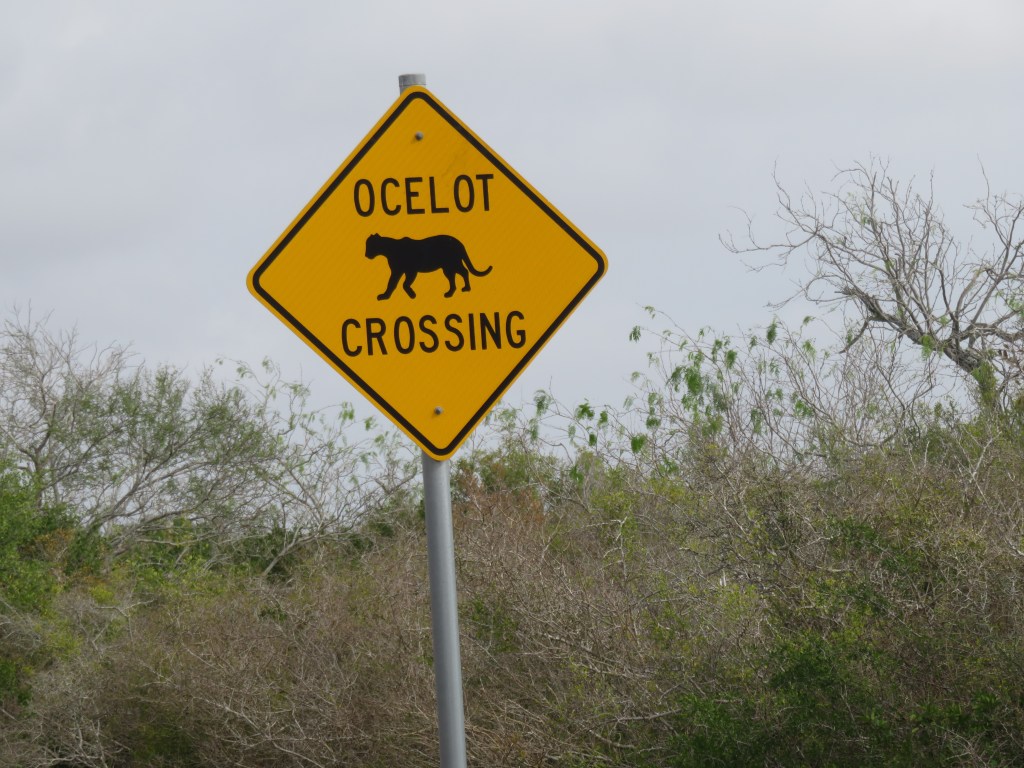
I hoped to find more wildlife at Laguna Atascosa National Wildlife Refuge, about 30 miles from our park and a place we walked twice. A sign at the beginning of the park road was promising:
I would have loved to see an ocelot, but I knew it would be a stretch. Much later, we watched a nature show about the wildlife of Texas and were able to see what this cute little cat looks like. Laguna Atascosa is only one of two of their remaining habitats in Texas, and only 100 are known to exist in the entire United States. This wildlife refuge is trying hard to encourage their reproduction but they have a lot of predators; it’s not an easy task for an ocelot mother to raise a kitten to adulthood.
A huge part of their mission is to provide habitat for wintering water birds, and other migratory birds. It is a bird watching destination for those who enjoy the hobby. We saw green jays at one of the feeding stations at Laguna Atascosa. I suppose if I wanted to be a serious bird watcher, I’d need to get to the refuge a little earlier in the day.
Most of this park is coastal wetlands. We did see egrets in the large lake here, and an alligator, but it was far in the distance.
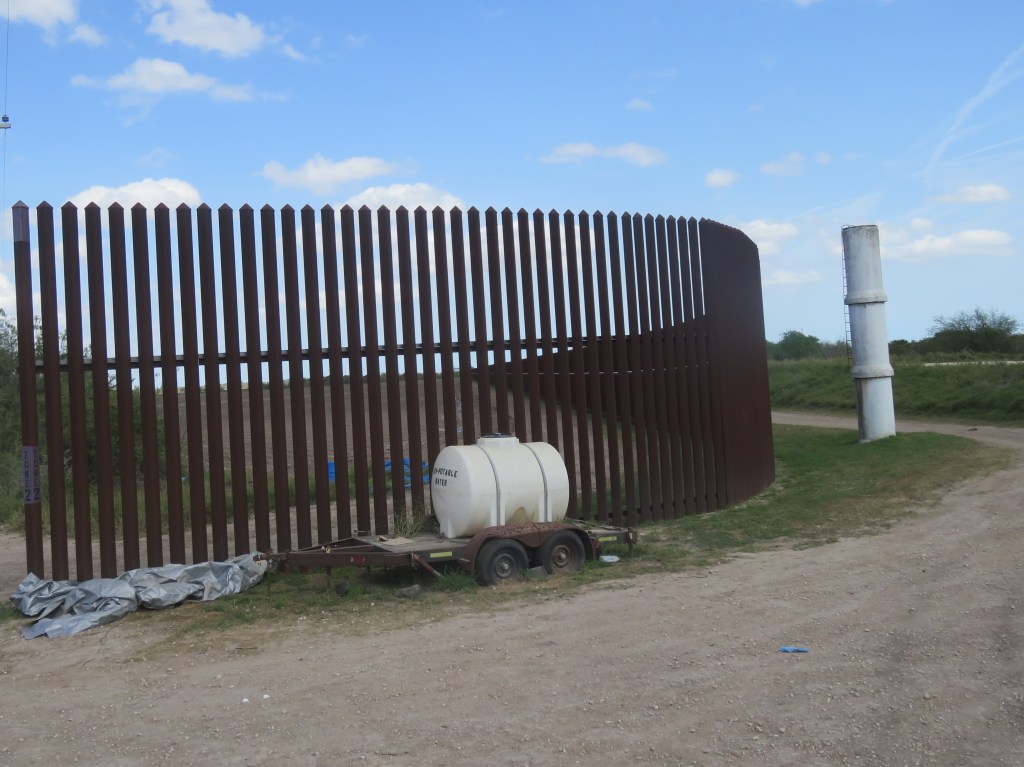
On another day we headed down to Sabal Palms Preserve, which is the last remaining stand of the great sabal palms that used to cover the area. An interesting part of visiting this preserve, as we discovered, is that it is right on the border with Mexico. We drove right past the fence.
Passing through this fence was a little confusing but somehow we were still in the United States. Two members of the National Guard were sitting on the levee by their truck as we passed. Sabal Palms closes right at 5:00 and the gates are then securely locked. There is plenty of illegal border activity here, as we later found out.
Long ago, before land was cleared for farming and there was no international border, there were about 60,000 acres of Sabal Palm forest along the Rio Grand River. Now there is less than 100 acres.
In my working days, I was thrilled when I vacationed somewhere during a long winter where I was able to see palm trees. Now I’m happy to see palm trees all winter long. They and other trees lined the beautiful trails in this park.
Part of the draw for Sabal Palms is the Rabb Plantation House. It was once part of Rancho San Tomas, which covered 20,000 acres. The house served as the headquarters for the ranch and was an architectural shift from typical ranch homes of the early 1900’s era. We were able to look around the first floor inside.
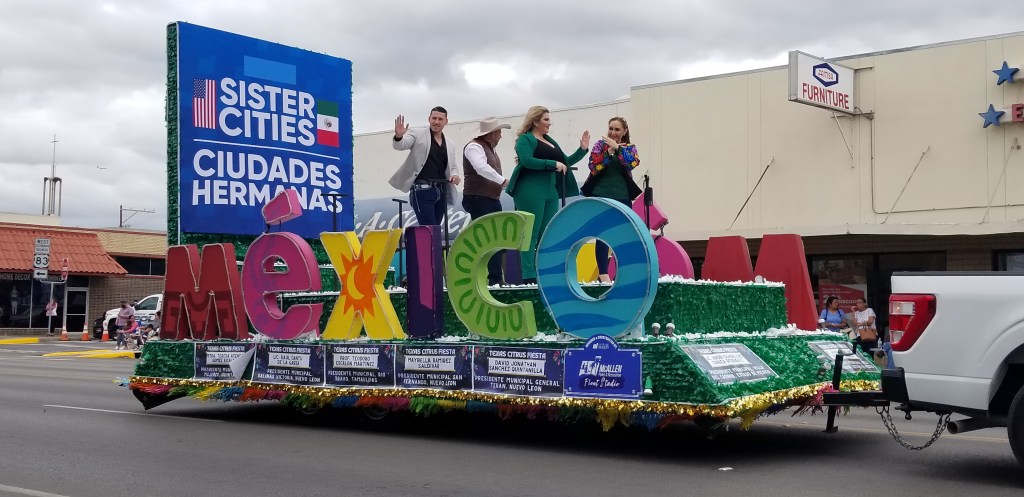
On one of our first Saturdays in the area we drove all the way past McAllen to Mission, on the west side of the RGV, for the Citrus Festival and Parade. It was good small town fun.
The best thing about the Citrus Festival was that we were able to buy two large bags of fresh citrus – one orange, one grapefruit – for $5.00. What a steal!
Harlingen still has a fairly vibrant old downtown, which was another thing that scored points with me. There is a smattering of thrift shops, antique malls, and other specialty shops, plus some eating establishments. Once a month on a Saturday, the streets are blocked off for Market Days. Vendors under their canopies line the streets. There is music and plenty of good Mexican and other food to be had, too.
I guess if one drawback can be given about the area, it is the wind. We learned to gauge the weather by very windy, not too windy, and not windy at all. I got used to it because I discovered I didn’t mind the wind as long as it was warm – which it usually was, even in the evenings.
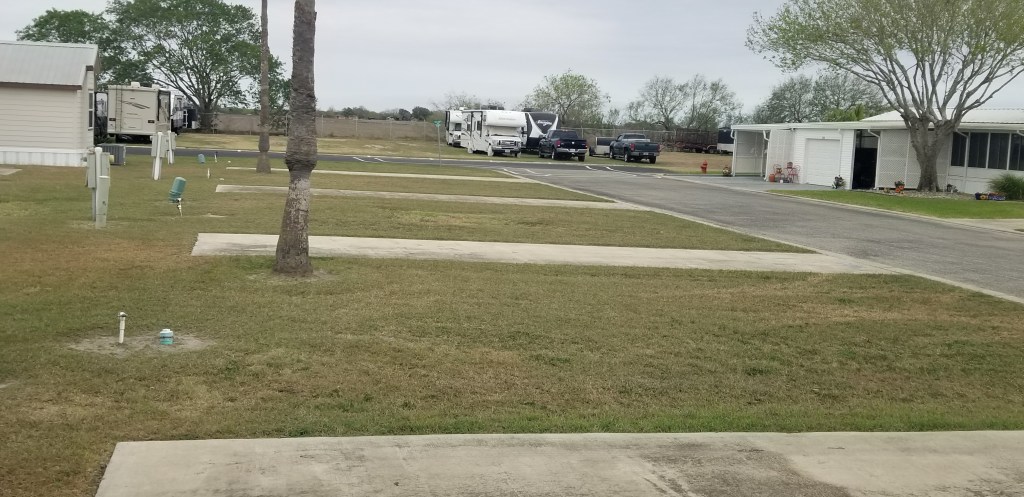
The sites next to us were empty most of the winter so we had a good back yard view. The park is bordered on three sides by farm land and it felt like being out in the country.
When we were at home in Tropic Winds, there were many things to do. I attended yoga and line dancing classes. Cal was outside a lot and chatted with all the neighbors around us. A fruit-and-vegetable truck showed up on Mondays. There were sometimes music concerts to listen to, and few special dinners. The spaghetti dinner put on by the woodworking group is a twice-annual event that everyone looks forward to. The spaghetti is delicious and prizes are handed out throughout the evening.
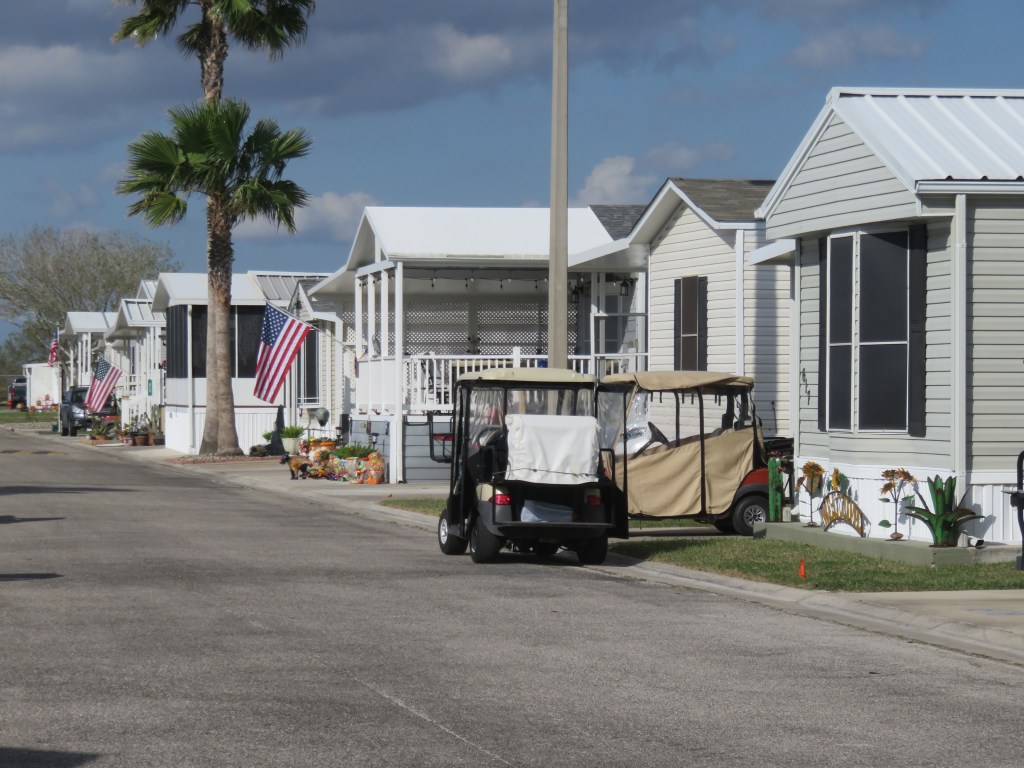
There are all kinds of ways to RV and we discovered last winter in Phoenix that settling down in a park like this for just a month or two during the winter gives us the community that we don’t have the rest of the year. The permanent park model and manufactured homes that lined the street across from our RV area made the place feel a little bit like the quintessential small town. As I walked the little streets I’d most always be greeted by everyone passing by, whether they were walking the dog or riding their bike or golf cart.
In the late afternoons, friends gather around RV sites, on front porches, or around someone’s golf cart when they are passing by.
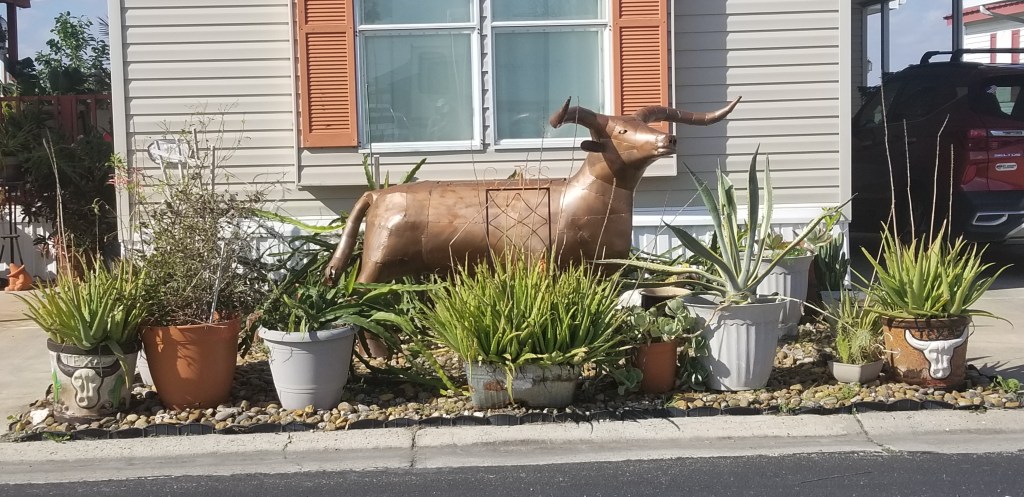
Everyone decorates their little home in their own particular style.
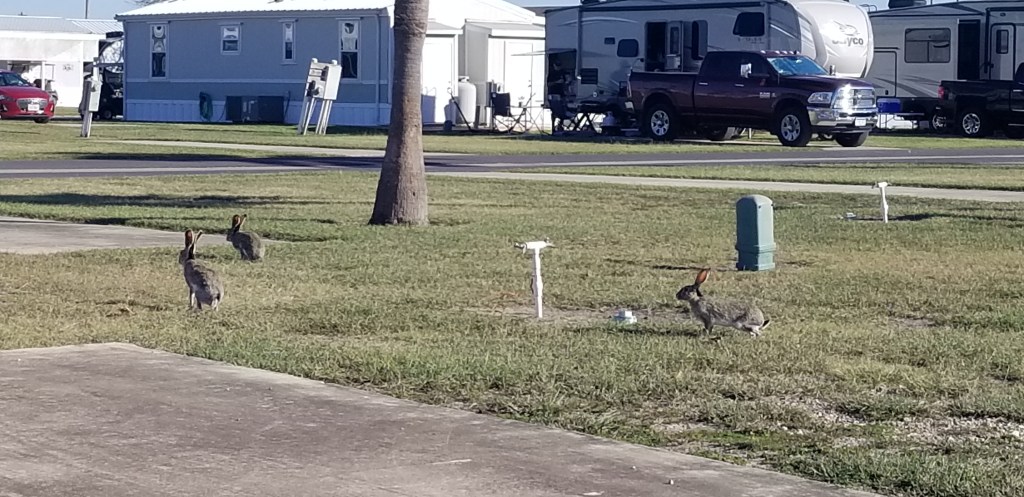
Jackrabbits make their home here, too. These RV sites were empty most of the winter and I always looked forward to seeing how many were out playing or basking in the sun.
Anywhere and any way you call it, there’s no place like home.
The day after we arrived at our winter spot in Harlingen, our park activities department hosted a free doughnuts and coffee morning. Not one to ever turn down a free doughnut, Cal set off to the main hall to take part. He disappeared for quite a while. Just when I was starting to wonder what happened, he returned with tickets for a 4 hour cruise, a Branson-style Kenny Rogers sound-alike concert by a gentleman named Rick McEwan, and a brochure for a tour to Mexico. Neither he nor I connected beforehand that it was an event where options for things to do for the winter were presented. It turned out to be an expensive doughnut!
Booking the actual date of the cruise with Osprey Cruises proved to be difficult because it was hard to find a day when the weather was optimal. That was part of the reason for the two-night stay in South Padre Island which was the subject of my last post. We were to cruise on the morning of the day we checked out of the hotel. The cruise leaves at 9AM and passengers are to arrive at 8:30, so we thought we would spare ourselves a long early morning drive. As it happened, though, it was more windy than usual that morning and a storm was predicted. The cruise company canceled the tour.
We finally found a good weather morning just over a week before our departure from Harlingen. We took off from the dock at Port Isabel–
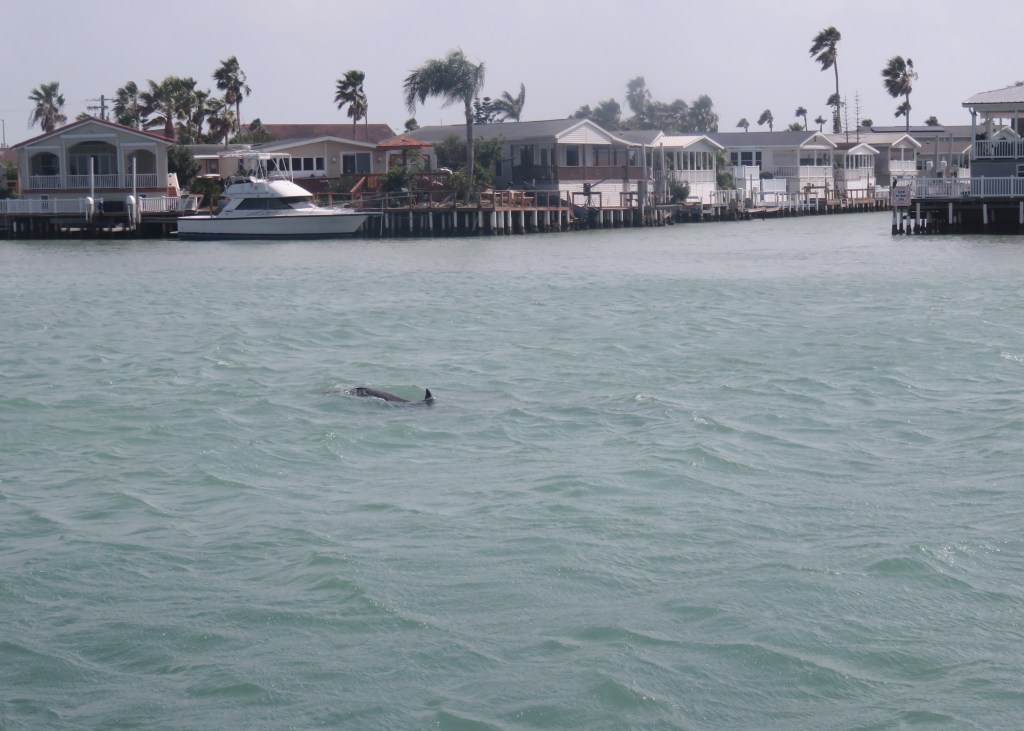
and cruised under the Causeway bridge through the Laguna Madre. It was so exciting to see dolphins for the first and only time on our visit to the Gulf. It’s hard to get good pictures of them, but you can see one in the picture below.
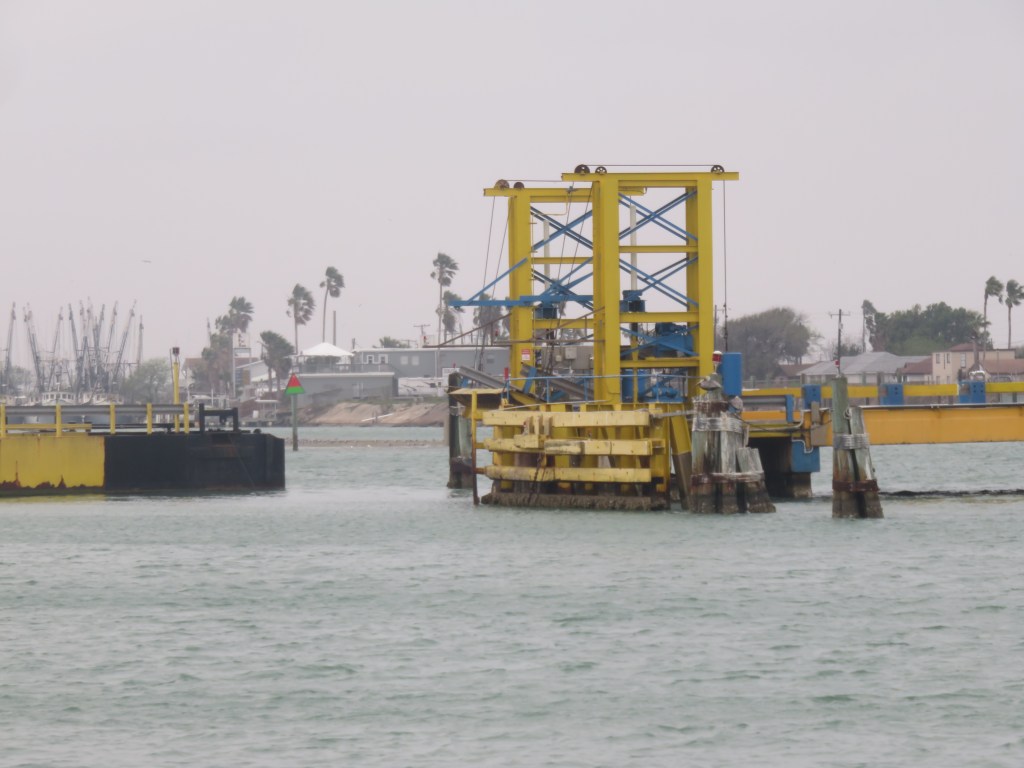
We went past a rotating bridge, which opened its gate for us.
And then, we were inside the Port of Brownsville waterway. The deepwater shipping channel is 17 miles long and 42 feet deep with 40,000 acres surrounding it. After we went through the bridge, the boat passed through miles of sand and brush. We could see a protected island that is prohibited for us humans to enter and it was full of bird life.
Many birds also filled the shore line.
We soon came to the shipping boneyard. Huge rectangles are cut out of the hulking ships. Those rectangles are cut and ground into steel pellets and reused.
There is currently even a military ship being scrapped. The Kittyhawk is one of the great diesel aircraft carriers built in the 60’s and the last to be decomissioned. It is here being taken apart bit by bit. I could still imagine the sailors waving on board the decks.
There is a lot of scrap to be processed. I enjoyed watching everyone hard at work while we just cruised on by.
There are little pretty little tugboats to be seen. I liked this one which reminded me of St. Joseph, Missouri, in the state I used to call home.
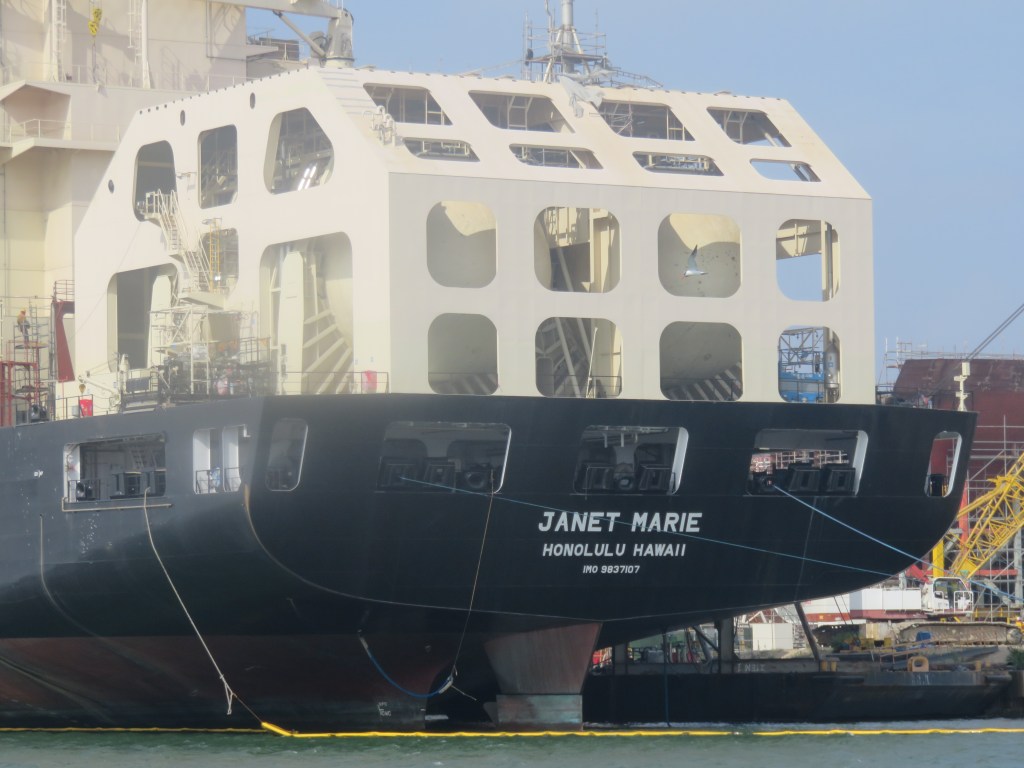
At the other end of vessel life, ships are being built here, too. This one will go to Hawaii. It is to be a container ship for a large shipping corporation there.
There are docking spots for ships to stop and unload goods or just to have a lay by. This ship holds the immense blades that will be installed on windmill farms.
It was time to visit the Brownsville Shrimp Basin. Shrimp boats need repairs, too, and some are in dry dock for that reason, or for a new coat of paint.
You would think that shrimp boats would be out catching shrimp on a workday, but many were docked as we went through the Basin. Currently, it is too expensive for the small-time operators to purchase gas. It costs about $75,000.00 to fill up the tank on a shrimp boat! It is hard to catch enough shrimp to recoup that cost.
And then, the Big Shrimp Handoff: we pulled in to Texas Gold Shrimp Company and two men were waiting there to hand us two big containers of shrimp. No sooner said than done, and we were off again.
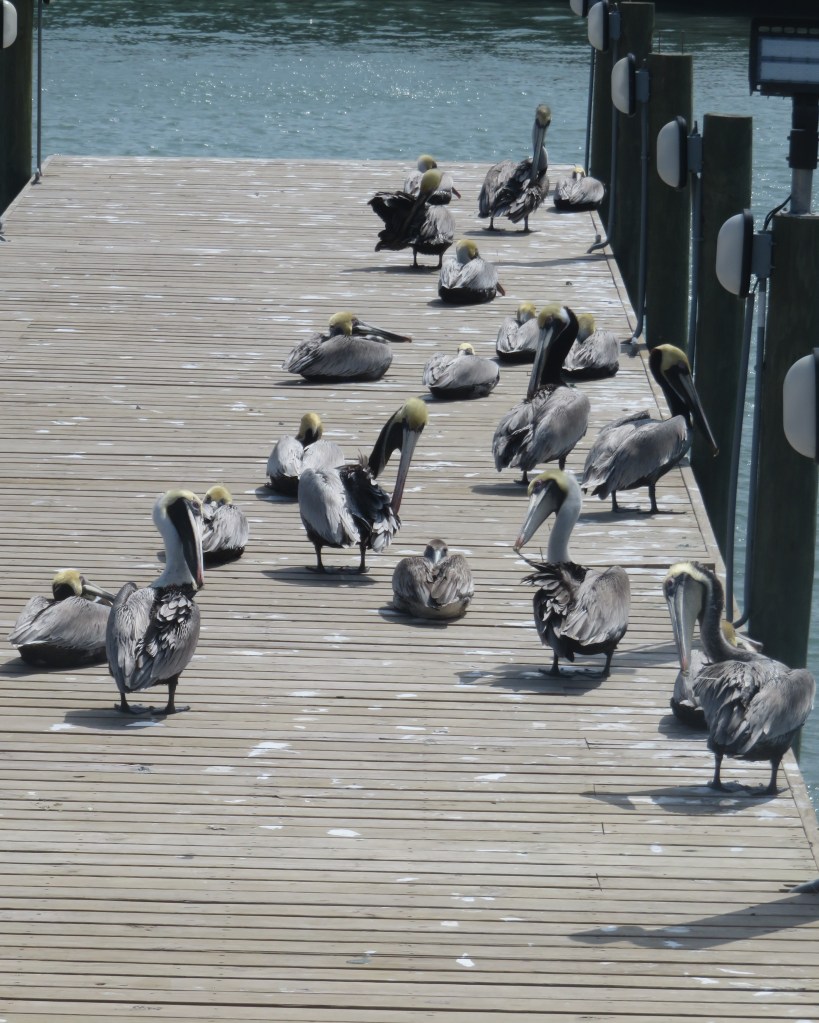
We caught all the action from the best seat in the house: the front of the boat. From our position, it felt like we were the only ones on the cruise. It was definitely windy, cool to start, and once in a while we were splashed, but we persevered and the morning warmed up as it went on. Going in and out of the shipping area, there was a long period where we were just sailing with nothing more special than sand and the sea to see. The captain stopped his narration at times to play 70’s music ( what I call Boomer Music). Going out I was munching a doughnut. Coming back I was tucking into a nice bowl of peel and eat shrimp with a cup of pina colada. The dolphins were playing again, and pelicans awaited our return at the dock. Could life get any better than that?
Oh, and the Rick McEwan concert? He was great, and we enjoyed our evening very much.
Next time – about that brochure for a tour to Mexico…
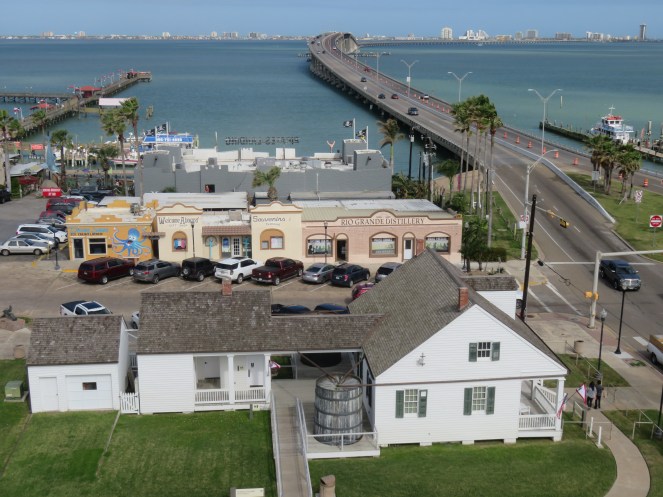
Port Isabel and the Queen Isabella Causeway leading to South Padre Island, as seen from Port Isabel Lighthouse
During our Texas stay, we made three trips down to South Padre. On our first, Cal had the brilliant idea of staying a couple of nights so we could be here for more than just one day. It didn’t take us long to get reservations booked after that suggestion. Our second visit, then, was our little mini vacation-away-from-our-permanent-vacation. The morning of the first day was our visit to Boca Chica that was in my previous blog.
South Padre Island lies just off the coast of extreme south Texas. The water in between the mainland and the island is part of the Intracoastal Waterway which goes all the way around the Gulf to the Mississippi River at New Orleans. It is also the southern part of the Laguna Madre, a long and shallow lagoon. Port Isabel is the last town before the bridge to the island.
We stopped at Port Isabel Lighthouse just before getting on the bridge.
Construction on the lighthouse was completed and lamps were lit in 1853. There was a period of stoppage during the Civil War. During that time, both sides used the lighthouse for observation. The last battle of the Civil War happened near here, more than a month after Lee’s surrender at Appomattox.
We climbed up 75 stairs and 3 ladders before we arrived at the top. There we were rewarded with the view that you see at the beginning of this blog. It was also interesting to get a look at the multifaceted lens. For those interested in such details, it is a reproduction of a 3rd Order Fresnel Lens. It was installed just this past December so that the lighthouse was lit for the first time in 117 years at that time. That must have been a sight to see!
Being able to stay on the island meant that we didn’t need to get up super early to get a good start on our day. We visited South Padre Island Birding Center. This was an excellent stop. We started in their museum, which was mostly a very cute and adorable collection of baby alligators and turtles. Directly outside were some adult versions of the same. These animals are not able to be rehabilitated in the wild so they make their home here.
Big Padre and his little buddy
There were about a half mile of boardwalks over fifty acres of wetlands, with many various birds that could be seen.
An egret on a fishing expedition
From the boardwalk, we could look over the salt marsh, and down into the shallow waters where we could see the reason for the assortment of birds – there was an abundance of fish in all sizes.
The interesting thing about the Laguna Madre is that it is hypersaline, meaning that it is saltier than the ocean. There are only five other lagoons like it in the world. The water evaporates faster than freshwater flows into it because of the dry climate, its shallowness, and the fact that it has no significant river source.
A gathering of ducks and roseate spoonbills
Right next door to the birding center is Sea Turtle Inc., which is a refuge and hospital for sea turtles. South Padre Island is a nesting hotspot for Kemp’s Ridley turtles. The center also has several Green turtles. In 2022, they were able to rehabilitate and release 89 turtles, and protect 7,403 hatchlings. We were able to see large tanks of turtles who were not able to be released back into the wild.
Gerry, an Atlantic Green, who is a permanent resident
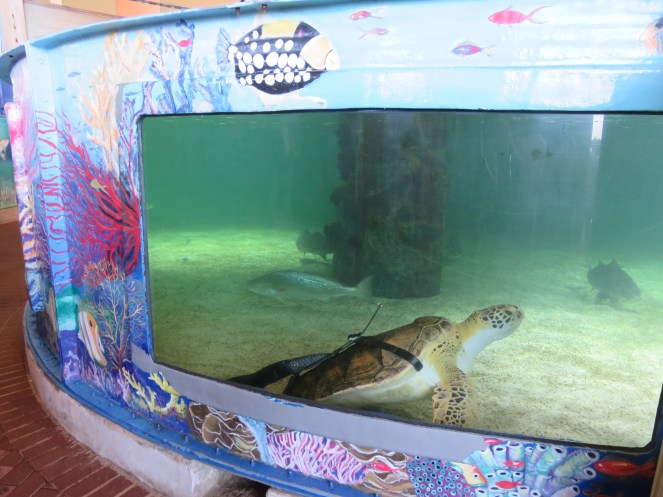
I was impressed at their ingenuity in giving the turtle below a new lease on life. Allison was missing three out of four of her flippers due to a predator attack, and all she could do was swim in left circles. The staff at the rehab center rigged up a brace so she can swim freely, although she cannot be released back into the wild.
Their hospital is under a tent while a brand new facility is under construction. They have smaller tanks in the hospital for those turtles who are still in states of rehabilitation. When it is exceptionally cold, sea turtles become cold-stunned. They are then weak and inactive, floating to the surface and washing up on the island. There is only a short period of time when they can be rescued. This past December a cold period happened where the organization rescued many turtles, and we saw five in the hospital which were still not yet ready to be released back into the wild from that event.
On our final trip out to South Padre we went out to the rock jetty where most of the turtles are found. It is on the very southern tip of the island in Isla Blanca County Park. It extends way out to sea. We did not see any turtles, but near the jetty is this statue:
It is a memorial to fisherman lost at sea. If you look closely on the left, you will see a grounded weather balloon.
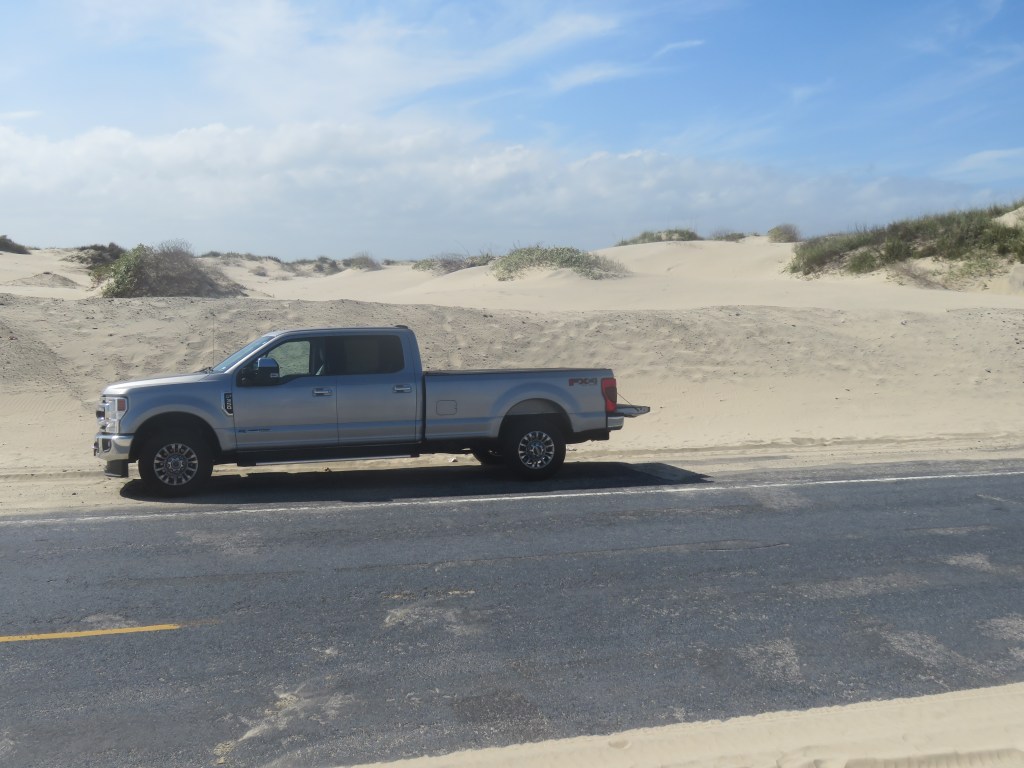
Certainly, the main thing about going to the island is the beach! Driving all the way north of the island, the hotels and condos recede into the rearview mirror, and all that’s left is the dunes and the sea. That’s just the way it ought to be. The road just ends. You can drive on the beach and we could have turned around and headed to the last beach access, but that would have been too easy. We just parked the truck and hiked through the dunes with our Subway sandwiches and lawn chairs.
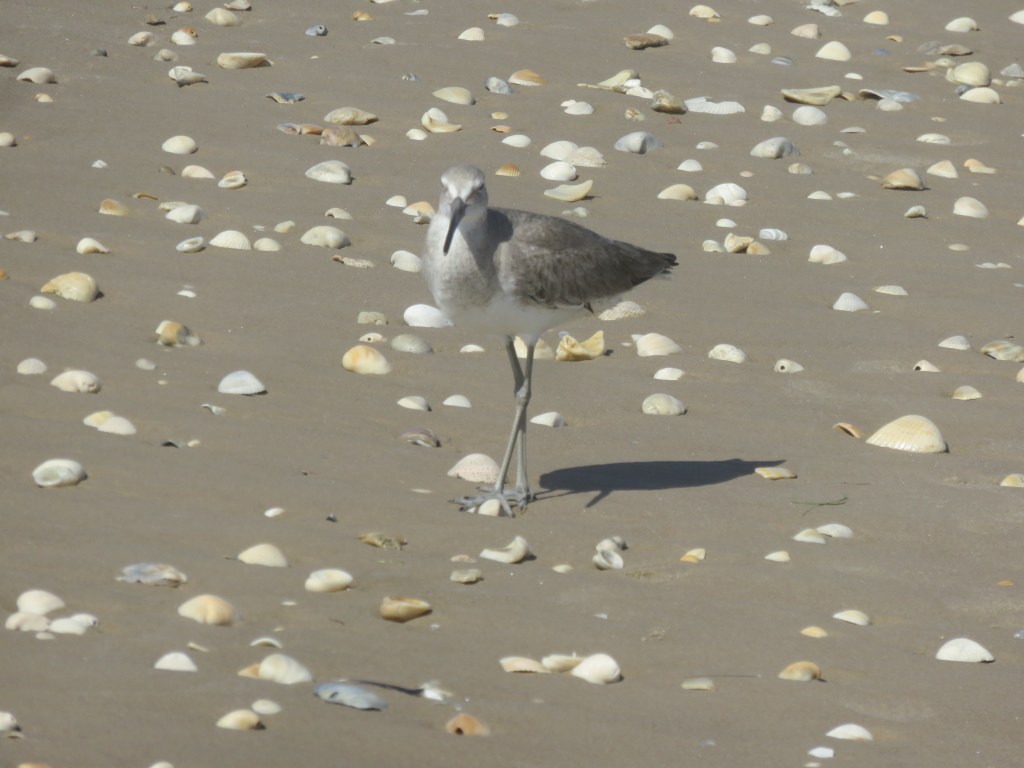
This friendly little bird led the way for quite a while on my beach walk
Next time – a cruise through the Port of Brownsville
An almost-two month stay from January to March in Harlingen, Texas offered several opportunities for trips down to the Gulf of Mexico. The area lies at the southernmost tip of Texas. From our park, it was an hour drive. On our second trip in that direction, we headed to the nature preserve at Boca Chica Beach. You can’t go any further south in Texas, or the United States, on the Gulf than Boca Chica.
Rocket launch fans would know this area as the home of SpaceX. Indeed, as we headed down the road toward Boca Chica, we couldn’t miss seeing the rockets sitting in place. There are days that SpaceX closes the road for a launch or to move their rockets around. We didn’t know that we should have checked first to see if the road was open, so I guess we were lucky that we could pass through.
I took the picture on top from our truck as we were driving by.
Then, further down the road, another site:
The road ends at Boca Chica Beach. The beach itself is drivable. A right turn from the road’s end, and there you are. I was conflicted about SpaceX. On the one hand it is exciting and interesting to see. On the other hand, I didn’t like seeing it from an otherwise pristine beach that had been all natural until they arrived.
SpaceX as seen from the beach
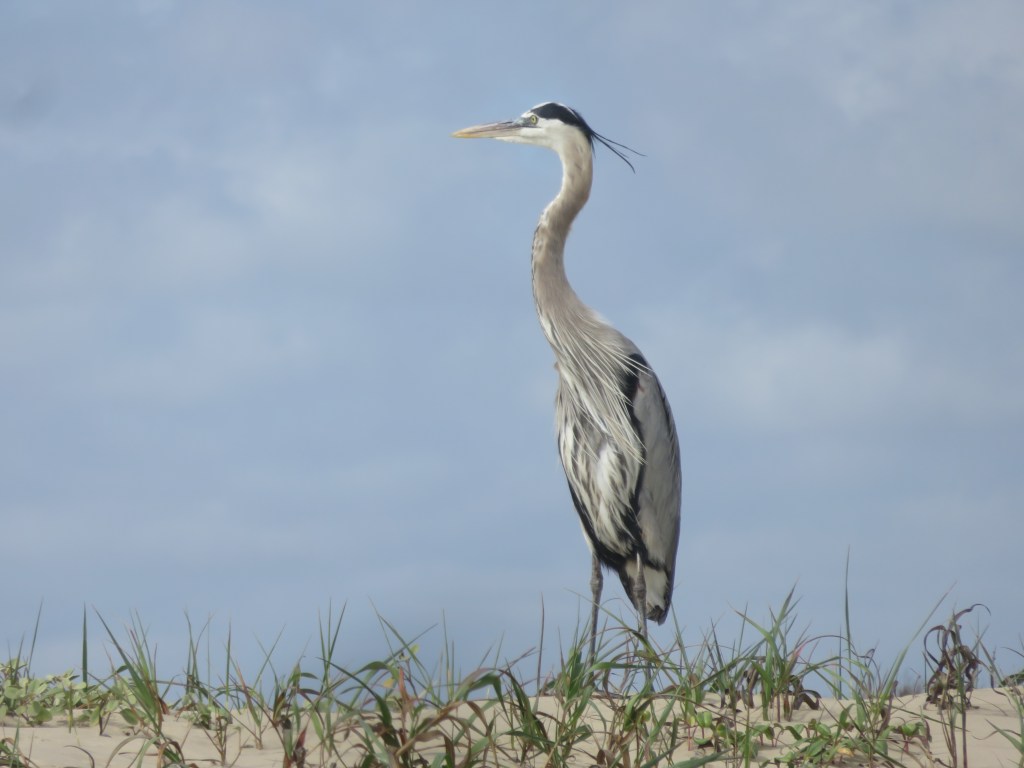
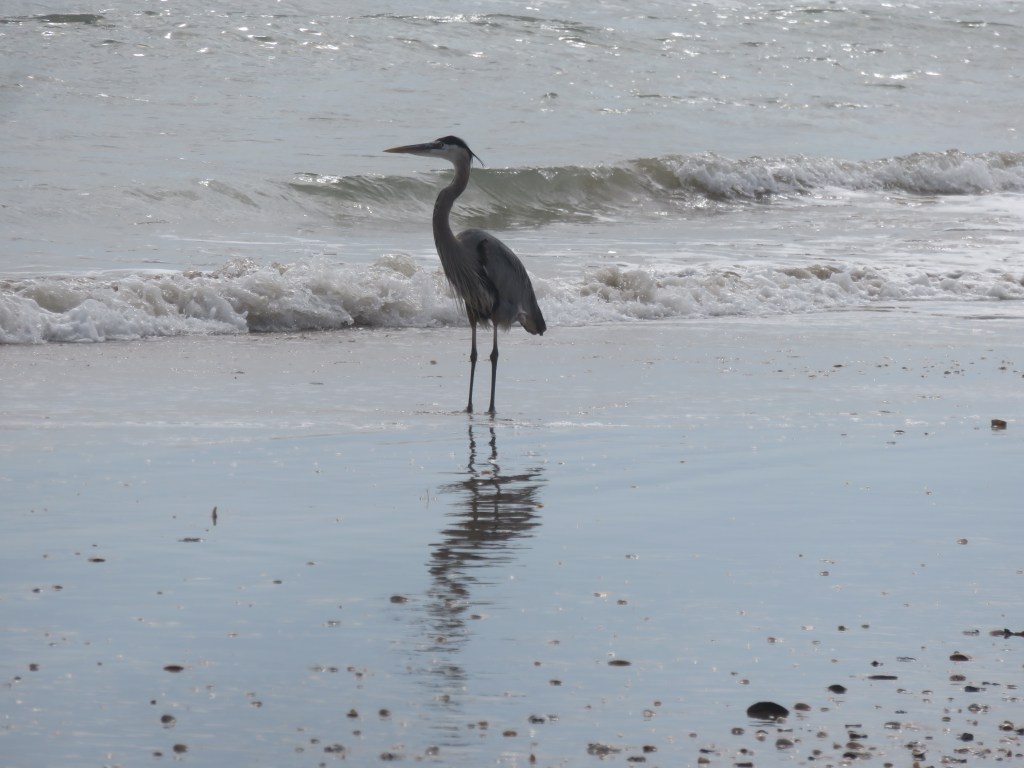
I turned my back to it and just enjoyed the beach. A great blue heron stood sentinel, as if to reassure me that all was still okay in his world.
There were long stretches of beach that were deserted except for the birds:
We talked to some park rangers who were congregated for a chat. They informed us that if we drove further down the beach we would see a lighthouse. Off we went, and thankfully left SpaceX in the distance behind us. It was about a mile or two down, and once we arrived, we found people again.
I must have missed something the rangers said (or they assumed we knew), because the lighthouse is in Mexico. And here is the mouth of the Rio Grande. It never ceases to amaze me how many times we cross paths with this river. The lighthouse is off in the distance, but you may be able to see it in this picture.
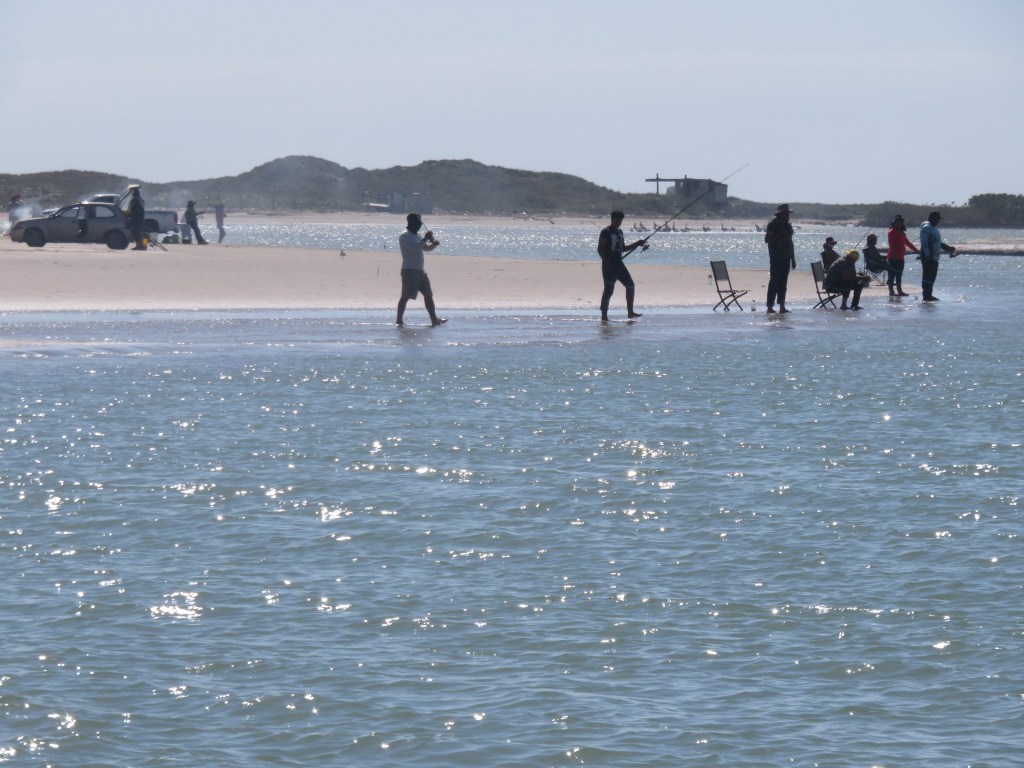
The Rio Grande makes its way west in the picture below. The river is very deep where it meets the ocean; the fishing must be good.
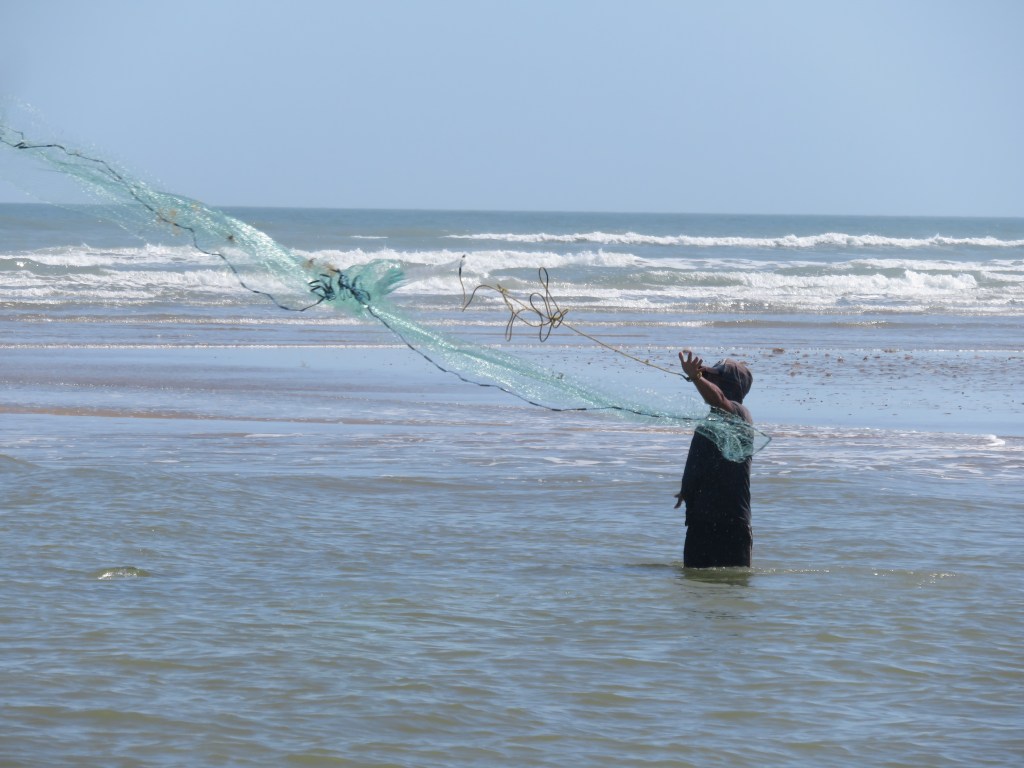
A fisherman casting his net
A pair of pelicans observed the action from the American side. The land right up to the river is still part of the Boca Chica Wildlife Refuge.
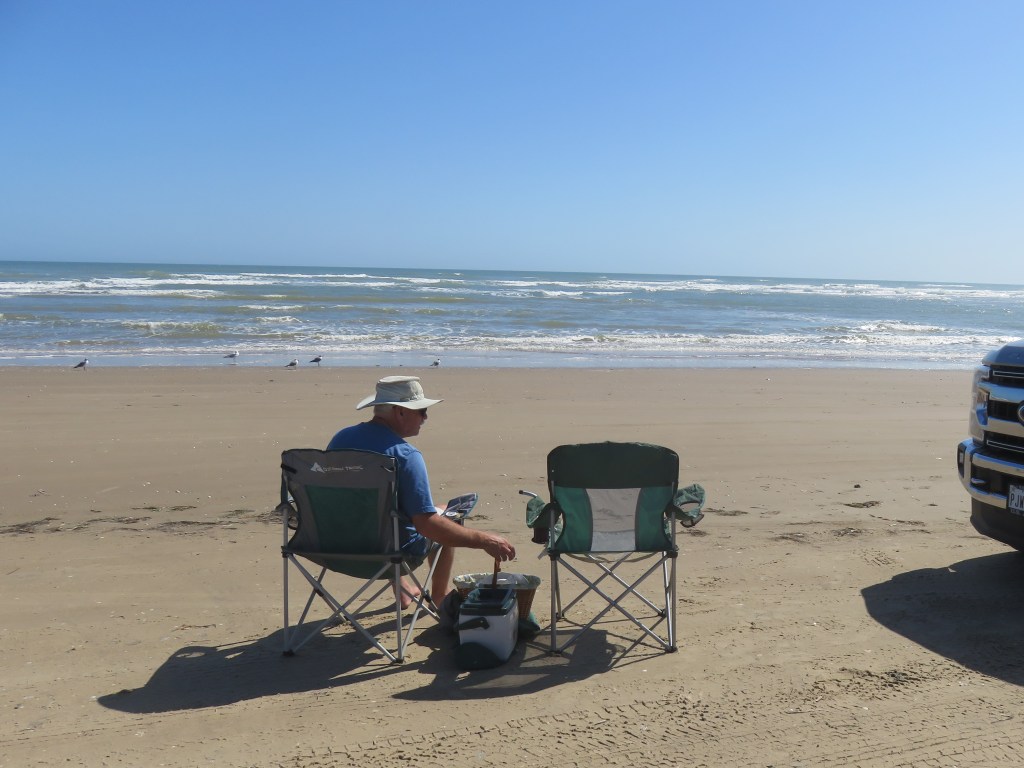
We had a picnic lunch on the beach before making our way out to further adventures. It had been a great beach morning at Boca Chica.
Life is good.
I was going to put all of our Boca Chica and South Padre adventures in one blog, but it would have proved to be very long. Our Boca Chica morning was part of a trip to South Padre Island. That will be for next time!
As luck (for me) would have it, my sister moved to New Orleans a couple of years ago to live with her oldest, Kat. I’ve always wanted to go to Mardi Gras there, so I put a trip for Mardi Gras in my plans, and my daughter Katie agreed to come with me. We had booked our AirBnb a year before the trip and it was only a couple of blocks away from my sister. Planning is everything.
I had a lot to learn about going there for Mardi Gras. First of all, there is not one or two parades, but multiple parades going on all over the area throughout the weeks leading up to the day before Ash Wednesday, the beginning of Lent. There are sometimes several parades in one day, with one parade leading the next. The Uptown parades are walkable from my sister’s house. We did not go to the French Quarter parades, or even set foot in the French Quarter on this trip. Both Katie and I had been there before.
Kat advised us not to come on the final weekend of Mardi Gras, which was a huge surprise to me. The crowds are massive and the cost of everything is higher. With Southwest Airlines not behaving as it used to, we may have had more difficulty with our flights. Both Katie and I were glad that we followed her advice.
On Friday night, our first night, we were down on the street after dinner and it was around 11:30 PM before we left. I didn’t even notice the time passing! It was pure fun to watch, wave at the people on the floats, and try to catch whatever they threw down. I got socked in the nose with a massive wad of beads and I didn’t even mind. Well, not too much.
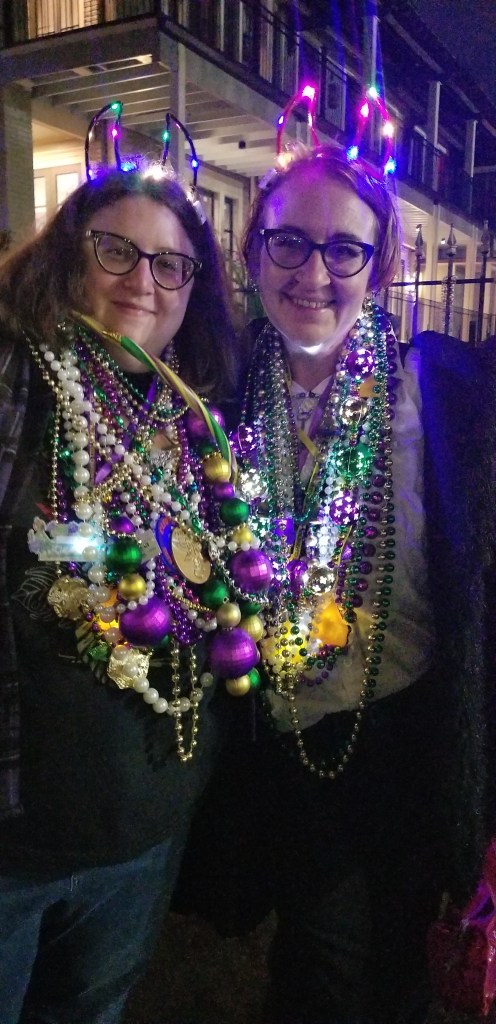
By the end of the night, we’d had quite a haul. Katie and Kat are here modeling their beads, and Katie (on the left) is also wearing her new hula hoop. I was wearing quite a few beads myself.
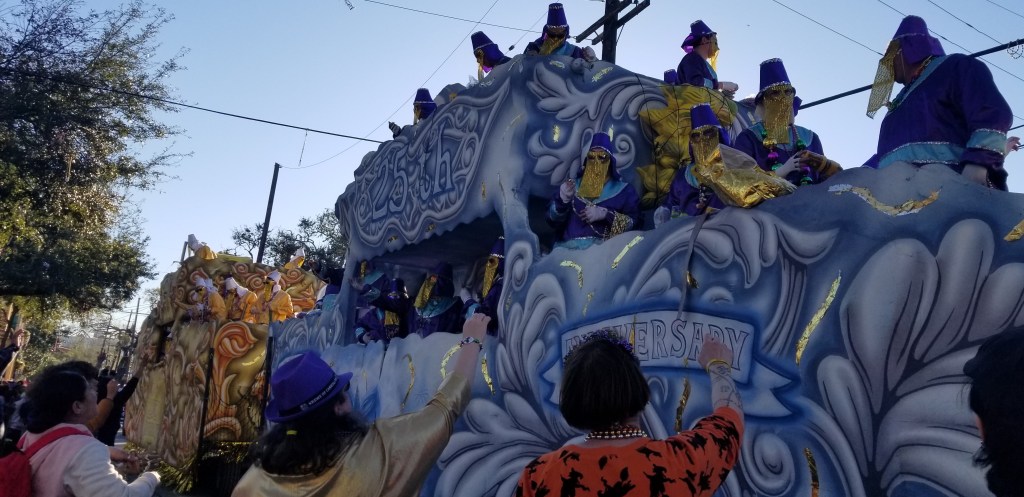
The goodies that the floats toss out are called “throws”. The beads are just a start, and some of those may have various decorations or lights on them. Katie received some very nice glass beads, plus three hula hoops throughout the weekend. There are also hats and headbands, sunglasses, cups of all sorts (New Orleans dinnerware), bubbles and toys, Kleenex and chapstick, balls and frisbees, bags of snacks, stuffed animals, and other odd things like a manicure set and a bamboo spear with feathers and a rubber tip. I’m sure I’m forgetting something. The people on the floats keep an eye out for the kids, and will try to throw them the nicest toys. It would be fun to be a kid at a Mardi Gras parade.
Katie’s treasures, and this was after just the first evening.
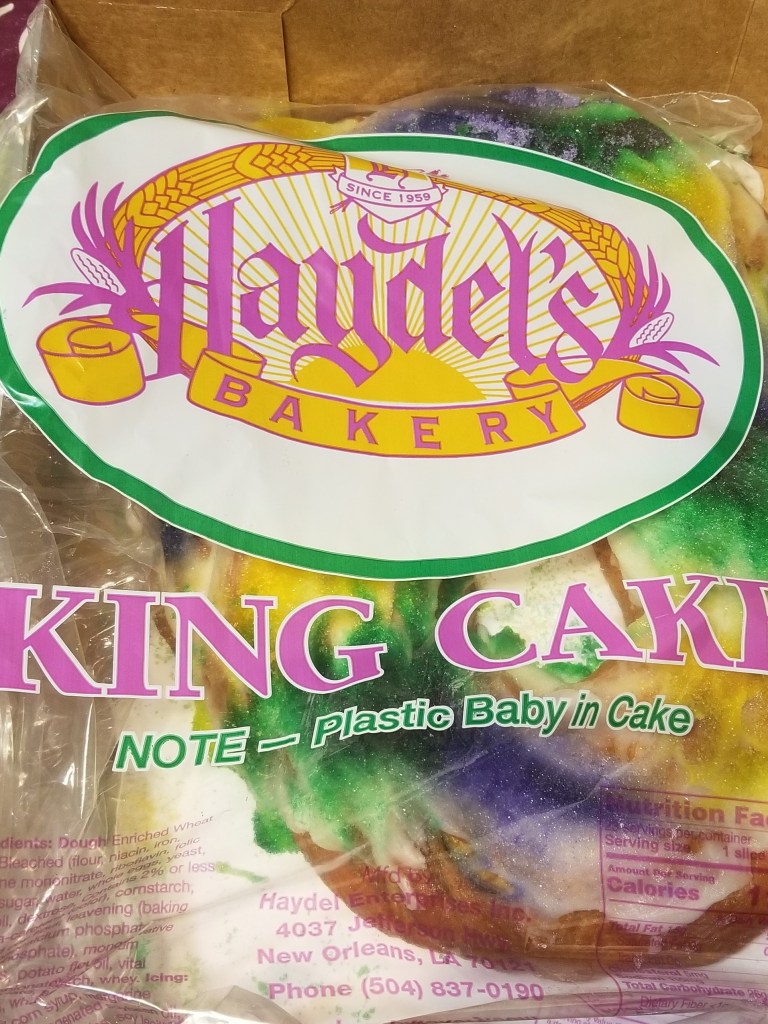
It wasn’t time for bed yet after the parades. We had to have a bite of King Cake back at the house first.
Haydels is one of the best bakeries in New Orleans to purchase your King Cake. It is a blend of coffee cake and cinnamon roll.
The name comes from the Biblical three wise men who brought gifts for the baby Jesus. Traditionally, King Cake is eaten between January 6, the day of their visit, to the eve of Mardi Gras, the day before Ash Wednesday. A baby is placed inside the cake. Supposedly if you find the baby in your piece, you will have good luck and will be “king” for the day. I also heard another version in New Orleans, which is that you have to buy the next King Cake. My piece of cake had the baby! I don’t know when I will be back to buy everyone another cake.
We watched just one parade on Saturday afternoon. I enjoyed that one because the groups in each float were the military, police, veterans, EMT, and firefighters organizations. Some of the groups were interesting, such as the Women of the Armed Forces and World War II veterans. I didn’t see any veterans on the float, though. They are all probably too old to be riding around on a float by now.
An EMT float in Saturday’s parade
Saturday was cold, and by the time this parade was over, it was starting to drizzle. Another parade was coming, but we abandoned it in favor of a coffee shop, and then found some little shops to explore over on Magazine Street. Strangely enough, we found a small Alligator Museum. It is one man’s lifetime collection of all things alligator. You could purchase your own little alligator in the gift shop.
Also found on Magazine Street:
And a homage to Mardi Gras:
A nice warm bowl of pho at a Vietnamese restaurant, Pho Tran, was wonderful in this weather.
On Sunday we were back out on the parade route on St. Charles with lawn chairs, lunch, and empty bags to hold our throws. The day was sunny and as it warmed up as it went on.
There was even a float where you could toss your beads or hoops back, if you didn’t want them:
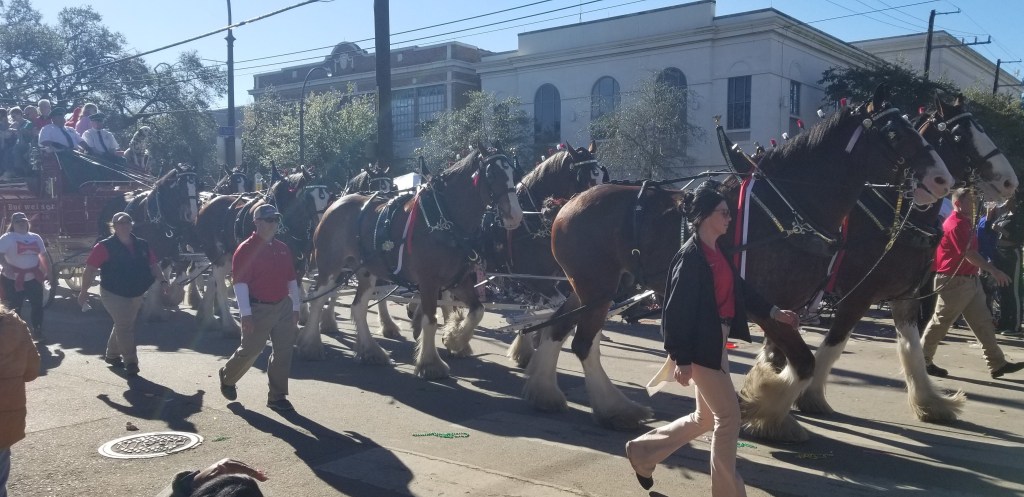
Having lived in St. Louis for so long, I was excited when the Clydesdales and the Budweiser beer wagon came along.
Of course, no parade would be complete without marching bands, pom squads, and twirlers. There were plenty of those. You could even get your own group together, put on some crazy costumes and dance music, and boogie down the street.
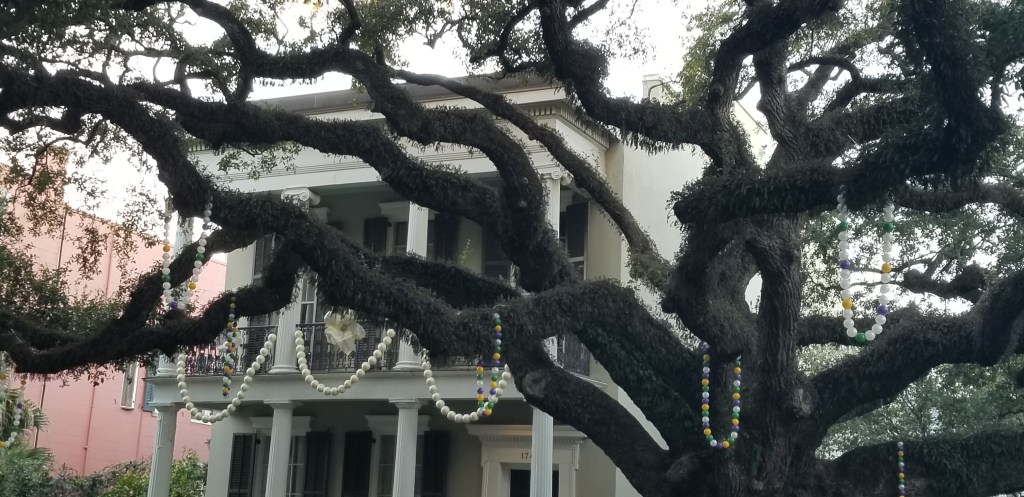
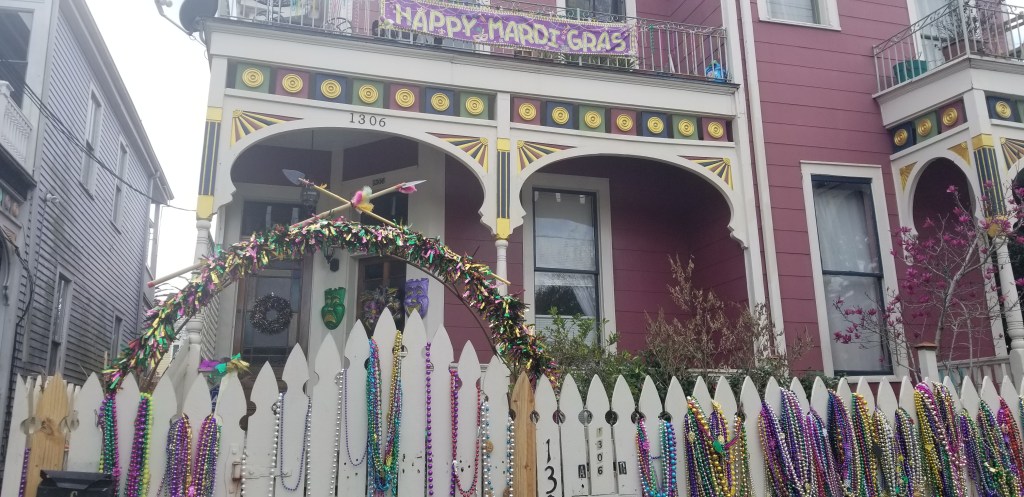
Even the houses and trees in New Orleans dress up in their beads for Mardi Gras:
We had a little time on our last day in New Orleans, so we Uber’d over to the Riverfront Mall for a beignet at one of Cafe DuMonde’s satellite coffee shops. There, we also got a look at the Mississippi River and strolled through some of the stores.
Our destination this morning, though, was Mardi Gras World, and from the mall it was a short walk. My sister and I had a picture taken next to this handsome gentleman in the waiting area:
Mardi Gras World is a working studio where most of the Mardi Gras floats are made. Several generations of the Kern family have been creating them since 1932. It has been open for many years so that everyone can get a behind-the-scenes look. First we were shown a short movie about Mardi Gras and the studios. We were given a slice of King Cake since it was Mardi Gras week – hooray! The tour then proceeded to the warehouse and studio.
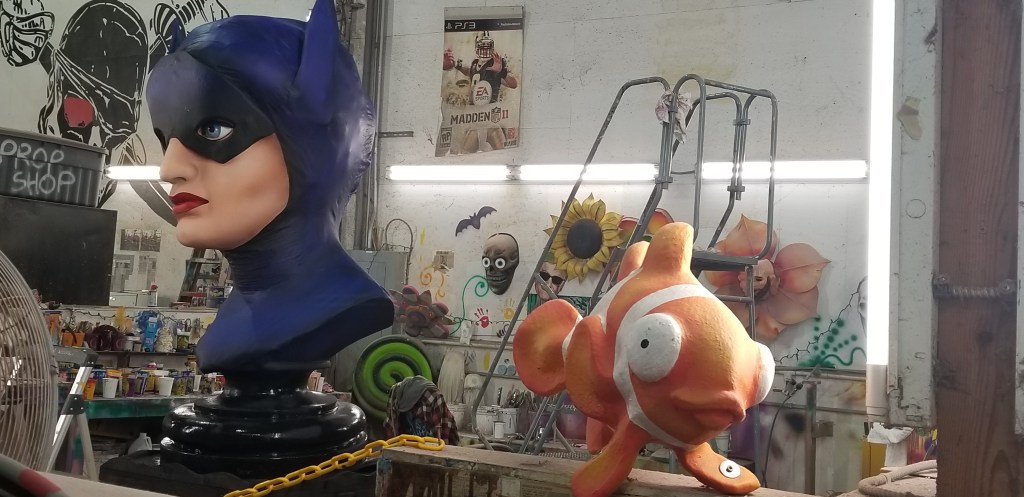
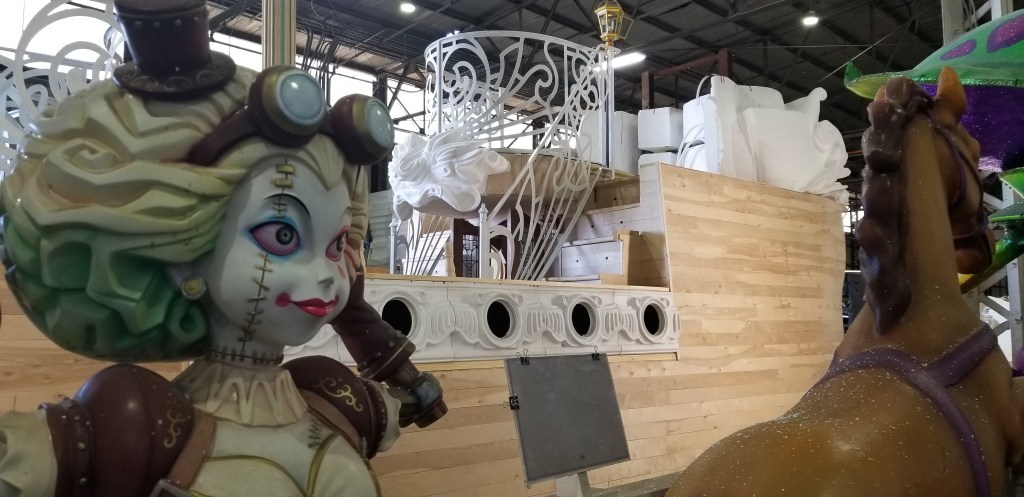
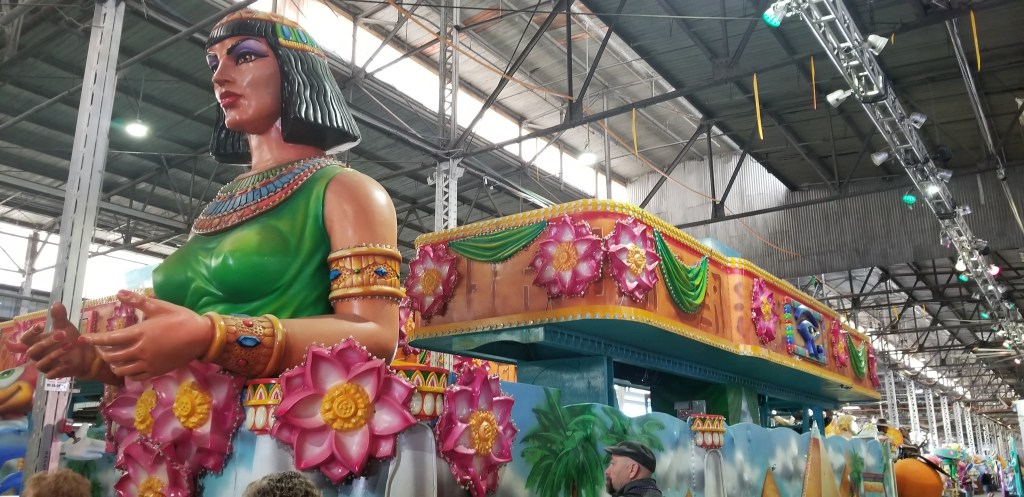
Inside were floats aplenty in all stages of construction. The various decorations on a float are called “props”. A float prop is pictured at the top of this blog, and there are a couple of small ones below:
The props are made with layers of styrofoam which are glued together with insulation foam. The prop artist will carve it into shape, and then it is decorated. A prop can be redecorated several times, as the head above has been.
Behindthe props is a float in progress
There are also props and floats that are made from fiberglass and reused unchanged every year. We had seen this one on the parade route, from the Krewe of Cleopatra, and it was already in the warehouse for next year.
Plenty of props in all phases of construction
A New Orleans Krewe is a social group. Krewes are a New Orleans tradition that go back all the way to 1856. Mistick Krew of Comus was the first one, and it still exists. A Krewe creates the parade and also has a ball. It can cost a lot of money just to join a Krewe. The group needs the funds to purchase all of the throws, which can run into the thousands of dollars. Besides Cleopatra, on Friday night we had seen the Krewe of Oshun and the Krewe of Alla parades.
I have heard that the French Quarter parades can get a little rowdy. The streets are narrow and the crowds can press in. The Uptown parades which we attended are more family friendly. For us, it was nice that we could just walk a few blocks down to the parade route whenever we wanted to go.
Now that we are in the season of Lent, the parades are over in New Orleans. But you can be sure that everyone is already working on next year’s parades. Fat Tuesday is February 13, 2024. It will be early in the year, so dress warm if you come!
Next time – across the Gulf to Boca Chica Beach and SpaceX
It’s time to hit the road and head off from El Paso all the way across Texas to our winter spot in Harlingen Texas. Is the truck hitched? Slides in? Stairs up? Let’s go!
Out of El Paso, the mountains were close by for quite awhile, but they gradually faded into distance. The terrain is rugged here. We saw plenty of buttes, strange rock formations, and miles upon miles of open, parched land.
I should maybe have titled this blog “Four for the road”, because there were actually four overnight stops along the way, but our first was at Fort Stockton RV Park. It’s right off the highway and is primarily an overnight stop for RVers crisscrossing the state before or after the long open stretch of west Texas. There are things to do here, but we always say: “Next time!” They do have a handy little restaurant which served us up a good breakfast.
The road entered some pretty hills and valleys of the southwest corner of the Texas Hill country. Our second stop was outside of Junction, Texas for two overnights at Pecan Valley RV. This is a lovely, quiet place just behind a pecan farm. The owners of this park have had it for just a handful of years. They own just two rows of the pecan orchard. The park is a large oval with nothing but grass in the middle of the oval, and RV spaces under plenty of trees ringing just half of the outsides of the loop. There were four sites next to ours, although there were more down the road, and for a blessed twenty-four hours we had no neighbors close by.
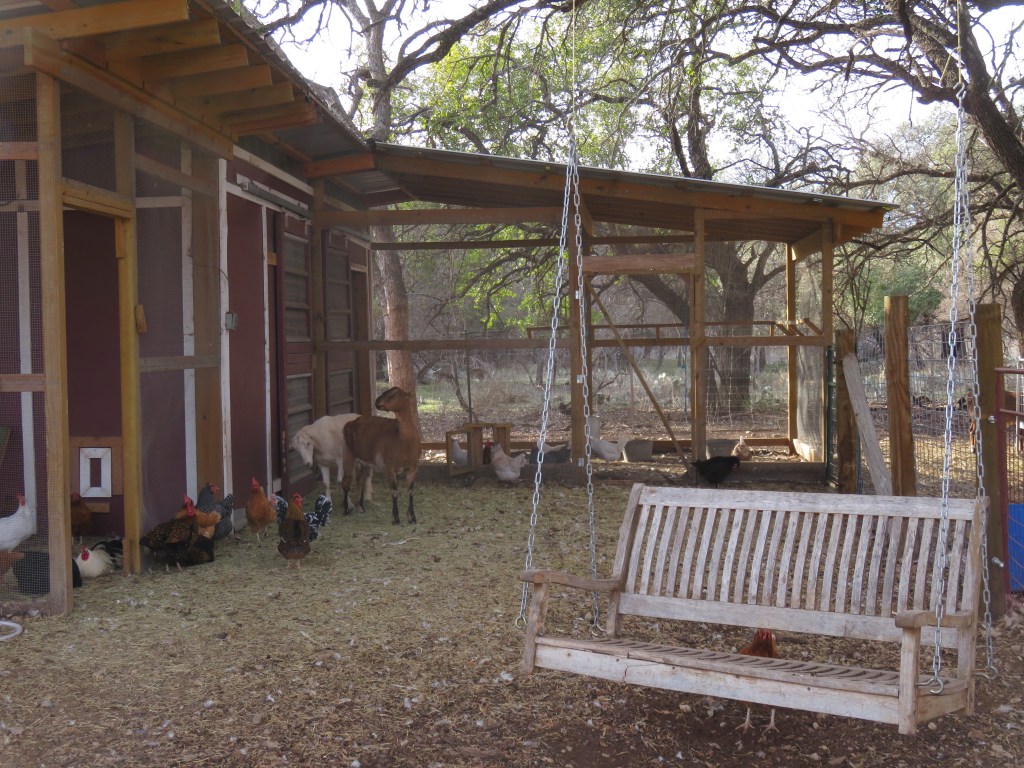
A pecan wagon-turned-chicken coop, with our RV in the background, at Pecan Valley
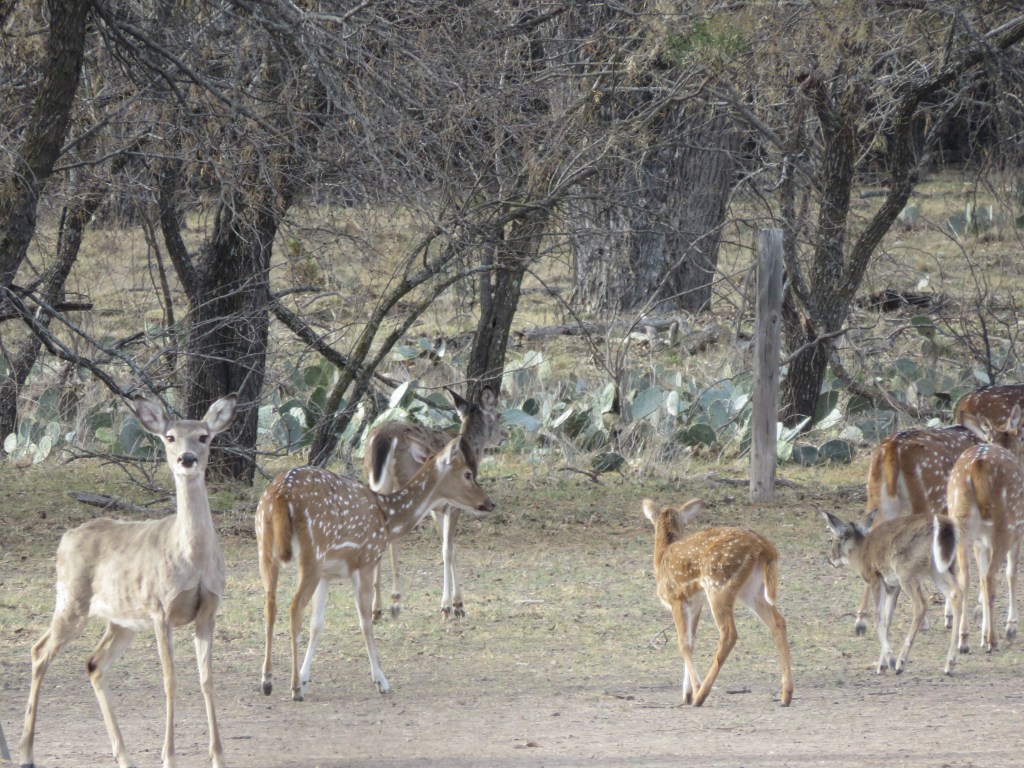
There are deer to be seen at any time wandering around. In a little farm area, there are chickens and goats. Many of the chickens were free ranging and came to pay us a visit. Thanks to those chickens, we were able to buy a dozen multi-hued eggs.
The South Llano River is just a short walk from the goat and chicken pen. The river is what makes this park popular in the summer. Besides swimming, people enjoy rafting, kayaking or tubing. In all of its history, the river has never run dry, although with today’s climate change it does get very low in the heat of summer.
We had a full day to rest up here, so we went over to South Llano River State Park for a hike. At this park there is a large protected area where about 800 turkeys make their home. The turkeys are easily scared off, so visiting their roost is not encouraged. We hiked the Overlook Trail, which, after spending time in the Southwest, was an easy trail up for us. We were even surprised on our hike by an armadillo scurrying into the underbrush. It moved too quickly for a picture.
Cal is appreciating a bench at the overlook. The flat, treed area below the overlook is the turkey roost.
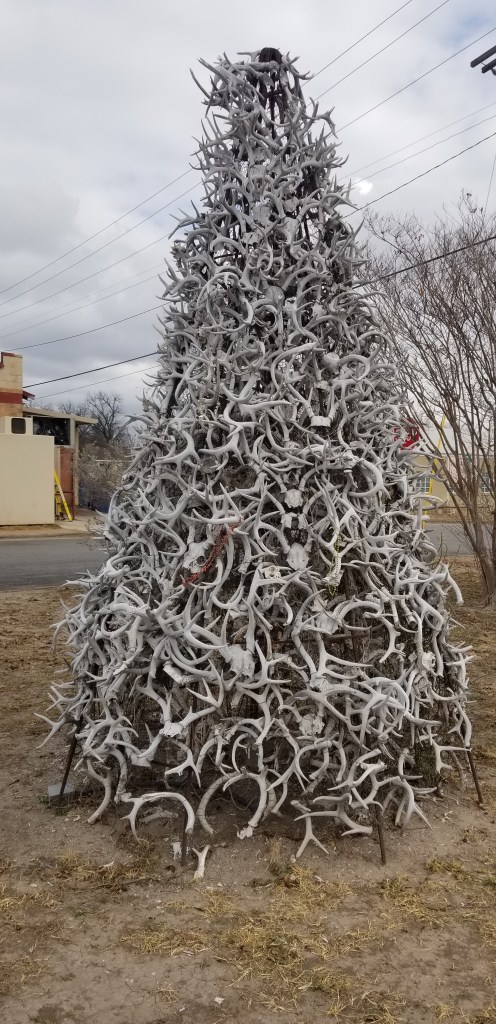
Junction’s single claim to fame is this antler tree, put up by the Women’s Club in 1968.
The Llano river is a bonus to the beauty of this area. I would like to be here when the trees bud again. We’re familiar with Texas Hill country and it was a good feeling to be back.
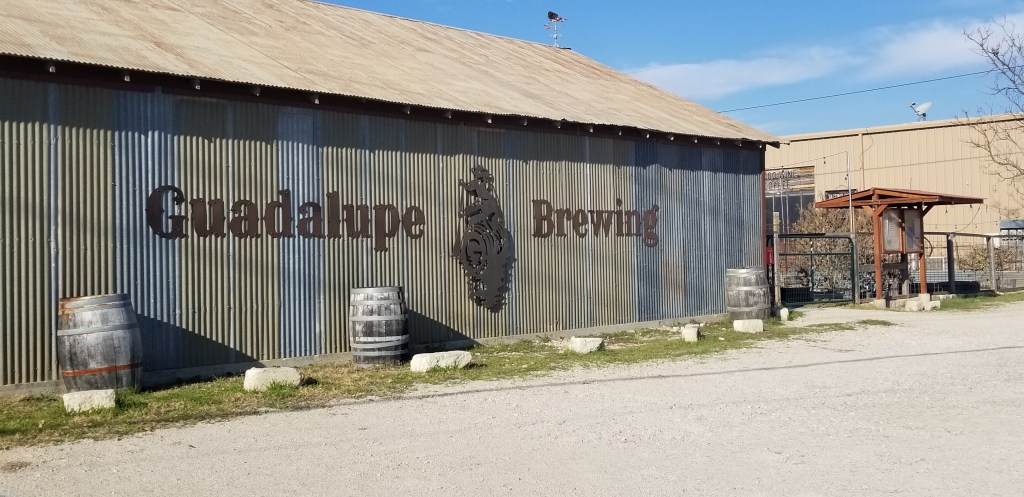
A short 140-mile drive took us further east to Guadalupe Brewing Company in New Braunfels. Since they are a Harvest Host location, we stayed a night in their back parking lot.
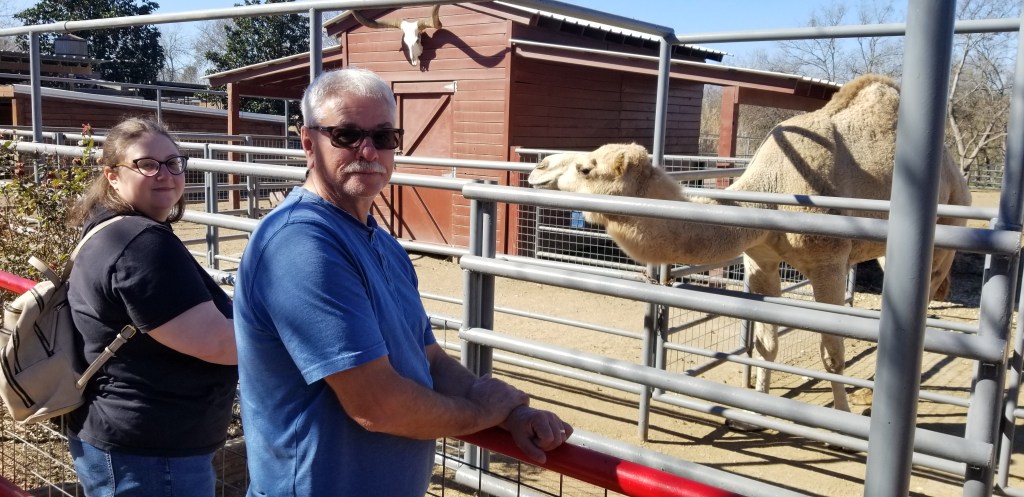
A surprise for this stop was that our daughter Katie, who lives in Austin, decided to come down and join us for the day. She always has ideas for different and fun things to do, so after getting set up at Guadalupe we headed off in her car. First stop: Animal World and Snake Farm Zoo. At first glance, this place looks like a tourist trap off the Interstate. But once inside, we discovered an interesting little zoo with a variety of well-cared-for animals, birds, and a good assortment of snakes.
I don’t think I’d like to meet this reticulated python out in the wild!
We also had cups of food to feed a multitude of goats with many cute little kids.
New Braunfels is but one of the German heritage towns that dot this area of the Texas hill country. We walked the little downtown area. All of the busy activity on this Sunday afternoon concentrated on their large Biergarten with Hofbrau beer on tap. Instead, though, we roamed the city streets, checked out an antique mall, and visited the little train depot. If you are ever in New Braunfels in November, you can enjoy their popular Wurstfest.
We needed to patronize Guadalupe Brewing for our stay, so we headed back. They had a full selection of beers to choose from. I’m not really a fan of beer, but Cal is, so we sampled three small glasses. My favorite was their Texas Honey Ale, which is described as “a blonde ale enriched with Texas honey”. Even the description sounds delicious. They also make a good pizza, and dinner was in order. That was a fun day!
Leaving New Braunfels, we pointed Sam and Frodo due south in earnest. It was getting warmer. Putting San Antonio behind us, we were on new-to-us territory. Our last stop: Lake Corpus Christi State Park. It is about forty miles to the east from the city for which it is named. Once we set up, I just sat at our picnic table and enjoyed the warmth and the cardinals singing and flying over us.
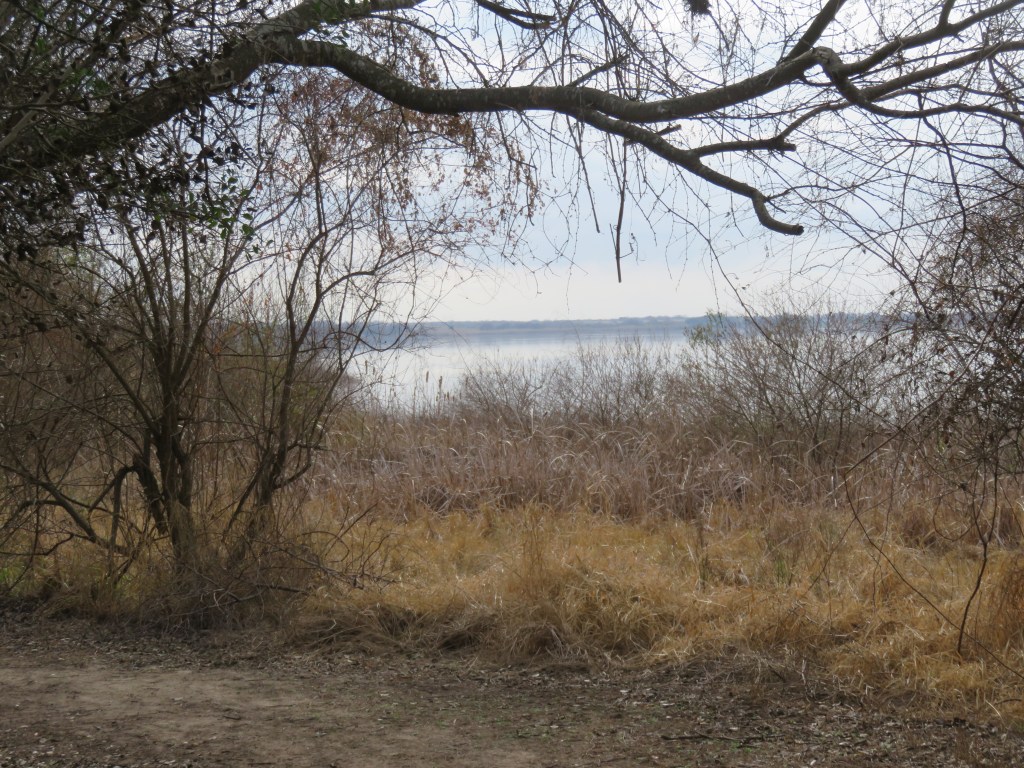
I hiked a mile long loop trail. Cactus on the the ground were interspersed with deciduous trees with no leaves, and here and there was a palmetto or a palm tree. The trail finally opened up onto the lake.
I missed getting an excellent photo that evening, though. We walked down to a large aluminum T-shaped fishing pier in the late afternoon and caught the setting sun over the lake. The sunset was amazing. It was a walk where we were just “going exploring”, and I had left my phone and camera behind. You’ll just have to take my word for it that it was spectacular.
Traveling further south, we entered a coastal plain with low vegetation, more cactus and very little sign of human life. We had about 140 miles still to go from Lake Corpus Christi. Once near Harlingen, civilization returned. Harlingen is in the northeast part of the Rio Grande Valley, an area that also includes Brownsville and south Padre Island to the southeast and McAllen and Mission on the west. It is at the very bottom of Texas, so once again, we are not far from Mexico.
I’ll leave you here for now while we make some new memories. I’m going to pick up my Europe blogs again for three or four weeks. Do you remember my question from way back in November: what did I leave out of my Scottish blogs?
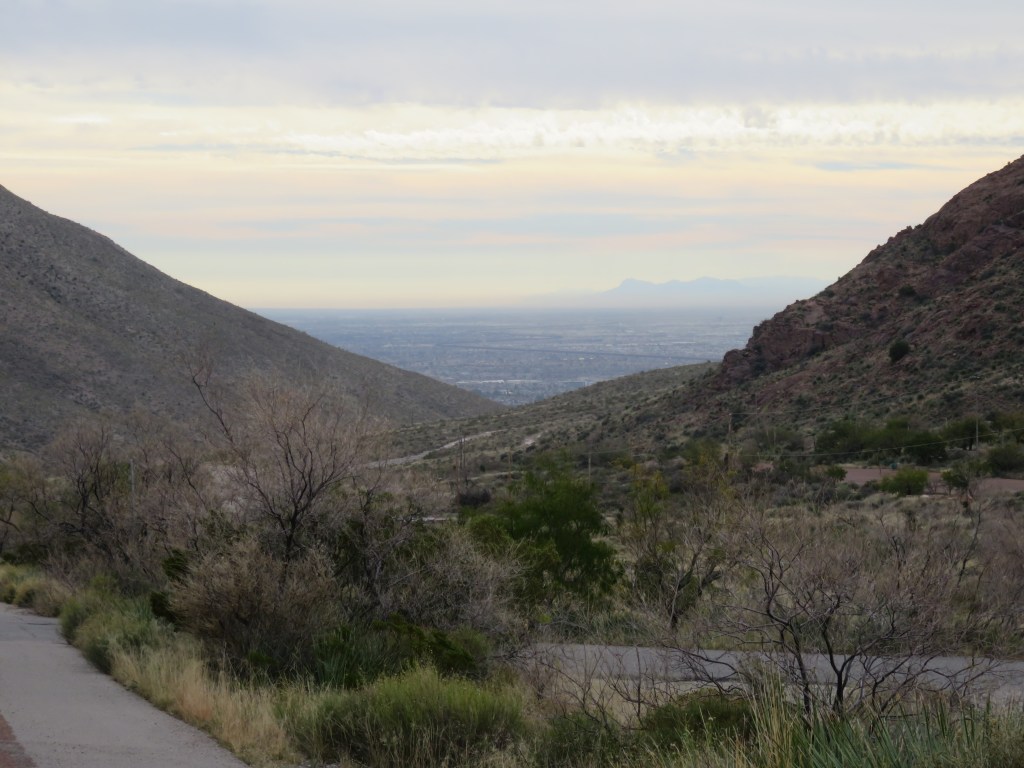
View of El Paso, with Juarez in the distance, from McKelligon Canyon
Huddled in our blankets in front of our fireplace in the cold November nights of New Mexico, we stalked the Weather Channel for a warmer place that would be still be a days driving distance from Denver. El Paso was consistently several degrees warmer. It’s a funny thing, too, because El Paso, Texas lies only approximately 50 miles to the south of Las Cruces, New Mexico. We knew where we had to go. We were going to go there anyway, but our arrival at our site in El Paso was about three weeks earlier than we originally planned.
At the very tip of the nose of Texas, on its far western side, lies the city of El Paso. Franklin Mountain rises up and pushes down into it like a thumb. The city has crept up and around the tip of that thumb. El Paso is limited in its growth southward by the Mexican city of Juarez, from which migrants poured during the months of November and December 2022. Driving along I-10 reveals a tale of two cities: Juarez, looking a little less prosperous and with a lining of smog along its mountainside, and El Paso, with its chain restaurants and hotels lining the expressway. If you look closely, you can see the immense border wall which snakes down and around, dividing Mexico and the United States.
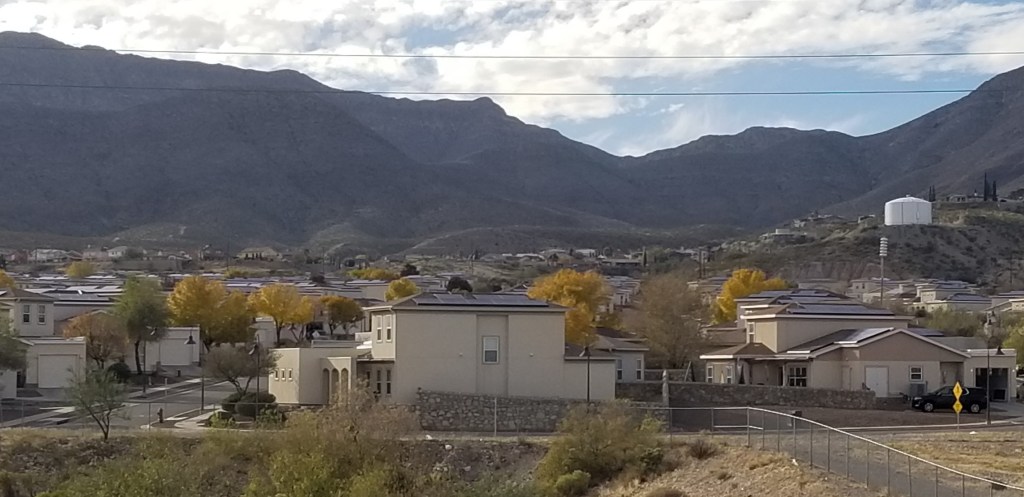
On the northeastern side of the mountain lies sprawling Ft. Bliss, the Army’s second largest base, containing 1.1 million acres. It is so big that it is chopped up by the roads that pass through it, notably SR 54 that passes in front of the RV park. Were it not for that highway, this would be a great place to sit. Behind the park, Franklin Mountain rises up and provides a lovely backdrop. All around the mountain, development never rises much higher than this. I suspect that much of the land is owned by either the federal government or the state of Texas.
On some of my daily walks, I tried to get behind the buildings and up into the hills, but it was just too far. In the foreground of this picture is one of Ft. Bliss’s housing areas and behind that is a fence.
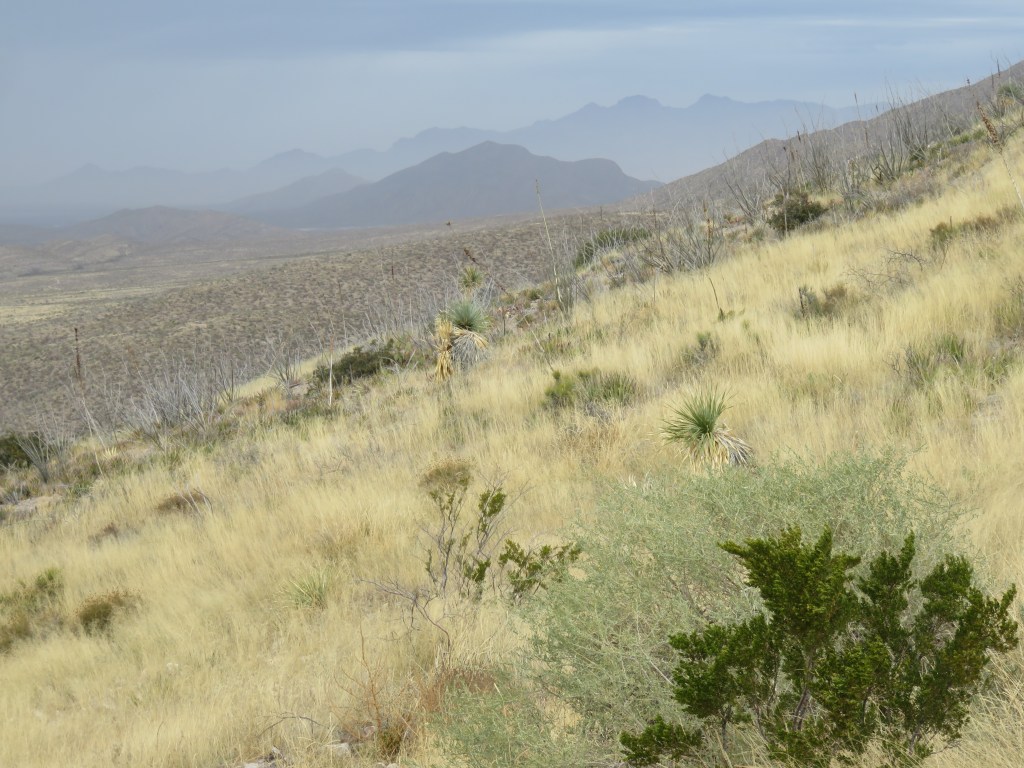
There was plenty of time to explore, so one of the first things we did was hike in the Franklin Mountains.
It was silent on the mountain, until the sound of birds broke through. We stood there for awhile, trying to figure out where the sound was coming from, until this gaggle of geese flew over us. They circled above our heads for quite awhile. Maybe, just like people, they were having an argument about which direction was best for their migration journey? There was quite a discussion, as evidenced by all their honking. Finally they fixed their formation and flew off. Adios amigoose!
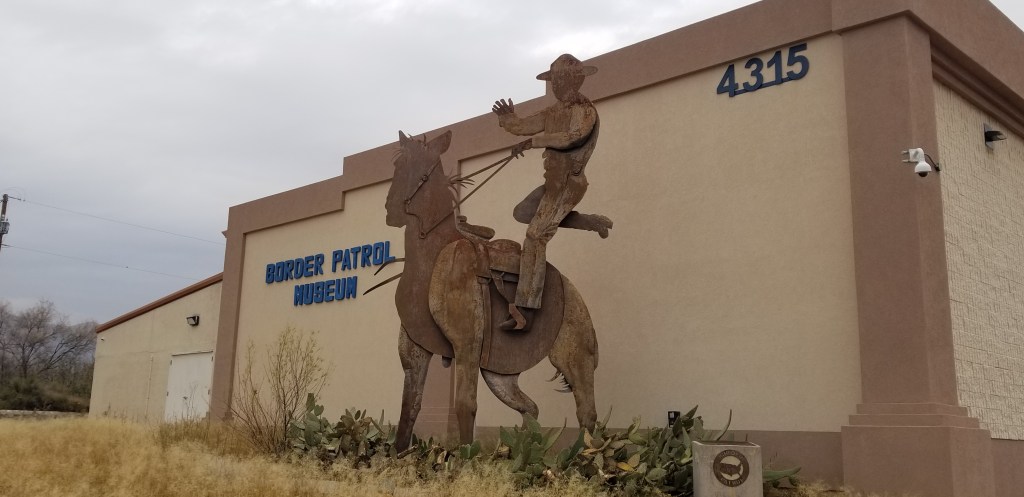
If you want to drive to a destination in El Paso that is on the other side of the mountain from where you are, it can take some time to go around on the highway. The single other option is to travel on the only road that cuts through it, which is beautiful Transmountain Road. Franklin State Park, where we hiked, is on that road. Going from west to east, at the end of Transmountain road, sits the National Border Patrol Museum. We thought it might be interesting, so we paid a visit.
The thing that struck me most about this museum is a reminder that the United States borders do not only encompass our border with Mexico, which is what comes to mind when I think about Border Patrol. Those who work for Border Patrol have to be ready for winter conditions up on the border with Canada, and also oceanic borders in other places. The museum is small and didn’t take us long to go through. It is a good place to learn about those who protect all of our borders.
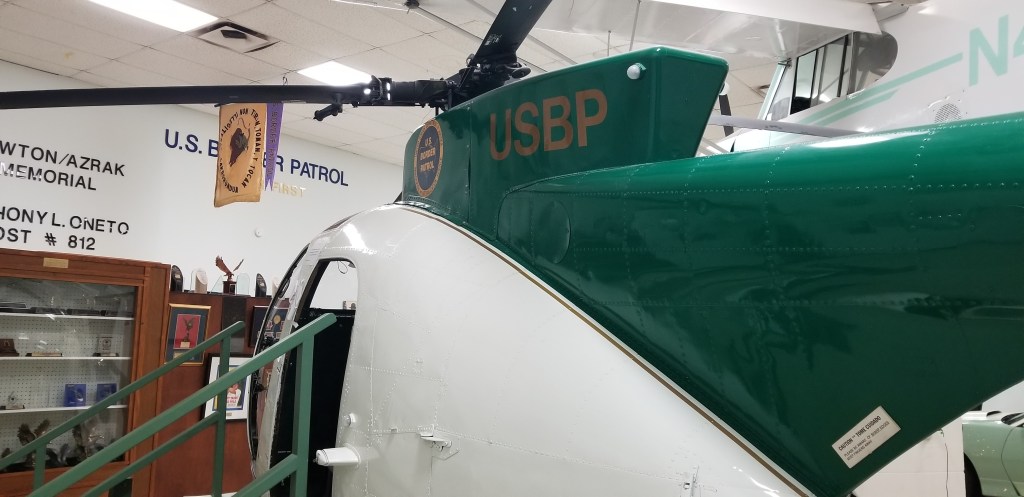
Border Patrol agents have to keep an eye out for motorized hang gliders, which are used for drug smuggling. We learned about the many ways that people try to smuggle all manner of things – and people – into the United States. Helicopters are needed, of course.
After we visited the museum, Cal made an attempt to see how high up we could drive into the mountains from our side (not very far). We passed a migrant detention center and observed many people walking around in the fenced back yard. One man was holding a baby. It is an image that stayed in my mind and put a very human face on the current migration crisis happening in this city.
We made a stop at Keystone Park and El Paso’s Botanical Garden one morning. Keystone Park needs a lot of love, as it doesn’t seem to be well maintained. It is a narrow strip of wetlands on a short trail located between a busy road and I-10, which is amazing given this light-industrial location. There were many birds to see, which made it worthwhile, and then the Botanical Garden can be accessed from this trail.
The birds would take flight and move to another section of wetland when I tried to take just a step closer, so I couldn’t get a closeup shot of them. But I did like this view of the mountains reflected in this picture. Our RV was on the other side of the mountain from here.
The garden was small, but a lot was packed in. It provided plants from the Chihuahuan desert and a peek into some past history.
In one area, there were pretty mosaics set into the wall:
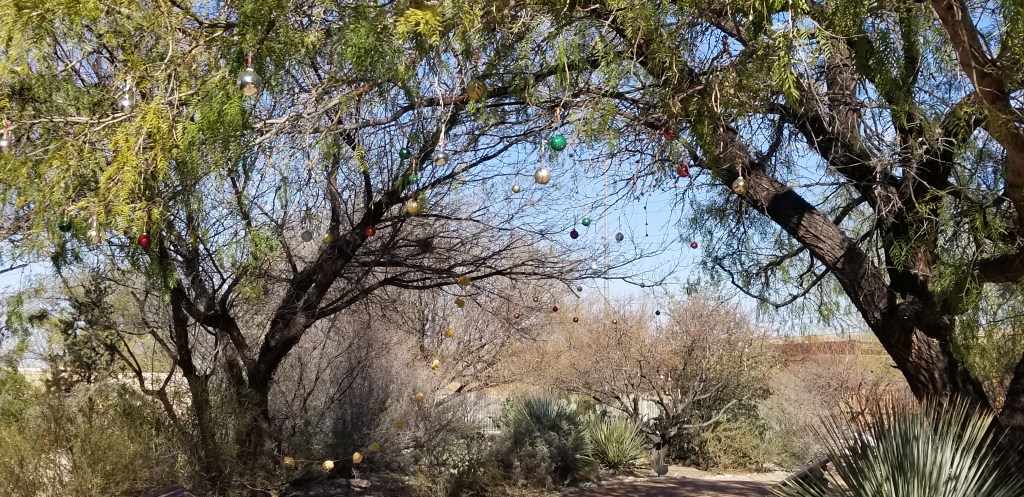
I liked how they had decorated, just a little, for Christmas:
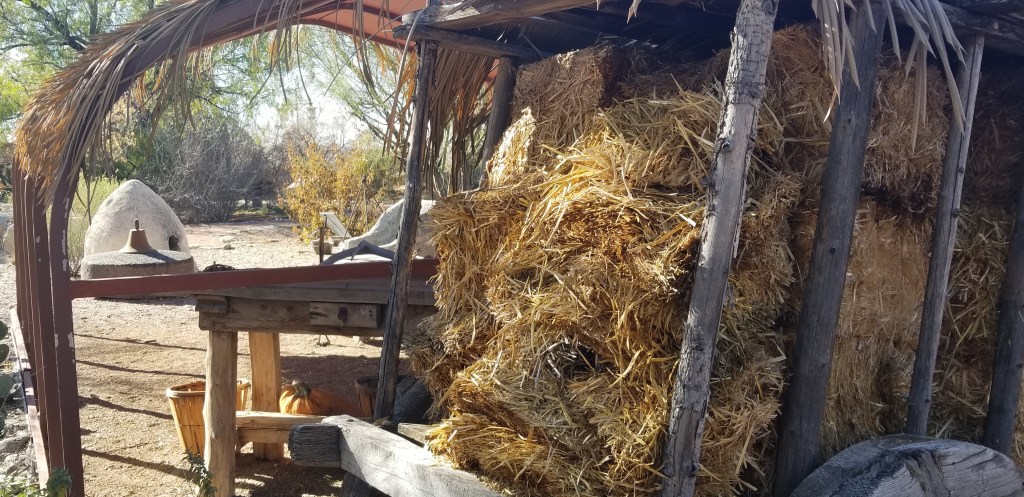
The garden also had a set up of a “paraje” which was an encampment along the Camino Real. This dates back to the 1600’s, when New Mexico was a Spanish colony. The trail covered the distance between Mexico and Santa Fe along what was originally a Pueblo Indian trail. The Spanish were setting up military outposts and needed to move both equipment and missionaries. Parajes were located every 10 or 15 miles to give shelter, rest and water to the livestock and and travelers as well.
The plan for the day was that if we had time, Cal would drop me off at Whoopee Bowl Antique Mall up the highway, and he would go to Camping World while I was there. We have such an exciting life!
I had read about Whoopee Bowl, and I love to poke around antique malls, so I wanted to check this out. If this is the sort of thing you enjoy, it is not to be missed if you are ever in El Paso. I’m always amazed at all the junk…excuse me…stuff that people collect. Whoopee Bowl takes antique malls to a whole ‘nother level.
The above picture is up on the second level. After checking out this massive place and returning down to the first floor, I found a room I hadn’t been in. There was huge fish aquarium, a blazing fire going in a massive brick fireplace, and a rousing game of poker going on.
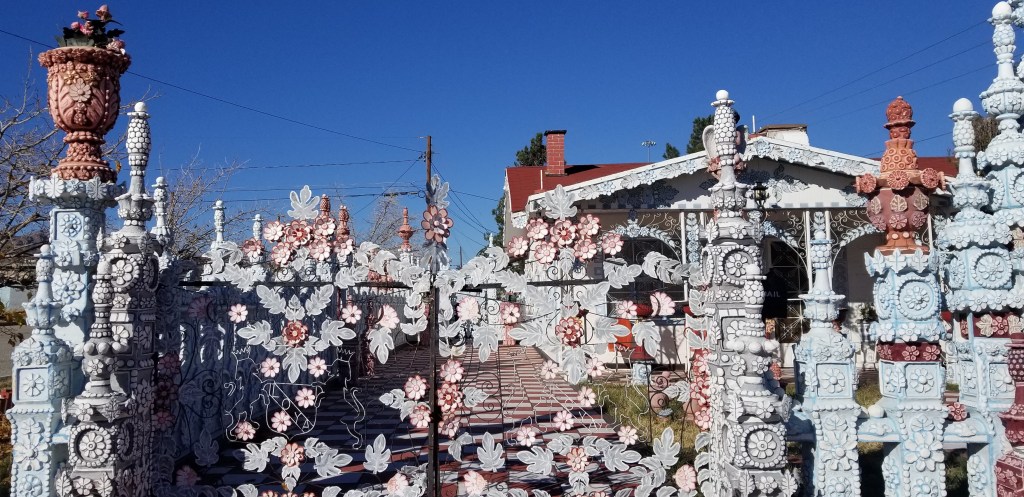
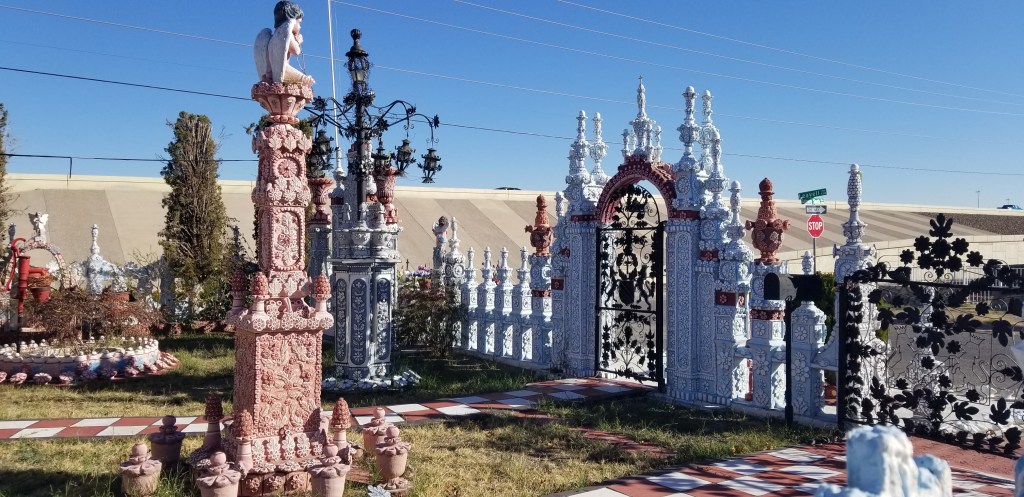
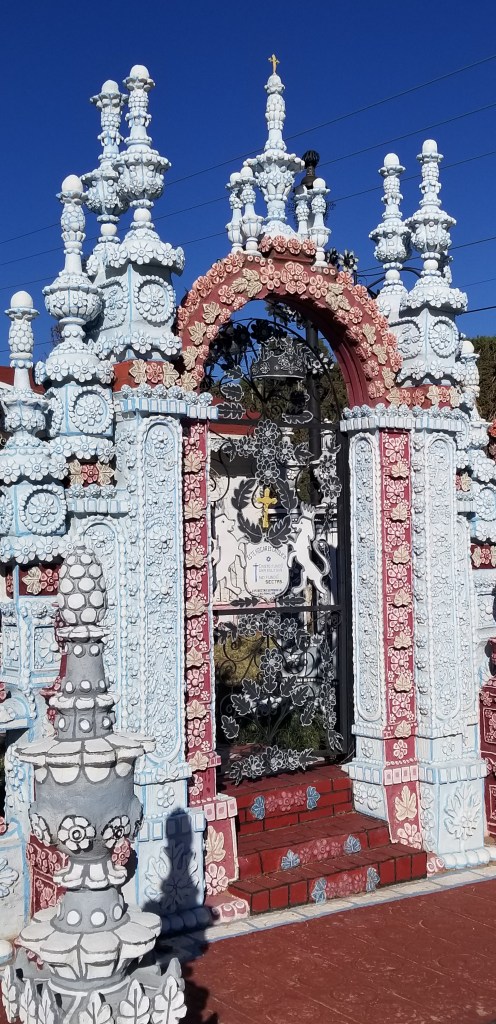
Atlas Obscura is a guide, both on-line and in book form, to all sorts of quirky and interesting places that one might normally miss. They don’t list the Whoopee Bowl, maybe because it is a business. But they do list the Casa de Azucar, which translated from Spanish means House of Sugar. It was just down from where we were staying and made for a good walk.
It is a testament to one man’s love for both his wife and his Catholic church. Rufino Loya started building this confection of decoration around his little house and kept at it for 25 years. He died just this past August at the age of 88 years. I hope someone will keep taking care of it.
Also just up the road, two artists were working on a mural on a concrete retaining wall. I enjoyed walking by and checking their progress.
Our time in El Paso was also about catching up on chores for me and RV maintenance for Cal. The less-glamorous side of RV life is that we do have to stay on top of everything that one would normally do in their lives. Some things had not been taken care of since before our trip to Europe. It being Christmas time, there was also gift buying, Christmas cards to write, and other things that one does to get ready for the holiday. Our RV park had a club house with a kitchen I could use, and I baked some Christmas cookies there.
Just a few days before Thanksgiving, we made a last-minute decision to visit our family in Denver, so we went drove there without the RV for both the Thanksgiving and Christmas holidays.
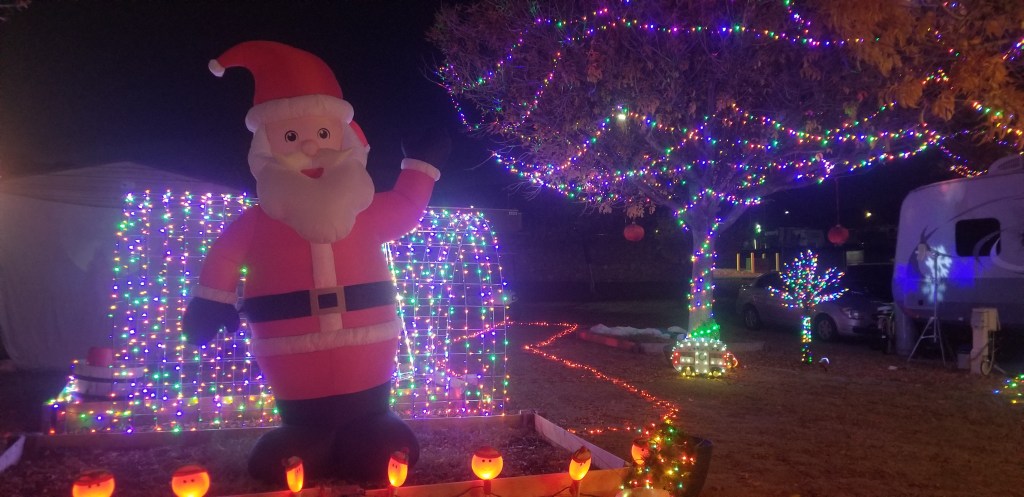
Almost every evening while we stayed here, though, we walked together through the little streets of the RV park. It was fairly large so I could get a good number of steps in. When the sun goes down, the temperature plummets, so at times we had to make sure we got our walk in before dinner. For awhile we enjoyed a full moon. There was also a little Christmas wonderland set up by our camp hosts.
And, of course, we paid a visit to Santa!
Like a coin which has two sides, we were happy to refuge here, and also happy when it was finally time to move on down the road.
Next time – zipping across the state of Texas in five days
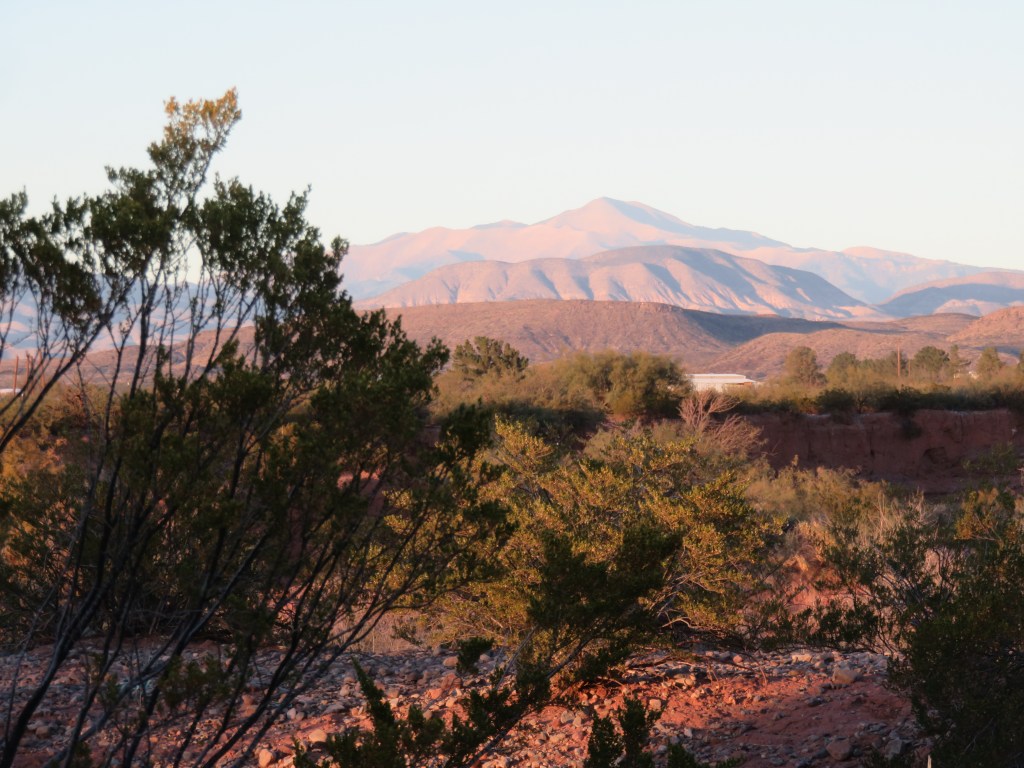
Sunset on the mountains behind our RV, Alamogordo, NM
Happy first blog of 2023! I haven’t gotten back to blogging as quickly as I would have liked after the holidays. Blame it on the flu, and traveling, and also having some nonexistent Internet. We are now in a good spot with great Wi-Fi for awhile, so it’s time to flip the calendar back a couple of months…
Entering our RV again after 3 months away in Europe was truly like coming home. It even still had a little of that “new RV” smell. No mice had settled in and nothing catastrophic happened to any of its mechanics. The lithium batteries hadn’t even lost much of their juice. We looked forward to getting back to our nomadic life, even as we still missed some of the aspects of life that we’d had in Europe. First, though, was two weeks in Denver and a happy reunion with our family there. We would be returning at Christmas. So, for the weeks in between, we headed south to New Mexico.
Our time in this state was a comical musical chairs-style switch up in plans and RV reservations. A five-night stay in a state park was canceled by the park for maintenance issues. A clueless RV park owner who takes reservations only by phone lost our reservation and had a full park during the dates we were to be there. And, unexpected: it often got cold at night, sometimes with below-freezing temperatures. We ended up canceling three other stays because the temperatures were dipping too much. RV life sometimes calls for some flexibility!
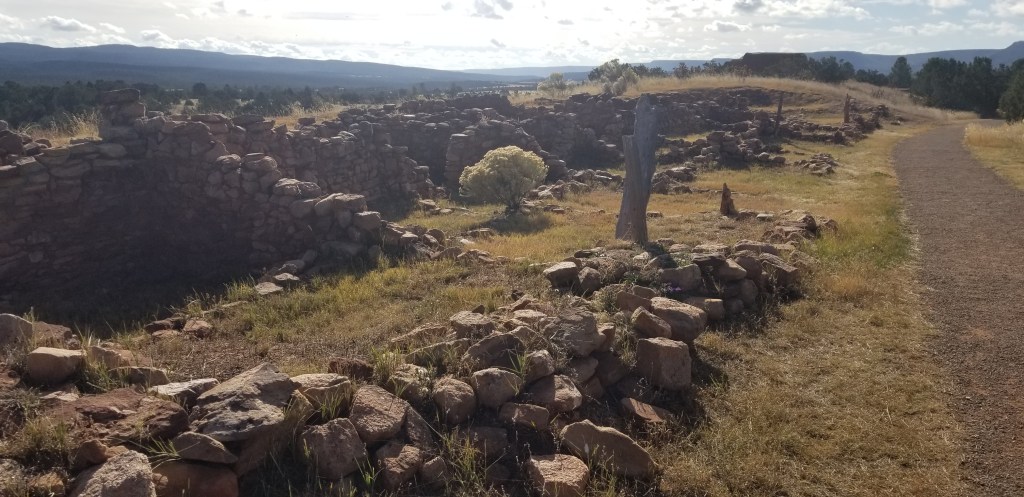
One of our “substitute stays” took us to a KOA park in Las Vegas. No, not THAT Las Vegas…remember, we are in New Mexico. While there, we took a drive 35 miles down the highway to visit Pecos National Historical Park. The Pecos Indians had a pueblo there, four to five stories high, home to about 2,000 people for several hundred years until the Spanish came along. What the Spanish didn’t destroy, the Americans did: later, it was a stage stop on the Santa Fe Trail. Situated in a fertile valley between two mountain ranges, it was a major gathering and trading place. The warriors were known to be fierce and undefeatable.
Pecos National Historical Park, New Mexico
The pueblo is in ruins. This is all that remains of a once-great people. Once upon a time, there were 20 kivas here, which were places for ritual ceremonies. I climbed down inside of one of them.
The park service is slowly reconstructing some of the park based on archeological finds. The Spanish mission was in a partially ruined state and they have rebuilt some of it and the surrounding pueblo.
The remains of the Spanish Mission church and layout of surrounding buildings that were here
We drove around Las Vegas a couple of times. It was once a stop on the Santa Fe trail during its Mexican past. Later, the railroad arrived. I read that there are 900 historic buildings in this town, dating back hundreds of years. There are things to see another time when it’s warmer. We had dinner in the Buffalo Hall and Cowboy Cafe, another old building. Their barbeque was delicious.
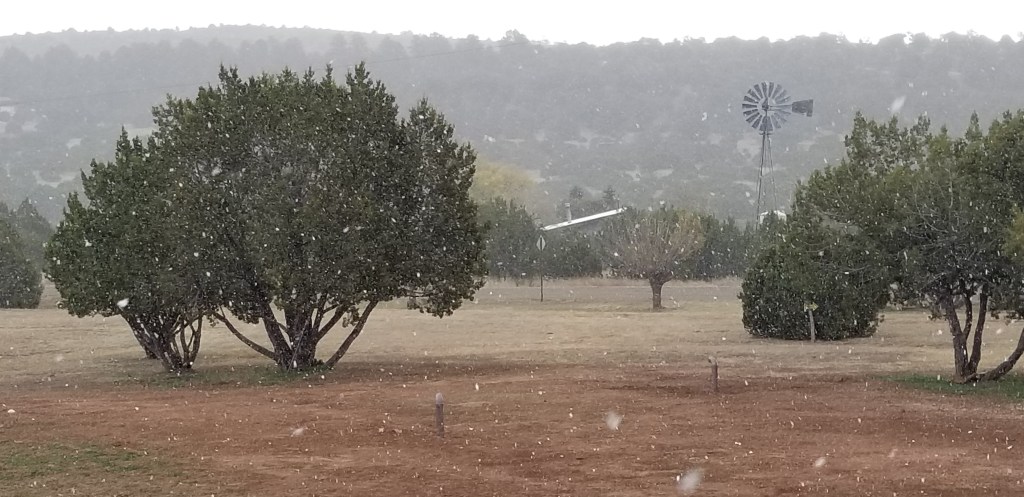
For me, KOA parks are usually just an overnight stop off the highway. Some are practically on the highway, and come with traffic noise and small sites. We stayed here for two nights, and I must say it wasn’t bad. They gave us site #1, which meant a full sprawling yard and no RV’s in view from our front porch. Susan, in the office, fried us up some delicious pancakes with vanilla and cinnamon for breakfast. However, this park sits near the Hogback Mountains, and Las Vegas itself is at 6,424 feet elevation. I didn’t think it would be so chilly this early in November, but we had snow on the morning of our departure. We needed to get further south!
The view from our porch in Las Vegas, New Mexico; time to flee!
Northern New Mexico is mountainous and is very beautiful. Santa Fe, Taos, and Angel Fire are all nearby. But we’ll have to save our exploration of it for a time when it’s a little warmer.
Our next stay, in Fort Sumner, was also a last-minute replacement find. It was a small mobile home and RV park, usually the kind of place that would be at the very bottom of our desired place to stay. But the permanent residents were to the back, us transients to the front, and all places were neat and tidy. Our site was very wide, and we were right in town. Well, such as town was. What this place lacked in amenities, it made up for in character.
The owners of Valley View RV also own the “Billy the Kid” museum up the street. Ed & Jewel Sweet opened the museum in 1953 as a repository for all the stuff they had collected in their life, and naming it after New Mexico’s famous outlaw is what drew people in. Their son, Donald (who is no spring chicken himself, but gets around well) is running the family business and together with his son, Tim, they run a tight ship.
Billy the Kid’s Rifle
I wasn’t much drawn into the Billy the Kid stuff. Stuff of lore though he may have been, he was still a criminal. Allegedly, he killed 21 men before he himself was killed at the age of 21 in 1881. But this is BTK territory: where ever we went around these parts, a sign would proclaim “Billy slept here!” or “Billy shot someone here!” and I couldn’t see one redeeming thing that he ever did. I guess it helps with tourism dollars, but I would say the heyday on these events has come and gone.
I loved looking at all the stuff the Sweets collected and had on for display in the museum, though. Besides these farm implements, there were collections of various household items, lots of old buggies and some covered wagons, and of course more BTK ephemera.
Whenever there is a fort to be seen, and we’re looking for something to do, we usually go see it. They’re all different, and some have been amazing for the surprises they hold. Nothing could have prepared me for Fort Sumner, though. Rather than normal western fort-looking buildings, this beautiful museum greeted us:
Recently completed, the Bosque Redondo Memorial tells the story of how 8,500 Navajo and Apache Indians were rounded up in January of 1864 and made to march almost 300 miles to this place. Called “The Long Walk”, under the leadership of Kit Carson, 200 of them died of cold and starvation on the way. The site was to be a reservation to “civilize” them by going to school, practicing Christianity, and becoming corn farmers. Once they got here, they were made to construct their own dwelling places. Unfortunately, the nearby Pecos river was brackish and caused intestinal problems and disease, armyworm destroyed the corn crops, and the wood supply was soon depleted. Most of the Apache escaped the next year, but it would be three more years before the Navajo simply walked home. The whole venture was a miserable failure.
The memorial was built at the request of some Navajo teenagers who, when visiting Ft. Sumner, wanted to know why their story here wasn’t told. Until just two years ago, you would visit the fort and simply not know what happened at this place. The events were certainly not included in any of my history books.
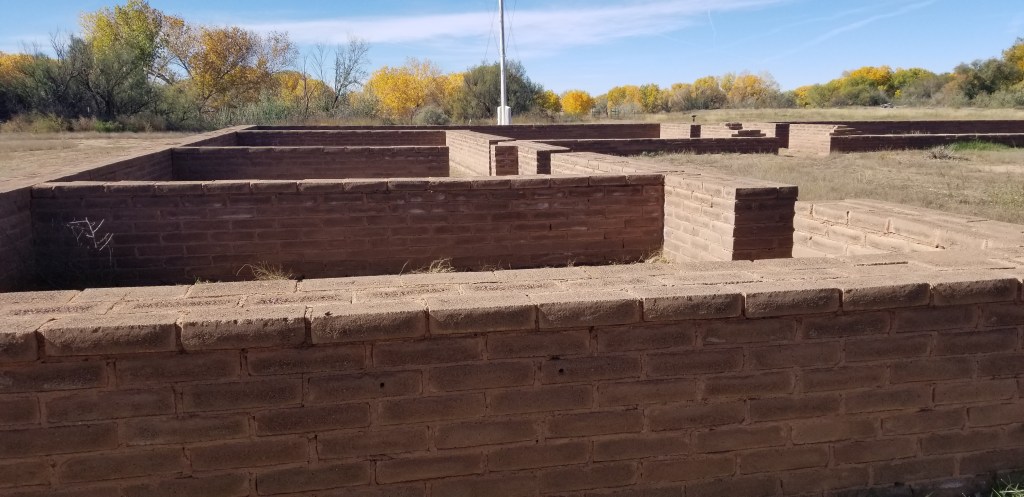
I didn’t have much of an appetite for visiting the fort after that, but we followed the trail out. There isn’t much left of it anyway. Walking about the grounds, I pondered the atrocities that occurred here under the direction of our government. It is a silent, windswept place.
A partially reconstructed layout of some of the buildings
I’m continually astounded at man’s inhumanity to man. I came away with a feeling that I, we all, need to travel and see these places and to learn their stories. Otherwise, how can we learn not to repeat them?
As a side note, after the fort was abandoned in 1869, a rancher purchased one of the old barracks buildings and turned it into a grand house. It was there that a local sheriff ended the life of Billy the Kid. He is buried in the military cemetery nearby, but we did not visit it.
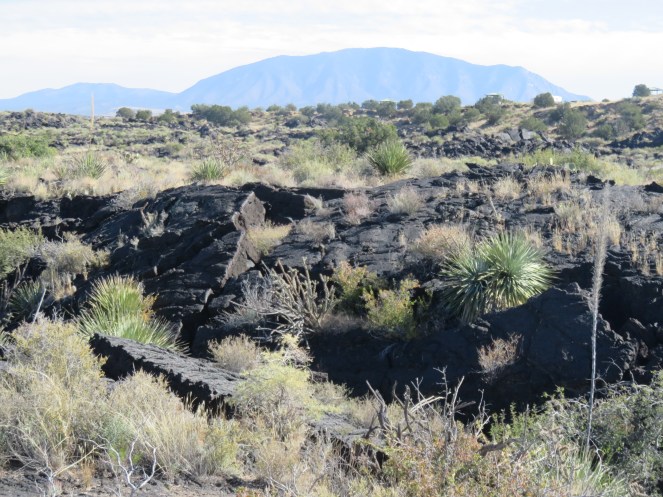
Ready to get back to nature, our next stay was at Valley of Fires Recreation Area, maintained by the Bureau of Land Management. It looks over part of a 44-mile lava flow that happened 5,000 years ago. It was not the result of a volcano. Instead, the Carrizozo Malpais Lava Flow was the result of volcanic vent openings in the valley floor. Our site also looked out over the lava field and provided us with several grand sunsets. From our perch, the only man-made thing that we could see was the nature trail and, occasionally, cars on the road far off in the distance to our right. Ahhhhh…excellent.
It is a quiet and peaceful place and was our favorite stay during this time.
When we hiked the nature trail, we discovered that the lava field is very much a living place. There are cactus, trees, and bushes common to the Chihuahuan Desert that we were in, as well as some late-blooming flowers. Animals live here too but we didn’t see any. Seeing lava rock again almost made us feel like we were back on the Big Island of Hawaii.
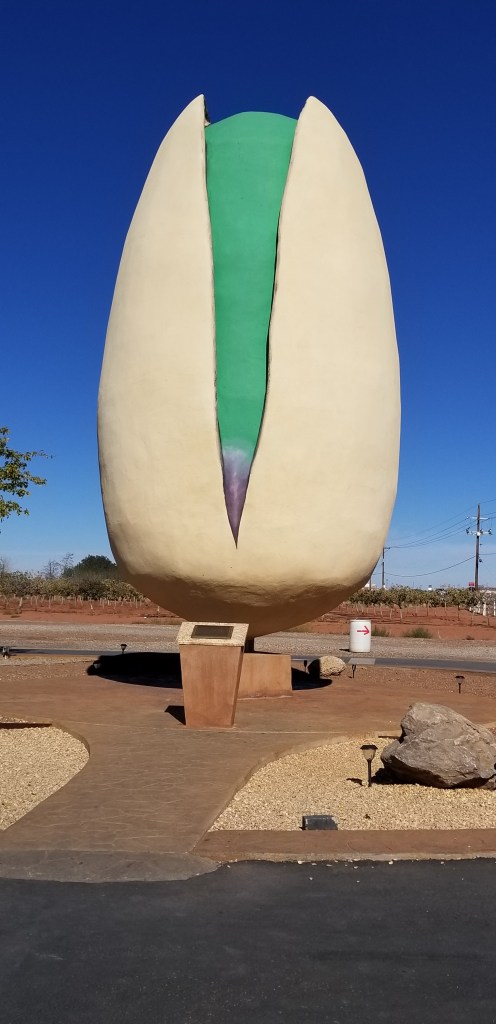
As a fill-in for our lost RV reservation, we stayed for several days in Alamogordo, right across the road from the world’s biggest pistachio.
It’s best not to try to eat this pistachio! It’s 30 feet tall.
McGinn’s PistachioLand and its neighbor, Heart of the Desert, were both great places to sample pistachios, pecans, and wine. It was very handy, after having all that wine, to just be able to walk across the road (carefully!) and go home. At McGinn’s we also took a little tram ride through the orchards and vineyards for an interesting tour. We liked McGinn’s best, but that was probably because Heart of the Desert was a smaller operation and were very busy with a wedding when we visited.
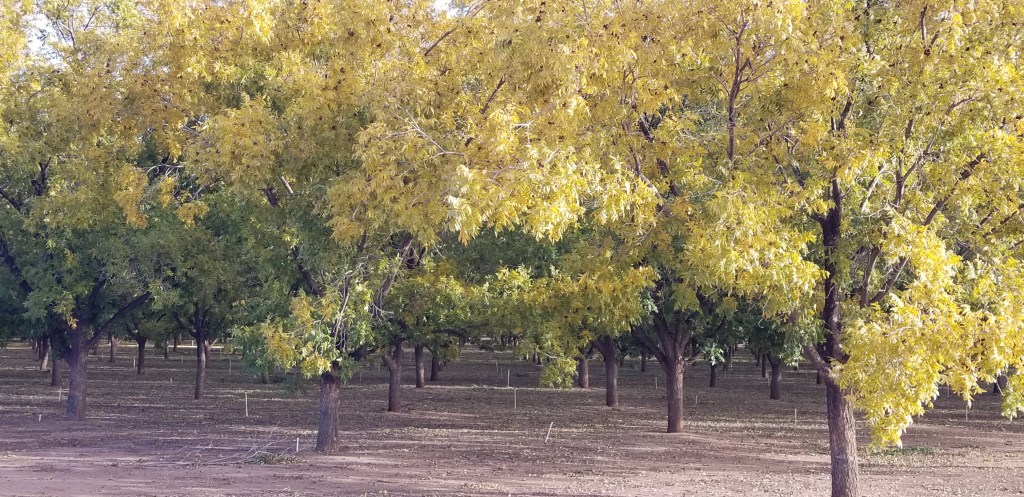
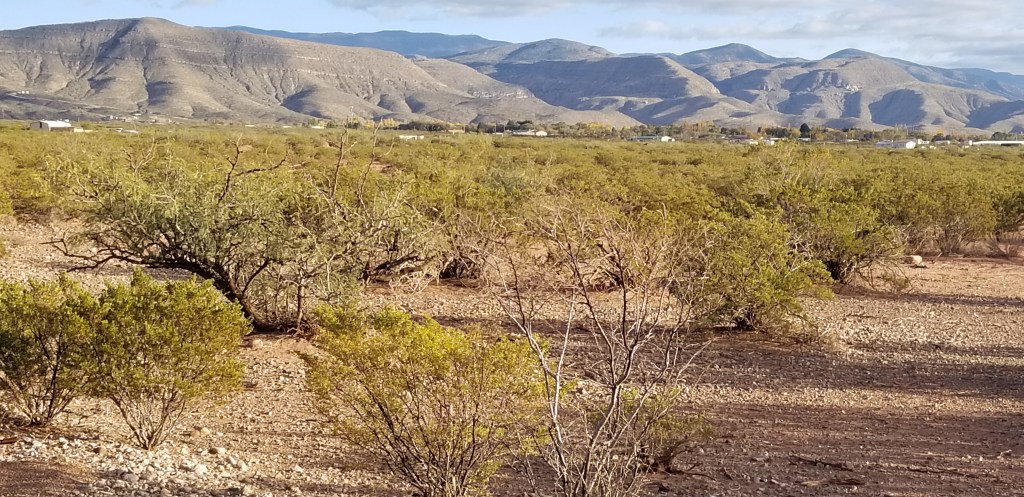
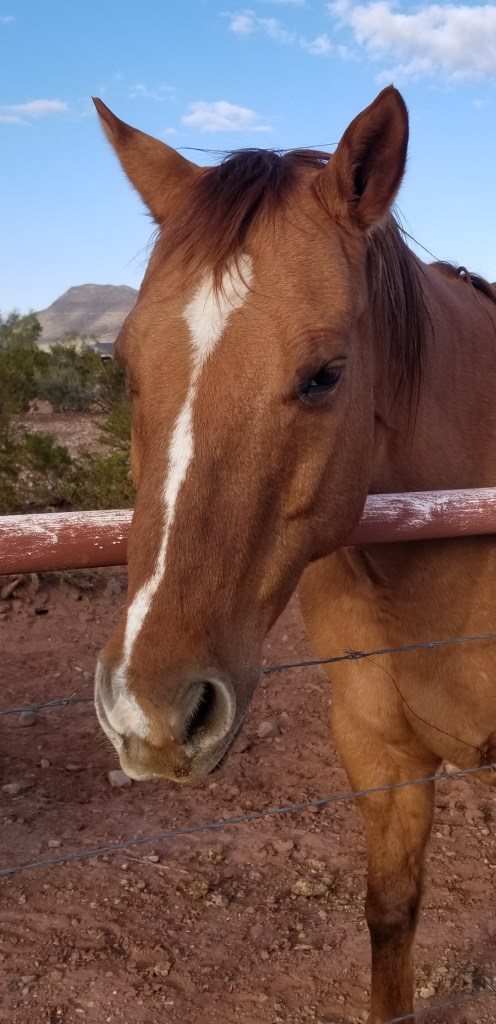
Also behind our RV park in Alamogordo was a little country road which I enjoyed walking on a couple of times. There was a large pecan orchard to look at, mountains ahead of me, and friendly horses to pet.
A pecan orchard
The highlight of our stay in Alamogordo, though, was a visit to White Sands National Park. Although it was designated a national monument in 1933, it became a national park in 2019. We took a guided walk by a park ranger, where we learned that recently they have found a set of ancient footprints here. The footprints date to 24,000 years ago, placing humans in North America sooner than was thought, but this date seems to still be in dispute. Although the gypsum sands seem dry, there is water only a couple of feet below the surface.
We also hiked a short nature trail – and it was easy to lose the trail!
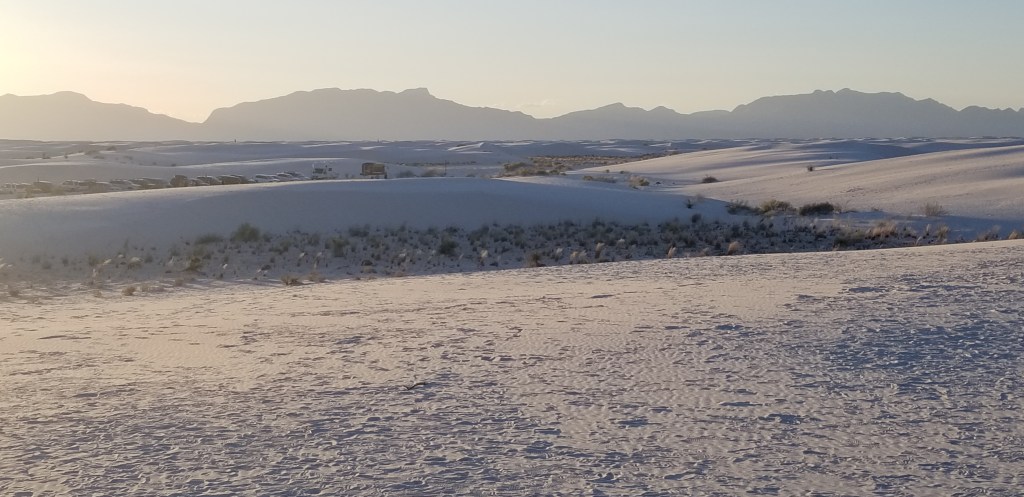
The sand pack on the road looked exactly like a snow storm had occurred here.
The sun going down made for great effect, casting its long shadows over the sandy hills. We were here in the late afternoon so as to catch the ranger’s tour, but it was a great time of day to visit.
Our last stay during this time was in Las Cruces. From our park, we were able to walk to Old Mesilla, a village that was settled over one hundred years ago. Red chile peppers adorn the plaza and the thick adobe-walled buildings contain art galleries, shops and restaurants.
A mural on our walk to Old Mesilla
Chile peppers and Christmas lights on the plaza
I cannot help but point out that there was once a courthouse here where Billy the Kid was tried for his crimes and sentenced to hang. He escaped before that could happen.
A historic home in Old Mesilla
We had excellent fajitas in a restaurant called La Posta in Old Mesilla. It had been a Butterfield stage stop and inn, and in 1935 it became a restaurant. Parrots and a piranha fish greeted us when we entered. La Posta had rooms upon rooms, and we ate in what was once was the blacksmith and harness room, with a fireplace that kept us warm. While we enjoyed our delicious dinner, we could look at an immense Christmas tree in an adjoining room.
The state of New Mexico overall has much to offer, but we will have to return at a time when it is warmer. The entire state is at elevation, which means it isn’t a great place to be in late fall and winter. Las Cruces itself, while in the far south of New Mexico, sits at 3,900 feet elevation. It was 27 degrees on our last morning in Las Cruces and it wasn’t the first time we’d had a freeze. Daytime temperatures usually warmed up into at least the 50’s, but nighttime freezing temperatures means that the RV mechanic (that’s Cal) has to disconnect hoses and turn on tank heaters. It’s always a worry that a connection might freeze and crack.
We were continuously keeping an eye on the Weather Channel, trying to figure out where would be the warmest place to sit for awhile. What did we find? That is the subject of my next post!













































































 Twosna Travels