Europe · UK and Ireland

Lights, Camera, Action! in the UK – Europe Travels 2022

Have you ever seen a movie or watched a TV series with a setting so beautiful or interesting to you that you really wanted to go see the location where it was filmed? Would you center a vacation around seeing one of these places for yourself?

While traveling around the UK we stumbled on many film locations. At the same time, an associate of Rick Steves by the name of Cameron Hewitt posted about this phenomenon on his Facebook blog. He called it “set jetting” or “location vacation”: people traveling to places solely to experience in person what they have seen on film. For instance, Dubrovnik, Croatia was a town off the tourist radar until Game of Thrones became a hit, and now it is one of Europe’s most-visited cities.

Cameron called his blog post “The Outlander Effect” and he wrote it just after our visit to Scotland. Eight years on from the first episode’s release, you can hardly travel around this country without seeing mentions of Outlander. Tourist shops carry Outlander merchandise, and there are websites and maps which helpfully point out the sites to visit. Tours that we went on highlighted Outlander locations.

I haven’t seen the series but I did read the first two books, enough to know about Claire touching a stone which turns out to be a time portal. She travels from 1945 back to 1743. This was filmed at Clava Cairns. I got caught up in the hype enough to have Cal take this picture of me touching the stone there. I did not find myself transported back to another era.

In the Outlander books/movies, Jamie Fraser is Claire’s love interest. The MacKenzie clan also figures in the story, and I saw the two names together on this burial stone inside the ruins at Beauly Priory. In the books, this is where Claire meets the seer Maisri.

The Battle of Culloden, which I’ve already written about, happened in Outlander also. People put flowers at the stone for the Fraser clan.

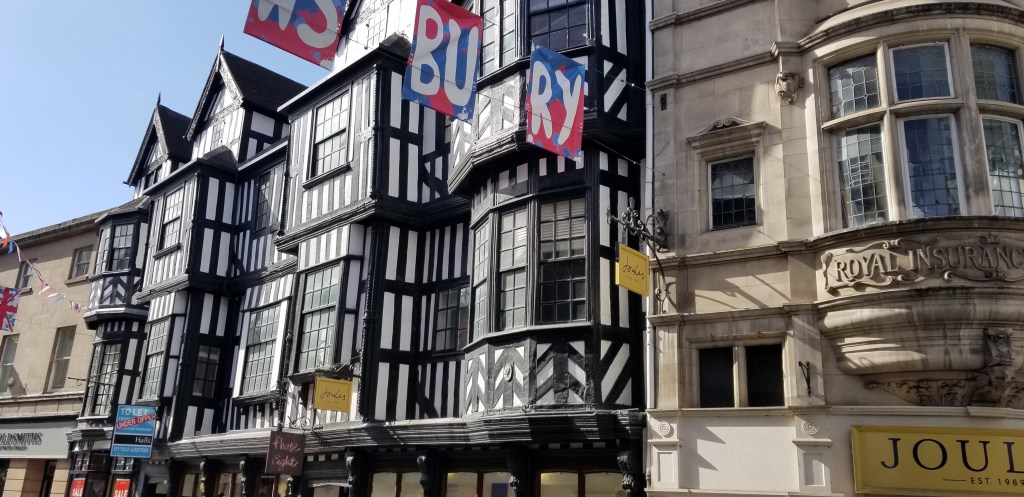
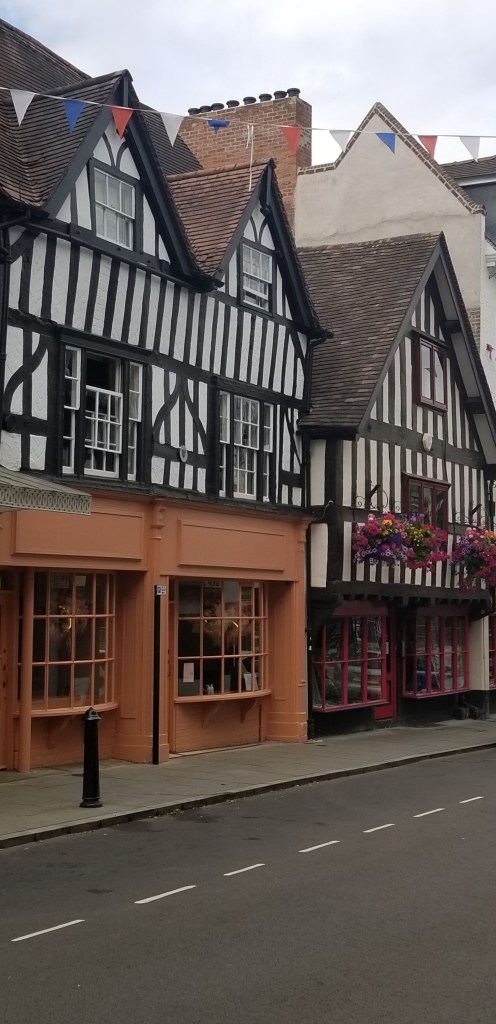
Down to England. When we had a boat ride on the Severn in Shrewsbury, our captain told us that the George C. Scott version of A Christmas Carol was filmed here. The medieval buildings make a perfect backdrop.
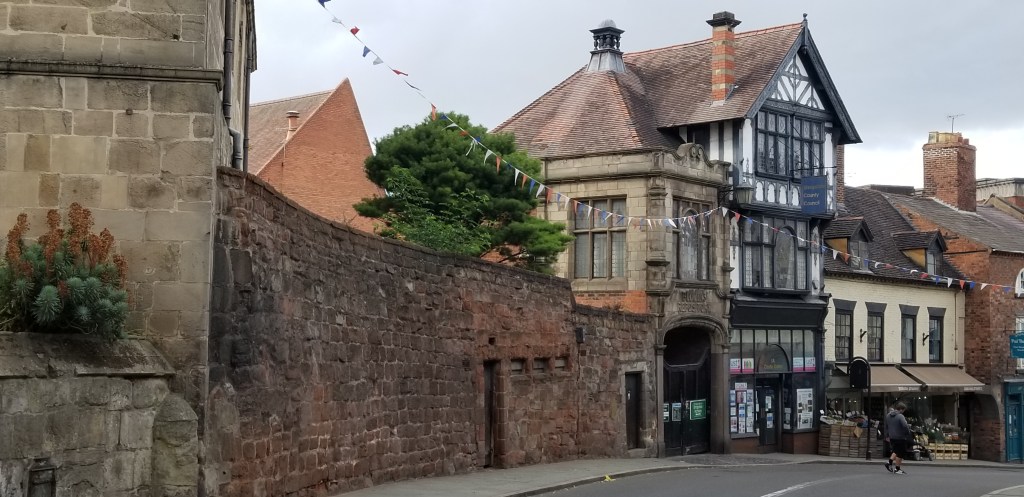
In St. Chad’s cemetery, we found the prop that was left there from the movie:

I admit to being just a little excited about finding it. I can still hear the Ghost of Christmas Future plaintively howling “Scroooooge”! It remains one of my favorite Christmas Carol movies.

Lacock, a little village in the Cotswolds, belongs to the National Trust and people who live there know when they need to clear the streets. This street was used for the filming of the first Downton Abbey movie. If you’ve seen it, just mentally move the cars and the cones out, add a little hay, and you’ll recognize the set.

Lacock has been the setting for many other movies, including three of the Harry Potter series. Lacock Abbey was the setting for several scenes at Hogwarts school, including the hallway inside these arched windows.

We had an abundance of time in tiny Lacock, so we opted to join our tour guide for a short walkabout near the end of our time there to see some movie sites. He showed us the house where Harry Potter’s parents lived before their untimely death.

Our guide offered to take a picture of us in front, and he had a picture of the house in the movie for us to hold. I thought it was slightly cheesy, but we went along with the fun.

Also from Harry Potter, Platform Nine and Three Quarters is where the Hogwarts students board the train in London. It is a tourist attraction at King’s Cross Station in London, and you can have your picture taken in front of it. Almost noon on a holiday weekend was the worst time to visit – there were people in long lines wrapped around ropes and stanchions for the picture. I was not about to invest my London time in line for the privilege, so this is the best I could get. It would have been fun to pretend I was pushing the luggage cart, though.

Speaking of train stations, Paddington Station is where another beloved character can be found. Paddington Bear is memorialized in its namesake place. The beloved children’s story was made into a handful of movies beginning in 2014. We had arrived at Paddington Station from Bath, and then went on a scavenger-hunt-style search for this cute little bear.

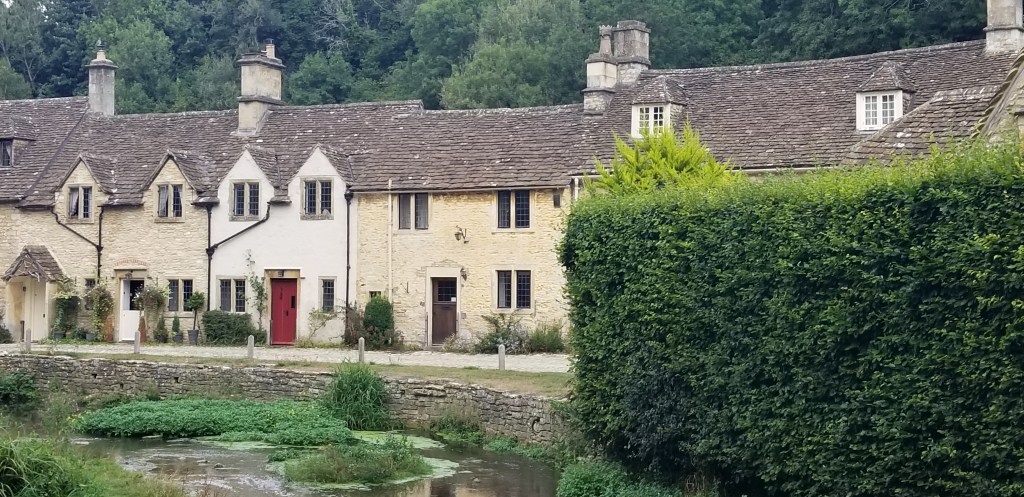
Perhaps the most moving spot for me, though, was in Castle Combe in the Cotswolds. Before setting us free to roam in the town, our guide pointed down the street and told us that we would find the location there for the filming of the 1967 movie Doctor Dolittle starring Rex Harrison.

I was a voracious reader as a child and the Doctor Dolittle series of books were among my favorites. Imagine being able to talk to the animals! I read them over and over. I don’t remember if I saw the movie in a theatre, or if it was later shown as a “special” on TV, but I do remember seeing it.

I stopped and looked…this scene was familiar!

In the movie, of course, the street and little dock is larger than life. All of a sudden I was transported back to childhood and I remembered the feeling of wanting to be here. I believe that movies I saw in those days such as Doctor Doolittle, Chitty Chitty Bang Bang, Mary Poppins, Oliver! and others, ignited my desire for travel.

Cameron Hewitt’s conclusion at the end of his blog post, and I agree, was that it’s fantastic if a wish to see a movie location results in travel to a place someone may not otherwise visit. Just visiting movie locations as the sole destination is another thing altogether. It would be like me focusing on the stone that was Claire’s time portal in Outlander and totally ignoring the fact that it is a standing stone for a Bronze Age chamber tomb.

Everyone is different, and has their own style of travel. For me, seeing these sites were the sprinkles on top of the ice cream of our trip. Or the salt and butter on top of the popcorn.

See you at the movies!

Next time: back to the RV’ing life in the US for now.

Europe · UK and Ireland

A Holiday Weekend in London – Europe Travels August 2022

St. Pancras International Rail Station

What else is there to do in London that may be a little off the radar? Well, I did have a small list, as I always do, but I wouldn’t call it a bucket list. I’m not one for just checking things off and moving on. Who knows? There may be something else more interesting to experience.

I had heard about the Charles Dickens Museum at the start of the Covid pandemic. It was a little news blurb about small museums, shuttered for the pandemic. They rely on their income from visitors to survive and they were concerned that they might not be able to reopen. I hoped it would make it so I could see it!

No worries: they did survive, and so we headed over to 48 Doughty Street to do our part in keeping the venerable museum afloat.

Dickens resided here almost three years from 1837 to 1839 with his wife and first child. He wrote “The Pickwick Papers” and “Oliver Twist” while here. It is an early Victorian home, and is one of only two of his London homes still remaining.

The grandfather clock that you see in the dining room was owned by Moses Pickwick, who owned a stagecoach and inn enterprise. He was thought to be the inspiration for the Pickwick Papers.

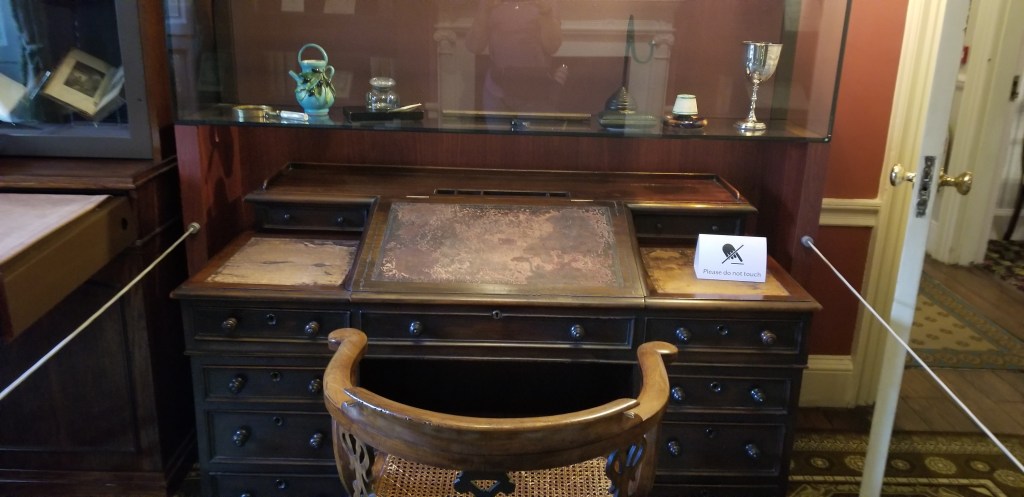
Dickens’s writing desk is here:

The desk was a later acquisition by Dickens. His final home was at Gad’s Hill and he purchased it while he lived there, in 1859. “Great Expectations” and other works were written on this desk.

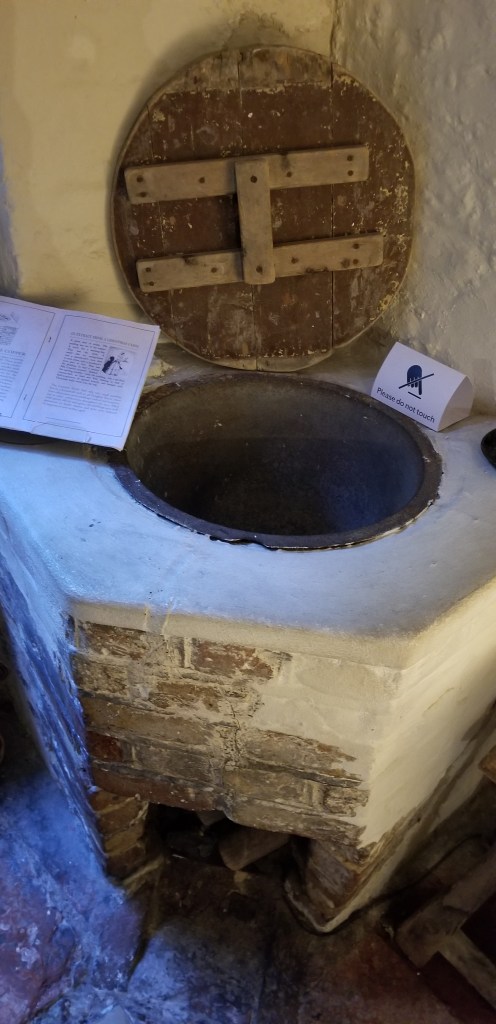
Going down the steep narrow steps and into the basement, I found something interesting. Called the “wash-house copper”, a fire was set in the bottom to heat water inside the pot to wash laundry. The laundry was stirred with a stick. The pot was cleaned out at Christmas-time for boiling the Christmas pudding.

The Dickens home is a narrow city townhouse, but there are five floors. Water was boiled here in the basement for cooking, cleaning and bathing. I cannot imagine having to haul the boiled water up five floors for a bath in one of the bedrooms.

Both the Dickens and the British museums were walking distance from our AirBnb, so we headed out early on the leafy streets for each of our two remaining mornings to arrive at the museums when they opened. We spent over two hours in the British museum and that was a fairly quick overview. I, but probably not Cal, could’ve spent days. There was just so much “stuff” to see.

The British Museum may not be off the radar, but it is free. It bills itself as having “two million years of human history and culture”. There are objects from around the world. First and foremost is the Rosetta stone, the key to deciphering Egyptian hieroglyphics. Too many people were gathered ’round to get a good picture.

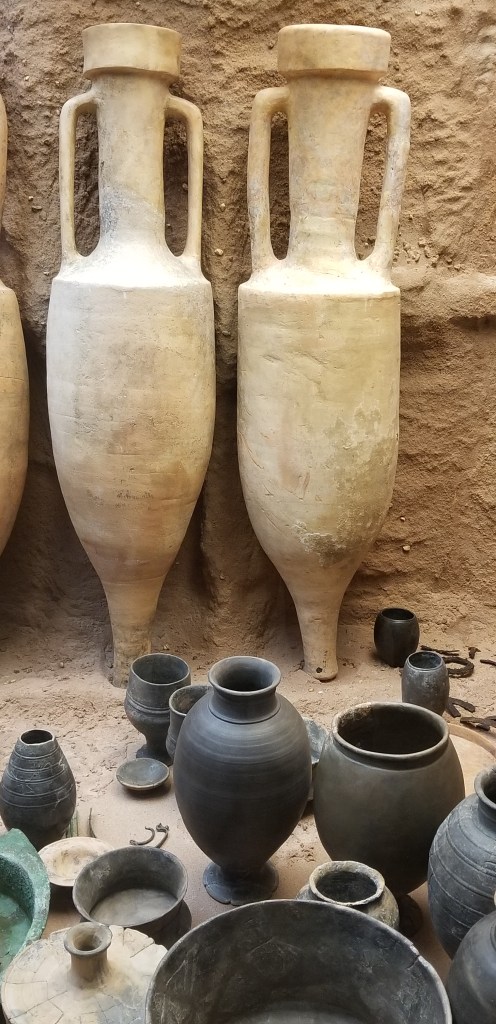
There were treasures from an Iron Age burial pit-

and the Lindow Man, who was found preserved in a bog. Time of death has been placed at between 2 BC and 119 AD.

The Lindow man was British, but so many of the artifacts are not. I have mixed feelings about antiquities that belong to other parts of the world. Still, Hoa Kananan’a from Nui/Easter Island was impressive. I will probably never get there to see the others. Looking at the visitor on the bottom left helps to give perspective on its size.

I could post so many more pictures, but I’ll leave off for now with a picture of part of the library. The British Museum library was founded in 1753 and has one of the world’s largest collection of written literature.

Out on the streets, there was a picturesque pub near the museum–

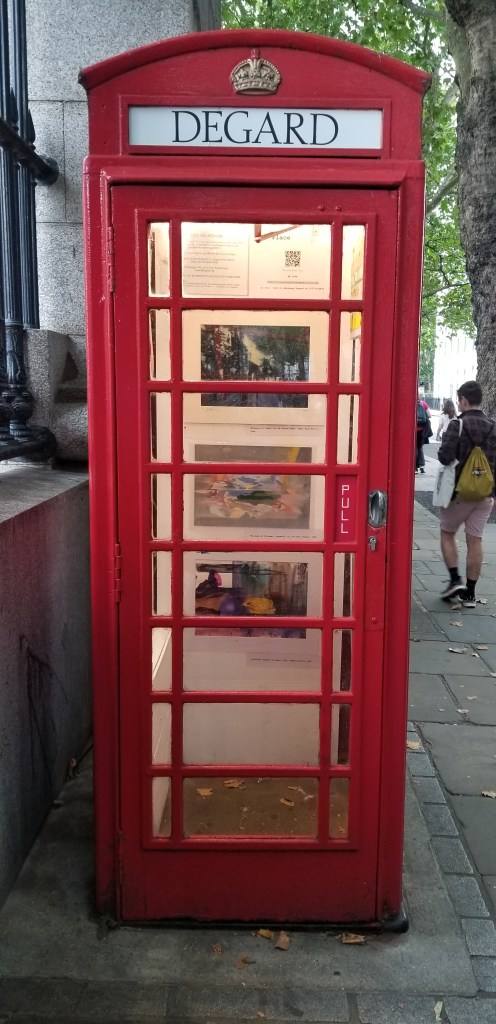
and an old telephone booth turned into a miniature art museum.

We hadn’t yet had a proper tea, and we were only a day away from leaving the continent. There are a mind-boggling lot of them to choose from in London, and they can be very expensive. Tea at Fortnum and Mason’s, THE tea spot for discerning afternoon tea patrons, starts at 78 pounds – which in today’s dollars is about a hundred dollars. We settled for a less expensive, but by no means less delicious, tea at The Coral Room. It was a sumptuous spread which served as our late lunch and we needed no more to eat the rest of the day.

For each of us there were four types of finger sandwiches, seen at bottom right, for starters. There were two scones in two different flavors with strawberry jam and clotted cream plus four different cubes of dessert. The full pot of tea was made with tea leaves (not a bag, heaven forbid!) and brewed with a timer. Perfection!

While I’m on the subject of food, I’d also like to tell you about our Sunday Roast. It is a custom in the UK, and we saw signs for Sunday Roast everywhere beginning in Scotland. On the Sunday we were in London the stars aligned. A pub we walked by often on the way to and from our AirBnb served this delectable dinner. We had a pint and watched a cricket game between India and Pakistan while we waited for our food. It consisted of roast beef and potatoes with gravy, cheesy cauliflower, and Yorkshire pudding. That last item may seem glamorous, but it is simply popovers which are baked and not fried. It was delicious sopped with the gravy.

We had ridden a black taxi from the train station when we first arrived in London, and we had been catching buses all over London. The one thing we hadn’t ridden on was the Tube, so on our last evening we rode the Tube down to Tower Bridge. Our tube stop must have been one of the older ones. It was 138 narrow steps spiraling down to the platform.

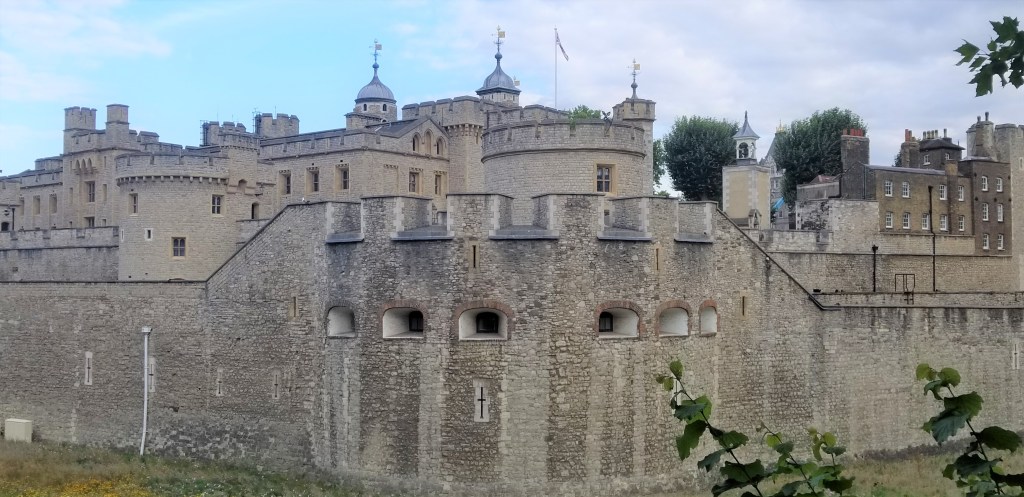
It was a beautiful evening and a lot of people were out, probably owing also to the holiday. We walked past the Tower of London, which was larger than I had remembered.

We also passed the Traitor’s Gate, over a little canal.

It is the most notorious entrance to the Tower by famous Tudor prisoners such as Lady Jane Grey, who died here at the tender age of 17 after claiming the throne for nine days back in the 1550’s. Prisoners would have been taken upriver to the Westminster courts for trial.

There is only a short walk to the Tower Bridge from here.

Could there possibly be a better finish to a visit to London?

Next time – grab your popcorn, we’re going to the movies!

Europe · UK and Ireland

From Westminster Abbey to St. Paul’s – Europe Travels August 2022

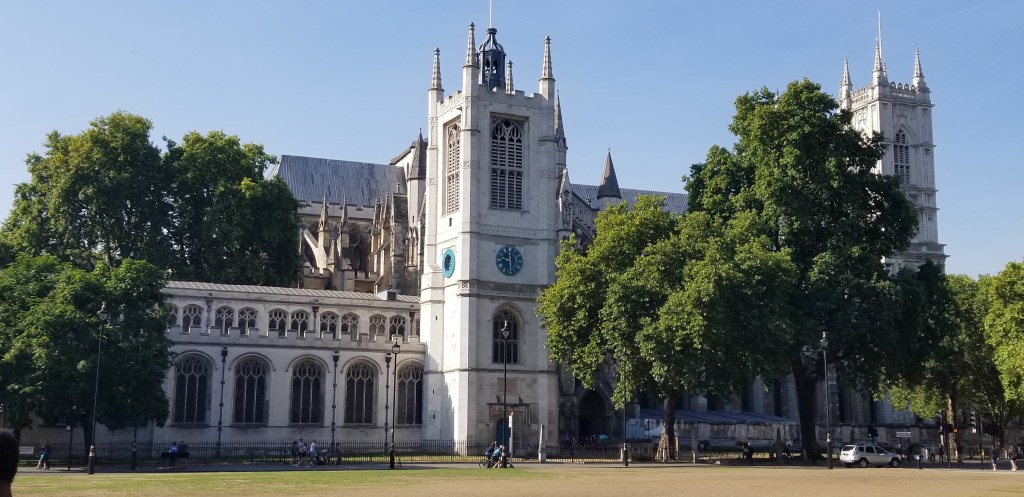
Westminster Abbey

While planning this trip I thought maybe we would skip London. We’d been there before. In order to cross the channel to the European continent, though, we needed to get on a train in London. And, honestly, our prior London trip had been more years ago than I’d like to count.

That trip was a gray and gloomy Thanksgiving weekend on one of those hulking tour buses that I keep talking about. We got on the bus way back in Germany, where we were living. Crazy, but we used to do stuff like that on our weekends back then. On that tour, we saw all the highlights like the changing of the guard at Buckingham Palace and the Tower of London, as well as things that weren’t, like a Beefeater medieval dinner complete with singing madrigals.

One thing I wanted to redo from that trip was Westminster Abbey. I hardly remembered our tour through it, and over the years since then I’ve heard many things about the church that I wanted to see. We didn’t visit St. Paul’s cathedral that time, either. I decided that a walking jaunt from one to the other was doable. And Cal, in his affable way, thought that anything we did would be just fine.

To get from our AirBnB, we needed to hop on one of those double decker buses that London is famous for. We were able to get a coveted front-row seat on the top level for our own personal London street tour.

Not our bus, but there were plenty of others around the city to take pictures of

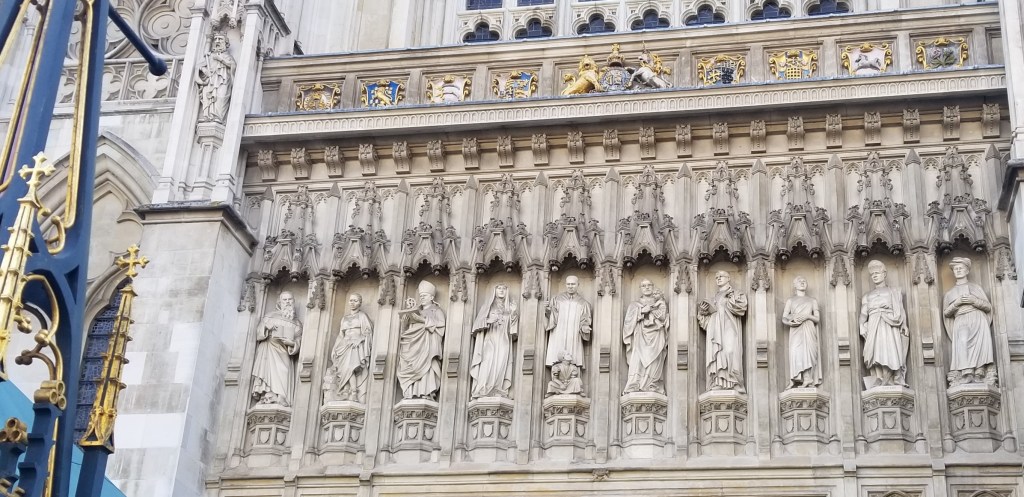
Looking up as we went into Westminster Abbey, I was surprised to see statues of people I recognized. These are martyrs from every continent who represent all who were oppressed or persecuted for their faith in the 20th century. Very modern, for an old cathedral.

The two I recognized were Dr. Martin Luther King Jr., fifth from left, and Dietrich Bonhoeffer of Germany, second to the right from him, killed by the Nazis in 1945. Niches for the statues were completed in the 15th century but never added until 1995.

We chose to be part of a 90 minute Verger-guided tour, which is a great way to learn the history of this Anglican church.

Forty monarchs have been crowned here since the year 1066. We saw the uncomfortable-looking chair that every monarch has sat in for their coronation, and sure enough, when King Charles II was recently crowned, there he was in that chair.

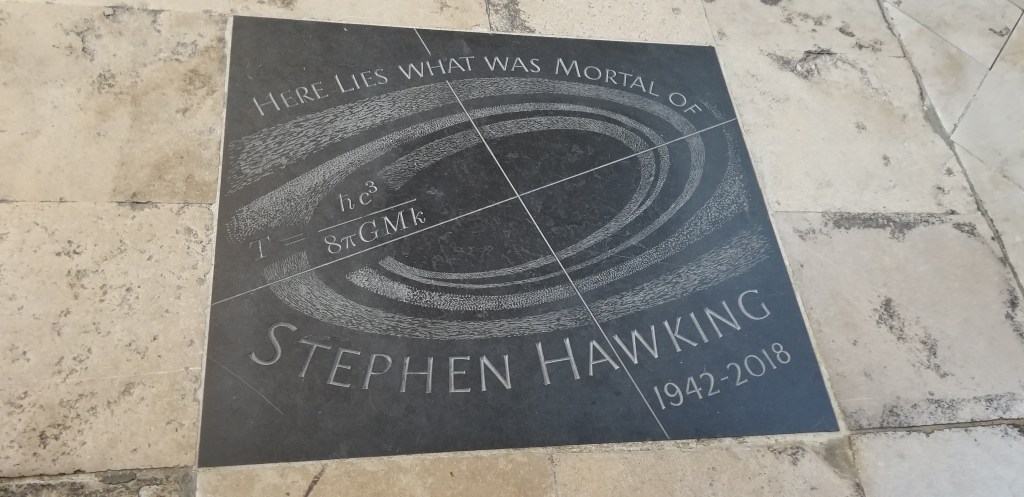
So many tombs! 3,000 people are buried within Westminster’s walls. That includes all of the royals until George II in 1760, because of space restraints. There is Mary Queen of Scots and her son, whose home I saw at Edinburgh Castle. In the scientists’ area are Charles Darwin, Isaac Newton, and a new grave: Steven Hawking.

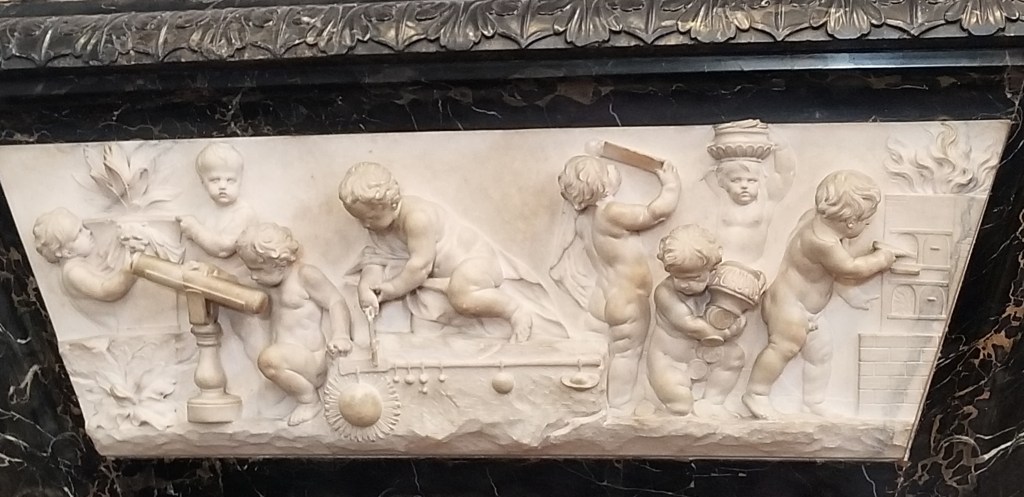
The cherubs in the memorial in their honor are so cute:

There is also a poets and musicians corner, where Chaucer, Kipling, Dickens, Handel and others are buried. I was pleased to see a memorial to the Bronte sisters, even though they are not buried here.

Outside again to exit, we walked through the cloisters of the abbey that was once here. Westminster Abbey received incendiary cluster bombing by the Nazis in 1941 and the cloisters sustained heavy damage. It has been reconstructed, like many other areas of the church.

Back out into the bright sunshine, we walked near Parliament and admired the statues. I had just finished reading Erick Larson’s “The Splendid and the Vile”, about the early days of Winston Churchill’s time as prime minister, and was pleased to see his statue.

I’m always happy to see women honored, because there aren’t as many statues of them. Here is Millicent Garret Fawcett, a politician and champion for women’s rights around the turn of the century.

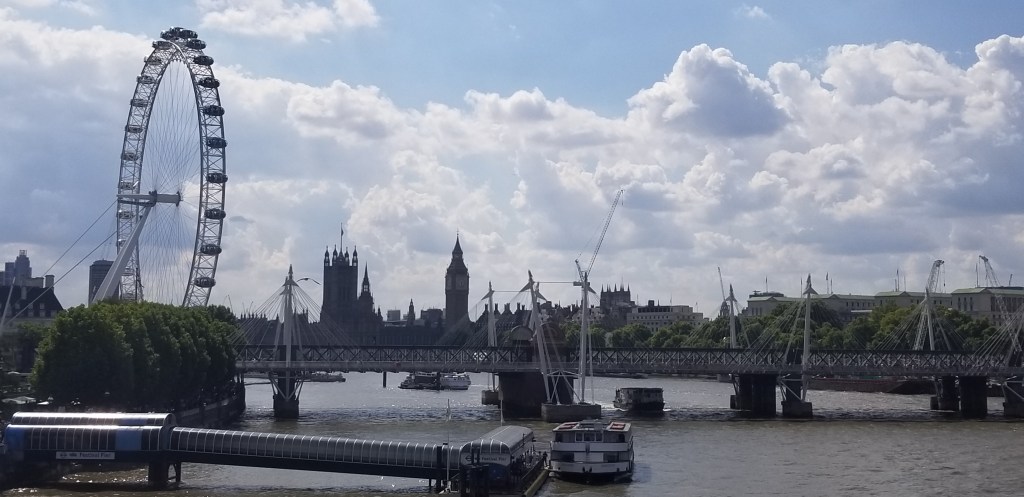
We walked over the Thames and got a view of Big Ben. I was more excited than I thought I would be to see both again.

Then, over the river to an exceptionally crowded and touristy area for a view of the London Eye, which we did not ride.

By now, we’d had lunch, crossed back over the river, and were walking towards St. Paul’s Cathedral in earnest. Twining’s Tea is along the way, and since that is one of my favorite brand of teas, a stop was obligatory. The shop has been in this location since 1706! You have to excuse the Chinamen on top of their facade. It’s an old stereotype, but they have only been there for a few centuries.

Although it was a pleasure to go inside, I was actually a little disappointed in their selection. Still, I was able to purchase individual tea bags in several flavors. Cal waited patiently outside for me and rested his tired feet.

Twinings is on an old thoroughfare called “The Strand”, and I admired the architecture in the buildings and monuments that we saw as we walked. The Temple Bar monument with its statue of Queen Victoria and the spiky dragon, symbol of London, marks the end of the Strand. It sits next to the corner of the Royal Courts of Justice.

Some fortification was needed before entering St. Paul’s Cathedral, and that came in the form of a shared sticky toffee pudding.

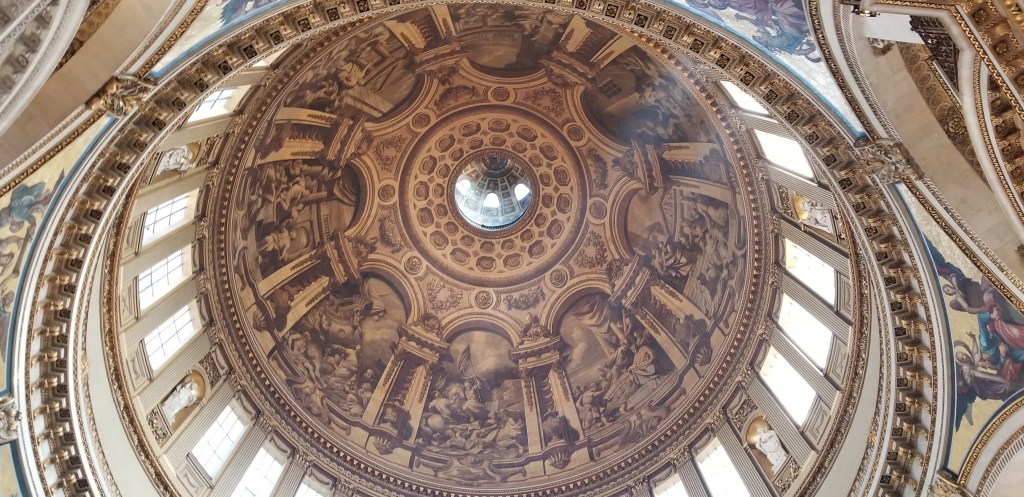
St. Paul’s is another Anglican cathedral, the first to be built after the Reformation. We were so amazed at the splendid mosaics in the ceiling and on the walls. There are mosaics everywhere. They are made of colored glass and gold leaf. These were done at the request of Queen Victoria, who thought the cathedral was looking too drab. The mosaics glitter and sparkle and make a person wonder exactly how anyone could create something so magnificent.

There are painted scenes of the life of Paul up in the lofty dome.

At St. Paul’s, there is almost more than the eye could take in.

As we were walking about, the choir started practicing. The music was so lovely that we decided to stay and wait for the evensong service. While we waited, we wandered below the cathedral, where the crypts are. Among others, there is the tomb of the Duke of Wellington, Napoleon’s conqueror, and also Florence Nightingale. Christopher Wren, the builder of St. Paul’s is buried here as well.

The evensong service capped off this first day in London. There were two more to come, and ironically, we were here on another holiday weekend. This time it was London’s holiday, not ours: the Summer Bank Holiday which made it a three day weekend. Sometimes, when one is on a long trip, this can’t be avoided, and I didn’t even know that Monday was a holiday until we got there. Crowd levels don’t matter much in a city like London unless one is in the biggest tourist areas, though, and except for our stroll past the London Eye, that’s not where we were. The entire city is busy anyway. We were in the Westminster Abbey area early in the day, which also helps. I’ll have more for you on our London weekend the next time I post.

Next time – more sights and tastes of London

Europe · UK and Ireland

Stonehenge and the Cotswolds – Europe Travels August 2022

For the next few weeks I will take you back in time and over the ocean to our trip to Europe last summer. I last left off with our outstanding visit to Bath. It was while we were in Bath that we took a excellent day trip to Stonehenge and the Cotswold region of England.

Rick Steve’s guidebook had led us to beautiful Bath. Another reason for coming here was that in the book he mentioned Mad Max’s day tour to Stonehenge. Since we were totally traveling by rail on this trip, I had not thought that we would be able to see it. This tour was icing on the cake for visiting Bath. Once again, we were in a little minibus, tooling around the Cotswold area for the day. Stonehenge is on the Salisbury Plain in Wiltshire.

And now I’ll let you in on a little secret. If you take this tour, you will be among the first to arrive at Stonehenge for the day. Tours from London – in those huge, hulking tour buses – arrived after us, because it takes longer to get there from London.

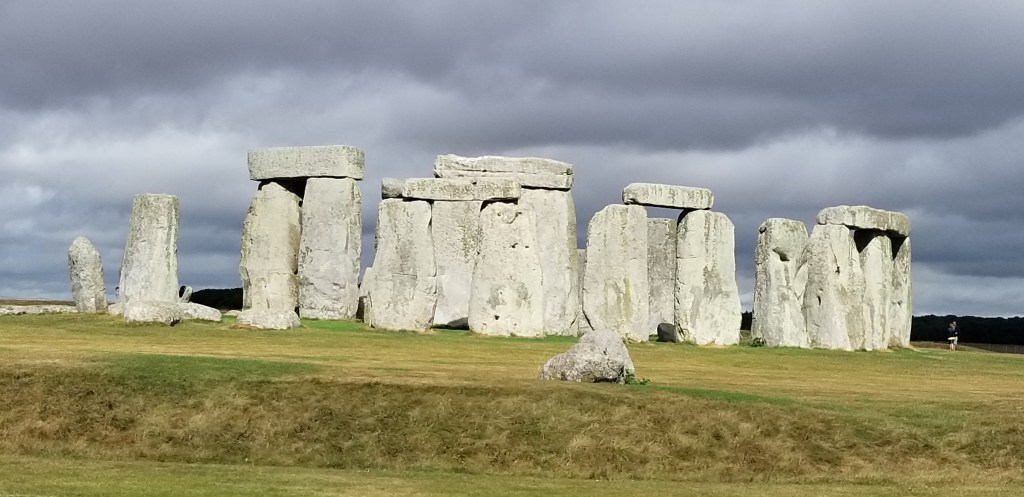
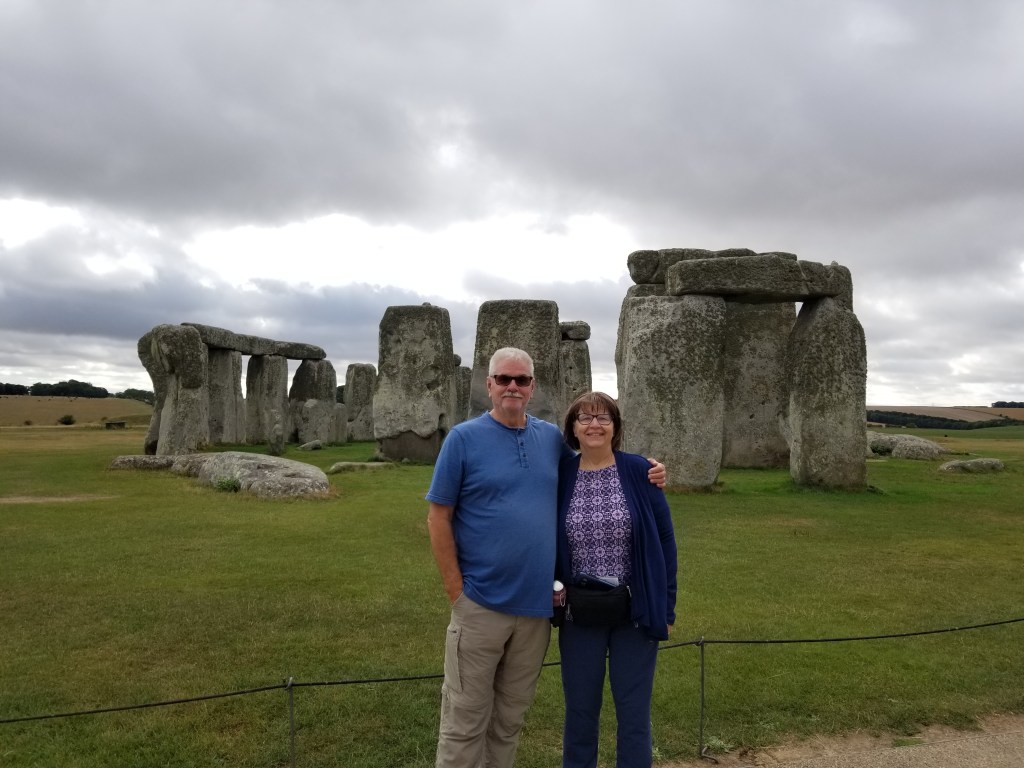
What a feeling to walk around it in person. The sun played peekaboo through the clouds and at times illuminated the rocks. The place was largely silent through most of our visit.

Yes, we were really there!

At its core, Stonehenge is a prehistoric temple in which the stones are aligned with the movements of the sun. The flat stones laying down at the top went all the way around in a circle. We still don’t know if it was a burial site or a place of healing, a celestial calendar, or all of the above. It took a thousand years to build. The beginning of its construction predates the Great Pyramids and the Roman Empire.

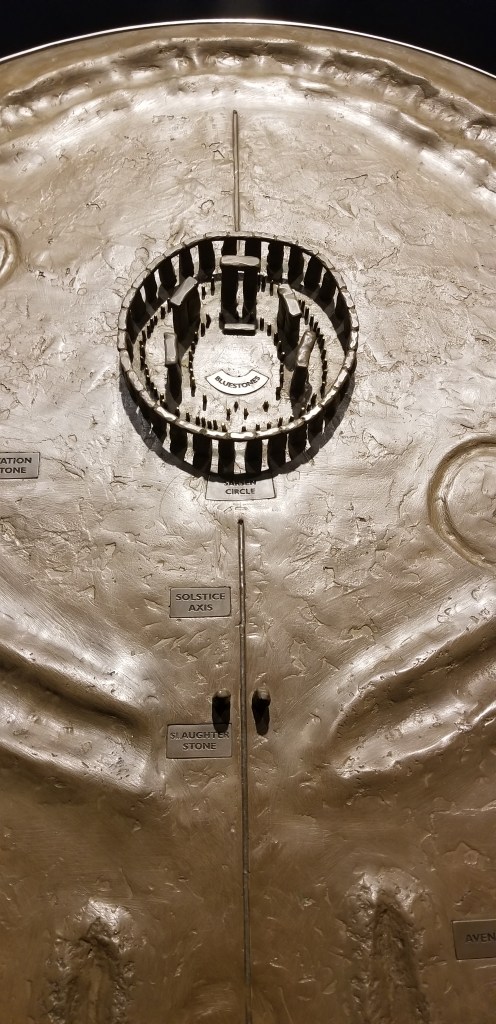
The outer circle of standing stones, called sarsens, enclosed five huge horse-shoe shaped stone arches. There are two inside circles, made of bluestones, and four station stones outside the central monument. The whole thing is surrounded by a circular ditch. The builders brought some of these rocks from great distances. The blue stones come from Wales, 140 miles away. In those days, there was no loading them up on a truck using a crane.

This diorama in the museum did a good job of showing what it looked like.

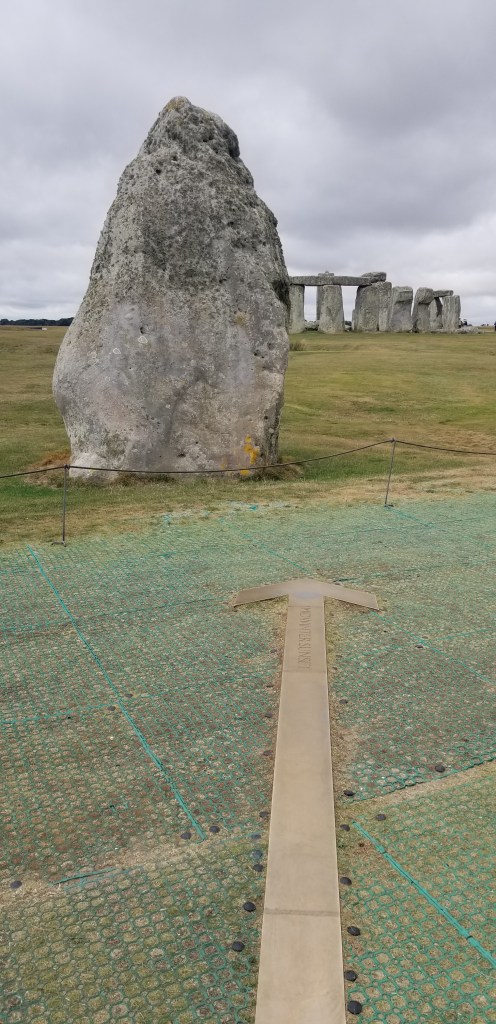
Back at the stones, we stood at the entranceway which is the thin line at the bottom of the diorama. It was a processional avenue built around 2300 BC. The stone in front is called a Heel Stone, and blocked by this view is one of the slaughter stones. Archeologists have found intense prehistoric activity here, because originally they lined the avenue with wooden stakes. The stakes were later replaced by stones, most of which are gone now.

I follow BBC news, and by coincidence Stonehenge has been in their news this week. Scientists now believe the stones may have also been a huge echo chamber. Voices inside the stones were amplified, while those outside the stones would not have been able to hear what was said. This just lends more fascination to the mystery.

We had plenty of time on our own to wander, visit the museum, and see their display of a Neolithic village.

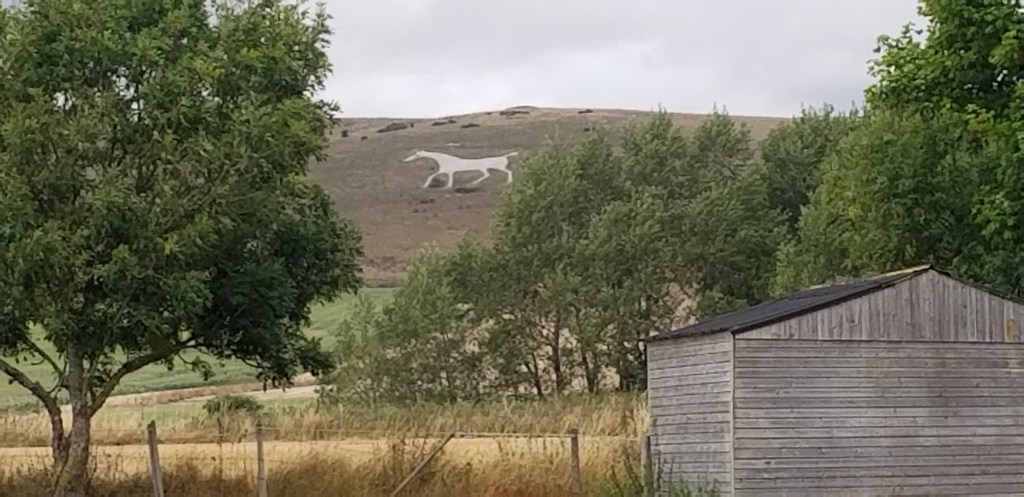
Back down the road, we made a brief stop to get a view of a chalk horse in Wiltshire that dates back to 1812. The chalk lies just under a layer of sod. Later on we drove by another that was cleared even earlier, in 1780.

We stopped at this little pasture, and friendly Gypsy Cobb horses came loping right up to see us. This was because our tour guide had a bag of carrots! With permission from the owner, he makes this stop every day and the horses know for sure that the tourists are going to feed them.

The Cotswolds are a rural and quaint area of England with towns and homes built from a limestone which is golden colored. Many picturesque thatched roof buildings can be found here. Our first stop in the Cotswolds was Avebury, where the thatched roofs take second place to the standing stones over an area that dates farther back than Stonehenge.

A “henge” is a large ditch or trench with a bank. At Avebury, the circular ditch is almost a mile around, and it was cleared with deer antlers and cow bones 6,000 years ago. The ancients would have cleared this down to the bedrock.

Inside the circle formed by the henge, stones were set in a straight line for quite a distance, perhaps as a processional route, leading up to stone circles. These were spread out and, unlike Stonehenge, uncut. Of course, through millenia many stones are gone. The town of Avebury grew inside the henge circle, along with farms.

Here you can see some of the stones with the bank of the henge behind them. This is a sheep pasture and we had to watch where we were stepping!

The huge stone below is called “The Devil’s Stone”. If you run around it 100 times, so the story goes, you will meet the devil. Well, we did not do that, but this handy rock also has a fertility seat. I sat in it and I can happily report that since then no babies have arrived.

Many people were out enjoying the stones and the day in Avebury. You can see the Devil’s Stone again at left below.

I was also happy to be out of the minibus to view the thatched roofs. Here an old cottage built of Cotswold stone, now a barn, sits among the stones.

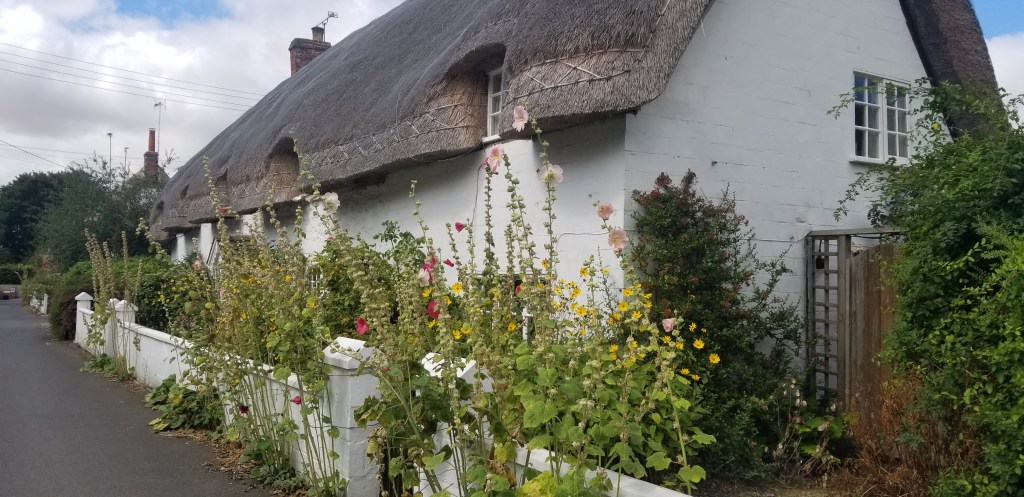
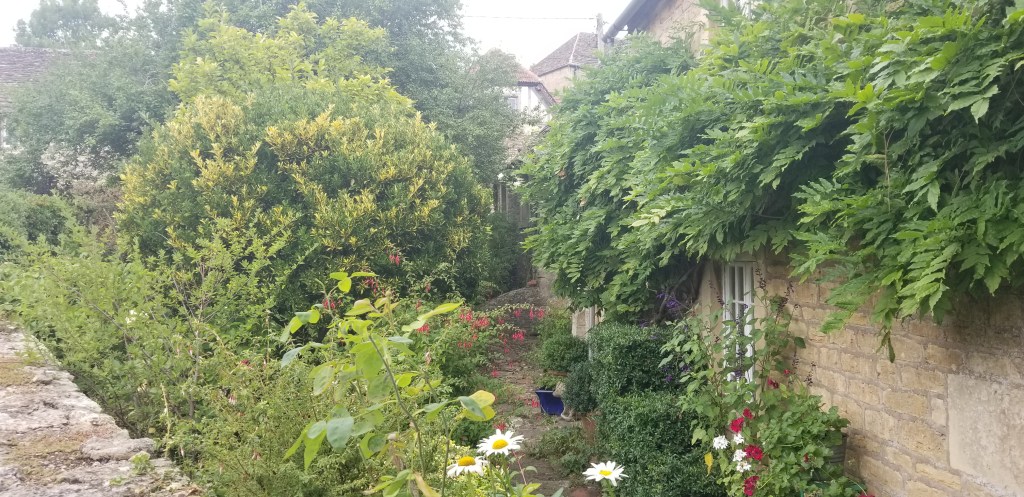
In town, I took this picture of a thatched home with a pretty garden.

After Avebury, our guide showed us many other thatched buildings. Here is the only church in England with a thatched roof:

It takes a lot of training and expertise to be able to repair a thatched roof. The buildings need to be re-thatched after several years, and a specialized craftsperson is hired for the job. It is custom for the thatcher to leave their trademark at the top of the roof when done. Here, on this house, you can see a little squirrel left as this crafter’s trademark.

We spent time in two villages, the first of which was Lacock. It was already mid afternoon so we made a lunch stop. Cal and I have figured out the score on these lunch stops. We were given plenty of time on our own, but we’ve learned from other tours that we didn’t want to use up this time waiting for food in a restaurant. We had put a picnic lunch together before we left Bath. As it happened, there was a little picnic area near our drop-off spot with a grove of trees and a low stone wall. Soon enough we were on our way to explore Lacock after our break.

For the past few centuries, the entire town of Lacock was owned by one family, the Talbots. Lacock Abbey, a former nunnery, was converted to be their manor home. There wasn’t time for a guided tour but our guide showed us a path we could take to explore the grounds. As we walked around we could see a security guard on the back terrace keeping an eye on us.

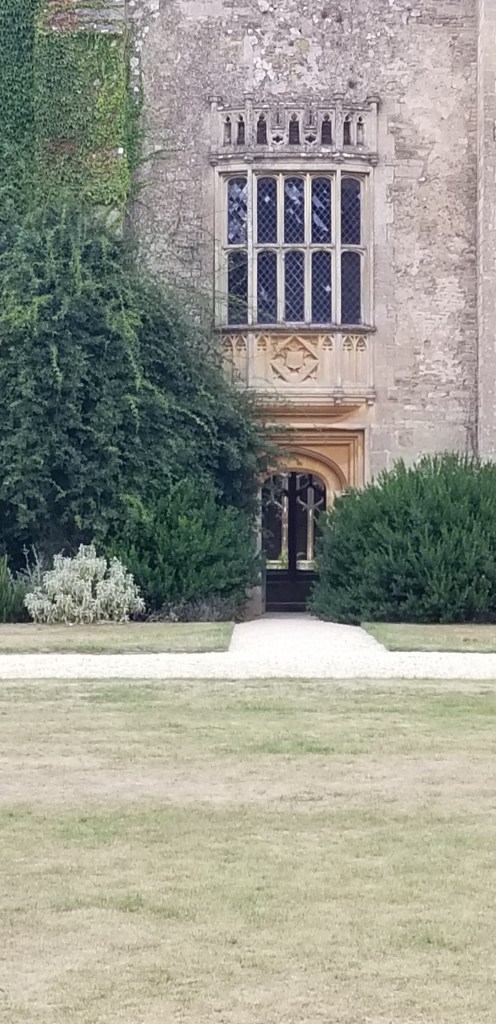
Lacock Abbey has a claim to fame: in 1835, William Henry Fox Talbot created the first photographic negative. The first picture ever taken was the small window that you see above the door.

In 1944 the last descendant of the Talbots sold the manor house and the town to the National Trust. The people who reside there are essentially living in a museum. They have all the trappings of modern day life inside their homes but none of it is shown on the outside save for the cars parked on some of the streets.

Laycock had an old workhouse reminiscent of Oliver Twist. That building is on the left of the picture below, next to a tannery where the folks in the workhouse were obliged to work.

The village dates to the early 14th century and there are seven centuries of buildings that can be seen in just a 10 minute walk around. There is nothing built after the 1920’s.

There were many beautiful gardens as well.

It was already getting on to late afternoon but we still had one more village to visit. Picturesque Castle Combe has had no new buildings in their historic area since 1600. The castle for which the town was named has long since been demolished. This was a large cloth making town in its day, but by the 1700’s the level of the river fell and could no longer support the mills. Spinners and weavers lived in the homes along the river.

Again, we were turned loose to explore. We had but a short time to look at the market center of town–

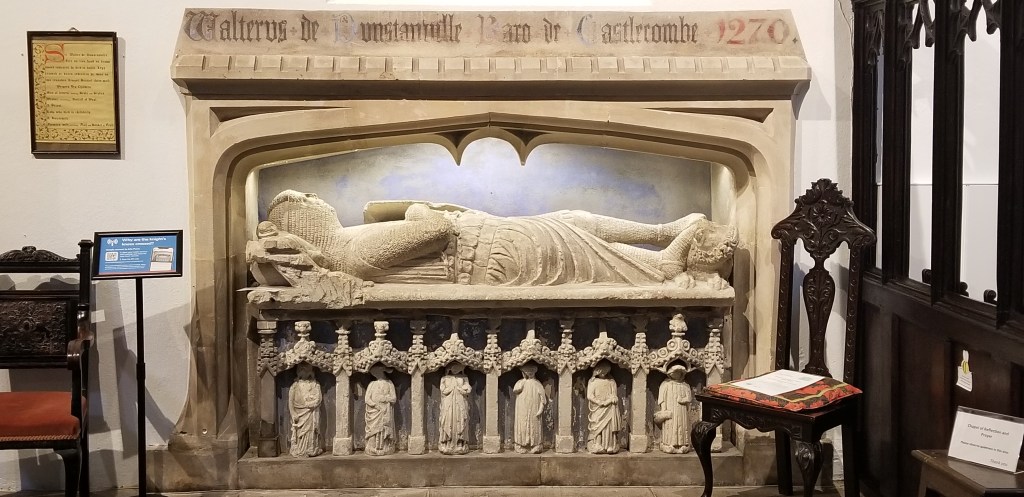
and to take a peek into the village church. There is a knight buried here.

This is Sir Walter de Dunstanville. His hand on his drawn sword indicates that he died in battle. His legs are crossed, signifying that he went on two crusades.

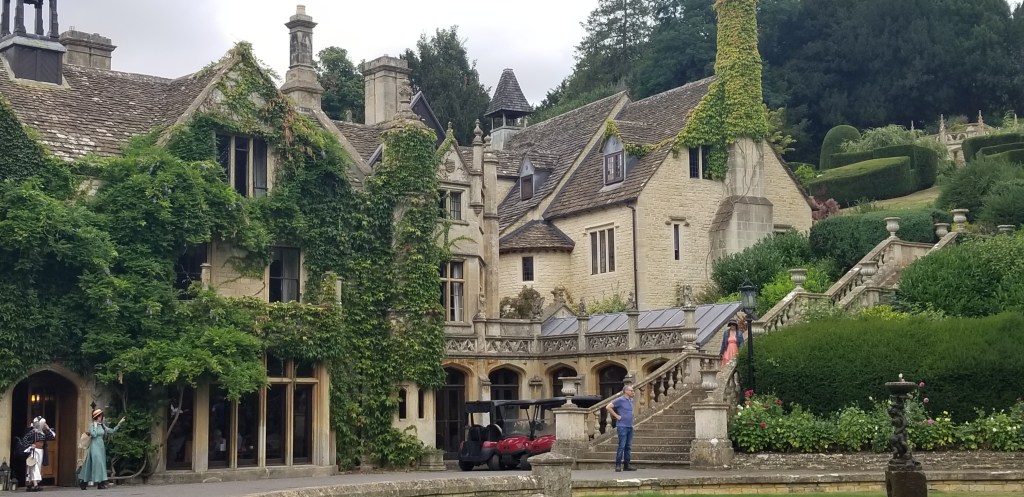
Castle Combe, like Laycock, had its manor house and for five centuries one family owed it and the town. Unlike Laycock, though, the town does not belong to the National Trust. The manor house has changed hands many times and is now a very upscale hotel. After I took this photo, I was amused to see various clashing eras in view. There is the house/hotel itself, some women in period costumes, a gentleman in jeans, and some golf carts. I would have loved to explore the grounds and the gardens more.
So many sights had been packed into one day! We capped off our return to Bath with 3 different and tasty mezes at a Greek restaurant on their patio. It was on a little pedestrian alley where we could people watch as we dined. I felt that this had been a very well-planned tour, and it went into memory as one of the highlights of our European trip.

Next time – London

Europe · UK and Ireland

Taking a Bath in Bath, England – Europe Travels August 2022

When putting together our trip, I found that we needed to visit one additional spot before going to London. I scrutinized my planning map. Where to go? Once again, I consulted my Rick Steves “Europe through the Back Door”. He gave Bath a solid three red triangles, meaning that it is a definite should-see destination.

In the travel chaos that was the summer of 2022, shortly before we left for Europe, Rick posted on Facebook about crowd management options. He suggested in his post that one should consider touring the less-visited cities that are less full of tourists. One of the examples he gave was Bath. “Instead of Bath, go to Bristol.” But Rick, you told me to go to Bath!

By now we were into late August, though, and the crowds in Bath were manageable. We knew what to do: see the places with the heaviest tourist traffic in the morning, avoid shopping areas in the afternoon, and have a plan for the day. We had come from several places that weren’t heavy tourist sites, so it was a little different, but we enjoyed so many aspects about our stay in Bath.

River Avon runs through the city of Bath, and we needed to walk alongside of it to get to the city center. There was a bridge over a canal that flowed into the river, and most every time a boat was making its way through the lock. A family with two kids was coming through one morning, and even the kids were helping to operate the manual locks.

Waiting to open the gates

The river is always beautiful, at any time of day.

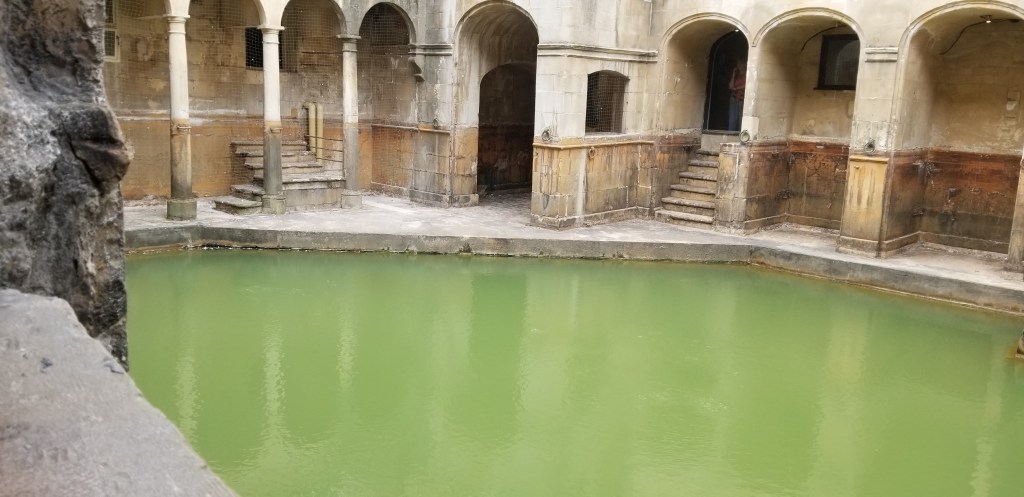
But are there really baths in Bath? Yes! In Roman times, it was considered to be one of the great religious spas of its era and the town was actually called Aquae Sulis. There are three hot springs, and the one with the most water in it is special to the goddess Sulis Minerva. She was worshipped even before the Roman era. A stone inscription dates the complex to 76 AD. We visited the Roman baths with a main bath and ruins of the temple and other bath rooms, housed in a museum with artifacts.

Lest you get a sudden urge to jump into the pool, it is sealed with lead, so your bath wouldn’t be so good for your health. There would have been a roof over this pool in Roman times, but now algae grows because it is open to the sky. For the average Roman bathing here, the baths would have been the biggest building they ever entered in their lives.

Inside, we walked under modern-day Bath through ruins of various smaller baths, cobbled Roman streets, and Temple Sulis Minerva. If we were Roman, we as commoners would not have been able to enter the rooms of the temple. There are altars and a tomb with a skeleton still in it. Many objects such as jewelry and coins that people left behind in the baths are displayed. There is even a gym.

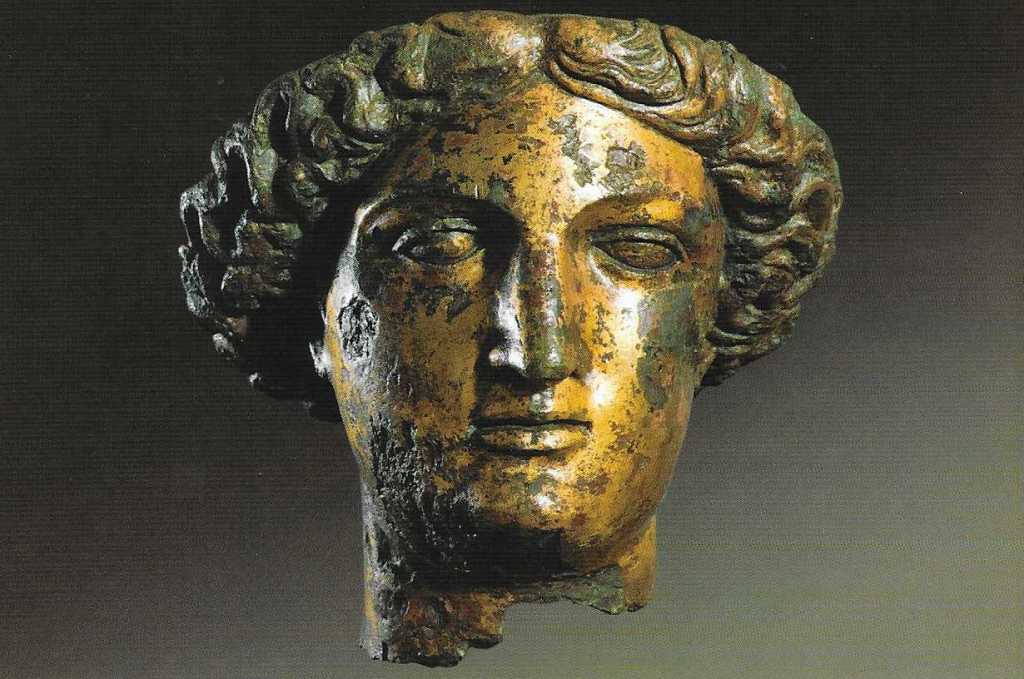
There would have been a full gilt bronze statue of Goddess Sulis Minerva in the temple. The head is all that remains and it was splendid to see. I didn’t get a picture of it, but found a postcard in the gift shop.

Also surviving is a large ornamental pediment, which would have been over the entranceway, with a fearsome head of a gorgon. As with many of the ruins and stones we saw, it would have been brightly painted. The Romans borrowed the gorgon from Greek mythology. It is thought to be was a symbol of Sulis Minerva.

We wandered around through the maze of rooms, all under the city of Bath. These rooms were at bath level.

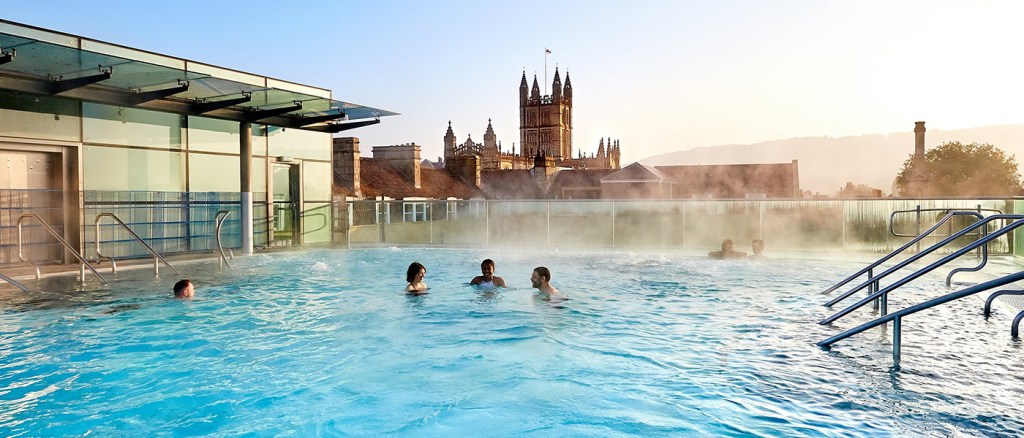
Of course, the spring is still here, and today there are modern baths. We celebrated our anniversary while in Bath, and took a bath in Bath at Thermae Bath Spa. We carried our bathing suits in our luggage all over Europe just so we could use them this one time. It’s not something we would normally do so it was a great experience. The pools in the baths are not heated because the water comes out of the spring and into the pools at about 93 degrees Fahrenheit. It feels like pleasantly warm bath water. A few floors up, there is an outdoor pool. It was raining so it was very strange to be in the warm water at the same time as the rain, but we could look out over the city as we lounged about. We spent most of our time in the floor-level indoor pool where there was a nice whirlpool and a lot of interesting jets.

Credit: Thermae Bath Spa, Bath, England

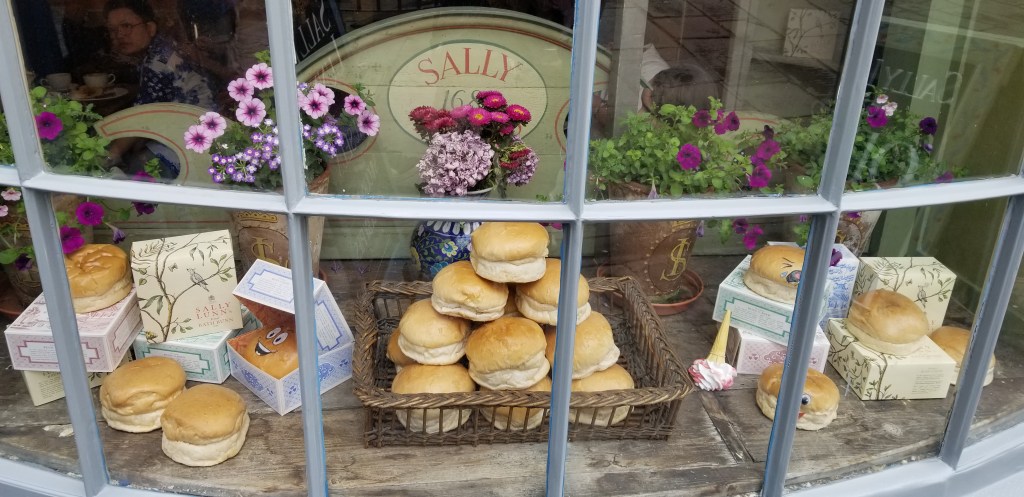
After our bath, we had tea (lunch) at Sally Lunn’s. Dating to 1483, the restaurant is in Bath’s oldest house. Sally Lunn came to Bath in 1680 and began selling her delicious French buns, and the rest is history. A Sally Lunn bun is like a brioche. It is part bun, part cake, part bread. This really wasn’t a great place for the real “tea” experience, but our buns were delicious.

Sally Lunn’s buns

For tea, we were each served one bun. One half, cut into quarters, had smoked salmon on top. The other half was served with butter, jam and clotted cream. I was just about full after having just the one half with the salmon, but who can resist all the goodness on the sweet side?

In the basement, a view of the kitchen as it would have been long ago

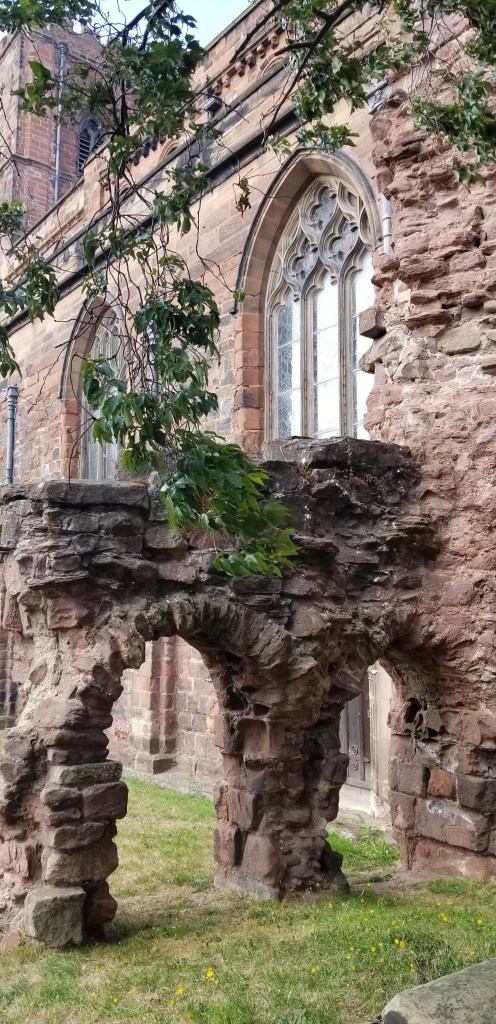
The other unforgettable experience here was a tower tour of Bath Abbey. The Abbey was founded in the 8th century as a Benedictine monastery and, like Shrewsbury Abbey, lost the monastery during the reign of King Henry VIII. The church itself has gone through many cycles of ruin and repair since 1090, and was even bombed in World War II. She is standing proud over the city of Bath today.

It was 212 steps up to the top of the tower! Along the way, though, our guide had many things to show us. After climbing a little, we were on an outside balcony where the priest could address his congregants on special occasions. There was a long narrow walkway on the roof, some more climbing, and we were in the room where the bell ringers gather. There are ten bells, and each person needs to pull their rope at the proper time to produce the correct melody. I’d be tired from the hike to this room at least twice a week before even proceeding to ring my bell. And several of the ringers are elderly. It’s a matter of great pride to be a bell ringer.

We ducked into some narrow passageways for a look at the bells and the rafters of the cathedral. There was even a tiny peek-a-boo spot where we could look down into the cathedral below. The very top of the roof vaults are only four inches thick!
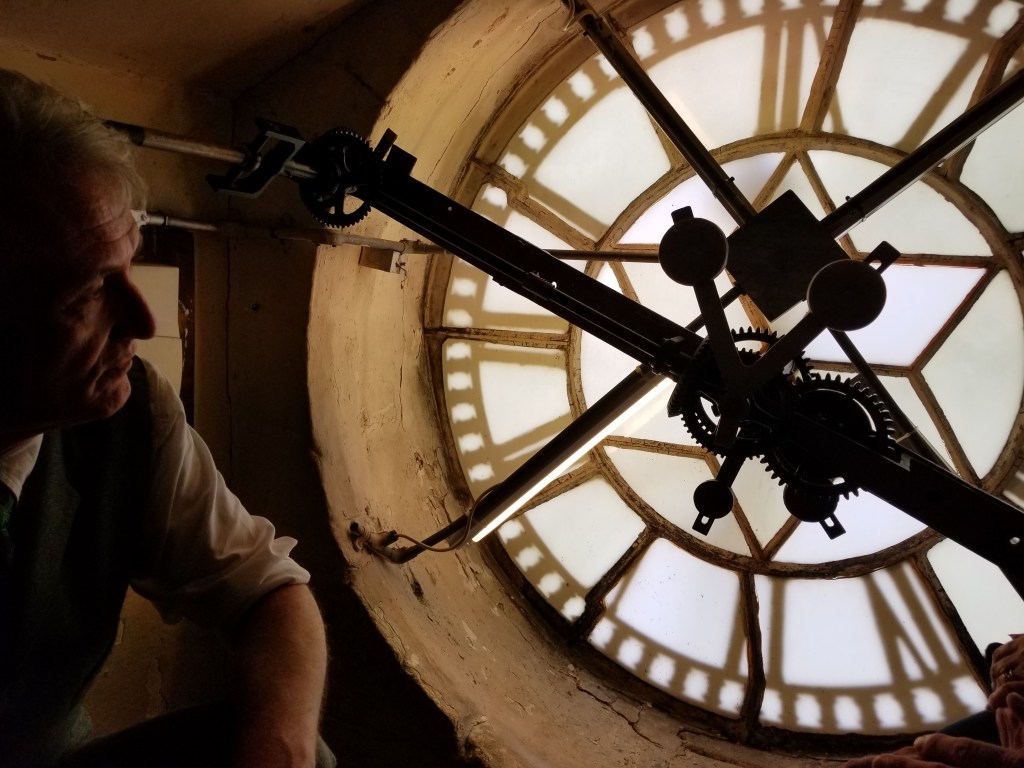
And then, we were behind the clock.

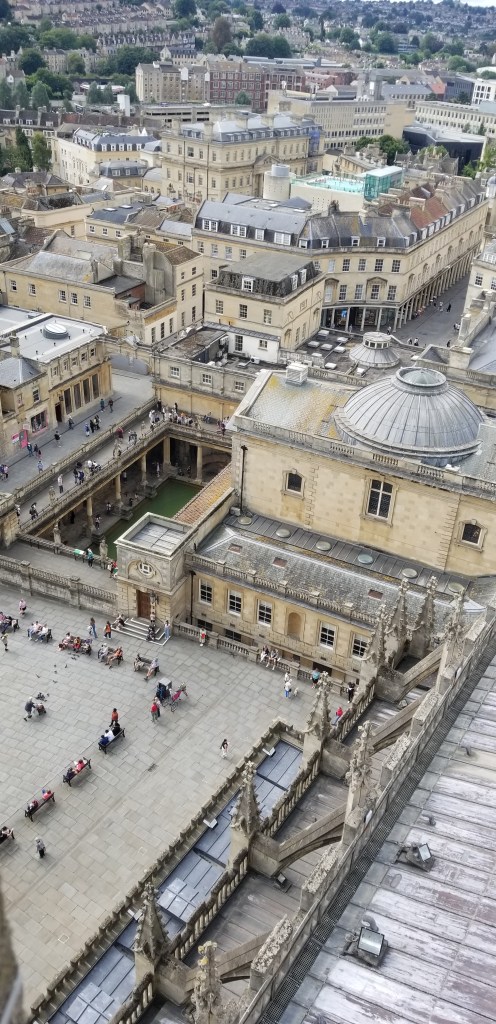
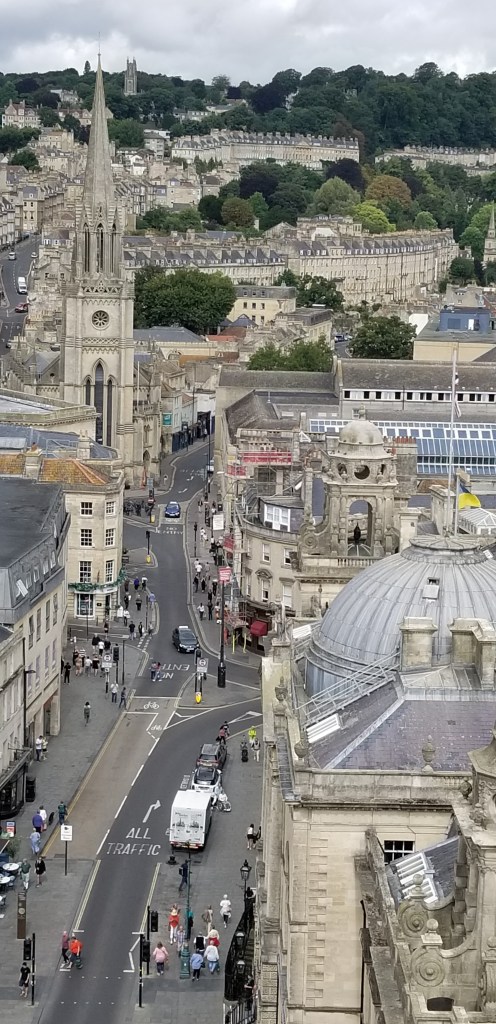
Finally, we were up at the top of the tower, and given a marvelous view over the city of Bath and the Roman baths below.

After the tour, we visited the inside of the cathedral. The very first king of England, King Edgar, was crowned at the monastery here in 973 and there is a large window with a depiction of the occasion. We looked at the beautiful fan shapes in the soaring ceiling, now more interesting since we had seen the attic. There were large flat gravestones (ledgerstones) on the Abbey floor, 891 of them in total. I don’t know if I walked on all of them. It took twelve years to repair the cathedral after World War II, but repairing the ledgerstones was a whole other project.

Cal needed some fortifications after all that time climbing around the cathedral, and we also took time to listen to the buskers on the street.

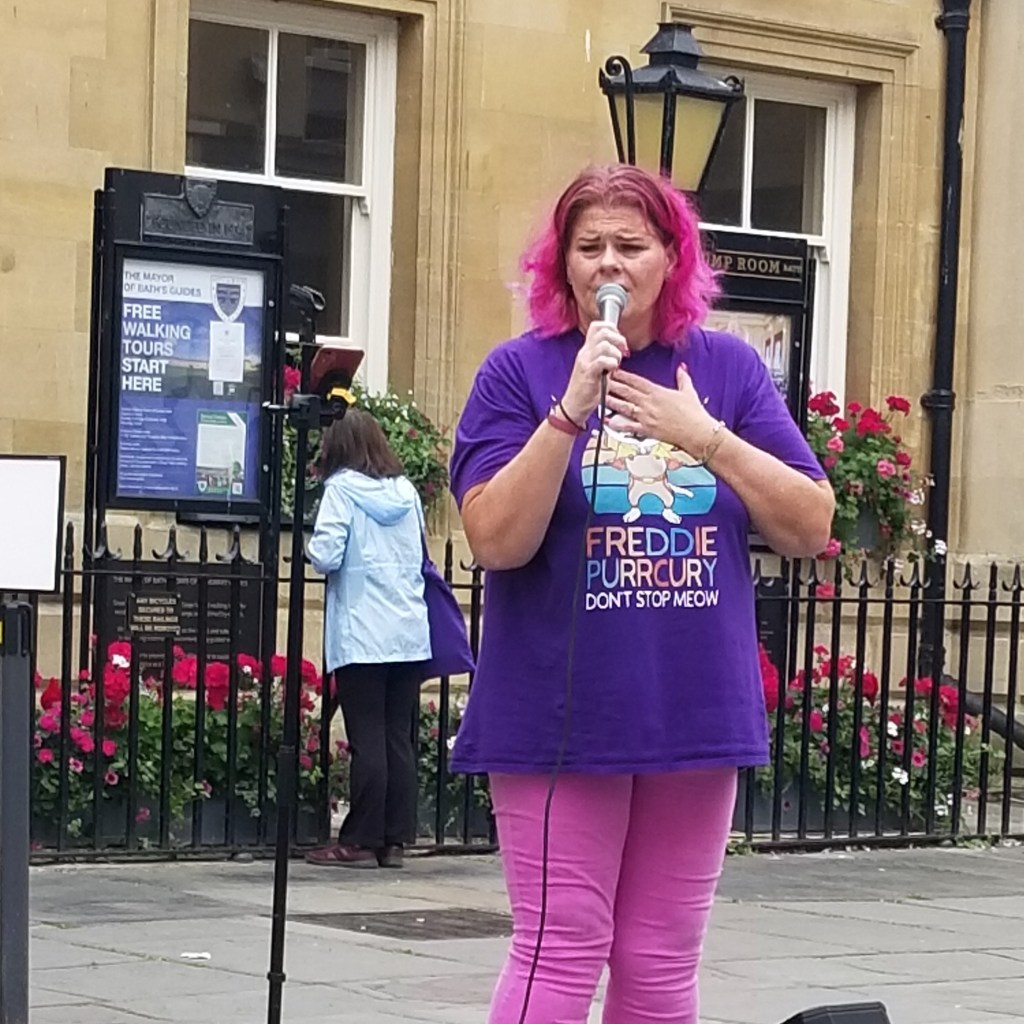
From our vantage point on top of the cathedral’s tower we had been able to see that there were three different places where the buskers performed, and they rotated around those places throughout the day. This woman was a classically trained opera singer who performed a lot of songs from musicals that I was familiar with, and we enjoyed an early lunch while sitting on a bench and listening to her.

This little piece of advertising on the cathedral plaza always caught my attention.

In a tucked-away corner of the canal leading to the river, we found this little swan family out for their evening swim.

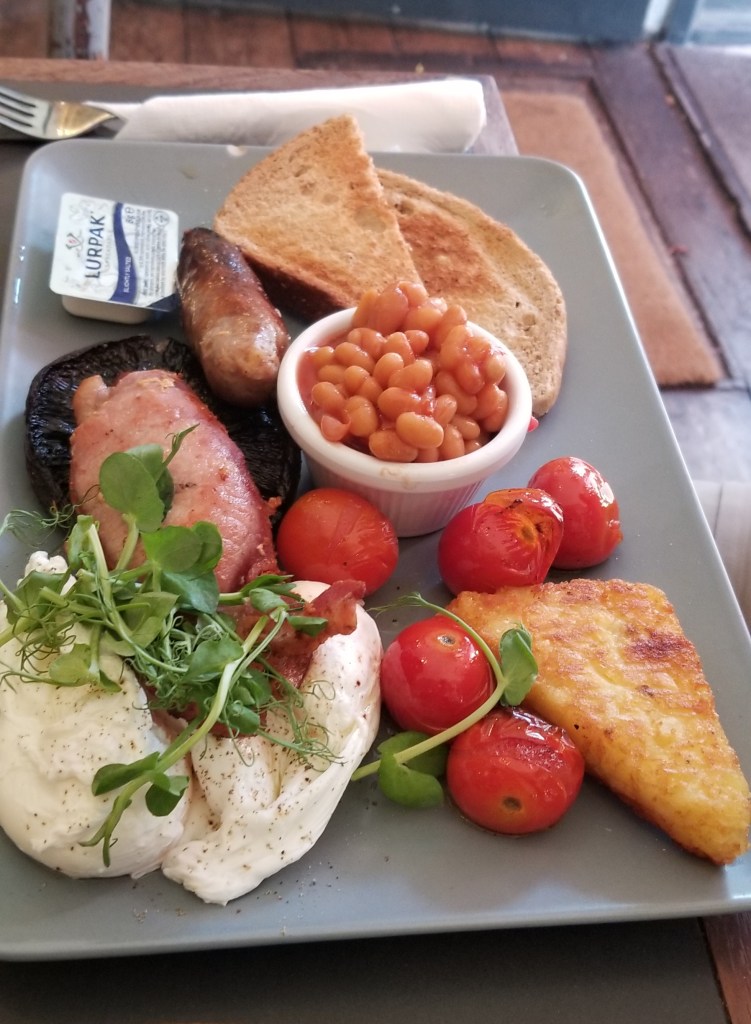
The day we left Bath, Cal enjoyed an English breakfast. These large breakfasts had lost a bit of their excitement for me after having had haggis and blood sausage in Scotland, and all of them in the UK are similar, so he did the honors while I just had a poached egg and toast.

English breakfast: poached egg, tomatoes, tattie scone, sausage and ham on a large mushroom, and beans

My next Europe posting will cover our visit to Stonehenge and the Cotswolds. First, though, I’m coming back to the present — February is a big traveling month for us, and I already have much to report. My posts will return to the United States for a little while. We’ll be on one of those travels next week so it will be two weeks before I’ll post again. I just returned from a long weekend in New Orleans, so stay tuned for the details!

Next time – Mardi Gras in New Orleans

Europe · UK and Ireland

Higgledy Piggledy Streets in Shrewsbury, England – Europe Travels August 2022

Shrewsbury is likely not the kind of town you would know about if you are trying to decide where to go on a trip to England. And indeed, if you don’t have a lot of time, you probably wouldn’t put it on your list. Tourists are here, yes, but not in droves that we saw elsewhere.

The town lies in Shropshire, in the far west side of England, right next to the border with Wales. It is the setting for a detective series about a 12th century Welsh Benedictine monk who solved crimes in Shrewsbury. Ellis Peters wrote 22 books in the “Brother Cadfael” series. I read all of them, although I enjoyed the earliest books in the series most. A few years back, I looked up what it might be like to visit here, and dismissed it for some reason. Of course, things are not going to look as they did in Cadfael’s day.

But then, a Facebook blogger that I follow called “Florry the Lorry” visited Shrewsbury. The pictures she took of this town are gorgeous. I’m sure that when I commented about a possible future visit here, she replied about the medieval buildings and streets going all “higgledy piggledy”. I can’t find that thread now, but I was ready to go based on her pictures and remarks. Plus, it was right on our path through England.

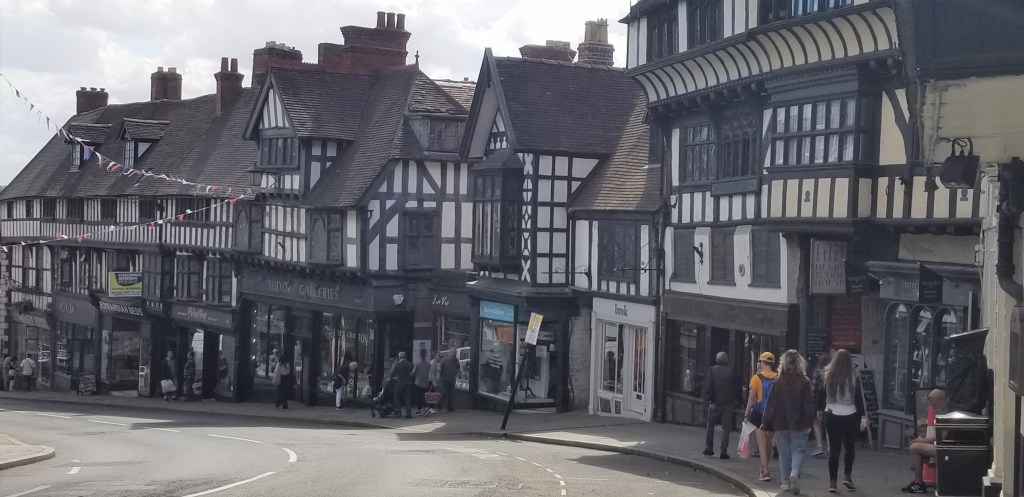
We spent a lot of time in Shrewsbury just wandering about, admiring the crooked buildings, and peering into shop windows.

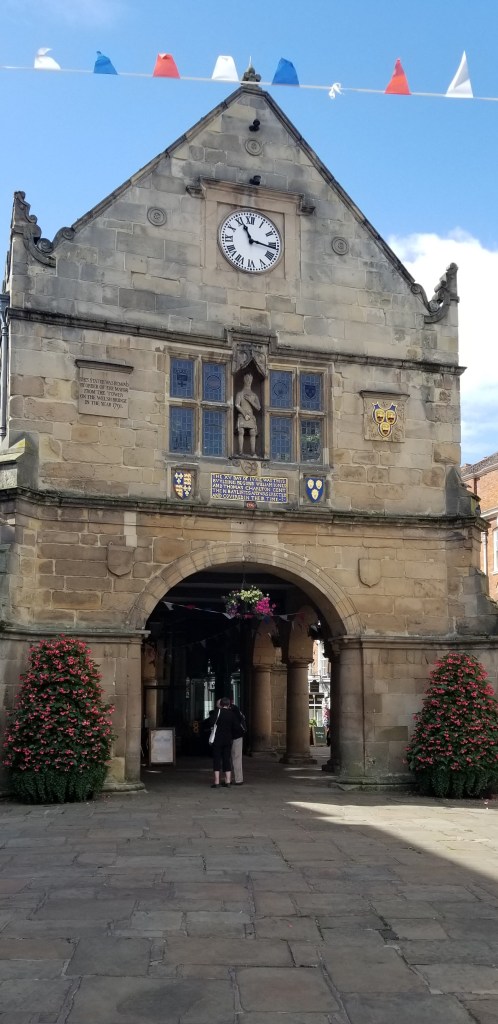
For centuries, Shrewsbury has been a designated “market town” which gives it the right to have a weekly market. It was held here, under the archway and the square:

In the 1960’s the need for a new market was evident. The town built a modern indoor market that retained none of the character of the original, but I’m sure the vendors enjoy being out of the weather. We walked through and I did a wee bit of shopping, as well as to have the requisite tea and cakes. I bought some much needed socks, a foldable tote bag, and – a steal – 3 vintage postcards for forty pence each. We had all the fruits and vegetables that we needed back in our apartment.

Charles Darwin was born in Shrewsbury. There is a statue of him in front of the building where he went to school as a boy. It is now the town library.

There are always so few statues of women that I feel that I should give Mary Webb her due. Her statue was near Charles Darwin’s.

The Shrewsbury places featured in the Brother Cadfael mysteries are Shrewsbury Abbey, the River Severn, and Shrewsbury castle. All of these places still exist…sort of.

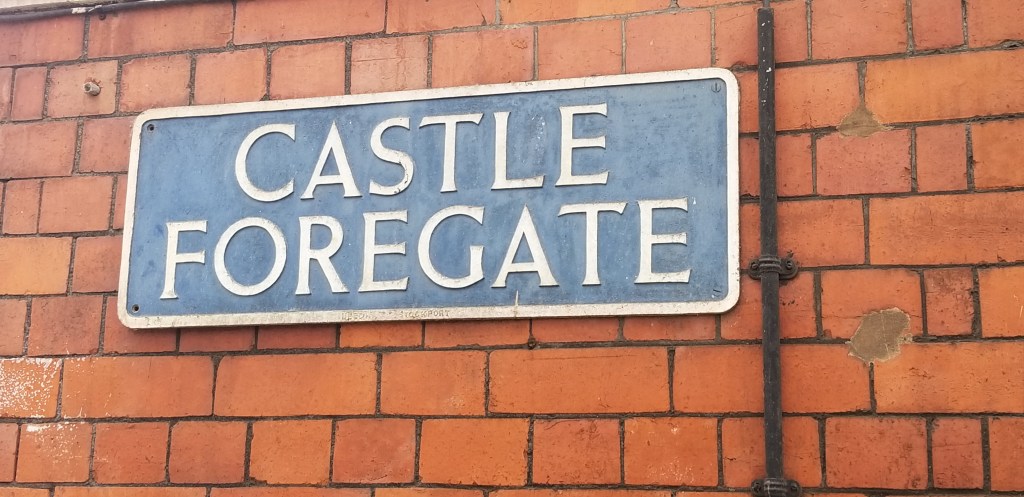
The “Castle Foregate” and the “Abbey Foregate” are two place names often mentioned often in the books. It is simply the roads leading up to the gates of the castle and the abbey, and they are street names used today. It’s interesting to think about how old street names can be in a country that has been inhabited for so long.

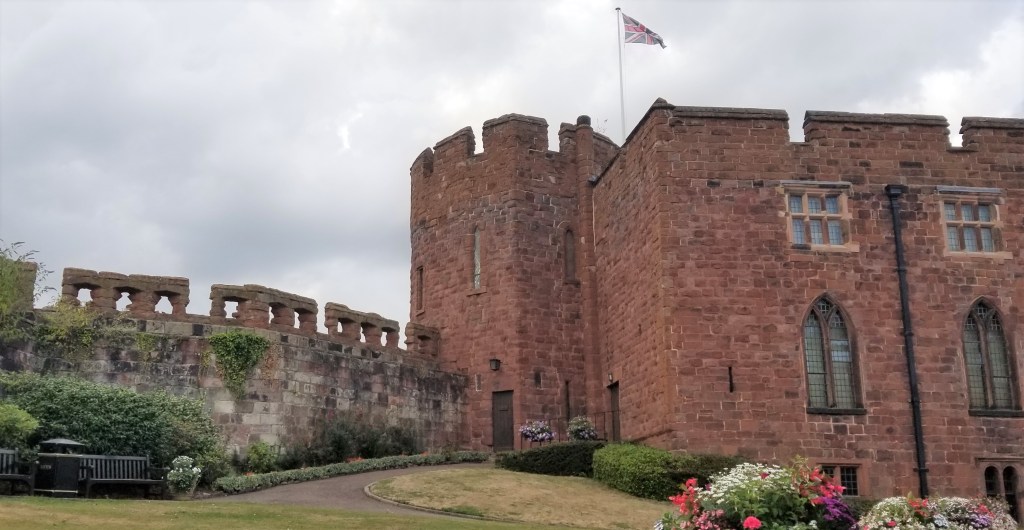
We walked up the foregate to the castle.

The castle contains an armament museum. Looking down into the knights’ hall, I tried to imagine it as it might have looked in the 1100’s without all the displays.

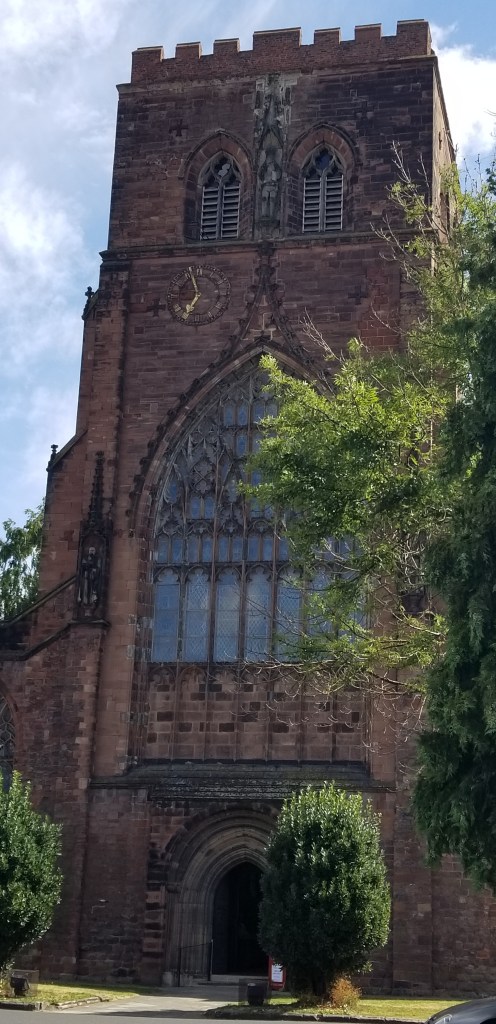
Shrewsbury Abbey, the home of the fictional Brother Cadfael, still exists too. It was founded in 1083. However, King Henry VIII did away with all the monasteries in England and made himself head of the Church of England. The abbey was destroyed in the 1500’s. The church retained its name although there is no abbey and was no longer Catholic after that point. The Romanesque church that was erected in the 11th century still stands, although parts of it have been rebuilt over the years.

A side gate which would have led to the Abbey is all that is left of that:

Inside Shrewsbury Abbey church

One of the stained glass windows paid homage to the Benedectine monks. There are also two statues of the same man laying down, one which depicts the man with a sword and the other shows him wearing a religious robe of some sort. Perhaps this was an inspiration for the books?

The window and artifacts below honor the memory of St. Winifred, a 7th century Welsh saint. The acquisition of her relics surrounds the plot of the first Cadfael book, “A Morbid Taste for Bones”, and is the story which hooked me into the whole series.

The church organ was purchased in 1911. Installation was never totally completed and by the 2000’s it needed some restoration. The update was finished in 2021. There was a surprise treat in store for us: an organ recital by a professor at a nearby college. He performed excellently and now that the organ could be played to its fullest potential, he (literally) pulled out all the stops.

Especially after visiting the church, I was very impressed with all the research Ellis Peters had done with her books. She wove all of her stories in and around the actual places and historical events that were happening in that era.

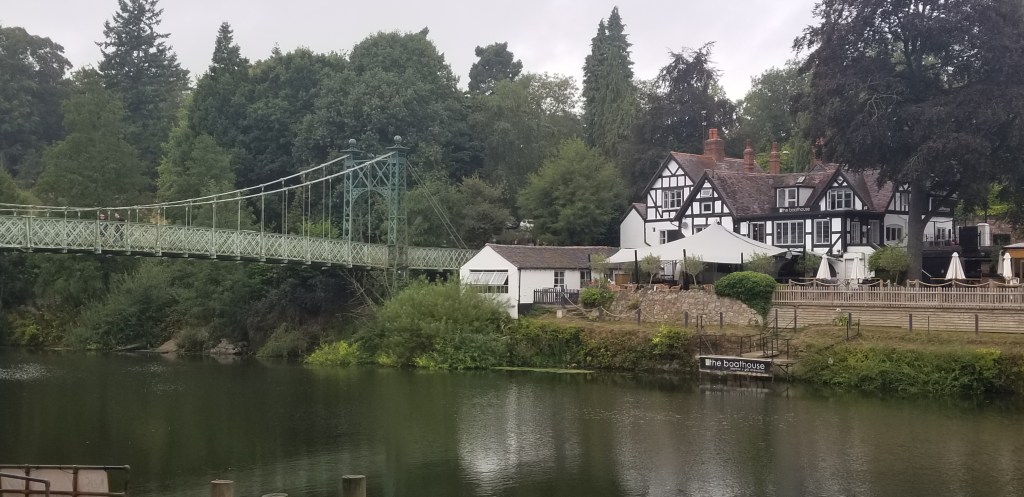
We crossed the River Severn often in our forays around town.

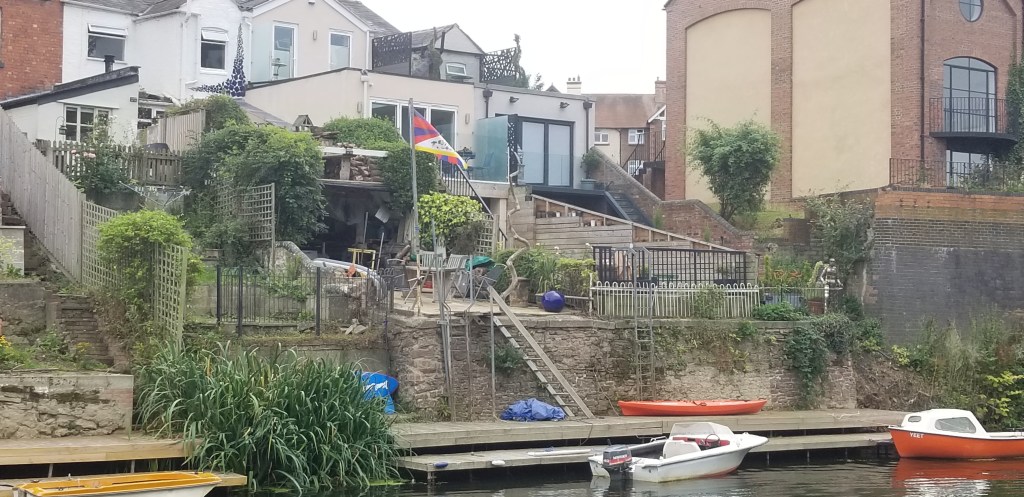
We took a boat ride, too. Although unfortunately we chose a rainy morning to do it, the top of the boat was covered and the rain held off until we were almost done. A spot of tea felt great in the chilly weather! The boat captain helpfully gave us a little Shrewsbury tour as we rode.

From the river, we could see little vignettes of the town that we would not have seen otherwise:

Once off the boat, we visited Quarry Park. An old part of the park called the Dingle dates back to 1879 and contains sunken gardens and a pond. It was the city’s way of dealing with what had been a medieval stone quarry. Charles Darwin used to look for newts and salamanders in the pond. The rainy morning made all the flowers look especially bright. Of course, with the off-and-on rain, we had the place to ourselves.

One evening, we headed down the street and saw a footpath called “Pig Trough”. Now, who could resist this? I read somewhere that, in the middle ages, streets would be named after the main enterprises that went on there. Was Pig Trough where everyone kept their pigs? I’ll never know the answer to that, but it will go down as one of our best evening walks. We had no idea where the path was going to go but we followed it all around and eventually it came out farther down the road.

We were in Shrewsbury for a long weekend and that was enough time to see it in a leisurely fashion. I was so very glad that this town had been on our itinerary!

I have been traveling for the past few days. There will be a blog coming up about that and our life in Texas this winter. First, though, I will have one more blog about our Europe trip before I leave it again for a little while.

Next time – we visit Bath, England

Europe · UK and Ireland

A Literary Journey to Haworth, England – Europe Travels August 2022

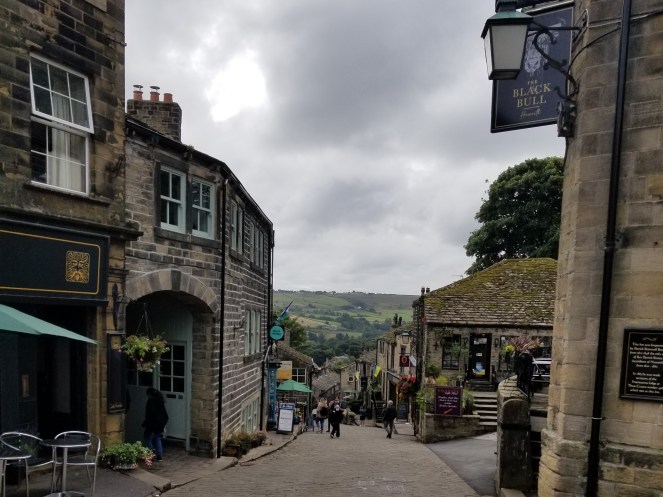
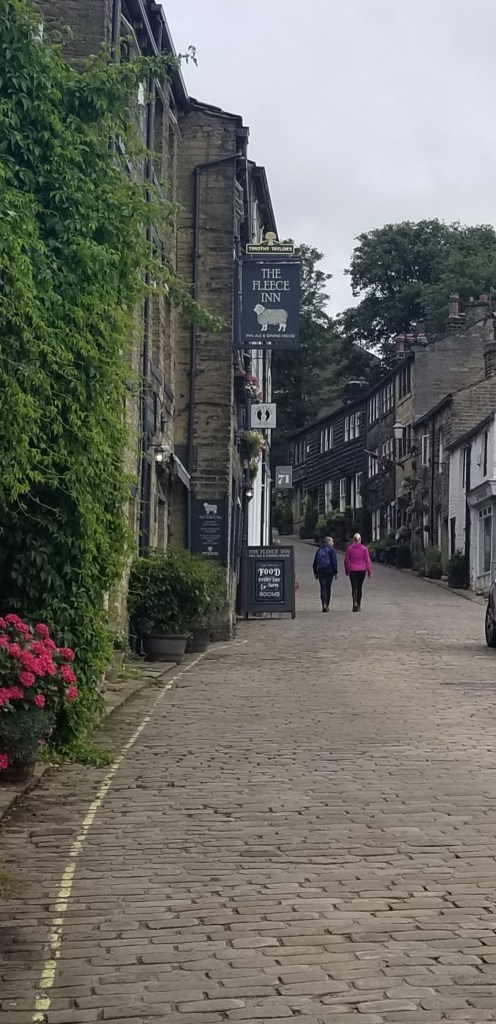
Historic downtown Haworth, England

It was a day’s train ride from Inverness, Scotland to Haworth. Down we went, back through the Cairngorms with sheep grazing on the heather in bloom and mountainsides dripping their waterfalls. Back down past Edinburgh and into England. Past towns like Berwick-on-Tweed, walled and right on the ocean, where we seemed for awhile to be skimming right on the water. The train was running slow due to some flooding down the track. We were late coming into York, missed our connection to Leeds but found another train, and both the train to Leeds and the train to Keighley were packed. Finally, in Keighley, a cab took us to Haworth. It had been a seven hour journey, and Haworth looked pretty good after a long day!

Coming here was a pilgrimage for me. My favorite book since my high school years is “Jane Eyre” by Charlotte Bronte. I pull this book off my shelf and reread it every now and again, and I still find it entertaining. If you are not familiar with it, perhaps you have heard of “Wuthering Heights” by her sister, Emily. I always dreamed of walking on the Yorkshire moors as Charlotte and Emily described in their books. If reading isn’t your thing, hang in there, I’ve also included a hike on the moors and a ride on a steam train here!

Haworth (pronounced, as I learned, “Howorth”) was the home of the Bronte family. Patrick Bronte was the minister at Haworth beginning in 1820, and he and his wife Maria had six children. Maria, and the two oldest daughters, died young. That left Charlotte, Emily, Anne, and Branwell. Anne was also a novelist and poet, and Branwell was a failed poet and artist. The four siblings were extremely close and lived in the parsonage with their father. After their mother’s death, their aunt came to help raise the children. Whenever the siblings ventured out into the world, all came home to Haworth as soon as they could. A signboard in the house stated that “it was at home where their creative lives flourished; in each others’ company and close to the wild moorland landscape that was such a source of inspiration to them.”

The parsonage, pictured here, is now a Bronte museum and much of the home is still furnished as it was when they left it. I cannot begin to tell you how exciting it was to walk through those doors.

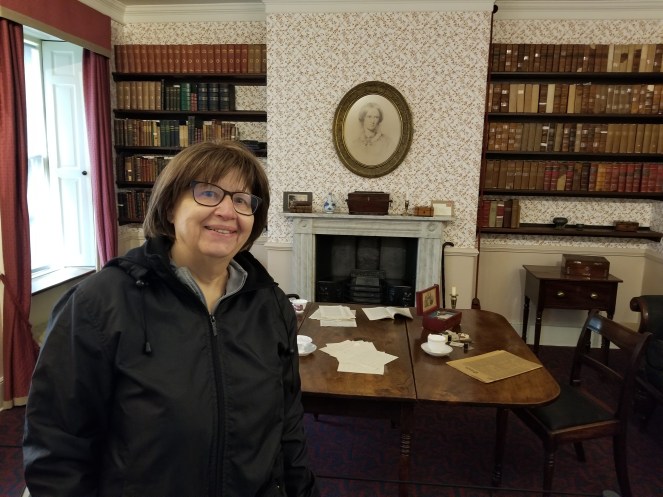
Here I am, next to a picture of Charlotte on the wall

This is the room, their dining room, where “Jane Eyre”, “Wuthering Heights”, and “Agnes Grey” (Anne’s book) were all written. In the evening, the siblings would be together, and the sisters would walk around the table discussing what they were writing. Cal knew how important this was for me, and made sure to get a picture of me standing here. And then, I just stood and looked a long time at everything.

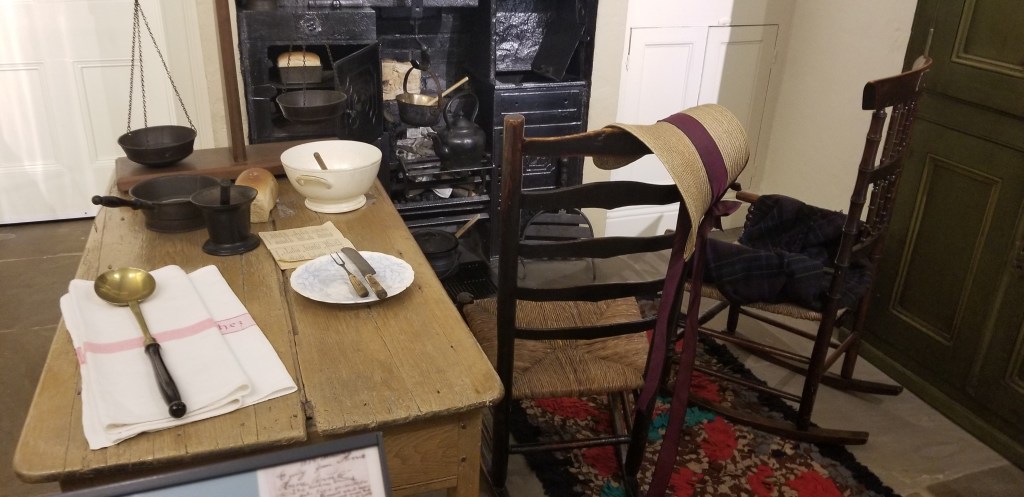
After the dining room, there was the rest of the house and museum to see. The kitchen:

And the grandfather clock that Patrick would wind every night before going up to bed:

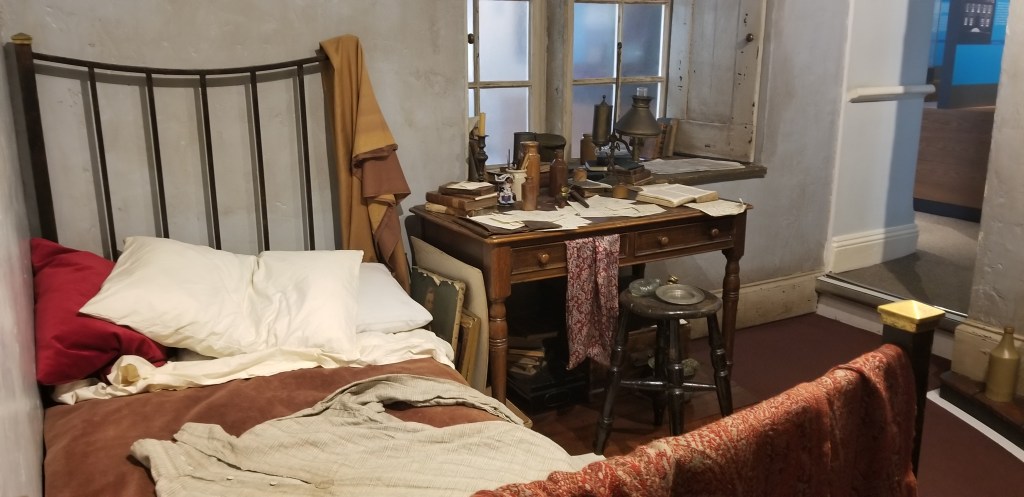
Branwell was a bit of a free spirit, as evidenced by his room. Their setup of it was very honest. Unfortunately, the Black Bull Pub in town was one of his favorite hangouts. You can see a corner of it in the top picture and we had lunch there in the afternoon.

The whole family’s history is interesting but it was Charlotte I had mostly come to see. Even though we live centuries apart we may have had some common interests. I’d love to have a spot of tea and a chat with her. She spent some time as a governess and wasn’t happy in her job. She wrote about it in a journal. Remembering my own working years, I could certainly relate!

As with most women in those days, Charlotte did needlework, as I do too. She made a Berlin wool work bag for her friend’s mother. The work bag was something fashionable to create in its day.

Here is the first American edition of “Jane Eyre”, published in 1848. It was an immediate success. Currer Bell was a pseudonym she used until her book was known and celebrated.

The church parsonage is located right next to the church cemetery. In the Bronte’s time there were no trees, and the stones stood straight and tall. It is thought that this cemetery was part of the cause of so much mortality in the village. The spring which provided the village drinking water flowed right underneath it.

The Bronte siblings’ story is a tragic one. Branwell, Emily and Anne died of tuberculosis. Branwell was the first at age thirty-one, and heavy drinking probably hastened his death. Emily and Anne died within a year of Branwell’s passing. I can’t imagine what it felt like for Charlotte to lose all of her siblings so young and so quickly. She lived a few more years and married, but died from complications of her first pregnancy. Patrick outlived all of his children.

The family is not buried in the graveyard but underneath the church. Anne was buried in Scarborough, where she died.

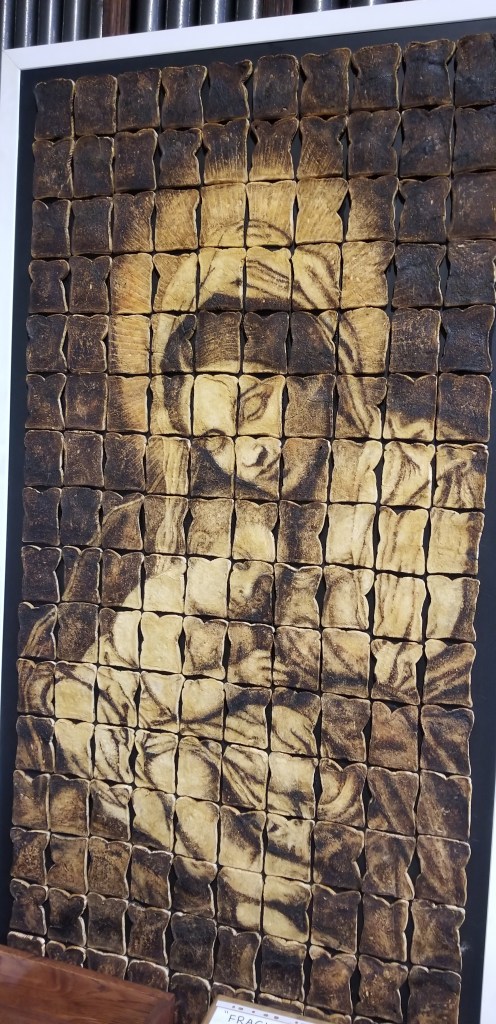
When we visited the church I was a little distracted by this piece of artwork, made entirely from toast! It was created by Adam Sheldon in 2010, who sadly died in early 2022 at the age of 45.

There were a lot of shops to explore in the quaint village. This part of Haworth is made for tourists with its restaurants and small inns.

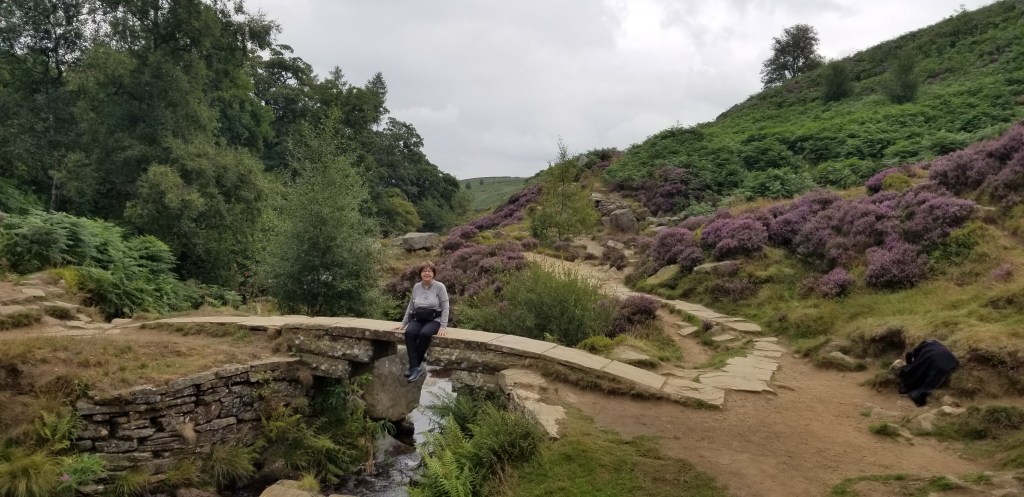
The other highlight of this visit, and one of many on the entire trip to Europe, was a hike to the “Bronte Waterfall”. This walk took us out to the windswept moors. Every step was a delight.

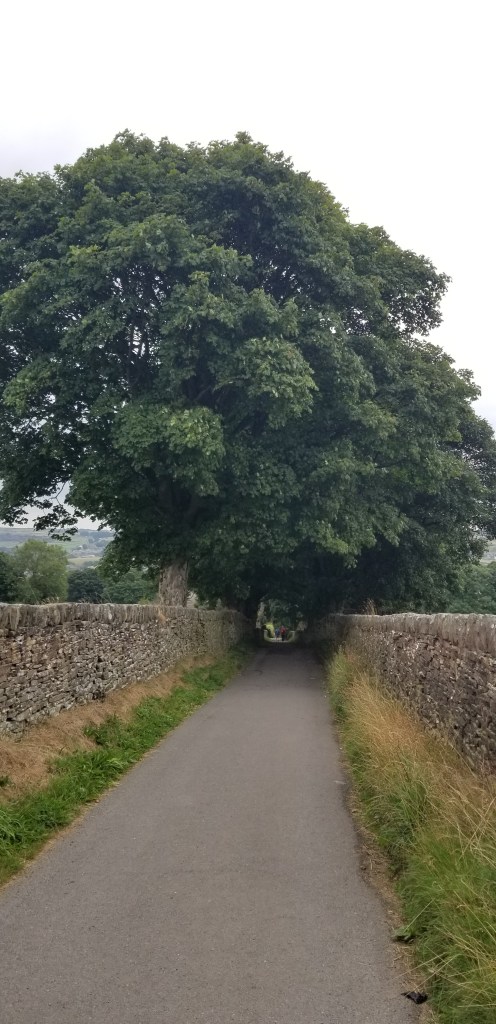
The trickiest part was finding the correct path. First, there was a narrow walkway, probably a horse path in days of old, with tall stone fences on each side.

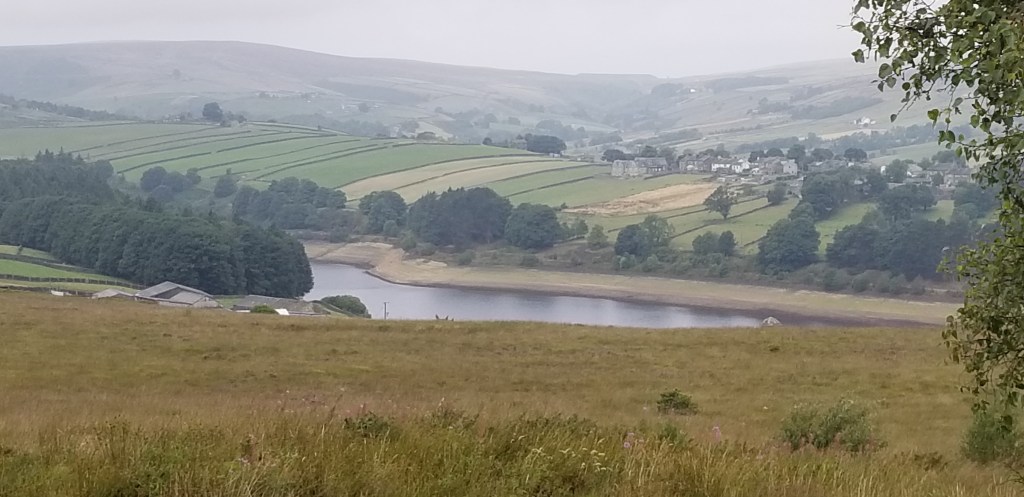
Then, up Penistone Hill and across the Haworth moors. There were open fields of blooming heather, land spread out wide, and farms receding into the distance. Pastures of sheep grazed between endless stone fences. I tried to imagine how this would have looked in the mid-1800’s. Although indistinct in the picture below, the lines in the hill are all stone fences.

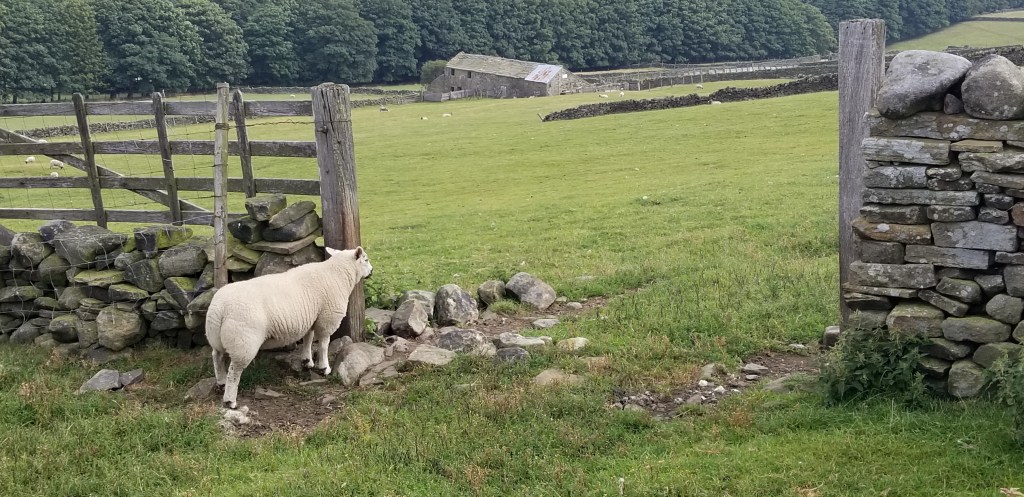
Then: through a cattle gate and sheep running loose. Now we were on the gorgeous South Pennine moors.

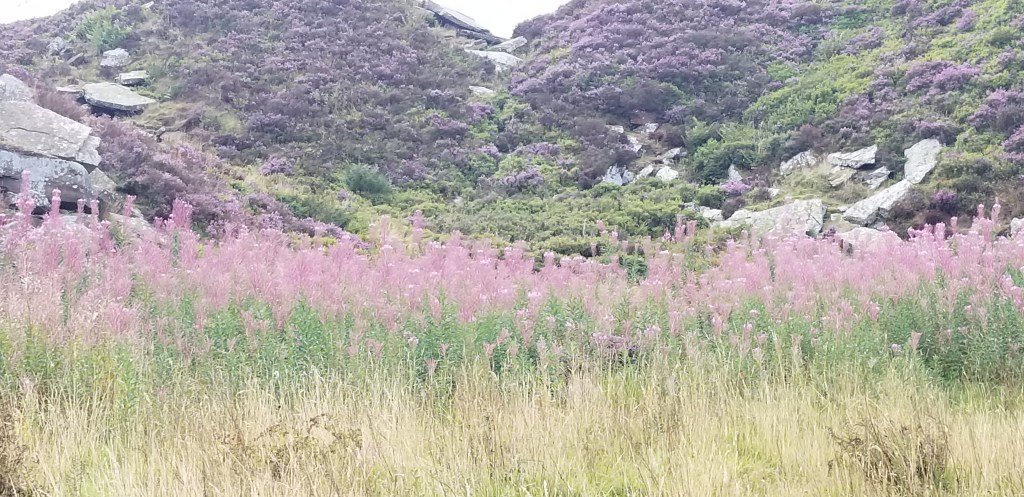
After passing a wonderland of ferns, we came to a pretty little river. No waterfall in sight.

I was pretty sure we had the right spot, and it was time for lunch anyway. We sat on a rock to enjoy the delicious sandwiches that we had purchased in a meat shop near our AirBnb. Other people came and went, some local and some not, and the missing waterfall was a topic of discussion. Someone finally filled us in: it was simply not there. It had dried up ages ago.

The Bronte siblings would come here for picnics, too. They would sit on the “Bronte Chair” – a big rock – to tell each other stories. We didn’t find the rock either at first, but someone was helpfully sitting on it on our way out. The missing waterfall would have been right behind it. Today it is a waterfall of heather and fern.

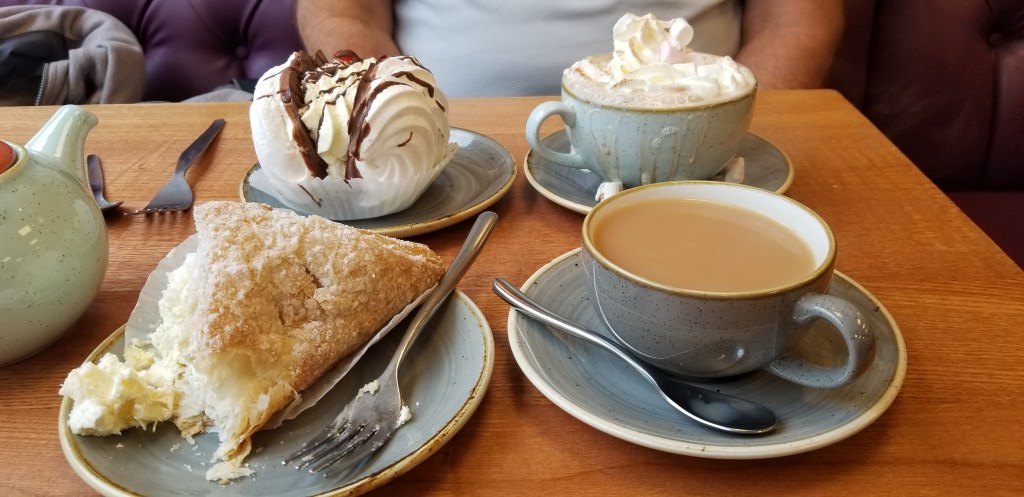
Our hike had been seven miles long. It had been longer than we thought it would be, and Cal deserved a reward after putting up with all my Bronte excitement. We totally negated the positive effect of our long hike with this mid-afternoon treat! His is a cream-filled meringue with hot cocoa, and mine is an apple turnover with of course, tea and cream.

We stayed in Haworth for only three nights, but after making sure I saw all of the Bronte-related sights we had time on our hands. If we’d had a car, we certainly would have visited other sights like the Yorkshire Dales. Instead, we looked into the possibility of an old steam excursion train that runs to Keighley. Haworth used to be a mill town which produced worsted yarn and cloth, and the train opened in 1867 to transport coal, textiles and workers to the mills. We rode Keighley and Worth Valley Railway from Haworth to Keighley, one stop short of the whole five-mile line.

On the platform and waiting for the train!

Some folks use this historic steam train to hitch a ride to Keighley because rail regular service from Haworth no longer exists. I mentioned that we had taken a cab to Haworth; when we left, we took a bus. Keighley is a much bigger city than Haworth, but we found nothing of note to see there.

I didn’t initially get a picture of our train because we were busy getting on it. But there is also a historic diesel train which we took on our return to Haworth, and another steam train passed us on our way. We made a stop at a manual switching station and Cal saw that the conductors made a swap of something. He said it was a mail bag. Would they deliver the mail in this way? I’m not sure. Maybe it was the day’s receipts.

The steam train, and a manual switching station

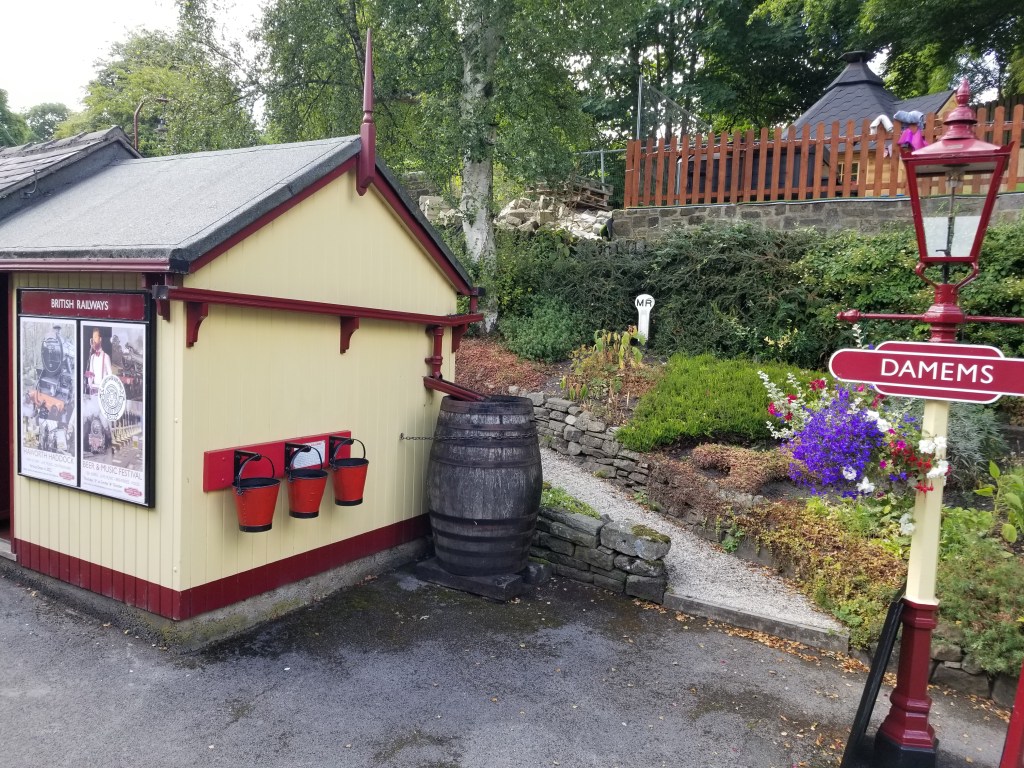
At Damems, we came to England’s smallest train station. Only one train car fits on the platform.

I can’t leave Haworth without showing you a picture of our little Airbnb cottage, which was very old. Cal is standing at the door and he always had to duck to go through. People were shorter in the old days.

The stairs going up to the bedroom were very precarious. At the top there was a measurable gap before one left the stairs and entered the hallway. The cottage was totally renovated, but the stairway was left as it had been. The steps were stone and I could just imagine the generations of weary feet that had climbed those stairs and worn them out in the middle. I hung on to those rails for dear life every time I slowly crawled up and down! It was a sweet little place and I loved our stay here.

The bonus to our stay was a chippy – a fish and chip shop – that did a steady carryout business in the evenings just a few doors down. We had a delicious dinner al fresco on one of their picnic tables. It wasn’t far from the meat shop that sold us our picnic sandwiches, and we purchased the same sandwiches for our train ride south on the day we left.

We are following the Masterpiece Theatre series “All Creatures Great and Small” on PBS weekly. In the last episode, the housekeeper, Mrs. Hall, goes to a train station to meet her son. As she was sitting at the station waiting for him, the name of the station was shown in big letters: “KEIGHLEY”. I shot up, and exclaimed excitedly, “Keighley! That is where we were!” And right there is an aspect of travel I most love: the sudden connectedness to places you had not ever heard of previously, and are now quite familiar with, thousands of miles from home.

Next time – moving on to Shrewsbury, England

Europe · UK and Ireland

Castles and Whiskey in Scotland – Europe Travels August 2022

Before I ever came to Scotland, two of the things that came to mind when I thought of this country were its castles and its Scotch whiskey. In my prior blogs about our visit here, a sharp-eyed reader may have wondered why I hadn’t written about visiting castles. The ones we saw are all in this posting; later, we’ll have a taste of whiskey.

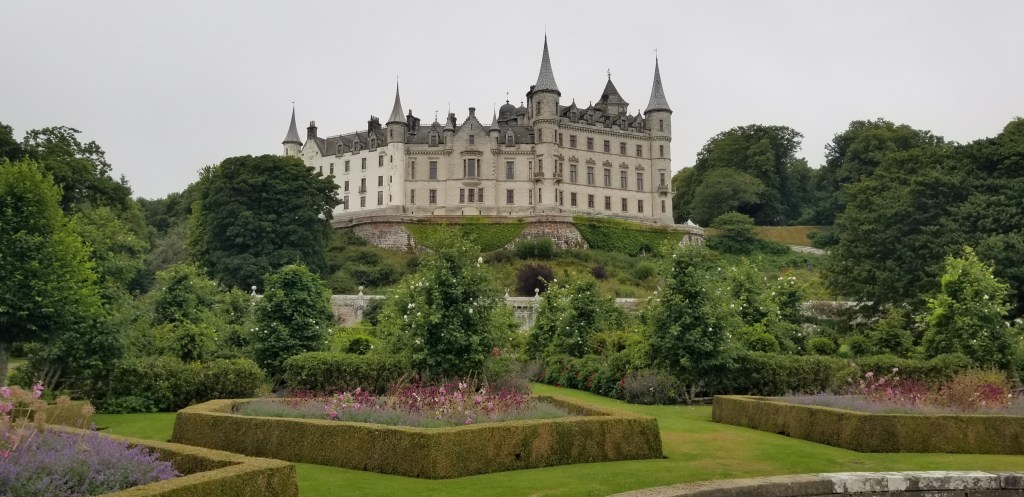
Castles are like Forrest Gump’s proverbial box of chocolates: you never know what you’re going to get. Some, like Dunrobin above, look pristine and like every vision you’ve ever had about castles. Others are in ruins. They can be medieval (think knights and coats of armor) or a glimpse at more recent royal life. The inside could be decorated like the occupants just left, it could be empty, or it could be a museum unrelated to the castle. Scotland’s castles were the first for this trip and we saw four of them.

Edinburgh Castle

Edinburgh Castle is a fortress which was built on volcanic rock. It was once the home of the Scottish monarchs, dating all the way back to Malcom III Canmore whose reign began in 1058. The castle was beseiged 23 times. The oldest surviving building in all of Edinburgh, St. Margaret’s Chapel, is inside the fortress and dates to the 12th century. The city of Edinburgh itself grew out of the castle, spilling down the hillside.

I had purchased tickets for the castle several days earlier but didn’t count on the weather: in typical Edinburgh fashion, it was cold, windy, and rain threatened. Still, it was a thrill to enter the gates of such a famous place.

From the ramparts of the fortress, we could look down on the city below. This is a view of “New Town” and Princes Street in the foreground with a view all the way out to the Firth of Forth.

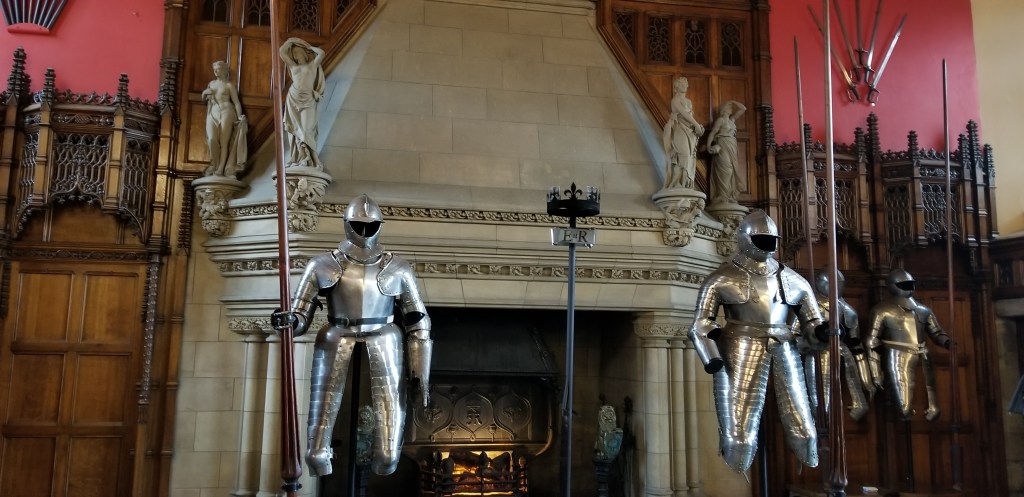
Inside the castle buildings were the Royal Chambers where Mary Queen of Scots lived and the room where she gave birth to her son James in 1566. There was also the knights hall:

Inside one of the castle courtyards

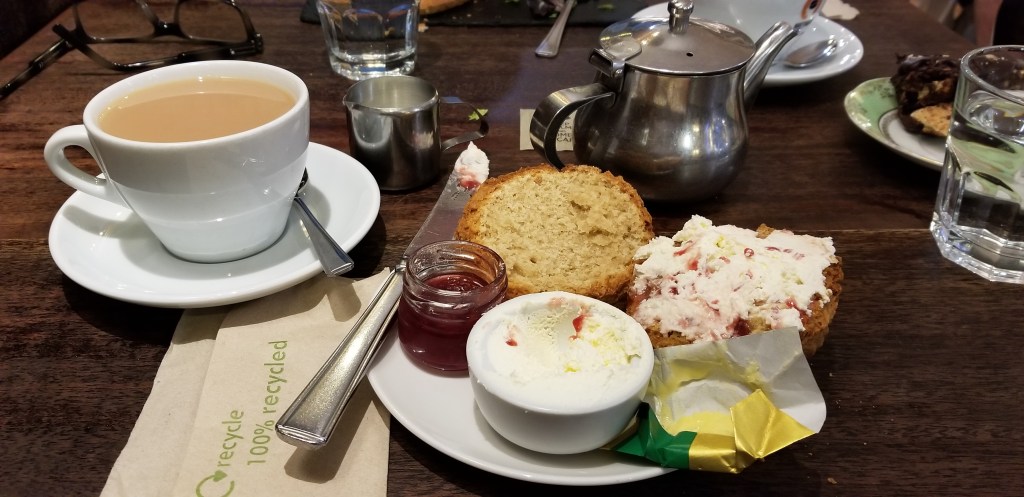
My memory of Edinburgh castle will always be inextricably linked to the cream tea I had in a cafe just off the Royal Mile following the visit. I was cold and wet and I wanted soup. We visited Deacon Brodies Cafe but we were too early for soup. Instead, I had a Scottish cream tea for the first time. It consists of a pot of tea with cream and a scone with butter, jam and clotted cream. It was absolutely heavenly and I have had nothing better since. I needed nothing else to eat until evening. It was one of those happy surprises that come with traveling Europe. Cream tea instead of soup, who knew?

Loch Ness and Castle Urquhart

And now we come to the third thing people think of when they think of Scotland: Loch Ness.

When planning our trip, I suspected that Loch Ness was not going to be a destination for us. Other places more interesting called to me for the time that we had. This was later verified by Rick Steves, who is my travel guru. For the uninitiated, Rick Steves is the go-to person for all things Europe travel-related. He has guide books, tours, TV shows, and a large on-line presence. I also follow Cameron Hewitt, Rick’s associate. Both suggested giving Loch Ness a pass as its own destination. Rick suggested that if you are on a tour in the Highlands or simply driving from point A to point B, you will probably drive right by it. And then, you can tell everyone back home that you saw Loch Ness.

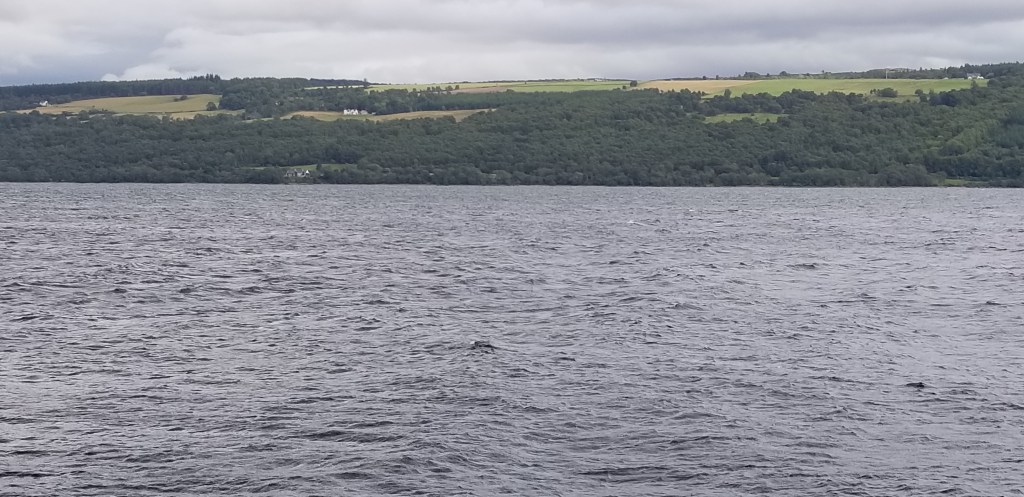
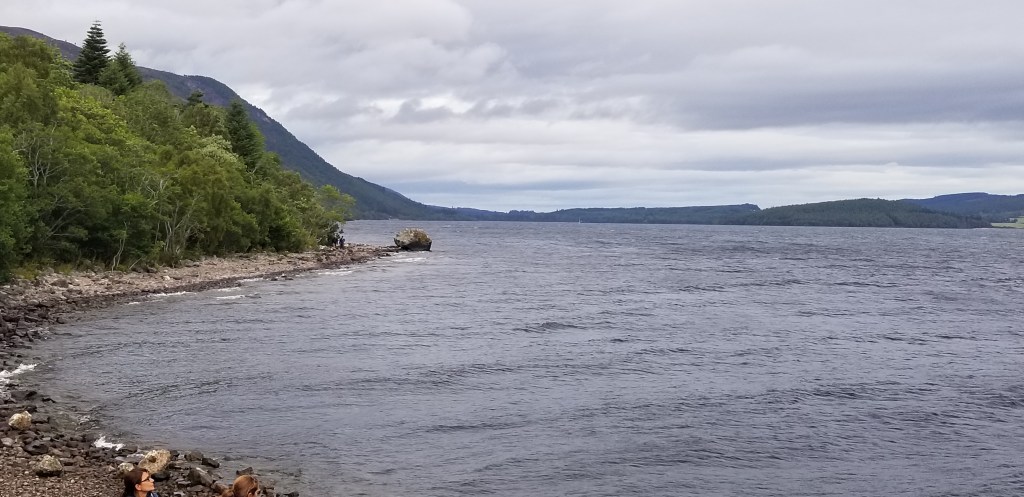
On our first tour from Inverness, our guide asked if anyone had not yet seen the lake. There were several of us, so she stopped on our way back to Inverness. We hiked down to the lakeshore, and this is it. No monsters in sight. But it is quite pretty, particularly the Highland bluffs on its northern side.

We did, however, see a monster on the way down to the lake:

Castle Urquhart is in ruins. It was built in the 13th century, but its fine location on the lake meant that it was raided several times. The final blow was dealt in 1692 from the British in order to prevent the Jacobite forces from using it, and it went into decay after that. It is now one of the most-visited castles in Scotland, probably because of its location on famous Loch Ness.

On our second Rabbie’s tour out to the Island of Skye, the guide made a quick stop for a look at Castle Urquhart. We were dealt a prettier day than our first visit here, and the lake sparkled. It was a lovely sight, and it was all we needed to see.

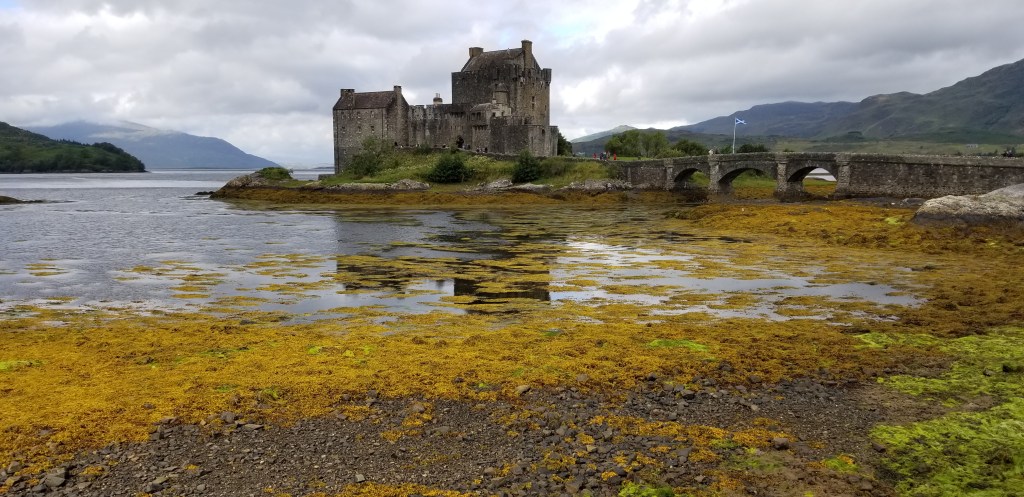
Eilean Donan Castle

We visited Eilean Donan right after the Castle Urquhart stop. In the Scottish Highlands, it is amazing how the weather can change in just a matter of 50 miles distance!

Like Urquhart, this castle was also laid to ruins as part of the Jacobite uprisings. It gets its name, Eilean, from the island it sits on. Donan is attributed to a 6th century Irish saint by the same name who came to Scotland and formed a community here. It was built as protection from the raiding Vikings and expanded over the years. The final blow was dealt by the British, though, in 1719, and it sat in ruins for 200 years. In 1911 a man by the name of Lt. Colonel John Macrae-Gilstrap bought the island and dedicated the next 20 years to reconstructing Eilean Donan.

Eilean Donan is one of the most picturesque and most photographed castles in all of Scotland. Every postcard rack I saw everywhere had beautiful images of this place, and many movies have been filmed here.

I’m not a great judge of time. On some of these tours, left to our own devices, we would arrive back at the mini-bus way too early with no one around. Other times, we would find just about everyone already seated and ready to go. At Eileen Donan, we were given an hour to explore. Our guide did not think it would be enough time to actually tour the inside, but we could either do that or purchase a ticket to walk around the outside of it. We couldn’t decide what to do, so we simply walked around shooting pictures, looking in vain for hot cocoa and then had too much time on our hands. It’s a small regret of mine that we didn’t at least buy the ticket to walk across the bridge and around the outside.

Dunrobin Castle

Flipping through my Scottish Facebook group one day, a picture of Dunrobin came up in my feed, and I was entranced. After a bit of Internet research, I found that we could go there on a two hour train ride north from Inverness. Going further up into the Highlands was a bonus. Better yet, the cost of the train ride was included in our Eurrail pass.

On the journey north, we saw herds of cows and sheep. It was funny to watch them run in panic away from the train. After all, it comes through at least twice a day! The white black-faced sheep dotted bright green pastures. The train also disturbed a little horned roe deer, which suddenly leaped out of the tall grasses. Two different flocks of swans graced a small winding river. A castle could be seen high on the cliffs in the distance. For awhile we rode along the sea where there were massive kelpy flats where the tide had gone out, with horses in a meadow on the shore.

The castle, pictured at the top of this blog, is the family seat of the Earl of Sutherland and Clan Sutherland and is still owned by them. The lands were acquired in 1211. The oldest surviving portion of the castle goes back to 1401, but most of what is presently seen was added in the early 1800’s. This castle has its own private rail station, which is where we arrived just like royalty of old. After a short walk through the woods, we were inside the castle.

As we entered the castle, we were greeted by pictures of ancestors and spoils from the hunt.

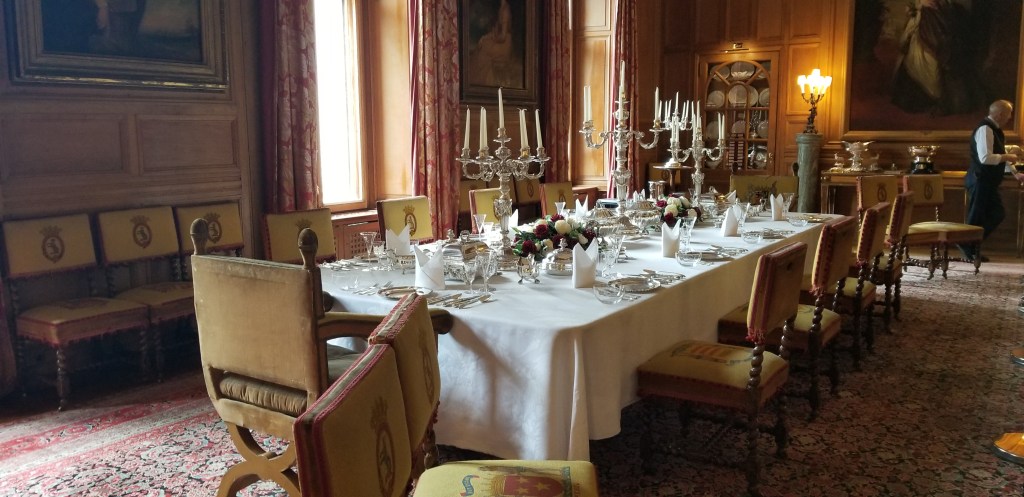
Dinner was set on the table and waiting for us.

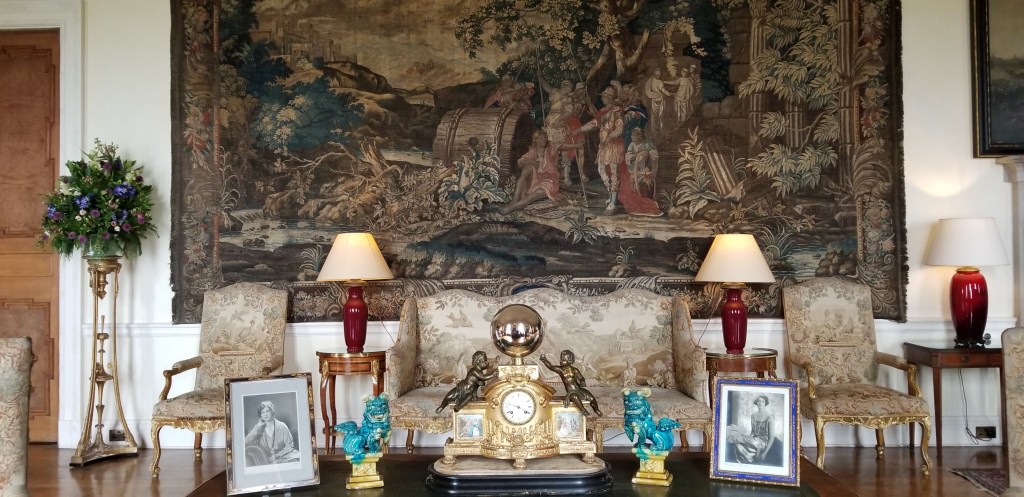
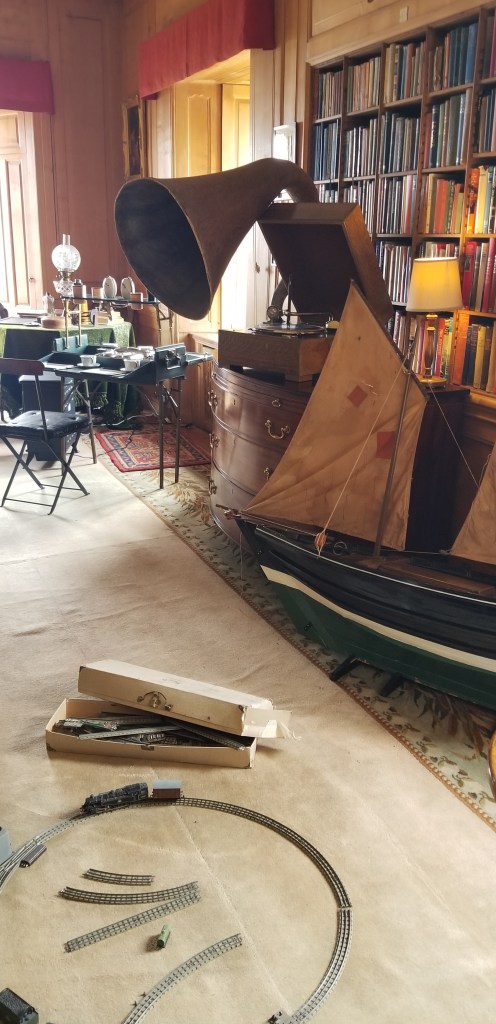
The ladies’ sitting room was lovely. And oh, that library! This was only one wall; all four were covered. Can you imagine having so many books at your disposal?

In the nursery, a child would have every toy and book imaginable for playtime.

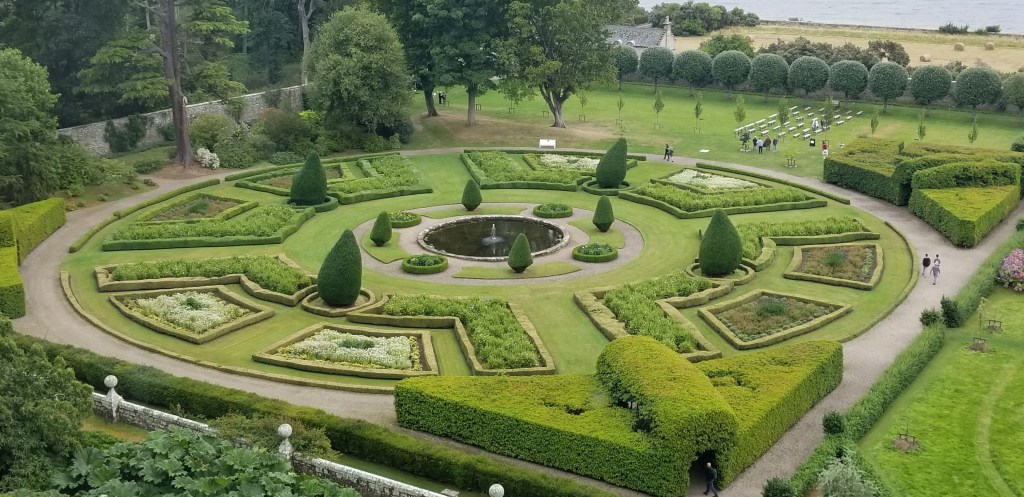
There were rooms upon rooms as we wound our way up and down stairs and down long passageways. At times, we could look out into the back garden.

We sat in on a falconry presentation. My impression is that it seems pretty difficult to use falcons to aid in hunting birds.

After watching the presentation and wandering through the gardens, we still had a great amount of time before the train returned. The castle sits on the North Sea, so we explored the shore.

The Sutherlands were loyal to the crown and so Dunrobin did not run any risk of being ruined by the British. It was stormed once by the Jacobites, but of course they did not have the armament necessary to do any damage.

On our train ride to and from Dunrobin, we passed a very large whiskey distillery. There are 141 operating distilleries in Scotland and a person could go on a whiskey tour to visit several in one go. Distilleries abound in Inverness, inviting us in for samples. We are not whiskey drinkers and so by the end of our stay we still hadn’t tasted a drop. How could we pass up this iconic taste of Scotland?

I found something that was a bit of a compromise for our very last night in Scotland: a whiskey tasting evening in a pub accompanied by Gaelic music and stories of Scotland. The owner of the pub played two-hundred-year-old songs on his violin and sang. The stories he told of Scotland’s past were sad. But Scotland’s future is bright: the country is promoting education in traditional instruments such as the bagpipes and violin. The old Gaelic language is being taught, and college is free for all. In 1998, Scotland finally received its own Parliament. A toast to that!

For those in the know regarding whiskey: we sampled Singleton of Glen Ord, Clynelish, Cu Bocan, Glenmorangie Quinta Ruban, and Tomatin.

Next time – South to Haworth, England

Europe · Life in General · UK and Ireland

Hallelujah! A Musical Christmas Card

A couple of weeks ago, I listened and watched the entire oratorio of Handel’s “Messiah” presented at the Washington Cathedral in Washington, D.C. It had been quite a while since I had heard the lesser-known pieces. If you don’t think you’ve ever heard of the “Messiah”, you have probably heard of one of the songs in it: the “Hallelujah Chorus”. The music took me back to Messiahs of other years.

During the middle of my time in high school, my father became the pastor of a small rural Lutheran church in northwestern Ohio. There, we lived at least ten miles from a town of any size. In the fall of my senior year and the fall following my graduation, he and I joined 150 other singers of the regionally famous Mennonite Choral Society in Berne, Indiana for practices and a performance of the Messiah just before Christmas. I don’t know how he found out about it or even if any auditions were required. I enjoyed singing some pieces from the Messiah at my previous high school the year before, so that could have been the catalyst. He had a beautiful tenor voice, and I sang soprano.

Once every week night, he and I headed out on dark and sometimes snowy or icy farm roads over the state line to Indiana to attend practices fifteen miles away. He was a taciturn man unless there were subjects to discuss that he was passionate about, so I don’t remember our conversations on the road – or even if there were any. I just remember the pride that I, and I’m sure he, felt about being part of such a wonderful performance. Knowing my dad, he probably was very happy that I did it with him.

The choir had performed the Messiah every year since 1893. Soloists were flown in from Chicago, which was Very Big Stuff to a small-town Ohio girl like me. A grand, beautiful pipe organ and small orchestra accompanied us.

The Messiah takes words from the Bible and tells the story of the nativity and its prophecy, as well as the crucifixion of Christ and victory over death. Even if you do not believe, the music itself is dramatic, heart-stopping, and absolutely beautiful. Both the oratorio and another piece, “Water Music Suite 1”, put Handel firmly in the list of my favorite composers. George Frederic Handel was originally German but he adopted London as his home. At age 56 he composed and had the very first Messiah performance not in London but in Dublin, Ireland on April 13, 1742. Not Christmas time? No, it was originally written as an Easter Oratorio.

How the Messiah came into being at all is an interesting story. The words had been compiled and edited by a man named Charles Jennens, who gave it to his friend Handel to put into music. The well-known story is that Handel completed it in 24 days without eating or sleeping much. After the composition of the Messiah, Handel was going through a difficult time. Overworked and laden with debt, he accepted an invitation from Lord Devonshire for a ten-month stay in Dublin. He brought with him the musical score he had worked on while living in London, and the rest is history.

While we were in Dublin this summer, I looked for signs that Handel was here, and I found them. Dubliners are still proud to have hosted the first performance, all these hundreds of years later.

Before it could ever happen, Handel needed an organ to work the oratorio through, and it is reputed that St. Michan’s Church of Dublin graciously let him use theirs. The church has a long and storied history, which you can Google if you’d like. St. Michan’s is now a bustling restaurant and bar called “The Church”, and we had dinner there in what was formerly the balcony. The keyboard to the organ sits in the little alcove below the pipes. In converting to a restaurant, renovations were thoughtfully and respectfully made to keep some of the original architecture and furnishings in place.

It was interesting to think what the former parishioners would have thought about food and alcohol being served in their church!

It is still the same organ Handel played. The restaurant would like to renovate the organ. If you have $100,000 to spare, you can help them out!

The inaugural Messiah was played at the then-new Musick Hall on Fishamble Street. The original entryway is all that remains; behind it is an apartment complex.

I also found a plaque nearby that commemorates the occasion.

A open-air Messiah is performed near these gates in the Temple Bar area every year on April 13. This past year it was presented by Our Lady’s Choral Society and the Dublin Handelian Orchestra. The streets are packed and people sing along with the music.

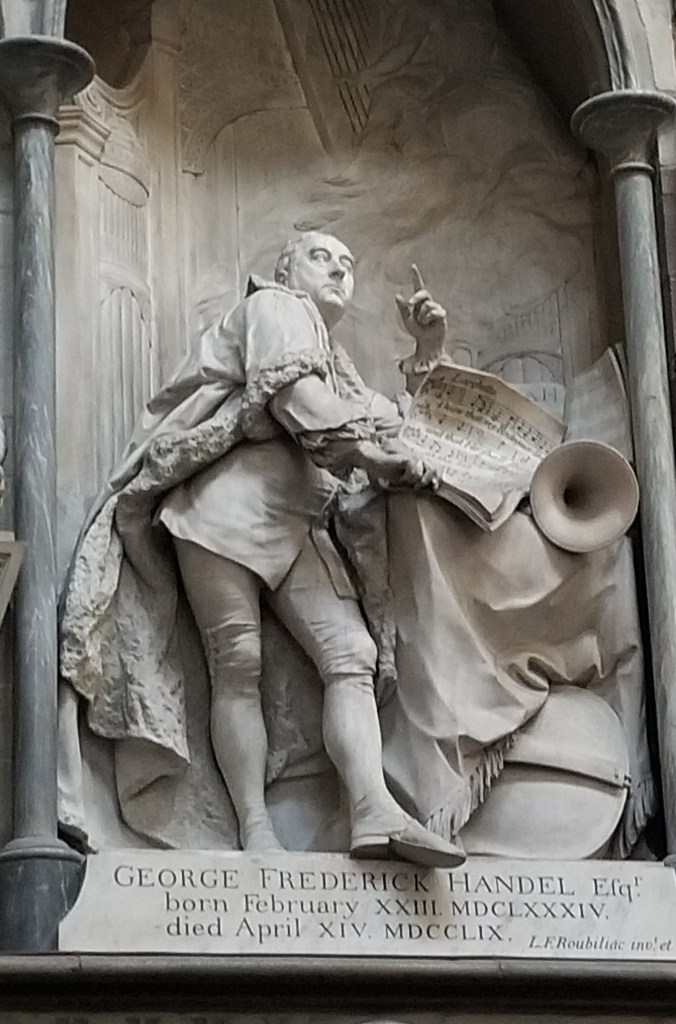
I came full circle with Handel when we later visited London and Westminster Abbey. He is buried there, and a life-size sculpture on the wall near his grave is a memorial to him.

A fitting tribute, indeed, to a great man.

There have been other Messiahs over the years since the two years in Berne, Indiana. A few years ago, I sang with the church choir that I was a member of for its Christmas Eve service. My oldest sang the soprano solos, and the torch was passed. Over the years, my voice dropped from soprano to alto, and now a frog has moved into my throat, so I no longer sing publicly. But no performance has ever been the same to me as those in the Mennonite Church long ago.

I looked up the choir on YouTube, and found a recording of the Hallelujah Chorus from the 2015 performance. It was years after mine, but all was exactly as I remembered. I have placed a link here for your enjoyment.

Here’s an interesting piece of trivia: why does the audience stand up when the Hallelujah chorus starts? The very first audience in the recital hall on Fishamble Street did not. Almost a year later, the Messiah performed in London, and King George II was in attendance. He stood up when the Hallelujah chorus began. It is believed that he was so moved that he stood to show his reverence. Although maybe he was just stretching his legs, who knows? Because the king stood, the audience had to stand too, and audiences have done that ever since.

It’s time for me to have some eggnog, a Christmas cookie, and another listen to the Hallelujah chorus. Merry Christmas! Happy Holidays! See you again in 2023.

Next time – a return to the RV’ing life in New Mexico

Europe · UK and Ireland

Circling Inverness, Scotland – Europe Travels 2022

Glen Affric, Scottish Highlands

In the months leading up to our trip, I joined a Facebook group for travelers to Scotland. People like me who are planning a trip here can ask all their questions and there is a ready supply of people who either live here or have traveled here to provide answers and suggestions. One lengthy discussion revolved around top sheets – or the lack thereof – on beds in Scotland because everyone in Europe uses only a duvet. The person was thinking about packing one, despite the fact that her trip was only ten days long. Another prospective traveler fretted about blow dryers (every single AirBnb we went to had one). A recurring theme was a concern about the availability of American drip coffee, which is not the way European coffee is made. You can try an “Americano”, which Cal did while we were here, but it’s not the same. He survived in fairly good humor for three months just fine without, in his opinion, a decent cup of coffee.

In between all the mundane stuff, I picked up some good sightseeing tips. The Dean walk that we had taken in Edinburgh was a suggestion from this group. Knowing nothing at first about what to see, I made a list of all the Highlands sites that sounded interesting. Cal and I decided fairly early on that we did not want to rent a car, but to take occasional day trips for sights that would be out of reach otherwise. A tour company name that kept popping up on the Facebook group was Rabbie’s, so I booked two day trips with them during our Inverness stay.

The first tour was called “Glen Affric, Culloden & Clava Cairns” which is exactly where we went. I had heard a little of Culloden before, and nothing of the other two. Culloden and the cairns were not far from Inverness so I thought it would be a great place to start. Both of these tours were in a small group and we rode in a mini-bus. Our driver was also our guide, and from the time we left Inverness she supplied us with a lot of information about what we were seeing.

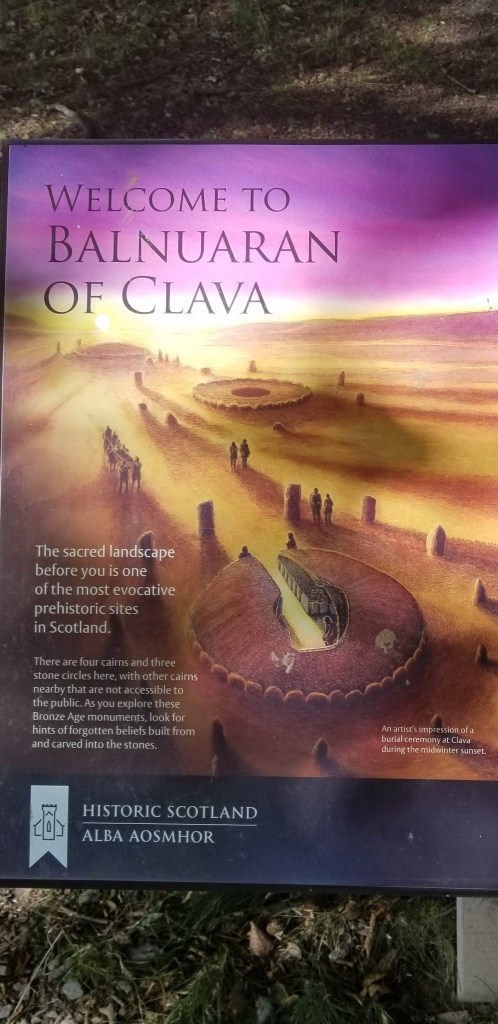
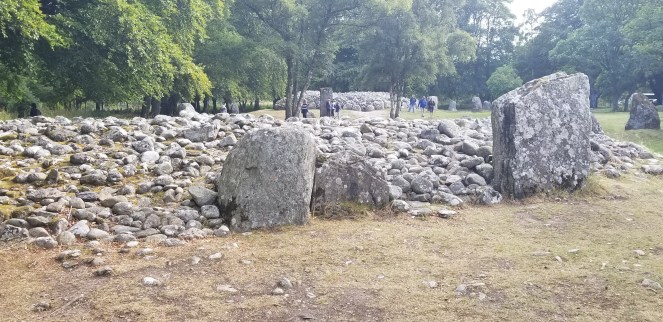
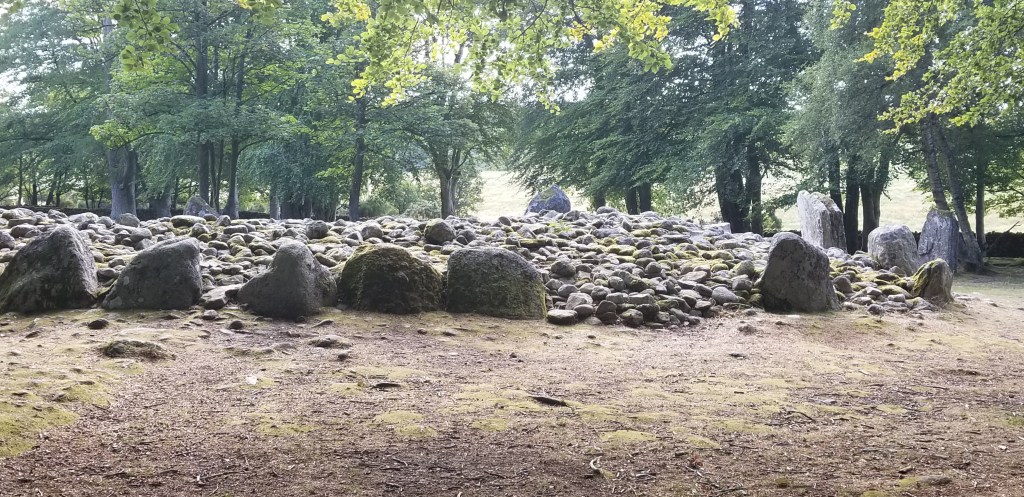
Clava Cairns are burial tombs from the Bronze Age – about 4,000 years ago – in a circular shape. They are sacred to the people who built them and to the people who reused them some 1,000 years later. Some have an entranceway to a single burial chamber, as the one I am standing in does, and it would have been covered. Others are an unroofed ring with no access to the stones. There are four cairns here, and actually fifty of them in the Inverness area. This group is called the Balnuaran of Clava.

This signboard shows what a burial ceremony may have looked like here. It was interesting for me to compare the place to the tombs we had seen at Newgrange and Knowth in Ireland. This site was much smaller. Just like Newgrange, though, the sentinel standing stones light the passage on the winter solstice – but at sunset, not sunrise.

This is a cairn that did not have a passageway

Although it looks like just a weathered grey pile of rocks now, the builders chose stones in various hues for their cairns. There were reds, pinks, and whites, and it is thought that the various colors had a meaning.

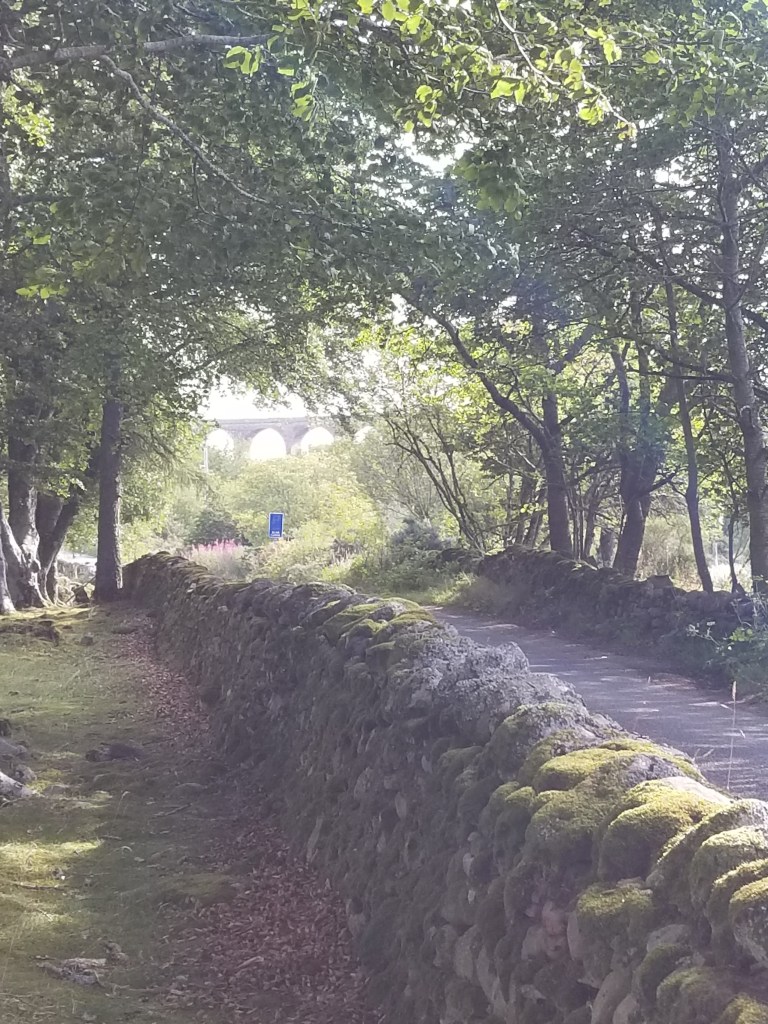
We had some extra time, so we strolled down the road next to the cairns to look at the railway bridge that was off in the distance.

The Battlefield of Culloden was not far from the cairns. Our guide gathered us near the visitor’s center to give us some history, and then turned us loose to explore as we wished. Inside the visitors center were historic armaments and archaeological finds from the battle. An immersion theater with a 360-degree view very realistically puts you in the middle of the battlefield with the Jacobites coming on one side and the British on the other, while you stand in the middle. The story of this battle is fascinating, complicated, and very sad. It marks the last battle that was ever fought on Scottish soil.

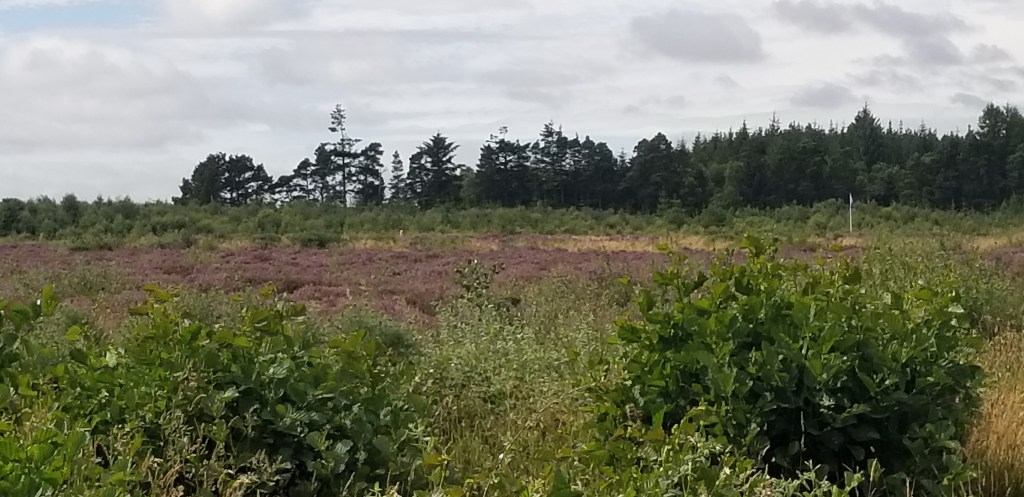
On Culloden battlefield; the blue flag at far right marks the front line of the Jacobite Army. The picture is taken from the British Army’s side.

The Jacobites were supporters of the restoration of the Stuart line to the British throne under Prince Charles, and they were a political movement from 1688 until this day of battle. Nicknamed “Bonnie” for his youthfulness (he was 24 years old), Prince Charles’s court was in exile in France. Having won some skirmishes, he was master of Scotland and summoned troops for the uprising. The army was made up of French fighters as well as Irish and Scottish clansmen. William Augustus, duke of Cumberland, led the British soldiers on the other side. The battle occurred on the 16th of April, 1746.

Looking over the heather to the red flag marking the British side; the visitors center is left.

The battle was a rout. The Jacobites had numbered 5,500. By the time the battle was over, 1,500 Jacobites had been slain compared to only 100 of the British. The bonnie prince turned tail and eventually ended up in Rome. This memorial, built in 1881, remembers the Scottish lives lost.

The Battle of Culloden marked a turning point in the British treatment of the Scots people. For the next 150 years, they worked hard to break up the clans by banning traditional songs, the wearing of kilts, and the Gaelic language.

Several clansmen are memorialized with stones such as this, which reads: “Well of the Dead. Here the chief of the MacGillivrays fell.” The well is on the left.

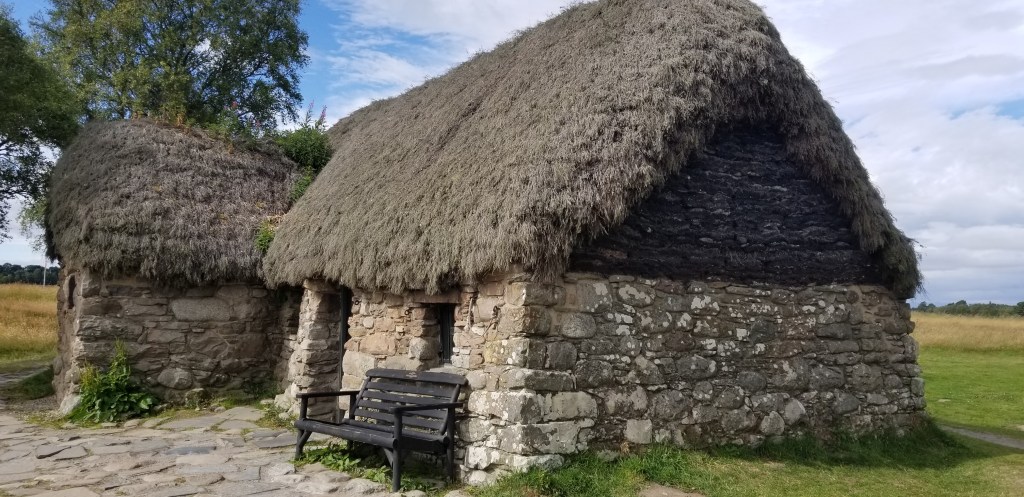
As we strolled through the battlefield, I kept eyeing this picturesque little thatched cottage on the far side of it.

Leanach Cottage existed when the conflict occurred and was once part of a larger farmstead. Immediately afterward, it was used as a field hospital.

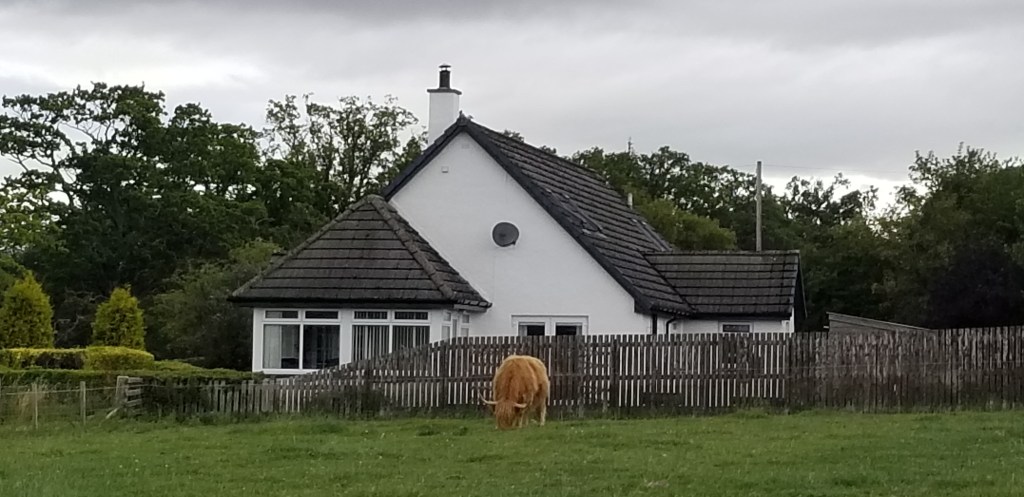
The little town of Beuly was also on our agenda for the day, and on the way to it we caught a glimpse of our first Highland cow. It wouldn’t come any closer than this for a picture, though.

Beauly was a lunch stop, but it also contained the ruins of a 12th century priory. What is a priory, you ask? I looked it up for you: it is a small monastery.

We had circled Inverness from Clava Cairns and Culloden on the east to Beauly on the west, and now it was time to head south to Glen Affric. We were on narrow roads, getting deeper into the Highland hills, and I was impressed that our guide could negotiate the traffic and also talk to us, all at the same time. Riding on the left side was still awfully confusing to this American and I was sure we were headed for a crash!

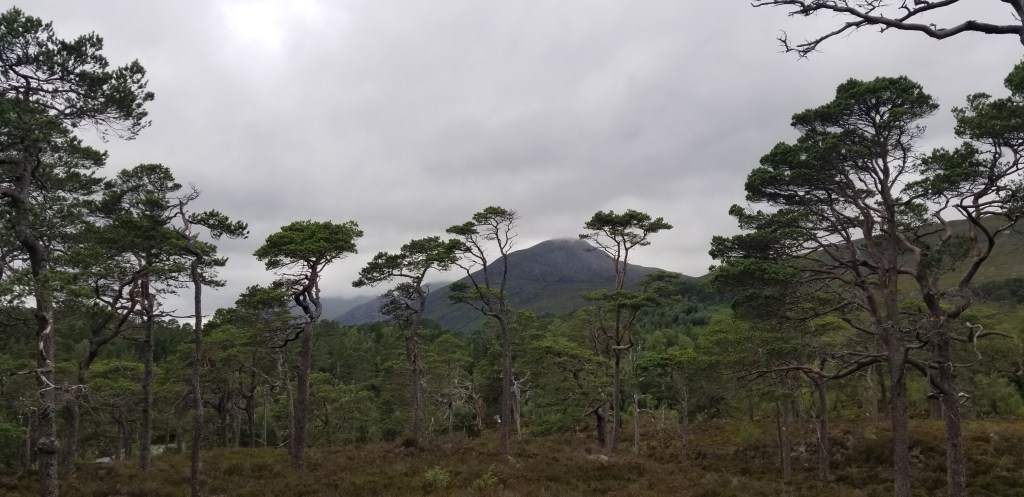
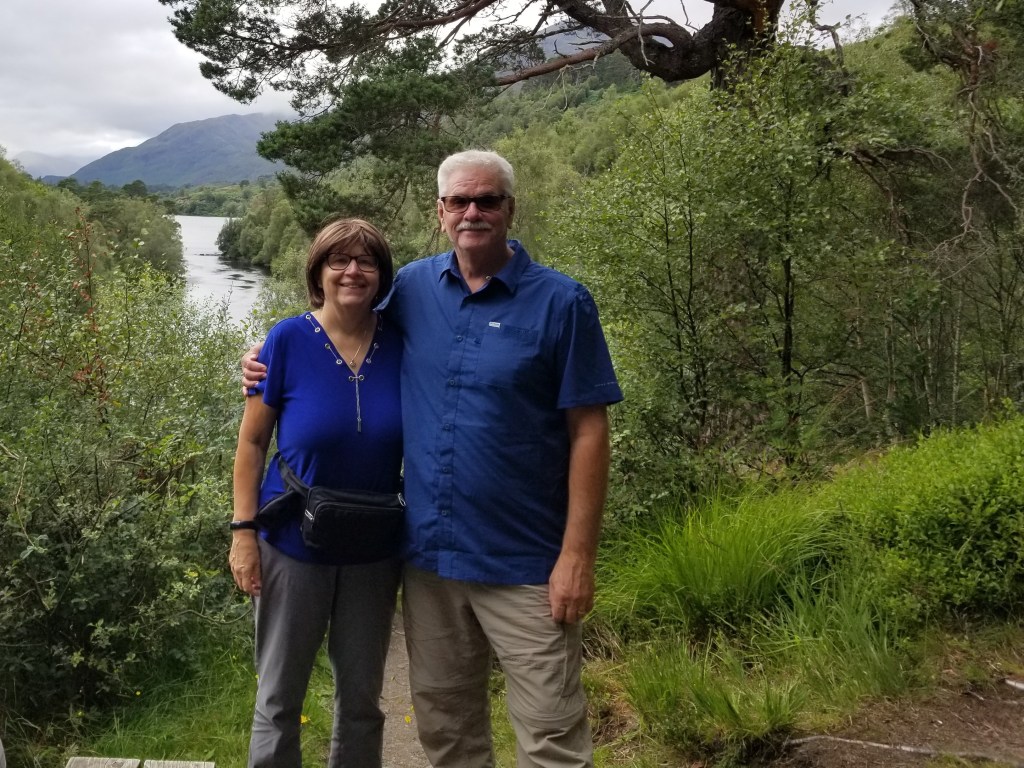
We stopped at River Affric, in Glen Affric, for a hike. There were a couple of trail options, and also an option to just sit. The group split up, and when we set off on our chosen trail we mostly had it to ourselves. The forest was hushed, the air damp. We walked through blooming heather, ferns and lush greenery, tall trees and hills, and the beautiful rushing river. A picture from our hike is at the top of this blog, and there are more below. I will leave you here for now to just enjoy them. We thoroughly enjoyed our day with Rabbie’s.

While hiking, I was struck by the vivid multi-hued green of the forest
Those trees…
Which would you choose?

Next time – out to the Island of Skye