Europe · Italy

The Venetian Islands of Murano and Burano – Europe Travels September 2022

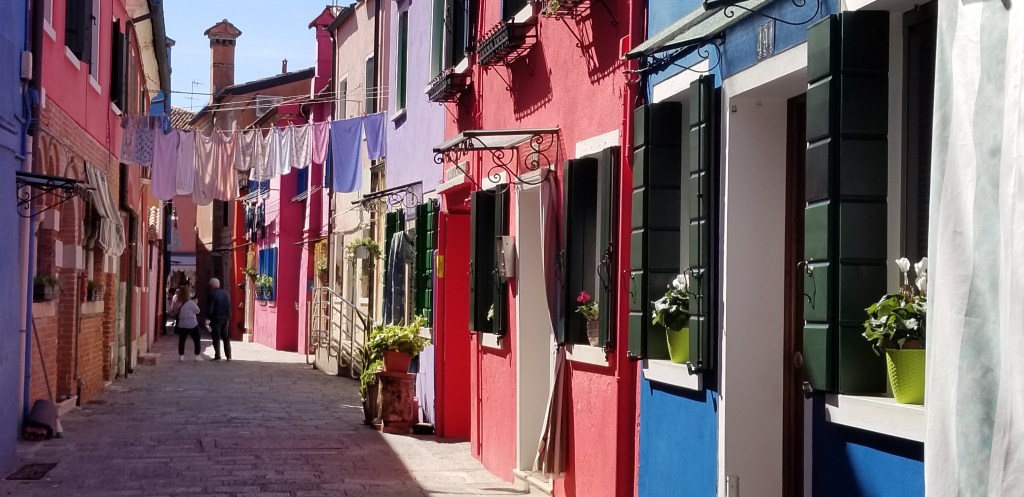
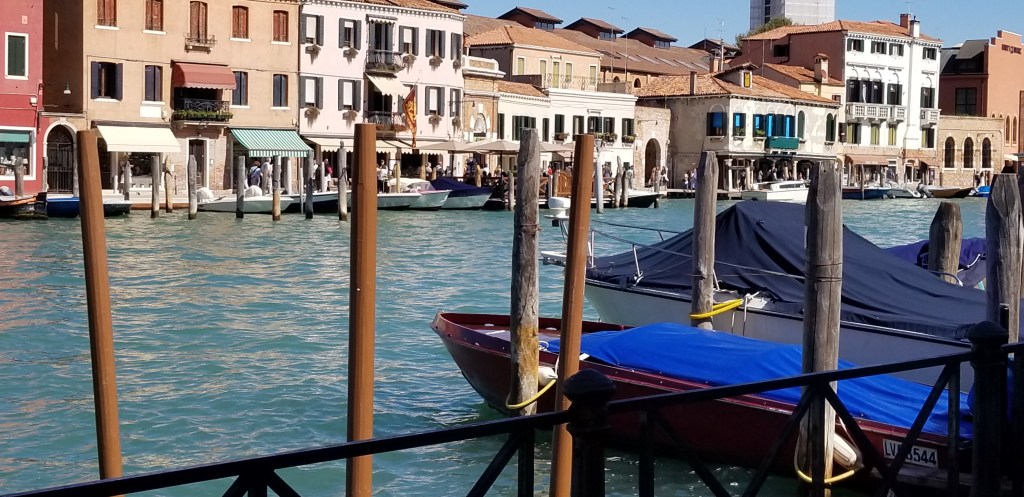
This picture may look like it was taken in Venice, but it is actually on the little island of Murano.

Many shops in Venice sell Murano glass, and it is interesting to look in the windows at them. All of the glassblowers that make this famous glass are located on this island, and early on the Sunday of our visit we went to visit them.

We walked to the Fondamenta Nova vaporetto station to catch the Number 12 Vaporetto (city water bus) line to Murano. It was only a short ten minute ride. We were a little early for the glass blowers to be open, so we had a small refreshment in a sidewalk cafe.

Visiting the glassblowers of Murano is more a window shopping trip than it is a look at the craftspeople in their workshops. I did peek into a few, but on a Sunday they are not working. For sure, the shops are open, and there is plenty of beautiful glass to see and little shops to peek into.
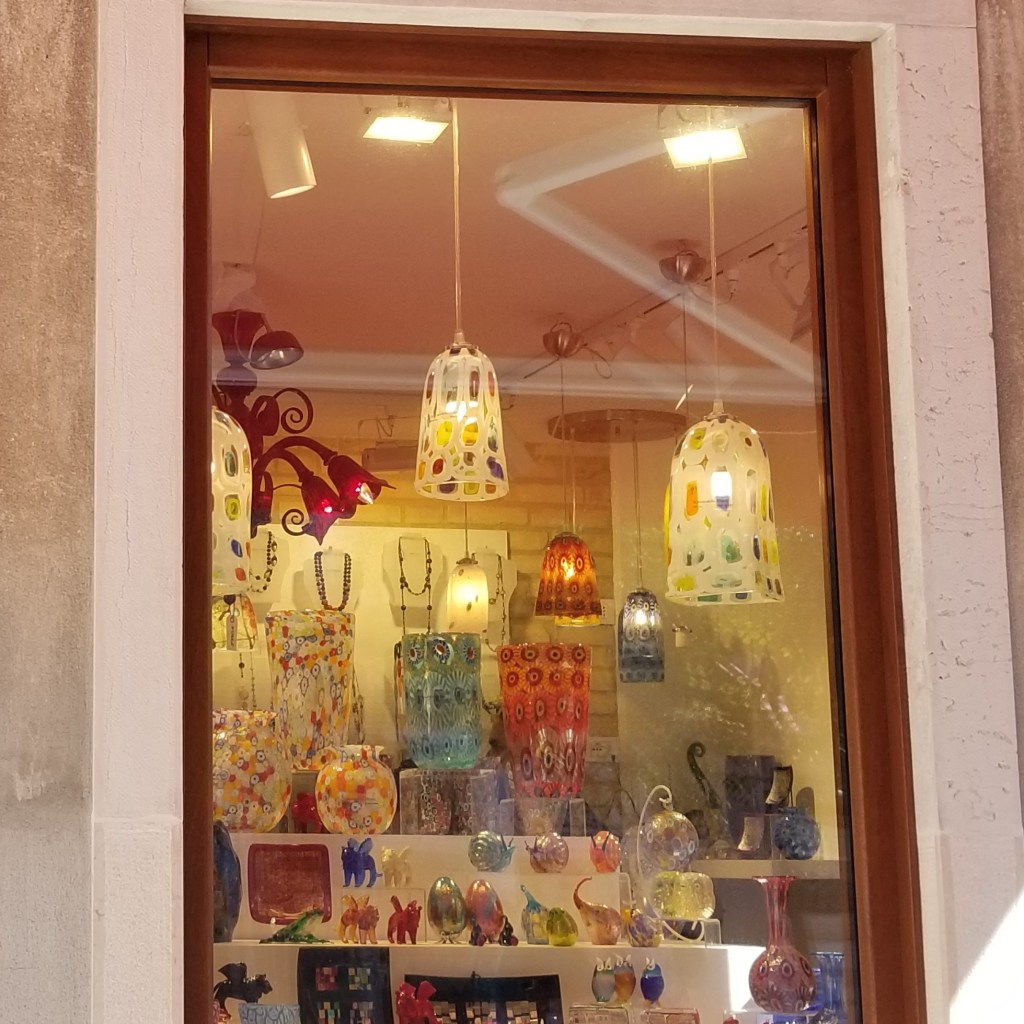
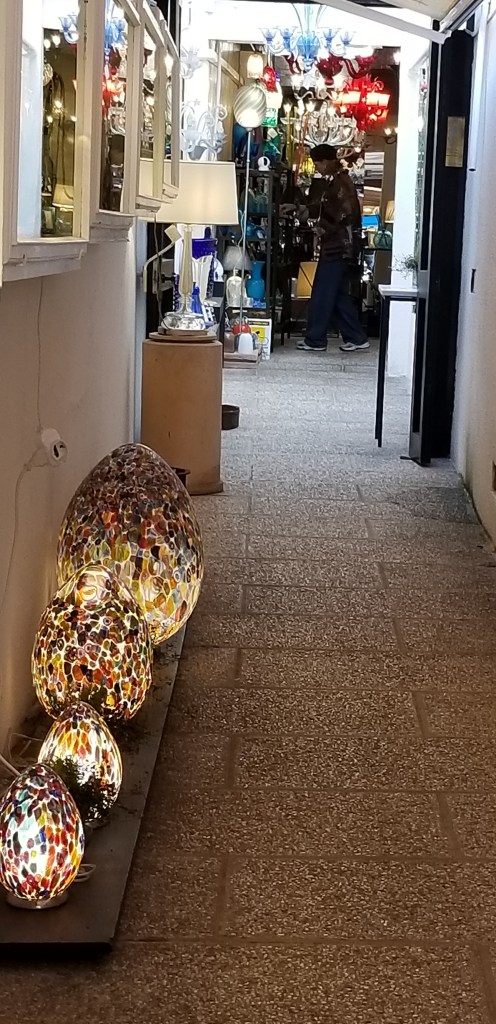
Some shops specialize only in jewelry. This one has a beautiful facade.
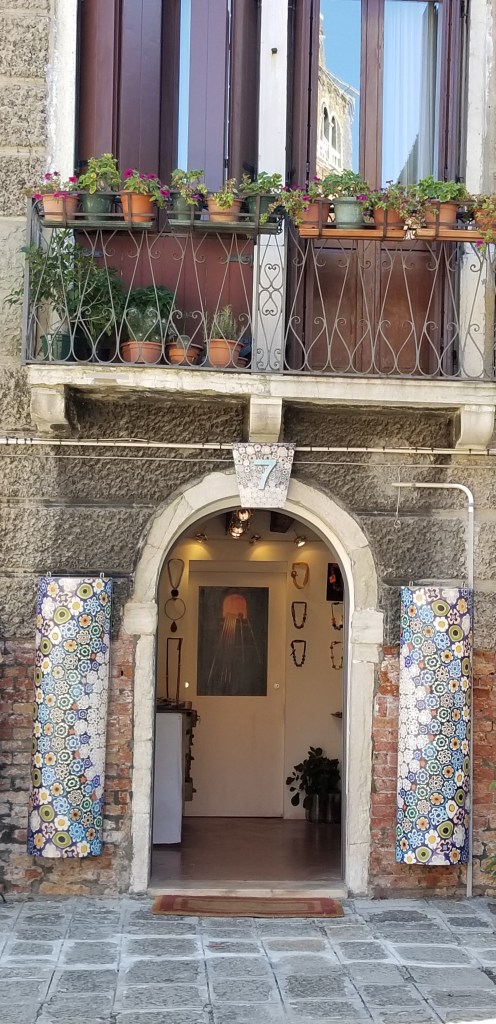
Of course, I couldn’t buy hardly any of this. It would be in shards traveling around Europe in my suitcase. I did purchase a couple of necklaces with glass pendants for gifts, though.

The reason that all the glass makers in Venice are here on this island goes back to the 13th century. The story goes that they were moved to the island to avoid the risk of fire to wooden structures in the already over-populated city. In reality, the motive was to isolate the craftsmen so that they wouldn’t disclose trade secrets. Venetian glass was already of the finest quality.

We had gotten off the boat in a quieter part of the island where many of the glassmakers are. By the time we worked our way to the main area, things were already hopping. Murano has canals just like Venice does because it is actually seven small islands connected with bridges and a Grand Canal.

We made our way back to the vaporetto stop for a ride to Burano, only to discover we were at the end of a very long line waiting in the hot sun for the next one. Would we even be able to get on it when it arrived? As we were pondering this question, we noticed a gentleman working the line. He and his partner offered a ride for 10 Euros per person to ride in his speedboat to the island.

Circumstances sometimes call for quick thinking and a large helping of trust in our fellow man. The price was right. We took the deal and we were not the only ones; the two enterprising gentlemen soon filled up every seat in their little boat with other takers.
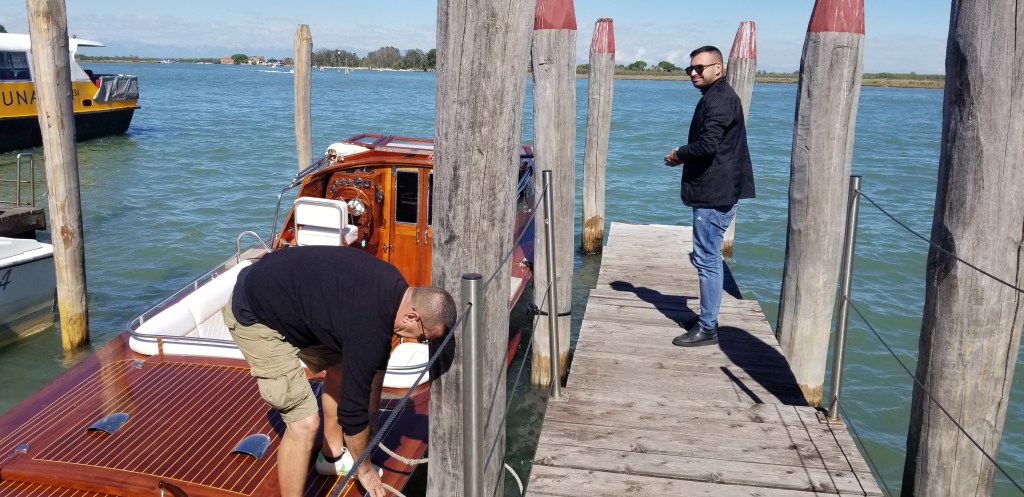
We zipped across the lagoon and found ourselves docking in Burano in half the time it would have taken us to ride the vaporetto. Besides that, it was fun!

Burano is a smaller island than Murano. It is traditionally known for its hand-made lace and its colorful houses. Leonardo da Vinci visited here, purchased an altar cloth, and the lace began to be exported all over Europe. Today, tourism has supplanted the lace-making industry. Lace is expensive and time consuming to make. I only remember seeing one or two shops and didn’t take pictures. I read later that most of what is sold now is machine-made.

No matter, I was mesmerized by these colorful and picturesque little streets and homes.
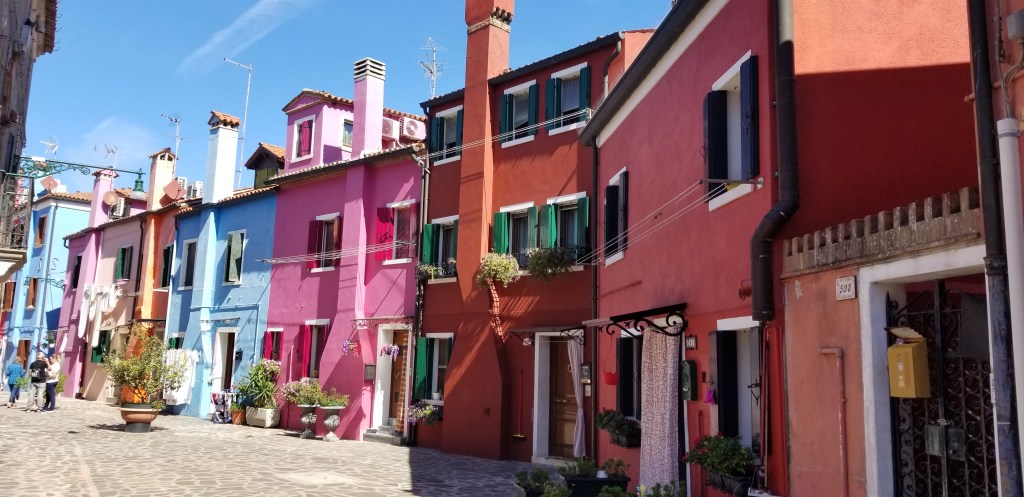
What is it about hanging laundry that makes everyone want to take a picture? Me included.
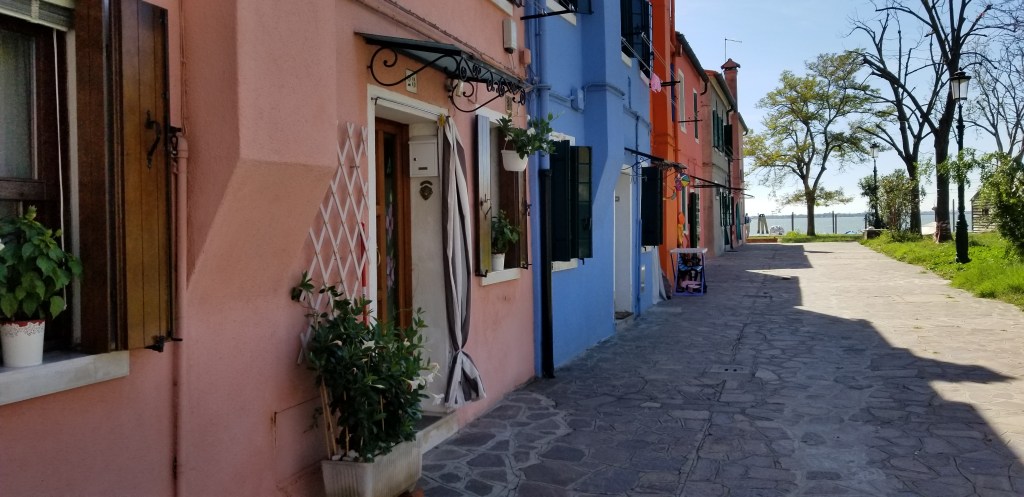
Traditionally, the houses were painted different colors so that fishermen returning home could easily see their own house while still out at sea. Today, the color of a house is regulated by the government; only certain colors are allowed for each particular lot.

I thought it was interesting to take a look at all the fishing gear in this small boat.

Murano may be tiny, but it still has its share of canals, plus a church with a leaning campanile.
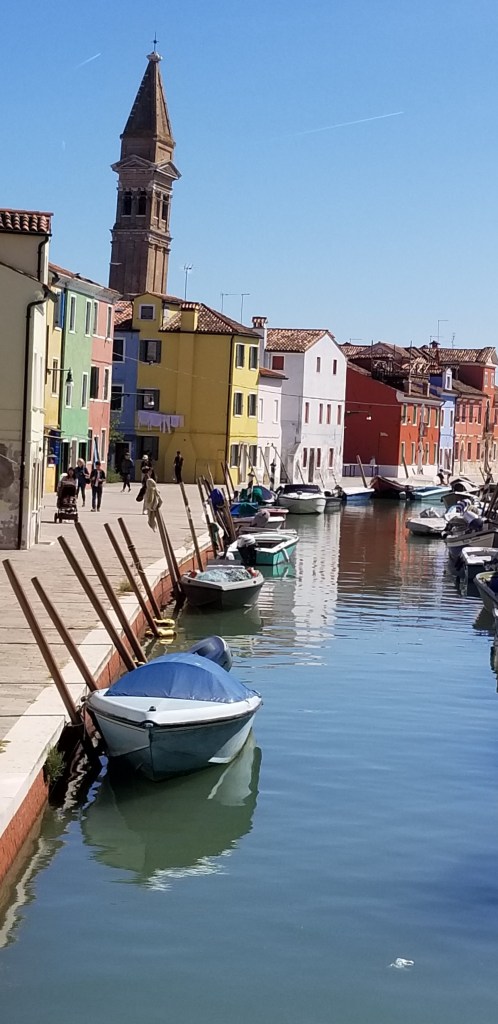
This time, upon leaving Murano, we took the vaporetto. It was not crowded. Since we were now further out from Venice, the ride was longer, and I had time to observe the “highway” in the lagoon. Posts help to keep everyone in their lane and prevent head-on collisions.
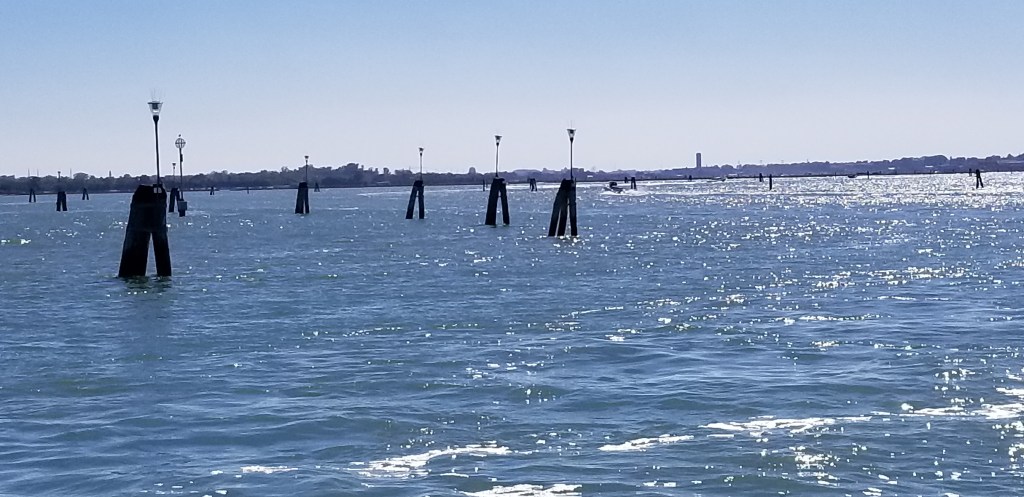
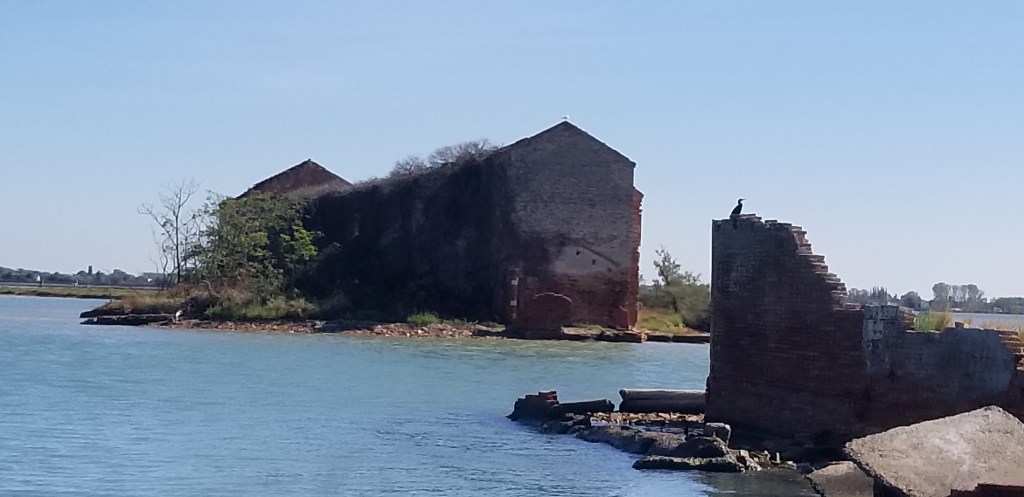
There are many things to be seen along the way, such as ancient buildings long abandoned:
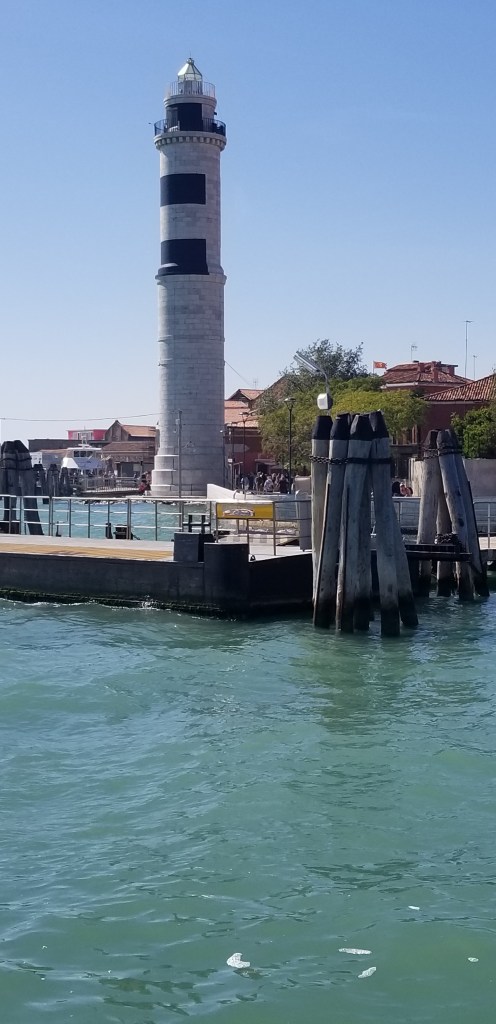
and a lighthouse at one of the vaporetto stops.
It had been a lovely, relaxing time on the islands of Burano and Murano, and just getting there and back was half the fun.

Next time: Boating to Padua
Europe · Italy

Venice’s Gems – Europe Travels, September 2022

Besides the enjoyable walks all over Venice, I wanted to get inside some of her buildings. I had picked up a pocket guidebook of Venice for this purpose somewhere on our travels, and knew where I wanted to start: the Scuola Grande San Rocco.
The monumental building is described as a “confraternity”, established in 1478, for a group of wealthy Venetians. It is next to the church of San Rocco which holds the remains of this saint, who was believed to be a protector against the plague. Basically, it’s their meeting place. There are two levels.

By Didier Descouens – Own work, CC BY-SA 4.0, https://commons.wikimedia.org/w/index.php?curid=65403655

I was bowled over when walking into this room.

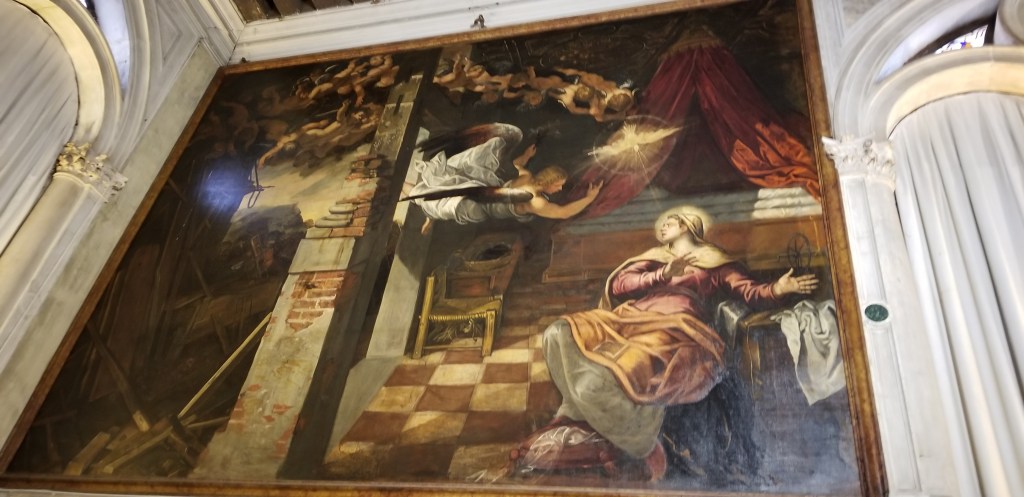
The other piece to this story is that the group commissioned a Venetian painter named Tintoretto, one of the leading painters in the era. He produced his finest work here over 23 years in the late 1500’s. There are paintings dedicated to the life of Mary, and, on the ceiling, scenes from the old Testament. Basically: huge, massive paintings everywhere. On the first floor, there are also paintings by an acclaimed artist named Titian.

Tintoretto’s painting of the angel’s appearance to Mary as she is doing her sewing
Mary’s ascension, also Tintoretto: I love how the little cupid is pulling on her foot, or giving her a push upwards.

As we climbed the stairs to the second level, the Old Testament scenes with swooping angels were over our heads. As Tintoretto painted, the plague was sweeping through Venice, and the paintings were meant to give solace and comfort. Tintoretto’s paintings on this floor were of crucifixion, resurrection and hope.

But it was the wood statues on the second level that really fascinated me. These were made by a sculptor named Francesco Pianta in the mid-1600’s. Each one is different and an allegory to such things as Melancholy, Honor, Spy, Science, Ignorance, and so on, as well as five shelves of a library carved all in wood. I didn’t know any of this when I was looking at them. I just thought they were interesting.

I went a little crazy taking pictures of these and couldn’t decide which ones to include!

This organization still exists today and they are focused on charitable causes.

We went to cathedrals: the Church of San Rocco is next door to the Scuola and is its associated church, with more works by Tintoretto and other Renaissance artists. Tintoretto painted many scenes of the San Rocco’s life (St. Roch, in English). The saint helped heal people during the plague. We saw the Basilica of Santa Maria Gloriosa dei Frari. It is the largest church and the artist Titian is buried here. I walked into a couple more on other days. Cal was tired of cathedrals at this point and was content to sit outside in the shade and watch the people go by.

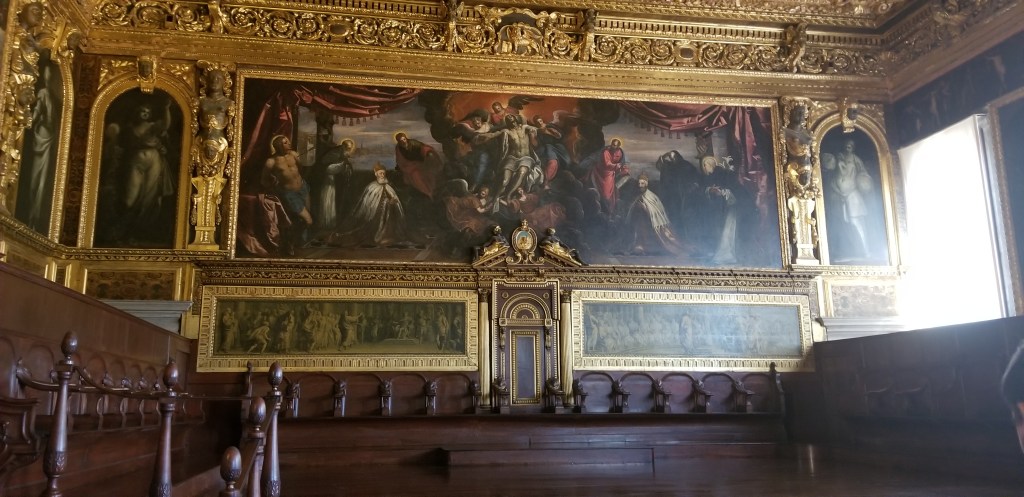
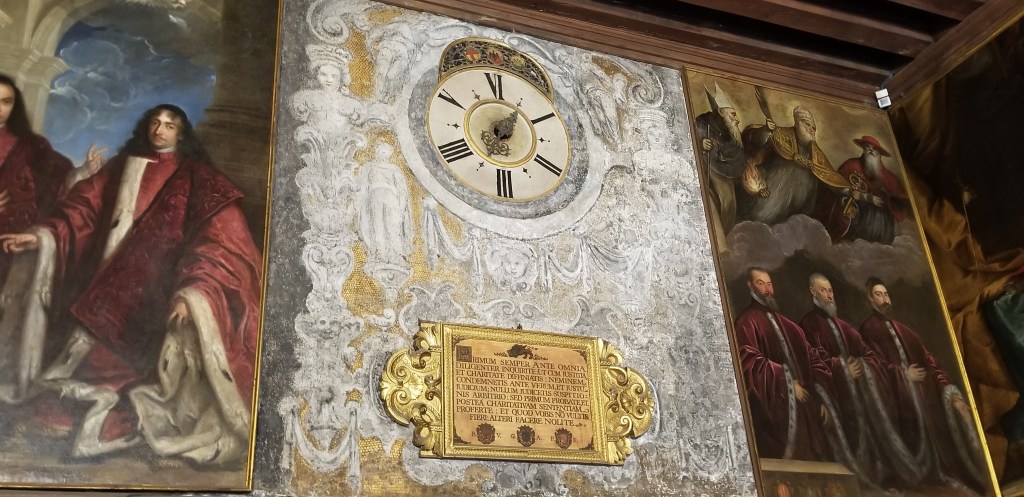
One of the most memorable gems of Venice, however, was our tour of the Doges Palace. I booked ahead for the “Secret Itineraries” tour because with this we were able to see some places not normally seen on just a walk-through of the palace. It’s not possible to purchase a timed ticket for the main rooms, so this enabled us to “skip the line” for that. Our tour began early in the morning, so on our way to the palace we saw everyone starting their day:

It was always fun to look in the shop windows along the way.

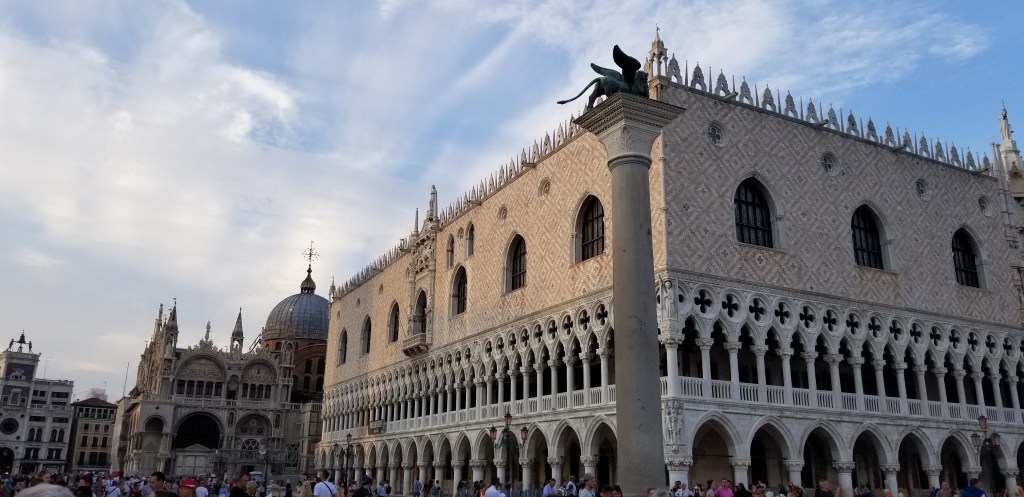
In this picture, the Doges Palace can be seen at the front right. On its left are St. Mark’s Cathedral and St. Mark’s Square.

The palace is the residence of the Doges of Venice, originally built in 1340. Of course, it has been enlarged and modified over the years. I looked this up out of curiosity: tradition holds that the first doge was Paolo Lucio Anafesto, who was elected in 697. I guess he and many subsequent doges had to do without a palace for several centuries. A doge was chosen from the ruling families of Venice and held his office for life. The last doge was Ludovico Manin, who lost his seat when Napoleon conquered northern Italy in 1797.

The Doge’s Palace held not only the apartments of the doge, but it was also the seat of government and had courtrooms and a jail. A doge’s position was largely in attending ceremonial events and receiving foreign dignitaries. He also presided over all meetings, but had no executive authority. Venice dominated trade in the Mediterranean between the 1200’s to the 1600’s, so the doge also commanded Venice’s vast military and naval fleet. A doge was not allowed to leave the palace.

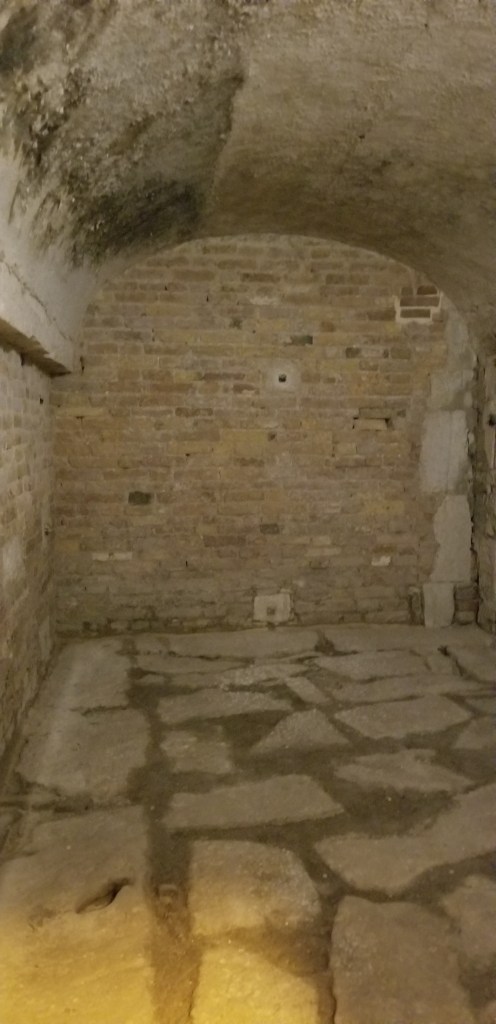
The first place we visited on the Secret Itineraries tour was the prison cells. Three to four prisoners would have been in one cell. A cell had no windows and was subject to canal flooding, which brought in vermin. Even in its day, it was considered to be the worst of the worst.

Up near the attic, there were another set of cells which were for the royal class. These prisoners got their own room and all the comforts of home except, of course, they were locked up. Casanova, the famous lover, was imprisoned here in the 1798 and is the only prisoner to have ever escaped. He went on to lead a long and interesting life, mixing with famous notables of his day, and even wrote a memoir. His room was here:

Looking out a window, we could see the steps in the courtyard in which Casanova made his hasty escape.

Venetian society was very secretive. Scribes would copy out city information and perform other administrative tasks. They could only work for one month so they wouldn’t learn too much.

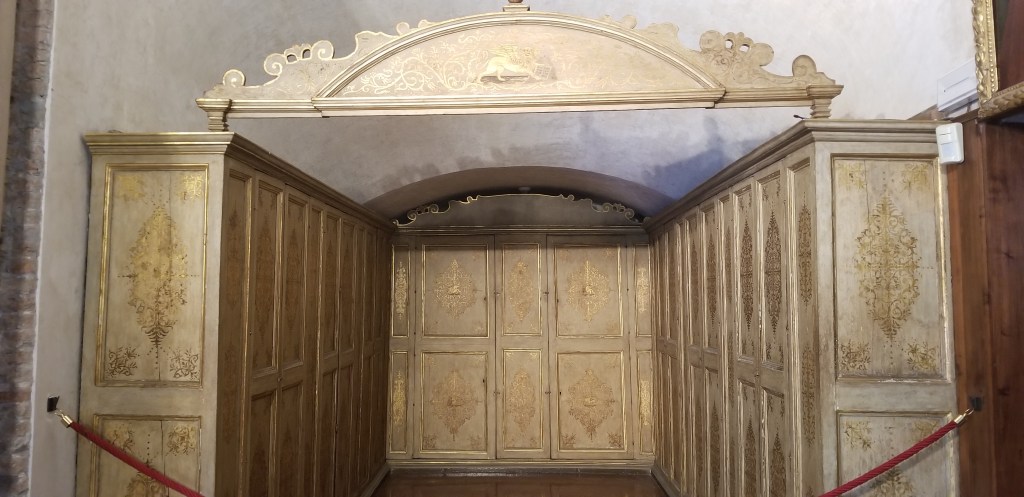
There were other things to be seen on this tour, including the Council of Ten Secret Headquarters (one of the governing bodies of Venice), the Chancellery, where drawers of top-secret files by the spy network were kept, a torture chamber, and displays of medieval armament.

The Secret Itineraries tour was over; we entered the main palace, which looked vastly different from the chambers we had been in.

The main palace dealt with higher-level administrative tasks. This included keeping the names and records of who was considered to be part of the ruling class in the Coffer Room.

If your name wasn’t in here somewhere, you were definitely not part of the aristocracy.

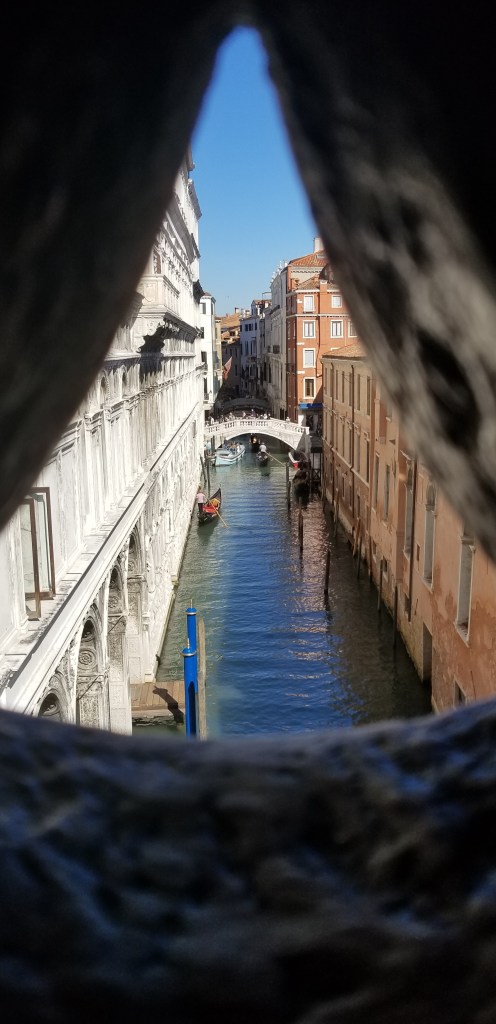
Part of the main tour is entrance to the “new” prison, which was built in the 1600’s. It was only a slight improvement over the old one. Going through to the new prison, we passed through the Bridge of Sighs. It is so named because prisoners heading to their cell would look out the window at their beloved city and know it was their last look for many years, if ever again.

This is the view of the Bridge of Sighs (and us) from the outside. We happened to be chatting with a family of other tourists here, and we all took each other’s pictures.

The new prison is on the left and the Doges palace, which includes the old prison, is on the right.

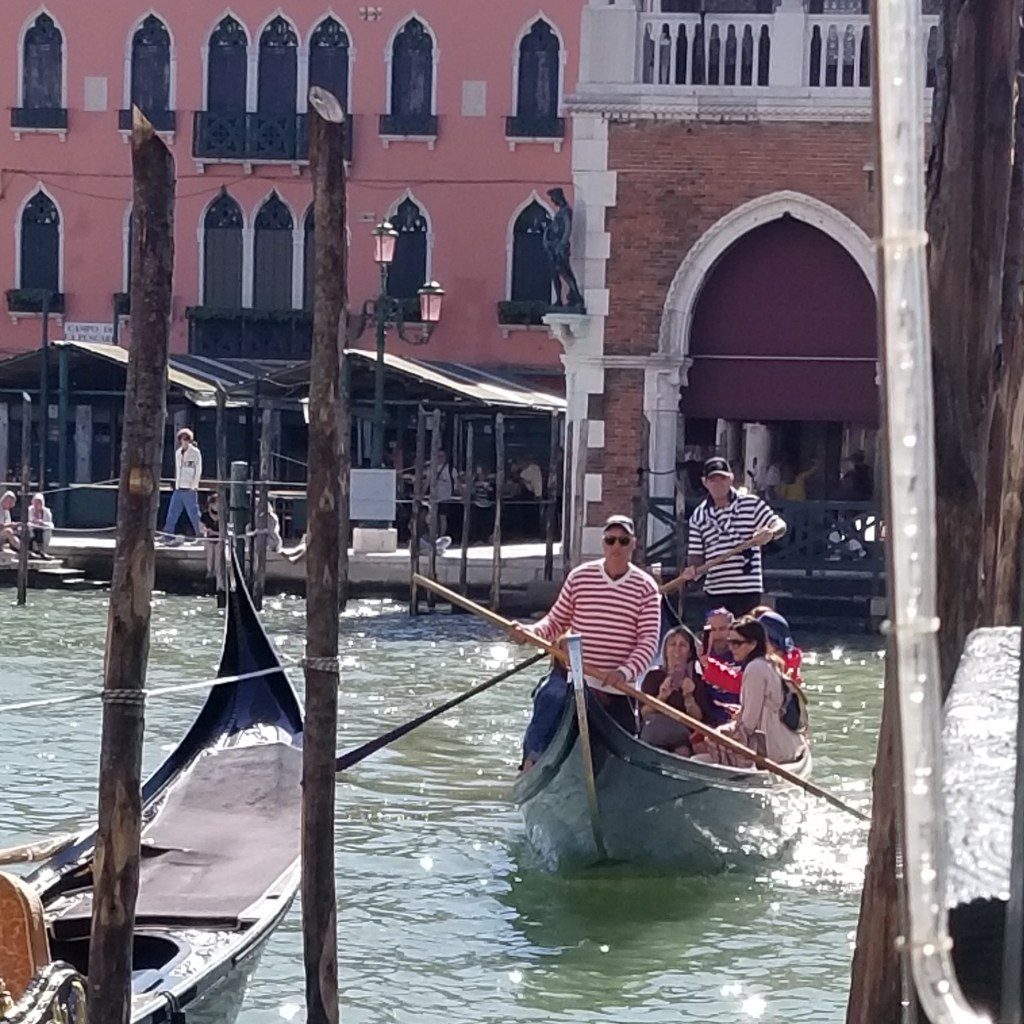
When we were in Venice for that one day years ago, we had one of those gondola rides that Venice is famous for. It was a cool evening and the gondolier had blankets for us. Behind our little flotilla of gondolas, a singer was in his own gondola singing traditional Venetian songs. People popped out of windows and waved. In short, it was a perfect, still-remembered experience, and I saw no need to even try to duplicate it. Many gondoliers today no longer wear the traditional costume and I never heard any music.

We are always happy at the end of the day to sit and relax. We discovered “Aperol Spritz” in Venice because that was what everyone was drinking. It is a light, refreshing drink which is alcoholic but I don’t ever feel the alcohol in it. On some days, that became our perfect drink for sitting in a little outdoor cafe to pass time before dinner.

One evening, we found a perfect spot for a Spritz while waiting for a pizza. It was on a small canal with gondolas occasionally going by. Hearing one of the gondoliers speaking English to his passengers, I asked him if he ever sings while he paddles. His reply? “No ma’m, you would not wish to hear me sing.”

Well, I guess that’s that.

Next time: visiting the little islands of Murano and Burano

Europe · Italy

Six Days in Venice, Italy – Europe Travels, September 2022

Six days. That’s how long I wanted to stay in Venice. Despite its reputation for having entirely too many tourists.

We’d been here, once, long ago. It was a ten-day romp through Italy from Germany on a great big bus. I don’t remember if we received an orientation to the city, only that we had just one day in Venice. We roamed about on our own, probably had some spaghetti or pizza, and the day was over much too soon. It’s always been my wish to come back and have plenty of time to explore. Six days this time was perfect.

This is the sight that greeted us when we stepped out of the train station upon our arrival from Bolzano. The body of water is the Grand Canal, which is the main boulevard in a city that has no streets for motorized vehicles. No cars, buses, trucks, emergency vehicles, motorcycles or even bicycles are allowed here. So it follows that there are no traffic lights or horns blaring. Except for one day that we left the city, we were blessedly relieved from normal everyday traffic noise. Everything in Venice goes by boat or on foot.

From the train station, we navigated the labyrinthian streets of Venice carefully and with an eye on our Google map. To get to our AirBnb we needed to cross the great bridge over the Grand Canal, walk along the pathway on the other side, execute a series of turns down various pathways, and cross smaller bridges. We followed a nun shepherding some other folks from the train station, until we went our separate ways.

I juggled my suitcase and interrupted the GPS on my phone to take pictures as we walked.

I did not want to lodge in the San Marco area, which is crowded and is where most of the tourists are. Venice has several neighborhoods and our AirBnb was the farthest away from it in Santa Croce, an easy walk from the train station. We could look out to the piazza from a small bedroom window. It was always interesting to see what was going on out there. Sometimes the restaurant was bustling, sometimes not. We had a couple of good meals there, and if we were back by late evening, we would watch the servers unfurl the umbrellas, whisk the linens away, and push all the furniture back to the side of the building.

In Venice I heard the term “tourist river” for the first time. Of course Venice has lots of tourists, although by now we were in late September and it was not too terrible. Tourist rivers are areas where a lot of people walk in a crowded stream to see sights or to shop. At times there was a light tourist river on the back of our piazza, where the person in red is walking, because we were on a pathway to the train station.

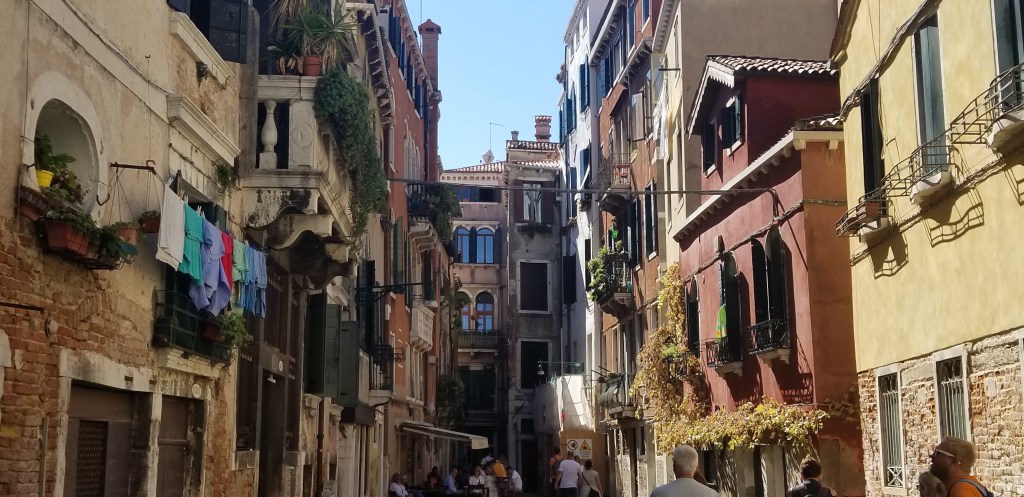
The joy of having time to explore Venice was being off of tourist rivers and into the quiet neighborhoods. This is the very definition of slow travel.

Yes, we found plenty of busy passageways. Even here there was so much to look at. There are not only tourists in Venice. There are students going to school, employees hurrying to work, and folks doing their marketing or crowding the tiny grocery stores for some lunch.

But then, there were plenty of quiet ones, too.

We would wander about, vaguely trying to get somewhere without any assistance, just enjoying the neighborhoods and the canals. A passageway would lead nowhere, or take us back to a piazza we had just walked through. We would finally have to give up, look at either our paper map or GPS and discover that we had been walking in circles. That was OK too!

In the middle of the picture below, you can see a passageway that just ends at a canal with no walkway or bridge. That happened to us quite a bit while wandering. We would have to turn around and retrace our steps.

Bridges are always picturesque, providing a view over canals large and small.

The famous Rialto bridge is the oldest of four bridges across the Grand Canal. Construction on this bridge began in 1588. We crossed this one on our way down to the San Marco neighborhood, and I got good photos of it on two separate occasions.

Venice is a faded lady. The city is over 1,200 years old and some of the buildings are 800 years old. Most, though, date back to the 1500’s. That was Venice’s Golden Age, which lasted a couple of hundred years. For good or for ill, it was one of the most richest and powerful Italian cities, with a stable government to keep everything in check.

The water in the canals are actually very shallow, only about ten to fifteen feet deep. The city was founded in the fifth century AD, and it was built in a lagoon, with small, marshy islands. Natural canals in between the islands were gradually enlarged and reinforced with bricks and other materials. There are 150 canals running through the city, connecting 118 small islands with a mixture of salt and fresh water. The local government works to keep the canals looking clean.

We didn’t always have to go on foot around the city. The canals have a system of vaporetti, or water buses, that run frequently and punctually on the Grand Canal. A vaporetto is docked at right in the picture below.

I took this picture while riding on a traghetto.

Along the entire length of the Grand Canal, there are only four bridges, and sometimes you just need to cross the Grand Canal where there isn’t one. For that there are traghettos. On one of our wandering excursions, the walkway ended at a traghetto stop. For two euros we could ride across. That looked interesting, so we hopped aboard. According to the sign, this is the Traghetto S. Sophia coming across for us.

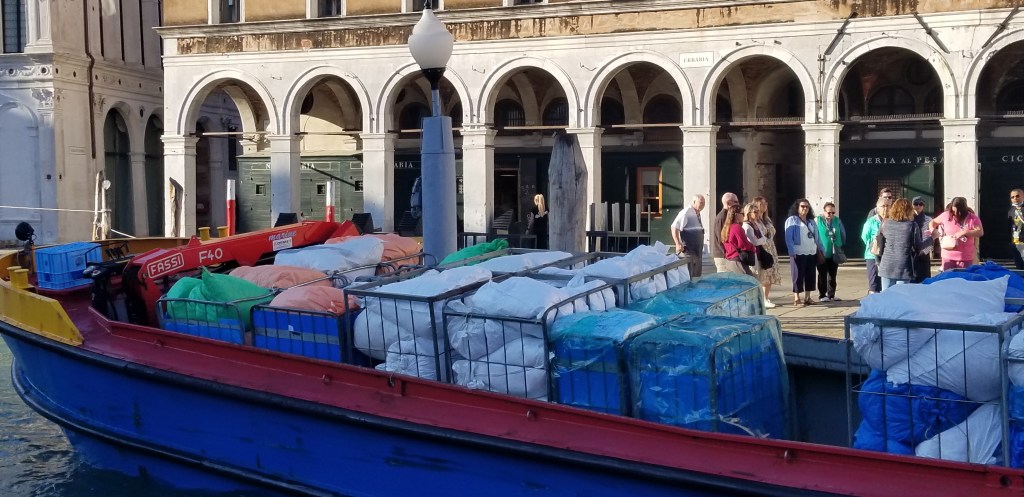
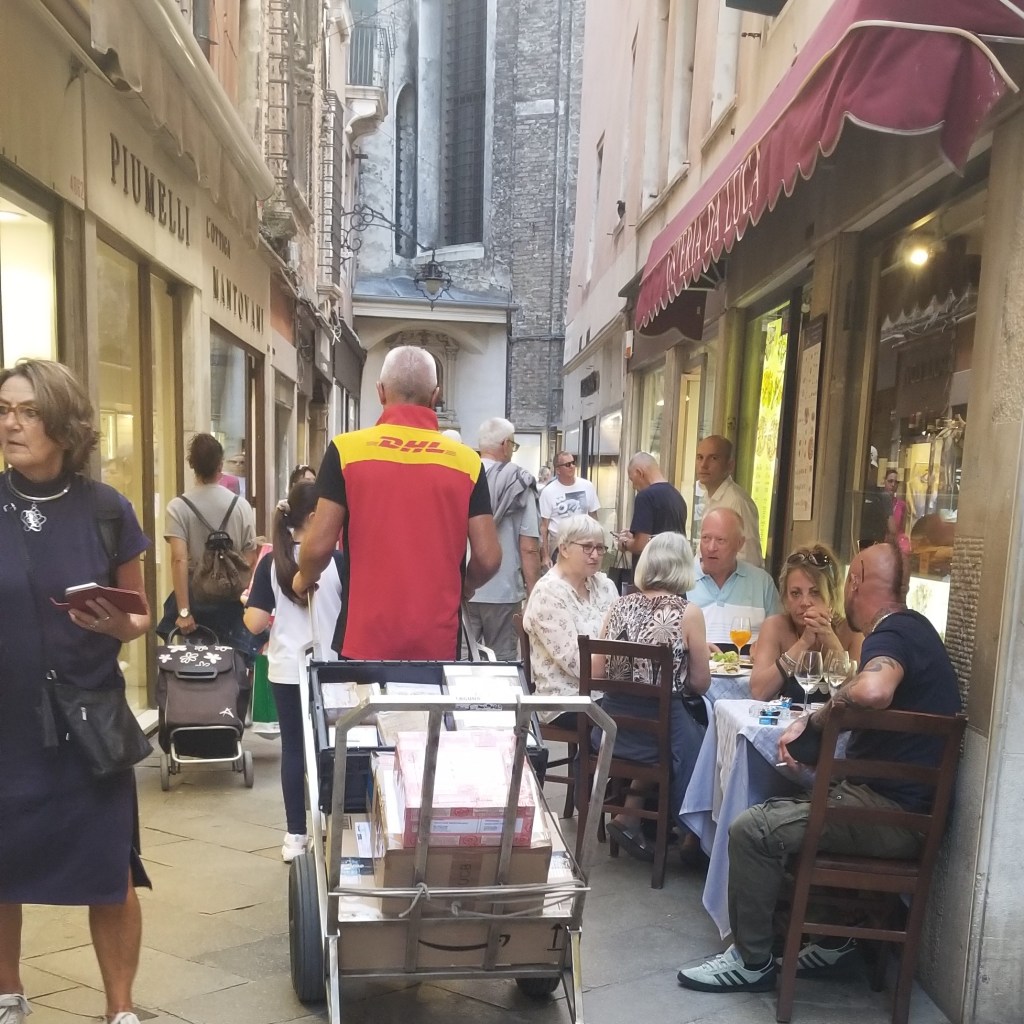
What about commercial transport in a city like Venice? Everything comes in or goes out by boat. Then it is transferred on carts down the pathways. The carts are built so that they can negotiate the steps, too, and people who pull them are good at getting up and down.

Package delivery on a crowded passageway near San Marco Plaza

The Grand Canal is used to transport everything, including perhaps the boxes that this DHL person is delivering.

One evening a strong wind blew in, followed by gusts of rain. From our window, I watched diners hurriedly finish eating and paying at the restaurant on our piazza. The servers scurried around swooping everything off tables and trying to fold up stubborn patio umbrellas that wanted to blow the wrong way. It was still raining in the morning. With the gloomy weather, I decided it was a good time to visit the Jewish quarter, in the Cannaregio neighborhood.

We crossed the Grand Canal on the bridge near the train station, where there were lots of people already out and about.

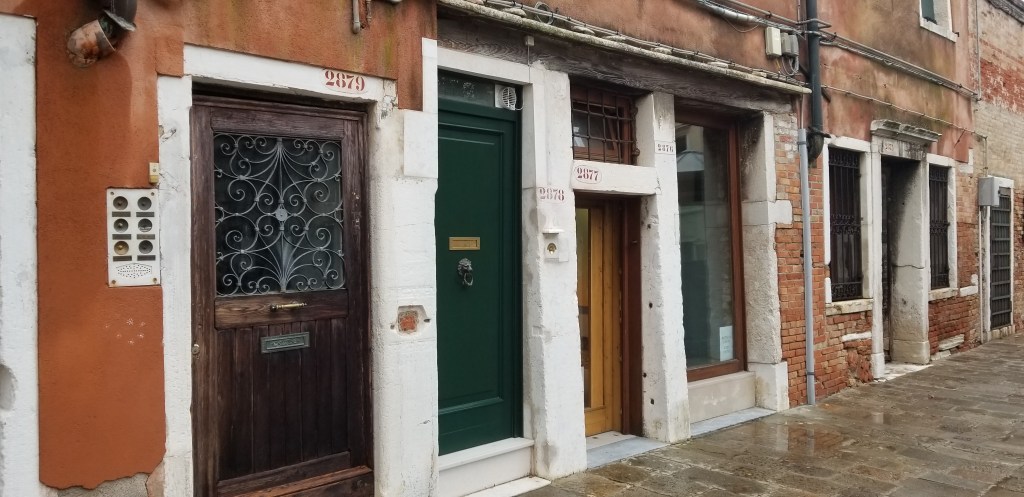
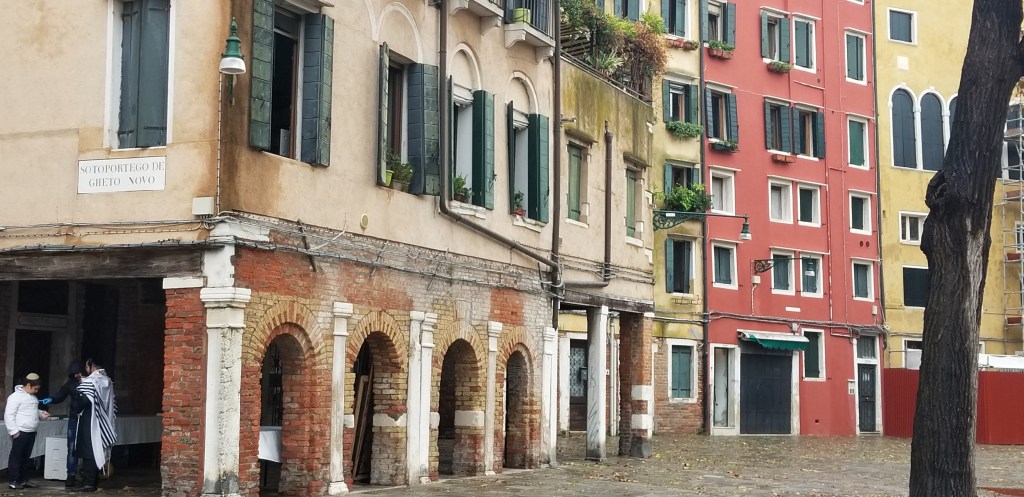
A few twists and turns, and we were in the quarter. It was a Saturday and the Sabbath, so a service was getting ready to start in a nearby synagogue. Despite that, some stores and cafes were open.

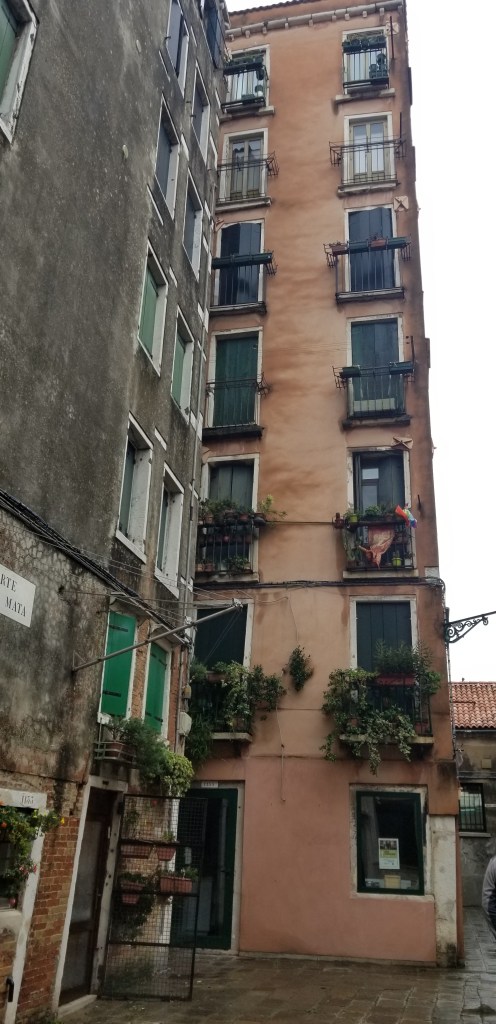
The “Golden Age” of Venice did not apply to Jews. In 1516, they were all made to move to an area where foundries, called “geto”, had been in ancient times. The area that included the ghetto is an island, since there is no way to get to it other than bridges. It got so crowded in the ghetto that buildings were made taller with substandard apartments. On ground level, smaller apartments were squeezed right next to each other.

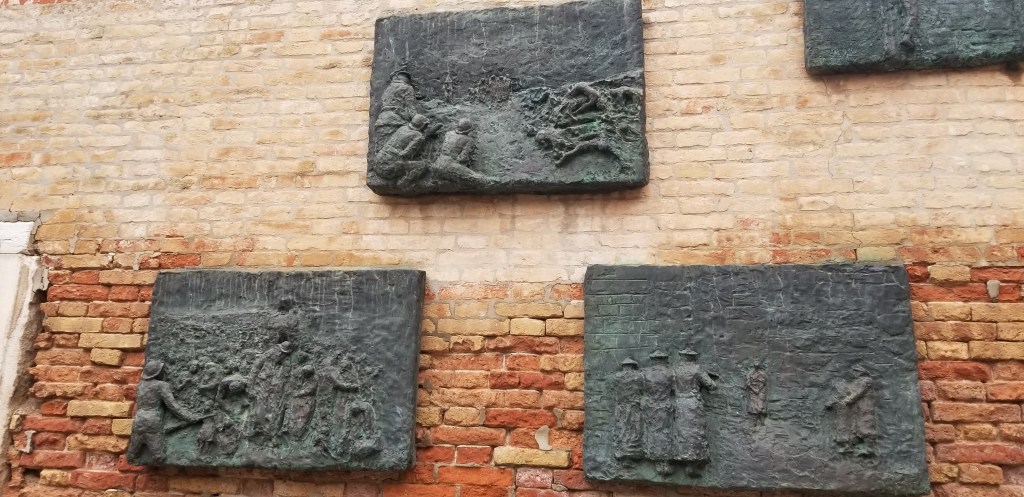
Looking about, I noticed pictures on the piazza wall. They are tributes to those arrested and murdered by the Nazis between 1943 and 1944 in this piazza.

It was sobering to ponder what happened here, but I think it is good to pause and reflect on these things.

All is not gloom and doom. The Jewish community is still here, with five synagogues and a library. Venetian Jews today number about 500, but only a handful live in the former ghetto.

I found a small art gallery where a gentleman had some cats lounging about. He takes pictures of scenes around the quarter and sends them to Israel, where an artist paints them onto canvas. I fell in love with one picture that included his cats, but I did not want to purchase anything.

We stepped into a small cafe to warm up and have a cup of tea (for me) and coffee (for Cal) with a cannoli. Cal was pretty happy with this stop. After thinking about it over my tea, I went back to the gallery and purchased my picture. It is now hanging up in my RV bedroom.

This was our only rainy morning in Venice, and the sun soon appeared to warm the day.

We did not just wander around Venice the whole time. There are golden treasures here: the Scuola Grande di San Rocco, the Chiesa del Gesu and other churches, the Doge’s Palace, Bridge of Sighs, and Piazza San Marco. That’s for next time!

Europe · Italy

A Mountain Discovery Day – Italy, Europe Travels September 2022

The Dolomites are a mountain range in northern Italy, and their beauty was all around us while we stayed in Bolzano. As soon as we could, we headed higher up in altitude for some exploration.

The cable car building was an easy walk from our lodging, and soon we were on our way.

It didn’t take long to rise above Bolzano and the vineyards encircling the city. The city lies on the floor of a valley and soon we lost sight of it as the mountains surrounded us.

Off the cable car, though, we were not on top of the mountain. On most every other cable car we have been on in the Alps, one or maybe two cable car runs usually puts us on top of the world where we can begin a hike. Surprise – not in this case!

The cable car had taken us to a little mountain village called Oberbozen. And straight ahead of me was a handy Tourist Information Office. There, I discovered that there was more to this journey than we anticipated. The nice lady inside the office, who spoke English, helped me map out our day.

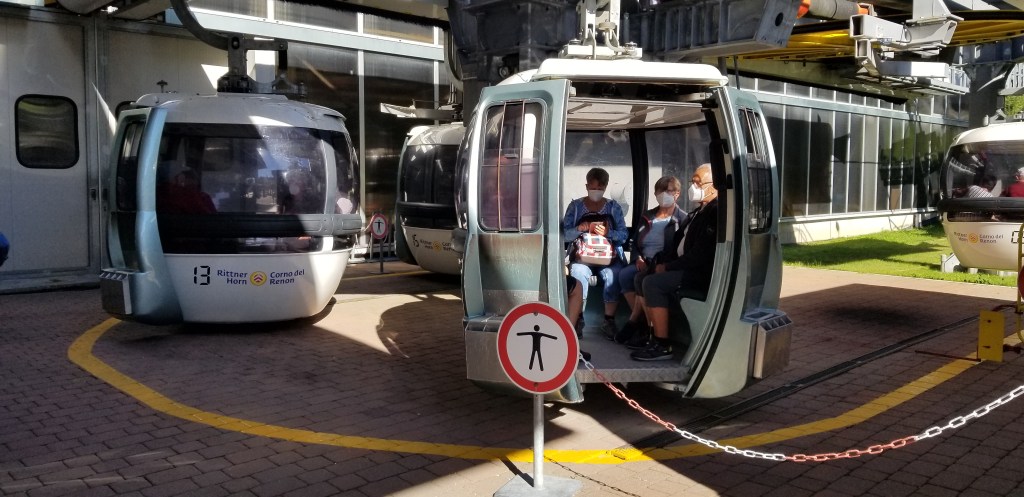
To get up higher, we needed to board a small cog wheel train, which took us across the mountain instead of up. Off the train, everyone hoofed it en masse over to a waiting bus in Klobenstein. We all packed that bus.

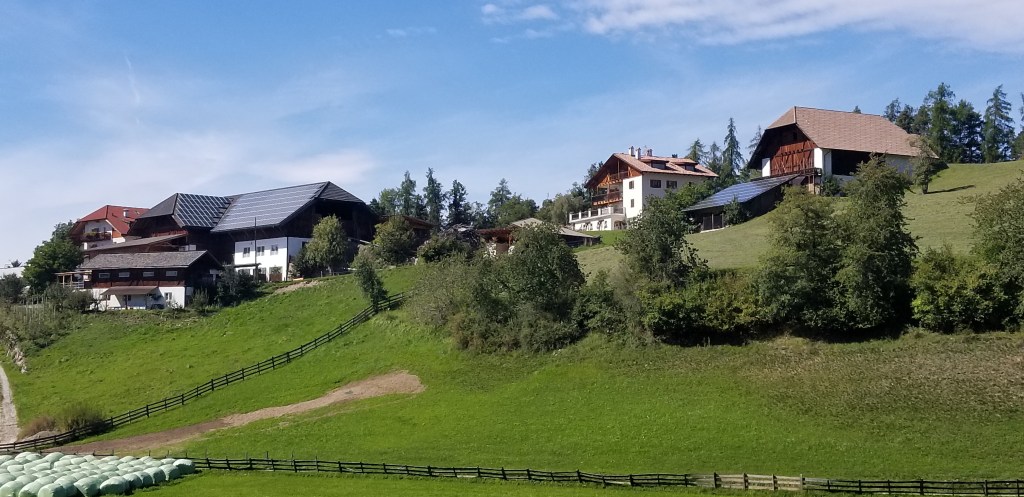
On both the bus and the train, we passed alpine farms and large dwellings that I would guess hold lots of skiiers in the winter season. There were brilliant green meadows with horses, cows, and sheep grazing. Huge barns and houses held planters of flowers spilling out over multiple balconies.

We stopped at tiny train stations.

Walking trails everywhere provided good options for a day in the Alps. In the winter these same trails are probably great for cross-country skiing.

We were not done yet. After the bus, the next step was another cable car. In September of 2022, masks were still the law Italy for any public conveyance.

Off the cable car, and finally – the mountain top! Here, even the little mountain villages are no longer to be seen. But which way to hike?

We set off on the “Panoramaweg”, hoping for pretty views. Of course, there was a pretty view everywhere we turned.

The start of this walk is in a forest of short trees, almost bushes, that are called the mountain pine. The tallest of them are only nine feet tall, and some are three hundred years old.

Mountain pine oil is used internally and externally for colds, rheumatism, sore muscles and other purposes. The oil “makes tired legs kick”. Well, my legs weren’t too tired yet. It felt good to get out and stretch after riding on all the various conveyances to get here.

On our walk, we dipped down in elevation a bit, and here the trees are taller.

Rounding a curve, the actual top of the mountain, Rittner Horn, rises up over the treeline. A lift would take you there in the wintertime for skiing. The beautiful plateau of the Ritten has been designated a Unesco World Heritage site.

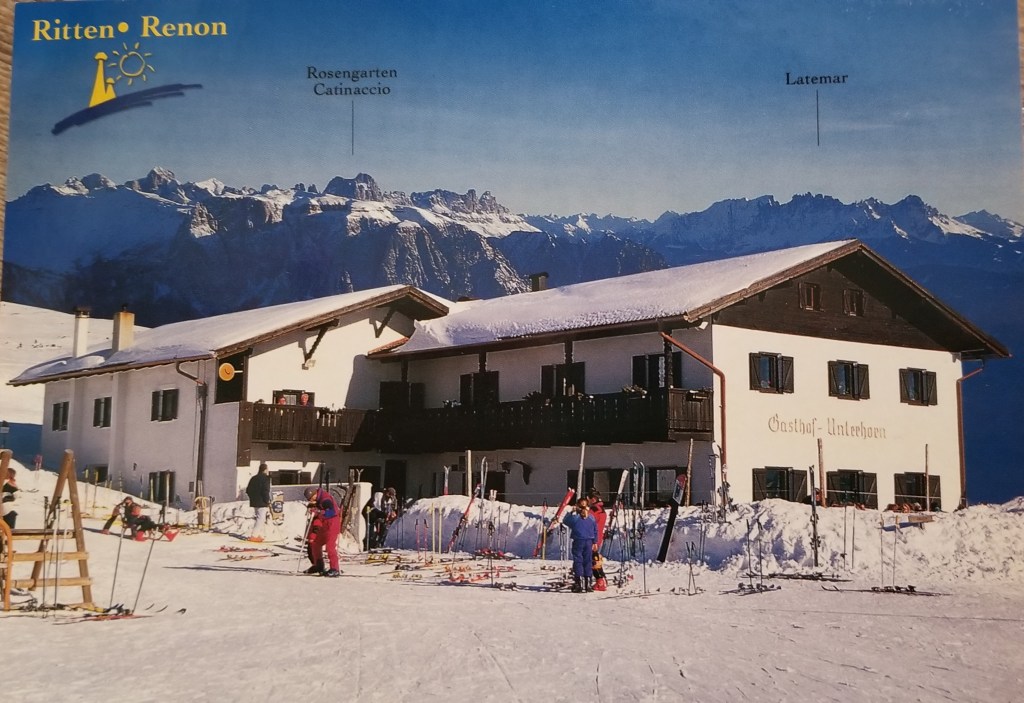
We did not hike up to it, since the sun was warm and it was already lunchtime. We made a stop at Gasthof Unterhorn, the white building in this picture.

We ate out on the patio, but I popped inside the restaurant and found this postcard. This is probably a great place to ski, and I can see why folks might want to lodge here. A skier would be right on the slope at the start of their day.

I did hike up just a little further after lunch to photograph this cow, which was also taking in the view. Or napping, I’m not sure which.

Hiking back to the cable car on the remainder of the “Panoramaweg”, there is more mountain splendor in store.

Starting from the highest peaks furthest away, waves of various colors ripple down the landscape.

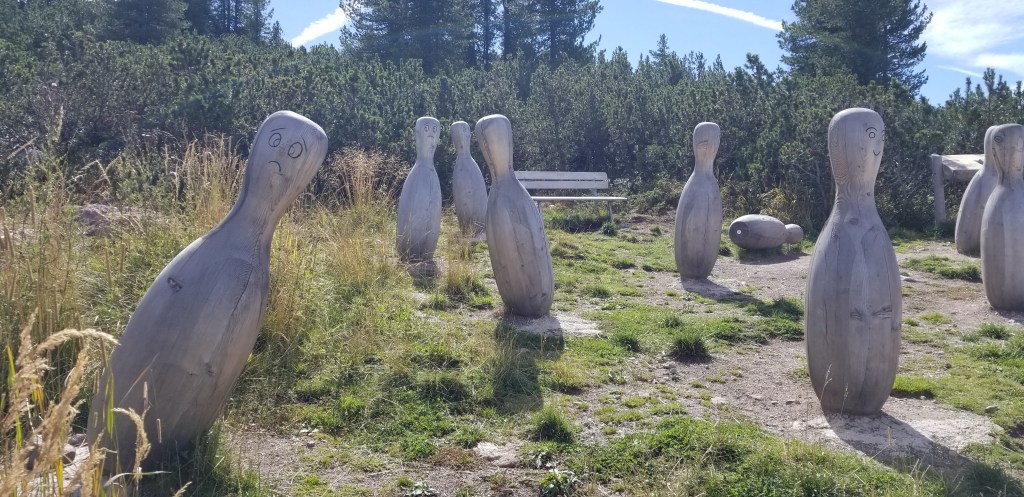
This part of the path has some small sculptures to keep the kids entertained.

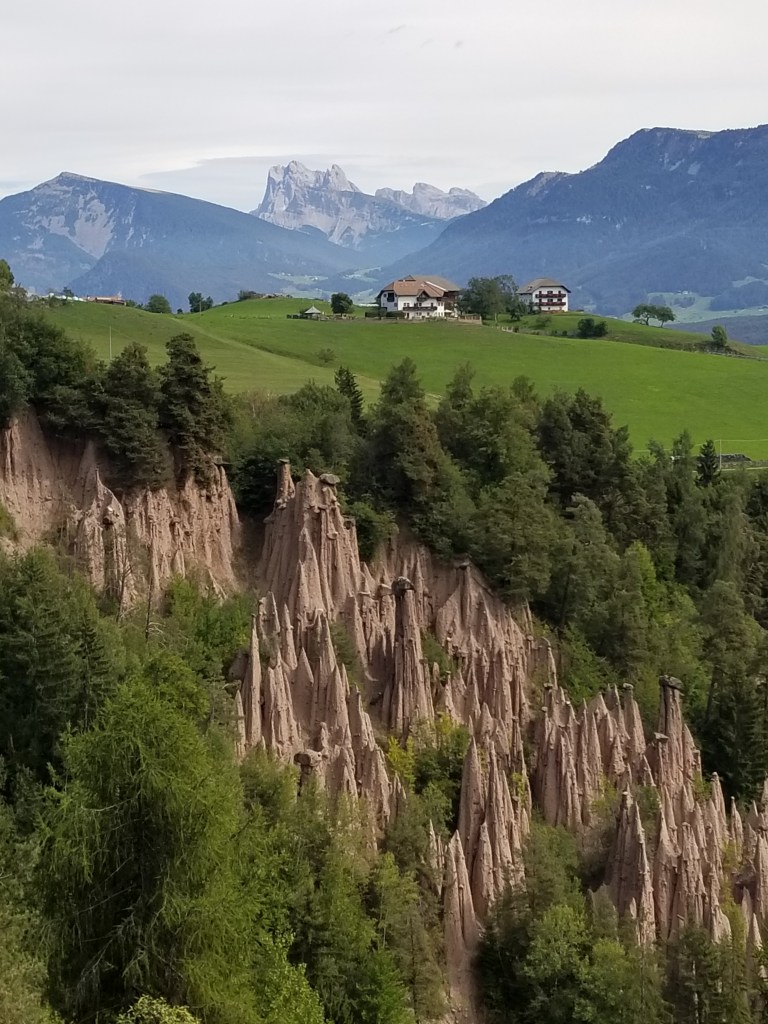
The woman at the tourist office back in Klobenstein had pointed out something else we might want to see, and we did. After the upper cable car and the bus ride we walked around the small bus depot to board a bus with a different route. This brought us to the stop for the “earth pyramids”. This is a natural phenomena due to hillside erosion. Each pyramid has a big rock on top. When the rock finally falls, the pyramid begins to die.

There was a sign that told us that pyramids such as these exist on every continent, but these are the tallest and best-developed. Several factors have to exist for the pyramids to happen: the type of soil, a steep incline, and protection from wind.

The earth pyramids were an extraordinary sight, and I was happy we’d taken this little detour. The short hike from the bus stop to see them gave us more beautiful scenery to enjoy, too.

There was a cute little bridge over a babbling mountain stream,

mountain ash trees full of berries clustered in profusion,

and we could hike in deeper woods than we had been in on the Ritter Horn, with the earth pyramids playing peek-a-boo.

What a day, full of nature and beautiful sights. Taken together with the other places we’d seen in Bolzano, we were feeling like our already-amazing trip was getting even better. A bonus: the weather was warming up, and on this day the sun shone all day. Along with all of that, one of my most-anticipated cities was the next stop on the itinerary.

Next time: our second (and last) Italian destination

Europe · Italy

Two Castles in Bolzano, Italy – Europe Travels September 2022

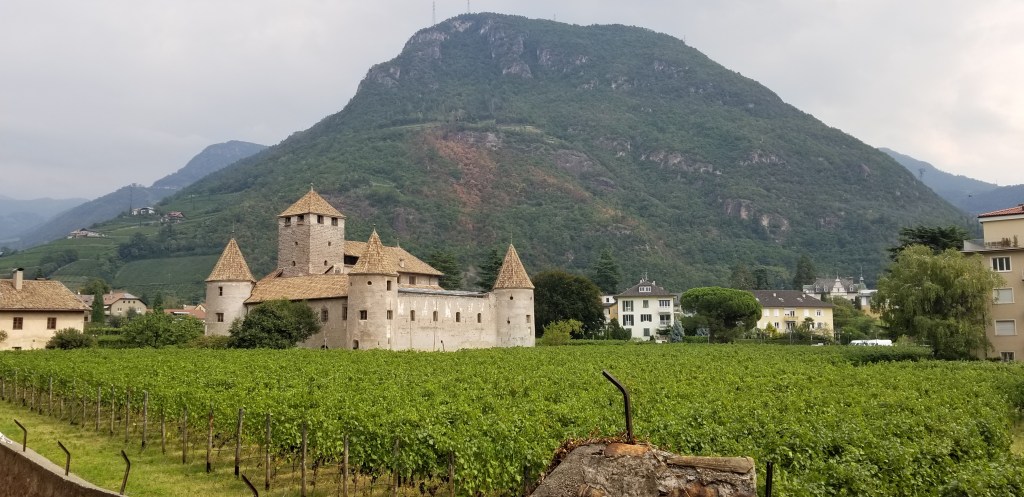
Maretsch Castle sits on the outskirts of Bolzano and was a pleasant walk for us from our stay inside town. The higher peaks of the Dolomites loomed in the distance, ancient villas dotted the walk, and a field of grapes were sitting ripe for the picking.

The oldest part of the castle was built in the 13th century, but received a makeover during the Renaissance in the 1560’s. It was built to be a residence and not a fortress. It’s used currently as an event center.

Frescoes were added as part of the makeover.

I could only imagine what this must have looked like when the paint and plaster was fresh.

Looking out from Maretsch’s windows

We wandered through rooms upon rooms bereft of furniture, up narrow and well-used staircases, and came upon a postcard exhibition. Not only that, but the exhibition told of how the area near the castle was once a resort town named Gries. The sun, the climate and the lush green hills made it a prime health and holiday resort in the 1800’s and early 1900’s.

The practice of sending postcards began in 1865, and of course everyone coming to the resort had to have postcards to send home. The collection of about 2,000 cards belonged to one person. The picture below is an enlargement of one of the postcards, and showed how Gries looked back in the day.

Unfortunately, the resort area of Gries was bombed badly in 1944. Reconstruction folded it into the town of Bolzano.

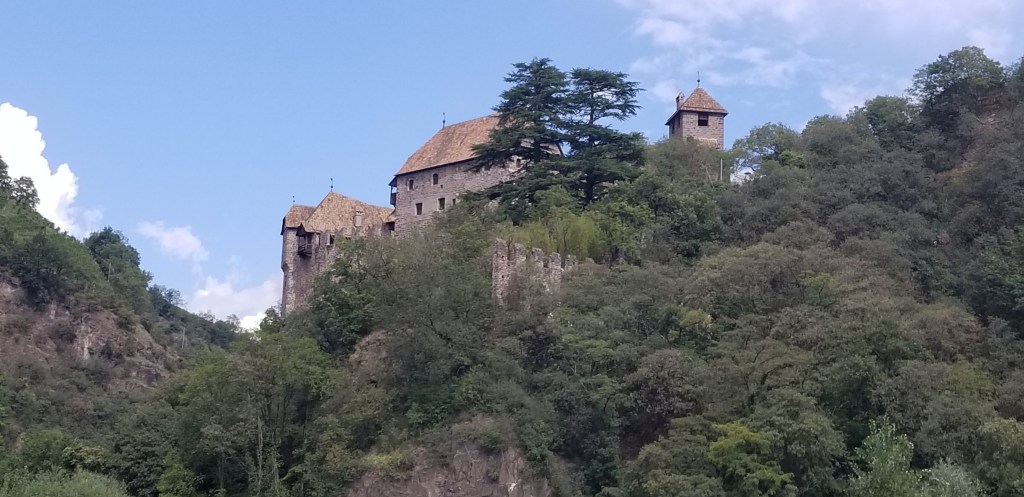
Back in our AirBnb, we looked out our window and saw Runkelstein Castle, although at first we didn’t know it was Runkelstein. Could we visit that castle, and how could we get there?

Of course, it was a much more distant view from our apartment!

The answer was yes: we could visit, and all we needed to do was to get on a bus from Piazza Walther. We stopped at a bakery for some lunch provisions before we set out.

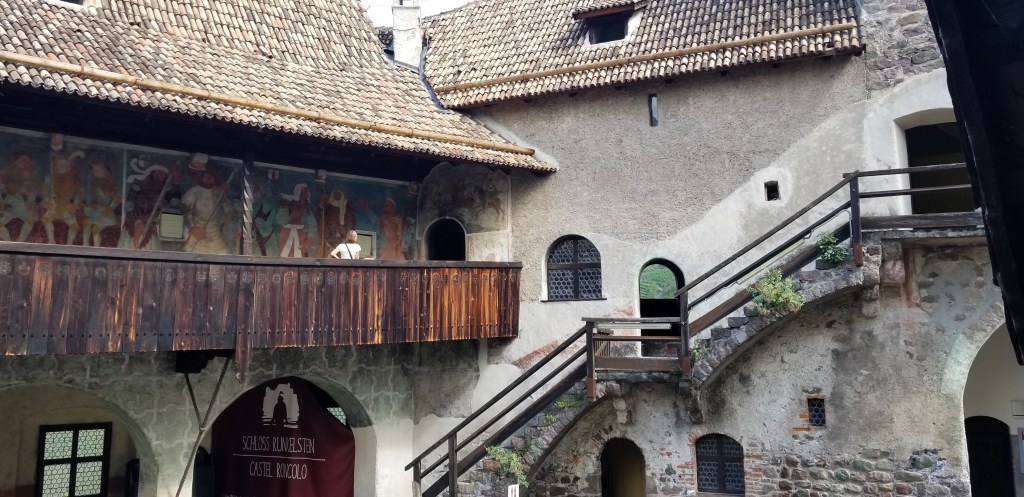
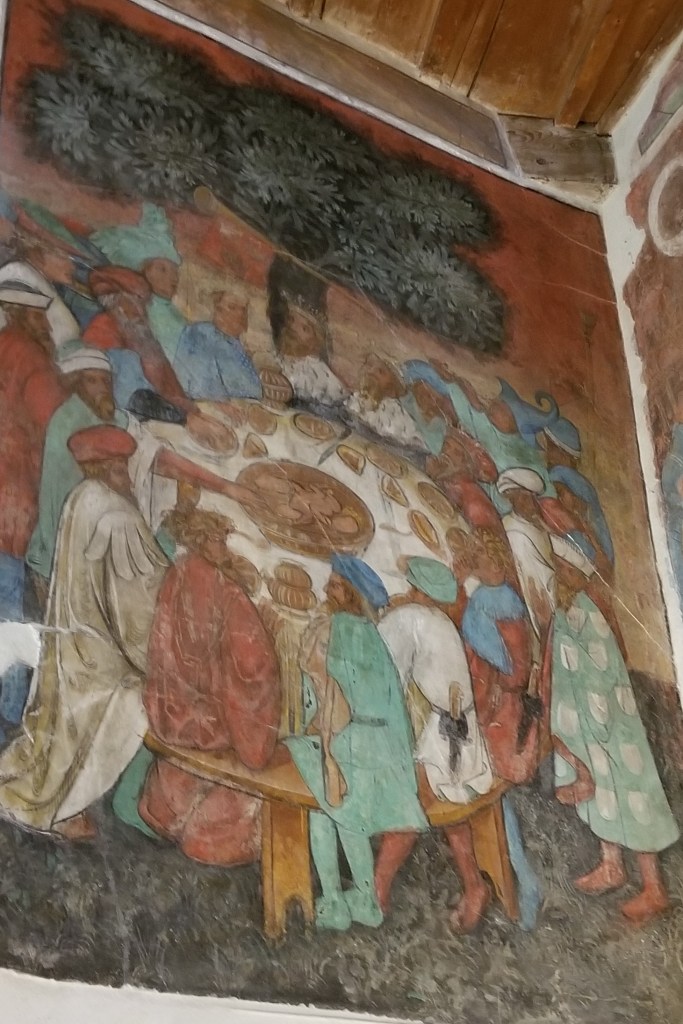
This castle is a medieval fortification originally built in 1237. It entered its golden years when two brothers, Nicklaus and Franz Vintler, purchased it in 1385. Sons of wine merchants, they wanted to validate their rise to aristocracy by giving it a fabulous makeover. In those days, as at Maretsch, the way to do that was by adding frescoes. This castle has one of the largest secular collections from medieval times. Also important: the addition of a privy and a cistern to store water.

There are frescoes everywhere, and new corners to explore at every turn.

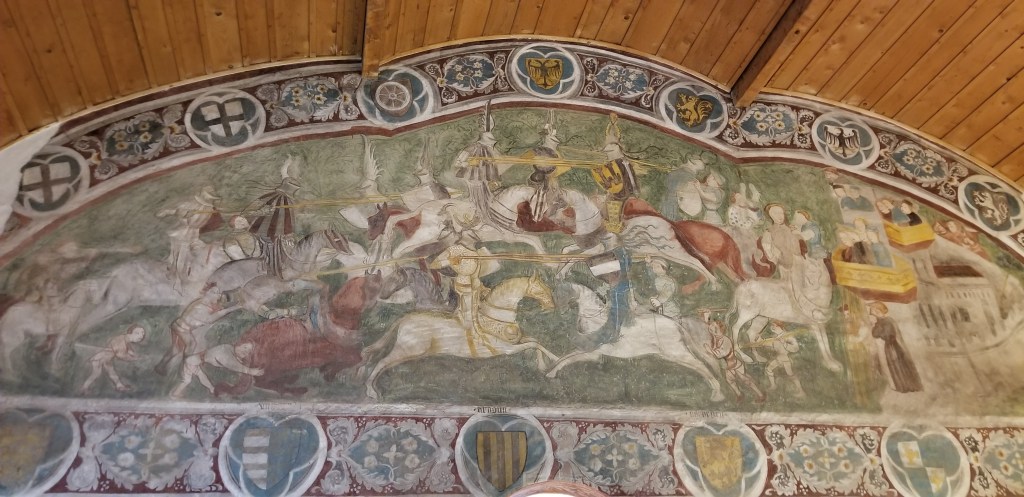
This fresco depicts a jousting tournament. What’s interesting here is not only the tournament but also what is happening on the right side.

There are women looking on from above, and a priest stands below. Perhaps the priest was needed in case of a mortal blow? In the far right corner, not allowed inside the the walls but watching from wherever they could, are Jews discernable by their pointed hats.

Another fresco shows the height of medieval fashion. A lady may own only one dress, but have several interchangeable sleeves for the dress. For the men, the longer the point on the shoe, the more important was the wearer.

Making a fresco takes a lot of time and experience. A picture must be drafted. Then the wall is prepared by making it smooth and even, and a top layer of plaster is applied. Finally the painting can begin. Frescoes have an advantage over other types of painting because they are very durable. It took five years to freshen up Castle Runkelstein’s frescoes in the late 1990’s.

There is also one of the earliest known depictions of King Arthur and his knights seated at the Round Table.

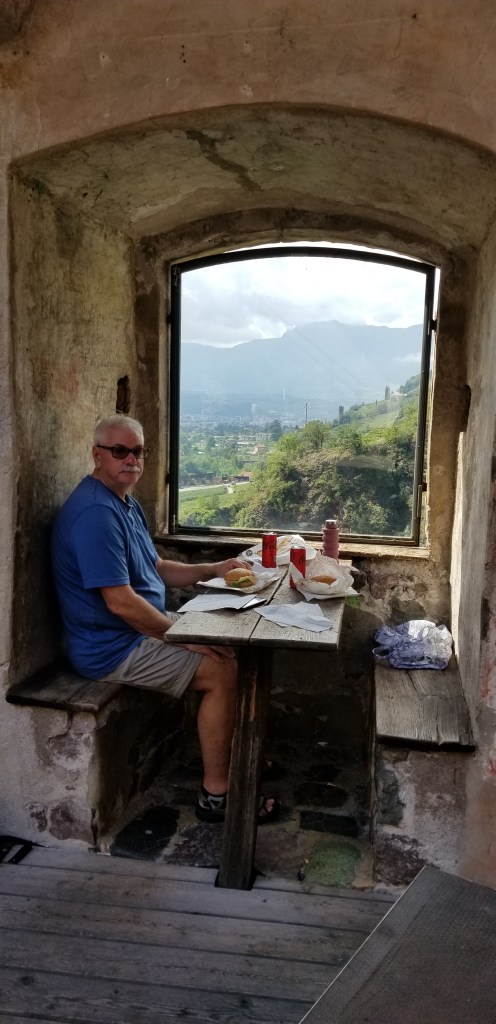
Cal was not immersed in every detail of the frescoes as I was, and when I emerged from inside the castle, I found he had snagged the greatest spot for us to have lunch.

Lunch with a view

I had watched our route to Castle Runkelstein when we had been on the bus. There were walking paths, and the distance of about two miles back to town looked very doable. Cal opted for the bus, and I set out for what was to be one of my favorite walks of the trip.

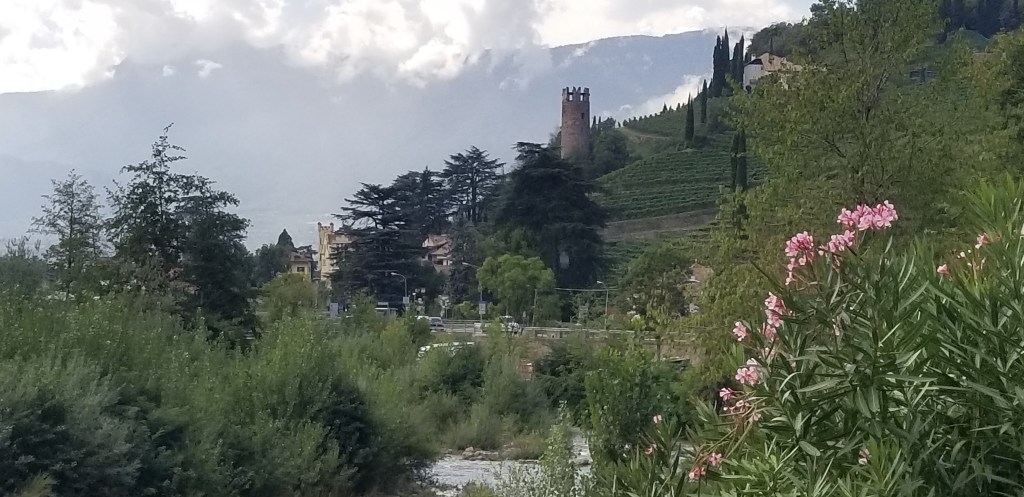
I could see the old watchtower close up. Cypress trees dotted the grape vines growing precariously on the hillsides.

Does this villa date back to the Gries resort days?

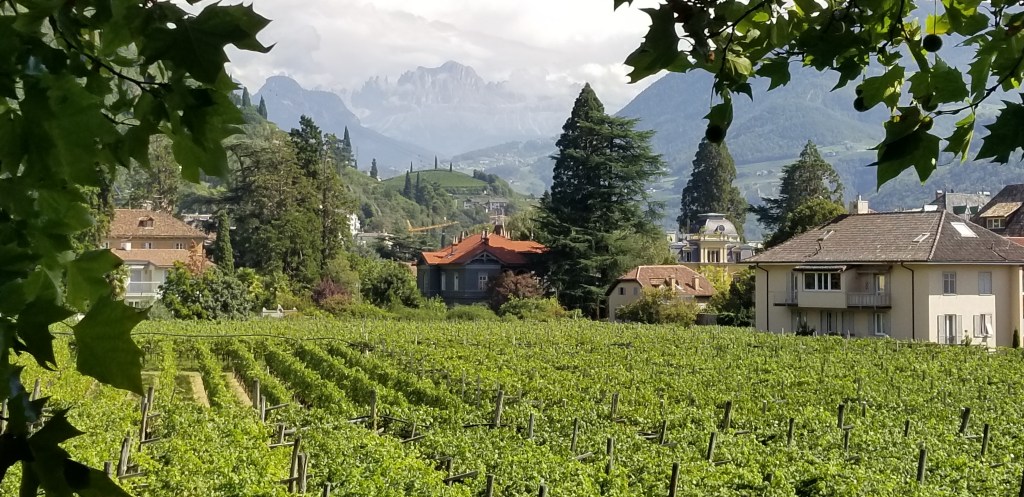
And then, one of the best views. It looked to me like an old landscape oil painting with the Dolomites hazily in the background. I took pictures, walked, took more pictures.

Still to be written is our most memorable Bolzano day. Like all great days, it was full of surprises.

Next time – a mountaintop experience high above Bolzano

Europe · Italy

Bol-what? Italy, Europe Travels September 2022

I traced a finger down the rail line on a map of Europe. We would be catching a train in Munich into Austria, through the Brenner pass, and into northern Italy. This area is in the Dolomite mountains, and, with its strong Austrian influence, might be a good transitional spot for going into Italy. I speak passable German, but not a word of Italian.

Bolzano looked promising: walkable, with a scenic old town, and with mountains all around. Most everything is printed in two languages: Italian and German. Great choice! It turned out to be excellent for a four-night stay.

I had some sort of a mental block about Bolzano, and could never remember its name off the top of my head. If anyone asked about our Italian stops, I had to go look it up. There was no more trouble about that after spending time here!

After less than a quarter mile walk from the train station, we came to what we later learned is the most important square of Bolzano: the Piazza Walther. It was built during the short period in the early 19th century when Bolzano was under Bavarian rule. The Bolzano Cathedral, with its striking green, yellow and white diamond roof, looks down on all the bustle like a fond friend.

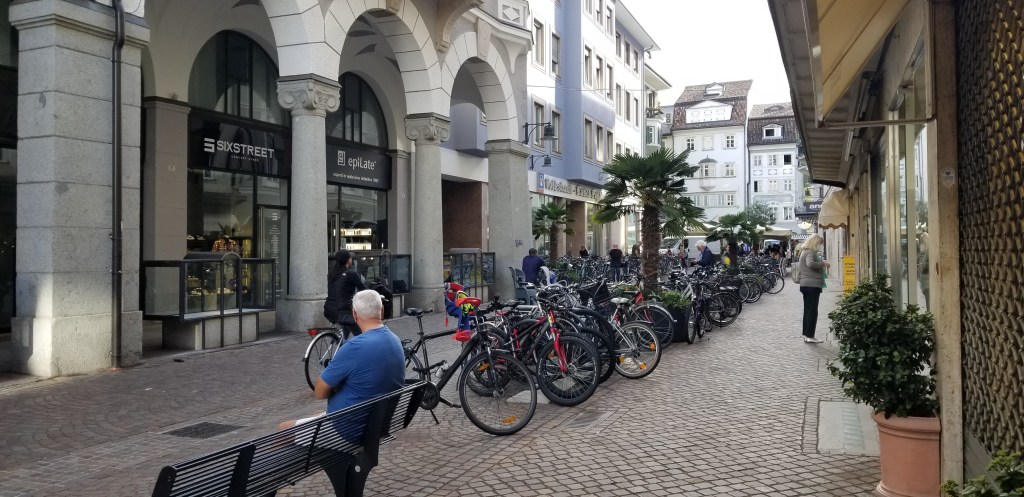
Bicycles zipped past us as we turned onto the pedestrian street to our AirBnb. I was happy to see this town has a bike culture.

Our home for a few days was a couple of floors up inside the arcade on the left. While waiting for me (he always has to wait for me to do whatever) Cal liked to watch the street activity on the bench opposite the entrance.

Soon enough, we figured out the reason for all the bikes. We were near a university – the Free University of Bozen-Bolzano. Bozen is Bolzano’s German name. Classes at the university are given in Italian, German and English. Down the street was a middle school, judging from the ages of the kids who poured out from it every day. In the evening, most of the bikes were gone.

The elevator in our building had a window in it from which we could survey the neighborhood on our rides up and down.

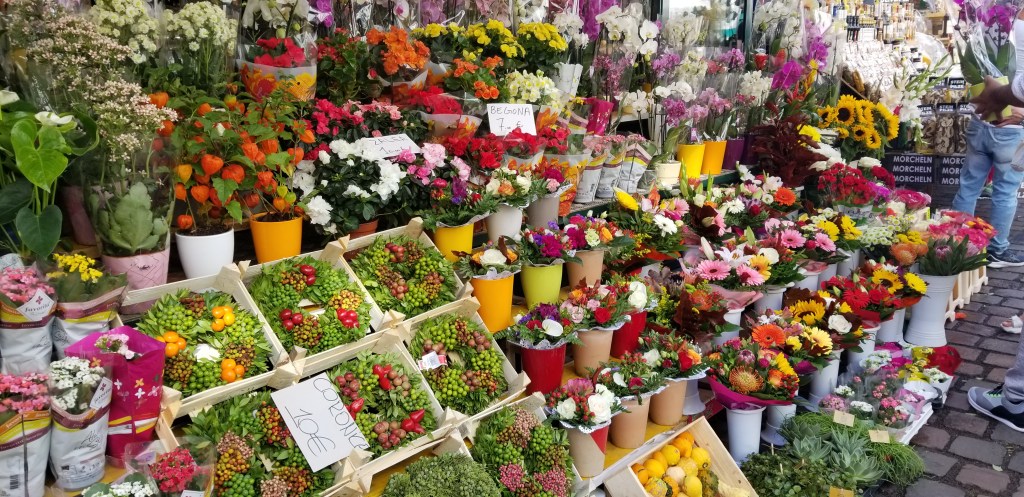
Around the corner in the other direction was a fruit, vegetable and flower market.

In the early morning, there would be a lot of bustle around the market as everyone got ready for their day. That includes purchasing some flowers for a special occasion.

We found our grocery store near the market, and near it, a pizzeria:

Metal chicken sculptures were in every window of this building. Bolzano, like its Austrian and German counterparts, also has traditional paintings on some of its buildings.

During our stay here, we wandered down labyrinthine streets and admired the architecture.

One evening we returned to Piazza Walther for dinner.

The next morning, there was a formal event in the piazza, and a platoon from the Italian Army was there. I loved their Tyrolean hats with the jaunty little feathers.

All we had to do was to step out our door to explore in any direction. We never knew what we’d find.

Besides being a pretty town, Bolzano is famous for something: Otzi’s mummified remains are here.

Otzi was discovered by hikers in 1991 in a melting glacier not too far from Bolzano. He lived between 3350 and 3105 BC and is Europe’s oldest known natural human mummy. We could visit him, as well as the clothing and equipment found with him, in the South Tyrol Archeological Museum near our apartment.

It wasn’t possible to take a picture of him, but I could take a picture of what the scientists think he looked like:

Lately Otzi has been in the news. Recent DNA analysis has shown that his skin may have been darker than what they first thought, he may have been bald, and came from an isolated group of farming people. Is his model going to receive a make-over?

It was interesting getting a small picture of this man’s life so far back in time. Otzi’s museum did not take much time to go through, so after finishing it I went over to the small Bolzano City Museum. It fast-forwarded me in time a few thousand years.

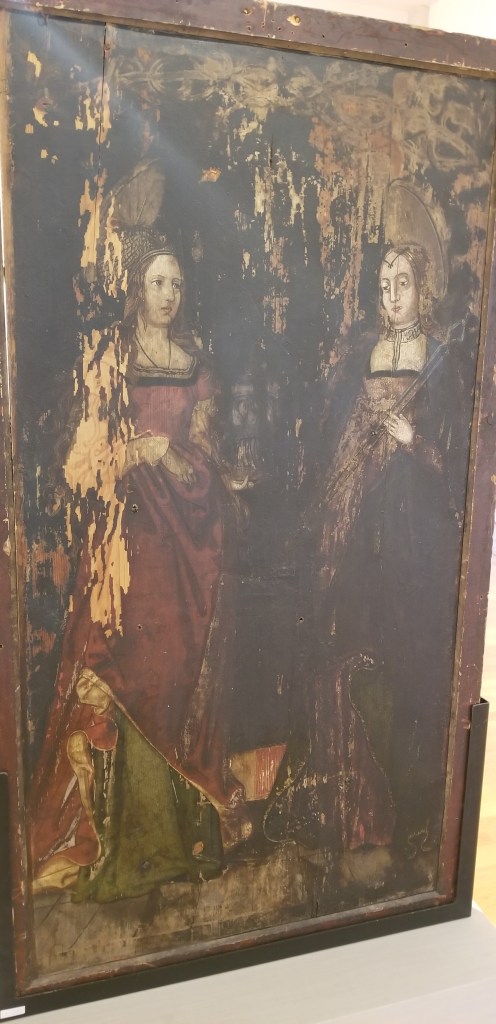
There was a carved and painted wood picture from 1510 of Saints Barbara and Catharina that, interestingly, had their picture on the reverse side also. Maybe the one was a model for the other.

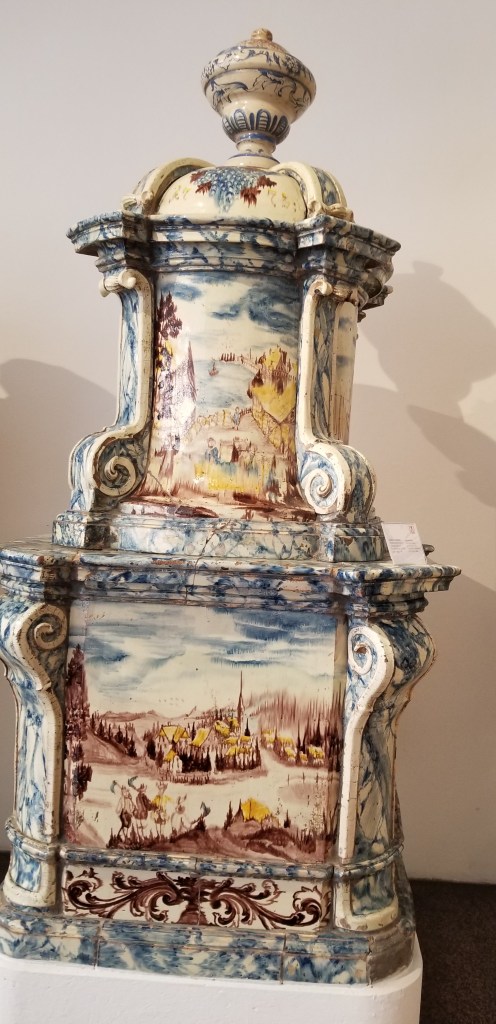
Moving forward in time, there was an entire room of elaborately painted and tiled wood stoves – “baking ovens”. This one dates back to 1780.

There were also ancient frescoes lifted from old churches as well as paintings by local artists in more modern eras.

Besides all this, there was beauty to be seen not far from the city center.

Old churches and an old watchtower, as well as picturesque homes, dotted the hillsides.

In Bolzano, I was able to photograph a phenomenon that I’d seen all over Europe, beginning in Belfast. In the evenings, shop keepers roll aluminum shades down over their stores. These are all covered in graffiti. The loveliest postprandial stroll down a picturesque pedestrian street can make one feel at times that they may not be in the best part of town. I got this picture while eating dinner in a restaurant on one of those streets after we watched this store being zipped down for the day.

Not nice, right? Imagine a street filled with these.

But in the morning, voila: a bakery with tempting treats! As with most everything in this area of Italy, the lettering over Cal’s head is both in German and Italian. That’s due not only to its proximity with Austria, but the fact that this region was ruled by the Austro-Hungarian empire for centuries.

But wait – there’s more!

Coming soon are two more blogs about our time here, each one better than the last. Taken together, it all adds up to one amazing stay in this South Tyrolian town. Here is a sneak peek:

Next time – Bolzano’s castles

Europe · Germany

All Around Feldafing, Germany – Europe Travels September 2022

I had two goals in visiting Bavaria: to be in the Alps, and to see things we hadn’t seen before. The first goal failed, since Feldafing isn’t in the Alps, but the second goal? Scored!

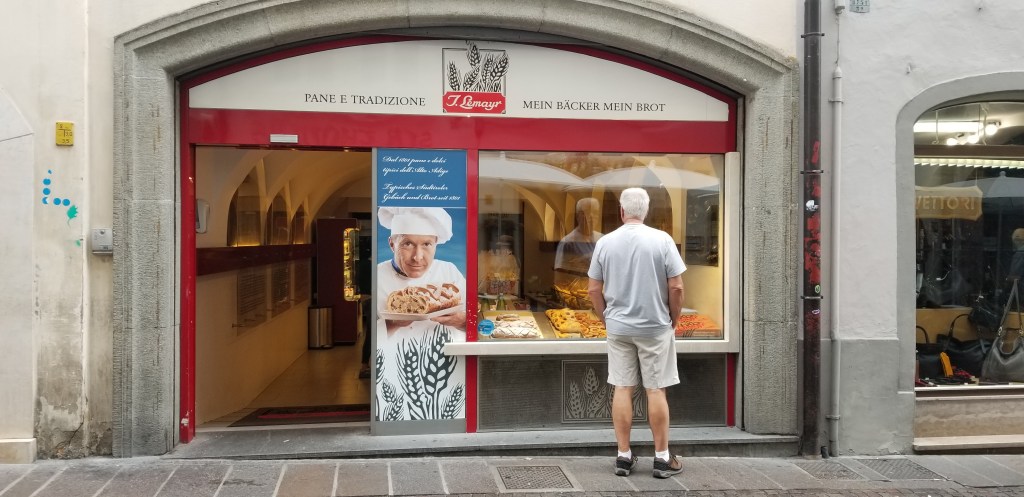
Feldafing’s bakery

Feldafing, being situated on the shores of the Starnberger See, rises up along steep bluffs. We were buried deep in a subdivision and every trip into town meant walking up or down a hill. Postwar, it had the first all-Jewish displaced persons camp, and hosted a large community of survivors. It also has pretty little Roseninsel (Rose Island), the only island on the Starnberger See.

We rode a quaint little boat out to the island. From here, the Alps can be seen in the distance.

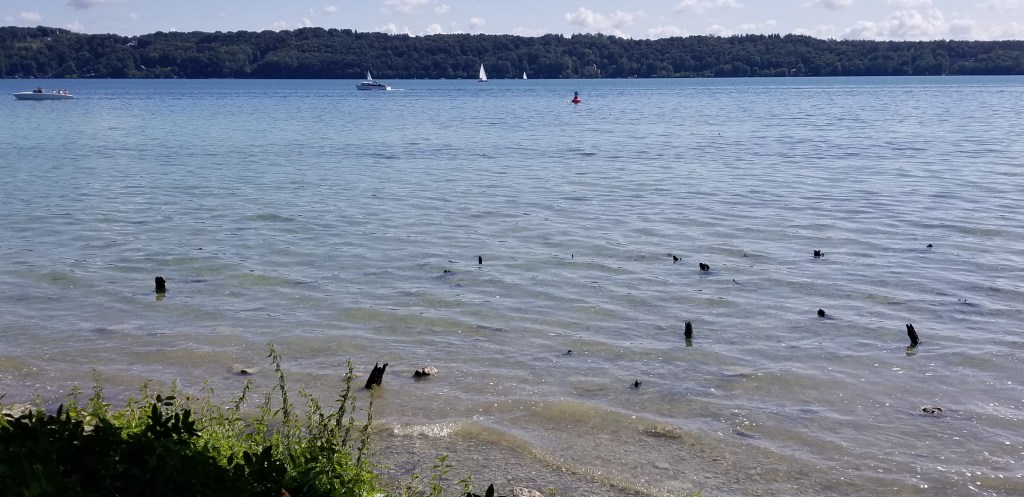
In the water just off the shoreline are Iron-Age timbers, dating from the 6th to the 4th century BC. It is evidence of the only known pre-historic lakeshore settlement of pile dwellings in Bavaria and has been designated a UNESCO World Heritage site. They are sticking up from the water in the picture below, with the framing unseen underwater. It’s unbelievable that this has been there all this time!

The thing to see on Roseninsel, though, is the beautiful casino. No, you can’t gamble here. The early definition of a casino is a small villa in the Italian style. It was commissioned by King Ludwig II’s father, but he was attached to it and made many renovations. A frequent guest was a relative, the Empress of Austria Elisabeth, nicknamed “Sissi”. King Ludwig also met here with Richard Wagner, a composer. It must have been a restful place for them.

It includes a beautiful garden, although the blooms were already finished for the year.

We took a tour of the house, but it is empty of furnishings.

It was time for a late lunch by the time we were back from Roseninsel, but since it was Sunday, our grocery store (and everything else in town) was closed. We walked along the shoreline to a bustling lakefront restaurant that had a special deal. How about some “steckerlfisch”?

Although this is supposed to be a treat in these parts, we passed on it in favor of other traditional German food.

Our AirBnb was billed as a small cottage, and although it felt like that, it was attached to a main home by a narrow hallway. Everything about it was very private, even our small patio in the back with its relaxing little pond. When he was home, our accomodating host turned on the fountain and I loved the sound of the flowing water. His name is Martin and he was the very first Airbnb host we’d met to date.

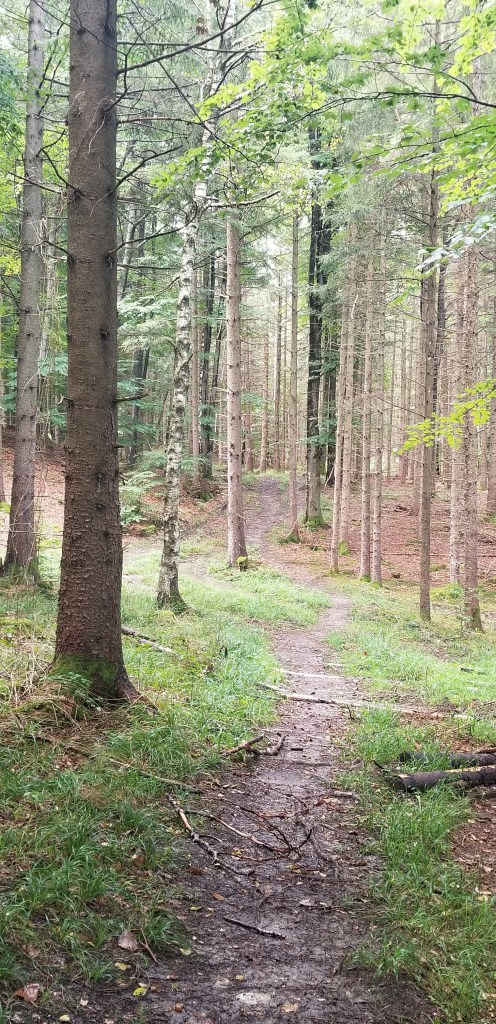
We had asked Martin for some hiking tips, and he had an excellent idea for us. Rain threatened but we set off anyway, out the other end of our subdivision and into the woods. We came to an open meadow, and there was the most gorgeous house:

Martin had told us that if we found it, we were going the right way. He’s not native to Feldafing and he could not tell us anything about it, and a search on line yielded no results. I could imagine it was built for some lower branch of the royal family.

My active imagination was working as we followed the path around behind the house and directly to the next town, Tutzing. We passed a half-buried moss-covered stone marker, so I conjectured that we were on an old road. I imagined royal guests coming to visit the yellow manor house, the women in long flowing velvet capes, galloping down the path on horses after riding the train from Tutzing.

The trail did take us to the train station, but we decided to ride a bus home. We were overjoyed to discover it was coming soon and would let us off almost directly across from our house, with no final hike up a hill for our tired feet!

I had heard of Andechs Monastery, where the monks make beer, but it took me a few days to work out how to get there. This involved a train ride back to Tutzing and then a different bus through the countryside.

Andechs, a Benedictine monastery is on a “holy hill” and was built in 1455. Pilgrims have been coming here since the 11th century, though, to see relics from the Third Crusade; most notably, a piece of Jesus’ crown of thorns. We admired the ornate architecture inside the church and this sundial on the bell tower.

Today, thirteen monks live here, and two hundred people call this their place of employment. Maybe the monks made their beer themselves in former days, but now it takes a lot of folks to produce it and run a large beer garden and restaurant.

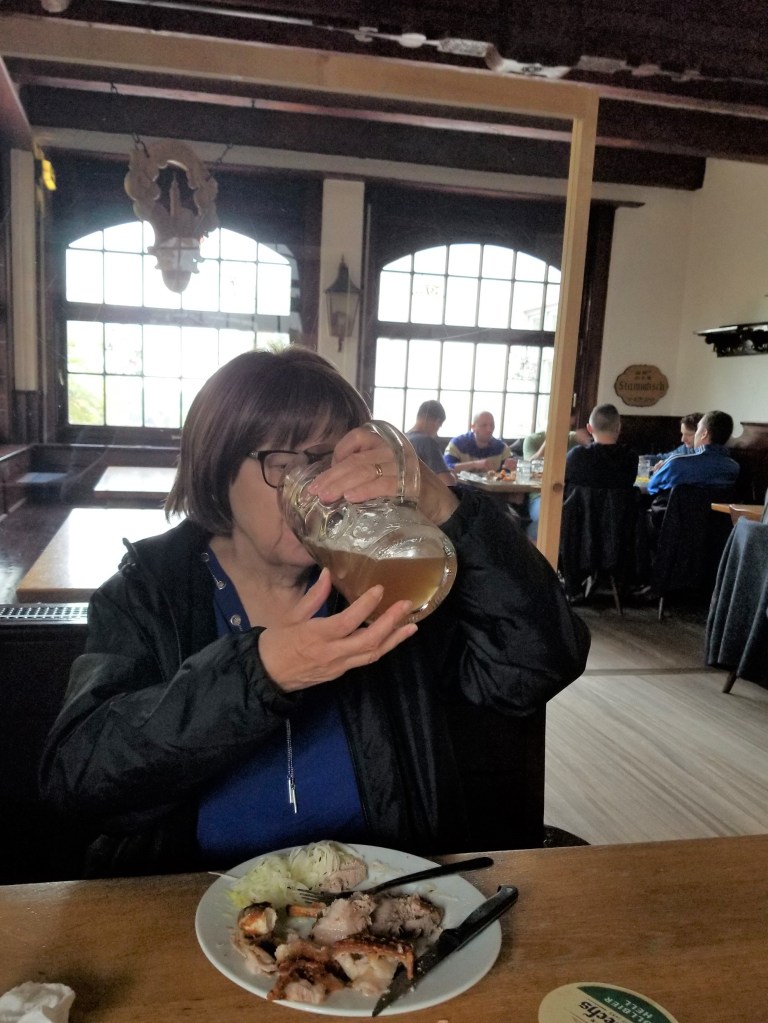
After we explored the monastery grounds, it was time for the second part of this excursion: lunch in the Braustuberl. The thing to order here is the “Schweine Haxen”, pork knuckles. It is so large that it’s best to share, which we did. The plate came with potato salad and a pretzel, and I also ordered the sauerkraut. The pork had a nice crispy rind, the meat was delicious, and the sauerkraut wasn’t overcooked like it is in the US.

We shared an Oktoberfest-size liter of the famous Andechs beer. Cal thought it was humorous that now I need two hands to lift one of these mugs. It’s heavy!

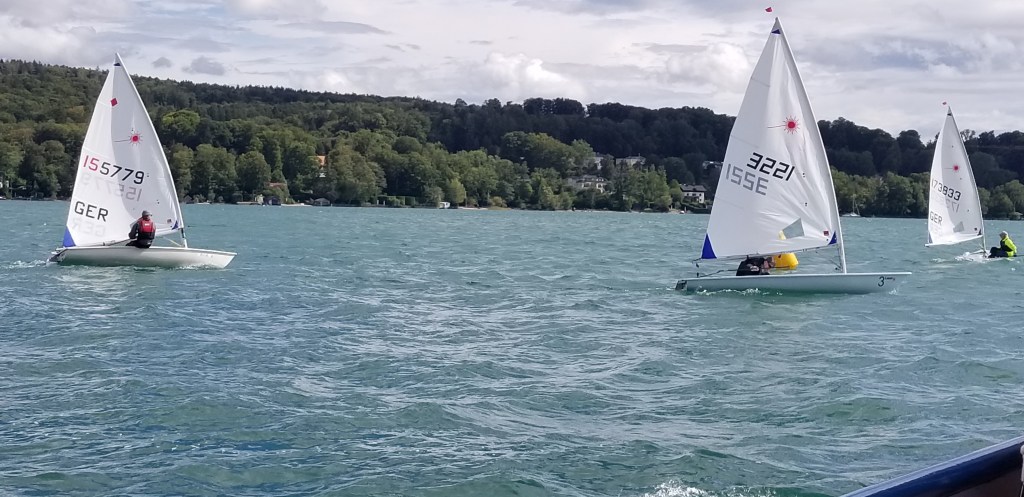
We saw excursion boats on the Starnberger See and waited for a sunny day to explore the lake. A sunny day never happened, so toward the end of our stay we finally gave up on that and just went.

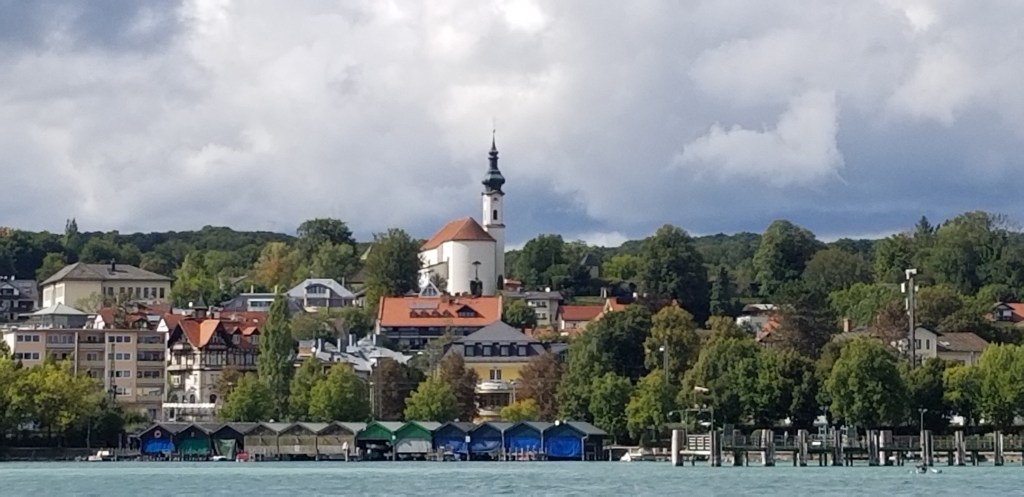
We could finally view the pretty town of Starnberg from the water.

We had often passed Possenhofen Castle on our train rides to Munich, so from the water we got a better look at it. It’s privately owned.

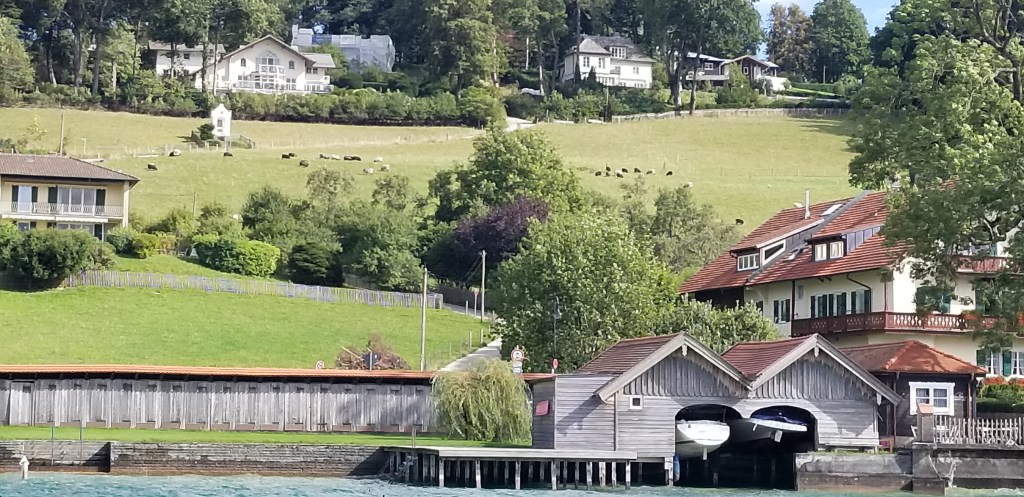
Homes, boat shelters, and sheep grazing in the meadows all came into focus when we stopped in little towns to pick up or drop off other passengers.

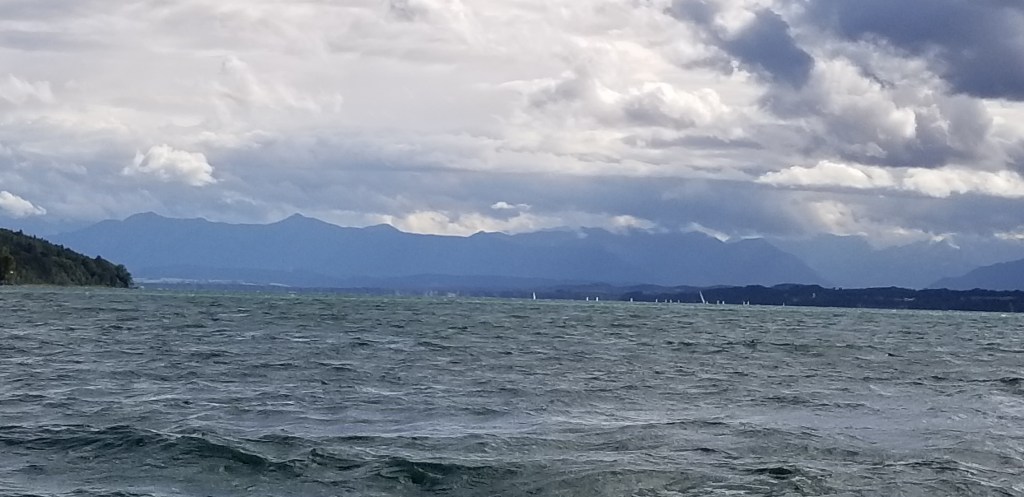
I’m always on the lookout for the Alps, even in lousy weather:

King Ludwig II, who lived from 1864 to 1886, was responsible for the existence of most of the famous Bavarian castles, including Neuschwanstein. We’ve been to all of them, some more than once, so we didn’t include them in this trip. As the years went on, King Ludwig became reclusive and his royal accountants were afraid he was draining the royal treasury in the building of the castles. This gave rise to his nickname: “Mad” King Ludwig. It was here on the shores of Lake Starnberg that he was taken into custody, and the following day both he and his doctor were found dead in the lake. It was ruled a suicide, but there has been some controversy.

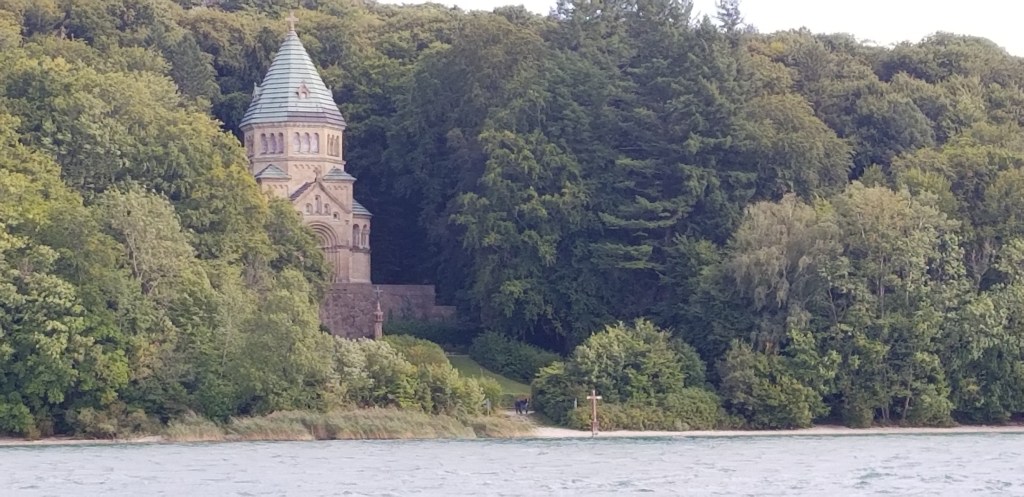
I knew the story but wasn’t sure which lake. As we rode on our little cruise, we passed the spot, marked by a small cross.

If the royal treasurers only knew how much tourist revenue the king’s castles would bring in future times, they might not have been so hard on him!

After our boat ride, ice cream was in order, but the only open cafe was full service and indoors. We sat, and there in front of me was a life-size portrait of the good King. He has a way of turning up when I least expect it.

The rest of our days in Feldafing dissolved into rainy storms. There was a day, maybe more, where we just didn’t fight the weather, choosing instead to stay indoors. Chores, further trip planning, and just mentally “catching up” have to be done on the road, too. The Queen of England had just died and on TV we watched her coffin procession move from Balmoral, Scotland to Edinburgh through all the little towns where people waited for her on the streets.

There were sunnier days ahead as we headed further south, with more surprises in store.

Next time: another new country to see

Europe · Germany

Marvelous Munich – Europe Travels September 2022

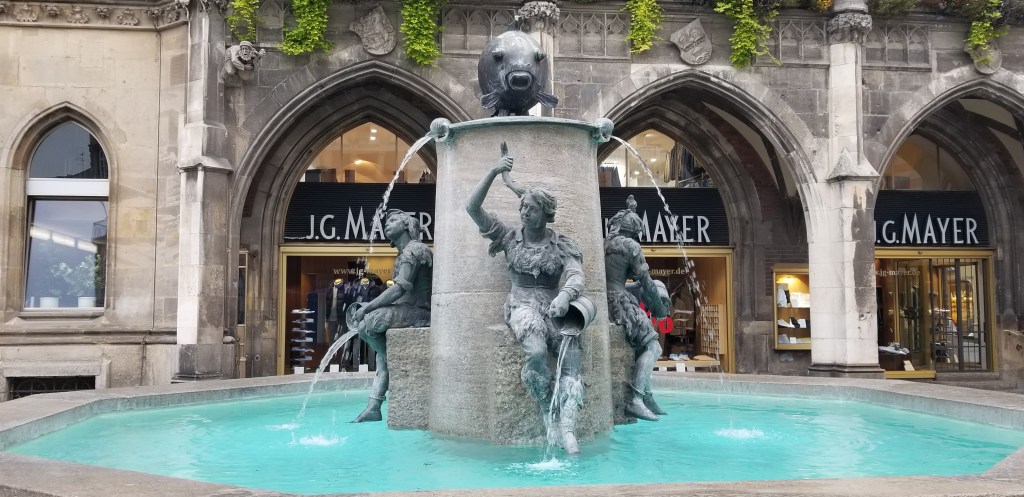
The Fischbrunnen (Fish Fountain) in Munich

As I searched for adjectives to describe Munich, I thought of the impressive neo-Gothic architecture of the Marienplatz and the playfulness of its Glockenspiel, but other edifices such as the majestic Residenz are imposing and inspiring. I thought of delicious beer and bratwurst in the Hofbrauhaus and other breweries, and the plentiful treats in the Viktualian Market, but there are plenty of other good things to eat. Museums of all varieties abound. I’ve had so much fun when I’ve visited the Oktoberfest in other years. The city is both traditional and cosmopolitan. I had to settle for marvelous. I’ve been here many times, and it’s one of my favorite European cities, so can there be any other word?

Having a Europe rail pass meant that we could zip on into the city whenever we wanted on the commuter S Bahn. It was generally a thirty to forty-minute ride. Over the course of our stay in Feldafing, we came in three times, once just for dinner. We would get off at Marienplatz and then we were in the center of everything. This blog will be a composite of all three visits. Let me show you just a little of the city that I love!

We were all business on our first rainy trip in, but there was one important thing to do first: head over to the Viktualienmarkt (Victuals Market) for a currywurst. It’s a favorite of Cal’s, and I like it too. Basically, it’s bratwurst cooked in a mixture of ketchup and curry powder. It may sound dreadful, but it grows on you, trust me.

Mine had a smidge too much mustard, but I wasn’t complaining. (Well, I did, just a little.) Otherwise, it was perfect: a roll crispy crusty on the outside, soft inside, with the wurst hanging out the sides. In Germany, an orange Fanta tastes great. I wouldn’t drink it anywhere else.

The Viktualienmarkt is a feast for the senses. I always want to buy everything, but I don’t want to carry food around with me all day. The market began long ago in the Marienplatz. After growing too large it was moved in 1807 to this place.

Most interesting to me are the unusual items that are sold. Below is a booth dedicated to selling mushrooms. I don’t know if I’ve ever seen so many kinds.

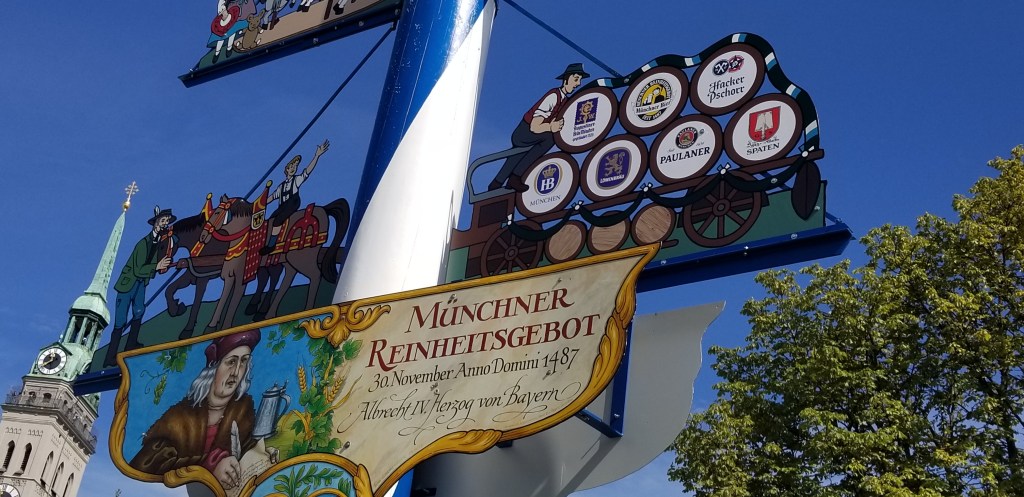
Every town in Bavaria has a Maypole. It is a focal piece which usually shows its main business and culture. Munich’s Maypole towers over the Viktualienmarkt, and I have here just the bottom portion of it to show you.

What is Munich about? Beer! The right side of the maypole shows the seven major breweries. The “Reinheitsgebot” below it is the Bavarian purity law for beer originated by Duke Albrecht in 1487. Brewers could only use water, malt, and hops for their beer, and that law governs the breweries still today.

Our “business” I mentioned earlier that brought us into Munich the first time involved a birthday gift that we needed to find and purchase for our grandson, and the mailing of a box back to the US. That didn’t mean we couldn’t stop and look around in the Marienplatz, as we always do.

This is the heart of old town Munich, and several main streets lead from here. The old and the new town hall is here, and so is the the Christmas market in December. Sadly, the Marienplatz was heavily bombed during World War II. Behind the spot where I took this picture, all the buildings are modern.

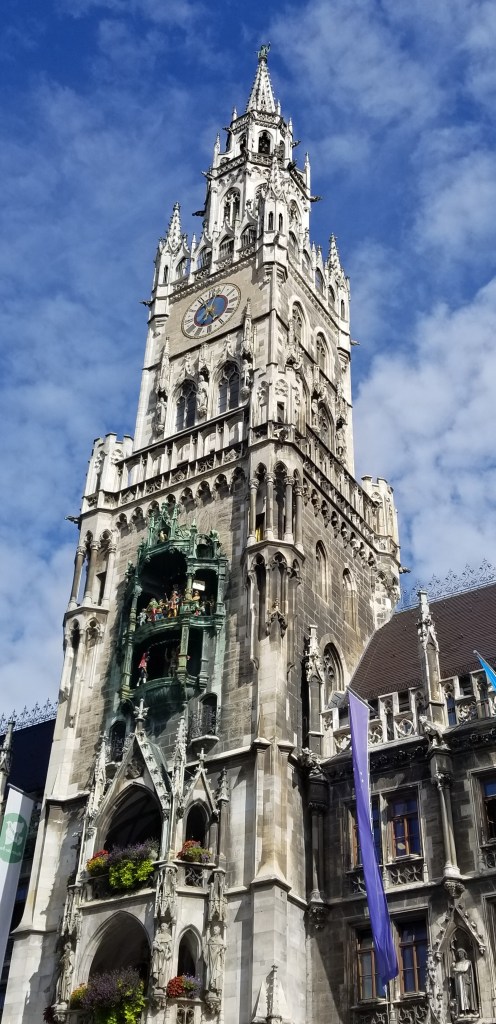
Most of the northern side of the Marienplatz is taken up by the new town hall, which isn’t really new: it was built between 1867 and 1909 in neo-gothic style. This picture only shows part of it.

Walking through the arches you see above, past the Ratskeller sign, we found several curious figures on the sides of the walls in the courtyard, such as this one. We decided they serve as water gutters since all their mouths are open.

But it is the Glockenspiel on the town hall’s tower in the plaza that catches everyone’s eye. The day we were shopping for our grandson, we hiked a pretty fair distance to a toy store I had seen on-line. We had no luck in that store, so were walking back through Marienplatz to my favorite department store, the multi-level Kaufhof. That’s where we should have gone in the first place. Luck was with us – it was exactly 11:00, time for the Glockenspiel to play! Everyone stops to watch and the Marienplatz fills with people. We’re not always fortunate enough to catch it at the exact time we are here, since it only plays at certain times of the day.

At left, you can see the whole tower with the Glockenspiel below the clock. There are 43 bells and 32 life-sized figures and it renacts two stories from the 16th century. On the top level in the left picture, there are dancers celebrating the marriage of Duke Wilhem V to Renata of Lorraine. Duke Wilhem founded the Hofbrauhaus – more on that later. On the right picture, knights are jousting in honor of the couple and of course the Bavarian knight always wins. Hooray! In the bottom level, then, is the cooper’s dance, which celebrates the end of the plague in 1517. At the end, a golden rooster at the top of the Glockenspiel chirps three times. The show lasts around 15 minutes, depending on the tunes that are played.

The Hofbrauhaus is a place we always return to when we are in Munich. It is the drinking and eating beer hall that Duke Wilhem founded for the Hofbrau brewery, but at that time it was only open for the royalty. King Ludwig I opened it to the public in 1828, and the party has been going on ever since. It’s full of “gemutlichkeit”; which means a comfortable friendliness. There is always an oompah band playing and the place is busy, even late afternoon. The crowd ebbs and flows; the empty spots you see here were filled again shortly after this picture was taken, including our own table.

These are not the standard size, full liter mugs of beer that are usually standard for the Hofbrauhaus. For the first time in our lives, we ordered the smaller size. I hardly like the taste of beer any more, but Hofbrau beer is different, and it only tastes this good in Germany. Sitting and enjoying the “gemutlichkeit” felt good after doing all that shopping and searching for a place to wrap and mail a package.

We returned to Munich just for dinner one evening, and enjoyed a stroll afterwards. We turned down a street we hadn’t explored yet, and discovered: the Residenz. I’m not sure why we never visited this place. Maybe I confused it with the Nymphenburg Palace, on the west side of the city, which we have been to before. It was too late in the evening for a tour so we just walked about.

The Residenz is the largest city palace in Germany, the home of Bavarian royalty until the monarchy was dissolved, and I don’t know how we ever missed it. See, Munich is just that way…there is so much to explore and maybe I never will see all of it.

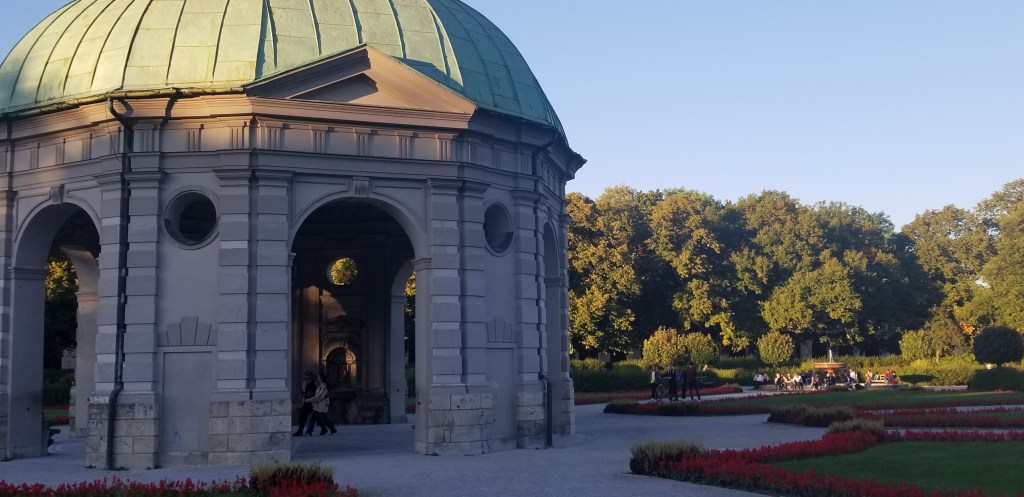
In the sunset hours, we walked through portions of the garden–

and out through the garden walls, which contained pictures of royal historical events.

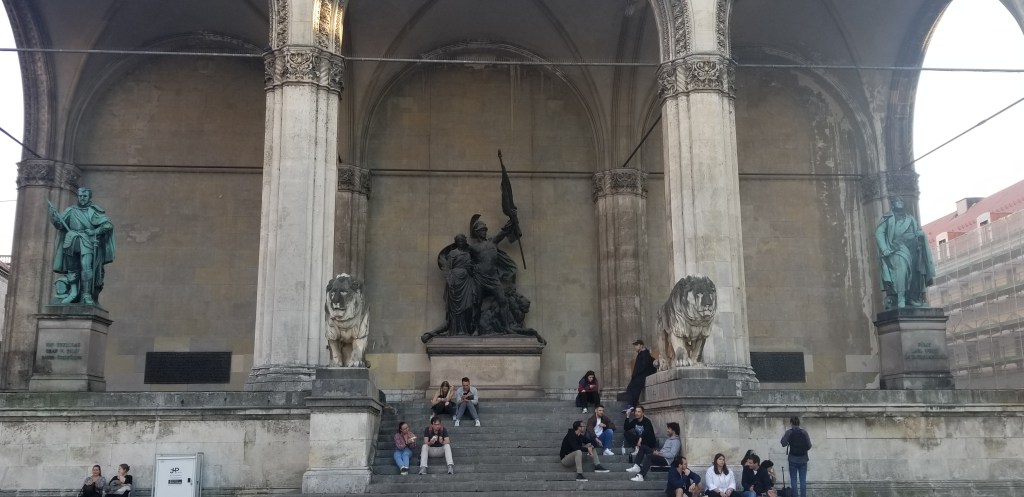
Out on the plaza, a huge monument:

This is the immense Feldernhalle, commissioned by King Ludwig I in 1941 to honor the Bavarian Army.

At a right angle to the Feldernhalle stands the Theatine Church of St. Cajetan. I had to look up the definition of “Theatine”. This branch of the Catholic church was founded in 1524 “to combat Protestantism and promote higher morality among Roman Catholics”, according to Collins.

The church was built in the late 1600’s to honor the new heir to the Bavarian throne, Prince Max Emanuel.

Inside, a riot of cherubs and curling vines and curlicues awaited us. It was stunning, and a massive contrast to the stark Frauenkirche that we had visited earlier.

The entire interior of the church was designed in this fashion.

As we headed back to the Marienplatz that evening, still awed by that amazing church, I thought about this: that one should never assume that one has seen everything in a certain place. If you are traveling, always look for the surprises that await around any corner. They are there, and that is especially true in Munich.

A golden facade lit up by the setting sun in Munich

Next time – discovering Feldafing

Europe · Germany

Alpine Wandering in Bavaria, Germany – Europe Travels September 2022

The town of Feldafing, which lies on the shores of the Starnberger See (Lake Starnberg), is the second-to-last bedroom community on the commuter train from Munich. It served as our next stop for a ten-day breather. Down by the lake, if you squint a bit, and catch a good day, you can see the Bavarian Alps. It really wasn’t close enough to the Alps for me (more on that later) so we headed to Mittenwald on the first day of promising weather.

Just getting to Mittenwald involved some mental acrobatics. We needed to translate what the signs were telling us. There was a train to Tutzing, which took five minutes. In Tutzing, we figured out that the train wasn’t going to take us to Mittenwald, it was only taking us to Murnau. Why? And then what? Between the two of us, and sort of going with the flow, we realized that we needed to get on an “ersatz” (replacement) bus to Mittenwald. For some reason, the train was down. So we rode the train for a half hour ride to Murnau and then we rode for on the bus trip to Mittenwald.

The fairy-tale town of Mittenwald would have to wait for later. A cable car up the mountain was our next step.

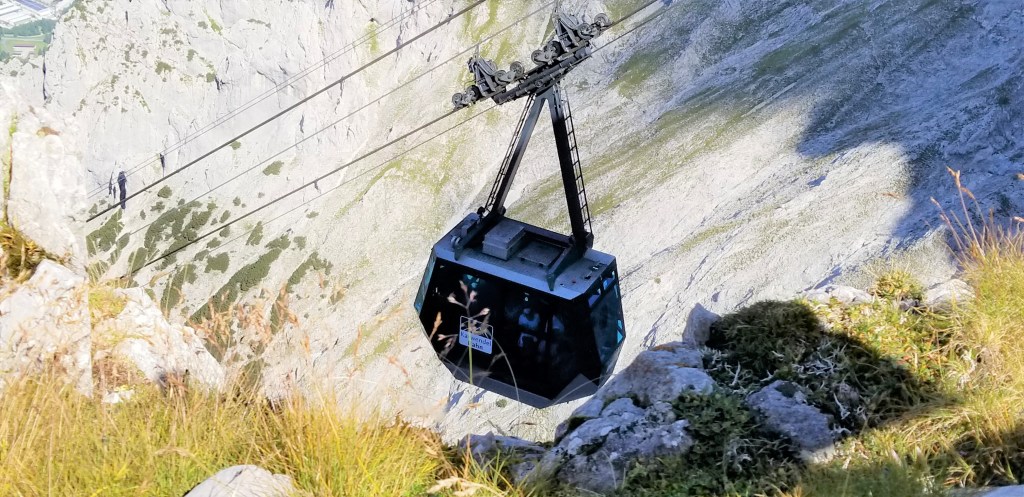
The cable car is the Karwendel Bahn, which took us to 7,362 feet elevation near the peak of Karwendel Mountain.

The peak was my destination, and we hiked over to it from here.

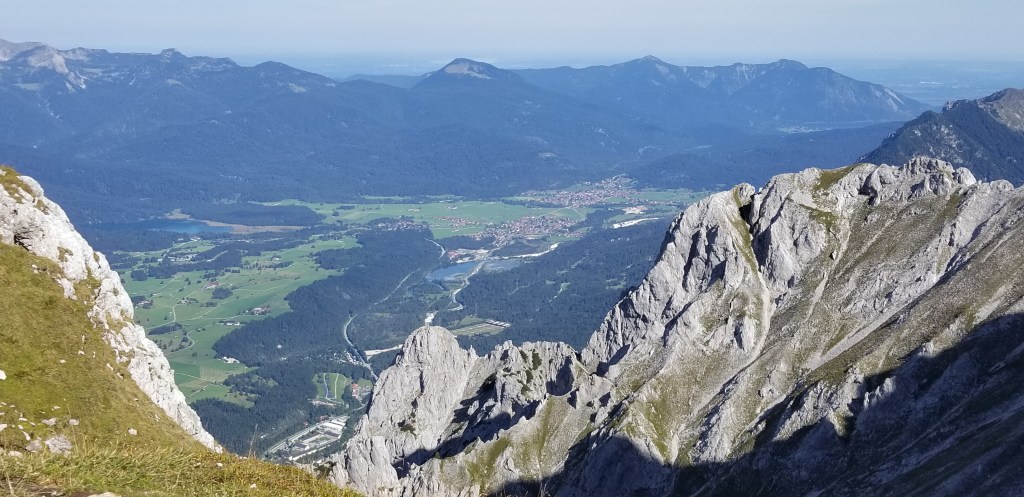
Passing the massive rock wall that you see on the left, we were treated to the magnificent view of the Alps that I love and had been looking for.

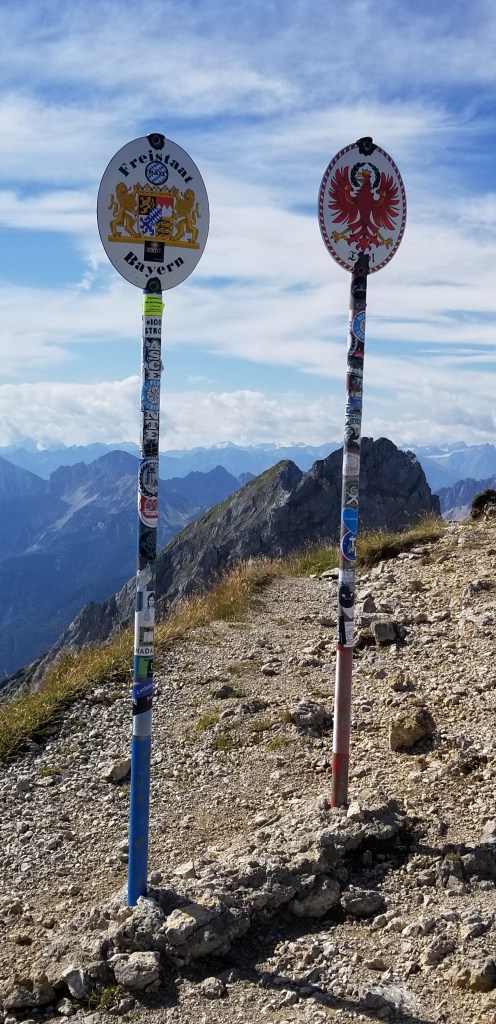
It was such a beautiful day that we could see deep into Austria, which wasn’t too difficult. We were at the border between the two countries.

The sign on the left is the border for the state of Bavaria, and the sign on the right is for the border of Tirol, Austria.

The way was steep and rocky and the air was thin, but we were up to the challenge, especially since we were being treated to such beautiful views.

A bit more climbing, and we were near the top. I needed to finish it off, so I climbed over the rocks to the peak. Success! The elevation at the peak is 9,019 feet.

From my perch on top of the mountain, I could see the cable car station far below, and sheep grazing in the Alpine meadows. Some of them are just barely discernable in the bottom right of the picture. We had to navigate through a lot of sheep poop at times on the trail.

We enjoyed the view for a long while, but finally it was time to come down off the mountain.

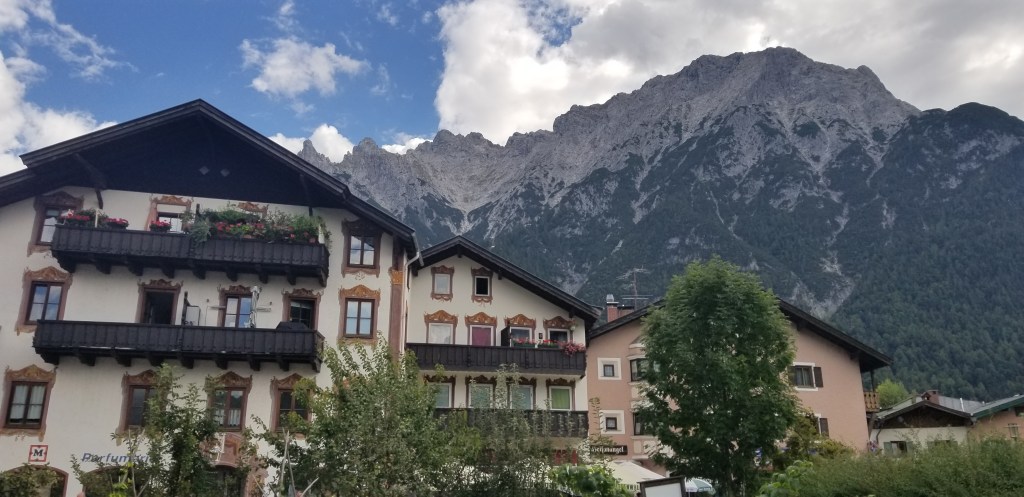
Mittenwald is a quaint little mountain village known, as several villages in Bavaria are, for its pretty paintings on their homes and businesses.

Flowers adorn the balconies and front steps of many homes, such as this typical Bavarian-style house.

Mittenwald is famous for the violin-making that began in the mid-17th century by a man named Matthias Klotz. It is said that Matthias crafted Mozart’s personal violin. I knew that the violin museum would, unfortunately, be closed on this day, but we passed by for a picture anyway.

The steeple of the Parish Church of St. Peter and Paul looks over the downtown area. The church was completed in 1740. The red marble for the church came from Italy and traveled over the Alps on the Roman “Via Claudia Augusta” trade route. Mittenwald was an important shipping point for marble and other goods in those days.

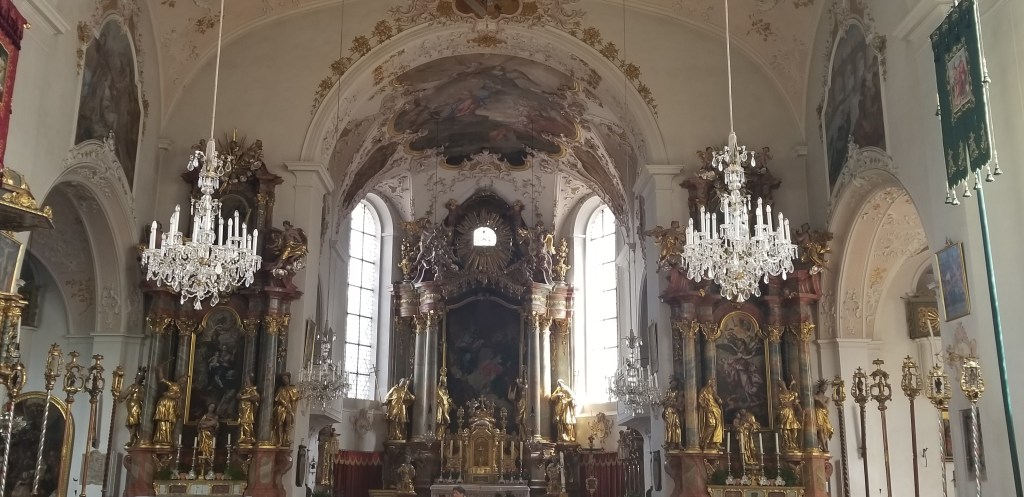
We stepped inside for a look.

Words fail me to describe the unexpected beauty of the frescoes, the gold work, and the crystal chandeliers. In a place like this, one can only take a pew to sit, enjoy the Baroque craftsmanship, and ponder life for just a while.

It is the mountains, however, that tower over everything and serve as the backdrop for this town.

We’d had a decent lunch after we’d come down off the mountain. After wandering through the village, a sign for “spaghetti eis” (spaghetti ice cream) caught my eye. This was one of my favorite treats when we lived in Germany and we surely couldn’t pass it by!

I have never seen such a huge serving of spaghetti eis. We should have shared one. The traditional version is on the left; Cal opted for the chocolate variety. What looks like spaghetti is in reality ice cream put through a noodle press; the red sauce on top is actually strawberry sauce. Grated white chocolate stands in for the parmesan. It’s always delicious, and this delectable bowl was no exception.

It had been an unforgettable day. As much as I wanted to return to the mountains, we were unable to for the rest of our stay in Feldafing. The weather became stormy and we would have encountered the train/bus combination again to get to any of the Alpine towns. The feeling of being in the Bavarian Alps is not anything I’ve encountered anywhere else. Other discoveries were in store for us while here, as I will post in my following blogs!

Next time – we visit Munich

Europe · Germany

Old and new friends in Biblis, Germany – Europe Travels August 2022

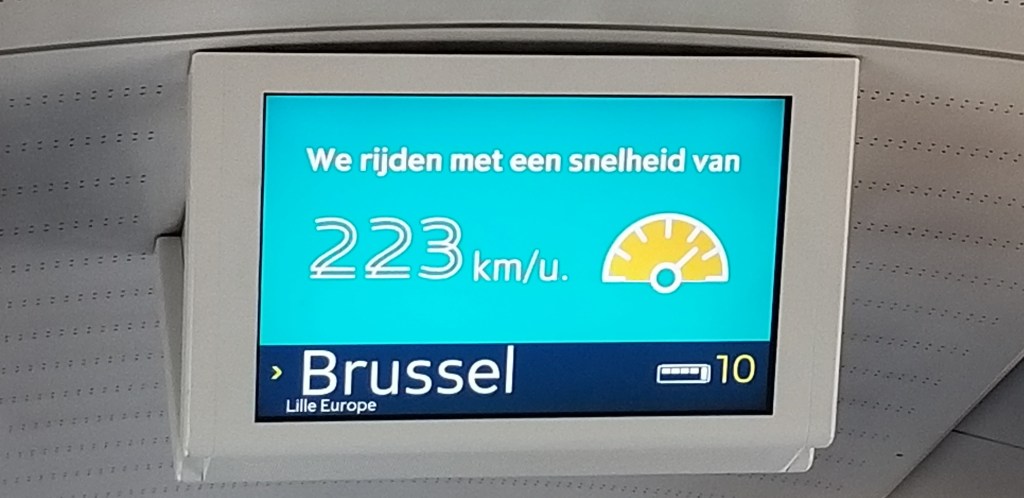
Under the water at 138 miles per hour to Brussels

Once upon a time, Cal and I crossed the English Channel on a ferry from the Dover coast of England to France for a very rough crossing. Let’s just say that it was not a good idea to dine on Indian cuisine before we left London. Fast forward to present day, in which we boarded a train in London for the ride to Brussels beneath the Channel. The train was fast and efficient, and electronic signs measured our speed and depth under the water as we rode. We were in Brussels after what seemed like a minute. That was not our final destination, though.

From Brussels, we caught another train to Germany. This train was not near as much fun.

Just as we were ordering lunch, the lights went out and the train came to a dead stop in a tunnel. We sat in that tunnel for two hours. No wurst was forthcoming, but the sodas and water were free. We had a lively conversation with our German seatmates who spoke English. One of them helped me compose conversations in German on What’s App with my friend Marlene in Biblis, who had been expecting us for dinner. The delay involved being towed back to the last town, Liege-Wilhelm, Belgium, and having to wait for the next train to Frankfurt.

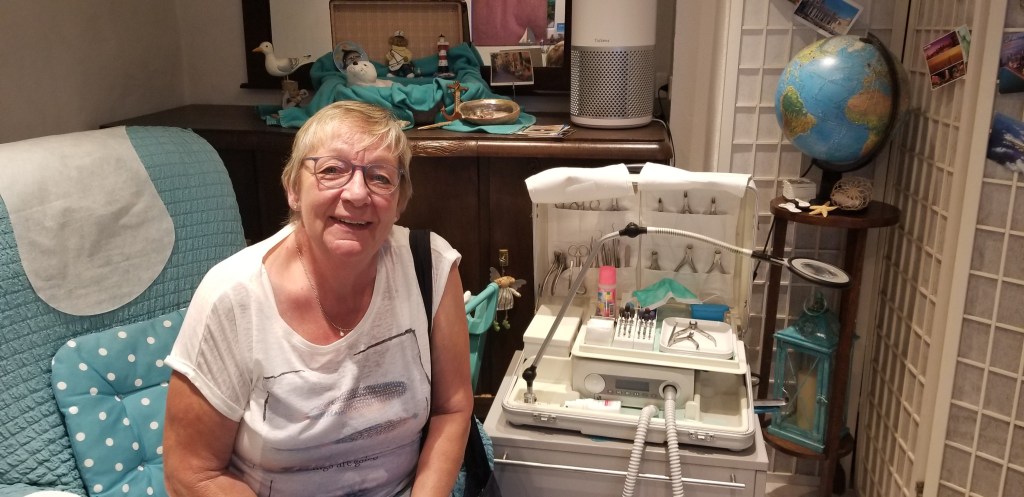
Marlene and her partner Edmund were right there to meet us on the platform when our train pulled into Biblis. Marlene snapped this picture which captures our joy at finally arriving, albeit four hours late.

She is our former landlady, now our friend, of the house we lived in for the almost four years we resided in Biblis. We lived upstairs and she and her husband, who has since passed, lived downstairs in the house they built for children that never came. Our girls adored them, and they helped wrap our time in Biblis into some very happy memories.

We had never met Edmund before this visit. They both rolled out the hospitality for us. We spent a rainy morning looking at pictures and catching up on the years. We admired all the work that Edmund is doing to remodel their house which she grew up in. Outside, Marlene keeps a beautiful garden. Across a small walkway, she has her own home-based business, a footcare salon. It is in a building that was her father’s barn in the old days.

When it was time for lunch, we feasted on Marlene’s delayed but delicious meal from the night before. The rain hadn’t stopped, but we piled into their car anyway for a drive around town.

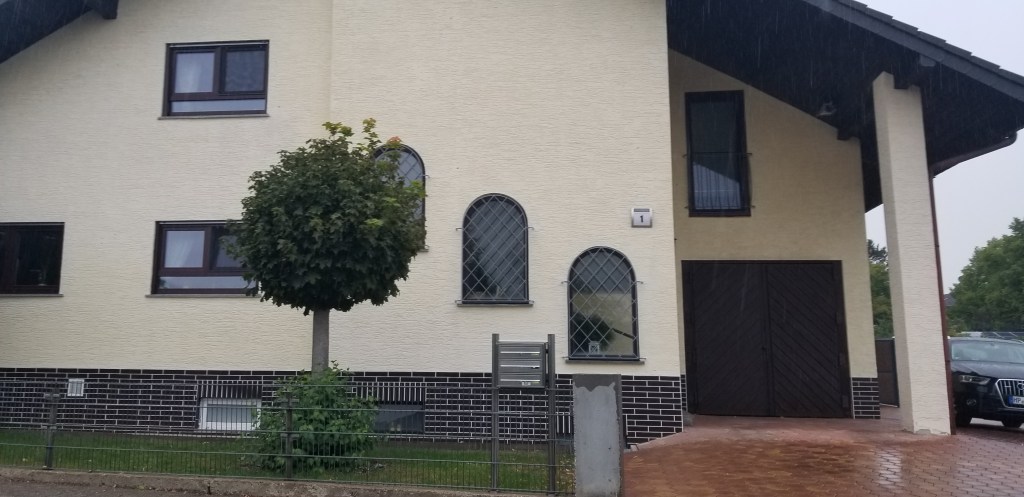
First on the agenda: a drive-by of the old house.

Ah, sweet memories. Our kitchen window was at top left, and the long window over the garage was in our eldest’s bedroom.

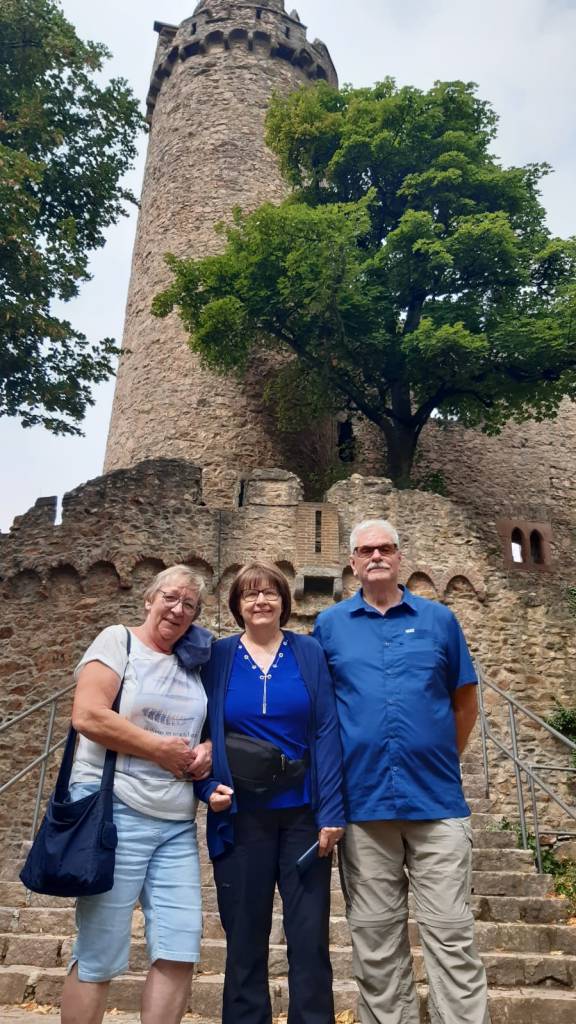
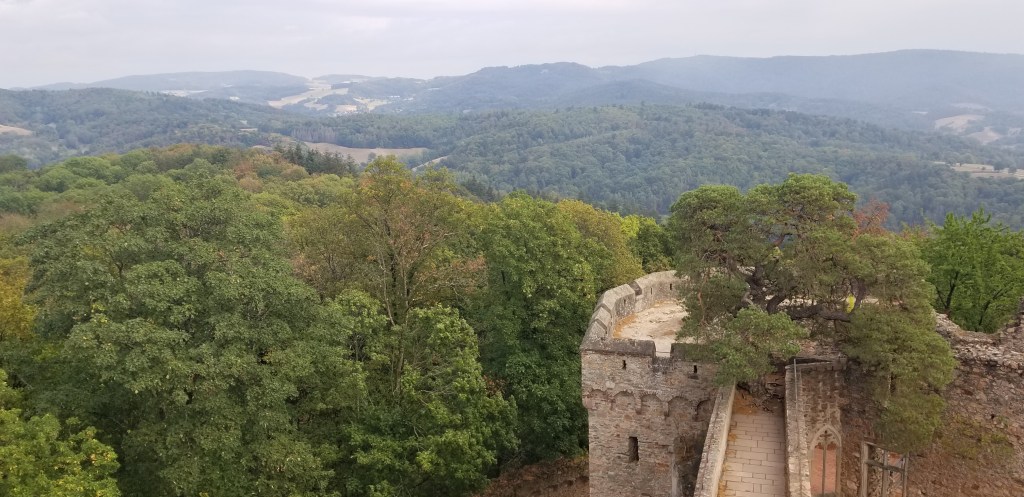
After tooling around town, Edmund headed out into the countryside of the Odenwald forests, to the town of Bensheim, for a visit to the ruins of Schloss (Castle) Auerbach. It was built in the 13th century. Had we ever been here? I really can’t remember; it was too long ago.

How was this tree able to grow and thrive way up here?
Edmund took this great picture of us with Marlene

From the castle, we enjoyed a beautiful view of the Odenwald hills. The weather was starting to cheer up.

Back in the car, and Edmund was off again, this time to Heppenheim. I thought I had been here before. I know we never walked through the old part of this town. Why ever not? We’d had lots of company and this was close to Biblis. I guess we were busy doing other things.

Heppenheim Altstadt (old town) has the medieval buildings that I love and we spent time strolling through that part of the town. The town was almost destroyed twice by fire, both in 1369 and again in 1693. But it came through both world wars mostly unscathed.

Edmund wasn’t finished driving us around. The next stop was the Rhein River near Biblis, and this was very familiar. But the once-mighty Rhein was almost unrecognizable. I had never seen the water level so low; and in a first for us, we were able to walk right out onto it.

Barge traffic hadn’t completely ground to a halt, despite the low water level.

When our kids were teenagers, we brought them back to Biblis for a visit. The Biblis years were some of the best of our lives and they were sad when we moved away from here. At that time, the visit was full of nostalgia as we visited many places that we had loved. In the intervening years, the sentimental feelings have passed. What has remained is the friendship we feel with Marlene, and now with Edmund as well. With today’s social media and on-line translators it is a little easier to keep up.

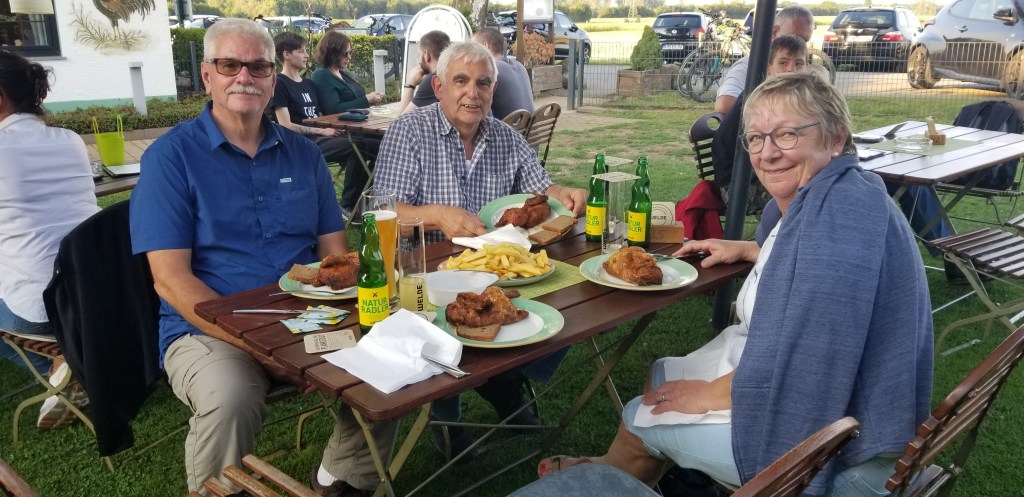
The last stop of the day was to Marlene’s favorite chicken restaurant. She brought us here when we visited the last time, too, and we were a little shocked that we had not known about it while we lived here. It’s very simple: just a huge plate of pommes frites (french fries) to share, chicken, and a little piece of bread. Pommes frites in Germany tastes better than anywhere else, in my opinion. Washed down with a beer or a radler, the meal is so very delicious.

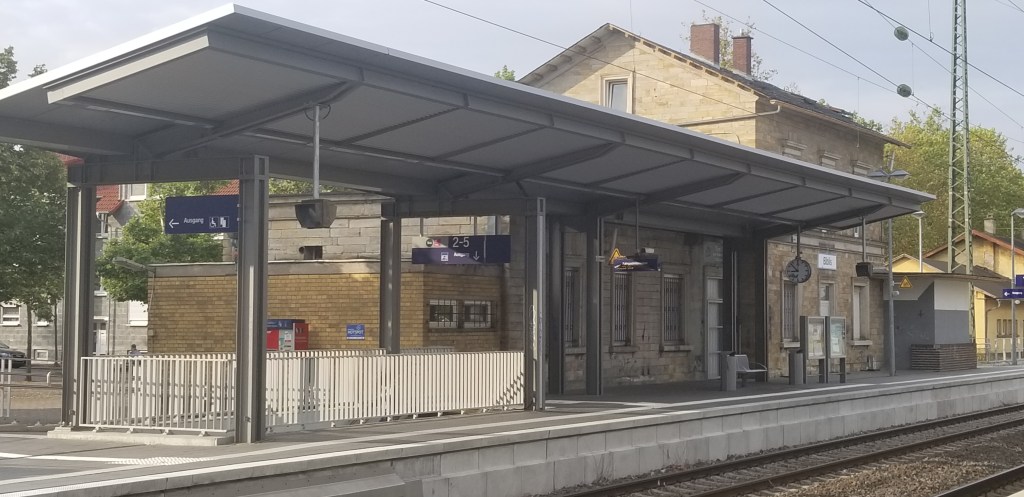
After more time that evening at their house, it was time to say our goodbyes. When the next morning came, we were back at the Biblis train station, ready to head southbound.

Next time – our visit to Bavaria