Europe · Greece

A Visit to the Mountain Villages of Naxos, Greece – Europe Travels October 2022

Upon our arrival in Naxos, our AirBnb host sat us down, unfolded a map, and drew all over it as she showed us all the varied things we could see in the mountain villages behind Naxos. It looked great! But how do we get there? Naxos is not Santorini, so the possibility of an ATV was quickly discarded. The distances are greater, the roads mountainous and tangled.

I turned once again to researching day tours. As I’ve already reported, Naxos in the middle of October was winding down their season. There wasn’t a lot to choose from except for a regular big bus tour. There were enough of us tourists left in Naxos to fill up that bus.

We headed out into the countryside. Olive and cypress trees dot the rolling landscape which is bordered by low stone walls. Old buildings in various states of decay can be seen here and there, and, up on distant mountaintops, ruins of Venetian castles. The valley is fertile and, besides olives, produces potatoes, fruit, wine, honey, and cheese. Small wonder, then, that the god that the ancient Greeks worshipped here was Demeter, god of harvest.

Our first stop was to see Demeter’s temple, built in 530 BC. It’s quite a story: as Greek civilization declined, a Byzantine church was built over the old temple. Arabic pirates destroyed the church in the sixth century AD, but it was rebuilt in 1977. After the discovery of the Greek temple, an archaeological excavation began, and the temple was rebuilt.

To allow for excavation and the subsequent build of the temple, the old Byzantine church had to be disassembled, moved to the side, and reassembled. It has its place in history, too.

One of our fellow tourists asked the guide why the temple wasn’t completely rebuilt. The answer is that under Greek law, buildings cannot be restored to a greater proportion than the ruins that were found.

Onward, then, to a 150-year-old olive press. Our guide demonstrated its use and the making of olive oil in the old days.

I wrote in my journal one thing I learned about the making of olive oil: that cold-pressed olive oil is best. I looked at both of my olive bottles in my pantry, and nothing is written anywhere on them about the oil being cold-pressed.

On to a little pottery shop, where the potter demonstrated his craft on a wheel. As he works, he throws excess bits of clay on the wall- his “wall art” is at left.

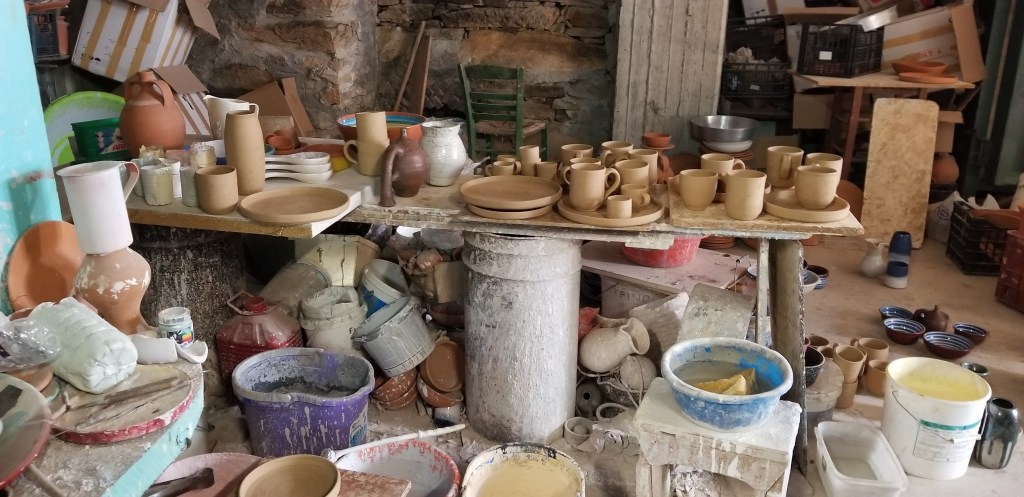
The potter’s studio

Then: off to the village of Halkio, to visit the 125-year-old Vallindras citron distillery. I enjoyed the little walk through the streets of town to get to it.

Citron is a fruit that grows on Naxos. It has a thick rind and the fruit is slightly bitter. The zest is what is mainly used. You may be familiar with candied citron. I remember it being packaged in small tubs in the grocery store, although I haven’t shopped for it in a very long time. My mother used to put it in the German lebkuchen cookies and stollen bread that she made at Christmas time. I like lebkuchen, but I only like stollen in small amounts and not enough to make it myself. In the few years that I made lebkuchen myself, I never considered what citron really was.

At the distillery, the citron is shown on the table below. Yellow yields the sweetest liqueur, but they also use the green variety and the leaves of the tree for production of the liqueur. It has 30-40% alcohol content. There was yellow, green and clear colored liqueur, and one little sample of the yellow liqueur kind was enough for me. The proprietors explained how they have made the citron through the years, and they used a little room containing the oldest equipment to demonstrate.

We were deep in the mountains by now, and I was in awe of our driver. The roads are mostly one-lane, full of hairpin turns, and not made for big buses. We would round a curve or ascend a hill, and find a car coming directly toward us. The driver of the car was obliged to back up and pull into whatever kind of roadway was closest in order for us to pass. Many times I would look out my window and notice that we were just a hair’s distance from a sign, a building, or a car mirror.

Just as I’d get comfortable looking out the window at the varied scenery, we would make another stop. This one was to Panagia Drosiani, another Byzantine church and the oldest church on Naxos. It was built at the end of the 6th century A.D. The front facade may be newer.

The inside of it was cave-like and dark. 

There are many priceless faded frescoes painted directly on to the walls. A dark side-chapel really did feel like entering a cave, and we could only go one person at a time into it. Visiting a church that had been built this early in Christianity’s very existence gave me a bit of goosebumps.

While waiting for others to go through it, I walked around to the back, and found an amazing sight. Here, the original construction of the church can be seen.

It was time for lunch, so for that we went into the village of Apiranthos. It is a village where the streets and archways are constructed from marble. We had a delicious lunch on a simple patio overlooking the valley while my feet were planted on a marble floor. A local cat placed herself there as well, looking at me hopefully during the entire time I ate my meal. Her wait was not in vain. She and I dined on a meal of roasted pork, spaghetti with a tomato gravy, and a salad with a local soft goat cheese called xinomizithra.

The reason for all the marble is that there are marble quarries in abundance on Naxos. It was simply the construction material that they had available to use. I was glad we had some time to wander around this pretty town on our own.

As with anywhere you go in Greece, ruins from earlier eras can still be seen.

Apiranthos’s setting in the mountains also makes it a beautiful place to be.

We rode north through the mountains for a long while, finally finding the north side of the island and the sea at Apollonas. I suspect that in the summer time this would have been a beach visit because we were given a lot of time to do not much. It was dubbed a “coffee stop”. There were a handful of gift shops and some places to eat. It was beautiful there, though.

We had just one stop left; a brief one, to the Apollonas Kouros. It is a massive 34-foot unfinished statue from the 5th or 6th century BC of Dionysus, the god of drink. It lays in the marble quarry where it was carved.

Why was this project abandoned? No one knows. Perhaps, our guide said, a war came. Times change. But another theory, one that I think makes most sense, was that they realized they would have difficulty getting such a colossal statue out of there. They would have had to get it down a steep hill without smashing it and then have an ocean-going vessel large enough for transport.

We returned to Naxos via the north coast with sweeping ocean views on one side and high cliffs on another. It had been a great day, although a little bittersweet because it was one of our last of the trip.

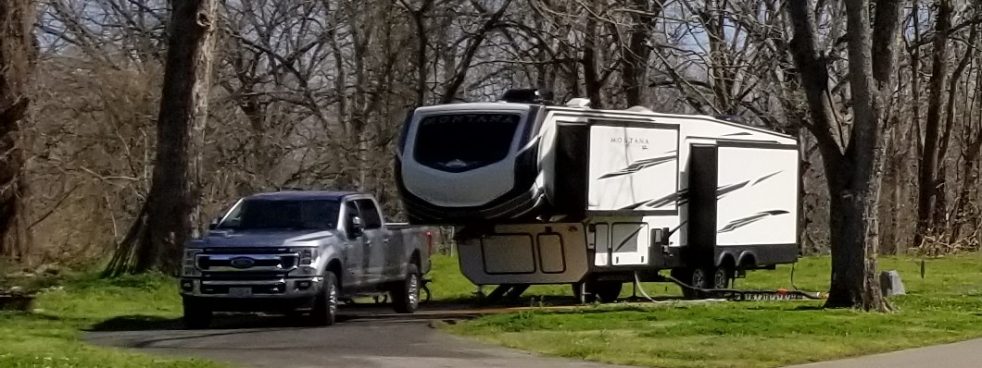
How were we feeling at the end of a three month trip? Cal had his moments when he felt that our adventure was too long and wanted to go back to his RV. Looking back on it, though, he says he enjoyed the sights and was glad we went. What made it fun for him was all the great food we had and being able to dine outside much of the time. I loved all the amazing places we visited. The trip truly did not have any down times for me and I think I would have been happy to keep on traveling. I missed the grandkids, but to put it in perspective, three months is really not that long a time and I was so happy to see them again when we returned.

For however long you have been with me on this journey, I humbly thank you for reading. I did not expect to be recording it for this long. And now, I am happy to report that my blogs will be returning to our RV life. The summer of ’23 was also epic, and we did do some more outside-the-RV travel both in the US and internationally, but perhaps those will be written at a later time.

Next time – enjoying the sun in Arizona

Europe · Greece

The Last Stop: Naxos, Greece – Europe Travels October 2022

Choosing a Greek island to visit is a lot like going to a buffet and knowing you can only have two dishes. Which one….? It’s hard to pick when you have never been there. There are so many, and they are large and small. Some may be known for great night life, the best beaches, or excellent cuisine.

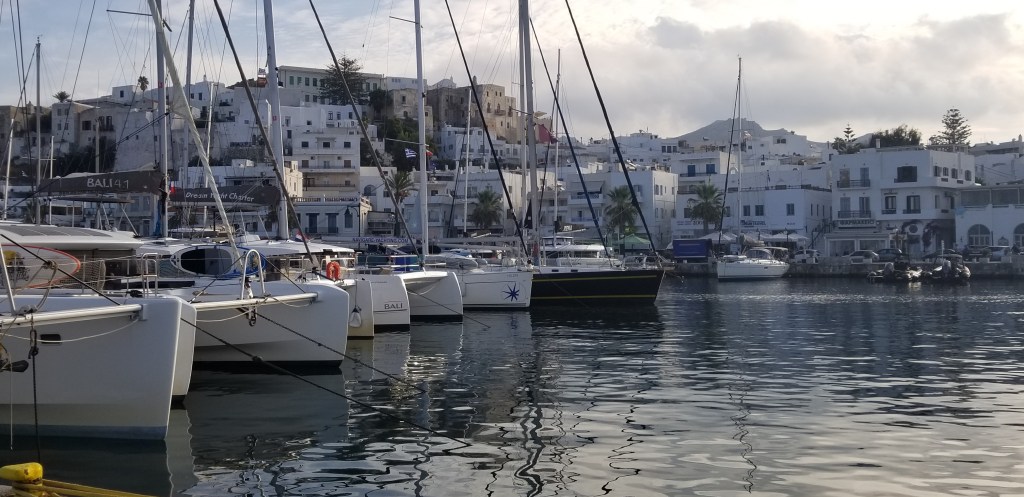
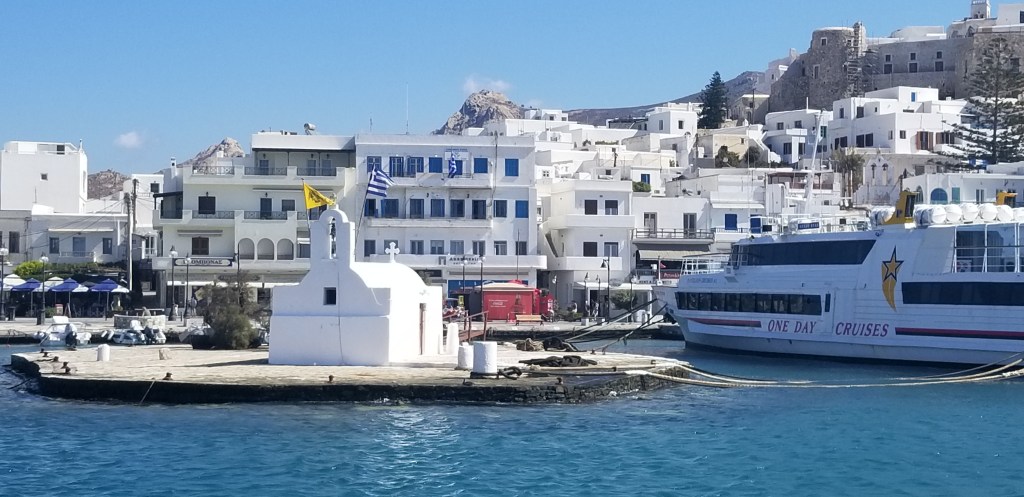
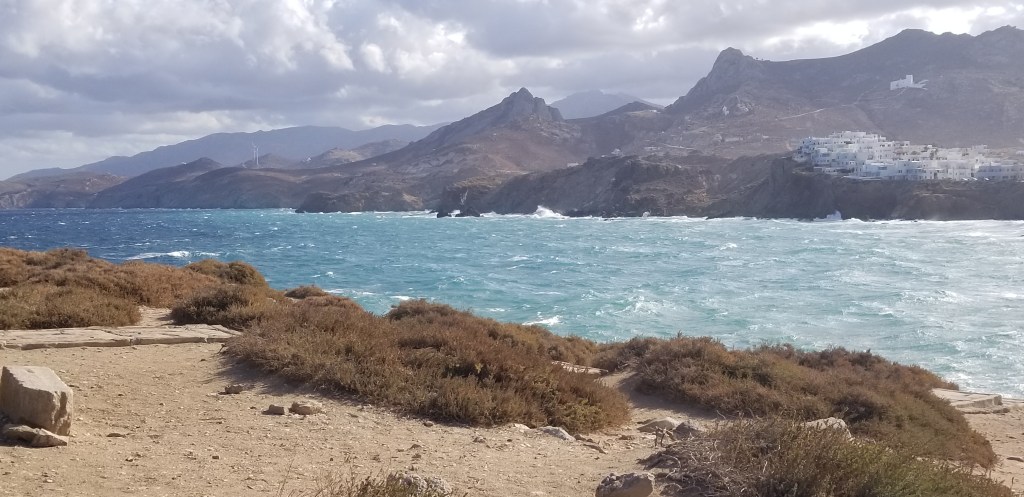
After visiting Santorini, I knew I wanted to look for an island where the cruise ships did not stop. Naxos has those pretty whitewashed buildings, narrow streets and passageways to explore, and beaches. There are places of interest to visit. There is farming, and much of its food is grown on the island. It’s less touristy than Santorini, although Naxos Town has its share of shops. Sounds good to me!

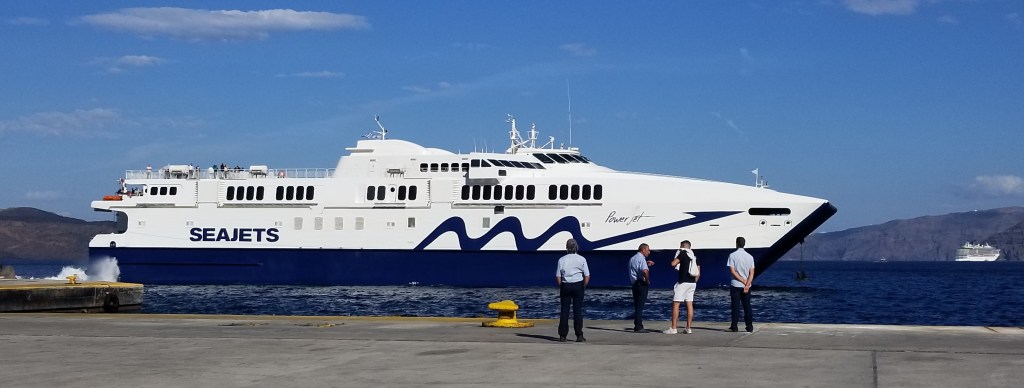
Like Santorini, Naxos is in the Cyclades group of islands, so our ferry ride from there was only an hour and a half long. We rode a Sea Jets ship, was supposed to be faster. For some inexplicable reason, though, it was running late.

Our apartment in Naxos was situated in a residential neighborhood. There were several ways to walk everywhere, and on our first afternoon we took too many turns and got totally lost coming back. GPS did not work. Two heads are better than one: we worked it out, and in the process learned better which way we should go in the future.

Not our neighborhood, since we were up and behind this view, but this area was on one of our walks to town.

One of Naxos’s most striking sights welcomes everyone arriving to the island. It is the ruins of the Temple of Apollo, called the Portara. I took this picture from the ferry.

The walk over to the ruins has a trick sidewalk. It takes careful timing so as not to get hit by the waves.

We waited for a big wave to pass, dove across…and still got wet. No matter, the October winds were already blowing and dried us off quickly.

The temple of Apollo was never finished, even in its own day. It dates back to 506 BC, and construction had commenced at the direction of a tyrant leader who was overthrown before completion.

The ancient and the modern…a partially obstructed view of the Blue Delos ferry from the Temple of Apollo gate
A natural view of Naxos from the Temple of Apollo. The waves were kicking up!

If you have been reading my blogs as far back as our time in Venice, I wrote about Venice’s “Golden Age”. It stretched back as far as the 8th century for a millenium, until Napoleon finally ended things. They had great maritime might and power. The remains of Venetian castles and fortresses dot the Mediteranean, and Naxos is no exception.

There really is no “castle” to see here, except the outside walls. There are four levels and it has a round shape, but the city of Chora (also called Naxos Town) is built right up and around it. Inside the “Kastro” is a Catholic cathedral and an archaeological museum, formerly a girls school. Mansions once housed Venetian ruling families, and some are now shops and cafes.

Part of the fun of walking up to it is trying to find it from the picturesque old market place to an old Venetian maze of passageways. We figured that as long as we were going upward, we were good.

We did get a view of the castle walls as we walked. From what I read, the tower will be a Byzantine museum when reconstruction is finished.

I visited the small archaeological museum inside the castle area.

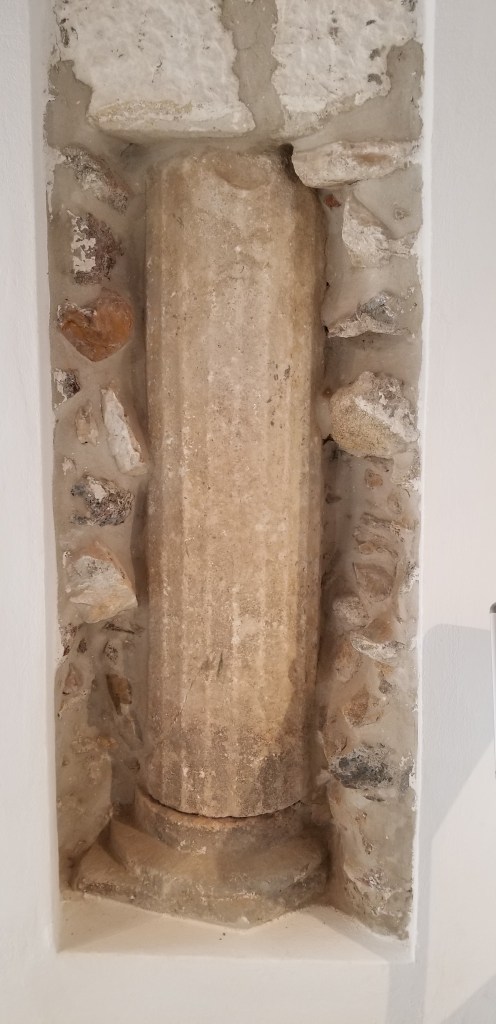
In the year 1207, Venetians built their castle on the foundations of an old Greek acropolis, and used the building materials from it and also from the Portara for construction. Here, a wall was built right around the acropolis column.

A little dwelling place I found while walking in this area:

The ceiling is a hodgepodge of sticks and timbers.

On another of our walks was a cemetery. Walking through, we noted that a number of the caskets were open and empty. What’s up with this? Later we found out that the city wants to move the cemetery elsewhere. The lucky deceased who still have living relatives have had their coffins removed elsewhere. It seems a little macabre!

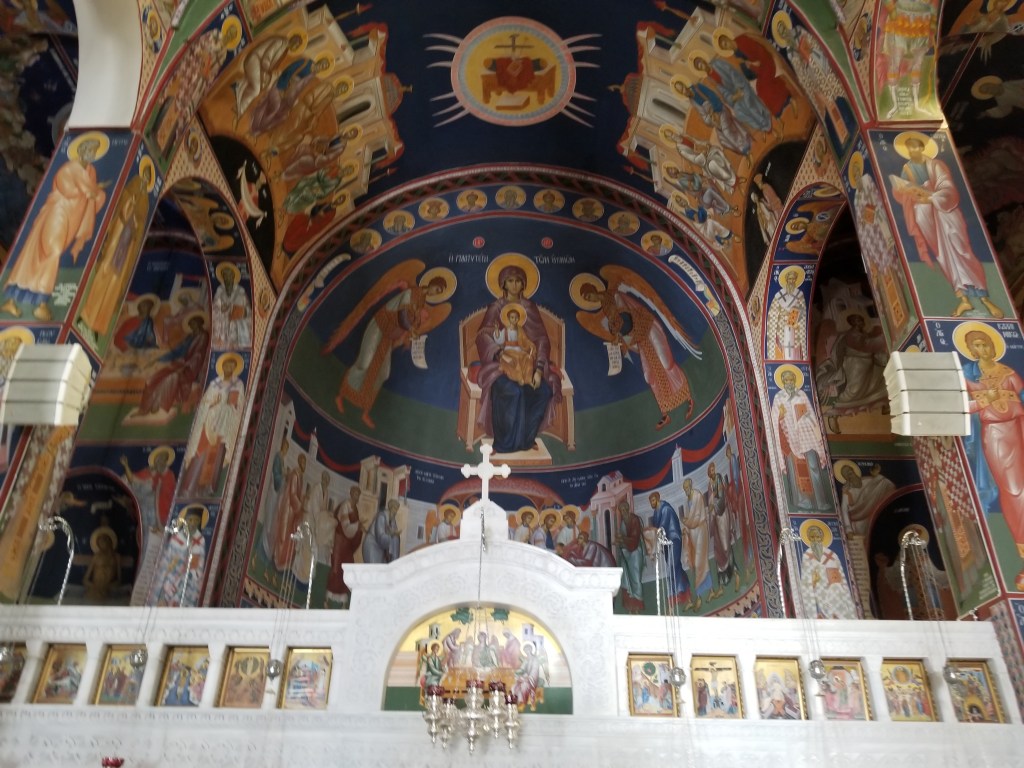
One of our most memorable church visits was to a Greek Orthodox church near our apartment. Cal is still talking about this one. There weren’t a lot of spaces in it that are left unpainted.

In my blogs from our visit to the UK, I usually closed with a photo of a breakfast we’d had. I haven’t done this since for a simple reason: as we traveled further south, breakfast became less of a big deal in the countries we visited. In both Italy and Greece, people tend to rise later and snatch a quick cup of expresso or cappucino, perhaps with a croissant. I think maybe it is because they like to dine later in the evening and so aren’t really hungry first thing in the morning, but that’s pure speculation on my part. Of course, exceptions can be found in all the tourist hotels.

I’m generalizing here, but Greeks do seem to like omelets. Or maybe it’s because they know we travelers like omelets. When we walked in a certain direction, we’d see a little cafe advertising a Greek breakfast, so one morning we stopped by. It was exciting to not be eating a bowl of cereal in our apartment for once.

My Greek breakfast:

The omelet contains potatoes, onions, and cheese. It was not overly stuffed with any of these three ingredients, and the cheese seemed like a cross between cream cheese and goat cheese. It came with toasted bread, a salad, and a strawberry smoothie. Delicious!

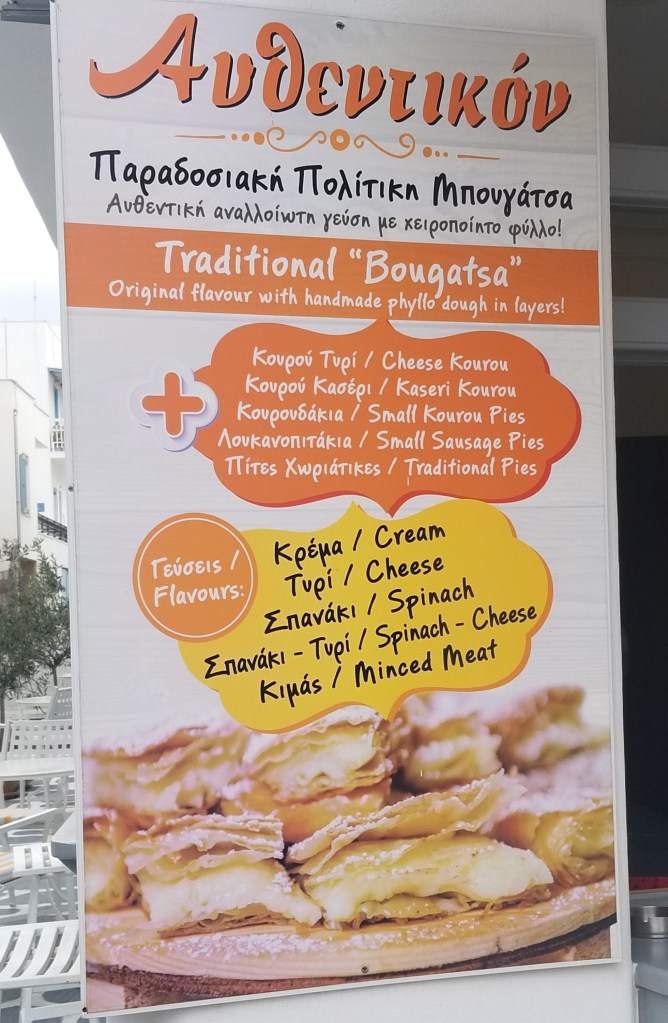
More typically, though, if the Greeks have anything with their coffee other than a croissant, it might be a bougatsa. I had one of these for lunch a time or two and it was delicious.

Another favorite all over Greece for any meal is a Gyro-in-hand. This is a gyro with french fries sticking out of it. It’s an entire compact meal which I often saw people munching on while they were walking down the street.

Earlier I mentioned the October winds. Naxos shuts down earlier than Santorini does, on October 15, for this reason. As our visit here progressed, we noticed stores starting to close for the season. The wind was not bad during the day, but it would become gusty later on and would become downright chilly. The darkness in the evenings plus the chill meant that I was digging out my jacket for the first time since Germany when we’d go out for dinner. The day before we left Naxos, the wind miraculously slowed and the clouds disappeared. Beach time!

Agios Georgios beach was not far from our apartment. Cal and I walked down the beach together–

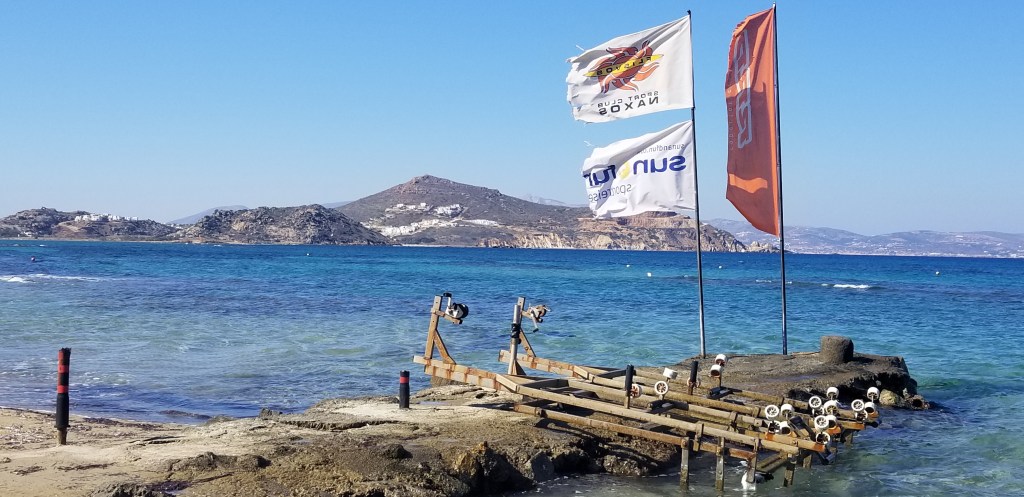
and then Cal settled in to a chaise lounger under an umbrella. He likes the beach, but he does not enjoy the sun. Meanwhile, I walked further down the beach and found a sheltered cove with many windsurfers. The wind on Naxos makes for some great windsurfing.

We were feeling the end of the trip. Our pattern for life in Naxos was often to go out and explore for awhile, maybe have lunch or pick something up from a bakery, and come back to the apartment. There were several days here. It was a relaxing time and Naxos lends itself to that. I was trying hard to finish a cross-stitch Christmas stocking for my granddaughter that I’d been carrying all over Europe. We watched a bit of TV, but Wheel of Fortune is just a little different in Greek.

We had one last day trip on Naxos, though. One last tour. That will be in my next post!

Next time – exploring the mountain villages of Naxos

Europe · Greece

ATVing in Santorini, Greece – Europe Travels October 2022

In my previous blog, I wrote that our apartment in Santorini was “neither here nor there”. I knew that going in, but thought we could use the bus system. Upon our arrival we were told that buses were unreliable. Seeing tourists waiting patiently at each bus stop reinforced that opinion for us. In hindsight, I think we should have given it a try at least once.

So on our first evening in Santorini and not knowing where else to go, we walked up the hill to Imerovigli for dinner. It was a little distance along a winding road and the shoulder was rocky and narrow. Traffic zoomed by, and that included many folks on ATVs. Our dinner conversation centered around a new idea: if we rented an ATV while in Santorini? Of course, Cal would be the driver. He has driven many types of motorized vehicles, although he had only operated an ATV once before. He was game for the plan, and Margarita in our apartment office arranged everything for us. We took delivery the very next morning.

Of course, there was a lengthy introduction to our ATV when it arrived, including a test drive. Here is Cal heading out on to the road for the very first time.

At first, he just tooled around on the roads around us, and to Oia. The ATV was very handy for getting to and from Fira. I couldn’t take pictures of what I was seeing, though, because I needed to hang on! I was afraid that we’d hit a bump and then the phone would go flying.

One morning, though, we cajoled Margarita (procurer of all things in our apartment office) into bringing our breakfast earlier than usual, and set off for the south side of the island. We knew it would be a bit of a ride, but after a while I felt that we were climbing. It was getting darker, foggier, and starting to sprinkle. Cal had inadvertently headed up toward the east, and we were in the mountains. It was hard to talk to him over the noise of the ATV, but after awhile I gave him a poke, and he stopped. “Hmmm, are we going in the right direction, do you think?” It remains one of the funniest stories of our trip.

GPS didn’t work well in Santorini, and I had a sketchy little map ripped out of a brochure. We finally found the sunshine again and figured out our location, and most of the day proceeded without incident.

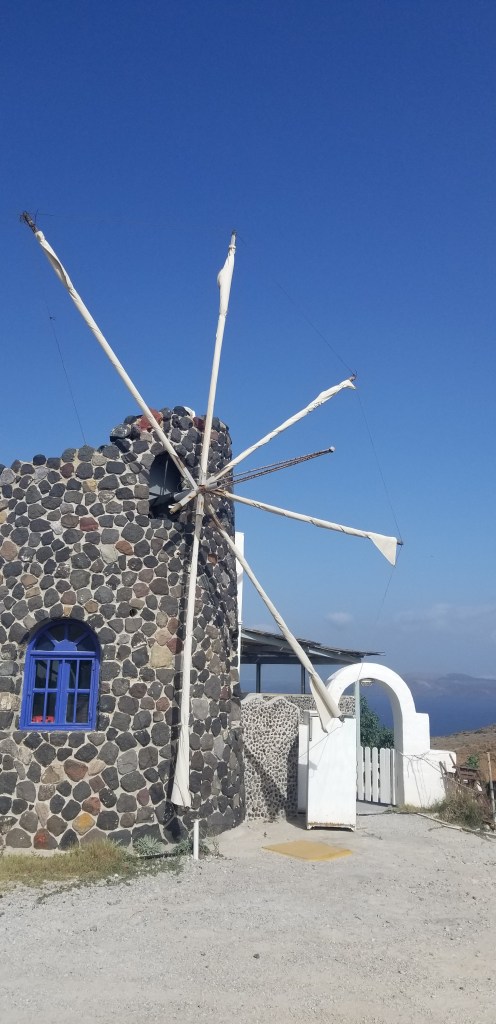
These windmills were once a familiar sight around Santorini. They were used to grind grain for flour. Today, many of them have been renovated into villas. This one was next to a restaurant.

Now, which way should we go?

In the sweeping landscape of this portion of the island, we could see the pumice layer left by the volcano 3,600 years ago.

Santorini has its very own version of Italy’s Pompeii in the form of an archaeological site named Akrotiri, and we stopped at this place for awhile. The island at that time was called not Santorini, but Thera. There was a thriving town here back in 1620 B.C. It had earlier been hit by two earthquakes which made the resident Minoans more determined to build back better before the volcano finally wiped it out completely. Their buildings contained the treasures of their advanced civilization. I could compare this to the city ruins found in Thessaloniki and under the Parthenon Museum in Athens, but these were mind-blowingly 1300 years older!

These urns were found in the “Pithoi Storeroom” – so named because of the large number of “pithoi”, or storage jars, found here.

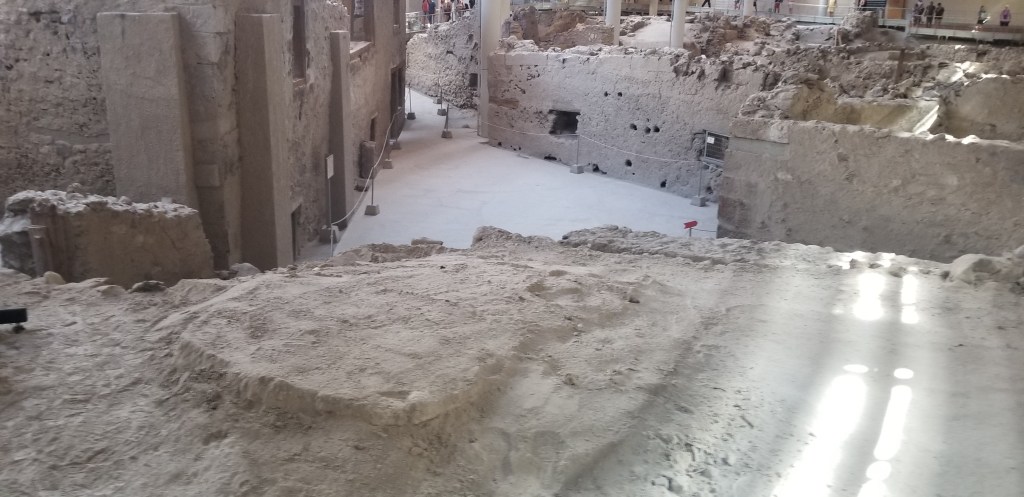
An then, most impressive to me, an actual town square.

The building in the front of this picture is still unexcavated, as is about 70% of the city. The picture below shows how the building on the top left would have looked like before the volcano hit.

During the volcano event, a huge mudflow filled up Akroteri. This preserved not only the treasures inside the homes but also many of their wall paintings. The paintings were the symbol of a resident’s wealth and status.

The next day, I visited the Archaeological Museum of Prehistoric Thera, which contains not only many artifacts from Akroteri but also the wall paintings which have been meticulously removed and preserved. I love the “Blue Monkeys” particularly.

There have never been indigenous monkeys in Santorini. The monkeys in this painting are indigenous to Ethiopia. Crete is in sight of Santorini, sixty miles away. It is thought that monkeys were traded there and brought to ancient Thera, or else sailors picked them up on their voyages around the Mediterranean. I love to imagine how these blue monkeys looked when the paint was fresh.

OK, back to our explorations. Besides Akroteri, I’d heard there was a red sand beach, and in a short time we were there. We’d visited a red sand beach in Hawaii so I wanted to check this out. It was a short drive away, and luckily easy to find, but quite a walk just from the parking lot. As usual, there were plenty of diversions along the way.

A couple getting married were having their picture taken in front of a pretty little church:

and a violinist was playing lively Greek folk music which we could hear from a distance away.

The hike to the beach began to get serious, and involved a little rock scrambling.

The beach is made up of fine red pebbles, which I do not think I would like to lay or sit on for long. When I shucked my shoes, it was felt sharp under my feet. Volcanic matter has iron in it, and that is what turns the pebbles red.

This is one of best that Santorini has in the way of beaches and from what I’ve read, other islands have better ones. Especially with its high volcanic cliffs, beaches are not the reason to come here. Red Beach scores points for beauty, though.

What remains in my memory is the sound of the receding waves moving all of the rocks around under the water. It was like nothing I’ve ever heard before, like soft thunder.

It wasn’t quite lunch time yet but there was a cute restaurant at the end of the beach. To be able have a front row seat on their porch and take a break, I ordered a plate of mussels saganaki, delicously sprinkled with feta cheese.

From our table, we could not possibly be too much closer to the water. I could have sat there all day, but unfortunately, the proprietor might have frowned on that.

We had one more stop at the very tip of the island, Faros Lighthouse, also called the Lighthouse of Akrotiri. Built in 1892, it is one of the oldest lighthouses in Greece.

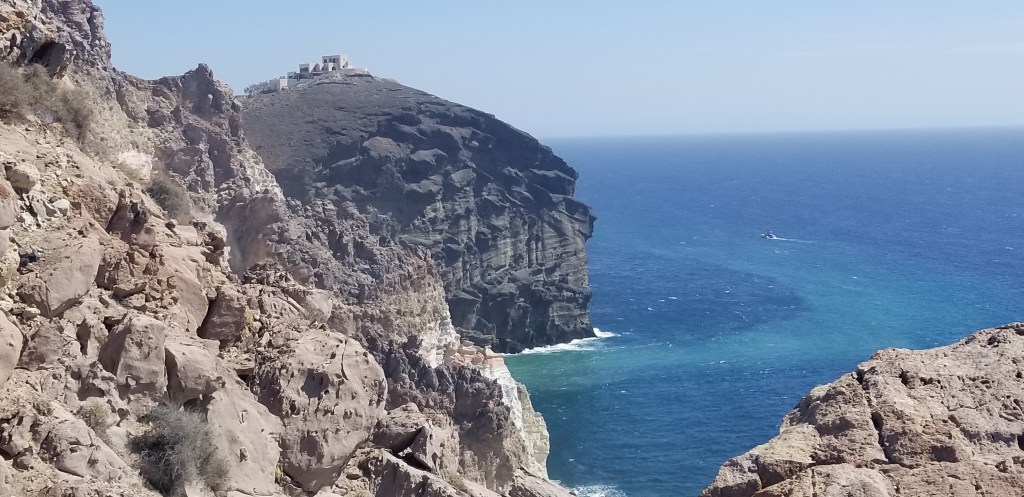
Looking at it from the parking lot, you’d wonder how it could possibly do its job, since the building is short. Hiking on the rocks below it, though, one sees its vantage point at the top of a cliff. This is what the lighthouse sees, although from considerably higher than I was at this point:

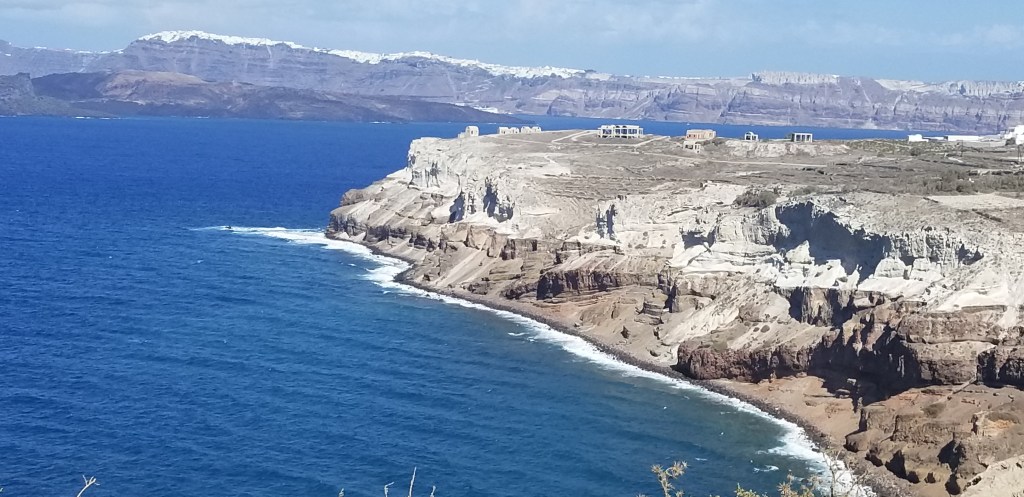
In the distance, Fira could be seen:

The ATV rental was a complete success.

Santorini left us with a lot of great island memories. Saying goodbye to Margarita, she told us that she was very happy; a vacation was coming soon. She had been in the office every single day we’d been there. Santorini officially shuts down November 15. The workers, who mostly come to the island from Athens, then leave and get a four month break. She said they work every day with no time off for eight months before that vacation. After telling us that, I really had to appreciate all of her hard work.

Our talkative driver on the way back through the island and down the precipitous cliffs also had the same sort of story to tell. Thanks to Margarita’s advice, we arrived much too early for the ferry. An entertaining server at the ferry restaurant plied us with warm croissants from the oven. From start to finish, Santorini shone, and I was sorry to leave.

Next time – Naxos, another Greek island

Europe · Greece

Sunny Santorini – Europe Travels October 2022

As the calendar flipped over to October, our travels were winding down. We figured that the best way to celebrate the last two weeks of an epic journey was by visiting a couple of Greek islands.

I could not ignore Santorini. It’s another one of those places that has a reputation for being overcrowded with tourists. But how I could go to the islands and not go there?

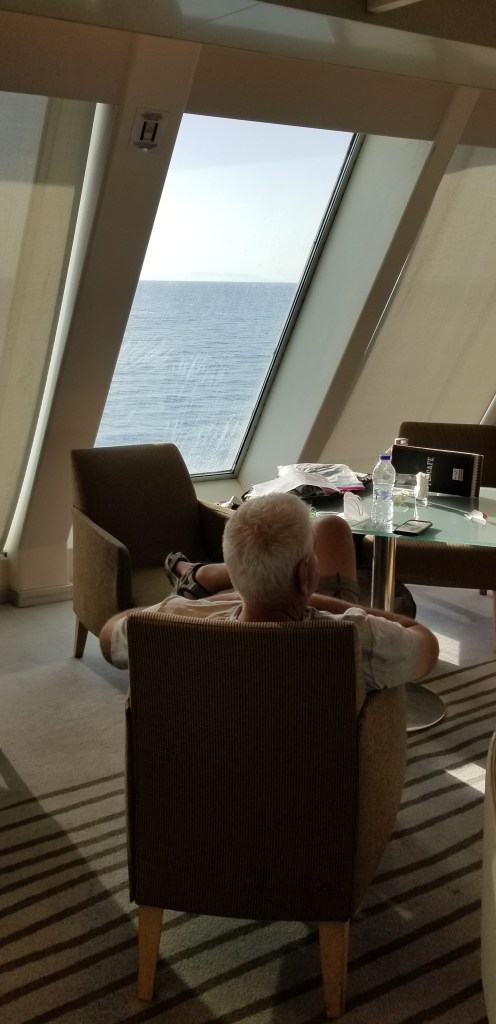
The sun hadn’t yet come up when we left our hotel in Athens, got on the subway, and found the Blue Star Delos at the Piraeus docks with a depart time of 7:25 AM. The ferry isn’t terribly expensive when all things are considered, so we upped our fare to Business Class. For that, we had a table, comfortable chairs, and an attentive server who would come by now and again to see if we needed drinks or food. We could look out the front of the ship, and of course we would go round and explore it at times. Views of other beautiful island towns were thrown in when stops were made at various ports. We were very pleased with our do-it-yourself cruise, which took about seven hours.

One of the island stops while on the ferry

Santorini is one of a chain of islands called the Cyclades in the Aegean sea. The main feature of these islands is that they were all formed by a volcano.

We received our first look at the island from our ship.

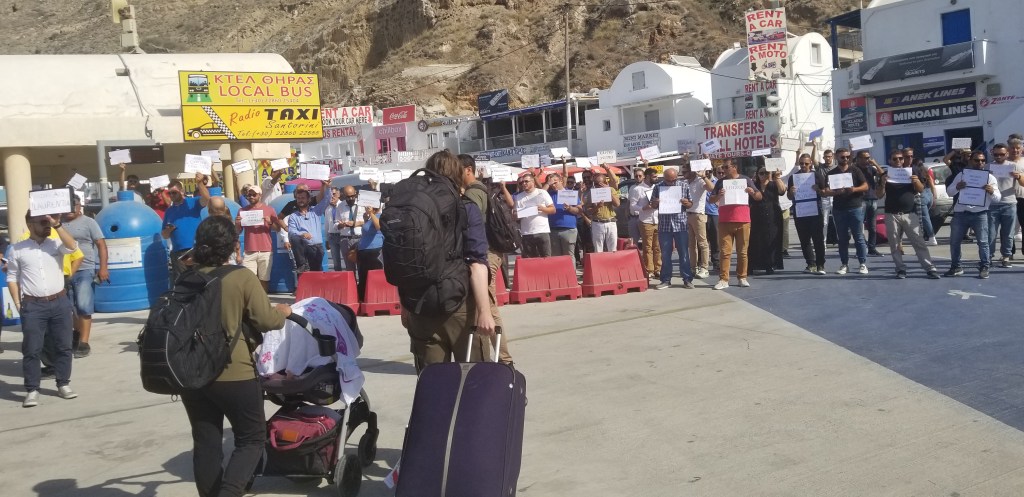
Somehow, we ended up at the front of the line upon disembarking. We still have not forgotten the sight of all of these drivers waiting for their passengers. It was crazy! Amazingly, we readily found the guy holding our name on his board, and we were off.

It’s tempting to call the biggest town “Santorini”, but that’s the name of the whole island; its name is really “Fira”.

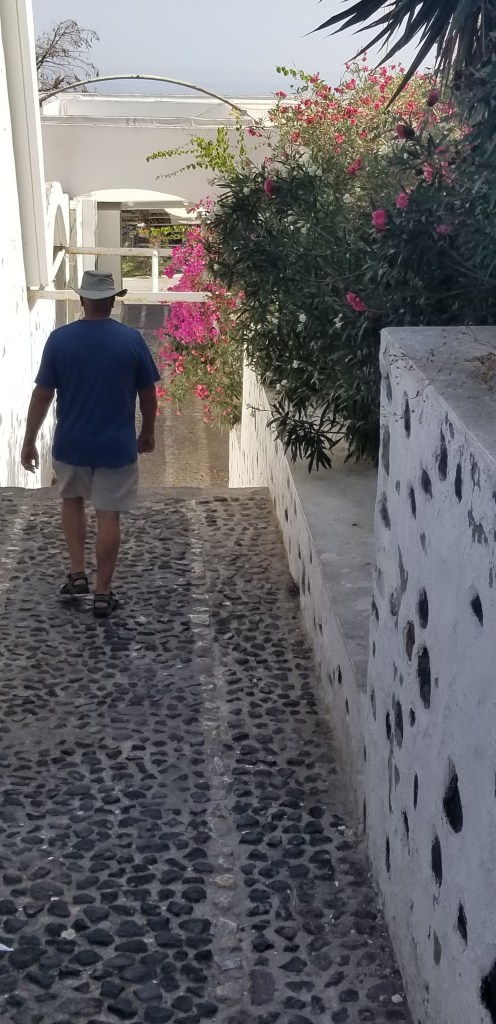
On our first afternoon, we did some wandering around in Fira. It was lovely – at first. We had lunch, and wandered down some of the labyrinthine streets and paths.

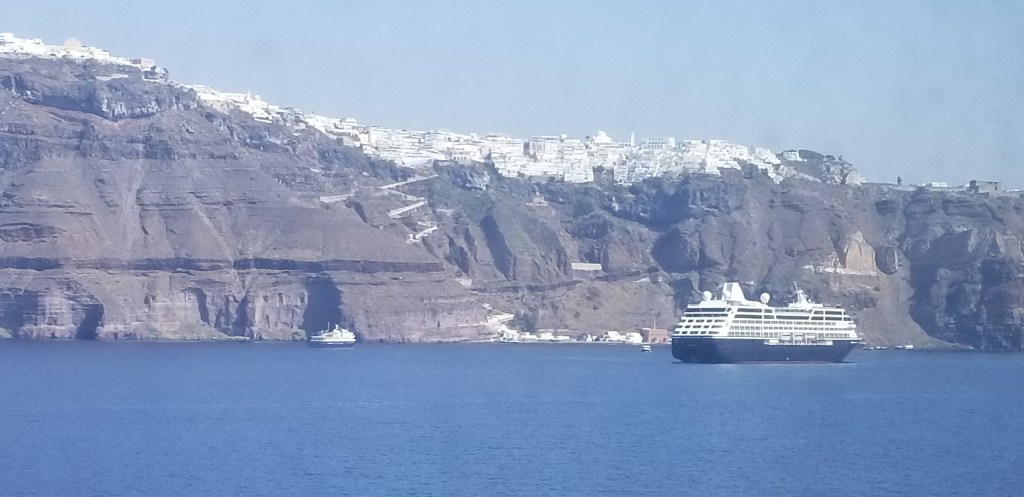
Soon enough, we got caught in a tourist river – a steady stream of people filling up the path from side to side, moving in one direction. People dodged in and out of the tiny shops. It was hard to get out of and really not enjoyable. Afternoon, as we discovered, is not a great time to explore Fira. Do you see the two cruise ships out in the harbor in my top picture? They hold lots of people. A driver that later took us back to the ferry told us that in July there could be as many as seven cruise ships in the harbor at one time. I cannot imagine all those people filling the little passageways of Fira.

Have you ever seen the iconic blue dome pictures of Santorini? That is what I was looking for. I don’t know why I was so fixated on finding that particular view. Later, I looked on a postcard I’d picked up, and I saw some lettering to the side – “Firostefani”. Now that I’d been here a couple of days, I knew that Firostefani is a village that bumps up right next to Fira. On the morning of our last full day, we headed down to Fira to run an errand or two. And then we split up. He wanted nothing more to do with my blue dome fixation – smart man!

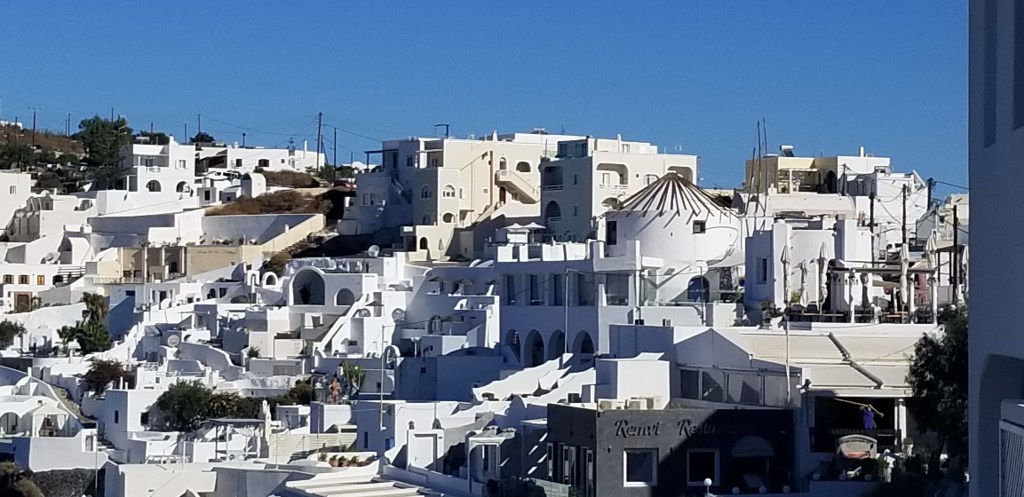
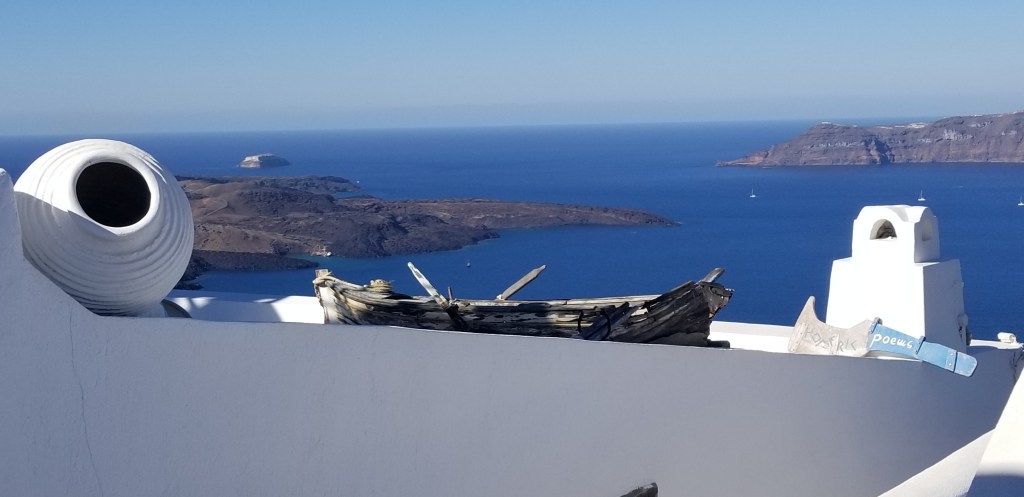
Here it was that I found the magic of Santorini. Crowds were light, the whitewashed buildings shone in the bright sunshine, and the water sparkled in the harbor. It was a fine walk to Firostefani. I worked my way up to a dizzying walkway along the cliffs.

The round building used to be a windmill; it looks like it has been repurposed to be a home.

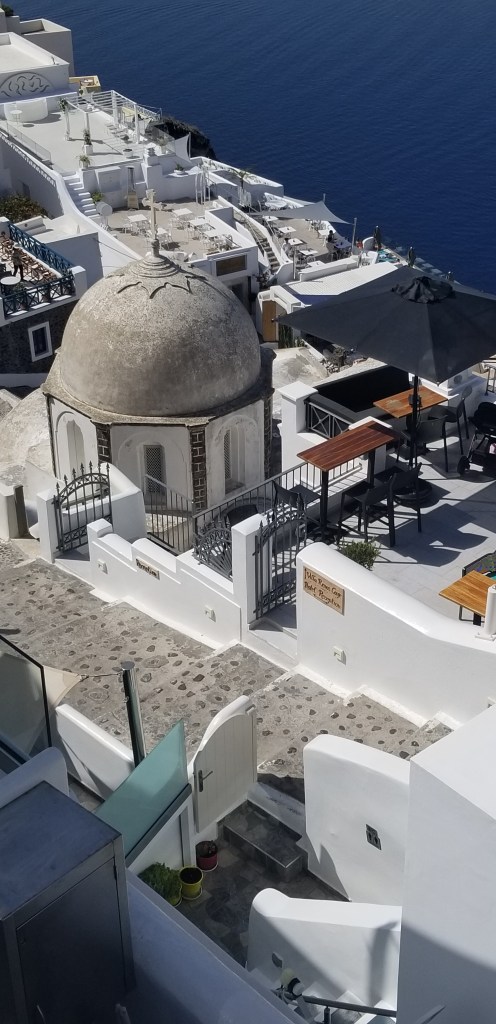
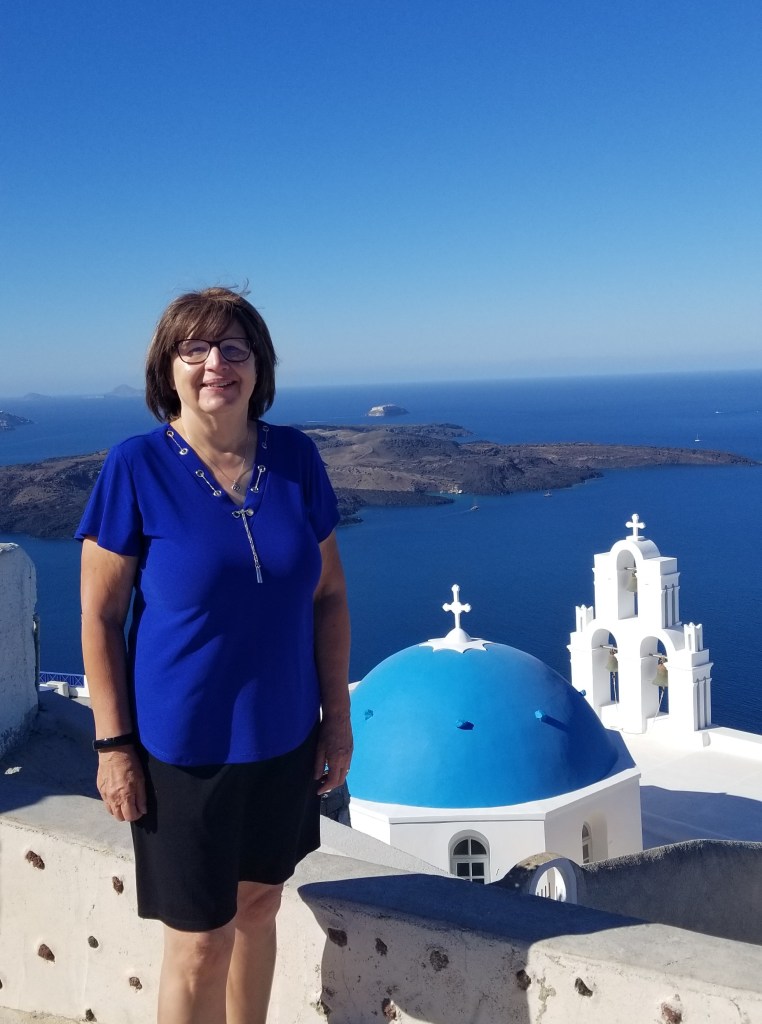
I walked along, enjoying the fine views so much that I was ready to give up my blue dome search. I stopped to look at an ornate gate in front of a church. It was as I was studying the gate that I saw it on the right of it – a picture of the blue dome, and directions on how to find it! It belongs to this church, the Catholic Church of Koimisi Tis Theotoku. A little walk back up the path and behind, and I was there. Eureka!

Ah….so beautiful. I took photos of other tourists when they asked, and of course they offered to take pictures of me.

From here, I could see to the opposite side of the island. In places, Santorini is so narrow that you can do that.

When I found Cal again, he was entertained by watching tourists taking selfies and group shots in front of a colorful plastic-looking donkey in the main square. He had spent most of his time in a coffee shop overlooking the harbor, enjoying the view, and had thoroughly enjoyed himself. His mode of travel is a lot less intense than mine.

I’d found our lodgings through AirBnb, but the place was more like one of a handful of villas in a family-owned bed and breakfast. They brought us breakfast every morning on a tray. By Santorini standards, it was inexpensive, probably because it was neither here nor there – it lay just outside of tiny Imerovigli on the road between Fira and Santorini’s other main village, Oia. When booking, I thought maybe we could hike to Oia on a little footpath, and with one more day, we may have. The view from our place wasn’t totally amazing, but not bad either. The villas are on the sunrise side.

Taking a walk from our place, we found another church with a blue dome. The reason for white buildings and blue domes is simple – they are the colors of the Greek flag.

Down and across the road from us a bit, we found tiny little Taverna Tasos that we loved so much that we ate there two out of the four nights that we were in Santorini. The Oia-Fira path was behind it, and also the “sunset” side of the island, so we would walk there after dinner for a sunset view.
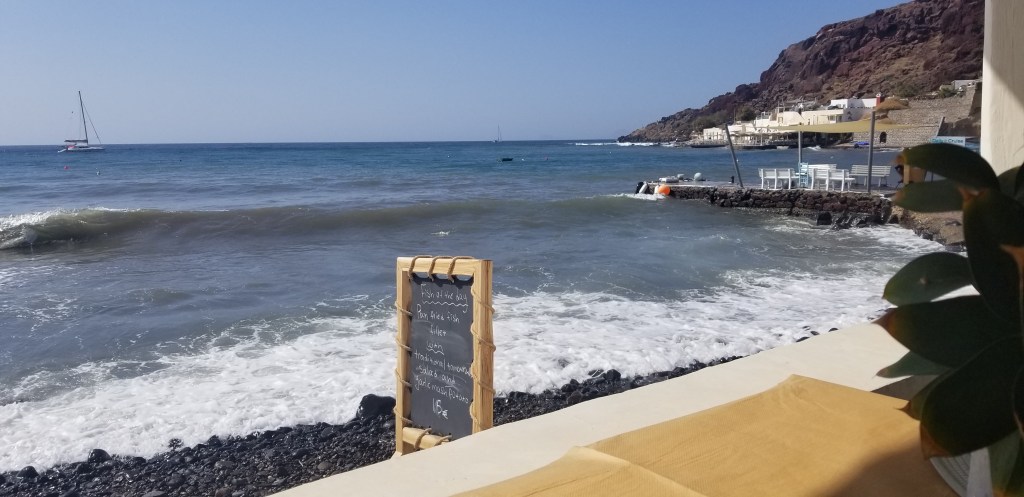
The path follows the low brick wall in the bottom right of the above picture, and you can just barely see it as it winds around on top of the cliffs. It ends at the town of Oia, which is not seen in this picture and would be on the far left.

Santorini was already occupied back in the 16th century BC when a volcano erupted that totally reshaped the island and formed a caldera. The island is crescent shaped and the landscape is rugged. Today, the villages are built a thousand feet above sea level, right on top of the steep walls of the caldera, half of which is submerged under the Aegean Sea. The island is only five miles from the active underwater volcano Kolumbo.

No better place to get a look at it than from a sunset dinner cruise.

In early times, there was little building material to be found in Santorini. Residences were dug right out of the cliffs, because the top layer of the caldera is a chalky substance called pumice. These cave dwellings were cool in the summer and warm in winter. All of the white you see on top is not only whitewash, which also reflects heat, but pumice.

The cruise gave us an entirely different view of the island. We could view all of the little towns way up high, and could see close-up the walls of the caldera.

In the below picture, the volcanic rock and dirt can clearly be seen on a nearby uninhabited island.

And then the sun went down – plop! – just like that.

As with other tourist-heavy places that we visited, there is gold (or white chalk) under the surface of Santorini. It is so much more than just those beautiful white buildings and blue domes spilling down the caldera. All one has to do is to take the path, or time of day, less traveled. Avoiding the shops, especially in the afternoon, helps. It seems sometimes that everyone’s main function is to shop and go.

We were sitting near the footpath one evening, waiting for sunset, when we struck up a conversation with a British couple. “I’m seeing so many American tourists here,” the gentleman commented. “Why is that?”

I had to give this a lot of thought before I answered him, because I think there are several reasons and maybe not just one. I said something about Santorini being heavily promoted as a romantic destination in the United States. But just maybe it is simply this – that Santorini has a magic all its own, which draws people here.

Or maybe it’s the view of that blue-domed church over the Aegean sea.

Next time – ATV’ing in Santorini

Europe · Greece

A Day Trip to Delphi, Greece – Europe Travels September 2022

Greece is a country that has so much to see and do, depending on how much time you have and what you are interested in. Much of what looked interesting took more time than we had available to step outside of Athens, which was just one day. Delphi sounded doable, so off we went.

By now, I was looking only for “small group tours” and found it with Get Your Guide. We were very surprised, getting in the van, that it was just going to be us and one other couple for the day. They were a young couple from Dallas and by the end of the day we were friends. Our guide, Soteri, was smart and funny and ran a patter of information and conversation all day.

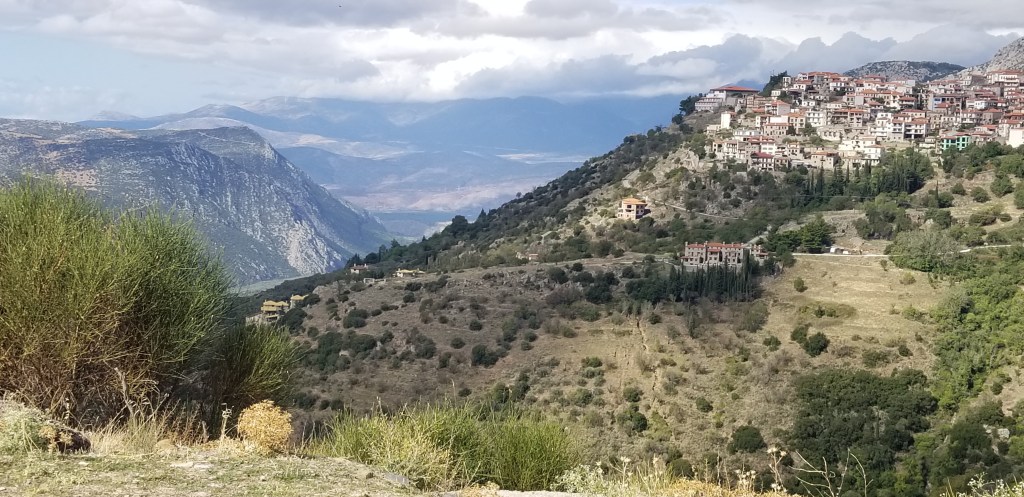
We stopped off for pictures with a view of Arachova, which is another great destination, but not today for us.

Soteri offered to take pictures of us at the scenic view, and ended up taking a selfie with my phone.

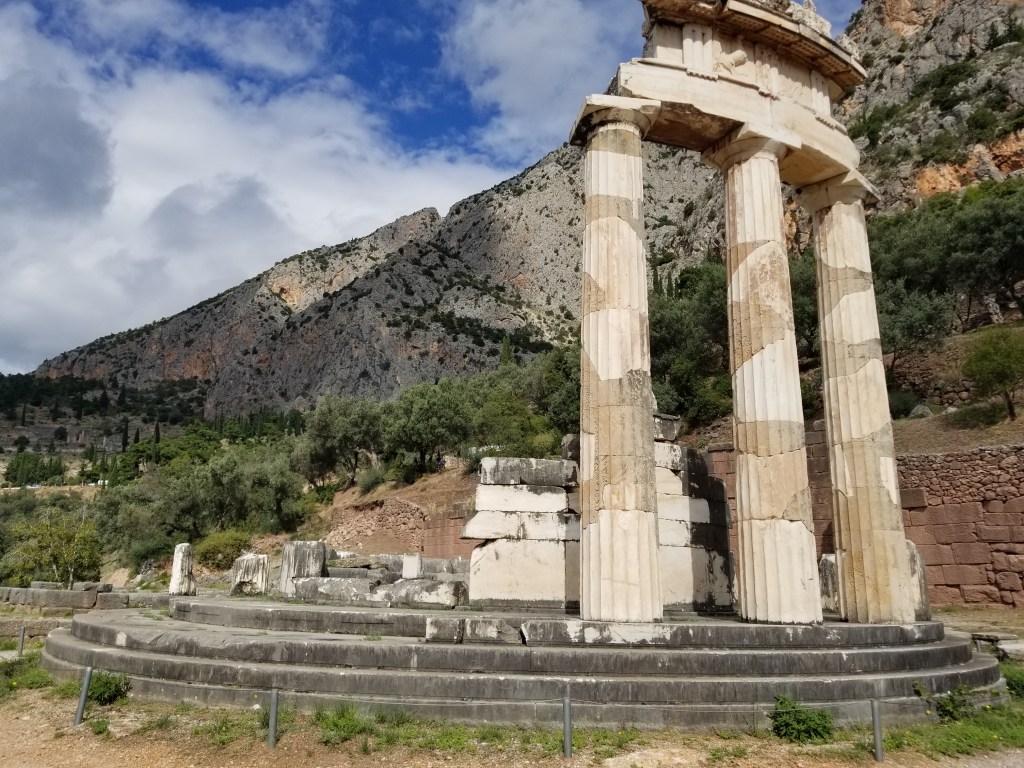
The visit to ancient Delphi began with a visit to the Temple of Athena, which was a major rest stop to the the city in those days. It was a “familiar, welcoming, and peaceful place” (according to the board) after making the arduous journey from all over Greece.

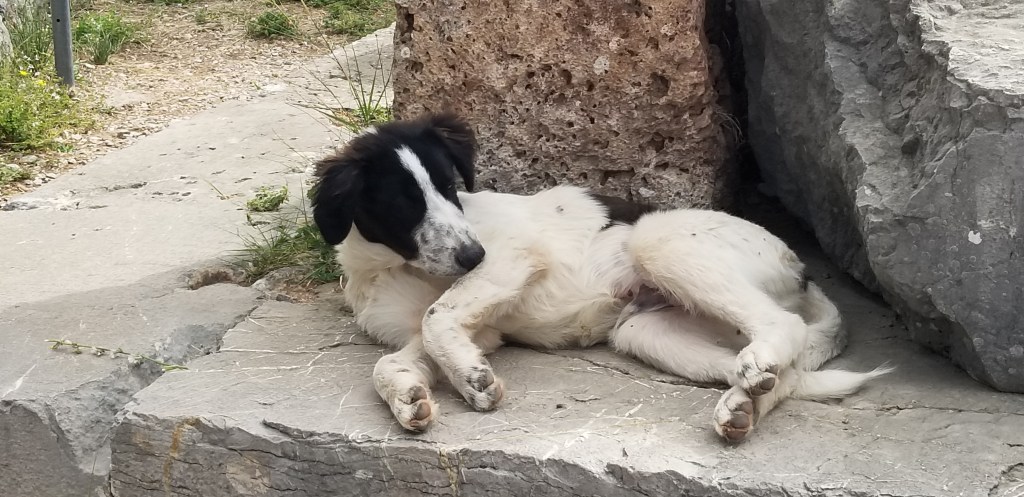
I’d been taking so many pictures of the cats I’d seen everywhere, so I had to take one of this dog that I saw at the temple.

So what’s the big deal about Delphi? Well, it was considered the center, the navel, of the world as far back the eighth century BC. Here, in this sacred place, the god Apollo gave oracles to the people through a priestess named Pythia. People traveled from all over the ancient world to give offerings and receive their oracle, generally an ambiguous sort of prophecy about their future. Of course, Pythia was human, so she wielded great power. She was highly regarded, educated, mysterious, and had to reliquish all family duties when chosen.

We started out at the museum. Soteri turned us over to another guide, Georgia, and she walked us through it, telling us so many things that I would not have known if I was just walking through. Then we were outside again, and just like the ancient peoples, we were walking on the way up to the Temple of Apollo to see Pythia.

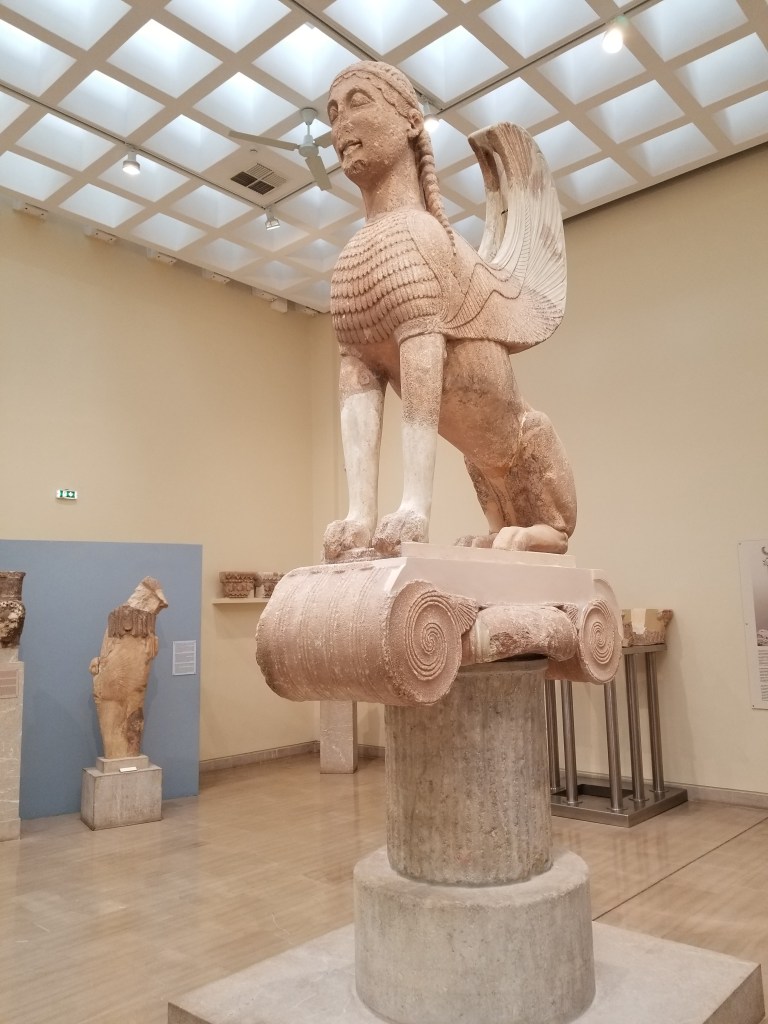
Originally, the way was lined with statues, such as this one that we’d seen in the museum.

It was not enough just to go to the temple and seek Apollo’s counsel through the priestess Pythia. The people needed to bring offerings, too. It was difficult to travel with elaborate offerings, so each city-state had a treasury. This one belonged to Athens:

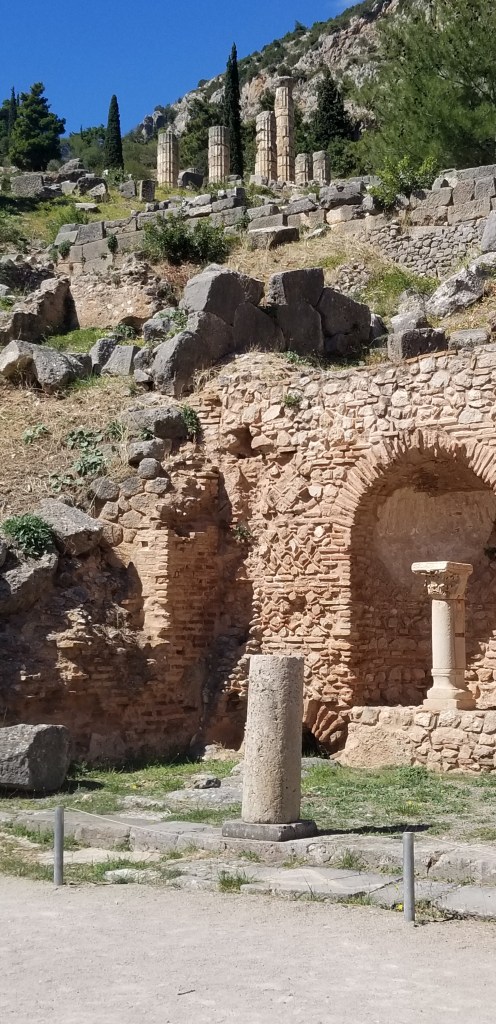
Finally, we were at the ruins of the Temple of Apollo and the place where Pythia was consulted.

It’s a beautiful spot, and I’m standing there at the entrance of the temple at the top of this blog. The picture below shows the building, and one of these rooms would have been Pythia’s.

Georgia was so knowledgeable about ancient Greece. She told us that in high school, which is five years, they are required to study Ancient Greek. This includes reading classic literature and studying the culture. She said that at first she wasn’t thrilled, but then it became interesting to see how different aspects of what she was learning fit together. Georgia left us here, but we were on our own to walk higher to visit Delphi’s amphitheater-

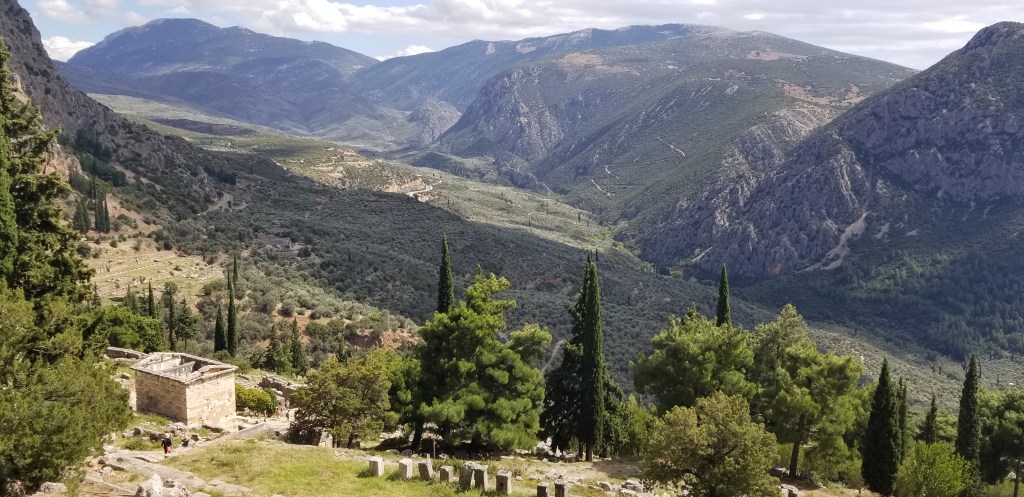
and admire the pretty view. Cypress trees dotted the landscape as far as the eye could see. Stopping here was also a good excuse to catch my breath.

Finally, at the top, a stadium, which is the best preserved ancient stadium in Greece. There were track and field events held here, as well as musical contests. There is room for 6,500 spectators.

I wanted a time machine so that I could sit here among the ancient Greeks and watch a contest.

It was already almost three o’clock and we hadn’t had a chance to stop for lunch, so Soteri took us in to modern Delphi to an excellent restaurant with traditional Greek cuisine. We dined with our new friends from Dallas but Soteri declined to join us. I guess he needed his break time.

We greatly enjoyed this journey back in time and the beautiful scenery along the entire way was a bonus. I’ll sign off on this blog with a couple of pictures from near our restaurant.

Next time – off to the Greek Islands

Europe · Greece

A Visit to Ancient Athens, Part II, Europe Travels September 2022

Some of what I read, pre-trip, said to give Athens two or three days and then head out of town. After all, there isn’t much more that’s worth seeing in Athens besides the Acropolis. The city is covered in grafitti, and traffic is heavy and crazy. Athens is working hard to clean up its act, though, and the city has a character all its own. I can always find much to see when looking under the surface. There certainly is plenty here for a multi-day stay.

We found other places to visit after our day around Acropolis.

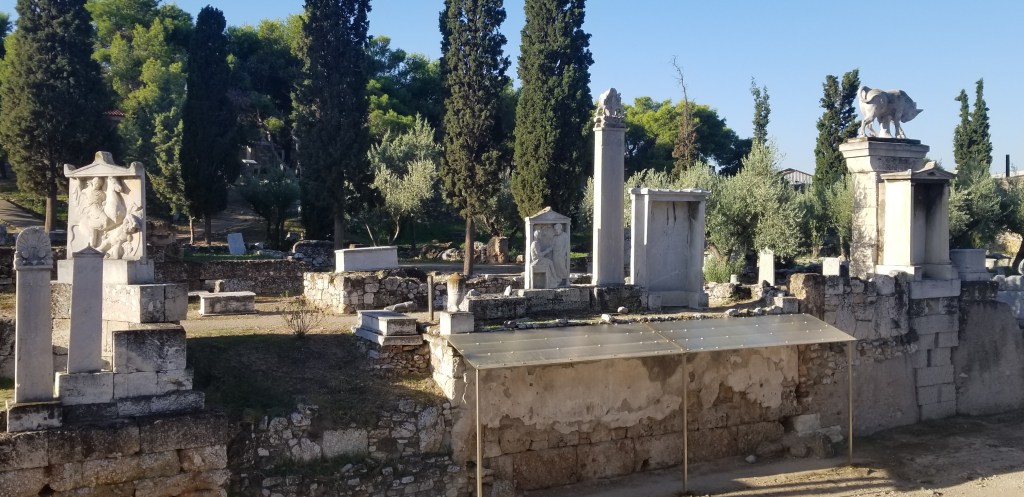
The Cemetery of Kerameikos popped up often in my “Athens Must-Sees”. In antiquity, this is a neighborhood where the potters lived. It flooded often, so it was not a great place to live. It began to be used as a cemetery as far back as the Bronze Age – around 2000 BC – from the Greek era to the Romans and early Christianity. Besides, that, there are a lot of cats and turtles here.

As you can see in the photo above, we did see several cats, playing and peeping out at us from the crevices in the stones.

The site lay just outside the Athens city wall, and some remnants of that wall can still be seen:

The Sacred Way was once lined with elaborate tombs for rich Athenians, going back to the late 4th century BC. It lay on the road to Eleusis. Going into Athens, this cemetery would be passed before entering the city walls. The party ended for the fancy tombs in 317 BC, when they were banned by law and replaced by simple columns for new burials. Maybe they were running out of space.

Also here is the Pompeion, which was the starting point for a grand parade for a festival that happened every four years. According to the explanatory sign, there was a large colonnaded court and rooms for feasts. A processional ship was made ready and moved through the streets to the Acropolis. The Romans destroyed some of this site when they invaded, but the festival continued for centuries.

Yes, we did see several turtles:

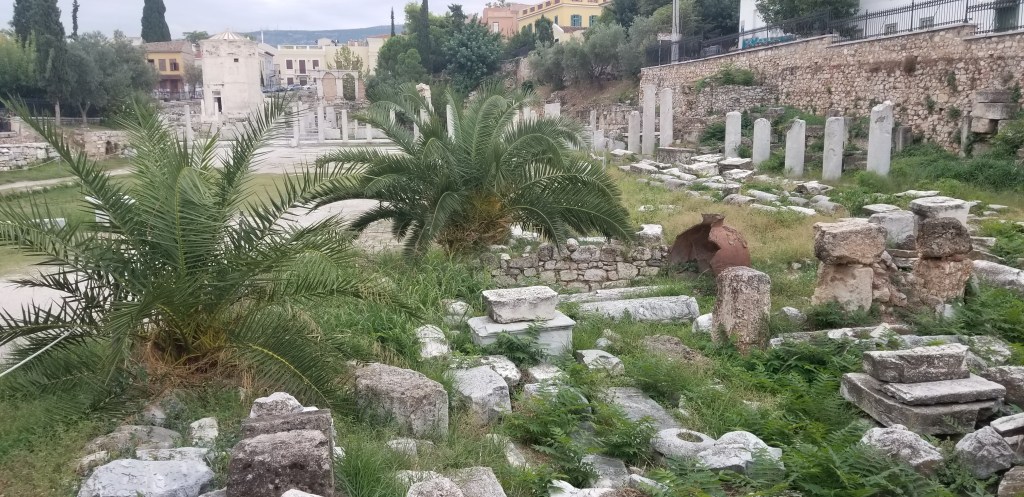
We also visited the Greek Agora. “Agora” is a word that means “market” in Greek but it had more meaning to them as a “gathering place”. It was the center of life for the city. Here, the fledgling democracy conducted state affairs, but also there were performances, philosophers giving lectures, business transacted, and folks just hanging out. I included a picture of the Roman Agora in my previous post; the ruins of the Greek Agora are far more extensive.

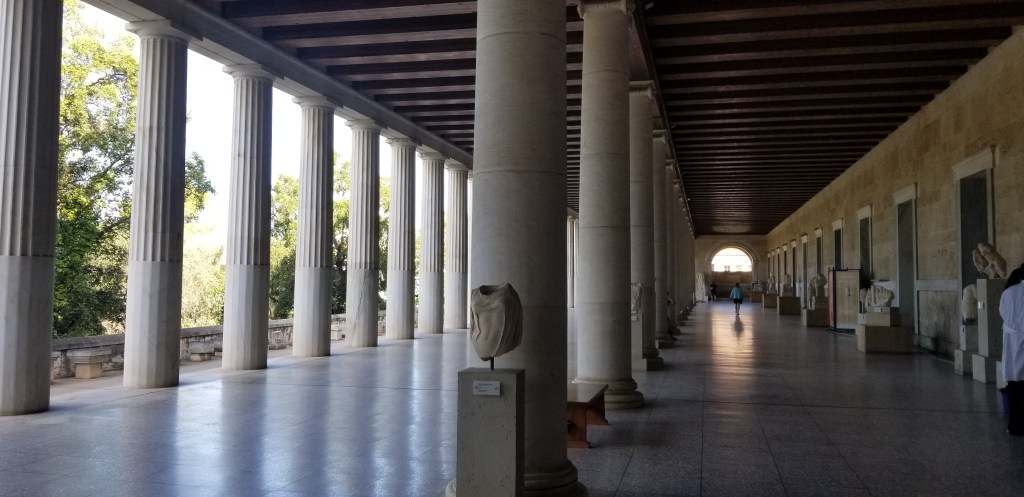
I was not prepared for this:

It is the Stoa of Attalos, which was reconstructed in the 1950’s. It was the largest reconstruction of an ancient building to that time, and I was bowled over by its size. In ancient times it was simply a covered porch with rooms in the back for important business. People could hang out here and there were people conducting business. Now it is a museum, and I spent a lot of time checking everything out.

Upstairs, I was fascinated by an exhibition dedicated to the work of Irishman Edward Dodwell, who traveled to Greece in the early 1800’s. On one occasion he came with an Italian painter, William Gell, and together they spent fifteen months drawing and documenting landscapes and monuments as they looked in that era, sights which are now lost. They also used a camera obscura. This quote from the sign board gave me things to ponder on:

“The sight of the ancient monuments now lying in ruins as well as the awareness of the achievements of the once pioneering spirit of the Greeks, now doomed to decline under the decaying Ottoman Empire, provoked the philosophical reflection on the transience of the human condition.”

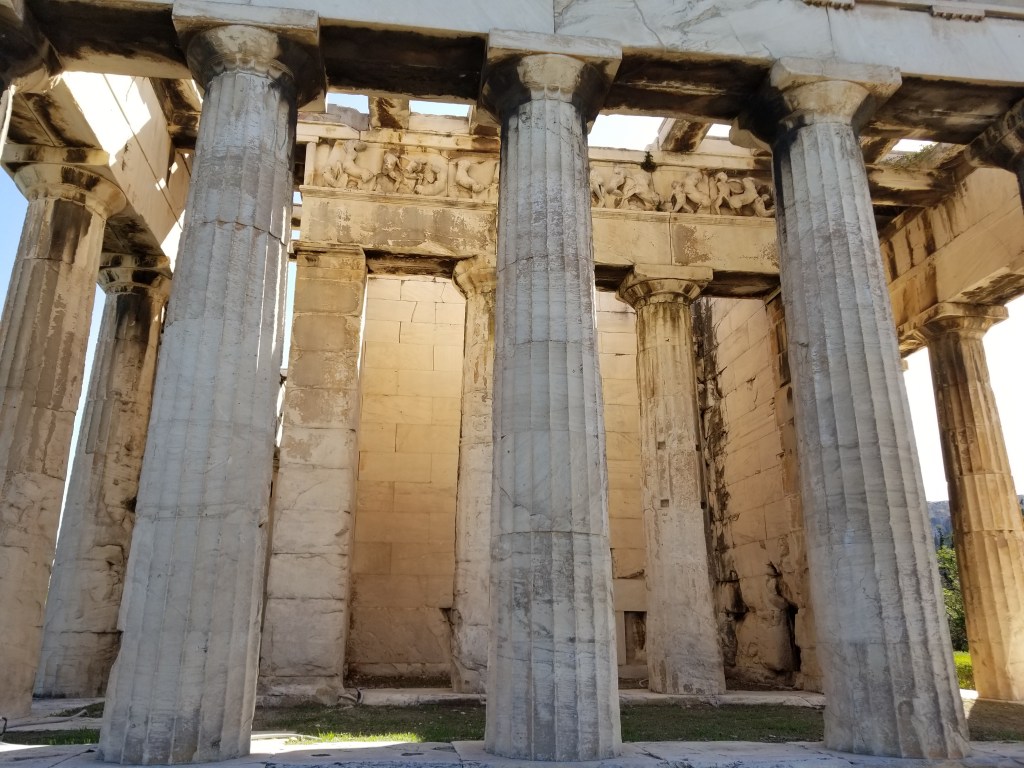
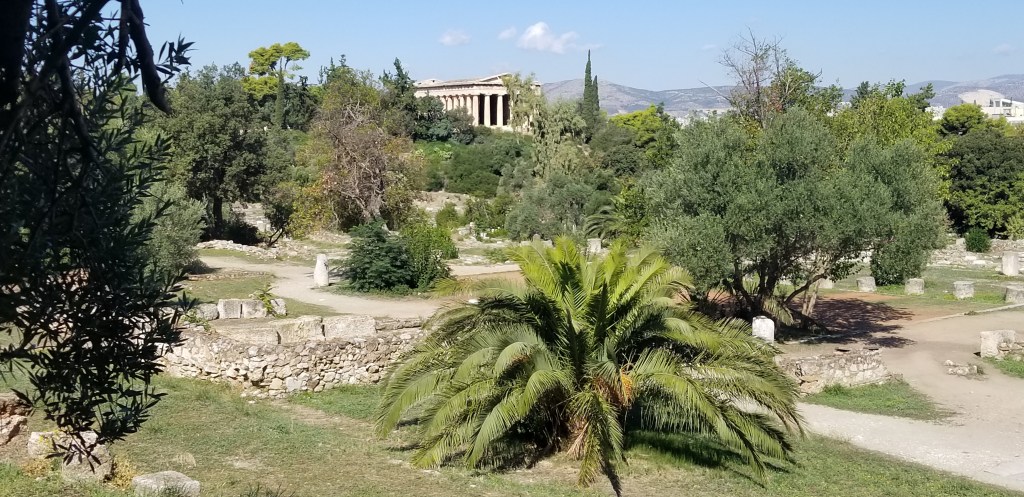
The ancient Temple of Hephaistos is also in the Greek Agora:

The place is a beautiful to walk around and view the various ruins.

We did see the famous changing of the guard, but it was at the Presidential Palace and not at Syntagma Square where everyone else goes. There were only two guards, and it was drizzling so they didn’t make a fuss, but we did see them up close. So up close, in fact, that one of the guards softly tapped his weapon on the ground as I peeked through the gates of the Palace. Uh-oh!

Part of what made our stay so memorable was our location at the Hotel Attalos. It is not sleek and modern, just an old and fairly inexpensive tourist hotel, and probably one step down from the City Hotel where we had stayed in Thessaloniki. A lot of tourists opt for the picturesque and mostly pedestrian Plaka district which is on the opposite side of the Acropolis hill. Despite all the city hubbub going on outside the doors, our hotel was clean, comfortable, and put on a great spread for breakfast every morning. A subterranean subway stop just five walking minutes away took us to the ferries, and to the airport in the other direction.

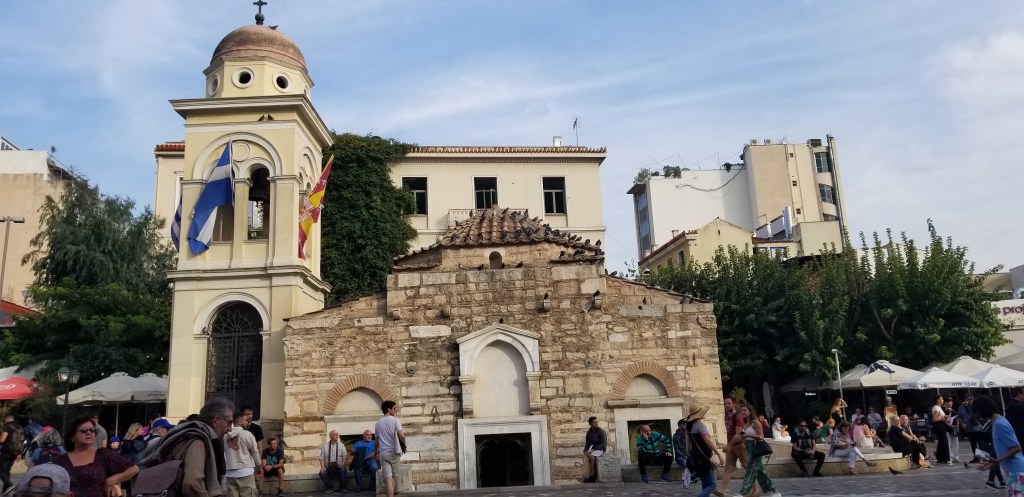
We were just down the street from Monasteriki, a square which has a flea market, shops, and a great view of the Acropolis. The Holy Church of the Virgin Mary Pantanassa is here, and it is all that remains of a 10th century monastery. The dark interior paired with the lush gilt furnishings was something to see.

Monasteriki Square is a very busy place. The picture below is looking up from the square:

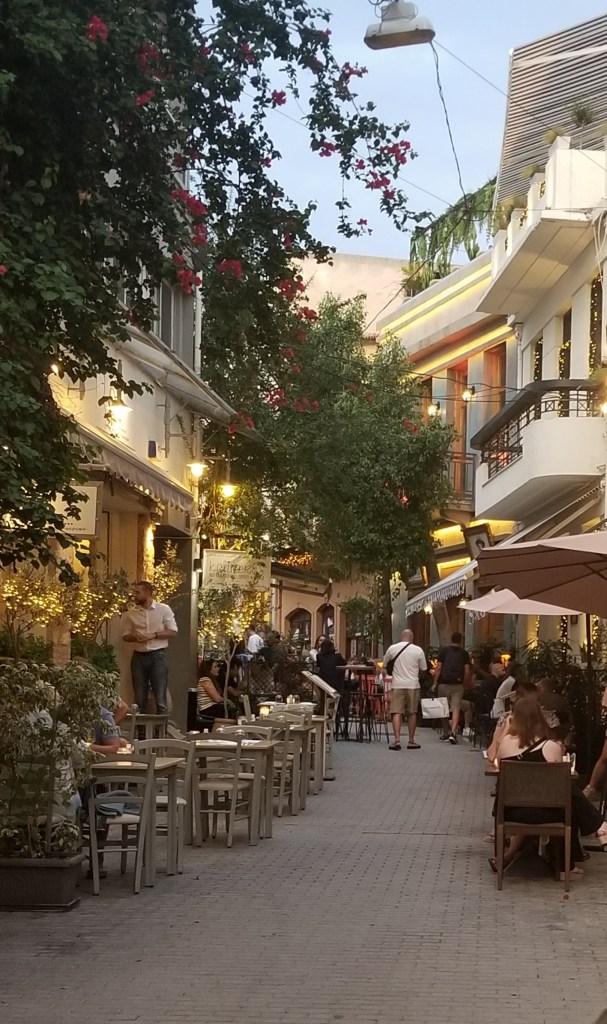
Behind our hotel was a rabbit-warren of tiny streets, many of them pedestrian, filled with all sorts of restaurants. I had a delicious moussaka there one night:

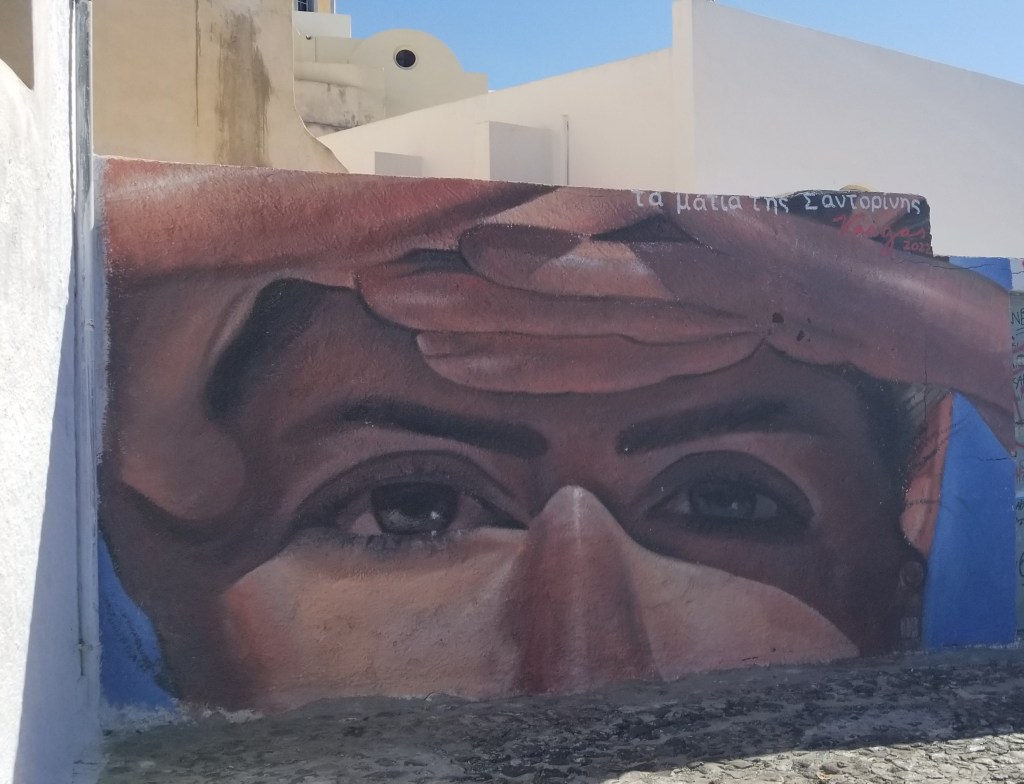
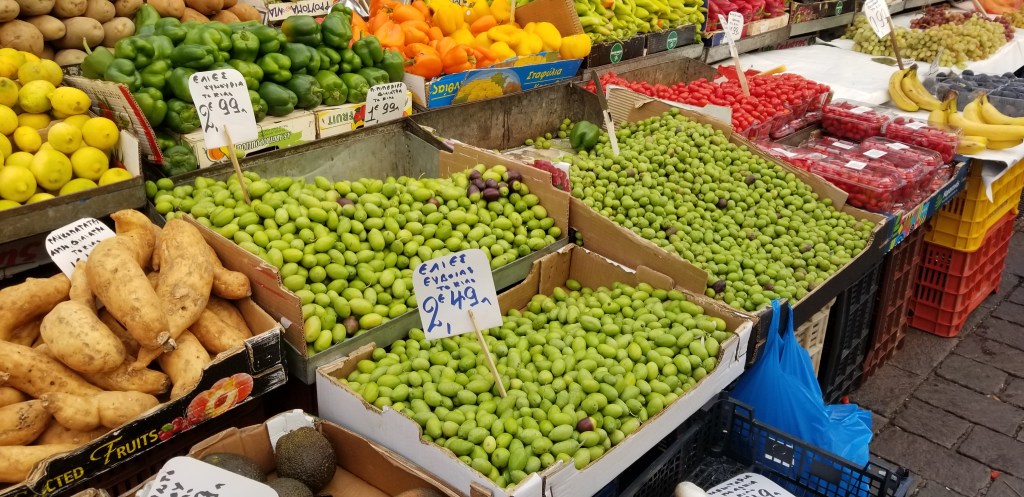
Walking out the door in the other direction, we’d see some great murals, and a market selling goods old and new, as well as produce, meat and fish. There was a lot of hanging meat here, too, but since I included a picture of that in my Thessaloniki blog I thought I’d spare my readers the sight of that.

Just a few blocks down was our favorite souvlaki stand. Upon our second meal there, a woman who worked there recognized us and started chatting with us. We returned to the Hotel Attalos for our last night in Greece and looked forward to one last souvlaki meal, and perhaps finding out more about her. Was she one of the owners? She was not there that night, so we’ll never know, unless we return to Hotel Attalos some day. That is a distinct possibility. Cal really wants to return to this souvlaki stand.

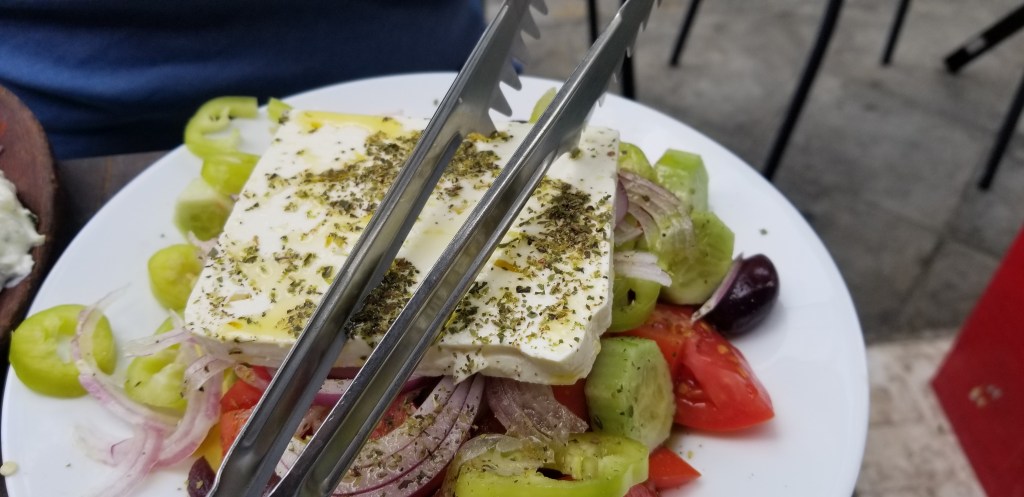
This is a Greek salad. No matter where we went in Greece, a Greek salad was the same all over: tomatoes, cucumbers, green pepper, and (for Cal) onions and olives. All of it under a slab of feta, with no lettuce. The tomatoes, in particular, always tasted freshly picked from someone’s garden.

The best thing about the Hotel Attalos, however, and the reason for booking this hotel, was their rooftop bar. I don’t normally look for bars in hotels, but this one was special: it had a view of the Acropolis, lit up, at night. The great view of the city all around and out in the distance was a bonus. How relaxing, after a busy day of sightseeing, to sit up here with a Spritz and watch the sun go down and the lights go on!

Next time: a day trip to Delphi

Europe · Greece

A Visit to Ancient Athens – Europe Travels September 2022

One more train ride on our Eurail Pass, from Thessaloniki to Athens. Unexpectedly, it was one of the best. On the day we arrived in Thesssaloniki, before we met the group, we figured out the closest bus number and stop from our hotel to the train station, and made a trial ride. We showed a sleepy ticket agent the Eurail passes on my phone and without comment he punched out a couple of paper tickets with seat reservations. We were excited about paper tickets! It meant we could actually go through the turnstiles without causing a commotion.

On travel day, we allowed extra time for the capriciousness of bus schedules and arrived at the station early. There was time to thoughtfully purchase lunch to eat on the train, find our track and our particular car. All of the seats faced forward, the train was not crowded, and the windows were clean to see out. We had a view of Mt. Olympus (which Cal climbed, a long time ago), a lot of cotton being harvested, and a beautiful mountain range that we went right through. The travel time to Athens was about four hours. Two stops on the subway, an eight minute walk, and we were in front of our hotel.

The star attraction in Athens, of course, is the Acropolis. We headed out early the next morning for our walk through picturesque neighborhoods, with many ruins along the way. The Acropolis, at the top of the hill, was often in view.

An ancient stadium is still in use.

We walked past the remains of the Roman agora:

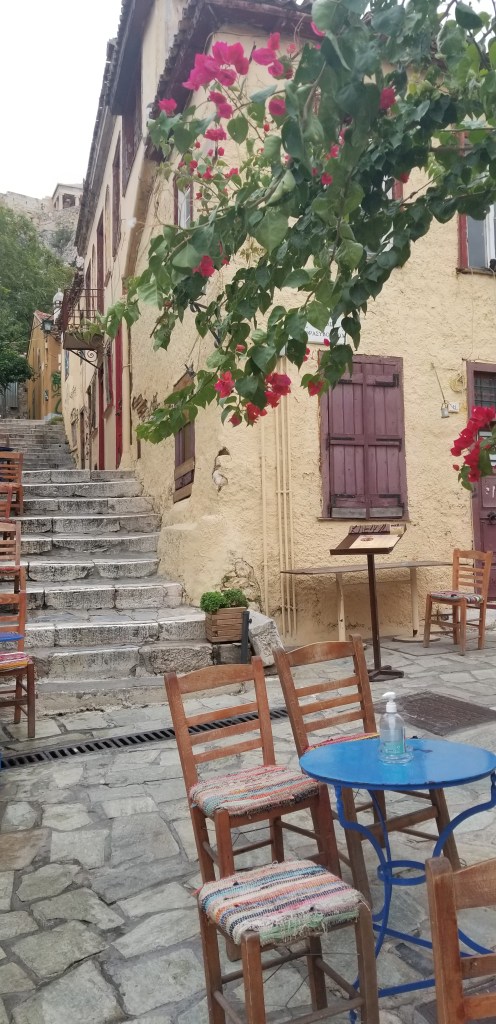
and plenty of pretty cobblestone streets and lanes.

We were at the Acropolis almost as it opened, which was perfect. The crowds only get heavier as the day goes on.

The Acropolis is the term for the whole complex on the hill. There have been fortification walls around this hill for 3,300 years; the first wall was built in the 13th century BC. In the latter part of the 5th century BC, the Greeks had a decided victory against the Persians and established democracy. An exceptional age of thought and art followed, and the monument to these ideas were established. It was dedicated to the goddess of wisdom, Athena. Today it is a UNESCO world heritage site.

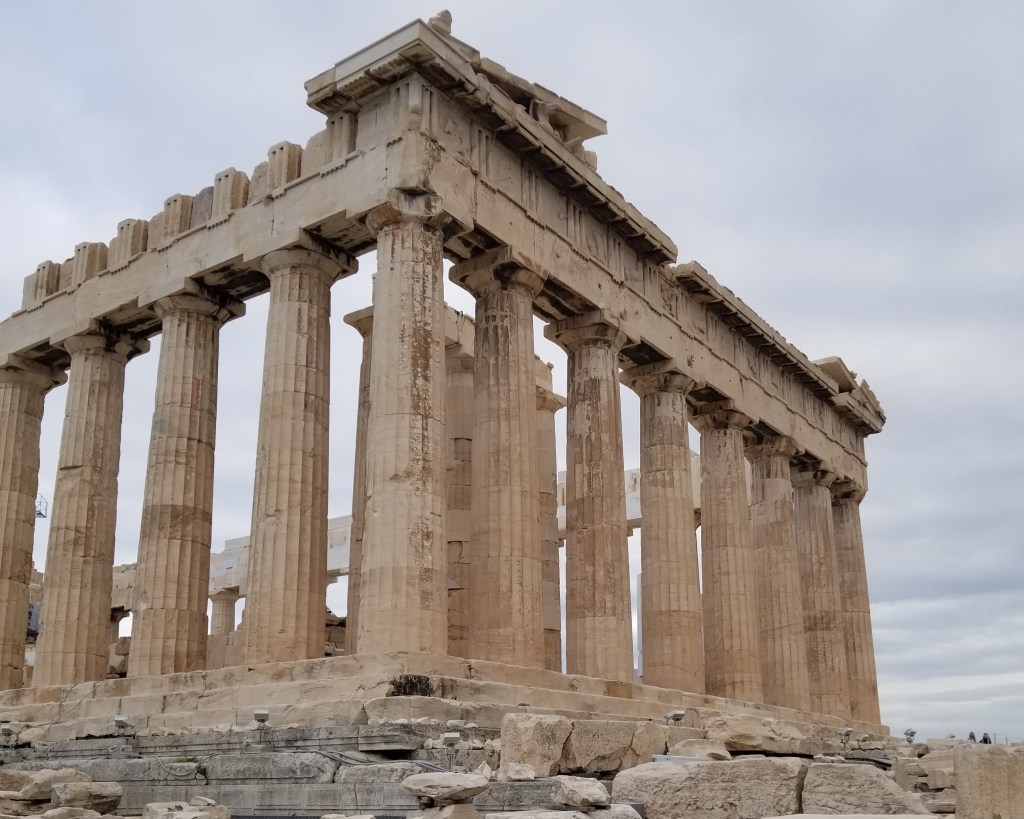
The Parthenon is a temple and but one of the ancient structures on the Acropolis, although it is arguably one of the most famous. It was an unbelievable and indescribable moment to be standing here.

Also at the Acropolis is the temple of Erechtheion, dedicated to several different deities, including Athena.

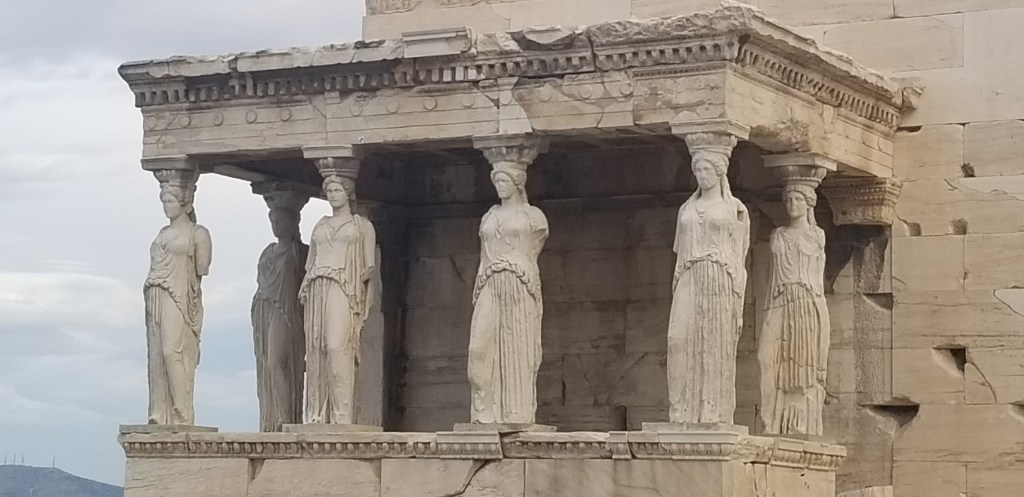
I liked the caryatids that are to one side of the Erechtheion. Caryatids are sculpted female figures used as a support instead of a column. These are all replicas; the originals are in the Acropolis Museum.

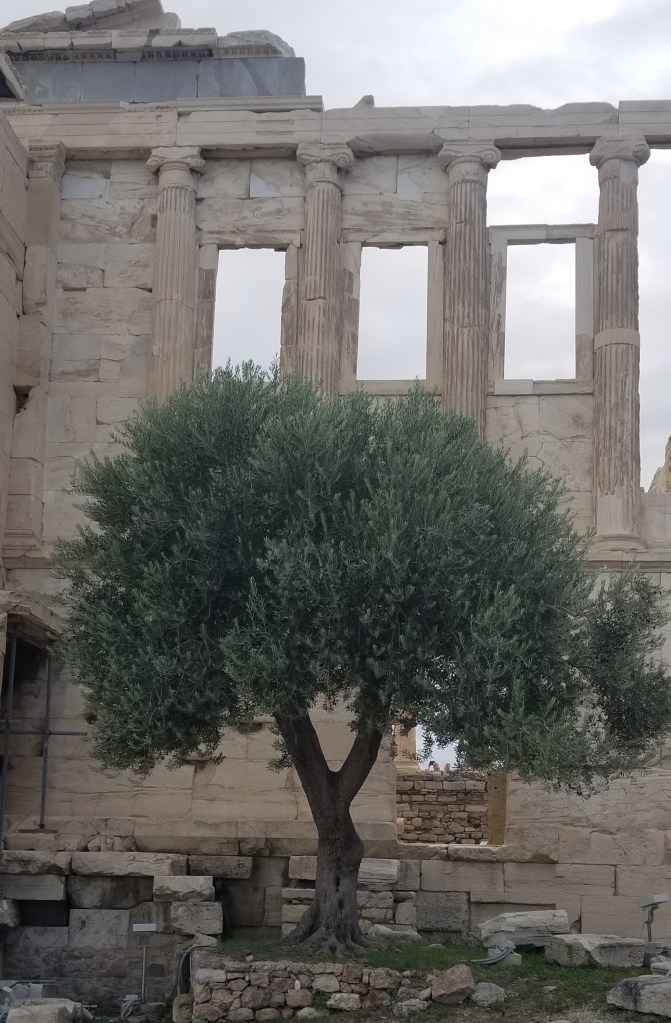
There was once a statue of Athena here; it was later carted off and destroyed in one of Greece’s battles. The story goes that Athena planted an olive tree here. The olive tree symbolizes peace, wisdom and harmony. Of course, the sacred olive tree from antiquity is long gone. This one was planted in the early 20th century.

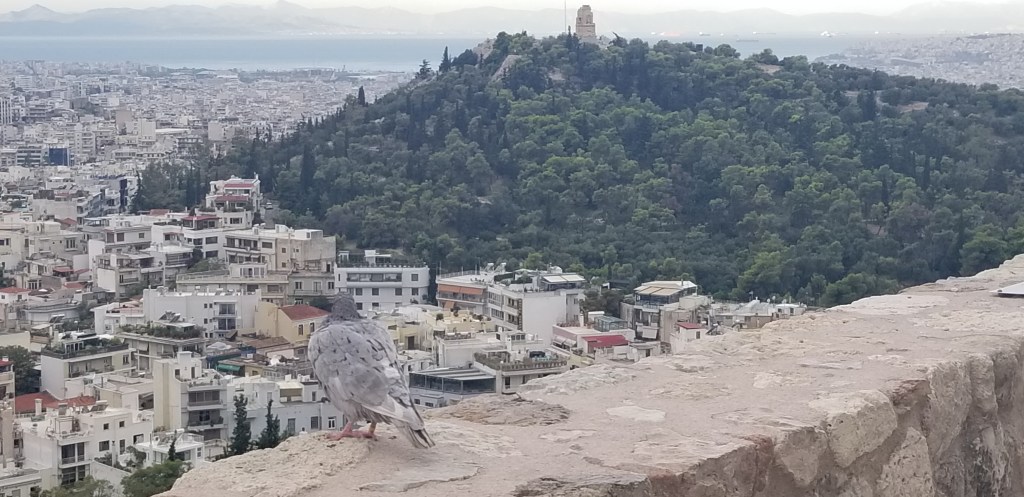
A pigeon and I admired the view from the Acropolis.

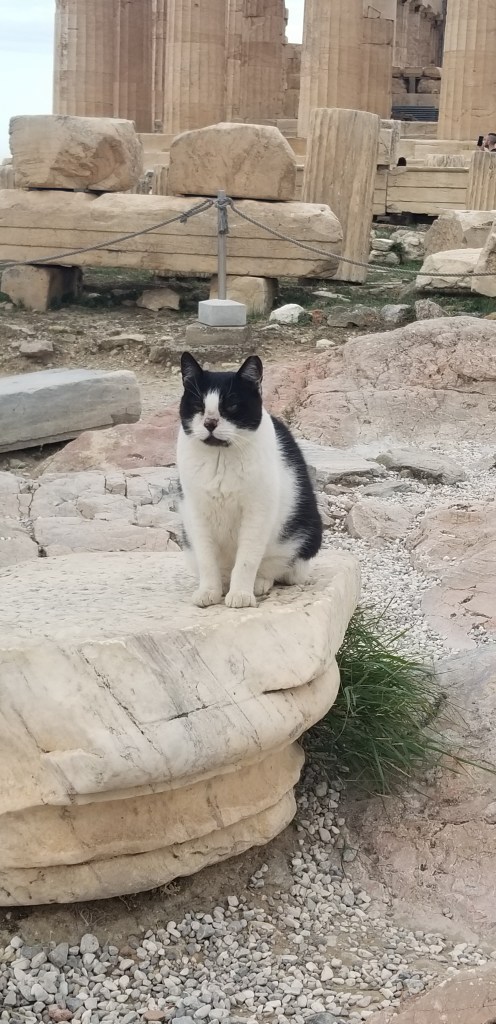
Beginning in Thessaloniki, we had begun seeing feral cats everywhere, and I delighted in seeing them. There are several to be seen at the Acropolis. I presumed this one was male, owing to his size, and dubbed him “King of the Parthenon”. I chatted with a lady who was feeding kitty treats to all the cats; she walks up and does this every morning. I’m sure that’s better than the junk food that many tourists probably feed them. Mr. King looks pretty well fed.

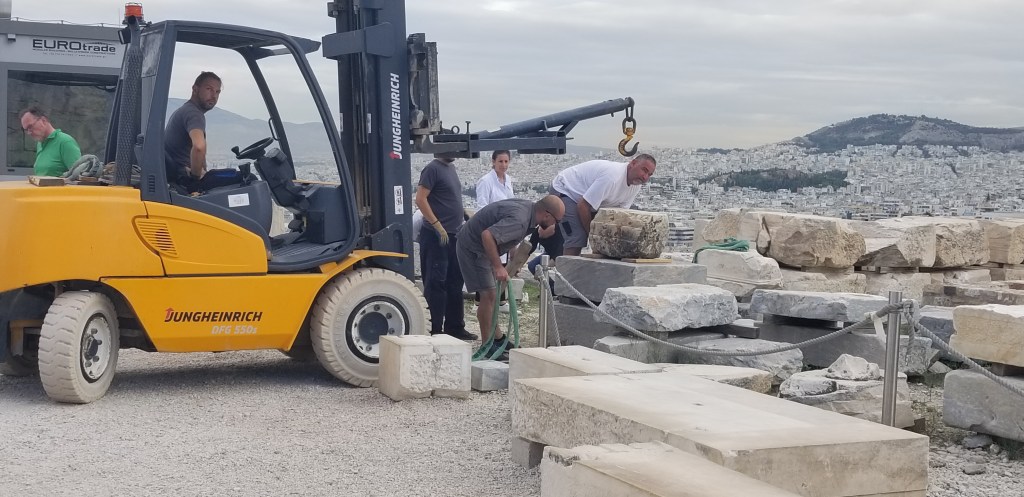
We also had fun watching a team of people reconstructing some ancient ruins. There was great discussion regarding the placement of the stones. The forklift driver waited patiently for someone to make a decision. The lady in the white coat, whom I would presume to be the archaeologist, seemed to always have the final word.

It’s wonderful that they pay so much attention to getting the tiniest details just right.

After visiting the Acropolis, the natural thing to do is to visit the Acropolis Museum, which is on the south side of the hill.

The surprise here is what is under the museum. When building it, the remains of a whole neighborhood dating back to the 4th and 5th century BC was discovered.

I was surprised that this neighborhood had a system of pipelines for clean water and and an underground sewer that ran under the sidewalks. I did not think that any dwellings of that age would be so advanced.

It is quite extensive. One more view:

What to do with such a treasure? Well, if a museum is being built above this, that’s easy: just make it a subterranean level of the museum.

Upstairs, I found one of the original caryatids from the Erechthion up on the hill.

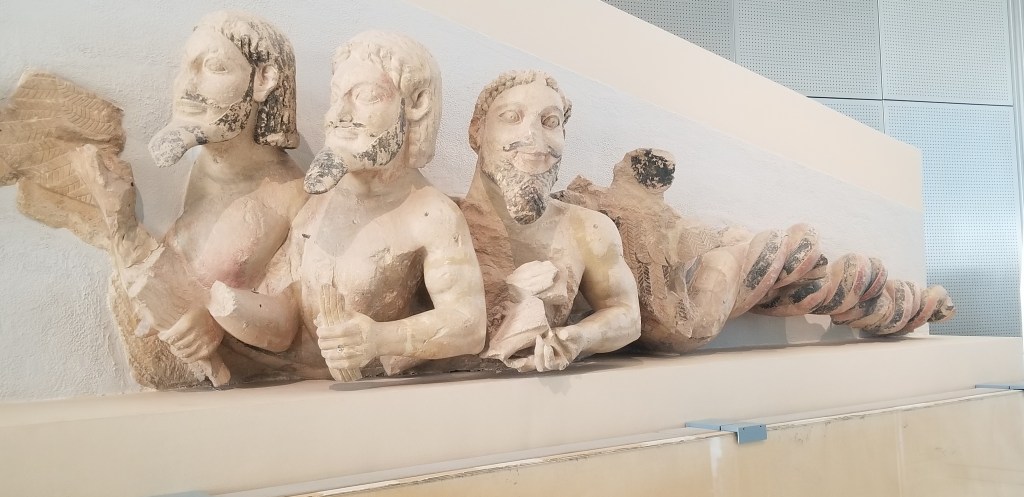
This is what the pediment of the west side of the Parthenon looked like. A pediment is the triangular upper part of the front of a building; the Greeks loved to put statues up there. In the center is Athena, and next to her is the sea god Poseidon. Poseidon is revered for striking a rock with his trident and causing a saltwater spring to appear on the Acropolis.

These smiling gentlemen are original architectural details that would have gone above a pediment.

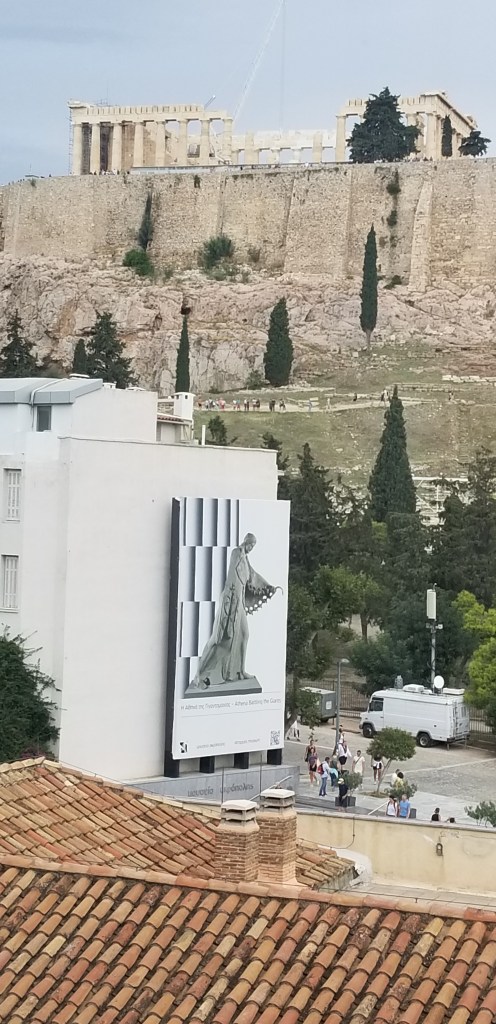
Here is a view looking out from the museum to the Acropolis above, where the antiquities came from.

My original plan was to smoosh everything we saw in Athens, including a day tour that we took, into one blog. Clearly, it did not work. Our short time here was packed from the time we left our hotel early in the morning to our search for a place to eat dinner – and it didn’t even stop there. There will be another Athens blog!

Next time – Athens, Part 2

Europe · Greece

Back in Time to Giannitsa, Greece – Europe Travels September 2022

On this sunny Saturday of Cal’s reunion with his Army buddies, we went back to where it all happened – the small detachment outside Giannitsa where they were stationed. For background, if you haven’t read my previous post, you may want to do so before reading this one.

Lefteris procured a van for us for the day. I was surprised that no other family members besides myself were coming, but there wouldn’t have been much more room in the van anyway. I wasn’t going to miss seeing this place that I’d heard so much about.

Our first stop down memory lane was this bridge:

Back in the day, this one-lane bridge was a mile long and had a stop light on either end, necessitating at times a long wait. And sometimes, the drivers coming the other way just didn’t want to wait for their light. The guys had many funny memories here, and there were a lot of stories flying back and forth. There is a “new” road now that bypasses this bridge.

By titling this blog “back in time” I didn’t only mean the time while Cal and his friends were stationed here. There also things to see that went back to the time of Alexander the Great.

Tom was the perfect guide for the day, making sure we stopped at everything of interest, and I really appreciated his efforts in this. Our first stop: a statue of Alexander, in the town where he was born, Pella.

We then moved on to ancient Pella. We pulled in to the site, discovered that it cost money, and Tom and Lefteris went over to the ticket booth.

Score! They told the people that we were all veterans and that the guys had been stationed nearby. Free tickets for all!

This is the ancient town of Pella, the place where Alexander the Great was born and raised. The amazing thing about this is that it used to be covered by the road going to Giannitsa. Cal still remembers seeing this pillar, which was the only thing that could be seen when he and his friends were here.

They couldn’t believe all of this had been underground as they had driven by. In the picture below, you can see the lone column amongst the ruins.

I should mention that we were respectful of these ruins, despite my sitting on an old Macedonian wall. The ruins were open for anyone to walk in and around, but we stayed outside the walls when doing that. The most precious pieces, the ones no one should step or sit on, are in a museum. Here at Pella are some, though, that have low barrier fences under shelters around them, and these were mostly the mosaics that had been found:

This was a mosaic floor depicting the abduction of Helen.

Once-flourishing Pella was the capital of the Macedonian kingdom. The city is believed to be inhabited as far back as the 4th century BC, and it was huge. There was a palace here, a rectangular street layout, and a water supply system with drainage, among other things. Most homes had a mosaic, which told the archaeologists that there were many mosaic craftspeople in town.

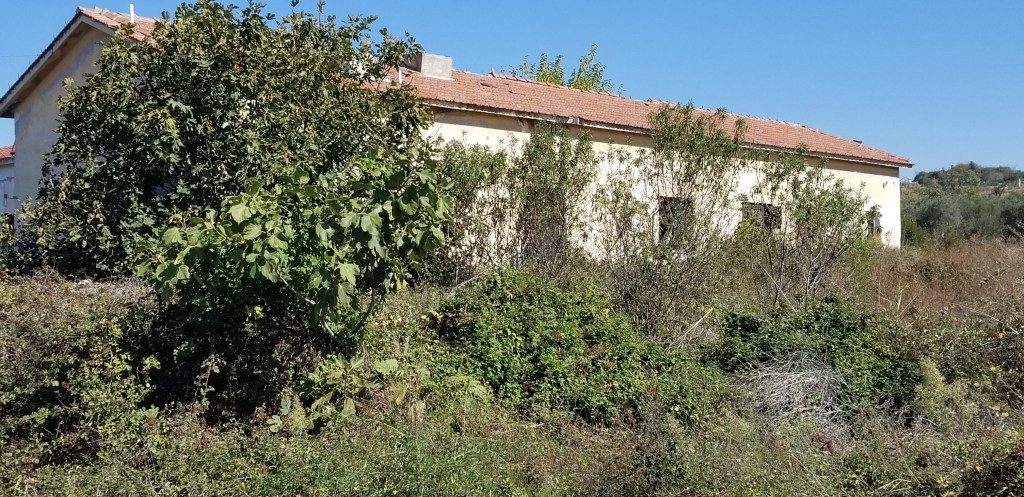
We finally arrived at the old detachment, which is now in a ruined state.

What were the guys doing when they were stationed here? Officially, they were advisors to the Greek Army since the communist country formerly known as Yugoslavia was just over the border. Today, that country is North Macedonia, named so as not to cause confusion with this area of Greece which was formerly Macedonia.

Nature is reclaiming the site. Mulberries and olive trees are growing wild and fighting for space along with the weeds and prickers. We picked through some of it to get a closer look, but I think the prickers won the battle.

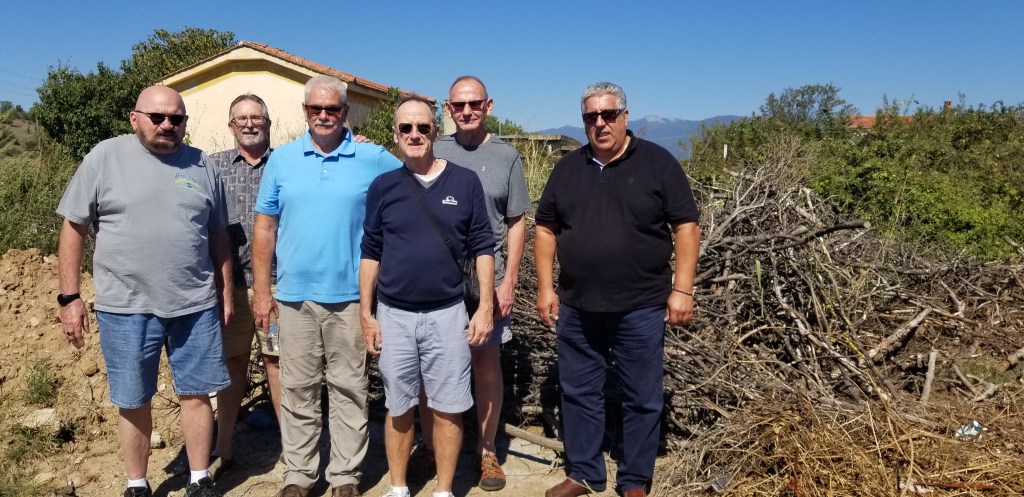
Billy, Mark, Cal, Tom, Milan and Lefteris: not the young kids they used to be!

The Greek Army was across the road and that site is still there and operating. That is where Lefteris was stationed.

Here is an old throwback picture of the American detachment from back in the day:

From the site, this picture is a view of Mount Paiko, which lies on the border:

This area is a fertile plain, producing cotton, tobacco, peaches, rice, olives, and other crops. Cal remembers that fields completely encircled the site, but now there are some homes and farms.

The guys were excited to see the site. They tried to figure out what was where back in the day, and many stories were told. Cal felt bad that it had deteriorated so much. Inside, everything which wasn’t nailed down, to include the fixtures, had been plundered and hauled away. We looked and walked down the road a bit.

Many of their memories are also linked to the little town of Giannitsa which is nearby. We traveled there next for a walkabout and a late lunch.

There is a tradition in Greece called the volta. Every town has one, and it is an area for an after dinner stroll and socializing. The way it was explained to me, in Giannitsa, a street was blocked off on weekend nights for this purpose. Lovely young ladies would be part of the stroll, and Mamas would hope that their daughters would make a good catch. Once she found a young man, of course, Mama could also supervise the dating scene right there on the Volta. Cal just remembers walking up and down the street, saying hello to people and that the locals were friendly. He thinks that the Greeks enjoyed them being part of the tradition.

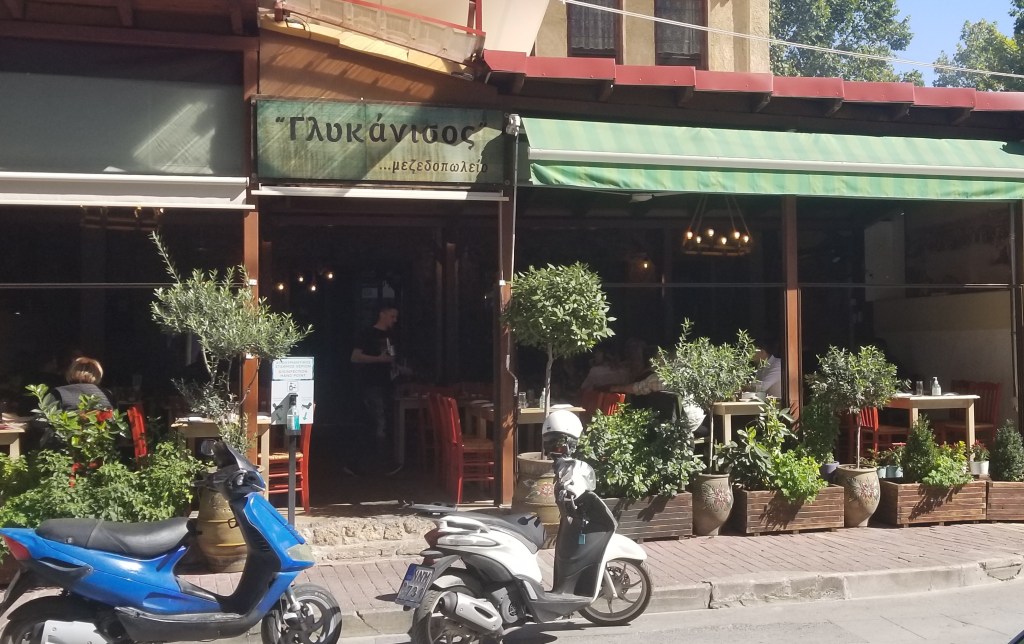
Giannitsa is now a small city, and the volta is blocked off permanently to traffic. Cafes line the sidewalk.

The efforts of the Mamas must have paid off. In just the couple of years surrounding the time that Cal was here, several of the guys married Greek women. This is the local church:

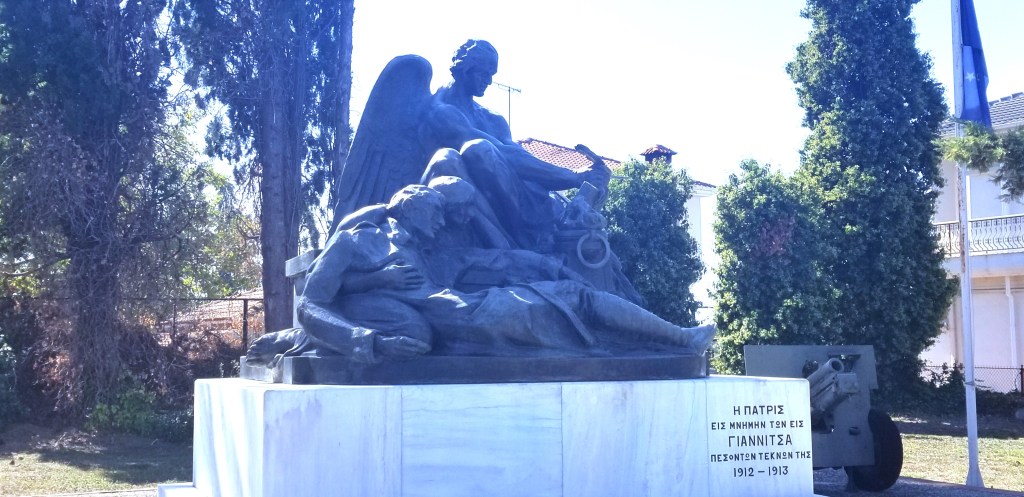
We had one more stop to make on the way back while still in Giannitsa. Tom said he had driven by this statue many times but had never stopped to look at it before.

It is a memorial to the soldiers lost in the Battle of Giannitsa, the final combat between the Greeks and the Ottomans in the war for independence in 1912. The signboard nearby stated that “the Ottoman Army retreated disorderly, followed by Muslim residents.”

Our day had come to a close, and it was time for the drive back to Thessaloniki. Kudos to Tom and Lefteris for all of their efforts in planning such a wonderful day. The whole weekend had been spectacular. Seeing the detachment again was fun, but seeing his friends again for made it special for Cal. I really enjoyed meeting the guys. Of course, there were so many others…ones that had not been able to make the trip, ones who have never been found on Facebook, and many that have already passed on. They were all remembered this weekend.

Of course, we couldn’t just spend one long weekend in Thessaloniki and leave the country. It was time to head south, and the next destination was just a train ride away.

But first: how about another throwback picture to when Cal was here? Most of the guys had an extra job in addition to their regular duties. Cal’s job was to run their little PX. He had to make trips down to Athens to resupply it, and usually had a list of special requests from the guys. The Quonset hut which housed the PX, rec center and a bar is gone now.

Next time: south to Athens

Europe

A Reunion in Thessaloniki, Greece – Europe Travels September 2022

Cal and I had only been dating a few months when the Army sent him to a little isolated detachment in northern Greece for a year. This was at the height of the Cold War era. In a pre-internet time where even phone calling was impossible, he wrote me letters. Lots of them, to his credit. I heard about all the antics that he and the guys got into, the day-to-day drudgery, but also all the things he saw and did. He sent back beautiful pictures of Greece, and I thought he was so lucky to be seeing the sights while I was back in the middle of Texas.

He and his buddies lost touch, but Facebook brought them back together. In 2019, they had a reunion in Las Vegas, with many of them attending. This was the year to have a reunion back where it all happened. Amazingly, it dovetailed perfectly with our big Europe trip, which was very exciting!

How to get to Thessaloniki from Venice? It’s too long a distance by train, involving many transfers, so we couldn’t use our Eurail pass. The best deal was, strangely, with Austrian Air. We flew north to Vienna and then south to Thessaloniki.

The city lies on the Aegean Sea north of Athens by about two hundred miles, as the crow flies. Driving that distance would add on another hundred miles. For the reunion, we stayed at the City Hotel in the heart of downtown and a couple of blocks away from the water.

We met two of the guys at the hotel, Milan and Billy. Another, Mark, came later in the day with his wife and additional family members. The reunion was organized by Tom, who has a Greek wife and lives here. That was it for our group. Attendance was small for a long and expensive trip to Greece.

On our first morning we set off with Milan and Billy to explore the White Tower which you can see on the left of the picture above.

It is a long climb up but there are displays on the history of the city on each level, where prison cells had been.

At the top we were rewarded with a great view, and Tom found us here.

The White Tower replaced an old Byzantine fortification in the fifteenth century by the Ottomans. It has a sad past, since it had been a notorious prison and the scene of many executions. When Greece reclaimed it in 1912, it was cleaned up and now it is a symbol of the city.

Over the weekend, there were many recollections of the city back in the day: buildings that were here and are not now, especially the American Embassy, and memories of fun times. Thessaloniki lies about 35 miles from where the detachment was.

Tom was a great guide and walked us around the city a bit. He showed us the old Greek Embassy. When Thessaloniki was under Ottoman Rule, Greece had an embassy here, which sounds really strange. 1912 was the big year; when Greece gained control the embassy was closed. We looked at the Greek Orthodox church next door from its patio.

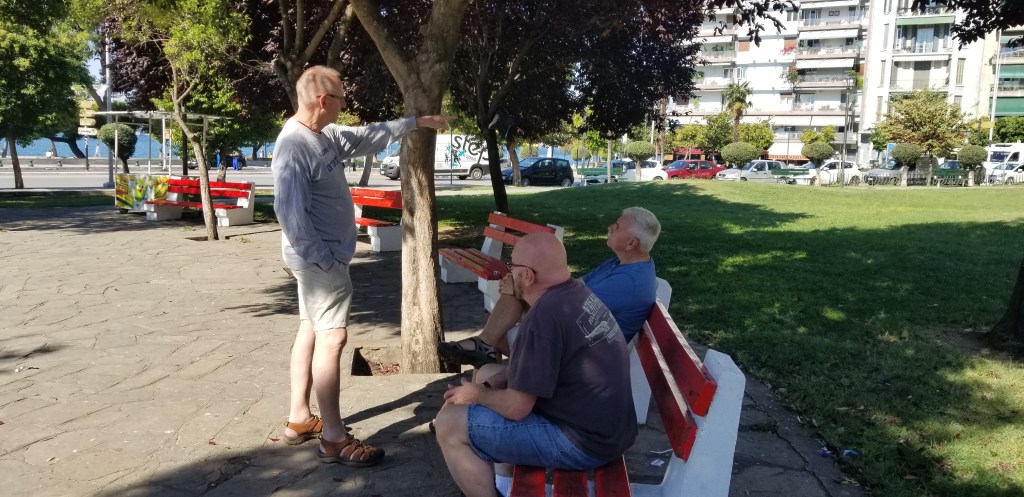
Later, I needed a nap and when I awoke, the guys had disappeared. I left them to their visiting and went exploring. There was an old Jewish bath house that I wanted to check out, hoping I could peek inside. It was locked tight.

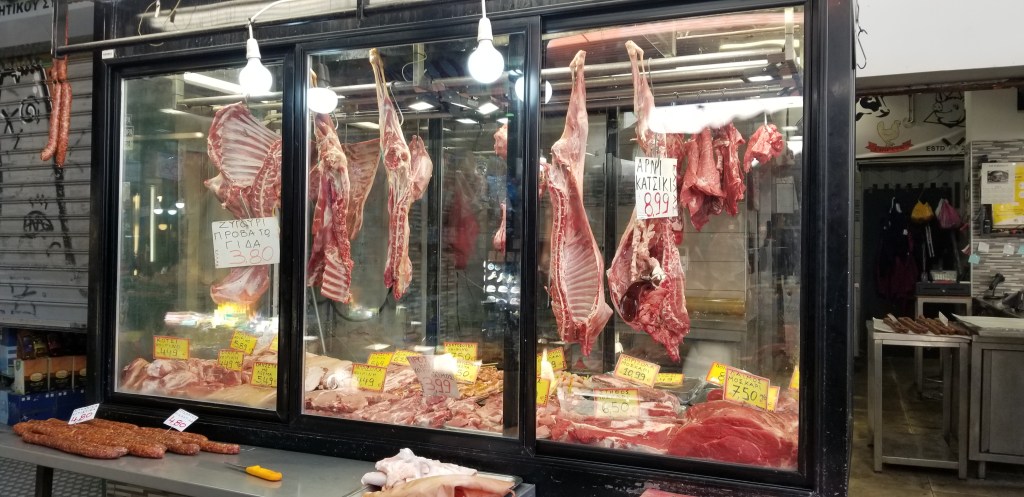
Next to the Jewish baths, there’s a market:

I was pretty glad that I did not need to purchase any meat or fish.

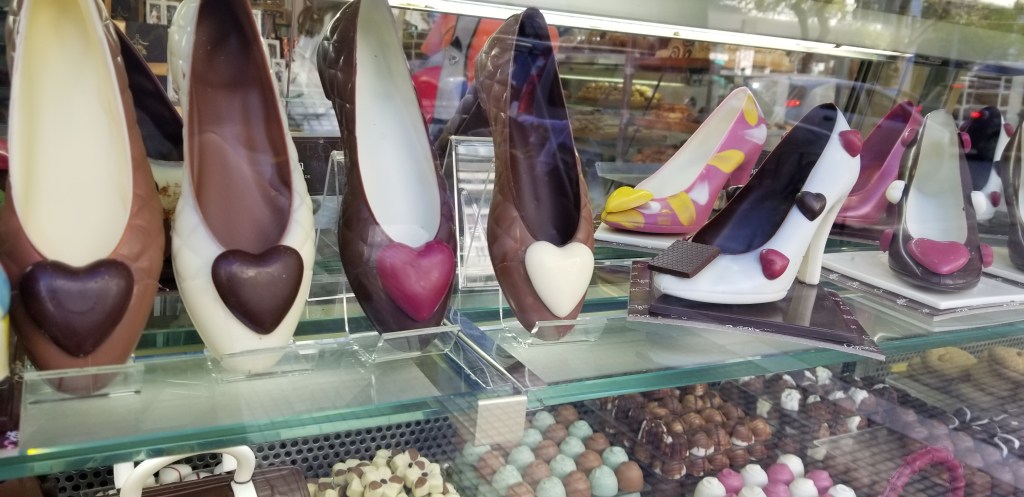
Chocolate high heels, anyone?

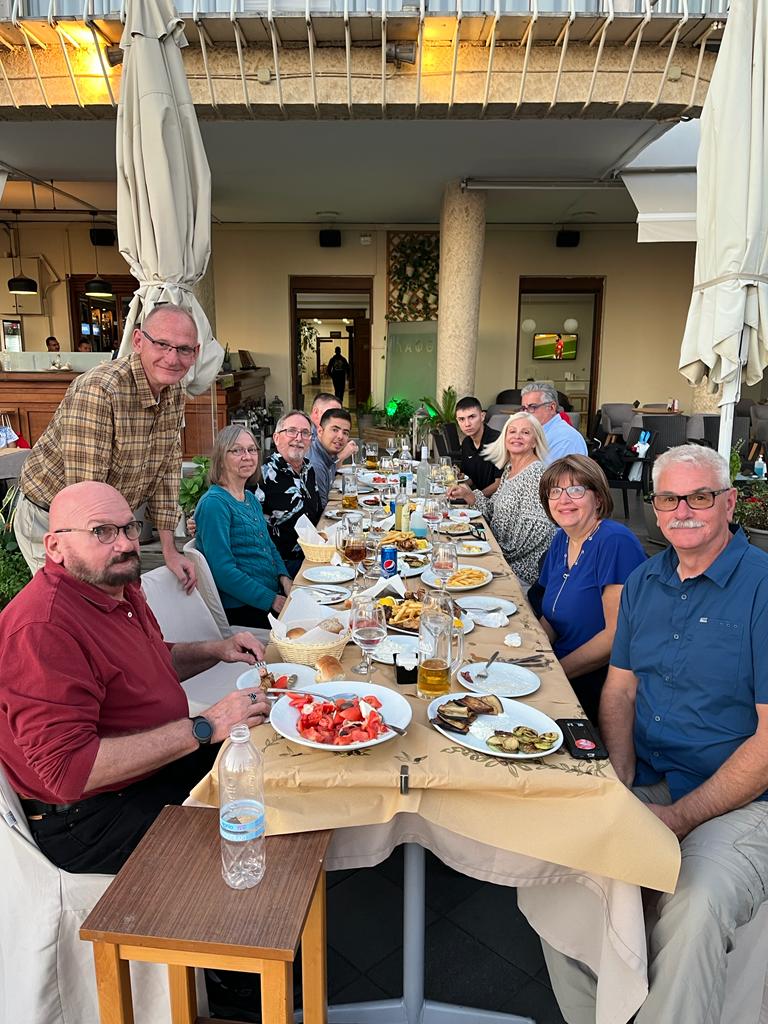
There was one other person to meet besides the Americans: Lefteris Dimopoulos, who had been in the Greek Air Force and had been part of the support for their detachment. He and Tom had put our reunion dinner together, which was at the Greek Officer’s Club. It was a feast of Greek salad, grilled aubergine, squash, and other vegetables, platters of Greek hamburger, souvlaki pork, chicken, pork strips, and french fries, with tzatziki sauce. The food kept coming, the conversations flowed, and we had a great view of the White Tower and sunset on the Aegean. It was spectacular.

Credit for these two pictures goes to Tom.

Left to right: Mark, Billy, Tom, Cal, and Milan

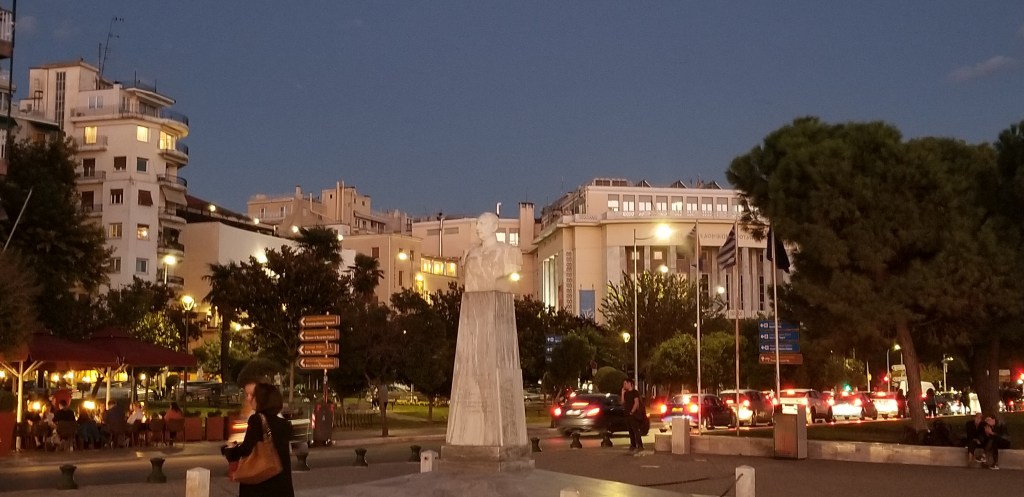
At night, Thessaloniki comes alive. The Greek Officer’s Club is behind the flags and is where we had our dinner.

The next evening our entire group visited a local seafood restaurant. It was Saturday night and the town was humming. We were there for several hours and for that entire time, every seat was packed in the restaurant inside and on the huge patio outside. The streets were crowded with pedestrians and traffic was down to a crawl. Party time in the city!

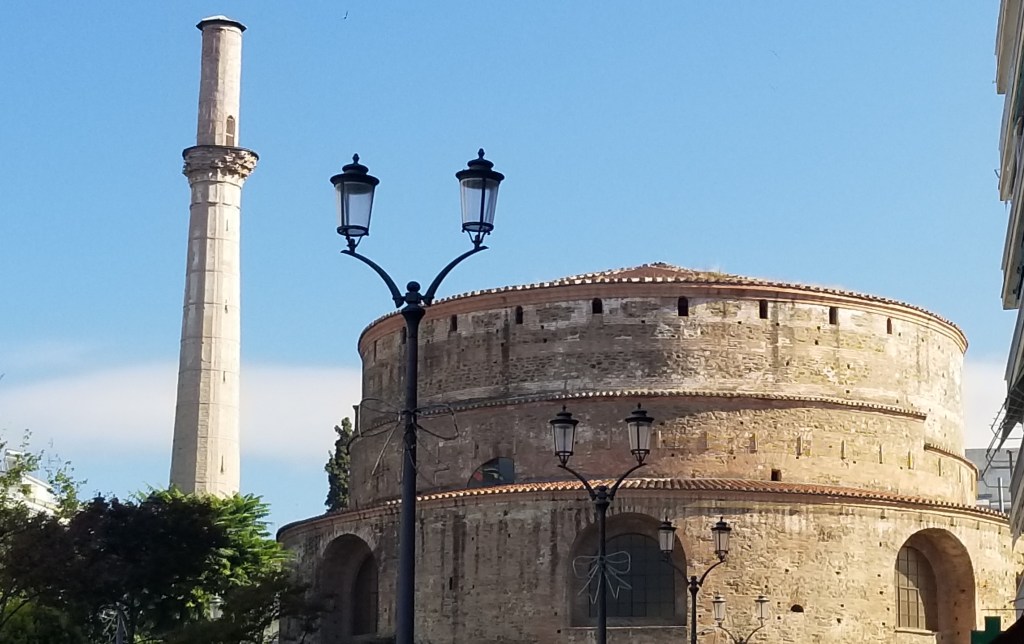
We did get to do some other sightseeing in Thessaloniki. This is the Rotunda:

For the Romans who built this Rotunda, the building’s purpose was a place for worshipping their deities. It can be compared to the Pantheon in Rome. Later, it became a Greek Orthodox church, and then a mosque when the Ottomans came to power in the 1500’s. That is why the minaret still stands to the left of the Rotunda. When Greece regained power it reverted back to Greek Orthodox.

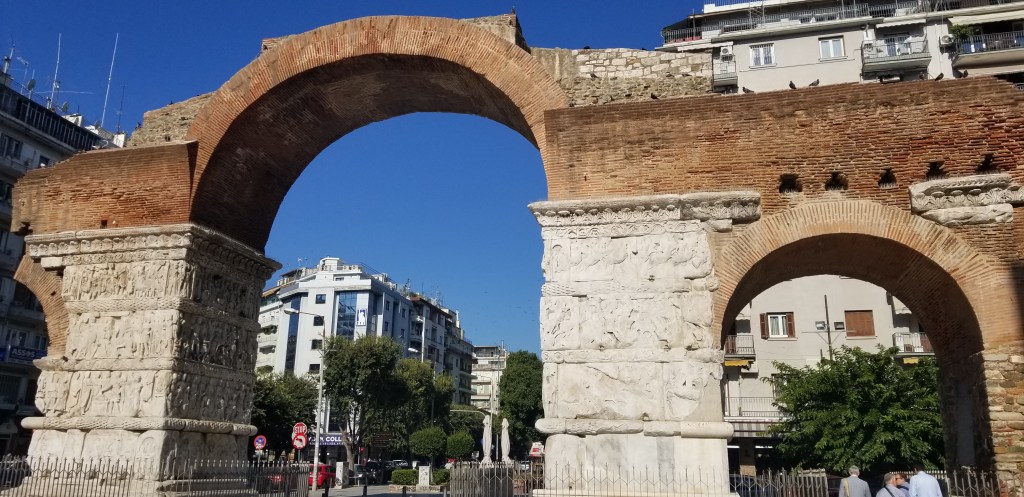
There is the ruins of a Roman gate:

What I came to love about Thessaloniki, and all of Greece, is that you can walk anywhere and see ancient ruins. If any kind of building is to be built, a team of archaeologists have to investigate the site and see what’s in the ground first.

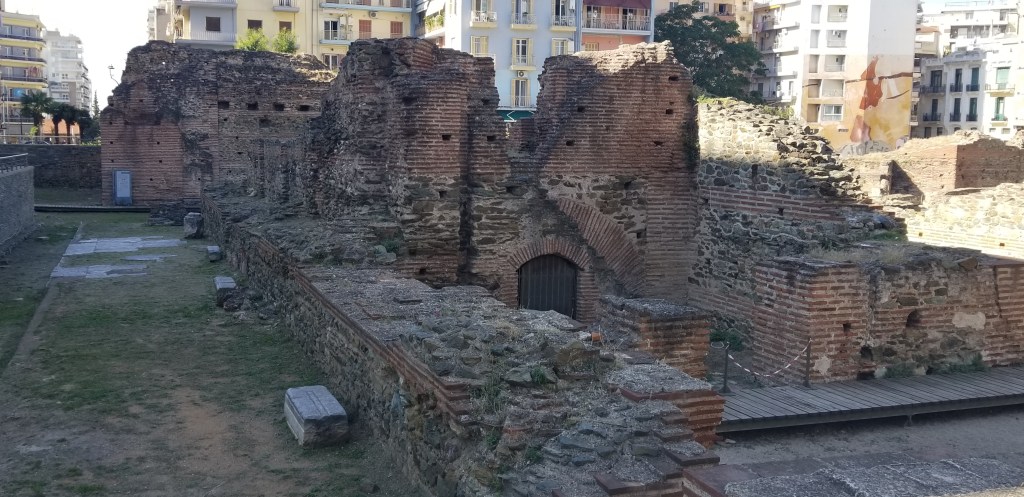
So, we were just walking down the street, and we came to a whole complex just below street level. It was once the magnificent home of Caesar Galerius and his court whenever he was in town. There are ruins of a basilica (an audience room), which still partly lies under the street. Additionally, we saw ruins of the Roman baths, and other buildings that made up part of the palace.

I also visited two museums: the Archaeological Museum of Thessaloniki, and the Museum of Byzantine Culture.

In the archaeological museum, antiquities abounded. This is the deed to a house, dated to 350 BC.

The Byzantine museum moved forward in time. This mosaic dates to about the 5th century AD.

I was glad I went to these museums, because they clarified for me what was happening historically in Greece through the centuries. There was the early Macedonian kingdom which was replaced by the Romans. The Roman era went into the Byzantine era, and then Greece was conquered by the Ottomans in the 15th century. Their rule lasted until 1912. This is simplified, but it greatly helped to explain everything I was about to see in the coming weeks.

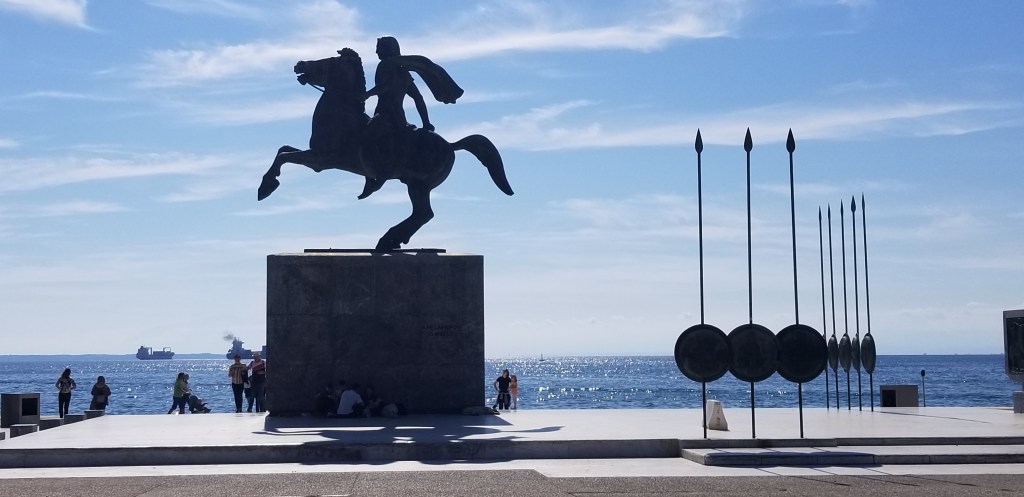
A statue of Alexander the Great looks out to sea on the shores of the Aegean:

Beginning with Italy, our trip began to look like Eat, Pray, Love with an emphasis on “eat”. In Thessaloniki it went full throttle. Every time we were out with the group, there were plates upon plates of food because everyone wanted to try some remembered dish. Out on the street, there are souvlaki stands, and Milan found a good one for us for the times in between when we might be just a little hungry. The smells coming out of the souvlaki stands are incredible.

This is the first meal we had when we came to Thessaloniki, on the patio of a restaurant by the sea:

Over the years, Cal has told me many times about having feta cheese that had been thrown in a wood-fired oven until it was soft, warm, and delectably tasty. Mark shared this memory with him, and they ordered the warm feta appetizer in a couple of restaurants until – Bingo! – one restaurant got the taste exactly right.

I’ve left off a big part of this reunion. On the day after our grand dinner at the Officer’s Club, we traveled to the detachment where the guys had been stationed. It turned out to be more than just a quick view. That’s for next time!

Next time: A Trip to Giannitsa, and Everything Along The Road

Europe · Italy

“Il Burchiello” to Padua – Europe Travels September 2022

Before leaving home and also in the earlier parts of our trip, I wondered if we would be tired of spending so many days in Venice. It might be nice to have a little side trip over to the mainland, maybe. Padua looked interesting. It is about thirty miles inland, has frequent trains from Venice, and the train ride is only about a half hour long.

As it happened, on our train ride from Munich to Bolzano, I conversed with a woman from Berlin across the aisle from me. She was traveling solo to Padua on her “holiday” (that’s what Europeans call a vacation). She’d been to Padua a couple of times earlier as part of other trips, but this time she wanted to spend her whole vacation there. Hearing my interest in Padua, she told me about many wonderful things that one could see, most of which I’ve forgotten now. “I’m not going to do it this time,” she mused, “but I always thought that I would like to take the boat from Venice to Padua.”

What? It’s possible to ride a boat to Padua?

It is, and after some investigation, I booked us on the tour that goes across the lagoon and down the Brenta River from Venice to Padua. Traveling involves a certain amount of serendipity, plus keeping one’s ear to the ground.

So it was that early on a sunny morning, we boarded “Il Burchiello” at the harbor near St. Mark’s Square and found great seats at the top. Some passengers brought suitcases. Our group spoke English, Italian, and French, and our guide gave us information in all three languages all day long. She began by giving us a rundown of what we were seeing as we left Venice. It was interesting to see the city from a different vantage point.

We rode out into the open lagoon and soon entered the mouth of the Brenta River.

In the 1500’s, the Venetians turned part of the river into a canal. We passed through the first of six locks. This one was still purely Venetian made, constructed in that era.

From the 1500’s to the late 1700’s, this canal was extensively used by the wealthy of Venice – the ones that had their names written in the Coffer room back at the Doges Palace. It was hot in the summertime in the city and the idea of air conditioning had not yet entered anyone’s mind. They would spend their summers in their villas along the Brenta Canal. It was considered a “fashion canal” because they would promenade along the pathways visiting each other and trying to outdo each other with their style of dress, the construction and decor of their villas, and the sumptuous parties that they hosted.

The nobility arrived at their summer homes with all of their wardrobes, all of their servants, and even some of their furniture.

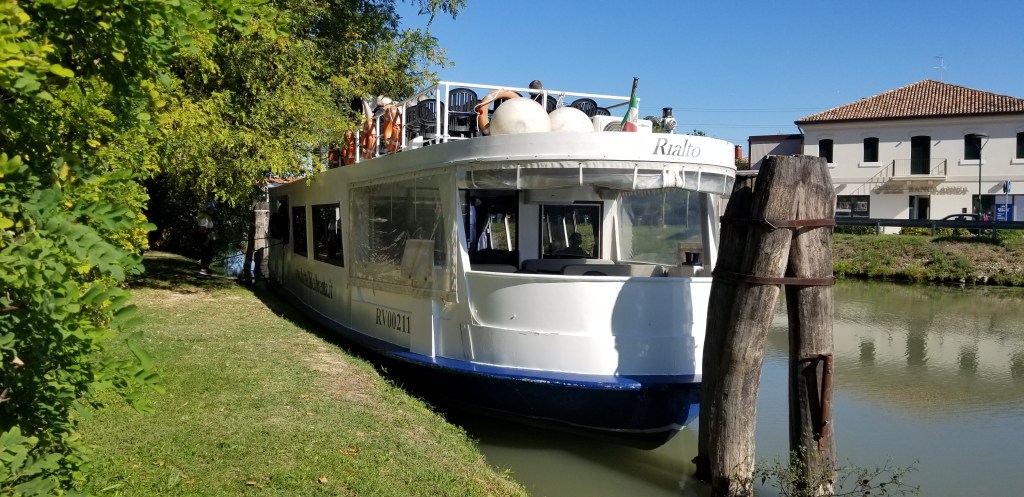
This was our boat for the day. Back in the Renaissance era, the boats were called “burchielli”. They were powered by oars through the lagoon. Along the Brenta Riviera, they were drawn by horses. So, a trip out to the villa was slow. The ladies and noblemen were entertained by adventurers, actors and artists.

Going through the locks, it always took quite a bit of time for our lock to drain or fill in order to pass to the next level. In this picture, we are ready to go, and the doors are opening.

There were also nine bridges that swung sideways for us. We had first seen one in Scotland, but this time we were the ones on the river.

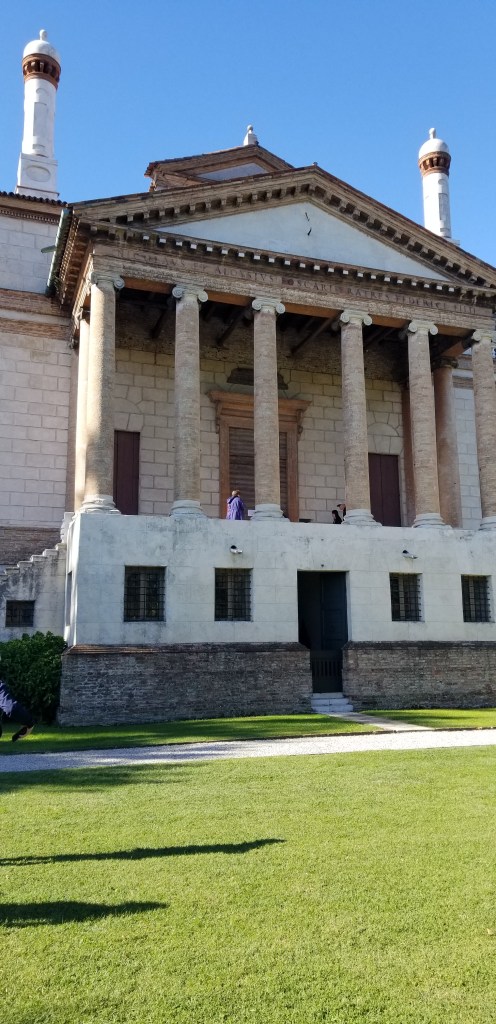
Our first stop was at Villa Foscari, in the town of Malcontenta, built between 1558 and 1560 by the renowned Renaissance architect by the name of Andrea Palladio. More recently it fell into ruin, and then was restored.

The villa was originally owned by the Foscari family, and changed hands over the years. Today, it is owned by a descendant of that original family. An architect would tell you it that it is built with a Roman temple facade, and stands on a pedestal. Inside, gorgeous frescos cover the walls and ceiling with scenes from mythology. The second floor has a balcony all around, so that one can look directly down to the first floor.

“Villa Malcontenta” is the nickname of this villa, which means “the discontented one”. A Foscari family member was confined in the home and its surrounding park for several years of her life for licentious behaviour. The confusing thing is that the town bears the same name but for a different reason: the area was marshy and the river was prone to flooding as far back as the Middle Ages, which brought disease and pestilence. The villagers may have been a little malcontented. Pretty dreary names for such a beautiful place!

Since the villa is still in the family, no pictures are allowed inside. I purchased these postcards, which shows “La Malcontenta” and the inside of the villa.

We had time to walk around the grounds before getting back on the boat. We didn’t have too much further to go before we docked at the restaurant that was our lunch stop.

The lunch on this trip had received mixed reviews. For the 22 Euro cost, some folks thought it was a better idea to walk into town and find a pizza place or just sightsee. We decided to go with the flow. The meal is called “The Casanova Fish Menu”. We received, in several courses: salad, smoked fish with a piece of toast (more fish than I could eat), fried shrimp, calamari, and baby octopus with a rectangle of polenta, rolls, and a bowl of fruit with ice cream. It was all delicious. The lunch was a bit salty and there was a lot of food, so we downed our water and almost finished the wine.

Of course, all that food and wine had a somnolent effect on Cal: he was snoozing down the river for quite awhile. It was hot and sunny on top of the boat so he moved down to a shadier spot, and he was not the only one. I had been glued to my seat because I didn’t want to miss anything, but now I went exploring the boat for a bit. We’d heard the guide talking about our disembarkation in Padua, making it seem like we wouldn’t be getting back on. What was that about? Were we not riding the boat back to Venice? Was there a bus to take us back? I found a brochure in the bar area to read later.

Meanwhile, I enjoyed the passing landscape along the way: villages, homes and churches, and people waiting for us to pass though bridges. I wondered who this pensive fellow might be:

You can’t see the word “Transit” before the above quote, but it means “Shadow passes, light remains” in Latin. That might have been something for “La Malcontenta” to think about.

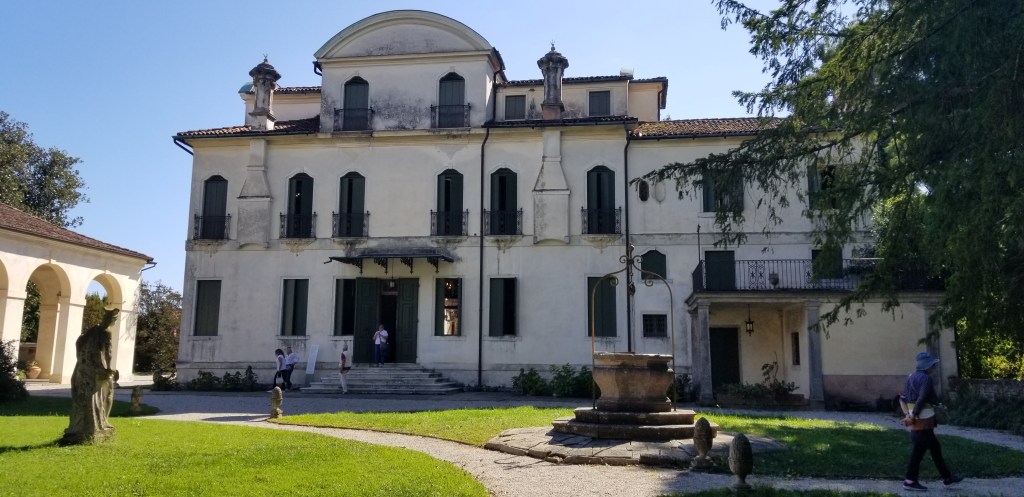
We stopped at another villa, called Villa Weidmann. It was built later than Villa Foscari, in 1719, and was remodeled in the latter part of that century. Like Villa Foscari, everything is built around a square central hall with a balcony on the upper floor, Murano glass chandeliers, and those breathtaking frescoes. Unlike Villa Foscari, we could take pictures here.

Outside, we could see a view of the villa from the back:

The fountain is just like those that still exist in Venice and would have been their water supply.

There are many statues in the beautiful garden.

There were once over forty villas lining the Brenta. The lifestyle came crashing down when Napoleon invaded in 1797. Peasants revolted, many villas were burned, and land taken over for farming. Other villas were used for animal, implement, and feed storage. I can imagine that this felt pretty good to the local farmers after seeing the upper class flaunt their wealth for two centuries.

Many villas still can be seen along the river, in different states of splendor or disrepair.

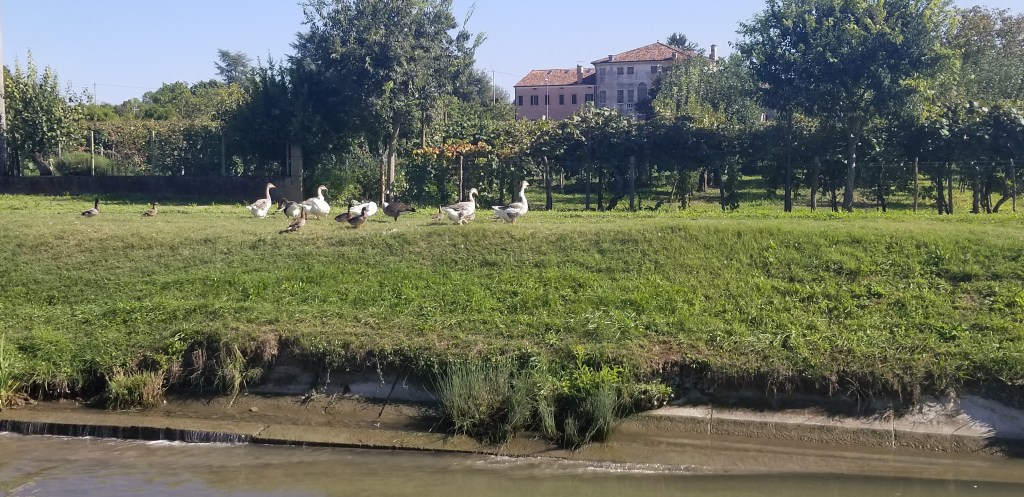
Some peeked out from behind woods or vineyards.

Some were on their last legs.

After Villa Widmann, I read the brochure I had picked up earlier, and went over to talk to our guide. She confirmed that yes, indeed, this was a one-way trip to Padua. Ah, that’s why so many people had suitcases. As it was taking us all day to get to Padua, the boat wouldn’t have gotten us back to Venice until the middle of the night. I don’t know how I had missed this little fact when I booked. But, in my defense, every single tour we’d taken thus far returned us to where we started! No worries though: we could take a train back to Venice.

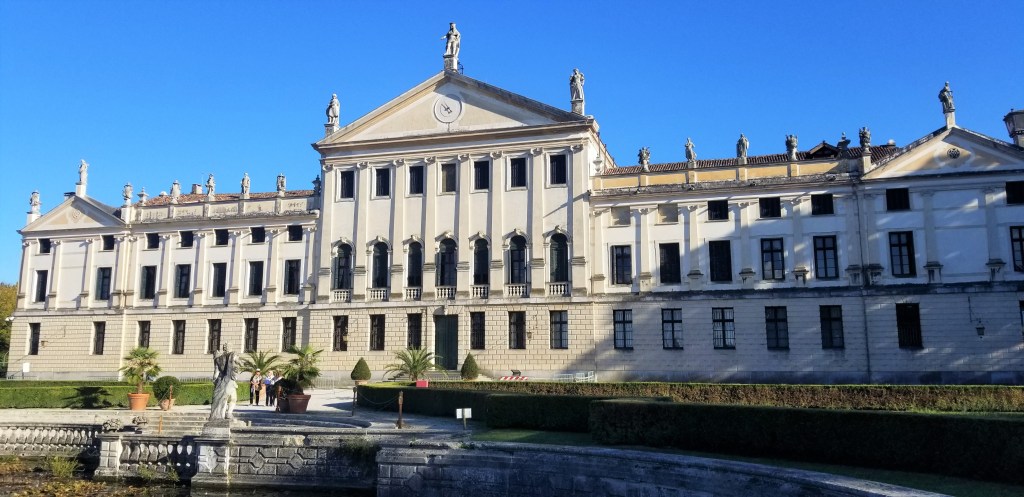
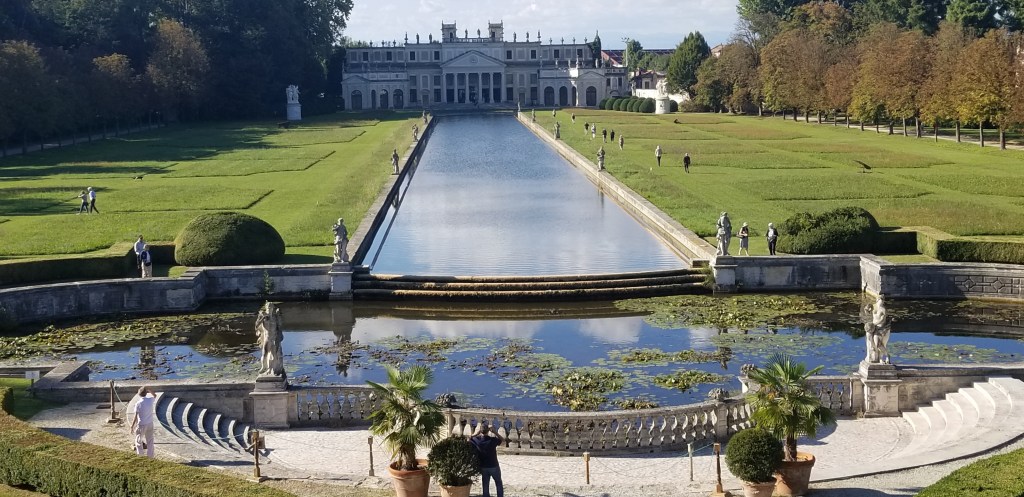
The last villa was jaw-dropping. Nothing I read could have prepared me for it. It may be called Villa Pisani, but it looked like a palace. It is considered to be the queen of all the Italian villas.

Looking out from the “villa”, the stables almost matched its size.

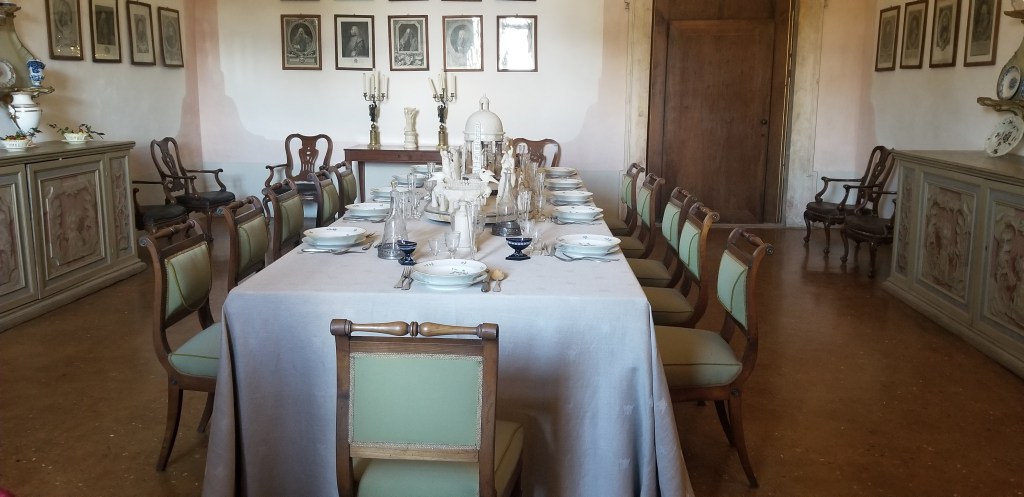
As you may imagine, this villa belonged to a doge: the 114th doge of Venice, actually, by the name of Alvise Pisani. It was purchased by Napoleon in 1807, and in 1814 fell into the ownership of European aristocracy. Finally, in 1882, it became part of the Italian state. There are over a hundred rooms. Doges, kings and emperors were welcomed here, and it is now a national museum. Most rooms have no furniture, but the dining room was set for dinner:

Pictures of past doges lined the walls

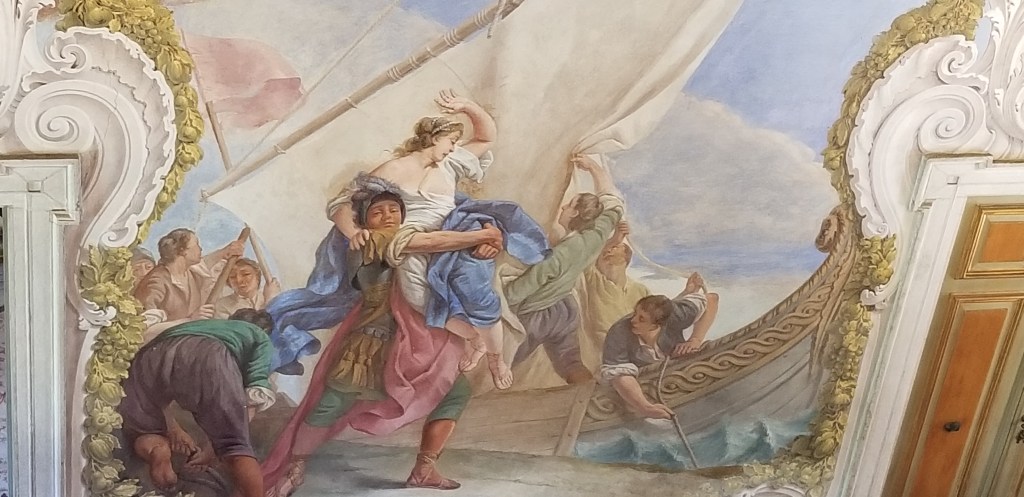
The frescoes here are masterpieces by a renowned artist by the name of Tiepolo.

I enjoyed the many paintings and frescoes providing glimpses of what life looked like in those days.

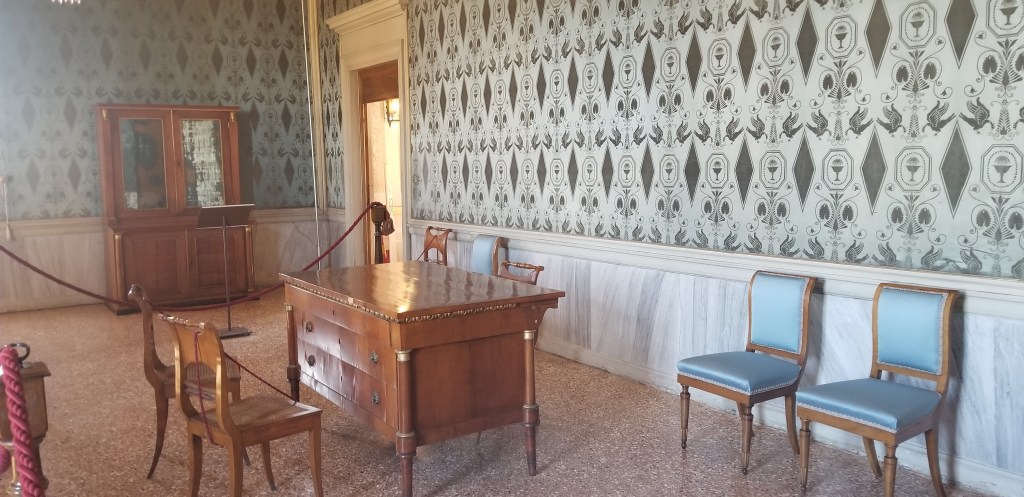
In this room, Mussolini and Hitler met for the first time.

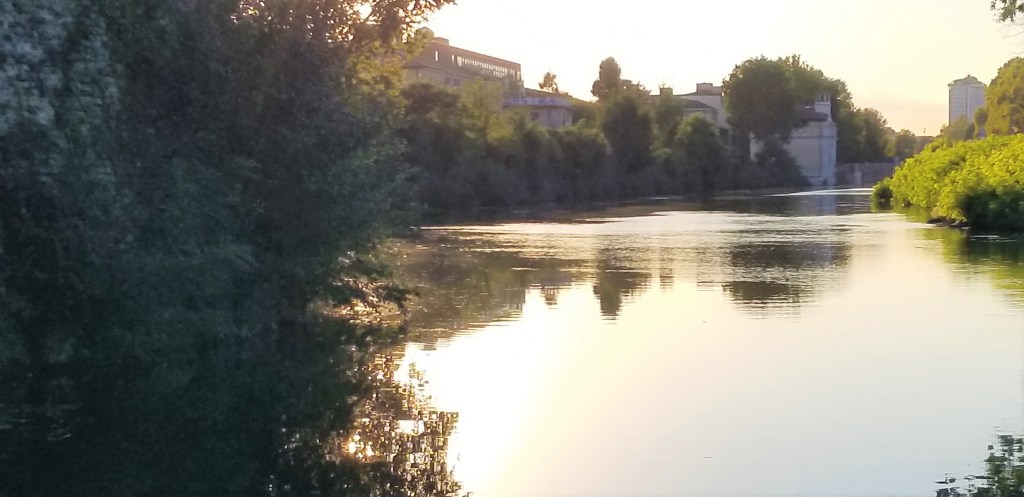
Back onboard, we enjoyed the last idyllic miles of river.

The sun was setting when we came to the outskirts of Padua.

In the end, all I saw of Padua was the river, a part of an old wall, and a pretty bridge where we got off the boat.

It was a mile to the train station in the gathering darkness and we could have opted for a taxi, but it felt good to stretch our legs for the walk after being on the boat all day. A train was waiting for us, the cost was covered by our Eurailpass, and we were back in Venice in no time.

This concludes our Italian travels. We had one more country to visit, and we were both eagerly anticipating this last leg of the trip. Where did we go? Well, all I’ll say about that for now is that we attended a reunion, visited a beautiful city on the sea, and we had to fly there.

Next time: flying north to go south