USTravel

Castle Dome Ghost Town, Arizona

In our continuing futile search for warmer weather, we moved our home just as far as we could go and still stay in the United States – to Yuma, Arizona. If we had gone any further south we would have been in Mexico. Our RV park was only fourteen miles away from the border.

While in Yuma, we had an incredibly interesting and fun day at Castle Dome Ghost Town.

The town takes its name from the mountain range behind it. Castle Dome is the peak that looks a bit like a knob on top of the peak on the left. We could always see it clear back to Yuma. And I say “clear back” because it is a bit of a drive to get here. After the forty mile or so trip, there is a three mile stretch of pavement on the turnoff, and then about seven miles on a rough dirt road through Kofa Wildlife Preserve. A good ghost town is never easy to get to – at least not the ones we have seen.

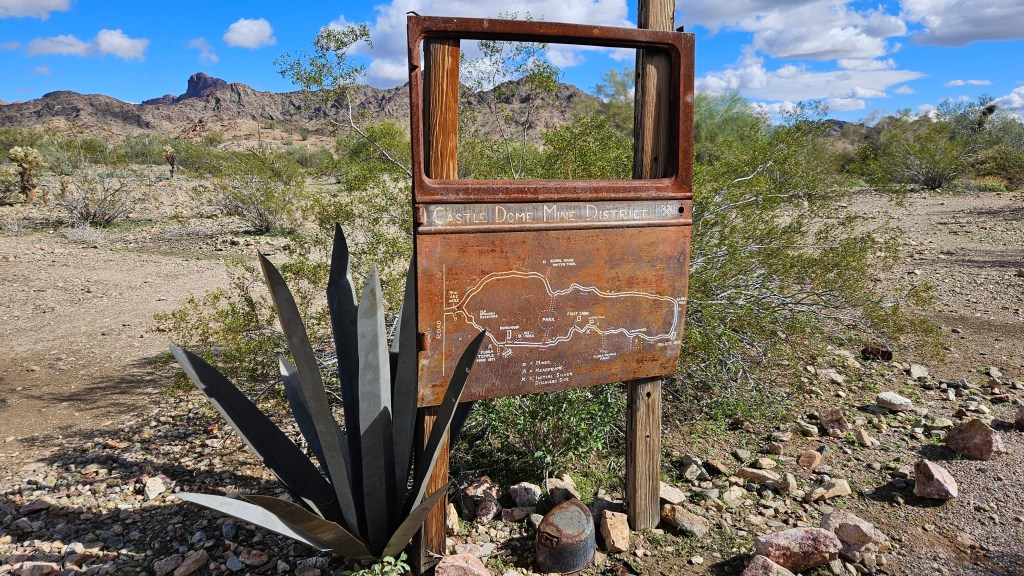
The actual name of this place, Castle Dome Mine Museum, is owned by a couple by the name of Stephanie and Allan Armstrong. They salvaged original town artifacts from the desert and the surrounding abandoned mines. Around 60 buildings have been resurrected and furnished. What I liked is that everything is open – no peering through dusty windowpanes here – and for the most part there are no display cases or ropes to stand behind.
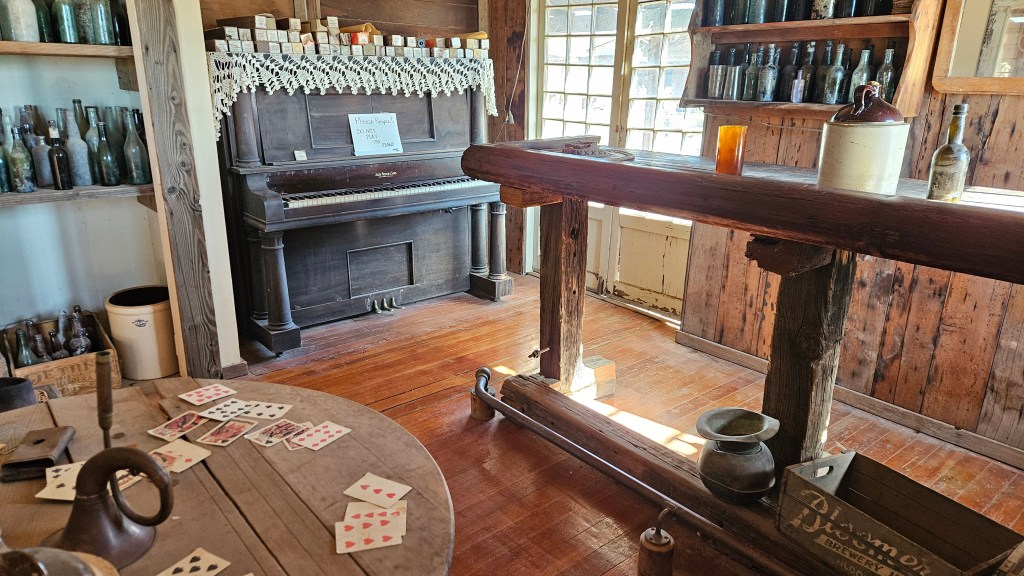
Inside one of the many saloons, where a good card game has seemingly just been abandoned. I could almost hear the piano playing some old-time tunes.

Cal found a bigger saloon to hang out in. This one belonged to the hotel and stagecoach stop. Is that a ghostly apparition in the mirror behind him?

Meanwhile, I tried to work the cash register in the general store.

There were once over three hundred mines here, and this is the longest worked mining district in Arizona. Both silver and lead were mined as late as 1979. Galena was the primary ore and the minerals were extracted from the rock, but when silver prices plummeted the mines finally closed. There are other minerals too, including gold, but the gold mostly played out before the 1900’s. The late 19th century was the heydey of mining in Castle Dome.
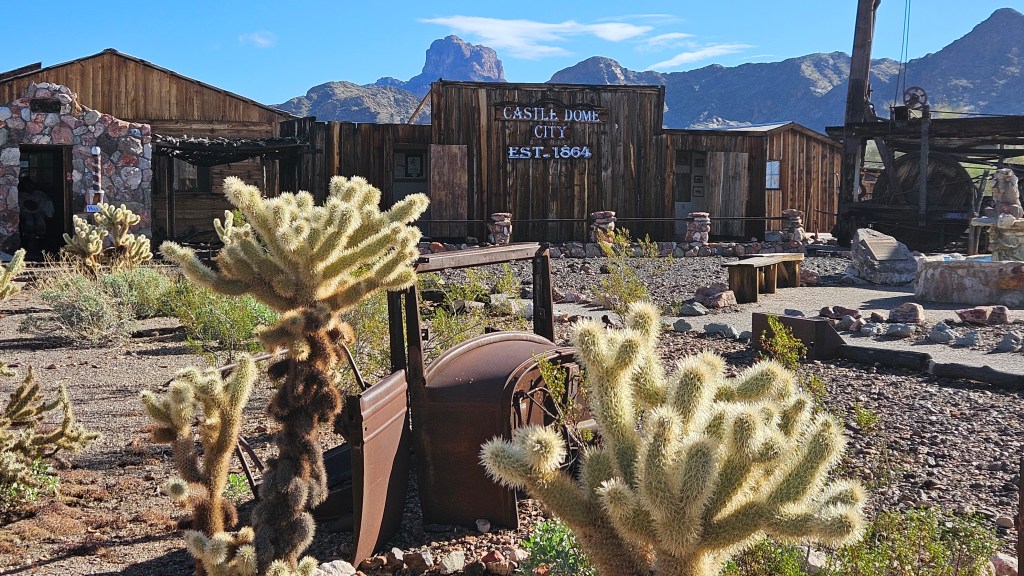
The town of Castle Dome was once larger than Yuma, and its main drag stretched for miles.
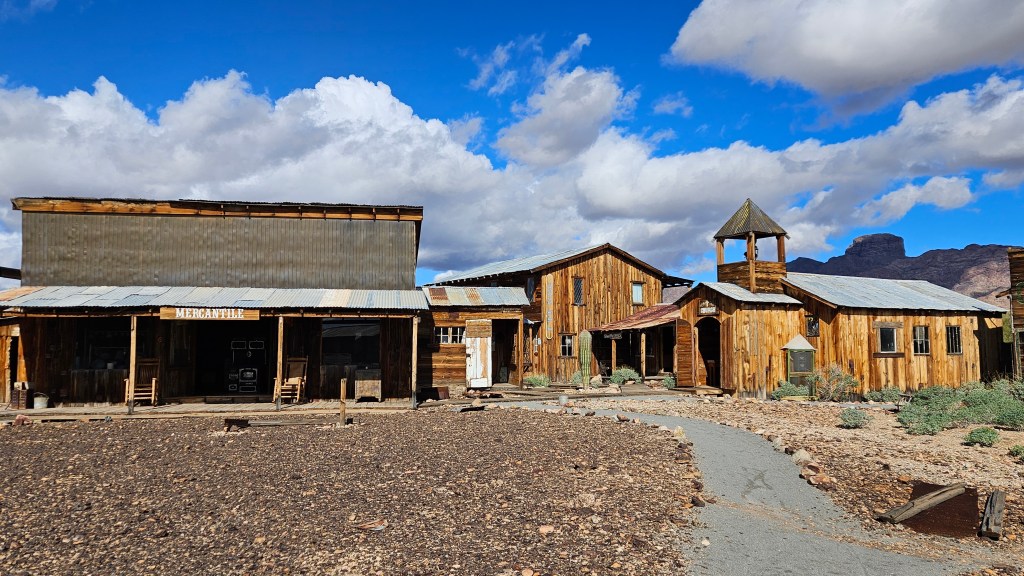
During and after the civil war, people came here in search of a better life. Other people were disillusioned by the California Gold Rush and came back east a bit to stake a claim. They would set up some cactus or tree branches from the desert, throw a blanket over the top, and call it home until their fortunes turned.

Tools of the trade

There were some areas that are restored back to the eras of the 50’s to the 70’s, since people were living here then, too. But I liked wandering a little further out from the restored town and looking at remains that are still sitting the way they were left.

In case the sign is hard to read, this is the encampment of Rita, who came here in 1883 looking for “the right man”. She built the stone steps to her cabin and the rock pillar with which to do her cooking. She always had a pot of beans and cup of coffee at the ready, and all were welcome.

There are actually four mines in this picture. Can you find them all?

It’s possible to tour one of the mines in Castle Dome. I will admit that, to us, it is outrageously expensive at $70 per head, but we are on the road to see and do all we can. We decided ahead of time that we’d plunk down the money and not look back!

We were in a large golf cart with only three other people plus the guide for the mine tour, and he was a fount of information. And this is where it got a little weird. Turns out Alan, the owner, has come into the treasure of someone who is liquidating their metal sculpture business. It’s not something that is advertised, but they are being set up everywhere out back. In between listening to the bits of information our guide was giving us, there was this to look at:
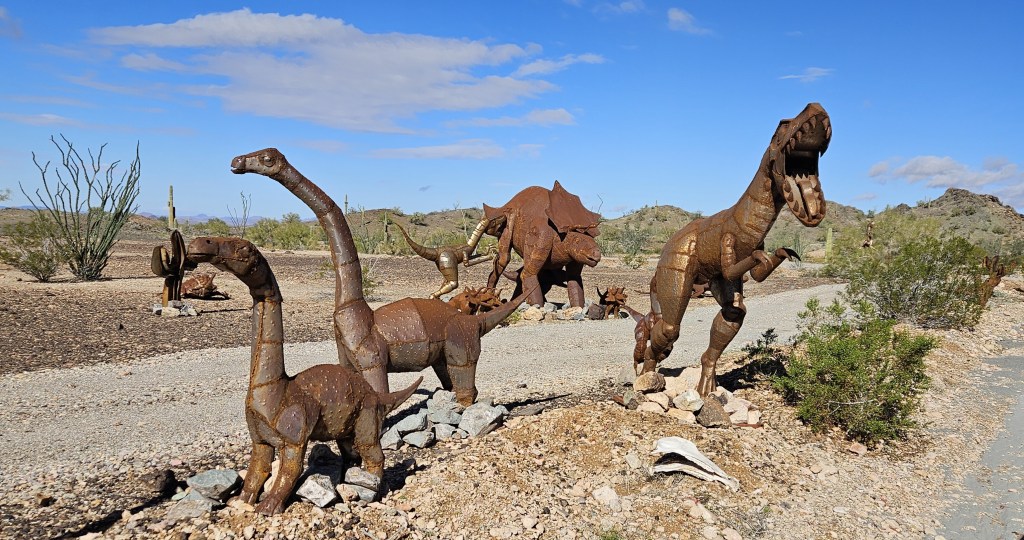
The pre-teen in our group was very impressed. I decided that this would really make the tour fun for kids (or adults) who might need a bit of a diversion from rocks and mining. And to be fair, there is more to the metalwork than just dinosaurs: there are animals and birds of the desert, a miners camp, and other scenes. Another adult in our group took picture after picture of the sculptures, so I guess she enjoyed them too.

We finally arrived at the mine and discussed mining equipment. While our guide was talking, I took a picture of the view. Just ignore the little coyote on the far right. It was impossible to take pictures without these things popping up.

Our golf cart went right into the mine, 100 feet down. We stayed on this level, but there are actually seven levels to the Castle Dome mines, and all mines feed into the main passageways. Out of the seven levels, five are under water. When the mines were in operation, the water was being continually pumped out.

Once down in the mine, we were out of the golf cart.

The mines are no longer in use because prices have dropped and the cost of extraction and production would erase any profit. We looked at this chunk of galena. It contains about 60% lead and 40% silver, and there is fluorite wrapped around it. Its value is estimated at about $5,400, but there would really be no value in processing it.

Our guide highlighted a vein of silver, which shows up more easily with his blue light.
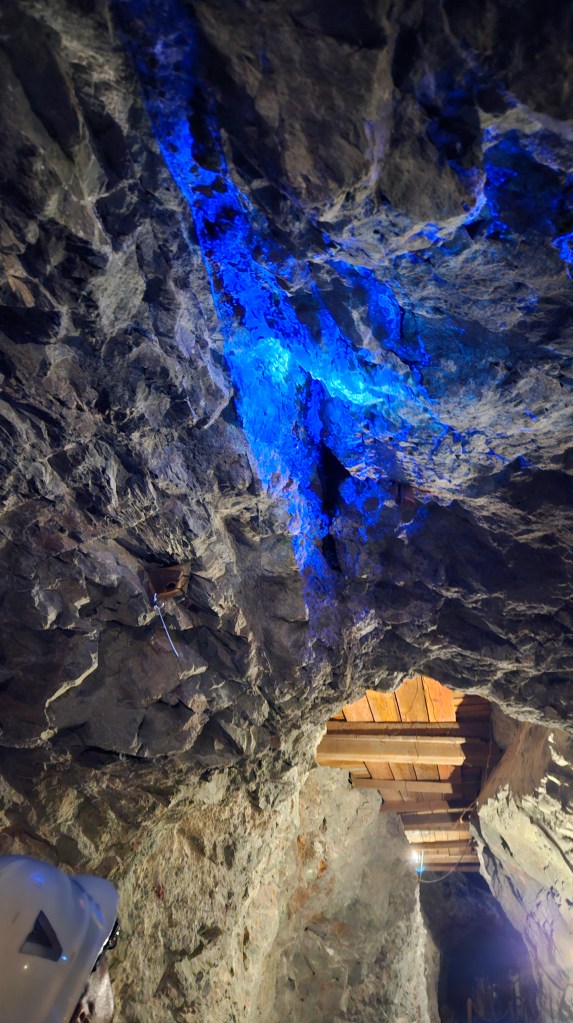
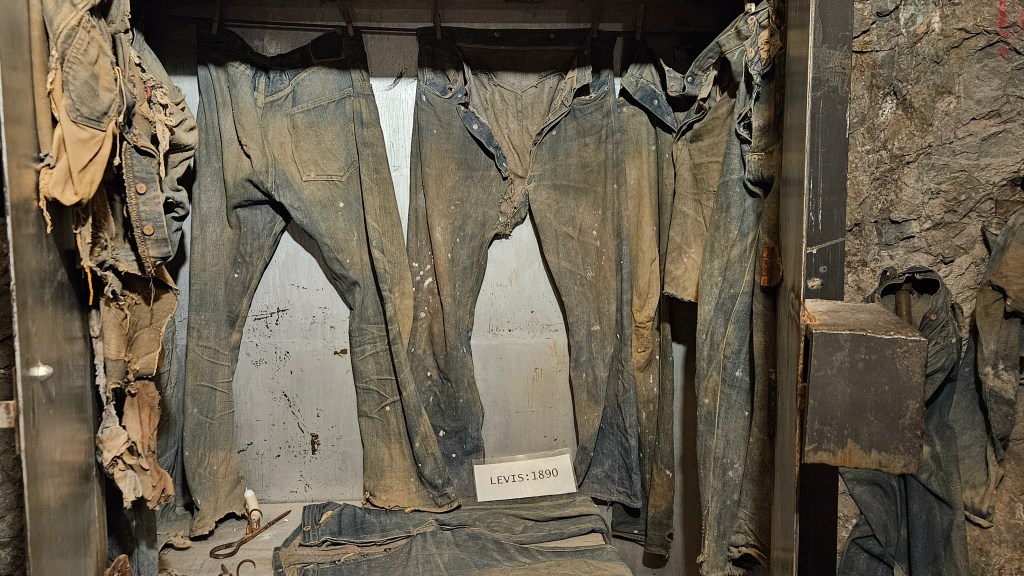
Besides the minerals, there is a treasure trove of items left behind by generations of miners. The climate of the mine preserves them perfectly. Outlaws hid their plunder down here, and there was once a blacksmith shop. Miners wore out their jeans quickly and needed replacements on the job, and many pairs have been found. We looked at some Levi’s that were over a hundred years old:
To us, the thing that made this mine absolutely worth what we paid for the tour was the view we received with the lights off and the high-powered black lights on. The mine is full of fluorescent minerals and these lights cause them to glow.
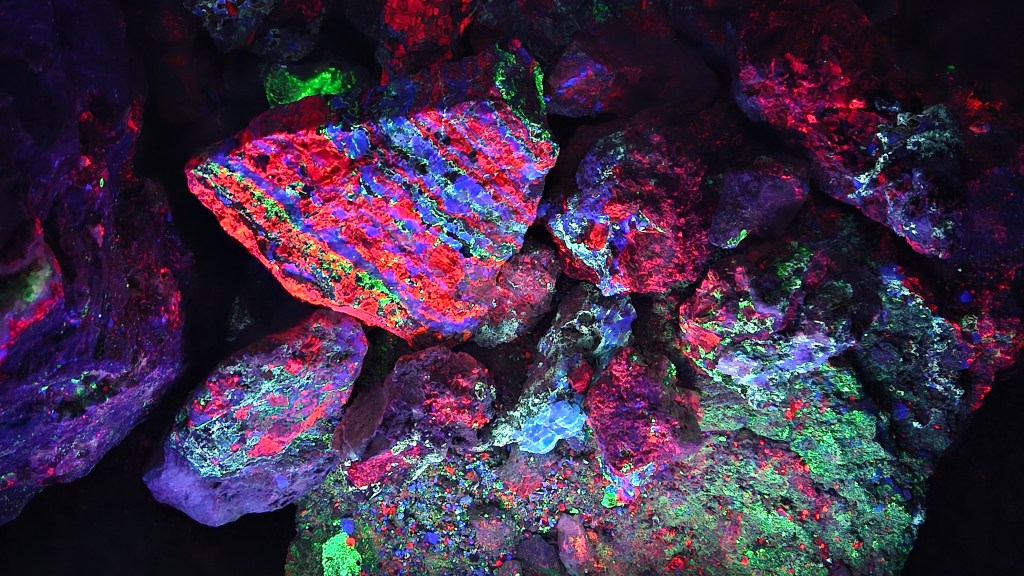
The reds are calcite or halite. Chalcedony, hyalite, or opalite causes the greens. The blues are mostly fluorite, but could also be hydrozinite. It is literally a feast for the eyes, each picture that I took a work of art. With the lights, the mine becomes a wonderland.

When our guide turned the lights off and we entered a totality of darkness, the rocks still glowed. They would continue to do so, he said, for about an hour.

This naturally-occurring “Karaoke Cat” was still glowing after the lights went out.

Our tour was done soon after that, because of course, the phosphorescence was the highlight. The tour lasted an hour and a half.

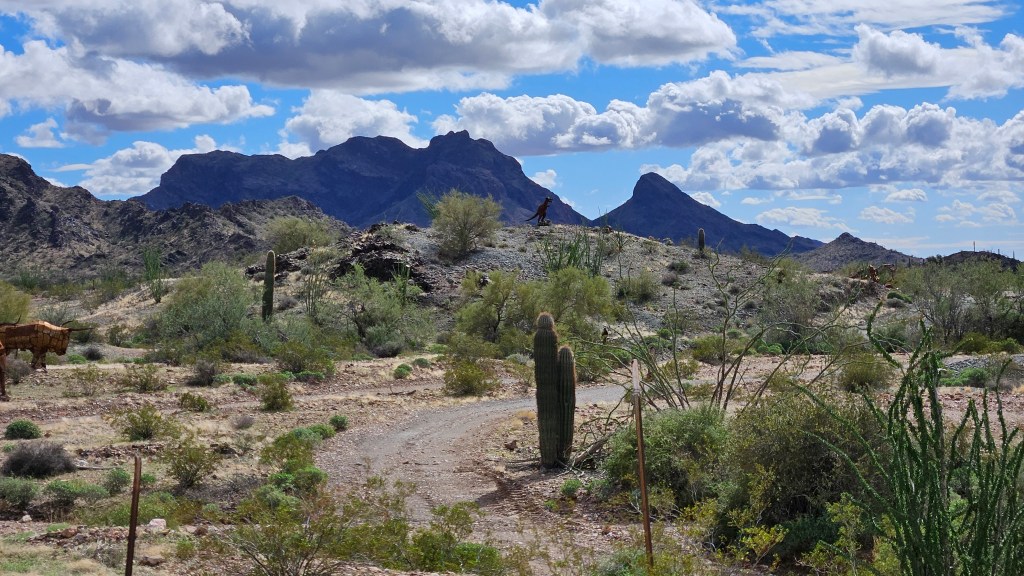
Inside the mine, our guide had discussed the shifting rocks that are pushing upward under the surface. Mountains were caused eons ago by this shifting rock. We could see the shape of the rocks that come together underground, and once above ground on the way back, could see the effect of those same rocks on the small hill in the picture below. Yes, the one the dinosaur is standing on.
Our guide stopped so we could have a little fun, too. He compared this to one of those tourist places where a picture can be taken with a fake background. Let me assure you, the background here is absolutely the real thing.
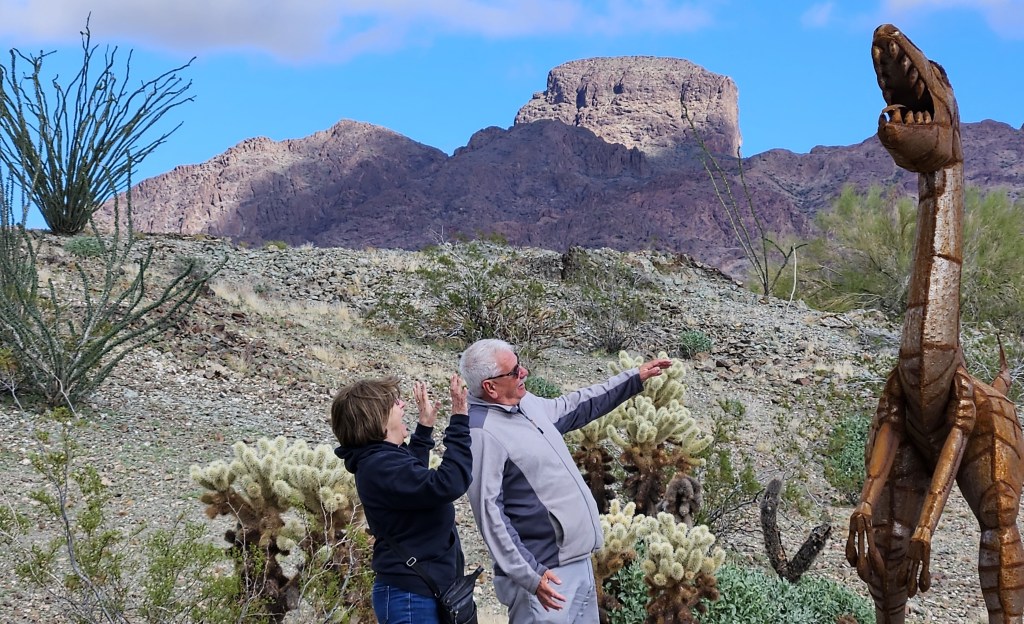
What a time we had here! If I’d loaded up all the pictures I took or enlightened you with all the other things I learned, we’d be here all day. So I’ll stop for now, and maybe do one more post about our stay in Yuma later.

Next time – what’s in your salad bowl?

USTravel

A Quartzsite Day

An RV sits on BLM land near Quartzsite, Arizona

Boondocking in the desert with nothing but the stars all around! Isn’t that the great RVer’s dream? 

Except that three and a half years into RV ownership, we know now that we are not boondockers. So no, that is not our RV in the picture at the top of the page. We may boondock (stay self-contained in an RV or van with no connection to electric, water or sewer) for an occasional night at a winery or other such idyllic enterprise, and even that throws Cal into a frenzy of planning: checking out the generator, filling up with fresh water, and whatever else might have to be prepared. Having hookups for our RV home makes life easier and everyone happier. I booked us into an RV park thirteen miles down the road in Brenda, Arizona.

In the months of January and February, Quartzsite, Arizona is a boondocker’s mecca. It is a little town with a population of 2,413 which swells during these months. The place attracts all types of RVers, drawn by the warm weather and sunny skies. The area is surrounded by miles of government Bureau of Land Management desert, which is free and open for people to set up camp if they are willing to tent or boondock . It is also called “dispersed camping”.  

It’s not just the boondocking experience here that draws everyone. At various times throughout these months, the town hosts a large RV show, several rock and gem shows and the Rubber Tramp Rendezvous, which is an annual gathering for van dwellers.

Our first stop for our day in Quartzsite was to pay homage to Hi Jolly. One hundred and twenty two years after his death, he is still a larger-than-life personality.

Hi Jolly originally had two names: Philip Tedro and Hadji Ali. He was brought here from the Middle East with a group of camels as part of a failed US Army experiment to use camels for cargo transport across the southwest desert. The camels terrified the accompanying burros and horses, the Civil War broke out, and funding for the project dried up. Hi Jolly had several other enterprises throughout his life and made his home in Quartzsite.

If you didn’t know this story, you would wonder why so many businesses in Quartzsite are named “Hi Jolly” and why there are camels decorating everything in town, including the welcome sign.

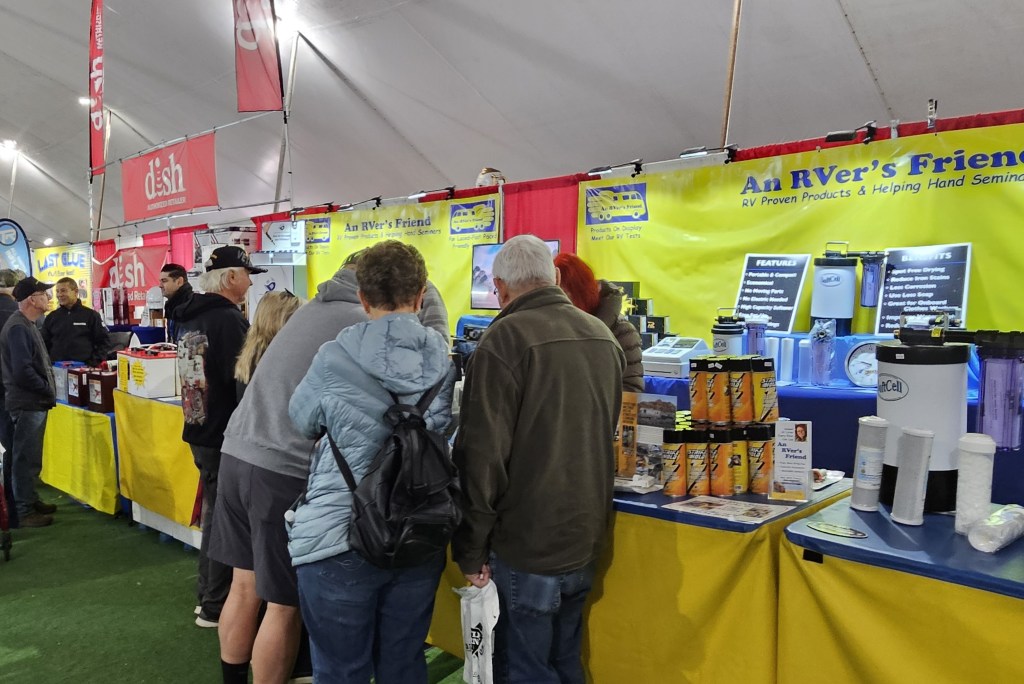
The reason why we were in Quartzsite this particular week was for the RV show. While many RV shows are understandably only about the RV’s, Quartzsite’s is more about the “stuff”. We wanted to see what it was all about.

The show is free, and right away when coming in, there is a huge vendor tent. 

There area vendors for RV accessories, RV parks and resorts, and all kinds of other stuff both RV and not RV related. It reminded me just a bit of the vendor tents I’ve seen at state fairs. Cal was a little disappointed to not see vendors with more useful stuff for the RV or people to answer particular questions that he had. 

We were taken in by this vendor. You can make toasty grilled cheese sandwiches in only three minutes in the microwave!

We purchased it, and have since tried it, and–it’s great! I think it will be handy when we have the grandkids over for lunch this summer.

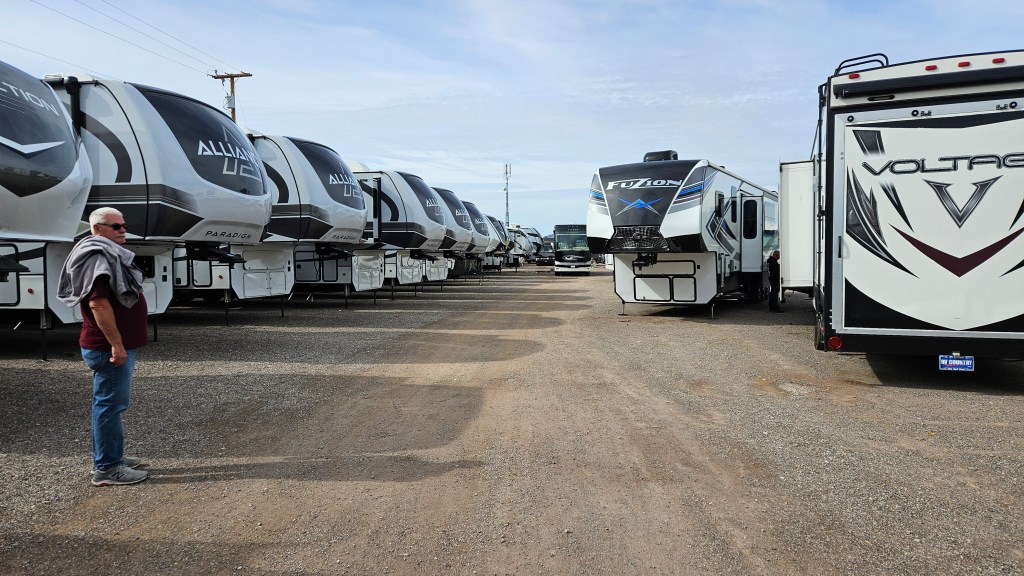
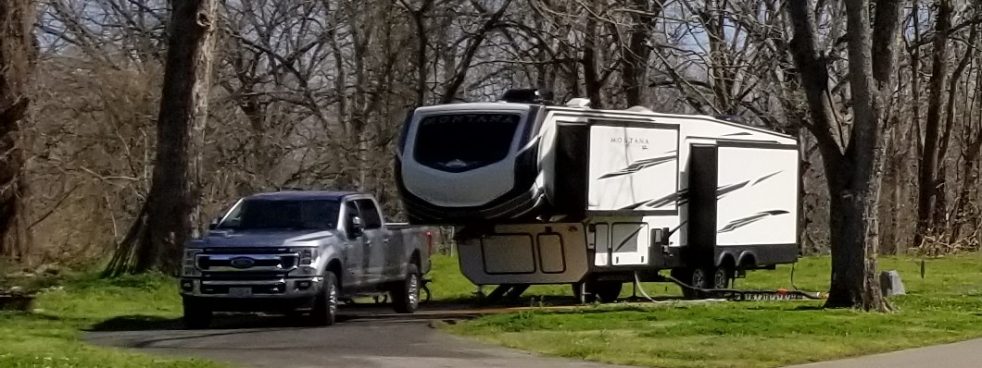
Outside of the tent, there are around 200 RV’s to be seen. Of course, we are most interested in the Montanas, because that is what we own.

There is a new 2024 Montana with an ebike compartment that we’ve heard about, and would have liked to see it. But that RV is too new for this show. We did enjoy looking at the various Montana models, including a newer version of our own.

It was also interesting going into some of the RVs that we’ve seen in RV parks. The Voltage at right in the picture below is called a “toy hauler”. The back flips down, and there is space to store a motorcycle or an ATV. Many people convert these to an extra bedroom or office. The RVs where Cal is standing are all 5th wheels.

We stepped into many, many RVs. In the end, we concluded that we still like ours best.

After we finished with the RV area, we walked across the street and discovered acres more of vendors, mostly selling crafts but also related RV supplies. We’d been at the show for four and a half hours, including a break back in the truck for lunch. Enough! Our feet were tired.

We were here on this particular day not only for the RV show but also to go to a party. We are members of an RV club called Escapees. There are many good aspects to having a membership with them, the most important for us being a mail center which holds and sends us our mail. On this day, they were having a gathering far out in the desert. 

There was music, free hotdogs, and some information tables. After awhile, though, I got up to take a walk down the BLM road to further check out the boondocking scene.

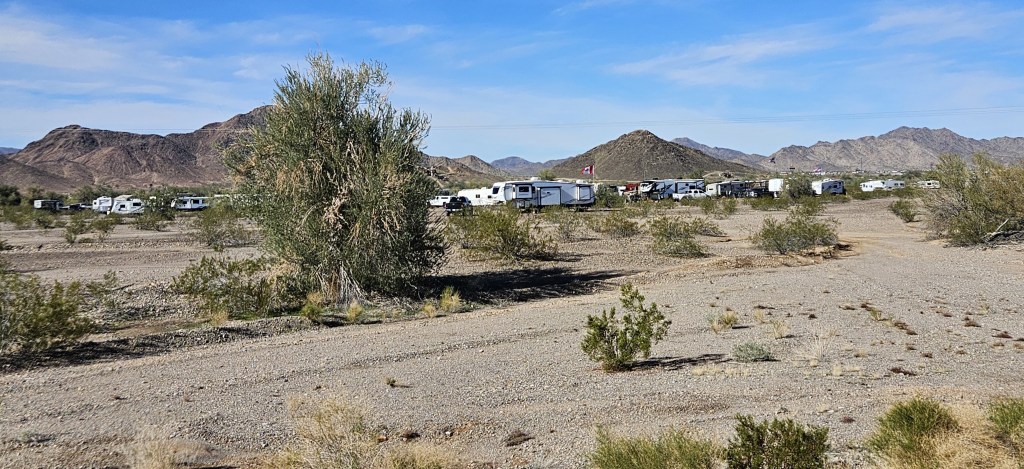
Many boondockers huddle in groups like this. Some are organizations that are having a gathering, and some are just people who know each other. And maybe some people feel that there’s safety in numbers. It looks too much like being in an RV park to me. Boondockers also tend to converge close to a main road.

I took this picture because the RV is a Montana. But you can see another boondocker close by. Do they know each other? If I was boondocking, I would not want someone even this close to me unless I knew them. To me, that is the magic of boondocking – to be out there all on your own.

As much as I’m attracted to the idea of boondocking, I think that the reality might not be quite so fun. So we headed back to our RV park in Brenda where the desert and mountain views were every bit as spectacular. We just had to walk behind the park to get to them.

Next time – we visit a ghost town

USTravel

Life in the Phoenix area

We spent a total of about two and a half months in the Phoenix area this winter, save the ten days that we returned to Denver for Christmas. Although I’m acclimated to desert living by now, I think once in awhile about how different life is here compared to life in the Midwest.

Everyday, mundane things, such as how it’s not unusual to find the parking lot at the grocery store with a covering over it. 

It’s not any covering, either. Those are solar panels. So the cars stay nice and shaded while they’re parked in the hot summers, and the panels help provide energy. The birds love it, as evidenced by all the tweeting coming from above. By the way, the grocery store is a Fry’s, a brand of Kroger’s, which is the main option here.

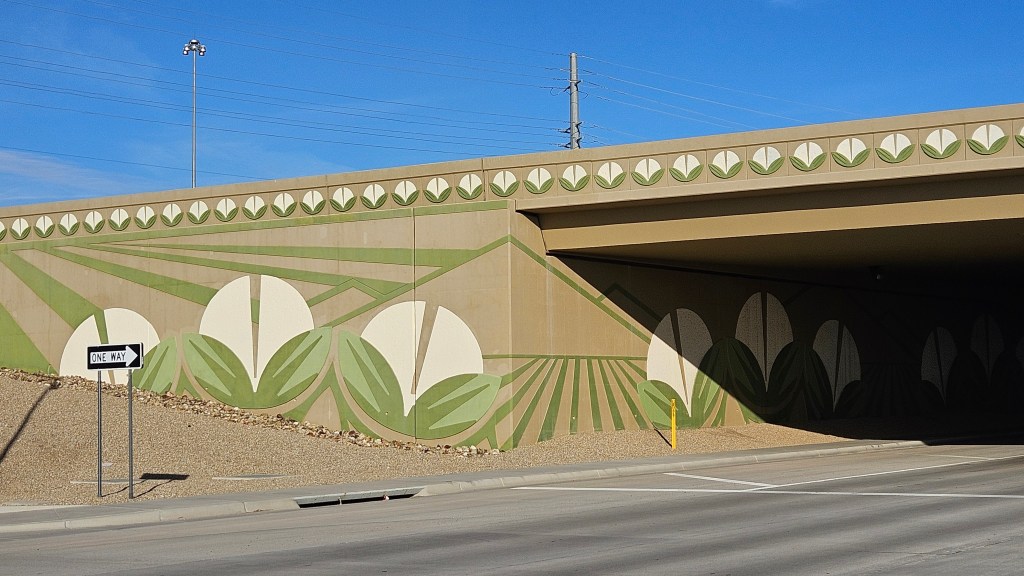
The highway berms are completely finished off with beautiful desert landscaping. The barrier walls and exit tunnels are decorated with desert or native designs. Two enormous lizards playfully climb up a column on an overpass near Goodyear, and a large cute bug graces a tunnel entrance nearby. Near where we were staying in Gold Canyon, a quail family marches along an exit berm in colored gravel, and a roadrunner is on the opposite side.

Of course, when we are on the highway, I can’t very well yell at my husband to stop so I can take a picture. But on an ambitious walk from our park in Goodyear one day I was able to photograph one of these.

The design on this particular exit bridge and tunnel is of cotton. That is because it is right next to Cotton Road, or because cotton has been traditionally grown around here. Or perhaps for both reasons.

Development is booming here. Subdivisions are going up everywhere. They bring in the road crew to add more lanes to an existing old desert road, then add sidewalks, desert landscaping, and a five-foot high decorative cement brick wall around the subdivision. I don’t know why every one has to have a wall. A new subdivision is going in kitty-corner from our park, and the empty stretch of land across from it will also be developed at some point soon, I’m sure. Signs from home builders about new developments are on every corner.

It’s not only homes, but also shopping centers. Of course, everyone needs a grocery store, but all the chain stores and restaurants are being built too.

We rode bikes one Sunday afternoon and tried without a lot of success to push past all the development. Our ride went like this: we were on the narrow edge of road pavement, then a new sidewalk, then a dirt path, then a stretch of prettily landscaped walkway between the walls of two communities, then a new subdivision road, then a path again, then a busy rural road. 

I’m afraid that, at some point not long in the future, family farms like this one will go the way of the dinosaur. 

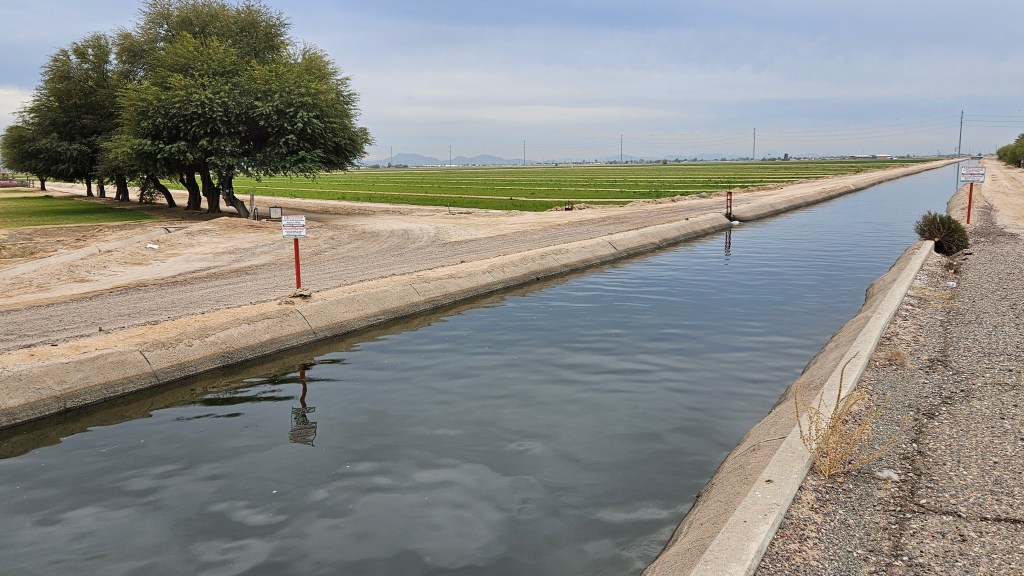
How can this lush green field exist in the desert?

The answer lies in irrigation from the canal system that crisscrosses this city. In antiquity, the Hohokam peoples cultivated the Salt River valley with a system of hand-dug canals for farming. Centuries later, the European settlers noticed the old canals, and began digging them up themselves. I’ve learned that there are 180 miles of canals in the Phoenix area. 

It’s not only for irrigation, of course. These canals provide drinking water, and the city could not survive without them. Water rights, preservation and distribution are an ongoing struggle here.

Roosevelt Canal lies next to our park. In one subdivision farther down the canal, they’ve built a sidewalk next to it that goes on for about a quarter mile.

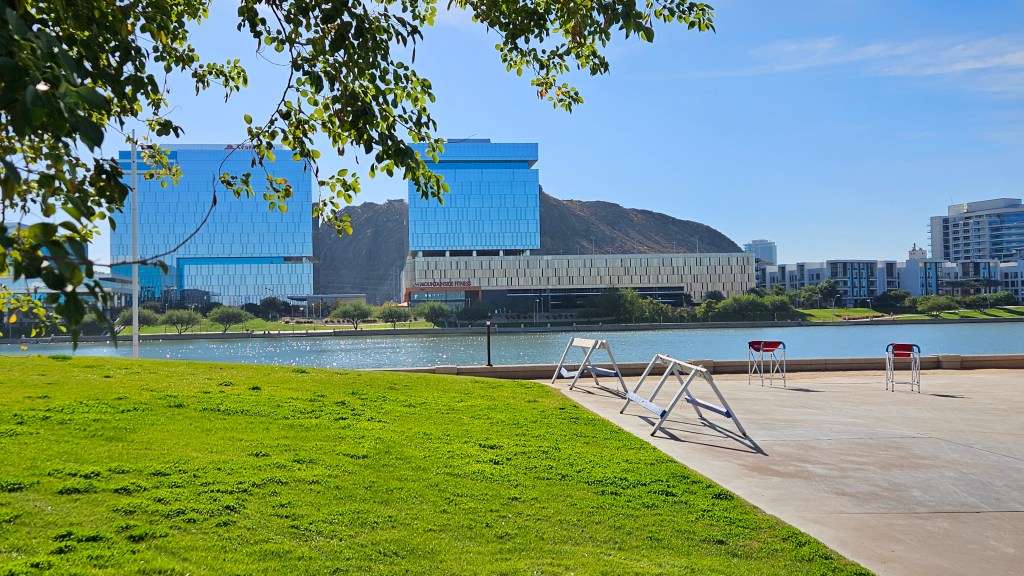
The city of Tempe, Phoenix’s first suburb, calls a wide spot in the canal “Tempe Lake”. They have built a park, complete with a bike trail, next to their stretch of canal. This part of it dams up the Salt River.

Although the valley that Phoenix is in is very flat, it is also surrounded by a mountain range, and every now and then an individual mountain pops up. The city has simply built around them, as evidenced by this mountain popping up behind the sparkly buildings on Tempe Lake.

We rode the bike trails around Tempe Lake, but only one of them really went anywhere. It took us to the Phoenix suburb of Scottsdale. The trail followed the canal for awhile, but then closer to Scottsdale it went through a series of parks and golf courses. We greatly enjoyed this ride.

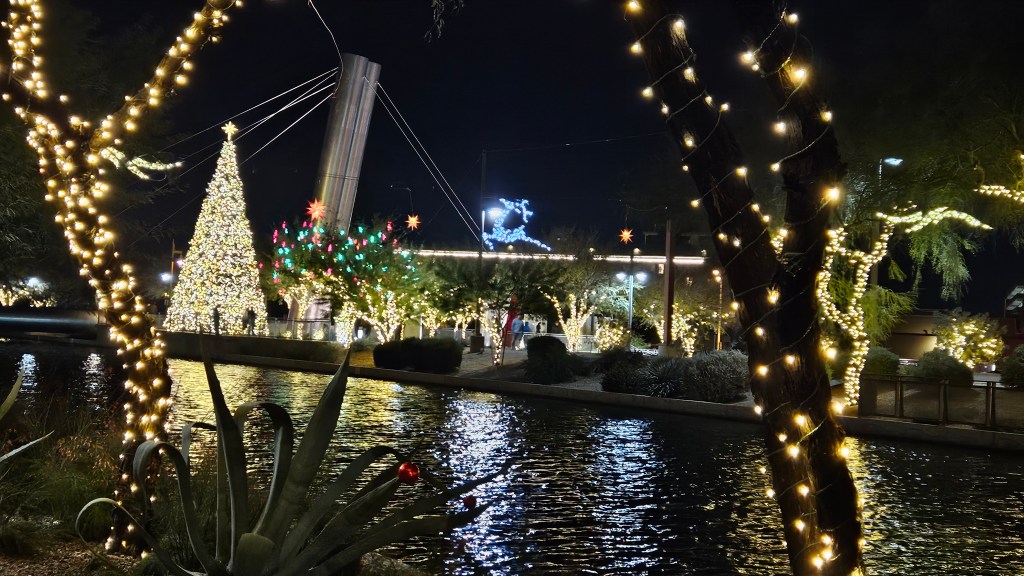
Speaking of Scottsdale, the Arizona Canal goes through the Old Town area. At Christmas time, the lights are very pretty on the canal.

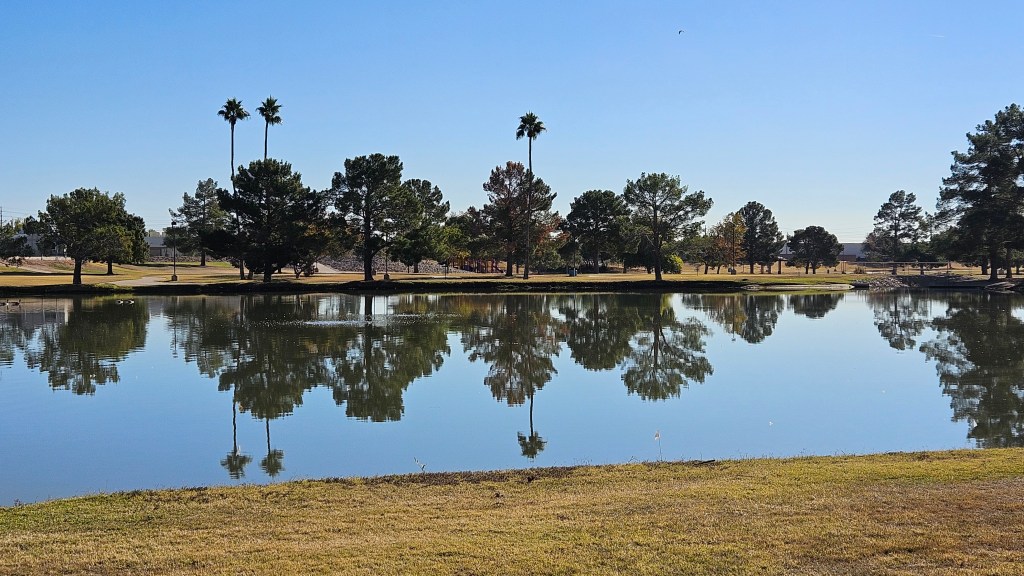
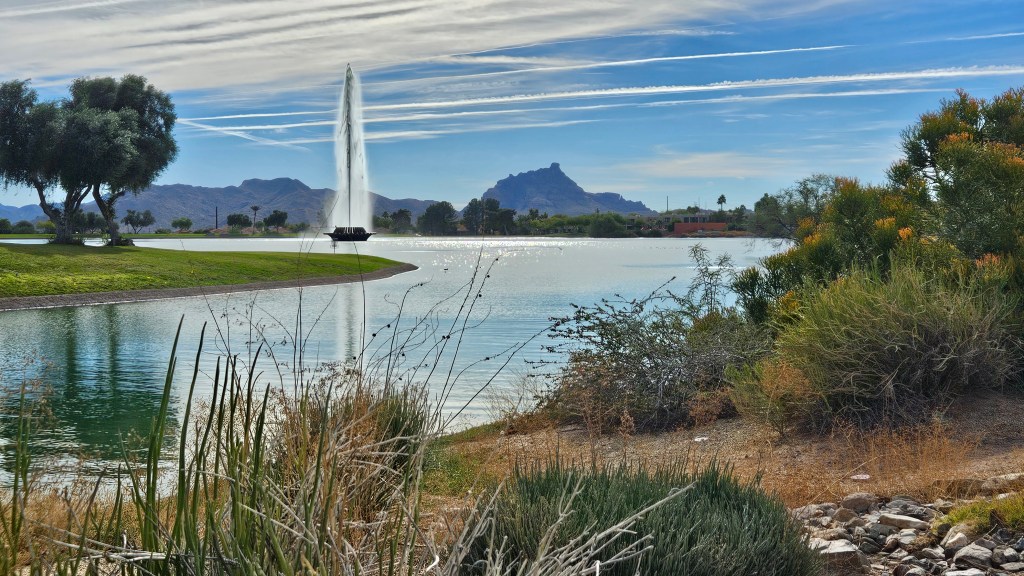
Another suburb with water is Fountain Hills. Their water is not a canal, but Fountain Lake. A beautiful paved walking path goes around the whole of it. The lake is effluent, meaning that it receives its water from a groundwater flow system. That’s about all I understand about that.

The centerpiece of this lake is a fountain. And not just any fountain, but the world’s fourth-tallest at 560 feet, and the second-tallest in the United States. It only goes off for 15 minutes on the hour.

Flying back in to Phoenix from our Christmas in Denver, we were able to see the fountain from the air. It rose up from the lake like a great white feather.

There are many fascinating sculptures along the path.

We went up to another suburb, Sun City West. There was no water to be seen here, but something much better: an afternoon spent with my brother and sister-in-law Marcus and Heidi, while they were visiting their son-in-law’s mother Joy. Their mutual family lives in Hawaii, and Marcus and Heidi had just returned from there. Joy graciously invited us to her home for lunch and we all had a lovely afternoon visit. 

From left to right: Heidi, Joy and Marcus
Marcus, Cal, Julia (that’s me), and Heidi

While we visited, we watched hummingbirds repeatedly visit at Joy’s feeder, and a family of Gambel’s quail playing around on the golf course behind her patio. Just before that visit, I was delighted to see a covey of them walking around our RV. It’s very hard for me to get pictures of them; they skitter around so fast. This time, they didn’t know I was watching them from inside.

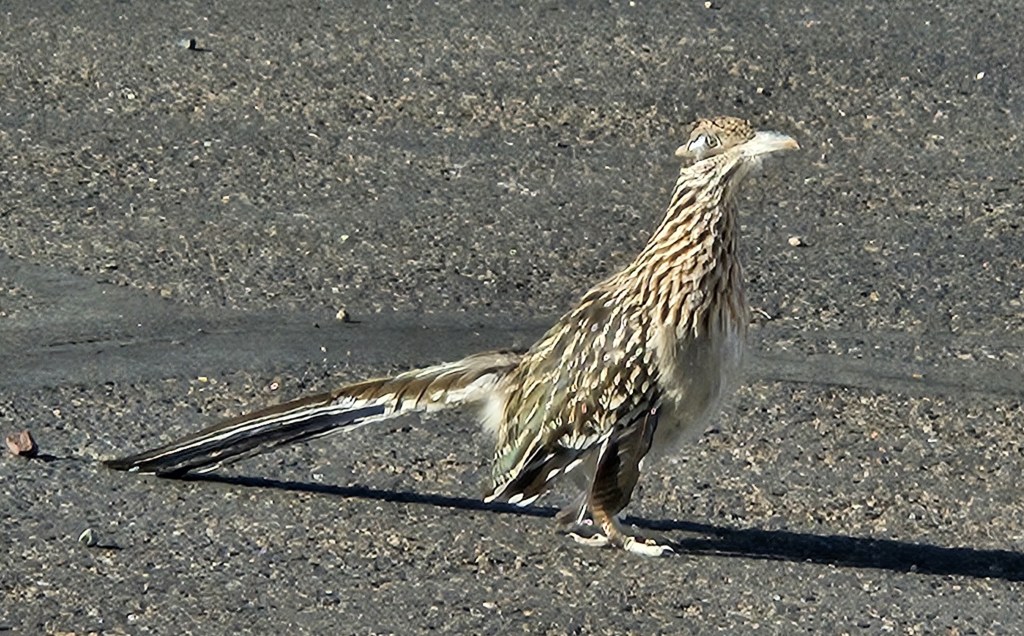
At our RV, Cal would often see a roadrunner making its way to somewhere further into the park. Later in the day, it would make its way back through our site again.

The thing I really liked about our stay in Goodyear was that there were citrus trees in our park, and the fruit was ours for the picking as residents. At any time, I would help myself to oranges, tangerines, lemons and grapefruit. This was my favorite grapefruit tree:

There are two regional Maricopa County Parks near Goodyear: Estrella Mountain, and White Tanks. We got in a couple of hikes when the weather warmed.

Estrella Mountain Regional Park
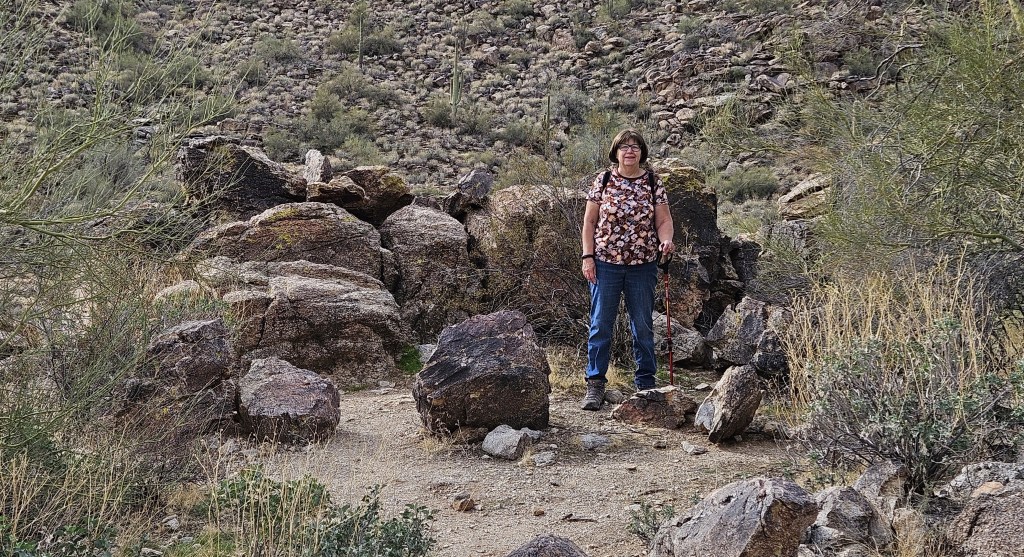
Yours truly in the rocks at White Tanks
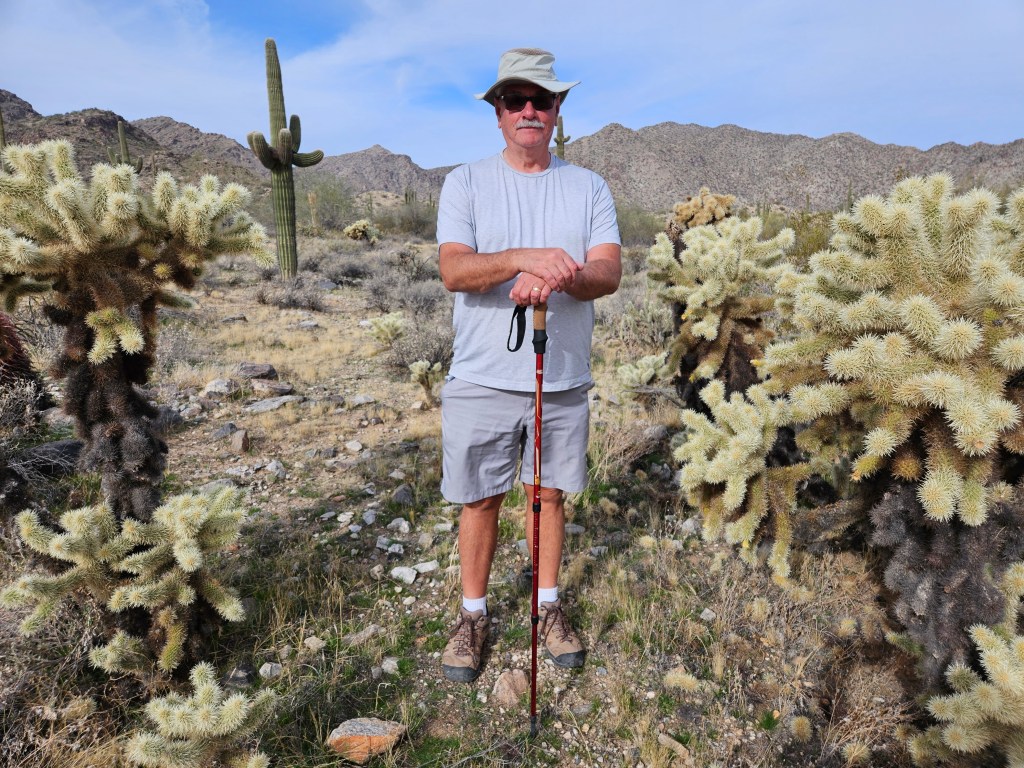
Cal at White Tanks between the cholla cactus

A winter in Arizona is certainly different from the Midwest, especially when I think about the landscape there in January. We’ve done our share of complaining about the chilly temperatures, but we know we have nothing to complain about when everyone up north is shivering with snow and ice.

Next time – Quartzsite!

USTravel

A Visit to the Capitol of Arizona

Just over a week before Christmas, we moved to Goodyear, on the west side of Phoenix. Two days later, we were on a plane to spend the holidays with our family in Denver. We were back in our RV for the New Year, ready to go and find out just what’s on this side of the city.

Except…we came back to Goodyear with long lingering colds, and Arizona was having its winter. It was chilly, and we spent a lot of time in the RV. One day, I was ready to get out, but we needed to go somewhere indoors. We hadn’t yet visited Arizona’s capitol building, so we headed back east to downtown Phoenix.

This may seem like an odd choice, but we have visited many capitol buildings, and they are usually pretty interesting. There is something different about each one. 


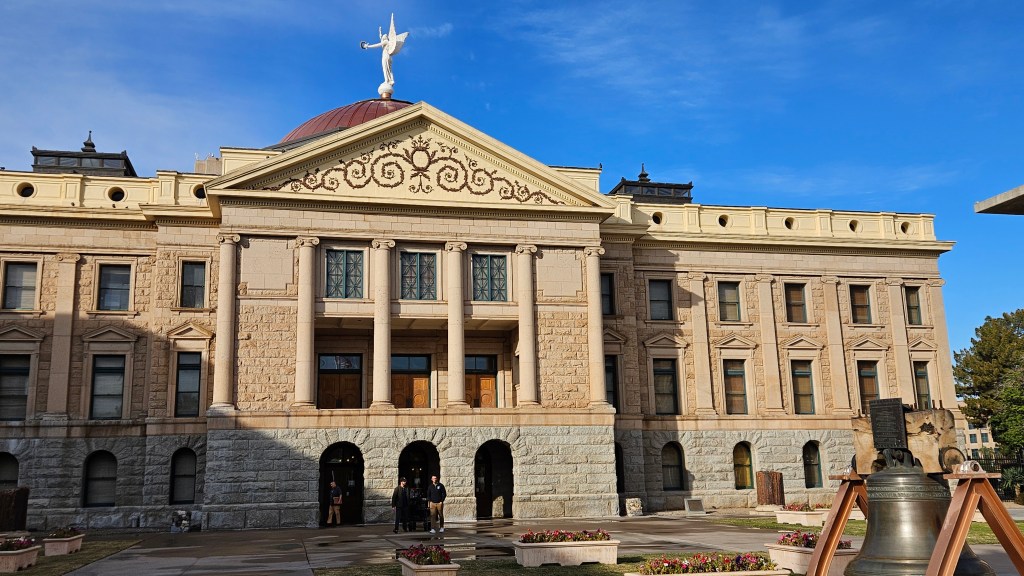
Right away, I spotted the difference in Arizona’s capitol building. It’s a museum. The state grew out of its building pretty quickly, and in 1960 constructed both a house and a senate building. 

This image has an empty alt attribute; its file name is 20240105_095334.jpg

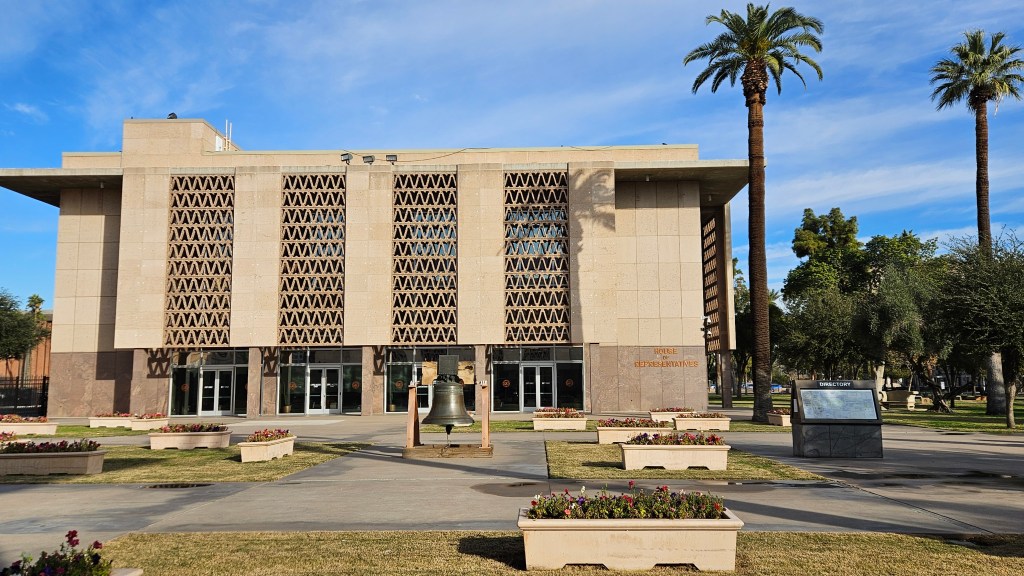
From where I was standing to take the Capitol building picture, the House of Representatives and the Senate buildings were on my right and left.

A Capitol docent was on hand as we stepped into the building. He made sure we knew that there is no fancy architecture here or impressive sculptures as in other state capitols. During the time of its construction in 1900, money was tight and the entire cost of the construction was a mere $135,000.00. Arizona was only a territory until statehood came in 1912. Even the copper dome on top was just painted on for its first 75 years, until the Arizona Mining Association donated the material for the real deal. This was a low budget build.

We walked through the original senate room, where the statue of a man presided over an empty room. Empty, that is, except for Cal over there on the right. Together, they look like they’re studying something up on the balcony.

This image has an empty alt attribute; its file name is 20240105_103925.jpg

I thought this was a little strange, but a small plaque on his desk told me who he was: none other than George W.P. Hunt, first governor of Arizona. He also served in both houses of the Arizona Territorial Legislature. Interesting piece of trivia – his burial spot is in a gleaming pyramid on a hill in Papago Park overlooking the Phoenix Airport. Jets are flying right over him in perpetuity.

Other than the legislature, the rooms on all four floors are for exhibits now. The first one we came to was a room dedicated to the USS Arizona, a battleship that was sunk during the attack at Pearl Harbor. Although it is now at the bottom of the sea and part of the memorial there, a piece of it is right here in the capitol building.

Across the hall is an exhibit dedicated to Buffalo Soldiers. They were the first African American soldiers to serve at Fort Huachuca back in the late 1800’s. Having spent time at that military post both when Cal was in the Army and at the RV park there two years ago, it was like greeting old friends. 

We looked at the exhibit, and then went into a room where they detailed the lives of some of the soldiers. I was interested in one in particular: Private Cathay Williams. It turns out that Cathay was a woman, although her picture is a fictionalized version of what she was thought to look like.

Born into slavery, Cathay experienced great discrimination and oppression in her life. Only being able to cook and clean after emancipation, she joined the military to be able to make her own way. Being 5’9″ tall, she was able to conceal her identity for a full two years, until a smallpox outbreak put her in the hospital. She was then discharged. The military denied her a pension even though she suffered ill health for the rest of her life as a result of her service. If she didn’t receive the honor she deserved in life, I’m glad her story is here in the Capitol for all to learn about.

A model railroad is set up in another room. The train runs the length of the state of Arizona in the exhibit. One of the engineers was on hand to point out the points of interest in various “towns” and natural features – including the Grand Canyon – that the train passes.

The life of Sandra Day O’Connor is also highlighted in the capitol building. She was the first female Supreme Court justice, and she grew up on a family cattle ranch near Duncan, Arizona.

When we visited, there was also an art exhibit of paintings solely by Arizona women artists. I liked this painting, called “Laughter in Creases”, by Christina Carmel.

The results of the 1912 election are written on the wall on the first floor. It was the first election after statehood, and in this election, women were given the right to vote. Nationally, this did not happen until 1920.

When we reached the top floor, we could look all the way down to the first floor and the mosaic of the state seal.

There were many other items of interest here which I haven’t covered. We found this to be a great way to pass a dreary and cool winter morning.

Next time – wrapping up our Phoenix-area stay

USTravel

Saguaro Lake and the Wild Horses of the Salt River, Arizona

The distance from our abode at Lost Dutchman State Park to our next stay at Gold Canyon RV Park was a grand total of eight miles away. For all that, our forty-day stay there might have been a world away in comparison. We enjoyed happy-hour music on the bistro patio while watching the Superstition mountains turn red, a golf-cart Christmas parade and a choir concert, and watching folks playing (or trying to play) glow-in-the-dark golf one evening as we took in our evening walk. It is a fun and welcoming place, which is why we returned. We’d stayed here two years ago.

We are already gone from there, though. Joe Friday from Dragnet comes to mind with the quote: “Just the facts, ma’am, just the facts.” In this case, “just the highlights”. When I think of the highlights from our Gold Canyon stay, it is the the wild horses of the Salt River that I think of first.

During our last stay at Gold Canyon, I’d heard about the horses and wanted to see them, but didn’t know where to find them. This time, I received information on two possibilities. 

We headed east a little bit before driving north of Mesa into the Tonto National Forest, leaving the Superstitions behind us and going into the Four Peaks mountain area. This was new territory to us and we enjoyed the drive. 

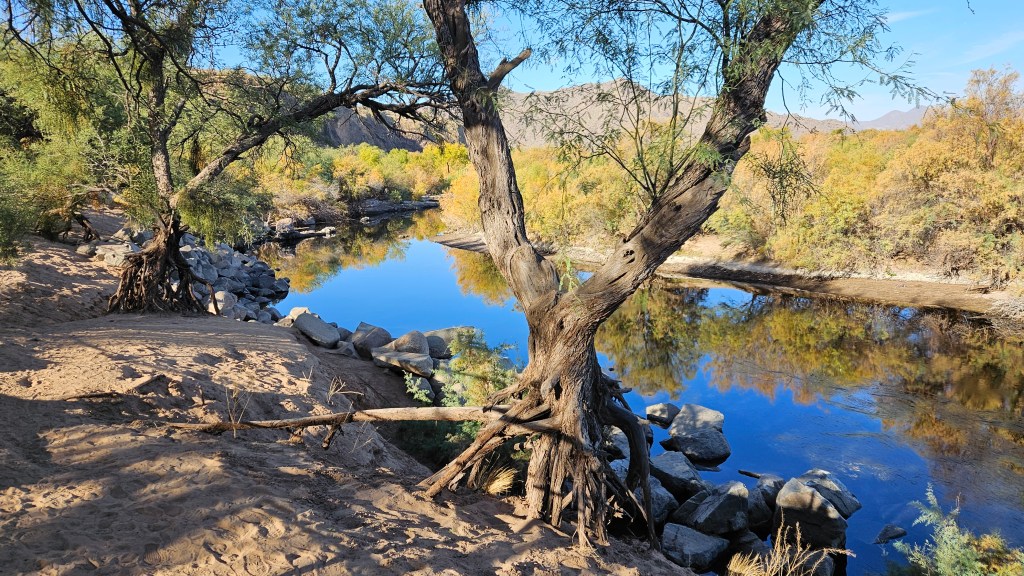
Our first stop this day was Coon Bluff Rec Area. It is a pretty spot with mesquite trees lining the high banks of the Salt River. Many bird watchers were out on this sunny day. I don’t know if they were successful in their bird sightings, but we didn’t have luck seeing the horses here. Still, it was pretty enough for a picture, horses or no.

Our second lead for possible horse sightings was Blue Point Rec area. We continued down the road, and just as we were on the bridge before the turnoff I saw them: several beautiful horses in the river! We turned into the Pebble Beach area across the road from Blue Point.

Except for one thirsty horse, they came up from the river soon after our arrival. We discovered there was a group of about eight, although they didn’t stay together.

They seemed aware of us but not afraid, moving not too far away as they munched their way up into the desert.

The horses are descendants of those brought here by the Spanish missionaries in the 1600’s when they were establishing their new churches. They are wild, but of course not indigenous. As such, they have had a long and fraught history. Their numbers multiplied more than local ranchers and the government would have liked, so they have been hunted and their numbers culled. Because of the dense vegetation along the river where horses could hide, however, many survived.

Several of them came up from the riverbank and I sat down on a rock to watch the show. They were unafraid of us but I did not want to come too close.

Today, the horses of the Salt River are protected and managed. It is thought that there are around three hundred of them, maybe more. There is an effort, through birth control, to reduce the herd down to one hundred. The horses do have predators: I was briefly a member of their Facebook group, and one of the new colts had just fallen prey to a mountain lion.

As we walked back to the car, the horses seemed to follow us.

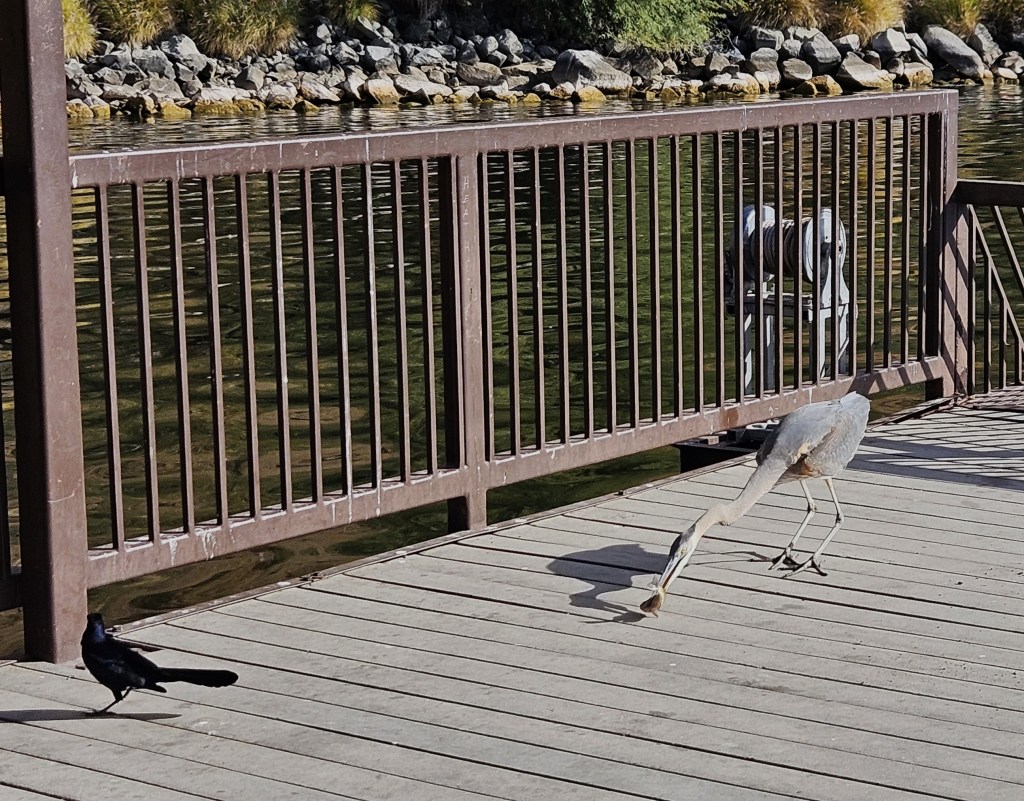
We weren’t ready to head home yet after all that excitement, so we moved up the road a short way to Saguaro Lake. We turned into the marina and drove around to a fishing dock where a blue heron was perched.

I usually can never, ever get a shot of a heron from this distance. They are aware of me long before I can focus my phone. I soon discovered the reason why this one was sticking around. A fisherman was throwing his small unwanted catch over to the heron.

We watched as he did this. A hopeful crow fluttered down next to the fish, but waited for the heron first. Snap! That fish was gone quick as a flash!

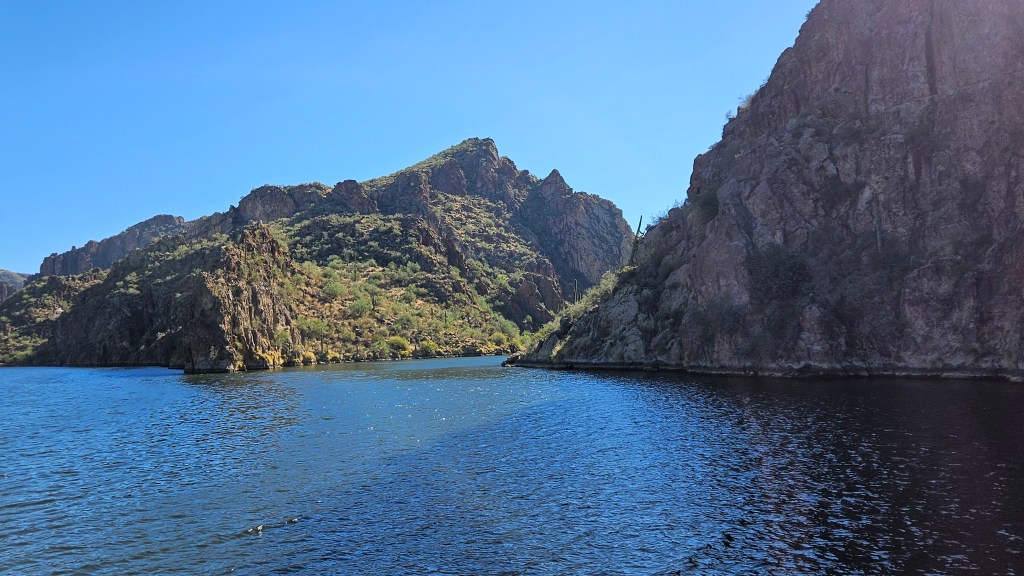
We returned to Saguaro Lake a few weeks later to ride its tour boat, the Desert Belle. For an hour and a half, we were treated to pretty mountain and desert views as we circled the lake.

A forest of saguaros grows on a hillside on one corner of the lake, where the sun and moisture are most favorable.

As the boat rounded the back of the lake, we found one of those most elusive of saguaros: the crested saguaro. For every 200,000 saguaros that there are, there is only one that is crested. We saw two or three during our last winter in Arizona, so now we can add this one to our list.

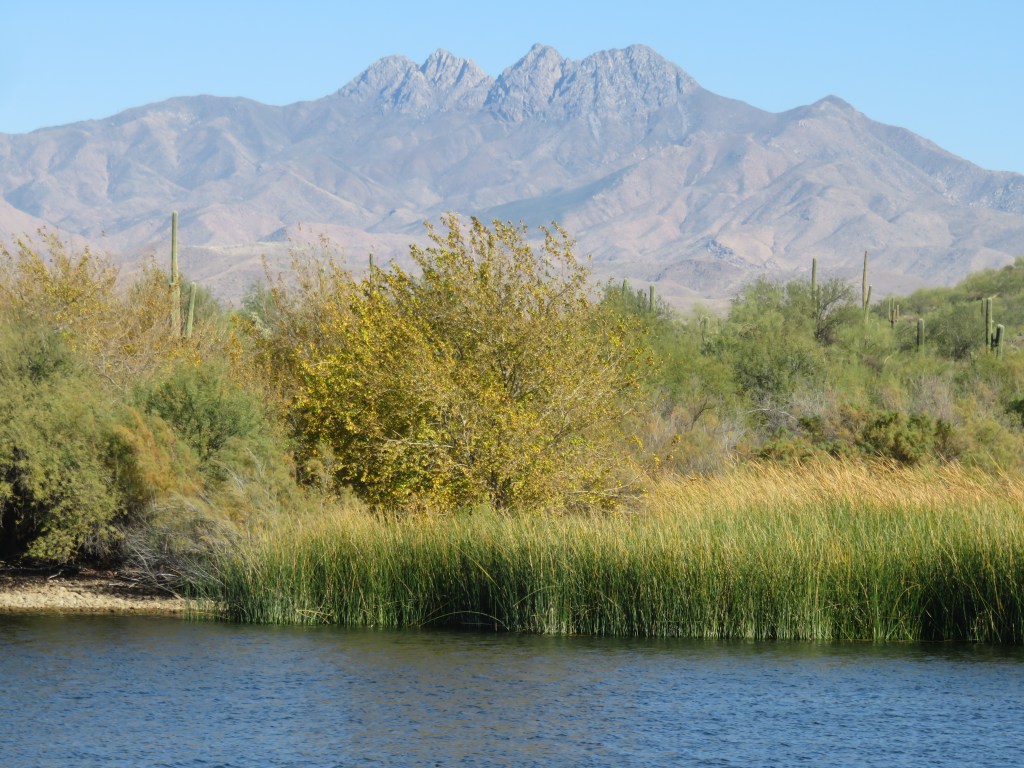
At the beginning of this blog, I noted that we were in the Four Peaks region of the Tonto National Forest. From the lake, we could see those peaks off in the distance.

The captain told us that there is an amethyst mine nestled below the peaks.

Bighorn sheep live here, but there were none to be seen today. We did, however, see eagles, and I switched my phone out for my camera to get this shot of one high on the rocks.

He also told us that there are actually four lakes created by damming the Salt River. From where we were, at Saguaro Lake, they go off to the east. If you think of the dams as a “scar” on the land, you can remember the names of the lakes that way: Saguaro, Canyon (in the Superstition Mountains), Apache, and Roosevelt.

One last shot of the lake for you – if you can see it, there is a rock formation that looks like an elephant. Appropriately, it is called Elephant Rock.

There were other adventures during our Gold Canyon stay, but I’ll save them for another time, perhaps. We’re on the move!

Next time – visiting Arizona’s Capitol Museum

USTravel

A Desert Stay at Lost Dutchman State Park, Arizona

The Twosna Travelers hope you had a merry Christmas, happy holidays, and a happy New Year, where ever it was you celebrated!

I have been a little quiet this past month on this blog. It was partly due to the holidays, partly due to relief at having finally finished my Europe blogs, and definitely due to Internet issues at the park we were at. This was not an inexpensive park; why was it so difficult to connect? Or, was it because my computer is now seven years old? Adding to this, the cable for our new phones will not fit my computer. This is how I transfer pictures. I can upload from Google Photos for now, but I’m probably going to have to address this sooner than later. If anyone has good ideas for me, I’m all ears.

For the third year in a row, we beat it out of Denver on November 1. There were several nightly stops in New Mexico but we did not stick around long; it was too cold there last year. This desert spot at Lost Dutchman, outside of Apache Junction, was our first destination. The warm sun was balm to our bones after the cooling temperatures in Denver.

It may not look like heaven, but perhaps a different perspective will change your opinion. We were situated in direct view of the the gorgeous Superstition Mountain range.

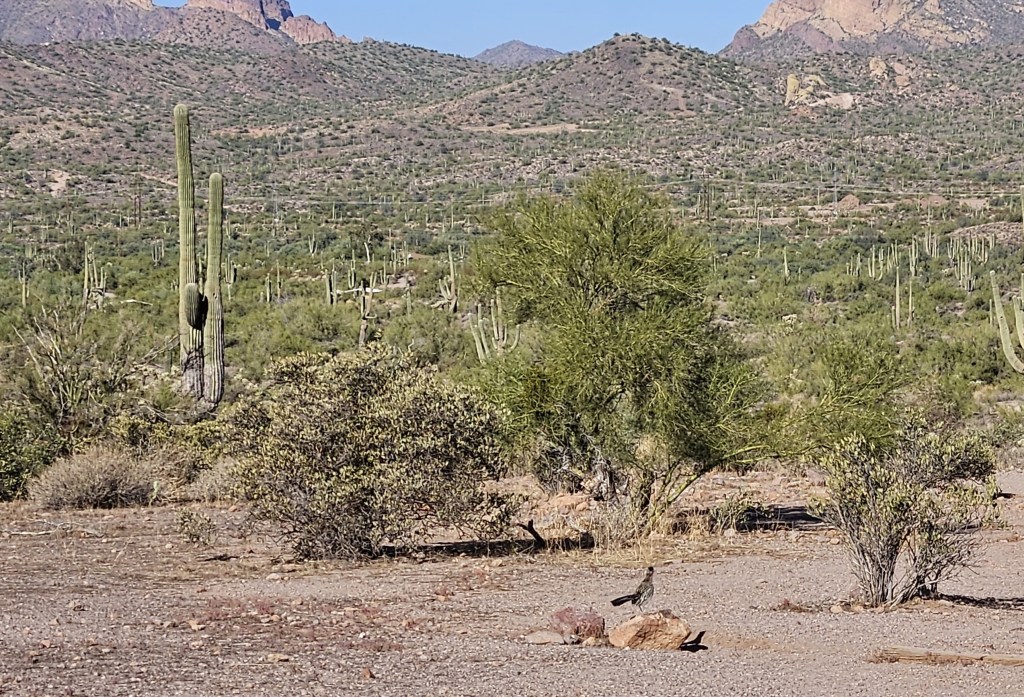
Every time I went for a walk around the campground loops, I would catch sight of several Gambel’s quail or at least one roadrunner, and I loved being back in the saguaro cactus forest. You can see a roadrunner on the rocks at the bottom of the picture below.

We came to Lost Dutchman to retreat, unwind, and hike. Our best hike was up in the shadows of the mountain on the Treasure Loop trail. We passed stands of other-worldly cholla on the way up.

Now, we could see close up the rock formations we had wondered about from our lawn chairs the night before.

The trail is also enjoyed by horseback riders.

Up at the part of the trail with highest elevation, we could see Phoenix in the distance and more mountains beyond. The city lies inside a ring of small mountain ranges, and the entire Phoenix area is known as “The Valley”.

Also at the top were weird rock formations–

and behind us, tucked into the mountain’s wall, a natural arch. It is on the right side of this picture.

If I ever make a list of the “Ten Favorite Things I’ve Learned While RV’ing”, one of those things would be this: that the setting sun on one horizon bathes mountainsides on the opposite horizon in a red glow before sunset. We first witnessed this at Big Bend National Park in Texas, and we have seen it in several places throughout the Southwest since then. It is a sight that thrills us every time, and the Superstitions were no exception. We pull up our lawn chairs for the brief show.

Compare this picture of the Superstition sunset glow to the daytime Superstition picture I posted above.

We never tire of this sight. We moved from here to an RV park where we could still see the Superstitions, and it has become one of my favorite mountain ranges.

Next time: horsing around by the Salt River

Europe · Greece

A Visit to the Mountain Villages of Naxos, Greece – Europe Travels October 2022

Upon our arrival in Naxos, our AirBnb host sat us down, unfolded a map, and drew all over it as she showed us all the varied things we could see in the mountain villages behind Naxos. It looked great! But how do we get there? Naxos is not Santorini, so the possibility of an ATV was quickly discarded. The distances are greater, the roads mountainous and tangled.

I turned once again to researching day tours. As I’ve already reported, Naxos in the middle of October was winding down their season. There wasn’t a lot to choose from except for a regular big bus tour. There were enough of us tourists left in Naxos to fill up that bus.

We headed out into the countryside. Olive and cypress trees dot the rolling landscape which is bordered by low stone walls. Old buildings in various states of decay can be seen here and there, and, up on distant mountaintops, ruins of Venetian castles. The valley is fertile and, besides olives, produces potatoes, fruit, wine, honey, and cheese. Small wonder, then, that the god that the ancient Greeks worshipped here was Demeter, god of harvest.

Our first stop was to see Demeter’s temple, built in 530 BC. It’s quite a story: as Greek civilization declined, a Byzantine church was built over the old temple. Arabic pirates destroyed the church in the sixth century AD, but it was rebuilt in 1977. After the discovery of the Greek temple, an archaeological excavation began, and the temple was rebuilt.

To allow for excavation and the subsequent build of the temple, the old Byzantine church had to be disassembled, moved to the side, and reassembled. It has its place in history, too.

One of our fellow tourists asked the guide why the temple wasn’t completely rebuilt. The answer is that under Greek law, buildings cannot be restored to a greater proportion than the ruins that were found.

Onward, then, to a 150-year-old olive press. Our guide demonstrated its use and the making of olive oil in the old days.

I wrote in my journal one thing I learned about the making of olive oil: that cold-pressed olive oil is best. I looked at both of my olive bottles in my pantry, and nothing is written anywhere on them about the oil being cold-pressed.

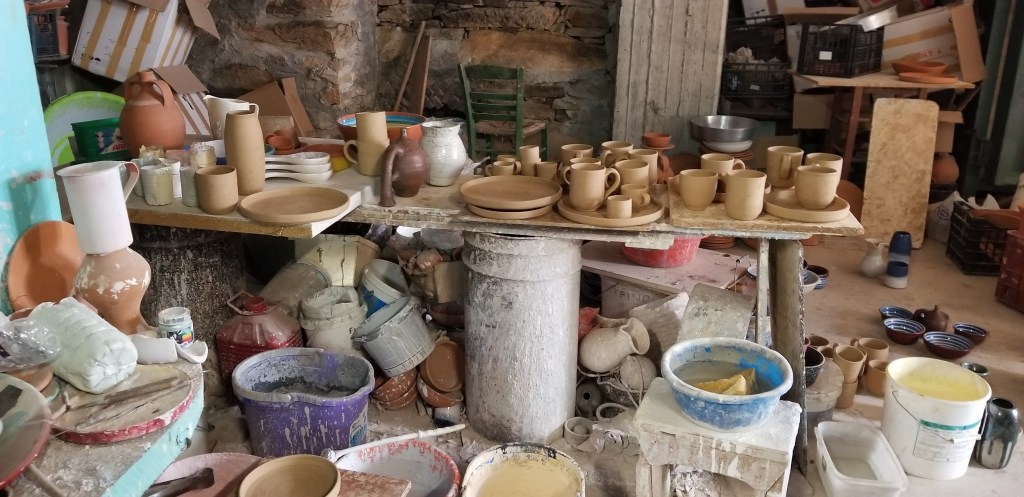
On to a little pottery shop, where the potter demonstrated his craft on a wheel. As he works, he throws excess bits of clay on the wall- his “wall art” is at left.

The potter’s studio

Then: off to the village of Halkio, to visit the 125-year-old Vallindras citron distillery. I enjoyed the little walk through the streets of town to get to it.

Citron is a fruit that grows on Naxos. It has a thick rind and the fruit is slightly bitter. The zest is what is mainly used. You may be familiar with candied citron. I remember it being packaged in small tubs in the grocery store, although I haven’t shopped for it in a very long time. My mother used to put it in the German lebkuchen cookies and stollen bread that she made at Christmas time. I like lebkuchen, but I only like stollen in small amounts and not enough to make it myself. In the few years that I made lebkuchen myself, I never considered what citron really was.

At the distillery, the citron is shown on the table below. Yellow yields the sweetest liqueur, but they also use the green variety and the leaves of the tree for production of the liqueur. It has 30-40% alcohol content. There was yellow, green and clear colored liqueur, and one little sample of the yellow liqueur kind was enough for me. The proprietors explained how they have made the citron through the years, and they used a little room containing the oldest equipment to demonstrate.

We were deep in the mountains by now, and I was in awe of our driver. The roads are mostly one-lane, full of hairpin turns, and not made for big buses. We would round a curve or ascend a hill, and find a car coming directly toward us. The driver of the car was obliged to back up and pull into whatever kind of roadway was closest in order for us to pass. Many times I would look out my window and notice that we were just a hair’s distance from a sign, a building, or a car mirror.

Just as I’d get comfortable looking out the window at the varied scenery, we would make another stop. This one was to Panagia Drosiani, another Byzantine church and the oldest church on Naxos. It was built at the end of the 6th century A.D. The front facade may be newer.

The inside of it was cave-like and dark. 

There are many priceless faded frescoes painted directly on to the walls. A dark side-chapel really did feel like entering a cave, and we could only go one person at a time into it. Visiting a church that had been built this early in Christianity’s very existence gave me a bit of goosebumps.

While waiting for others to go through it, I walked around to the back, and found an amazing sight. Here, the original construction of the church can be seen.

It was time for lunch, so for that we went into the village of Apiranthos. It is a village where the streets and archways are constructed from marble. We had a delicious lunch on a simple patio overlooking the valley while my feet were planted on a marble floor. A local cat placed herself there as well, looking at me hopefully during the entire time I ate my meal. Her wait was not in vain. She and I dined on a meal of roasted pork, spaghetti with a tomato gravy, and a salad with a local soft goat cheese called xinomizithra.

The reason for all the marble is that there are marble quarries in abundance on Naxos. It was simply the construction material that they had available to use. I was glad we had some time to wander around this pretty town on our own.

As with anywhere you go in Greece, ruins from earlier eras can still be seen.

Apiranthos’s setting in the mountains also makes it a beautiful place to be.

We rode north through the mountains for a long while, finally finding the north side of the island and the sea at Apollonas. I suspect that in the summer time this would have been a beach visit because we were given a lot of time to do not much. It was dubbed a “coffee stop”. There were a handful of gift shops and some places to eat. It was beautiful there, though.

We had just one stop left; a brief one, to the Apollonas Kouros. It is a massive 34-foot unfinished statue from the 5th or 6th century BC of Dionysus, the god of drink. It lays in the marble quarry where it was carved.

Why was this project abandoned? No one knows. Perhaps, our guide said, a war came. Times change. But another theory, one that I think makes most sense, was that they realized they would have difficulty getting such a colossal statue out of there. They would have had to get it down a steep hill without smashing it and then have an ocean-going vessel large enough for transport.

We returned to Naxos via the north coast with sweeping ocean views on one side and high cliffs on another. It had been a great day, although a little bittersweet because it was one of our last of the trip.

How were we feeling at the end of a three month trip? Cal had his moments when he felt that our adventure was too long and wanted to go back to his RV. Looking back on it, though, he says he enjoyed the sights and was glad we went. What made it fun for him was all the great food we had and being able to dine outside much of the time. I loved all the amazing places we visited. The trip truly did not have any down times for me and I think I would have been happy to keep on traveling. I missed the grandkids, but to put it in perspective, three months is really not that long a time and I was so happy to see them again when we returned.

For however long you have been with me on this journey, I humbly thank you for reading. I did not expect to be recording it for this long. And now, I am happy to report that my blogs will be returning to our RV life. The summer of ’23 was also epic, and we did do some more outside-the-RV travel both in the US and internationally, but perhaps those will be written at a later time.

Next time – enjoying the sun in Arizona

Europe · Greece

The Last Stop: Naxos, Greece – Europe Travels October 2022

Choosing a Greek island to visit is a lot like going to a buffet and knowing you can only have two dishes. Which one….? It’s hard to pick when you have never been there. There are so many, and they are large and small. Some may be known for great night life, the best beaches, or excellent cuisine.

After visiting Santorini, I knew I wanted to look for an island where the cruise ships did not stop. Naxos has those pretty whitewashed buildings, narrow streets and passageways to explore, and beaches. There are places of interest to visit. There is farming, and much of its food is grown on the island. It’s less touristy than Santorini, although Naxos Town has its share of shops. Sounds good to me!

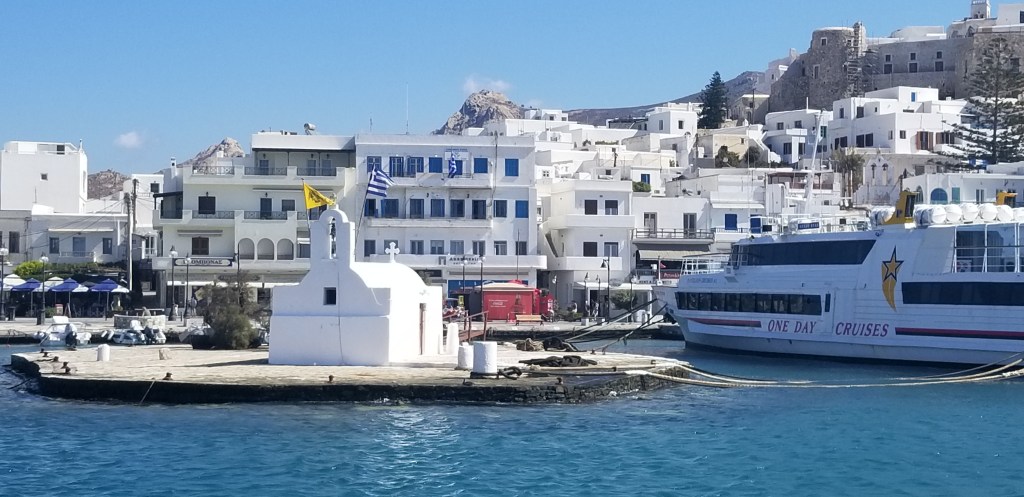
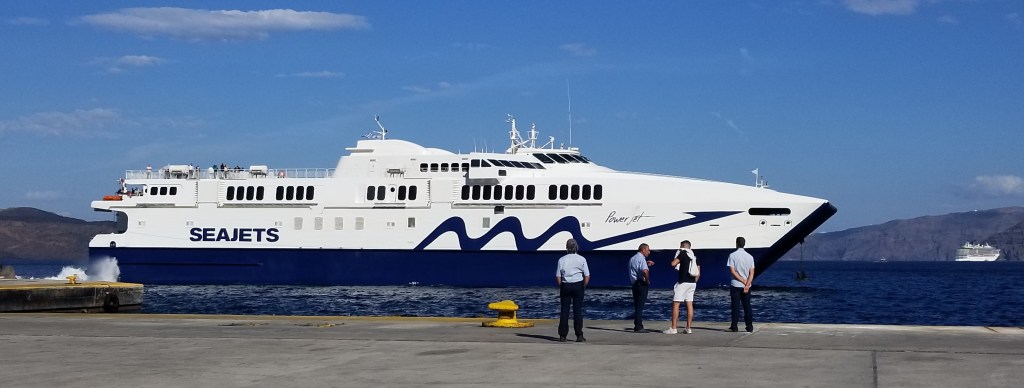
Like Santorini, Naxos is in the Cyclades group of islands, so our ferry ride from there was only an hour and a half long. We rode a Sea Jets ship, was supposed to be faster. For some inexplicable reason, though, it was running late.

Our apartment in Naxos was situated in a residential neighborhood. There were several ways to walk everywhere, and on our first afternoon we took too many turns and got totally lost coming back. GPS did not work. Two heads are better than one: we worked it out, and in the process learned better which way we should go in the future.

Not our neighborhood, since we were up and behind this view, but this area was on one of our walks to town.

One of Naxos’s most striking sights welcomes everyone arriving to the island. It is the ruins of the Temple of Apollo, called the Portara. I took this picture from the ferry.

The walk over to the ruins has a trick sidewalk. It takes careful timing so as not to get hit by the waves.

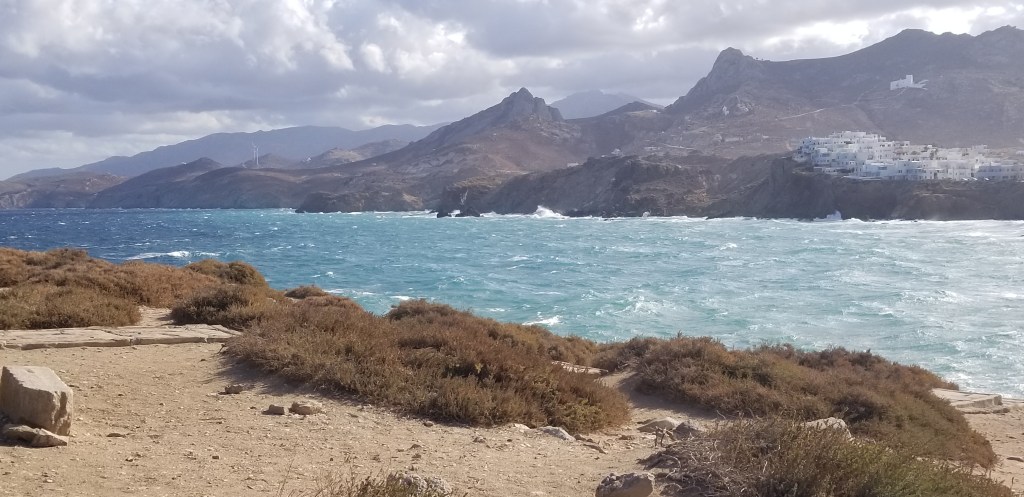
We waited for a big wave to pass, dove across…and still got wet. No matter, the October winds were already blowing and dried us off quickly.

The temple of Apollo was never finished, even in its own day. It dates back to 506 BC, and construction had commenced at the direction of a tyrant leader who was overthrown before completion.

The ancient and the modern…a partially obstructed view of the Blue Delos ferry from the Temple of Apollo gate
A natural view of Naxos from the Temple of Apollo. The waves were kicking up!

If you have been reading my blogs as far back as our time in Venice, I wrote about Venice’s “Golden Age”. It stretched back as far as the 8th century for a millenium, until Napoleon finally ended things. They had great maritime might and power. The remains of Venetian castles and fortresses dot the Mediteranean, and Naxos is no exception.

There really is no “castle” to see here, except the outside walls. There are four levels and it has a round shape, but the city of Chora (also called Naxos Town) is built right up and around it. Inside the “Kastro” is a Catholic cathedral and an archaeological museum, formerly a girls school. Mansions once housed Venetian ruling families, and some are now shops and cafes.

Part of the fun of walking up to it is trying to find it from the picturesque old market place to an old Venetian maze of passageways. We figured that as long as we were going upward, we were good.

We did get a view of the castle walls as we walked. From what I read, the tower will be a Byzantine museum when reconstruction is finished.

I visited the small archaeological museum inside the castle area.

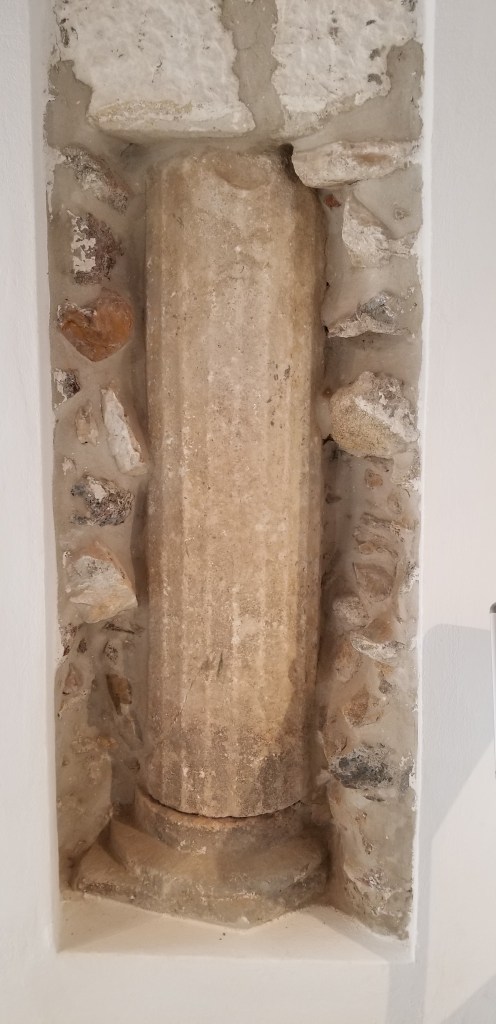
In the year 1207, Venetians built their castle on the foundations of an old Greek acropolis, and used the building materials from it and also from the Portara for construction. Here, a wall was built right around the acropolis column.

A little dwelling place I found while walking in this area:

The ceiling is a hodgepodge of sticks and timbers.

On another of our walks was a cemetery. Walking through, we noted that a number of the caskets were open and empty. What’s up with this? Later we found out that the city wants to move the cemetery elsewhere. The lucky deceased who still have living relatives have had their coffins removed elsewhere. It seems a little macabre!

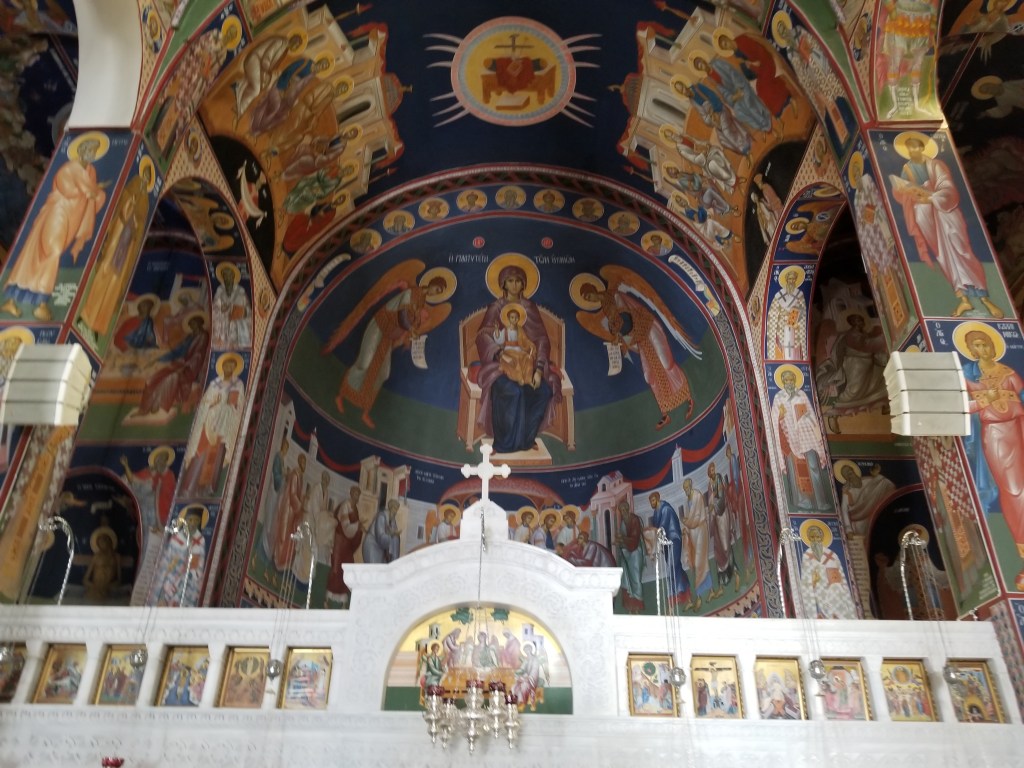
One of our most memorable church visits was to a Greek Orthodox church near our apartment. Cal is still talking about this one. There weren’t a lot of spaces in it that are left unpainted.

In my blogs from our visit to the UK, I usually closed with a photo of a breakfast we’d had. I haven’t done this since for a simple reason: as we traveled further south, breakfast became less of a big deal in the countries we visited. In both Italy and Greece, people tend to rise later and snatch a quick cup of expresso or cappucino, perhaps with a croissant. I think maybe it is because they like to dine later in the evening and so aren’t really hungry first thing in the morning, but that’s pure speculation on my part. Of course, exceptions can be found in all the tourist hotels.

I’m generalizing here, but Greeks do seem to like omelets. Or maybe it’s because they know we travelers like omelets. When we walked in a certain direction, we’d see a little cafe advertising a Greek breakfast, so one morning we stopped by. It was exciting to not be eating a bowl of cereal in our apartment for once.

My Greek breakfast:

The omelet contains potatoes, onions, and cheese. It was not overly stuffed with any of these three ingredients, and the cheese seemed like a cross between cream cheese and goat cheese. It came with toasted bread, a salad, and a strawberry smoothie. Delicious!

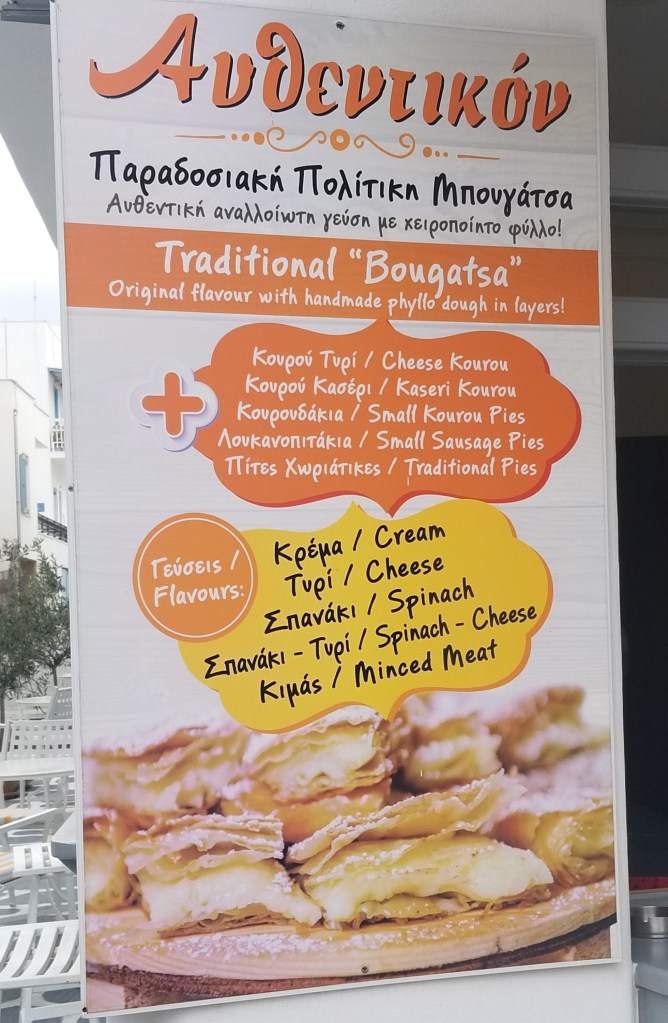
More typically, though, if the Greeks have anything with their coffee other than a croissant, it might be a bougatsa. I had one of these for lunch a time or two and it was delicious.

Another favorite all over Greece for any meal is a Gyro-in-hand. This is a gyro with french fries sticking out of it. It’s an entire compact meal which I often saw people munching on while they were walking down the street.

Earlier I mentioned the October winds. Naxos shuts down earlier than Santorini does, on October 15, for this reason. As our visit here progressed, we noticed stores starting to close for the season. The wind was not bad during the day, but it would become gusty later on and would become downright chilly. The darkness in the evenings plus the chill meant that I was digging out my jacket for the first time since Germany when we’d go out for dinner. The day before we left Naxos, the wind miraculously slowed and the clouds disappeared. Beach time!

Agios Georgios beach was not far from our apartment. Cal and I walked down the beach together–

and then Cal settled in to a chaise lounger under an umbrella. He likes the beach, but he does not enjoy the sun. Meanwhile, I walked further down the beach and found a sheltered cove with many windsurfers. The wind on Naxos makes for some great windsurfing.

We were feeling the end of the trip. Our pattern for life in Naxos was often to go out and explore for awhile, maybe have lunch or pick something up from a bakery, and come back to the apartment. There were several days here. It was a relaxing time and Naxos lends itself to that. I was trying hard to finish a cross-stitch Christmas stocking for my granddaughter that I’d been carrying all over Europe. We watched a bit of TV, but Wheel of Fortune is just a little different in Greek.

We had one last day trip on Naxos, though. One last tour. That will be in my next post!

Next time – exploring the mountain villages of Naxos

Europe · Greece

ATVing in Santorini, Greece – Europe Travels October 2022

In my previous blog, I wrote that our apartment in Santorini was “neither here nor there”. I knew that going in, but thought we could use the bus system. Upon our arrival we were told that buses were unreliable. Seeing tourists waiting patiently at each bus stop reinforced that opinion for us. In hindsight, I think we should have given it a try at least once.

So on our first evening in Santorini and not knowing where else to go, we walked up the hill to Imerovigli for dinner. It was a little distance along a winding road and the shoulder was rocky and narrow. Traffic zoomed by, and that included many folks on ATVs. Our dinner conversation centered around a new idea: if we rented an ATV while in Santorini? Of course, Cal would be the driver. He has driven many types of motorized vehicles, although he had only operated an ATV once before. He was game for the plan, and Margarita in our apartment office arranged everything for us. We took delivery the very next morning.

Of course, there was a lengthy introduction to our ATV when it arrived, including a test drive. Here is Cal heading out on to the road for the very first time.

At first, he just tooled around on the roads around us, and to Oia. The ATV was very handy for getting to and from Fira. I couldn’t take pictures of what I was seeing, though, because I needed to hang on! I was afraid that we’d hit a bump and then the phone would go flying.

One morning, though, we cajoled Margarita (procurer of all things in our apartment office) into bringing our breakfast earlier than usual, and set off for the south side of the island. We knew it would be a bit of a ride, but after a while I felt that we were climbing. It was getting darker, foggier, and starting to sprinkle. Cal had inadvertently headed up toward the east, and we were in the mountains. It was hard to talk to him over the noise of the ATV, but after awhile I gave him a poke, and he stopped. “Hmmm, are we going in the right direction, do you think?” It remains one of the funniest stories of our trip.

GPS didn’t work well in Santorini, and I had a sketchy little map ripped out of a brochure. We finally found the sunshine again and figured out our location, and most of the day proceeded without incident.

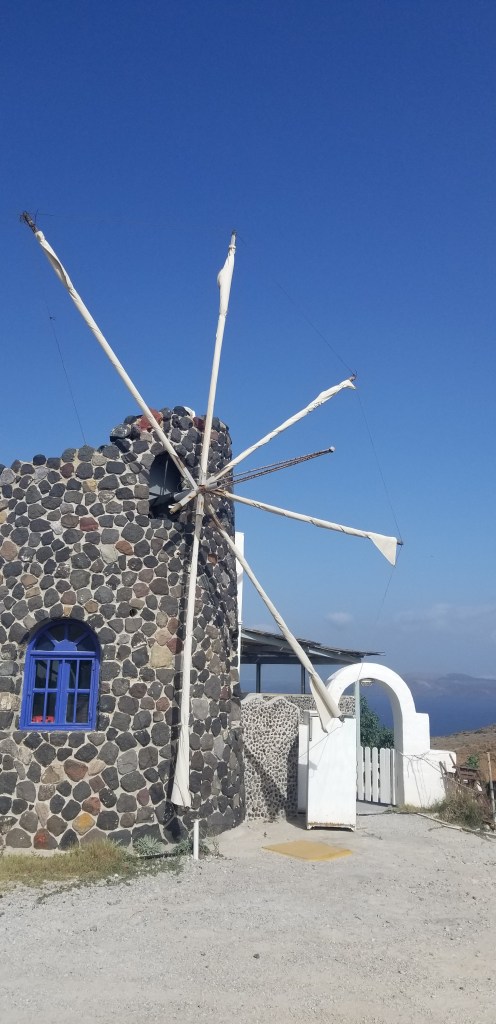
These windmills were once a familiar sight around Santorini. They were used to grind grain for flour. Today, many of them have been renovated into villas. This one was next to a restaurant.

Now, which way should we go?

In the sweeping landscape of this portion of the island, we could see the pumice layer left by the volcano 3,600 years ago.

Santorini has its very own version of Italy’s Pompeii in the form of an archaeological site named Akrotiri, and we stopped at this place for awhile. The island at that time was called not Santorini, but Thera. There was a thriving town here back in 1620 B.C. It had earlier been hit by two earthquakes which made the resident Minoans more determined to build back better before the volcano finally wiped it out completely. Their buildings contained the treasures of their advanced civilization. I could compare this to the city ruins found in Thessaloniki and under the Parthenon Museum in Athens, but these were mind-blowingly 1300 years older!

These urns were found in the “Pithoi Storeroom” – so named because of the large number of “pithoi”, or storage jars, found here.

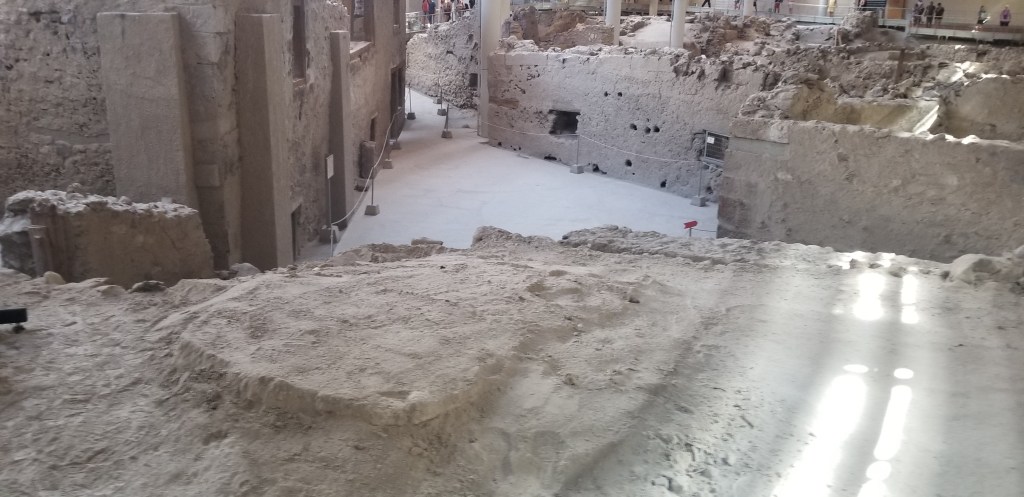
An then, most impressive to me, an actual town square.

The building in the front of this picture is still unexcavated, as is about 70% of the city. The picture below shows how the building on the top left would have looked like before the volcano hit.

During the volcano event, a huge mudflow filled up Akroteri. This preserved not only the treasures inside the homes but also many of their wall paintings. The paintings were the symbol of a resident’s wealth and status.

The next day, I visited the Archaeological Museum of Prehistoric Thera, which contains not only many artifacts from Akroteri but also the wall paintings which have been meticulously removed and preserved. I love the “Blue Monkeys” particularly.

There have never been indigenous monkeys in Santorini. The monkeys in this painting are indigenous to Ethiopia. Crete is in sight of Santorini, sixty miles away. It is thought that monkeys were traded there and brought to ancient Thera, or else sailors picked them up on their voyages around the Mediterranean. I love to imagine how these blue monkeys looked when the paint was fresh.

OK, back to our explorations. Besides Akroteri, I’d heard there was a red sand beach, and in a short time we were there. We’d visited a red sand beach in Hawaii so I wanted to check this out. It was a short drive away, and luckily easy to find, but quite a walk just from the parking lot. As usual, there were plenty of diversions along the way.

A couple getting married were having their picture taken in front of a pretty little church:

and a violinist was playing lively Greek folk music which we could hear from a distance away.

The hike to the beach began to get serious, and involved a little rock scrambling.

The beach is made up of fine red pebbles, which I do not think I would like to lay or sit on for long. When I shucked my shoes, it was felt sharp under my feet. Volcanic matter has iron in it, and that is what turns the pebbles red.

This is one of best that Santorini has in the way of beaches and from what I’ve read, other islands have better ones. Especially with its high volcanic cliffs, beaches are not the reason to come here. Red Beach scores points for beauty, though.

What remains in my memory is the sound of the receding waves moving all of the rocks around under the water. It was like nothing I’ve ever heard before, like soft thunder.

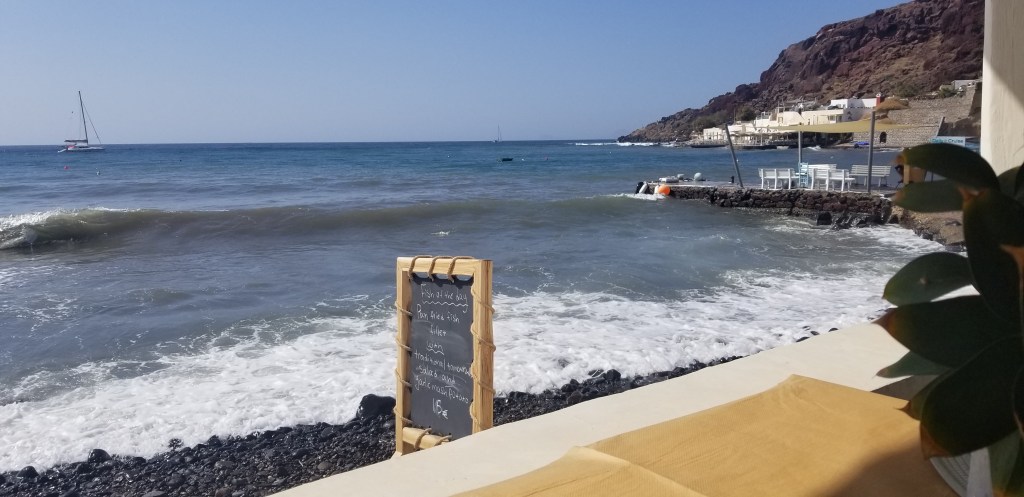
It wasn’t quite lunch time yet but there was a cute restaurant at the end of the beach. To be able have a front row seat on their porch and take a break, I ordered a plate of mussels saganaki, delicously sprinkled with feta cheese.

From our table, we could not possibly be too much closer to the water. I could have sat there all day, but unfortunately, the proprietor might have frowned on that.

We had one more stop at the very tip of the island, Faros Lighthouse, also called the Lighthouse of Akrotiri. Built in 1892, it is one of the oldest lighthouses in Greece.

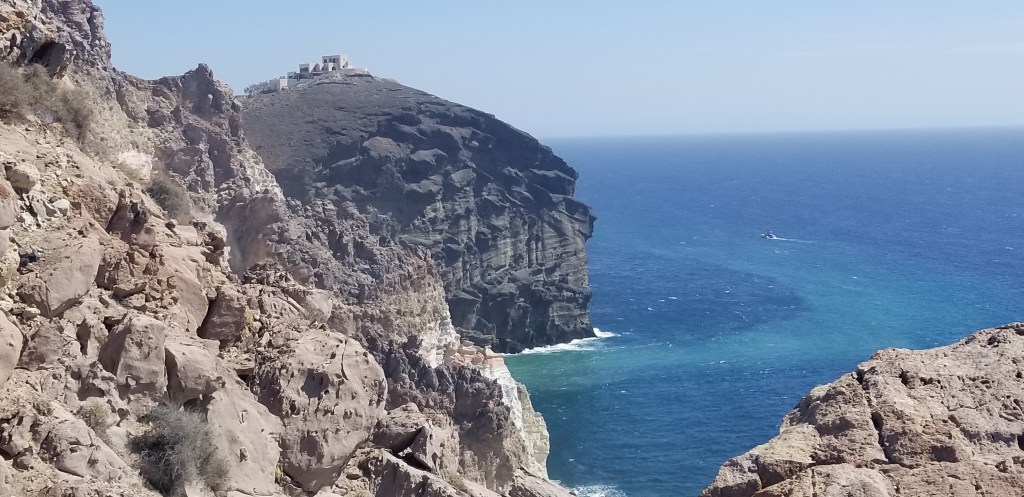
Looking at it from the parking lot, you’d wonder how it could possibly do its job, since the building is short. Hiking on the rocks below it, though, one sees its vantage point at the top of a cliff. This is what the lighthouse sees, although from considerably higher than I was at this point:

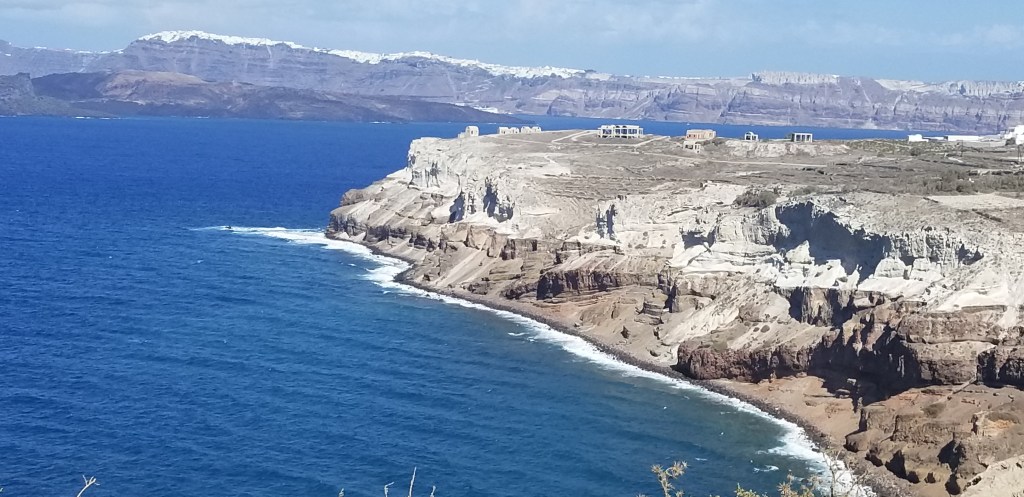
In the distance, Fira could be seen:

The ATV rental was a complete success.

Santorini left us with a lot of great island memories. Saying goodbye to Margarita, she told us that she was very happy; a vacation was coming soon. She had been in the office every single day we’d been there. Santorini officially shuts down November 15. The workers, who mostly come to the island from Athens, then leave and get a four month break. She said they work every day with no time off for eight months before that vacation. After telling us that, I really had to appreciate all of her hard work.

Our talkative driver on the way back through the island and down the precipitous cliffs also had the same sort of story to tell. Thanks to Margarita’s advice, we arrived much too early for the ferry. An entertaining server at the ferry restaurant plied us with warm croissants from the oven. From start to finish, Santorini shone, and I was sorry to leave.

Next time – Naxos, another Greek island

Europe · Greece

Sunny Santorini – Europe Travels October 2022

As the calendar flipped over to October, our travels were winding down. We figured that the best way to celebrate the last two weeks of an epic journey was by visiting a couple of Greek islands.

I could not ignore Santorini. It’s another one of those places that has a reputation for being overcrowded with tourists. But how I could go to the islands and not go there?

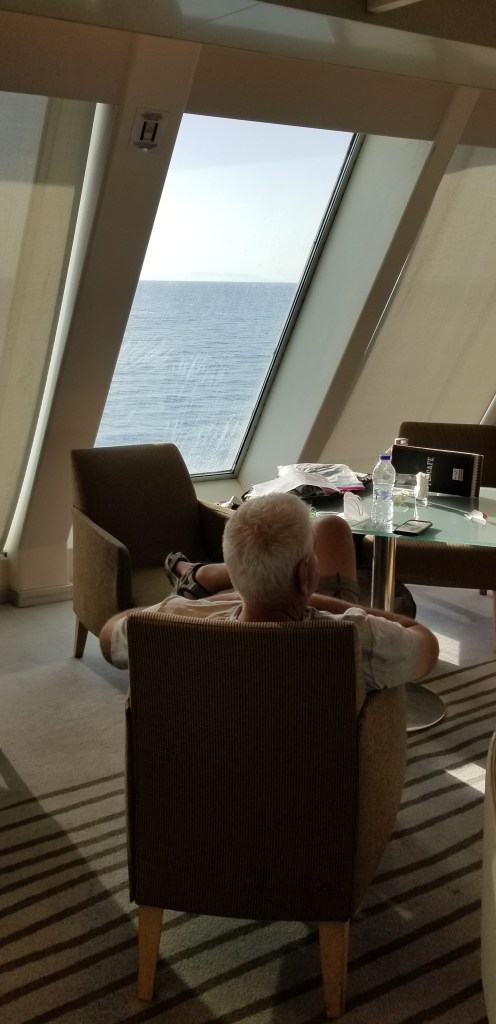
The sun hadn’t yet come up when we left our hotel in Athens, got on the subway, and found the Blue Star Delos at the Piraeus docks with a depart time of 7:25 AM. The ferry isn’t terribly expensive when all things are considered, so we upped our fare to Business Class. For that, we had a table, comfortable chairs, and an attentive server who would come by now and again to see if we needed drinks or food. We could look out the front of the ship, and of course we would go round and explore it at times. Views of other beautiful island towns were thrown in when stops were made at various ports. We were very pleased with our do-it-yourself cruise, which took about seven hours.

One of the island stops while on the ferry

Santorini is one of a chain of islands called the Cyclades in the Aegean sea. The main feature of these islands is that they were all formed by a volcano.

We received our first look at the island from our ship.

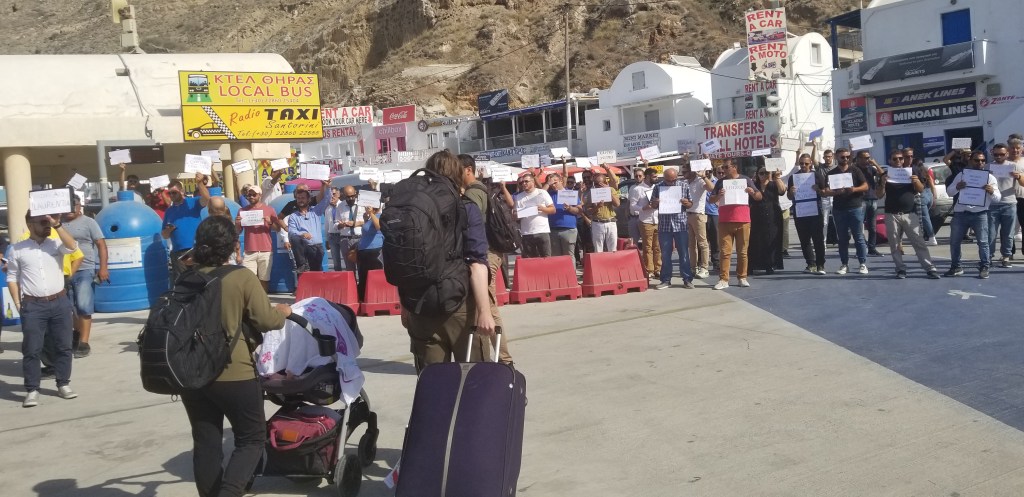
Somehow, we ended up at the front of the line upon disembarking. We still have not forgotten the sight of all of these drivers waiting for their passengers. It was crazy! Amazingly, we readily found the guy holding our name on his board, and we were off.

It’s tempting to call the biggest town “Santorini”, but that’s the name of the whole island; its name is really “Fira”.

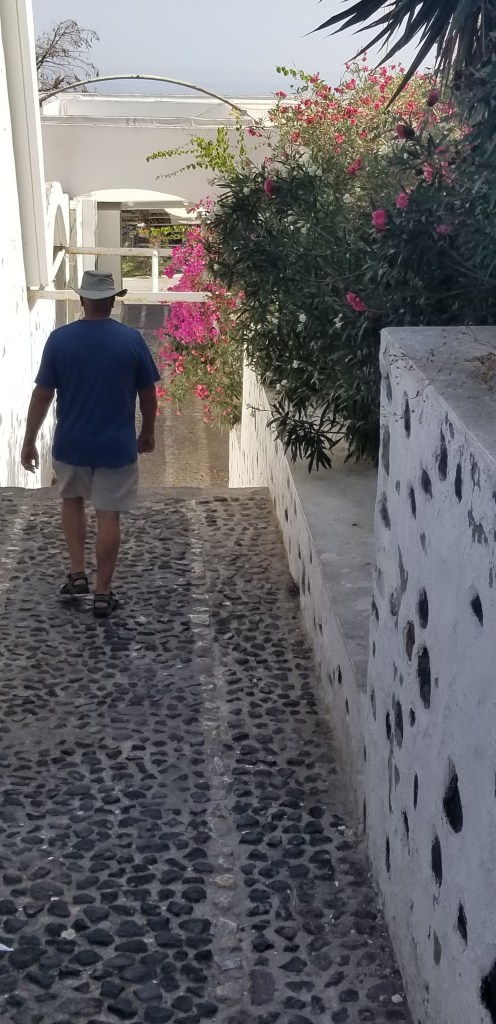
On our first afternoon, we did some wandering around in Fira. It was lovely – at first. We had lunch, and wandered down some of the labyrinthine streets and paths.

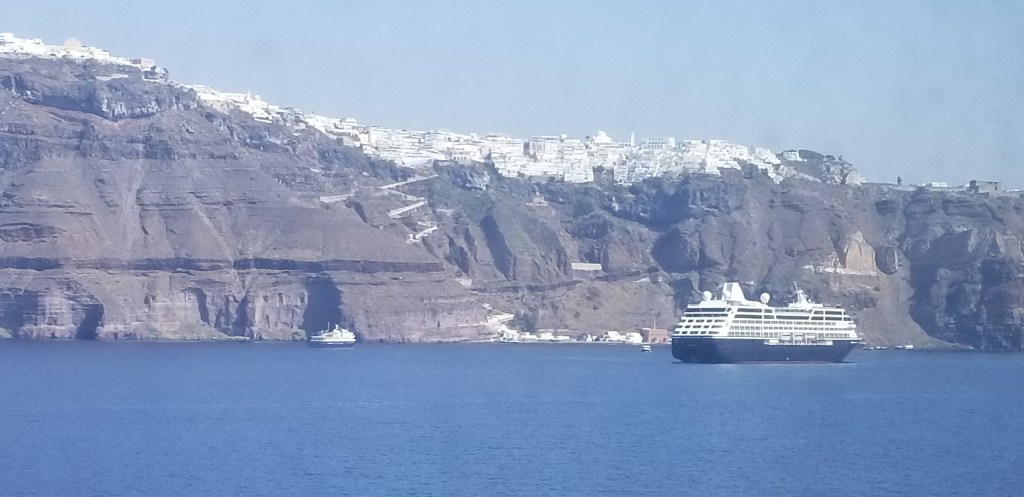
Soon enough, we got caught in a tourist river – a steady stream of people filling up the path from side to side, moving in one direction. People dodged in and out of the tiny shops. It was hard to get out of and really not enjoyable. Afternoon, as we discovered, is not a great time to explore Fira. Do you see the two cruise ships out in the harbor in my top picture? They hold lots of people. A driver that later took us back to the ferry told us that in July there could be as many as seven cruise ships in the harbor at one time. I cannot imagine all those people filling the little passageways of Fira.

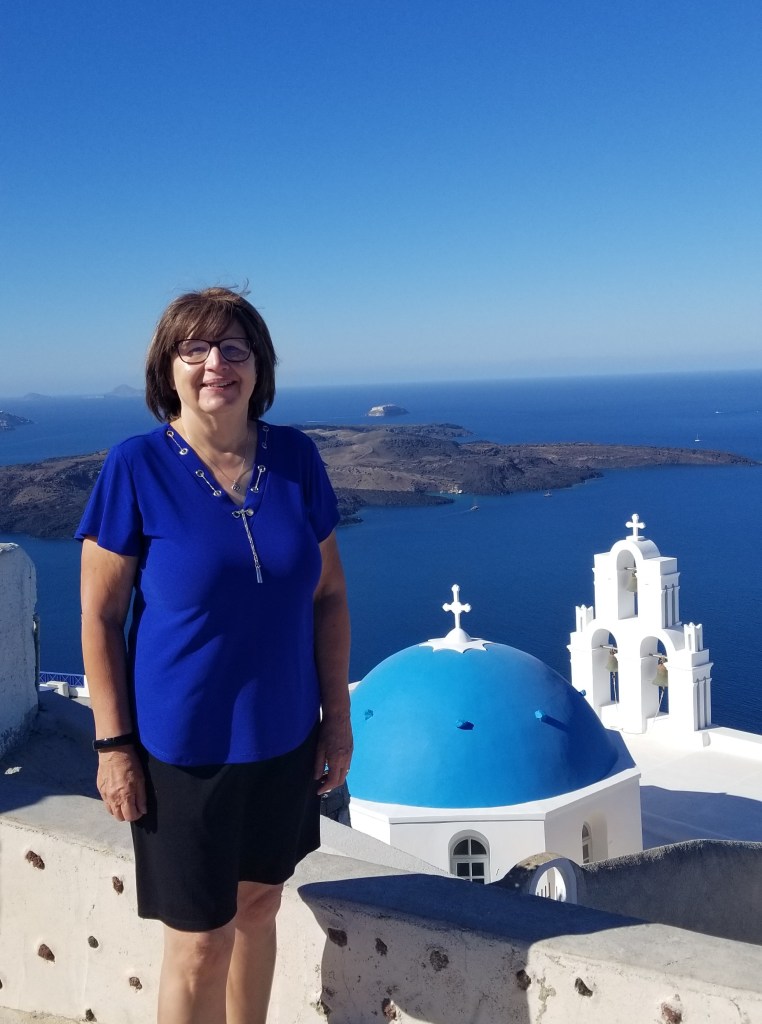
Have you ever seen the iconic blue dome pictures of Santorini? That is what I was looking for. I don’t know why I was so fixated on finding that particular view. Later, I looked on a postcard I’d picked up, and I saw some lettering to the side – “Firostefani”. Now that I’d been here a couple of days, I knew that Firostefani is a village that bumps up right next to Fira. On the morning of our last full day, we headed down to Fira to run an errand or two. And then we split up. He wanted nothing more to do with my blue dome fixation – smart man!

Here it was that I found the magic of Santorini. Crowds were light, the whitewashed buildings shone in the bright sunshine, and the water sparkled in the harbor. It was a fine walk to Firostefani. I worked my way up to a dizzying walkway along the cliffs.

The round building used to be a windmill; it looks like it has been repurposed to be a home.

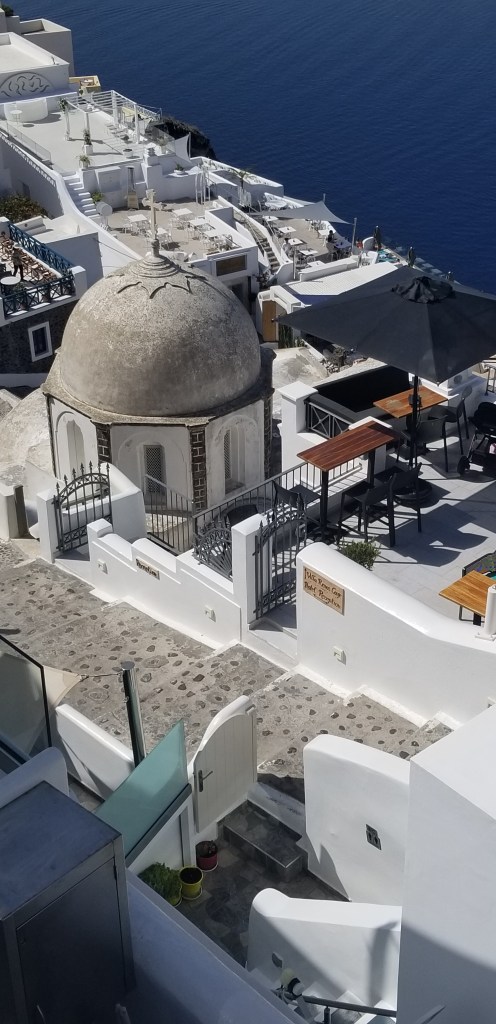
I walked along, enjoying the fine views so much that I was ready to give up my blue dome search. I stopped to look at an ornate gate in front of a church. It was as I was studying the gate that I saw it on the right of it – a picture of the blue dome, and directions on how to find it! It belongs to this church, the Catholic Church of Koimisi Tis Theotoku. A little walk back up the path and behind, and I was there. Eureka!

Ah….so beautiful. I took photos of other tourists when they asked, and of course they offered to take pictures of me.

From here, I could see to the opposite side of the island. In places, Santorini is so narrow that you can do that.

When I found Cal again, he was entertained by watching tourists taking selfies and group shots in front of a colorful plastic-looking donkey in the main square. He had spent most of his time in a coffee shop overlooking the harbor, enjoying the view, and had thoroughly enjoyed himself. His mode of travel is a lot less intense than mine.

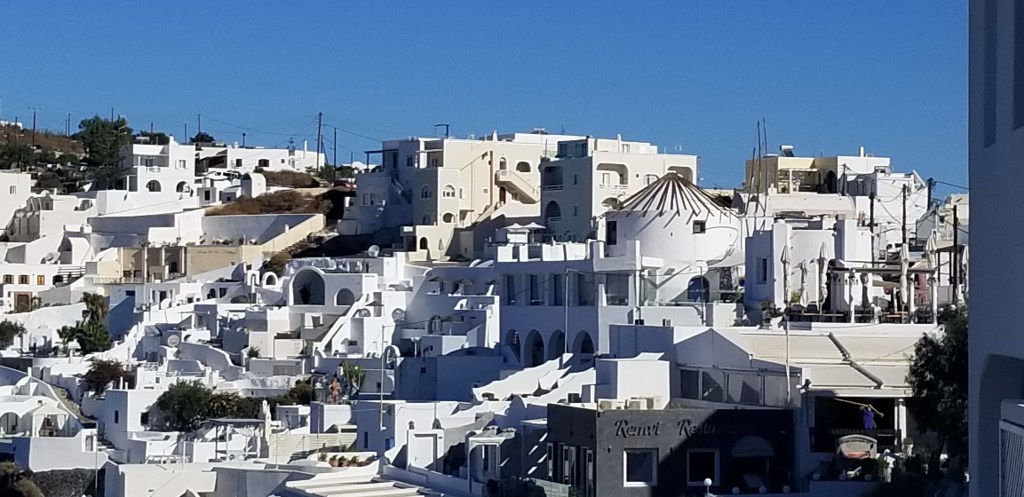
I’d found our lodgings through AirBnb, but the place was more like one of a handful of villas in a family-owned bed and breakfast. They brought us breakfast every morning on a tray. By Santorini standards, it was inexpensive, probably because it was neither here nor there – it lay just outside of tiny Imerovigli on the road between Fira and Santorini’s other main village, Oia. When booking, I thought maybe we could hike to Oia on a little footpath, and with one more day, we may have. The view from our place wasn’t totally amazing, but not bad either. The villas are on the sunrise side.

Taking a walk from our place, we found another church with a blue dome. The reason for white buildings and blue domes is simple – they are the colors of the Greek flag.

Down and across the road from us a bit, we found tiny little Taverna Tasos that we loved so much that we ate there two out of the four nights that we were in Santorini. The Oia-Fira path was behind it, and also the “sunset” side of the island, so we would walk there after dinner for a sunset view.

The path follows the low brick wall in the bottom right of the above picture, and you can just barely see it as it winds around on top of the cliffs. It ends at the town of Oia, which is not seen in this picture and would be on the far left.

Santorini was already occupied back in the 16th century BC when a volcano erupted that totally reshaped the island and formed a caldera. The island is crescent shaped and the landscape is rugged. Today, the villages are built a thousand feet above sea level, right on top of the steep walls of the caldera, half of which is submerged under the Aegean Sea. The island is only five miles from the active underwater volcano Kolumbo.

No better place to get a look at it than from a sunset dinner cruise.

In early times, there was little building material to be found in Santorini. Residences were dug right out of the cliffs, because the top layer of the caldera is a chalky substance called pumice. These cave dwellings were cool in the summer and warm in winter. All of the white you see on top is not only whitewash, which also reflects heat, but pumice.

The cruise gave us an entirely different view of the island. We could view all of the little towns way up high, and could see close-up the walls of the caldera.

In the below picture, the volcanic rock and dirt can clearly be seen on a nearby uninhabited island.

And then the sun went down – plop! – just like that.

As with other tourist-heavy places that we visited, there is gold (or white chalk) under the surface of Santorini. It is so much more than just those beautiful white buildings and blue domes spilling down the caldera. All one has to do is to take the path, or time of day, less traveled. Avoiding the shops, especially in the afternoon, helps. It seems sometimes that everyone’s main function is to shop and go.

We were sitting near the footpath one evening, waiting for sunset, when we struck up a conversation with a British couple. “I’m seeing so many American tourists here,” the gentleman commented. “Why is that?”

I had to give this a lot of thought before I answered him, because I think there are several reasons and maybe not just one. I said something about Santorini being heavily promoted as a romantic destination in the United States. But just maybe it is simply this – that Santorini has a magic all its own, which draws people here.

Or maybe it’s the view of that blue-domed church over the Aegean sea.

Next time – ATV’ing in Santorini