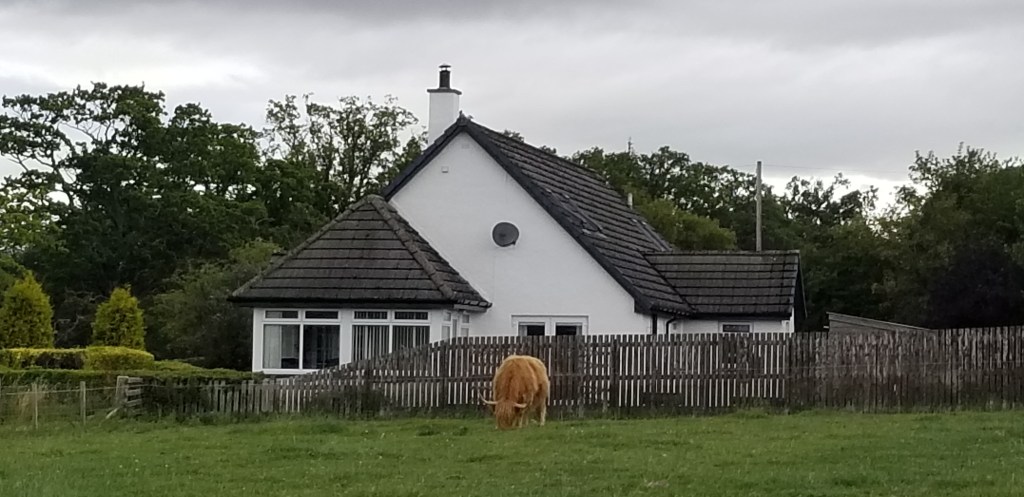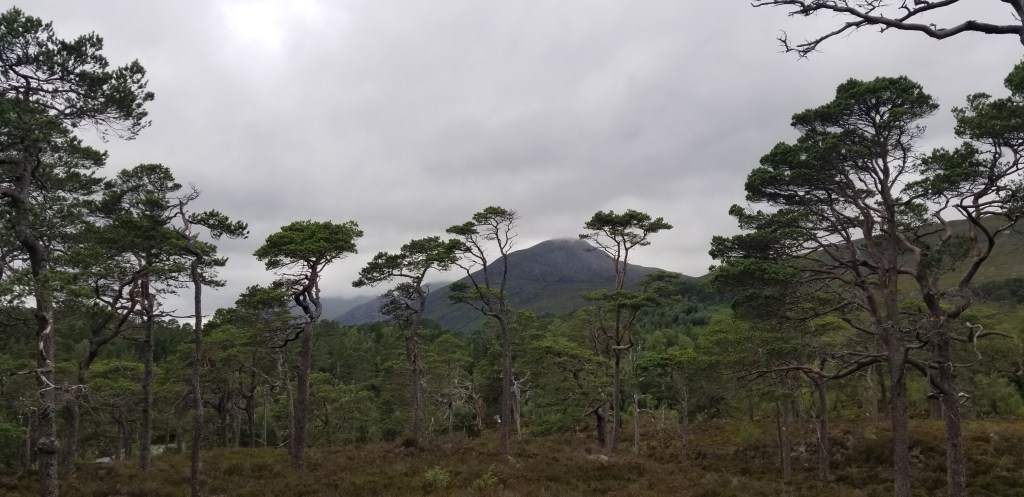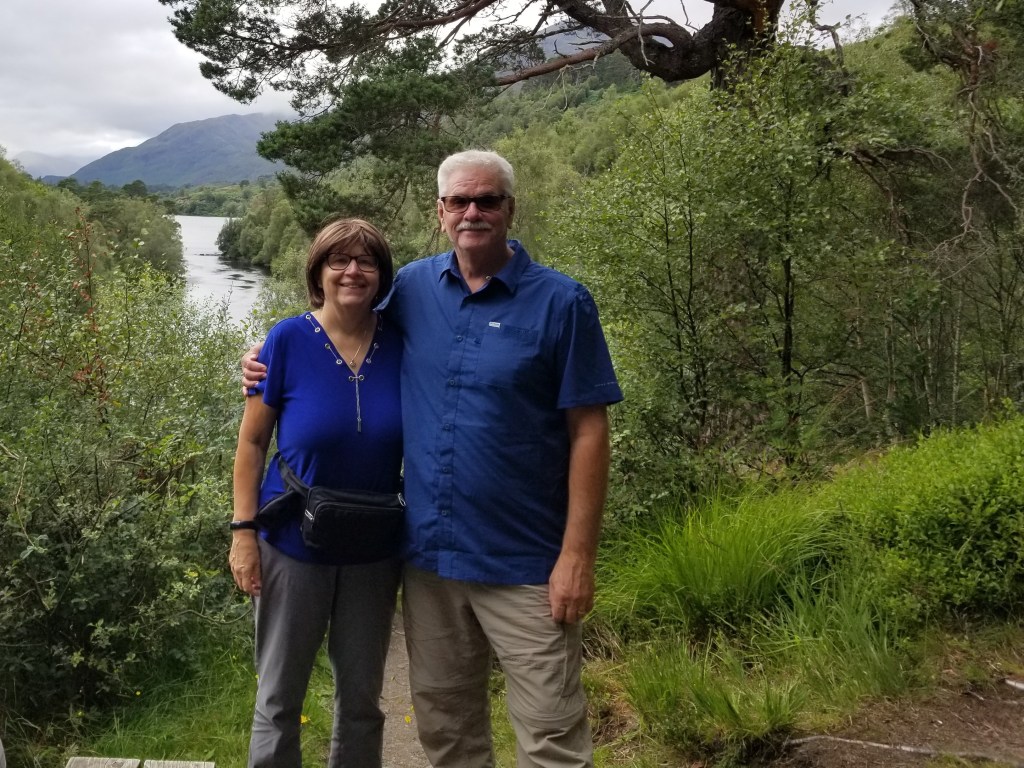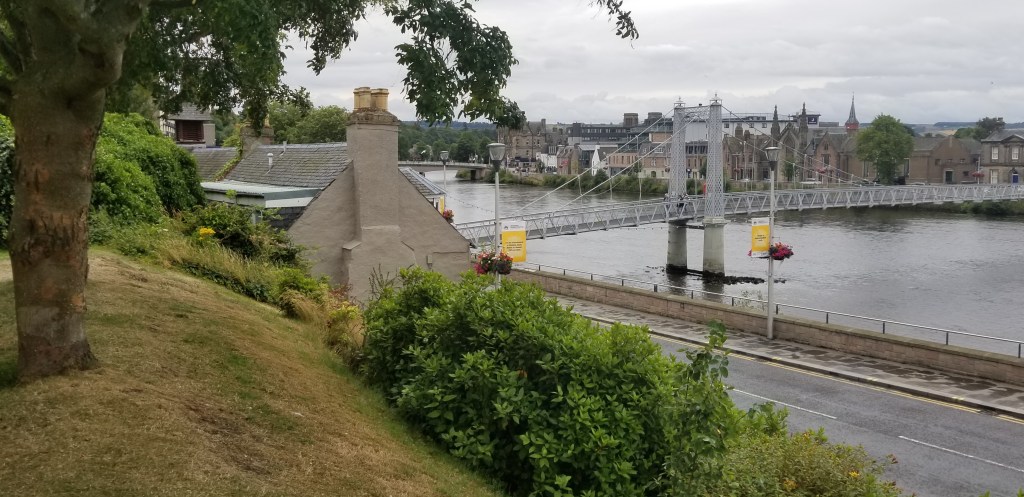
Europe · UK and Ireland

Higgledy Piggledy Streets in Shrewsbury, England – Europe Travels August 2022

Shrewsbury is likely not the kind of town you would know about if you are trying to decide where to go on a trip to England. And indeed, if you don’t have a lot of time, you probably wouldn’t put it on your list. Tourists are here, yes, but not in droves that we saw elsewhere.
The town lies in Shropshire, in the far west side of England, right next to the border with Wales. It is the setting for a detective series about a 12th century Welsh Benedictine monk who solved crimes in Shrewsbury. Ellis Peters wrote 22 books in the “Brother Cadfael” series. I read all of them, although I enjoyed the earliest books in the series most. A few years back, I looked up what it might be like to visit here, and dismissed it for some reason. Of course, things are not going to look as they did in Cadfael’s day.

But then, a Facebook blogger that I follow called “Florry the Lorry” visited Shrewsbury. The pictures she took of this town are gorgeous. I’m sure that when I commented about a possible future visit here, she replied about the medieval buildings and streets going all “higgledy piggledy”. I can’t find that thread now, but I was ready to go based on her pictures and remarks. Plus, it was right on our path through England.

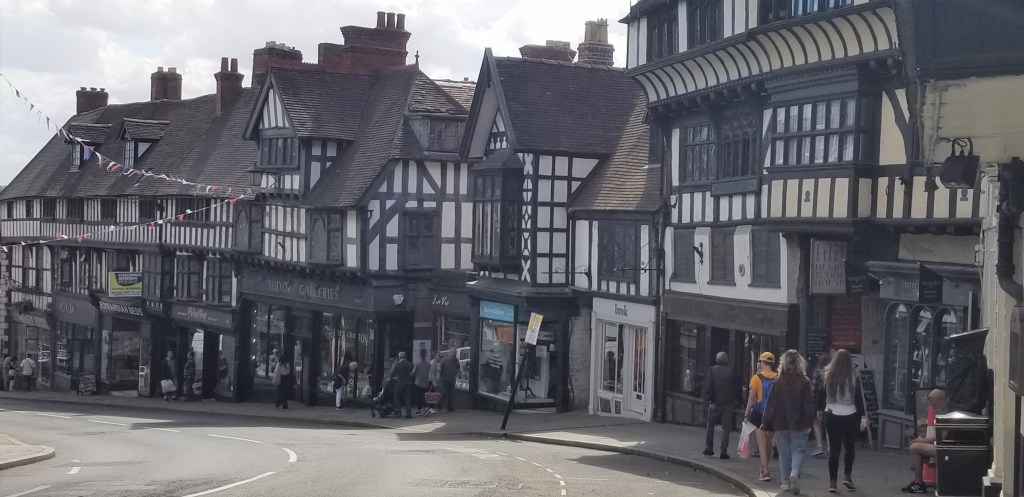
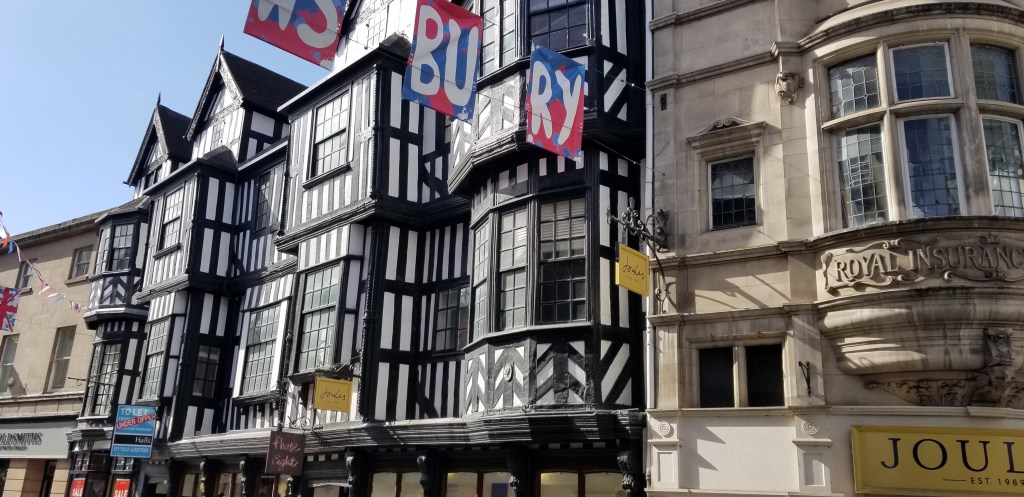
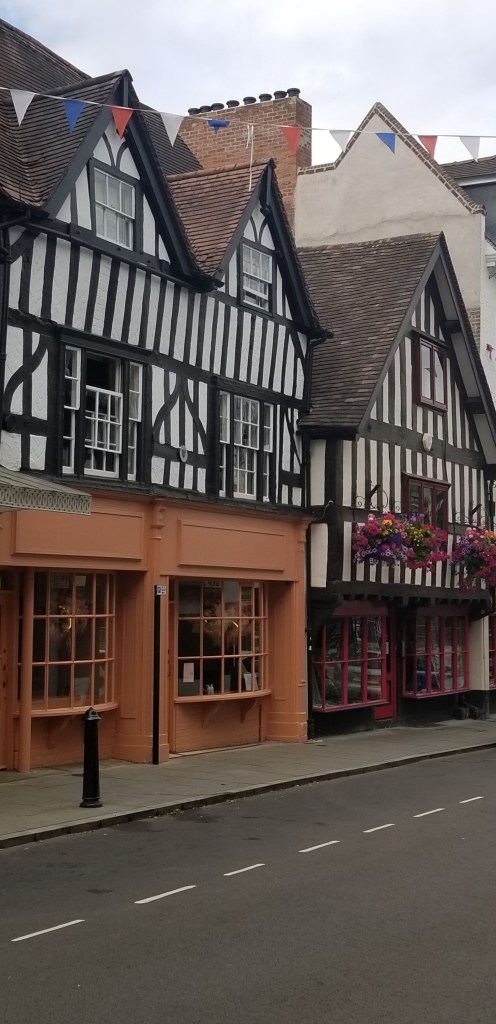
We spent a lot of time in Shrewsbury just wandering about, admiring the crooked buildings, and peering into shop windows.

For centuries, Shrewsbury has been a designated “market town” which gives it the right to have a weekly market. It was held here, under the archway and the square:
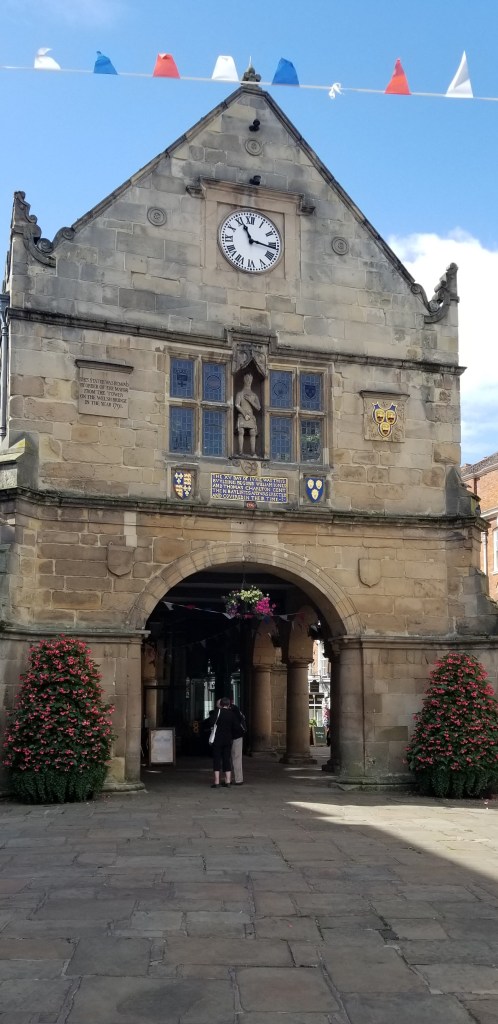
In the 1960’s the need for a new market was evident. The town built a modern indoor market that retained none of the character of the original, but I’m sure the vendors enjoy being out of the weather. We walked through and I did a wee bit of shopping, as well as to have the requisite tea and cakes. I bought some much needed socks, a foldable tote bag, and – a steal – 3 vintage postcards for forty pence each. We had all the fruits and vegetables that we needed back in our apartment.

Charles Darwin was born in Shrewsbury. There is a statue of him in front of the building where he went to school as a boy. It is now the town library.

There are always so few statues of women that I feel that I should give Mary Webb her due. Her statue was near Charles Darwin’s.

The Shrewsbury places featured in the Brother Cadfael mysteries are Shrewsbury Abbey, the River Severn, and Shrewsbury castle. All of these places still exist…sort of.

The “Castle Foregate” and the “Abbey Foregate” are two place names often mentioned often in the books. It is simply the roads leading up to the gates of the castle and the abbey, and they are street names used today. It’s interesting to think about how old street names can be in a country that has been inhabited for so long.
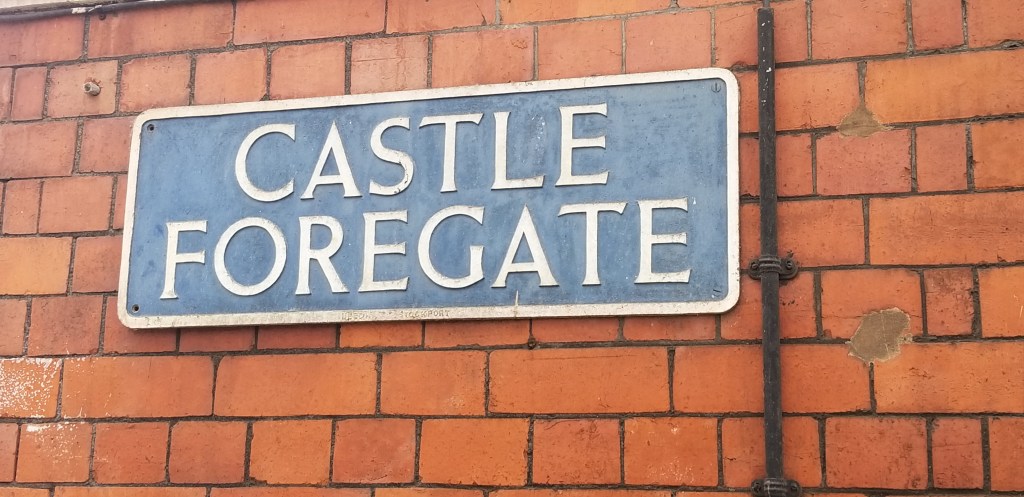
We walked up the foregate to the castle.

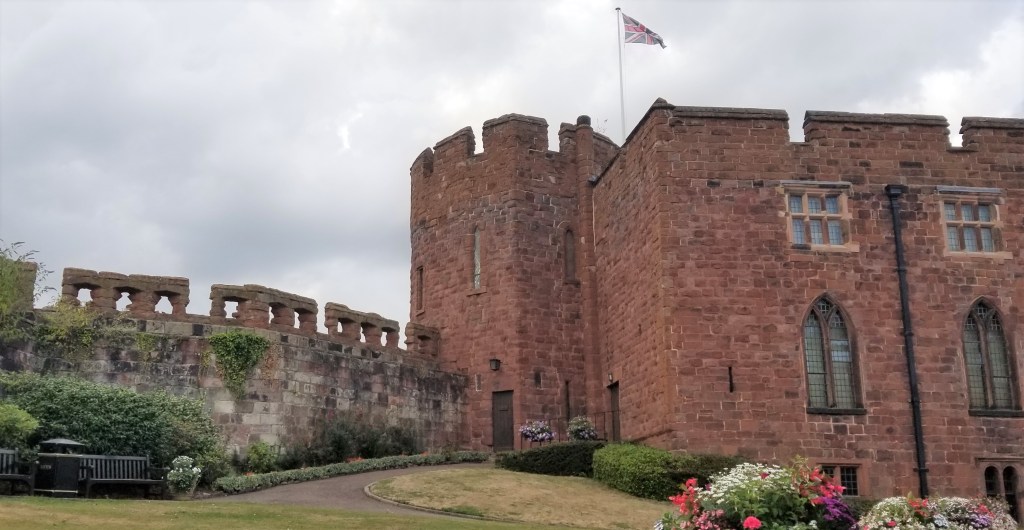
The castle contains an armament museum. Looking down into the knights’ hall, I tried to imagine it as it might have looked in the 1100’s without all the displays.

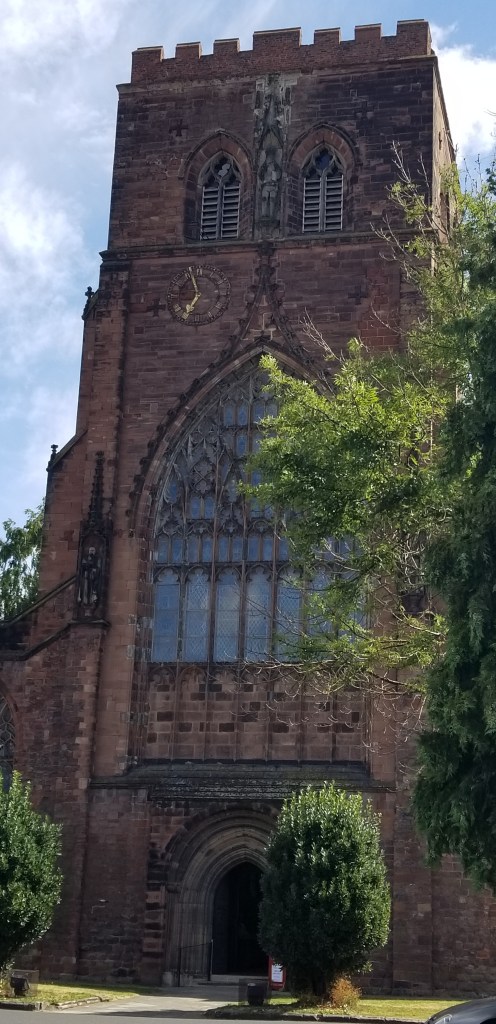
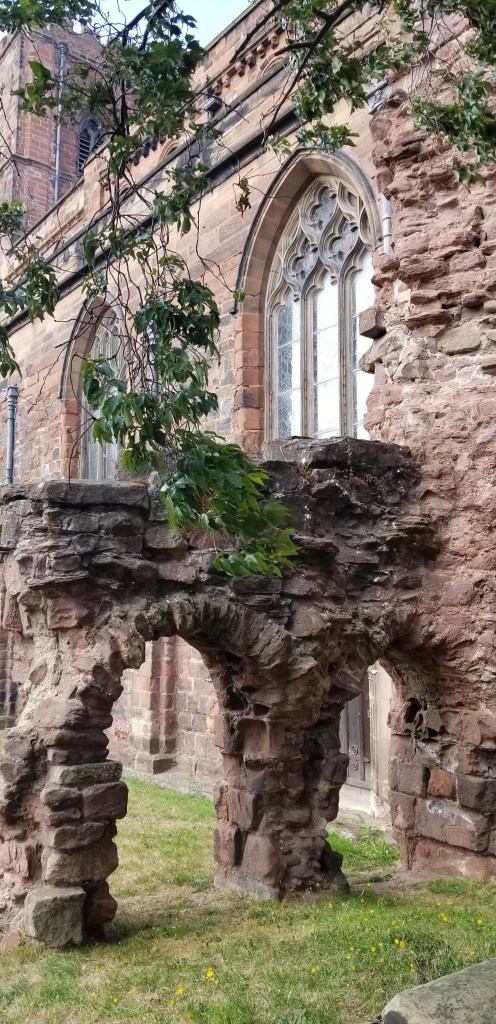
Shrewsbury Abbey, the home of the fictional Brother Cadfael, still exists too. It was founded in 1083. However, King Henry VIII did away with all the monasteries in England and made himself head of the Church of England. The abbey was destroyed in the 1500’s. The church retained its name although there is no abbey and was no longer Catholic after that point. The Romanesque church that was erected in the 11th century still stands, although parts of it have been rebuilt over the years.
A side gate which would have led to the Abbey is all that is left of that:
Inside Shrewsbury Abbey church

One of the stained glass windows paid homage to the Benedectine monks. There are also two statues of the same man laying down, one which depicts the man with a sword and the other shows him wearing a religious robe of some sort. Perhaps this was an inspiration for the books?

The window and artifacts below honor the memory of St. Winifred, a 7th century Welsh saint. The acquisition of her relics surrounds the plot of the first Cadfael book, “A Morbid Taste for Bones”, and is the story which hooked me into the whole series.

The church organ was purchased in 1911. Installation was never totally completed and by the 2000’s it needed some restoration. The update was finished in 2021. There was a surprise treat in store for us: an organ recital by a professor at a nearby college. He performed excellently and now that the organ could be played to its fullest potential, he (literally) pulled out all the stops.

Especially after visiting the church, I was very impressed with all the research Ellis Peters had done with her books. She wove all of her stories in and around the actual places and historical events that were happening in that era.

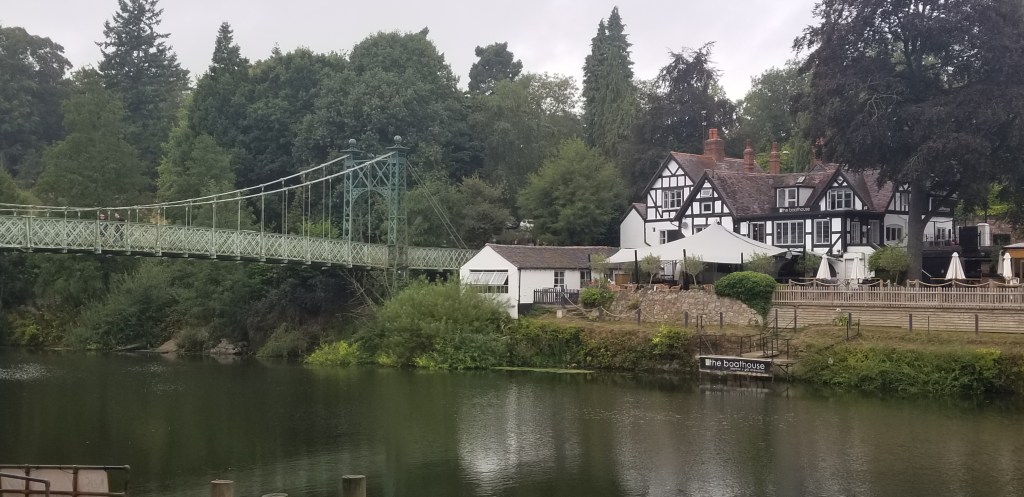
We crossed the River Severn often in our forays around town.

We took a boat ride, too. Although unfortunately we chose a rainy morning to do it, the top of the boat was covered and the rain held off until we were almost done. A spot of tea felt great in the chilly weather! The boat captain helpfully gave us a little Shrewsbury tour as we rode.

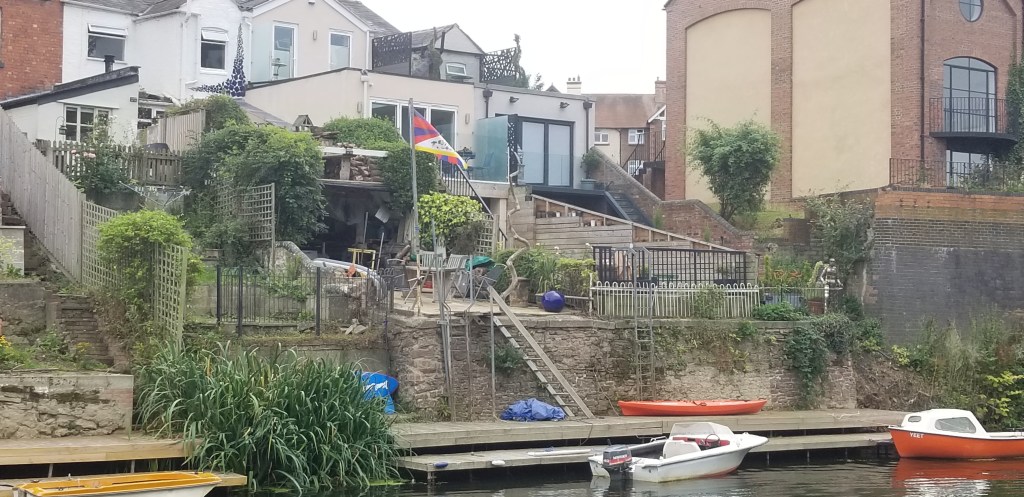
From the river, we could see little vignettes of the town that we would not have seen otherwise:

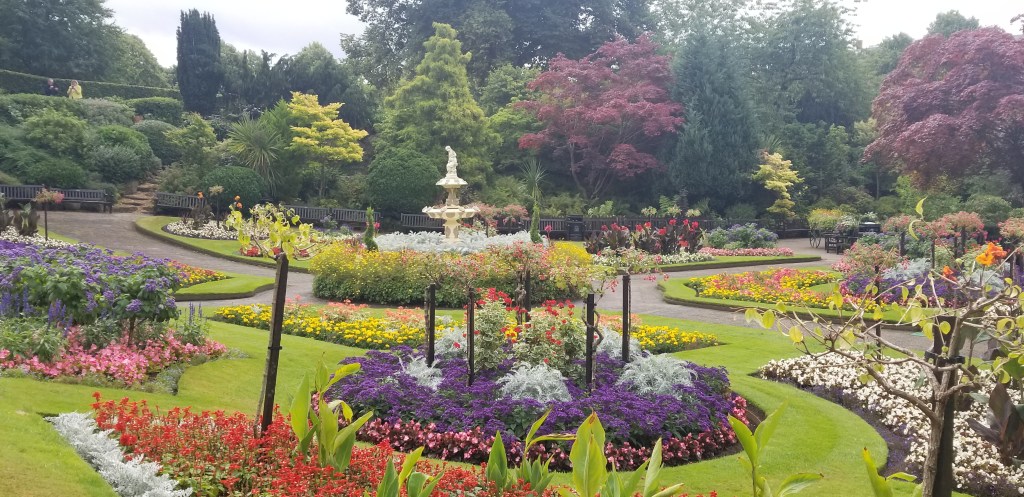
Once off the boat, we visited Quarry Park. An old part of the park called the Dingle dates back to 1879 and contains sunken gardens and a pond. It was the city’s way of dealing with what had been a medieval stone quarry. Charles Darwin used to look for newts and salamanders in the pond. The rainy morning made all the flowers look especially bright. Of course, with the off-and-on rain, we had the place to ourselves.

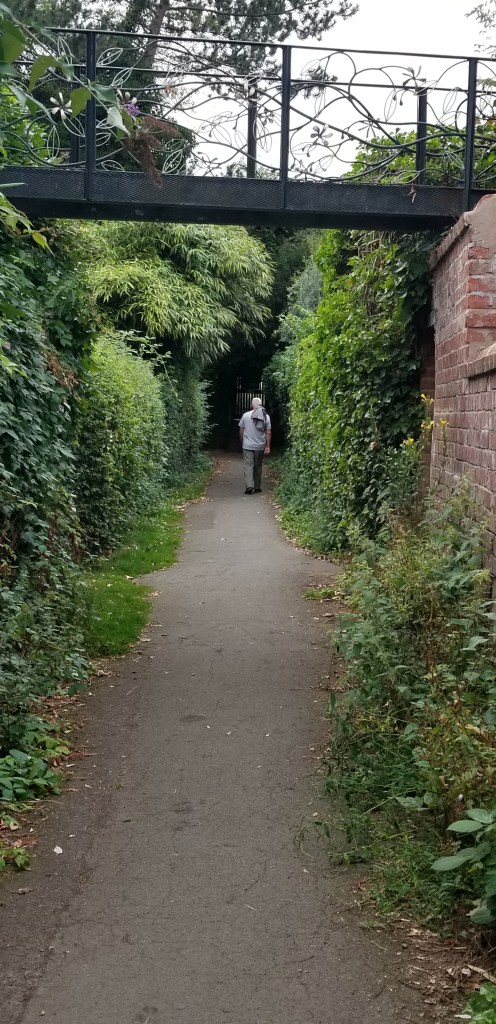
One evening, we headed down the street and saw a footpath called “Pig Trough”. Now, who could resist this? I read somewhere that, in the middle ages, streets would be named after the main enterprises that went on there. Was Pig Trough where everyone kept their pigs? I’ll never know the answer to that, but it will go down as one of our best evening walks. We had no idea where the path was going to go but we followed it all around and eventually it came out farther down the road.

We were in Shrewsbury for a long weekend and that was enough time to see it in a leisurely fashion. I was so very glad that this town had been on our itinerary!

I have been traveling for the past few days. There will be a blog coming up about that and our life in Texas this winter. First, though, I will have one more blog about our Europe trip before I leave it again for a little while.

Next time – we visit Bath, England
Europe · UK and Ireland

A Literary Journey to Haworth, England – Europe Travels August 2022

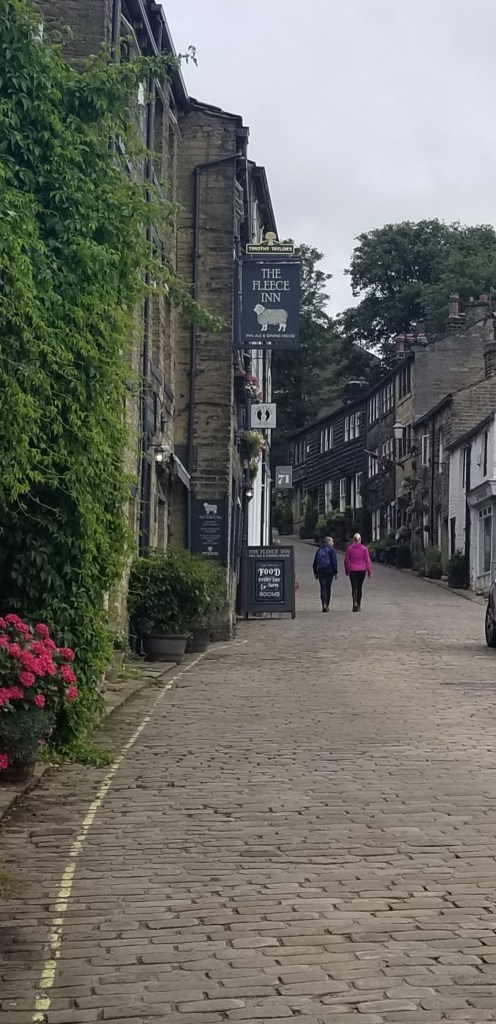
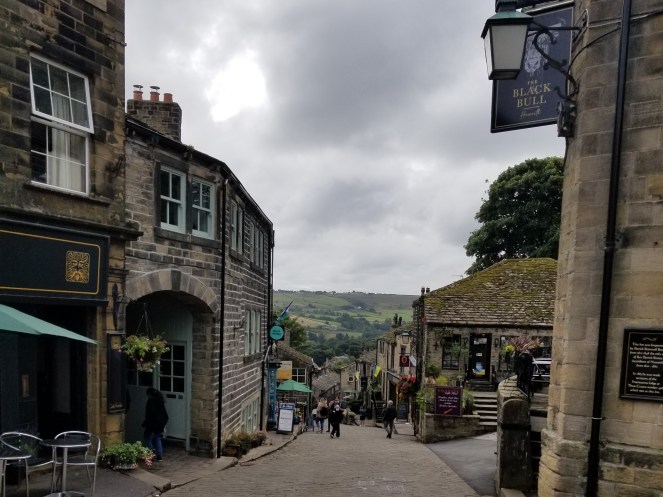
Historic downtown Haworth, England

It was a day’s train ride from Inverness, Scotland to Haworth. Down we went, back through the Cairngorms with sheep grazing on the heather in bloom and mountainsides dripping their waterfalls. Back down past Edinburgh and into England. Past towns like Berwick-on-Tweed, walled and right on the ocean, where we seemed for awhile to be skimming right on the water. The train was running slow due to some flooding down the track. We were late coming into York, missed our connection to Leeds but found another train, and both the train to Leeds and the train to Keighley were packed. Finally, in Keighley, a cab took us to Haworth. It had been a seven hour journey, and Haworth looked pretty good after a long day!

Coming here was a pilgrimage for me. My favorite book since my high school years is “Jane Eyre” by Charlotte Bronte. I pull this book off my shelf and reread it every now and again, and I still find it entertaining. If you are not familiar with it, perhaps you have heard of “Wuthering Heights” by her sister, Emily. I always dreamed of walking on the Yorkshire moors as Charlotte and Emily described in their books. If reading isn’t your thing, hang in there, I’ve also included a hike on the moors and a ride on a steam train here!

Haworth (pronounced, as I learned, “Howorth”) was the home of the Bronte family. Patrick Bronte was the minister at Haworth beginning in 1820, and he and his wife Maria had six children. Maria, and the two oldest daughters, died young. That left Charlotte, Emily, Anne, and Branwell. Anne was also a novelist and poet, and Branwell was a failed poet and artist. The four siblings were extremely close and lived in the parsonage with their father. After their mother’s death, their aunt came to help raise the children. Whenever the siblings ventured out into the world, all came home to Haworth as soon as they could. A signboard in the house stated that “it was at home where their creative lives flourished; in each others’ company and close to the wild moorland landscape that was such a source of inspiration to them.”

The parsonage, pictured here, is now a Bronte museum and much of the home is still furnished as it was when they left it. I cannot begin to tell you how exciting it was to walk through those doors.

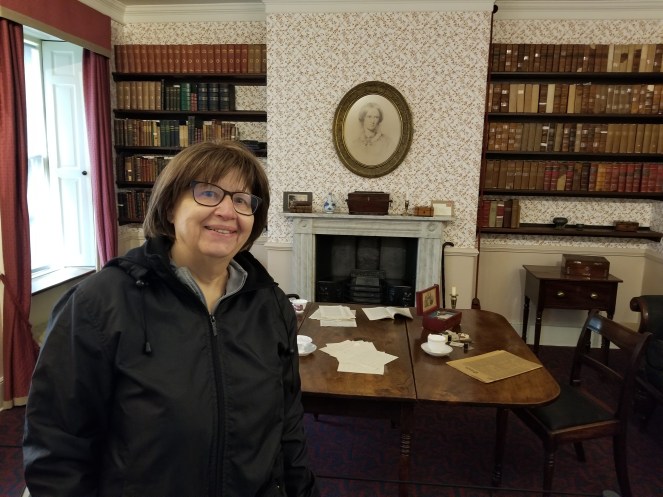
Here I am, next to a picture of Charlotte on the wall

This is the room, their dining room, where “Jane Eyre”, “Wuthering Heights”, and “Agnes Grey” (Anne’s book) were all written. In the evening, the siblings would be together, and the sisters would walk around the table discussing what they were writing. Cal knew how important this was for me, and made sure to get a picture of me standing here. And then, I just stood and looked a long time at everything.

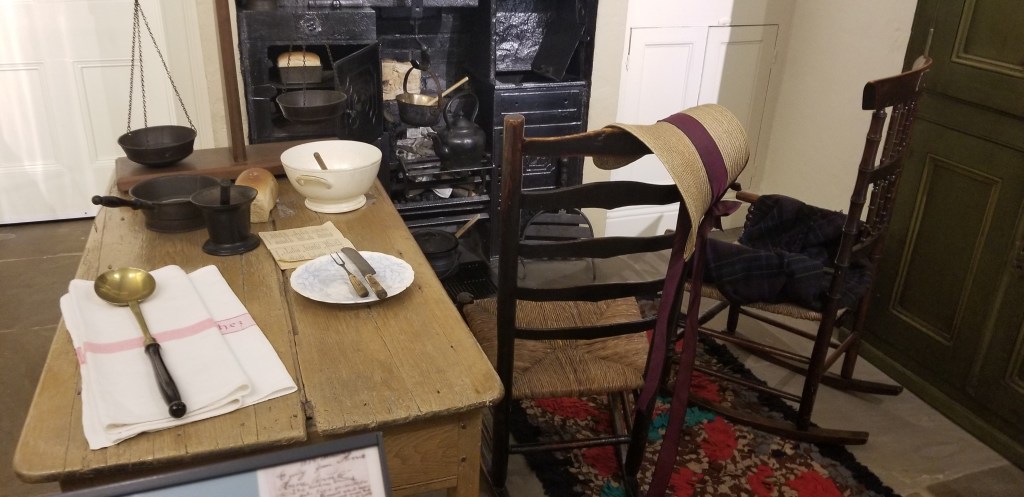
After the dining room, there was the rest of the house and museum to see. The kitchen:

And the grandfather clock that Patrick would wind every night before going up to bed:

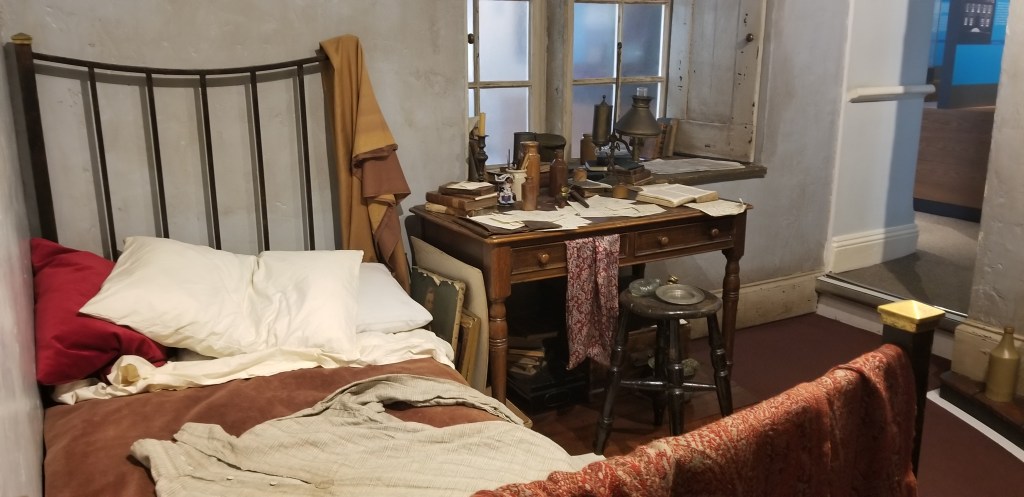
Branwell was a bit of a free spirit, as evidenced by his room. Their setup of it was very honest. Unfortunately, the Black Bull Pub in town was one of his favorite hangouts. You can see a corner of it in the top picture and we had lunch there in the afternoon.

The whole family’s history is interesting but it was Charlotte I had mostly come to see. Even though we live centuries apart we may have had some common interests. I’d love to have a spot of tea and a chat with her. She spent some time as a governess and wasn’t happy in her job. She wrote about it in a journal. Remembering my own working years, I could certainly relate!

As with most women in those days, Charlotte did needlework, as I do too. She made a Berlin wool work bag for her friend’s mother. The work bag was something fashionable to create in its day.

Here is the first American edition of “Jane Eyre”, published in 1848. It was an immediate success. Currer Bell was a pseudonym she used until her book was known and celebrated.

The church parsonage is located right next to the church cemetery. In the Bronte’s time there were no trees, and the stones stood straight and tall. It is thought that this cemetery was part of the cause of so much mortality in the village. The spring which provided the village drinking water flowed right underneath it.

The Bronte siblings’ story is a tragic one. Branwell, Emily and Anne died of tuberculosis. Branwell was the first at age thirty-one, and heavy drinking probably hastened his death. Emily and Anne died within a year of Branwell’s passing. I can’t imagine what it felt like for Charlotte to lose all of her siblings so young and so quickly. She lived a few more years and married, but died from complications of her first pregnancy. Patrick outlived all of his children.

The family is not buried in the graveyard but underneath the church. Anne was buried in Scarborough, where she died.

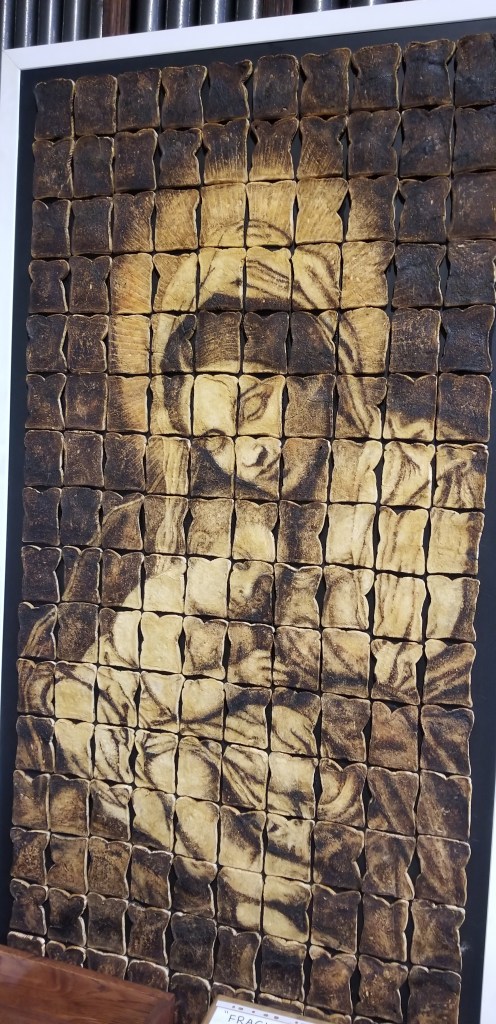
When we visited the church I was a little distracted by this piece of artwork, made entirely from toast! It was created by Adam Sheldon in 2010, who sadly died in early 2022 at the age of 45.

There were a lot of shops to explore in the quaint village. This part of Haworth is made for tourists with its restaurants and small inns.

The other highlight of this visit, and one of many on the entire trip to Europe, was a hike to the “Bronte Waterfall”. This walk took us out to the windswept moors. Every step was a delight.

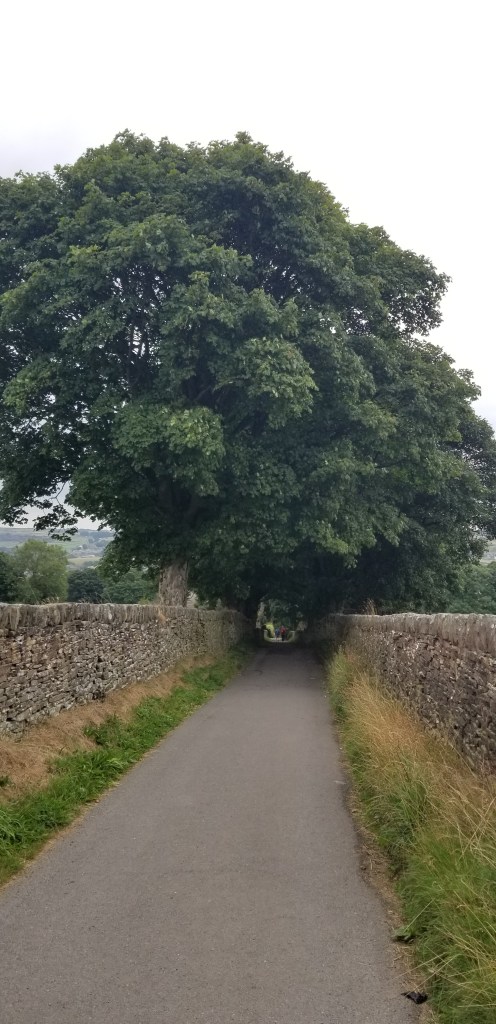
The trickiest part was finding the correct path. First, there was a narrow walkway, probably a horse path in days of old, with tall stone fences on each side.

Then, up Penistone Hill and across the Haworth moors. There were open fields of blooming heather, land spread out wide, and farms receding into the distance. Pastures of sheep grazed between endless stone fences. I tried to imagine how this would have looked in the mid-1800’s. Although indistinct in the picture below, the lines in the hill are all stone fences.

Then: through a cattle gate and sheep running loose. Now we were on the gorgeous South Pennine moors.

After passing a wonderland of ferns, we came to a pretty little river. No waterfall in sight.

I was pretty sure we had the right spot, and it was time for lunch anyway. We sat on a rock to enjoy the delicious sandwiches that we had purchased in a meat shop near our AirBnb. Other people came and went, some local and some not, and the missing waterfall was a topic of discussion. Someone finally filled us in: it was simply not there. It had dried up ages ago.

The Bronte siblings would come here for picnics, too. They would sit on the “Bronte Chair” – a big rock – to tell each other stories. We didn’t find the rock either at first, but someone was helpfully sitting on it on our way out. The missing waterfall would have been right behind it. Today it is a waterfall of heather and fern.

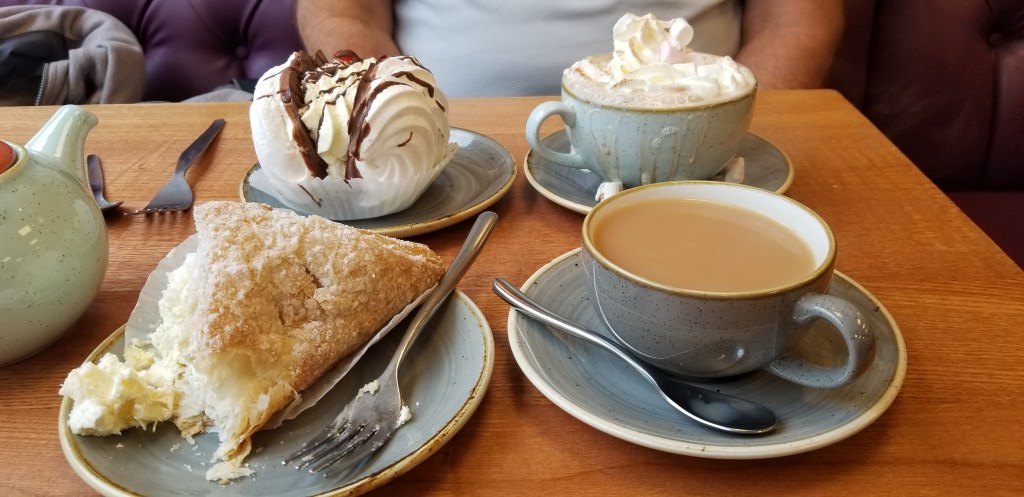
Our hike had been seven miles long. It had been longer than we thought it would be, and Cal deserved a reward after putting up with all my Bronte excitement. We totally negated the positive effect of our long hike with this mid-afternoon treat! His is a cream-filled meringue with hot cocoa, and mine is an apple turnover with of course, tea and cream.

We stayed in Haworth for only three nights, but after making sure I saw all of the Bronte-related sights we had time on our hands. If we’d had a car, we certainly would have visited other sights like the Yorkshire Dales. Instead, we looked into the possibility of an old steam excursion train that runs to Keighley. Haworth used to be a mill town which produced worsted yarn and cloth, and the train opened in 1867 to transport coal, textiles and workers to the mills. We rode Keighley and Worth Valley Railway from Haworth to Keighley, one stop short of the whole five-mile line.

On the platform and waiting for the train!

Some folks use this historic steam train to hitch a ride to Keighley because rail regular service from Haworth no longer exists. I mentioned that we had taken a cab to Haworth; when we left, we took a bus. Keighley is a much bigger city than Haworth, but we found nothing of note to see there.

I didn’t initially get a picture of our train because we were busy getting on it. But there is also a historic diesel train which we took on our return to Haworth, and another steam train passed us on our way. We made a stop at a manual switching station and Cal saw that the conductors made a swap of something. He said it was a mail bag. Would they deliver the mail in this way? I’m not sure. Maybe it was the day’s receipts.

The steam train, and a manual switching station

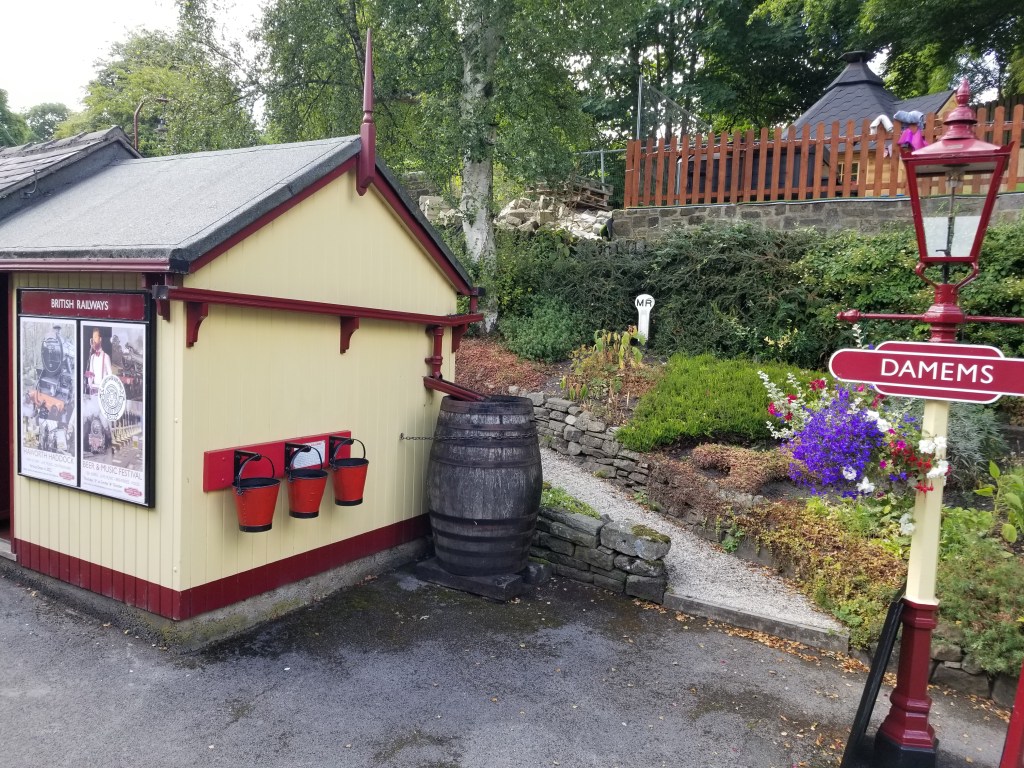
At Damems, we came to England’s smallest train station. Only one train car fits on the platform.

I can’t leave Haworth without showing you a picture of our little Airbnb cottage, which was very old. Cal is standing at the door and he always had to duck to go through. People were shorter in the old days.

The stairs going up to the bedroom were very precarious. At the top there was a measurable gap before one left the stairs and entered the hallway. The cottage was totally renovated, but the stairway was left as it had been. The steps were stone and I could just imagine the generations of weary feet that had climbed those stairs and worn them out in the middle. I hung on to those rails for dear life every time I slowly crawled up and down! It was a sweet little place and I loved our stay here.

The bonus to our stay was a chippy – a fish and chip shop – that did a steady carryout business in the evenings just a few doors down. We had a delicious dinner al fresco on one of their picnic tables. It wasn’t far from the meat shop that sold us our picnic sandwiches, and we purchased the same sandwiches for our train ride south on the day we left.

We are following the Masterpiece Theatre series “All Creatures Great and Small” on PBS weekly. In the last episode, the housekeeper, Mrs. Hall, goes to a train station to meet her son. As she was sitting at the station waiting for him, the name of the station was shown in big letters: “KEIGHLEY”. I shot up, and exclaimed excitedly, “Keighley! That is where we were!” And right there is an aspect of travel I most love: the sudden connectedness to places you had not ever heard of previously, and are now quite familiar with, thousands of miles from home.

Next time – moving on to Shrewsbury, England
Europe · UK and Ireland

Castles and Whiskey in Scotland – Europe Travels August 2022

Before I ever came to Scotland, two of the things that came to mind when I thought of this country were its castles and its Scotch whiskey. In my prior blogs about our visit here, a sharp-eyed reader may have wondered why I hadn’t written about visiting castles. The ones we saw are all in this posting; later, we’ll have a taste of whiskey.

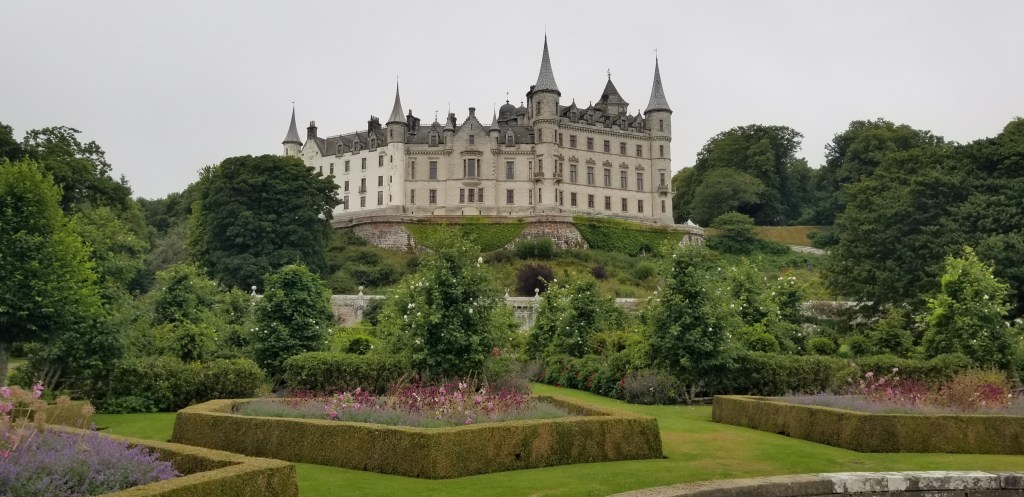
Castles are like Forrest Gump’s proverbial box of chocolates: you never know what you’re going to get. Some, like Dunrobin above, look pristine and like every vision you’ve ever had about castles. Others are in ruins. They can be medieval (think knights and coats of armor) or a glimpse at more recent royal life. The inside could be decorated like the occupants just left, it could be empty, or it could be a museum unrelated to the castle. Scotland’s castles were the first for this trip and we saw four of them.

Edinburgh Castle

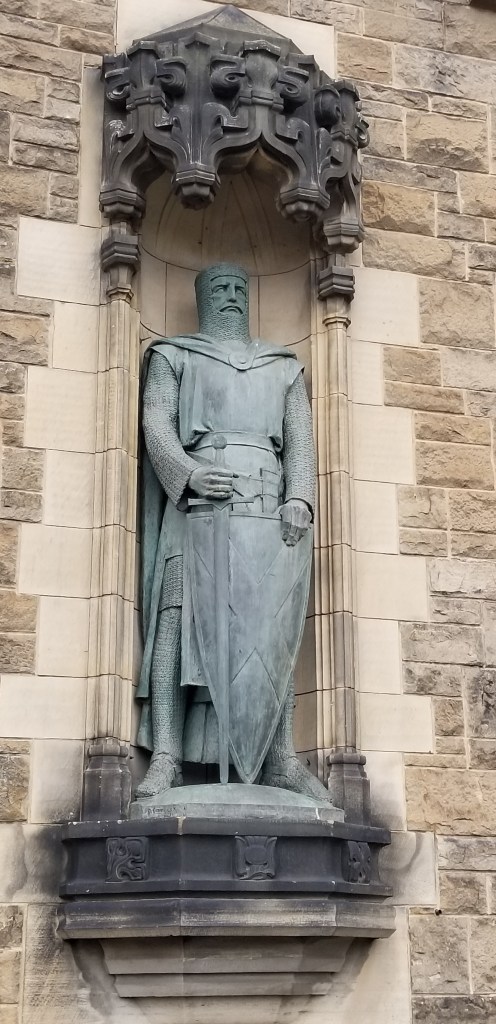
Edinburgh Castle is a fortress which was built on volcanic rock. It was once the home of the Scottish monarchs, dating all the way back to Malcom III Canmore whose reign began in 1058. The castle was beseiged 23 times. The oldest surviving building in all of Edinburgh, St. Margaret’s Chapel, is inside the fortress and dates to the 12th century. The city of Edinburgh itself grew out of the castle, spilling down the hillside.

I had purchased tickets for the castle several days earlier but didn’t count on the weather: in typical Edinburgh fashion, it was cold, windy, and rain threatened. Still, it was a thrill to enter the gates of such a famous place.

From the ramparts of the fortress, we could look down on the city below. This is a view of “New Town” and Princes Street in the foreground with a view all the way out to the Firth of Forth.

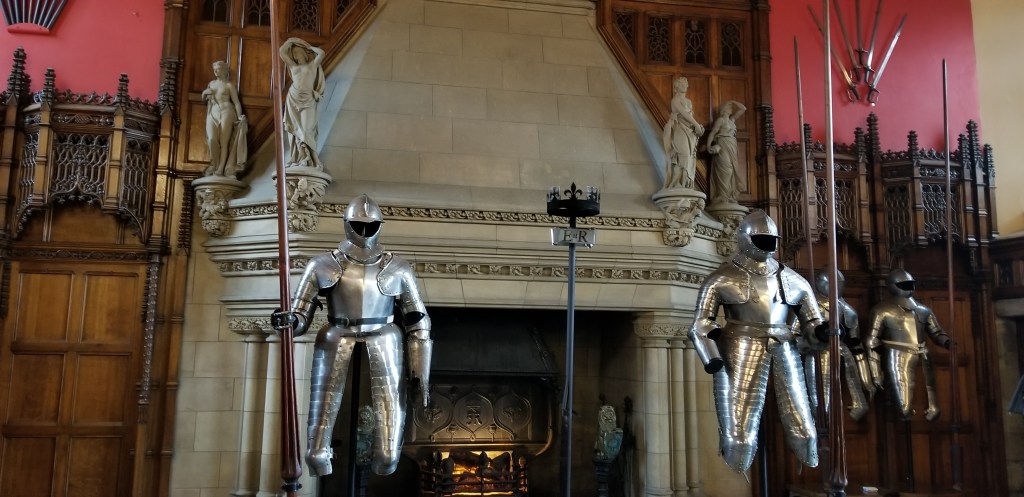
Inside the castle buildings were the Royal Chambers where Mary Queen of Scots lived and the room where she gave birth to her son James in 1566. There was also the knights hall:

Inside one of the castle courtyards

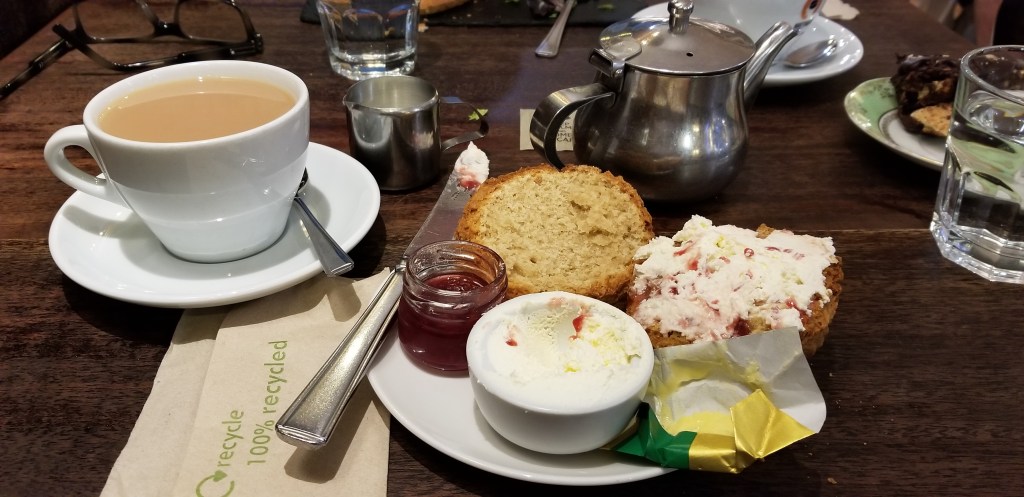
My memory of Edinburgh castle will always be inextricably linked to the cream tea I had in a cafe just off the Royal Mile following the visit. I was cold and wet and I wanted soup. We visited Deacon Brodies Cafe but we were too early for soup. Instead, I had a Scottish cream tea for the first time. It consists of a pot of tea with cream and a scone with butter, jam and clotted cream. It was absolutely heavenly and I have had nothing better since. I needed nothing else to eat until evening. It was one of those happy surprises that come with traveling Europe. Cream tea instead of soup, who knew?

Loch Ness and Castle Urquhart

And now we come to the third thing people think of when they think of Scotland: Loch Ness.

When planning our trip, I suspected that Loch Ness was not going to be a destination for us. Other places more interesting called to me for the time that we had. This was later verified by Rick Steves, who is my travel guru. For the uninitiated, Rick Steves is the go-to person for all things Europe travel-related. He has guide books, tours, TV shows, and a large on-line presence. I also follow Cameron Hewitt, Rick’s associate. Both suggested giving Loch Ness a pass as its own destination. Rick suggested that if you are on a tour in the Highlands or simply driving from point A to point B, you will probably drive right by it. And then, you can tell everyone back home that you saw Loch Ness.

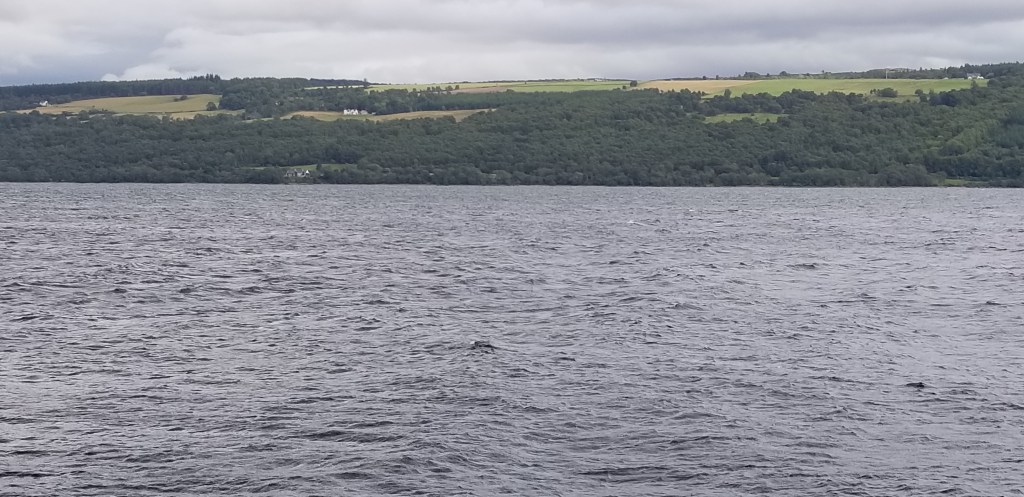
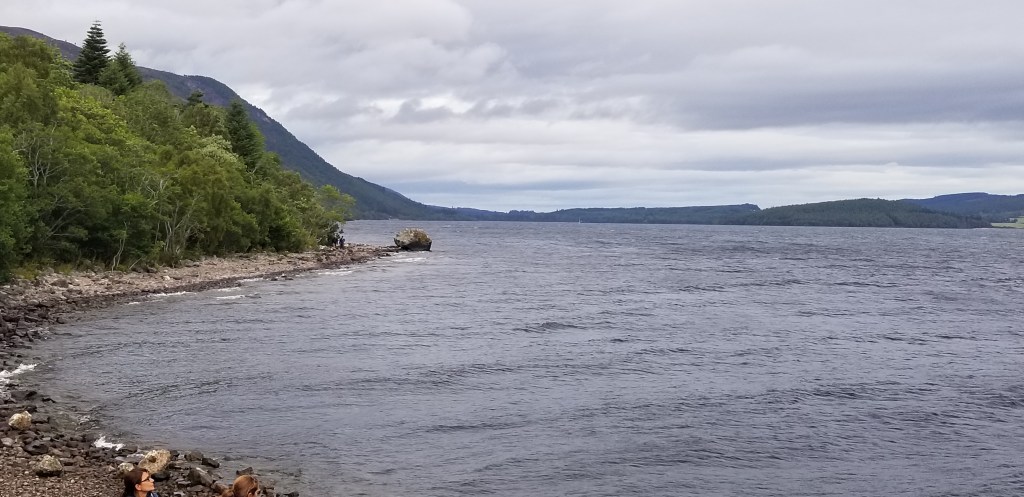
On our first tour from Inverness, our guide asked if anyone had not yet seen the lake. There were several of us, so she stopped on our way back to Inverness. We hiked down to the lakeshore, and this is it. No monsters in sight. But it is quite pretty, particularly the Highland bluffs on its northern side.

We did, however, see a monster on the way down to the lake:

Castle Urquhart is in ruins. It was built in the 13th century, but its fine location on the lake meant that it was raided several times. The final blow was dealt in 1692 from the British in order to prevent the Jacobite forces from using it, and it went into decay after that. It is now one of the most-visited castles in Scotland, probably because of its location on famous Loch Ness.

On our second Rabbie’s tour out to the Island of Skye, the guide made a quick stop for a look at Castle Urquhart. We were dealt a prettier day than our first visit here, and the lake sparkled. It was a lovely sight, and it was all we needed to see.

Eilean Donan Castle

We visited Eilean Donan right after the Castle Urquhart stop. In the Scottish Highlands, it is amazing how the weather can change in just a matter of 50 miles distance!

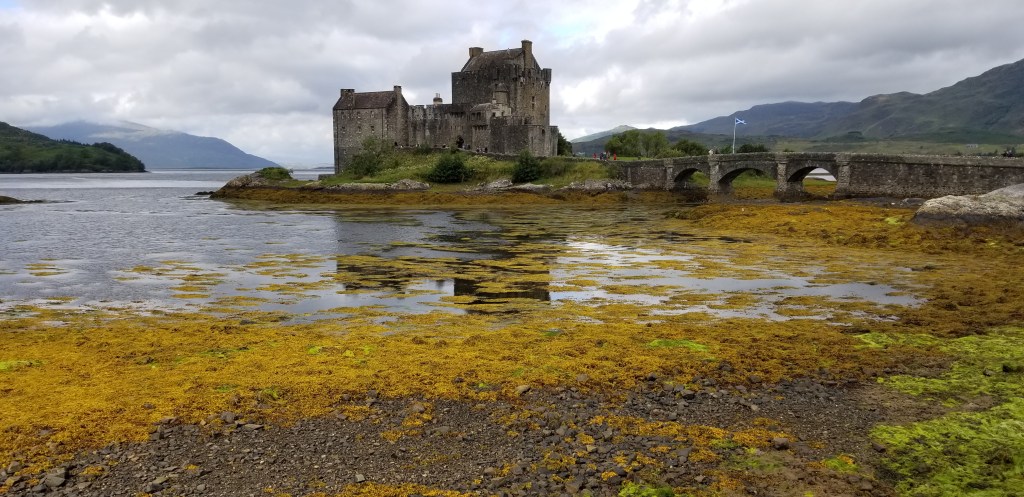
Like Urquhart, this castle was also laid to ruins as part of the Jacobite uprisings. It gets its name, Eilean, from the island it sits on. Donan is attributed to a 6th century Irish saint by the same name who came to Scotland and formed a community here. It was built as protection from the raiding Vikings and expanded over the years. The final blow was dealt by the British, though, in 1719, and it sat in ruins for 200 years. In 1911 a man by the name of Lt. Colonel John Macrae-Gilstrap bought the island and dedicated the next 20 years to reconstructing Eilean Donan.

Eilean Donan is one of the most picturesque and most photographed castles in all of Scotland. Every postcard rack I saw everywhere had beautiful images of this place, and many movies have been filmed here.

I’m not a great judge of time. On some of these tours, left to our own devices, we would arrive back at the mini-bus way too early with no one around. Other times, we would find just about everyone already seated and ready to go. At Eileen Donan, we were given an hour to explore. Our guide did not think it would be enough time to actually tour the inside, but we could either do that or purchase a ticket to walk around the outside of it. We couldn’t decide what to do, so we simply walked around shooting pictures, looking in vain for hot cocoa and then had too much time on our hands. It’s a small regret of mine that we didn’t at least buy the ticket to walk across the bridge and around the outside.

Dunrobin Castle

Flipping through my Scottish Facebook group one day, a picture of Dunrobin came up in my feed, and I was entranced. After a bit of Internet research, I found that we could go there on a two hour train ride north from Inverness. Going further up into the Highlands was a bonus. Better yet, the cost of the train ride was included in our Eurrail pass.

On the journey north, we saw herds of cows and sheep. It was funny to watch them run in panic away from the train. After all, it comes through at least twice a day! The white black-faced sheep dotted bright green pastures. The train also disturbed a little horned roe deer, which suddenly leaped out of the tall grasses. Two different flocks of swans graced a small winding river. A castle could be seen high on the cliffs in the distance. For awhile we rode along the sea where there were massive kelpy flats where the tide had gone out, with horses in a meadow on the shore.

The castle, pictured at the top of this blog, is the family seat of the Earl of Sutherland and Clan Sutherland and is still owned by them. The lands were acquired in 1211. The oldest surviving portion of the castle goes back to 1401, but most of what is presently seen was added in the early 1800’s. This castle has its own private rail station, which is where we arrived just like royalty of old. After a short walk through the woods, we were inside the castle.

As we entered the castle, we were greeted by pictures of ancestors and spoils from the hunt.

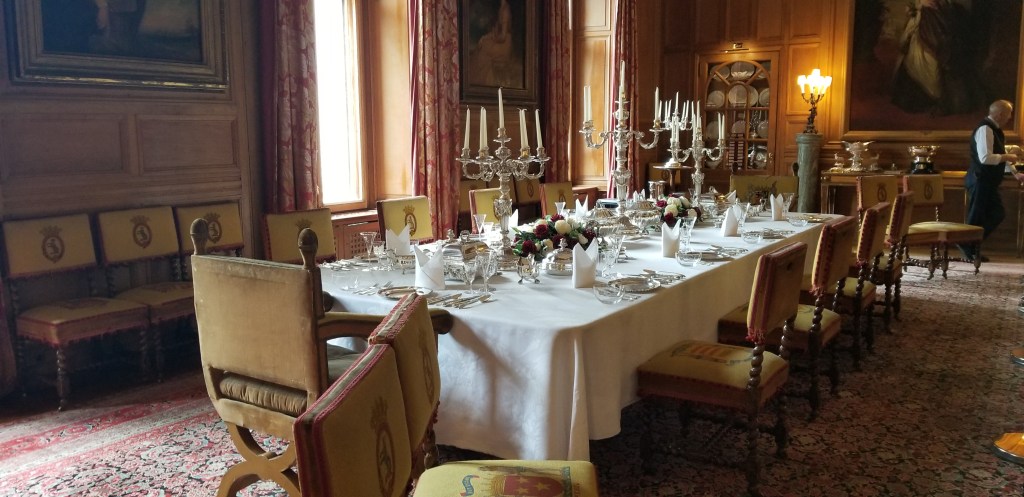
Dinner was set on the table and waiting for us.

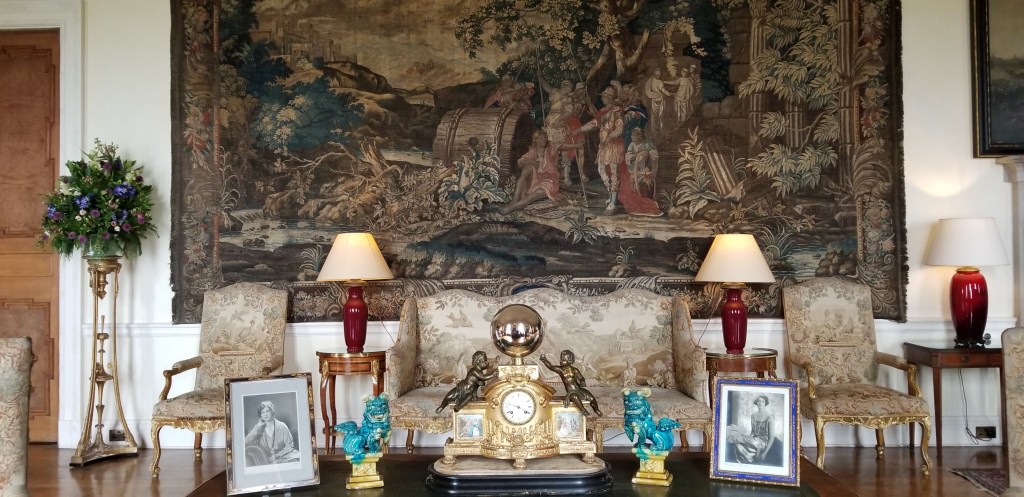
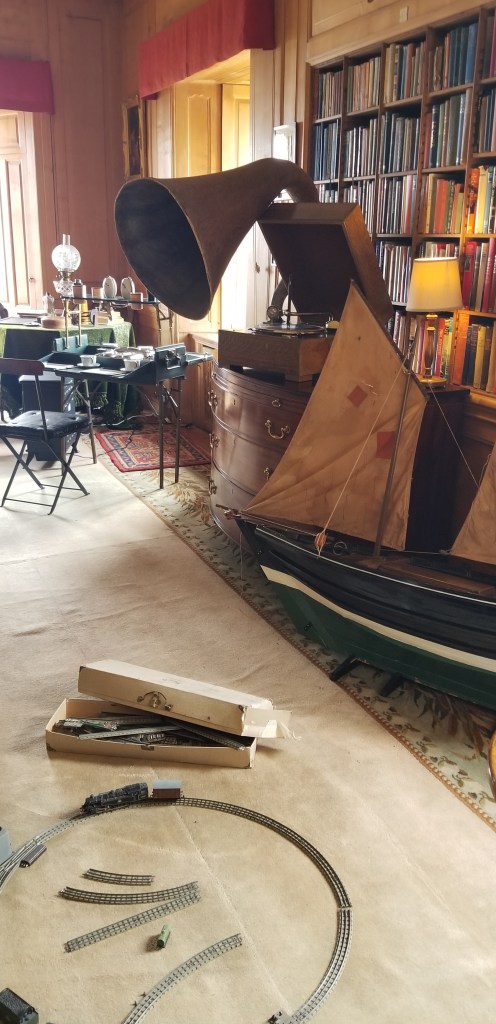
The ladies’ sitting room was lovely. And oh, that library! This was only one wall; all four were covered. Can you imagine having so many books at your disposal?

In the nursery, a child would have every toy and book imaginable for playtime.

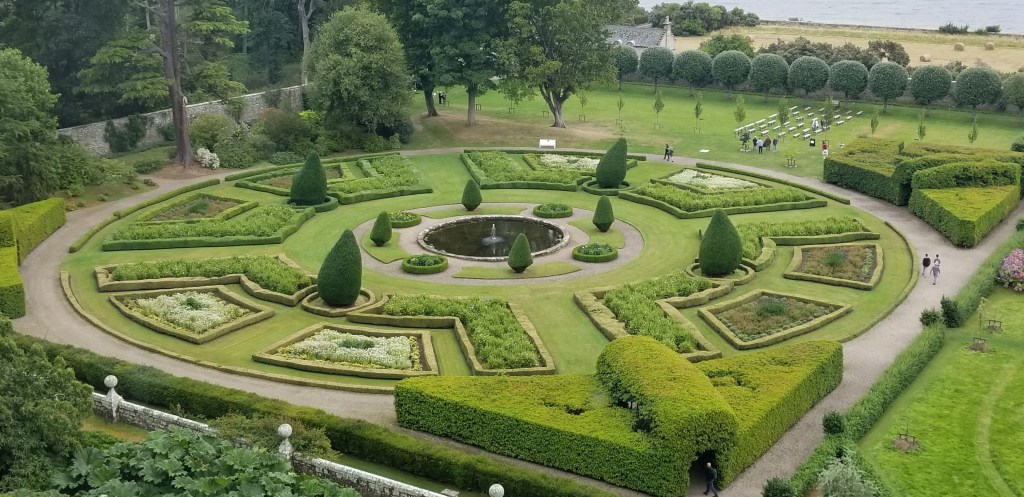
There were rooms upon rooms as we wound our way up and down stairs and down long passageways. At times, we could look out into the back garden.

We sat in on a falconry presentation. My impression is that it seems pretty difficult to use falcons to aid in hunting birds.

After watching the presentation and wandering through the gardens, we still had a great amount of time before the train returned. The castle sits on the North Sea, so we explored the shore.

The Sutherlands were loyal to the crown and so Dunrobin did not run any risk of being ruined by the British. It was stormed once by the Jacobites, but of course they did not have the armament necessary to do any damage.

On our train ride to and from Dunrobin, we passed a very large whiskey distillery. There are 141 operating distilleries in Scotland and a person could go on a whiskey tour to visit several in one go. Distilleries abound in Inverness, inviting us in for samples. We are not whiskey drinkers and so by the end of our stay we still hadn’t tasted a drop. How could we pass up this iconic taste of Scotland?

I found something that was a bit of a compromise for our very last night in Scotland: a whiskey tasting evening in a pub accompanied by Gaelic music and stories of Scotland. The owner of the pub played two-hundred-year-old songs on his violin and sang. The stories he told of Scotland’s past were sad. But Scotland’s future is bright: the country is promoting education in traditional instruments such as the bagpipes and violin. The old Gaelic language is being taught, and college is free for all. In 1998, Scotland finally received its own Parliament. A toast to that!

For those in the know regarding whiskey: we sampled Singleton of Glen Ord, Clynelish, Cu Bocan, Glenmorangie Quinta Ruban, and Tomatin.

Next time – South to Haworth, England

USTravel

Three For the Road

Ducks swimming on the South Llano River, Texas

It’s time to hit the road and head off from El Paso all the way across Texas to our winter spot in Harlingen Texas. Is the truck hitched? Slides in? Stairs up? Let’s go!

Out of El Paso, the mountains were close by for quite awhile, but they gradually faded into distance. The terrain is rugged here. We saw plenty of buttes, strange rock formations, and miles upon miles of open, parched land.

I should maybe have titled this blog “Four for the road”, because there were actually four overnight stops along the way, but our first was at Fort Stockton RV Park. It’s right off the highway and is primarily an overnight stop for RVers crisscrossing the state before or after the long open stretch of west Texas. There are things to do here, but we always say: “Next time!” They do have a handy little restaurant which served us up a good breakfast.

The road entered some pretty hills and valleys of the southwest corner of the Texas Hill country. Our second stop was outside of Junction, Texas for two overnights at Pecan Valley RV. This is a lovely, quiet place just behind a pecan farm. The owners of this park have had it for just a handful of years. They own just two rows of the pecan orchard. The park is a large oval with nothing but grass in the middle of the oval, and RV spaces under plenty of trees ringing just half of the outsides of the loop. There were four sites next to ours, although there were more down the road, and for a blessed twenty-four hours we had no neighbors close by.

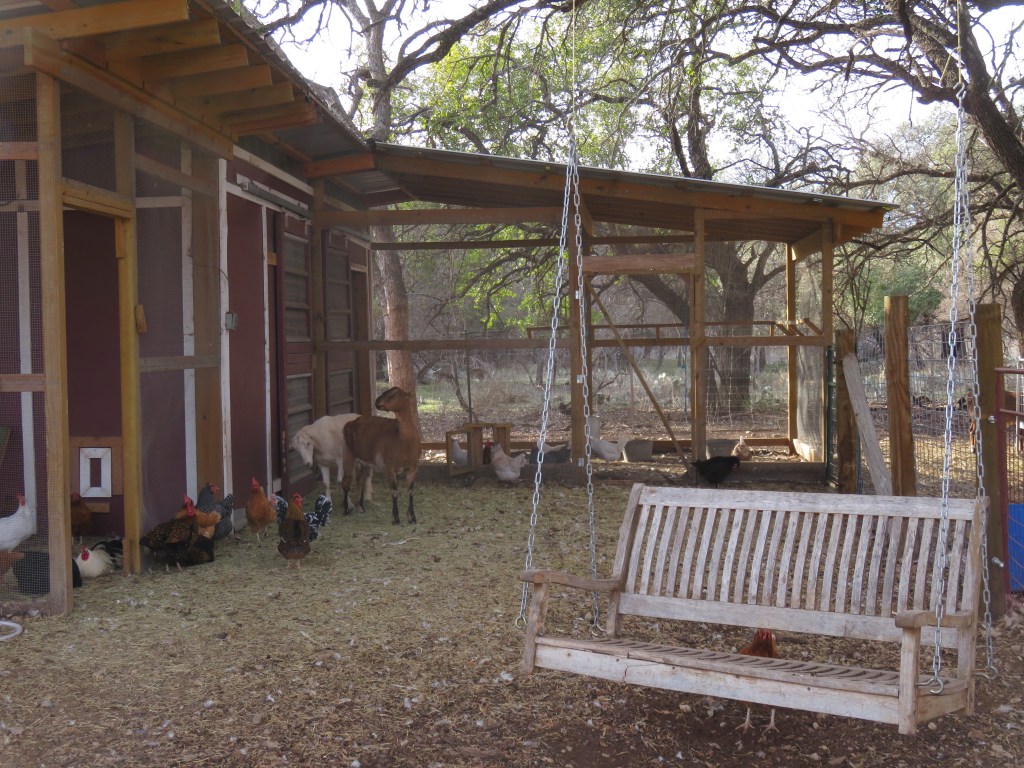
A pecan wagon-turned-chicken coop, with our RV in the background, at Pecan Valley

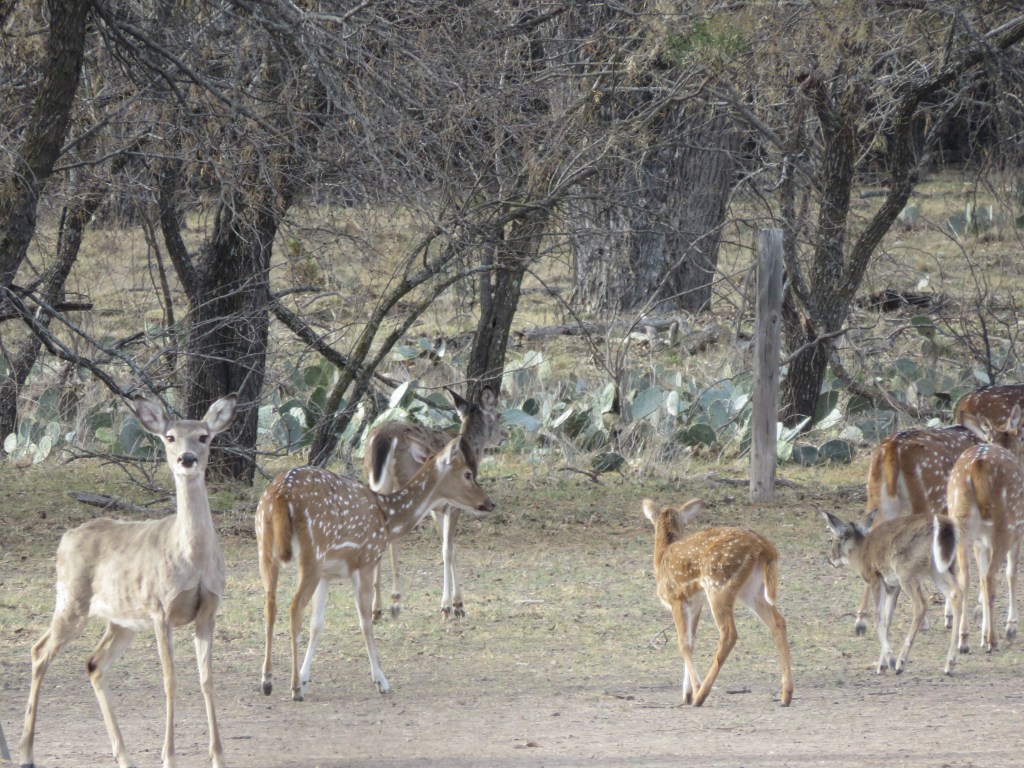
There are deer to be seen at any time wandering around. In a little farm area, there are chickens and goats. Many of the chickens were free ranging and came to pay us a visit. Thanks to those chickens, we were able to buy a dozen multi-hued eggs.

The South Llano River is just a short walk from the goat and chicken pen. The river is what makes this park popular in the summer. Besides swimming, people enjoy rafting, kayaking or tubing. In all of its history, the river has never run dry, although with today’s climate change it does get very low in the heat of summer.

We had a full day to rest up here, so we went over to South Llano River State Park for a hike. At this park there is a large protected area where about 800 turkeys make their home. The turkeys are easily scared off, so visiting their roost is not encouraged. We hiked the Overlook Trail, which, after spending time in the Southwest, was an easy trail up for us. We were even surprised on our hike by an armadillo scurrying into the underbrush. It moved too quickly for a picture.

Cal is appreciating a bench at the overlook. The flat, treed area below the overlook is the turkey roost.

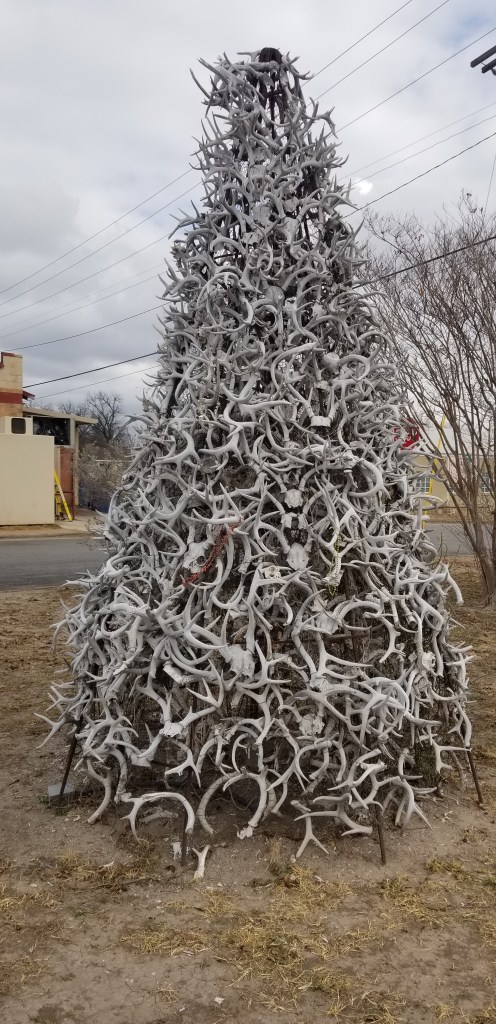
Junction’s single claim to fame is this antler tree, put up by the Women’s Club in 1968.

The Llano river is a bonus to the beauty of this area. I would like to be here when the trees bud again. We’re familiar with Texas Hill country and it was a good feeling to be back.

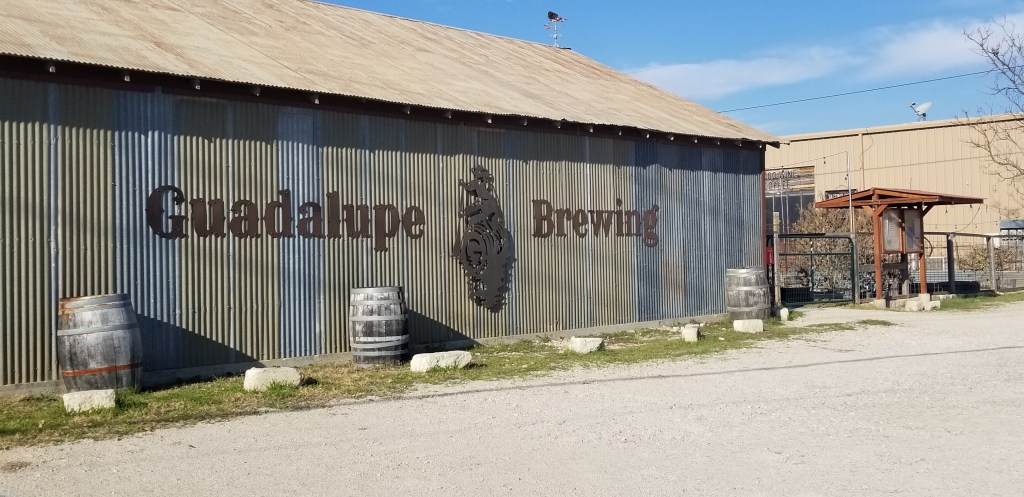
A short 140-mile drive took us further east to Guadalupe Brewing Company in New Braunfels. Since they are a Harvest Host location, we stayed a night in their back parking lot.

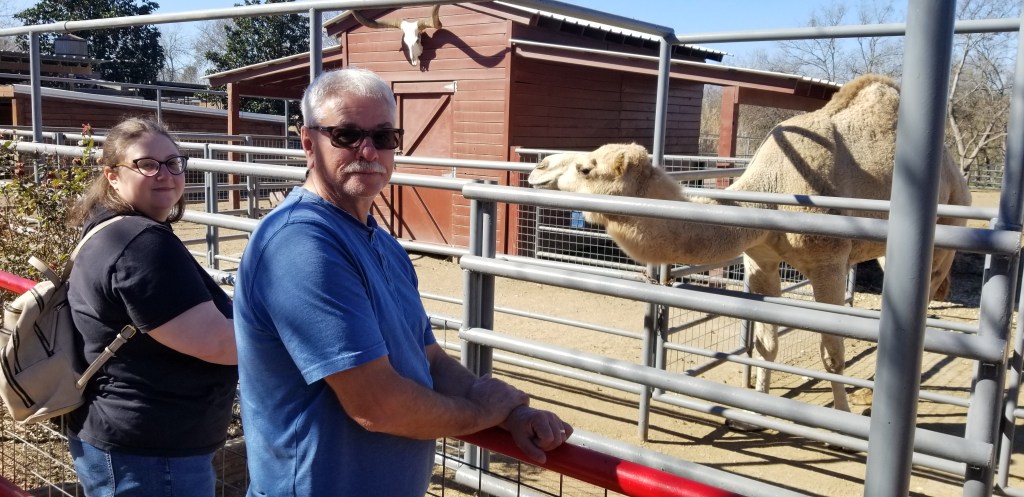
A surprise for this stop was that our daughter Katie, who lives in Austin, decided to come down and join us for the day. She always has ideas for different and fun things to do, so after getting set up at Guadalupe we headed off in her car. First stop: Animal World and Snake Farm Zoo. At first glance, this place looks like a tourist trap off the Interstate. But once inside, we discovered an interesting little zoo with a variety of well-cared-for animals, birds, and a good assortment of snakes.

I don’t think I’d like to meet this reticulated python out in the wild!

We also had cups of food to feed a multitude of goats with many cute little kids.

New Braunfels is but one of the German heritage towns that dot this area of the Texas hill country. We walked the little downtown area. All of the busy activity on this Sunday afternoon concentrated on their large Biergarten with Hofbrau beer on tap. Instead, though, we roamed the city streets, checked out an antique mall, and visited the little train depot. If you are ever in New Braunfels in November, you can enjoy their popular Wurstfest.

We needed to patronize Guadalupe Brewing for our stay, so we headed back. They had a full selection of beers to choose from. I’m not really a fan of beer, but Cal is, so we sampled three small glasses. My favorite was their Texas Honey Ale, which is described as “a blonde ale enriched with Texas honey”. Even the description sounds delicious. They also make a good pizza, and dinner was in order. That was a fun day!

Leaving New Braunfels, we pointed Sam and Frodo due south in earnest. It was getting warmer. Putting San Antonio behind us, we were on new-to-us territory. Our last stop: Lake Corpus Christi State Park. It is about forty miles to the east from the city for which it is named. Once we set up, I just sat at our picnic table and enjoyed the warmth and the cardinals singing and flying over us.

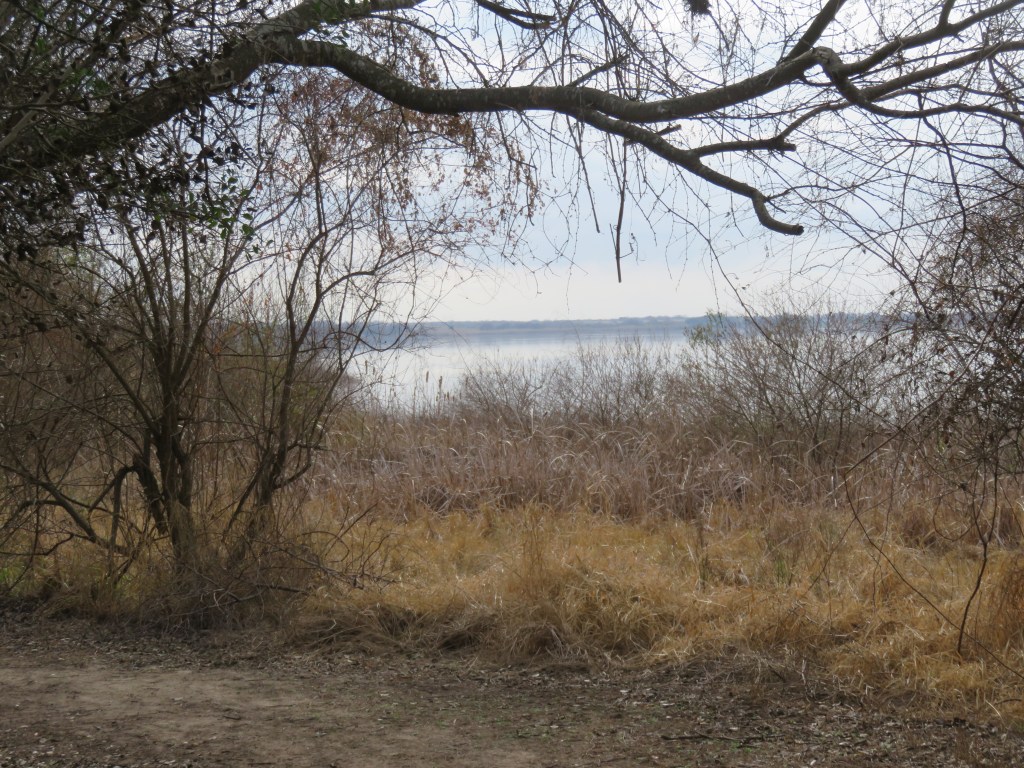
I hiked a mile long loop trail. Cactus on the the ground were interspersed with deciduous trees with no leaves, and here and there was a palmetto or a palm tree. The trail finally opened up onto the lake.

I missed getting an excellent photo that evening, though. We walked down to a large aluminum T-shaped fishing pier in the late afternoon and caught the setting sun over the lake. The sunset was amazing. It was a walk where we were just “going exploring”, and I had left my phone and camera behind. You’ll just have to take my word for it that it was spectacular.

Traveling further south, we entered a coastal plain with low vegetation, more cactus and very little sign of human life. We had about 140 miles still to go from Lake Corpus Christi. Once near Harlingen, civilization returned. Harlingen is in the northeast part of the Rio Grande Valley, an area that also includes Brownsville and south Padre Island to the southeast and McAllen and Mission on the west. It is at the very bottom of Texas, so once again, we are not far from Mexico.
I’ll leave you here for now while we make some new memories. I’m going to pick up my Europe blogs again for three or four weeks. Do you remember my question from way back in November: what did I leave out of my Scottish blogs?

That’s for next time!

USTravel

Passing Time in El Paso, Texas

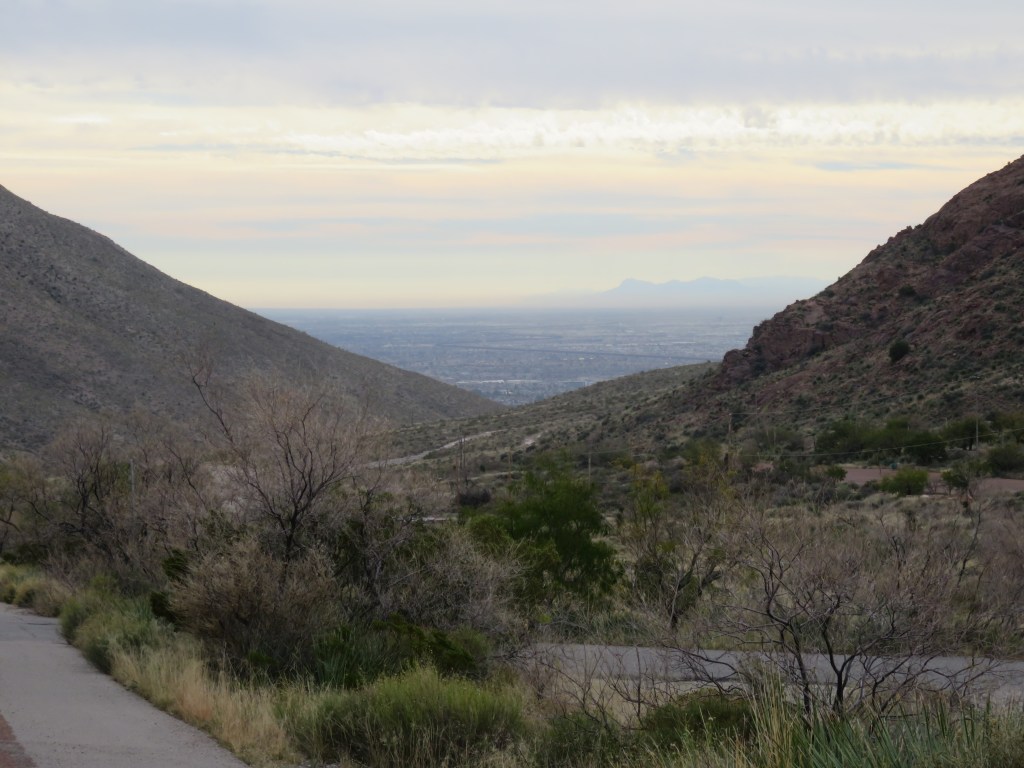
View of El Paso, with Juarez in the distance, from McKelligon Canyon

Huddled in our blankets in front of our fireplace in the cold November nights of New Mexico, we stalked the Weather Channel for a warmer place that would be still be a days driving distance from Denver. El Paso was consistently several degrees warmer. It’s a funny thing, too, because El Paso, Texas lies only approximately 50 miles to the south of Las Cruces, New Mexico. We knew where we had to go. We were going to go there anyway, but our arrival at our site in El Paso was about three weeks earlier than we originally planned.

At the very tip of the nose of Texas, on its far western side, lies the city of El Paso. Franklin Mountain rises up and pushes down into it like a thumb. The city has crept up and around the tip of that thumb. El Paso is limited in its growth southward by the Mexican city of Juarez, from which migrants poured during the months of November and December 2022. Driving along I-10 reveals a tale of two cities: Juarez, looking a little less prosperous and with a lining of smog along its mountainside, and El Paso, with its chain restaurants and hotels lining the expressway. If you look closely, you can see the immense border wall which snakes down and around, dividing Mexico and the United States.

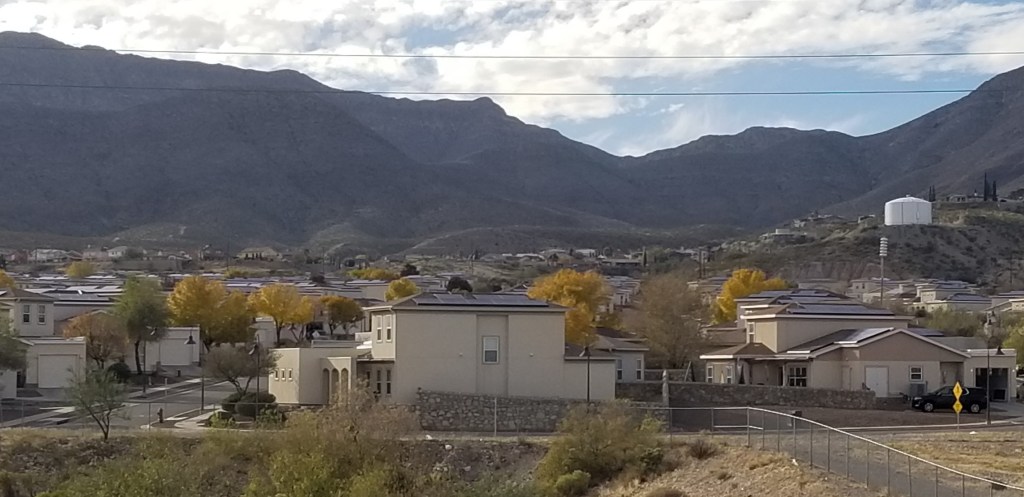
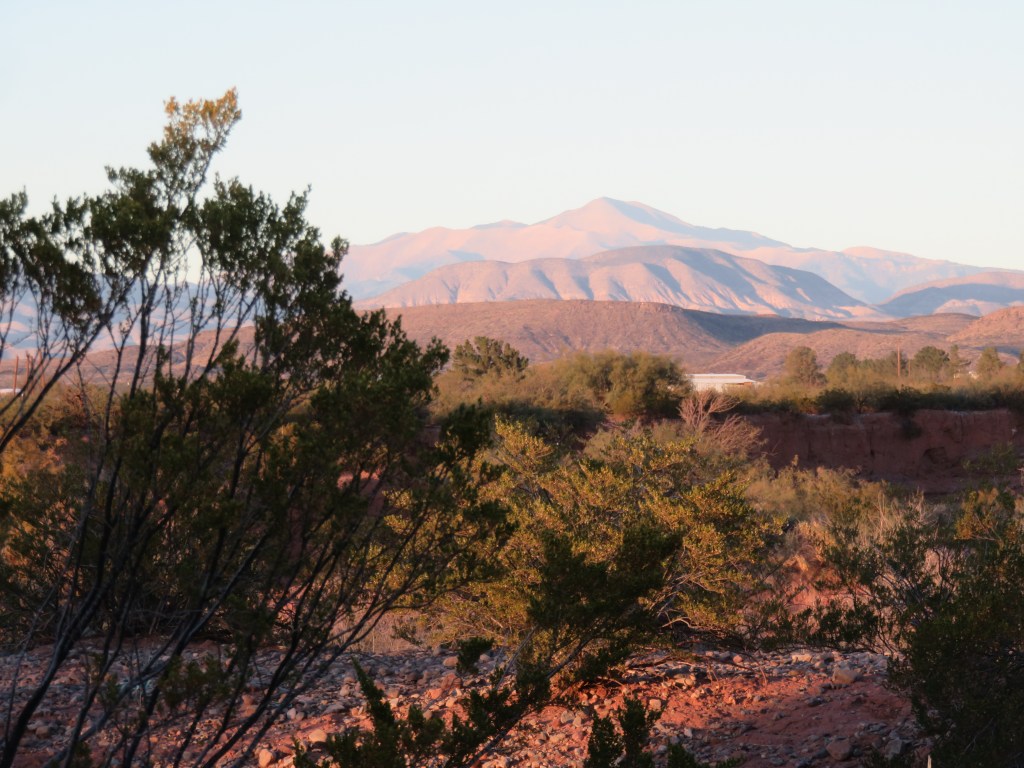
On the northeastern side of the mountain lies sprawling Ft. Bliss, the Army’s second largest base, containing 1.1 million acres. It is so big that it is chopped up by the roads that pass through it, notably SR 54 that passes in front of the RV park. Were it not for that highway, this would be a great place to sit. Behind the park, Franklin Mountain rises up and provides a lovely backdrop. All around the mountain, development never rises much higher than this. I suspect that much of the land is owned by either the federal government or the state of Texas.

On some of my daily walks, I tried to get behind the buildings and up into the hills, but it was just too far. In the foreground of this picture is one of Ft. Bliss’s housing areas and behind that is a fence.
I’ve written about Ft. Bliss in a blog post about some of the military bases we stayed in, so I’ll not go on further about it. If interested, I’ve included the post here: https://twosnatravels.com/2022/01/29/military-family-camping/.

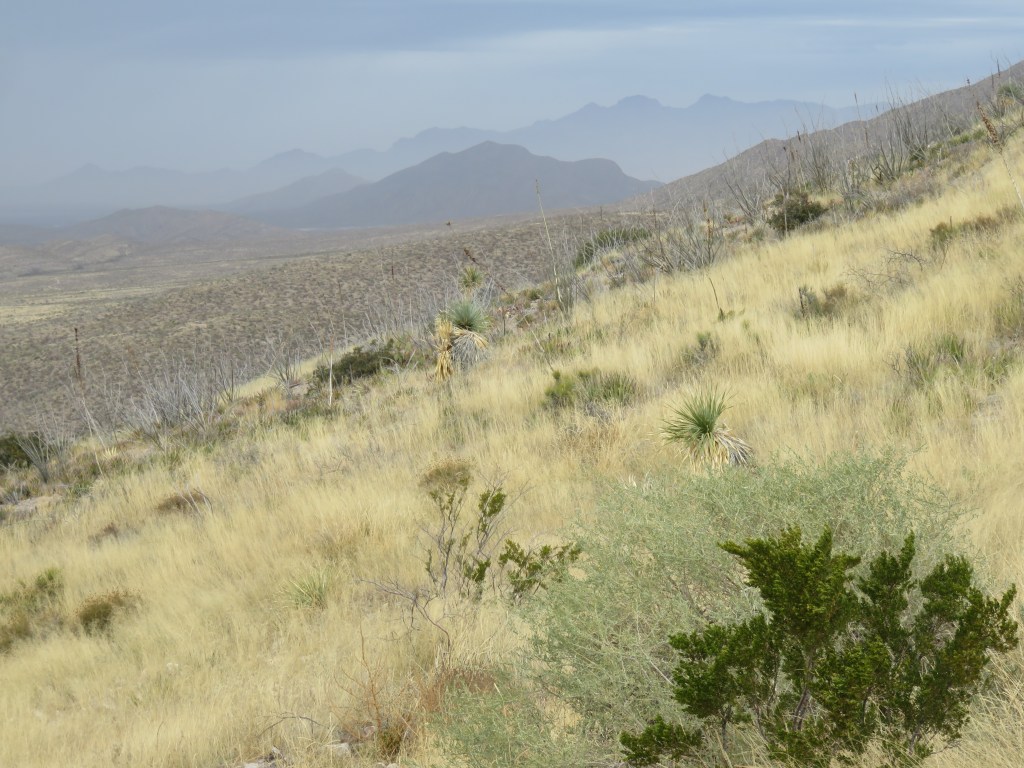
There was plenty of time to explore, so one of the first things we did was hike in the Franklin Mountains.

It was silent on the mountain, until the sound of birds broke through. We stood there for awhile, trying to figure out where the sound was coming from, until this gaggle of geese flew over us. They circled above our heads for quite awhile. Maybe, just like people, they were having an argument about which direction was best for their migration journey? There was quite a discussion, as evidenced by all their honking. Finally they fixed their formation and flew off. Adios amigoose!

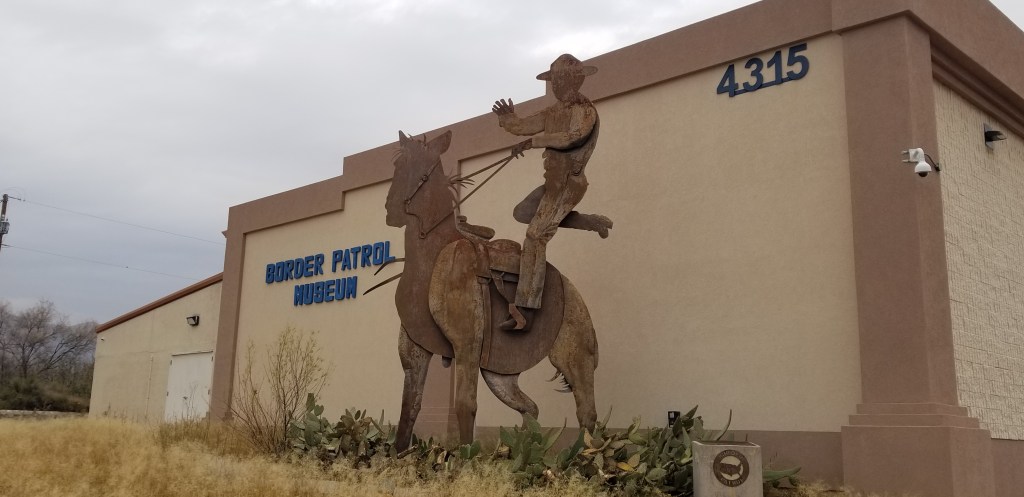
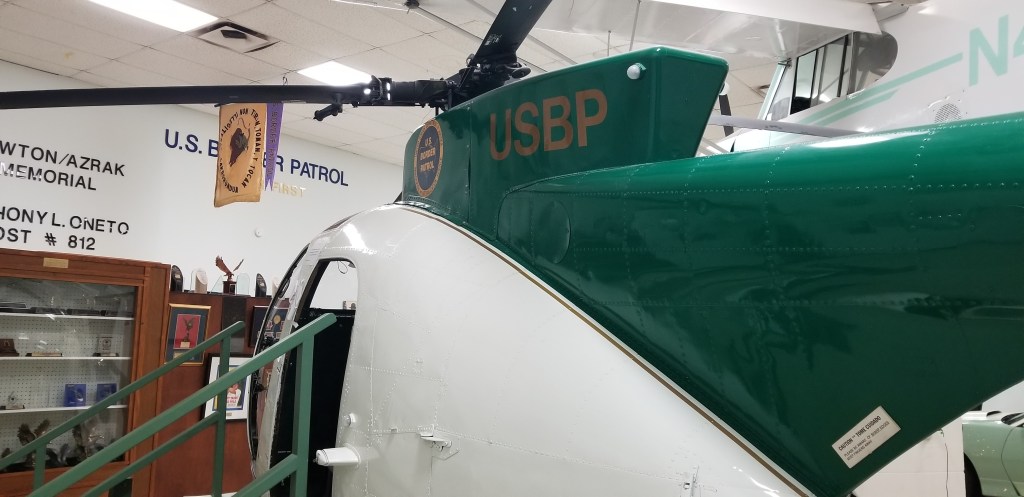
If you want to drive to a destination in El Paso that is on the other side of the mountain from where you are, it can take some time to go around on the highway. The single other option is to travel on the only road that cuts through it, which is beautiful Transmountain Road. Franklin State Park, where we hiked, is on that road. Going from west to east, at the end of Transmountain road, sits the National Border Patrol Museum. We thought it might be interesting, so we paid a visit.

The thing that struck me most about this museum is a reminder that the United States borders do not only encompass our border with Mexico, which is what comes to mind when I think about Border Patrol. Those who work for Border Patrol have to be ready for winter conditions up on the border with Canada, and also oceanic borders in other places. The museum is small and didn’t take us long to go through. It is a good place to learn about those who protect all of our borders.

Border Patrol agents have to keep an eye out for motorized hang gliders, which are used for drug smuggling. We learned about the many ways that people try to smuggle all manner of things – and people – into the United States. Helicopters are needed, of course.

After we visited the museum, Cal made an attempt to see how high up we could drive into the mountains from our side (not very far). We passed a migrant detention center and observed many people walking around in the fenced back yard. One man was holding a baby. It is an image that stayed in my mind and put a very human face on the current migration crisis happening in this city.

We made a stop at Keystone Park and El Paso’s Botanical Garden one morning. Keystone Park needs a lot of love, as it doesn’t seem to be well maintained. It is a narrow strip of wetlands on a short trail located between a busy road and I-10, which is amazing given this light-industrial location. There were many birds to see, which made it worthwhile, and then the Botanical Garden can be accessed from this trail.

The birds would take flight and move to another section of wetland when I tried to take just a step closer, so I couldn’t get a closeup shot of them. But I did like this view of the mountains reflected in this picture. Our RV was on the other side of the mountain from here.

The garden was small, but a lot was packed in. It provided plants from the Chihuahuan desert and a peek into some past history.

In one area, there were pretty mosaics set into the wall:

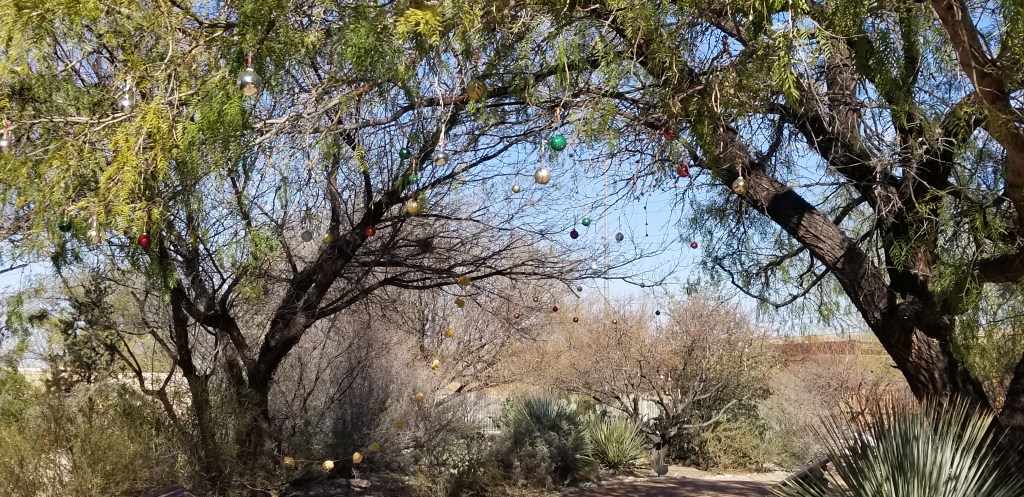
I liked how they had decorated, just a little, for Christmas:

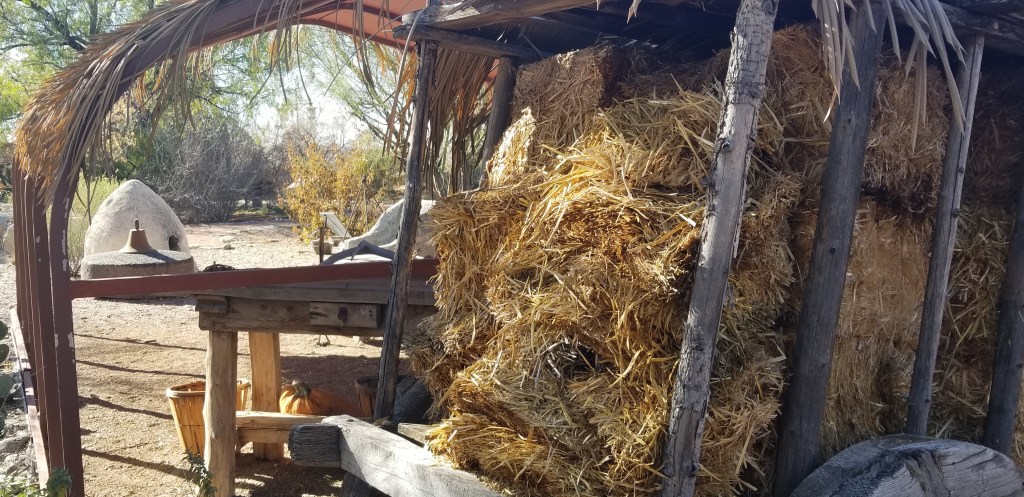
The garden also had a set up of a “paraje” which was an encampment along the Camino Real. This dates back to the 1600’s, when New Mexico was a Spanish colony. The trail covered the distance between Mexico and Santa Fe along what was originally a Pueblo Indian trail. The Spanish were setting up military outposts and needed to move both equipment and missionaries. Parajes were located every 10 or 15 miles to give shelter, rest and water to the livestock and and travelers as well.

The plan for the day was that if we had time, Cal would drop me off at Whoopee Bowl Antique Mall up the highway, and he would go to Camping World while I was there. We have such an exciting life!

I had read about Whoopee Bowl, and I love to poke around antique malls, so I wanted to check this out. If this is the sort of thing you enjoy, it is not to be missed if you are ever in El Paso. I’m always amazed at all the junk…excuse me…stuff that people collect. Whoopee Bowl takes antique malls to a whole ‘nother level.

The above picture is up on the second level. After checking out this massive place and returning down to the first floor, I found a room I hadn’t been in. There was huge fish aquarium, a blazing fire going in a massive brick fireplace, and a rousing game of poker going on.

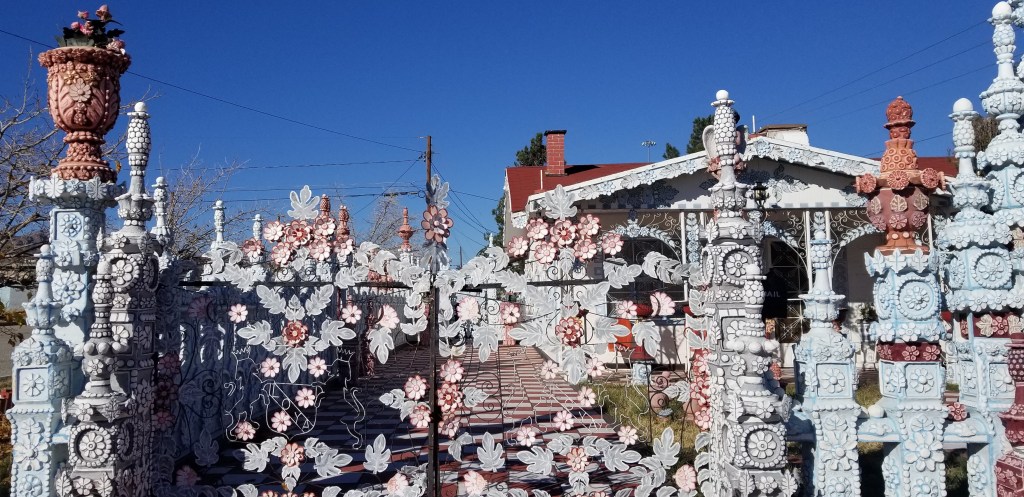
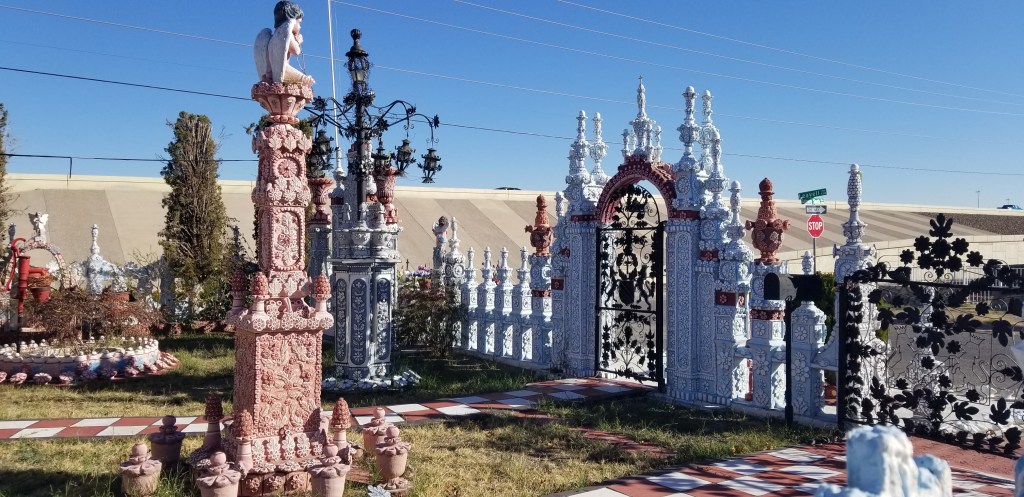
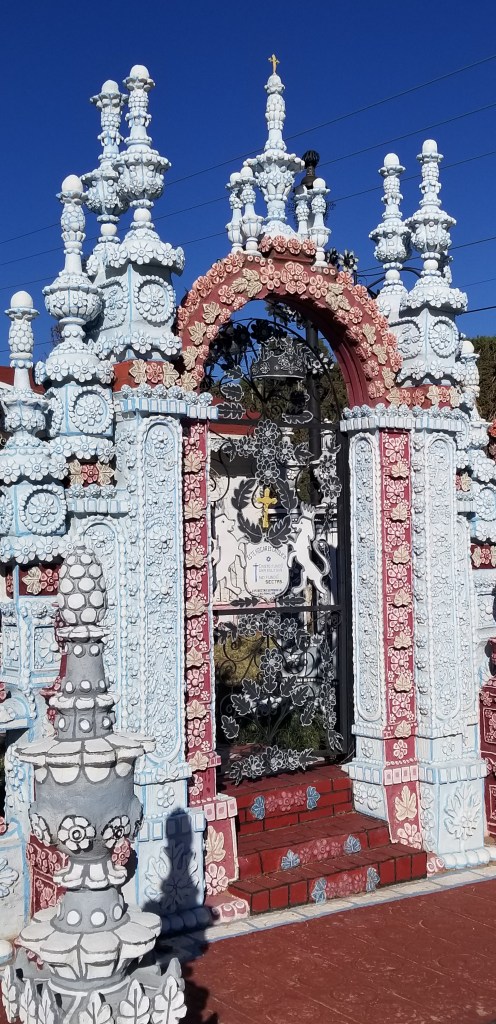
Atlas Obscura is a guide, both on-line and in book form, to all sorts of quirky and interesting places that one might normally miss. They don’t list the Whoopee Bowl, maybe because it is a business. But they do list the Casa de Azucar, which translated from Spanish means House of Sugar. It was just down from where we were staying and made for a good walk.

It is a testament to one man’s love for both his wife and his Catholic church. Rufino Loya started building this confection of decoration around his little house and kept at it for 25 years. He died just this past August at the age of 88 years. I hope someone will keep taking care of it.

Also just up the road, two artists were working on a mural on a concrete retaining wall. I enjoyed walking by and checking their progress.

Our time in El Paso was also about catching up on chores for me and RV maintenance for Cal. The less-glamorous side of RV life is that we do have to stay on top of everything that one would normally do in their lives. Some things had not been taken care of since before our trip to Europe. It being Christmas time, there was also gift buying, Christmas cards to write, and other things that one does to get ready for the holiday. Our RV park had a club house with a kitchen I could use, and I baked some Christmas cookies there.

Just a few days before Thanksgiving, we made a last-minute decision to visit our family in Denver, so we went drove there without the RV for both the Thanksgiving and Christmas holidays.

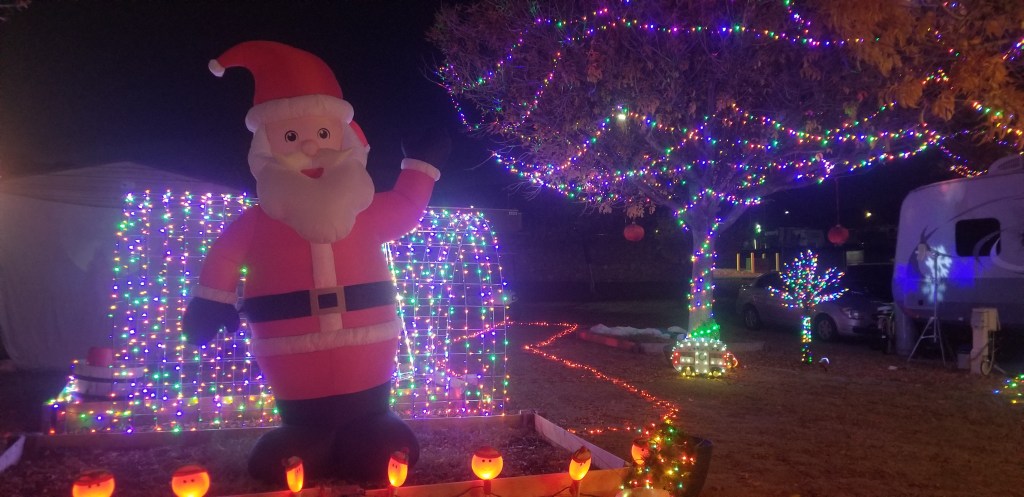
Almost every evening while we stayed here, though, we walked together through the little streets of the RV park. It was fairly large so I could get a good number of steps in. When the sun goes down, the temperature plummets, so at times we had to make sure we got our walk in before dinner. For awhile we enjoyed a full moon. There was also a little Christmas wonderland set up by our camp hosts.

And, of course, we paid a visit to Santa!

Like a coin which has two sides, we were happy to refuge here, and also happy when it was finally time to move on down the road.

Next time – zipping across the state of Texas in five days

USTravel

Wandering New Mexico

Sunset on the mountains behind our RV, Alamogordo, NM

Happy first blog of 2023! I haven’t gotten back to blogging as quickly as I would have liked after the holidays. Blame it on the flu, and traveling, and also having some nonexistent Internet. We are now in a good spot with great Wi-Fi for awhile, so it’s time to flip the calendar back a couple of months…

Entering our RV again after 3 months away in Europe was truly like coming home. It even still had a little of that “new RV” smell. No mice had settled in and nothing catastrophic happened to any of its mechanics. The lithium batteries hadn’t even lost much of their juice. We looked forward to getting back to our nomadic life, even as we still missed some of the aspects of life that we’d had in Europe. First, though, was two weeks in Denver and a happy reunion with our family there. We would be returning at Christmas. So, for the weeks in between, we headed south to New Mexico.

Our time in this state was a comical musical chairs-style switch up in plans and RV reservations. A five-night stay in a state park was canceled by the park for maintenance issues. A clueless RV park owner who takes reservations only by phone lost our reservation and had a full park during the dates we were to be there. And, unexpected: it often got cold at night, sometimes with below-freezing temperatures. We ended up canceling three other stays because the temperatures were dipping too much. RV life sometimes calls for some flexibility!

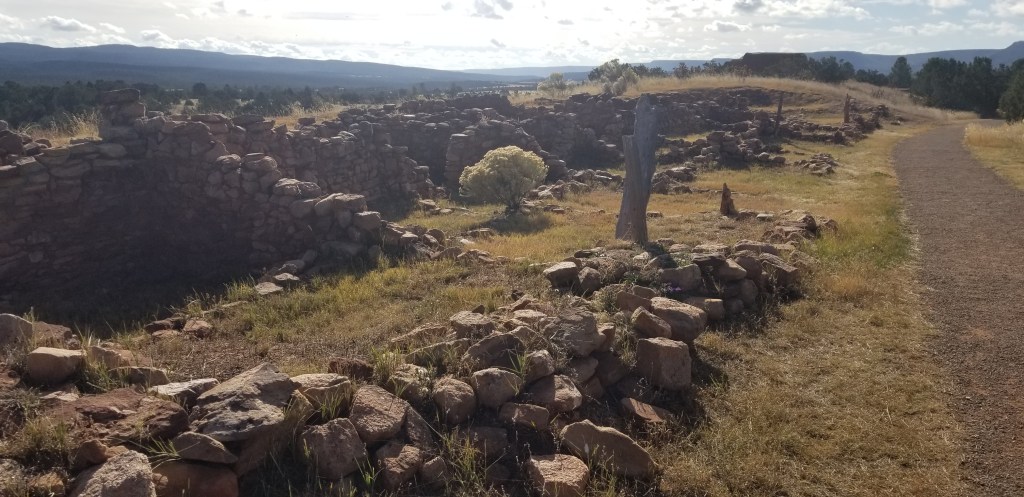
One of our “substitute stays” took us to a KOA park in Las Vegas. No, not THAT Las Vegas…remember, we are in New Mexico. While there, we took a drive 35 miles down the highway to visit Pecos National Historical Park. The Pecos Indians had a pueblo there, four to five stories high, home to about 2,000 people for several hundred years until the Spanish came along. What the Spanish didn’t destroy, the Americans did: later, it was a stage stop on the Santa Fe Trail. Situated in a fertile valley between two mountain ranges, it was a major gathering and trading place. The warriors were known to be fierce and undefeatable.

Pecos National Historical Park, New Mexico

The pueblo is in ruins. This is all that remains of a once-great people. Once upon a time, there were 20 kivas here, which were places for ritual ceremonies. I climbed down inside of one of them.

The park service is slowly reconstructing some of the park based on archeological finds. The Spanish mission was in a partially ruined state and they have rebuilt some of it and the surrounding pueblo.

The remains of the Spanish Mission church and layout of surrounding buildings that were here

We drove around Las Vegas a couple of times. It was once a stop on the Santa Fe trail during its Mexican past. Later, the railroad arrived. I read that there are 900 historic buildings in this town, dating back hundreds of years. There are things to see another time when it’s warmer. We had dinner in the Buffalo Hall and Cowboy Cafe, another old building. Their barbeque was delicious.

For me, KOA parks are usually just an overnight stop off the highway. Some are practically on the highway, and come with traffic noise and small sites. We stayed here for two nights, and I must say it wasn’t bad. They gave us site #1, which meant a full sprawling yard and no RV’s in view from our front porch. Susan, in the office, fried us up some delicious pancakes with vanilla and cinnamon for breakfast. However, this park sits near the Hogback Mountains, and Las Vegas itself is at 6,424 feet elevation. I didn’t think it would be so chilly this early in November, but we had snow on the morning of our departure. We needed to get further south!

The view from our porch in Las Vegas, New Mexico; time to flee!

Northern New Mexico is mountainous and is very beautiful. Santa Fe, Taos, and Angel Fire are all nearby. But we’ll have to save our exploration of it for a time when it’s a little warmer.

Our next stay, in Fort Sumner, was also a last-minute replacement find. It was a small mobile home and RV park, usually the kind of place that would be at the very bottom of our desired place to stay. But the permanent residents were to the back, us transients to the front, and all places were neat and tidy. Our site was very wide, and we were right in town. Well, such as town was. What this place lacked in amenities, it made up for in character.

The owners of Valley View RV also own the “Billy the Kid” museum up the street. Ed & Jewel Sweet opened the museum in 1953 as a repository for all the stuff they had collected in their life, and naming it after New Mexico’s famous outlaw is what drew people in. Their son, Donald (who is no spring chicken himself, but gets around well) is running the family business and together with his son, Tim, they run a tight ship.

Billy the Kid’s Rifle

I wasn’t much drawn into the Billy the Kid stuff. Stuff of lore though he may have been, he was still a criminal. Allegedly, he killed 21 men before he himself was killed at the age of 21 in 1881. But this is BTK territory: where ever we went around these parts, a sign would proclaim “Billy slept here!” or “Billy shot someone here!” and I couldn’t see one redeeming thing that he ever did. I guess it helps with tourism dollars, but I would say the heyday on these events has come and gone.

I loved looking at all the stuff the Sweets collected and had on for display in the museum, though. Besides these farm implements, there were collections of various household items, lots of old buggies and some covered wagons, and of course more BTK ephemera.

Whenever there is a fort to be seen, and we’re looking for something to do, we usually go see it. They’re all different, and some have been amazing for the surprises they hold. Nothing could have prepared me for Fort Sumner, though. Rather than normal western fort-looking buildings, this beautiful museum greeted us:

Recently completed, the Bosque Redondo Memorial tells the story of how 8,500 Navajo and Apache Indians were rounded up in January of 1864 and made to march almost 300 miles to this place. Called “The Long Walk”, under the leadership of Kit Carson, 200 of them died of cold and starvation on the way. The site was to be a reservation to “civilize” them by going to school, practicing Christianity, and becoming corn farmers. Once they got here, they were made to construct their own dwelling places. Unfortunately, the nearby Pecos river was brackish and caused intestinal problems and disease, armyworm destroyed the corn crops, and the wood supply was soon depleted. Most of the Apache escaped the next year, but it would be three more years before the Navajo simply walked home. The whole venture was a miserable failure.

The memorial was built at the request of some Navajo teenagers who, when visiting Ft. Sumner, wanted to know why their story here wasn’t told. Until just two years ago, you would visit the fort and simply not know what happened at this place. The events were certainly not included in any of my history books.

I didn’t have much of an appetite for visiting the fort after that, but we followed the trail out. There isn’t much left of it anyway. Walking about the grounds, I pondered the atrocities that occurred here under the direction of our government. It is a silent, windswept place.

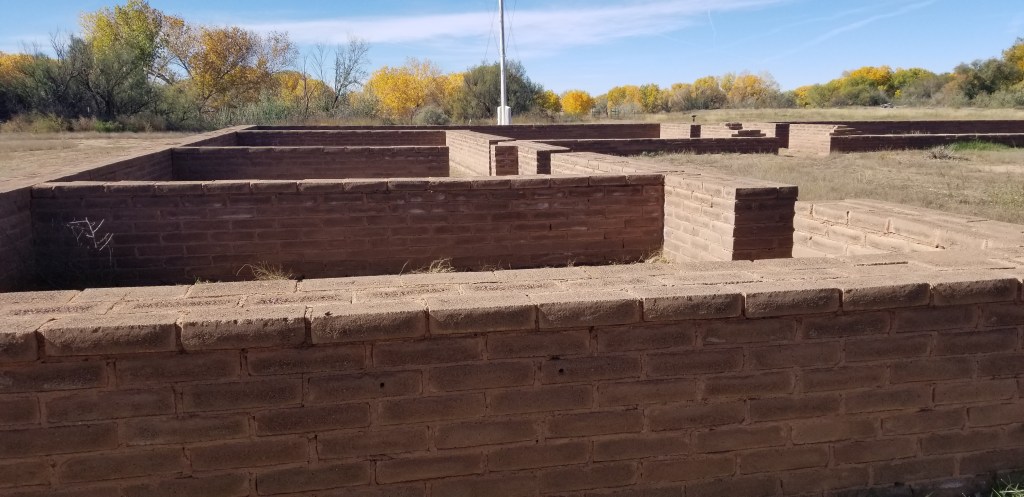
A partially reconstructed layout of some of the buildings

I’m continually astounded at man’s inhumanity to man. I came away with a feeling that I, we all, need to travel and see these places and to learn their stories. Otherwise, how can we learn not to repeat them?

As a side note, after the fort was abandoned in 1869, a rancher purchased one of the old barracks buildings and turned it into a grand house. It was there that a local sheriff ended the life of Billy the Kid. He is buried in the military cemetery nearby, but we did not visit it.

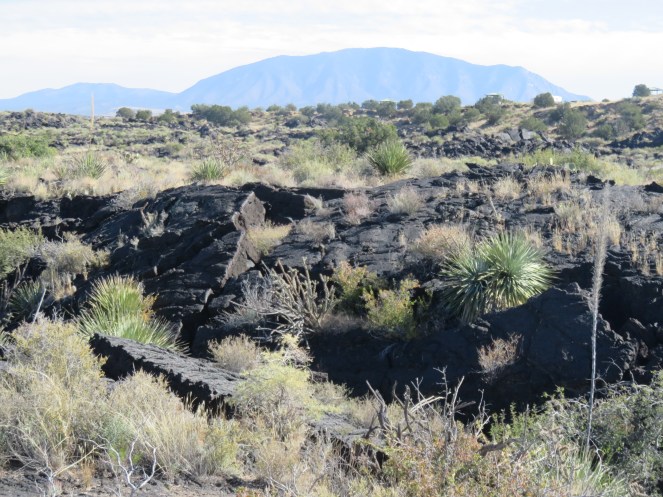
Ready to get back to nature, our next stay was at Valley of Fires Recreation Area, maintained by the Bureau of Land Management. It looks over part of a 44-mile lava flow that happened 5,000 years ago. It was not the result of a volcano. Instead, the Carrizozo Malpais Lava Flow was the result of volcanic vent openings in the valley floor. Our site also looked out over the lava field and provided us with several grand sunsets. From our perch, the only man-made thing that we could see was the nature trail and, occasionally, cars on the road far off in the distance to our right. Ahhhhh…excellent.

It is a quiet and peaceful place and was our favorite stay during this time.

When we hiked the nature trail, we discovered that the lava field is very much a living place. There are cactus, trees, and bushes common to the Chihuahuan Desert that we were in, as well as some late-blooming flowers. Animals live here too but we didn’t see any. Seeing lava rock again almost made us feel like we were back on the Big Island of Hawaii.

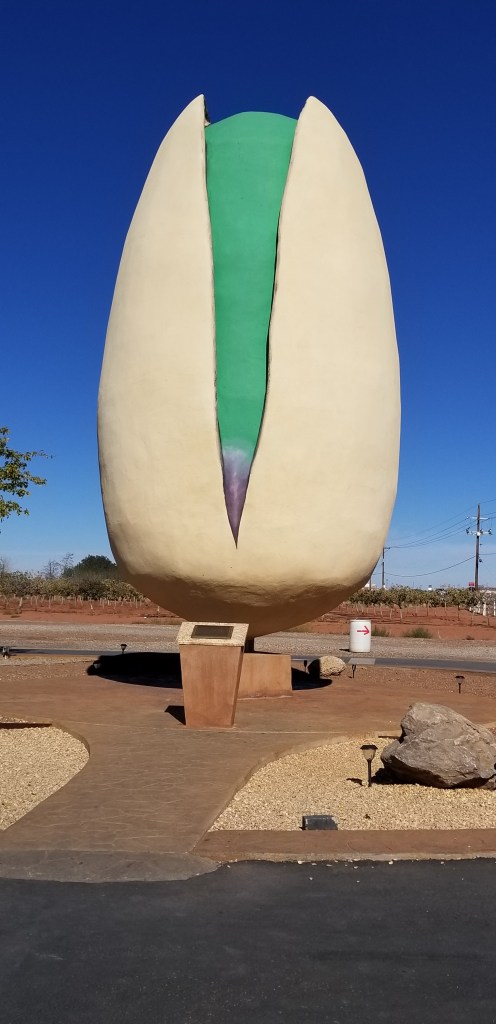
As a fill-in for our lost RV reservation, we stayed for several days in Alamogordo, right across the road from the world’s biggest pistachio.

It’s best not to try to eat this pistachio! It’s 30 feet tall.

McGinn’s PistachioLand and its neighbor, Heart of the Desert, were both great places to sample pistachios, pecans, and wine. It was very handy, after having all that wine, to just be able to walk across the road (carefully!) and go home. At McGinn’s we also took a little tram ride through the orchards and vineyards for an interesting tour. We liked McGinn’s best, but that was probably because Heart of the Desert was a smaller operation and were very busy with a wedding when we visited.

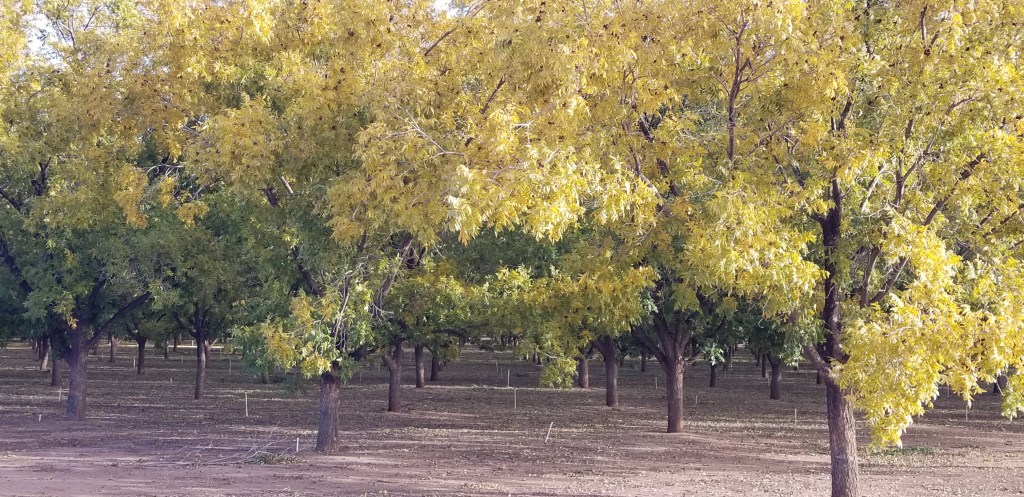
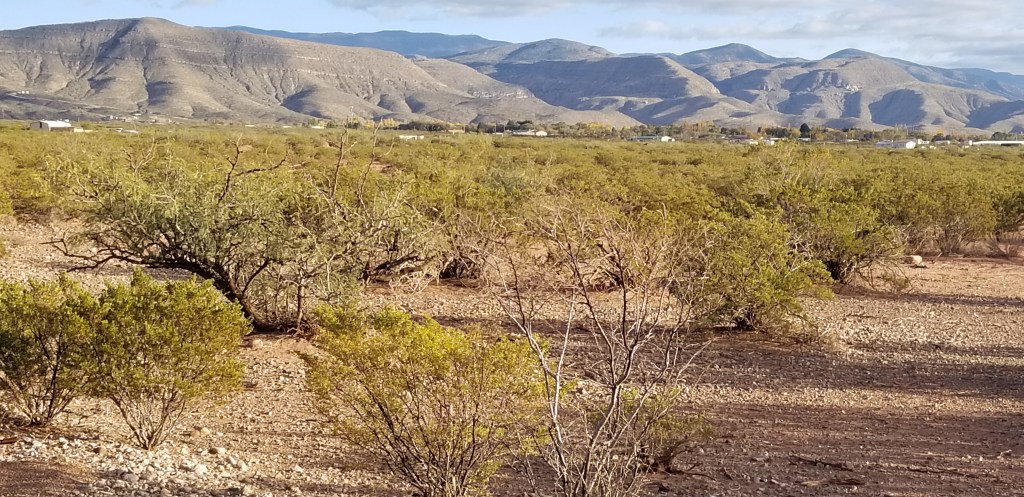
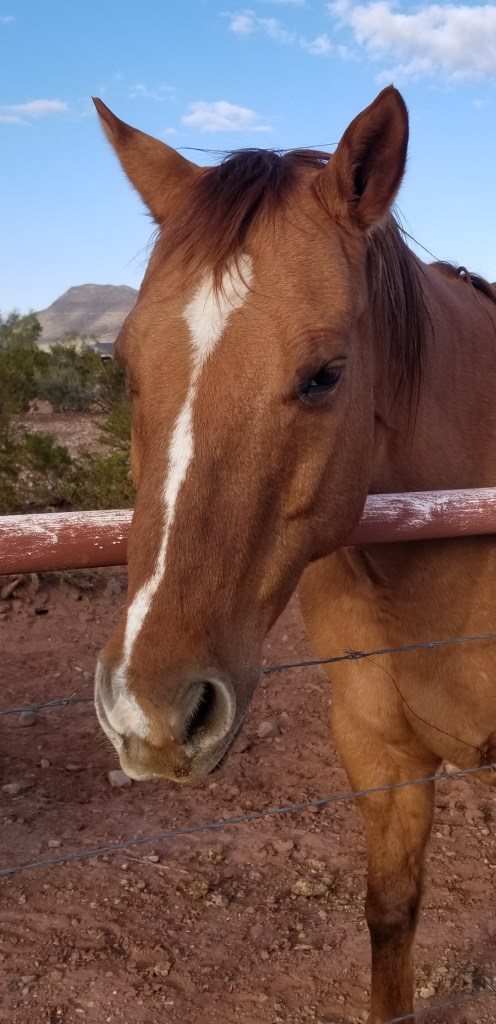
Also behind our RV park in Alamogordo was a little country road which I enjoyed walking on a couple of times. There was a large pecan orchard to look at, mountains ahead of me, and friendly horses to pet.

A pecan orchard

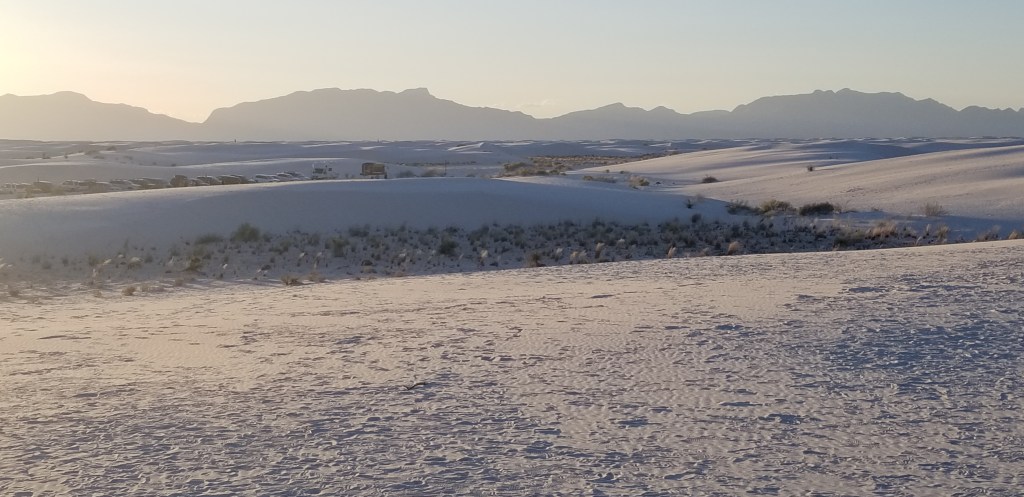
The highlight of our stay in Alamogordo, though, was a visit to White Sands National Park. Although it was designated a national monument in 1933, it became a national park in 2019. We took a guided walk by a park ranger, where we learned that recently they have found a set of ancient footprints here. The footprints date to 24,000 years ago, placing humans in North America sooner than was thought, but this date seems to still be in dispute. Although the gypsum sands seem dry, there is water only a couple of feet below the surface.

We also hiked a short nature trail – and it was easy to lose the trail!
The sand pack on the road looked exactly like a snow storm had occurred here.

The sun going down made for great effect, casting its long shadows over the sandy hills. We were here in the late afternoon so as to catch the ranger’s tour, but it was a great time of day to visit.

Our last stay during this time was in Las Cruces. From our park, we were able to walk to Old Mesilla, a village that was settled over one hundred years ago. Red chile peppers adorn the plaza and the thick adobe-walled buildings contain art galleries, shops and restaurants.

A mural on our walk to Old Mesilla
Chile peppers and Christmas lights on the plaza

I cannot help but point out that there was once a courthouse here where Billy the Kid was tried for his crimes and sentenced to hang. He escaped before that could happen.

A historic home in Old Mesilla

We had excellent fajitas in a restaurant called La Posta in Old Mesilla. It had been a Butterfield stage stop and inn, and in 1935 it became a restaurant. Parrots and a piranha fish greeted us when we entered. La Posta had rooms upon rooms, and we ate in what was once was the blacksmith and harness room, with a fireplace that kept us warm. While we enjoyed our delicious dinner, we could look at an immense Christmas tree in an adjoining room.

The state of New Mexico overall has much to offer, but we will have to return at a time when it is warmer. The entire state is at elevation, which means it isn’t a great place to be in late fall and winter. Las Cruces itself, while in the far south of New Mexico, sits at 3,900 feet elevation. It was 27 degrees on our last morning in Las Cruces and it wasn’t the first time we’d had a freeze. Daytime temperatures usually warmed up into at least the 50’s, but nighttime freezing temperatures means that the RV mechanic (that’s Cal) has to disconnect hoses and turn on tank heaters. It’s always a worry that a connection might freeze and crack.

We were continuously keeping an eye on the Weather Channel, trying to figure out where would be the warmest place to sit for awhile. What did we find? That is the subject of my next post!

Next time – looking for sunshine in the southwest

Europe · Life in General · UK and Ireland

Hallelujah! A Musical Christmas Card

A couple of weeks ago, I listened and watched the entire oratorio of Handel’s “Messiah” presented at the Washington Cathedral in Washington, D.C. It had been quite a while since I had heard the lesser-known pieces. If you don’t think you’ve ever heard of the “Messiah”, you have probably heard of one of the songs in it: the “Hallelujah Chorus”. The music took me back to Messiahs of other years.

During the middle of my time in high school, my father became the pastor of a small rural Lutheran church in northwestern Ohio. There, we lived at least ten miles from a town of any size. In the fall of my senior year and the fall following my graduation, he and I joined 150 other singers of the regionally famous Mennonite Choral Society in Berne, Indiana for practices and a performance of the Messiah just before Christmas. I don’t know how he found out about it or even if any auditions were required. I enjoyed singing some pieces from the Messiah at my previous high school the year before, so that could have been the catalyst. He had a beautiful tenor voice, and I sang soprano.

Once every week night, he and I headed out on dark and sometimes snowy or icy farm roads over the state line to Indiana to attend practices fifteen miles away. He was a taciturn man unless there were subjects to discuss that he was passionate about, so I don’t remember our conversations on the road – or even if there were any. I just remember the pride that I, and I’m sure he, felt about being part of such a wonderful performance. Knowing my dad, he probably was very happy that I did it with him.

The choir had performed the Messiah every year since 1893. Soloists were flown in from Chicago, which was Very Big Stuff to a small-town Ohio girl like me. A grand, beautiful pipe organ and small orchestra accompanied us.

The Messiah takes words from the Bible and tells the story of the nativity and its prophecy, as well as the crucifixion of Christ and victory over death. Even if you do not believe, the music itself is dramatic, heart-stopping, and absolutely beautiful. Both the oratorio and another piece, “Water Music Suite 1”, put Handel firmly in the list of my favorite composers. George Frederic Handel was originally German but he adopted London as his home. At age 56 he composed and had the very first Messiah performance not in London but in Dublin, Ireland on April 13, 1742. Not Christmas time? No, it was originally written as an Easter Oratorio.

How the Messiah came into being at all is an interesting story. The words had been compiled and edited by a man named Charles Jennens, who gave it to his friend Handel to put into music. The well-known story is that Handel completed it in 24 days without eating or sleeping much. After the composition of the Messiah, Handel was going through a difficult time. Overworked and laden with debt, he accepted an invitation from Lord Devonshire for a ten-month stay in Dublin. He brought with him the musical score he had worked on while living in London, and the rest is history.

While we were in Dublin this summer, I looked for signs that Handel was here, and I found them. Dubliners are still proud to have hosted the first performance, all these hundreds of years later.

Before it could ever happen, Handel needed an organ to work the oratorio through, and it is reputed that St. Michan’s Church of Dublin graciously let him use theirs. The church has a long and storied history, which you can Google if you’d like. St. Michan’s is now a bustling restaurant and bar called “The Church”, and we had dinner there in what was formerly the balcony. The keyboard to the organ sits in the little alcove below the pipes. In converting to a restaurant, renovations were thoughtfully and respectfully made to keep some of the original architecture and furnishings in place.

It was interesting to think what the former parishioners would have thought about food and alcohol being served in their church!

It is still the same organ Handel played. The restaurant would like to renovate the organ. If you have $100,000 to spare, you can help them out!

The inaugural Messiah was played at the then-new Musick Hall on Fishamble Street. The original entryway is all that remains; behind it is an apartment complex.

I also found a plaque nearby that commemorates the occasion.

A open-air Messiah is performed near these gates in the Temple Bar area every year on April 13. This past year it was presented by Our Lady’s Choral Society and the Dublin Handelian Orchestra. The streets are packed and people sing along with the music.

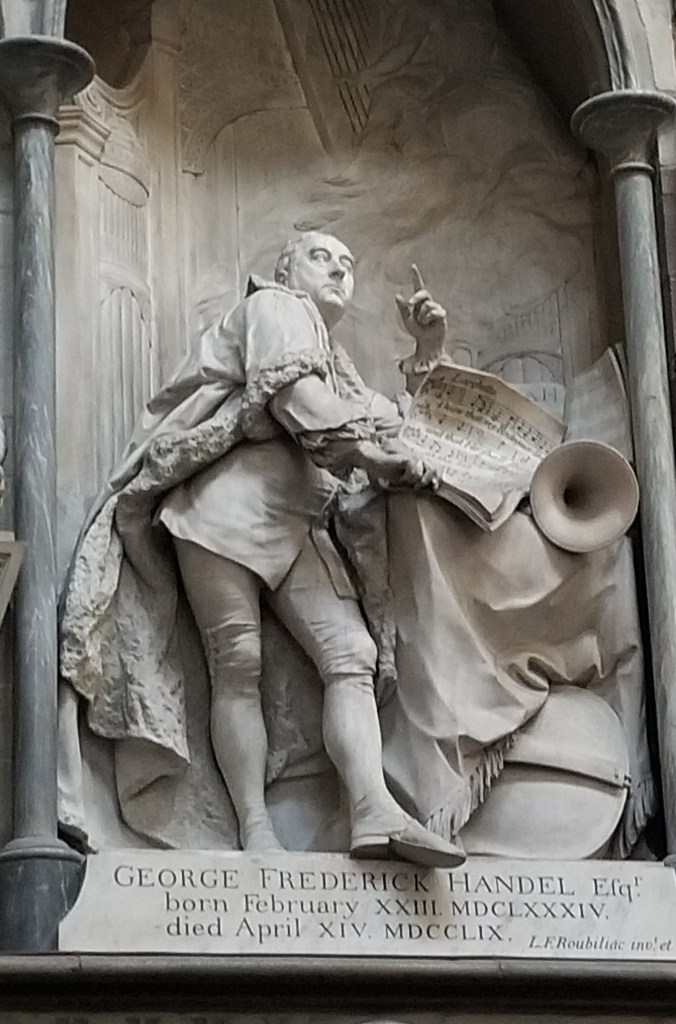
I came full circle with Handel when we later visited London and Westminster Abbey. He is buried there, and a life-size sculpture on the wall near his grave is a memorial to him.

A fitting tribute, indeed, to a great man.

There have been other Messiahs over the years since the two years in Berne, Indiana. A few years ago, I sang with the church choir that I was a member of for its Christmas Eve service. My oldest sang the soprano solos, and the torch was passed. Over the years, my voice dropped from soprano to alto, and now a frog has moved into my throat, so I no longer sing publicly. But no performance has ever been the same to me as those in the Mennonite Church long ago.

I looked up the choir on YouTube, and found a recording of the Hallelujah Chorus from the 2015 performance. It was years after mine, but all was exactly as I remembered. I have placed a link here for your enjoyment.

Here’s an interesting piece of trivia: why does the audience stand up when the Hallelujah chorus starts? The very first audience in the recital hall on Fishamble Street did not. Almost a year later, the Messiah performed in London, and King George II was in attendance. He stood up when the Hallelujah chorus began. It is believed that he was so moved that he stood to show his reverence. Although maybe he was just stretching his legs, who knows? Because the king stood, the audience had to stand too, and audiences have done that ever since.

It’s time for me to have some eggnog, a Christmas cookie, and another listen to the Hallelujah chorus. Merry Christmas! Happy Holidays! See you again in 2023.

Next time – a return to the RV’ing life in New Mexico

Europe · UK

A Visit to the Island of Skye, Scotland – Europe Travels August 2022

This was the day I had been waiting for: another Rabbie’s tour. The trip around Inverness with Rabbie’s had been so interesting and fun that we looked forward to our trip out to Skye for several days. It would be a much longer day: twelve hours, because Skye is a fair distance from Inverness. This tour is very popular, and although we were still in a small minibus, there were two of them waiting when we arrived at Inverness bus station.

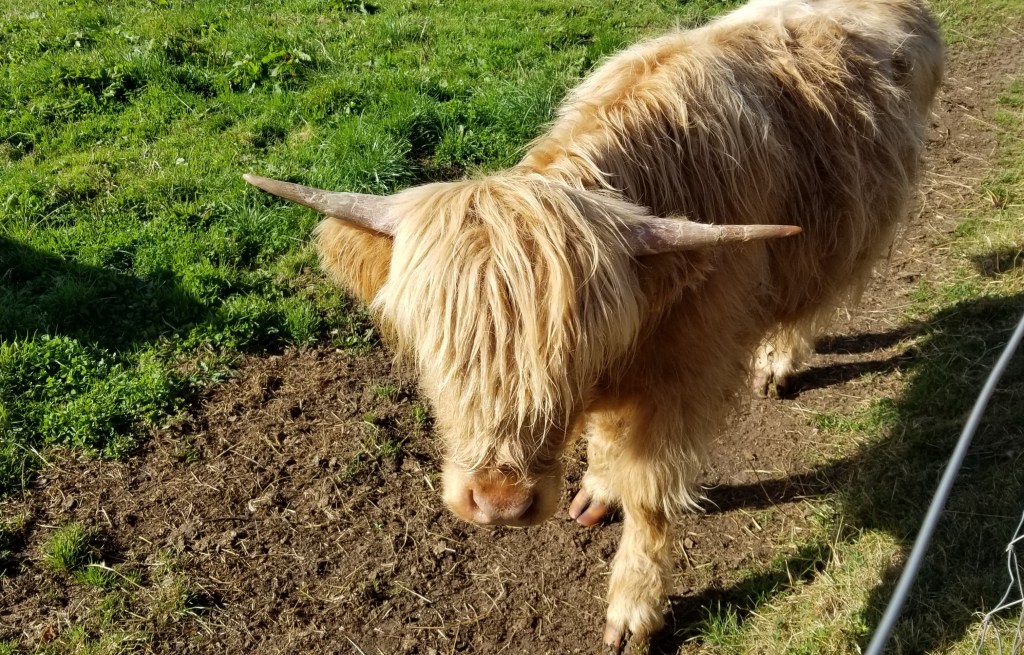
First things first, though. There were Highland cows to see on the way out, and we had a much better view of these than we had on the earlier tour.

Besides these two, there were an additional two further out in the field. The cow on the left was very friendly and trotted right out to see us.

If you want to attempt to sound like a local, you would call this animal a “Heelan Coo”. It is indigenous to Western Scotland. Highland cows are as docile as they are cute. This one even stopped to show us one eye beneath all that hair.

Cuteness overload!

When we left Inverness, the skies were clear blue. As we got closer to Skye, the clouds gathered and the day became gloomier. I hear this is pretty typical for Skye. The average amount of sun hours for Portree, the largest town on Skye, is 1,170 hours annually. If you figure an average of twelve hours of sunshine daily, more or less, that works out to only 98 days when you may luck out and get a sunny day.

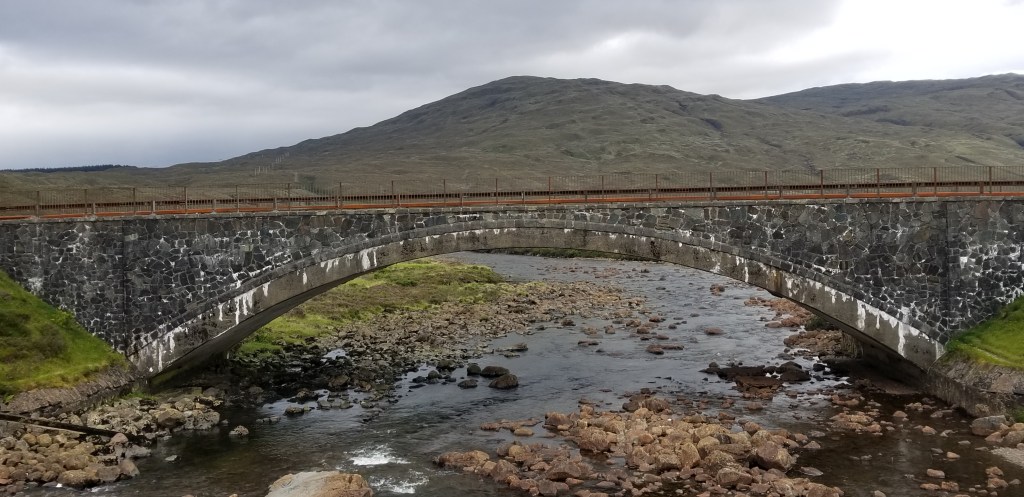
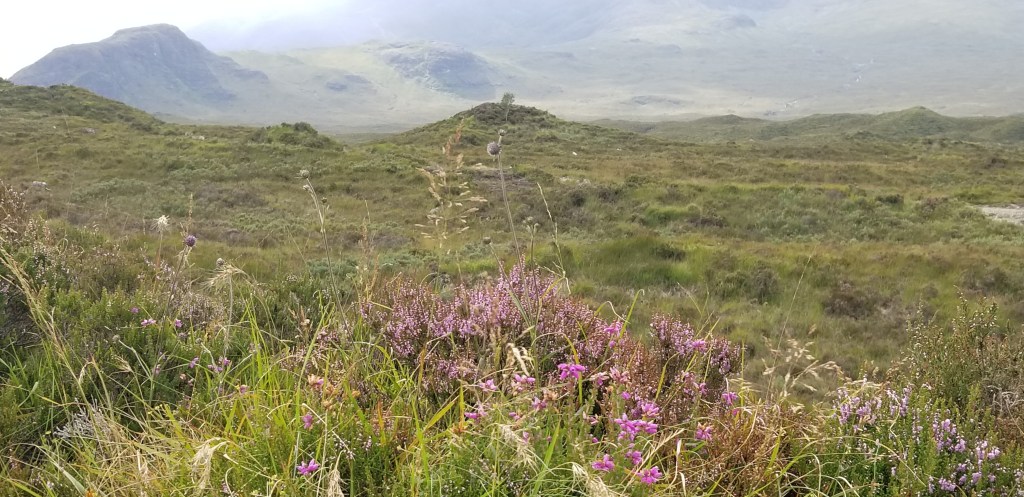
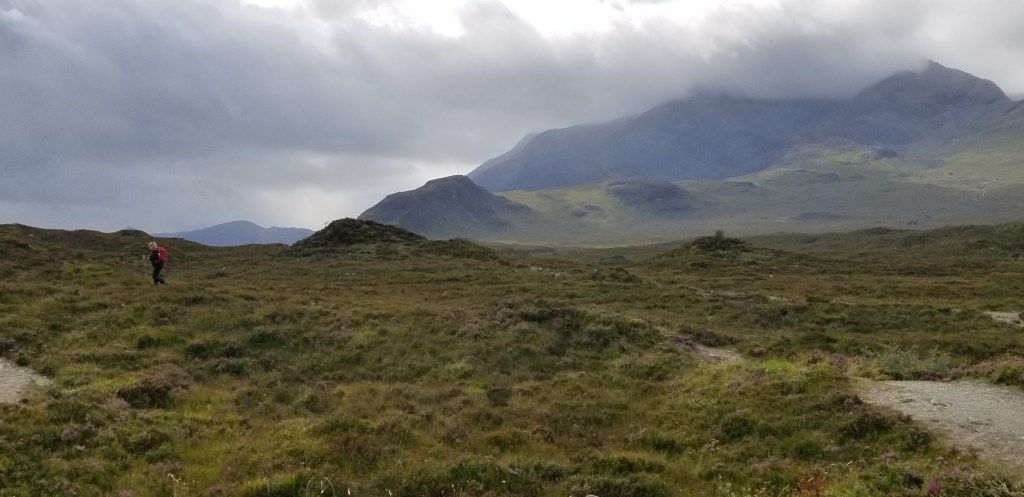
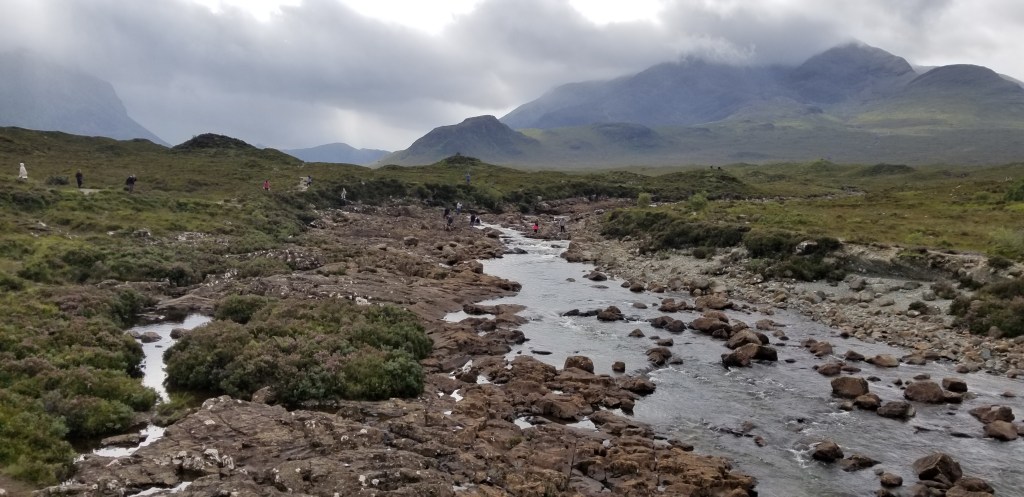
Arriving on Skye, our first stop was Glen Sligachan, with the Cuillin Hills in the background. This area is peatland, which the locals once used to cut for heating and cooling. About 20% of Scotland is covered in peatland. We walked over this bridge for a better look.

It was beautiful, but there were too many people about and not enough time for a venture further into nature. People were wandering everywhere. And therein lies a problem: these peatlands are fragile and protected. A signboard made a plea for a donation to the John Muir Trust to upgrade the paths.

The two men in this statue are John MacKenzie and Norman Collie. They climbed, mapped, and named the Cuillin hills in the late 1800’s and early 1900’s. Their partnership together lasted fifty years, and they are buried next to each other in a small cemetery within view of the mountains they loved.

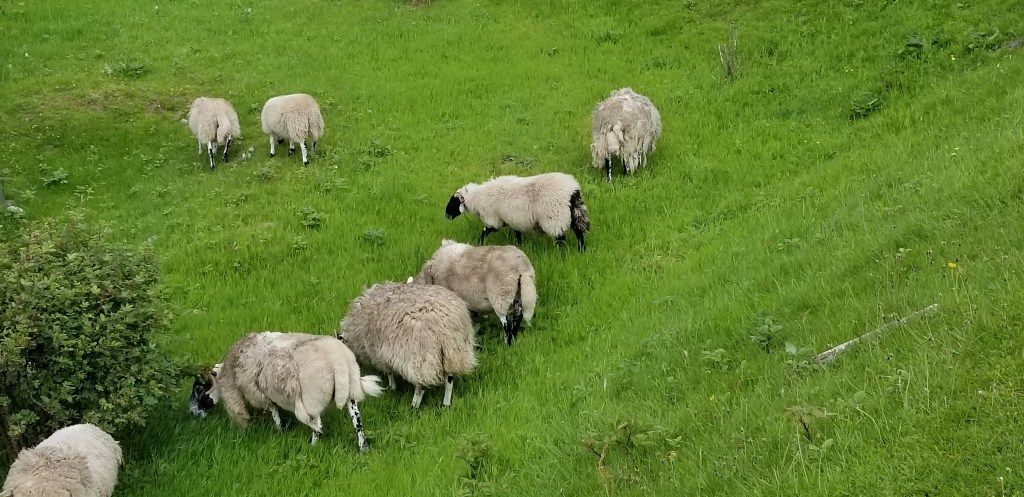
The Island of Skye is covered in sheep. Unfenced sheep are grazing everywhere. There are over 100,000 sheep on the island of Skye, with blackface being the most common breed. I stopped to admire this little group, grazing near the bus park where we had stopped. They were too busy eating to turn around and pose for a picture.

Our guide had plenty of information for us as he drove. In the 1930’s and into the 1940’s, people built new homes next to the old thatched roof ones that had housed their families for generations. They removed the thatch, replaced the roof with cheap tin, and the old home became their shed. I looked for these as we rode and found several of them. Old stone fences also criscrossed the landscape.

We had some delicious fish and chips for lunch in the town of Portree. It was the second time on our trip that we ate in a former church, and these folks were doing a brisk business. It was the only item on their menu. The tour buses and minivans that are on the island for the day all converge on Portree at the lunch hour, so every eating establishment is full.

If you have ever watched the series “Doc Martin” on PBS, Portree looks a lot like the fictional “Portwenn” from this view.

In Portree after lunch, I poked around a local craft market and found a Skye author, Liz MacRae Shaw. Her books are historical fiction. One of them, “Love and Music Will Endure”, portrayed the life of Mairi Mhor Nan Oran. She was a poet and political activist from Skye during the 19th century.

The British had decided they wanted more sheep from Scotland, and Skye in particular. The landlords were encouraged to increase their income by replacing the smaller farms in their holdings with larger farms with more grazing land. They also wanted to reduce population. As a continuation of the hardships imposed after the Battle of Culloden, they started squeezing out those smaller farms in the 1750’s, now known as “crofts”, in a policy known as “The Highland Clearances”. There was forced migration and old ancestral homes were set on fire. To add insult to injury, the potato blight struck, just like in Ireland. People were suddenly homeless and crowded into local churches. Poverty reigned, and many former crofters left for the large industrial city of Glasgow to work. Some were involuntarily sent to Canada or the United States. The Highland Clearances went on for almost a hundred years.

Mairi fought for crofter’s rights in a time when women were supposed to be tending the hearth. She expressed her love for her homeland and the need for change through her poetry. I purchased the book, Liz signed it, and I spent the next week or two engrossed in this place at that time in history.

Looking down Skye’s rugged coastline from Portree

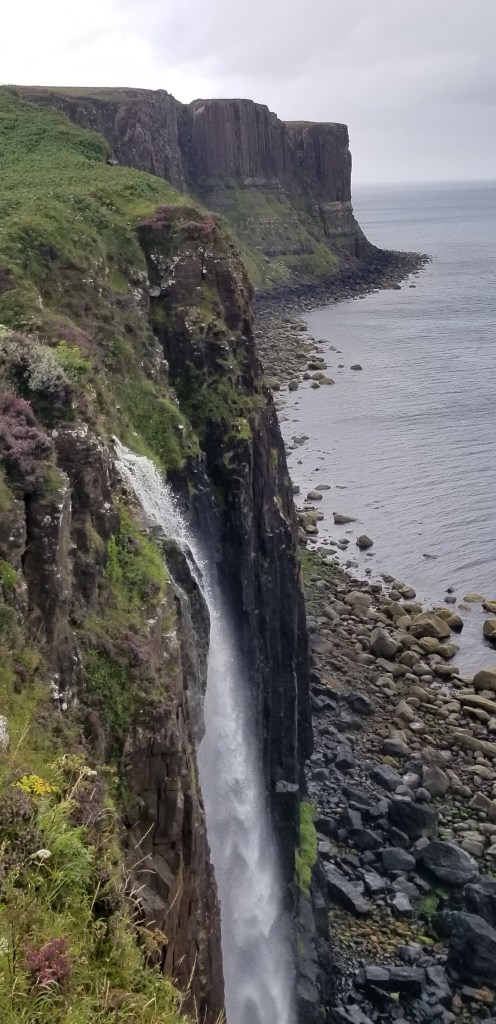
Back on the road after lunch, we headed northward along the coast. We were sometimes on single lane roads, preariously winding around the mountains, rising in elevation, with the wind picking up. The next stop: Kilt Rock or, in Gaelic, Creag An Fheilidh.

The cliff face that looks like a kilt is in the top rear of this photo. I was honestly more entranced by the gushing waterfall in the foreground. By now we had some light rain in addition to the wind, so this was a very quick stop.

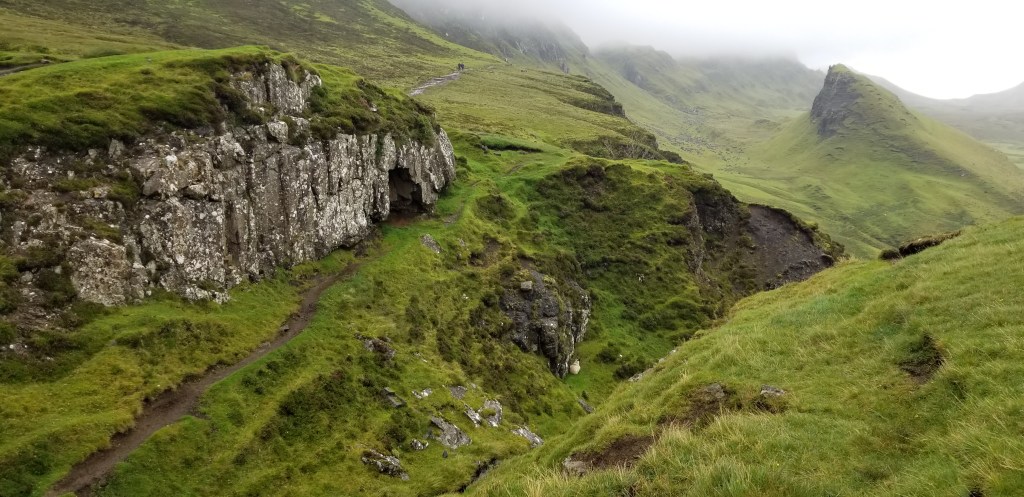
Away from the coast and higher into the mountains we climbed, with the rain coming down in earnest now. When we finally arrived at Quirang, I was stunned at the panoramic beauty of the place.

I was cold, wet and almost blown away by the wind. Cal thought this was an auspicious time to take my picture!

The view at Quirang was more than worth the time we spent out in the weather.

We had seen the other Rabbie’s minibus here and there throughout the day, but by Quirang it was nowhere in sight. When I expressed my appreciation to our guide/driver for making this stop in deteriorating conditions, he said that some of the other guides don’t bother with it when the weather is getting bad. It was his opinion that you shouldn’t miss seeing what you’ve paid for. Of course, I wouldn’t have known the difference if we hadn’t stopped, so I was glad that we were on this particular minibus! For me, it was the highlight of the day.

It had been our furthest point north, so we started on our way back. At the bridge to the mainland, we stopped for a cup of hot cocoa and a look at some ruins.

We took a different way back to Inverness with completely different scenery. Unfortunately, it was not possible to take pictures out the window since it had rained off and on throughout the day. Especially closer to the island, I would have liked to know what I was seeing but our guide fell silent. He’d been regaling us with his stories and talking all day so I guess he was just tired! Our Rabbie’s day had been stellar, just like the first one had been.

I will be on a Christmas topic next week, and then will be taking a week off from the blog for the holidays. What about our RV’ing life, and what did we do after we returned from Europe? I’ll be answering those questions when I return.

There will be one more blog about our travels in Scotland. I’ve left out details of three things that many people think about when they think of this country. Do you know what they are? I’ll leave you to ponder that until I get back to it in 2023!

Next time – A Musical Christmas Card

Europe · UK and Ireland

Circling Inverness, Scotland – Europe Travels 2022

Glen Affric, Scottish Highlands

In the months leading up to our trip, I joined a Facebook group for travelers to Scotland. People like me who are planning a trip here can ask all their questions and there is a ready supply of people who either live here or have traveled here to provide answers and suggestions. One lengthy discussion revolved around top sheets – or the lack thereof – on beds in Scotland because everyone in Europe uses only a duvet. The person was thinking about packing one, despite the fact that her trip was only ten days long. Another prospective traveler fretted about blow dryers (every single AirBnb we went to had one). A recurring theme was a concern about the availability of American drip coffee, which is not the way European coffee is made. You can try an “Americano”, which Cal did while we were here, but it’s not the same. He survived in fairly good humor for three months just fine without, in his opinion, a decent cup of coffee.

In between all the mundane stuff, I picked up some good sightseeing tips. The Dean walk that we had taken in Edinburgh was a suggestion from this group. Knowing nothing at first about what to see, I made a list of all the Highlands sites that sounded interesting. Cal and I decided fairly early on that we did not want to rent a car, but to take occasional day trips for sights that would be out of reach otherwise. A tour company name that kept popping up on the Facebook group was Rabbie’s, so I booked two day trips with them during our Inverness stay.

The first tour was called “Glen Affric, Culloden & Clava Cairns” which is exactly where we went. I had heard a little of Culloden before, and nothing of the other two. Culloden and the cairns were not far from Inverness so I thought it would be a great place to start. Both of these tours were in a small group and we rode in a mini-bus. Our driver was also our guide, and from the time we left Inverness she supplied us with a lot of information about what we were seeing.

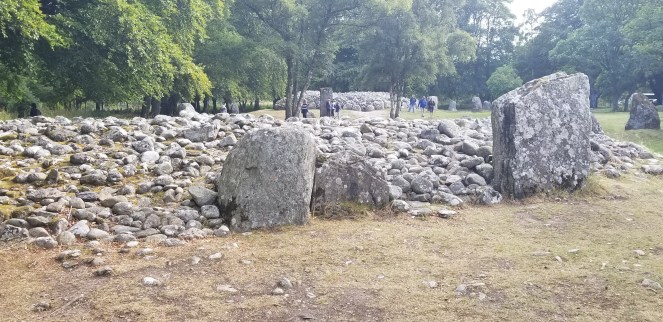
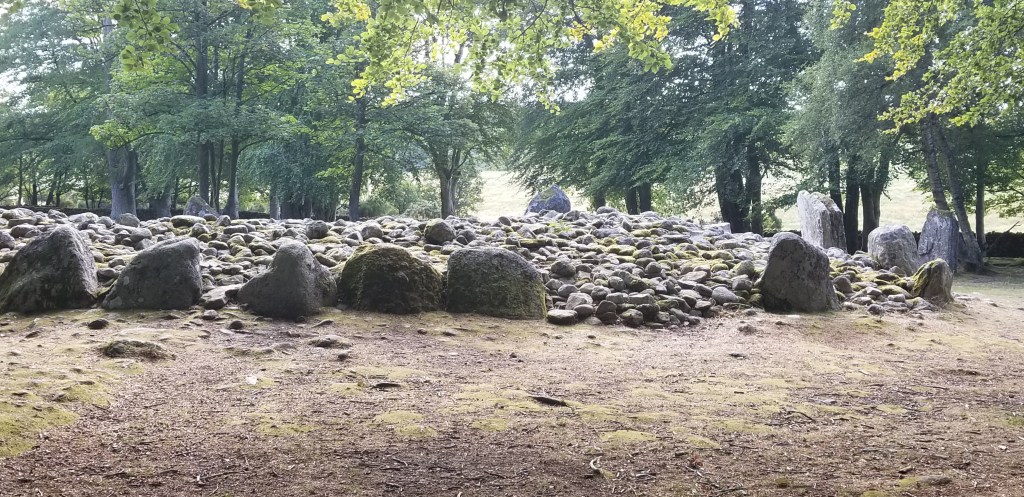
Clava Cairns are burial tombs from the Bronze Age – about 4,000 years ago – in a circular shape. They are sacred to the people who built them and to the people who reused them some 1,000 years later. Some have an entranceway to a single burial chamber, as the one I am standing in does, and it would have been covered. Others are an unroofed ring with no access to the stones. There are four cairns here, and actually fifty of them in the Inverness area. This group is called the Balnuaran of Clava.

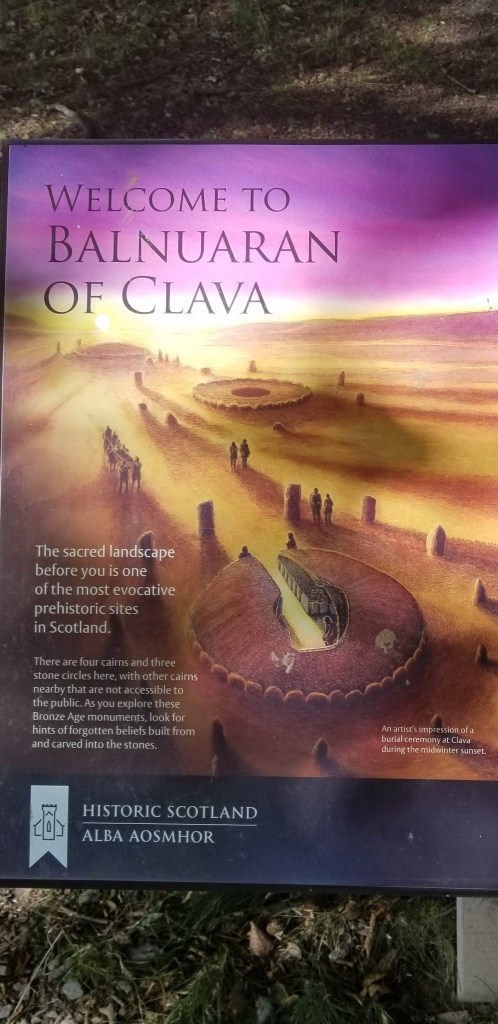
This signboard shows what a burial ceremony may have looked like here. It was interesting for me to compare the place to the tombs we had seen at Newgrange and Knowth in Ireland. This site was much smaller. Just like Newgrange, though, the sentinel standing stones light the passage on the winter solstice – but at sunset, not sunrise.

This is a cairn that did not have a passageway

Although it looks like just a weathered grey pile of rocks now, the builders chose stones in various hues for their cairns. There were reds, pinks, and whites, and it is thought that the various colors had a meaning.

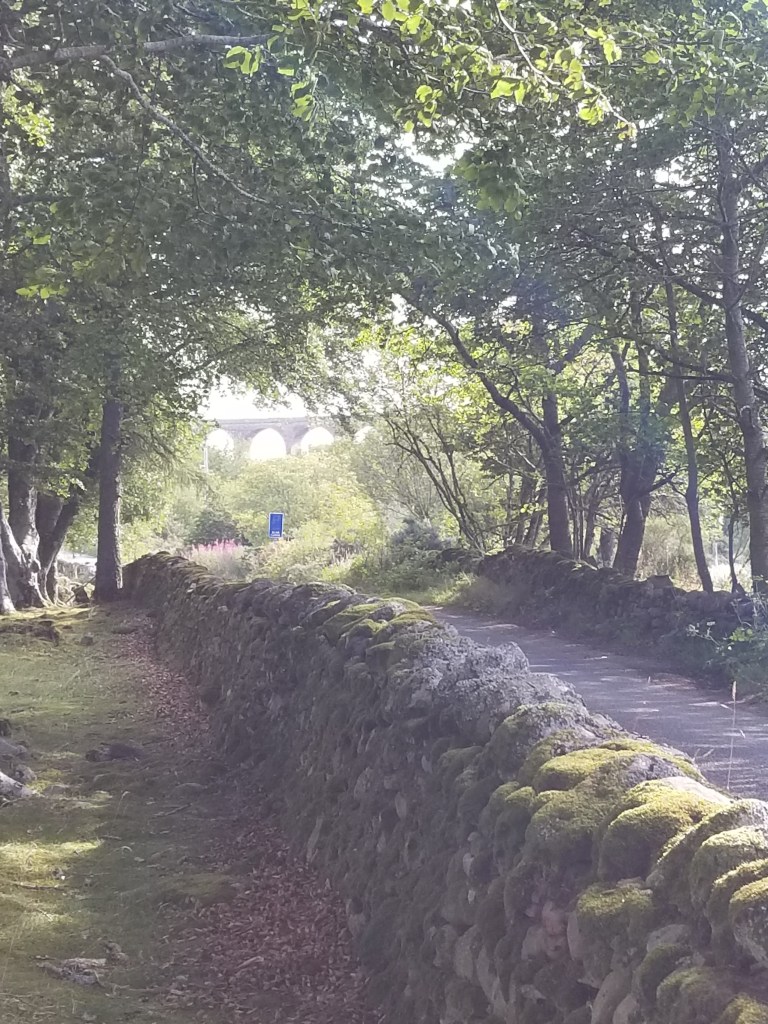
We had some extra time, so we strolled down the road next to the cairns to look at the railway bridge that was off in the distance.

The Battlefield of Culloden was not far from the cairns. Our guide gathered us near the visitor’s center to give us some history, and then turned us loose to explore as we wished. Inside the visitors center were historic armaments and archaeological finds from the battle. An immersion theater with a 360-degree view very realistically puts you in the middle of the battlefield with the Jacobites coming on one side and the British on the other, while you stand in the middle. The story of this battle is fascinating, complicated, and very sad. It marks the last battle that was ever fought on Scottish soil.

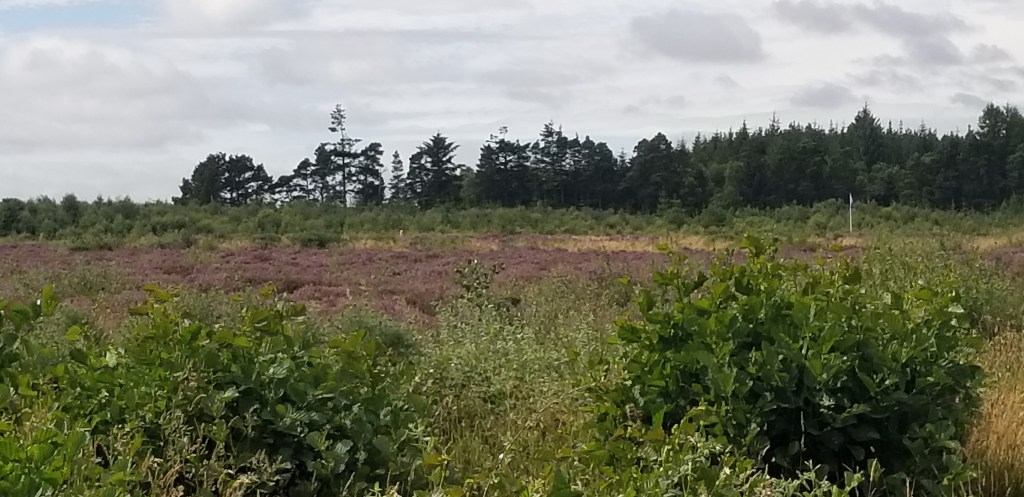
On Culloden battlefield; the blue flag at far right marks the front line of the Jacobite Army. The picture is taken from the British Army’s side.

The Jacobites were supporters of the restoration of the Stuart line to the British throne under Prince Charles, and they were a political movement from 1688 until this day of battle. Nicknamed “Bonnie” for his youthfulness (he was 24 years old), Prince Charles’s court was in exile in France. Having won some skirmishes, he was master of Scotland and summoned troops for the uprising. The army was made up of French fighters as well as Irish and Scottish clansmen. William Augustus, duke of Cumberland, led the British soldiers on the other side. The battle occurred on the 16th of April, 1746.

Looking over the heather to the red flag marking the British side; the visitors center is left.

The battle was a rout. The Jacobites had numbered 5,500. By the time the battle was over, 1,500 Jacobites had been slain compared to only 100 of the British. The bonnie prince turned tail and eventually ended up in Rome. This memorial, built in 1881, remembers the Scottish lives lost.

The Battle of Culloden marked a turning point in the British treatment of the Scots people. For the next 150 years, they worked hard to break up the clans by banning traditional songs, the wearing of kilts, and the Gaelic language.

Several clansmen are memorialized with stones such as this, which reads: “Well of the Dead. Here the chief of the MacGillivrays fell.” The well is on the left.

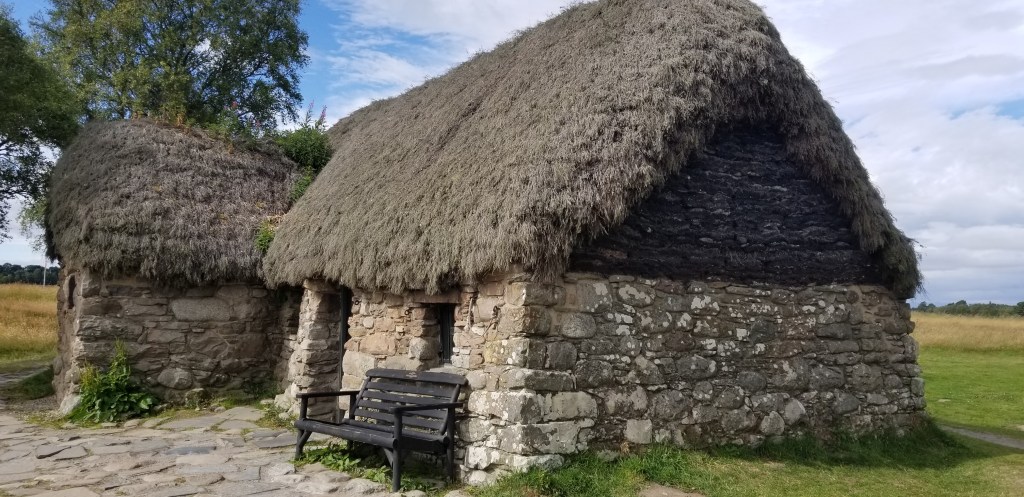
As we strolled through the battlefield, I kept eyeing this picturesque little thatched cottage on the far side of it.

Leanach Cottage existed when the conflict occurred and was once part of a larger farmstead. Immediately afterward, it was used as a field hospital.

The little town of Beuly was also on our agenda for the day, and on the way to it we caught a glimpse of our first Highland cow. It wouldn’t come any closer than this for a picture, though.

Beauly was a lunch stop, but it also contained the ruins of a 12th century priory. What is a priory, you ask? I looked it up for you: it is a small monastery.

We had circled Inverness from Clava Cairns and Culloden on the east to Beauly on the west, and now it was time to head south to Glen Affric. We were on narrow roads, getting deeper into the Highland hills, and I was impressed that our guide could negotiate the traffic and also talk to us, all at the same time. Riding on the left side was still awfully confusing to this American and I was sure we were headed for a crash!

We stopped at River Affric, in Glen Affric, for a hike. There were a couple of trail options, and also an option to just sit. The group split up, and when we set off on our chosen trail we mostly had it to ourselves. The forest was hushed, the air damp. We walked through blooming heather, ferns and lush greenery, tall trees and hills, and the beautiful rushing river. A picture from our hike is at the top of this blog, and there are more below. I will leave you here for now to just enjoy them. We thoroughly enjoyed our day with Rabbie’s.

While hiking, I was struck by the vivid multi-hued green of the forest
Those trees…
Which would you choose?

Next time – out to the Island of Skye

Europe · UK and Ireland

North to Inverness – Scotland- Europe Travels August 2022

Inverness, Scotland

Have you ever traveled from Minneapolis to Duluth, Minnesota in the United States? It’s about a two-hour drive. Traveling north to Duluth, there is a feeling that you are entering another, separate world. Open Midwest farmlands disappear and you start to see birch trees. And then, you get a great view of Lake Superior, plunge down a massive hill on I-35, and the temperature drops. Down by Lake Superior, it can feel like you’ve stepped into a refrigerator. The distance from Edinburgh to Inverness, Scotland is a little further, the scenery completely different, but the perception is the same.

We began the first official day of our Euro Rail Pass by traveling from Edinburgh to Inverness. We had the same awareness of entering a different world as we left the city and suburbs surrounding Edinburgh behind. The villages were smaller and more spread apart. We entered the wild Cairngorms with its mountains swooping up from the valleys and the sheep grazing in the heather. There were dense forests and castles off in the distance. Stepping off the train, the cool and rainy weather let us know we were much further north. The weather felt the same as Duluth in August, although it of course did not look the same at all.

Inverness Castle was picturesque but closed for renovations when we were there

Inverness is only half the size of Duluth in terms of its population of almost 47,000 people. It is the Highland’s largest city and its cultural capital. Instead of Lake Superior, there is the River Ness, and inlets that empty into the North Sea.

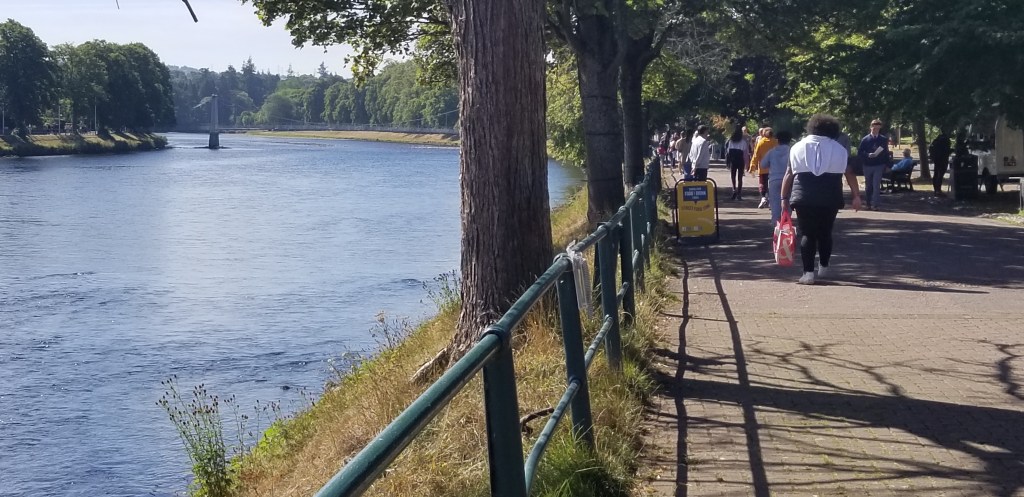
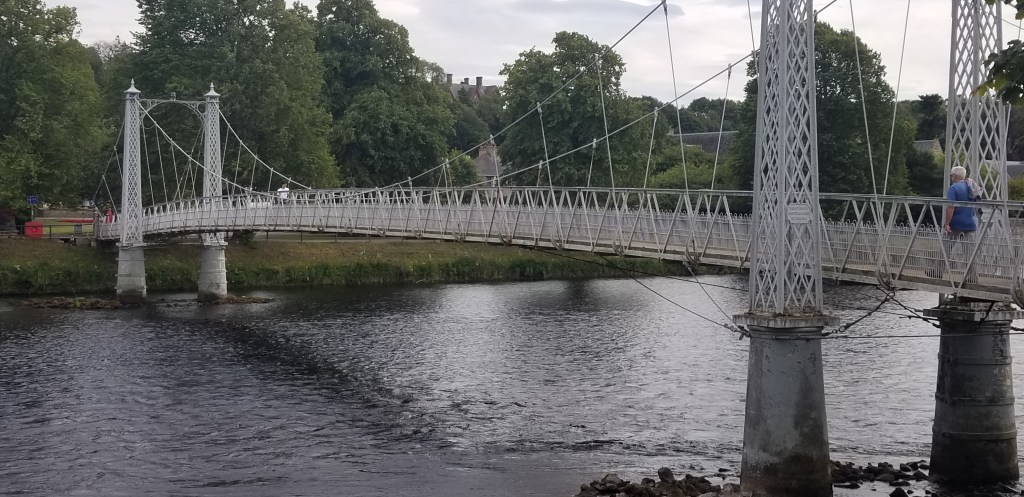
The first priority is always to find our Airbnb, and we were delighted that what we needed to do was simply to follow the river. There were footpaths on either side. The question throughout our ten days here was: “which side of the river shall we walk on?” Every time we walked down these footpaths toward “home”, with the castle behind us, I felt so happy to be here. Imagine walking home on these paths every day of your life! You buy your groceries, run your errands, and maybe pick up some takeout on foot, and then just follow the beautiful river home. If you have a dog, what a perfect place to walk it. I guess I wouldn’t like being out much in the winter time, though, and I’m sure it comes early here.

Inverness Cathedral is on the left of this photo; it lies directly across the river from the castle

People in the UK walk the same way as they drive: on the left side. I took the picture below on a beautiful Saturday so there were more people out than usual.

If we walked on this side of the river, we had to take the footbridge over to our side, which was always an extra treat.

The bridge made a thundering sound and swayed slightly when other people besides us were on it. A thrill every time!

Our AirBnb was just a block from the river and was the last in a little row of townhouses with some pretty daisies growing out front. You can just barely see the outline of the door in this picture. Inside, we had a one bedroom apartment and every room was entirely separate, our largest stay in the entire trip. It was perfect for what was to be one of our longest stays.

These pictures are a collage of many that I took while we were in Inverness. In all of our days in the town, there was plenty of time to explore. Sometimes the sun shone, sometimes not.

This picture is of the old High Church of Inverness, built in the 18th century on the spot where in 565 AD a gentleman by the name of St. Columba preached to the native Pictish people and their leader, King Brude. It is the cradle of Christianity in the Highlands. We received a fine view of the River Ness from here.

Two churches, including High Church, seen from across the river.
Abertaff House, built in 1593

Most European cities that we visited had statues of one kind of animal created in many different ways for photo ops here and there on the city streets. In Inverness, it was the Highland Cow, affectionately known as a “Hairy Coo”. Besides this one, we would regularly see another covered in pennies when we were downriver near the footpath.

We saw the young man below standing in a cold drizzle. Michael is 15 and started playing the bagpipes at age 11. Probably more impressive, he was spending a Monday morning out on the street in his kilt. He played beautifully.

Like everywhere in the UK, Inverness had its share of pubs

On our first Saturday afternoon in Inverness, there was a full downpour. We whiled away the afternoon by listening to traditional Scottish music at a different pub from the one above, called Hootananny. They have music that goes on through the night on two floors at this popular pub, but this afternoon they were having a “ceilidh”, which simply is Scottish or Irish folk music and singing. We enjoyed listening to them. Are you thinking that “Hootananny” is an American word? It comes over as that way to me, but the word was brought over to Appalachia from the Scots. It has roughly the same meaning as ceilidh, but somewhere along the line the spelling changed to “hootenanny”. Whatever it’s called, we enjoyed the music and the company in the pub.

Venturing a bit further downriver past our AirBnb, there are some islands in the River Ness called, appropriately, Ness Islands. This was a relaxing walk on a Sunday afternoon. I admired the homes along the river pathway.

A walk over a little bridge took us to the first island. It is a beautiful, serene place even with all the other people out enjoying the day.

Cal always appreciates a restful park bench with a scenic view

From the islands, it isn’t far to Inverness Botanic Gardens. The gardens are small but I enjoyed seeing the hydrangeas and other flowers blooming.

We spent a greater portion of another day hiking the Caledonian Canal. It begins at Inverness and connects the east coast to the west coast. The canal was envisioned as a throughway and safe harbor for shipping during Napoleon’s reign. During its construction in the early 1800’s, there were cost overruns and construction issues. By the time it was completed, it was no longer usable; ships were being built that were too big to use it. Napoleon had been defeated and the threat was gone. Although never used for the commercial purposes that it was envisioned for, it became a tourist attraction. Trains were scheduled to connect with steamboat services, and even Queen Victoria took a ride in 1873. Today, narrow boating is popular; people can spend several days navigating the canal from end to end.

The canal is sixty miles long and contains twenty-eight locks. It follows the Great Glen, which is a beautiful narrow valley, and cuts through Lochs (Lakes) Oich, Lochy and Ness.

There was a small boat progressing through the locks. Cal was totally absorbed in this process, so we watched it for a quite a while. In the picture below, the lock operator is behind the white fence on the left, and one of the boat owners is walking beside her boat to tie and untie it at each lock.

While we watched the Skimble go through, we looked down at a bridge below this set of locks and wondered: what are they going to do with this bridge to let the boat pass? After a while we had the answer to this mystery: it is a swing bridge, which rolls to the side.

After the Fort Augustus Swing Bridge the canal opens up into a marina, where I photographed this cute little houseboat:

The canal starts (or ends, depending on your perspective) at Beuly Firth, an inlet which empties into the North Sea. We walked all the way to the end of the canal.

Looking out at Beauly Firth

From here we retraced our steps back, stopping by the swing bridge at a tiny cafe for lunch. I ordered a split pea soup with a cheese scone. Look at the size of this scone! It was as big as a small loaf of bread and the leftovers were enough for both Cal and I to share for lunch the next day. We were outside and able to look at the canal as we had our lunch.

We had walked much further than we had intended when we left the AirBnb: 7 miles. When we returned, it was time for a nap!

I have one more food shot for you: a Scottish breakfast which I had on our last morning in Inverness. Starting with the tomato on the top and moving clockwise, there is lorne (beef) sausage, black pudding, haggis, a tattie (potato) scone, mushrooms, and of course, egg on top and tea with cream on the side. I didn’t care too much for the black pudding. Honestly, although I enjoyed this breakfast and was glad I tried the haggis, Cal had ordered a delicious-looking plate of French toast, and I kept looking longingly over at his food..

Of course, there was more to see in our stay here than just the city of Inverness. In my next posts, I will take you out and about into the Highlands of Scotland.

Next time – the countryside around Inverness, including the Battlefield of Culloden