USTravel

Winter in Harlingen, Texas

My never-ending quest for a warm winter is what led me to book a stay in Harlingen this past January and February. Harlingen is almost as south as you can go without bumping into Mexico.

The town is part of an area known as the Rio Grande Valley. The “valley”, or the RGV as it’s sometimes called, is bounded by South Padre Island on the east to Mission on the west. This whole area sits just north of the Mexican border. It’s not really a valley, but mostly part of a flat scrubby coastal plain.

The RGV is a popular place for “snow birds” from northern states like Michigan, Wisconsin and Minnesota, and the whole area has a plethora of RV parks. The snow birds are welcome here; they have a huge positive effect on the local economy. I have posted about all of our trips down to the Gulf; what else is there to do?

Plenty, as we found out. I will try in this blog to give you a little flavor of what our life here was like.

Closest to us and just a short ride on our new e-bikes (more on that later) was a large Iwo Jima monument. I took a picture of Cal in front of it just to show how he was dwarfed by it.

The original statue is in Arlington Cemetery. The sculptor, Dr. Felix W. de Weldon, gifted this full-size model of his statue to the Marine Military Academy across the street. It is 32 feet high. It is made of molding plaster prior for casting in bronze; the constant temperature and humidity here were thought to be perfect for its preservation. All of the conflicts that our country has been in are etched around the base of the statue.

Still on our bikes, after seeing the memorial we also drove right past the Valley Airport doors. That’s how small it is! I flew out of this airport when I went to New Orleans. It only has seven gates.

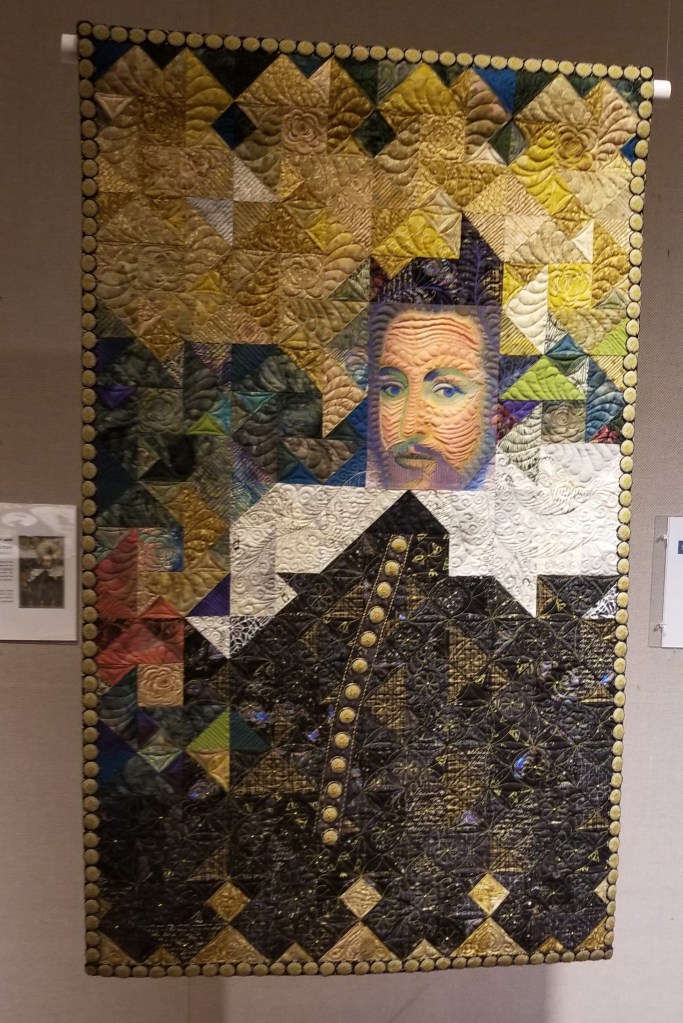
Harlingen Arts and Heritage Museum was also near our park. They had a quilt show in their exhibition area. The quilt show had a Shakespearean theme and this quilt was inspired by the bard himself.
Stepping outside the exhibit and entrance, we could see the 1904 home of Lon C. Hill, along with other historic buildings. According to the museum brochure, Lon was a “lawyer, store keeper, hotel owner, farmer, sugar mill owner, developer, builder, brick kiln owner, canal builder, Statesman, pioneer and visionary.” What a busy guy! His wife died when he built the home, leaving him with eight children.
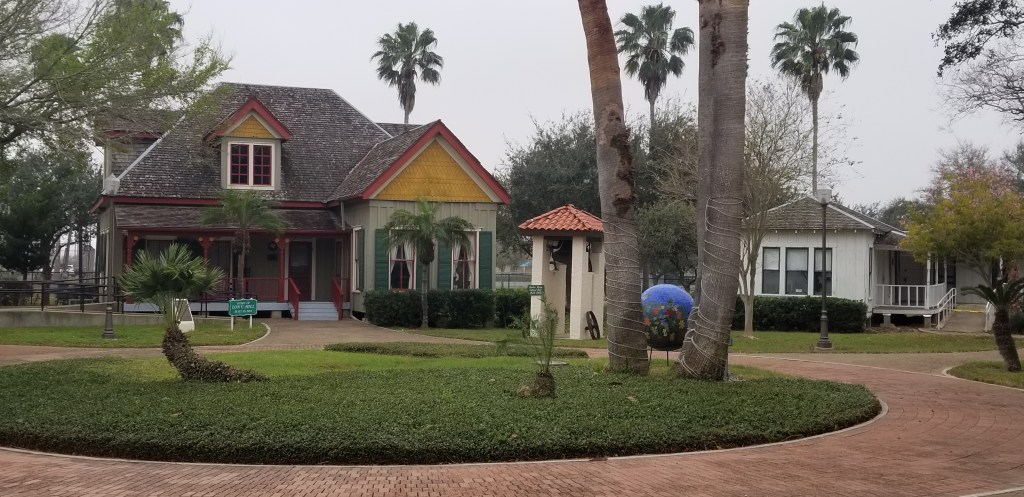
Len’s house is on the left

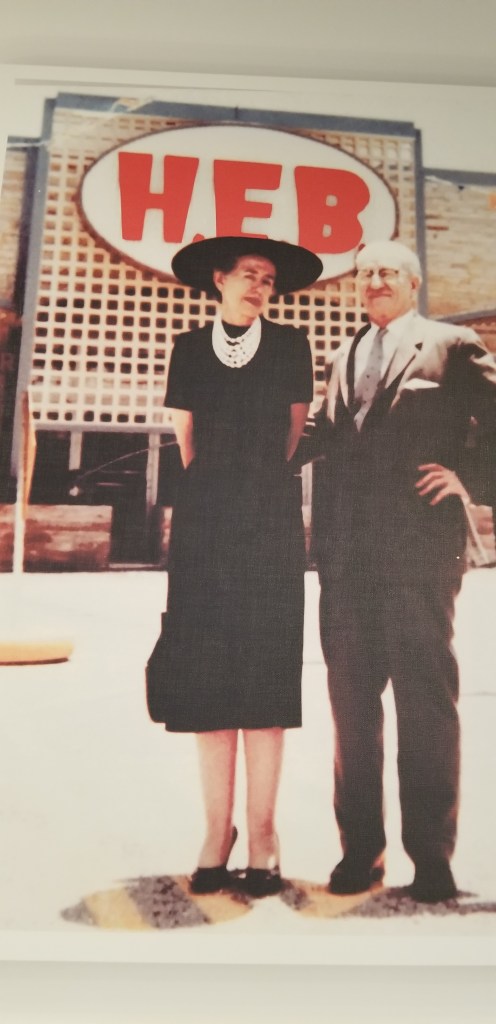
One of the things we love about Texas is being able to grocery shop at HEB. To me, it is the best grocery store chain of anywhere we have been. How can you complain about a store with a tortilla bakery? But what does the abbreviation mean?

It is explained at the historical museum here. The H.E. Butt family donated the building housing the museum to the city back in 1967. Howard Edward Butt took over management of the family grocery store from his mother, Florence T. Butt, in 1919. She founded it and ran it for fourteen years, so why isn’t the store named for her? Well, that’s a mystery. Howard and his wife are in this somewhat grainy picture.
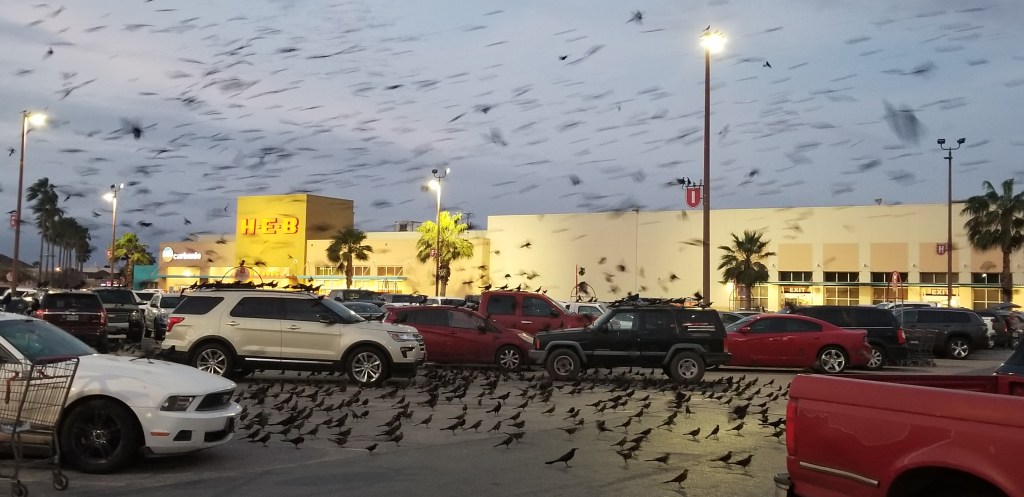
Shopping at our local HEB one evening, the grackles totally took over the parking lot. It was raining birds! We even saw the parking lot on the evening news the next night. It was the time of year when grackles come from where ever they are all day and congregate. I guess even grackles like to shop at HEB.
Speaking of birds, there are plenty of places to go see them in the valley. The area is part of the migration flyway for birds. We took a walk in Hugh Ramsey Nature Center in Harlingen and came upon a yellow-throated warbler that you can see in the branches below, keeping an eye on the two turtles below.

At the beginning of our Hugh Ramsey walk, we spotted a couple of javelinas in the underbrush. That was exciting, until at the end we found the whole herd!

I hoped to find more wildlife at Laguna Atascosa National Wildlife Refuge, about 30 miles from our park and a place we walked twice. A sign at the beginning of the park road was promising:
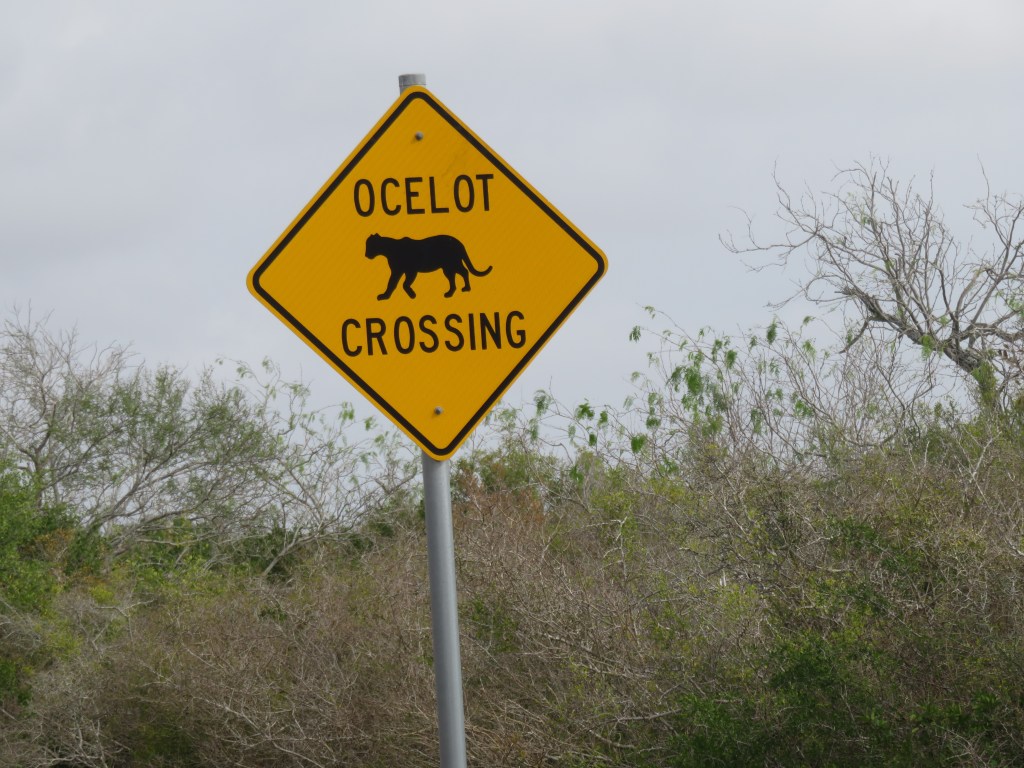
I would have loved to see an ocelot, but I knew it would be a stretch. Much later, we watched a nature show about the wildlife of Texas and were able to see what this cute little cat looks like. Laguna Atascosa is only one of two of their remaining habitats in Texas, and only 100 are known to exist in the entire United States. This wildlife refuge is trying hard to encourage their reproduction but they have a lot of predators; it’s not an easy task for an ocelot mother to raise a kitten to adulthood.

A huge part of their mission is to provide habitat for wintering water birds, and other migratory birds. It is a bird watching destination for those who enjoy the hobby. We saw green jays at one of the feeding stations at Laguna Atascosa. I suppose if I wanted to be a serious bird watcher, I’d need to get to the refuge a little earlier in the day.

Most of this park is coastal wetlands. We did see egrets in the large lake here, and an alligator, but it was far in the distance.

On another day we headed down to Sabal Palms Preserve, which is the last remaining stand of the great sabal palms that used to cover the area. An interesting part of visiting this preserve, as we discovered, is that it is right on the border with Mexico. We drove right past the fence.

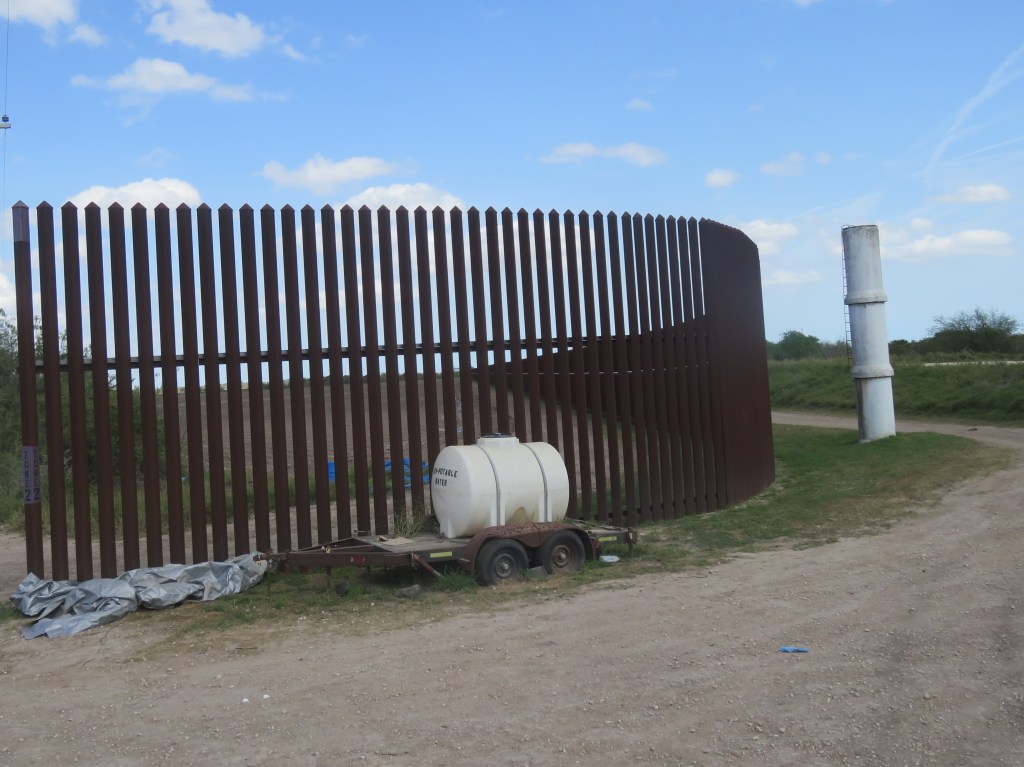
Passing through this fence was a little confusing but somehow we were still in the United States. Two members of the National Guard were sitting on the levee by their truck as we passed. Sabal Palms closes right at 5:00 and the gates are then securely locked. There is plenty of illegal border activity here, as we later found out.

Long ago, before land was cleared for farming and there was no international border, there were about 60,000 acres of Sabal Palm forest along the Rio Grand River. Now there is less than 100 acres.
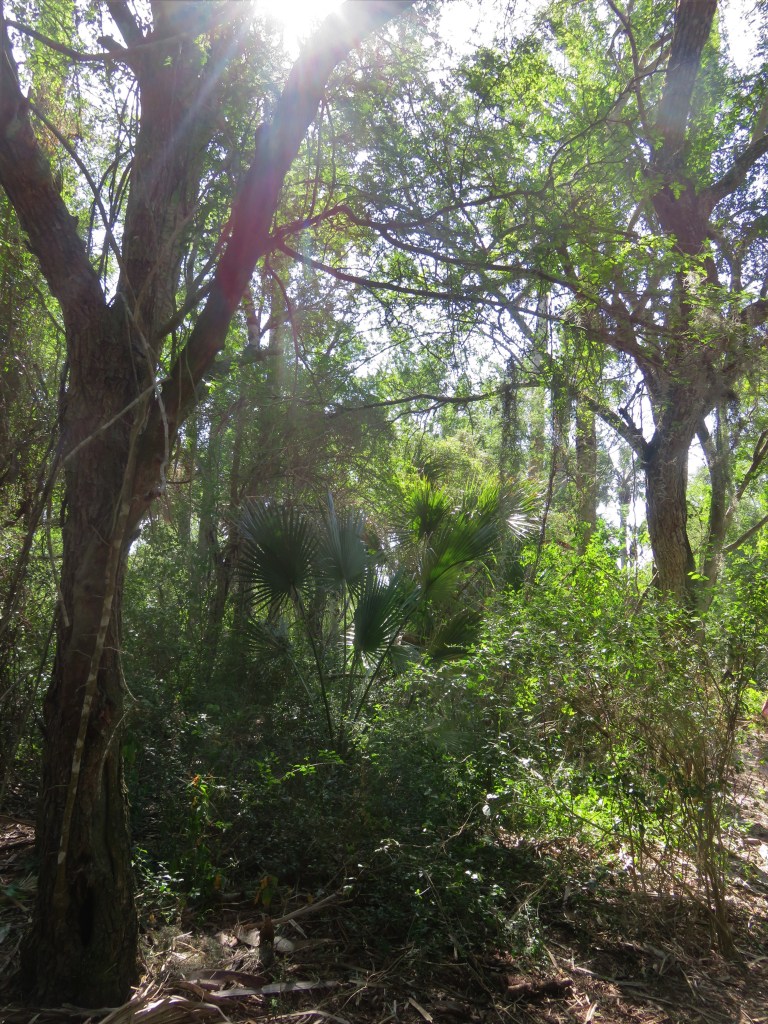
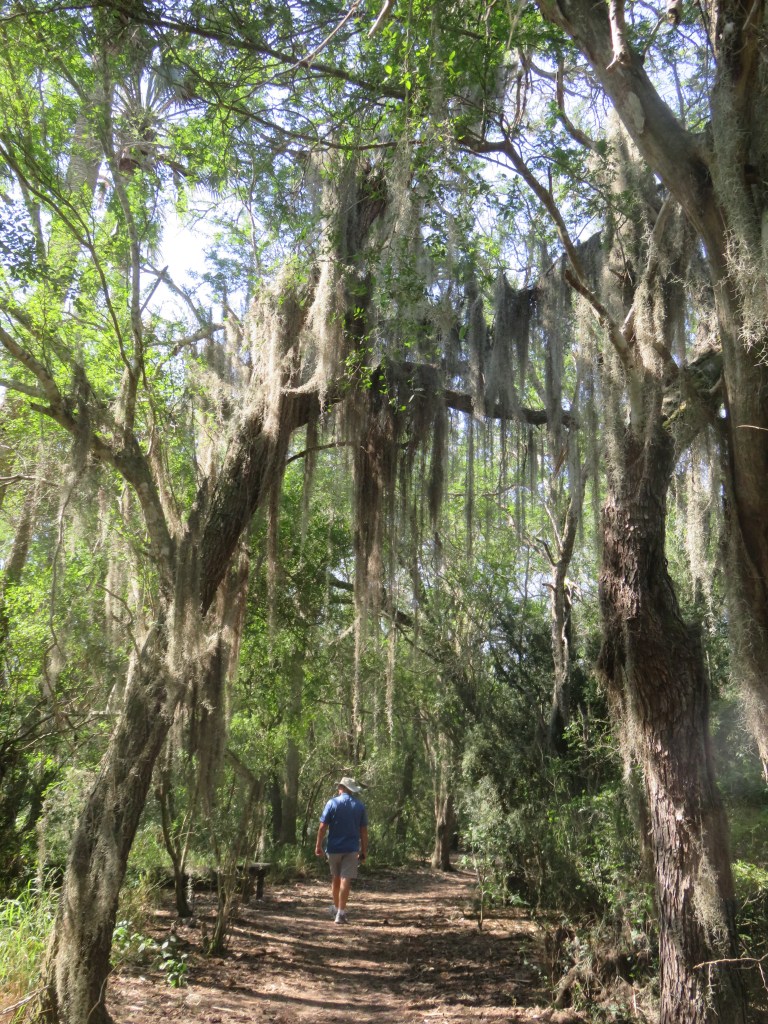
In my working days, I was thrilled when I vacationed somewhere during a long winter where I was able to see palm trees. Now I’m happy to see palm trees all winter long. They and other trees lined the beautiful trails in this park.

Part of the draw for Sabal Palms is the Rabb Plantation House. It was once part of Rancho San Tomas, which covered 20,000 acres. The house served as the headquarters for the ranch and was an architectural shift from typical ranch homes of the early 1900’s era. We were able to look around the first floor inside.

On one of our first Saturdays in the area we drove all the way past McAllen to Mission, on the west side of the RGV, for the Citrus Festival and Parade. It was good small town fun.

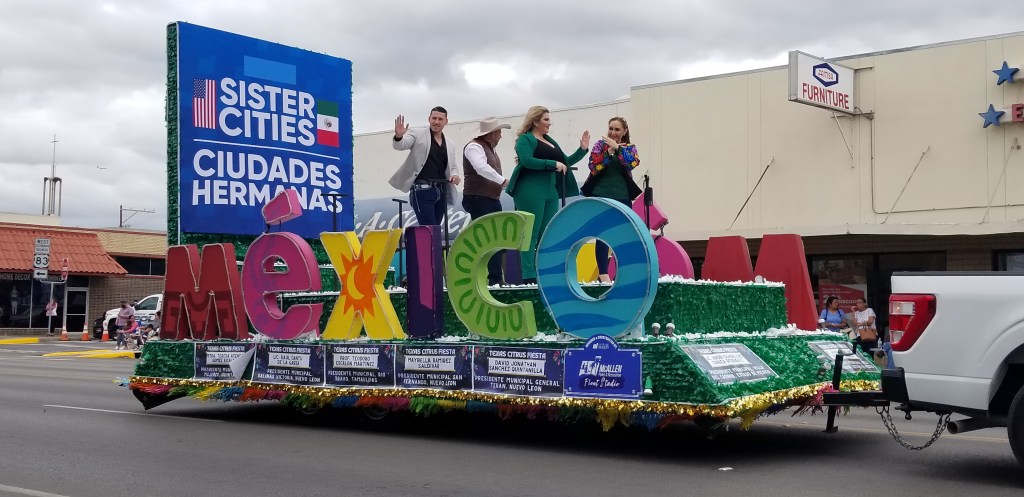
The best thing about the Citrus Festival was that we were able to buy two large bags of fresh citrus – one orange, one grapefruit – for $5.00. What a steal!

Harlingen still has a fairly vibrant old downtown, which was another thing that scored points with me. There is a smattering of thrift shops, antique malls, and other specialty shops, plus some eating establishments. Once a month on a Saturday, the streets are blocked off for Market Days. Vendors under their canopies line the streets. There is music and plenty of good Mexican and other food to be had, too.

I guess if one drawback can be given about the area, it is the wind. We learned to gauge the weather by very windy, not too windy, and not windy at all. I got used to it because I discovered I didn’t mind the wind as long as it was warm – which it usually was, even in the evenings.

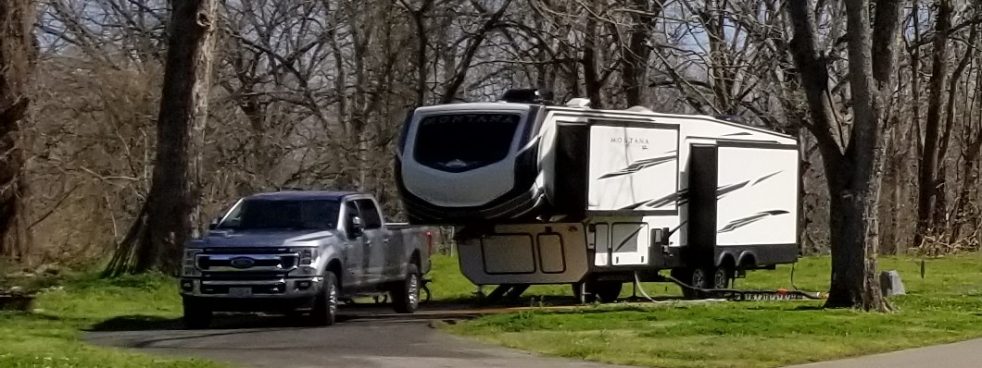
The sites next to us were empty most of the winter so we had a good back yard view. The park is bordered on three sides by farm land and it felt like being out in the country.
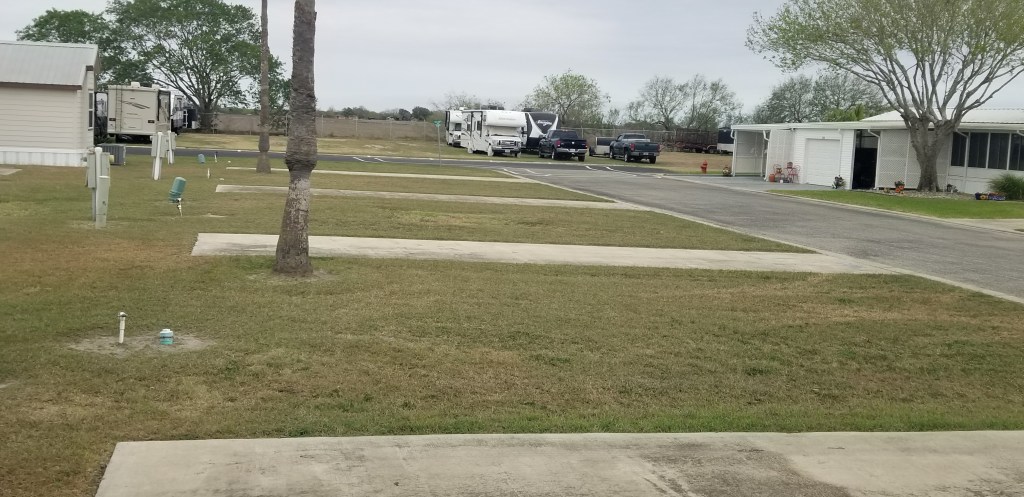
When we were at home in Tropic Winds, there were many things to do. I attended yoga and line dancing classes. Cal was outside a lot and chatted with all the neighbors around us. A fruit-and-vegetable truck showed up on Mondays. There were sometimes music concerts to listen to, and few special dinners. The spaghetti dinner put on by the woodworking group is a twice-annual event that everyone looks forward to. The spaghetti is delicious and prizes are handed out throughout the evening.

There are all kinds of ways to RV and we discovered last winter in Phoenix that settling down in a park like this for just a month or two during the winter gives us the community that we don’t have the rest of the year. The permanent park model and manufactured homes that lined the street across from our RV area made the place feel a little bit like the quintessential small town. As I walked the little streets I’d most always be greeted by everyone passing by, whether they were walking the dog or riding their bike or golf cart.
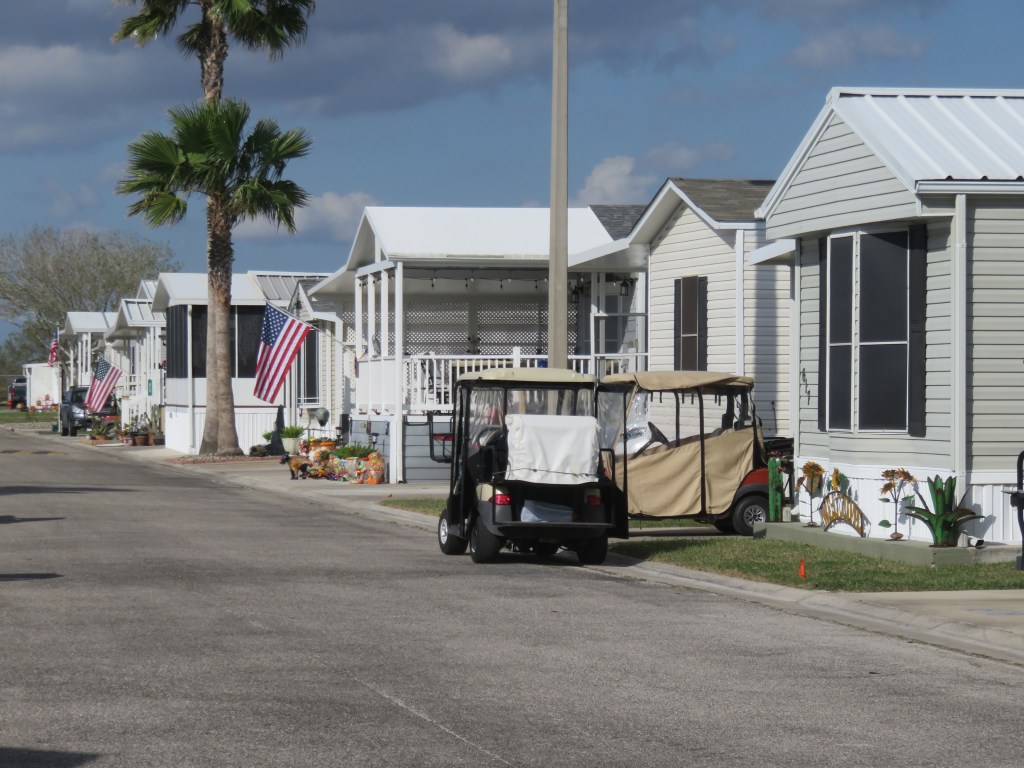
In the late afternoons, friends gather around RV sites, on front porches, or around someone’s golf cart when they are passing by.

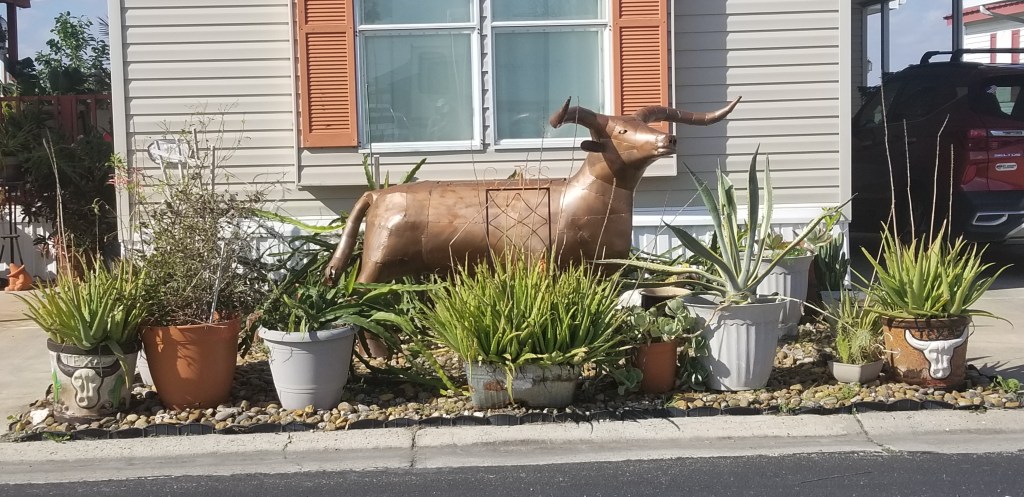
Everyone decorates their little home in their own particular style.
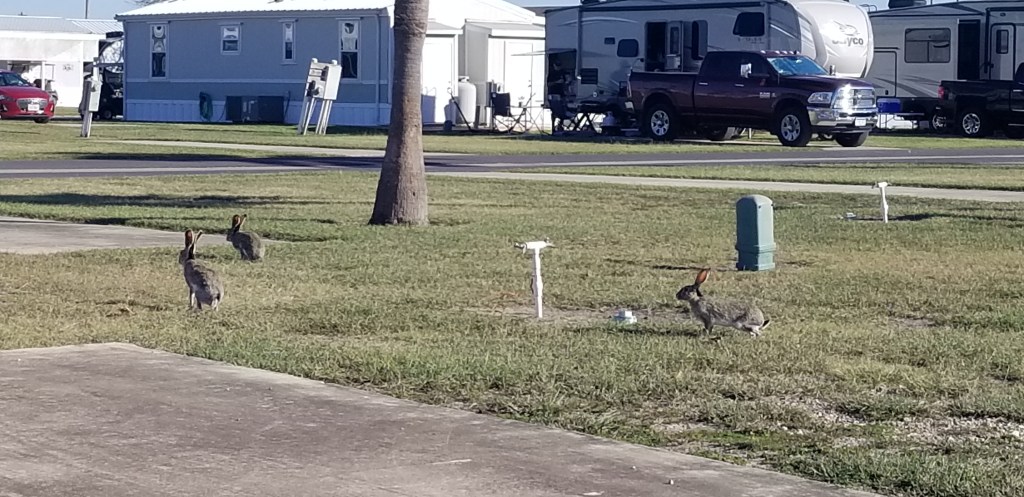
Jackrabbits make their home here, too. These RV sites were empty most of the winter and I always looked forward to seeing how many were out playing or basking in the sun.
Anywhere and any way you call it, there’s no place like home.
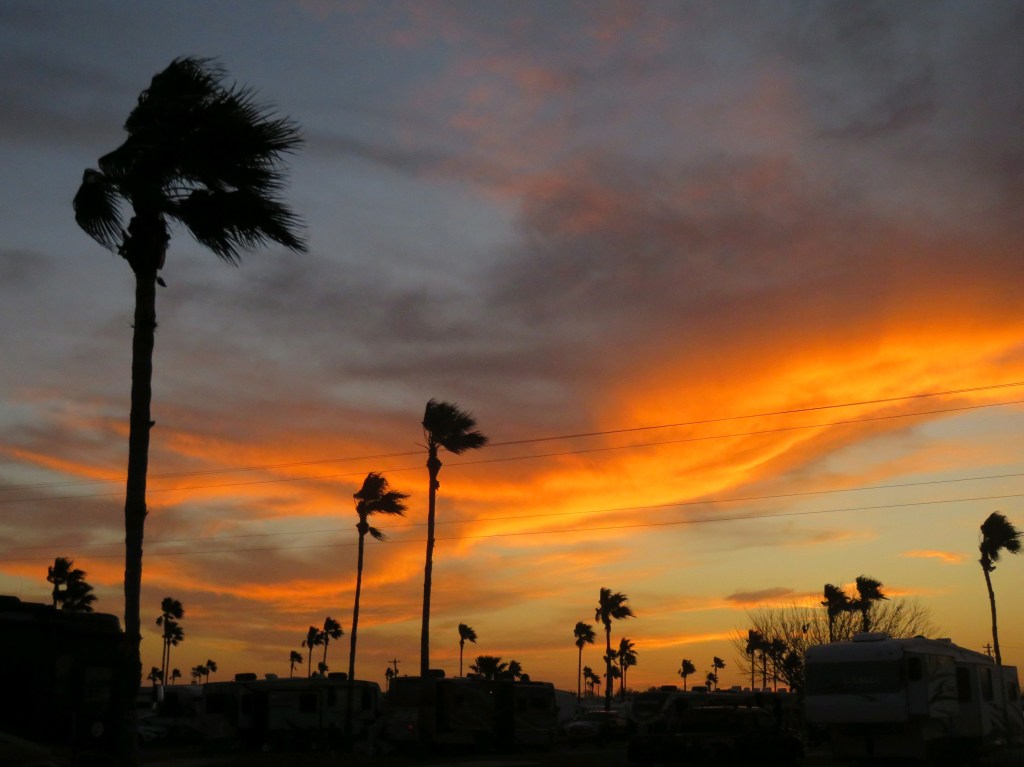
Next time – on the bay in Corpus Christi

Mexico

San Miguel de Allende, Mexico

Before I retired and Covid happened, I thought it might be nice to finish up our 9 month trip to Europe with a couple of months in San Miguel de Allende during the months of January and February. I’d heard that the climate is perfect, the cost of living cheap, the crime rate low, and lots of expats (people that live here who hold citizenship in other countries like the United States, Ireland, Germany and Israel) make this their home. Cal, in his usual style, was noncommittal, and definitely not sure about being in Mexico that long. Of course, as life goes, those plans didn’t happen exactly that way. When I saw that this tour included a stop here, then, it was the frosting on the cake.

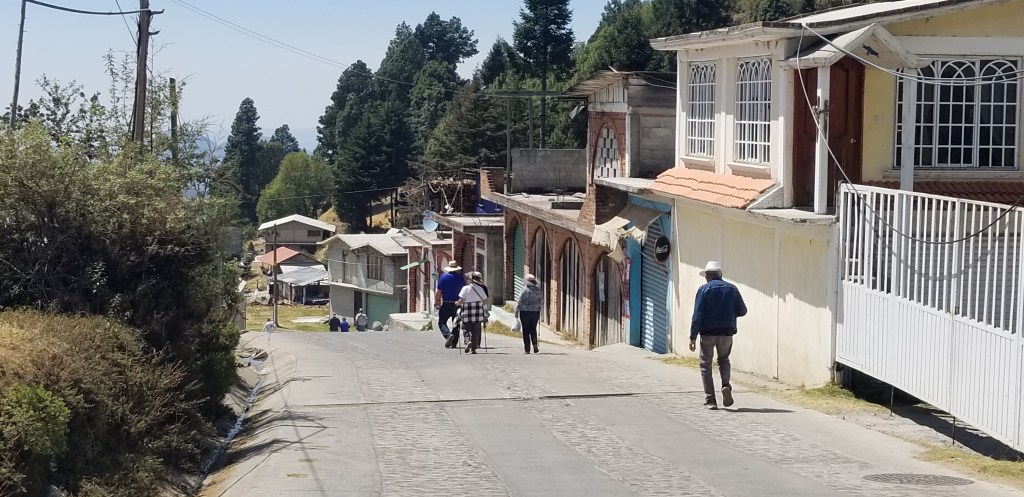
We rode for hours and hours from the butterfly sanctuary of El Rosario. The Mexican countryside flew by out my window. There were farms and ranches, people riding horses or bicycles and people driving trucks or out in the middle of nowhere, walking. Then there were strawberry fields, miles and miles of them. Perhaps you’ve eaten strawberries that come from this area. Usually if there was one house, there were several nearby in a little compound. We saw some very nice homes. But homes like this one in the town near El Rosario were most typical:

Clothes drying on the roof, the water tank, and a satellite dish

We stopped only once at a convenience store for a rest and snacks. Our arrival in San Miguel de Allende was very late in the evening and the hotel looked good. It was, in fact, the best one of the whole trip. Omelets made to order greeted us the next morning, and then we were off on a city bus to see the sights of San Miguel de Allende.

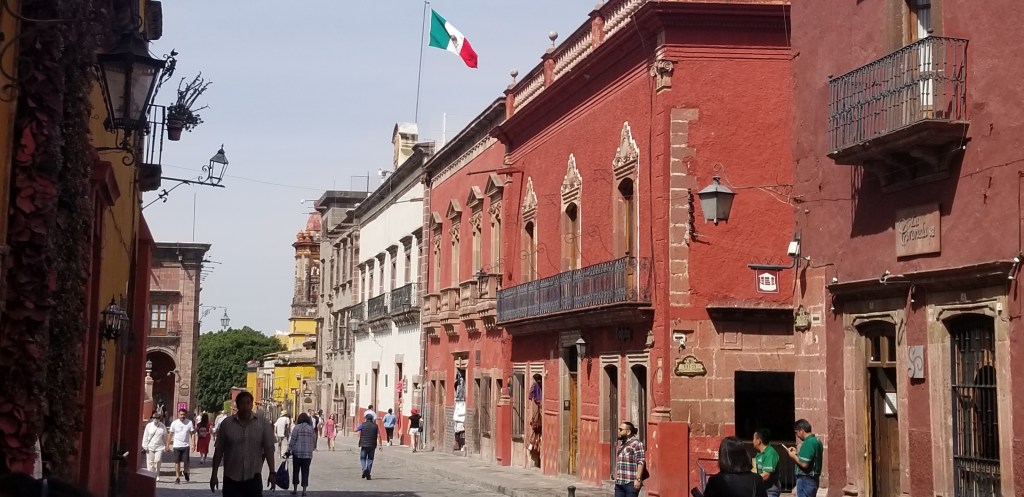
There is a maze of many beautiful streets to get lost in.

Our guide Juan sat us down in a quiet church courtyard when we arrived off the bus to deliver an impressive history of the founding of the town, before Allende’s time. He used peso coins on the cobble stones to demonstrate to us where the cities of Mexico were located in the 1500’s and gave us a good sense of time and place. If he wasn’t an archaeologist, he would have made a great actor!

The town was founded by the Franciscan monk Juan de San Miguel in 1542, who with his dogs found a natural springs in the area. He was a great friend to the natives here, and the town became a market center and waystation for the Spaniards from Mexico City to the silver mines in the west. Tin is also mined here. The entire city became a UNESCO World Heritage site in 2008.

Besides the beautiful colonial architecture, the town is home to no less than 16 Catholic churches. Juan explained that if there were something special to be grateful to God for, the Spaniards built a church. Sometimes one church is right next to another. The churches dot the town and are their spires are a pretty part of its skyline.

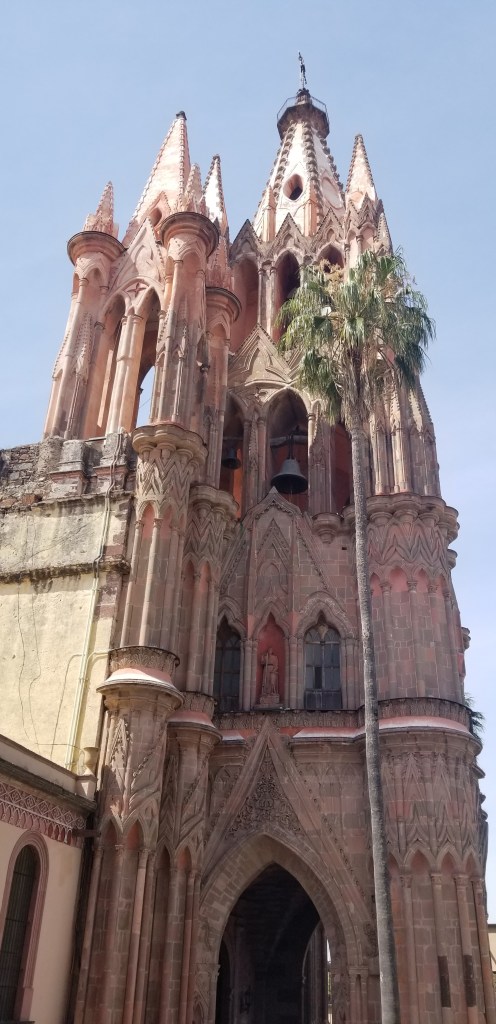
The most beautiful of them all, however, is the pink confection below. It is the magnificent Parroquia de San Miguel Arcangel, or simply the Parroquia. It was built in the late 17th century in colonial design. In the late 1800’s a local self-taught architect, who was inspired by pictures he’d seen of the Gothic cathedrals of Europe, decided it needed some sprucing up. He reworked the towers and the facade, and the result is now an icon of this town.

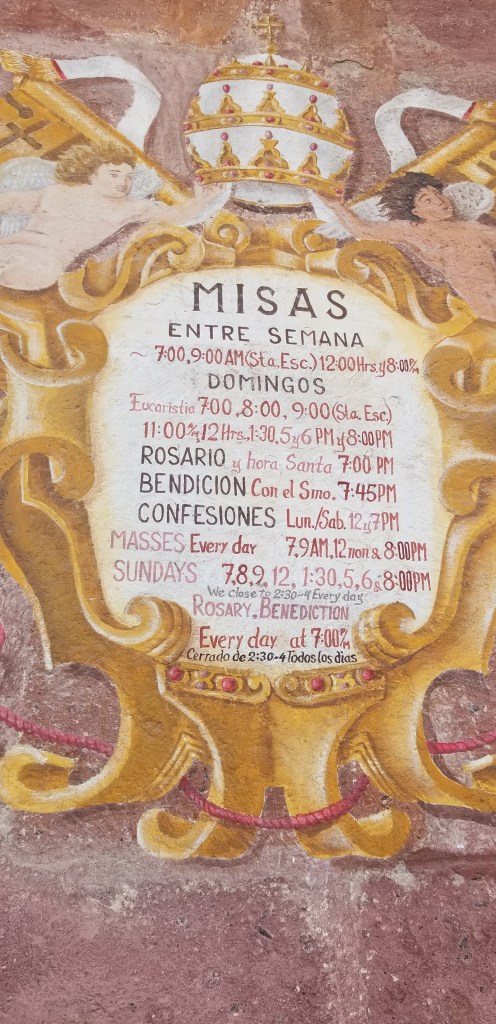
In colonial-era times, it was compulsory to attend mass four times a day. I don’t know how anyone got any work done. Old traditions die hard. Looking at the mass times during the week, there are still four daily opportunities to attend.

One of the heros of the fight for independence from Spain was Ignacio Allende, a Spaniard himself who grew to sympathize with the cause. A statue here honors him.

Ignacio Allende’s birthplace is in one of the main squares in the town, near the Parroquia:

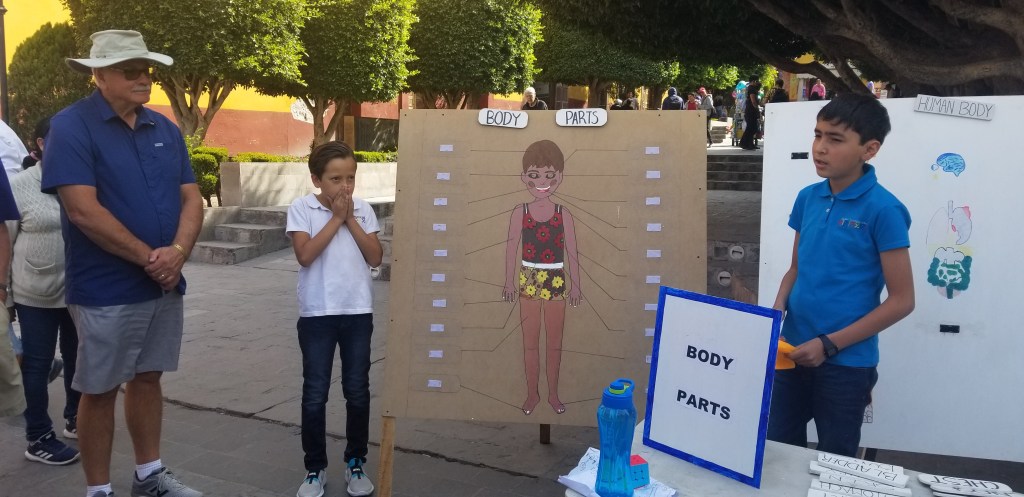
As our group walked through town, we came upon a little fair by a local school of the things the children were learning. I’m sure we all embarrassed these two little boys with their display of body parts in English but I think they were excited too. There was a good discussion of the English and Spanish words for these terms. We drew the attention of the headmaster and their teacher, and it was a big moment for them.

Like I’d seen elsewhere, many of the churches had parks in front of them, big and small.

These women were headed to the Parroquia.

After a delicious multi-course lunch, Cal and I were on our own. We explored the artisan market and it went on for several blocks.

Hats everywhere

I caught a glimpse of an artist at work with her partner “minding” the shop.

Brightly colored paintings ended the market

I truly would have loved to have given this town more of my time but we were done in after a schedule-packed week. We had been given three options for getting back to the hotel: cab, bus, or walking the two miles. The distance was not a big deal to us so we walked, enjoying more of the scenic streets and the beautiful day. In the historic center there are no stoplights, parking meters, or fast food restaurants. There are plenty of restaurants and small shops. The cobblestone streets are narrow.

The white building is San Miguel de Allende’s city hall

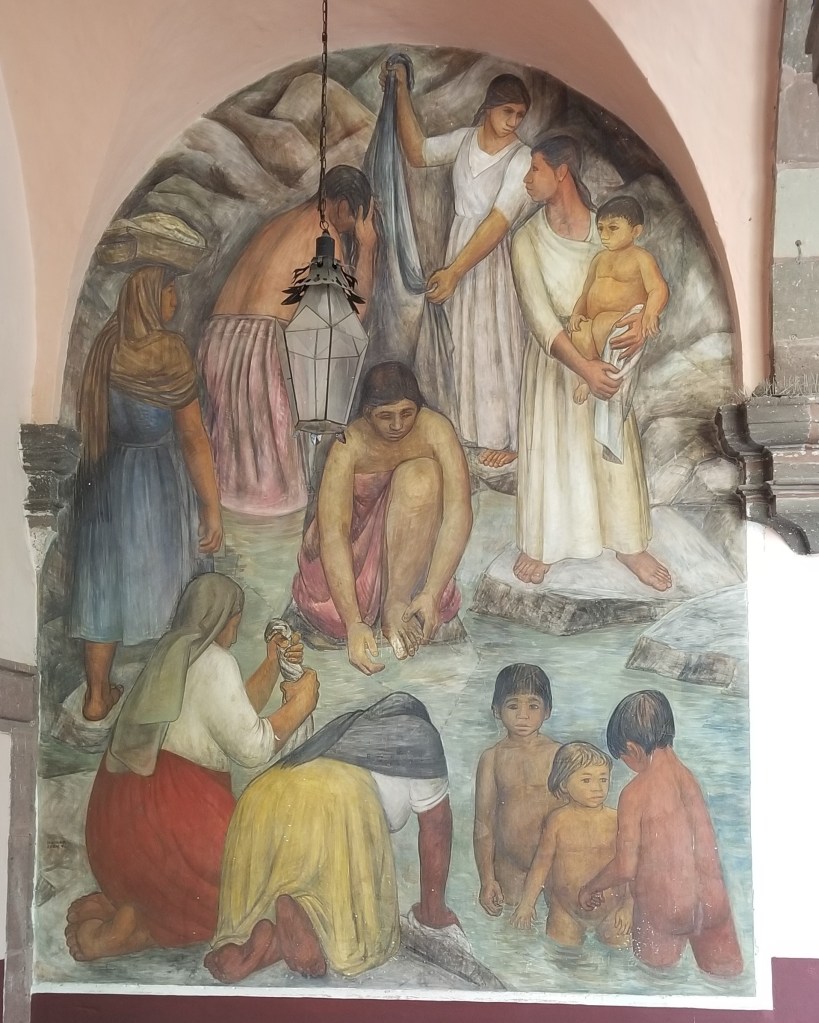
Fun fact: there are about two thousand doors with about two thousand courtyards of various sizes in this town. A detour into one little courtyard revealed this painting, titled “The Washerwomen”.

And then, there was this startling doorknob:

After a week of Mexican food and not being real hungry for dinner, we set out for an evening pizza just down the street from our hotel. The manager of the small restaurant, in a fedora, was probably an expat himself. He asked us how long we were staying in San Miguel de Allende, and was incredulous that it was only one day: “What!! That is not enough to see the whole city!” he exclaimed. Come to think of it, so am I incredulous!

Next time – back to our winter in Texas

Mexico

The Monarch Butterflies of El Rosario, Mexico

This was the day! The one I’d been excitedly waiting for since I first heard about the trip to Mexico. It was time to visit the monarch butterflies at their winter home near Ocampo, Mexico, in the state of Michoacán. We had ridden for several hours from Mexico City the afternoon before, and arrived at the Villa Monarca Hotel in Zitacuaro. A simple dinner was waiting for us, beginning with lentil soup. It was late and the soup was hot, delicious, and only the first course in this meal.

The red drink that I have in this picture is made by steeping hibiscus flowers, very refreshing.

Alert readers might know that the state of Michoacán is on the US State Department watch list. Our hotel was in a resort compound (which sounds fancier than it was) which was bricked all the way around. The entrance was gated, and we were locked in safe and sound for the night.

It was another hour-long ride to this place, close to the Butterfly Sanctuary. I didn’t realize at the time that this would later be our lunch stop. Here, we got a view of the valley below and the surrounding countryside. Like the light showers that sometimes come before a heavy rain, we started seeing the butterflies in the air. This was a little rest stop and also a loading place for half of our group to get an express ride in a small van to the sanctuary. These were the folks who felt like they needed a bit of a head start for the steep hike up the mountainside.

The van was waiting for the rest of us at the parking lot to save us the half mile hike up to the sanctuary. Butterflies in flight were in heavier numbers now. We came to the entrance:

A beautiful mural on a little building greeted us.

“When there is sun, the butterflies fly.”

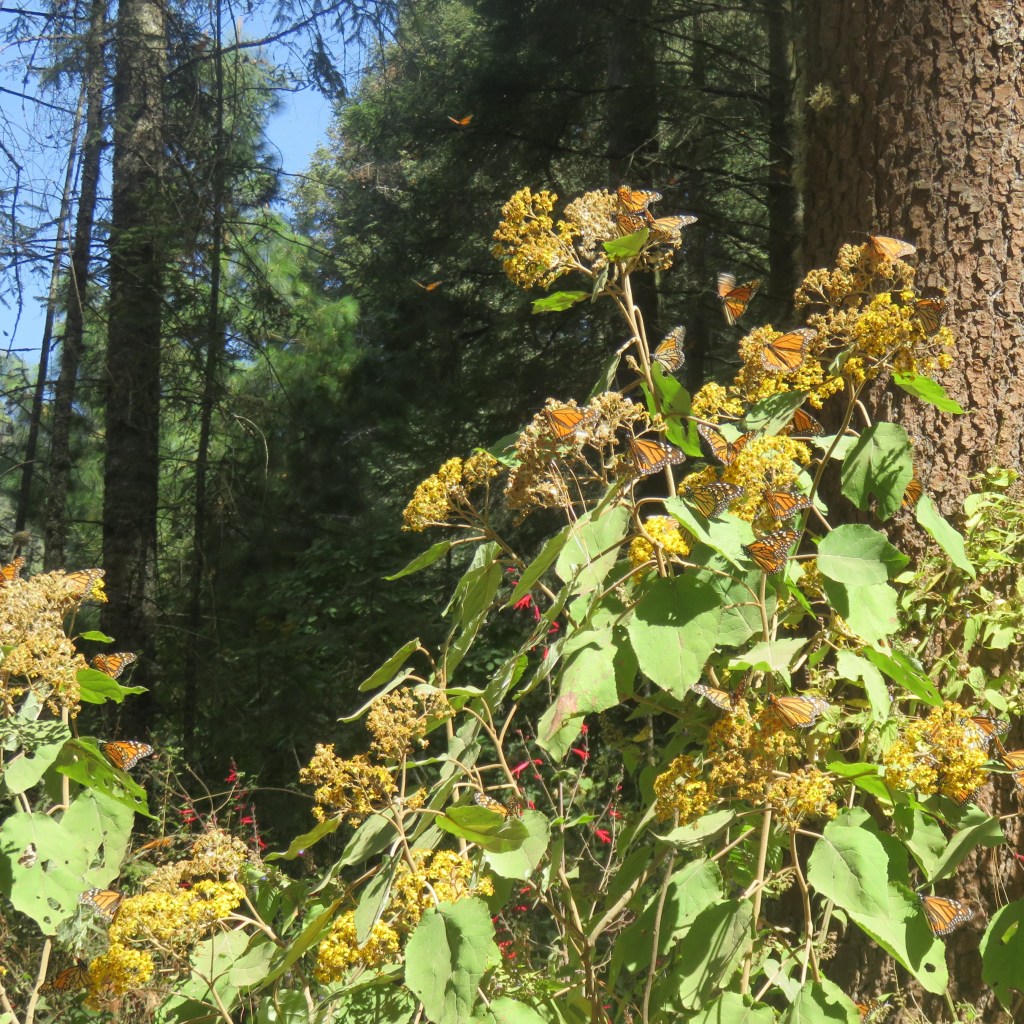
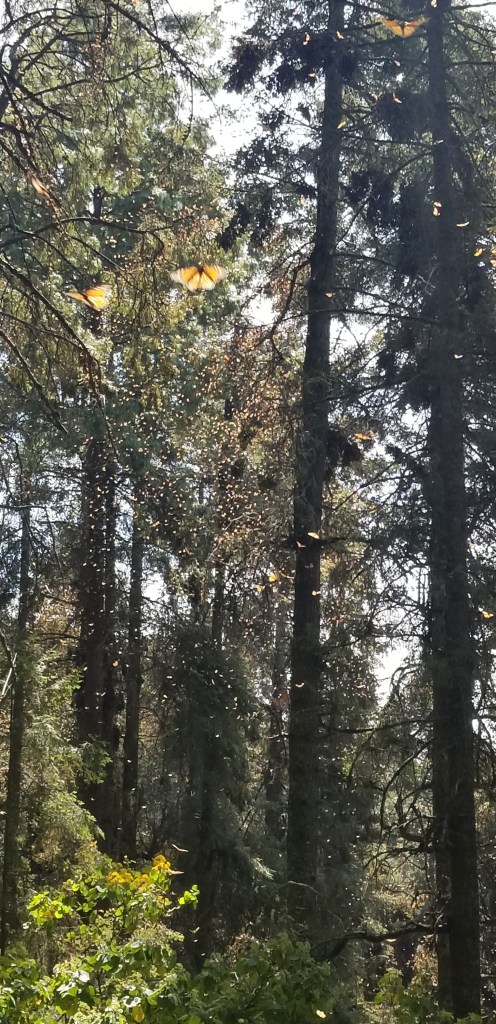
And then, up, up, up. There were so many stairs. Butterflies were dancing everywhere. Any orange spot that you may see in this picture is not a falling leaf, but a butterfly!

We were very lucky to be here for this year of migration. The monarchs are a littler farther down in elevation, not as far from the entrance, and there are more of them. Wonderful for the butterflies, and wonderful for us! We were lucky on this day, too, because this mountain is also often heavily clouded and rainy. Despite the elevation of about 10,000 feet, we experienced warm sunshine.

I had never even pondered what monarchs did during the winter until I saw an IMax movie at the Science Center in St. Louis about them several years ago. Our guide, Juan, told us much of the same story after breakfast that morning. By the 1930’s, scientists had figured out that monarchs migrate. Fred Urquhart, a Toronto entomologist, and his wife Nora began tagging the wings of the monarchs when they arrived in Canada during late summer. After much trial and error, they developed tags that would stay on the butterflies, and enlisted a network of 3,000 enthusiasts across the United States to let him know where they found them. Fred traced them all the way down to the Hill Country of Texas and the trail stopped cold.

This is where Kenneth Brugger, an American businessman, comes into the picture. Very interested in the migration, he and his Mexican wife searched for two years and finally found them in Mexico on January 2, 1975. Happily, Fred and Nora were able to visit the very next year.

Once we were finally finished with the steps, there was more trail, always going up. We passed some members of our tour who had been in the first van.

The Monarch Butterfly Biosphere Reserve is now a World Heritage Site, established to protect the monarchs’ habitat. UNESCO calls it “a superlative natural phenomenon”. The space set aside is approximately 216 miles large and the butterflies occupy only a tiny portion of it. El Rosario is but one colony of several, but it is the best set up for visitors. Of course, no one knows exactly in what spot they will want to set up colonies for the winter, so it’s all available for them.

Signs admonished everyone to be silent. When we finally arrived at the butterflies’ home, it was a sight that defies all description. Breathtaking is one word that comes to mind. Blessed is another, to be here on this day to be witnessing these tiny creatures going about their important lives. It’s like visiting a cathedral of nature.

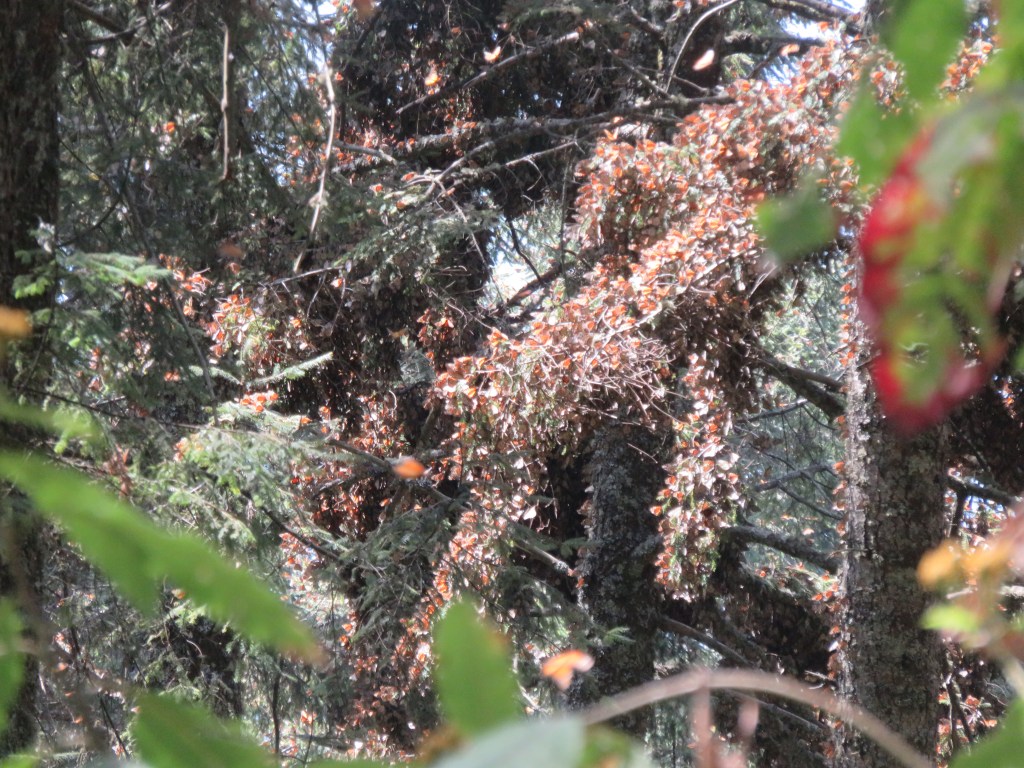
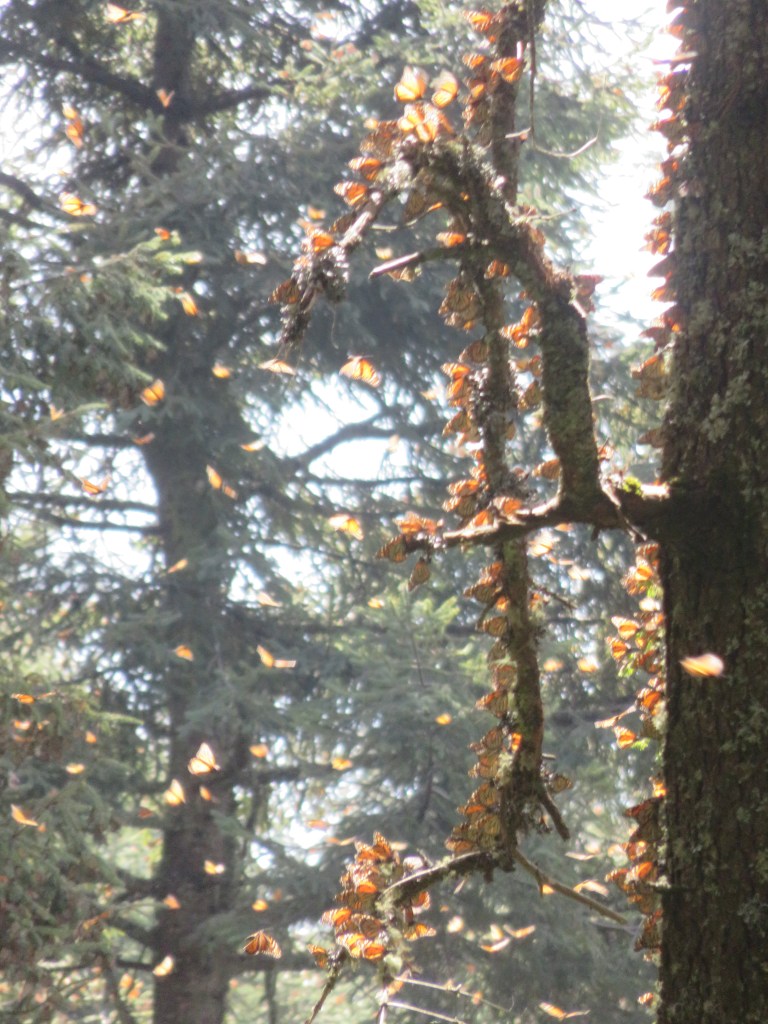
The oyamel fir trees are loaded with butterflies. All of the clumps that you see in these trees, and any speck of orange, are butterflies.

I’m pretty sure that Juan told us that 225 monarchs make up a pound of weight. I looked it up, and I got varying numbers. You wouldn’t think so, but the butterflies are very heavy on the trees, but the trees are still able to support them. The limbs bend with their weight.

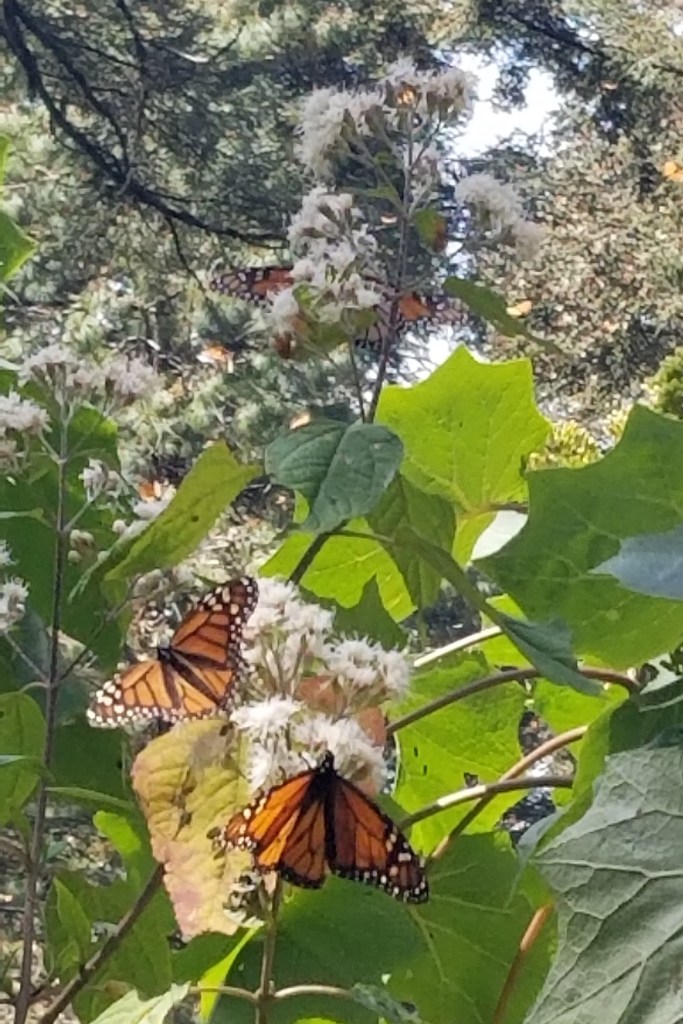
Here in Mexico, the butterflies are very busy. They arrive in late October to early November. The males mate as much as they can. On our hike, butterflies were mating everywhere – even on the steps when we were climbing them.

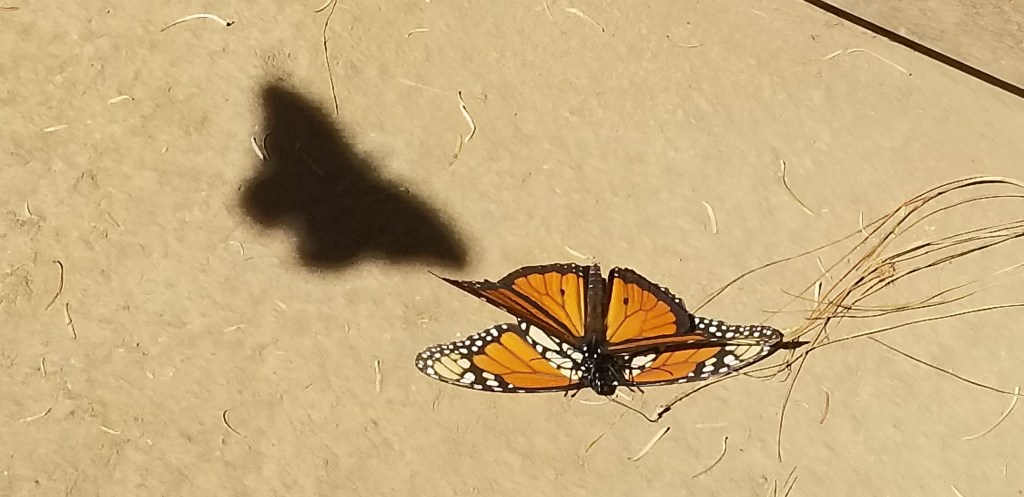
I caught the shadow of a flying butterfly over this mating pair.

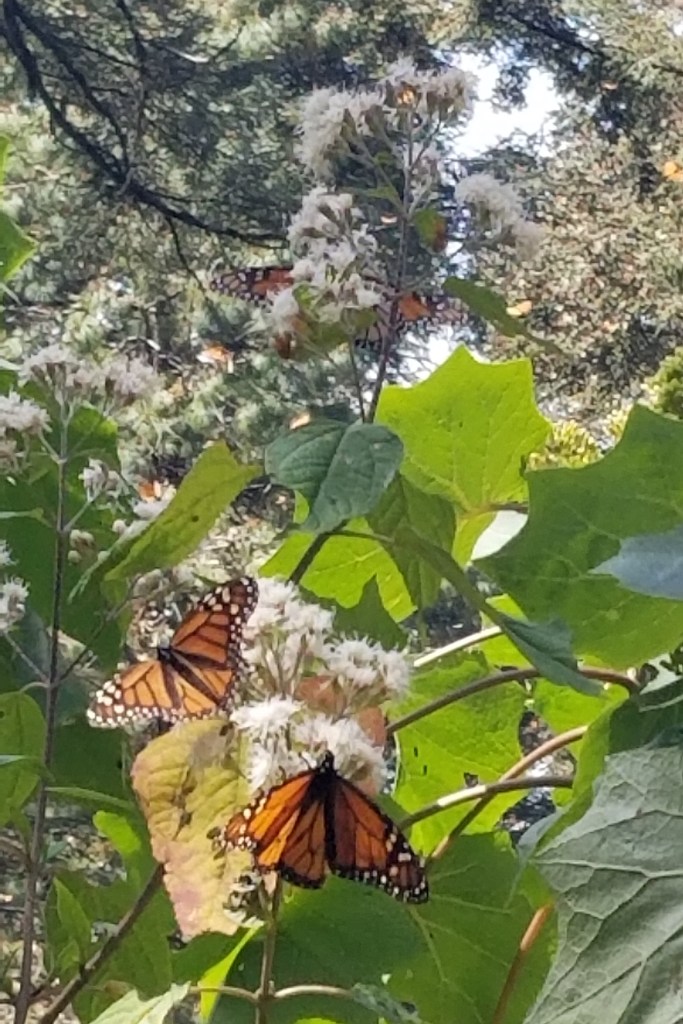
When the females are able to get some private time, they are busy eating. They are using their stored fat from the milkweed they consumed on the trip to Mexico. They add to that with the nectar they drink from flowers here in Mexico.

We were here on the very last day of February. By the end of March, the butterflies are gone. The males die off. The females head for the Hill Country of Texas, lay their eggs, and they will die too. It is the next generation that begins to make the journey north to Canada for the summer. But they won’t make it either; there will be another generation, or two, that arrives in Canada. They lay eggs, die, and a new “Super Generation” is born. This generation of monarchs have thicker and stronger wings and are well equipped for the journey all the way back to Mexico.

The butterflies clump together in the fir trees to conserve energy when it is cold. When a sunbeam hits them, off they fly in a beautiful cascade.

We stood for the longest time gazing in awe, taking in the beautiful sight. The admonition to be silent was taken seriously by everyone there, adding to the feeling of being in a holy space.

In the years following my viewing of the IMax movie, I read two books that further piqued my interest. Flight Behavior, by Barbara Kingsolver, is excellent fiction. The other book, by Sara Dykman, is Bicycling with Butterflies. Sara tells the non-fiction story of her 10,201-mile bicycle journey following the butterfly migration for one season in 2017. She started here, at El Rosario, and followed the trail of the butterflies all the way up to Canada. She camped in hidden spots along the way (yes, including in Mexico) or visited friends or family. It was the raw aloneness of her journey, her strong desire for the butterflies to succeed, and her almost militant wish that the ecosystem along their journey would be a safer place that struck me. She not only went to Canada but returned to Mexico to complete the full cycle of migration.

The trail north is fraught with danger for the butterflies. Pesticide use and mowing of the green spaces along the highways are but two of the hazards. I find it amazing that the females make it to Texas, let alone their children and grandchildren making it to Canada.

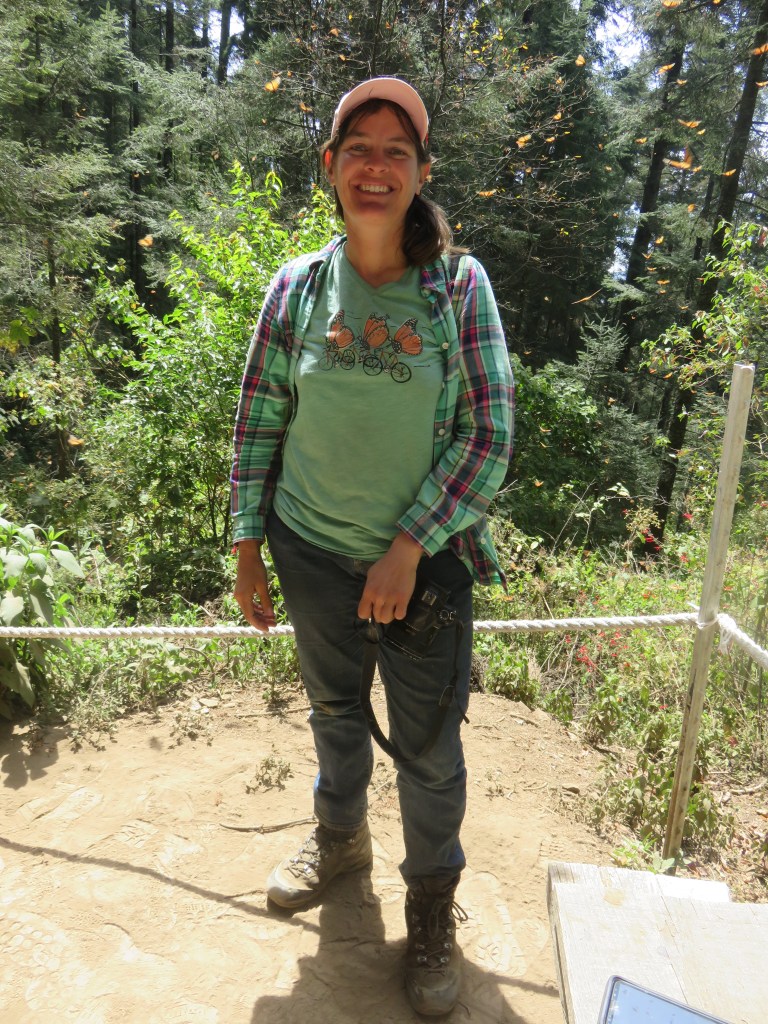
On the trail down, my mind purely on butterflies, I saw a woman wearing a t-shirt that had butterflies riding bicycles on it. Her face was slightly familiar. Could it be….? I asked her if she was Sara Dykman, and yes, it was she!

She is very friendly and we chatted for a short while. She had ridden her motorcycle down this year and not her bicycle. She was part of a group of women who had been counting butterflies, and as a consequence of staring up at the sky for hours, her lips were burned, she said. They counted 400 per minute which was a banner year for the monarchs. Meeting her was a huge bonus in an already magnificent day.

All too soon, it was time to say goodbye to the butterflies. It was almost strange and sad to walk down through the little village–

and back to the bus (no van lift on the way back), and see them thinning out. Like Sarah, I would have loved to have followed them, but I don’t think I’d make more than a few miles on the journey!

Next time – the last Mexico post – San Miguel de Allende

Mexico

A Sunday to Remember in Mexico City

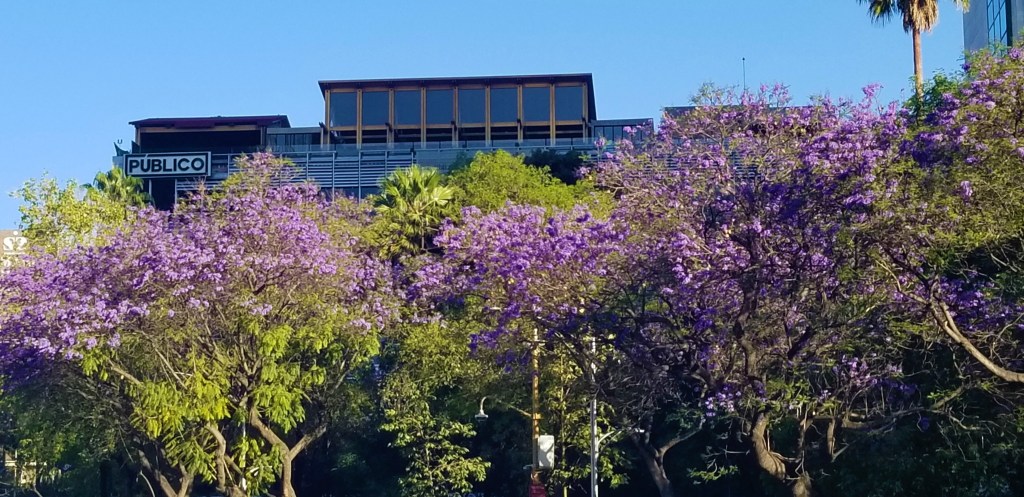
Jacaranda trees in bloom

A Sunday in Mexico City! What shall we do? How about a boat ride? Lunch in the park? Maybe a show with traditional dancers and mariachi bands? Oh well, let’s do it all!

First stop: Xochimilco, known as the floating gardens of Mexico. It is a UNESCO World Heritage Site. When Cortes drained the lakes of Mexico City, he left one standing. This lake contains a large water transport system of canals that were built by the Aztecs. We had just arrived when there was a treat in store for us: a performance of the “Voladores de Papantla”, the famous flying men of Papantla. Our guide, Juan, comes from the same area in Mexico and his enthusiasm for the performance spilled over.

This is an ancient dance which is still practiced in Papantla area today. It is a tradition thought to have originated with a plea to the gods to end drought. The voladores in their home would be using a tree that had been totally cleared of branches. Here, it is a pole. First they dance around the tree (pole), one man playing a flute with a little drum attached to it.

They shimmy up the pole and spend quite a bit of time spinning in a tiny platform at the top, arranging their ropes. Then – down they come, going around as they go! The flute player never stops playing!

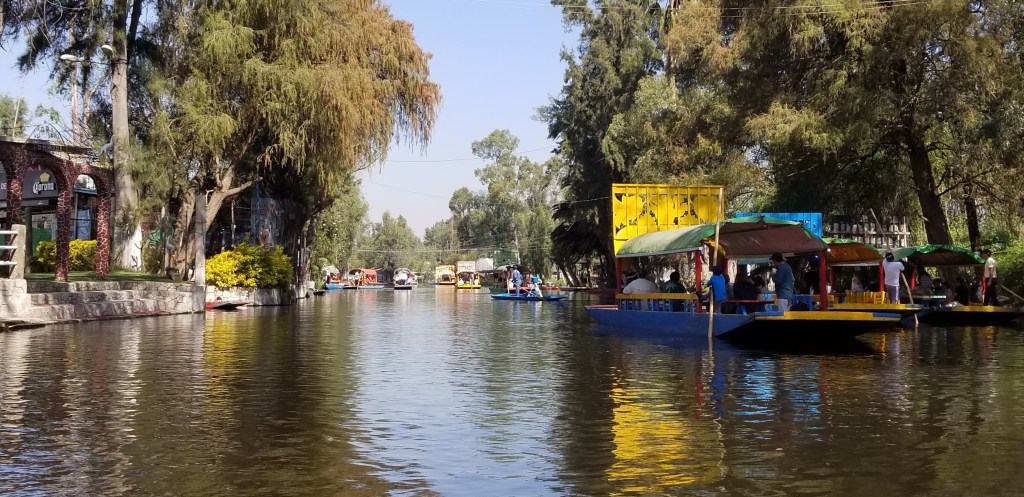
It was time for our boat ride on the canal. There are so many boats, each one brightly painted and slightly different from the others.

What a beautiful day for a little cruise.

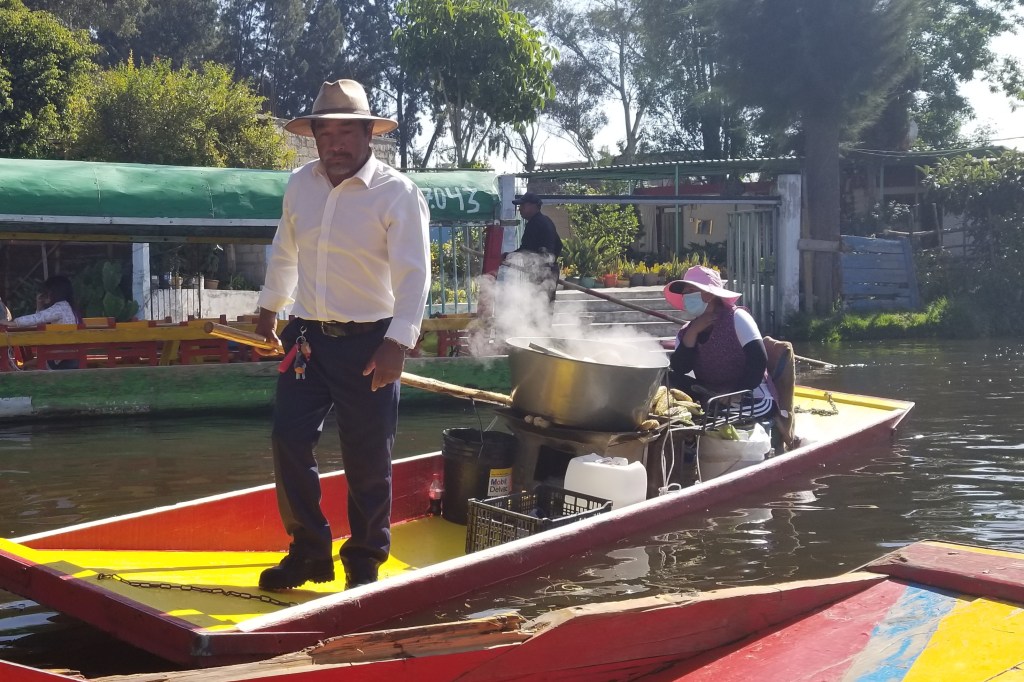
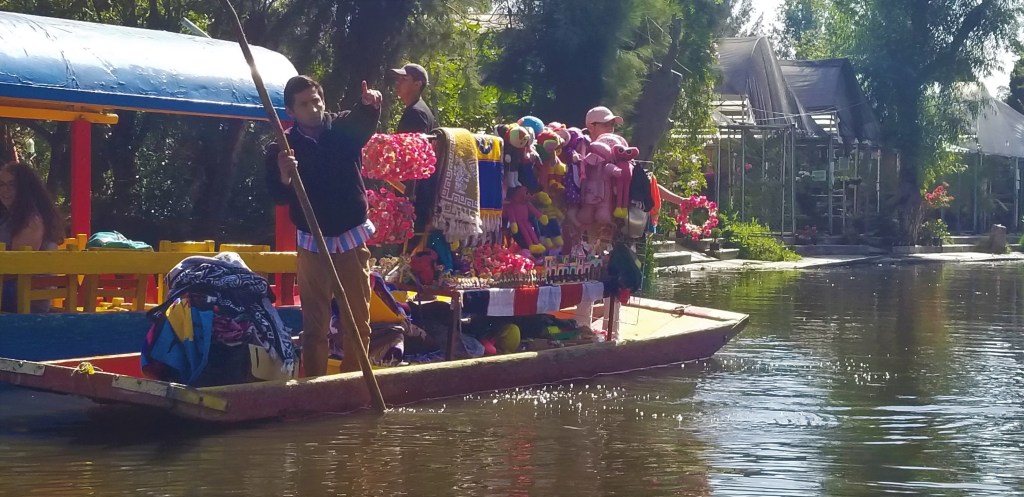
For the most part, our ride was not as tranquil as this picture would make it seem. There was a lot happening! Vendors are ubiquitous in Mexico, and here they are in boats to sell their wares.

This vendor is selling corn on the cob. It seems to be a favorite treat because I saw them sold in many places in Mexico. I suppose they are sprinkled with chile powder, as everything else seems to be. There are also vendors selling other snacks plus drinks and trinkets. These vendors show how all the boats are transported down the canals: with a man in the front with a pole, Venetian gondolier-style.

But the absolute best is the floating mariachi bands. This band pulled up beside us, and we all decided to chip in for a little entertainment. Floating down the canal with mariachi music makes for a perfect ride. From the back of the boat in the bright sunshine, I didn’t get a great picture, but here it is.

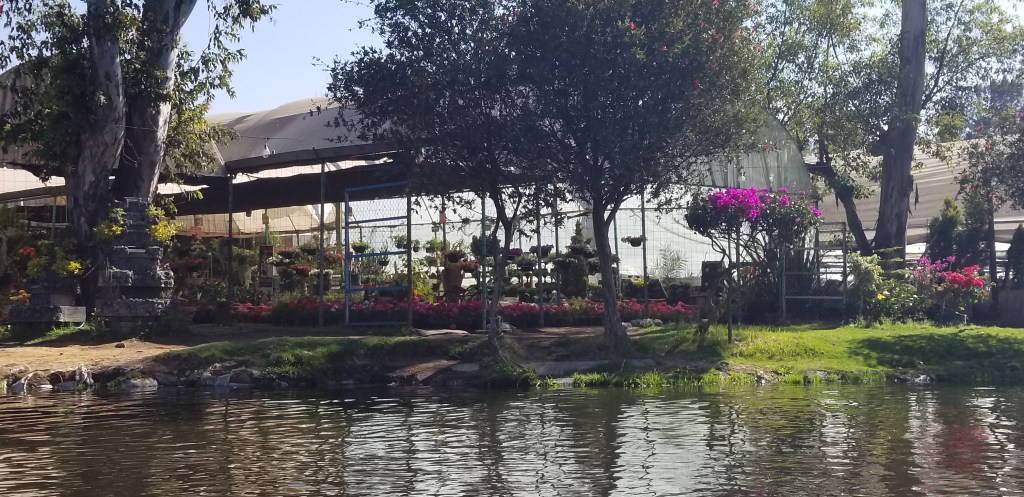
Aside from all of that, there was much to look at on the shore as we went by. There are many greenhouses here with beautiful flowers.

Shops, homes, and beautiful old trees and other vegetation line the banks. The water is clear, and there are about 115 miles of canals winding all around.

Juan told us that on a typical Sunday, families in Mexico eat breakfast together. There may be a soccer game that one of their kids are playing in. Then there may be an outing with extended family, including grandparents, which could include a gathering of family at someone’s home or dinner at a restaurant. In between, they attend Mass. It used to be said that just about all of Mexico was of the Catholic faith. Of course, that is changing now, but it is still a very strong thread in the fabric of life for the Mexican people. There are some Masses on Saturday, but on Sunday there is one every hour. It’s forty-five minutes long, and then worshippers need to vamoose for the next one.

With all that in mind, we had arrived at Xochimilco early and had a fairly quiet and pleasant boat ride. It was getting very busy when we left, though. There are about 2,500 boats in total that could be used on the busiest of days. I don’t know how they would all fit in the canals!

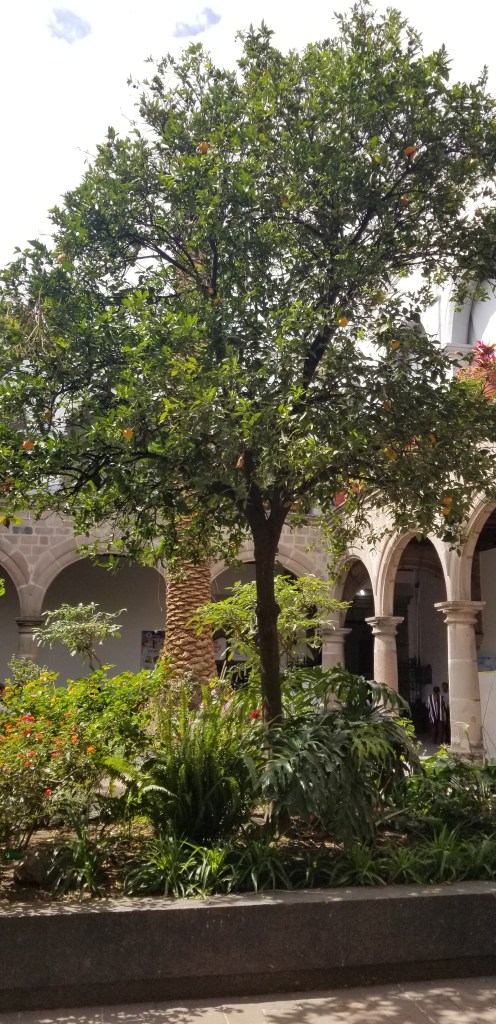
The day was moving on as we arrived in the suburb of Coyoacán, and by now everyone was out to enjoy this beautiful day. Masses were in full swing at the cathedral. Parroquia San Juan Bautista, dedicated to St. John the Baptist, is one of the oldest churches in Mexico City, completed in 1552. As in Mexico City, it is built on the rubble of an Aztec building. The lighter colored building on the right is the convent. We walked through the arches and came to a beautiful inner courtyard with an orange tree.

I have been to a handful of small towns in Mexico and Guatemala, and they all have the same layout: the main cathedral fronts a very nice public park. The park is a gathering place for the town at all times, but especially on Sunday. This is certainly true for the park in Coyoacán. We had our time here to ourselves, and headed straight to one of the restaurants lining the park for a late lunch.

I had lamb chops and Cal had steak. It was one of our best meals of the trip.

The people on the bench to the right of this picture were interesting because, confirming what Juan had told us, they were an intergenerational group. We saw this throughout our visit here. Every time the bench emptied, it refilled again with another little family, usually enjoying their ice cream. After the blanket vendor that you see near them got off the phone, he realized I was looking at him and thought I was interested in his blankets. He kept opening them for me to see but he was wasting his effort; I had already bought one from another vendor!

Like its church, the suburb of Coyoacán has colonial architecture and quaint cobbled streets. It was once the home of Frida Kahlo, Leon Trotsky, and Diego Rivera. There wasn’t time to do much beyond explore the park area for us, but there a lot going on to see.

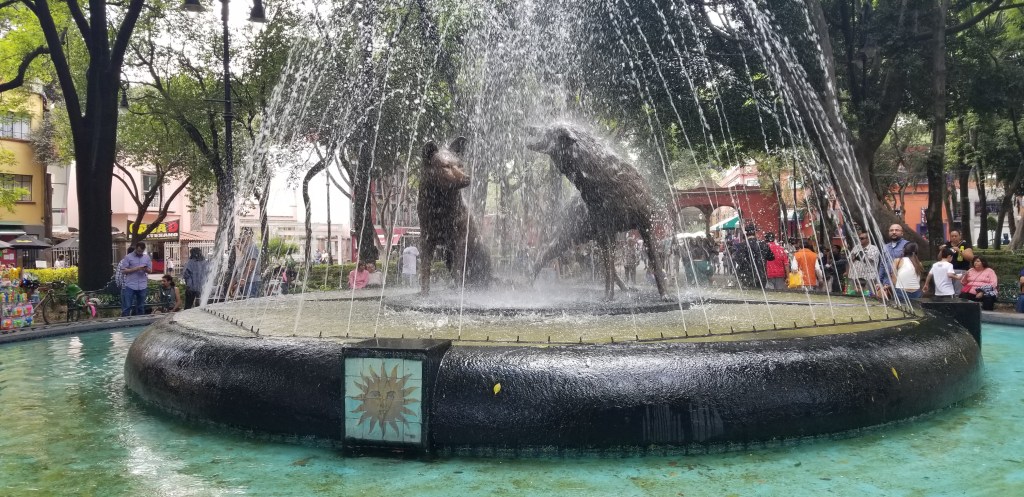
The name of the town, Coyoacán, is derived from the native Nahuatl word for “place of coyotes”. Coyotes once roamed through the forests and lakes here in those days. The beautiful fountain in the park pays homage to this name.

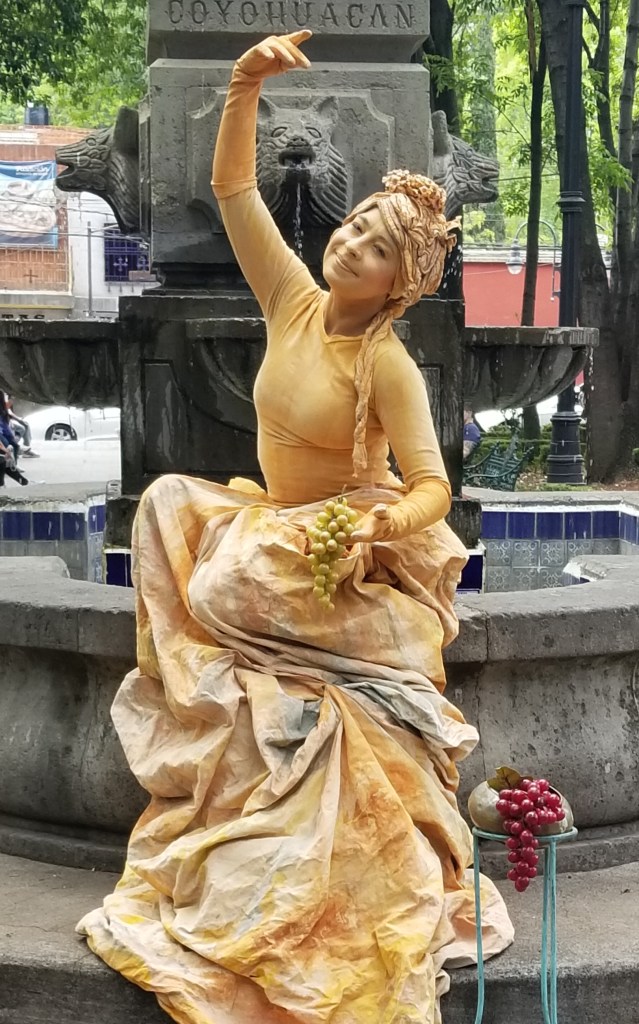
Near the fountain, a woman was dressed as a statue from Roman times for pictures and a few coins. She looked remarkably like one of my nieces so of course I took her photo.

There were so many people everywhere, but it did not have the feel of being overcrowded. Good luck finding a place to sit, though.

For two years while Mexico City was being built, Coyoacán was the first capital of New Spain. There were haciendas and forests between it and what is now the downtown area. Of course now the forests have been replaced by city streets. This building is named the Palace of Cortes, but it is actually the Coyoacán municipal building, constructed two hundred years after Cortes lived here.

Not far from the municipal building and the cathedral, native groups were having a large all-day “gathering”. One group would finish and another would take its place. Juan stressed to us that this is not put on for the tourists but, rather, it is connection to their roots. I’m not sure if their being bumped right against the cathedral walls, and holding the gathering on a Sunday, was intentional or not. After the Masses finished for the day, we walked into the cathedral and could hear the booming of the drums quite clearly.

There was a large, covered 2-story artisan market just across the street from the park.

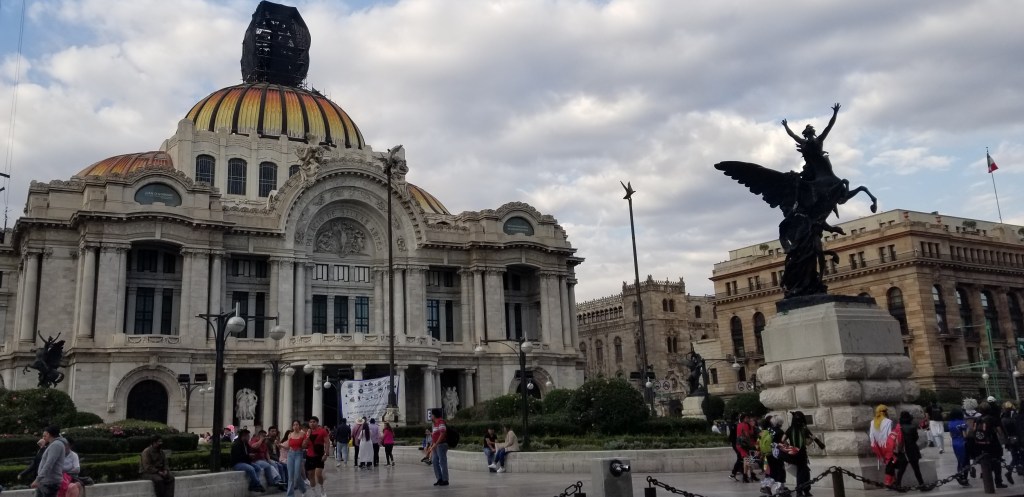
One more treat was in store for us on this day. We barely had an hour back at the hotel before we had to leave again for the Ballet Folklorico de Mexico, held in the beautiful Palace of Arts.

This dance ensemble has been in existence for about sixty years, highlighting the traditional music and dance of different regions throughout Mexico. There were a couple of numbers that reflected their indigenous roots as well. Sometimes there were only two people on stage and sometimes as many as thirty. There was plenty of mariachi with different instruments, swishing of beautiful skirts, hats thrown up in the air, and foot stomping. It was an enjoyable and memorable evening.

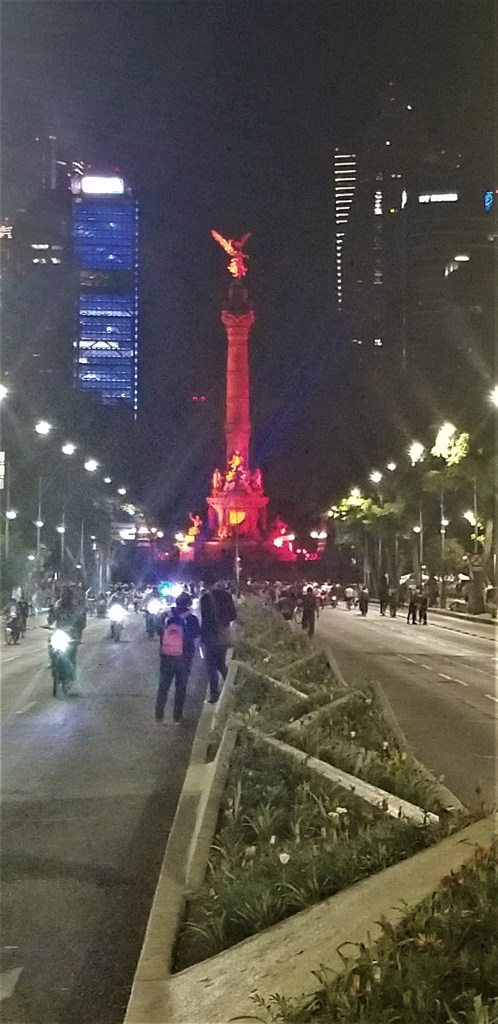
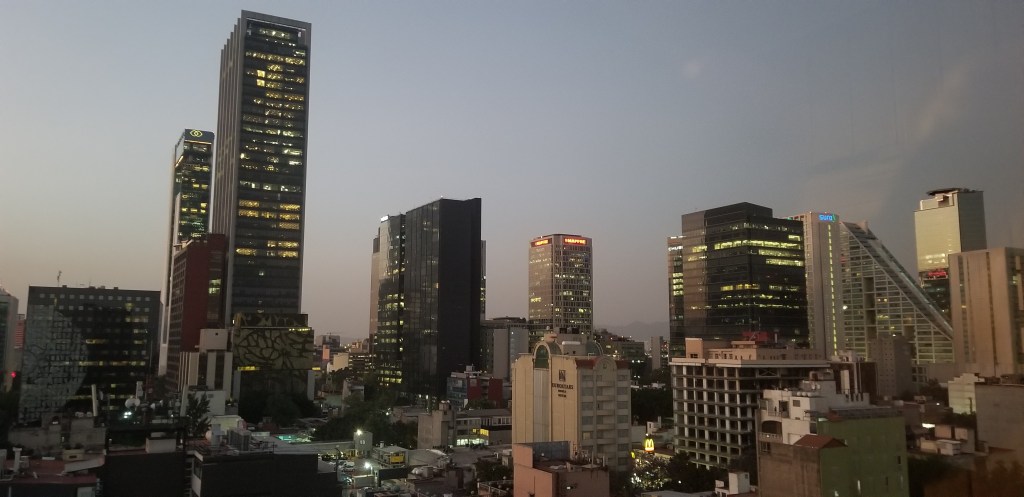
Mexico City had the feel of any number of European cities that we had been to. Of course, it has its own history, architecture, and culture. On the weekend nights the area around our hotel was a hotspot for restaurants, bars, and just being out. One of the main streets was totally blocked to traffic, making way for cyclists and pedestrians. That is the way to enjoy a beautiful evening!

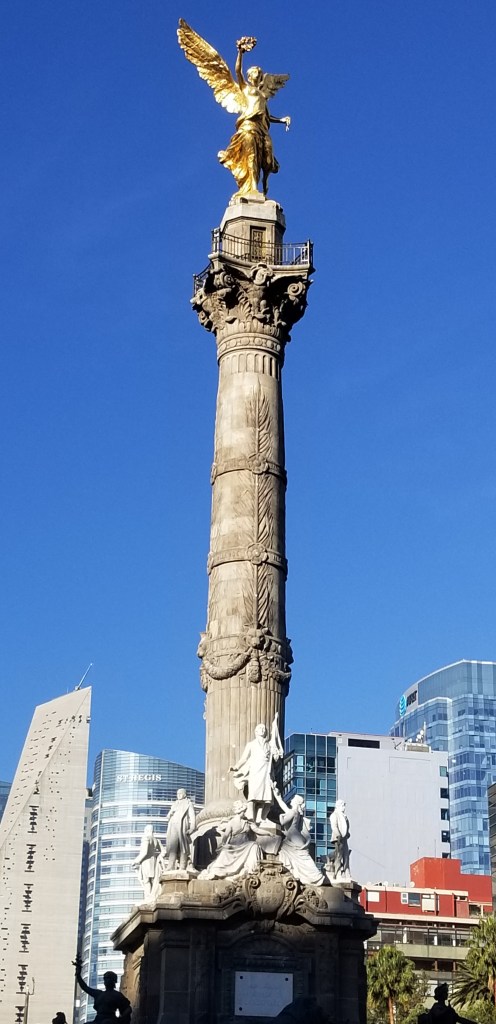
The Angel of Independence, the monument to Mexican independence from Spain, looks like this by day:

At night, it is lit, and here you can see the former traffic lanes open for pedestrian traffic. The mood is very celebratory, since it’s the weekend. We felt comfortable moving with the crowd as we looked for an ATM and a restaurant for dinner.

Our few days in Mexico City were a kaleidoscope of sights and experiences. I don’t know if I’ll ever be back, but of course there is so much to do and see that I could have a full list for another visit.

Next time – Butterflies at the El Rosario Monarch Butterfly Sanctuary

Mexico

Destination Mexico City

My husband, Cal, appeared in our RV with a brochure for a tour to Mexico that he had picked up on what he had thought was just a free coffee and donuts get-together. The tour was to visit Mexico City, the Monarch Butterfly Sanctuary of El Rosario, and the town of San Miguel de Allende. All three are places I’ve always thought would be wonderful to visit but I never really had an idea how I would get there. It was like holding a dream in my hands. The whole itinerary for the week’s tour looked interesting. A quick consult with our finances, a couple of reassuring calls to the travel agency, and within a week the trip was booked. That definitely increased the cost of the donut!

“You’re gonna get shot!” “Oh my…please be careful!” were some of the comments I received when telling family of our plans.

I wouldn’t undertake a visit to Mexico without vetting the company and plans carefully. Viva Tours has been in business for 35 years, taking the snowbirds of the Rio Grande Valley down to Mexico on many different excursions. Our guide, Juan, has led this tour for 16 of those years. He is an archaeologist from southern Mexico who comes up on a reverse snowbird migration to the Rio Grande Valley in Texas every year for three months to be a tour guide for Viva and its owner, Tomas. Juan is experienced, knowledgeable, and personable and we felt that we were in excellent hands throughout the week-long trip.

We met Tomas and some of our fellow tourists at the eye-rubbing hour of 3:30 AM for a van ride to find Juan and the rest of the group in McAllen. There was a transfer to a bus, a quick stop at the border to put our luggage through Mexican security, and a drop-off at the Reynosa Airport. A two hour flight and then…we were in Mexico City.

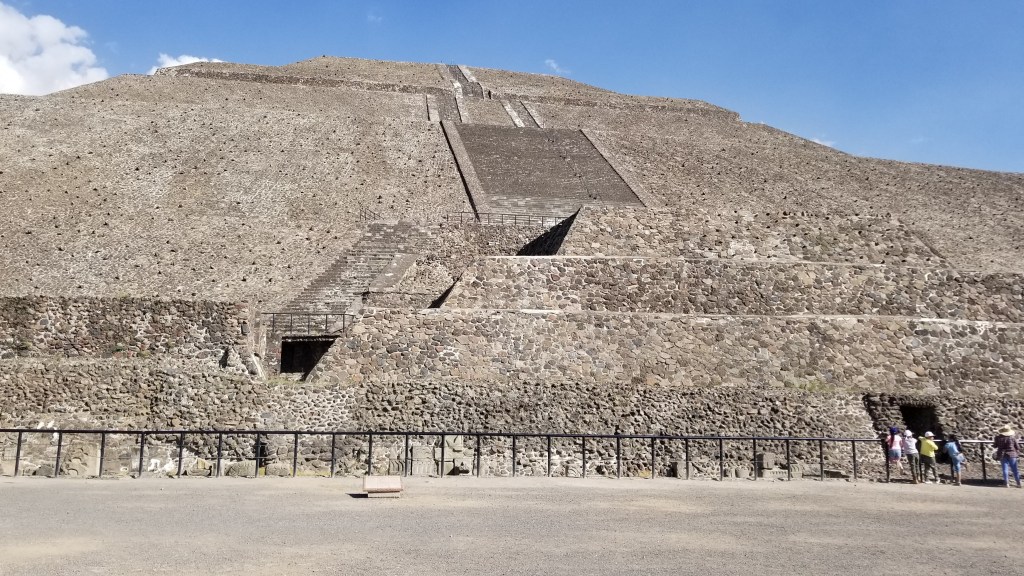
Our stop that afternoon included one of the things I had come to see and a highlight of the trip for me. The ancient city of of Teotihuacan includes two pyramids: the Pyramid to the Sun and the Pyramid to the Moon. We saw the latter mostly off in the distance from our bus window. We visited the Pyramid of the Sun and its museum.

This pyramid is the third largest in the world. At the top is a huge pedestal where human sacrifices were made. It is located on a central road of Teotihuacan called “Avenue of the Dead” because it is believed to have been paved with tombs. In the museum I was able to get a clearer picture of the ancient city:

The Pyramid of the Sun is in the foreground. The buildings that you see were ceremonial and the people lived in the outlying areas.

The city predates the Aztecs. In its heyday, around year 1 to 500 CE, it was the largest city in the Americas and the sixth largest in the world. It had an estimated population of around 125,000. Teotihuacan was built to be a religious center but became a living city. The pyramid itself dates to around 250 BCE. When the Aztecs saw these ruins, they claimed ancestry with the residents and adopted it as their own.

Although the pyramid was originally thought to be dedicated to the Sun god, hence its name, current thinking is that the god actually worshipped in this pyramid was a water deity named Tlaloc. There was a ten foot moat around the pyramid, and child burials were found in the corners. These are characteristic of water god offerings.

A close up of the pyramid and its surrounding ruins revealed some of the construction techniques. At one time it was possible for visitors to climb it, but now that has been deemed too dangerous.

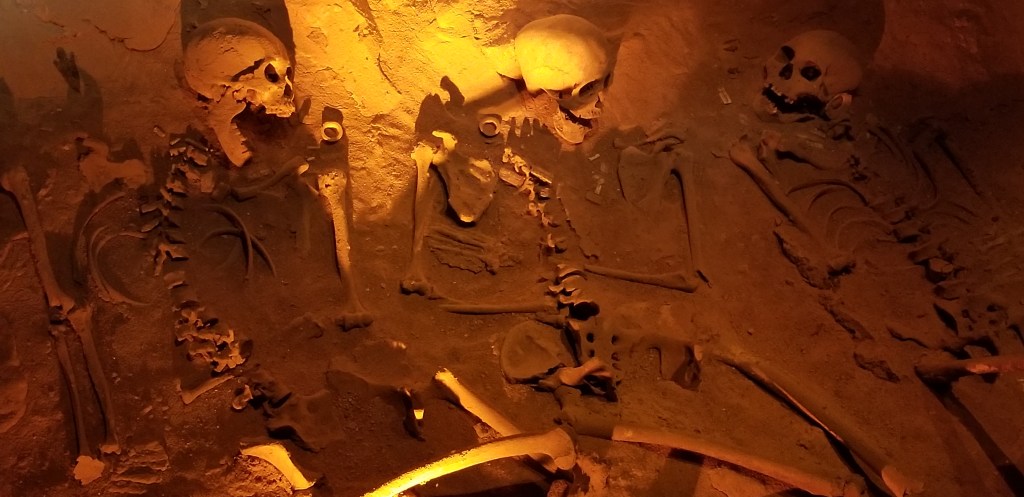
The museum had some interesting artifacts uncovered during archaeological digs, including many skeletons.

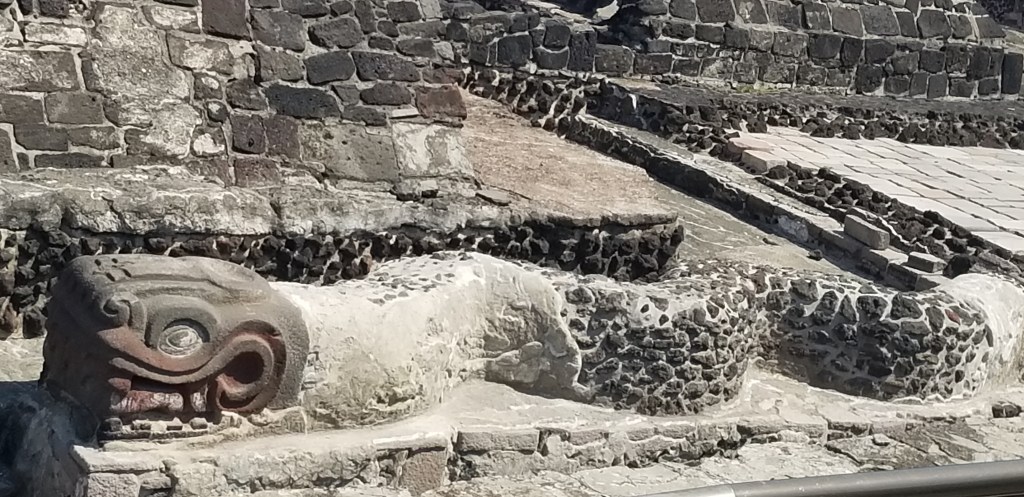
A couple of days later we visited the heart of Mexico City. Moving forward a few centuries, the Aztecs had a great temple here. It was their capital city, as Mexico City is now, and was called Tenochtitlan. They started construction in 1325, rebuilt it six times, and the Spaniards destroyed it in 1521. To add insult to injury, the Spaniards built Mexico City right on top of the rubble of Tenochtitlan. The ancient temple is now being excavated.

You may remember the conqueror of Mexico City from your history books – it was Hernan Cortes and the Aztec leader was Montezuma II. The Aztec’s city was built on an island in a lake, with a system of canals. Originally there were five lakes in Mexico City. Cortes drained all but one, to the present-day detriment of the city. Built on the old lake bed, it is sinking at a rate of about three feet per year.

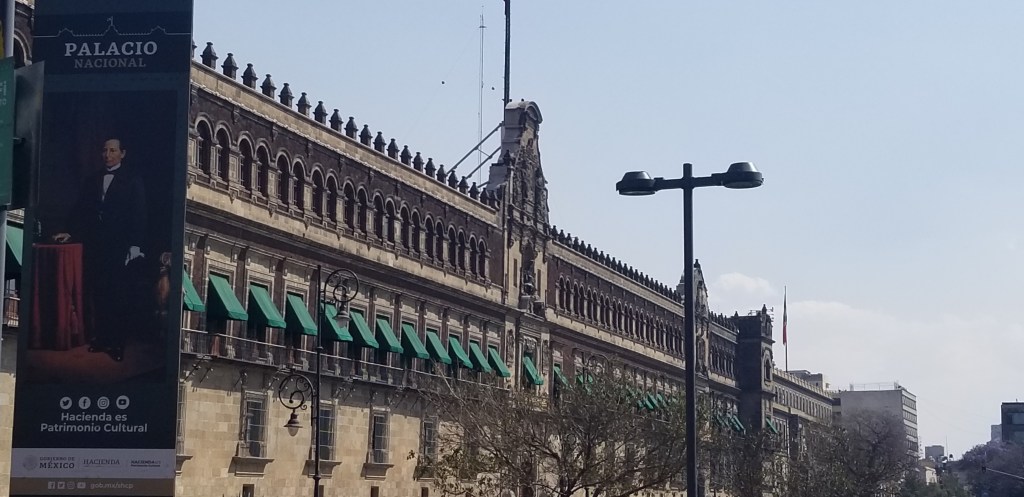
After an extensive history lesson from Juan, and viewing the Aztec ruins, we took a short walk through the city that Cortes built. The President of Mexico currently lives in the Royal Palace.

Across from it sits the Metropolitan Cathedral, which one of the oldest and largest cathedrals in the Americas. Unfortunately here the sinking I mentioned earlier is happening unevenly, but efforts to keep the foundation level are ongoing.

The organ inside is impressive with its flyaway pipes. There is also a black crucifix here. Poison was put on Jesus’s feet and the whole crucifix turned black. You can find the complete story on Google if you are interested.

Plaza Mayor, where both the palace and the cathedral sit, is grand and impressive.

There is a pretty cactus garden to the side of the cathedral, along with old-style phone booths:

You could receive a cleansing on the street if you needed it. And then you could call someone from the phone booth and tell them how good it was.

A song from a mariachi band, anyone?

On our last morning in Mexico City before departing for other sites, we visited the Basilica of Santa Maria de Guadalupe. It is the second most visited basilica in the world after St. Peter’s Vatican, with twenty million visitors annually.

The image of the virgin Mary superimposed on Juan Diego’s robe, the person who witnessed her appearance in 1531

What I’ve covered here is just the tip of the iceberg for everything we saw and absorbed while in Mexico City. Some of the places we visited may not even make it into the blogs. I’m trying to condense it but I am finding that not to be an easy task! Hopefully I can at least give you a flavor for this great city and its environs.

Next time – a boat ride in Xochimilco and Sunday in the park in a Mexico City suburb. Still to come–butterflies, and San Miguel de Allende

USTravel

Cruising the Port of Brownsville

The day after we arrived at our winter spot in Harlingen, our park activities department hosted a free doughnuts and coffee morning. Not one to ever turn down a free doughnut, Cal set off to the main hall to take part. He disappeared for quite a while. Just when I was starting to wonder what happened, he returned with tickets for a 4 hour cruise, a Branson-style Kenny Rogers sound-alike concert by a gentleman named Rick McEwan, and a brochure for a tour to Mexico. Neither he nor I connected beforehand that it was an event where options for things to do for the winter were presented. It turned out to be an expensive doughnut!

Booking the actual date of the cruise with Osprey Cruises proved to be difficult because it was hard to find a day when the weather was optimal. That was part of the reason for the two-night stay in South Padre Island which was the subject of my last post. We were to cruise on the morning of the day we checked out of the hotel. The cruise leaves at 9AM and passengers are to arrive at 8:30, so we thought we would spare ourselves a long early morning drive. As it happened, though, it was more windy than usual that morning and a storm was predicted. The cruise company canceled the tour.

We finally found a good weather morning just over a week before our departure from Harlingen. We took off from the dock at Port Isabel–

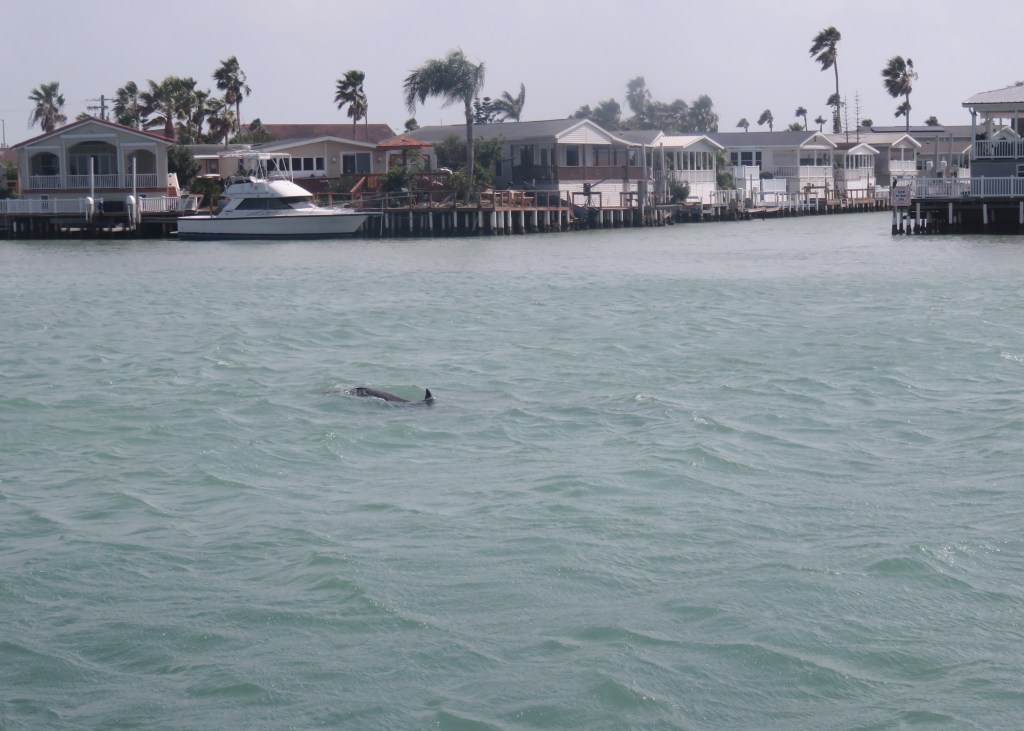
and cruised under the Causeway bridge through the Laguna Madre. It was so exciting to see dolphins for the first and only time on our visit to the Gulf. It’s hard to get good pictures of them, but you can see one in the picture below.

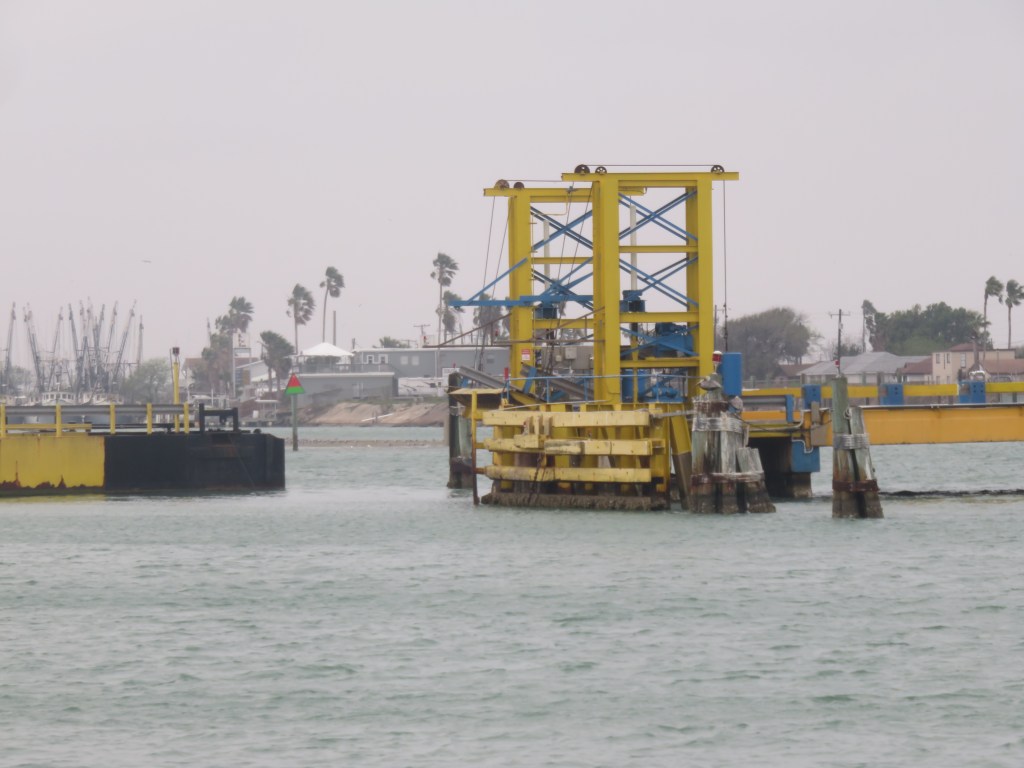
We went past a rotating bridge, which opened its gate for us.

And then, we were inside the Port of Brownsville waterway. The deepwater shipping channel is 17 miles long and 42 feet deep with 40,000 acres surrounding it. After we went through the bridge, the boat passed through miles of sand and brush. We could see a protected island that is prohibited for us humans to enter and it was full of bird life.

Many birds also filled the shore line.

We soon came to the shipping boneyard. Huge rectangles are cut out of the hulking ships. Those rectangles are cut and ground into steel pellets and reused.

There is currently even a military ship being scrapped. The Kittyhawk is one of the great diesel aircraft carriers built in the 60’s and the last to be decomissioned. It is here being taken apart bit by bit. I could still imagine the sailors waving on board the decks.

There is a lot of scrap to be processed. I enjoyed watching everyone hard at work while we just cruised on by.

There are little pretty little tugboats to be seen. I liked this one which reminded me of St. Joseph, Missouri, in the state I used to call home.

At the other end of vessel life, ships are being built here, too. This one will go to Hawaii. It is to be a container ship for a large shipping corporation there.

There are docking spots for ships to stop and unload goods or just to have a lay by. This ship holds the immense blades that will be installed on windmill farms.

It was time to visit the Brownsville Shrimp Basin. Shrimp boats need repairs, too, and some are in dry dock for that reason, or for a new coat of paint.

You would think that shrimp boats would be out catching shrimp on a workday, but many were docked as we went through the Basin. Currently, it is too expensive for the small-time operators to purchase gas. It costs about $75,000.00 to fill up the tank on a shrimp boat! It is hard to catch enough shrimp to recoup that cost.

And then, the Big Shrimp Handoff: we pulled in to Texas Gold Shrimp Company and two men were waiting there to hand us two big containers of shrimp. No sooner said than done, and we were off again.

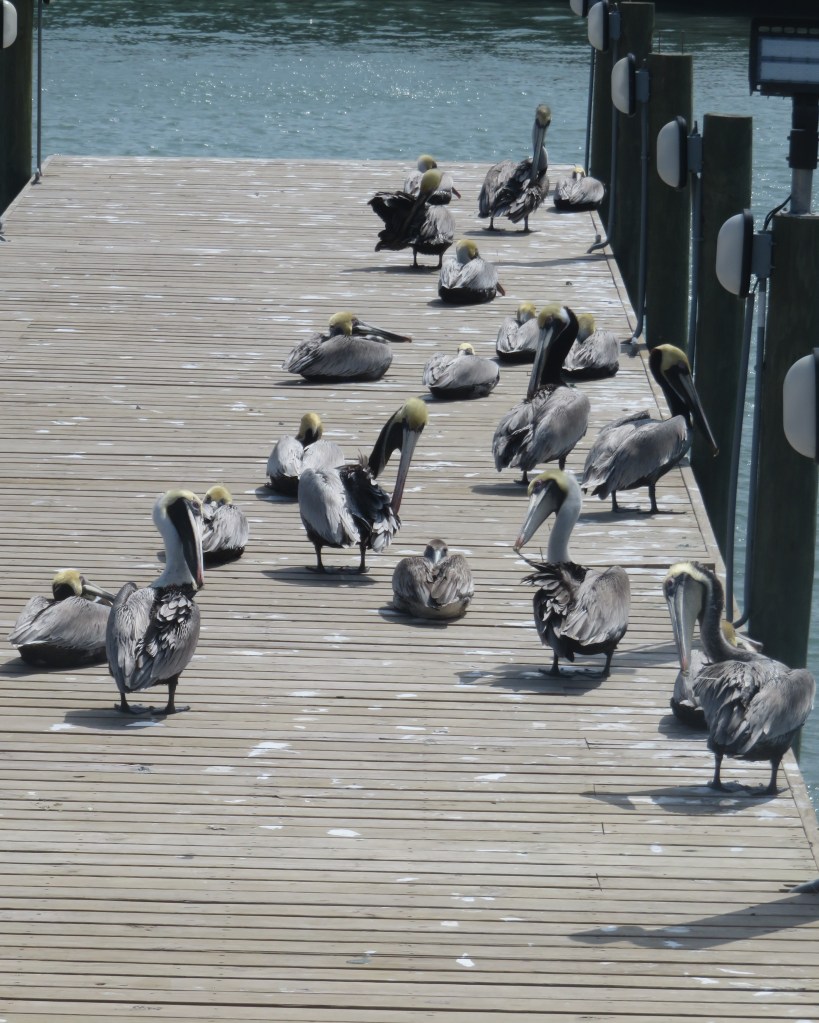
We caught all the action from the best seat in the house: the front of the boat. From our position, it felt like we were the only ones on the cruise. It was definitely windy, cool to start, and once in a while we were splashed, but we persevered and the morning warmed up as it went on. Going in and out of the shipping area, there was a long period where we were just sailing with nothing more special than sand and the sea to see. The captain stopped his narration at times to play 70’s music ( what I call Boomer Music). Going out I was munching a doughnut. Coming back I was tucking into a nice bowl of peel and eat shrimp with a cup of pina colada. The dolphins were playing again, and pelicans awaited our return at the dock. Could life get any better than that?

Oh, and the Rick McEwan concert? He was great, and we enjoyed our evening very much.

Next time – about that brochure for a tour to Mexico…

USTravel

Port Isabel and South Padre Island

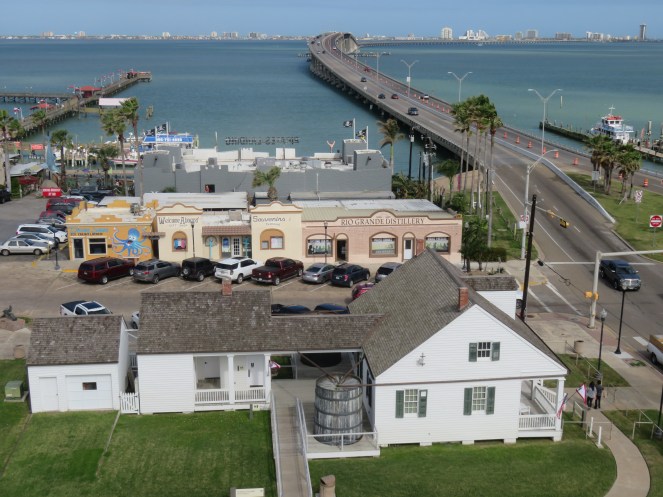
Port Isabel and the Queen Isabella Causeway leading to South Padre Island, as seen from Port Isabel Lighthouse

During our Texas stay, we made three trips down to South Padre. On our first, Cal had the brilliant idea of staying a couple of nights so we could be here for more than just one day. It didn’t take us long to get reservations booked after that suggestion. Our second visit, then, was our little mini vacation-away-from-our-permanent-vacation. The morning of the first day was our visit to Boca Chica that was in my previous blog.

South Padre Island lies just off the coast of extreme south Texas. The water in between the mainland and the island is part of the Intracoastal Waterway which goes all the way around the Gulf to the Mississippi River at New Orleans. It is also the southern part of the Laguna Madre, a long and shallow lagoon. Port Isabel is the last town before the bridge to the island.

We stopped at Port Isabel Lighthouse just before getting on the bridge.

Construction on the lighthouse was completed and lamps were lit in 1853. There was a period of stoppage during the Civil War. During that time, both sides used the lighthouse for observation. The last battle of the Civil War happened near here, more than a month after Lee’s surrender at Appomattox.

We climbed up 75 stairs and 3 ladders before we arrived at the top.   There we were rewarded with the view that you see at the beginning of this blog. It was also interesting to get a look at the multifaceted lens. For those interested in such details, it is a reproduction of a 3rd Order Fresnel Lens.  It was installed just this past December so that the lighthouse was lit for the first time in 117 years at that time.  That must have been a sight to see!

Being able to stay on the island meant that we didn’t need to get up super early to get a good start on our day. We visited South Padre Island Birding Center. This was an excellent stop. We started in their museum, which was mostly a very cute and adorable collection of baby alligators and turtles. Directly outside were some adult versions of the same. These animals are not able to be rehabilitated in the wild so they make their home here.

Big Padre and his little buddy

There were about a half mile of boardwalks over fifty acres of wetlands, with many various birds that could be seen.

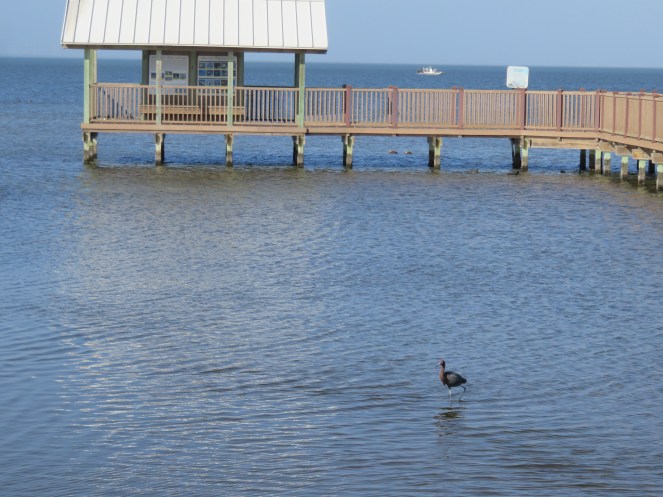
An egret on a fishing expedition

From the boardwalk, we could look over the salt marsh, and down into the shallow waters where we could see the reason for the assortment of birds – there was an abundance of fish in all sizes.

The interesting thing about the Laguna Madre is that it is hypersaline, meaning that it is saltier than the ocean.  There are only five other lagoons like it in the world.  The water evaporates faster than freshwater flows into it because of the dry climate, its shallowness, and the fact that it has no significant river source.

A gathering of ducks and roseate spoonbills

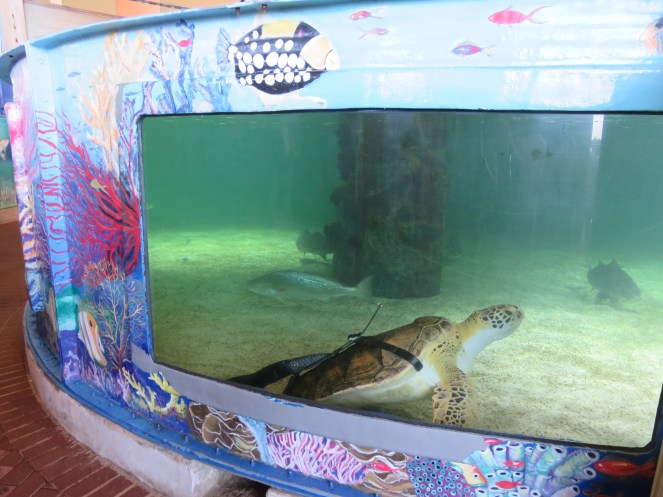
Right next door to the birding center is Sea Turtle Inc., which is a refuge and hospital for sea turtles. South Padre Island is a nesting hotspot for Kemp’s Ridley turtles. The center also has several Green turtles. In 2022, they were able to rehabilitate and release 89 turtles, and protect 7,403 hatchlings. We were able to see large tanks of turtles who were not able to be released back into the wild.

Gerry, an Atlantic Green, who is a permanent resident

I was impressed at their ingenuity in giving the turtle below a new lease on life. Allison was missing three out of four of her flippers due to a predator attack, and all she could do was swim in left circles. The staff at the rehab center rigged up a brace so she can swim freely, although she cannot be released back into the wild.

Their hospital is under a tent while a brand new facility is under construction. They have smaller tanks in the hospital for those turtles who are still in states of rehabilitation. When it is exceptionally cold, sea turtles become cold-stunned. They are then weak and inactive, floating to the surface and washing up on the island. There is only a short period of time when they can be rescued. This past December a cold period happened where the organization rescued many turtles, and we saw five in the hospital which were still not yet ready to be released back into the wild from that event.

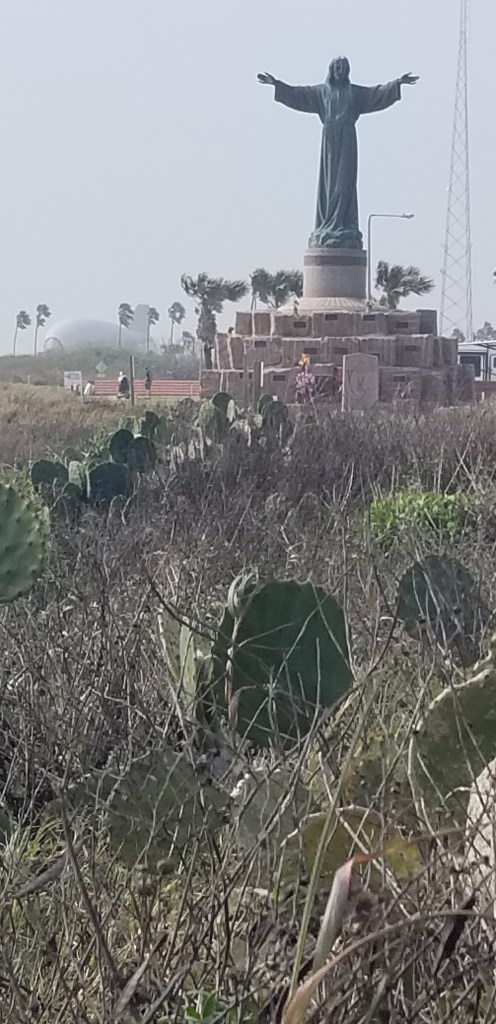
On our final trip out to South Padre we went out to the rock jetty where most of the turtles are found. It is on the very southern tip of the island in Isla Blanca County Park. It extends way out to sea. We did not see any turtles, but near the jetty is this statue:

It is a memorial to fisherman lost at sea. If you look closely on the left, you will see a grounded weather balloon.

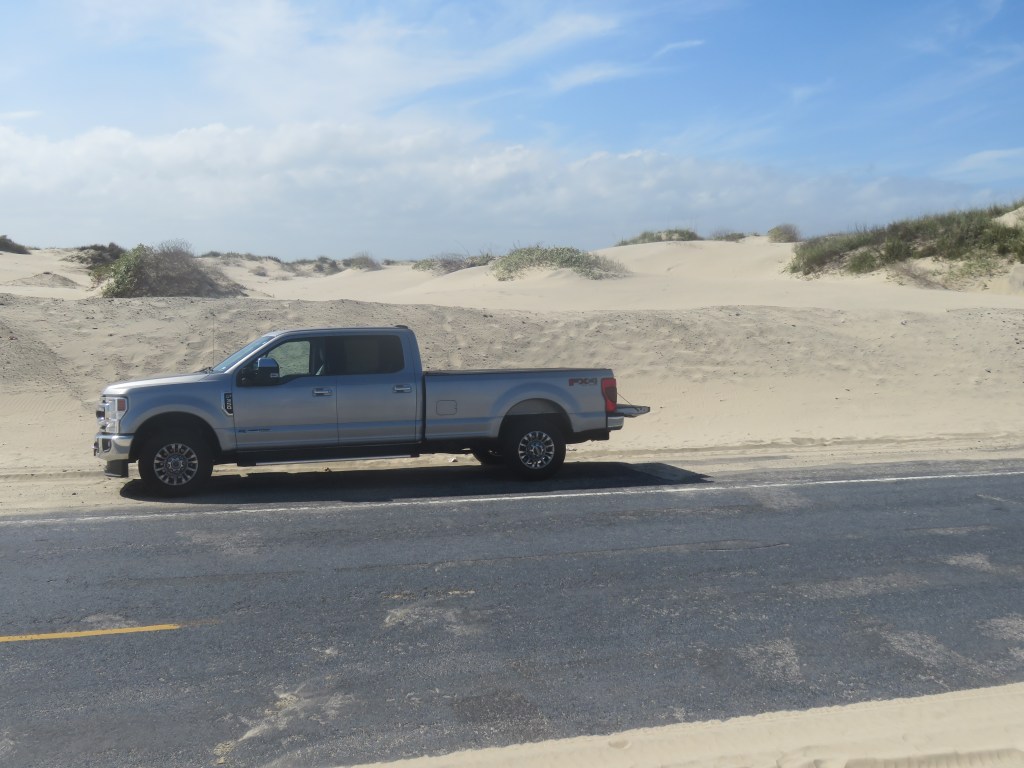
Certainly, the main thing about going to the island is the beach! Driving all the way north of the island, the hotels and condos recede into the rearview mirror, and all that’s left is the dunes and the sea. That’s just the way it ought to be. The road just ends. You can drive on the beach and we could have turned around and headed to the last beach access, but that would have been too easy. We just parked the truck and hiked through the dunes with our Subway sandwiches and lawn chairs.

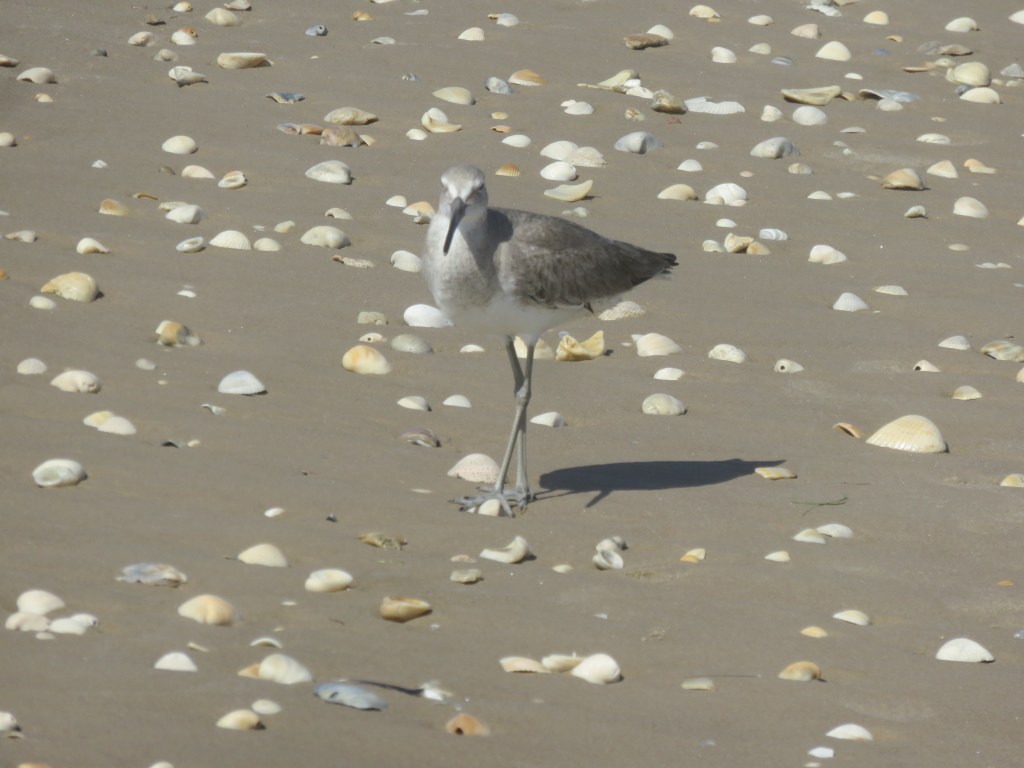
This friendly little bird led the way for quite a while on my beach walk

Next time – a cruise through the Port of Brownsville

USTravel

SpaceX, Shore Birds, and the Rio Grande on Boca Chica Beach

An almost-two month stay from January to March in Harlingen, Texas offered several opportunities for trips down to the Gulf of Mexico. The area lies at the southernmost tip of Texas. From our park, it was an hour drive. On our second trip in that direction, we headed to the nature preserve at Boca Chica Beach. You can’t go any further south in Texas, or the United States, on the Gulf than Boca Chica.

Rocket launch fans would know this area as the home of SpaceX. Indeed, as we headed down the road toward Boca Chica, we couldn’t miss seeing the rockets sitting in place. There are days that SpaceX closes the road for a launch or to move their rockets around. We didn’t know that we should have checked first to see if the road was open, so I guess we were lucky that we could pass through.

I took the picture on top from our truck as we were driving by.

Then, further down the road, another site:

The road ends at Boca Chica Beach. The beach itself is drivable. A right turn from the road’s end, and there you are. I was conflicted about SpaceX. On the one hand it is exciting and interesting to see. On the other hand, I didn’t like seeing it from an otherwise pristine beach that had been all natural until they arrived.

SpaceX as seen from the beach

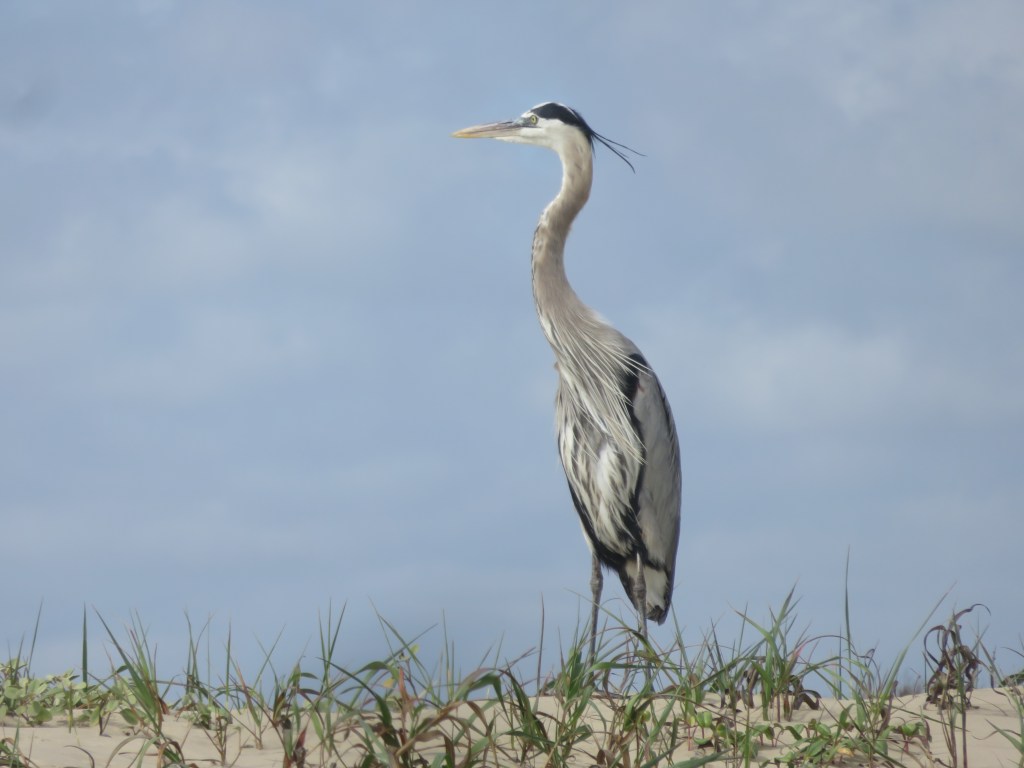
I turned my back to it and just enjoyed the beach. A great blue heron stood sentinel, as if to reassure me that all was still okay in his world.

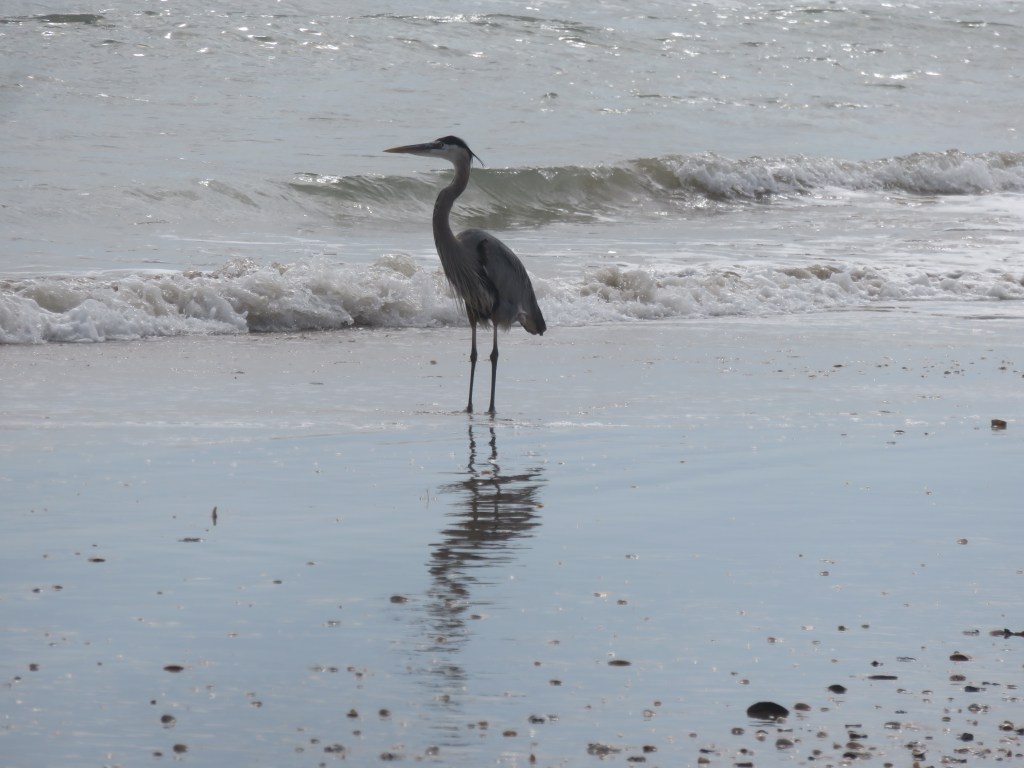
There were long stretches of beach that were deserted except for the birds:

We talked to some park rangers who were congregated for a chat. They informed us that if we drove further down the beach we would see a lighthouse. Off we went, and thankfully left SpaceX in the distance behind us. It was about a mile or two down, and once we arrived, we found people again.

I must have missed something the rangers said (or they assumed we knew), because the lighthouse is in Mexico. And here is the mouth of the Rio Grande. It never ceases to amaze me how many times we cross paths with this river. The lighthouse is off in the distance, but you may be able to see it in this picture.

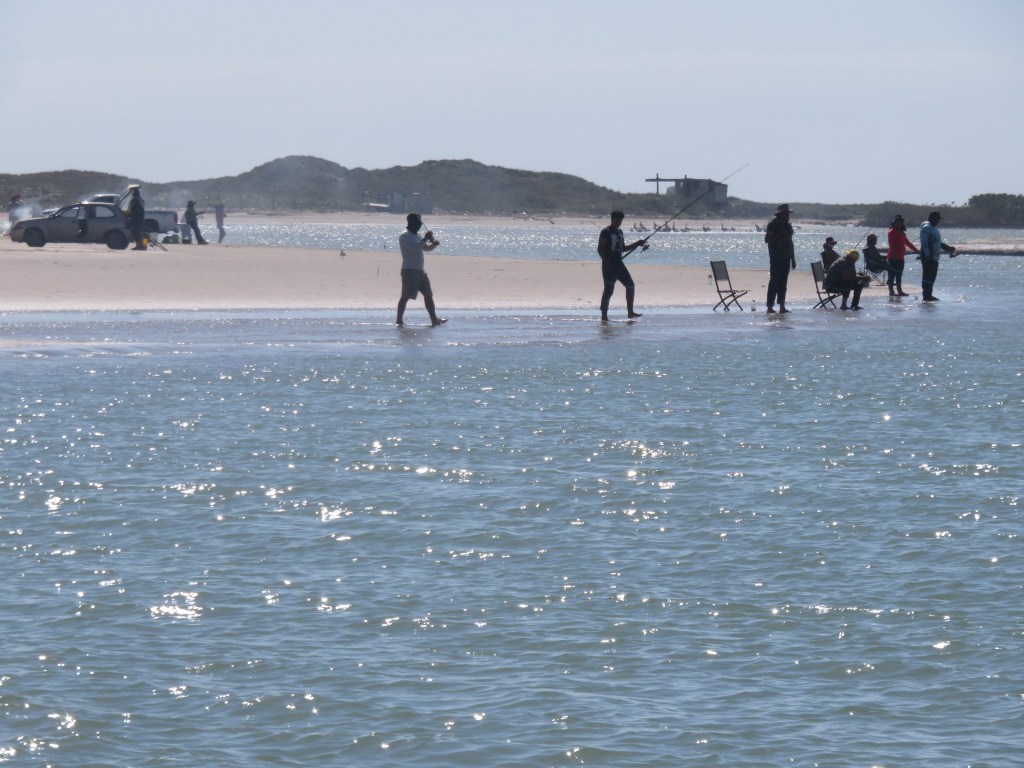
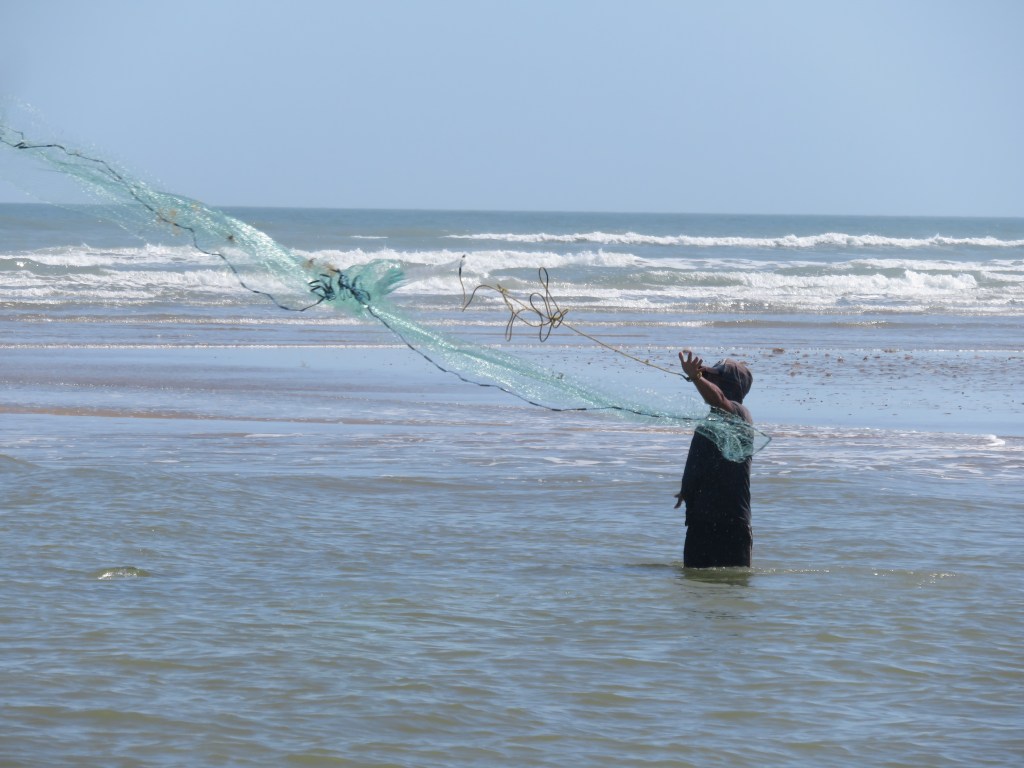
The Rio Grande makes its way west in the picture below. The river is very deep where it meets the ocean; the fishing must be good.

A fisherman casting his net

A pair of pelicans observed the action from the American side. The land right up to the river is still part of the Boca Chica Wildlife Refuge.

We had a picnic lunch on the beach before making our way out to further adventures. It had been a great beach morning at Boca Chica.

Life is good.

I was going to put all of our Boca Chica and South Padre adventures in one blog, but it would have proved to be very long. Our Boca Chica morning was part of a trip to South Padre Island. That will be for next time!

USTravel

A Weekend Celebrating Mardi Gras in New Orleans

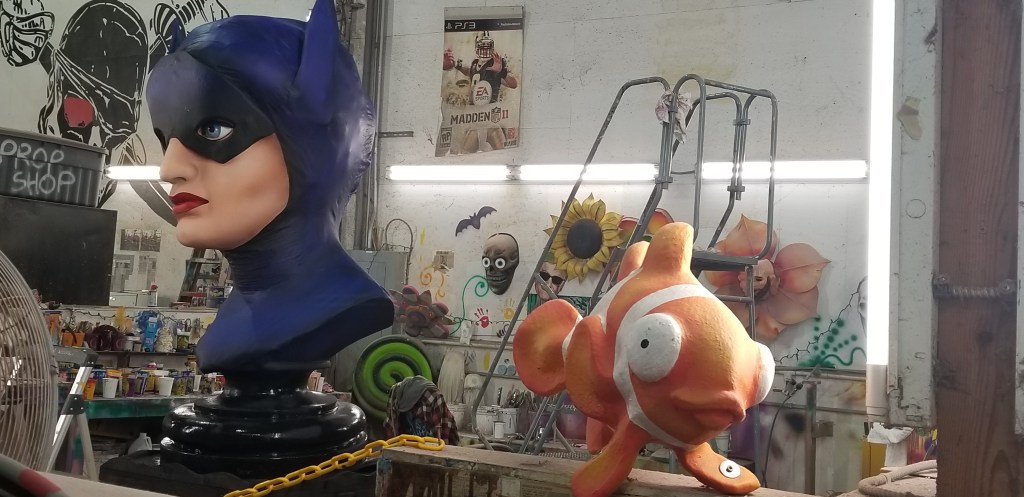
A New Orleans parade float prop

As luck (for me) would have it, my sister moved to New Orleans a couple of years ago to live with her oldest, Kat. I’ve always wanted to go to Mardi Gras there, so I put a trip for Mardi Gras in my plans, and my daughter Katie agreed to come with me. We had booked our AirBnb a year before the trip and it was only a couple of blocks away from my sister. Planning is everything.

I had a lot to learn about going there for Mardi Gras. First of all, there is not one or two parades, but multiple parades going on all over the area throughout the weeks leading up to the day before Ash Wednesday, the beginning of Lent. There are sometimes several parades in one day, with one parade leading the next. The Uptown parades are walkable from my sister’s house. We did not go to the French Quarter parades, or even set foot in the French Quarter on this trip. Both Katie and I had been there before.

Kat advised us not to come on the final weekend of Mardi Gras, which was a huge surprise to me. The crowds are massive and the cost of everything is higher. With Southwest Airlines not behaving as it used to, we may have had more difficulty with our flights. Both Katie and I were glad that we followed her advice.

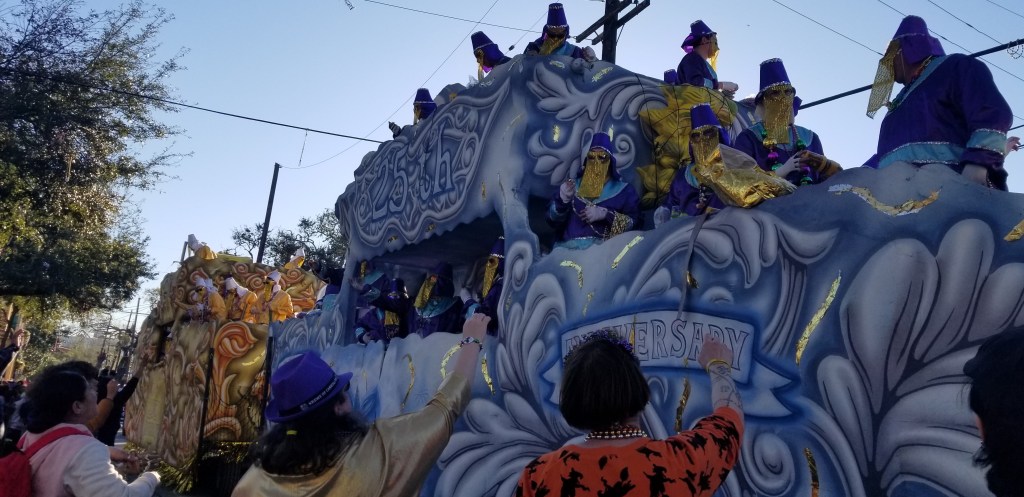
On Friday night, our first night, we were down on the street after dinner and it was around 11:30 PM before we left. I didn’t even notice the time passing! It was pure fun to watch, wave at the people on the floats, and try to catch whatever they threw down. I got socked in the nose with a massive wad of beads and I didn’t even mind. Well, not too much.

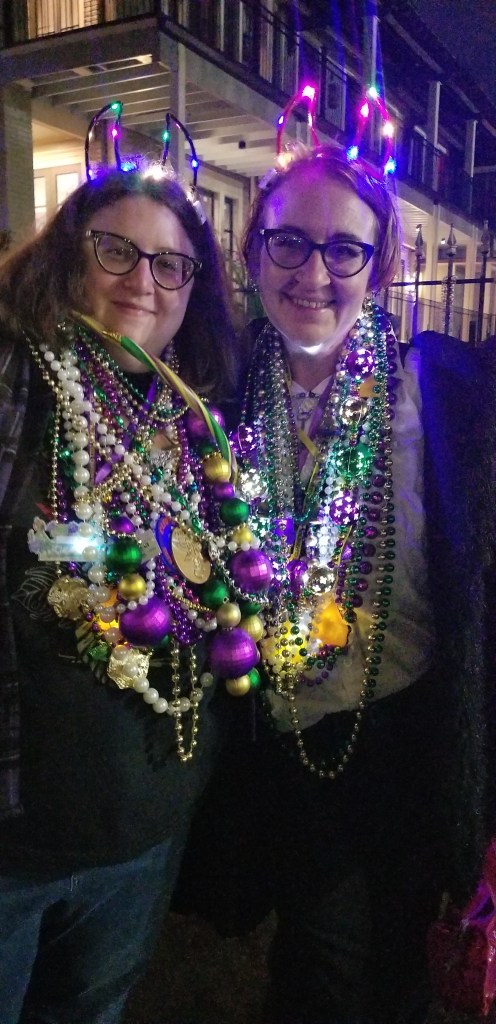
By the end of the night, we’d had quite a haul. Katie and Kat are here modeling their beads, and Katie (on the left) is also wearing her new hula hoop. I was wearing quite a few beads myself.

The goodies that the floats toss out are called “throws”. The beads are just a start, and some of those may have various decorations or lights on them. Katie received some very nice glass beads, plus three hula hoops throughout the weekend. There are also hats and headbands, sunglasses, cups of all sorts (New Orleans dinnerware), bubbles and toys, Kleenex and chapstick, balls and frisbees, bags of snacks, stuffed animals, and other odd things like a manicure set and a bamboo spear with feathers and a rubber tip. I’m sure I’m forgetting something. The people on the floats keep an eye out for the kids, and will try to throw them the nicest toys. It would be fun to be a kid at a Mardi Gras parade.

Katie’s treasures, and this was after just the first evening.

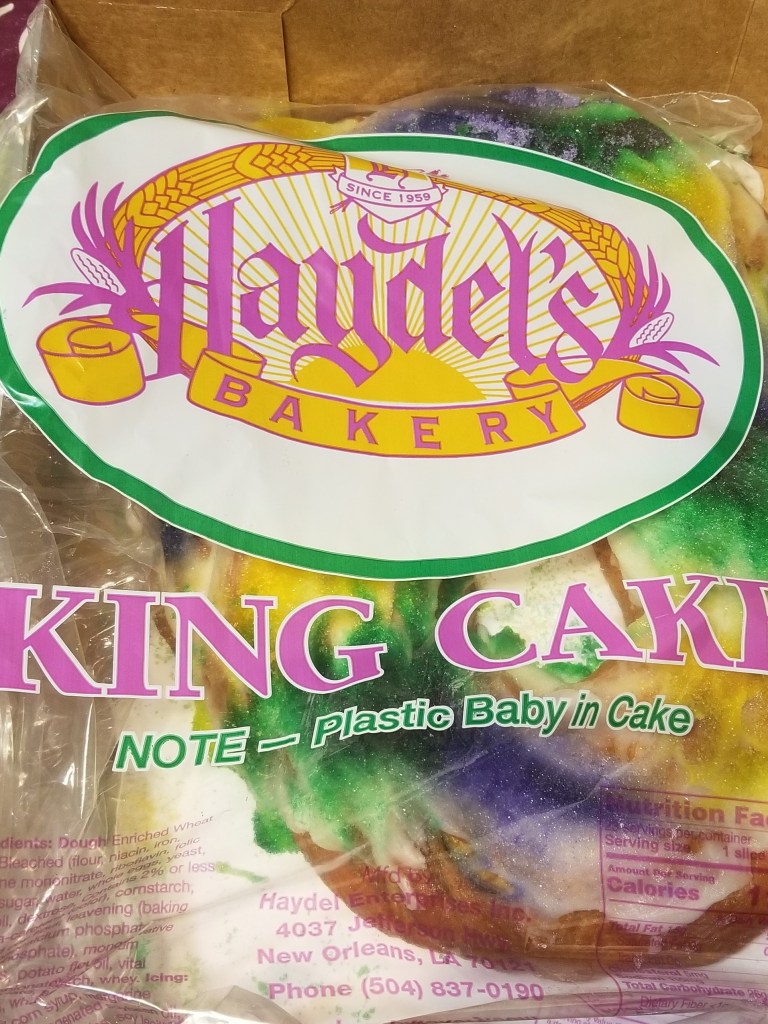
It wasn’t time for bed yet after the parades. We had to have a bite of King Cake back at the house first.

Haydels is one of the best bakeries in New Orleans to purchase your King Cake. It is a blend of coffee cake and cinnamon roll.

The name comes from the Biblical three wise men who brought gifts for the baby Jesus. Traditionally, King Cake is eaten between January 6, the day of their visit, to the eve of Mardi Gras, the day before Ash Wednesday. A baby is placed inside the cake. Supposedly if you find the baby in your piece, you will have good luck and will be “king” for the day. I also heard another version in New Orleans, which is that you have to buy the next King Cake. My piece of cake had the baby! I don’t know when I will be back to buy everyone another cake.

We watched just one parade on Saturday afternoon. I enjoyed that one because the groups in each float were the military, police, veterans, EMT, and firefighters organizations. Some of the groups were interesting, such as the Women of the Armed Forces and World War II veterans. I didn’t see any veterans on the float, though. They are all probably too old to be riding around on a float by now.

An EMT float in Saturday’s parade

Saturday was cold, and by the time this parade was over, it was starting to drizzle. Another parade was coming, but we abandoned it in favor of a coffee shop, and then found some little shops to explore over on Magazine Street. Strangely enough, we found a small Alligator Museum. It is one man’s lifetime collection of all things alligator. You could purchase your own little alligator in the gift shop.

Also found on Magazine Street:

And a homage to Mardi Gras:

A nice warm bowl of pho at a Vietnamese restaurant, Pho Tran, was wonderful in this weather.

On Sunday we were back out on the parade route on St. Charles with lawn chairs, lunch, and empty bags to hold our throws. The day was sunny and as it warmed up as it went on.

There was even a float where you could toss your beads or hoops back, if you didn’t want them:

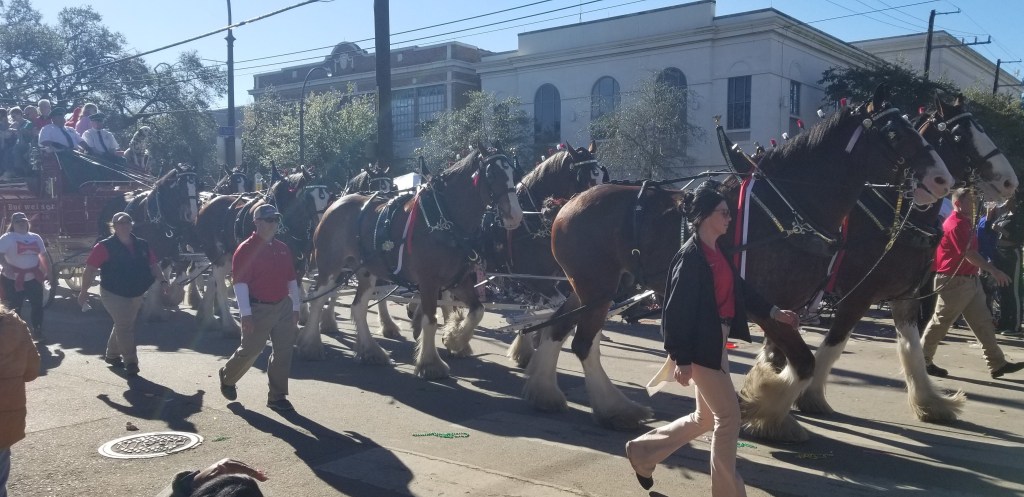
Having lived in St. Louis for so long, I was excited when the Clydesdales and the Budweiser beer wagon came along.

Of course, no parade would be complete without marching bands, pom squads, and twirlers. There were plenty of those. You could even get your own group together, put on some crazy costumes and dance music, and boogie down the street.

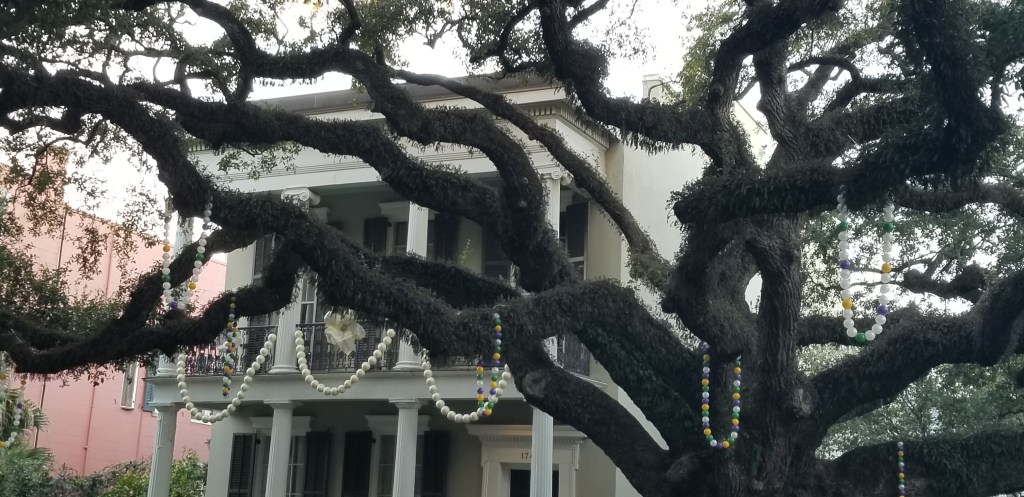
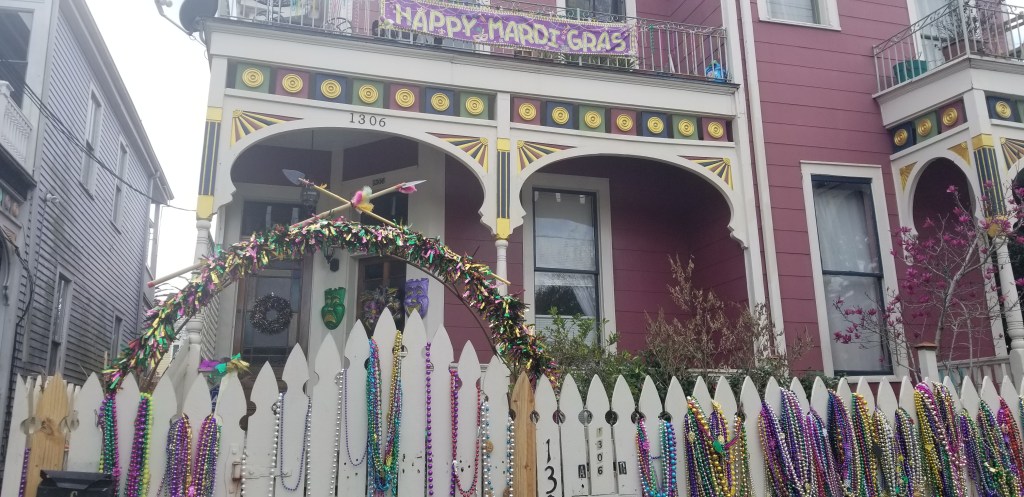
Even the houses and trees in New Orleans dress up in their beads for Mardi Gras:

We had a little time on our last day in New Orleans, so we Uber’d over to the Riverfront Mall for a beignet at one of Cafe DuMonde’s satellite coffee shops. There, we also got a look at the Mississippi River and strolled through some of the stores.

Our destination this morning, though, was Mardi Gras World, and from the mall it was a short walk. My sister and I had a picture taken next to this handsome gentleman in the waiting area:

Mardi Gras World is a working studio where most of the Mardi Gras floats are made. Several generations of the Kern family have been creating them since 1932. It has been open for many years so that everyone can get a behind-the-scenes look. First we were shown a short movie about Mardi Gras and the studios. We were given a slice of King Cake since it was Mardi Gras week – hooray! The tour then proceeded to the warehouse and studio.

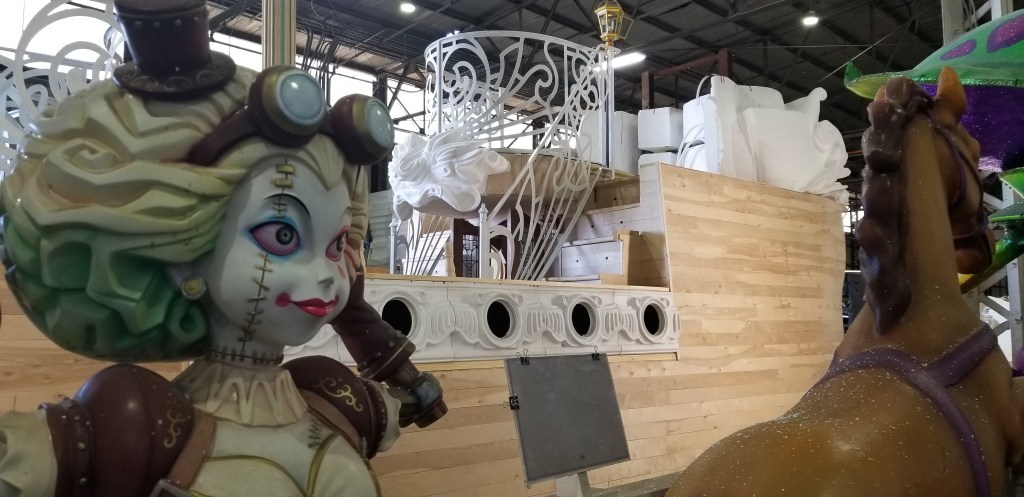
Inside were floats aplenty in all stages of construction. The various decorations on a float are called “props”. A float prop is pictured at the top of this blog, and there are a couple of small ones below:

The props are made with layers of styrofoam which are glued together with insulation foam. The prop artist will carve it into shape, and then it is decorated. A prop can be redecorated several times, as the head above has been.

Behind the props is a float in progress

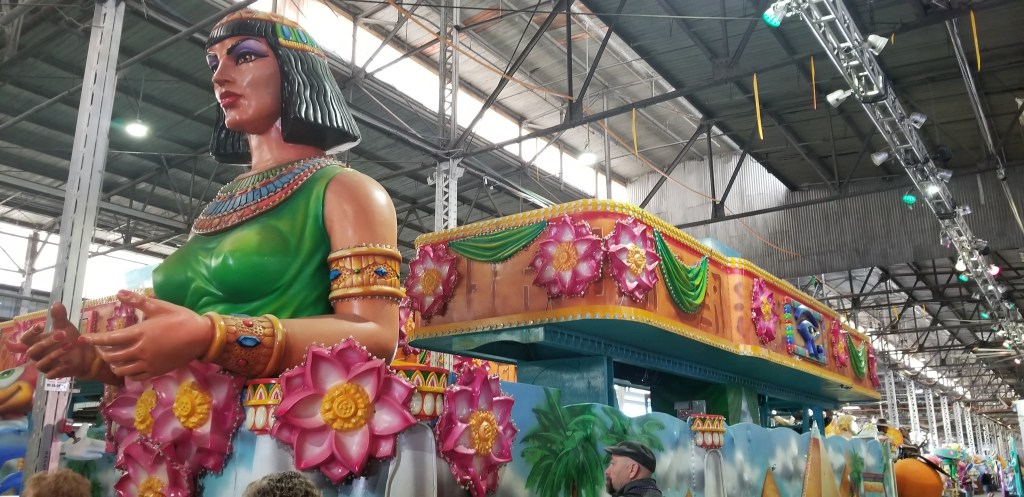
There are also props and floats that are made from fiberglass and reused unchanged every year. We had seen this one on the parade route, from the Krewe of Cleopatra, and it was already in the warehouse for next year.

Plenty of props in all phases of construction

A New Orleans Krewe is a social group. Krewes are a New Orleans tradition that go back all the way to 1856. Mistick Krew of Comus was the first one, and it still exists. A Krewe creates the parade and also has a ball. It can cost a lot of money just to join a Krewe. The group needs the funds to purchase all of the throws, which can run into the thousands of dollars. Besides Cleopatra, on Friday night we had seen the Krewe of Oshun and the Krewe of Alla parades.

I have heard that the French Quarter parades can get a little rowdy. The streets are narrow and the crowds can press in. The Uptown parades which we attended are more family friendly. For us, it was nice that we could just walk a few blocks down to the parade route whenever we wanted to go.

Now that we are in the season of Lent, the parades are over in New Orleans. But you can be sure that everyone is already working on next year’s parades. Fat Tuesday is February 13, 2024. It will be early in the year, so dress warm if you come!

Next time – across the Gulf to Boca Chica Beach and SpaceX

Europe · UK and Ireland

Taking a Bath in Bath, England – Europe Travels August 2022

When putting together our trip, I found that we needed to visit one additional spot before going to London. I scrutinized my planning map. Where to go? Once again, I consulted my Rick Steves “Europe through the Back Door”. He gave Bath a solid three red triangles, meaning that it is a definite should-see destination.

In the travel chaos that was the summer of 2022, shortly before we left for Europe, Rick posted on Facebook about crowd management options. He suggested in his post that one should consider touring the less-visited cities that are less full of tourists. One of the examples he gave was Bath. “Instead of Bath, go to Bristol.” But Rick, you told me to go to Bath!

By now we were into late August, though, and the crowds in Bath were manageable. We knew what to do: see the places with the heaviest tourist traffic in the morning, avoid shopping areas in the afternoon, and have a plan for the day. We had come from several places that weren’t heavy tourist sites, so it was a little different, but we enjoyed so many aspects about our stay in Bath.

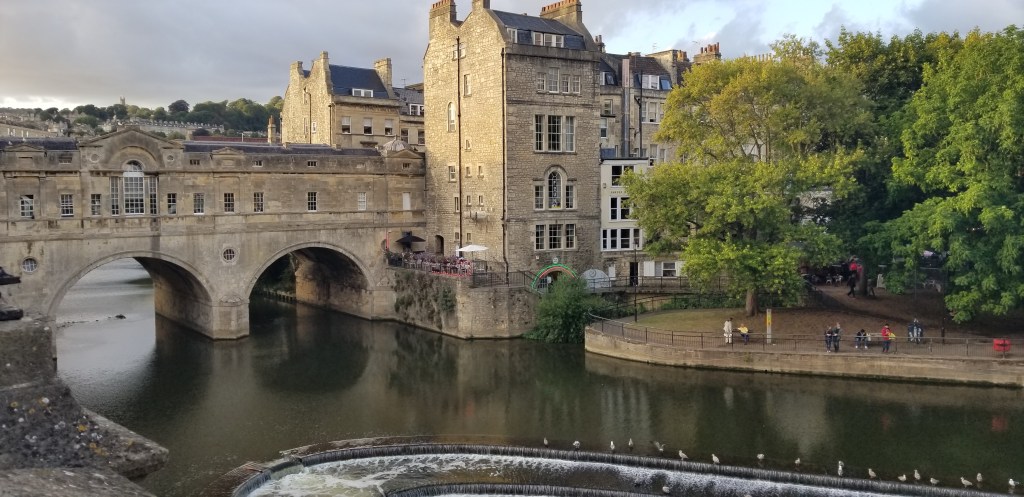
River Avon runs through the city of Bath, and we needed to walk alongside of it to get to the city center. There was a bridge over a canal that flowed into the river, and most every time a boat was making its way through the lock. A family with two kids was coming through one morning, and even the kids were helping to operate the manual locks.

Waiting to open the gates

The river is always beautiful, at any time of day.

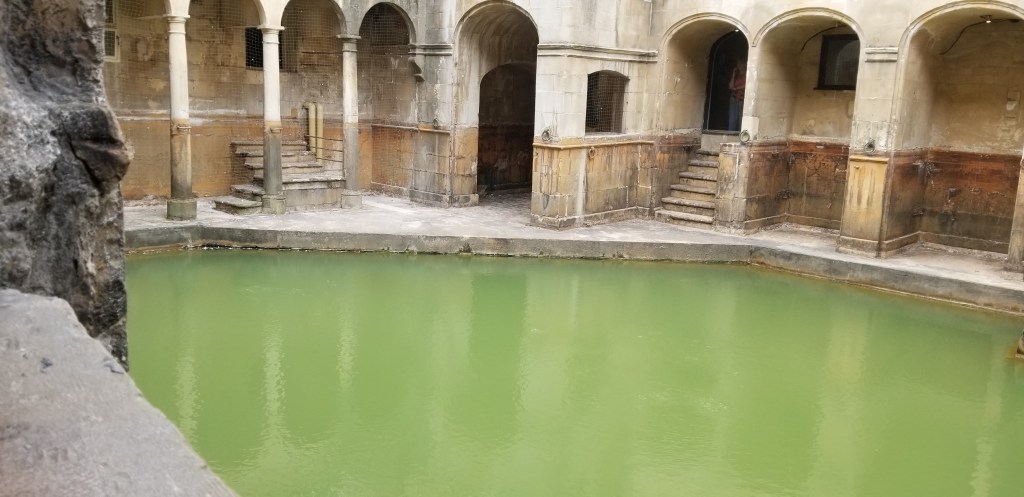
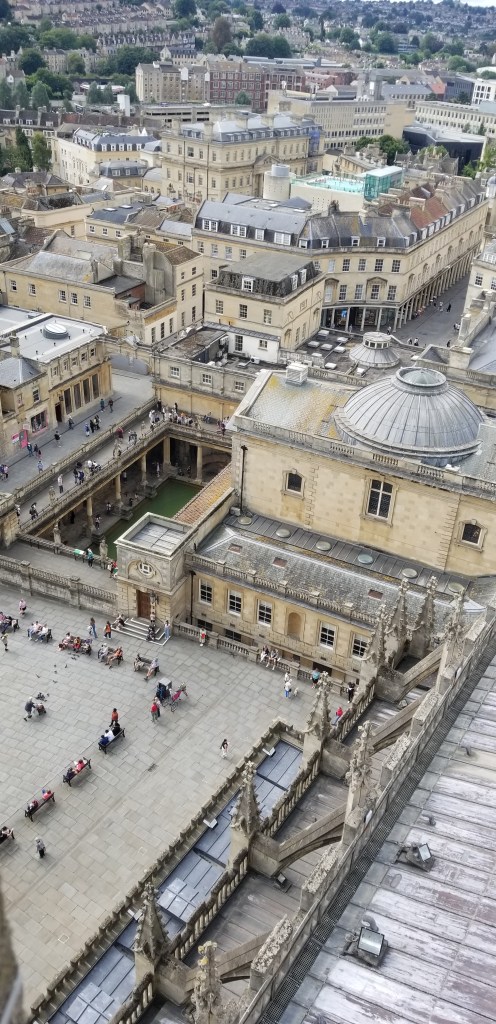
But are there really baths in Bath? Yes! In Roman times, it was considered to be one of the great religious spas of its era and the town was actually called Aquae Sulis. There are three hot springs, and the one with the most water in it is special to the goddess Sulis Minerva. She was worshipped even before the Roman era. A stone inscription dates the complex to 76 AD. We visited the Roman baths with a main bath and ruins of the temple and other bath rooms, housed in a museum with artifacts.

Lest you get a sudden urge to jump into the pool, it is sealed with lead, so your bath wouldn’t be so good for your health. There would have been a roof over this pool in Roman times, but now algae grows because it is open to the sky. For the average Roman bathing here, the baths would have been the biggest building they ever entered in their lives.

Inside, we walked under modern-day Bath through ruins of various smaller baths, cobbled Roman streets, and Temple Sulis Minerva. If we were Roman, we as commoners would not have been able to enter the rooms of the temple. There are altars and a tomb with a skeleton still in it. Many objects such as jewelry and coins that people left behind in the baths are displayed. There is even a gym.

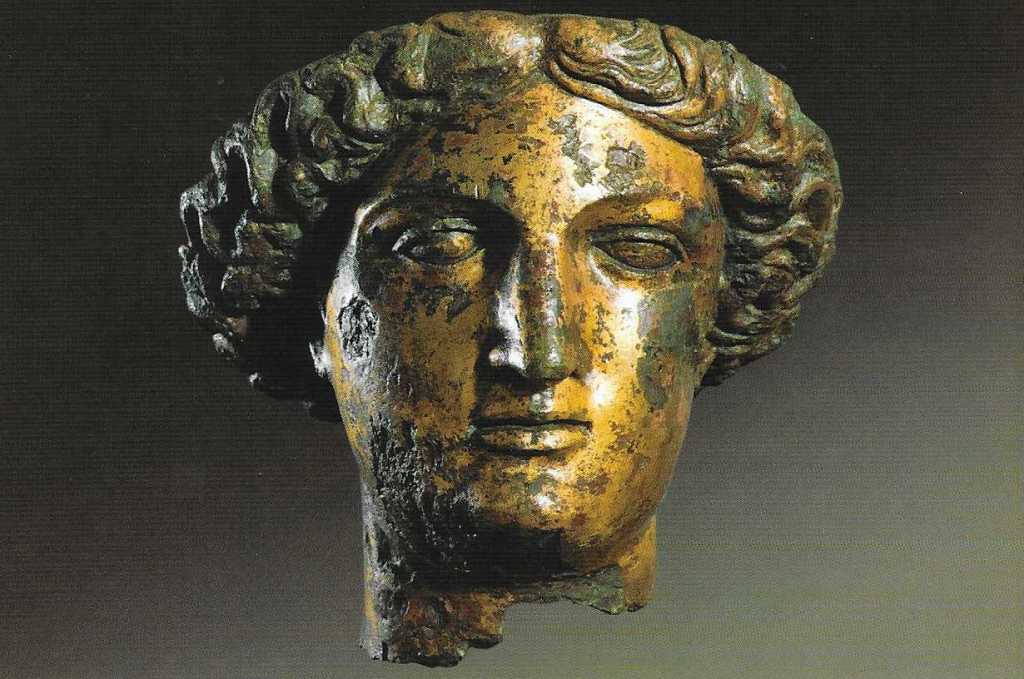
There would have been a full gilt bronze statue of Goddess Sulis Minerva in the temple. The head is all that remains and it was splendid to see. I didn’t get a picture of it, but found a postcard in the gift shop.

Also surviving is a large ornamental pediment, which would have been over the entranceway, with a fearsome head of a gorgon. As with many of the ruins and stones we saw, it would have been brightly painted. The Romans borrowed the gorgon from Greek mythology. It is thought to be was a symbol of Sulis Minerva.

We wandered around through the maze of rooms, all under the city of Bath. These rooms were at bath level.

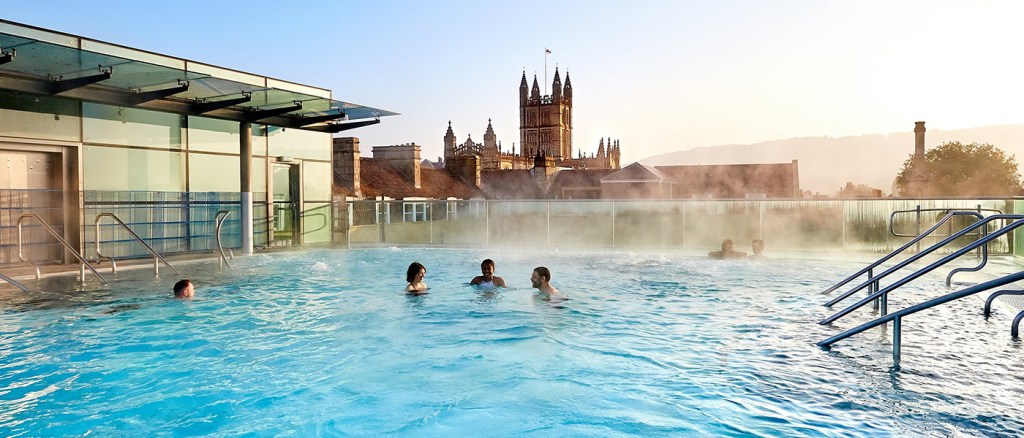
Of course, the spring is still here, and today there are modern baths. We celebrated our anniversary while in Bath, and took a bath in Bath at Thermae Bath Spa. We carried our bathing suits in our luggage all over Europe just so we could use them this one time. It’s not something we would normally do so it was a great experience. The pools in the baths are not heated because the water comes out of the spring and into the pools at about 93 degrees Fahrenheit. It feels like pleasantly warm bath water. A few floors up, there is an outdoor pool. It was raining so it was very strange to be in the warm water at the same time as the rain, but we could look out over the city as we lounged about. We spent most of our time in the floor-level indoor pool where there was a nice whirlpool and a lot of interesting jets.

Credit: Thermae Bath Spa, Bath, England

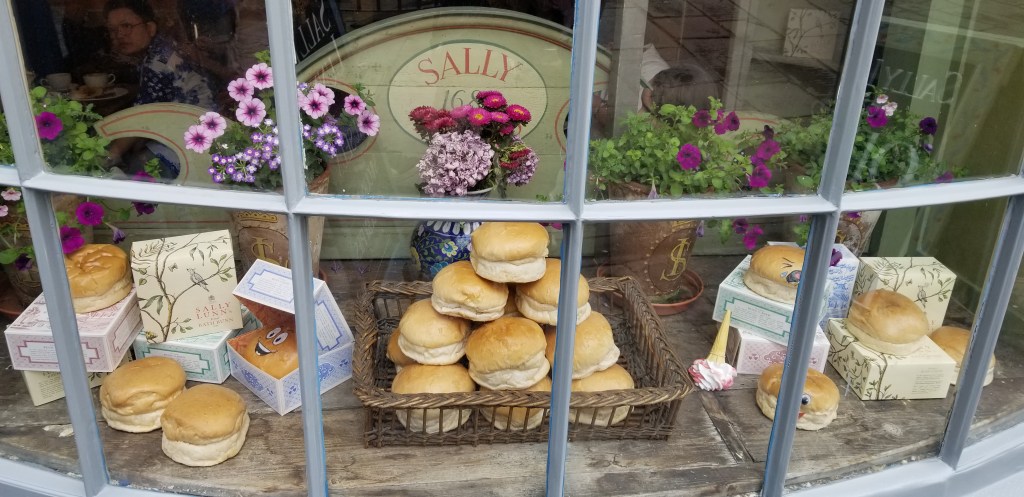
After our bath, we had tea (lunch) at Sally Lunn’s. Dating to 1483, the restaurant is in Bath’s oldest house. Sally Lunn came to Bath in 1680 and began selling her delicious French buns, and the rest is history. A Sally Lunn bun is like a brioche. It is part bun, part cake, part bread. This really wasn’t a great place for the real “tea” experience, but our buns were delicious.

Sally Lunn’s buns

For tea, we were each served one bun. One half, cut into quarters, had smoked salmon on top. The other half was served with butter, jam and clotted cream. I was just about full after having just the one half with the salmon, but who can resist all the goodness on the sweet side?

In the basement, a view of the kitchen as it would have been long ago

The other unforgettable experience here was a tower tour of Bath Abbey. The Abbey was founded in the 8th century as a Benedictine monastery and, like Shrewsbury Abbey, lost the monastery during the reign of King Henry VIII. The church itself has gone through many cycles of ruin and repair since 1090, and was even bombed in World War II. She is standing proud over the city of Bath today.

It was 212 steps up to the top of the tower! Along the way, though, our guide had many things to show us. After climbing a little, we were on an outside balcony where the priest could address his congregants on special occasions. There was a long narrow walkway on the roof, some more climbing, and we were in the room where the bell ringers gather. There are ten bells, and each person needs to pull their rope at the proper time to produce the correct melody. I’d be tired from the hike to this room at least twice a week before even proceeding to ring my bell. And several of the ringers are elderly. It’s a matter of great pride to be a bell ringer.

We ducked into some narrow passageways for a look at the bells and the rafters of the cathedral. There was even a tiny peek-a-boo spot where we could look down into the cathedral below. The very top of the roof vaults are only four inches thick!

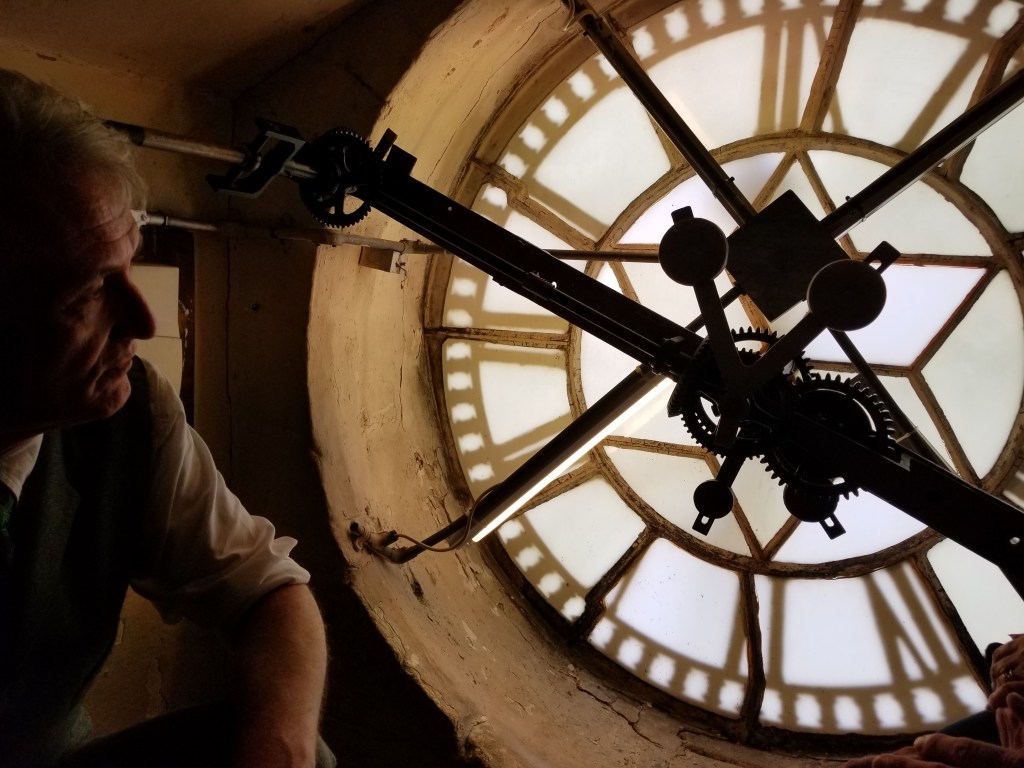
And then, we were behind the clock.

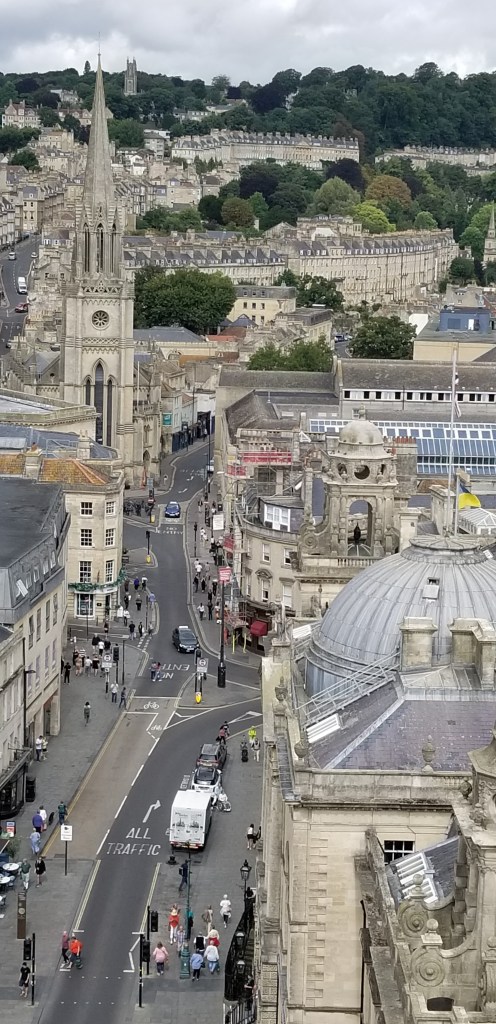
Finally, we were up at the top of the tower, and given a marvelous view over the city of Bath and the Roman baths below.

After the tour, we visited the inside of the cathedral. The very first king of England, King Edgar, was crowned at the monastery here in 973 and there is a large window with a depiction of the occasion. We looked at the beautiful fan shapes in the soaring ceiling, now more interesting since we had seen the attic. There were large flat gravestones (ledgerstones) on the Abbey floor, 891 of them in total. I don’t know if I walked on all of them. It took twelve years to repair the cathedral after World War II, but repairing the ledgerstones was a whole other project.

Cal needed some fortifications after all that time climbing around the cathedral, and we also took time to listen to the buskers on the street.

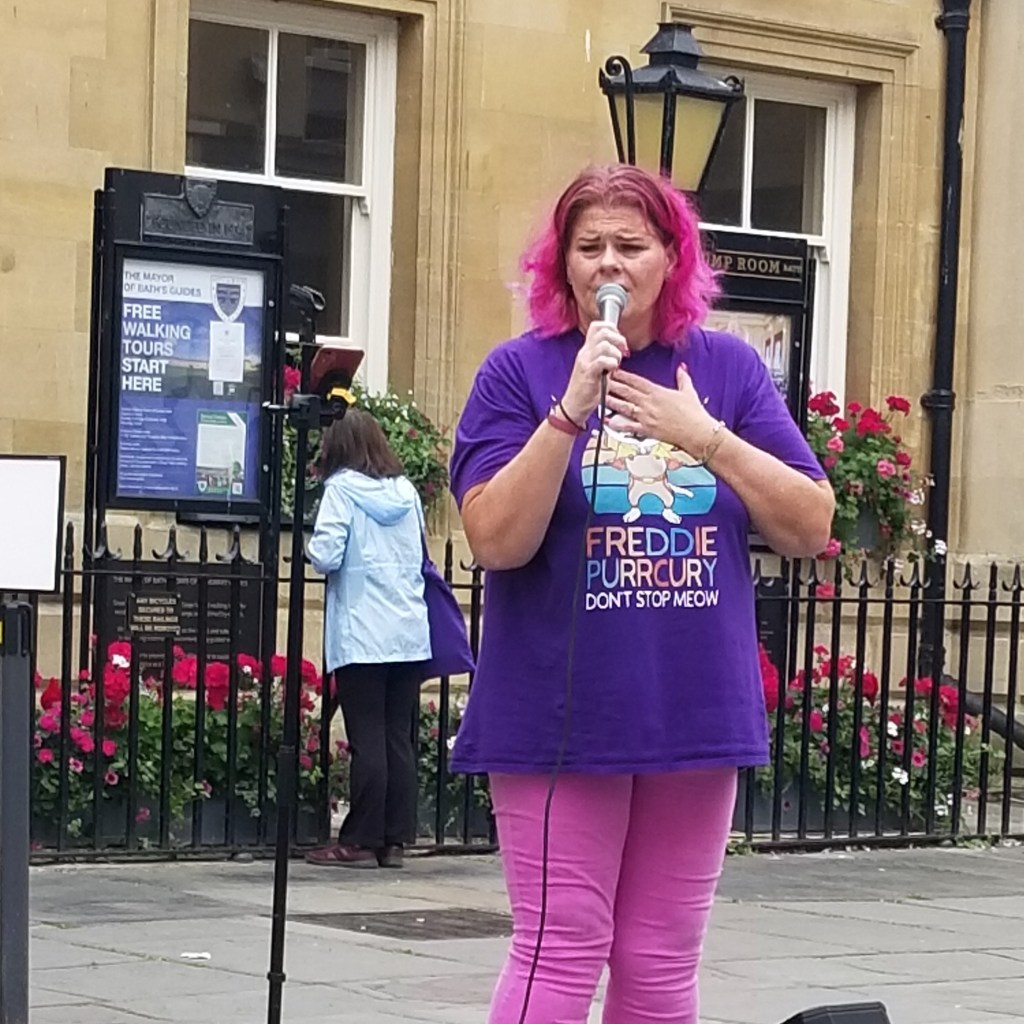
From our vantage point on top of the cathedral’s tower we had been able to see that there were three different places where the buskers performed, and they rotated around those places throughout the day. This woman was a classically trained opera singer who performed a lot of songs from musicals that I was familiar with, and we enjoyed an early lunch while sitting on a bench and listening to her.

This little piece of advertising on the cathedral plaza always caught my attention.

In a tucked-away corner of the canal leading to the river, we found this little swan family out for their evening swim.

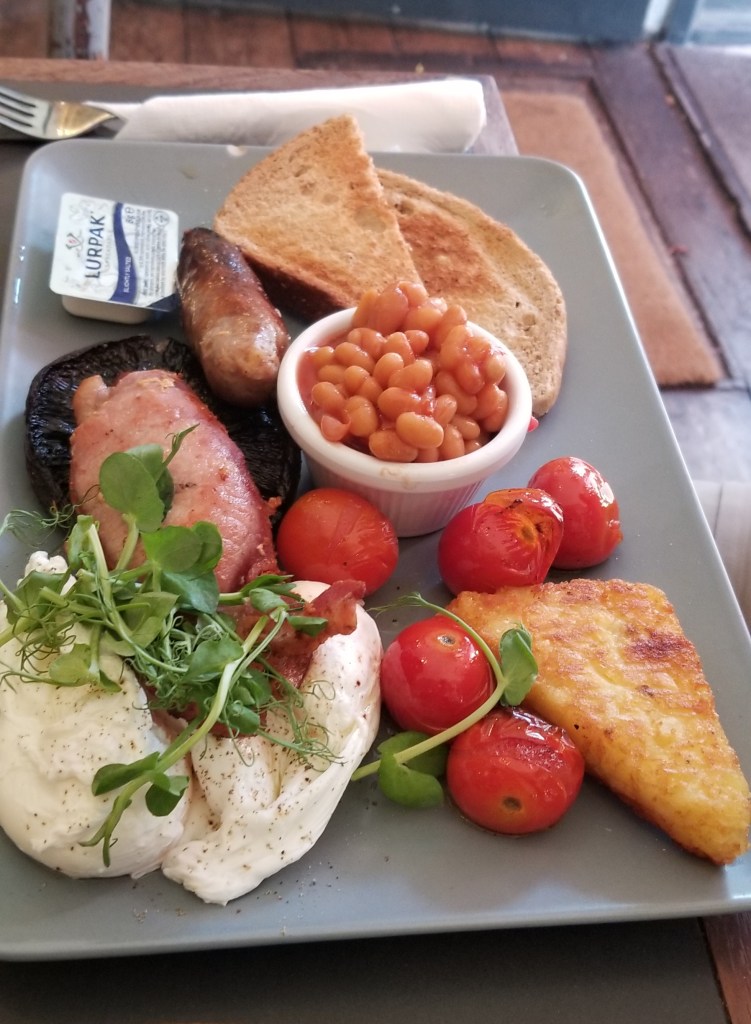
The day we left Bath, Cal enjoyed an English breakfast. These large breakfasts had lost a bit of their excitement for me after having had haggis and blood sausage in Scotland, and all of them in the UK are similar, so he did the honors while I just had a poached egg and toast.

English breakfast: poached egg, tomatoes, tattie scone, sausage and ham on a large mushroom, and beans

My next Europe posting will cover our visit to Stonehenge and the Cotswolds. First, though, I’m coming back to the present — February is a big traveling month for us, and I already have much to report. My posts will return to the United States for a little while. We’ll be on one of those travels next week so it will be two weeks before I’ll post again. I just returned from a long weekend in New Orleans, so stay tuned for the details!

Next time – Mardi Gras in New Orleans